
A complete issue · 48 pages · 1904
Judge — December 17, 1904
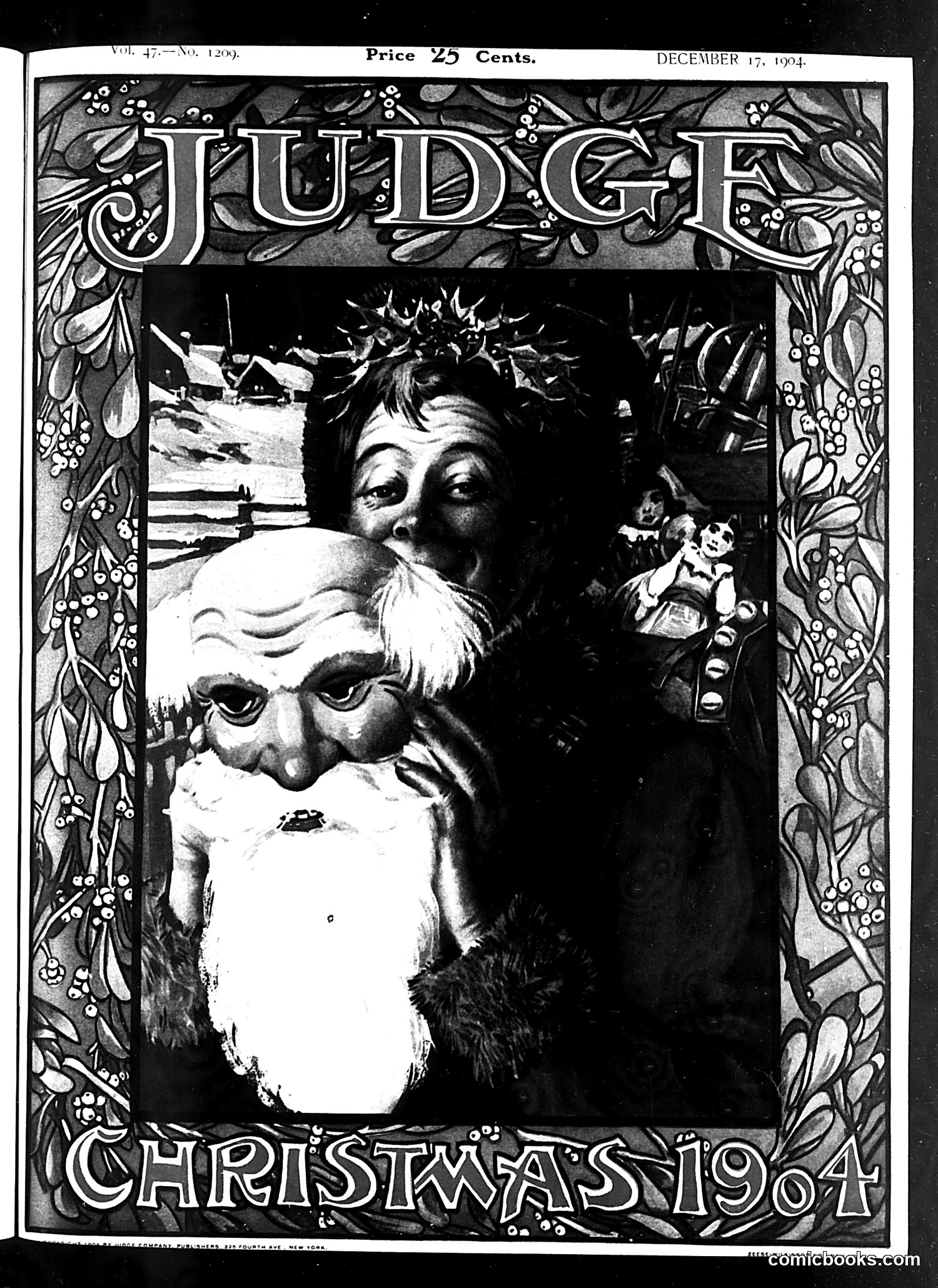
This is a Judge magazine Christmas 1904 cover featuring a prominent bearded figure in the foreground with an astonished or surprised expression. Behind him, additional figures appear in a darker, more theatrical setting with what looks like a snowy landscape visible in the background. The cover's decorative holly and berry border frames a holiday theme, though the central figure's exaggerated facial expression suggests satirical intent rather than straightforward Christmas sentiment. Without additional text identifying the specific figures or political context, I cannot definitively determine which contemporary personalities or events this caricatures. The theatrical staging and dramatic expressions suggest it comments on some 1904 social or political occurrence, but the specific target remains unclear from the image alone.
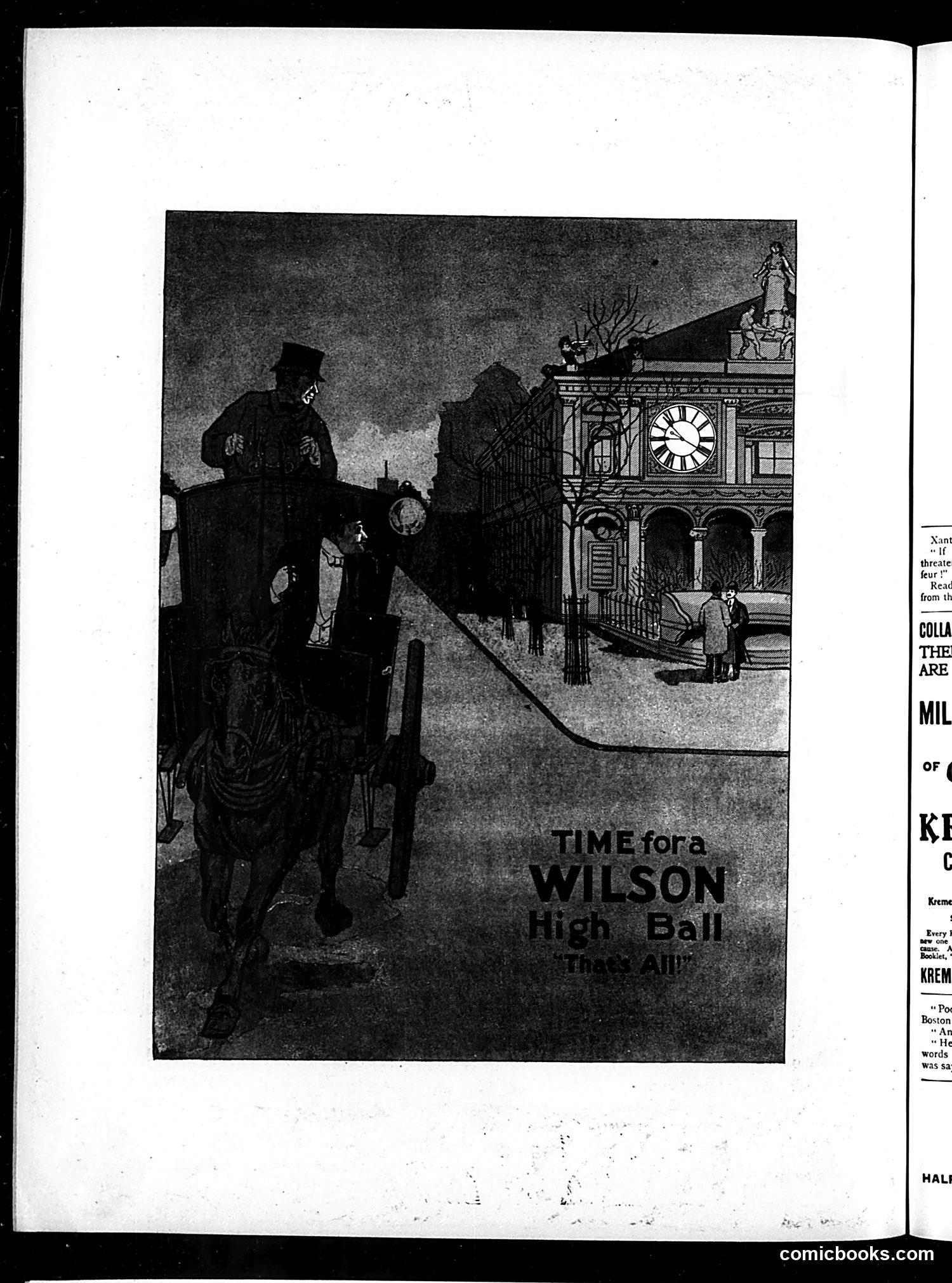
This appears to be an advertisement for a Wilson High Ball product, rather than political satire. The image depicts a nighttime street scene with Victorian-era architecture featuring a prominent clock tower. A horse-drawn carriage with passengers is shown on the left, while pedestrians walk near the building on the right. The text reads "TIME for a WILSON High Ball 'That's All!'" — a straightforward commercial pitch using the clock tower as a visual pun about time. The "High Ball" (a whiskey-based cocktail) is being promoted as an appropriate evening beverage. The right margin contains partial text for other advertisements (KREM and similar products), confirming this is primarily an advertising page rather than editorial political commentary. The satirical magazine format served as a vehicle for such advertisements.
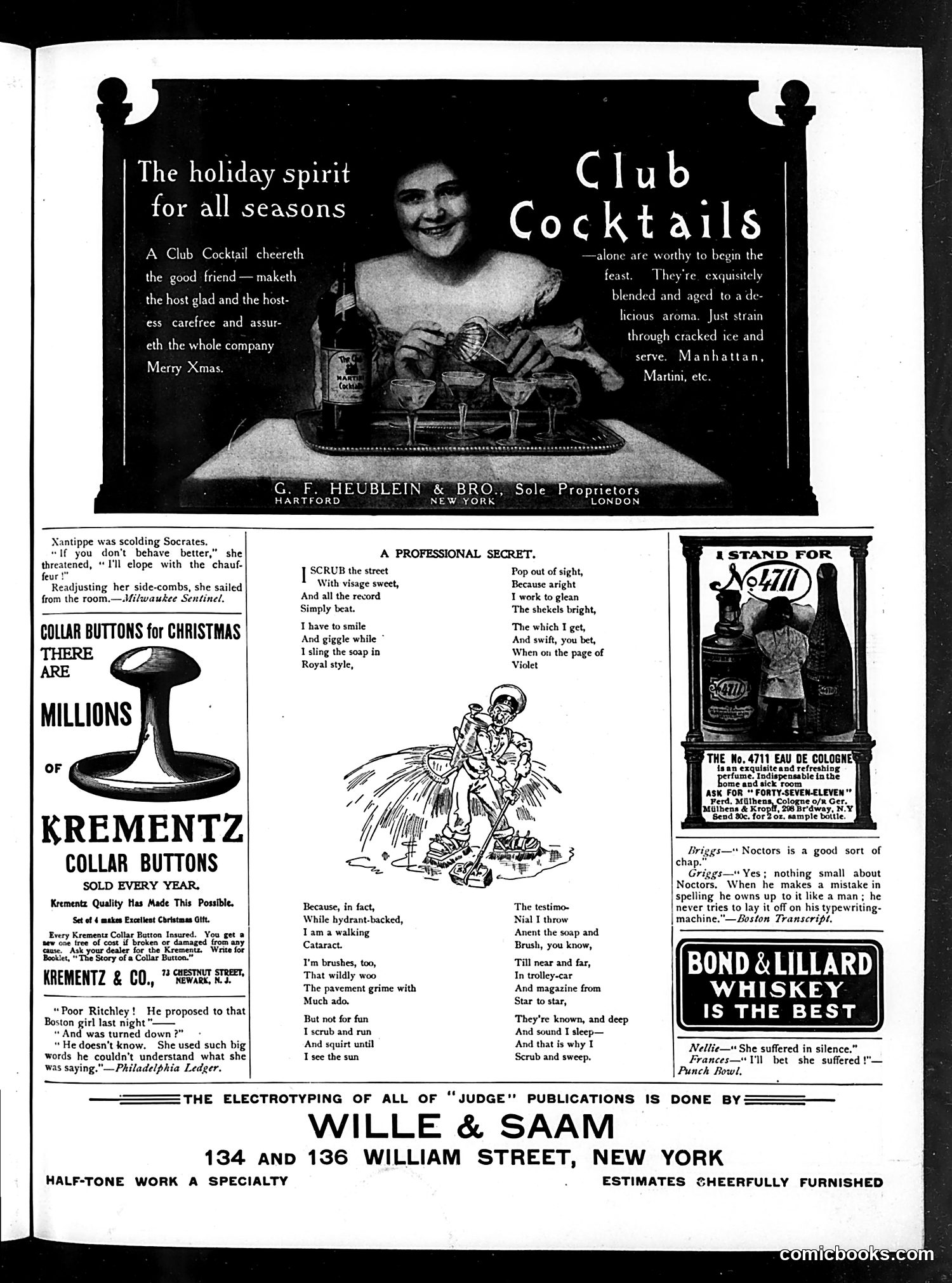
This page is primarily **advertising with minimal editorial content**. The main advertisements are for: 1. **Club Cocktails** (top) - promoting holiday spirits with an attractive woman serving drinks 2. **Krementz Collar Buttons** - emphasizing durability as a Christmas gift 3. **No. 4711 Eau de Cologne** - luxury fragrance marketing 4. **Bond & Lillard Whiskey** - spirits advertising The only satirical content is a brief poem titled "A Professional Secret" (center) about soap-scrubbing drudgery, followed by a short joke about someone named "Poor Richley" and an unknown "Bonson." The page reflects **early 20th-century consumer culture**, with heavy advertising typical of Judge magazine's revenue model. The satirical element is minimal—mostly advertising-driven rather than editorial commentary on political or social issues.
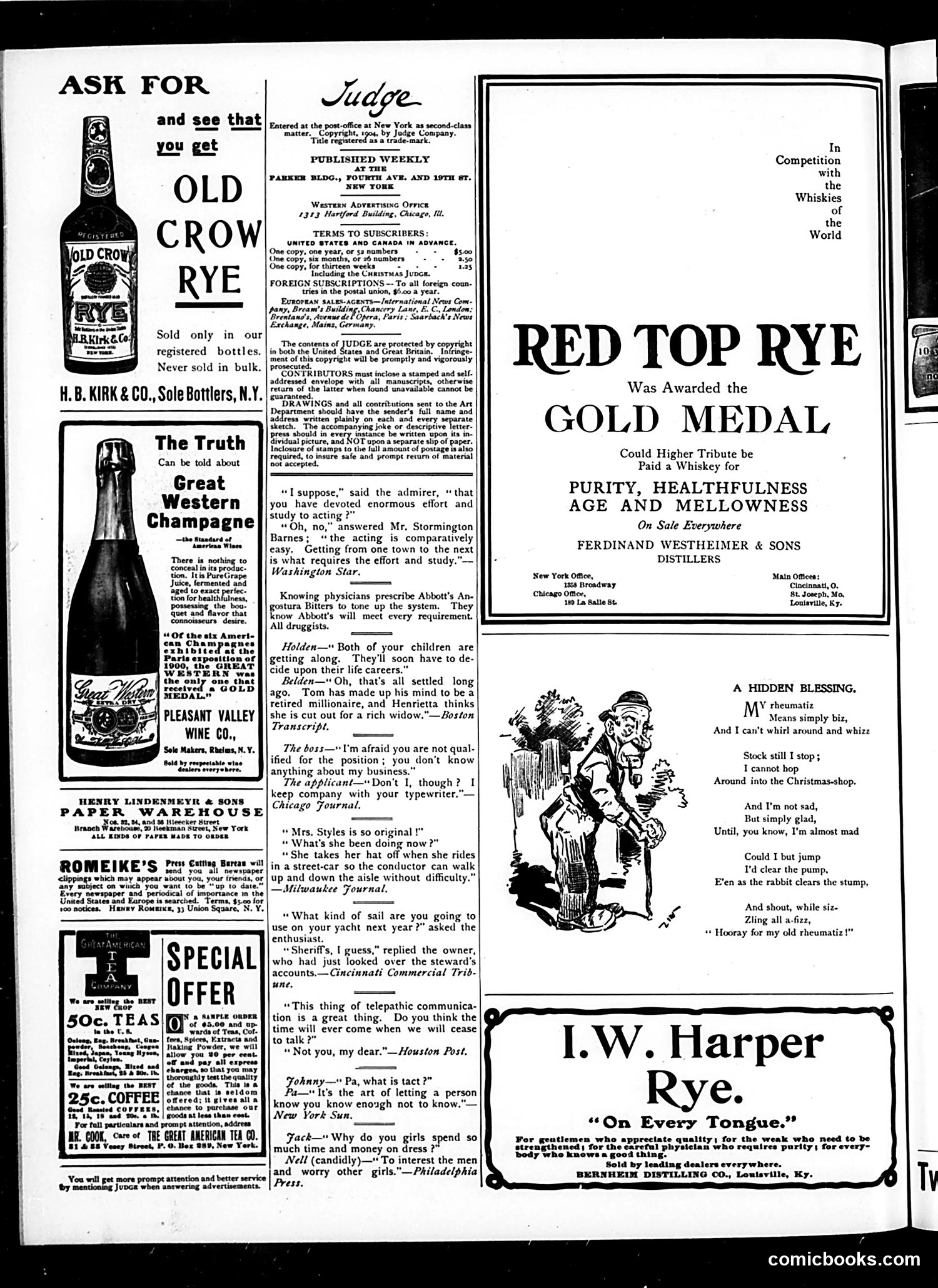
This cartoon appears to be a humorous poem about rheumatism, illustrated with a figure bent over in pain. The poem's joke is ironic: the speaker lists various hardships—can't whirl or jump, can't clear the pump, can't climb the stump—but then concludes that rheumatism is a "hidden blessing" because it keeps him from the Christmas shop. The satire targets consumerism and holiday spending pressures. Rather than viewing illness negatively, the poem suggests rheumatism accidentally benefits the speaker by preventing wasteful holiday shopping. It's a darkly comedic inversion: physical suffering becomes inadvertently advantageous by limiting financial excess during the expensive Christmas season. The cartoon reflects period anxieties about holiday commercialism and spending habits.
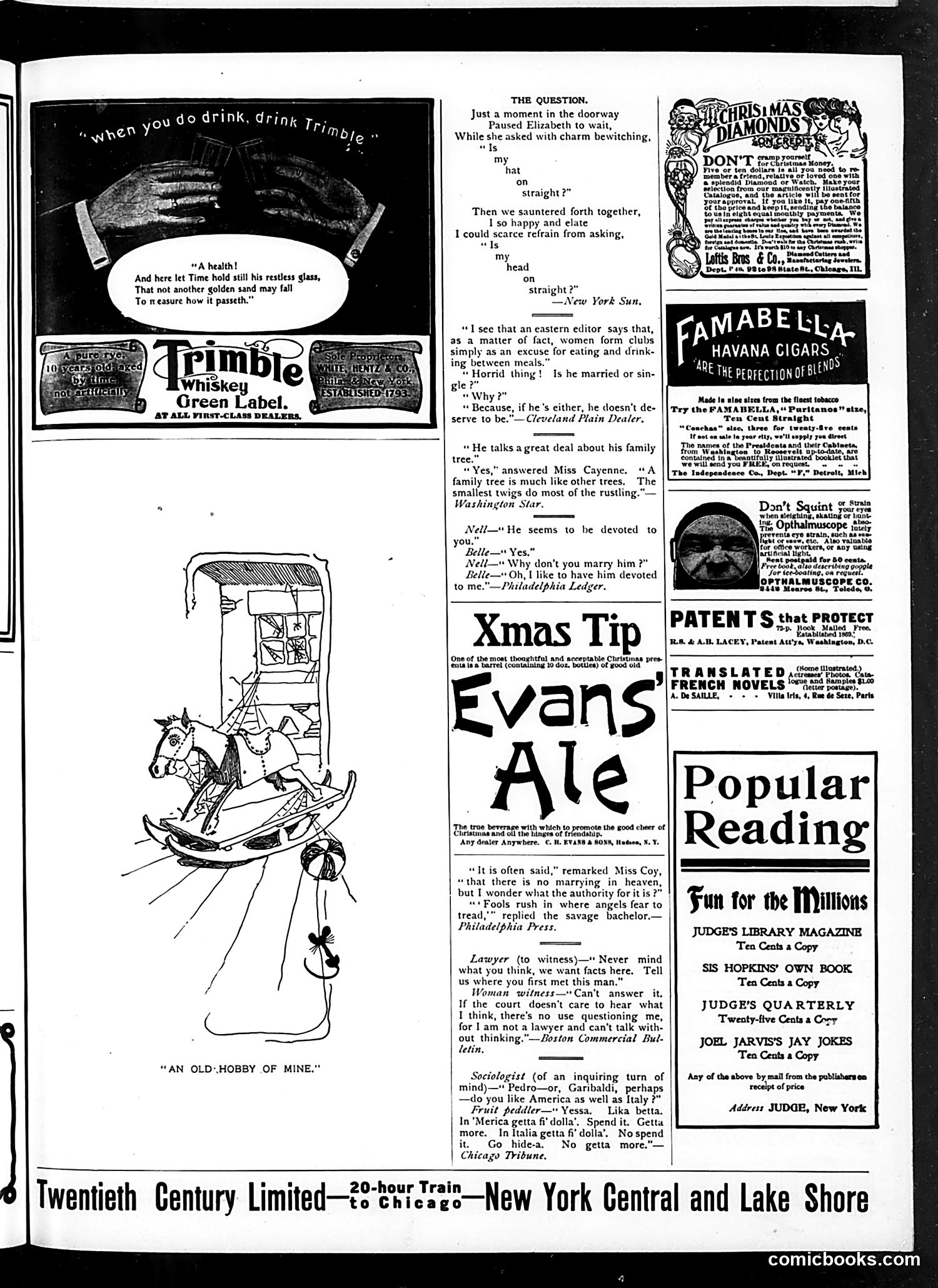
This page from *Judge* magazine combines satirical content with period advertisements. The main cartoons mock social conventions of the era: **"The Question"** explores marital uncertainty through overlapping dialogues—a woman repeatedly asks if her suitor is "straight" (honest/sincere), while other snippets mock family pretension, women's clubs formed merely for eating and drinking, and marriage hesitation. The humor derives from Victorian-era anxieties about courtship sincerity and women's social independence. **"An Old Hobby of Mine"** depicts a man in a bathtub—likely satirizing excess drinking or idle leisure pursuits as gentlemanly "hobbies." The advertisements (Trimble Whiskey, Evans Ale, Famabella cigars) reflect the magazine's target audience: affluent male readers. A joke about Italian immigrant fruit vendors suggests period ethnic stereotyping common to the era. Overall, the page reflects early 20th-century American satirical humor focused on courtship, class pretension, and consumer culture.
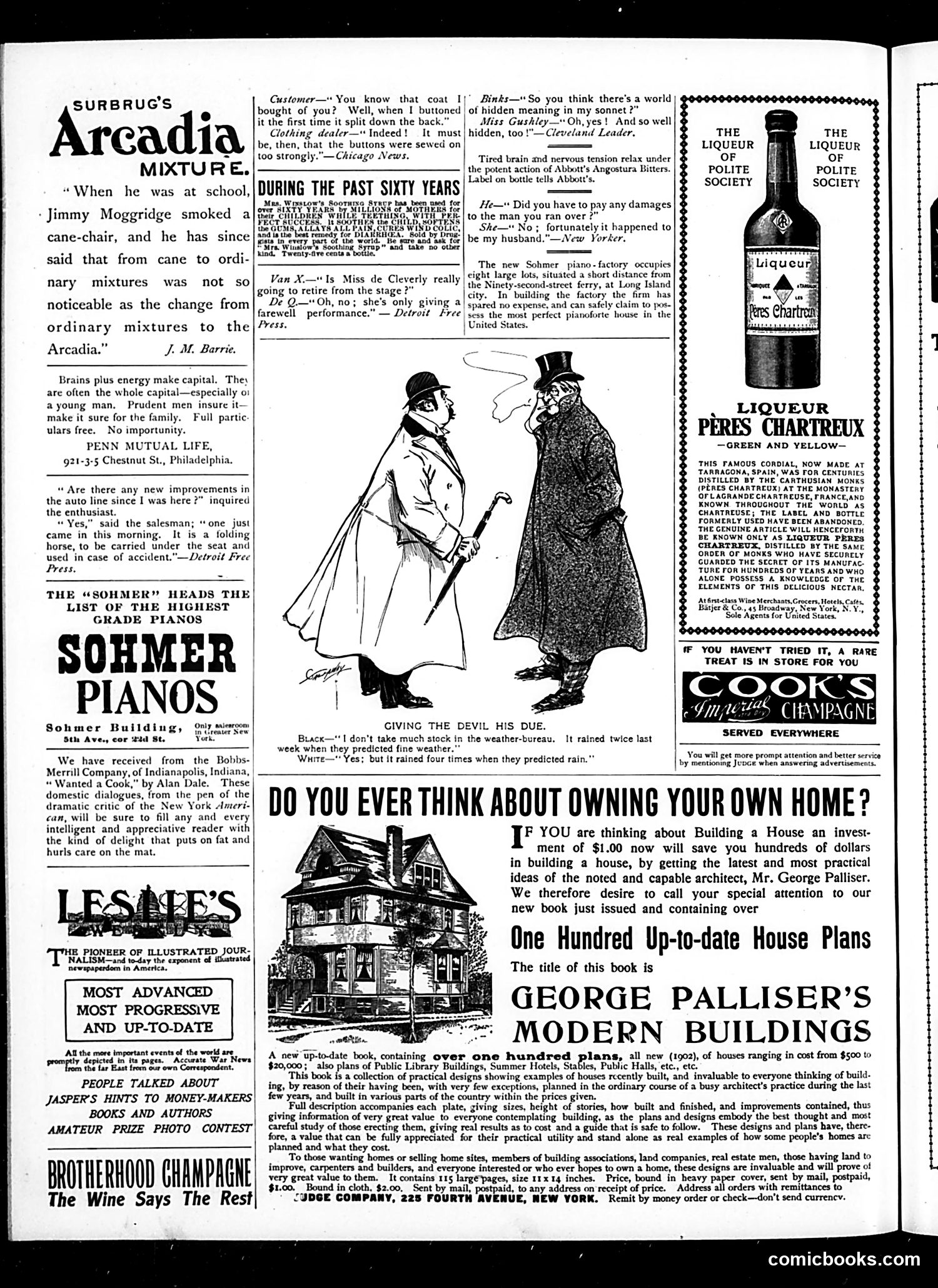
This page is primarily **advertising**, with brief satirical content interspersed. The main cartoon—captioned "GIVING THE DEVIL HIS DUE"—shows two men debating weather forecasting. Black claims the weather bureau is unreliable because it rained twice when they predicted sunshine. White counters that it actually rained *four* times when they predicted rain, so the bureau deserves credit for occasional accuracy. The satire mocks the era's primitive weather forecasting as so consistently wrong that getting predictions right even occasionally warrants praise. The page's other brief jokes target common annoyances: a tailor blaming button-sewing for a coat's poor quality; a motorist's "improvement" being a folding horse for emergencies; a woman joking her husband was the accident victim. These reflect early-1900s urban life concerns. Most of the page comprises advertisements for pianos, insurance, real estate guides, and patent medicines—typical Judge content, reflecting advertising's dominance in period magazines.
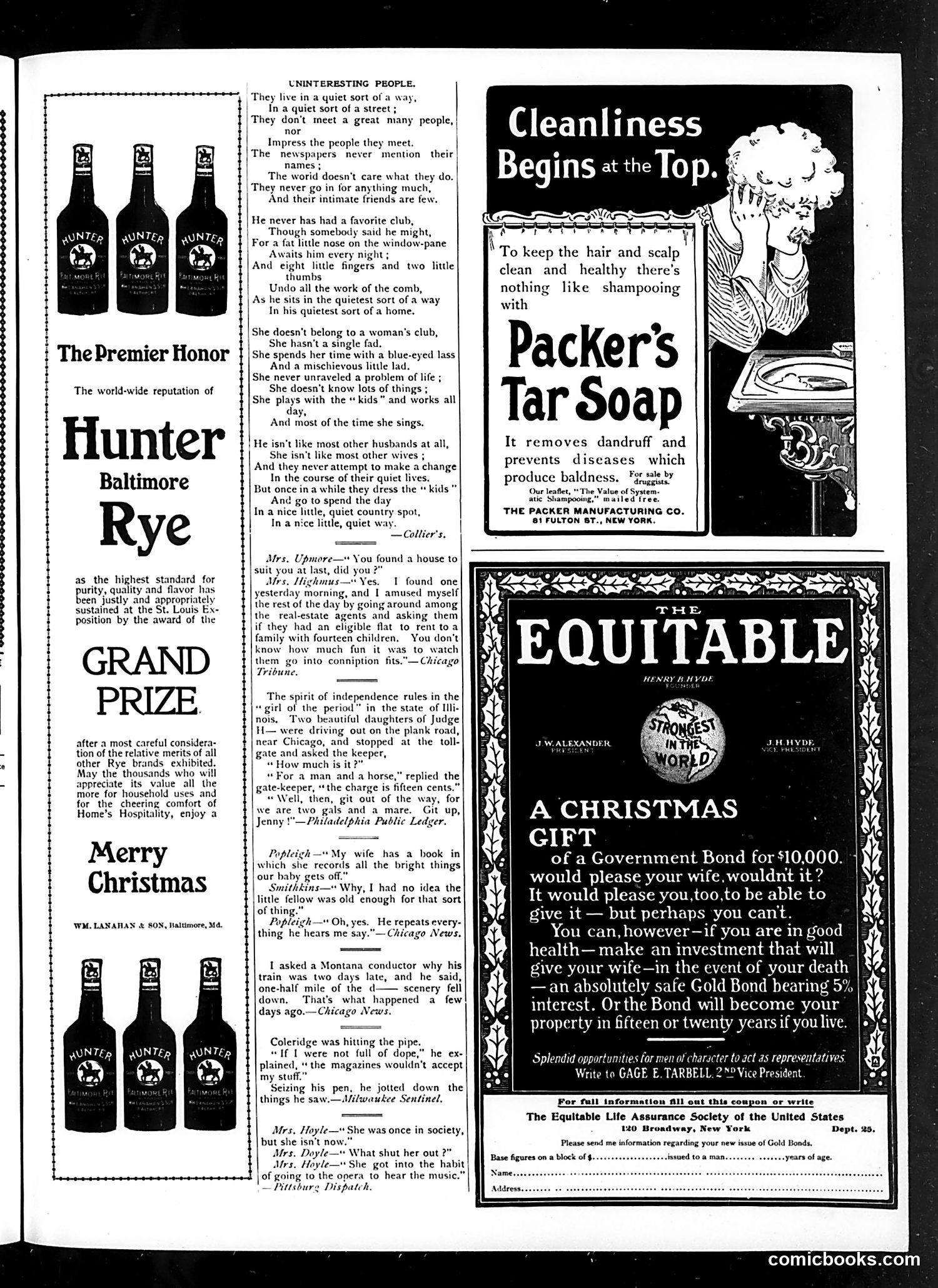
This page is primarily **advertising** interspersed with light humor rather than political satire. The main content includes: **Left side:** Hunter Baltimore Rye whiskey ads with a sentimental poem about "uninteresting people"—ordinary families living quiet, domestic lives. This appears designed to appeal to middle-class values, portraying contentment in modest family routines. **Center:** Brief humorous anecdotes mocking various social types: pretentious homeowners, independent women at toll gates, new mothers recording their babies' remarks. These are gentle jabs at contemporary social pretensions rather than sharp satire. **Right side:** Advertisements for Packer's Tar Soap (hair care) and Equitable Life Insurance, offering Government Bonds and gold-bearing investments—appeals to middle-class financial security. **Overall context:** This reflects early 1900s values emphasizing domesticity, modest living, and financial prudence. The humor is mild, the tone conservative. It's primarily a vehicle for selling products to affluent readers while subtly reinforcing conventional social attitudes about gender, family, and class.
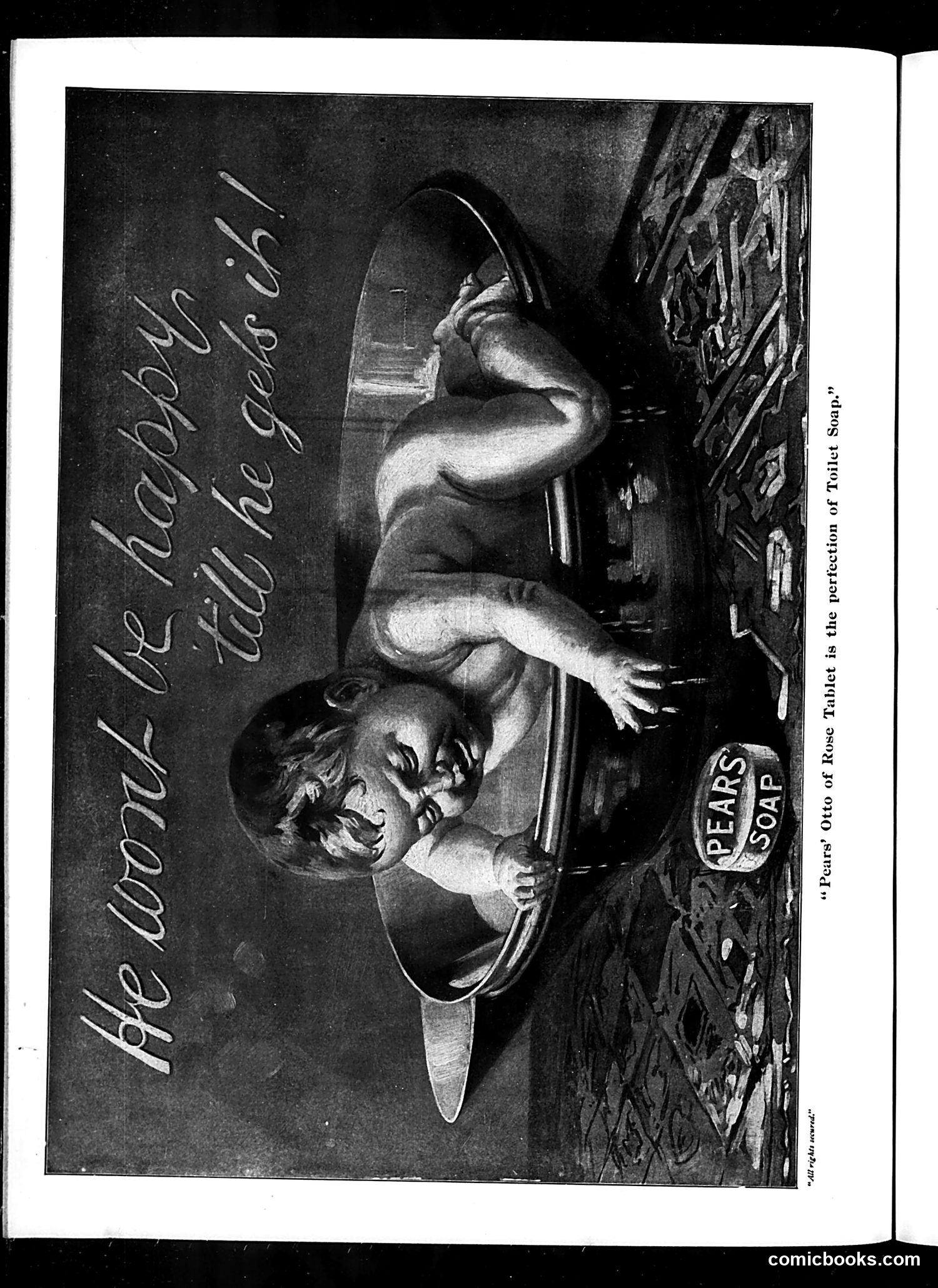
This is a Pears' Soap advertisement from Judge magazine, rotated 90 degrees. The ad features a cherubic child in a bathtub with the text "Be good to yourself" and "Pears' Soap" visible. The right margin indicates this is "Pears' Ours of Toilet Soap" - the perfection of Toilet Soap." This is commercial advertising rather than political satire. Pears' Soap was a well-known luxury brand marketed with imagery of cleanliness and wholesomeness. The cherub and bathtub imagery appealed to period notions of gentility and self-care. The ad's placement in Judge suggests the magazine accepted paid advertising to supplement its satirical content. There is no political commentary here—it's straightforward product promotion targeting Judge's affluent readership.
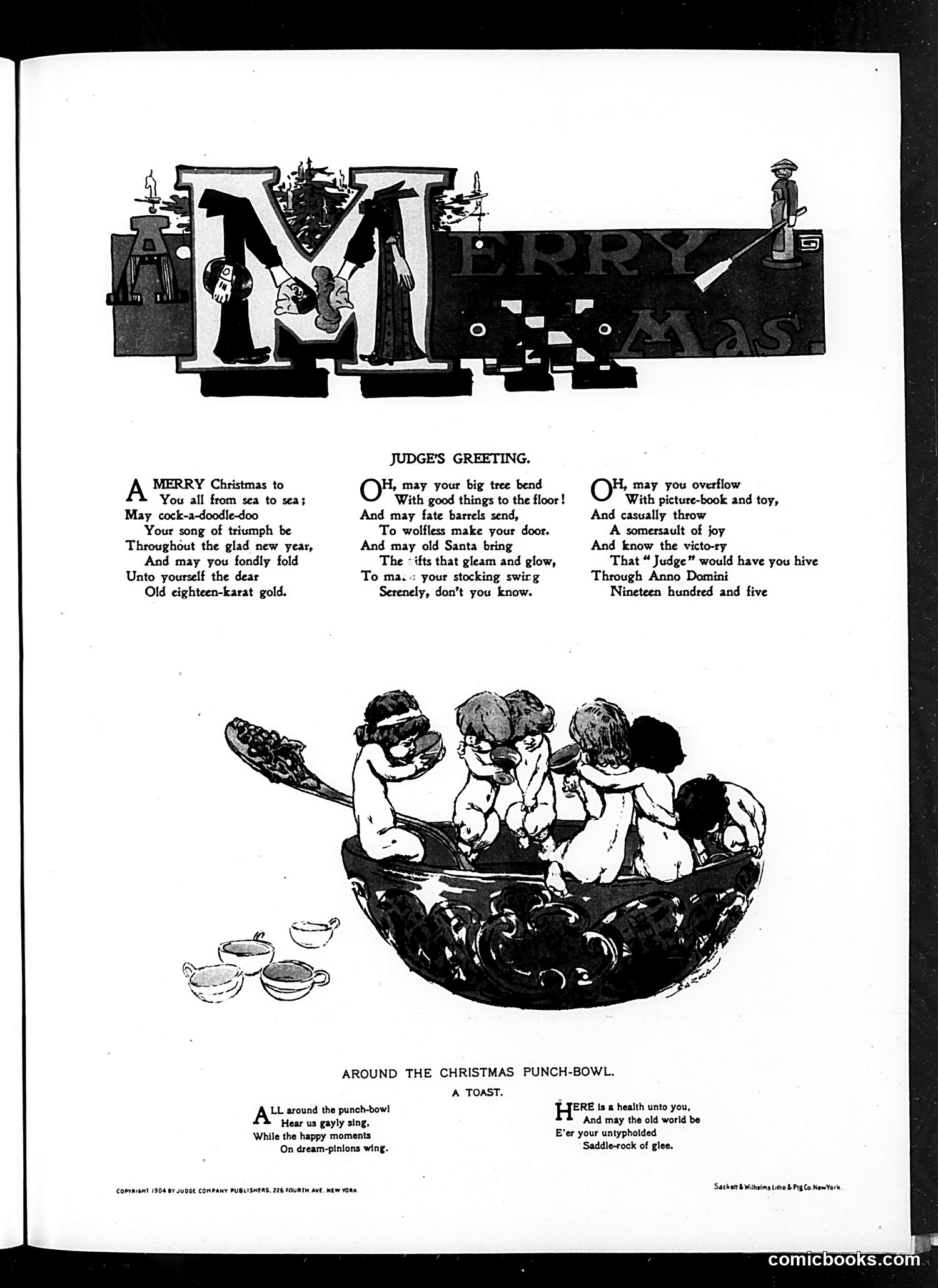
This is a **Christmas greeting page** from Judge magazine, not political satire. The page contains three festive poems offering holiday wishes to readers. The "Judge's Greeting" section uses whimsical language typical of turn-of-the-century humor—puns like "cock-a-doodle-doo" as a "song of triumph" and references to "eighteen-karat gold" (likely mocking materialism). The greeting wishes readers prosperity, Santa's gifts, and joy "through Anno Domini / Nineteen hundred and five" (1905). The decorative header shows stylized Christmas imagery with figures and holiday symbols. The bottom illustration depicts cherubs or putti (baby figures common in Victorian holiday art) gathered in a punch bowl—a visual pun on "around the Christmas punch-bowl." The toasts are sentimental verse typical of Gilded Age holiday publications, with no apparent political commentary. This appears to be Judge's standard seasonal goodwill content rather than satirical commentary.
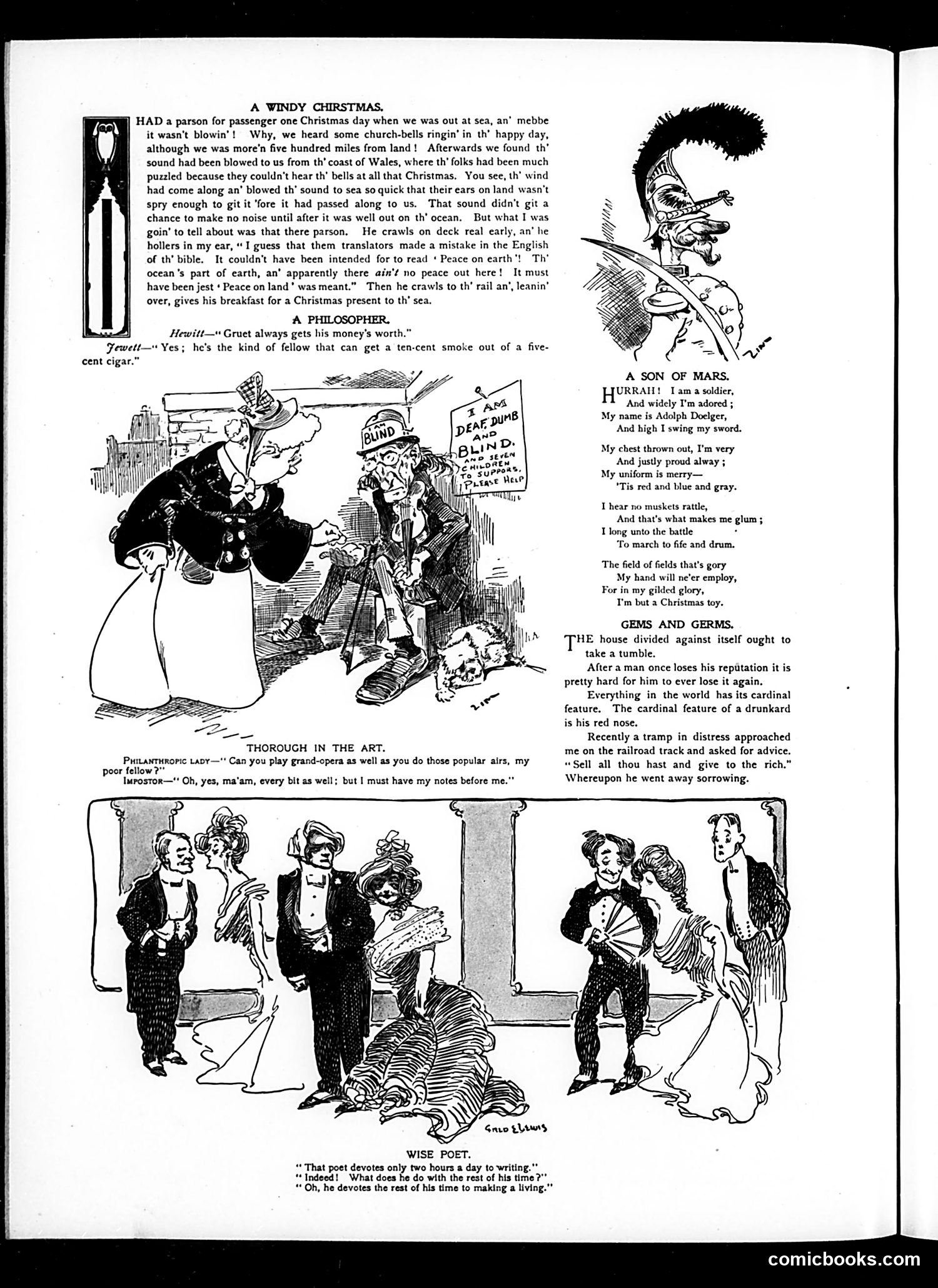
This page contains several unrelated satirical sketches typical of Judge's humor: **"A Windy Christmas"** mocks religious literalism through a sailor's tall tale: a parson aboard ship hears church bells from Wales (impossible at that distance), then complains that "Peace on earth" should read "Peace on land" since the ocean has no peace—before vomiting overboard. **"A Philosopher"** jokes about a penny-pincher who extracts maximum value from cheap items. **"A Son of Mars"** satirizes a toy soldier (likely a Christmas gift or decoration) who boasts of military glory while admitting he's merely a decorative plaything—commentary on militarism or perhaps commentary on contemporary soldier figures. **"Thorough in the Art"** presents a female opera singer who can perform both grand opera and popular songs, but needs her sheet music. **"Gems and Germs"** offers aphorisms, including a jab at drunkards' red noses and a Biblical reference ("Sell all thou hast...") applied humorously to a beggar. **"Wise Poet"** jokes that a writer spends more time earning a living than actually writing—critique of impoverished artists.
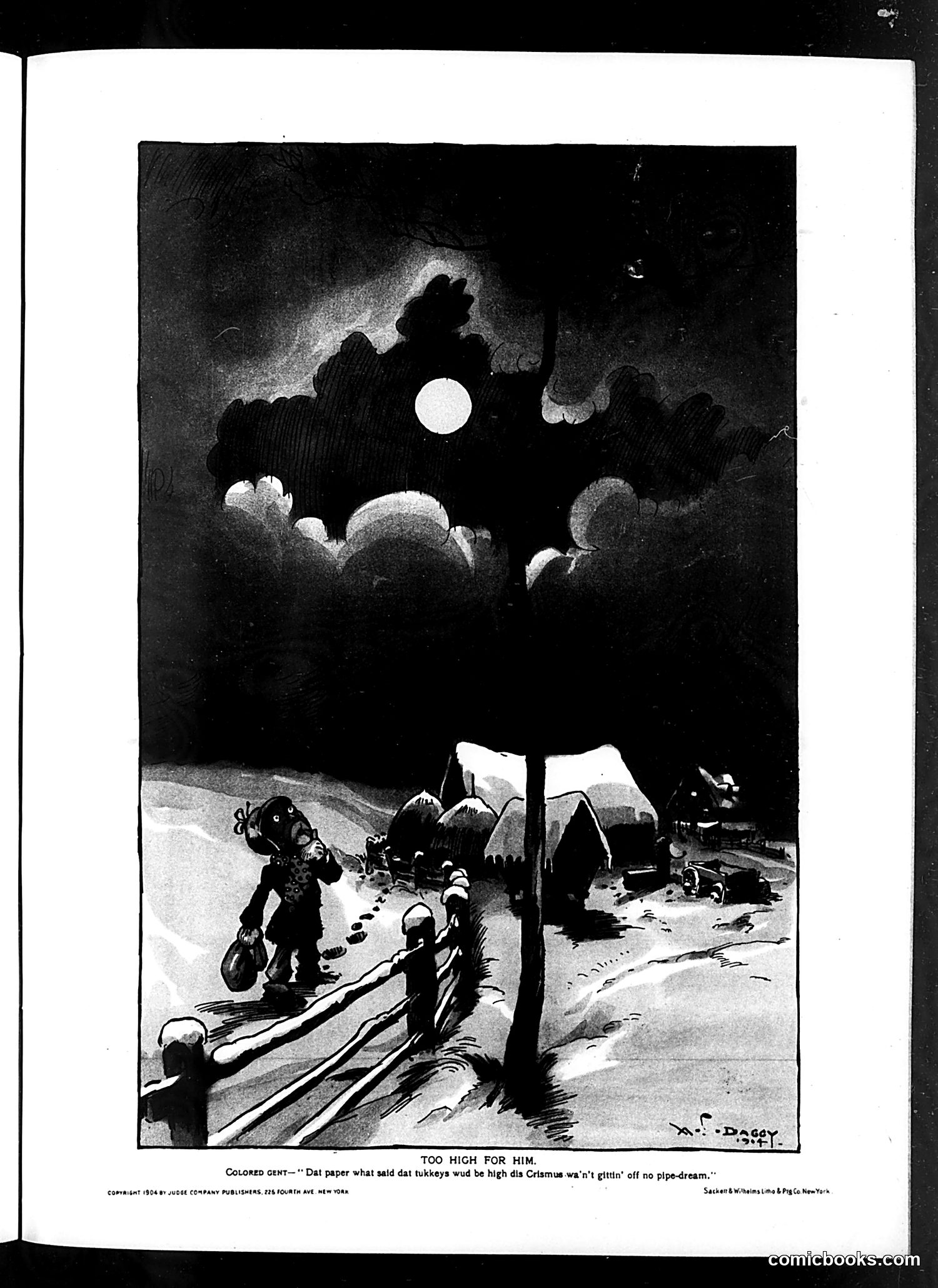
This 1904 Judge cartoon satirizes inflated newspaper predictions about Christmas turkey prices. The title "Too High for Him" plays on "high" prices while depicting a poor man unable to afford holiday poultry—a common concern for working-class families during the season. The "colored gent" (using the period's terminology) character validates that newspapers' warnings about expensive turkeys proved accurate ("wa'n't gittin' off no pipe-dream"—wasn't just wishful thinking). The snow-covered settlement scene with modest dwellings emphasizes the economic hardship of ordinary people facing holiday expenses. The satire targets both inflated media predictions and the real economic squeeze on ordinary Americans during Christmas shopping season. The cartoon reflects early-1900s class anxieties about holiday affordability for working families.
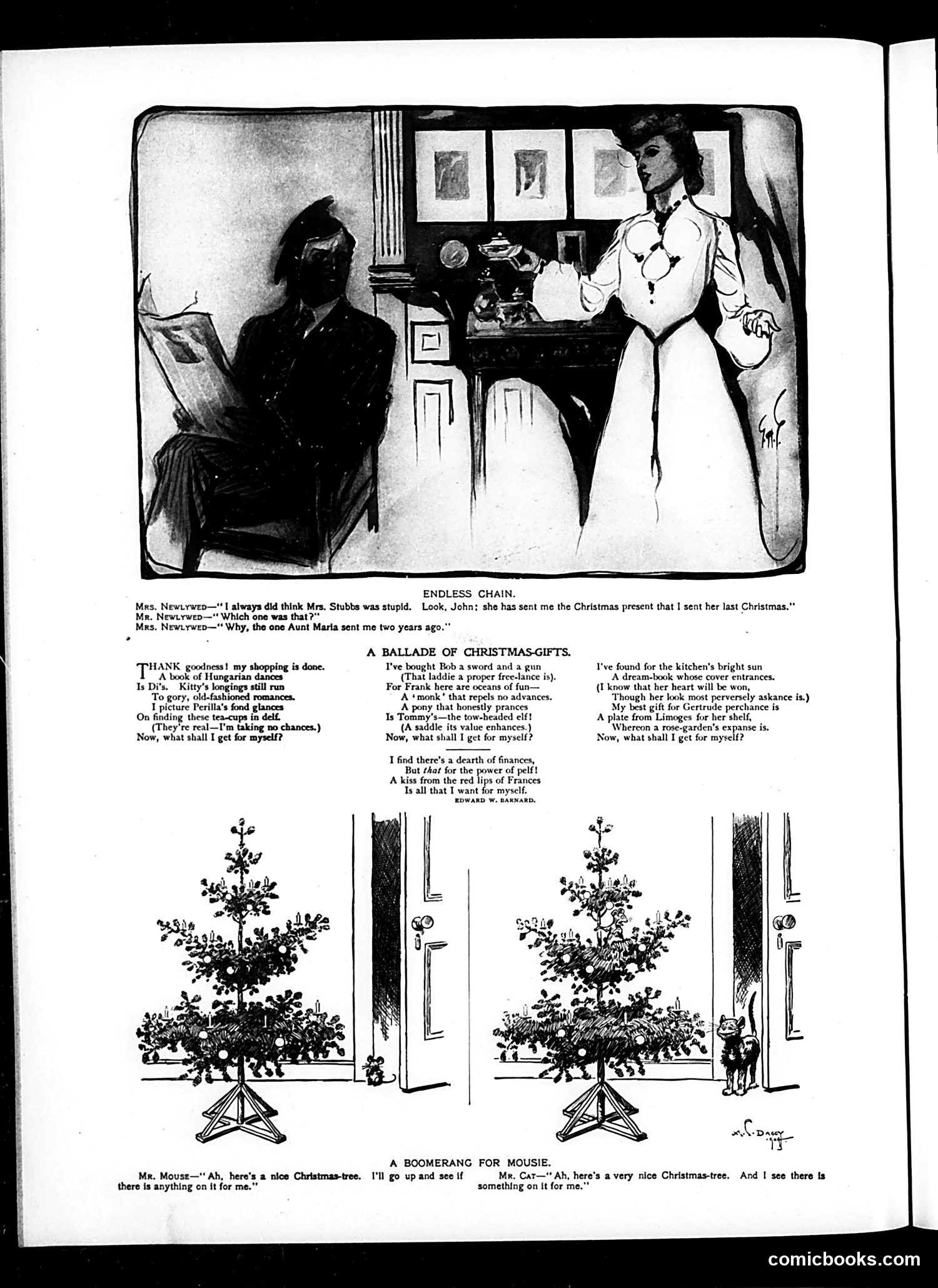
This Judge magazine page contains holiday-themed satirical content from the early 20th century. **"Endless Chain"** depicts wealthy women exchanging unwanted gifts in a cycle—Mrs. Newlywed complains her friend returned a gift that originally came from her own relative two years prior. It mocks the social obligation and wastefulness of gift-giving among the affluent. **"A Ballad of Christmas-Gifts"** is verse satire about gift-shopping excess, listing increasingly elaborate presents for children and loved ones, then questioning what the speaker gets for themselves. **"A Boomerang for Mousie"** is a visual joke: a mouse and cat separately discover a Christmas tree, each hoping for gifts. The irony—the cat considers the *mouse* the gift "on" the tree—plays on predator-prey dynamics as dark humor about holiday expectations backfiring. The overall theme: Christmas gift-giving as social theater involving obligation, waste, and ironic disappointment.
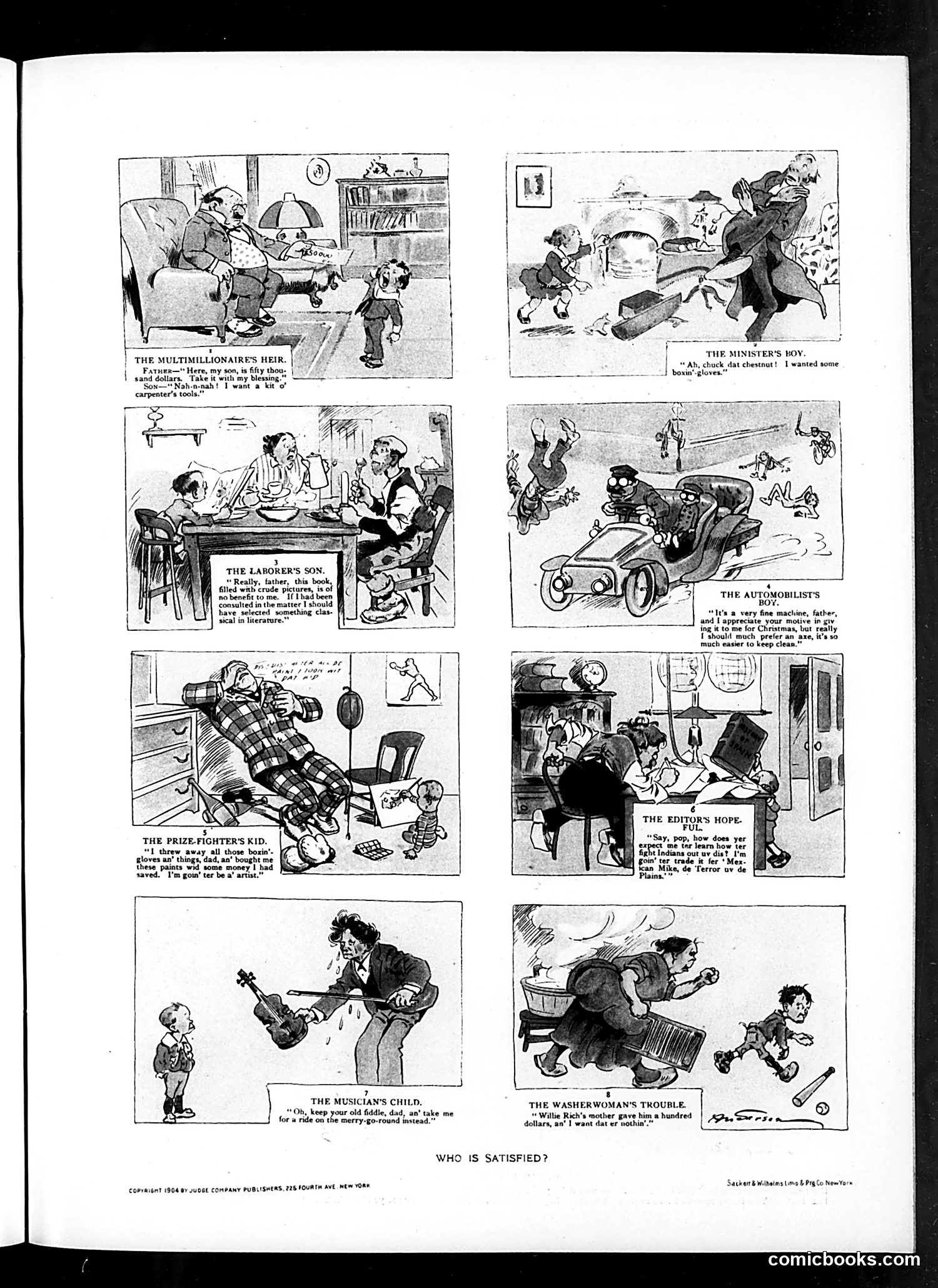
This page presents a series of vignettes satirizing class-based parental aspirations and children's rejection of their parents' values. Each panel shows a father offering his son an inheritance or gift reflecting the father's own profession or status, only to have the child rudely reject it in favor of something entirely different. The satire's point: children stubbornly refuse to follow their fathers' paths, regardless of social class. A millionaire's son wants carpenter's tools instead of money; a laborer's son rejects crude pictures for "classical literature"; a prize-fighter's kid trades boxing gloves for paints to become an artist; a musician's child spurns his fiddle for a merry-go-round ride; an editor's son appears indifferent to intellectual pursuits; and a washerwoman's son demands money, not her example of hard work. The title "Who Is Satisfied?" suggests no one—not the fathers trying to pass down their values, nor the children getting what they actually want. It's social commentary on generational conflict and the unpredictability of inherited desire.
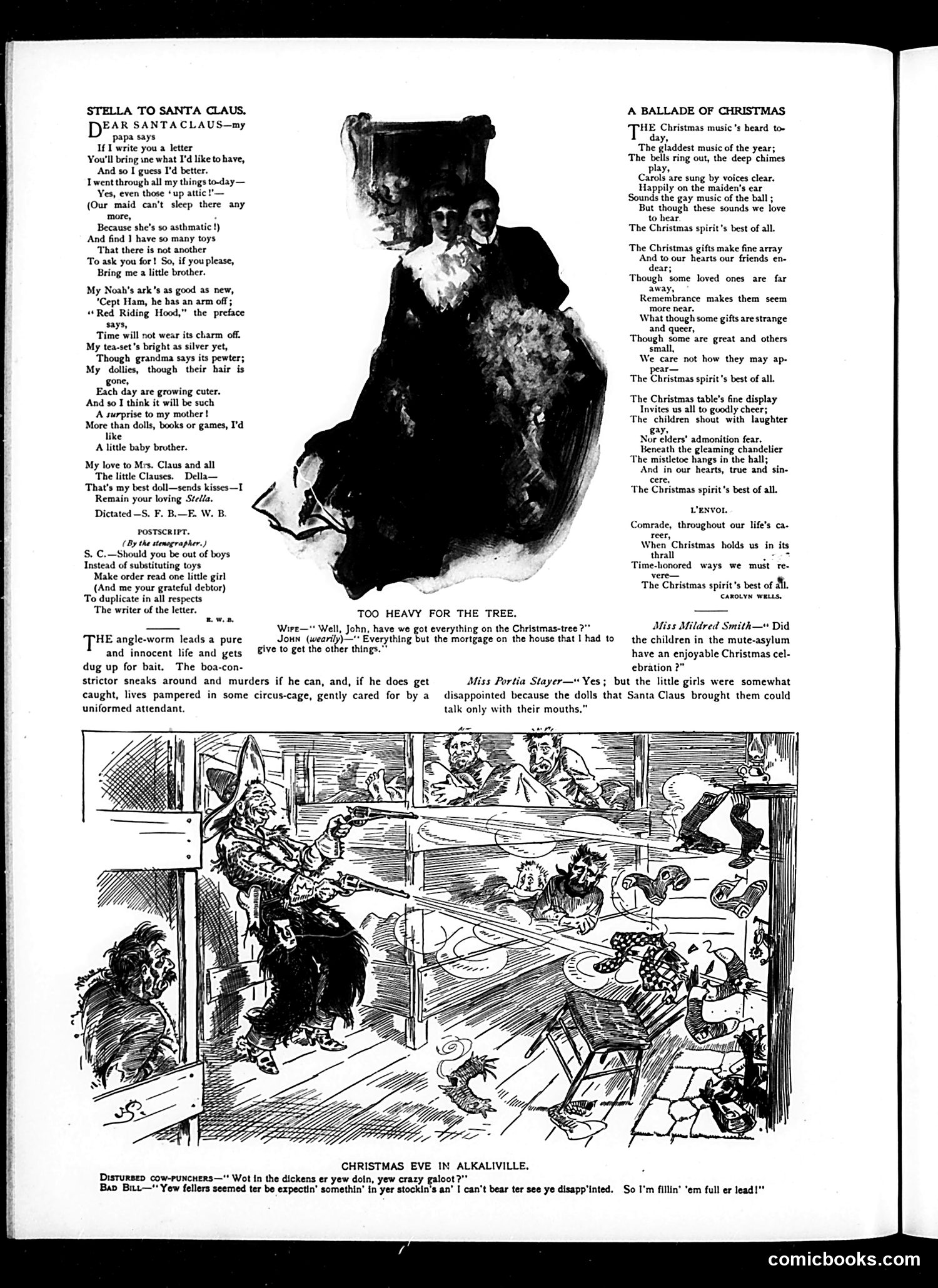
This page contains several Christmas-themed pieces typical of early 20th-century American humor: **"Stella to Santa Claus"**: A child's letter requesting a baby brother instead of toys, with a postscript editor's note offering to substitute a girl if boys are unavailable. The humor lies in the child's logic and the editor's sardonic aside. **"Too Heavy for the Tree"**: A brief joke about a mortgage being so burdensome it won't fit on a Christmas tree—satirizing financial strain during holiday celebrations. **"Christmas Eve in Alkaliville"**: A Western dialect joke where rough cowboys fill stockings with lead bullets, misunderstanding the phrase about "expecting something in your stockings." **"A Ballade of Christmas"**: A sentimental poem emphasizing spiritual values over material gifts. **Final joke**: Mock dialogue about deaf children's disappointment that dolls only talk with their mouths, playing on period attitudes toward disability. The satire targets materialism, class anxiety about finances, and employs stereotypes common to the era.
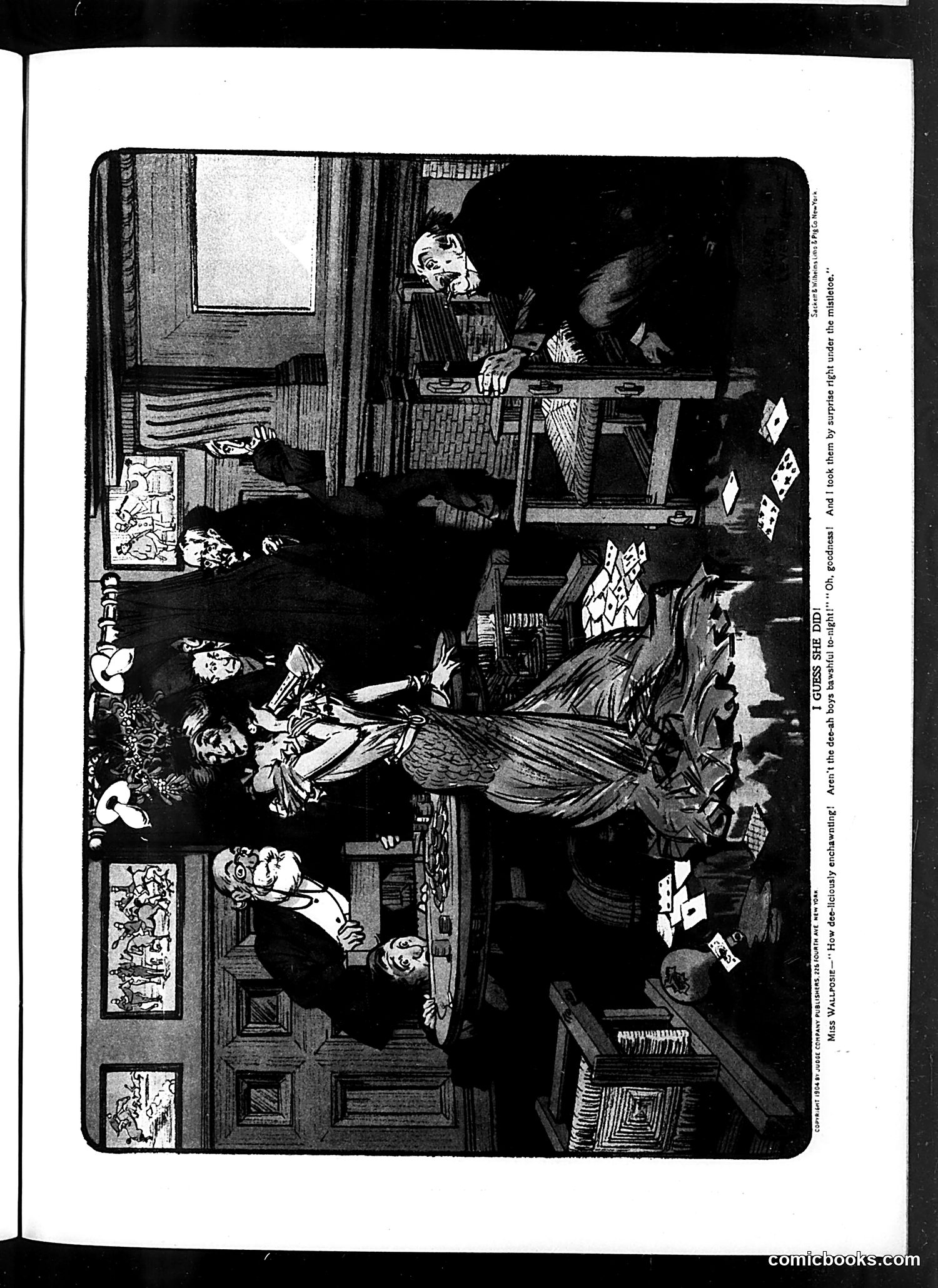
I cannot reliably read the OCR'd text on this page—it appears heavily corrupted or distorted, making it impossible to identify the specific satirical subject matter or political references with accuracy. From the IMAGE alone, I can see this is a multi-panel illustration showing what appears to be a domestic or social scene with multiple figures in period clothing (possibly late 19th or early 20th century), rendered in the bold black-and-white woodcut or engraving style typical of Judge magazine. However, without legible text identifying the figures or satirical target, I cannot responsibly explain what specific political or social commentary this cartoon intended. To properly analyze this, clearer source text would be needed.
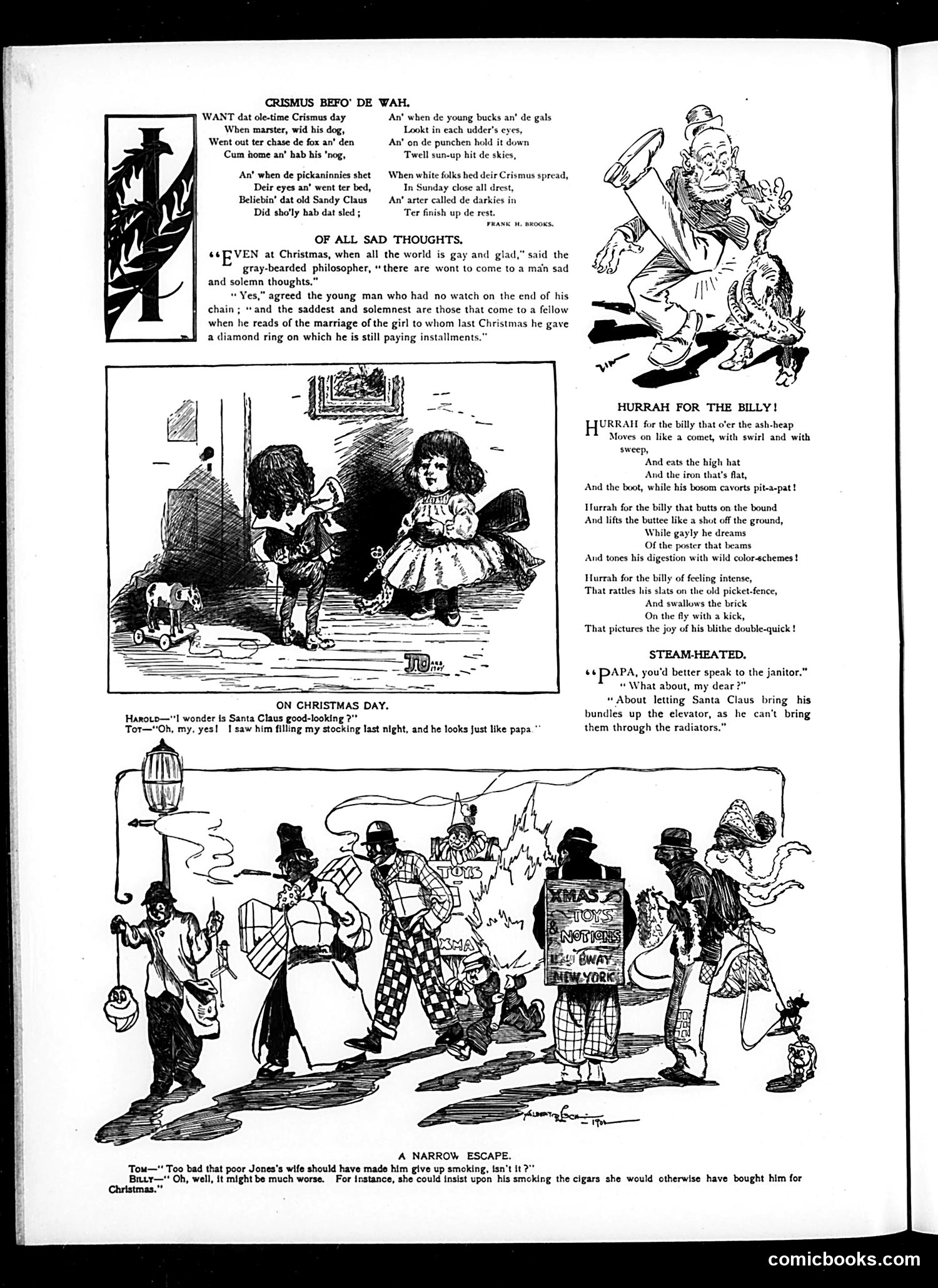
This appears to be a Judge magazine Christmas-themed page combining humor with period attitudes. Key content: **"Crismas Befo' De Wah"** uses dialect verse (rendered in exaggerated phonetic spelling) depicting nostalgic antebellum plantation Christmas—from a white perspective romanticizing slavery's supposed contentment. This reflects post-Civil War nostalgia common in northern publications. **"Of All Sad Thoughts"** jokes about a man still paying installments on a diamond ring to a woman who married someone else—commentary on consumer debt and romantic regret. **"On Christmas Day"** plays on a child mistaking her father for Santa Claus. **"A Narrow Escape"** quips that Jones's wife forcing him to quit smoking is better than her buying him cheap cigars instead. **"Hurrah for the Billy"** celebrates a billy-goat's chaotic antics and appetite. **"Steam-Heated"** jokes about modern apartment living—Santa can't fit presents through radiators. The satire targets consumer culture, marriage, technology, and nostalgia alongside period racial attitudes.
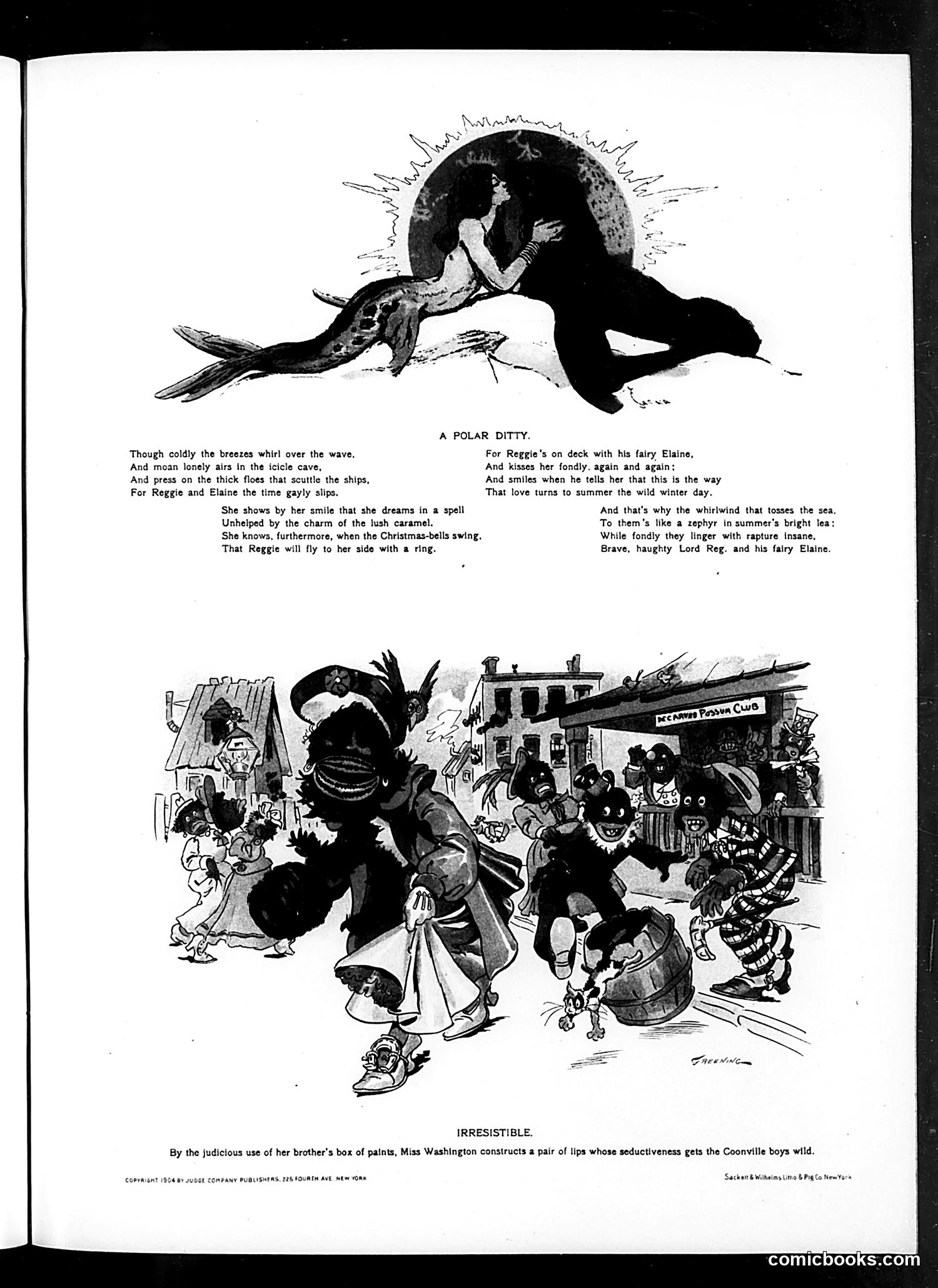
**"A Polar Ditty"** depicts a romantic fantasy: a couple (Reggie and Elaine) in an Arctic setting where harsh winter conditions become irrelevant because love transforms their experience into paradise. The poem uses contrast—cold seas and ice floes versus their warm emotional state—to celebrate romantic devotion. **"Irresistible"** is a racial caricature cartoon set in "Coonville" (a dehumanizing period term for Black communities). It depicts Miss Washington using makeup to attract local men, presenting the joke as her artificially applied lips causing an uncontrollable attraction among the boys shown in exaggerated racial caricature. The second cartoon relies on deeply offensive racist stereotypes common to early-1900s American humor—depicting Black people with grotesque features and suggesting they're easily manipulated by superficial means. This reflects the casual racism embedded in mainstream publications of the era, which modern readers should recognize as bigoted propaganda rather than humor.
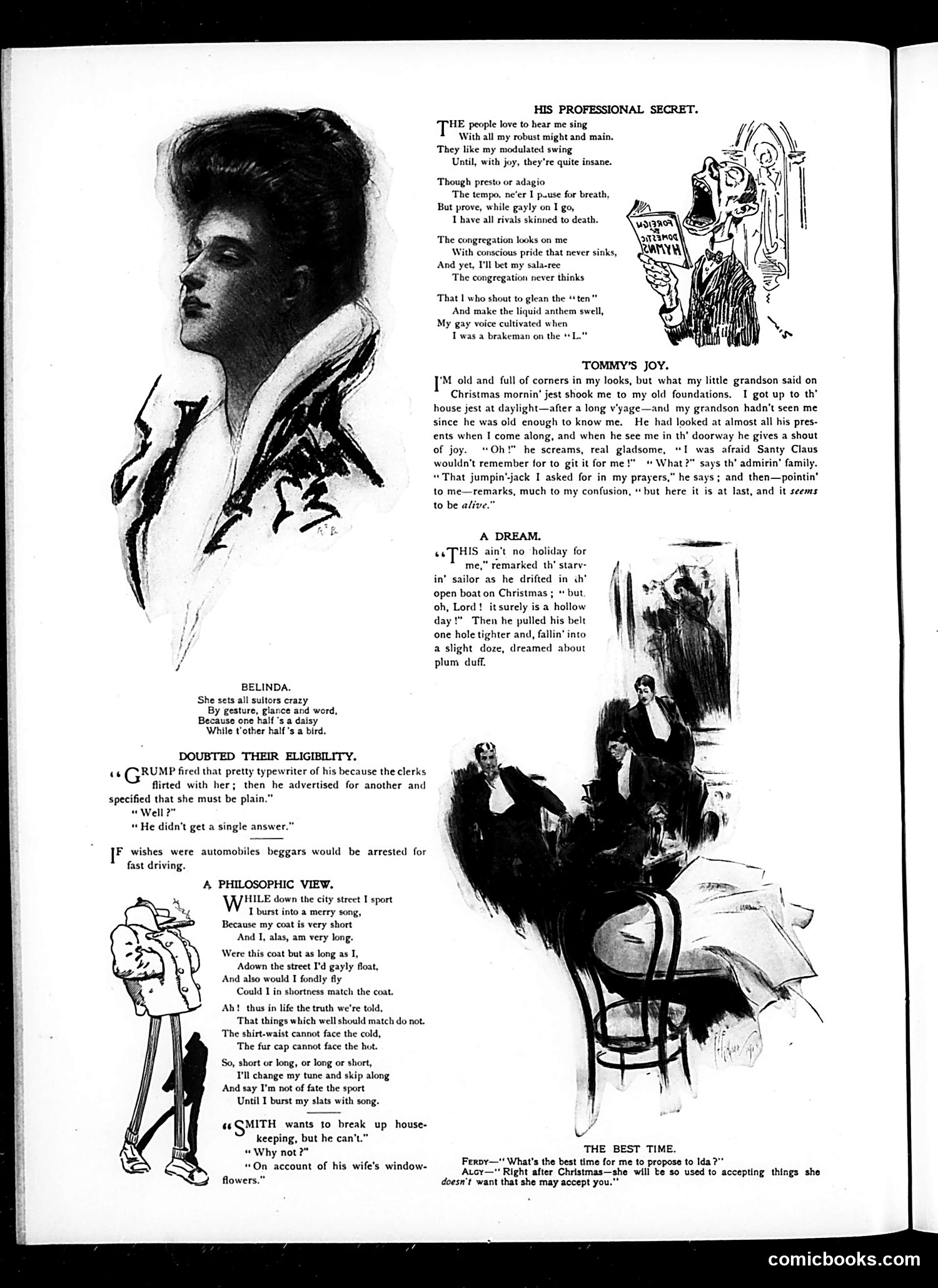
This page from *Judge* (a satirical American magazine) contains multiple short humor pieces typical of early 20th-century comic magazines: **"His Professional Secret"** mocks a church singer whose powerful voice impresses congregants, but the joke reveals he learned to sing as a brakeman on the "L" (Chicago's elevated train)—crude, working-class origins underlying his cultured performance. **"Tommy's Joy"** plays on a child's confusion: a grandfather returns from a voyage; the boy, disappointed he didn't receive a toy "jumpin'-jack" he prayed for, then sees Grandpa and calls *him* the toy—"and it seems to be alive," treating the man as an inanimate object. **"A Dream"** presents a starving sailor's dark Christmas humor—he's drifting at sea with nothing, yet still dreams of "plum duff" (a rich pudding), the absurdity of hunger-induced fantasy. Other items are brief wordplay or observational humor about domestic situations. The cartoons use exaggerated illustrations typical of satirical magazines. None reference specific political events; the humor is gentle, domestic, and character-based rather than topical.
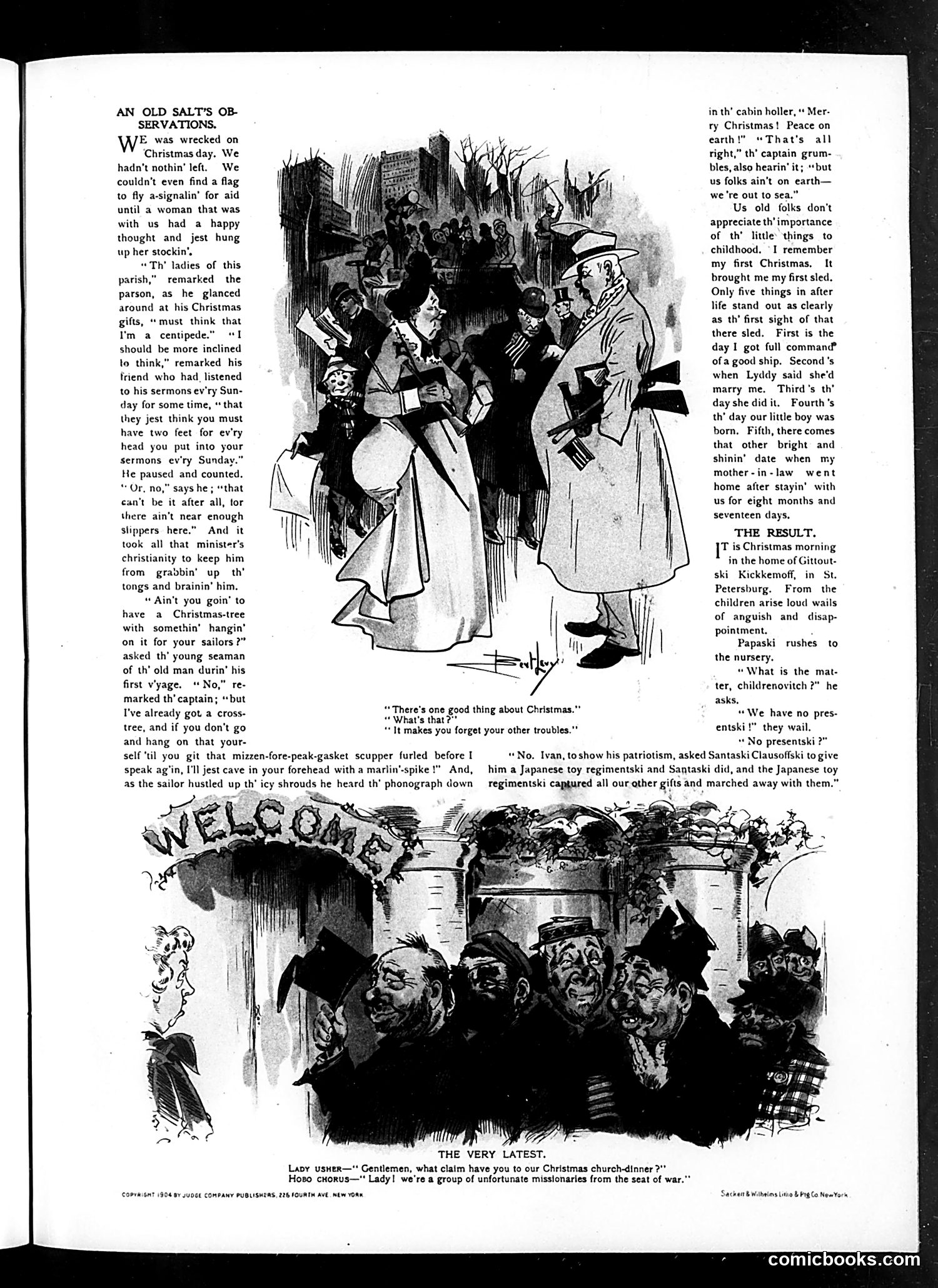
This page combines humorous nautical anecdotes with contemporary political satire about the Russo-Japanese War (1904-1905). **The main cartoons**: The upper illustration shows sailors receiving Christmas gifts; the lower shows a Russian family ("Gittoutski Kickkemoff") disappointed by missing presents. The satire here is that Japanese toy soldiers—representing Japan's military—have "captured all our other gifts and marched away," a dark joke about Japan's military victories against Russia. **The final cartoon** depicts missionaries claiming to be from "the seat of war," seeking Christmas charity—satirizing how the war displaced people seeking aid. **The broader point**: These vignettes mock how even Christmas cannot escape the intrusions of real-world troubles—shipwrecks, maritime hardship, and especially the ongoing Russo-Japanese War, which was dominating 1904 headlines. The satire suggests that conflict and misfortune penetrate all aspects of life, even festive occasions.
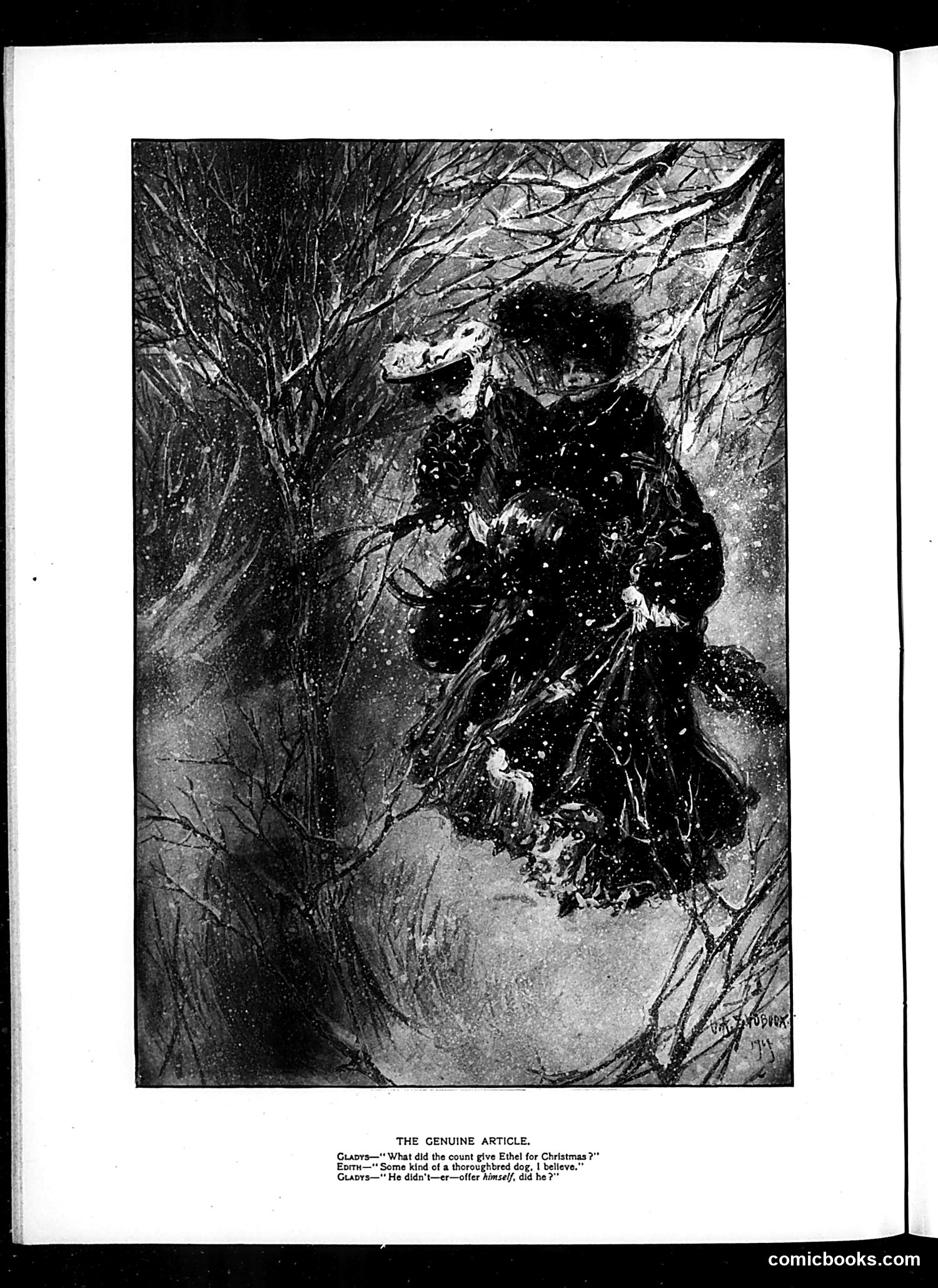
This is a satirical cartoon about romantic pretense among the wealthy. The dialogue shows two women (Gladys and Edith) discussing what "the count" gave Ethel for Christmas. When told he gave a thoroughbred dog, Gladys pointedly asks if he "offered himself"—implying that a genuine suitor of noble status would propose marriage rather than give mere gifts. The satire targets European nobility (particularly continental "counts") who were seen as fortune-hunting seducers in American society. The joke suggests that this count is either uninterested in actual commitment or is a fraud—not a "genuine article" despite his title. The caption's title reinforces the theme of authenticity versus pretense.
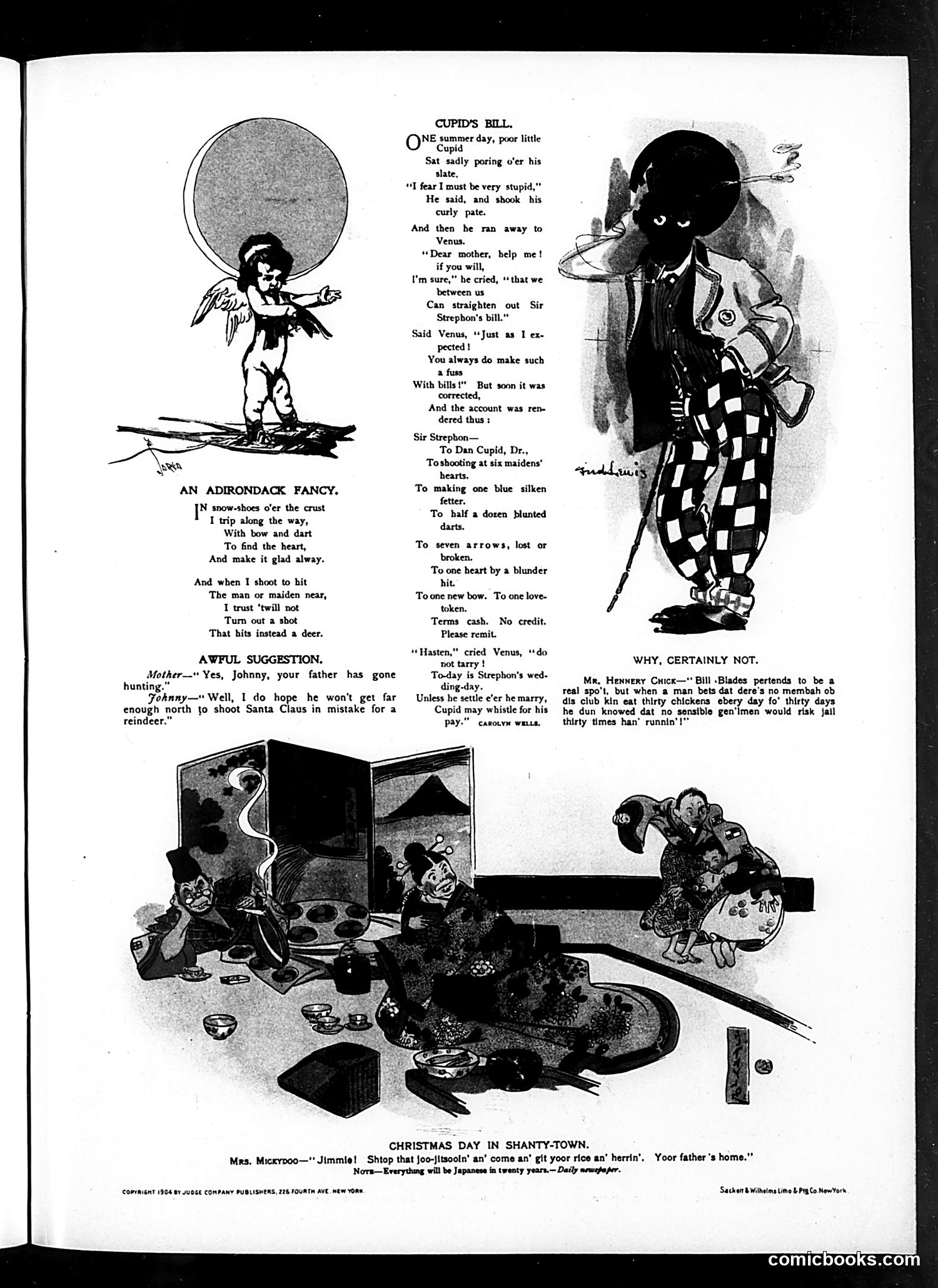
This 1904 page contains three satirical pieces reflecting early 20th-century humor: **"Cupid's Bill"** mocks romantic entanglement through an invoice joke—Cupid must bill Sir Strephon for his bungled matchmaking efforts (broken arrows, wasted darts, failed attempts). The humor plays on the absurdity of love as a commercial transaction. **"Awful Suggestion"** is a dark joke about hunting accidents: a mother hopes her husband won't mistake Santa Claus for a reindeer while hunting—satirizing the danger of firearms and perhaps poking fun at Christmas mythology. **"Why, Certainly Not"** uses racist dialect to ridicule a character ("Mr. Hennery Cuick") for his skepticism about an implausible bet involving eating chickens daily. **"Christmas Day in Shanty-Town"** employs ethnic stereotyping and broken dialect, with a final editorial note predicting everything will be "Japanese in twenty years"—reflecting xenophobic anxieties about Asian influence during the period of Japanese imperial expansion. The page reflects Judge's typical blend of wordplay, social commentary, and period-typical racial caricature.
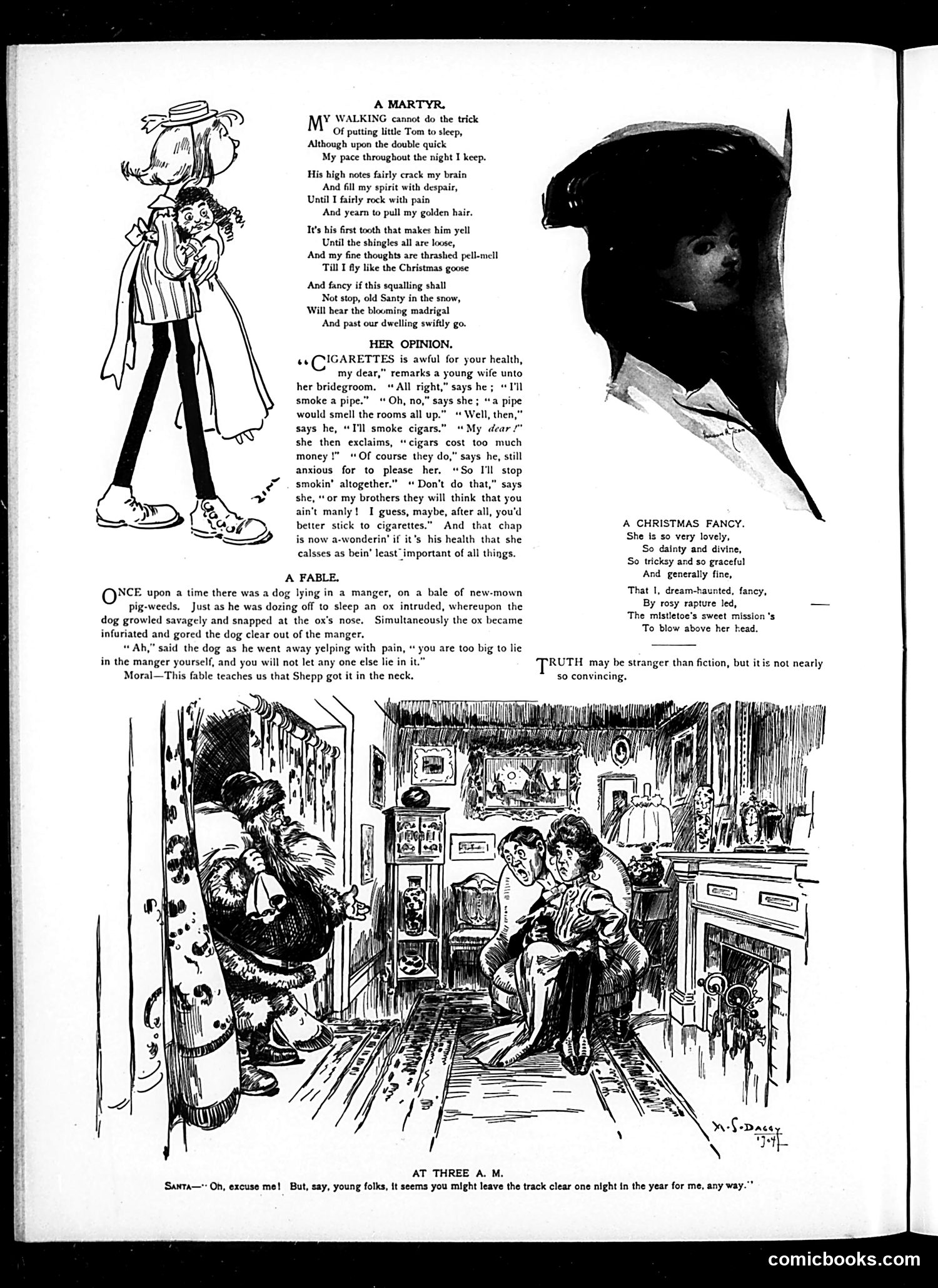
This Judge magazine page contains three satirical pieces with period-specific humor: **"A Martyr"** depicts a exhausted parent walking an inconsolable teething infant through the night, fearing the noise will alert Santa to skip their house. It's domestic comedy about infant sleep deprivation. **"Her Opinion"** satirizes a newlywed wife who contradicts herself on her husband's smoking—rejecting cigarettes for health, pipes for odor, cigars for cost, then criticizing him for quitting altogether as "unmanly." The joke mocks women's unreasonable expectations and nagging wives, a common Judge theme. **"A Fable"** references someone named "Shepp" (unclear who without publication date context) getting metaphorically defeated for overreach, using a dog-and-ox story as moral lesson. **"A Christmas Fancy"** is romantic verse about mistletoe above a beloved's head. **"At Three A.M."** shows Santa asking households to keep their chimneys clear for Christmas Eve—mild holiday humor. The artwork throughout uses period illustration styles typical of early-20th-century American humor magazines.
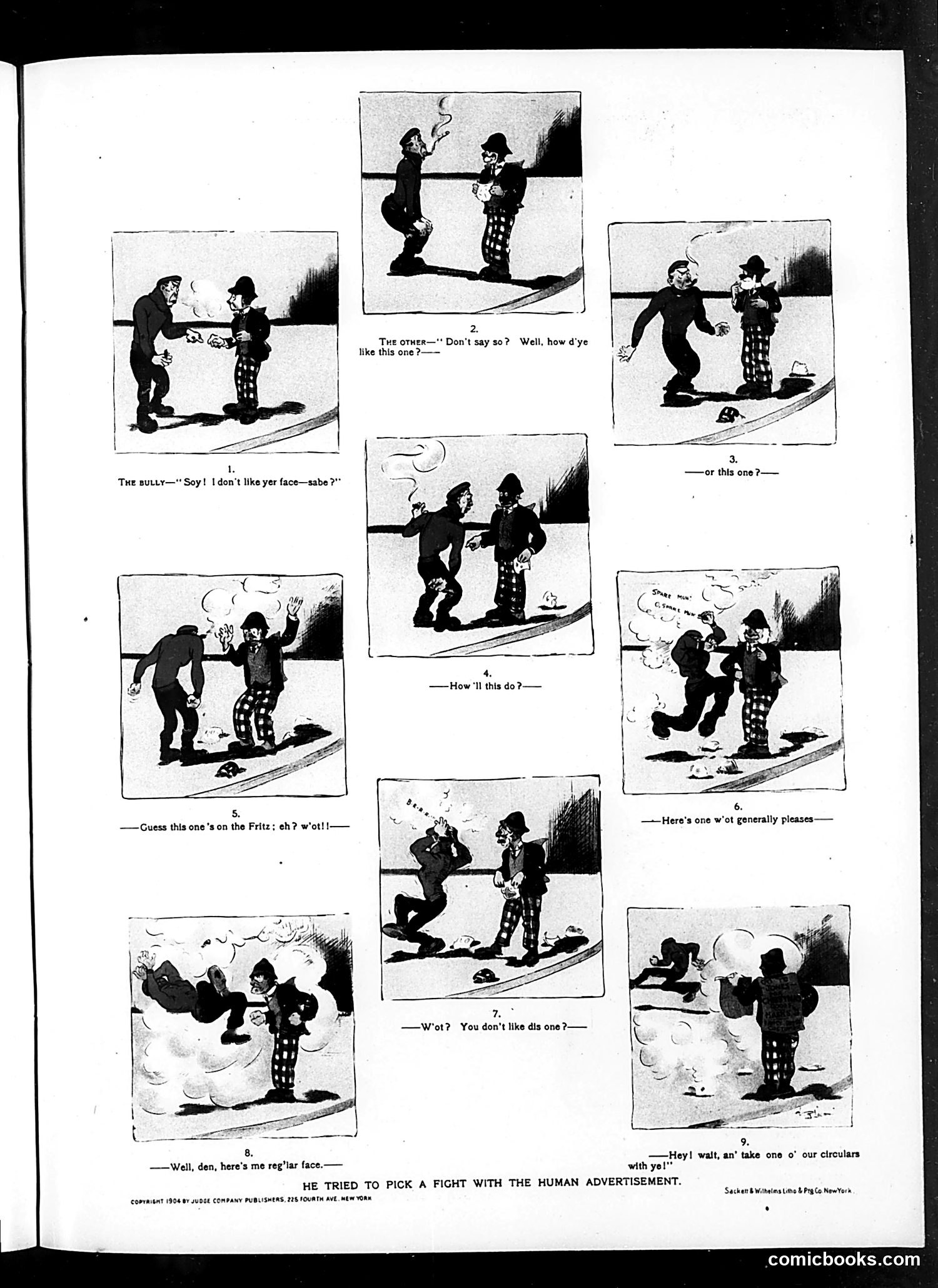
This 1904 Judge cartoon satirizes street advertising—specifically the human "sandwich men" or "human billboards" who wore advertising boards and walked city streets to promote products. The strip shows a confrontation between a well-dressed man (the "bully") and a working-class figure in checkered clothing (the human advertisement). The bully insults and challenges the advertiser, who responds by showing off different facial expressions and poses—literally treating himself as a product display, offering "circulars" (pamphlets). The joke plays on the absurdity of this emerging form of labor: a person reduced to a walking advertisement, so accustomed to performing their commercial role that when physically threatened, they respond not with anger but by showcasing their "product" more enthusiastically, almost reflexively. The satire critiques both the dehumanizing nature of such work and the era's aggressive street-marketing tactics.
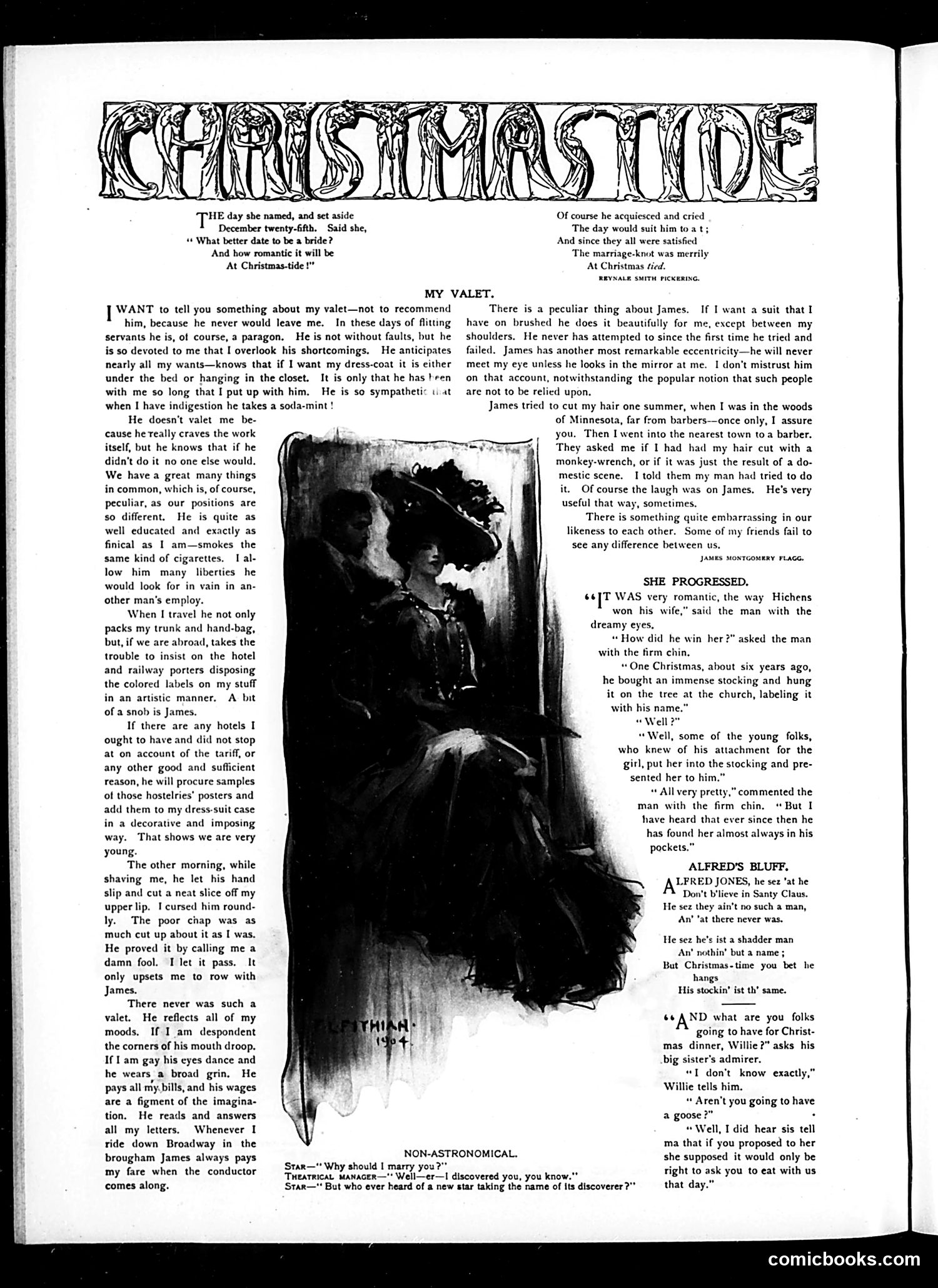
This page from *Judge* contains three separate humorous pieces typical of the magazine's satirical style: **"Christmas-Tide"** (top): A brief poem about a woman choosing December 25th as her wedding date for romance. The satire is gentle—mocking the sentimentality of romantic notions. **"My Valet"** (main essay): A lengthy comic monologue about the author's devoted servant James. The humor relies on class dynamics and the absurdity of the valet's peculiar habits—he mirrors his employer's moods, pays the author's bills despite earning no wages, and famously botched a haircut with a "monkey-wrench." The satire gently mocks both wealthy employers who exploit servants and servants who enable this dynamic through misplaced loyalty. **"Non-Astronomical"** (bottom): A brief theatrical joke about a star (actress) asking why a manager should marry her. His answer—that he "discovered" her—prompts her witty retort that no star takes its discoverer's name, implying he's inflating his importance. The cartoons feature period illustrations accompanying these texts, typical of *Judge's* format blending text and image for satirical effect.
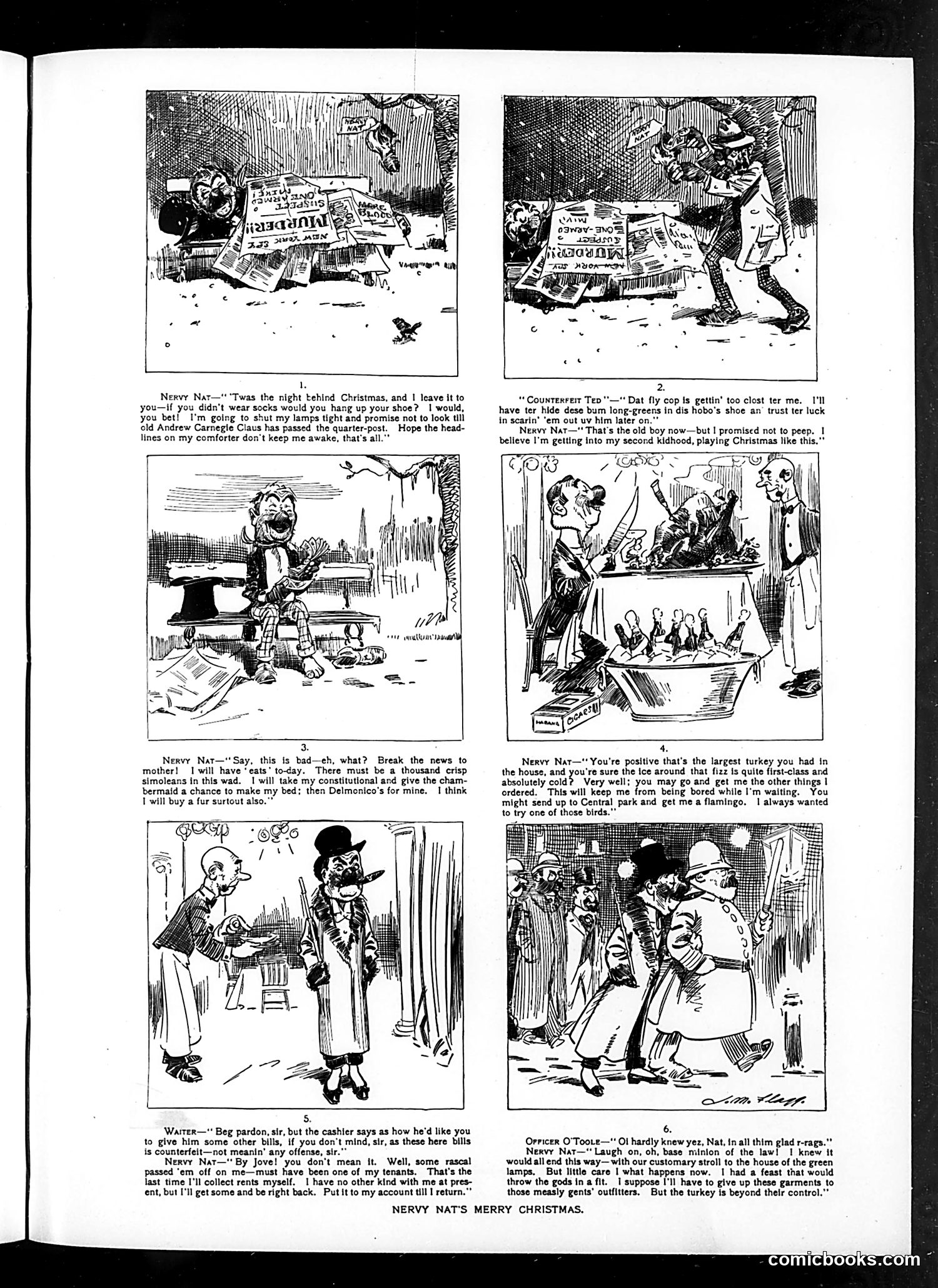
This six-panel satirical comic follows a character named "Nervy Nat," apparently a street hustler or con man, through a surreal Christmas day marked by sudden wealth and delusion. The joke: Nat finds a large sum of money ("simoleans") and briefly lives like a wealthy man—ordering expensive meals at Delmonico's, demanding flamingos from Central Park, treating servants imperiously. His fantasy collapses when the waiter reveals his bills are counterfeit (likely planted by one of his tenants seeking revenge). The final panel shows him arrested by Officer O'Toole, ending his brief pretense of respectability. The satire mocks both Nat's absurd social climbing and the precariousness of working-class criminality. His "merry Christmas" is essentially a fever dream of unearned gentility, punctured by reality. The humor relies on period slang and class commentary typical of Judge magazine's satirical approach to urban American life.
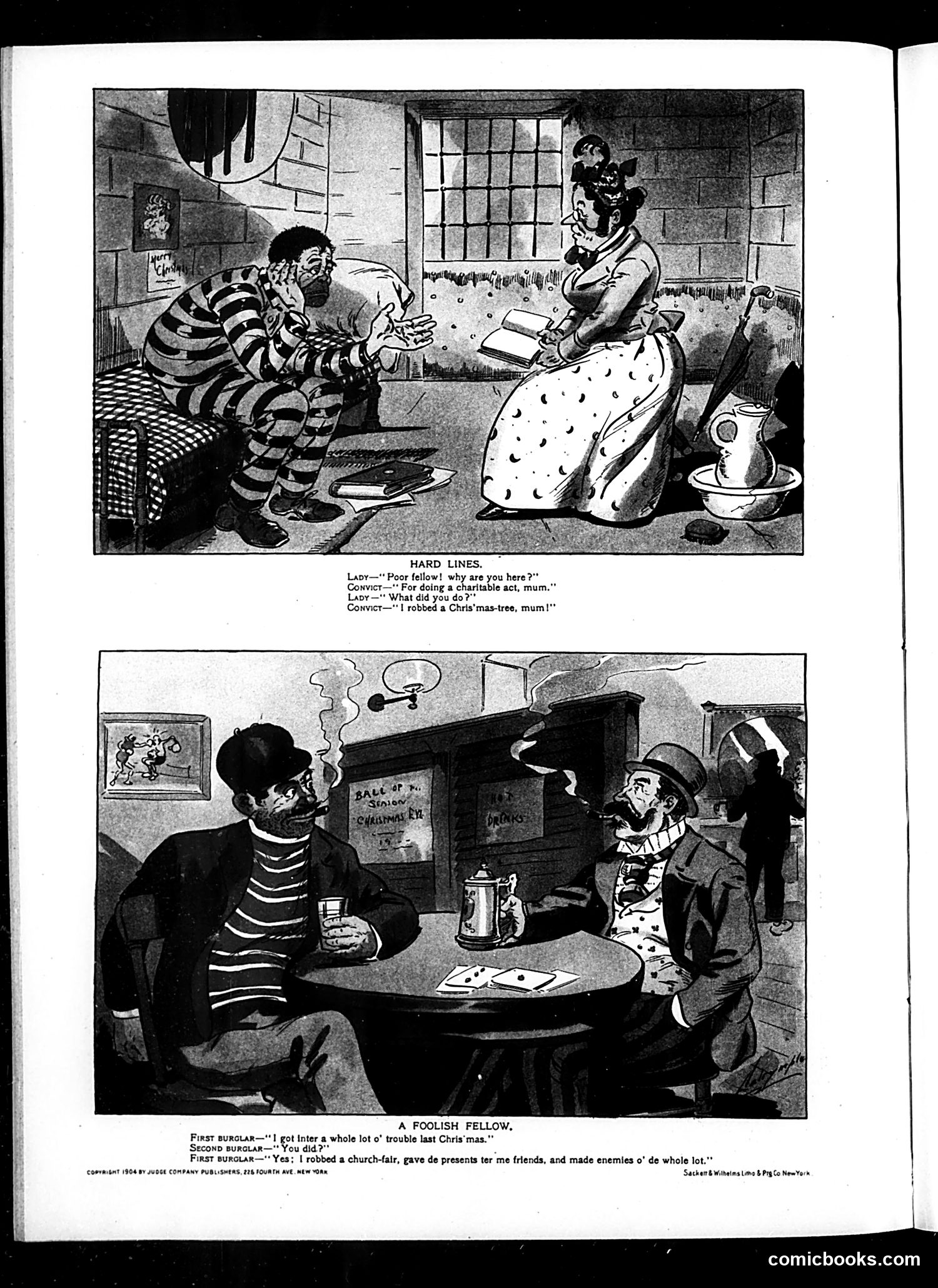
These two cartoons satirize criminals' misguided attempts at charity during Christmas. In the top panel, a convict in striped prison garb explains to a sympathetic lady visitor that he's imprisoned for "robbing a Christmas tree"—stealing gifts intended for children. The irony is that he frames theft as a charitable act. The bottom panel features two burglars discussing how one got "into a whole lot of trouble" by robbing a church fair and distributing the stolen goods to friends as Christmas presents. The joke: his crime created more enemies than goodwill, since the church community lost property while his friends gained undeserved credit. Both cartoons mock the logic of criminals who rationalize theft as generosity, exposing how good intentions don't excuse criminal behavior—a pointed Christmas-season message about morality and the law.
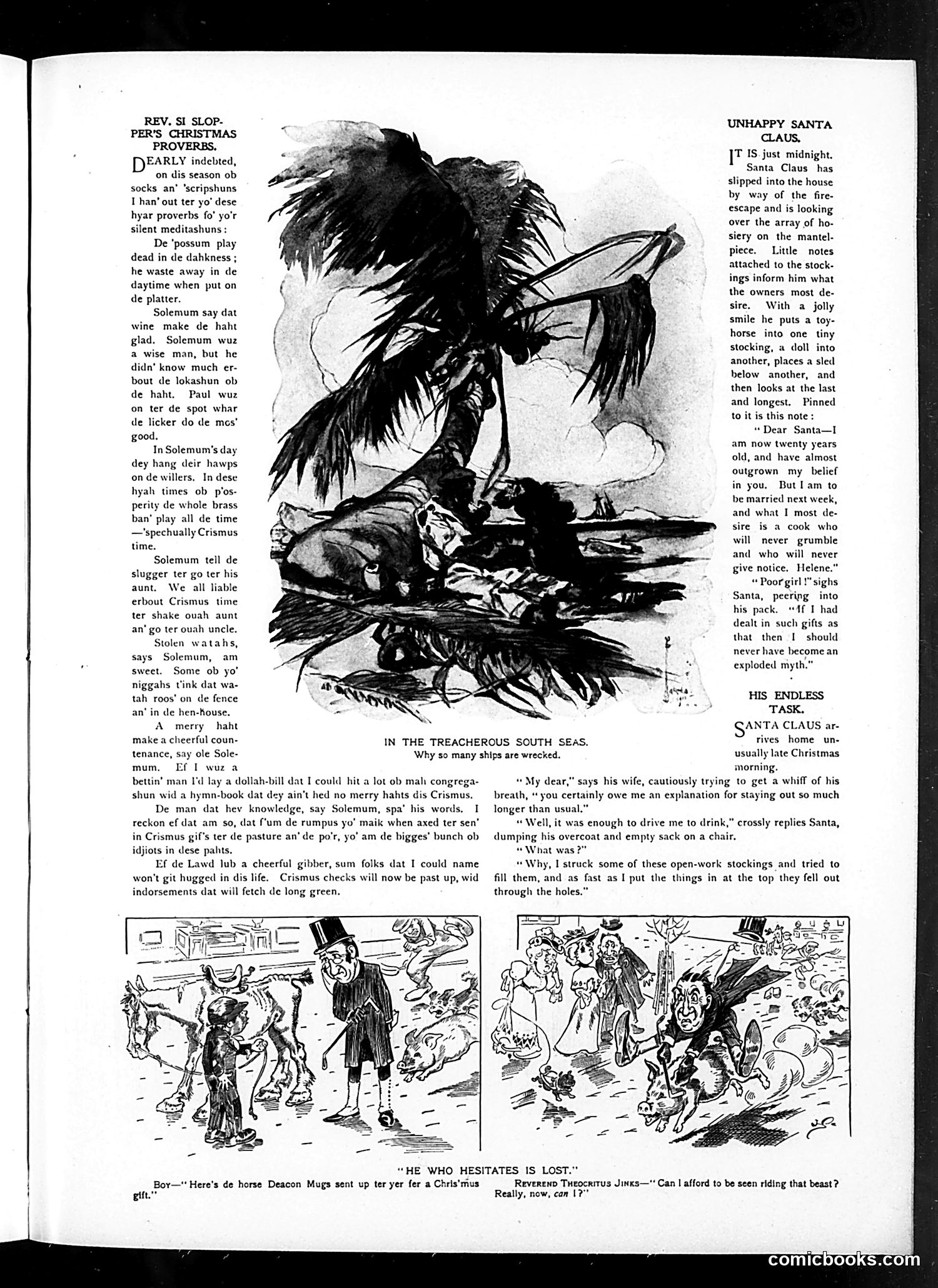
This page contains three satirical pieces: **"Rev. Si Slop's Christmas Proverbs"** (left): A racist dialect piece mocking African American speech, presenting pseudo-biblical wisdom about Christmas charity. The satire targets both the hypocrisy of those who don't give generously and stereotypes the Black community. **"Unhappy Santa Claus"** (center/right): Two related cartoons about Santa's impossible task. The first shows a young woman requesting an eternally cheerful, reliable cook—an impossible gift that makes Santa realize his "exploded myth" status. The second depicts Santa complaining to his wife about open-work stockings where gifts fall through. The satire comments on impossible domestic expectations and the absurdity of certain Christmas wishes. **"He Who Hesitates Is Lost"** (bottom): Shows a Black reverend reluctant to ride a horse gifted by a deacon, apparently concerned about his dignity or appearance. The satire likely mocks either clerical pretension or racial social anxieties of the era. The overall page reflects Judge's typical late-19th/early-20th-century editorial voice: satirizing social hypocrisy, gender relations, and class anxiety, relying heavily on racial stereotyping.
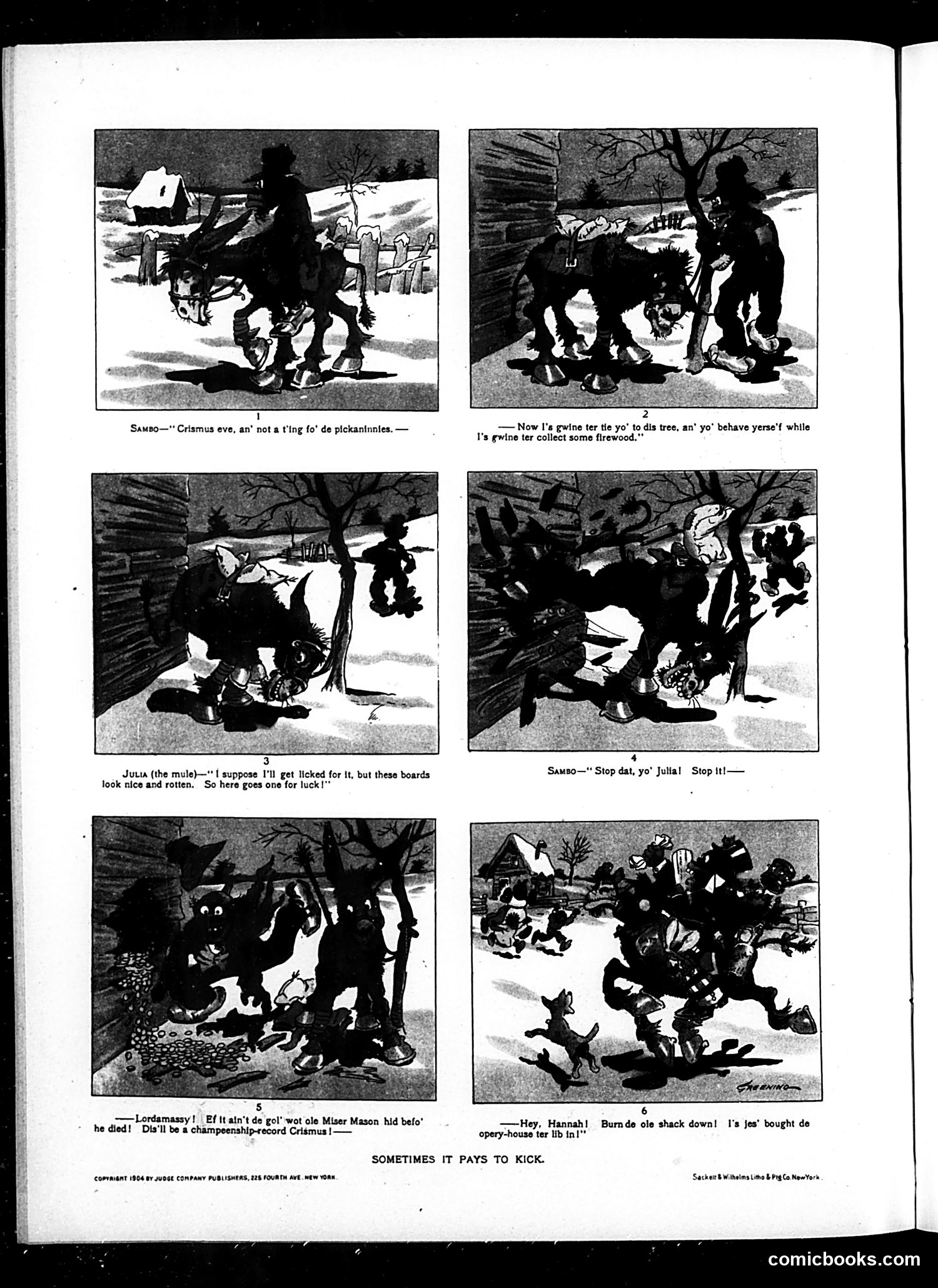
This six-panel comic strip uses racist stereotypes typical of early 1900s American humor. The story follows characters named "Sampo" and "Julia" (a mule) during Christmas ("Crismus"). The narrative: Sampo leaves Julia tied to a tree while collecting firewood. The mule kicks through rotting boards, accidentally breaking into a hiding spot where a miser had concealed gold before dying. The discovery leads to a chaotic celebration where the characters find enough wealth to "buy de opery-house ter lib in." **The satire**: The joke plays on the idea that unintelligent characters accidentally stumble into fortune through destructive behavior—hence the title's pun about kicking literally and figuratively "paying off." The dialect and characterization reflect deeply offensive minstrelsy conventions of the era. The comic relies entirely on racial caricature for humor, depicting African American characters in subordinate positions using exaggerated dialect.
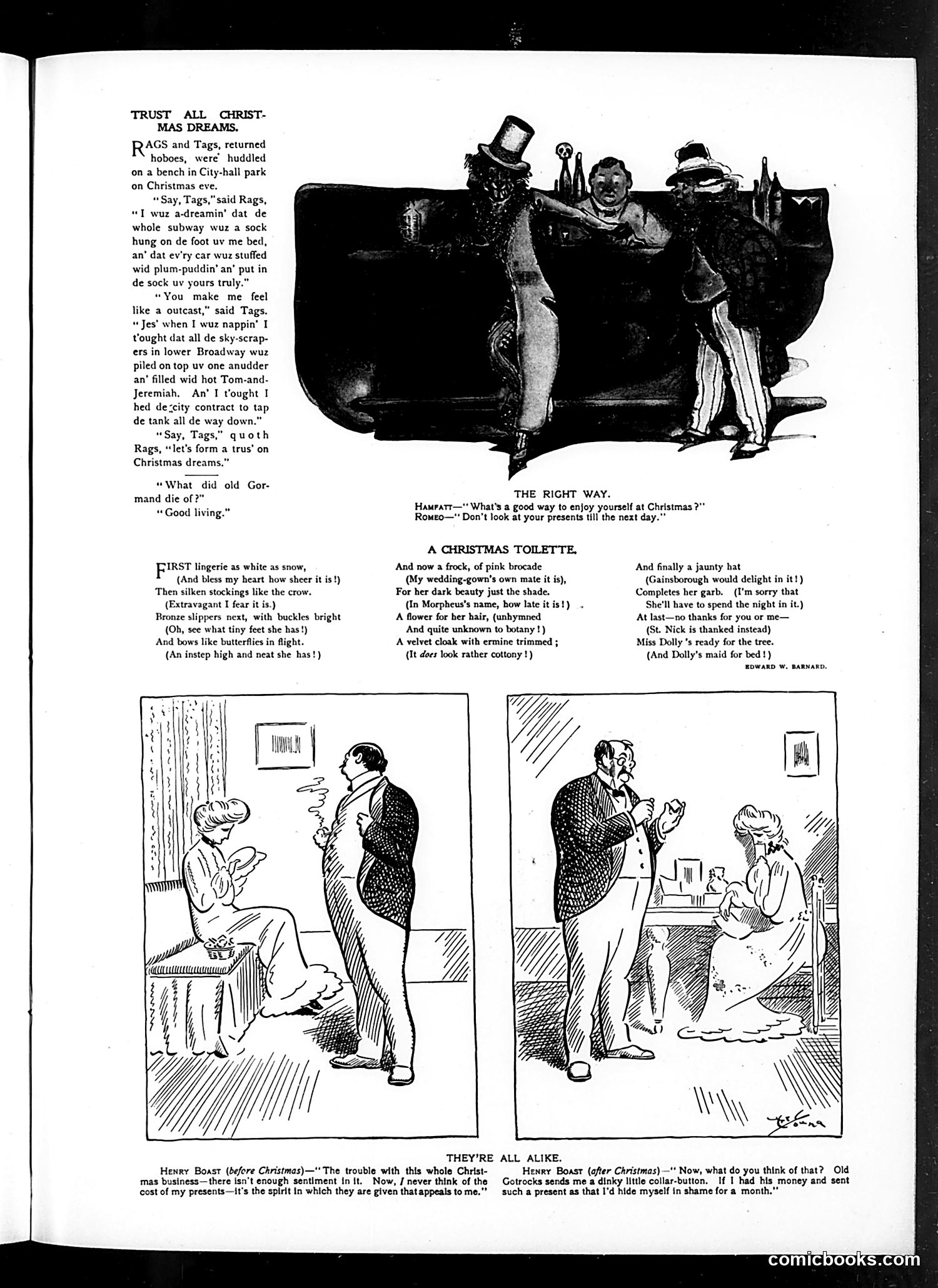
This page contains Christmas-themed humor typical of early 20th-century satire. **Top section ("Trust All Christmas Dreams"):** Two homeless men ("Rags" and "Tags," written in exaggerated dialect) sitting on a park bench share whimsical Christmas fantasies—one imagines the subway as a stocking filled with plum pudding; the other envisions skyscrapers stacked and filled with hot drinks. They propose forming a "trust on Christmas dreams," a wry joke about trusts (monopolistic business combinations) applied to shared poverty and hope. **Middle sections:** A poem about a woman's elaborate Christmas dressing, and a brief joke about enjoying Christmas (contrasting "good living" with delaying gift-opening). **Bottom cartoons ("They're All Alike"):** Two panels showing Henry Boast before and after Christmas. Before: he claims presents' value lies in "spirit," not cost. After: he complains that a wealthy friend (Gotrocks) sent him a cheap collar-button, revealing his hypocrisy about materialism. The satire critiques wealthy people's self-serving attitudes toward gift-giving and Christmas sentiment.
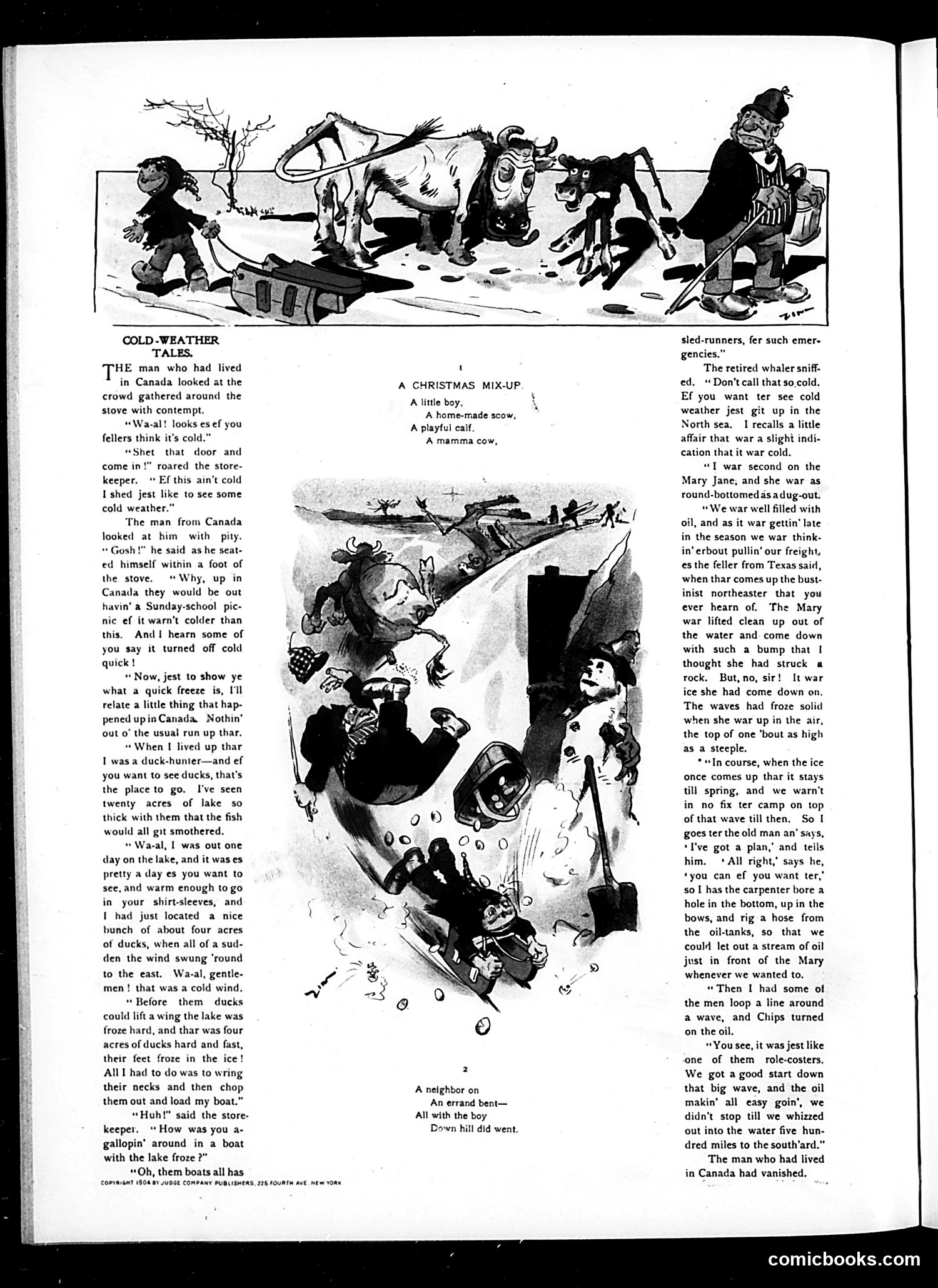
This page contains humorous tall tales about extreme cold weather. The top cartoon shows a chaotic Christmas scene where a boy, homemade sled, playful calf, mama cow, and a neighbor on an errand all tumble down a hill together—a visual pun on "Christmas mix-up." The main text features a storytelling competition among men gathered around a stove. A Canadian man boasts about freezing so severe that ducks freeze solid mid-flight in the ice. A retired whaler then one-ups him with an even more outlandish tale: his ship was lifted completely out of water by frozen waves and he used heated oil to slide down the ice like a roller coaster for "five hundred miles." The satire mocks masculine braggadocio and exaggeration—each man tries to top the previous speaker's implausible story. The Canadian's sudden disappearance at the end suggests he's been defeated by the whaler's absurdity, humorously ending the competition. This represents period American folk humor celebrating tall tales and frontier exaggeration.
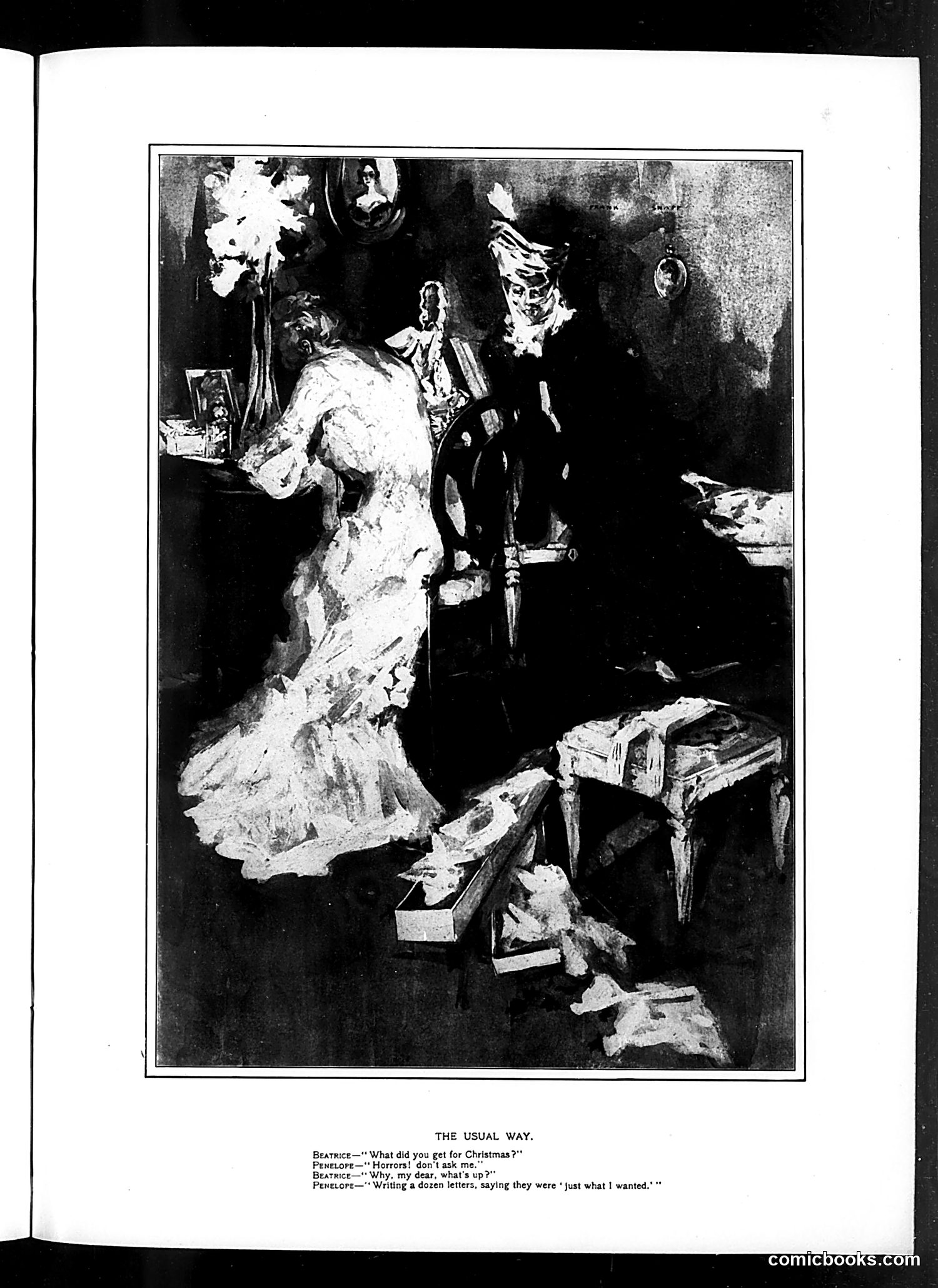
This cartoon satirizes the social obligation of insincere thank-you letters. Two women—Beatrice and Penelope—discuss Christmas gifts. Penelope received unwanted presents but must now write formal thank-you notes falsely claiming satisfaction ("just what I wanted"). The joke targets the hypocrisy of obligatory politeness: the recipient must lie in writing to the giver, pretending genuine appreciation for gifts she doesn't want. The cartoon's title, "The Usual Way," suggests this dishonest performance is standard social convention among the upper-class women depicted. This reflects early 20th-century etiquette expectations where maintaining appearances and social niceties outweighed honesty.
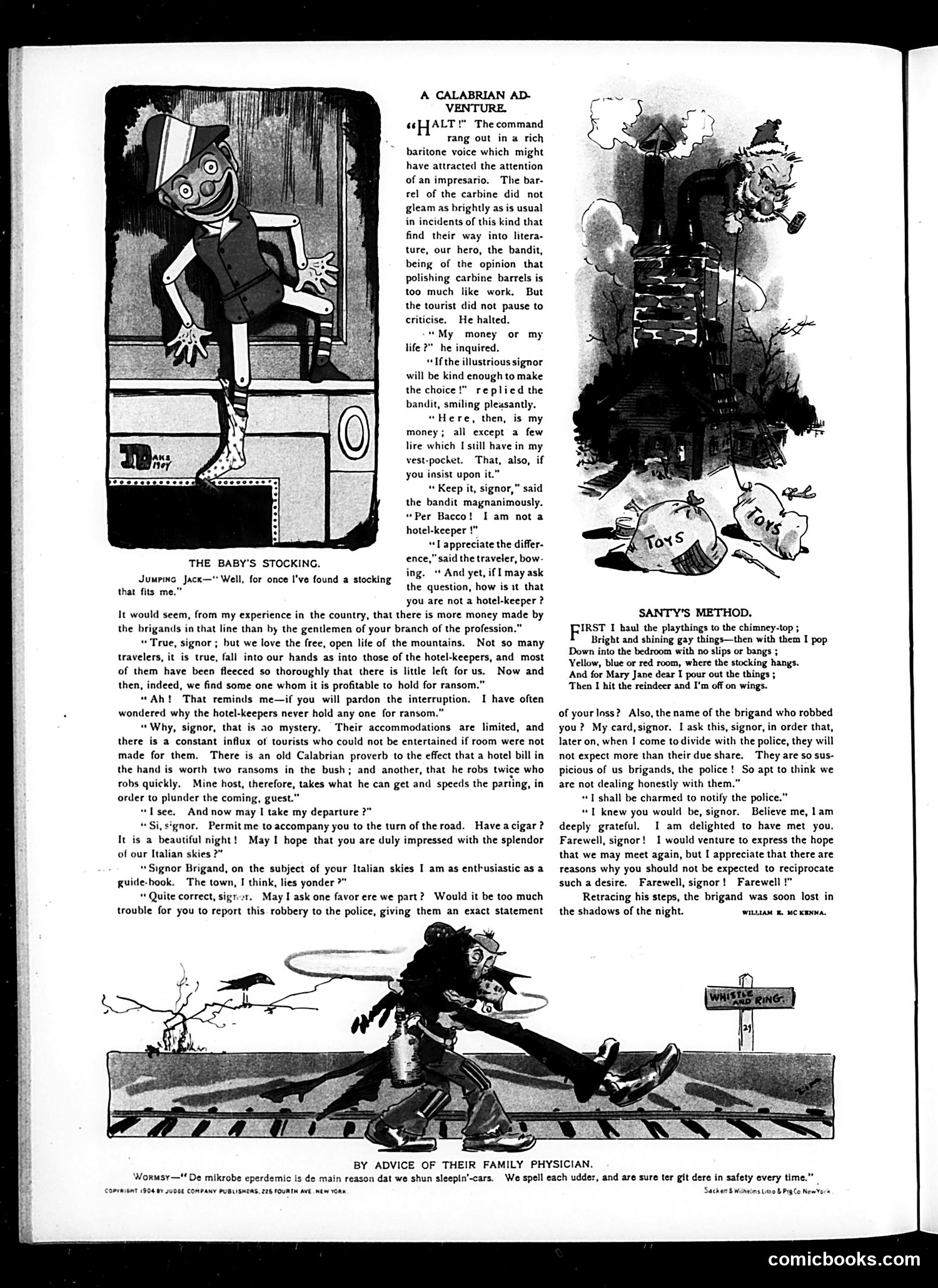
This satirical story-cartoon mocks Italian hotels and brigands as equally predatory toward tourists. A well-mannered bandit robs a traveler in Calabria (southern Italy), but their exchange reveals the bandit's "honest" philosophy: he steals only what tourists can afford to lose, unlike hotel-keepers who systematically fleece visitors before ejecting them to rob the next guests. The satire's point: Italian hoteliers are worse criminals than actual brigands—at least bandits are transparent about robbery, while hotels disguise exploitation as legitimate business. The brigand even requests the traveler report the robbery to police, wanting credit for "honest dealing" compared to hospitality fraud. The smaller cartoons ("Baby's Stocking," "Santy's Method") are unrelated holiday-themed pieces.
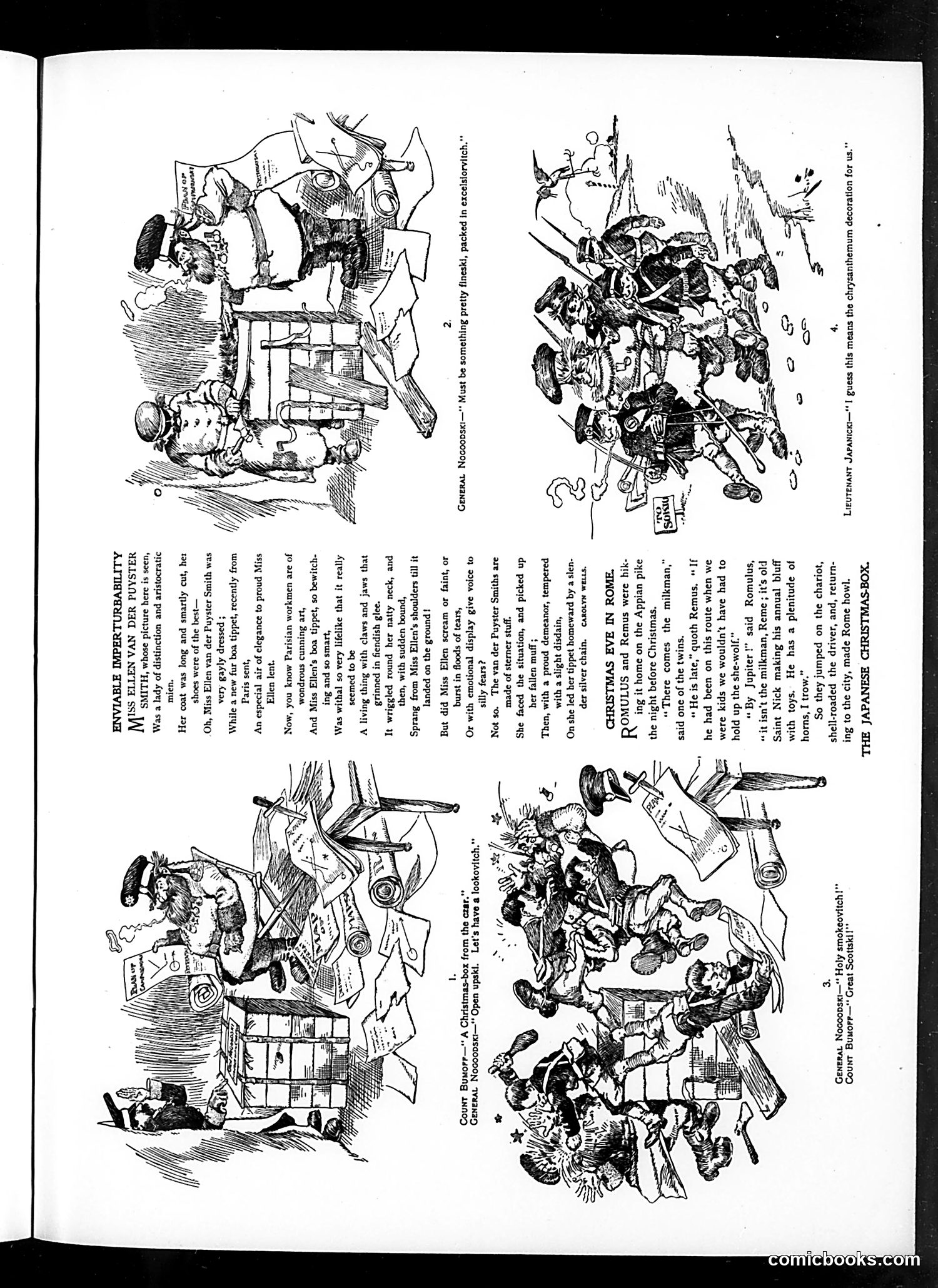
The OCR text is too degraded to read reliably, so I'll focus on what the images show. This page contains four satirical cartoon panels in the style of late-19th or early-20th century American political humor. The drawings depict chaotic domestic scenes with multiple figures engaged in violent or destructive behavior—fighting, throwing objects, and generally creating mayhem in home settings. The cartoons appear to be social satire targeting working-class or immigrant family life, using exaggeration and caricature to mock domestic violence, drunkenness, or poverty-related disorder. The detailed cross-hatching and frantic composition emphasize the chaos. Without legible text identifying specific figures or events, I cannot definitively state which political figures or contemporary scandals these target. The style suggests commentary on social problems rather than specific politicians, though Judge magazine frequently mixed both types of satire.
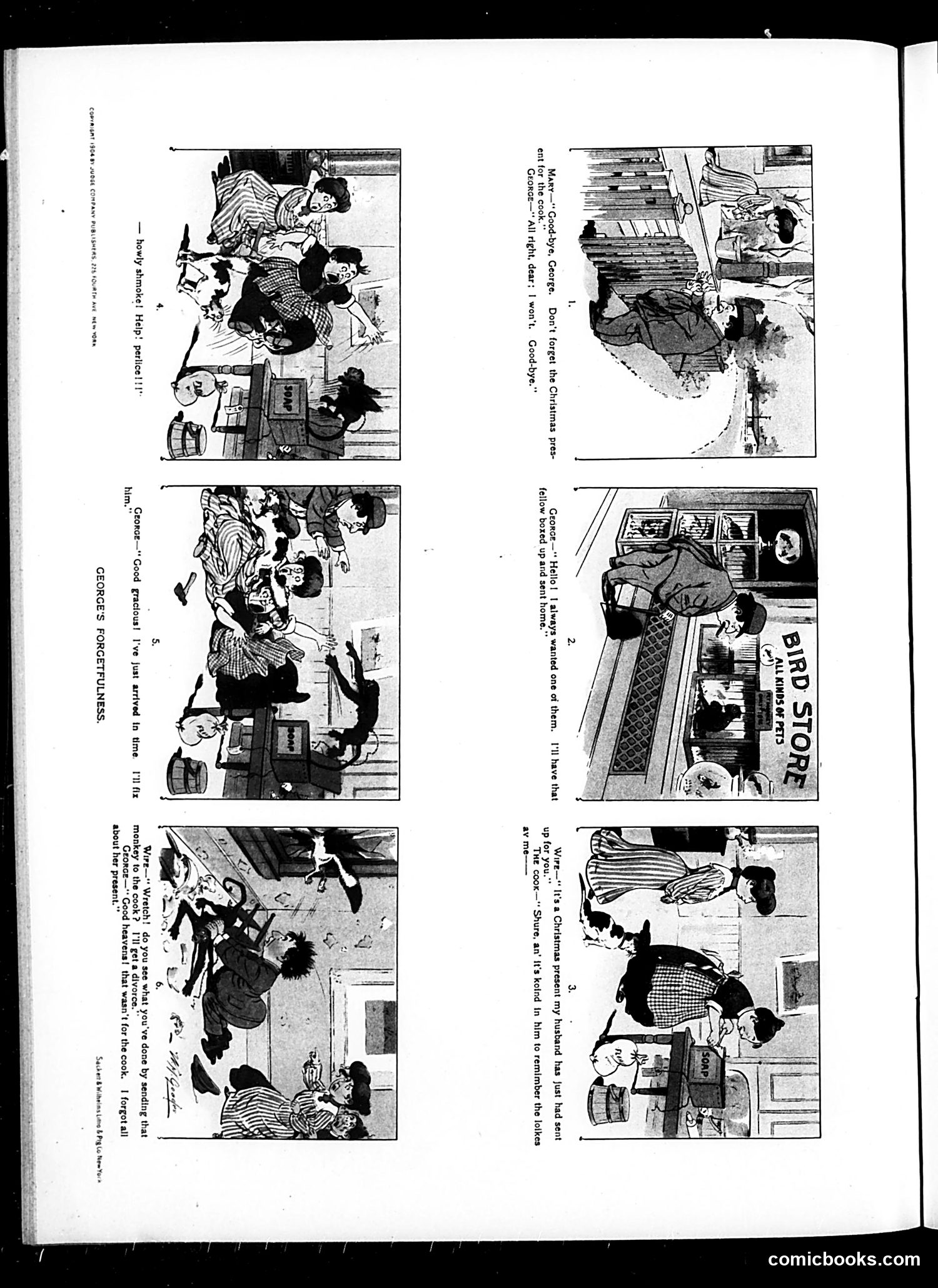
This multi-panel domestic comedy depicts a husband's mishap during Christmas gift-giving. George is instructed to deliver a Christmas present to the cook but forgets. When a live monkey arrives instead (apparently a gift *for* George), chaos ensues in the household. The humor operates on several levels typical of early-20th-century Judge satire: 1. **Class dynamics**: The cook's Irish dialect ("Shure," "kinda") marks her as working-class, while the family speaks standard English—a common comedic device of the era. 2. **Domestic incompetence**: George's forgetfulness and confusion about which gift belongs to whom satirizes male household obliviousness. 3. **Physical comedy**: The monkey's unexpected arrival creates slapstick confusion and panic. The cartoon mocks both marital forgetfulness and the chaos of gift-giving, using ethnic humor and class distinctions as supporting comedic elements typical of the period.
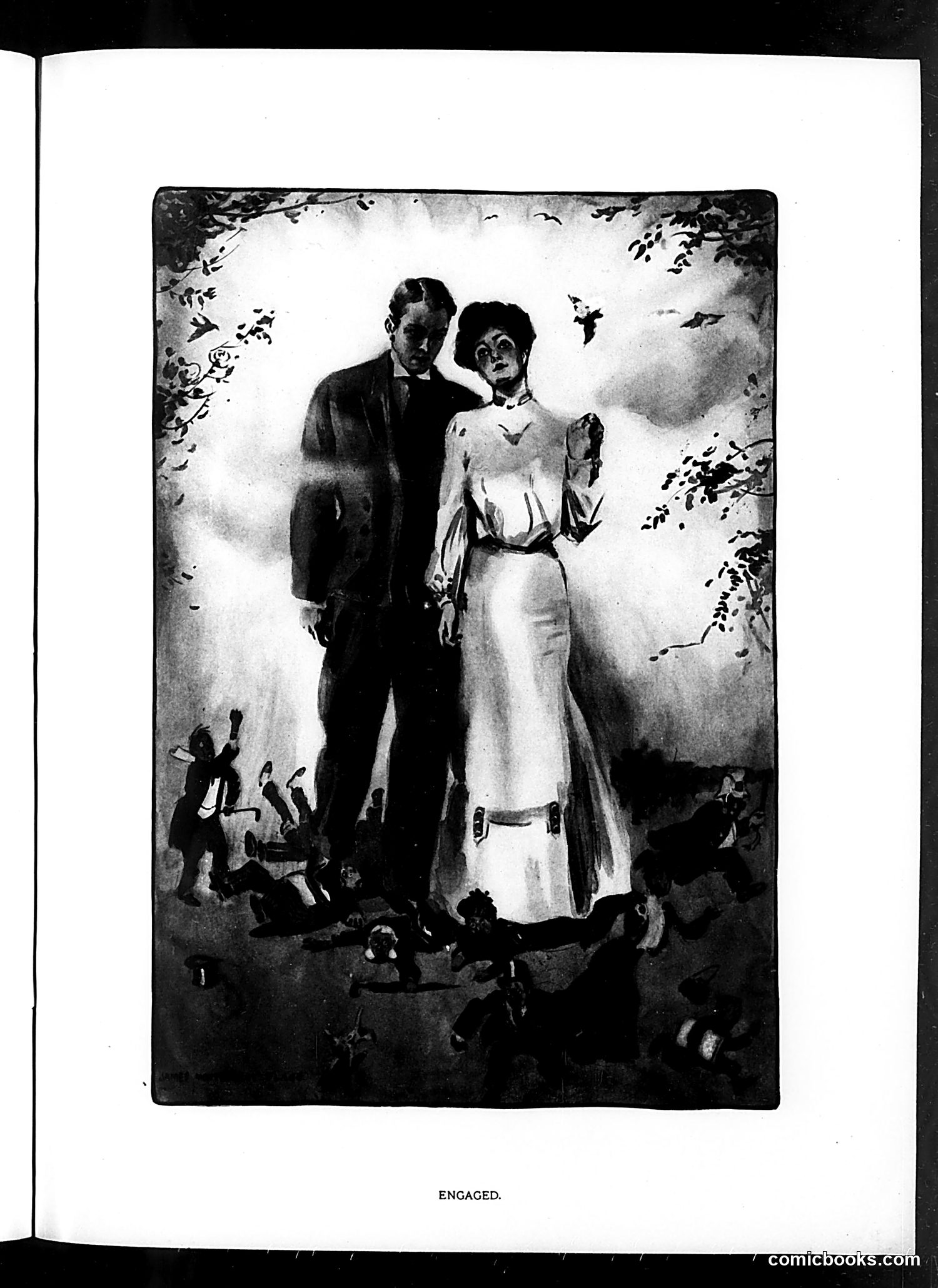
This illustration depicts a couple in an engagement scene, with the woman in a white dress and the man in dark formal attire standing together against a romanticized natural backdrop with foliage. They are surrounded by cherubs or cupids at the bottom of the image. The single-word caption "ENGAGED" suggests this is satirical commentary on courtship and marriage customs. Given Judge magazine's satirical nature, the piece likely mocks romantic idealization of engagement—the elaborate staging, cherubic embellishments, and formal poses all parody the sentimental way society portrayed courtship during this era. The contrast between the grandiose mythological decoration and the stiff, formal poses of the couple may be the intended humor, suggesting the gap between romantic fantasy and reality in marriage customs.
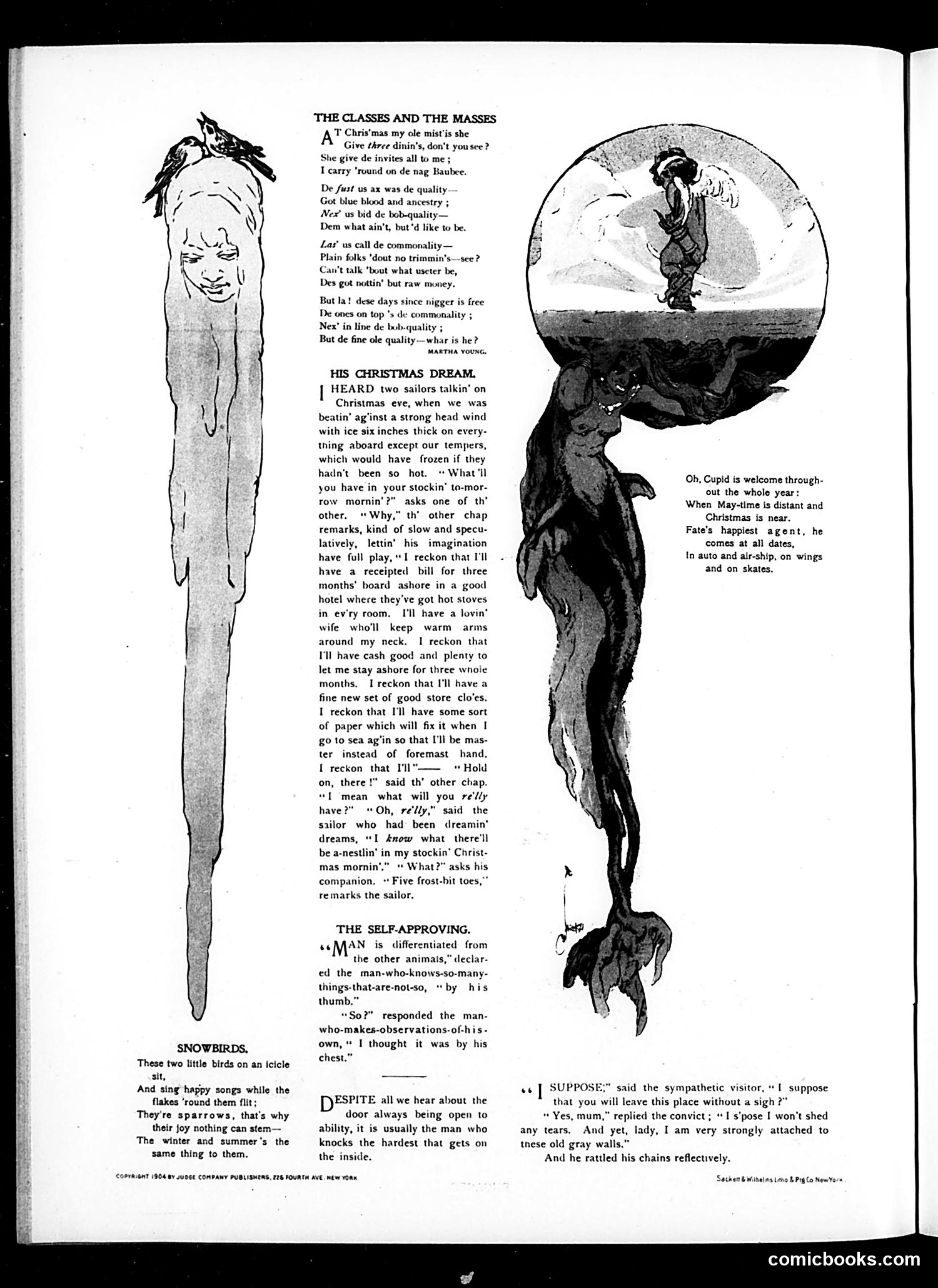
This page contains several distinct satirical pieces reflecting early 1900s American class and social anxieties: **"The Classes and the Masses"** (Martha Young) presents a Black servant's dialect commentary on social hierarchy. The satire critiques how post-emancipation economic mobility has inverted traditional class structures—wealthy "quality" families have declined while the newly moneyed "commonality" now dominate, destabilizing established social order that the magazine's presumably upper-class readers valued. **"His Christmas Dream"** depicts sailors' harsh realities through dark humor: a sailor's elaborate fantasy of shore leave, family, and advancement ends with the grim punchline of frostbite—poverty and suffering are inescapable. **"The Self-Approving"** and the convict piece mock pretension: men who congratulate themselves on minor distinctions, and a prisoner ironically claiming attachment to his chains. The **Cupid poem** offers lighter romantic content. Throughout, Judge satirizes social pretension, class anxiety, and the gap between aspiration and brutal reality in Gilded Age America.
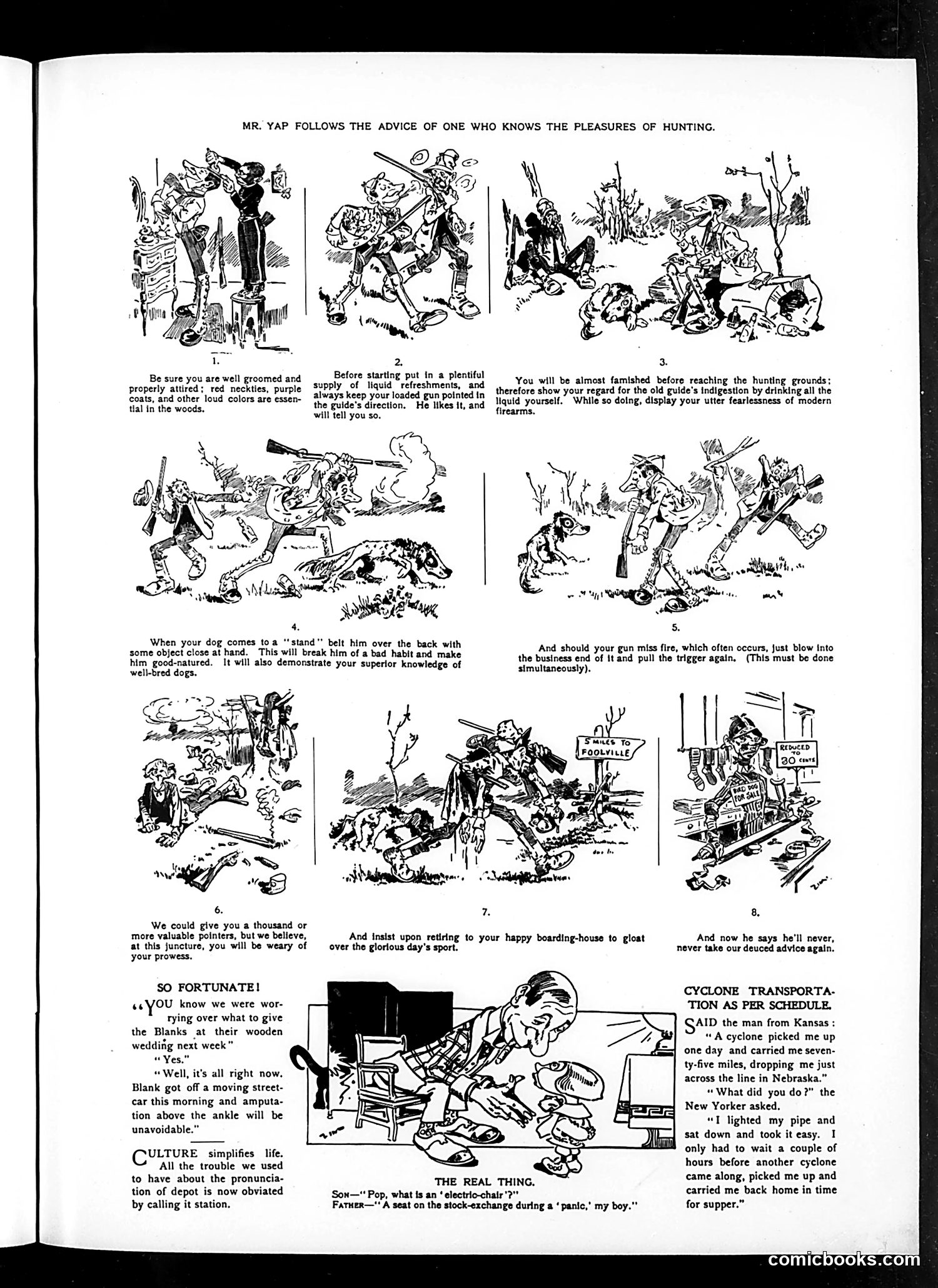
This page satirizes incompetent hunters through Mr. Yap's misadventures. The eight-panel sequence mocks absurd "advice" that actually demonstrates dangerous ignorance: wearing loud colors and getting drunk before hunting, abusing dogs, pointing loaded guns at guides, blowing into gun barrels to clear misfires, and other reckless behaviors. The humor relies on readers recognizing these as obviously wrong practices presented as expert tips. The surrounding satirical pieces mock broader American follies: a cruel joke about amputation as a wedding gift (dark humor typical of the era), confusion of "depot" with "station" as linguistic "progress," and the stock-exchange as an "electric chair" during financial panics—referencing the literal electric chair's recent introduction as execution method. The Kansas cyclone anecdote offers tall-tale humor about frontier resilience. Overall, the page ridicules pretentious incompetence, reckless behavior, and contemporary anxieties about new technology and financial instability.
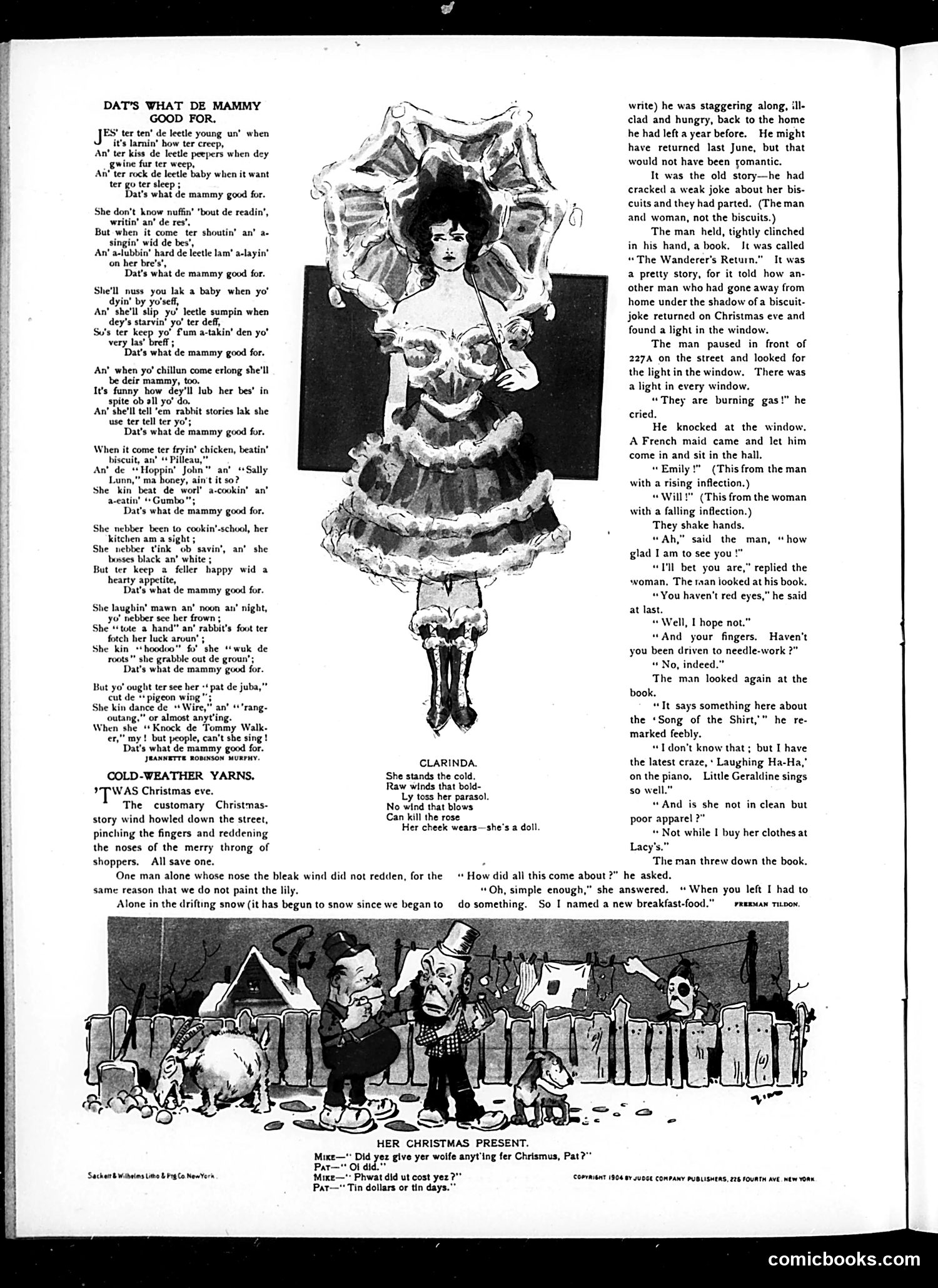
This page contains **racist dialect humor** typical of early-20th-century American publications. **"Dat's What De Mammy Good For"** (left column) is a poem in stereotypical African American vernacular celebrating the nurturing role of Black domestic workers, emphasizing childcare, cooking, and emotional labor while explicitly denying them education. It romanticizes servitude as inherent to Black women's identity. **"Cold-Weather Yarns"** (right) presents sentimental Christmas stories: one about a man returning home after a biscuit-related quarrel with a woman, paralleling a romantic novel he carries. The accompanying cartoon **"Her Christmas Present"** (bottom) shows working-class figures in a humorous exchange about gift-giving, using Irish dialect stereotypes ("yez," "Chrismus"). The **"Clarinda"** poem praises a woman's beauty and composure in winter weather. Together, these pieces reflect Judge's formula: ethnic/racial caricature paired with sentimental or comedic domestic narratives, all intended as entertainment for a presumably white, middle-class readership.
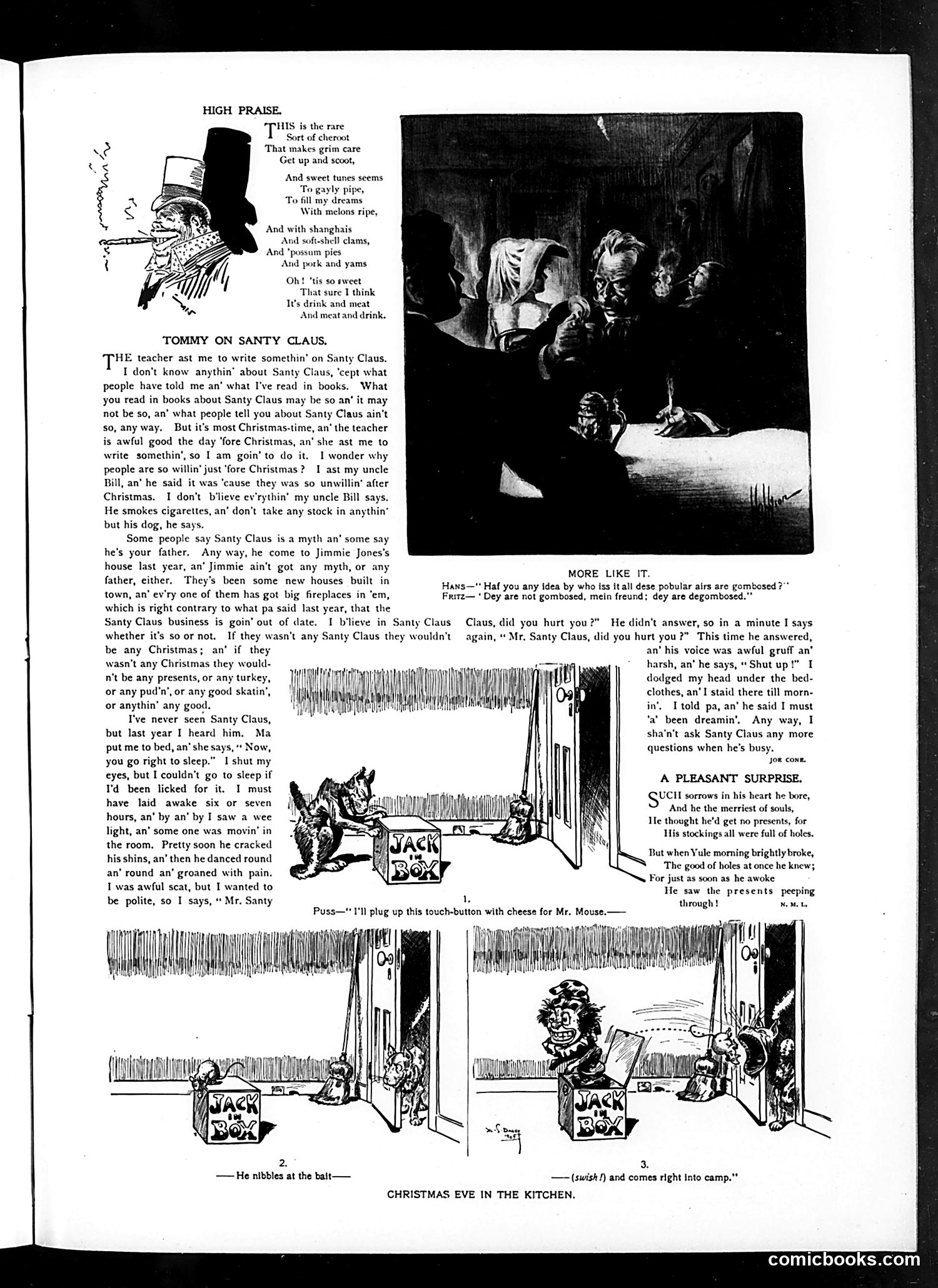
This page contains three distinct pieces of Christmas-themed humor typical of Judge's satirical approach: **"Tommy on Santy Claus"**: A dialect monologue by a working-class child skeptically discussing Santa Claus. The humor relies on authentic vernacular speech and the boy's pragmatic reasoning—he believes in Santa because Christmas wouldn't exist without him, yet he's skeptical of adults' claims. The child's encounter with an injured "Santa" (likely his father) is presented as darkly comedic. **"More Like It"**: A brief joke featuring what appears to be German immigrants (indicated by the dialect spelling "iss," "gombosed," "dey," "mein freund"), playing on ethnic humor common to the era. The wordplay involves musical composition terminology. **"A Pleasant Surprise" and "Christmas Eve in the Kitchen"**: A short poem about poverty and a comic strip showing a mouse trap, both involving modest Christmas expectations and gentle domestic humor. The overall tone reflects Judge's blend of class-conscious observation, ethnic humor, and sentimental Americana characteristic of early 20th-century American satire.
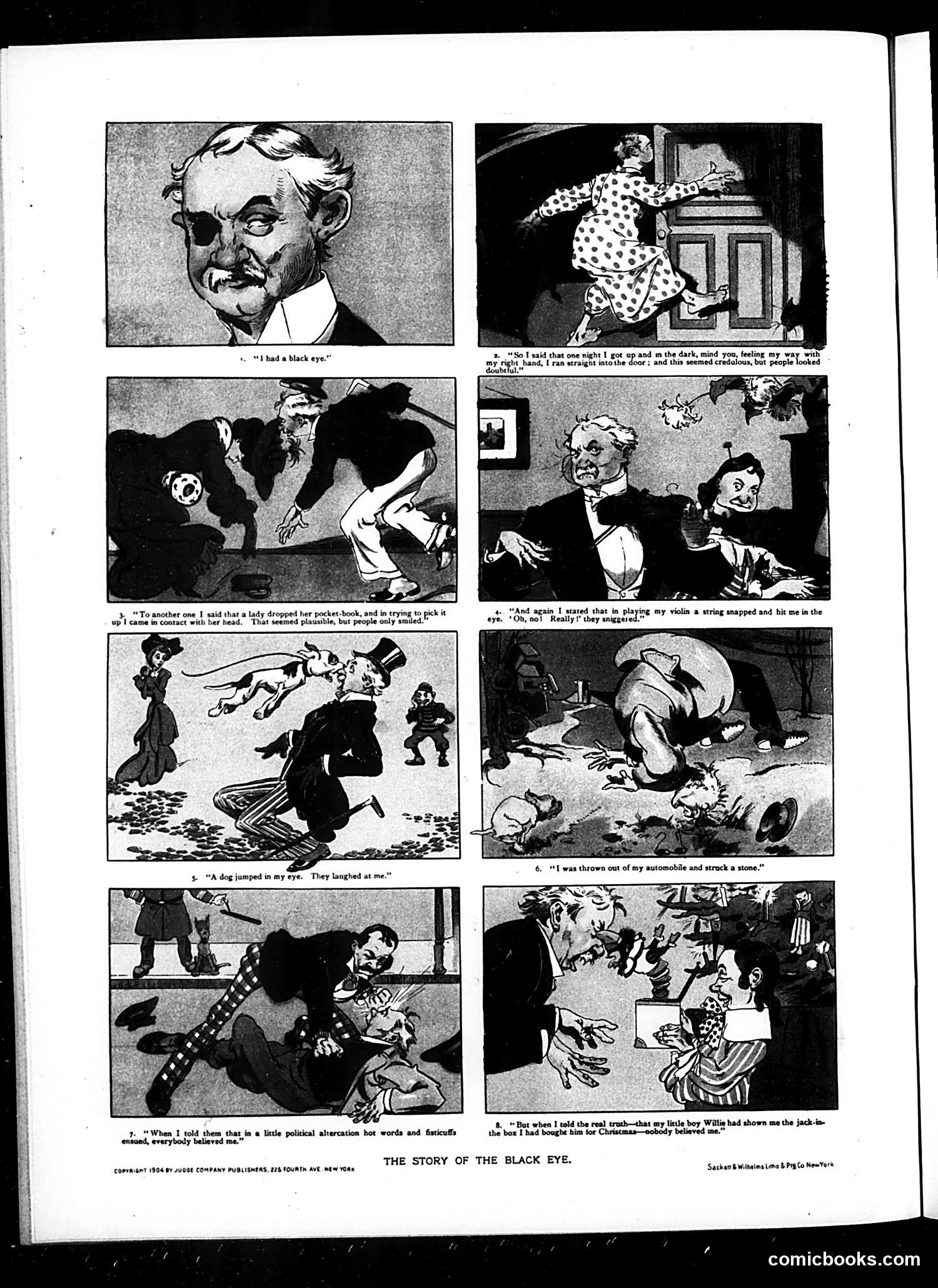
This 1904 Judge comic tells a satirical story about credibility and truth-telling. A man with a black eye recounts various implausible excuses (running into a door in the dark, a lady's dropped purse, a violin string) that people skeptically dismiss. However, when he finally tells the *actual* truth—that a toy jack-in-the-box his young son Willie received as a Christmas gift caused the injury—nobody believes him. The satire mocks human nature: absurd lies seem more plausible than mundane reality. The punchline critiques how people's expectations and biases shape what they'll accept as true. It's also gently mocking the earnestness of children's toys and domestic accidents, treating them as inherently unbelievable compared to more dramatic scenarios. The crude, exaggerated caricatural style was typical of Judge's visual humor in this era.
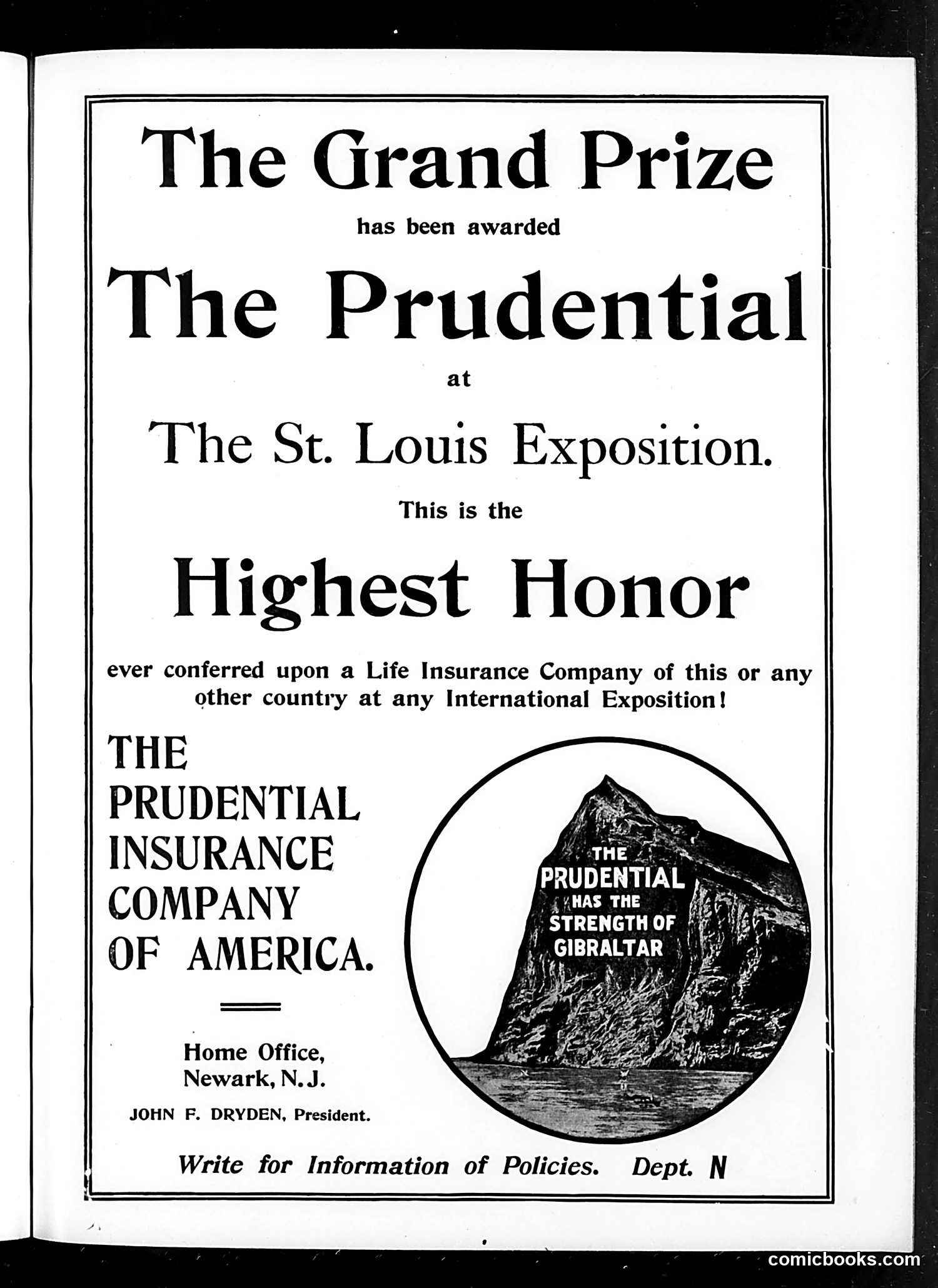
This is a **full-page advertisement**, not a cartoon or satire. It announces that The Prudential Insurance Company of America won the Grand Prize at the 1904 St. Louis Exposition—claimed as the highest honor ever given a life insurance company at an international exposition. The page features The Prudential's famous logo: the Rock of Gibraltar with the company motto "The Prudential has the strength of Gibraltar." This iconic symbol emphasized financial stability and reliability—important messaging for an insurance company seeking customer trust. The ad identifies John F. Dryden as President and lists the home office in Newark, New Jersey. It's a straightforward promotional piece leveraging the prestigious world's fair award to build brand credibility, with a call-to-action inviting readers to request policy information.
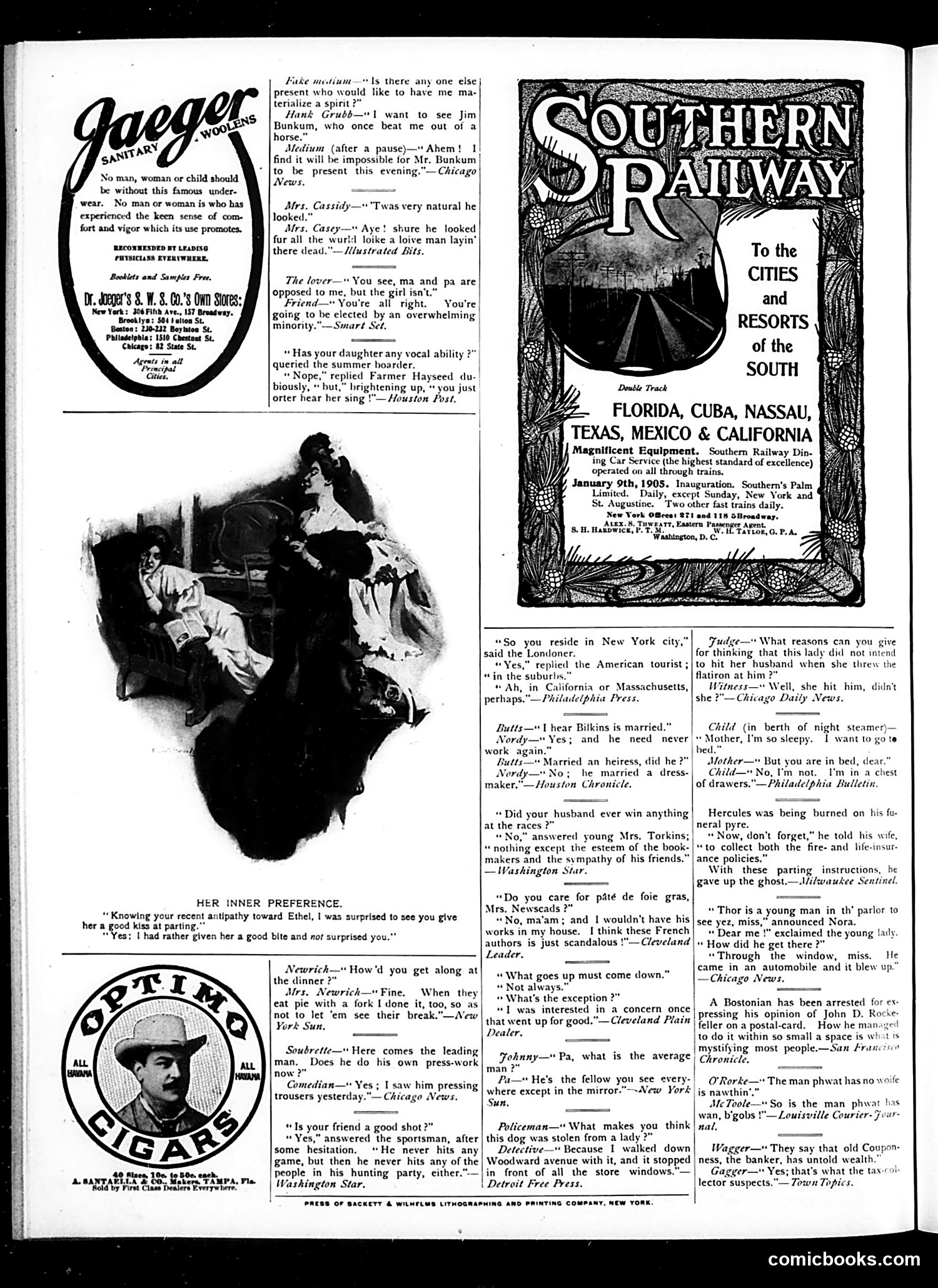
This page from *Judge* (circa 1905) is primarily **advertising and humor snippets** rather than political cartooning. **Main Content:** The page features brief, unrelated jokes and quips typical of early 1900s humor magazines. Topics include a spiritualist séance scam, rural dialect humor, social climbing ("Newrich"), marital discord, and observational jokes about hunting and New York suburbs. **Key Advertisement:** A large **Southern Railway ad** promoting winter tourism to Florida, Cuba, and Mexico—reflecting the era's growing leisure travel industry. **Social Context:** The humor reflects period attitudes: mockery of nouveau riche pretension, rural/immigrant dialect comedy (considered acceptable entertainment), cynicism about marriage and gambling, and class-based observations. The spiritualist joke suggests skepticism toward fraudulent mediums—a common con of that era. **Notable:** One joke's punchline about preferring to bite rather than kiss reveals caustic domestic sentiment typical of the era's satirical magazines. The page lacks sustained political commentary or identified caricatures of specific public figures.
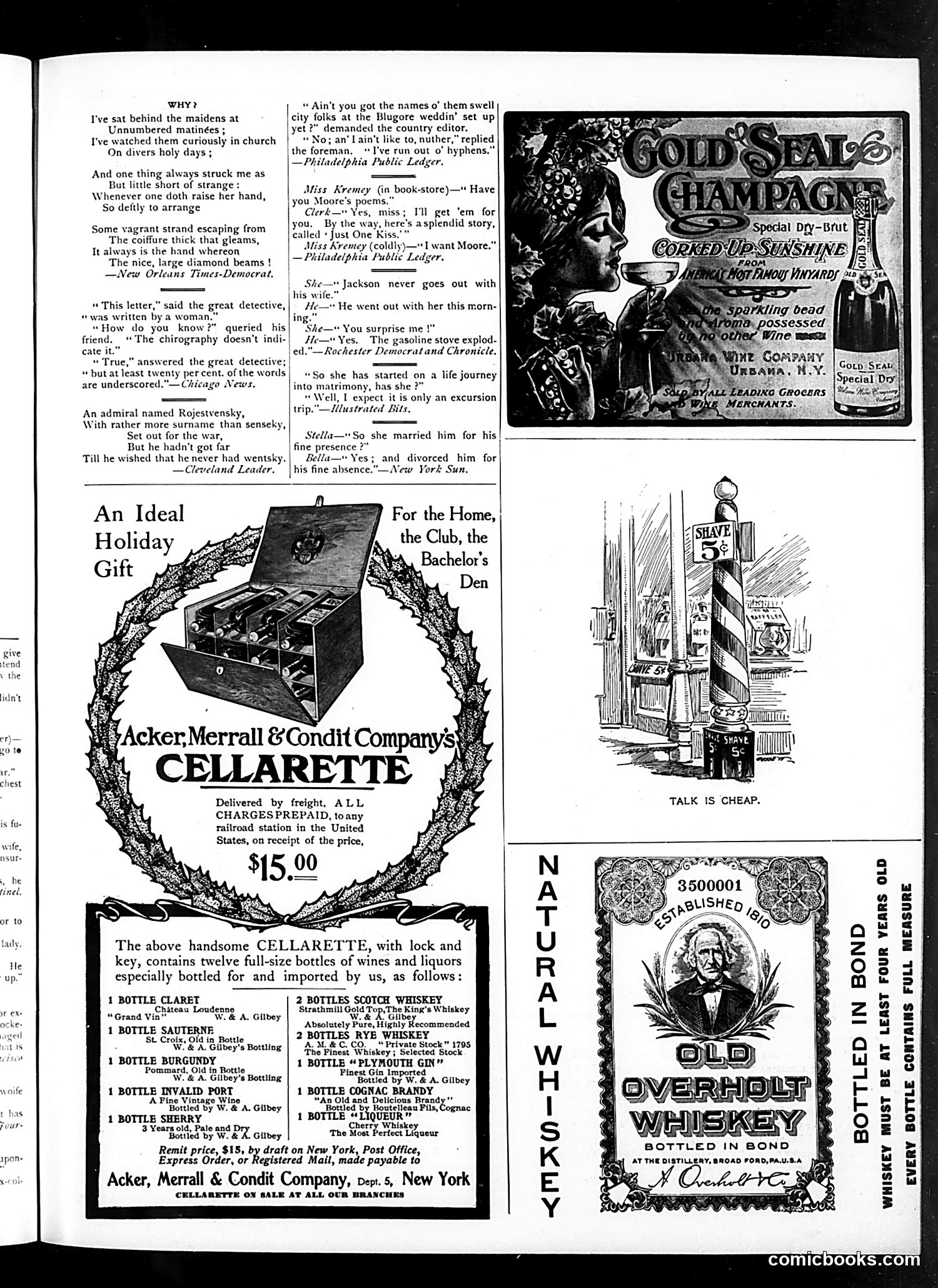
This page is primarily **advertising with humorous filler content**. The main advertisement promotes Acker, Merrill & Condit Company's "Cellarette"—a decorative wooden case containing twelve bottles of imported wines and liquors, priced at $15 with free shipping. The surrounding content consists of short humorous verses and jokes typical of Judge magazine's satirical style: - Jokes about women raising their hands to show off diamond rings - A limerick mocking Admiral Rojestvensky (likely referencing the Russian-Japanese War era) - Puns on names ("Moore's poems," "Miss Kremey") - Domestic humor about marriages and infidelity The barber pole advertisement and whiskey label are additional period advertisements. The content reflects early 20th-century American middle-class concerns: materialism, romance, matrimonial discord, and luxury consumption. The humor is gentle and largely apolitical, relying on wordplay and social observation rather than satirizing specific public figures or events.
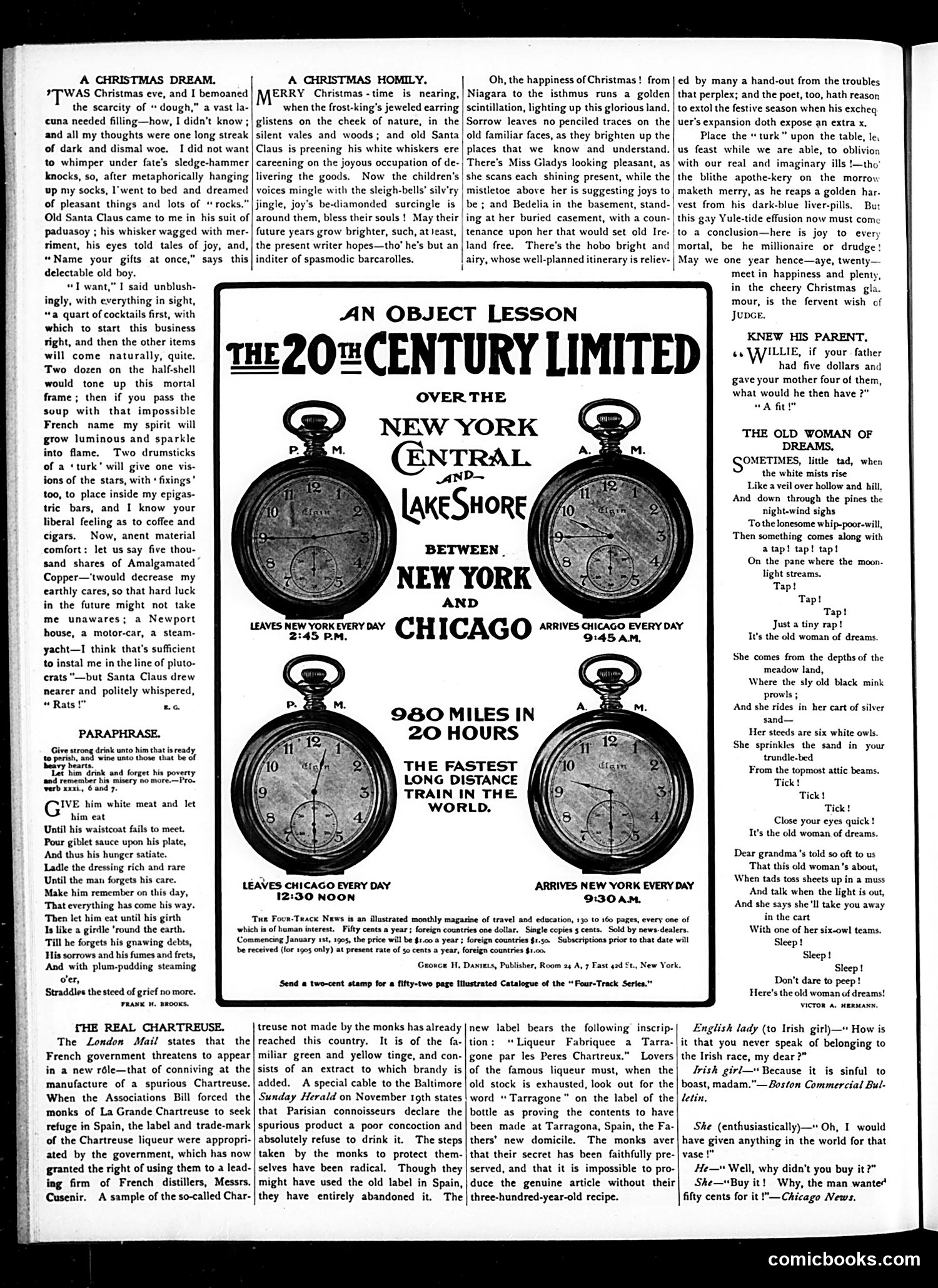
This page contains Christmas-themed satirical content satirizing wealth inequality and American materialism in the early 20th century. **"A Christmas Dream"** mocks a poor man's fantasy where Santa Claus grants extravagant wishes: cocktails, fine dining, stocks in Amalgamated Copper, a Newport house, motorcar, and yacht. When the dreamer finishes his wish list, Santa simply whispers "Rats!"—deflating the fantasy. The satire targets both the dreamer's unrealistic expectations and the era's obsession with conspicuous consumption. **"Paraphrase"** presents biblical wisdom about feeding the poor and hungry during Christmas, contrasting sharply with the preceding materialistic fantasy—suggesting the moral gap between Christian charity and actual Gilded Age behavior. The **railroad advertisement** for the "20th Century Limited" appears on the same page, ironically juxtaposing luxury travel promotion with satirical commentary on wealth. The piece critiques American class anxieties and the gap between holiday ideals of generosity and the era's actual economic disparities.
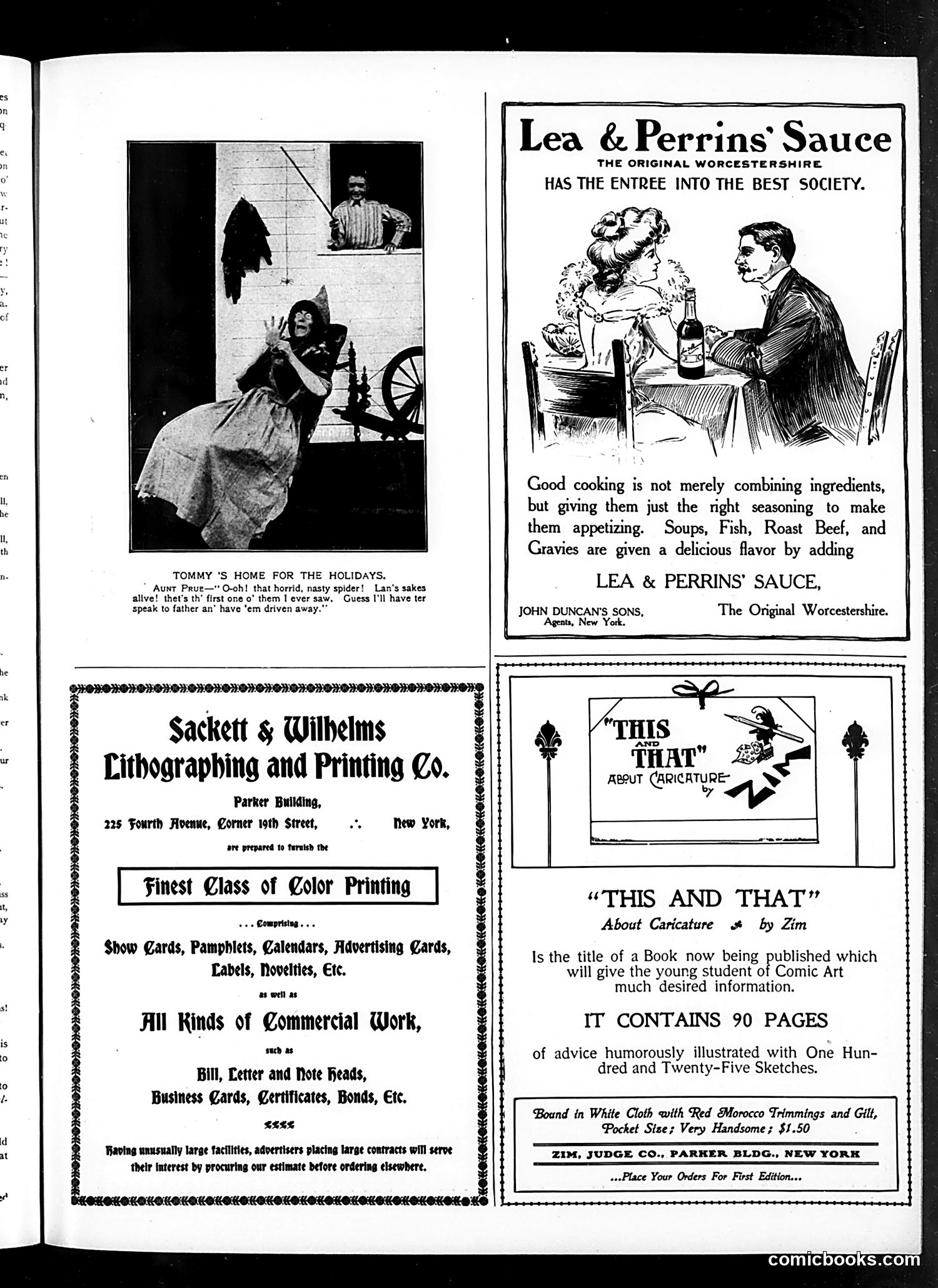
This page is primarily **advertising**, not political satire. It contains four commercial advertisements interspersed with one small cartoon. The cartoon "Tommy's Home for the Holidays" shows a rural woman (Aunt Prue) discovering a spider and planning to have her father eliminate it—a lighthearted domestic scene reflecting early 20th-century rural life and attitudes toward household pests. The advertisements include: - **Lea & Perrins Sauce**: A Worcestershire sauce ad claiming their product grants access to "best society"—suggesting that proper seasoning signals social refinement - **Sackett & Wilhelms**: A lithography/printing company - **"This and That" book**: A humor/caricature instruction manual by artist Zim The page reflects advertising conventions of the era, using humor and social aspiration to market consumer products. The spider cartoon likely appealed to rural readers familiar with such domestic concerns. The Lea & Perrins ad humorously equates condiment use with social status.
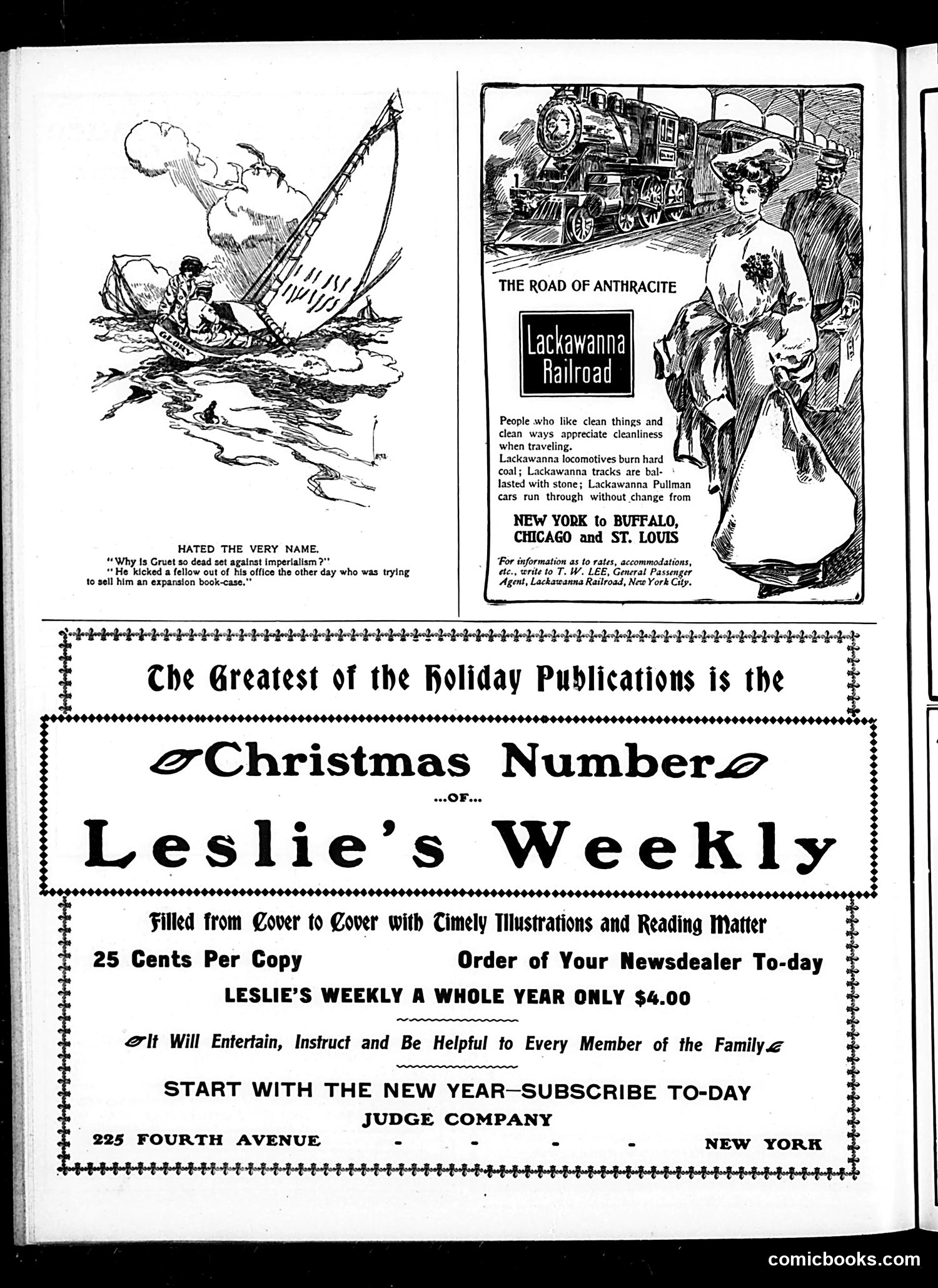
This page consists primarily of **advertisements** rather than satirical content. The top left contains a small cartoon joke about imperialism: a character named Gruet opposes "expansion" so vehemently he fired an employee trying to sell him an "expansion book-case"—a pun conflating furniture with American imperial expansion, a politically contentious issue of the era. The Lackawanna Railroad advertisement (top right) emphasizes cleanliness and modernity as selling points, featuring an elegant train and well-dressed passengers. The bulk of the page promotes Leslie's Weekly's **Christmas Number** and yearly subscription—standard magazine advertising. The text promises "timely illustrations and reading matter" for family entertainment. This appears to be a back-of-magazine advertising page, likely from an early 20th-century issue of Judge. The small imperialism joke is the only actual satirical content; the rest serves commercial purposes.
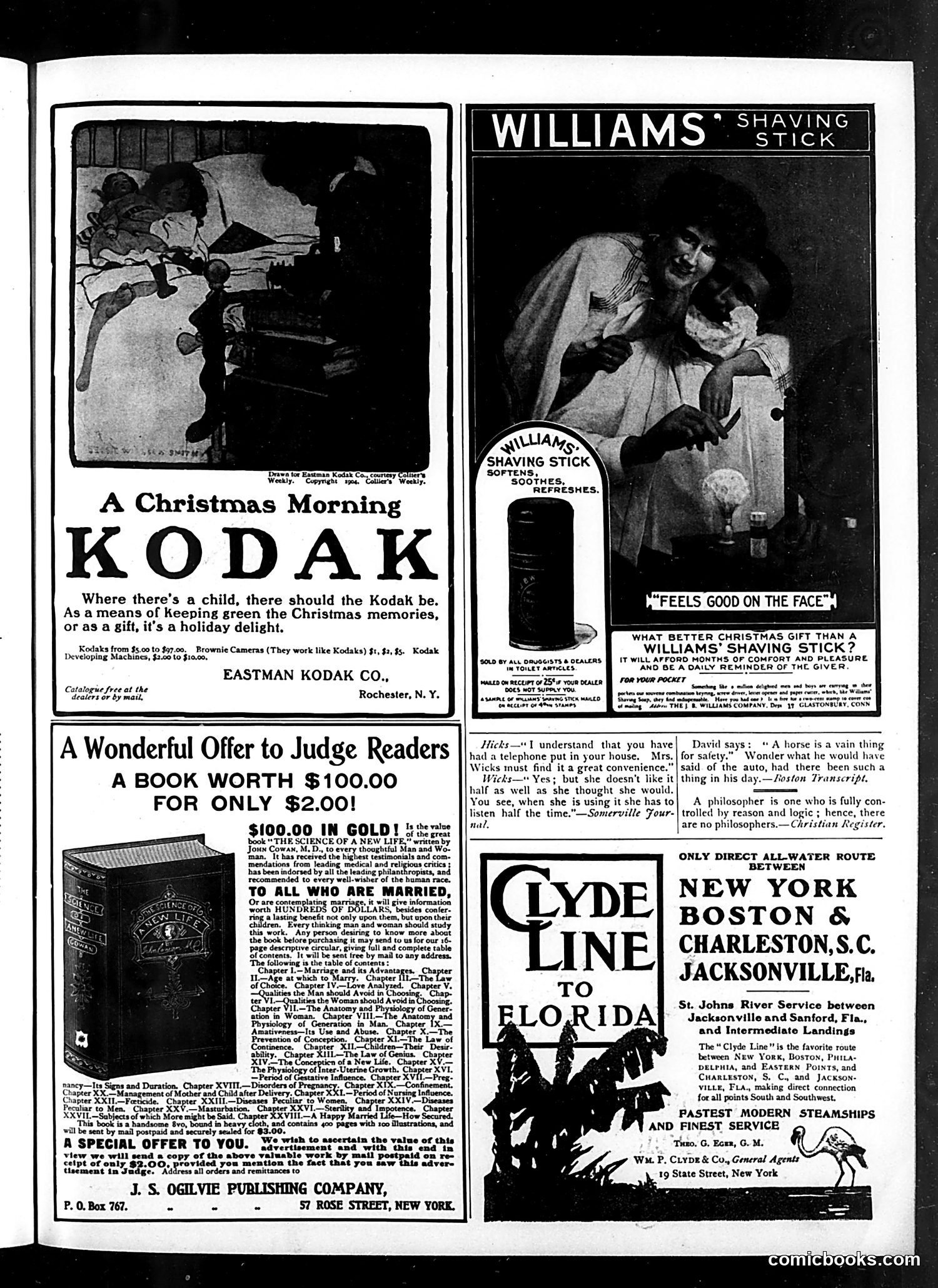
This page is primarily **advertisements** rather than editorial content or satire, typical of Judge magazine's revenue model. The ads include: - **Kodak cameras** (top left): Christmas gift messaging for photography equipment - **Williams' Shaving Stick** (top right): Men's grooming product marketed as holiday gift - **"The Science of a New Life"** (center-left): A medical book by John Cowan, M.D., promoted as valuable for married couples—likely addressing sexual/reproductive health, a sensitive but commercially successful topic of the era - **Clyde Line shipping** (right): Steamship service advertising routes to Florida and Charleston The small **text snippets** scattered between ads appear to be brief humorous observations (jokes about telephones and marriage, horses vs. automobiles) filler content typical of Judge's satirical format. **For modern readers:** This reflects early 1900s consumer culture—photography was still novel technology; grooming products were marketed directly; and frank medical/marital advice books sold through magazine advertisements, all normalized commercial practices of the period.
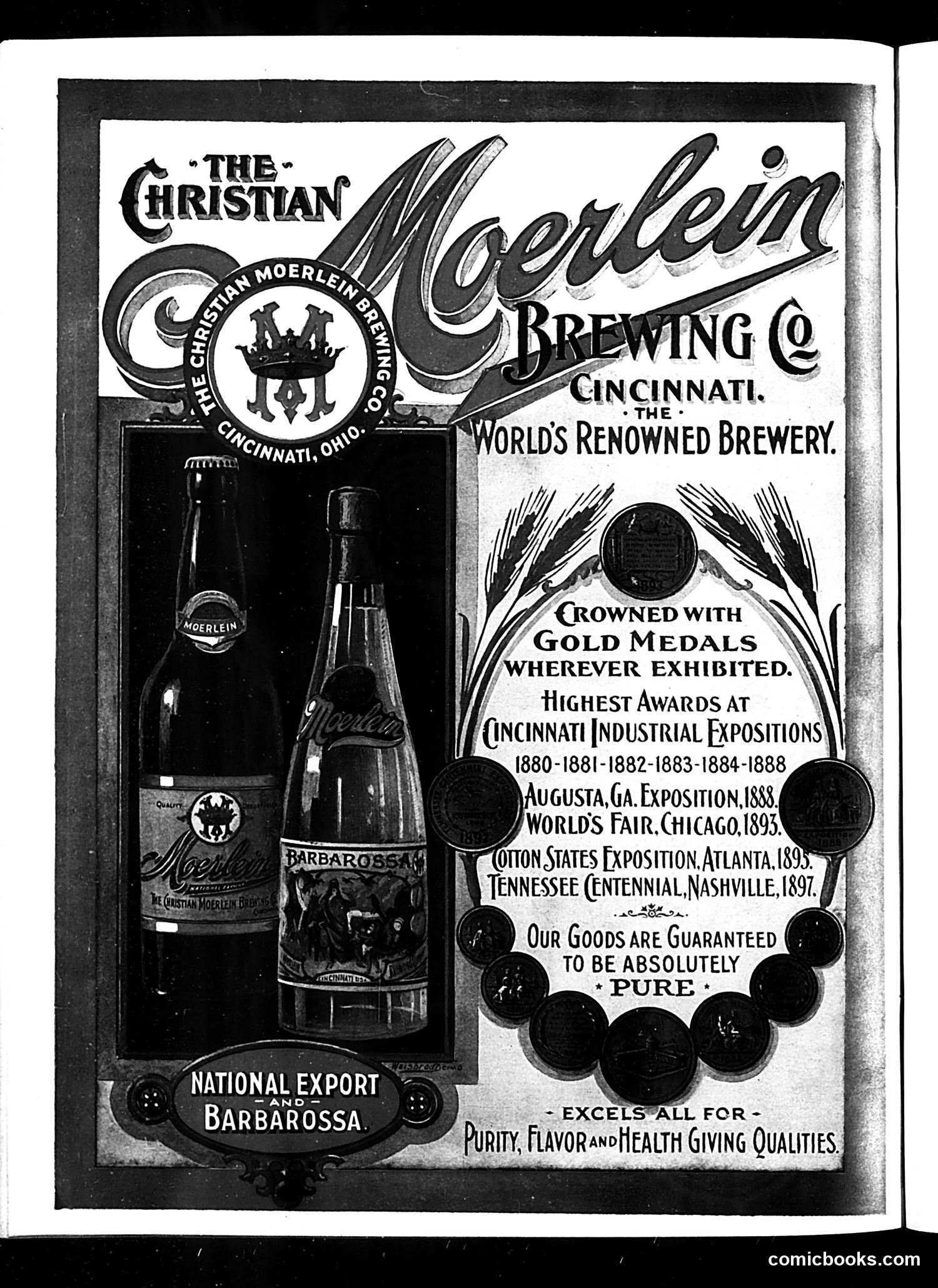
This is not a satirical cartoon but rather a **full-page advertisement** for The Christian Moerlein Brewing Company of Cincinnati, Ohio. The ad promotes two beer products: "National Export" and "Barbarossa," displayed as actual bottle photographs. The company emphasizes their legitimacy and quality through an extensive list of gold medal awards from major expositions (Cincinnati Industrial Expositions, 1880-1888; World's Fair Chicago 1893; Cotton States Exposition Atlanta 1895; Tennessee Centennial Nashville 1897). The "Christian" branding and emphasis on "absolutely pure" goods reflects late 19th-century marketing practices, when brewers—often German-American immigrants—used moral language to counter prohibitionist sentiment and build consumer trust. The prestigious exhibition wins served as proof of superior quality in an era before modern advertising regulation.