
Judge, 1904-12-17 · page 10 of 48
Judge — December 17, 1904 — page 10: what you’re looking at
What you’re looking at
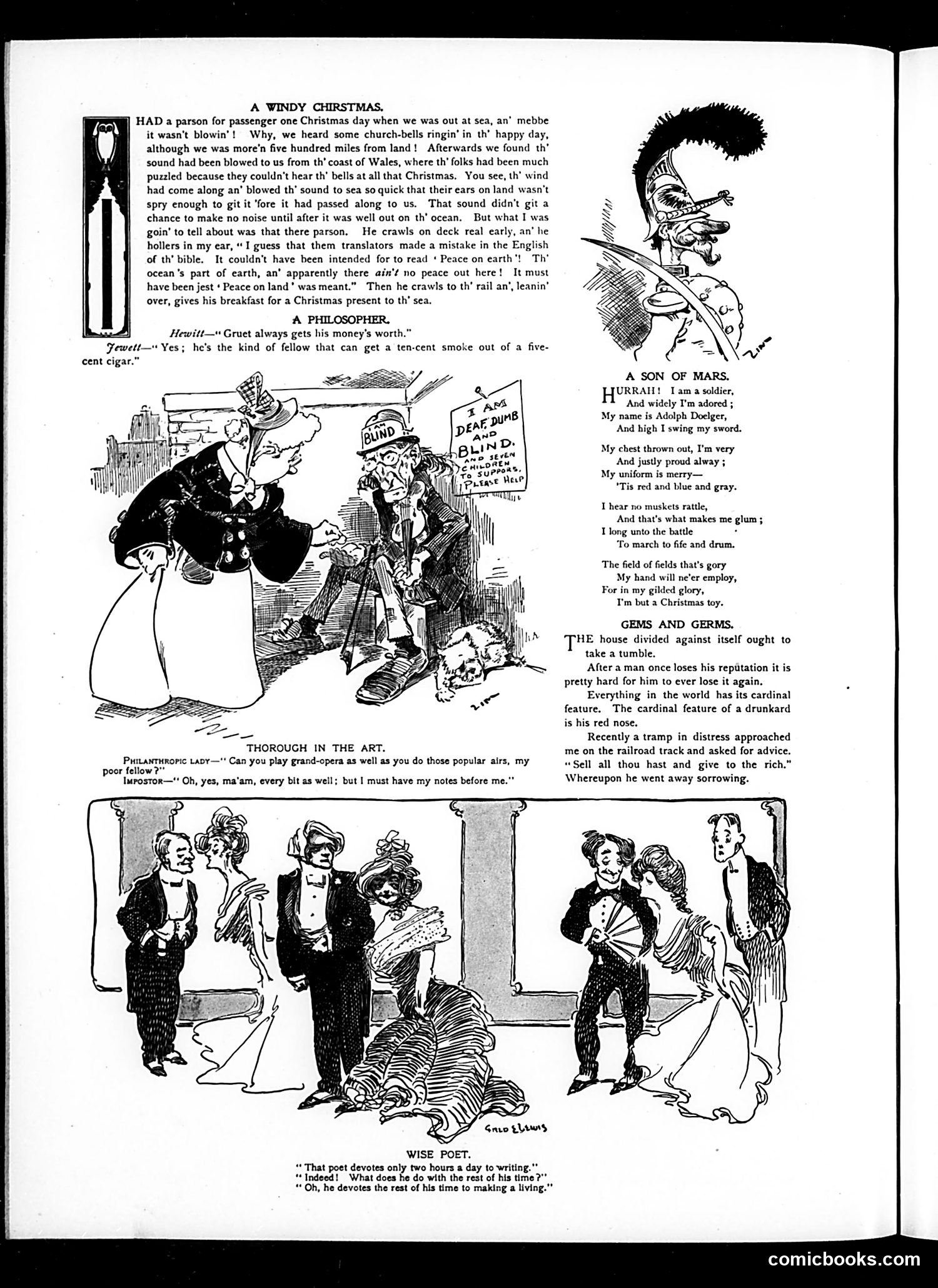
This page contains several unrelated satirical sketches typical of Judge's humor: **"A Windy Christmas"** mocks religious literalism through a sailor's tall tale: a parson aboard ship hears church bells from Wales (impossible at that distance), then complains that "Peace on earth" should read "Peace on land" since the ocean has no peace—before vomiting overboard. **"A Philosopher"** jokes about a penny-pincher who extracts maximum value from cheap items. **"A Son of Mars"** satirizes a toy soldier (likely a Christmas gift or decoration) who boasts of military glory while admitting he's merely a decorative plaything—commentary on militarism or perhaps commentary on contemporary soldier figures. **"Thorough in the Art"** presents a female opera singer who can perform both grand opera and popular songs, but needs her sheet music. **"Gems and Germs"** offers aphorisms, including a jab at drunkards' red noses and a Biblical reference ("Sell all thou hast...") applied humorously to a beggar. **"Wise Poet"** jokes that a writer spends more time earning a living than actually writing—critique of impoverished artists.
📄 Transcribed text from this page (OCR, searchable)
Machine-transcribed from the original scan — historical spelling and the odd misread are preserved.
A WINDY CHIRSTMAS. HAD a parson for passenger one Christmas day when we was out at sea, an’ mebbe it wasn't blowin’! Why, we heard some church-bells ringin’ in th’ happy day, although we was more’n five hundred miles from land! Afterwards we found th’ sound had been blowed to us from th’ coast of Wales, where th’ folks had been much puzzled because they couldn't hear th’ bells at all that Christmas. You see, th’ wind had come along an’ blowed th’ sound to sea so quick that their ears on land wasn’t spry enough to git it ‘fore it had passed along to us. That sound didn’t git a chance to make no noise until after it was well out on th’ ocean, But what I was goin’ to tell about was that there parson. He crawls on deck real early, an’ he hollers in my ear, “I guess that them translators made a mistake in the English of th’ bible. It couldn't have been intended for to read * Peace on earth"! Th’ ocean's part of earth, an’ apparently there ain't no peace out here! It must have been jest ‘ Peace on land’ was meant.” Then he crawls to th’ rail an’, leanin’ over, gives his breakfast for a Christmas present to th’ sea. A PHILOSOPHER. Hewitt—“ Gruet always gets his money's worth.” Fewett—“ Yes; he's the kind of fellow that can get a ten-cent smoke out of a five- cent cigar.” URRAH! Lama soldier, And widely I'm adored ; My name is Adolph Doelger, And high I swing my sword. My chest thrown out, I'm very And justly proud alway ; My uniform is merry— ‘Tis red and blue and gray. T hear no muskets rattle, And that’s what makes me glum ; T long unto the battle ‘ ‘To march to fife and drum. The field of fields that’s gory My hand will ne'er employ, For in my gilded glory, T’'m but a Christmas toy. GEMS AND GERMS. 'HE house divided against itself ought to take a tumble. After a man once loses his repitation it is pretty hard for him to ever lose it again. Everything in the world has its cardinal feature. The cardinal feature of a drunkard is his red nose. —— Recently a tramp in distress approached THOROUGH IN THE ART. me on the railroad track and asked for advice. Pruwaxrunoric Labt—"* Can you play grand-opera as well as you do those popular airs, my “Sell all thou hast and give to the rich.” poor fellow 5 , Iurostor—"' Oh, yes, ma'am, every bit as well; but | must have my notes before me." Whereupon he went away sorrowing. WISE POET. “That poet devotes only two hours a day to writing." “Indeed! What does he do with the rest of his time?” “Oh, he devotes the rest of his time to making a living.” comicbooks.com