
Judge, 1904-12-17 · page 38 of 48
Judge — December 17, 1904 — page 38: what you’re looking at
What you’re looking at
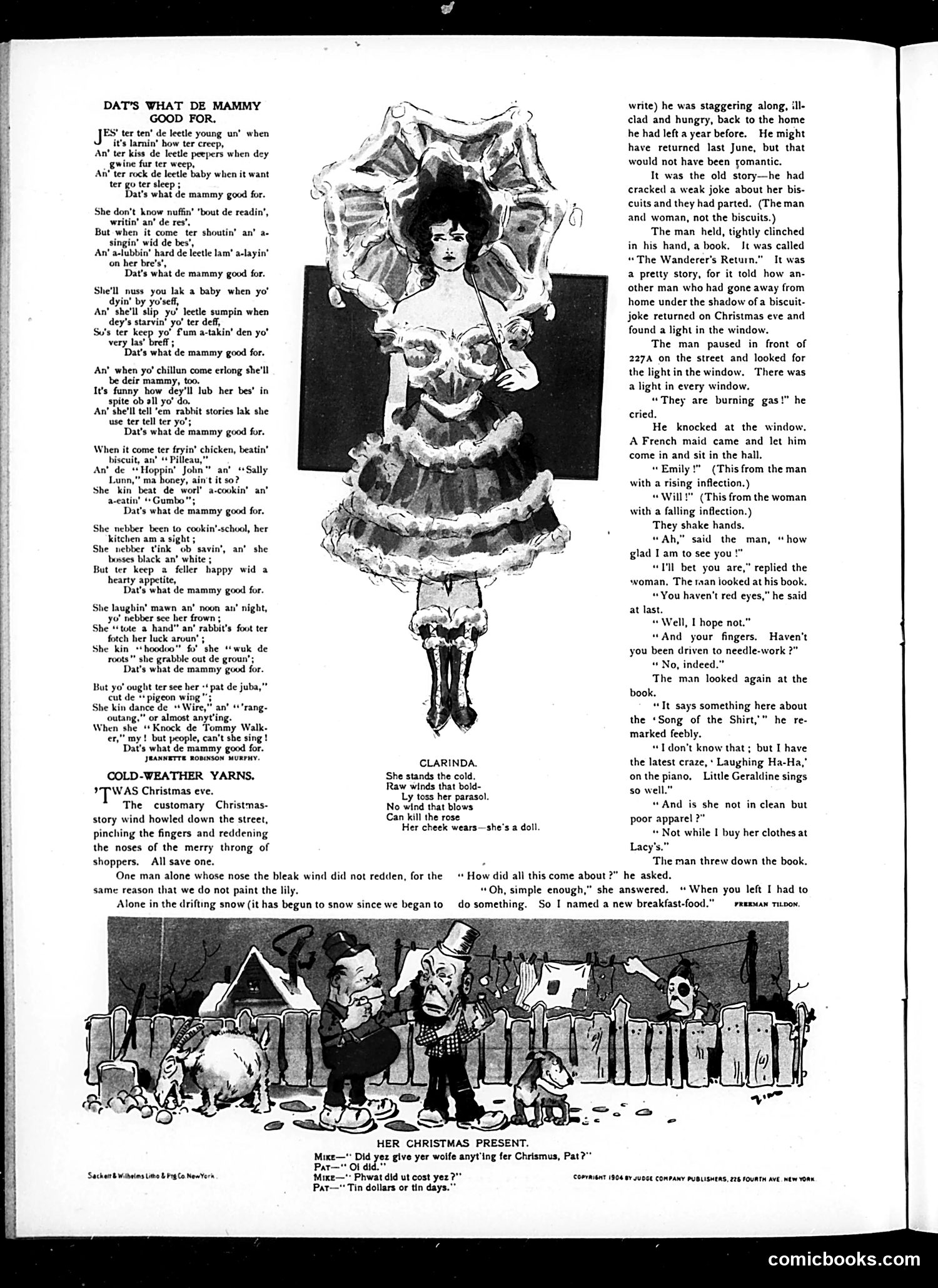
This page contains **racist dialect humor** typical of early-20th-century American publications. **"Dat's What De Mammy Good For"** (left column) is a poem in stereotypical African American vernacular celebrating the nurturing role of Black domestic workers, emphasizing childcare, cooking, and emotional labor while explicitly denying them education. It romanticizes servitude as inherent to Black women's identity. **"Cold-Weather Yarns"** (right) presents sentimental Christmas stories: one about a man returning home after a biscuit-related quarrel with a woman, paralleling a romantic novel he carries. The accompanying cartoon **"Her Christmas Present"** (bottom) shows working-class figures in a humorous exchange about gift-giving, using Irish dialect stereotypes ("yez," "Chrismus"). The **"Clarinda"** poem praises a woman's beauty and composure in winter weather. Together, these pieces reflect Judge's formula: ethnic/racial caricature paired with sentimental or comedic domestic narratives, all intended as entertainment for a presumably white, middle-class readership.
📄 Transcribed text from this page (OCR, searchable)
Machine-transcribed from the original scan — historical spelling and the odd misread are preserved.
DAT’S WHAT DE MAMMY GOOD FOR. ES’ ter ten’ de leetle young un’ when it's larnin’ how ter creep, An’ ter kiss de leetle peepers when dey gwine fur ter weep, Aji" ter rock de leetle baby when it want ter go ter sleep ; Dat’s what de mammy good for. She don't know nuffin’ ‘bout de readin’, writin’ an’ de res’, But when it come ter shoutin’ an’ ae singin’ wid de bes’, An’ a-lubbin’ hard de leetle lam’ a-layin’ on her bre’s’, Dat’s what de mammy good for. She'll _nuss you lak a baby when yo’ dyin’ by yo'seff, An’ she'll slip yo’ leetle sumpin when dey’s starvin’ yo’ ter deff, Su's ter keep yo’ fum a-takin’ den yo" very las’ breff ; Dat's what de mammy good for. An’ when yo! chillun come erlong she'll be deir mammy, too. It’s funny how dey'll lub her bes’ in spite ob all yo’ do. An’ she'll tell em rabbit stories lak she use ter tell ter yo"; Dat’s what de mammy good for. When it come ter fryin’ chicken, beatin’ biscuit, an’ “ Pilleau,”* An‘ de ‘Hoppin’ John” an’ “Sally Lunn," ma honey, ain't it so? She kin beat de worl’ a-cookin’ an’ a-eatin’ “Gumbo”; Dat's what de mammy good for. She nebber been to cookin'.school, her kitchen am a sight ; She nebber tink ob savin’, an’ bosses black an’ white ; But ter keep a feller happy wid a hearty appetite, Dat's what de mammy good for. she She laughin’ mawn an’ noon an’ night, yo' nebber sce her frown ; She “tote a hand" an’ rabbit's foot ter fotch her luck aroun’ ; She kin *+hoodoo" fo' ‘she “wuk de roots” she grabble out de groun’; Dat’s what de mammy good for. But yo’ ought ter see her +! pat de juba,”” cut de * pigeon wing She kin dance de + Wire," an’ ‘*'rang- outang,” or almost anyt'ing. When she ‘Knock de Tommy Walk- er," my! but people, can't she sing ! Dat's what de mammy good for. JEANNETTE ROBINSON MURTHY. COLD-WEATHER YARNS. oT WAS Christmas eve. The customary Christmas- story wind howled down the street, pinching the fingers and reddening the noses of the merry throng of shoppers. All save one. One man alone whose nose the bleak wind did not redden, for the same reason that we do not paint the lily. Alone in the drifting snow (it has begun to snow since we began to Sacheirb Wilhelms Lite & Prg Co NewYer’ CLARINDA. She stands the cold. Raw winds that bold- Ly toss her parasol. No wind that blows Can kill the rose Her cheek wears—she's a doll. HER CHRISTMAS PRESENT. Did yez give yer wolfe anyt'ing fer Chrismus, Pat?” or did Phwat did ut cost yez?”" Tin dollars or tin days.”" write) he was staggering along, ill- clad and hungry, back to the home he had left a year before. He might have returned last June, but that would not have been romantic. It was the old story—he had cracked a weak joke about her bis- cuits and they had parted. (The man and woman, not the biscuits.) The man held, tightly clinched in his hand, a book. It was called “The Wanderer's Return.” It was. a pretty story, for it told how an- other man who had gone away from home under the shadow ofa biscuit- joke returned on Christmas eve and found a light in the window. The man paused in front of 227A on the street and looked for the light in the window. There was a light in every window. “They are burning gas!” he cried. He knocked at the window, A French maid came and let him come in and sit in the hall. “Emily !" (This from the man with a rising inflection.) “Will!” (This from the woman with a falling inflection.) They shake hands. “Ah,” said the man, “how glad I am to see you!” “I'l bet you are,” replied the ‘woman, The man looked at his book. «You haven't red eyes,” he said at last. “Well, I hope not.” “And your fingers. Haven't you been driven to needle-work 2” “No, indeed.” The man looked again at the book. “Tt says something here about the ‘Song of the Shirt," he re- marked feebly. “T don't know that; but I have the latest craze, * Laughing Ha-Ha,’ onthe piano, Little Geraldine sings so well.” “And is she not in clean but poor apparel ?" + Not while I buy her clothes at Lacy's.” The man threw down the book. “ How did all this come about 2” he asked. “Oh, simple enough,” she answered. “When you left I had to do something. So I named a new breakfast-food.” FREEMAN TILDON. (COPrmiGnT 1904 BY JUDGE COMPANY PUBLISHERS, 226 FOURTH AVE. WEW YORK comicbooks.com