
A complete issue · 68 pages · 1922
Captain Billy's Whiz Bang #34
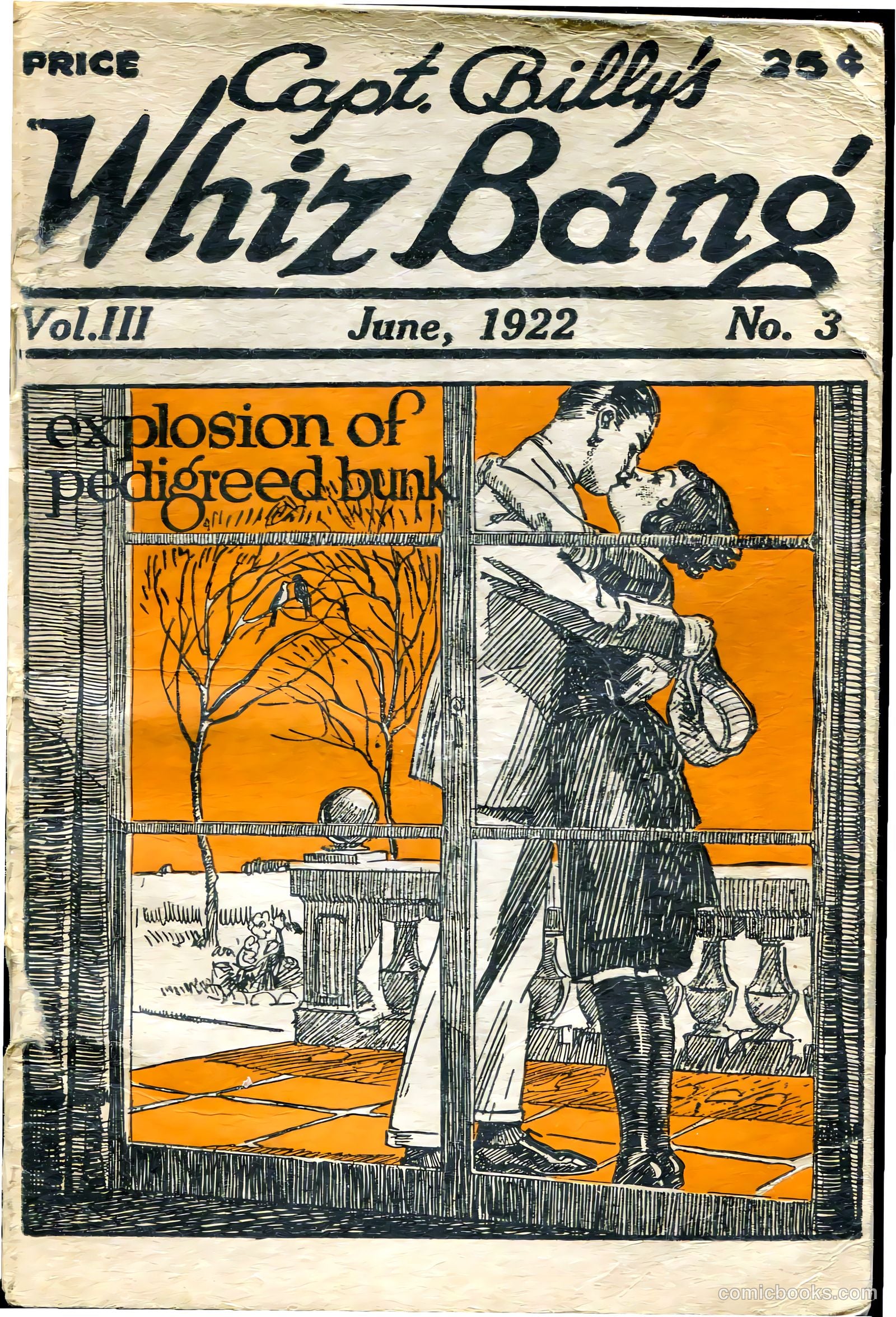
This June 1922 *Whiz Bang* cover satirizes pretension and hypocrisy through a four-panel narrative. The title "explosion of pedigreed bunk" suggests debunking of high-class nonsense. The panels show a wealthy woman observing bare trees through a window, then holding a small child while appearing refined, contrasted with lower panels depicting poverty and harsh conditions outside—children in snow, sparse furnishings, bottles suggesting deprivation. The satire critiques the disconnect between upper-class respectability (the woman's "pedigree") and the brutal reality of working-class suffering occurring literally outside her window. The woman's obliviousness to or indifference toward this disparity exemplifies the "bunk"—the false dignity and moral superiority of wealth during a period of significant economic inequality in 1920s America.
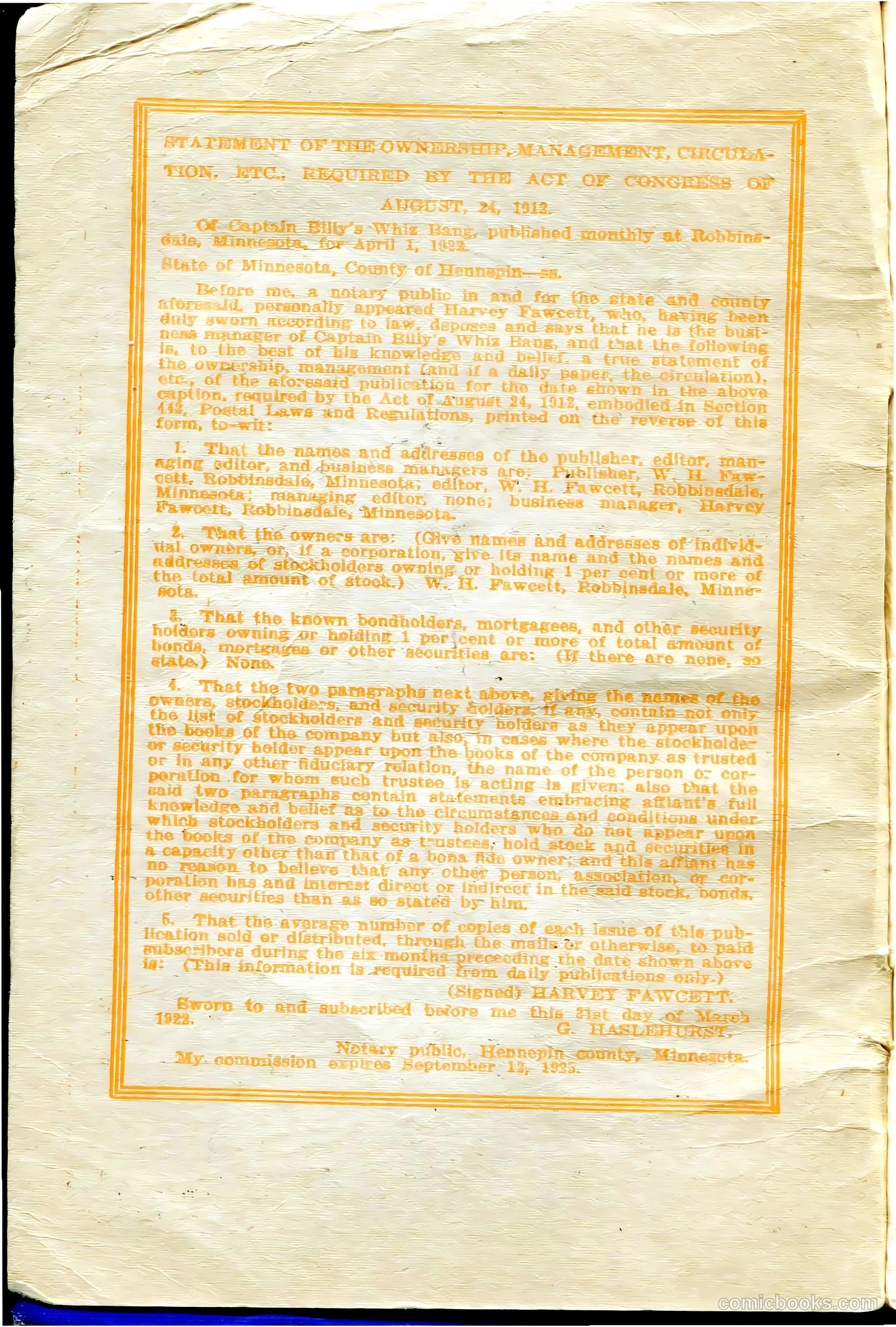
This is not a cartoon or satirical content page—it's a **legal ownership statement** required by federal law. The page documents that *Captain Billy's Whiz Bang*, a monthly satirical magazine published in Robbinsdale, Minnesota, is owned and managed by W. H. Fawcett and his son Harvey Fawcett as of April 1, 1922. Under the Act of Congress from August 24, 1912, publications had to publicly declare their ownership, editorial staff, and circulation details. This document fulfills that requirement, listing the publisher, editors, business managers, and confirming W. H. Fawcett as the sole stockholder. There is no satirical content visible here—it's administrative paperwork, likely included in the magazine to comply with postal regulations.
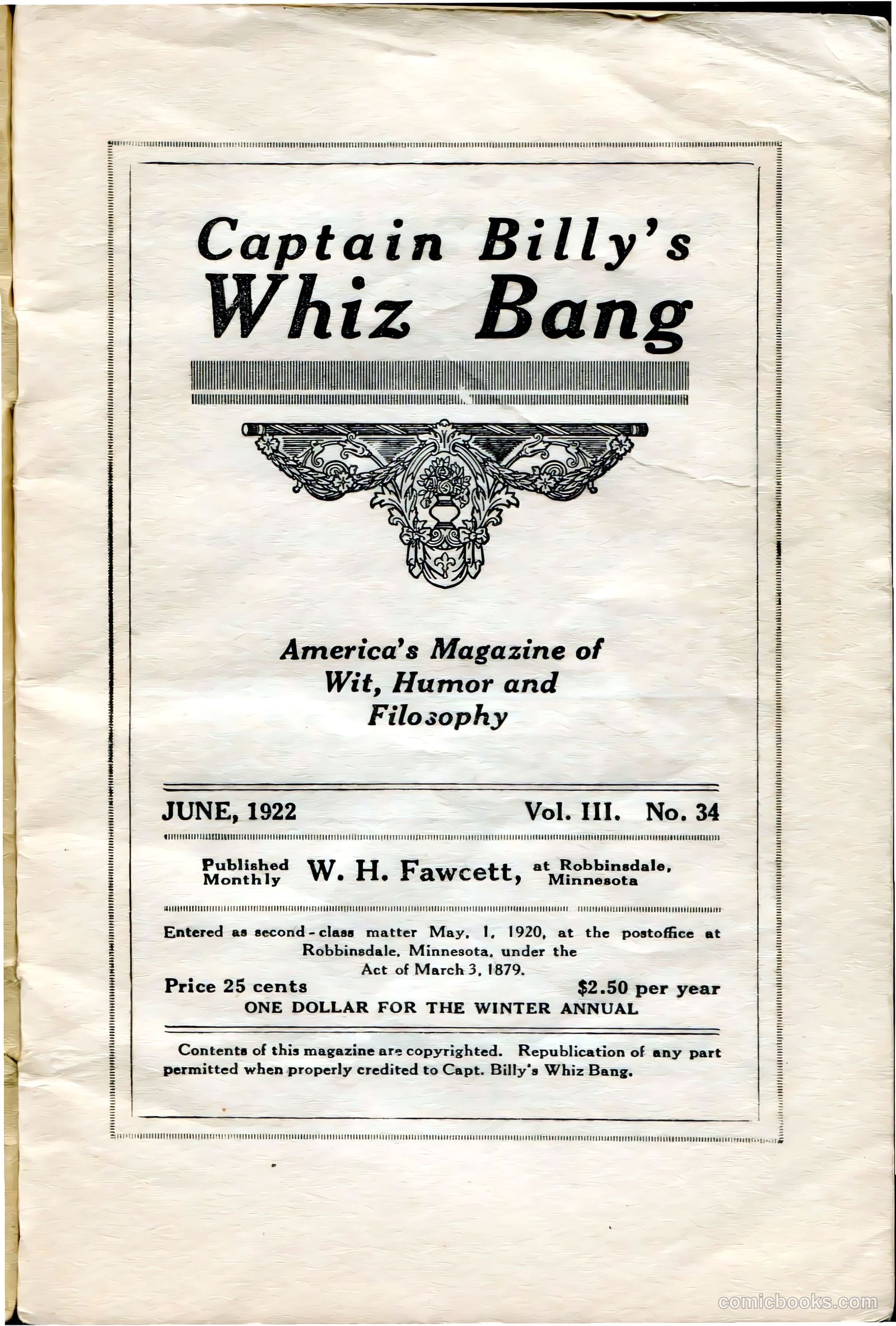
This is the **title/masthead page** of *Captain Billy's Whiz Bang*, a humor magazine published monthly in Robbinsdale, Minnesota. The page contains no cartoons or satirical content—only publication information. The magazine is described as "America's Magazine of Wit, Humor and Philosophy," priced at 25 cents per issue ($2.50 yearly). It was entered as second-class mail in 1920. The ornamental header design is purely decorative. The copyright notice permits republication when credited to the magazine. This appears to be a standard cover page rather than editorial content, so there are no political figures, caricatures, or specific jokes to analyze here.
This is a **title/masthead page** from Captain Billy's Whiz Bang, a 1922 satirical magazine. The page contains no cartoon content—instead it displays: 1. A Theodore Roosevelt quote about patriotic loyalty 2. Copyright information by W.H. Fawcett 3. A boxed notice explaining the magazine's subscription policy (direct mail only, no solicitors or premiums, $2.50/year) 4. A statement that the publication was edited by a Spanish-American War and World War I veteran, dedicated to U.S. fighting forces The page establishes the magazine's editorial identity and business model rather than presenting satirical content. The Roosevelt epigraph suggests the publication positioned itself as patriotic and American-focused during the post-WWI era.
This is a humorous column titled "Drippings From the Fawcett" in *Captain Billy's Whiz Bang*, a satirical magazine. The piece mockingly describes American summer leisure activities and social trends of the era (appears to be 1920s, based on references to "flappers"). The satire targets: - **Summer vacationing clichés**: casual trips to lakes and resorts - **Prohibition era humor**: joking references to illegal stills, "bootleggers," and seeking alcohol ("snifter") during vacation - **"Flapper" culture**: young women's fashions and behaviors - **The KKK**: "King Kleagle" is a satirical jab at KKK leadership titles, suggesting even vacationers might encounter unsavory characters - **Mock advertisement**: "Uncle Billy's Breezy Point resort" appears to be self-promotional, humorously claiming legal compliance while winking at Prohibition violations The tone is cynical yet playful—mocking both middle-class leisure pursuits and the hypocrisy surrounding Prohibition enforcement. No specific political cartoon is visible; this is satirical prose commentary.
This is satirical commentary on 1920s social reform movements, particularly around bathing suit modesty standards. The text mocks "reformers" who wanted to mandate extremely conservative swimwear (burlap extending six inches below the heels) while praising St. Petersburg, Florida's newly elected mayor who ran on a platform supporting modern one-piece bathing suits. The humor relies on the contrast between reformers' strict morality and the author's celebration of summer leisure and modest modernization. The "Plymouth Rock or White Leghorn" reference uses chicken breeds as metaphors for innocent young women unfairly targeted by moral crusaders. This reflects the 1920s "culture war" between traditionalists opposed to changing social mores (shorter skirts, simpler swimwear) and those embracing modern fashion. The magazine takes the modernist side, portraying reformers as foolishly out-of-step with contemporary life.
This page presents satirical commentary on moral legislation and religious coercion. The author critiques proposed Massachusetts bills mandating church attendance and banning women's public smoking, arguing such moralistic laws reflect egotistical thinking that backfires—forced church attendance would breed resentment rather than genuine piety. The piece then praises a Los Angeles minister's pragmatic alternative: converting church social rooms into courting spaces (dating parlors). This is presented as superior to coercive religious attendance, as it attracts people voluntarily. The joke about "Poison Ivy toll" and "automobile spin" suggests young couples using church facilities as dating venues instead of courting in cars outdoors (exposing themselves to nature hazards or moral scandal). The satire targets paternalistic reform movements and celebrates practical accommodation over puritanical enforcement.
This page contains two satirical pieces from an early 20th-century American humor magazine. The first section mocks American prudishness about women smoking, contrasting it with more permissive English attitudes. It references recent (unspecified) actions by New York and Chicago officials who apparently tried to restrict women's smoking—actions the author finds absurdly outdated, even by small-town standards. The second piece satirizes a San Jose newspaper's awkward promotional offer: complimentary tickets to a film called "Go Straight" contingent on Mrs. Abel visiting their office. The satire suggests the newspaper's veiled implication that Mrs. Abel needs moral correction—that she should "go straight." The humor lies in this patronizing, judgmental pitch disguised as a promotional gimmick, highlighting how moralistic language masked social control efforts. Both pieces mock American moral rigidity and paternalism toward women.
This satirical column critiques Hollywood's moral reputation and sex-scandal-dominated cinema circa the early 1920s. The writer references the Arbuckle and Taylor tragedies (real scandals involving actor Roscoe "Fatty" Arbuckle and director William Desmond Taylor that shocked the industry), suggesting Hollywood deserves its notoriety. The piece ridicules Avery Hopwood's film about Hollywood life, particularly its strip-poker scene. It then uses a humorous anecdote about novelist Rupert Hughes attending a risqué Chicago party where he's asked about "wicked Hollywood"—only to reply he's returning there to clean his mind. The joke's irony: Hughes suggests the actual Hollywood is *morally superior* to this Chicago gathering, inverting readers' assumptions about Hollywood's depravity. The satire targets both Hollywood's actual scandals and the public's simultaneous fascination with and moral condemnation of the industry.
This page from *Captain Billy's Whiz Bang* (a WWI-era satirical magazine) contains a serious editorial column and an unrelated short joke at bottom. **Main Editorial Column:** References the "Taylor case" (likely William Desmond Taylor, a Hollywood director, whose 1922 murder exposed drug use in the film industry). The text warns of increasing narcotics abuse nationwide, not just Hollywood. It discusses opium smuggling from China with racist language typical of the era. The piece predicts "white ribboners" (Prohibition advocates) will eventually abandon alcohol prohibition for moderation—a critique of Prohibition policies. **Bottom Joke:** "Chief Blowberger" is a recurring character telling fast drivers that Robbinsdale doesn't enforce speed laws because the town welcomes dangerous speeding. This is satirical local humor, mocking a specific town's (lack of) traffic enforcement. The column presents drugs as an imported threat while attacking Prohibition as counterproductive policy.
This page contains editorial content from *Captain Billy's Whiz Bang*, an early 20th-century humor magazine. The editor thanks a contributor for writing about the magazine's farm near Robbinsdale, Minnesota. The humor here is domestic and self-deprecating: the editor jokingly hopes his wife won't see the headline calling Whiz Bang "world popular," fearing it might make him too proud to visit his Eagles lodge weekly—a gentle jab at marital dynamics. The main narrative describes a 1920s-era contradiction between "modern progress" and rural reality: Captain Billy flew 22 miles by aeroplane in 15 minutes, yet a six-mile wagon journey through snow drifts took over two hours. This juxtaposition satirizes the uneven modernization of America, where technological advancement existed alongside primitive rural conditions. The page concludes with an incomplete anecdote about a mysterious letter, presumably continuing on the next page.
This page from the April 1, 1922 issue features a letter from a female reader (A. Kaye) in Chattanooga requesting Captain Billy reveal his personality. She notes finding his magazine everywhere—in farmers' homes, towns across America, even Baptist ministers' houses—yet feels unable to discern who he actually is from his writing. She references her changed opinions on Shakespeare and Balzac after reading their autobiographies, then puzzles over Captain Billy's contradictory tone: sometimes deeply emotional, sometimes flippant. She calls him "an enigma" and asks him to satisfy her curiosity about his true nature "on a good sportsmanship basis." The editor's brother responds that her letter, dated April 1st, "could not be misconstrued as an April Fool joke, but we must confess it is indeed a puzzler"—suggesting the request itself is playfully mysterious. The page showcases *Whiz Bang*'s interactive reader engagement and the era's curiosity about magazine editors as personalities.
This page is a humorous semi-autobiographical defense of Captain Billy, the magazine's founder, responding to reader curiosity about his background. Harvey Fawcett (the Business Manager) provides a tongue-in-cheek biography claiming Billy grew up among wild horses in North Dakota, recovered a drowned body at age fifteen, rode the rails as a hobo ("Knight of the Blind Baggage"), served in the Spanish-American War, worked various jobs including WWI captain, and founded the magazine. The humor relies on absurd exaggeration and tall-tale conventions typical of *Whiz Bang*—a satirical magazine known for irreverent humor. References like "Blackjack Pershing" (General John Pershing) and being "burned by hot tea in Japan" appear designed as mock-heroic flourishes. The closing note about finding letters "in the smokehouse" reinforces the publication's comedic, anything-goes tone. This is self-parody masquerading as biography.
This page contains a poem titled "Captain Billy's Whiz Bang," presented as a contribution from an unknown writer (with a humorous disclaimer blaming "Gus" for any quality issues). The poem is a first-person narrative celebrating life's extremes and contradictions. It catalogs the speaker's experiences across social classes and circumstances: dining with the wealthy versus starving in poverty, dancing in grand ballrooms versus performing native dances in mud, commanding servants versus begging as a vagrant, experiencing luxury and terror alike. The tone is satirical and somewhat cynical—the speaker boasts of vast experience while acknowledging life's unpredictability. References to "Caruso" (the famous opera singer), "Mammon" (wealth/greed), and the "bughouse ward" (asylum) ground it in early 20th-century American culture. The final stanza abandons pretense: despite all these experiences, the speaker admits uncertainty about enemies and friends, ending with a casual toast to camaraderie—a wry acknowledgment that life's lessons teach humility alongside adventure.
This page from the satirical magazine contains no political cartoons—just humorous prose and verse. The content reflects the magazine's rural, folksy humor style. The opening poem presents a philosophical monologue about life's ups and downs, concluding that despite all experiences, one returns to their starting point. The anecdotes that follow are domestic humor: a reference to Arctic explorer Vilhjalmur Stefansson (a real historical figure) for naming kittens, and a slapstick rural story about Deacon Callahan being kicked by his donkey and his wife's rescue attempt interrupted by a new farm worker's arrival. The humor relies on rural settings, practical farm life mishaps, and working-class characters. There's no apparent political satire—just lighthearted storytelling typical of American humor magazines from the early 20th century.
This page from the satirical magazine contains three unrelated jokes typical of early 20th-century American humor: 1. **Mrs. Callahan's joke**: A domestic violence gag where a wife admits beating her husband with a "single-tree" (a farm implement). The humor relies on role-reversal and the casual bar-room setting (Eddie is apparently a bartender). 2. **The manure spreader anecdote**: A double-entendre joke playing on a city woman's prudish reaction to farm machinery. "For land's sake" is her shocked exclamation; Olaf's literal "Yes" response suggests innocent obliviousness, creating the comedy. 3. **The parrot and owl**: A bedroom scene where a bawdy parrot makes inappropriate advances toward a disrobing woman, while an owl's innocent "Who-o-o-o?" is reinterpreted as voyeuristic. The parrot insults the owl, creating absurdist humor. All three jokes reflect lowbrow, ribald humor standard for this era's "men's magazines."
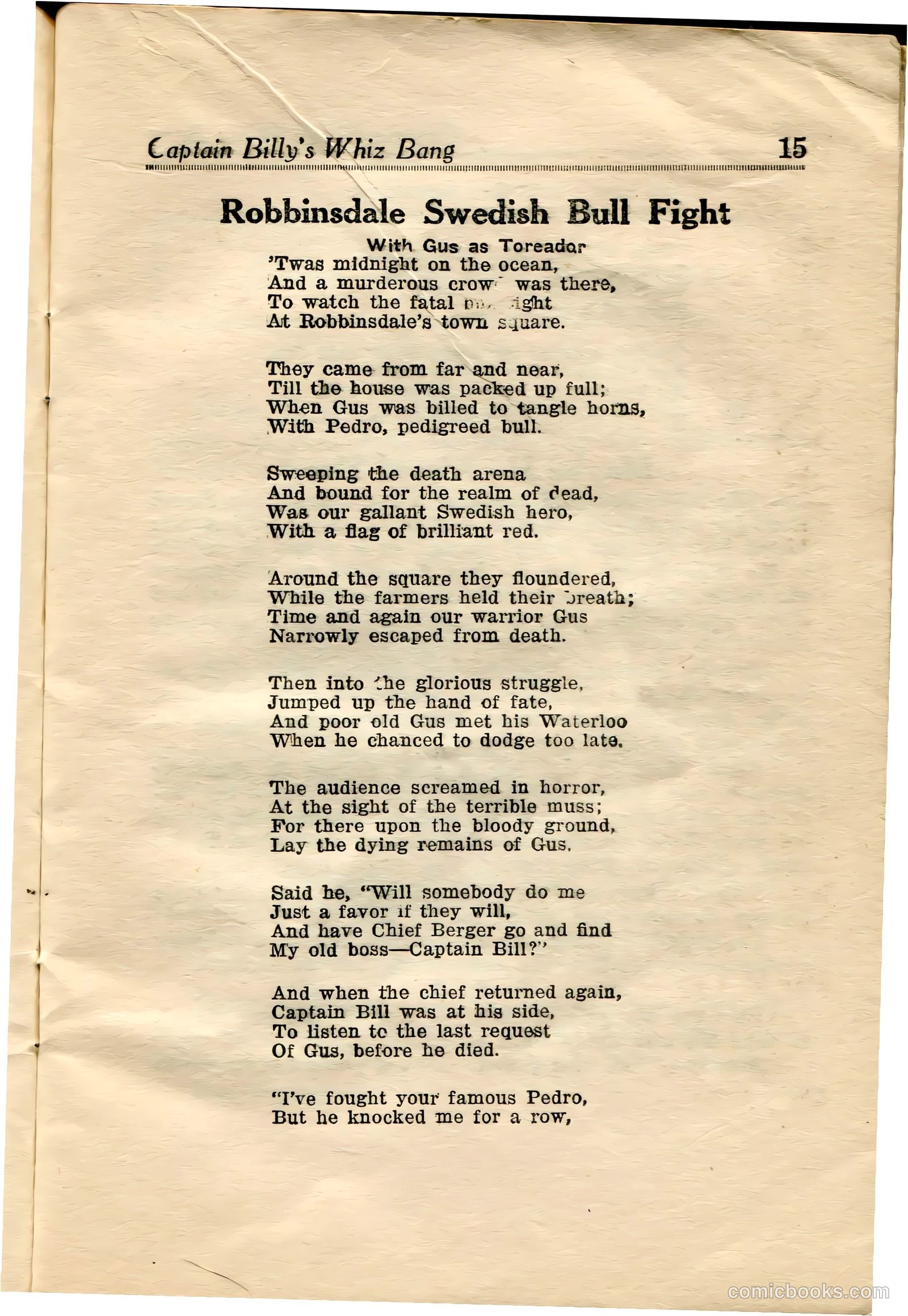
This is a humorous narrative poem (not a political cartoon) from *Captain Billy's Whiz Bang*, a satirical magazine popular in the 1920s-30s. The piece satirizes rural Americana and immigrant culture through exaggerated melodrama. The "satire" lies in treating a backwoods bull-fighting spectacle—apparently held in Robbinsdale (a real Minnesota town)—with grandiose, mock-heroic language. "Gus," a Swedish immigrant, is the bullfighter ("toreador") who faces "Pedro," a pedigreed bull. The poem mock-seriously narrates Gus's fatal goring, complete with dramatic death scene where he requests his boss "Captain Bill." The humor targets both rural American spectacle-seeking and Swedish immigrant culture. References to "Chief Berger" (likely a local official) and the small-town setting suggest this parodies an actual local event. The overwrought poetic language contrasts absurdly with the crude subject matter—treating a man killed by a bull as tragic opera.
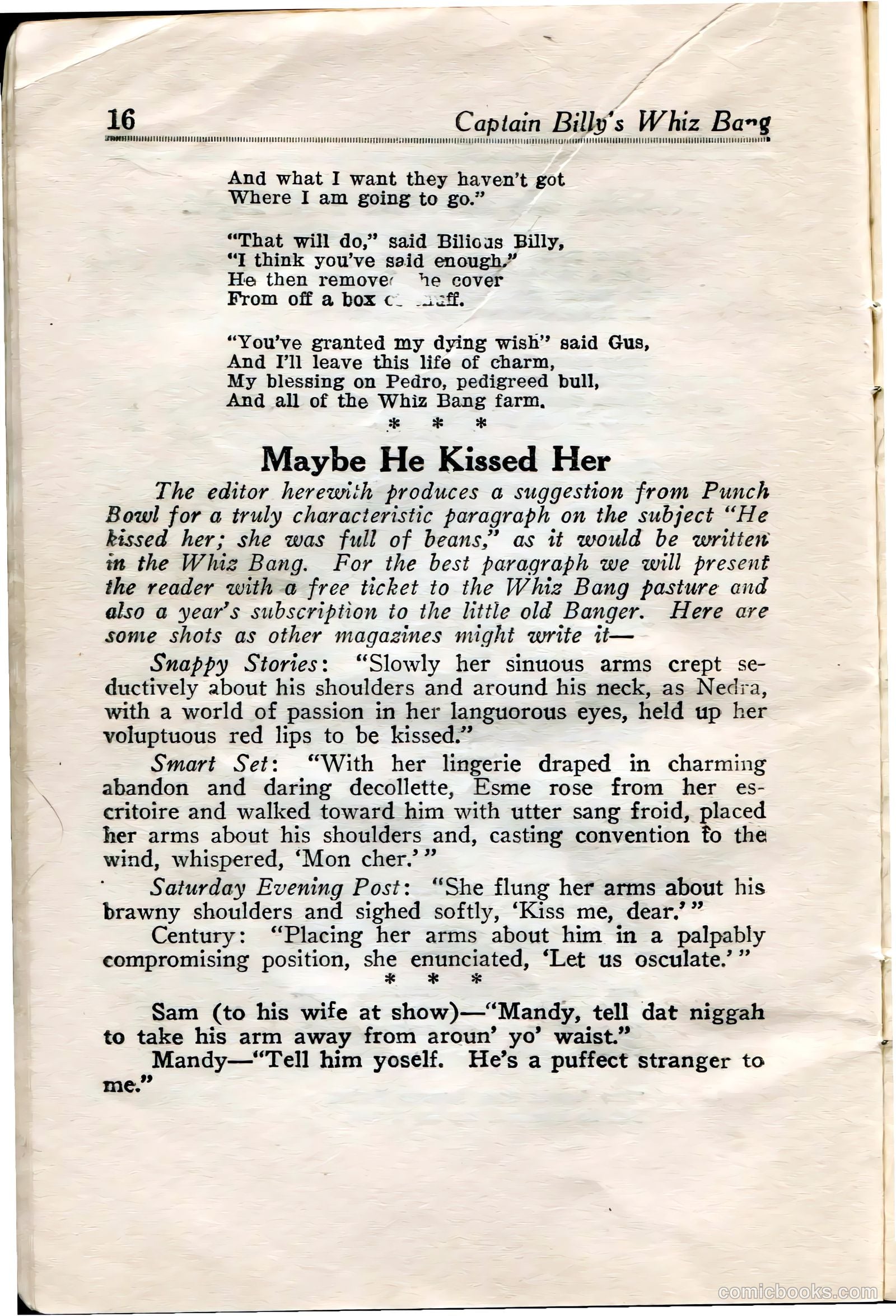
This page from *Captain Billy's Whiz Bang* (a satirical humor magazine) contains two main sections: **"Maybe He Kissed Her"** is a parody contest mocking how different magazines would describe a romantic kiss. It ridicules their affected writing styles—*Snappy Stories* for purple prose ("voluptuous red lips"), the *Smart Set* for pretentious French affectation ("sang froid," "Mon cher"), the *Saturday Evening Post* for saccharine sentimentality, and *Century* for pseudo-intellectual language ("osculate"). The humor lies in exaggerating each publication's characteristic voice. **The closing joke** features racial stereotypes typical of 1920s-era humor—a white man (Sam) objecting to a Black man touching his wife at a show, but his wife (Mandy) claiming the stranger is no threat because she doesn't know him. The joke trades on period assumptions and offensive dialect representation. The earlier verse about "Bilious Billy" and "Gus" appears unrelated domestic/farm humor.
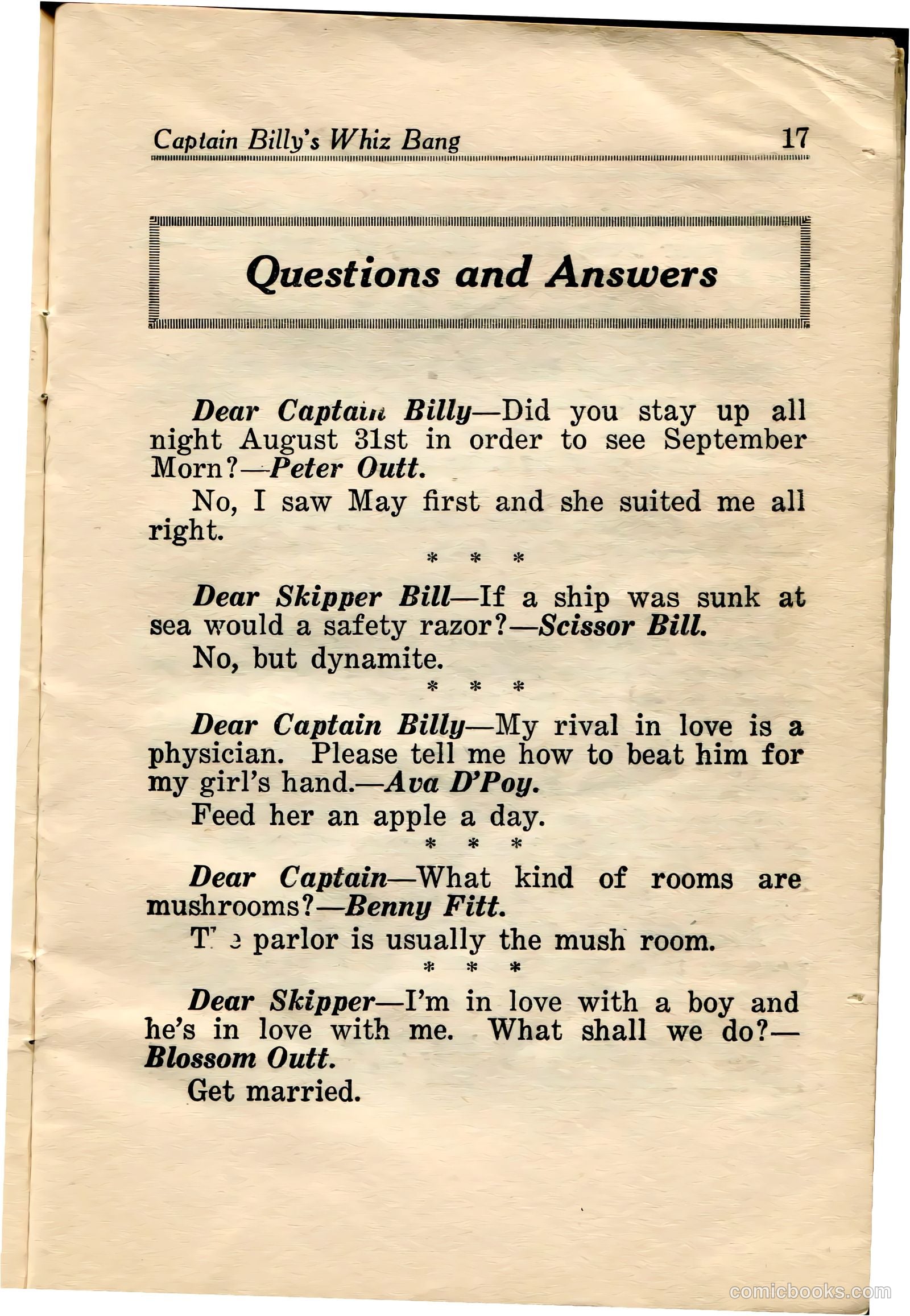
This is a humor column featuring pun-based jokes disguised as advice letters. The "Captain Billy" persona responds to absurd questions with groan-worthy wordplay: - **"September Morn"** likely references a famous 1912 Paul Chabas painting of a nude woman—the joke plays on "seeing" the month and "May" (a woman's name). - **"Safety razor" joke** exploits the ambiguous phrasing of the question—the answer uses "dynamite" as nonsensical humor. - **"Beat him"** is misinterpreted literally (feed her apples, referencing the proverb "an apple a day keeps the doctor away"). - **"Mushroom"** is a pun: "mush room" (parlor as a romantic meeting place). - The correspondents have punning names (**Scissor Bill, Ava D'Poy, Blossom Outt**) enhancing the satirical tone. This typifies *Whiz Bang's* lowbrow, ribald humor style popular in 1920s America.
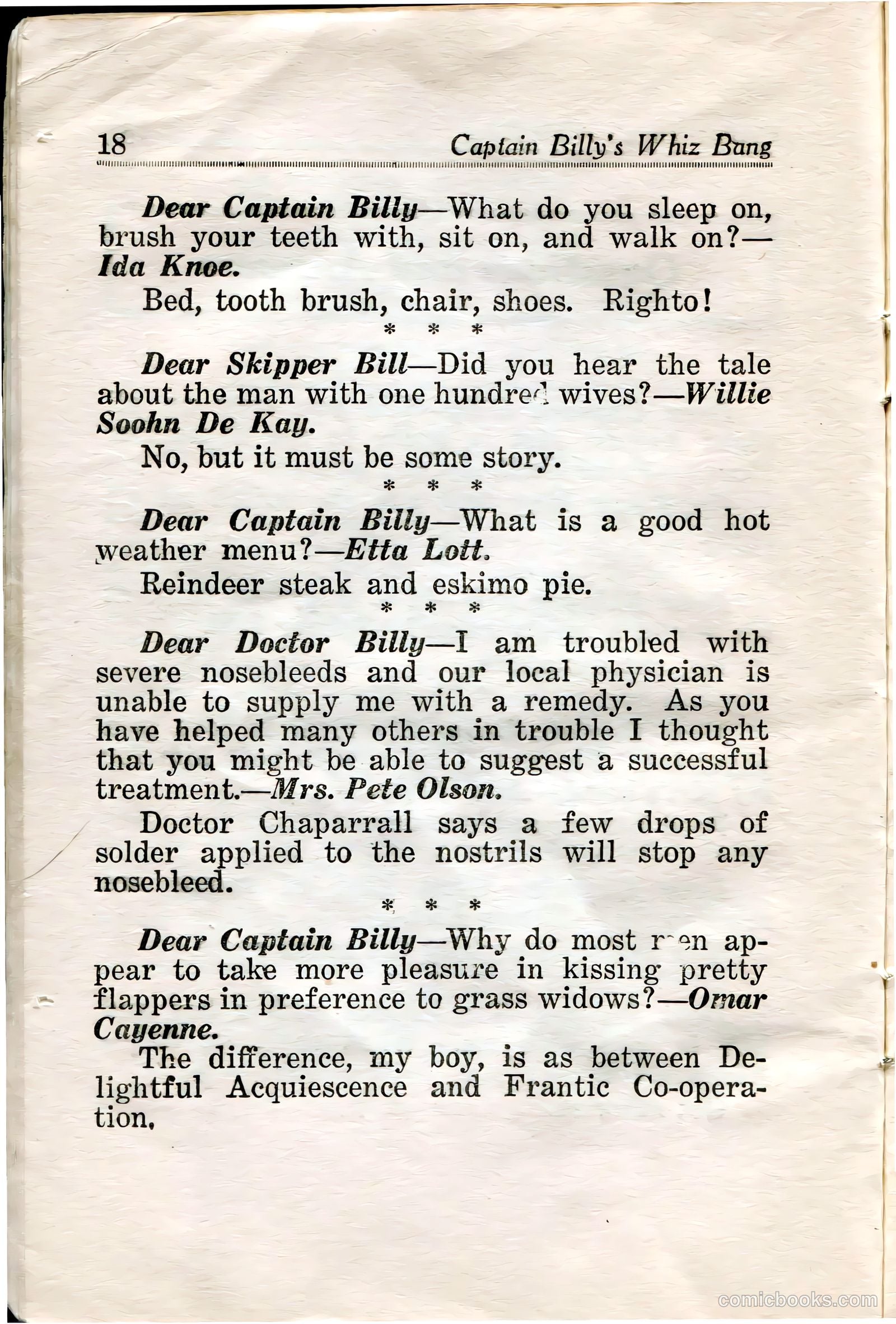
This page from *Captain Billy's Whiz Bang* is a humor advice column featuring punny riddles and jokes disguised as reader letters. The content relies on wordplay and period-specific references: - **Ida Knoe/Etta Lott/Omar Cayenne** are fake names that sound like punchlines when spoken aloud ("I don't know," "ate a lot," "oh, mar cayenne") - The "flappers vs. grass widows" joke references 1920s dating culture: "flappers" were modern, sexually liberated young women, while "grass widows" were women separated from husbands. The answer mocks both: flappers passively accept kisses while grass widows enthusiastically reciprocate. - The nosebleed remedy (solder—molten metal) is deliberately absurd medical advice, typical of the magazine's irreverent humor. - References like "Eskimo pie" reflect casual 1920s terminology without modern awareness of offensive implications. The format represents early 20th-century magazine humor: fake advice-seeker names that are actually jokes, absurd remedies, and cheeky commentary on contemporary social behavior, particularly regarding young women and courtship.
This is a Q&A humor column from an early 20th-century satirical magazine. The jokes rely on wordplay and social commentary typical of the era: **Key jokes:** - A devil ice-skating pun (hell = heat, so impossible) - A "bumble bee and bell" joke setup (implied punchline: "hum-dinger") - **"Flapper" definition**: Mocks 1920s young women's fashion (low necklines) and dating behavior, suggesting they dress provocatively but catch colds instead of men—satirizing both the fashion trend and the women themselves - **Paris trip**: A marital joke suggesting wives are expensive companions - **"Philip the Grate"**: A pun on "fill up the grate" when adding coal to a fire - **Bunker Hill reference**: A factual historical note, not a joke The column's tone is lighthearted ribaldry aimed at male readers, mocking women's fashion and marriage while punning on names and wordplay.
This is a humorous narrative poem (not a political cartoon) from *Captain Billy's Whiz Bang*, a popular American humor magazine. The piece is a tall tale by "Reckless Dan," a roguish drifter who brags about misadventures across America. The satire works through **puns and wordplay based on city names**: "pulled" in Pullman (train cars), "locks" in Locksport, "hack" in Hackensack, "fond" in Fondulac. The narrator claims increasingly absurd feats—selling Niagara Falls, stealing sleeping cars, romancing women—while his economic fortunes decline ("out of MON[ey]"). The humor reflects post-WWI American culture: a footloose drifter type, casual drinking references (Prohibition era), and lighthearted exaggeration. The "Koco Kolo Kiddo from Kareless Kokomo" signature is itself a joke—nonsense language mimicking the character's tall-tale style. This represents typical *Whiz Bang* content: bawdy, accessible humor for working-class readers.
This page from *Captain Billy's Whiz Bang* (a satirical magazine) discusses the aftermath of director William D. Taylor's murder, a major 1922 Hollywood scandal. The text gossips about two actresses implicated in the case: **Mabel Normand** — the silent film star shown here living openly and enjoying herself (box parties, races, dancing) just one month after Taylor's death, suggesting either her innocence or shameless indifference. **Mary Miles Minter** — another actress involved in the scandal who was engaged to T.E. Dixon (son of a pencil-manufacturing millionaire). The scandal reportedly exposed embarrassing letters from her. The satire's point: both actresses are fleeing the country—Normand to Europe, Minter to the Orient—implying guilt or at least the desire to escape scandal. The magazine mocks Hollywood's moral chaos and the actresses' apparent lack of shame, while also noting how quickly social standing (like Minter's engagement) can collapse under such exposure.
This page contains gossip-column satire about Hollywood scandal and contracts, typical of *Whiz Bang* magazine's irreverent celebrity coverage. The first item discusses a broken engagement between an unnamed man (Dixon) and Mary Shelby, a film star. The author mocks Dixon for ending the engagement based on an old letter, portraying him as having poor judgment while praising Mary's careful upbringing by her protective mother (a former actress). The second section cynically explains how to read entertainment headlines. When magazines report that studios are "demanding" a star return to stage work, the author notes this typically masks a broken contract. The example given is Pauline Frederick, under a $36,000/month Robertson-Cole contract, whose mother warned her against overspending. The satire targets both Hollywood's contract disputes and the entertainment press's euphemistic coverage of such conflicts—suggesting readers shouldn't believe the romantic narratives studios promote.
This is a celebrity gossip column from an early 20th-century satirical magazine. It contains three Hollywood scandal items: **Pauline Frederick's contract dispute**: Actress Pauline Frederick's lucrative $36,000/month contract with Universal was terminated when executive "Pat" Powers took over, claiming she wasn't worth the salary. Though she fought legally, the contract was dissolved via "mutual consent"—a transparent legal fiction. Sessue Hayakawa faced similar contract cancellation. **Mary Thurman and May Collins's downfall**: Two picture stars lost their wealth and automobiles to a landlord's legal attachment after they allegedly damaged his rental flat's furnishings worth hundreds of dollars within three months. **Marshall Neilan's romantic entanglements**: Director Marshall Neilan denied intending to marry actress Blanche Sweet, who's traveling to the Orient. Hollywood gossip speculates whether he'll pursue Gloria Swanson while Sweet is overseas. The tone is mocking—these items expose Hollywood's instability, financial recklessness, and romantic drama among silent-era celebrities.
This satirical piece mocks **Will Hays**, newly appointed head of the motion picture industry's self-censorship board (the Motion Picture Producers and Distributors of America). The author dismisses Hays's impact as minimal—he's only made pleasant speeches so far. The text ridicules rumors about Hays centralizing the film industry in Long Island with a church at its center (presenting this as absurdly unrealistic). Most significantly, it contains veiled gossip about an unnamed male film star allegedly addicted to cocaine ("snow"), now requiring an on-set bodyguard. The author predicts studios will quietly drop him to avoid scandal damaging the industry's reputation—despite his current popularity with millions. The satire critiques both Hays's ineffectual authority and the film industry's fear-driven, protective response to star scandals. The "lightning" metaphor suggests imminent public exposure. This reflects 1920s anxieties about drug abuse among celebrities and industry hypocrisy.
This satirical piece attacks Hollywood's hypocrisy regarding moral standards. The author sarcastically praises Hollywood's claimed "100 per cent purity" while documenting actual scandals that contradict this image. The specific example involves actress **Seena Owen**, who sued her ex-husband **George Walsh** for divorce, naming **Estelle Taylor** (a Fox film star) as correspondent—meaning Taylor and Walsh were living together unmarried. The satire's point: Hollywood publicly projects moral virtue while its stars openly cohabitate without marriage, something that would have scandalized ordinary Americans in that era. The piece mocks the double standard—criticizing how the industry polices its public image while ignoring actual immoral behavior by its stars. It's commentary on institutional hypocrisy and the gap between Hollywood's manufactured respectability and its actual conduct. The tone is biting mockery of an industry that controls appearances while enabling private misconduct.
This page satirizes a 1920s Hollywood morality scandal involving actress Estelle Taylor. The narrative mocks the hypocrisy surrounding "free love" and sexual propriety in the era. **The scandal**: Miss Taylor lived with George (likely actor George Ullman) while unmarried. When police ("Dicks") raided the house, actress Seena Owen apparently reported the arrangement. Taylor sued Owen for $100,000, claiming damage to her reputation—despite publicly defending cohabitation and laughing at the trial. **The satire's point**: The magazine ridicules the contradiction between Taylor's stated belief that unmarried couples should live together freely, and her simultaneous claim that exposure destroyed her "morality and virtue." It's absurd to defend free love while suing for reputation damage based on exactly that behavior. **Final section reference**: The piece transitions to Upton Sinclair's relationship—his ex-partner wrote articles arguing against free love after their relationship failed, setting up a similar hypocrisy angle for continuation. The humor targets both Hollywood and progressive ideology of the period.
This is a gossip column from *Captain Billy's Whiz Bang* attacking "handsome Max" (likely a real socialist activist), who advocated "free love"—a radical 1920s idea that rejected traditional marriage restrictions. The satire is **hypocrisy-focused**: The piece suggests Max preached free love ideology while leaving a trail of abandoned women, including actress Florence Deshon, who committed suicide. The column implies his socialist principles didn't prevent him from behaving callously toward women in his romantic life. The reference to Upton Sinclair indicates broader criticism of prominent socialists' personal conduct contradicting their public philosophy. The tone is moralizing—using Max's real romantic entanglements to discredit his political beliefs. For 1920s readers, this was scandalous celebrity gossip with political bite: exposing alleged hypocrisy among Greenwich Village intellectuals and radical thinkers.
This gossip column satirizes Hollywood's romantic entanglements in the early 1920s. The piece mocks the era's "Cupid" (romantic chaos) by tracking interconnected affairs among silent film stars: Kenneth Harlan, Flo Hart, Lottie Pickford, Alan Forrest, and Lowell Sherman. The satire's targets are: 1. **Hollywood instability**: Stars constantly switching partners, divorcing and remarrying 2. **Post-WWI moral anxiety**: The opening references "Cupid" being "shell shocked" since the war—suggesting modern morality has become confused and damaged 3. **The Arbuckle scandal**: References to "Fatty Arbuckle's parties" allude to the famous actor's 1921 assault scandal, implying widespread moral corruption in Hollywood 4. **Hypocrisy**: Women divorcing men for infidelity while engaging in it themselves ("the tables have been turned") The tone is sardonic, treating celebrity romantic drama as absurd theater while implicitly criticizing the era's loosening sexual standards—a typical conservative concern of early-1920s satirical magazines.
This is gossip-column satire mocking Hollywood scandals and morality. The piece ridicules several figures in a divorce involving Carroll Fleming (a studio extra with dubious credentials), "Al," and Mrs. Maude Delmonte. "Al" divorced his wife for friendliness with Fleming, complaining Fleming performed domestic chores at his home—absurdly trivial grounds. Mrs. Delmonte subsequently inherited $25,000 and was deemed too dishonest to testify at "Fatty's trial" (likely referring to Roscoe "Fatty" Arbuckle's notorious 1921-22 scandal). The satire notes she now frequents Tijuana bars with "Al," living lavishly despite her untrustworthiness. The broader joke: post-WWI chaos has exhausted Cupid himself, making romantic entanglements impossible to untangle. The closing quip about Deacon Hawkins represents moralistic hypocrisy—judging women's behavior while glossing over the messier male deceptions above.
This page from *Captain Billy's Whiz Bang* (a 1920s-era men's humor magazine) contains brief jokes and anecdotes typical of the era's lowbrow comedy: **"Gwan to Bed Story"**: A misunderstanding joke—a boy's basket contains puppies, not pickles, explaining mysterious leaking. **"Confederate soldier/Union Suit"**: A pun exploiting the double meaning of "Union Suit" (a one-piece undergarment), making light of Civil War divisions through wordplay. **"Ten Bars in a Night Room"**: Dark humor about child neglect—a child admits her drunk father gives her money, implying parental irresponsibility. **"Foolish Questions"**: A simple pun: "Gra-Apes" (Grapes) answers what monkeys grow on vines. **"Bawl Room"**: A pun on "Ball Room"—a baby swallowing a spoon provokes no reaction ("nothing stirring"). The content reflects early 20th-century American working-class humor: crude, punning, and often touching on drinking, poverty, and domestic dysfunction without moral judgment. The magazine targeted male readers seeking irreverent entertainment.
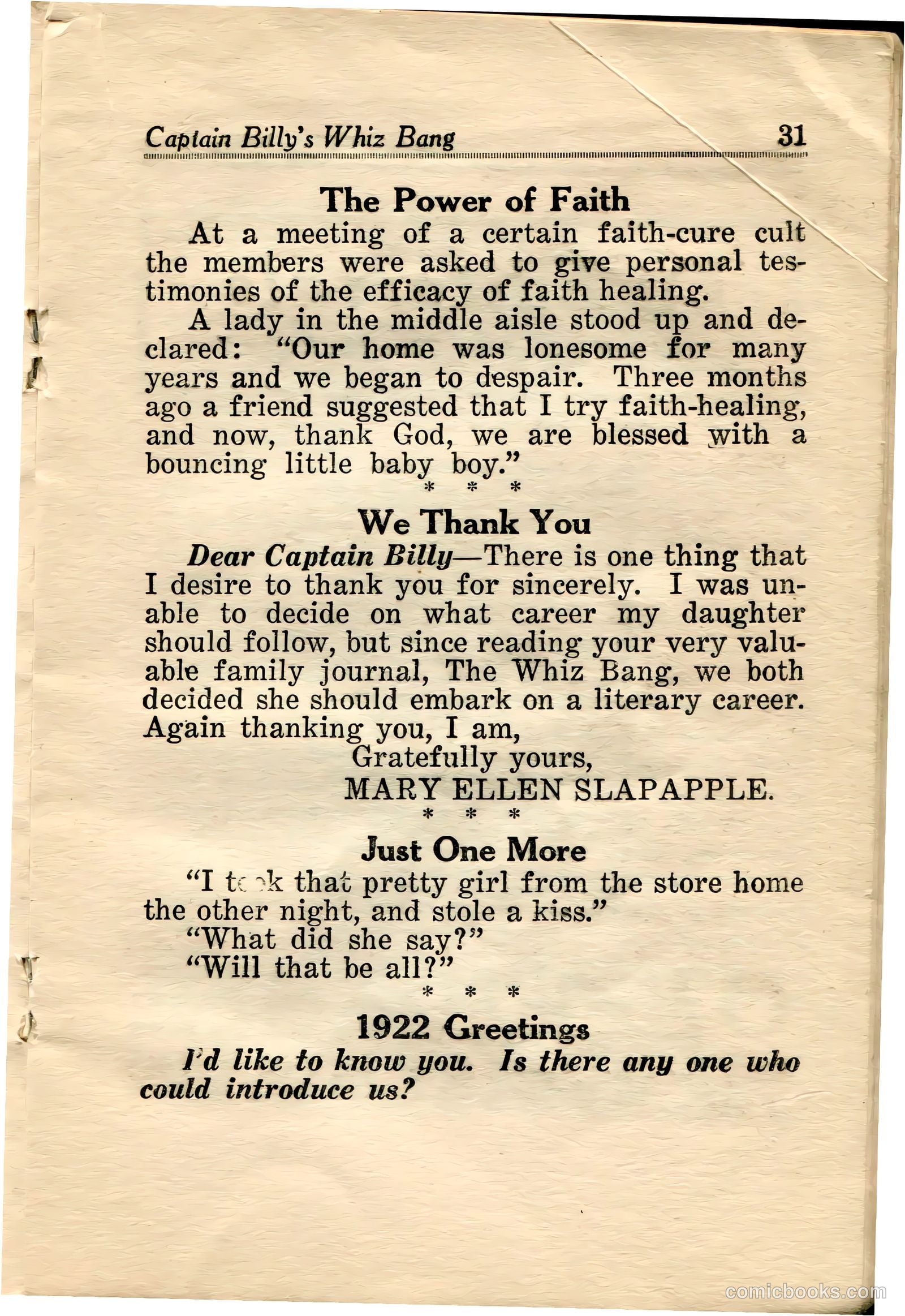
This page from the satirical magazine contains several brief humorous items: **"The Power of Faith"** mocks faith-healing cults through ironic testimony—a woman credits faith-healing for her pregnancy, when the obvious explanation is natural conception. The satire targets gullible believers who attribute mundane life events to miraculous intervention. **"We Thank You"** is a reader's flattering letter thanking the magazine for career guidance, likely genuine or semi-ironic advertising for the publication itself. **"Just One More"** is a flirtatious joke: a man steals a kiss from a store girl, who responds "Will that be all?"—treating the kiss as a transactional item like merchandise, suggesting either her mercenary nature or his presumption. **"1922 Greetings"** appears to be a personal ad seeking introduction/companionship. The page reflects *Whiz Bang's* blend of crude humor, social satire of contemporary fads (faith-healing), and ribald romantic jokes typical of 1920s men's magazines.
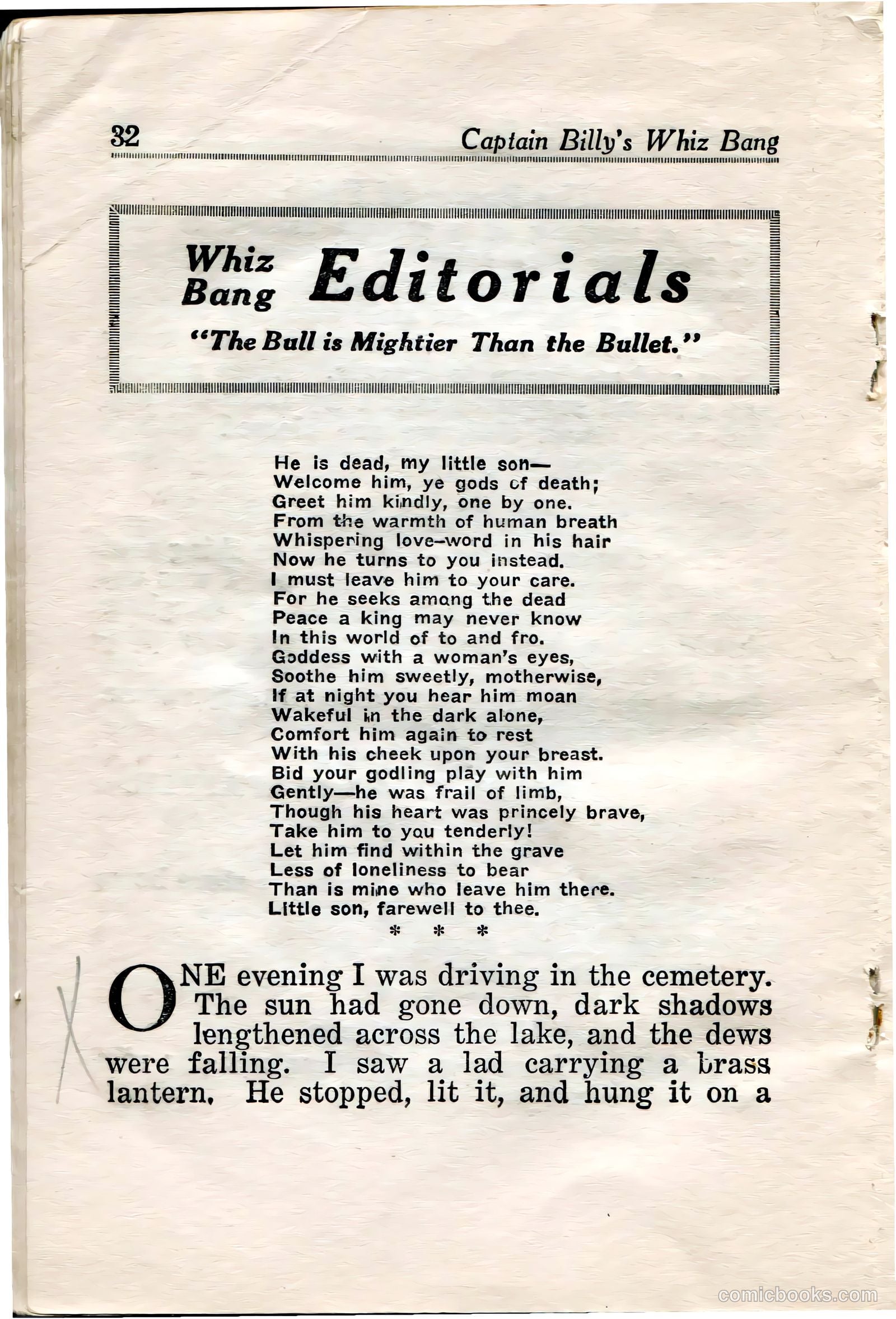
This page from *Captain Billy's Whiz Bang* (a 1920s satirical magazine) presents an editorial mixing poetry and prose about grief and loss, likely referencing World War I casualties. The poem is a mother's farewell to her dead son, asking the gods of death to comfort him in the grave. It emphasizes his youth ("frail of limb") and bravery, contrasting his peaceful death with the mother's ongoing suffering. The editorial's title—"The Bull is Mightier Than the Bullet"—appears to argue that spiritual or moral strength transcends military violence. The prose fragment beginning below describes a cemetery scene at dusk, where a youth places a memorial lantern on a grave, reinforcing themes of mourning and remembrance. This is sentimental, anti-war commentary typical of post-WWI American publications processing national trauma through domestic loss.
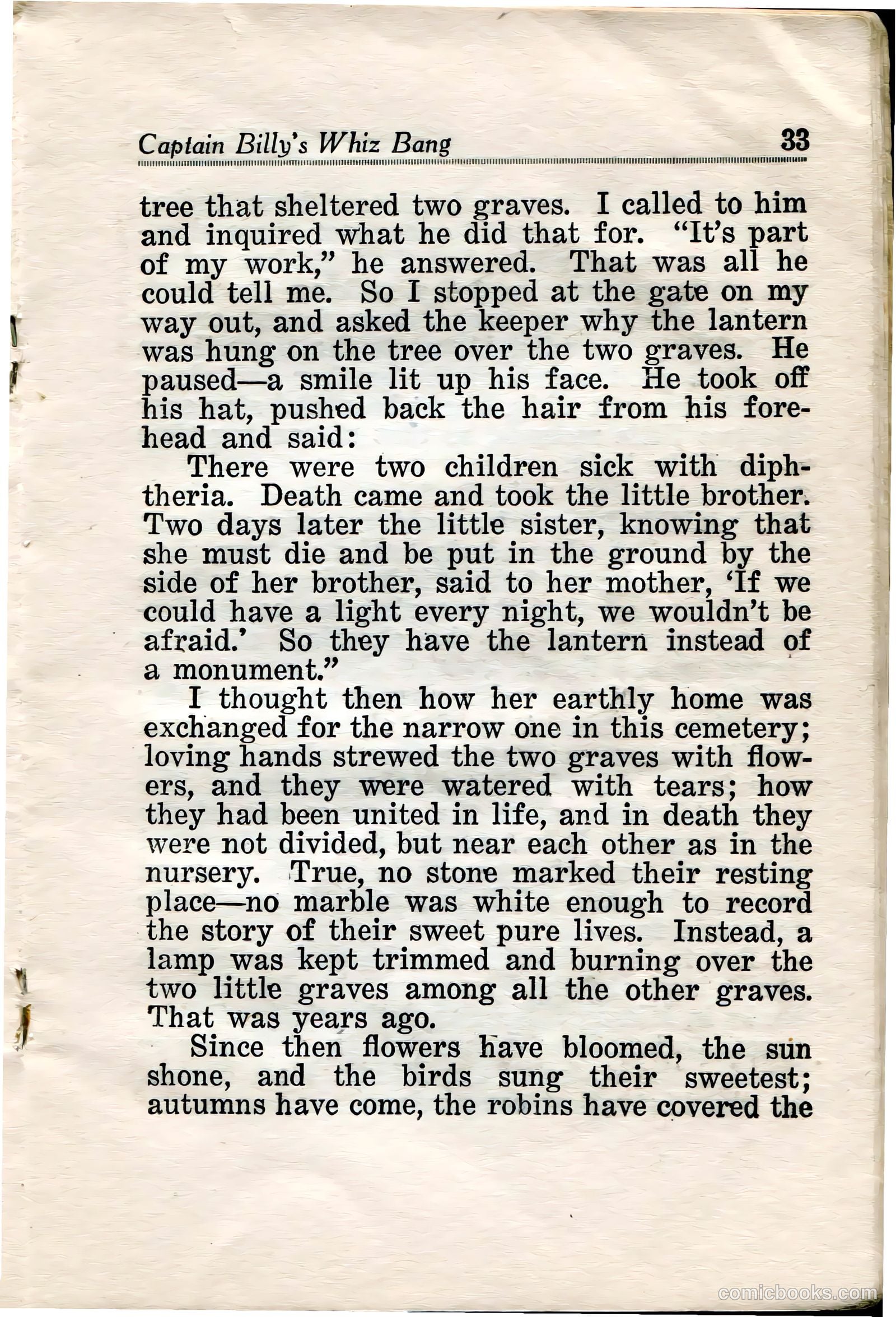
This page contains a sentimental narrative rather than political satire or cartoon content. It tells the touching story of two children who died of diphtheria and were buried together in a cemetery. Before her death, the younger sister requested a light be kept burning at night so she wouldn't be afraid—so a lantern was hung over their graves instead of a traditional monument. The piece appears to be a nostalgic, emotionally manipulative short story emphasizing themes of childhood innocence, sibling devotion, and parental love. It reflects early 20th-century attitudes toward death, commemorating the deceased through symbols of comfort rather than conventional markers. There is no apparent political satire, caricature, or social commentary present—it's purely sentimental content, likely included among the magazine's mix of humor and human-interest stories.
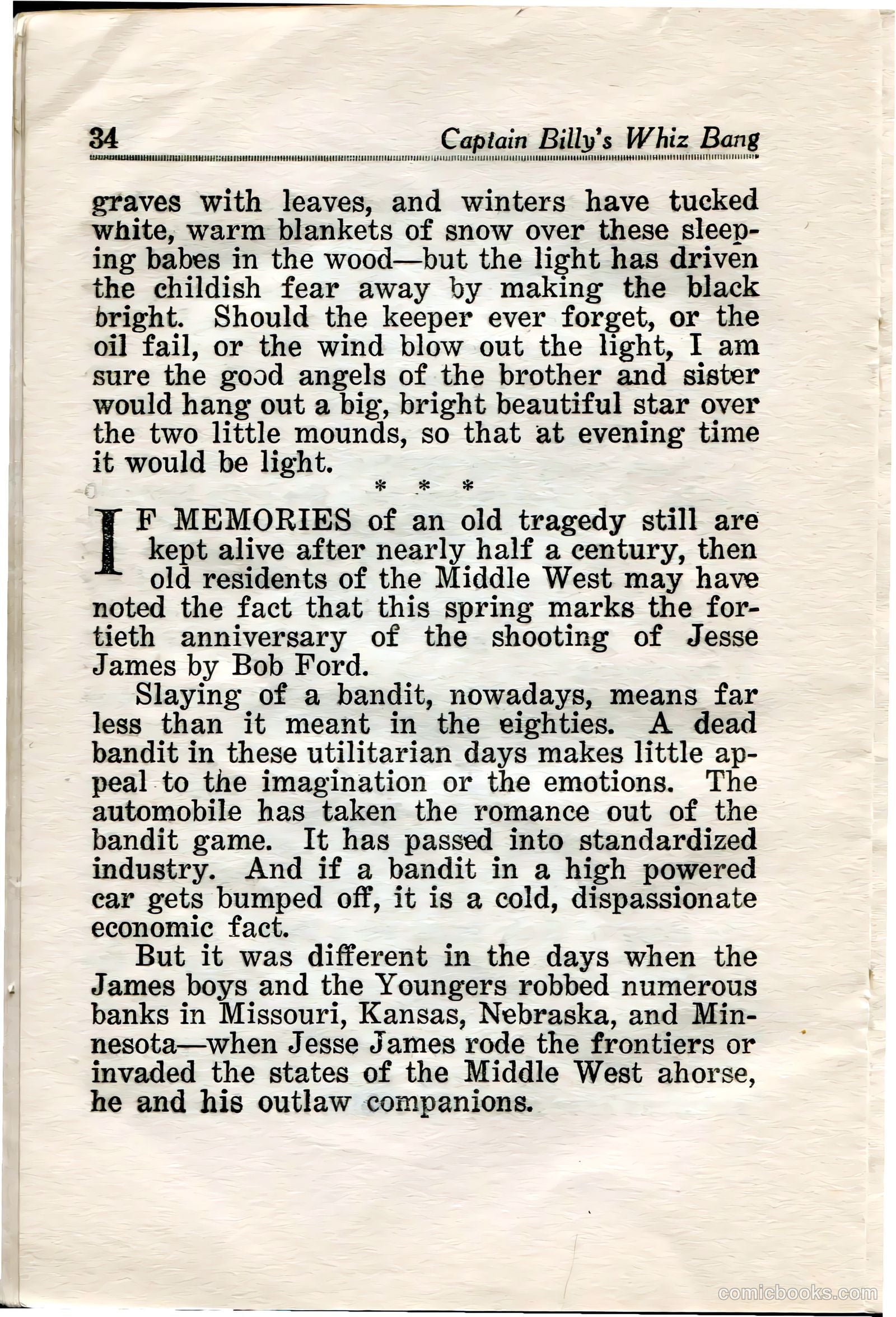
This page contains no cartoon, but rather **prose commentary** on Jesse James and outlaw romanticism. The article marks the 40th anniversary of Jesse James's 1882 shooting by Bob Ford. The author contrasts 19th-century banditry—which captured public imagination as "romantic" frontier adventure—with modern (1920s) crime, now rendered mundane by automobiles and industrialization. The opening passage appears to be sentimental fiction about children's graves ("sleeping babes in the wood"), possibly referencing the nursery tale, though its connection to the James essay is unclear. The satire's point: technology has stripped criminality of its mystique. When Jesse James robbed banks "ahorse" across the Middle West frontier, outlaws were folk legends. Now, when criminals operate in "high powered cars," their capture is merely cold economic fact—stripped of all romance and emotional resonance that once captivated readers.
This page from the satirical magazine presents the famous ballad of Jesse James's death, focusing on the moral betrayal by Robert Ford, who shot the outlaw in his St. Joseph, Missouri home. The text frames Ford as a "dirty little coward" who violated the bond of hospitality—he "ate of Jesse's bread and he slept in Jesse's bed" before killing him. The ballad romanticizes James as a "friend to the poor" while condemning Ford's treachery. This reflects how 1880s-90s American frontier mythology elevated outlaws into folk heroes, particularly in border regions. The magazine appears to be republishing this widely-sung ballad as historical commentary, treating the James gang's final days as emblematic of the Old West's passing. The satire likely critiques how Americans mythologized criminals and violence.
This page discusses the 1882 assassination of outlaw Jesse James by Robert Ford, presented through contrasting cultural perspectives. A folk song ("Billy Garshade") romanticizes James as a figure who "could not be taken alive," treating his killing as tragic. The satire targets prosecutor William H. Wallace's elaborate courtroom speech during Frank James's trial. Wallace's ornate metaphor—comparing Jesse "training" the Ford brothers in crime like an eagle teaches young to hunt—is presented as absurdly overwrought oratory that inadvertently glorifies the bandit while condemning his killers. The joke lies in the gap between Wallace's claimed condemnation of Jesse James and his flowery, almost heroic language. For modern readers, this captures how 1880s courtroom rhetoric could be bombastically theatrical, and how the James brothers occupied ambiguous cultural status (outlaws yet folk heroes in some circles). *Whiz Bang* mocks both sentimentalizing outlaws and prosecutors who inadvertently romanticize them through purple prose.
This page contains two distinct pieces: **The Eagle Poem**: An allegorical poem about an eagle killed by its own feather, followed by a lengthy farewell addressing **Jesse James**, the notorious outlaw. The text presents an ambivalent moral judgment—condemning James as a "bloody star of murder" who terrorized Missouri, yet grudgingly celebrating his death as a release from evil. The eagle metaphor suggests James was destroyed by forces he himself generated. **"Each in His Own Tongue"**: An introductory note about a popular poem by William Hubert Carruth, formerly a Kansas University professor. The piece announces that this poem received considerable reader correspondence. The page appears designed to showcase literary content rather than satire or political commentary. The Jesse James piece reflects genuine 19th-century ambivalence toward the outlaw—simultaneous moral condemnation and romantic fascination—common in American popular culture of that era.
This page from *Captain Billy's Whiz Bang* (a humor magazine) reprints a poem that reconciles evolution with religious faith. The poem, quoted by ministers at Westminster Abbey and Yale, presents natural phenomena and human experiences—evolution, autumn, longing, sacrifice—as equally valid expressions of either scientific or divine truth. The refrain "Some call it [X], and others call it God" bridges the era's heated science-versus-religion debate. The satire appears gentle: the magazine presents this serious poem straightforwardly, then undercuts it with a crude "Health Hint" suggesting hedonism ("eat and drink") over marriage and responsibility—likely mocking both the poem's earnestness and contemporary anxiety about mortality and social obligation. The overall tone is irreverent toward established institutions (churches, universities) while presenting conflicting worldviews without resolving them.
**"Why Walk a Mile?"** is a crude joke about women smoking. The title plays on a cigarette advertising slogan ("I'd walk a mile for a Camel"). The humor attempts wordplay: the biblical reference to Rebekah "lighting off" her camel is twisted to suggest "lighting" a cigarette—implying women have smoked since biblical times. This reflects 1920s anxiety about changing women's behavior; female smoking was then controversial and seen as morally questionable. **"The Tropics,"** attributed to Randolph Atkin, presents a poem warning against Central America. It catalogs stereotypical dangers: disease, moral laxity, political chaos, and sensuality. The repeated emphasis on "dark-eyed" women and "white-skinned gringoes" reflects contemporary racial attitudes. The poem's underlying message: despite tropical allure, the region's corruption and disease make it ultimately dangerous—yet irresistibly seductive. It expresses American imperial-era ambivalence toward Latin America.
This page collects brief satirical bits targeting domestic life and wartime bureaucracy: **"When Wifie Kisses Me, Hide My Pocketbook"** is a joke about wives as spendthrifts—a common domestic stereotype of the era. **The Deacon Miller / hen joke** appears to be a mild double entendre about the deacon's reputation. **The lawyer epitaph** is straightforward cynicism about the legal profession. **"Echoes From Wartime Days"** is the substantial piece—a humorous letter from Mrs. Paul Quinn to Army headquarters. The humor derives from her malapropisms and confusions ("elopement" for allowance, "kneed" for need, "spittoon" duty). She's a genuinely struggling wife seeking support for her infant while her husband serves, but her fractured English and muddled descriptions make her plight comedic rather than sympathetic—reflecting how *Whiz Bang* treated serious topics with irreverent humor. The P.S. about him playing piano at the Y.M.C.A. adds to the absurdity.
This page reprints a humorous poem by Edward J. Phelps, a real historical figure (U.S. Ambassador to England under Cleveland), about a frustrating train experience. Phelps accidentally boarded the wrong train at Essex Junction, Vermont, and ended up back where he started—inspiring bitter verse about the junction itself. The satire targets the real inconvenience of late 19th-century rail travel: missed connections, long layovers, and poorly designed transfer points. The poem's exaggerated curse—damning whoever "invented" Essex Junction to hell—mocks the traveler's mounting desperation after nine hours of waiting. This reflects contemporary complaints about railroad inefficiency and the absurdity of connection-based travel schedules. The humor lies in channeling genuine frustration into mock-grandiose condemnation of a location rather than the system itself. *Whiz Bang* positioned such relatable comedic complaints as entertainment for readers familiar with similar travel mishaps.
This page contains two poems satirizing different frustrations. **"Essex Junction"** mocks a railroad junction (likely in Vermont) notorious for delays and accidents. The speaker curses whoever invented this location, hoping their souls suffer in hell—hyperbolic humor about travel frustrations that affected the war-era public. **"Whether You're Jew or Christian"** (recited by Ed. E. Ford) addresses World War I's Western Front. It argues that religious divisions become meaningless in combat's face—when poison gas attacks and death looms, soldiers of all faiths pray together equally. The poem's point: shared mortal danger transcends theological boundaries. The closing reference to a wounded soldier being "booked for 'the west'" (likely meaning death) reinforces this grim leveling effect of warfare. Both poems use dark humor typical of *Whiz Bang*, a satirical magazine known for irreverent commentary on contemporary hardships.
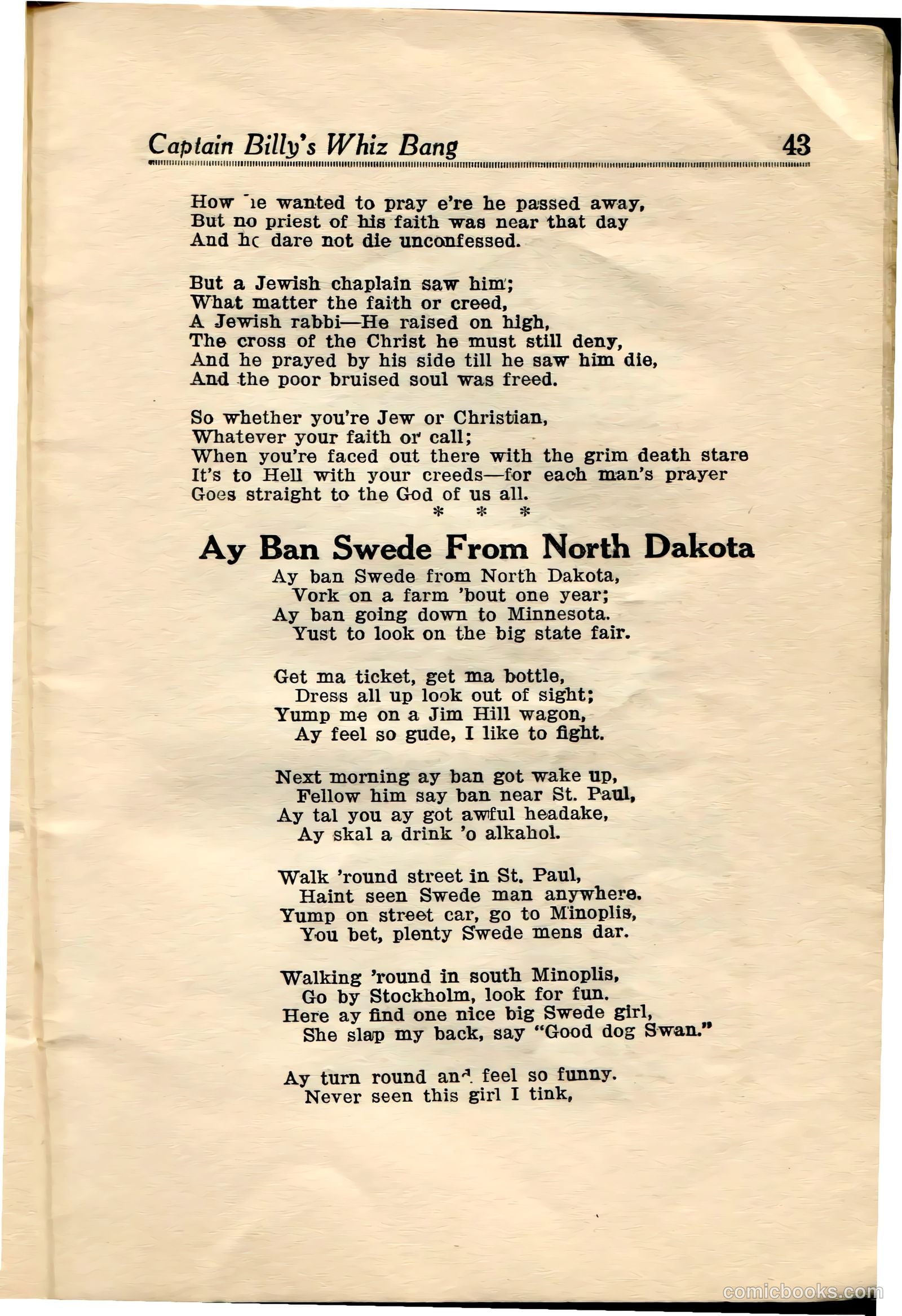
This page contains two poems reflecting early 20th-century American attitudes. **"Captain Billy's Whiz Bang"** (top): A sentimental poem about interfaith tolerance during wartime (likely WWI). A dying soldier, denied a Catholic priest, receives last rites from a Jewish chaplain who holds up a cross despite his own faith. The message: in extremity, religious boundaries dissolve—all prayers reach "the God of us all." This reflects genuine WWI-era discussions about soldiers of different faiths serving together. **"Ay Ban Swede From North Dakota"** (bottom): A comedic monologue in exaggerated Swedish-immigrant dialect ("Ay ban," "Yump," "Minoplis"). The humor derives from the speaker's broken English and boorish behavior—getting drunk, losing his way, meeting a woman who greets him familiarly. The piece trades on stereotypes about Swedish immigrants as unsophisticated farm laborers, but treats them affectionately rather than viciously. This reflects 1920s American amusement with immigrant communities and their dialects.
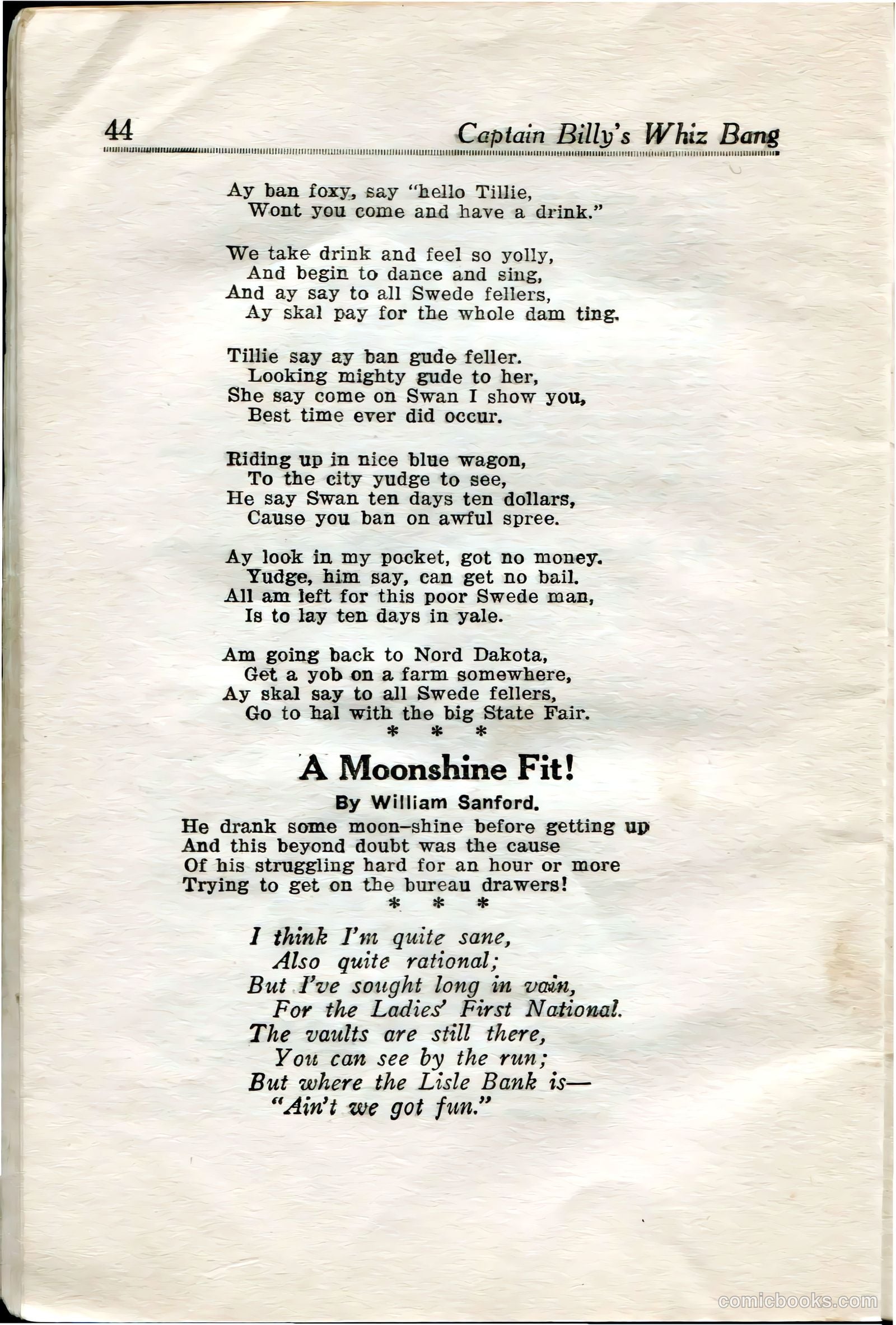
This page contains two satirical pieces from an early 20th-century American humor magazine. The first poem mocks Swedish immigrants through exaggerated dialect and stereotypes. A Swedish man named Swan courts "Tillie," gets drunk, goes on a spree, and is arrested by the judge ("yudge"), receiving a ten-day jail sentence. The humor relies on thick accent reproduction ("ay ban," "skal," "yob") and portrays the immigrant as foolish and impulsive—a common ethnic caricature of the era. The second piece, "A Moonshine Fit!," jokes about prohibition-era bootleg liquor, describing a drunk man's inability to find his bureau drawers. The final short poem references bank failures, likely the Lisle Bank collapse, using the phrase "Ain't we got fun"—suggesting sardonic humor about economic hardship during unstable banking periods. All three pieces use working-class vernacular and target vulnerable populations—immigrants and the economically struggling.
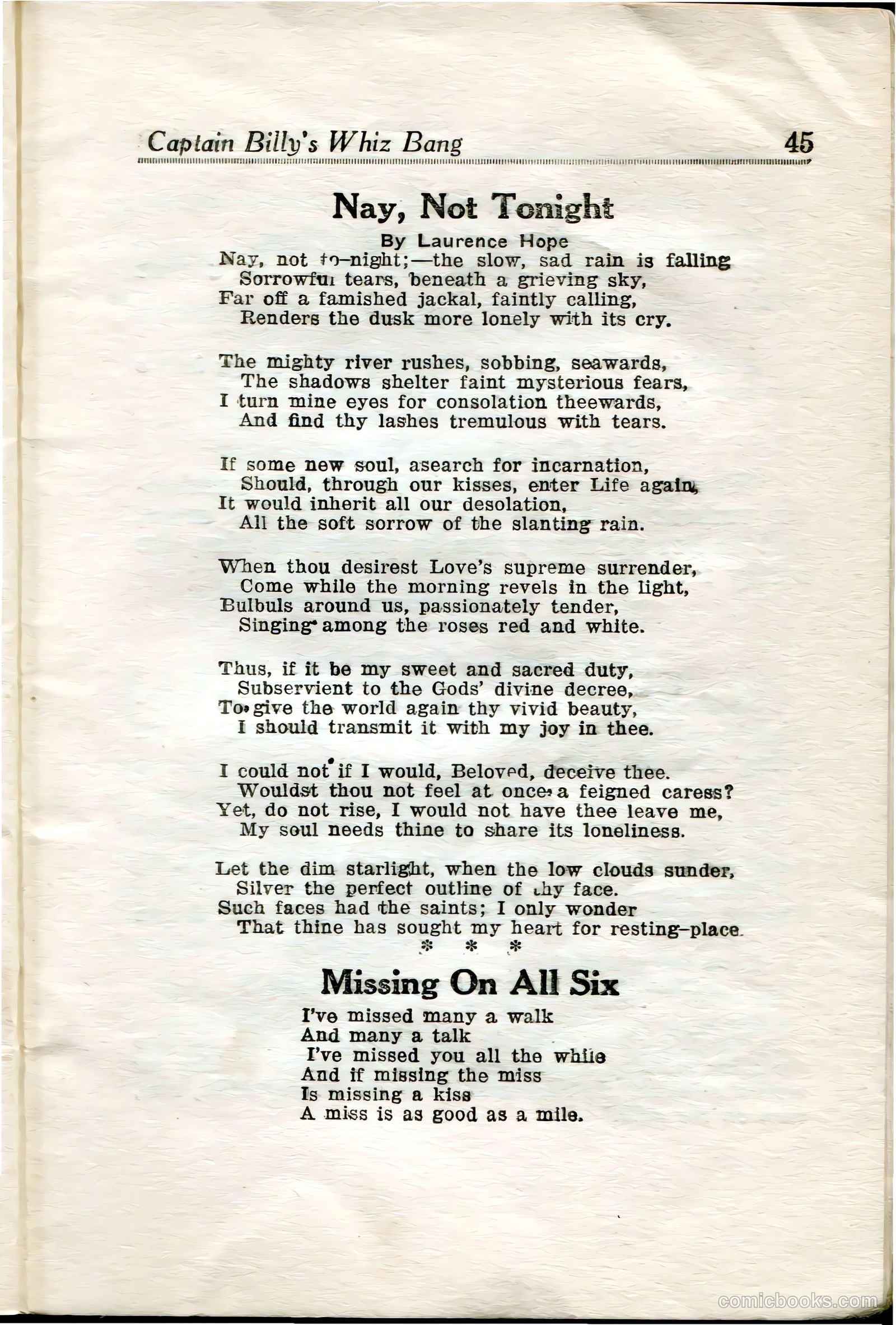
This page contains two poems, not cartoons or satirical content. "Nay, Not Tonight" by Laurence Hope is a romantic, melancholic poem set in an exotic (likely Indian) setting, addressing themes of love, loneliness, and spiritual connection. The second piece, "Missing On All Six," is a brief, lighthearted poem about romantic absence that plays on the phrase "a miss is as good as a mile." There are no political caricatures, identifiable figures, or satirical commentary visible. The page appears to be literary content from *Captain Billy's Whiz Bang*, a humor magazine that mixed jokes, advertisements, and poetry. Without additional context about the magazine's satirical intent or visual elements, these read as straightforward romantic and sentimental verses typical of early 20th-century periodical literature rather than satire.
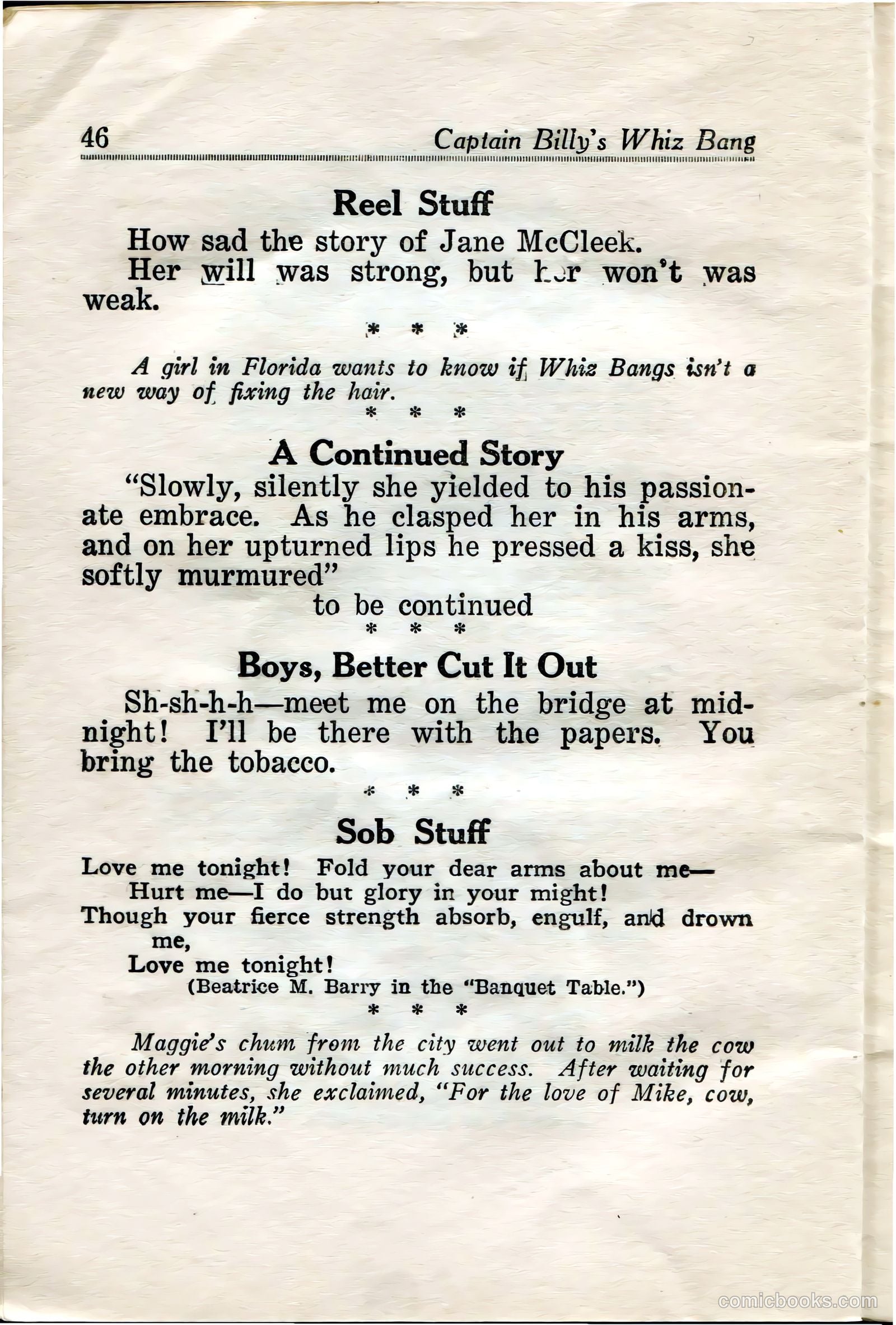
This page from *Captain Billy's Whiz Bang* (a humor magazine popular in the 1920s) is a collection of short satirical jokes and quips targeting contemporary social attitudes. The humor mocks melodramatic romance writing ("A Continued Story," "Sob Stuff"), with exaggerated passionate prose that was common in pulp fiction. The Jane McCleek joke plays on moral judgment—her "will" being strong but her "won't" (desire to resist) being weak, satirizing judgmental attitudes about women's sexuality. "Boys, Better Cut It Out" appears to mock young men's secretive rebelliousness, perhaps referencing illicit meetings or contraband (tobacco suggests bootlegging during Prohibition). The final anecdote jokes about city people's ignorance of farm life—the woman's command "turn on the milk" treats the cow like a mechanical appliance, mocking urban disconnection from rural reality. Overall, the page reflects 1920s sensibilities about romance, propriety, youth behavior, and rural-urban cultural divides.
This Whiz Bang piece satirizes Prohibition's enforcement in San Francisco. The poem laments Ellis Street's transformation from a glamorous bar district serving champagne ("Cliquot") and cocktails into a mundane waffle shop—suggesting Prohibition has stripped the city of its sophisticated vice. The prose mocks San Francisco's previous lax enforcement, where residents avoided the medical pretense other Americans used to drink legally (fake "tonsilitis prescriptions"). It ridicules the new strict Prohibition director ("Uncle Samuel"—the federal government) through absurdist examples of newfound enforcement absurdity: eating raisins on a Ferris wheel or toasting with a "cross-eyed girl" are now technically violations. The satire targets both Prohibition's puritanical overreach and San Francisco's lost libertarian drinking culture. The humor hinges on comparing serious alcohol prohibition to trivial, invented "misdemeanors," exposing the law's excessive reach.
This satirical piece mocks Prohibition-era crime and its unexpected criminals. The article describes nine "booze bandits" who robbed the Hart mansion in San Mateo of $25,000 in liquor. The satire's bite comes from revealing these weren't hardened criminals but respectable professionals: a prominent insurance broker, chauffeurs, and waiters—ordinary citizens driven to crime by Prohibition's economic opportunities. The piece ridicules the insurance broker specifically, who allegedly couldn't focus on looting because he was distracted by the Hart household's young women in their nightwear, requiring the gang leader to punch him in the eye. The Latin phrases ("spirits fermenti" for booze, "requiescatting in pace" for prison labor) add mock-scholarly humor. The overall message: Prohibition created a lucrative "school and profession of crime," recruiting respectable middle-class men rather than eliminating vice.
This article mocks the heavy censorship of Erich von Stroheim's 1922 film *Foolish Wives*. Carl Laemmle (Universal Pictures owner) and von Stroheim (the film's director and star) attempt to screen the picture in San Francisco, but police censors eliminate multiple scenes involving seduction and voyeurism—a character named Count Sergius attempting to kiss and undress an ambassador's wife, and spying on her undressing. The satire's point: the censors cut so much sexually suggestive content that the remaining film becomes absurd. The author highlights a logical inconsistency—how could Sergius wade through a marsh for 30 minutes and still have a dry cigarette case and matches?—to mock both the film's implausibility and censorship's heavy-handedness. Despite being gutted, the censored version still drew huge crowds, suggesting audiences craved the scandal regardless.
This page from the humor magazine contains brief jokes targeting early 1920s celebrities and social situations: **Von Stroheim reference**: Director Erich von Stroheim's costly "Monte Carlo" film production is mocked for its expensive extras and sets, with hope that producer Carl Laemmle recovers his investment—satirizing Hollywood's extravagant spending. **Celebrity jokes**: Chaplin (Charlie Chaplin, the silent film star) and Fairbanks (Douglas Fairbanks, action film hero) are referenced in wordplay jokes assuming readers recognize these major figures. **"Cuban Dialogue"**: A joke about con men taking money from educated marks, using vague ethnic humor common to the era. **Magazine self-promotion**: A joke credits *Whiz Bang* magazine itself with ruining a romantic evening—playful advertising. **"Tied the can"**: An idiom meaning "broke up with" (the girl rejected her garbage man's daughter fiancé). The page is primarily **joke columns**, not political cartoons, reflecting the magazine's satirical humor focused on celebrities, relationships, and contemporary urban life.
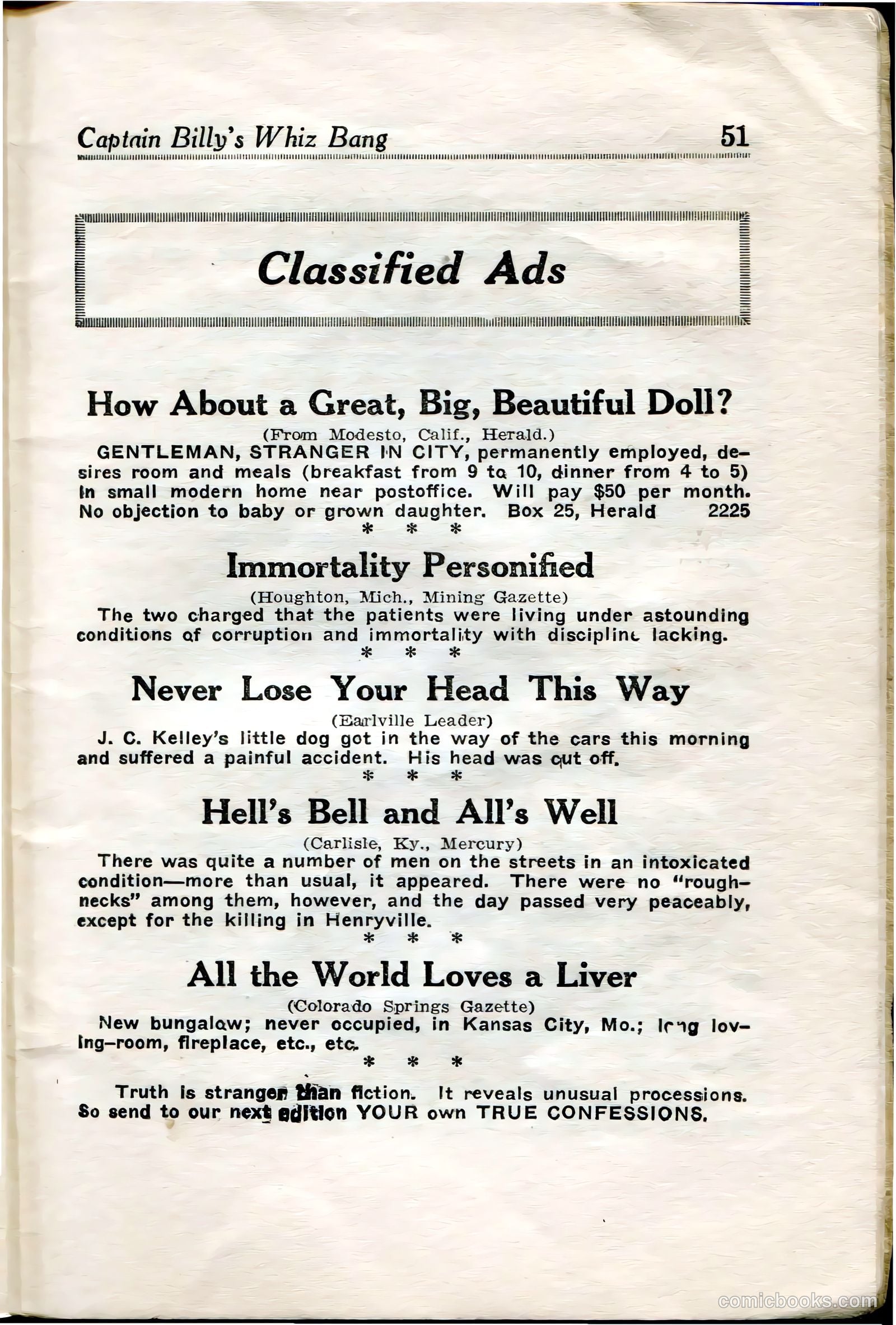
This page presents *Classified Ads* — a humor feature where the magazine reprints real newspaper classified advertisements and headlines from across America, highlighting their unintentional comedic absurdities through poor wording or disturbing juxtapositions. Examples include: - A roommate ad oddly emphasizing "no objection to baby or grown daughter" - A headline about hospital "immortality" (likely meant "immorality") - A dog accident report casually mentioning decapitation - A town crime report nonchalantly noting a killing amid otherwise peaceful intoxication - A real estate ad with an apparent typo: "loving-room" (likely "living-room") The satire works through **malapropisms, typos, and dark juxtapositions**—the humor derives from real-world language mistakes and the absurd tone-deafness of mixing casual observations with serious crimes. This reflects *Whiz Bang*'s formula of satirizing American small-town life through its own published words, revealing unintentional humor in everyday communication.
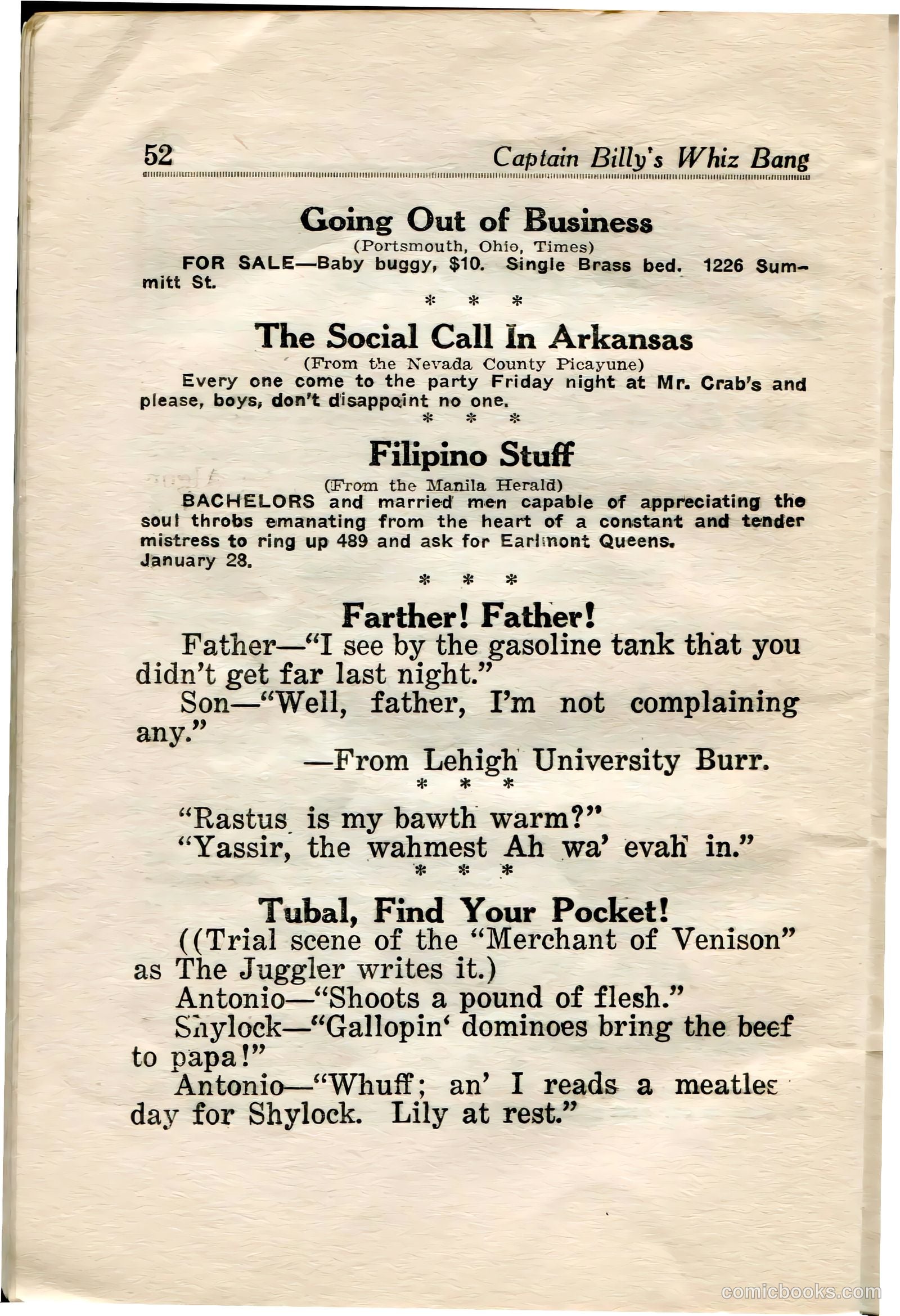
This page collects brief satirical items typical of 1920s American humor magazines. Most items mock contemporary social life and emerging technologies: **"Farther! Father!"** jokes about the novelty of automobiles and gasoline rationing or expense—the father teases his son about not traveling far despite using fuel. **The dialect humor** ("Rastus," "Yassir") reflects the casual, offensive racial stereotyping common in period publications, portraying Black speakers in exaggerated vernacular. **"Tubal, Find Your Pocket!"** parodies Shakespeare's *Merchant of Venice*, replacing refined language with crude slang ("Gallopin' dominoes bring the beef to papa"). The humor depends on mangling high literature into lowbrow speech. **"Filipino Stuff"** appears to mock Filipino English or advertising conventions, though the exact satirical target is unclear. The page emphasizes humor through dialect, class mockery, and literary parody—all hallmarks of irreverent 1920s magazine comedy that modern readers would find crude and often offensive.
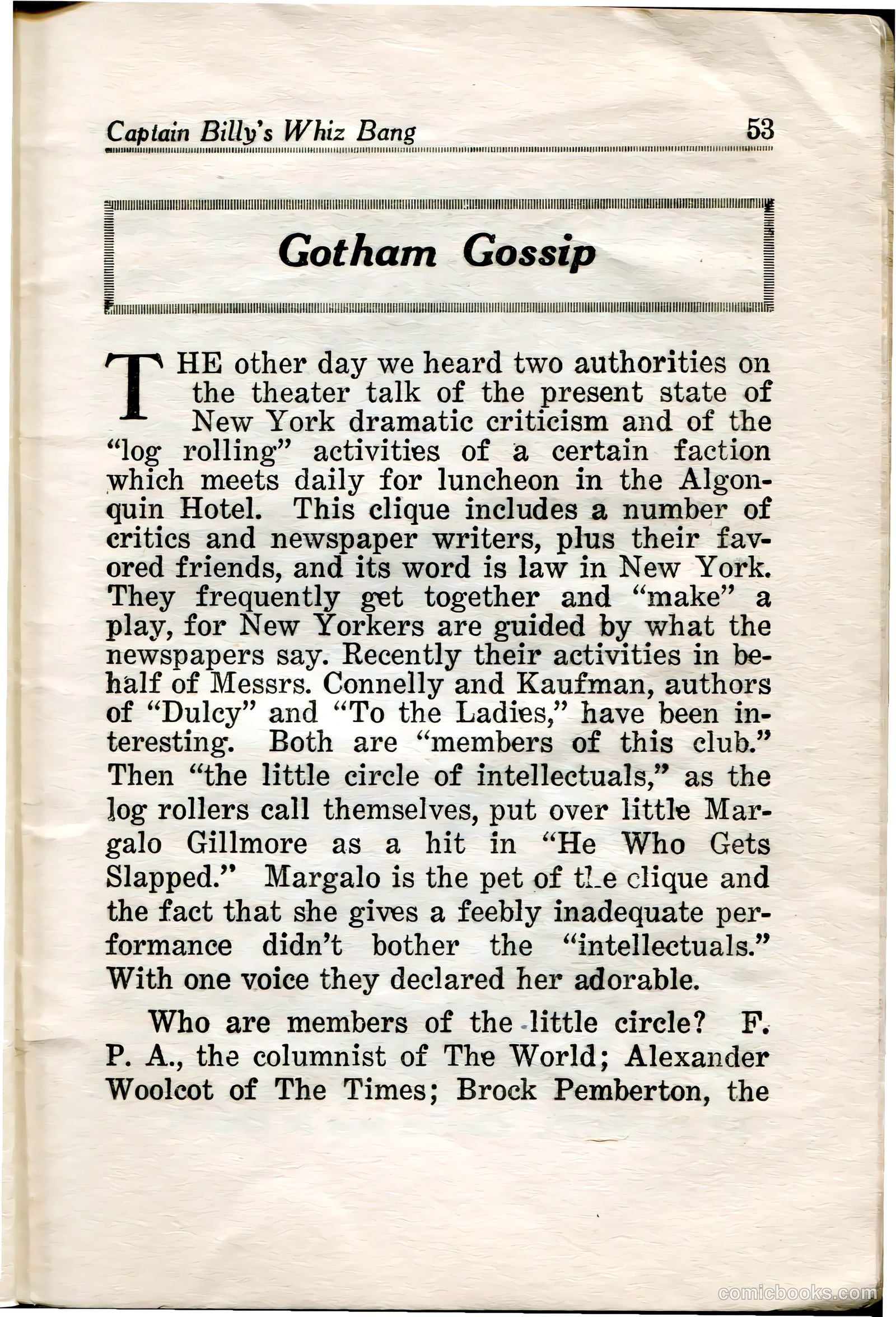
This is satirical gossip about New York's influential theater clique—specifically critics and columnists who met regularly at the Algonquin Hotel. The piece attacks what it calls "log rolling" (mutual back-scratching promotion) by these self-styled "intellectuals." The target: prominent theater critics including **F.P.A.** (Franklin Pierce Adams of The World), **Alexander Woolcott** (The Times), and **Brock Pemberton** (incomplete). The satire alleges they collusively promoted certain plays and playwrights—naming Connelly and Kaufman's works "Dulcy" and "To the Ladies," plus Margalo Gillmore's performance in "He Who Gets Slapped." **The joke**: These arbiter figures claim intellectual superiority yet supposedly praise mediocre work merely because it's connected to fellow clique members, while New York audiences blindly follow their newspaper pronouncements. The satire mocks both the critics' self-importance and their cynical manipulation of public taste.
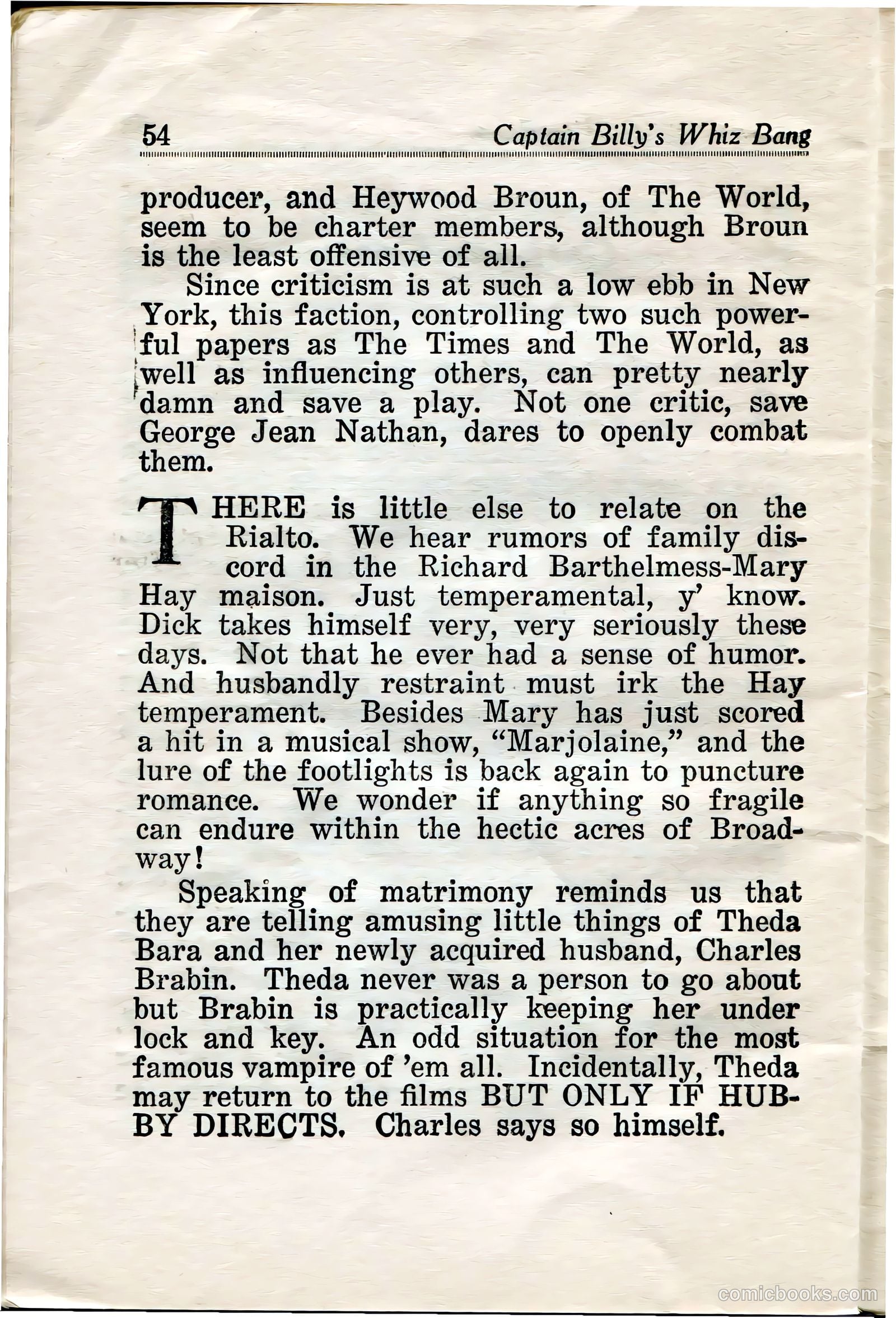
This page from the satirical magazine gossips about Broadway theater and Hollywood celebrities circa the 1920s. The text criticizes theater critics' power, particularly those at major papers like *The Times* and *The World*, noting they can "damn and save a play." Only critic George Jean Nathan allegedly dares challenge them independently. The gossip section targets film and stage personalities: Richard Barthelmess and Mary Hay face rumored marital discord; Theda Bara (the famous "vampire" seductress of silent film) has married director Charles Brabin, who reportedly keeps her confined—an ironic situation for cinema's most notorious femme fatale. The satire suggests Bara will only return to films if her husband directs, implying he controls her career. The humor relies on readers' familiarity with these celebrities' public personas and romantic scandals—typical of entertainment gossip columns of the era.
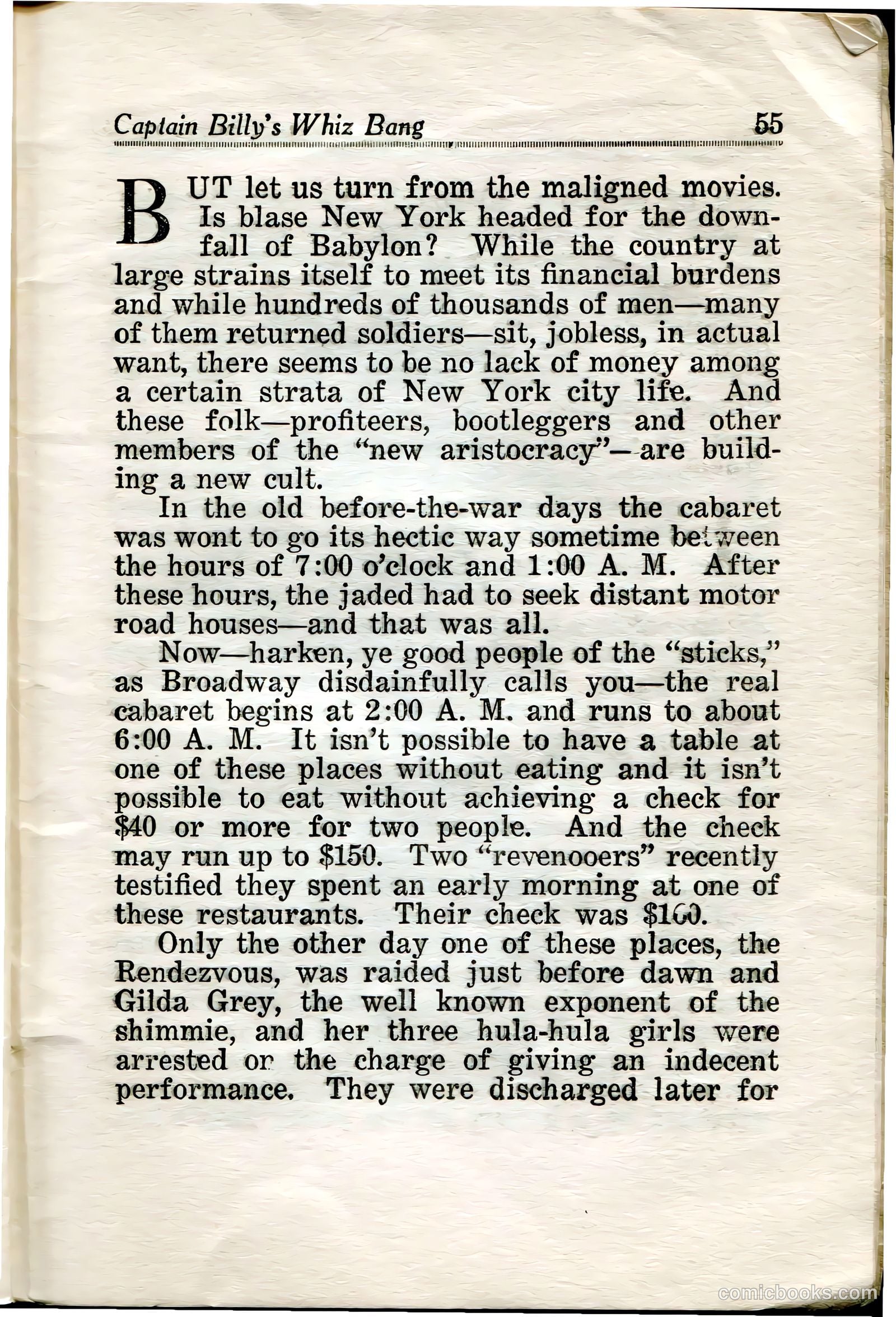
This 1920s satire condemns New York's nightclub culture during Prohibition. The article attacks the "new aristocracy" of profiteers and bootleggers living lavishly while returning soldiers face joblessness and poverty. The specific critique targets all-night cabarets (2 AM–6 AM operations) where patrons pay exorbitant fees ($40–$150 per couple) for food and entertainment—including performances by dancer Gilda Grey, known for the "shimmy" dance. The Rendezvous cabaret's pre-dawn raid and Grey's arrest (later dismissed) exemplify the moral decay the author sees. The satire's bite: wealthy urbanites flout both financial responsibility and laws (Prohibition) while ordinary Americans suffer. The dismissive term "sticks" for rural readers emphasizes the East Coast elite's arrogance. The piece argues this decadent nightlife represents America's spiritual decline, invoking Babylon as a biblical metaphor for corrupt civilization heading toward ruin.
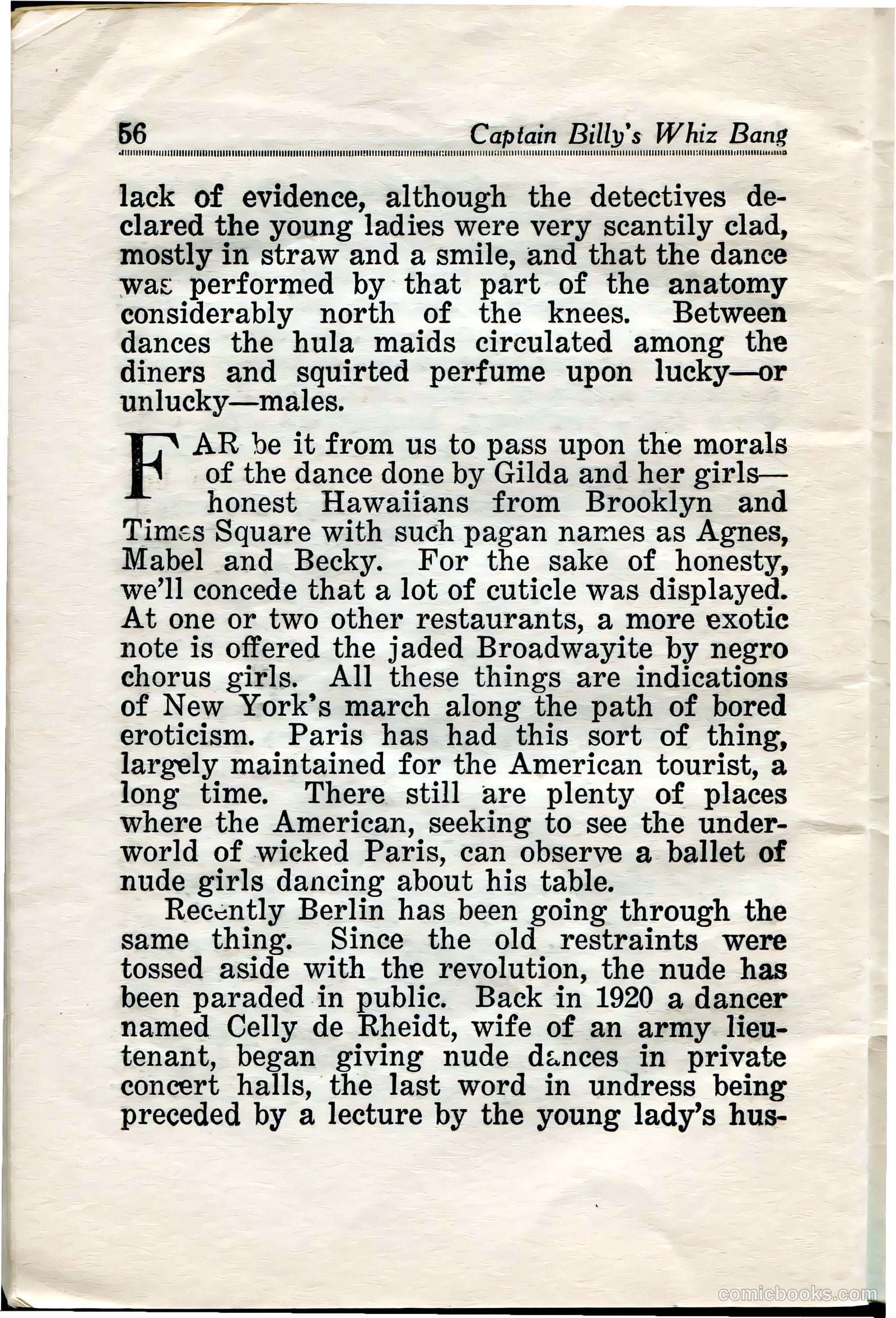
This satirical piece mocks New York's embrace of exotic entertainment and moral loosening in the 1920s. The author sarcastically describes "hula" performances by performers with obviously non-Hawaiian names (Agnes, Mabel, Becky) from Brooklyn and Times Square—exposing the artificiality of the spectacle marketed to tourists seeking "exotic" thrills. The satire targets both the entertainers' obvious fakery and the audience's gullible consumption of manufactured eroticism. By comparing New York's trend to Paris and Berlin's post-war nude dancing scenes, the piece suggests America is following Europe's path toward "bored eroticism"—entertainment for jaded urban consumers willing to pay for increasingly explicit shows under thin pretexts of cultural authenticity or intellectual legitimacy (like the husband's "lecture" preceding undress). The underlying critique: modernity, tourism, and moral decline are commercializing sexuality.
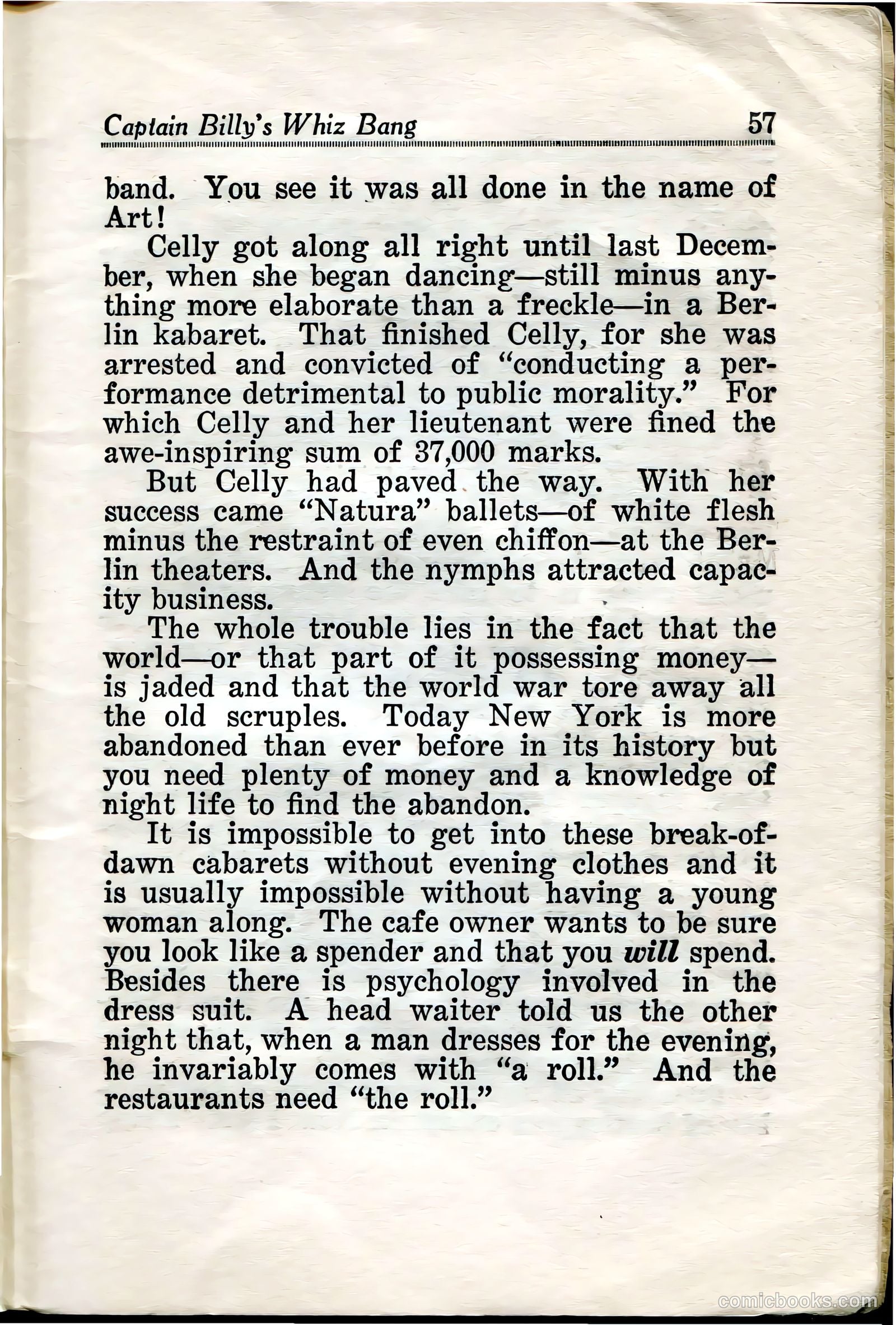
This page satirizes post-WWI moral decay and commercialized vice in 1920s Berlin and New York. The text describes "Celly," a performer arrested in Berlin for nude dancing (presented as "Art"), fined 37,000 marks for "conduct detrimental to public morality." Her notoriety sparked demand for "Natura" ballets—explicitly nude performances that became profitable spectacles. The satire targets multiple targets: the hypocrisy of calling nudity "Art," the ease with which moral standards collapsed after World War I ("tore away all the old scruples"), and the commercialization of vice. The author mocks upscale venues that require evening dress and female companions—not for propriety, but to ensure wealthy clientele ("spenders with 'a roll'"). The cynical point: establishments perform morality theater while profiting from abandon, and wealthy patrons' formal attire paradoxically signals their intent to spend money on illicit entertainment.
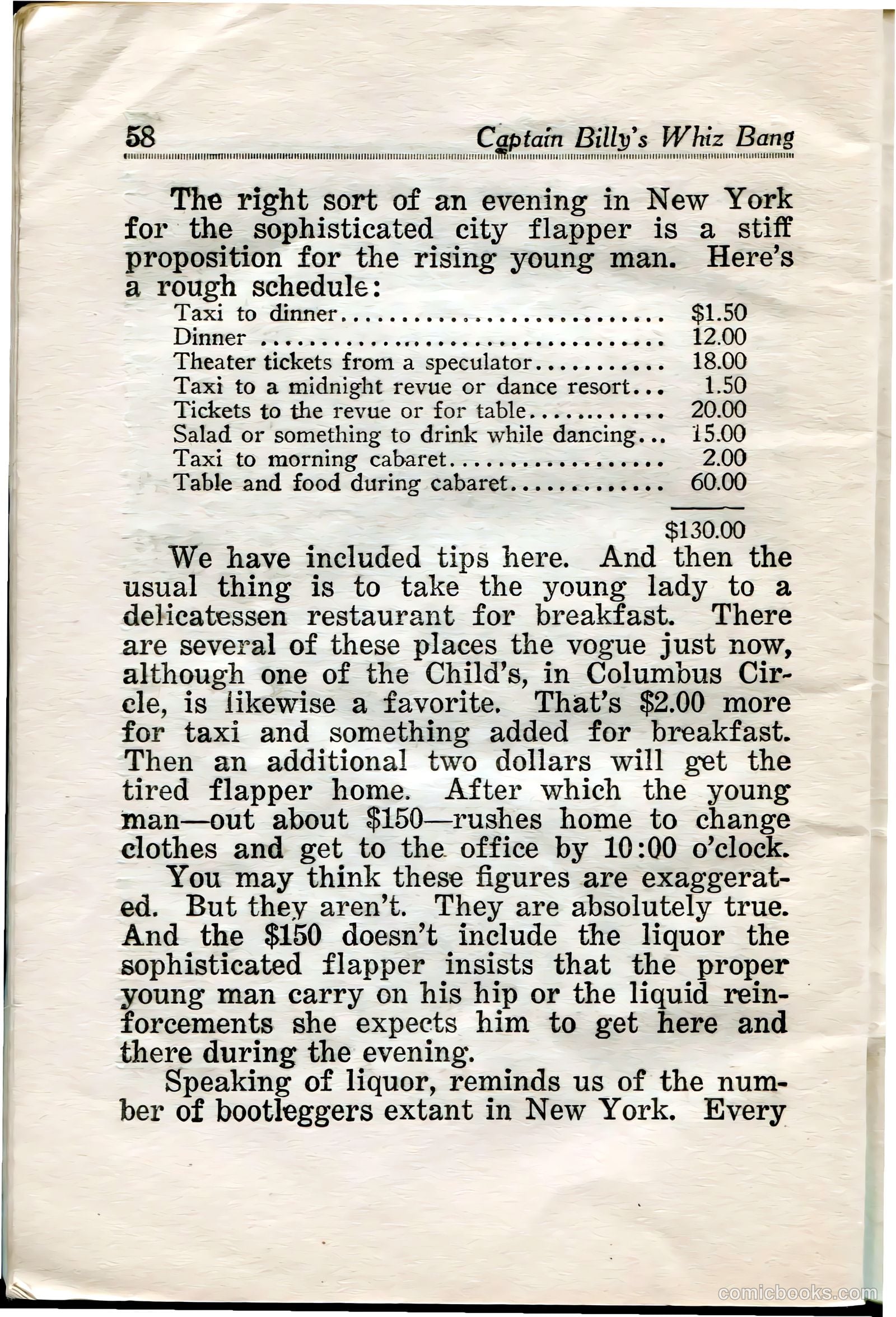
This is satirical commentary on the financial burden of dating a "flapper"—the modern, independent young women who emerged in the 1920s. The piece humorously itemizes an evening's expenses ($130-$150) for a young man attempting to impress a sophisticated New York city girl: dinner, theater, nightclubs, cabarets, and breakfast afterward. The satire targets both the flapper's expensive tastes and the young man's desperation to keep up. A crucial detail: the $150 total *excludes* alcohol—either what he must carry illegally (Prohibition was in effect) or purchase during the evening. The closing reference to "bootleggers extant in New York" underscores the era's illegal alcohol trade. The joke is that despite spending a fortune and rushing to the office exhausted at 10 a.m., the young man still hasn't fully satisfied his date's expectations. It's social commentary disguised as humor about changing gender dynamics and consumer culture in the Jazz Age.
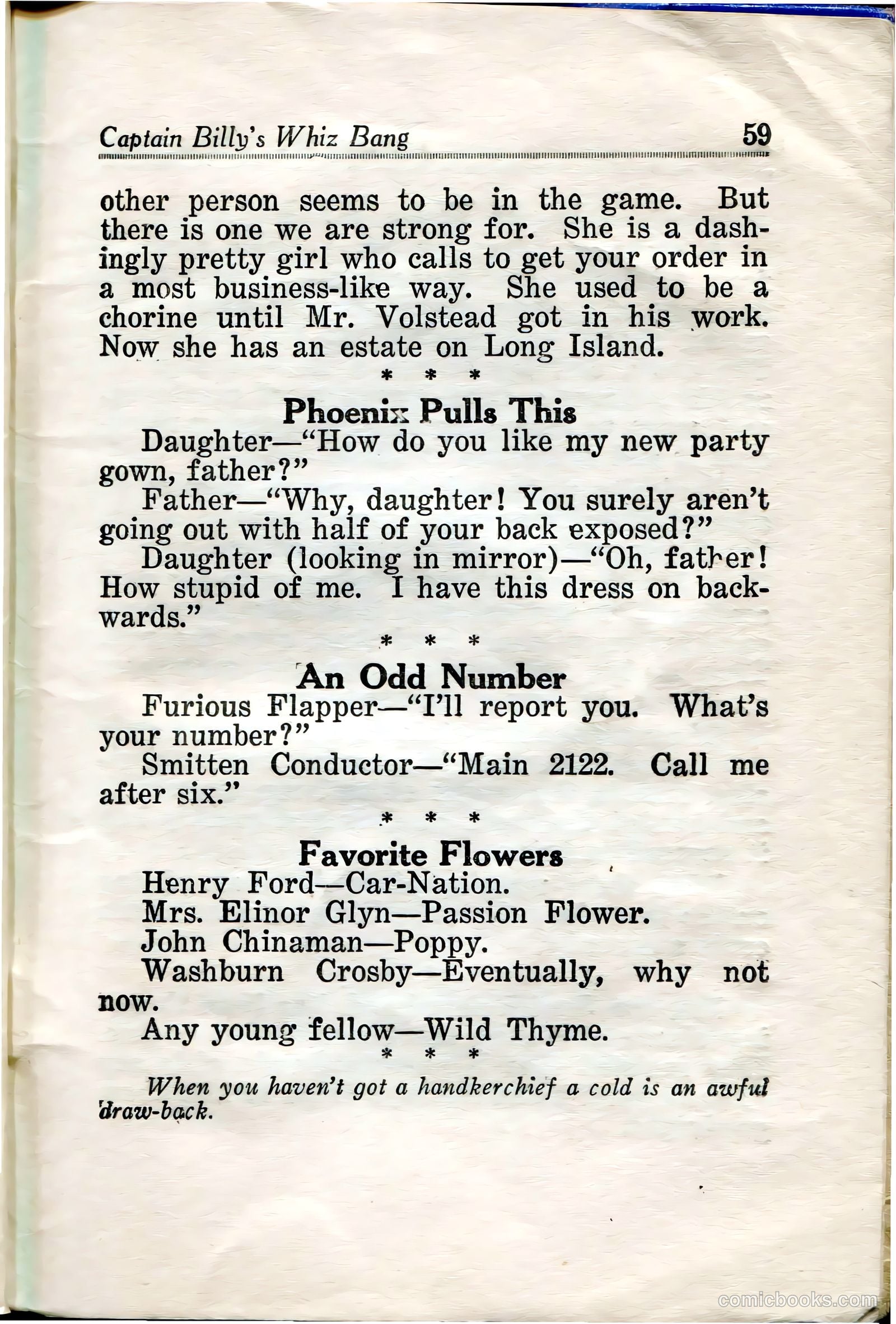
This page from the satirical magazine contains several short jokes targeting 1920s social issues and celebrities: **"Phoenix Pulls This"** jokes about flapper fashion—specifically the trend of revealing backs in party dresses. The humor relies on the daughter's claim she wore it backwards, mocking both the scandalous styles and parental disapproval. **"An Odd Number"** plays on flapper culture and forward dating practices, with a conductor using his work number as a pickup line. **"Favorite Flowers"** contains puns on famous figures: Henry Ford (cars/car-nation), Mrs. Elinor Glyn (a famous romance novelist), John Chinaman (likely referencing opium/poppies and anti-Chinese stereotypes), Washburn Crosby (appears to reference a flour company), and generic young men (wild thyme/time). The opening section references **Prohibition** ("Mr. Volstead"), the Volstead Act that banned alcohol. The "chorine" (chorus girl) becoming wealthy via an estate suggests how some women profited during Prohibition's era.
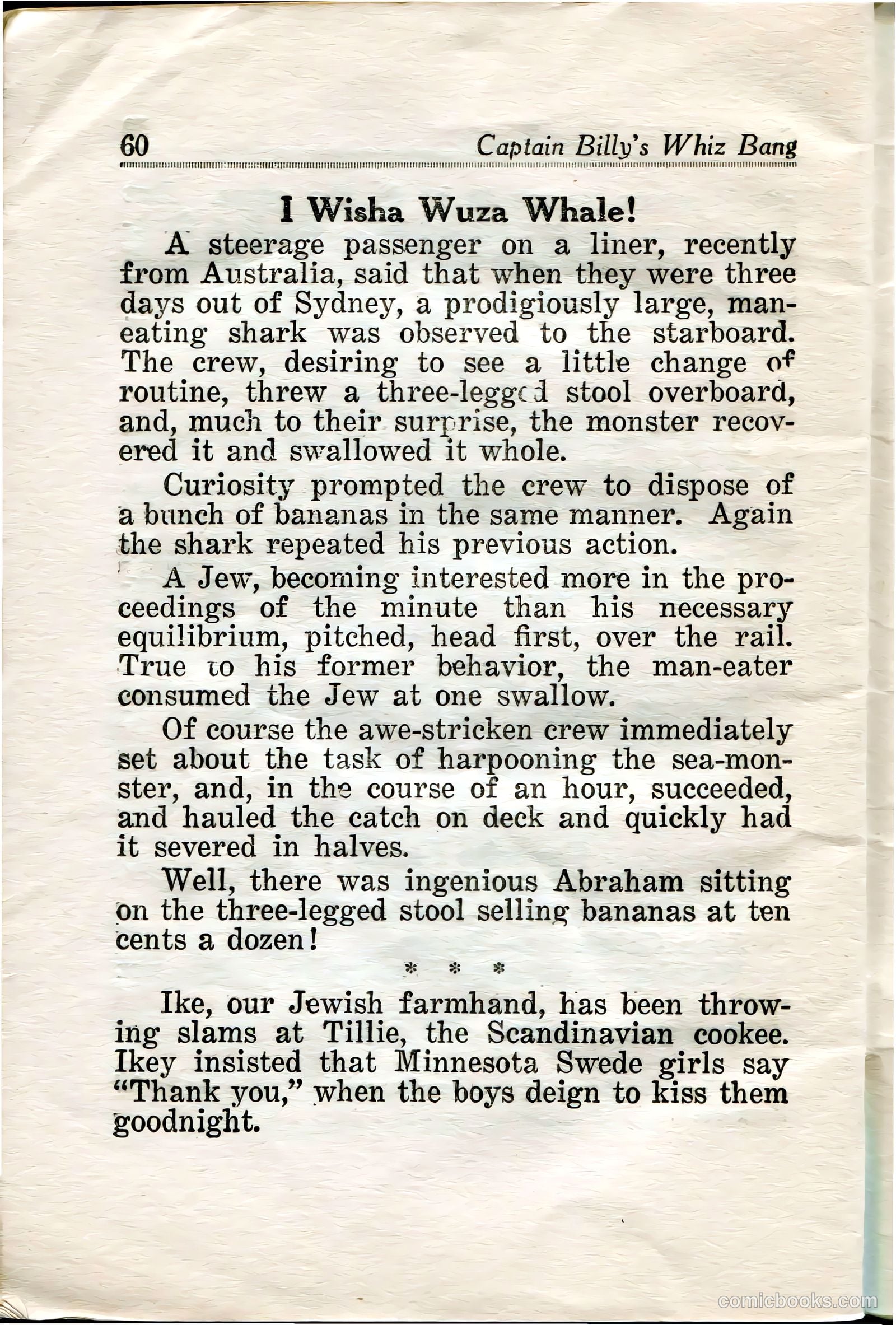
This page from *Captain Billy's Whiz Bang* contains two antisemitic jokes typical of early 20th-century American humor magazines. The main story uses a common antisemitic trope: a Jewish passenger falls overboard and is swallowed by a shark, but survives inside the shark's stomach. When the shark is killed and cut open, the Jewish man ("Abraham") emerges unharmed and immediately begins profiteering by selling bananas—a stereotype linking Jewish people to petty commerce and materialism. The second joke references "Ike," a Jewish farmhand, mocking Scandinavian ("Swede") women for supposedly requiring politeness after romantic advances. Both jokes rely on ethnic stereotyping—depicting Jewish characters as commercially shrewd and conniving, and Scandinavians as simple or unsophisticated. This reflects pervasive xenophobic attitudes of the era toward immigrant and minority groups. The humor is cruel rather than clever, exploiting prejudices the magazine assumed its audience shared.
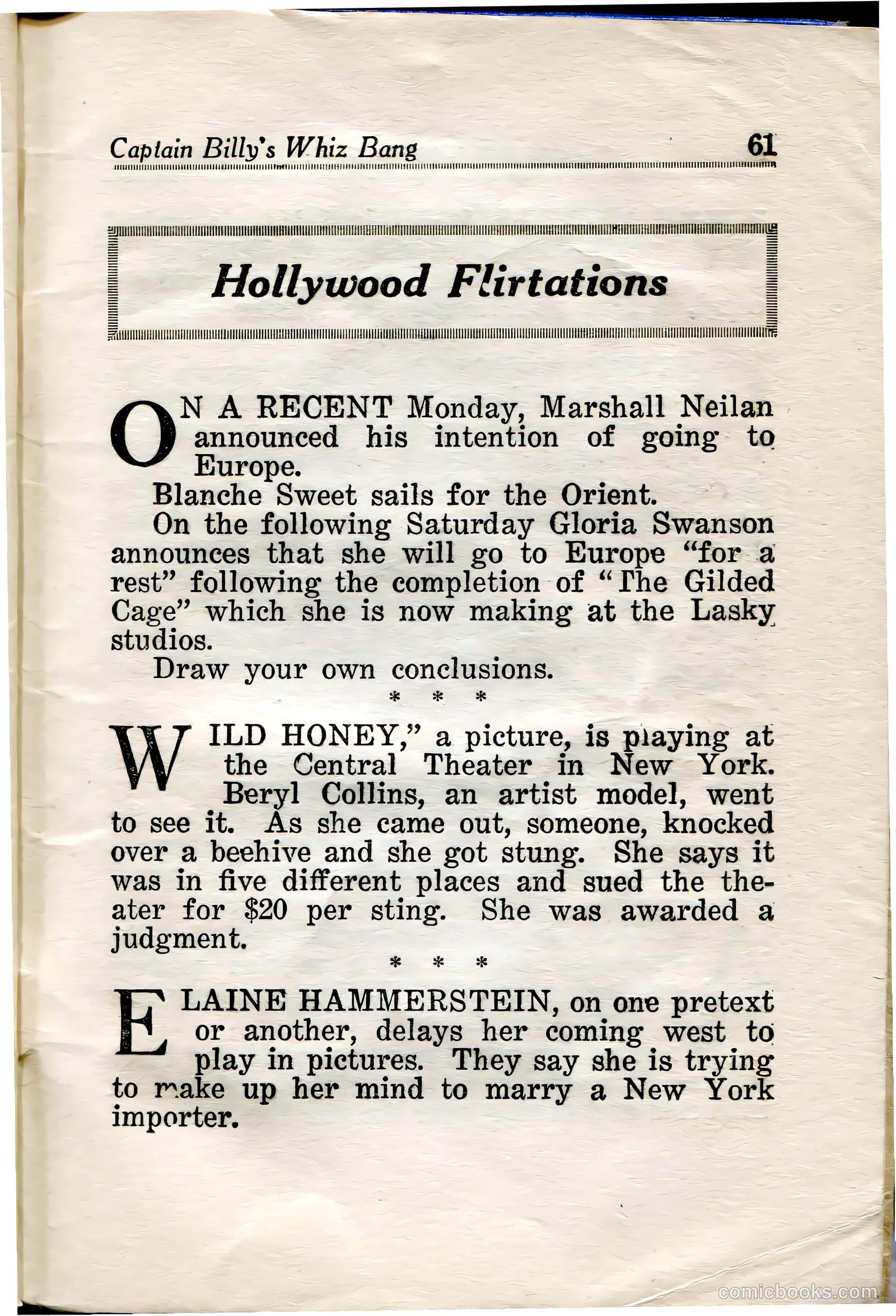
This gossip column mocks Hollywood celebrities through innuendo and absurdist humor. The first item suggests director Marshall Neilan and actresses Blanche Sweet and Gloria Swanson are coordinating their travel—implying romantic entanglement, with the editor inviting readers to "draw your own conclusions." The second anecdote is purely comedic absurdism: an artist model sues a theater for $20 per bee sting after a hive incident, and wins. The joke mocks frivolous lawsuits and the performative nature of theater-goers. The final item pokes fun at actress Elaine Hammerstein's reluctance to move west for film work, suggesting she's distracted by romantic prospects with a New York businessman. Throughout, the column reflects 1920s attitudes toward celebrity gossip, manufacturing scandal from travel announcements, and treating actresses' personal lives as public entertainment fodder.
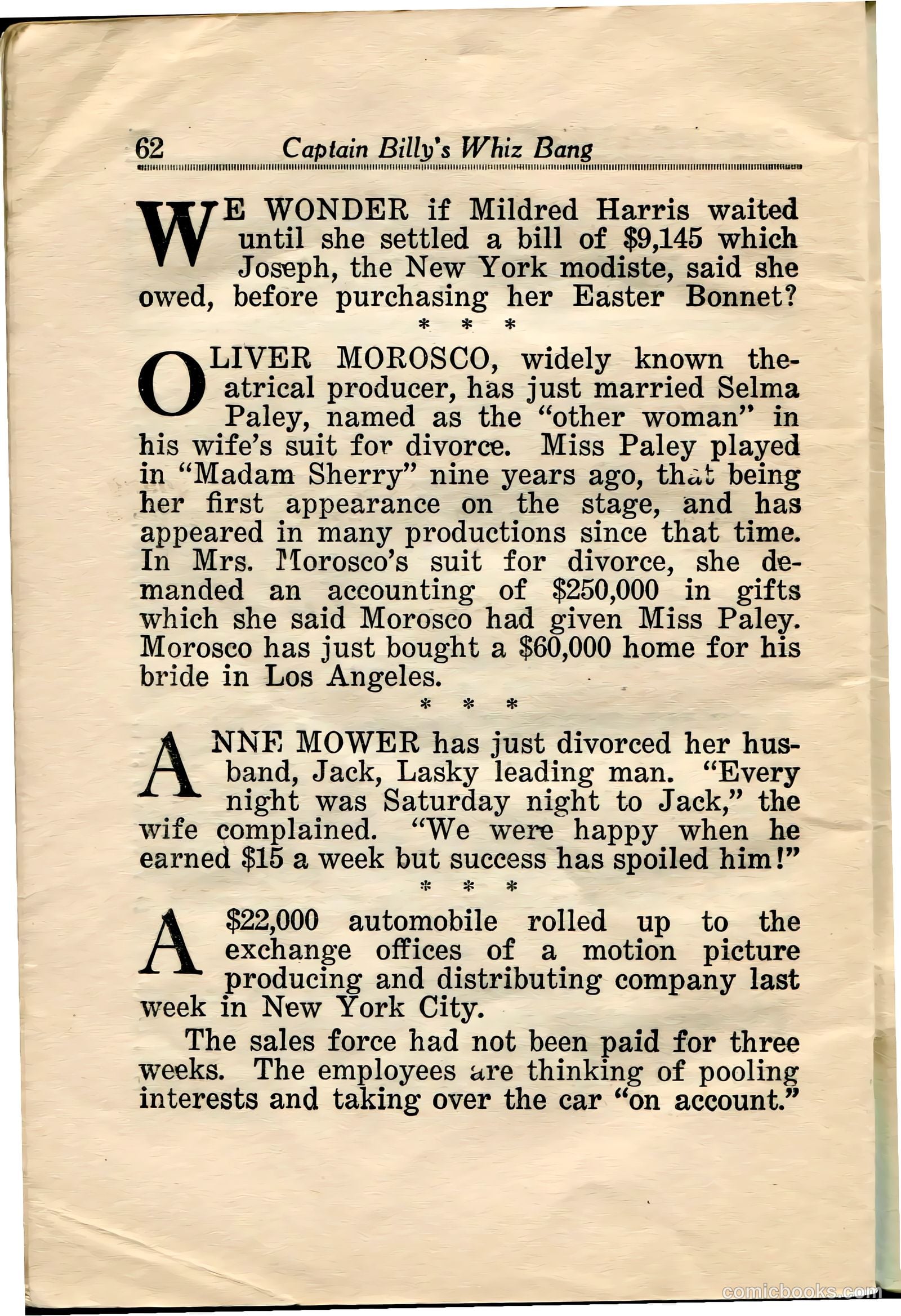
This is a gossip and satirical column from an early 1920s humor magazine. The page mocks Hollywood celebrities and the film industry through brief scandal items: **Key targets:** - **Mildred Harris** (actress): mocked for owing a large dressmaker's bill ($9,145) while buying luxuries - **Oliver Morosco** (theater/film producer): ridiculed for marrying his mistress (Selma Paley) after his wife's divorce suit demanded accounting of $250,000 in gifts to her; he then bought the new wife a $60,000 house - **Jack Lasky** (actor): his wife complains he's become spoiled by success, changed from a humble $15/week earner - **Motion picture company**: employees unpaid for three weeks contemplate seizing a $22,000 company car as compensation **The satire:** Hollywood's nouveau riche excess, infidelity, and financial irresponsibility—contrasting extravagant spending with worker exploitation and unpaid wages.
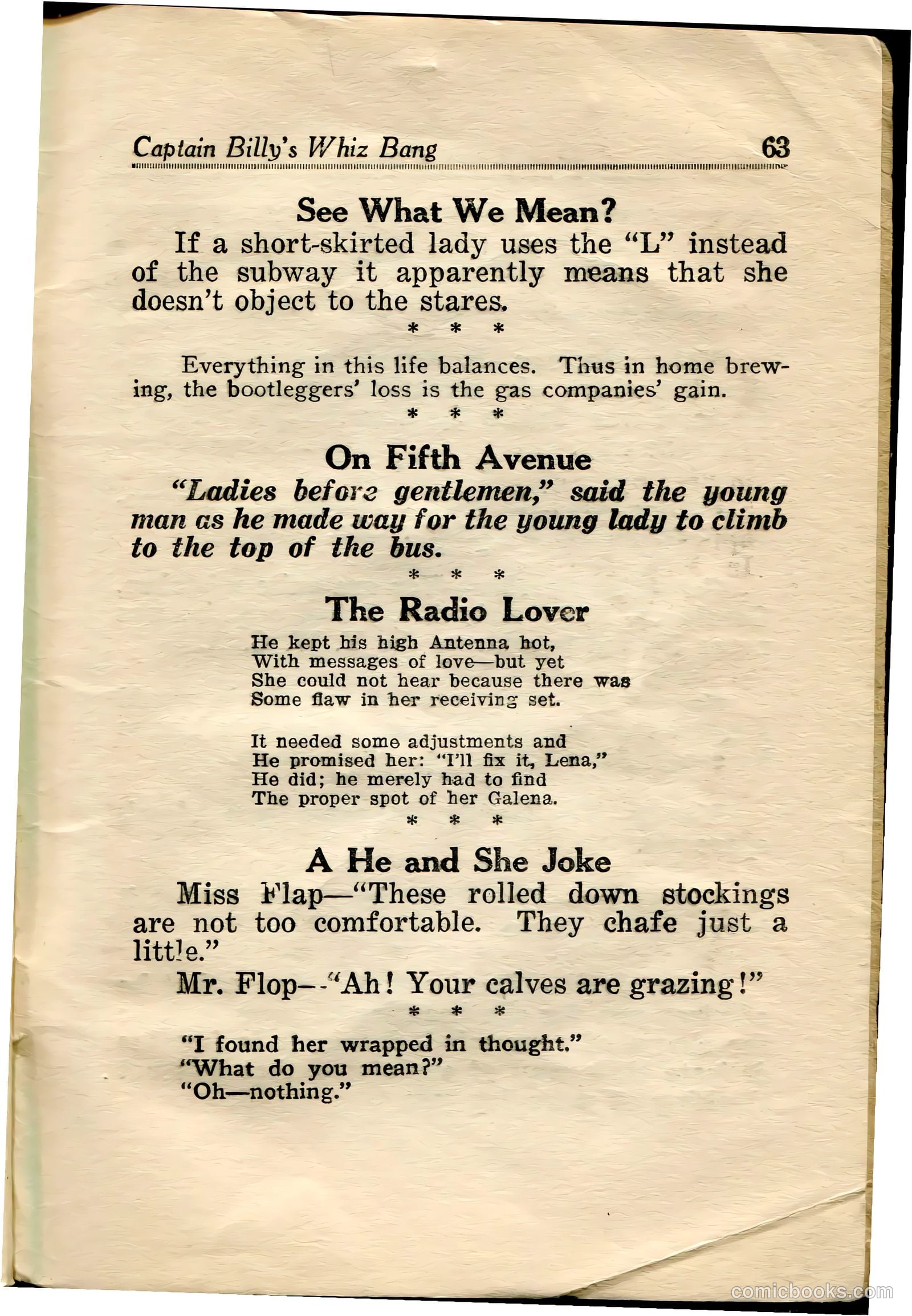
This page from the 1920s satirical magazine contains several short jokes targeting contemporary social trends: **"See What We Mean?"** references women wearing shorter skirts (a scandalous fashion change of the era) and implies their public transit choices reveal willingness to be observed. **Prohibition-era joke**: Home brewing (illegal alcohol production) flourished during Prohibition, so bootleggers' losses supposedly benefited gas companies—unclear if this references fuel for stills or something else. **"The Radio Lover"** uses radio technology (then novel) as metaphor for romantic miscommunication—she has a faulty "receiving set," he must find her "Galena" (a crystal used in early radio receivers), making a double entendre about physical intimacy. **"He and She Joke"** plays on "rolled down stockings" (fashionable in the 1920s) with "calves are grazing"—a crude joke about women's exposed legs. These represent typical Roaring Twenties humor mocking modernizing fashion, Prohibition, and changing gender relations.
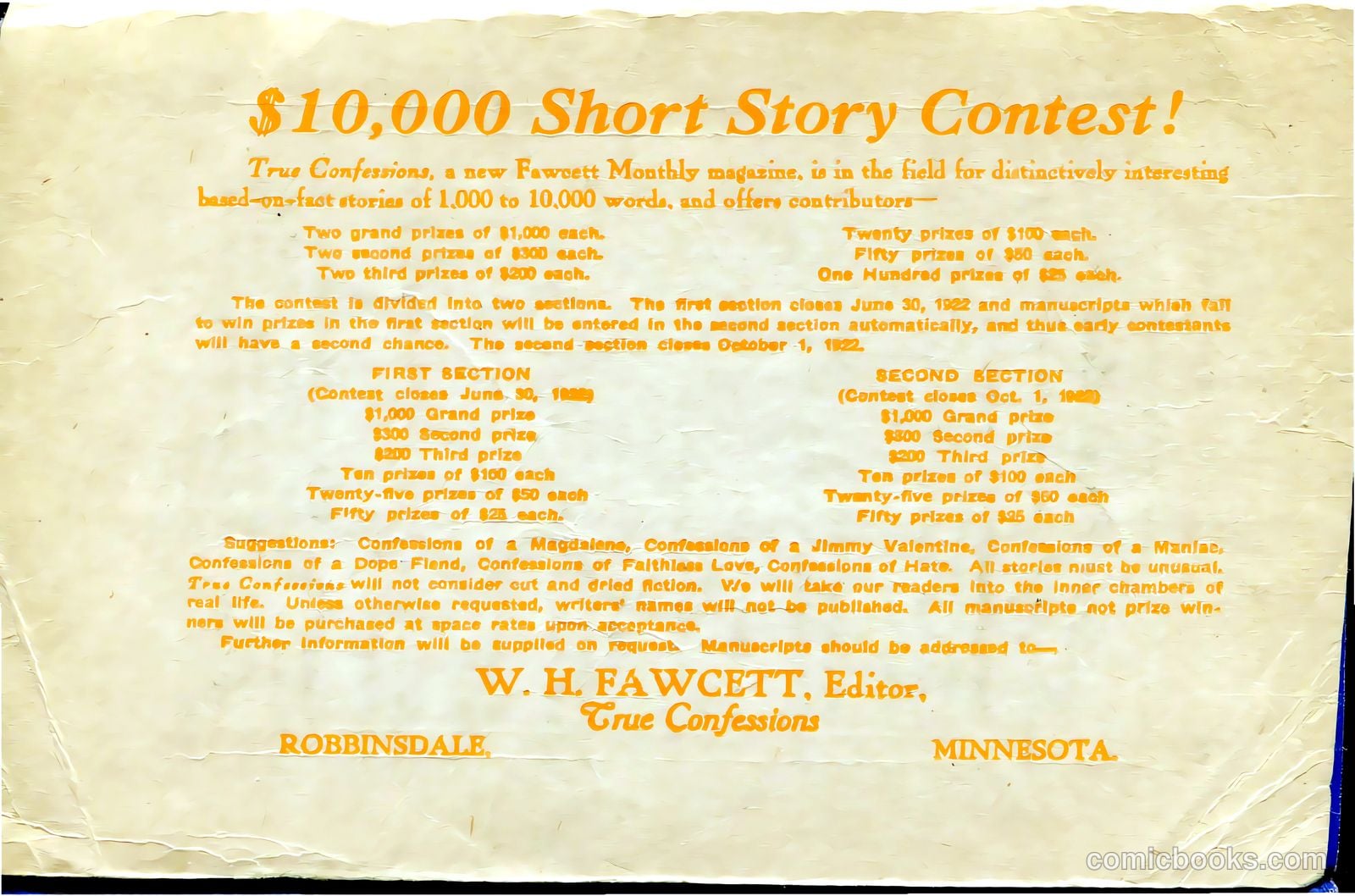
This is **not a cartoon or satire**—it's a **contest advertisement** for *True Confessions*, a new Fawcett Monthly magazine (1922). The publication sought short stories of 1,000-10,000 words based on real events, offering $10,000 in total prizes across two submission periods. The suggested topics reveal the magazine's sensational focus: "Confessions of a Magdalene" (fallen woman), "Dope-Fiend," "Faithless Love," and "Hate." These reflect *True Confessions*' actual editorial mission—publishing lurid, emotionally intense personal narratives, often about moral transgressions or urban vice. The anonymous publication clause ("writers' names will not be published") suggests readers valued confession's perceived authenticity while protecting contributors' reputations. This magazine pioneered the "confession" genre that became enormously popular throughout the 1920s-40s, blending voyeuristic appeal with moral instruction.
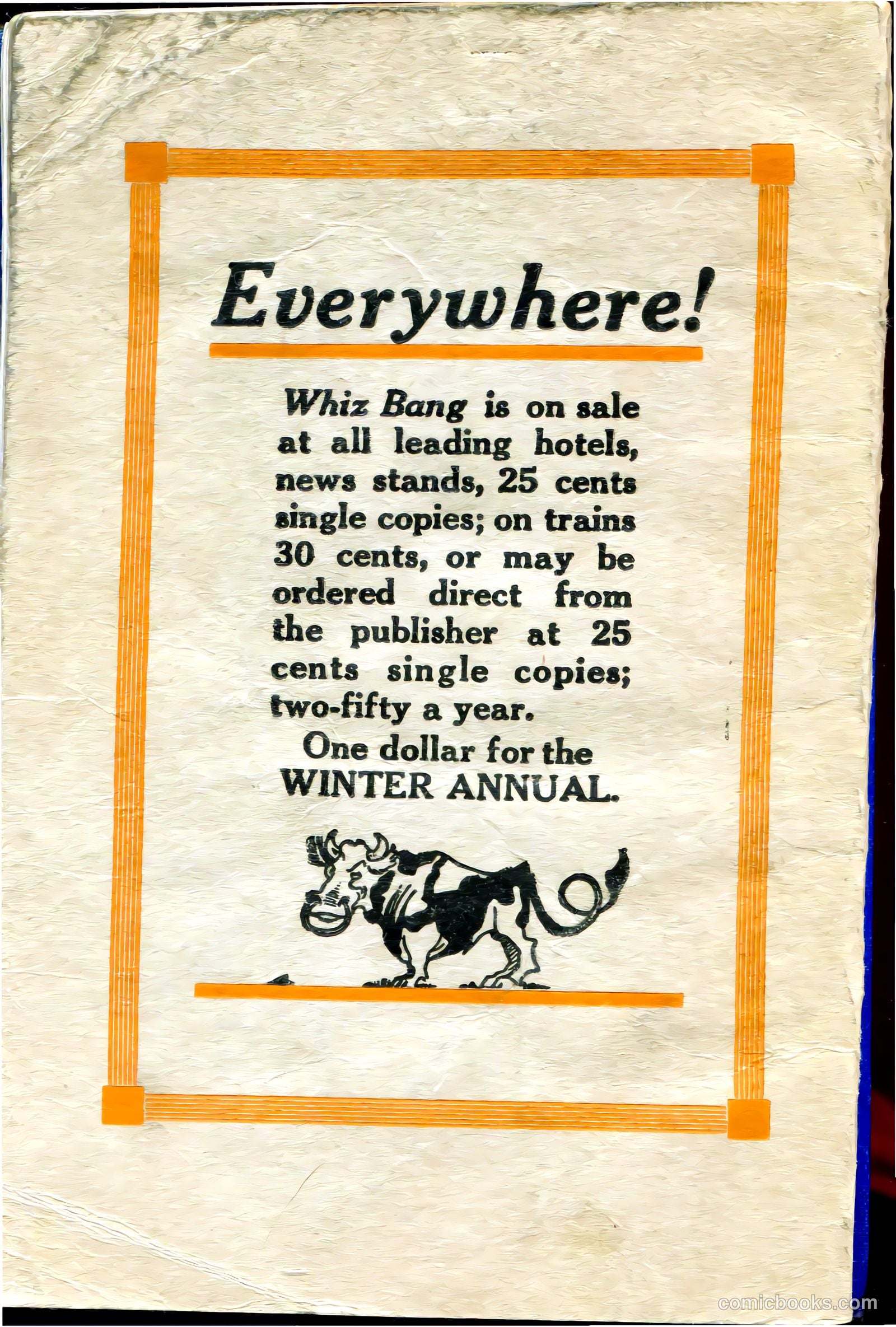
This is a title or advertisement page for *Whiz Bang*, an American satirical magazine. The page announces where readers can purchase the publication—at hotels, newsstands, and train stations—and lists pricing: 25 cents per copy at newsstands, 30 cents on trains, or $2.50 yearly by subscription. A special Winter Annual costs one dollar. The cartoon mascot is a cow with a somewhat mischievous expression, serving as the magazine's brand icon. The orange decorative border frames the text in a period-appropriate Art Deco style. This is essentially a promotional page designed to drive circulation and subscriptions rather than showcase satirical content itself.