
Captain Billy's Whiz Bang, June 1922 · page 36 of 68
Captain Billy's Whiz Bang #34 — page 36: what you’re looking at
What you’re looking at
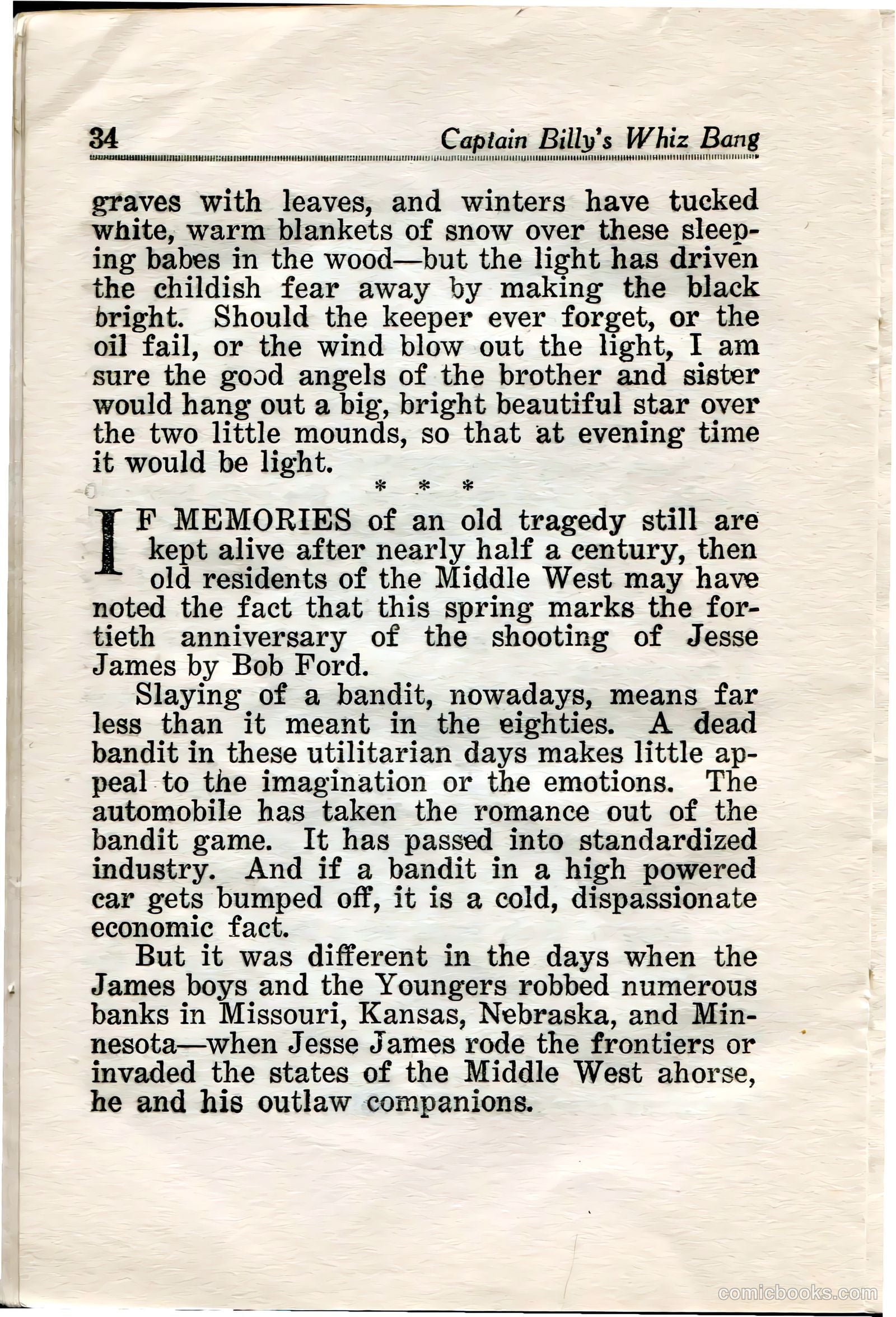
This page contains no cartoon, but rather **prose commentary** on Jesse James and outlaw romanticism. The article marks the 40th anniversary of Jesse James's 1882 shooting by Bob Ford. The author contrasts 19th-century banditry—which captured public imagination as "romantic" frontier adventure—with modern (1920s) crime, now rendered mundane by automobiles and industrialization. The opening passage appears to be sentimental fiction about children's graves ("sleeping babes in the wood"), possibly referencing the nursery tale, though its connection to the James essay is unclear. The satire's point: technology has stripped criminality of its mystique. When Jesse James robbed banks "ahorse" across the Middle West frontier, outlaws were folk legends. Now, when criminals operate in "high powered cars," their capture is merely cold economic fact—stripped of all romance and emotional resonance that once captivated readers.
📄 Transcribed text from this page (OCR, searchable)
Machine-transcribed from the original scan — historical spelling and the odd misread are preserved.
34 Captain Billy's Whiz Bang graves with leaves, and winters have tucked white, warm blankets of snow over these sleep- ing babes in the wood—but the light has driven the childish fear away by making the black bright. Should the keeper ever forget, or the oil fail, or the wind blow out the light, I am sure the good angels of the brother and sister would hang out a big, bright beautiful star over the two little mounds, so that at evening time it would be light. * * * IF MEMORIES of an old tragedy still are kept alive after nearly half a century, then old residents of the Middle West may have noted the fact that this spring marks the for- tieth anniversary of the shooting of Jesse James by Bob Ford. Slaying of a bandit, nowadays, means far less than it meant in the eighties. A dead bandit in these utilitarian days makes little ap- peal to the imagination or the emotions. The automobile has taken the romance out of the bandit game. It has passed into standardized industry. And if a bandit in a high powered car gets bumped off, it is a cold, dispassionate economic fact. But it was different in the days when the James boys and the Youngers robbed numerous banks in Missouri, Kansas, Nebraska, and Min- nesota—when Jesse James rode the frontiers or invaded the states of the Middle West ahorse, he and his outlaw companions.