
Captain Billy's Whiz Bang, June 1922 · page 29 of 68
Captain Billy's Whiz Bang #34 — page 29: what you’re looking at
What you’re looking at
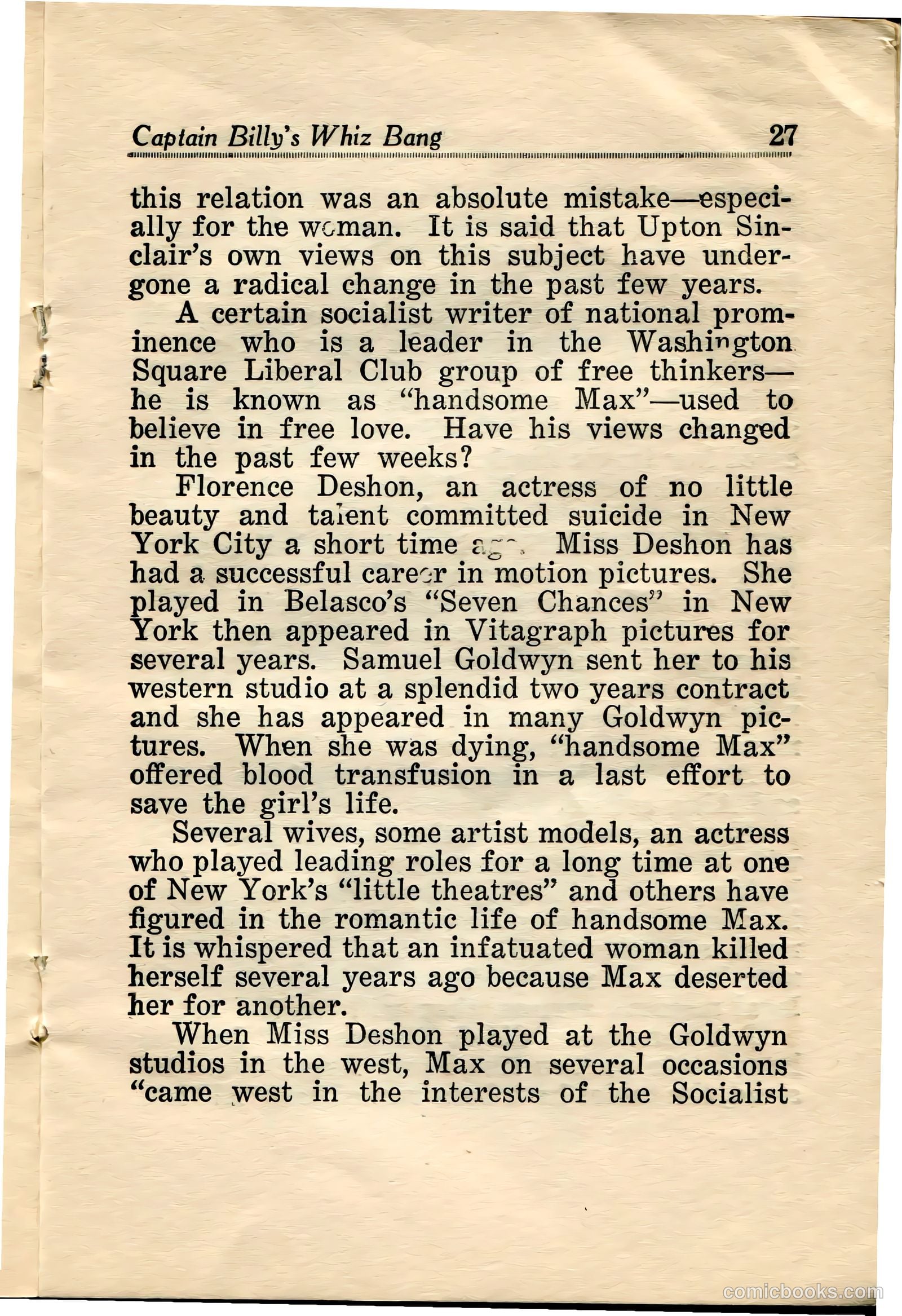
This is a gossip column from *Captain Billy's Whiz Bang* attacking "handsome Max" (likely a real socialist activist), who advocated "free love"—a radical 1920s idea that rejected traditional marriage restrictions. The satire is **hypocrisy-focused**: The piece suggests Max preached free love ideology while leaving a trail of abandoned women, including actress Florence Deshon, who committed suicide. The column implies his socialist principles didn't prevent him from behaving callously toward women in his romantic life. The reference to Upton Sinclair indicates broader criticism of prominent socialists' personal conduct contradicting their public philosophy. The tone is moralizing—using Max's real romantic entanglements to discredit his political beliefs. For 1920s readers, this was scandalous celebrity gossip with political bite: exposing alleged hypocrisy among Greenwich Village intellectuals and radical thinkers.
📄 Transcribed text from this page (OCR, searchable)
Machine-transcribed from the original scan — historical spelling and the odd misread are preserved.
Captain Billy's Whiz Bang 27 this relation was an absolute mistake—especi- ally for the woman. It is said that Upton Sin- clair's own views on this subject have under- gone a radical change in the past few years. A certain socialist writer of national prom- inence who is a leader in the Washington Square Liberal Club group of free thinkers— he is known as "handsome Max"—used to believe in free love. Have his views changed in the past few weeks? Florence Deshon, an actress of no little beauty and talent committed suicide in New York City a short time ago. Miss Deshon has had a successful career in motion pictures. She played in Belasco's "Seven Chances" in New York then appeared in Vitagraph pictures for several years. Samuel Goldwyn sent her to his western studio at a splendid two years contract and she has appeared in many Goldwyn pic- tures. When she was dying, "handsome Max" offered blood transfusion in a last effort to save the girl's life. Several wives, some artist models, an actress who played leading roles for a long time at one of New York's "little theatres" and others have figured in the romantic life of handsome Max. It is whispered that an infatuated woman killed herself several years ago because Max deserted her for another. When Miss Deshon played at the Goldwyn studios in the west, Max on several occasions "came west in the interests of the Socialist