
Captain Billy's Whiz Bang, June 1922 · page 9 of 68
Captain Billy's Whiz Bang #34 — page 9: what you’re looking at
What you’re looking at
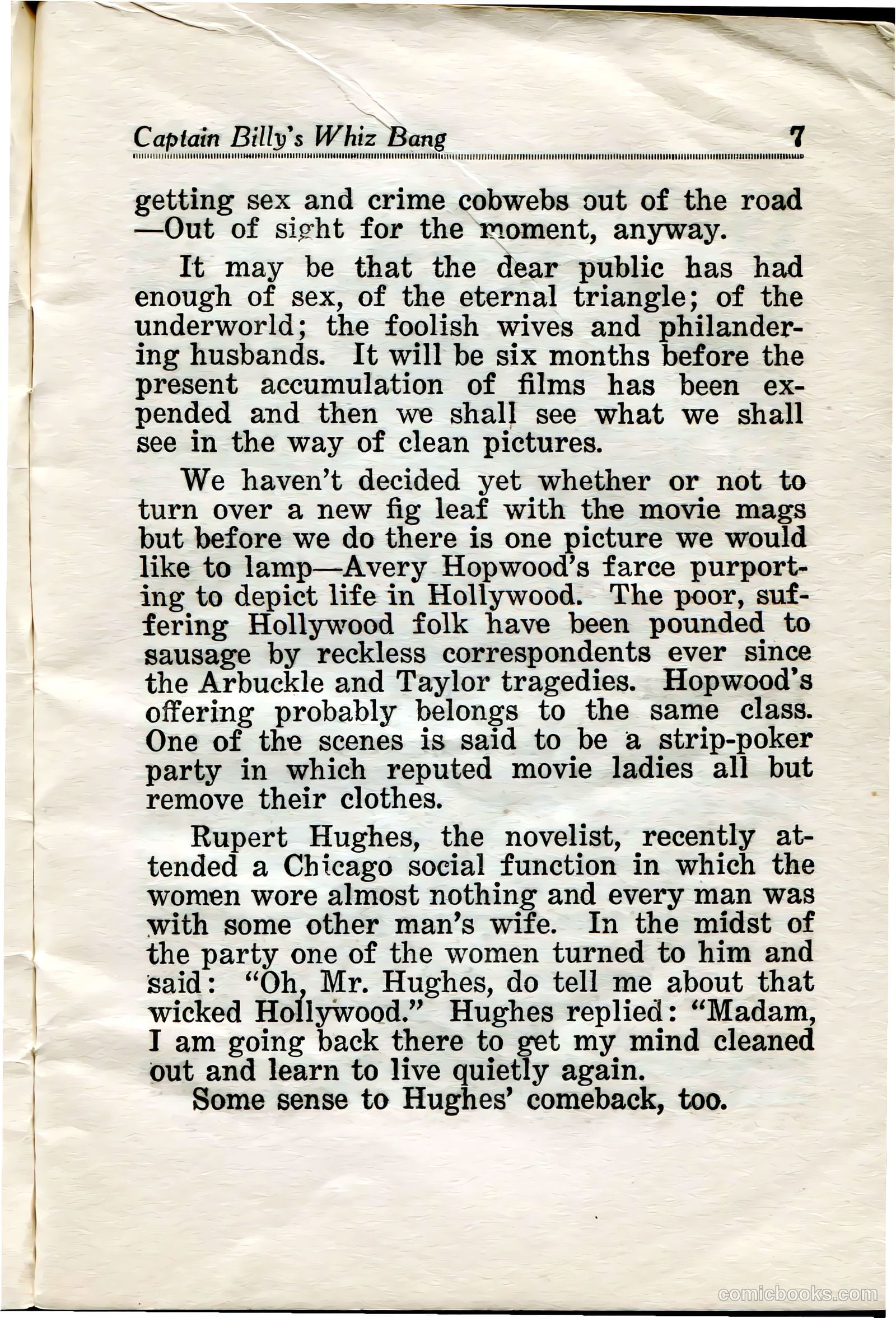
This satirical column critiques Hollywood's moral reputation and sex-scandal-dominated cinema circa the early 1920s. The writer references the Arbuckle and Taylor tragedies (real scandals involving actor Roscoe "Fatty" Arbuckle and director William Desmond Taylor that shocked the industry), suggesting Hollywood deserves its notoriety. The piece ridicules Avery Hopwood's film about Hollywood life, particularly its strip-poker scene. It then uses a humorous anecdote about novelist Rupert Hughes attending a risqué Chicago party where he's asked about "wicked Hollywood"—only to reply he's returning there to clean his mind. The joke's irony: Hughes suggests the actual Hollywood is *morally superior* to this Chicago gathering, inverting readers' assumptions about Hollywood's depravity. The satire targets both Hollywood's actual scandals and the public's simultaneous fascination with and moral condemnation of the industry.
📄 Transcribed text from this page (OCR, searchable)
Machine-transcribed from the original scan — historical spelling and the odd misread are preserved.
Captain Billy's Whiz Bang 7 getting sex and crime cobwebs out of the road —Out of sight for the moment, anyway. It may be that the dear public has had enough of sex, of the eternal triangle; of the underworld; the foolish wives and philander- ing husbands. It will be six months before the present accumulation of films has been ex- pended and then we shall see what we shall see in the way of clean pictures. We haven't decided yet whether or not to turn over a new fig leaf with the movie mags but before we do there is one picture we would like to lamp—Avery Hopwood's farce purport- ing to depict life in Hollywood. The poor, suf- fering Hollywood folk have been pounded to sausage by reckless correspondents ever since the Arbuckle and Taylor tragedies. Hopwood's offering probably belongs to the same class. One of the scenes is said to be a strip-poker party in which reputed movie ladies all but remove their clothes. Rupert Hughes, the novelist, recently at- tended a Chicago social function in which the women wore almost nothing and every man was with some other man's wife. In the midst of the party one of the women turned to him and said: "Oh, Mr. Hughes, do tell me about that wicked Hollywood." Hughes replied: "Madam, I am going back there to get my mind cleaned out and learn to live quietly again. Some sense to Hughes' comeback, too.