
Captain Billy's Whiz Bang, June 1922 · page 39 of 68
Captain Billy's Whiz Bang #34 — page 39: what you’re looking at
What you’re looking at
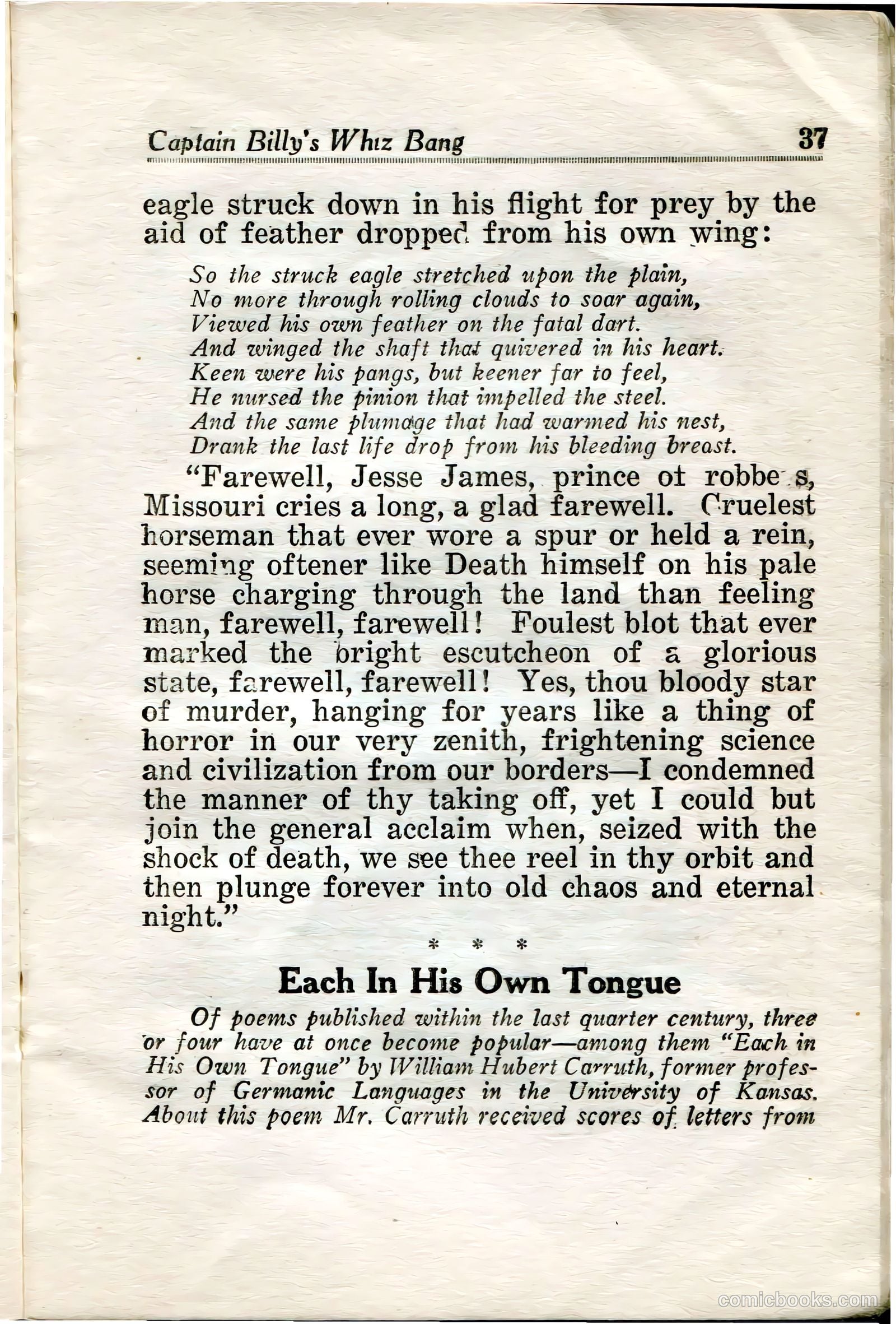
This page contains two distinct pieces: **The Eagle Poem**: An allegorical poem about an eagle killed by its own feather, followed by a lengthy farewell addressing **Jesse James**, the notorious outlaw. The text presents an ambivalent moral judgment—condemning James as a "bloody star of murder" who terrorized Missouri, yet grudgingly celebrating his death as a release from evil. The eagle metaphor suggests James was destroyed by forces he himself generated. **"Each in His Own Tongue"**: An introductory note about a popular poem by William Hubert Carruth, formerly a Kansas University professor. The piece announces that this poem received considerable reader correspondence. The page appears designed to showcase literary content rather than satire or political commentary. The Jesse James piece reflects genuine 19th-century ambivalence toward the outlaw—simultaneous moral condemnation and romantic fascination—common in American popular culture of that era.
📄 Transcribed text from this page (OCR, searchable)
Machine-transcribed from the original scan — historical spelling and the odd misread are preserved.
Captain Billy's Whiz Bang 37 eagle struck down in his flight for prey by the aid of feather dropped from his own wing: So the struck eagle stretched upon the plain, No more through rolling clouds to soar again, Viewed his own feather on the fatal dart. And winged the shaft that quivered in his heart. Keen were his pangs, but keener far to feel, He nursed the pinion that impelled the steel. And the same plumage that had warmed his nest, Drank the last life drop from his bleeding breast. “Farewell, Jesse James, prince of robbers, Missouri cries a long, a glad farewell. Cruelest horseman that ever wore a spur or held a rein, seeming oftener like Death himself on his pale horse charging through the land than feeling man, farewell, farewell! Foulest blot that ever marked the bright escutcheon of a glorious state, farewell, farewell! Yes, thou bloody star of murder, hanging for years like a thing of horror in our very zenith, frightening science and civilization from our borders—I condemned the manner of thy taking off, yet I could but join the general acclaim when, seized with the shock of death, we see thee reel in thy orbit and then plunge forever into old chaos and eternal night.” * * * Each In His Own Tongue Of poems published within the last quarter century, three or four have at once become popular—among them “Each in His Own Tongue” by William Hubert Carruth, former profes- sor of Germanic Languages in the University of Kansas. About this poem Mr. Carruth received scores of letters from