
Captain Billy's Whiz Bang, June 1922 · page 7 of 68
Captain Billy's Whiz Bang #34 — page 7: what you’re looking at
What you’re looking at
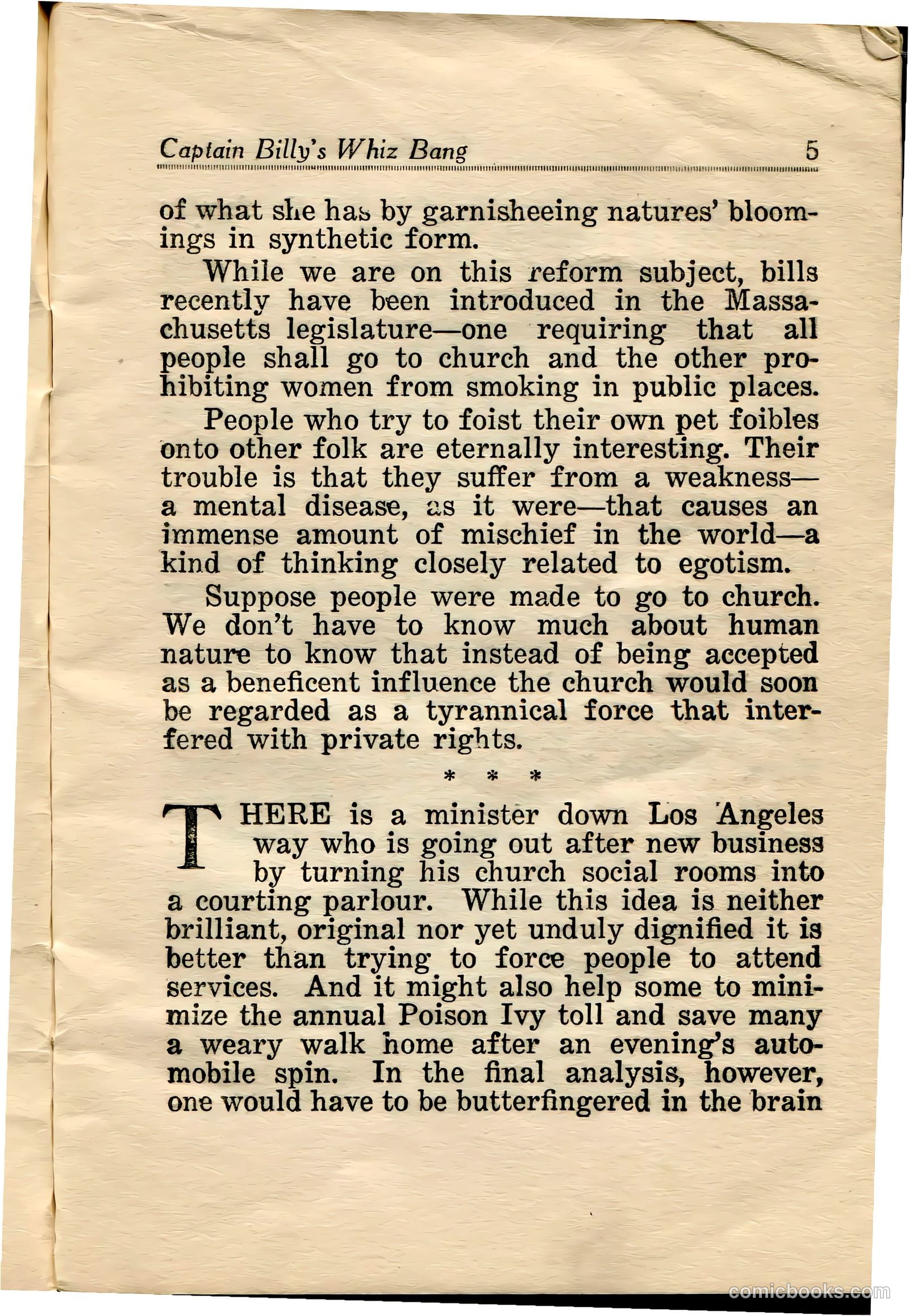
This page presents satirical commentary on moral legislation and religious coercion. The author critiques proposed Massachusetts bills mandating church attendance and banning women's public smoking, arguing such moralistic laws reflect egotistical thinking that backfires—forced church attendance would breed resentment rather than genuine piety. The piece then praises a Los Angeles minister's pragmatic alternative: converting church social rooms into courting spaces (dating parlors). This is presented as superior to coercive religious attendance, as it attracts people voluntarily. The joke about "Poison Ivy toll" and "automobile spin" suggests young couples using church facilities as dating venues instead of courting in cars outdoors (exposing themselves to nature hazards or moral scandal). The satire targets paternalistic reform movements and celebrates practical accommodation over puritanical enforcement.
📄 Transcribed text from this page (OCR, searchable)
Machine-transcribed from the original scan — historical spelling and the odd misread are preserved.
Captain Billy's Whiz Bang 5 of what she has by garnisheeing natures' bloom- ings in synthetic form. While we are on this reform subject, bills recently have been introduced in the Massa- chusetts legislature—one requiring that all people shall go to church and the other pro- hibiting women from smoking in public places. People who try to foist their own pet foibles onto other folk are eternally interesting. Their trouble is that they suffer from a weakness— a mental disease, as it were—that causes an immense amount of mischief in the world—a kind of thinking closely related to egotism. Suppose people were made to go to church. We don't have to know much about human nature to know that instead of being accepted as a beneficent influence the church would soon be regarded as a tyrannical force that inter- fered with private rights. * * * T HERE is a minister down Los Angeles way who is going out after new business by turning his church social rooms into a courting parlour. While this idea is neither brilliant, original nor yet unduly dignified it is better than trying to force people to attend services. And it might also help some to mini- mize the annual Poison Ivy toll and save many a weary walk home after an evening's auto- mobile spin. In the final analysis, however, one would have to be butterfingered in the brain