
Captain Billy's Whiz Bang, June 1922 · page 38 of 68
Captain Billy's Whiz Bang #34 — page 38: what you’re looking at
What you’re looking at
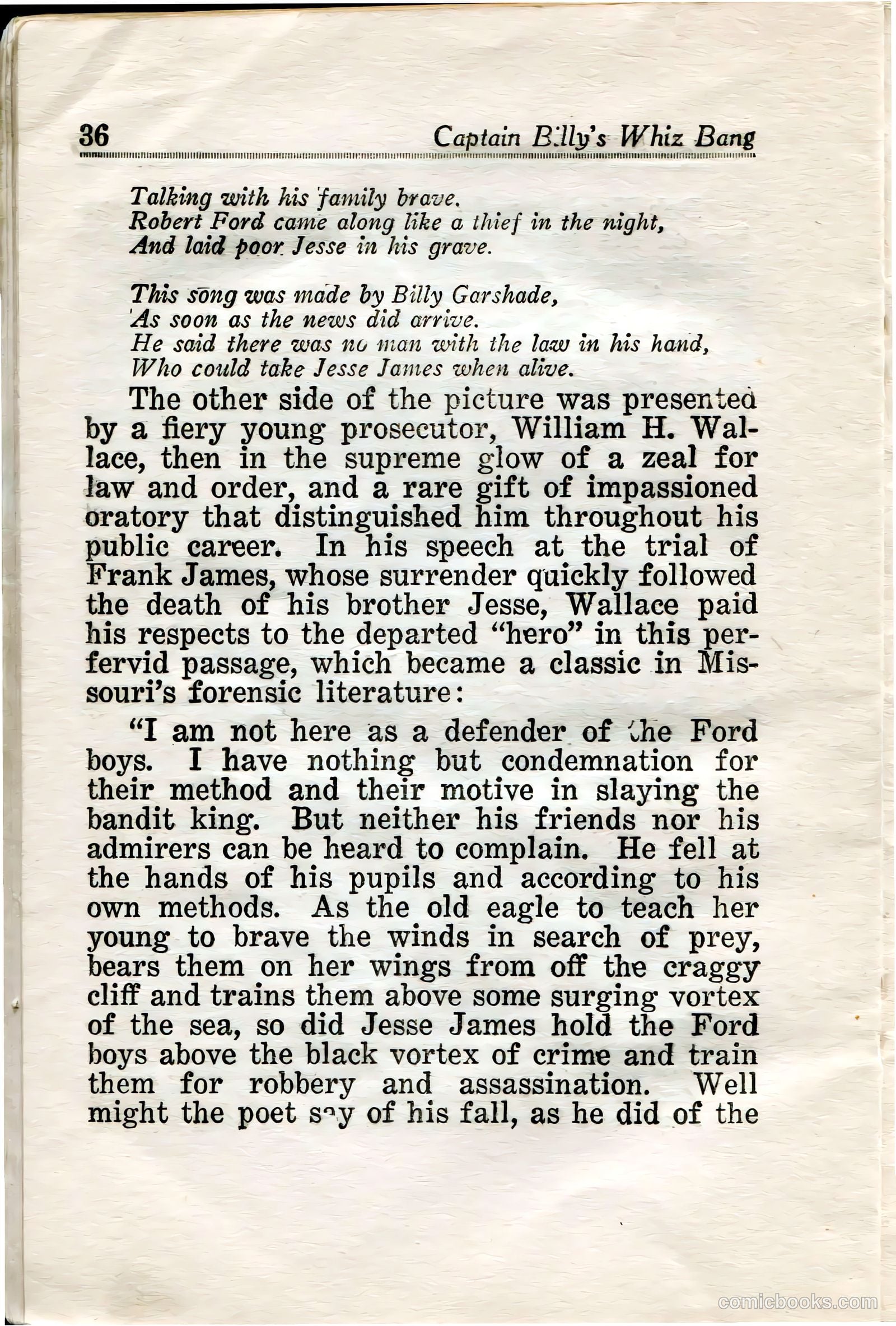
This page discusses the 1882 assassination of outlaw Jesse James by Robert Ford, presented through contrasting cultural perspectives. A folk song ("Billy Garshade") romanticizes James as a figure who "could not be taken alive," treating his killing as tragic. The satire targets prosecutor William H. Wallace's elaborate courtroom speech during Frank James's trial. Wallace's ornate metaphor—comparing Jesse "training" the Ford brothers in crime like an eagle teaches young to hunt—is presented as absurdly overwrought oratory that inadvertently glorifies the bandit while condemning his killers. The joke lies in the gap between Wallace's claimed condemnation of Jesse James and his flowery, almost heroic language. For modern readers, this captures how 1880s courtroom rhetoric could be bombastically theatrical, and how the James brothers occupied ambiguous cultural status (outlaws yet folk heroes in some circles). *Whiz Bang* mocks both sentimentalizing outlaws and prosecutors who inadvertently romanticize them through purple prose.
📄 Transcribed text from this page (OCR, searchable)
Machine-transcribed from the original scan — historical spelling and the odd misread are preserved.
36 Captain Billy's Whiz Bang Talking with his family brave. Robert Ford came along like a thief in the night, And laid poor Jesse in his grave. This song was made by Billy Garshade, As soon as the news did arrive. He said there was no man with the law in his hand, Who could take Jesse James when alive. The other side of the picture was presented by a fiery young prosecutor, William H. Wal- lace, then in the supreme glow of a zeal for law and order, and a rare gift of impassioned oratory that distinguished him throughout his public career. In his speech at the trial of Frank James, whose surrender quickly followed the death of his brother Jesse, Wallace paid his respects to the departed "hero" in this per- fervid passage, which became a classic in Mis- souri's forensic literature: "I am not here as a defender of the Ford boys. I have nothing but condemnation for their method and their motive in slaying the bandit king. But neither his friends nor his admirers can be heard to complain. He fell at the hands of his pupils and according to his own methods. As the old eagle to teach her young to brave the winds in search of prey, bears them on her wings from off the craggy cliff and trains them above some surging vortex of the sea, so did Jesse James hold the Ford boys above the black vortex of crime and train them for robbery and assassination. Well might the poet say of his fall, as he did of the