
Captain Billy's Whiz Bang, June 1922 · page 43 of 68
Captain Billy's Whiz Bang #34 — page 43: what you’re looking at
What you’re looking at
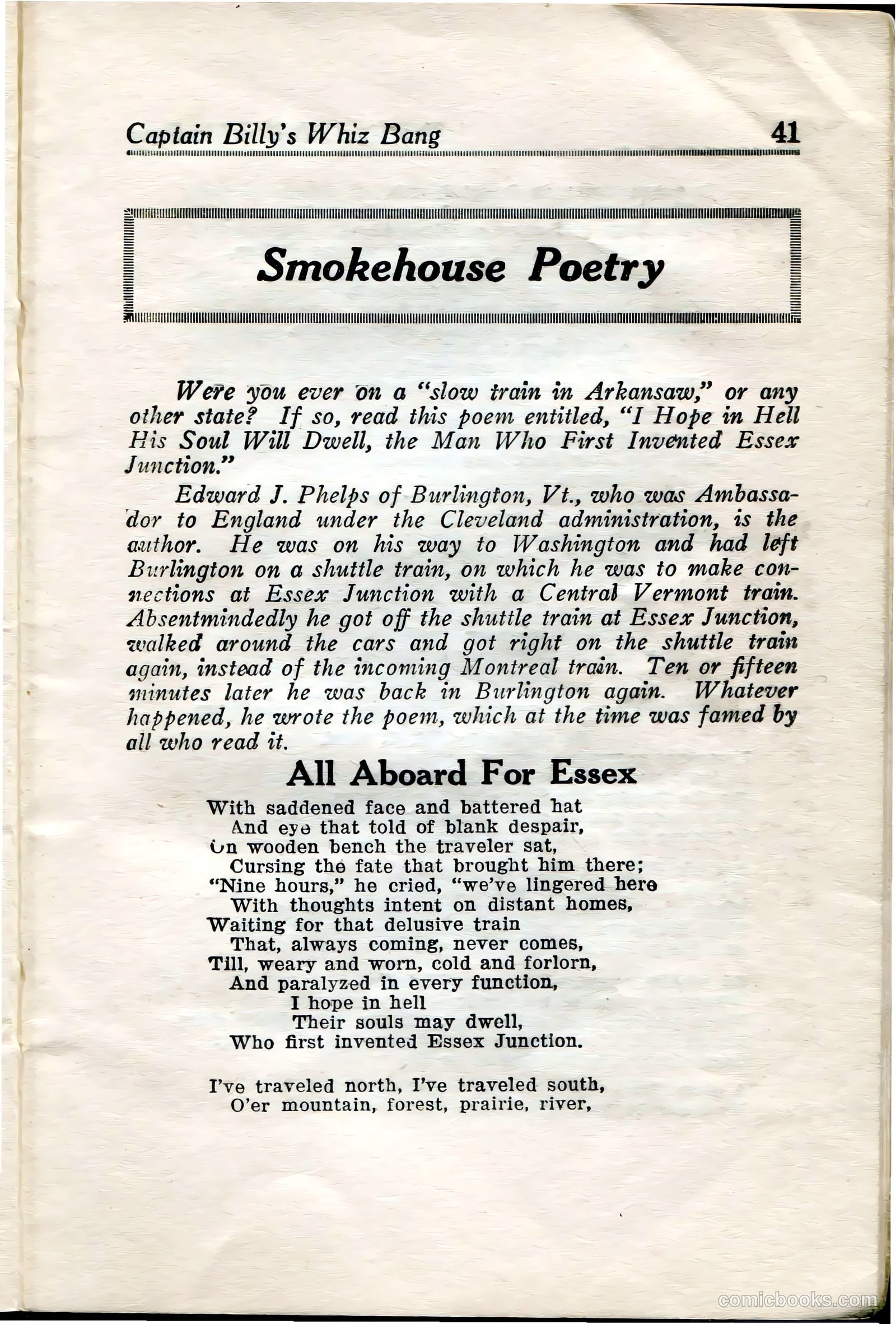
This page reprints a humorous poem by Edward J. Phelps, a real historical figure (U.S. Ambassador to England under Cleveland), about a frustrating train experience. Phelps accidentally boarded the wrong train at Essex Junction, Vermont, and ended up back where he started—inspiring bitter verse about the junction itself. The satire targets the real inconvenience of late 19th-century rail travel: missed connections, long layovers, and poorly designed transfer points. The poem's exaggerated curse—damning whoever "invented" Essex Junction to hell—mocks the traveler's mounting desperation after nine hours of waiting. This reflects contemporary complaints about railroad inefficiency and the absurdity of connection-based travel schedules. The humor lies in channeling genuine frustration into mock-grandiose condemnation of a location rather than the system itself. *Whiz Bang* positioned such relatable comedic complaints as entertainment for readers familiar with similar travel mishaps.
📄 Transcribed text from this page (OCR, searchable)
Machine-transcribed from the original scan — historical spelling and the odd misread are preserved.
Captain Billy's Whiz Bang 41 Smokehouse Poetry Were you ever on a “slow train in Arkansaw,” or any other state? If so, read this poem entitled, “I Hope in Hell His Soul Will Dwell, the Man Who First Invented Essex Junction.” Edward J. Phelps of Burlington, Vt., who was Ambassa- dor to England under the Cleveland administration, is the author. He was on his way to Washington and had left Burlington on a shuttle train, on which he was to make con- nections at Essex Junction with a Central Vermont train. Absentmindedly he got off the shuttle train at Essex Junction, walked around the cars and got right on the shuttle train again, instead of the incoming Montreal train. Ten or fifteen minutes later he was back in Burlington again. Whatever happened, he wrote the poem, which at the time was famed by all who read it. All Aboard For Essex With saddened face and battered hat And eye that told of blank despair, On wooden bench the traveler sat, Cursing the fate that brought him there; “Nine hours,” he cried, “we’ve lingered here With thoughts intent on distant homes, Waiting for that delusive train That, always coming, never comes, Till, weary and worn, cold and forlorn, And paralyzed in every function, I hope in hell Their souls may dwell, Who first invented Essex Junction. I’ve traveled north, I’ve traveled south, O’er mountain, forest, prairie, river,