
Captain Billy's Whiz Bang, June 1922 · page 35 of 68
Captain Billy's Whiz Bang #34 — page 35: what you’re looking at
What you’re looking at
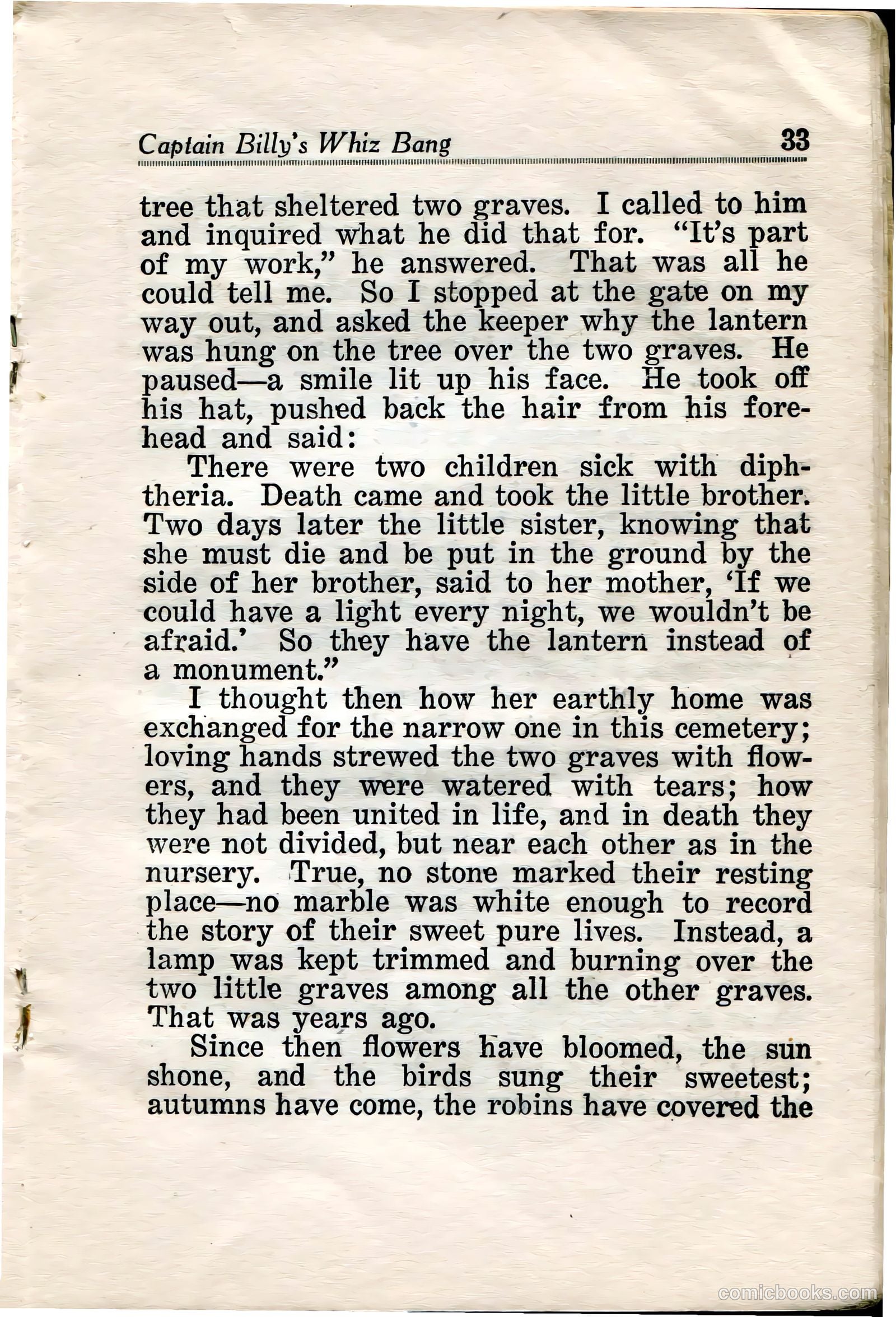
This page contains a sentimental narrative rather than political satire or cartoon content. It tells the touching story of two children who died of diphtheria and were buried together in a cemetery. Before her death, the younger sister requested a light be kept burning at night so she wouldn't be afraid—so a lantern was hung over their graves instead of a traditional monument. The piece appears to be a nostalgic, emotionally manipulative short story emphasizing themes of childhood innocence, sibling devotion, and parental love. It reflects early 20th-century attitudes toward death, commemorating the deceased through symbols of comfort rather than conventional markers. There is no apparent political satire, caricature, or social commentary present—it's purely sentimental content, likely included among the magazine's mix of humor and human-interest stories.
📄 Transcribed text from this page (OCR, searchable)
Machine-transcribed from the original scan — historical spelling and the odd misread are preserved.
Captain Billy's Whiz Bang 33 tree that sheltered two graves. I called to him and inquired what he did that for. “It’s part of my work,” he answered. That was all he could tell me. So I stopped at the gate on my way out, and asked the keeper why the lantern was hung on the tree over the two graves. He paused—a smile lit up his face. He took off his hat, pushed back the hair from his fore- head and said: There were two children sick with diph- theria. Death came and took the little brother. Two days later the little sister, knowing that she must die and be put in the ground by the side of her brother, said to her mother, ‘If we could have a light every night, we wouldn’t be afraid.’ So they have the lantern instead of a monument.” I thought then how her earthly home was exchanged for the narrow one in this cemetery; loving hands strewed the two graves with flow- ers, and they were watered with tears; how they had been united in life, and in death they were not divided, but near each other as in the nursery. True, no stone marked their resting place—no marble was white enough to record the story of their sweet pure lives. Instead, a lamp was kept trimmed and burning over the two little graves among all the other graves. That was years ago. Since then flowers have bloomed, the sun shone, and the birds sung their sweetest; autumns have come, the robins have covered the