
A complete issue · 44 pages · 1928
Life — October 12, 1928
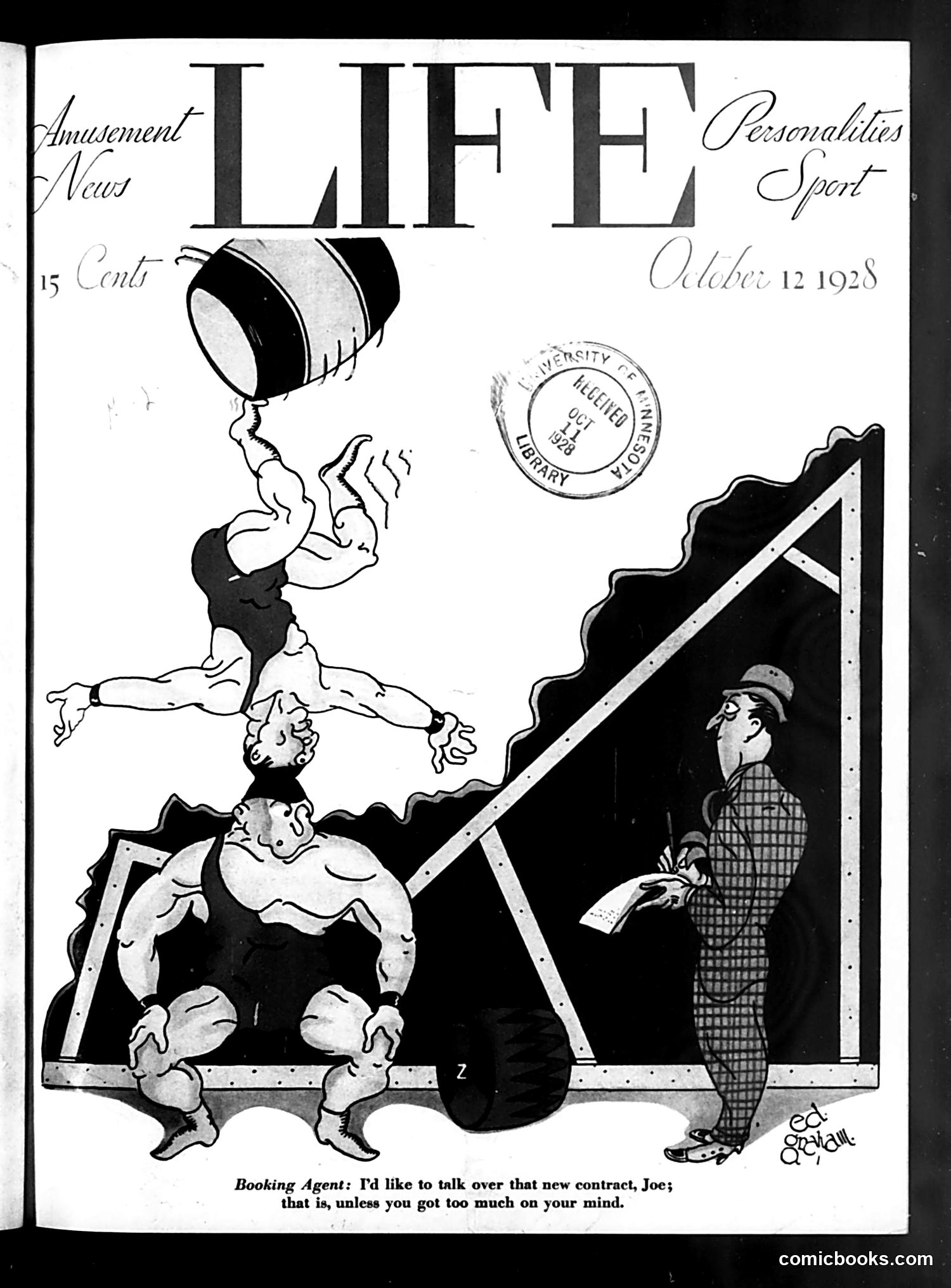
This cartoon satirizes vaudeville entertainment contracts. The booking agent (right, in plaid suit) attempts to negotiate with "Joe," a performer portrayed as an acrobat/strongman doing a headstand while balancing another performer on his feet—a physically impossible, comedic display of strength. The agent's dialogue suggests Joe is demanding too much money: "I'd like to talk over that new contract, Joe; that is, unless you got too much on your mind." The joke plays on the double meaning of "too much on your mind"—literally, Joe has another person balanced on his head, implying his mental/financial demands are equally unwieldy and unreasonable. It mocks performers' salary negotiations during the vaudeville era.
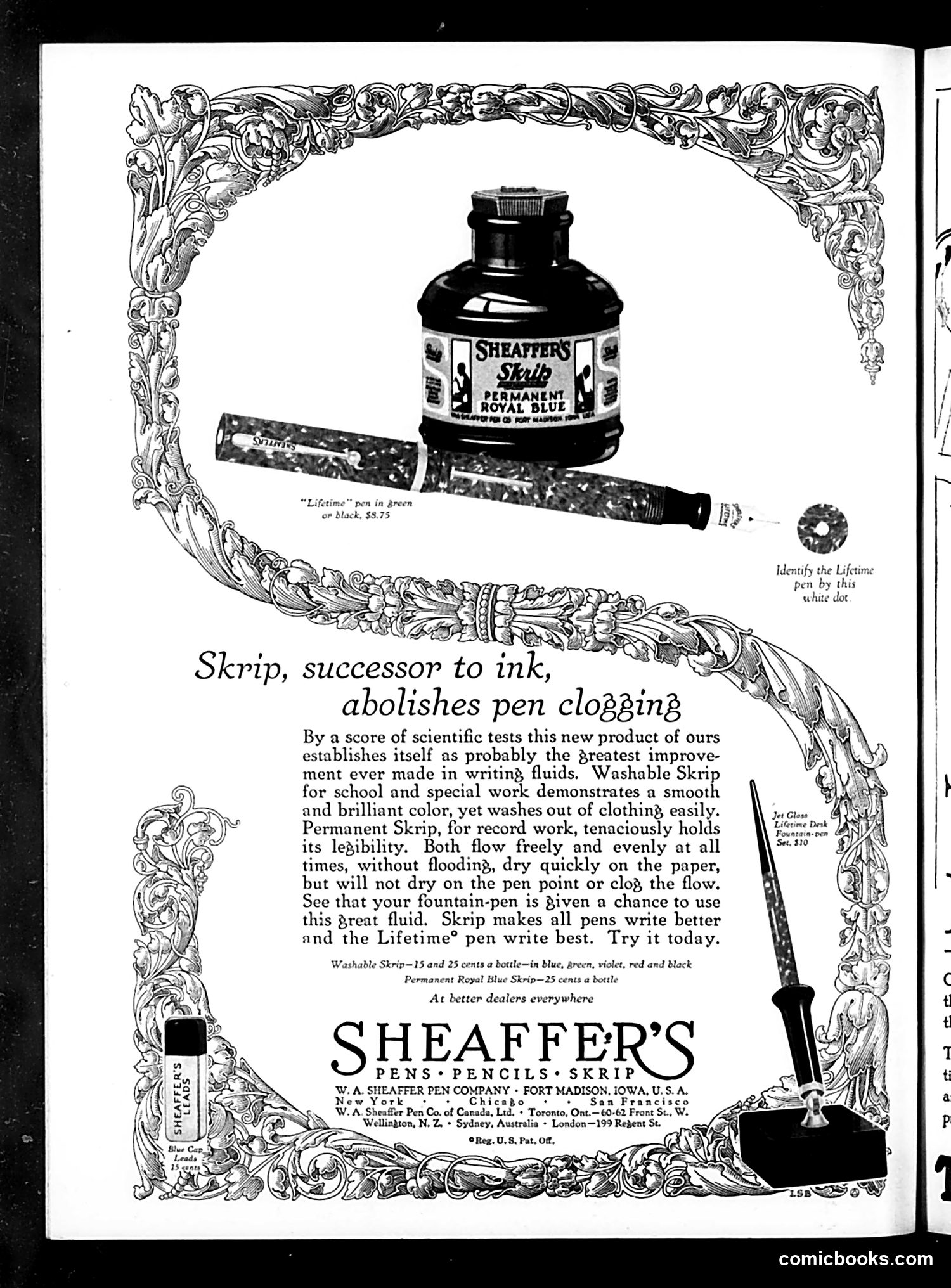
This page is primarily **a Sheaffer's pen advertisement**, not a political cartoon. There is no satire or political content to analyze. The ad promotes "Skrip," a new writing fluid product positioned as a successor to ink. The ornamental border frames product images: a Sheaffer's Skrip bottle labeled "Permanent Royal Blue" and fountain pens. The advertisement claims Skrip eliminates pen clogging and offers superior flow and color compared to traditional ink. It emphasizes practical benefits: washability for school use, quick drying, and reliability for professional writing. The "Lifetime" pen is identified by a white dot, suggesting product differentiation. The copy is straightforward marketing language typical of early 20th-century advertisements, with no satirical or political commentary present.
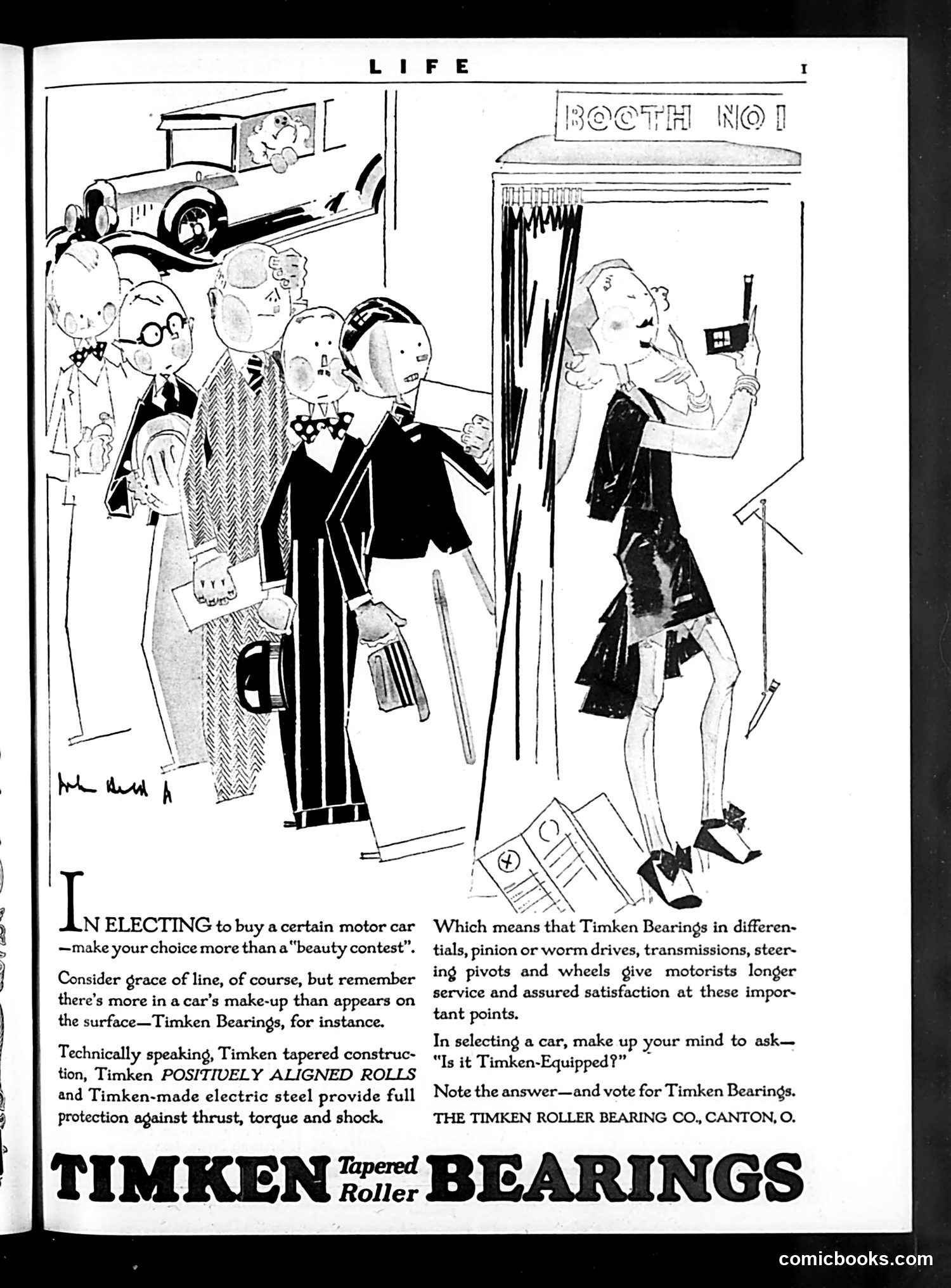
This page is primarily a **Timken Roller Bearings advertisement** from Life magazine's early 20th century era. The left cartoon depicts an auto show or dealership with well-dressed potential car buyers examining vehicles. The right panel shows "Booth No. 1" where a woman in fashionable dress examines a car, presumably at the same event. The advertisement's message is straightforward: when selecting a motor car, buyers should look beyond surface aesthetics ("beauty contest") and consider technical components like bearings. The satire is gentle—the implication that car selection is often as superficial as a beauty pageant, when consumers should prioritize mechanical quality and durability. Timken Bearings, the ad argues, represent the "hidden" quality that ensures "motorists longer service and assured satisfaction." The cartoon illustrates contemporary 1920s-era consumer culture and automotive commerce.
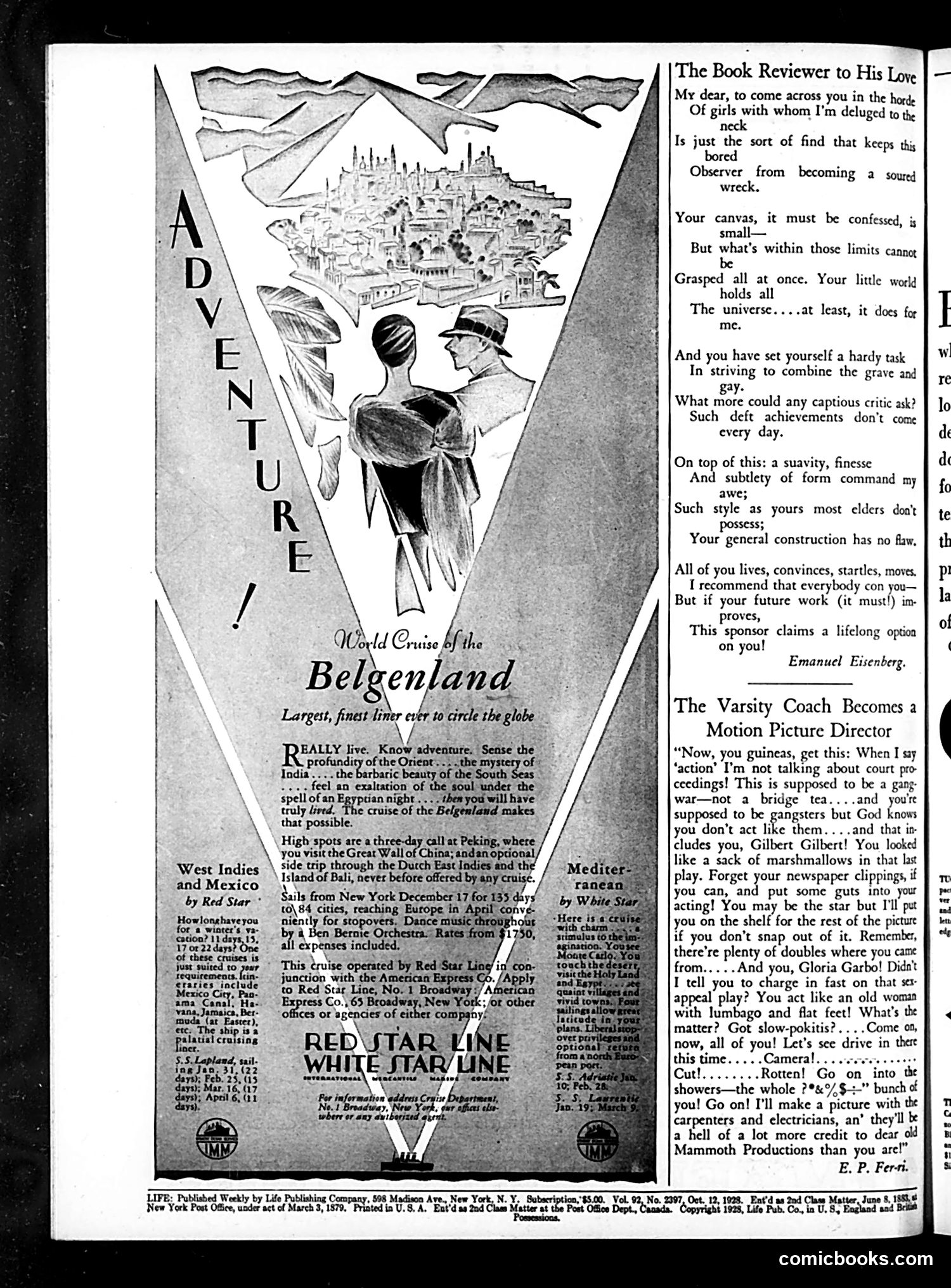
This page is primarily **advertising**, not political cartoons. The main content features: 1. **"Adventure" cruise advertisement** for the Belgenland, described as "Largest, finest liner ever to circle the globe." The ad emphasizes exotic travel to the Orient, West Indies, and Mexico via Red Star Line. 2. **Red Star Line/White Star Line shipping company ads** promoting world cruises departing December 17. 3. **"The Varsity Coach Becomes a Motion Picture Director"** — a humorous piece satirizing the transition of sports coaches to Hollywood film directing, using Gilbert (likely a real coach) as the subject. The joke mocks their lack of film experience and rough demeanor. The page reflects 1920s leisure culture and entertainment industry humor rather than political satire.
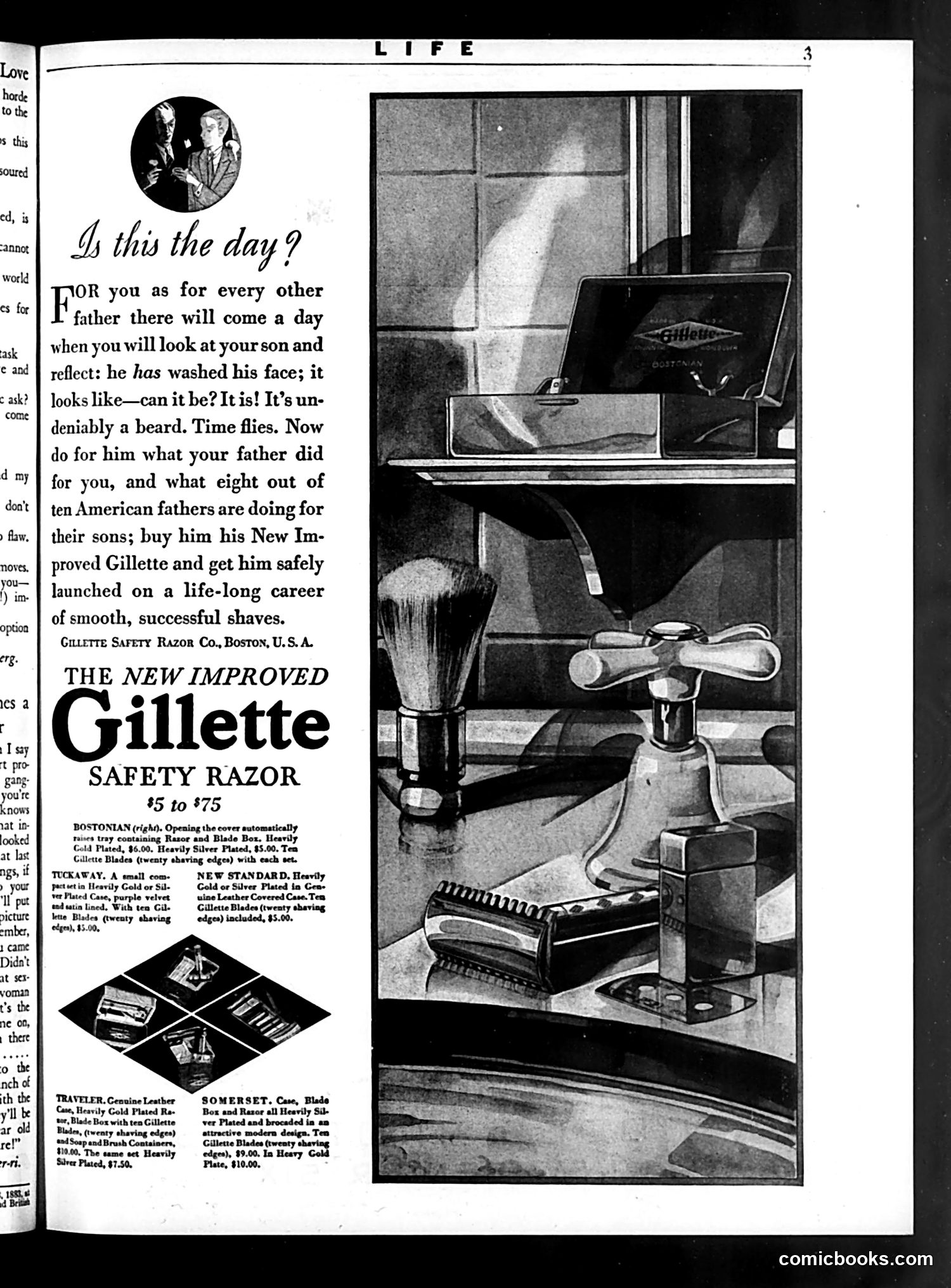
This page is **primarily a Gillette Safety Razor advertisement**, not satirical content. The ad occupies most of the space with product photography showing shaving supplies on a bathroom shelf. The advertisement uses a sentimental narrative hook: "Is this the day?" addresses fathers, suggesting the moment when a son first shaves and needs his own razor. The copy appeals to paternal sentiment and duty, framing the purchase as a rite of passage—"eight out of ten American fathers" buying Gillette razors for their sons. The small circular vignette at top shows what appears to be two figures (likely a father and son), reinforcing this generational theme. This reflects early 20th-century advertising strategy: linking consumer products to life milestones and masculine identity rather than simply describing product features. There is no satirical content—this is straightforward commercial messaging.
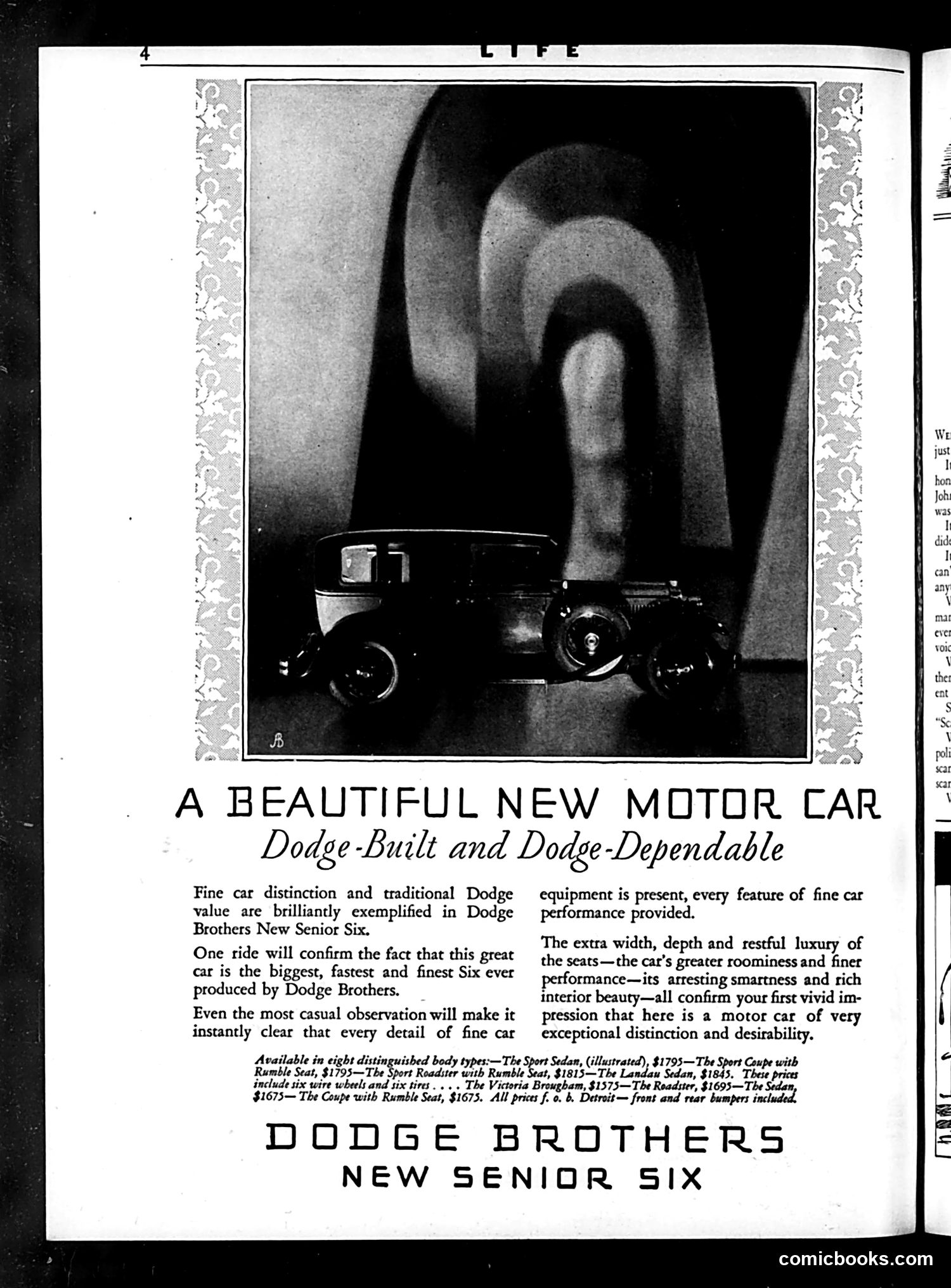
This page is **primarily an advertisement**, not editorial content or satire. It promotes the Dodge Brothers "New Senior Six" automobile as "A Beautiful New Motor Car — Dodge-Built and Dodge-Dependable." The ad emphasizes luxury features: fine car distinction, spacious seating with "extra width, depth and restful luxury," and superior interior beauty. Various body styles are listed with prices (ranging from $1,573 to $1,815), including rumble seat and roadster options. The dramatic photograph shows the car's side profile against an artistic draped background, emphasizing its elegant design. This represents typical 1920s automotive advertising strategy: appealing to aspirational middle-class buyers by stressing craftsmanship, comfort, and refined aesthetics rather than mechanical specifications alone.
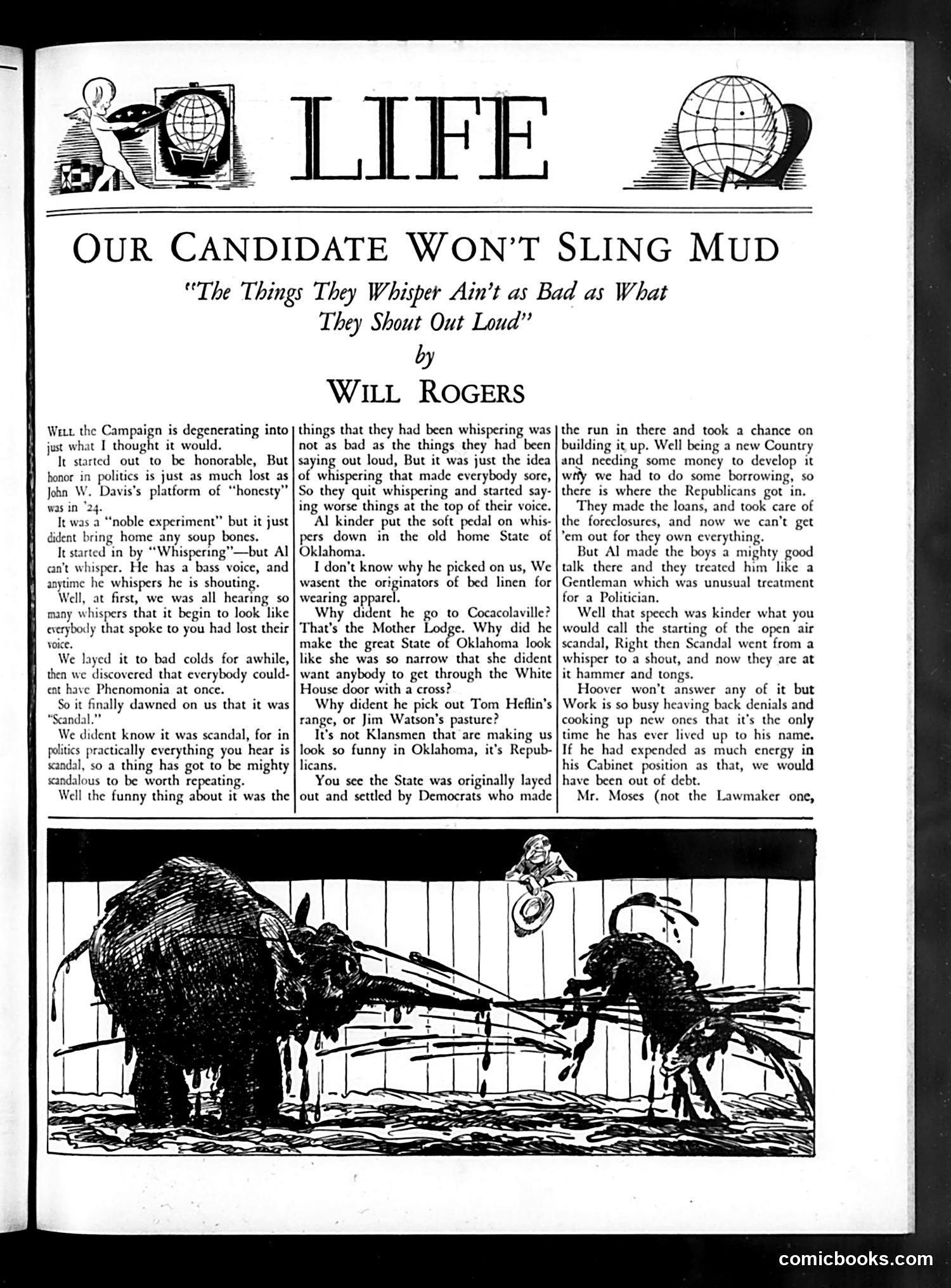
This Will Rogers column critiques a 1924 presidential campaign for degenerating into personal attacks. Rogers argues the candidate under discussion won't resort to mud-slinging, contrasting whispered scandals with loudly publicized ones. The text references specific attacks: questions about a candidate's attendance at Mother Lodge, the White House, and Tom Heflin's range. Rogers notes Republicans (not "Kinsmen") are making Oklahoma look foolish with narrow attacks. The illustration shows two mules being worked hard—a visual metaphor for exhausting political labor or the strain of campaigning itself. Rogers's point: politicians should discuss substantive issues rather than personal character attacks, which he views as beneath serious political discourse. The satire defends dignified campaigning.
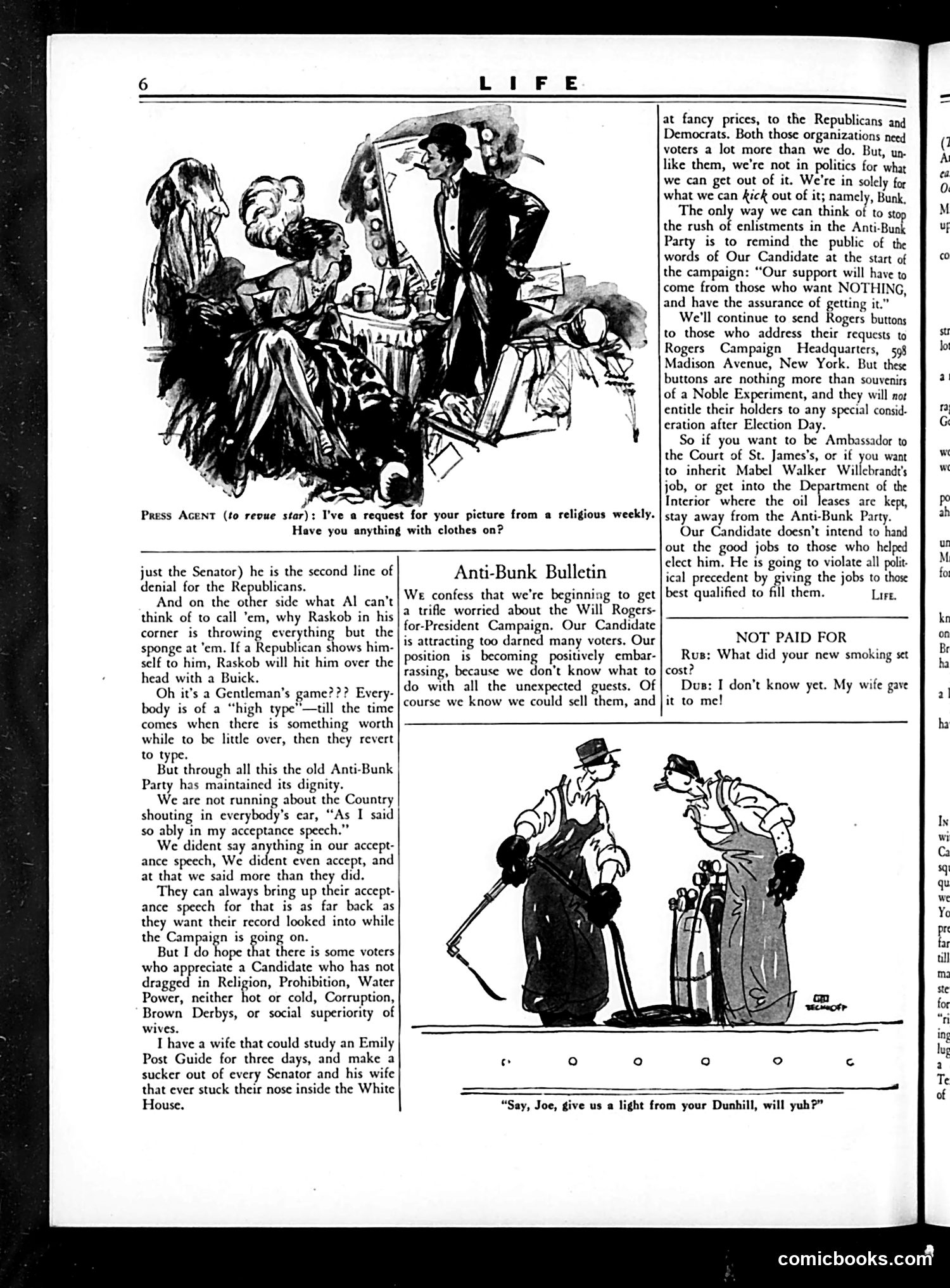
This page contains anti-Prohibition satire during the 1920s campaign season. The top cartoon shows a press agent pitching a political candidate's image to religious publications, humorously asking if they have "clothes on"—suggesting the candidate lacks substance or respectability. The "Anti-Bunk Bulletin" text mocks the Will Rogers presidential campaign, complaining it's attracting "darned many voters" and worrying about "unexpected guests." The satire suggests the Anti-Bunk Party (opposing Prohibition) maintains dignity despite lacking serious platform positions. The bottom cartoon shows two men, with one asking another to "give us a light from your Dunhill"—a reference to expensive cigarettes, satirizing wealth disparities or social pretension during Prohibition era when such luxuries became black-market status symbols.
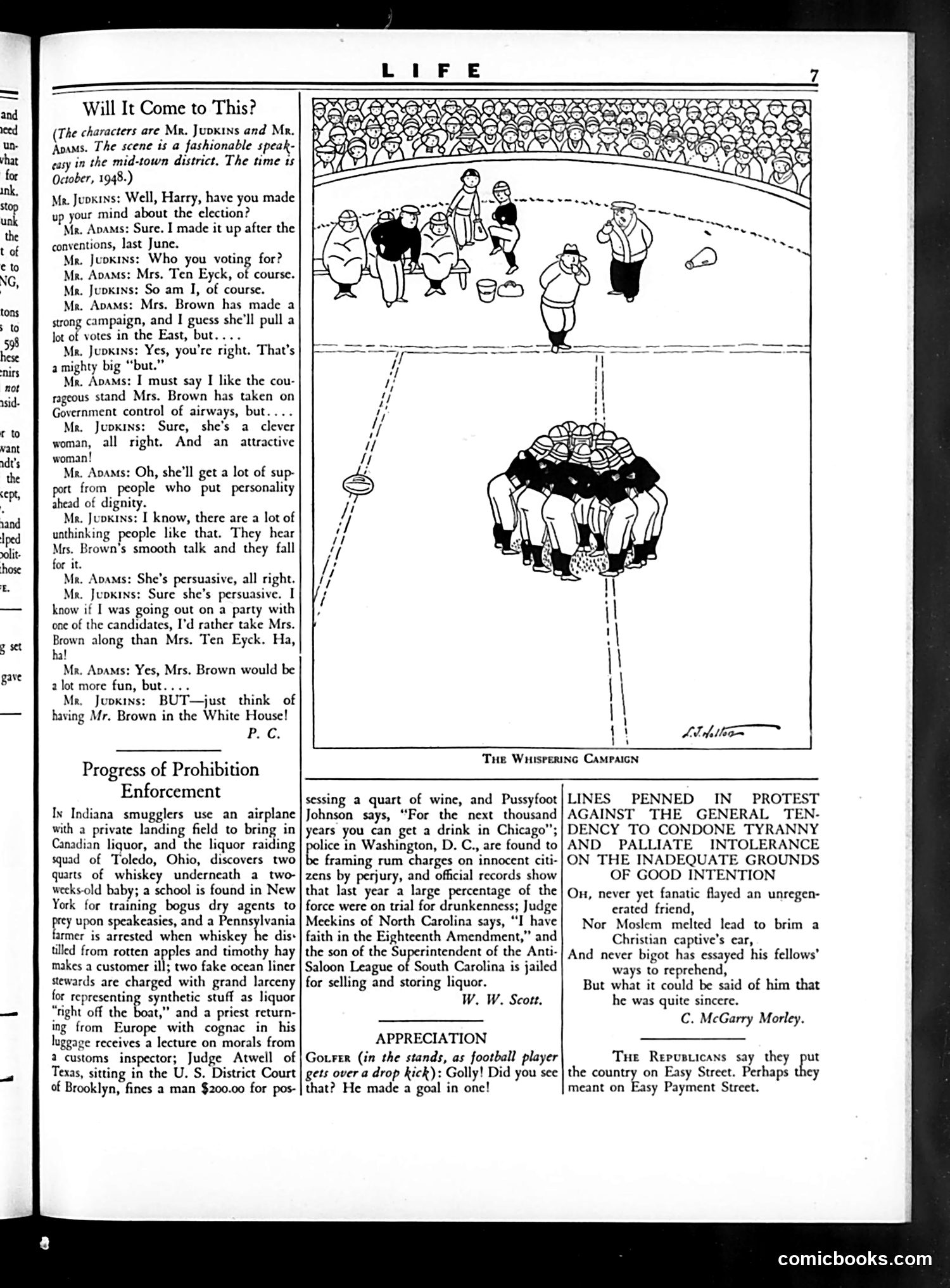
This 1948 cartoon satirizes the upcoming presidential election, depicting a crowd watching two scenarios. The dialogue between Ms. Jenkins and Ms. Adams debates whether to vote for Mrs. Ten Eyck or Mrs. Brown, with Adams praising Brown's "courageous stand" on government control of airways. The cartoon's title and dual images suggest anxiety about female political power. The upper scene shows people gathered; the lower shows figures huddled together protectively, labeled "The Whispering Campaign." This visualizes contemporary fears that women voters—newly politically engaged—might elect candidates based on personality and persuasiveness rather than substantive policy, potentially leading to undesirable outcomes. The satire reflects mid-century anxieties about expanding female political participation.
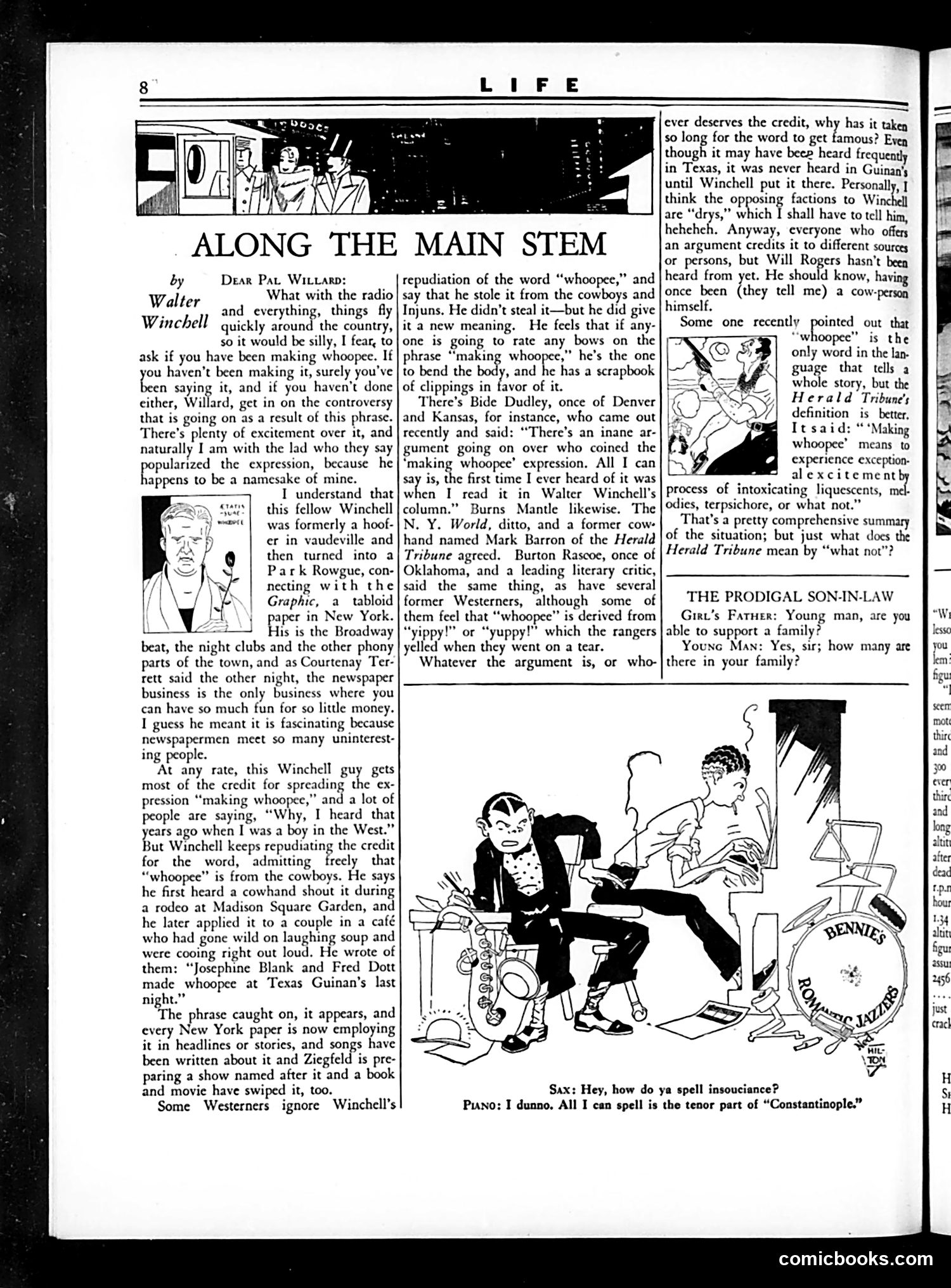
This page features Walter Winchell's gossip column discussing the origin and spread of the slang term "whoopee." Winchell credits himself with popularizing the word, which he claims originated from cowboys and was reinforced by Texas Guinan's nightclub scene. The column documents how the term spread through New York entertainment venues and was adopted by songwriters and entertainers. The lower cartoon jokes about spelling and pronunciation: a saxophonist and pianist argue over how to spell "insouciance," with the saxophonist suggesting it's "the tenor part of Constantinople"—a nonsensical pun playing on musical instruments and word sounds. The content reflects 1920s-30s popular culture's fascination with slang terminology and entertainment industry gossip.
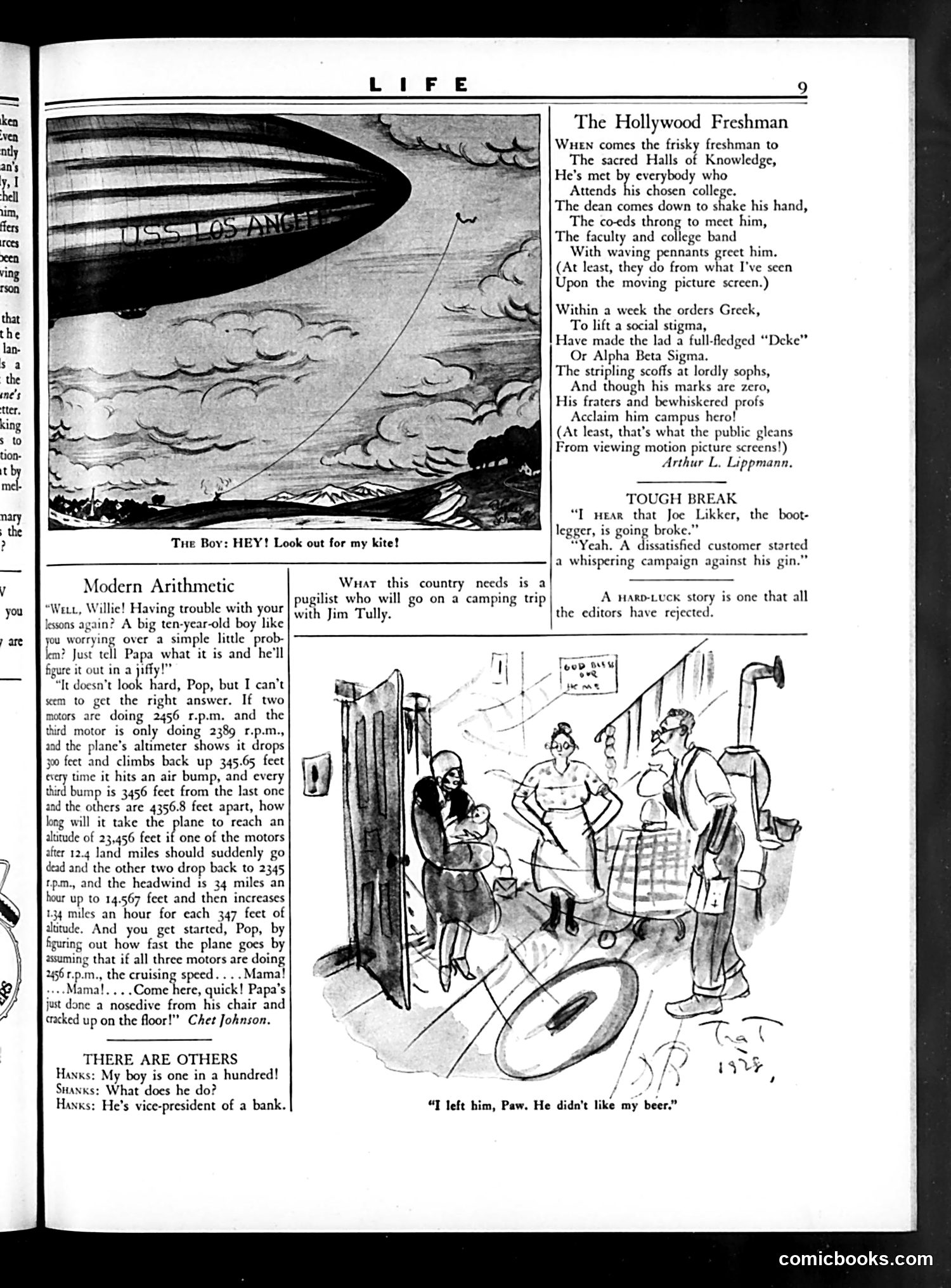
This page contains three distinct pieces of satirical content: **"The Hollywood Freshman"** (poem): Satirizes how Hollywood studios manufacture stardom by orchestrating enthusiastic receptions for newcomers—deans shake hands, faculty greet them, orchestras play—creating the illusion of earned prestige when really it's studio marketing (referencing motion pictures). **"Modern Arithmetic"**: A humorous dialogue where a father tries explaining airplane engine calculations to his son using increasingly complex math about motor speed and altitude, culminating in the child's impatient "Come here, quick! Papa's having a nosebleed!"—satirizing overly technical explanations. **"There Are Others"**: A brief joke about social pretension: one man brags his son is "one in a hundred," another responds the son is a bank vice-president, suggesting ironic commentary on privilege and status. The page reflects 1920s-30s American humor about Hollywood promotion, technical jargon, and class.
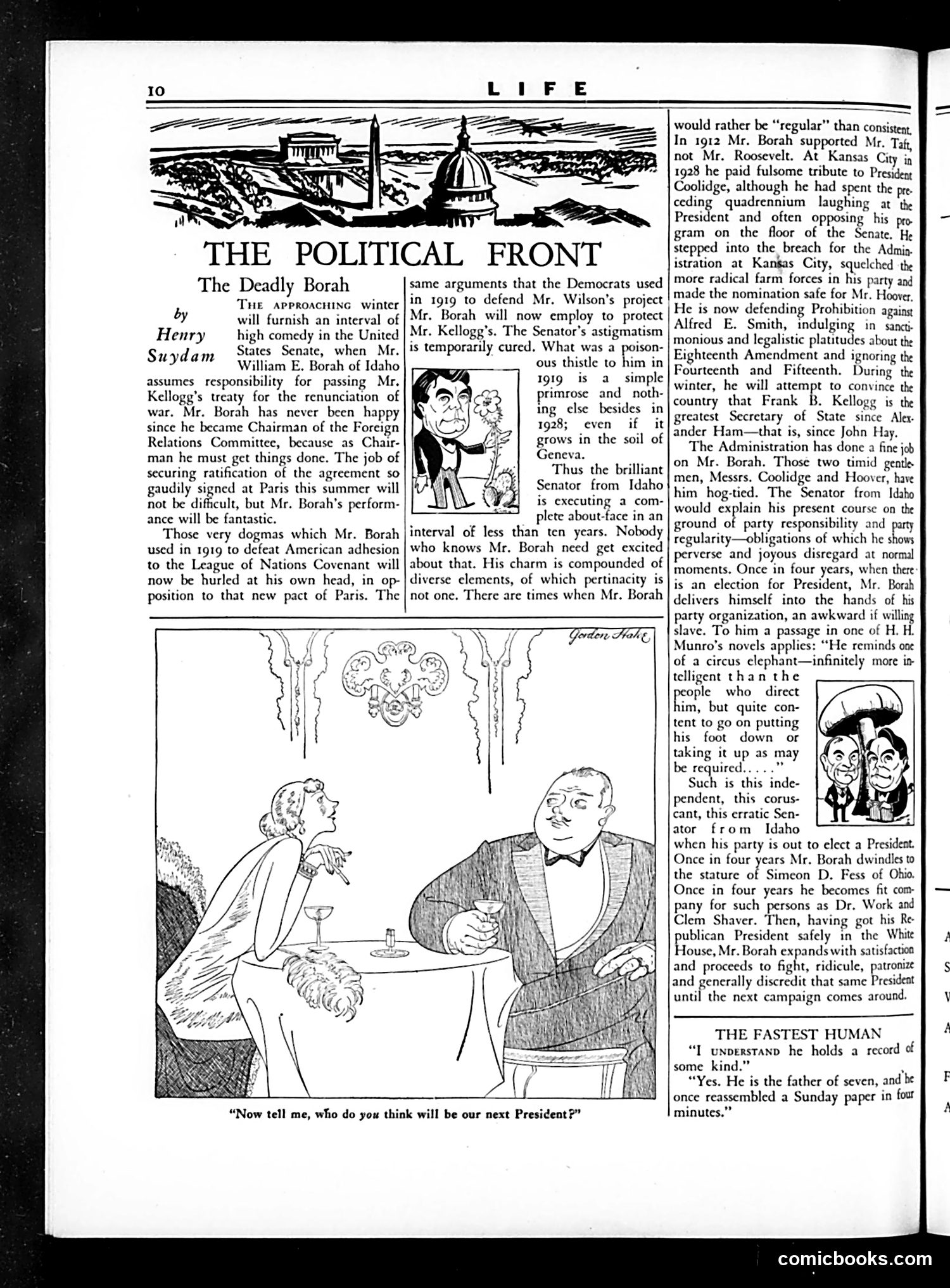
This satirical article by Henry Sydnor attacks Senator William E. Borah of Idaho. The main cartoon depicts Borah at a dinner table with a woman, captioned "Now tell me, who do you think will be our next President?" The satire targets Borah's political inconsistency. The text criticizes him for opposing the League of Nations in 1919, then defending President Wilson's 1928 Kansas City convention speech. Borah is portrayed as an unprincipled opportunist who shifts positions based on political convenience rather than principle. The caricatured drawings emphasize Borah's facial features mockingly. The article suggests he's an "erratic Senator from Idaho" who expands and contracts his positions depending on which party needs him during presidential campaigns—making him unreliable and self-serving rather than principled.
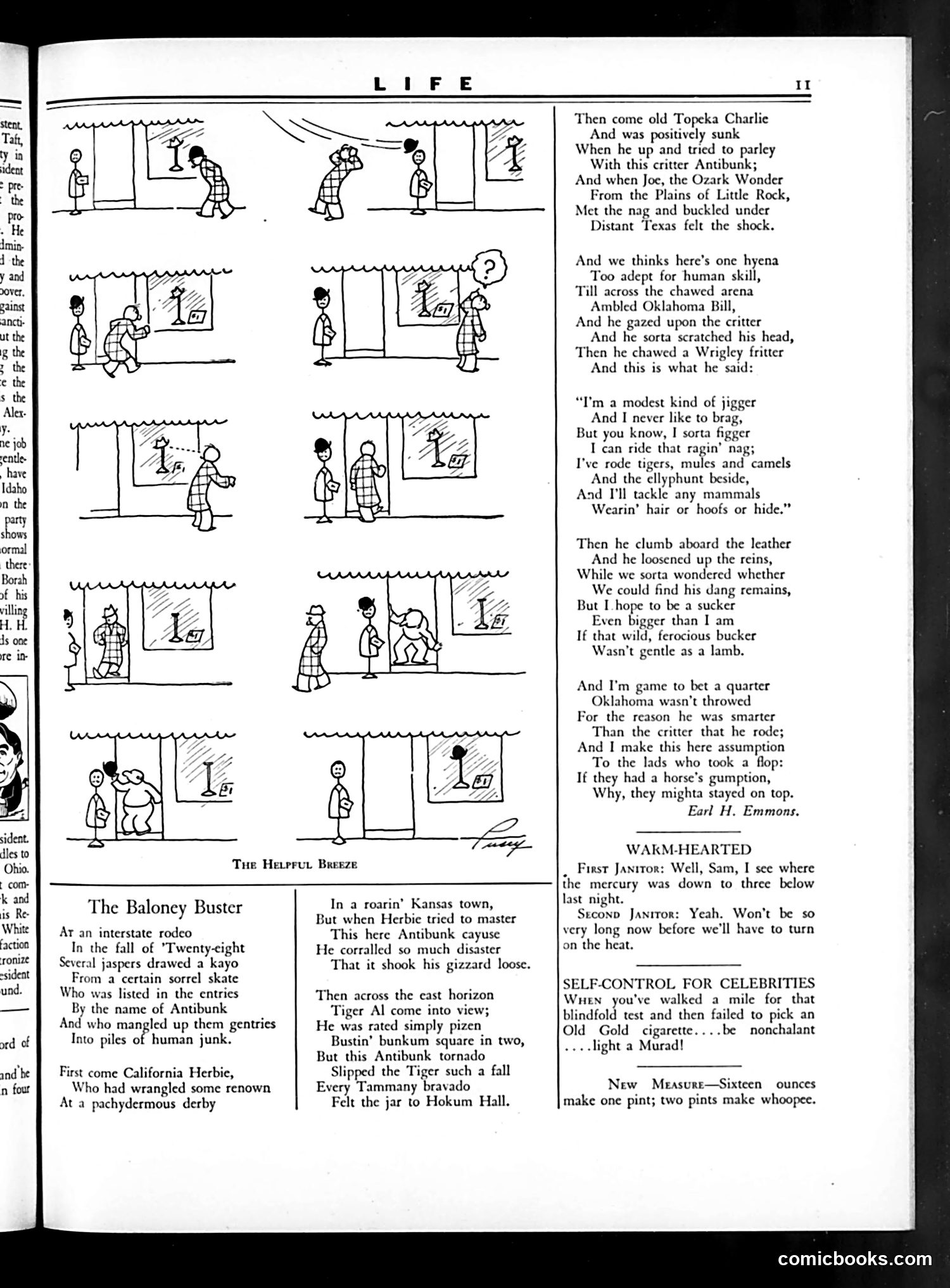
This six-panel comic depicts a simple domestic scenario: a woman hanging laundry outdoors encounters progressively stronger wind that ultimately blows her clothes away entirely. The final panel shows her empty-handed as garments scatter. The title "The Helpful Breeze" is ironic—what seems initially beneficial (wind to dry clothes) becomes destructive. This appears to be gentle humor about household mishaps rather than political satire. The page also contains "The Balconey Buster," a poem about a rodeo accident involving various named characters (California Herbie, Tiger Al, Antibank). These are humorous tall tales typical of Life's satirical cowboy/frontier content, playing on exaggerated Western stereotypes popular in early 20th-century American humor.
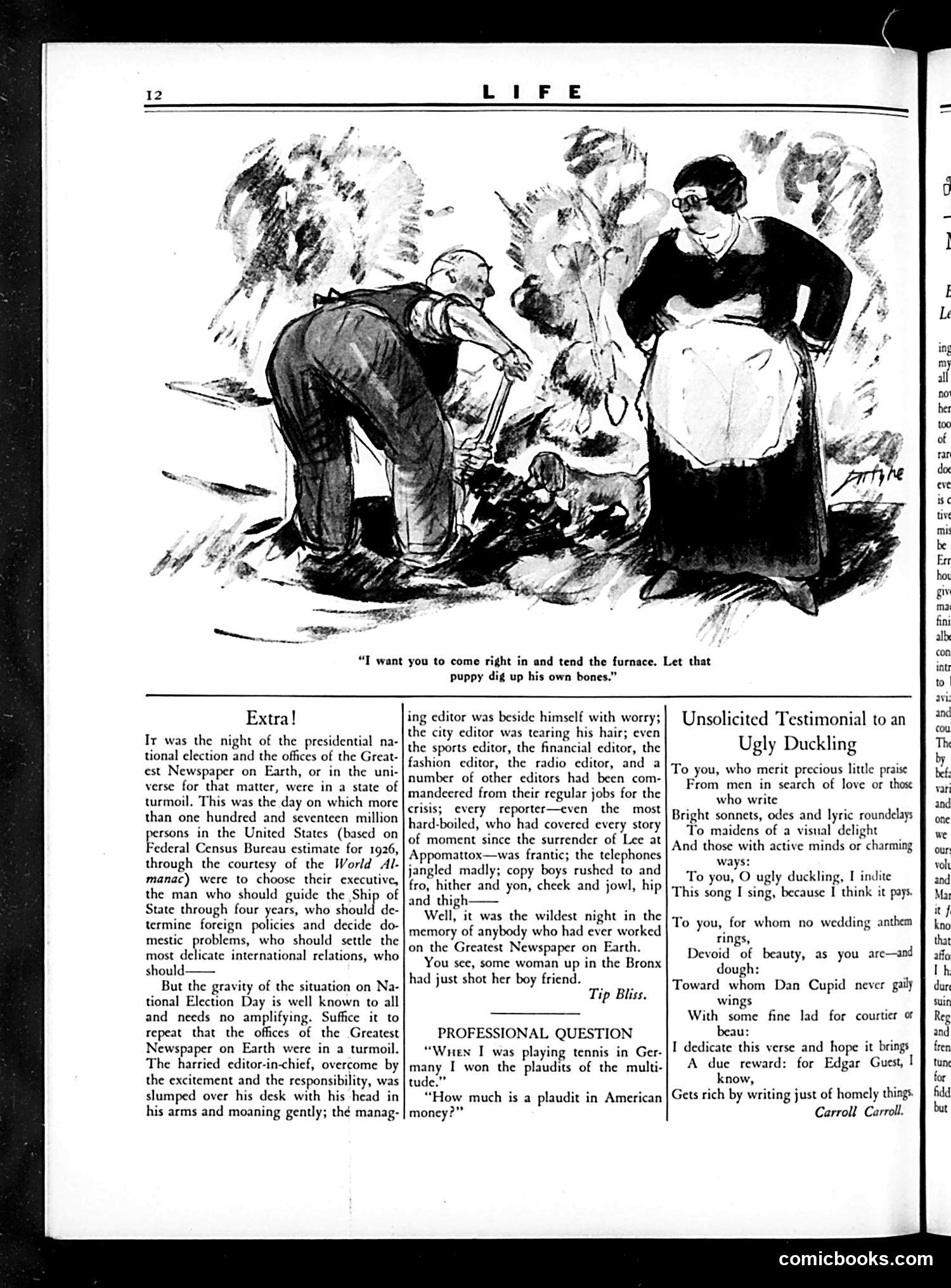
**The Cartoon:** The sketch depicts a man bending over a furnace while two women watch. The caption reads: "I want you to come right in and tend the furnace. Let that puppy dig up his own bones." **Meaning:** This is domestic satire. The woman is instructing her husband to do manual labor (tend the furnace) while their dog digs in the yard. The joke plays on gender roles and marital dynamics—the husband is being ordered around by his wife, reduced to performing household tasks while even the family pet seems more independent. It's mocking emasculation in marriage and the loss of male authority in the domestic sphere, a recurring theme in early 20th-century American humor magazines like *Life*. The cartoonist's signature appears at bottom left.
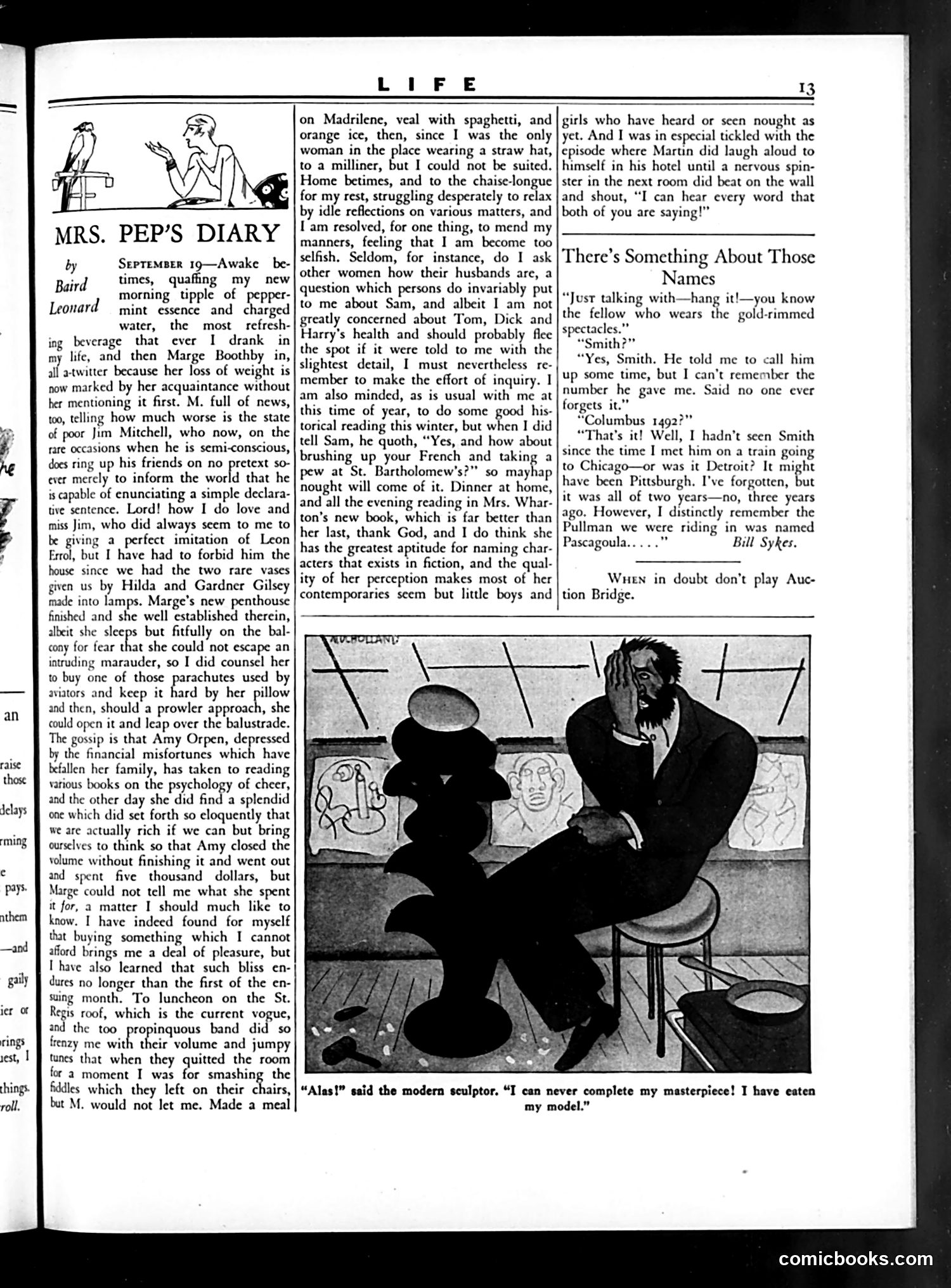
This page contains two satirical pieces from *Life* magazine: **"Mrs. Pep's Diary"** (by Baird Leonard) mocks the pretensions and self-absorption of wealthy socialites. Mrs. Pep obsesses over trivial domestic matters—her new mint essence, lost vases, and the "proper" names of acquaintances—while claiming moral superiority and cultural sophistication. The humor targets how the upper class disguises selfishness as refined concern. **"There's Something About Those Names"** satirizes the American habit of forgetting or mispronouncing names. A man's memory fails him repeatedly (Smith, Columbia, Pascagoula), reflecting broader social anxiety about propriety and embarrassing social mistakes. The accompanying cartoon depicts a sculptor lamenting that he "can never complete my masterpiece! I have eaten my model"—likely satirizing modern art's pretension and the stereotype of struggling artists.
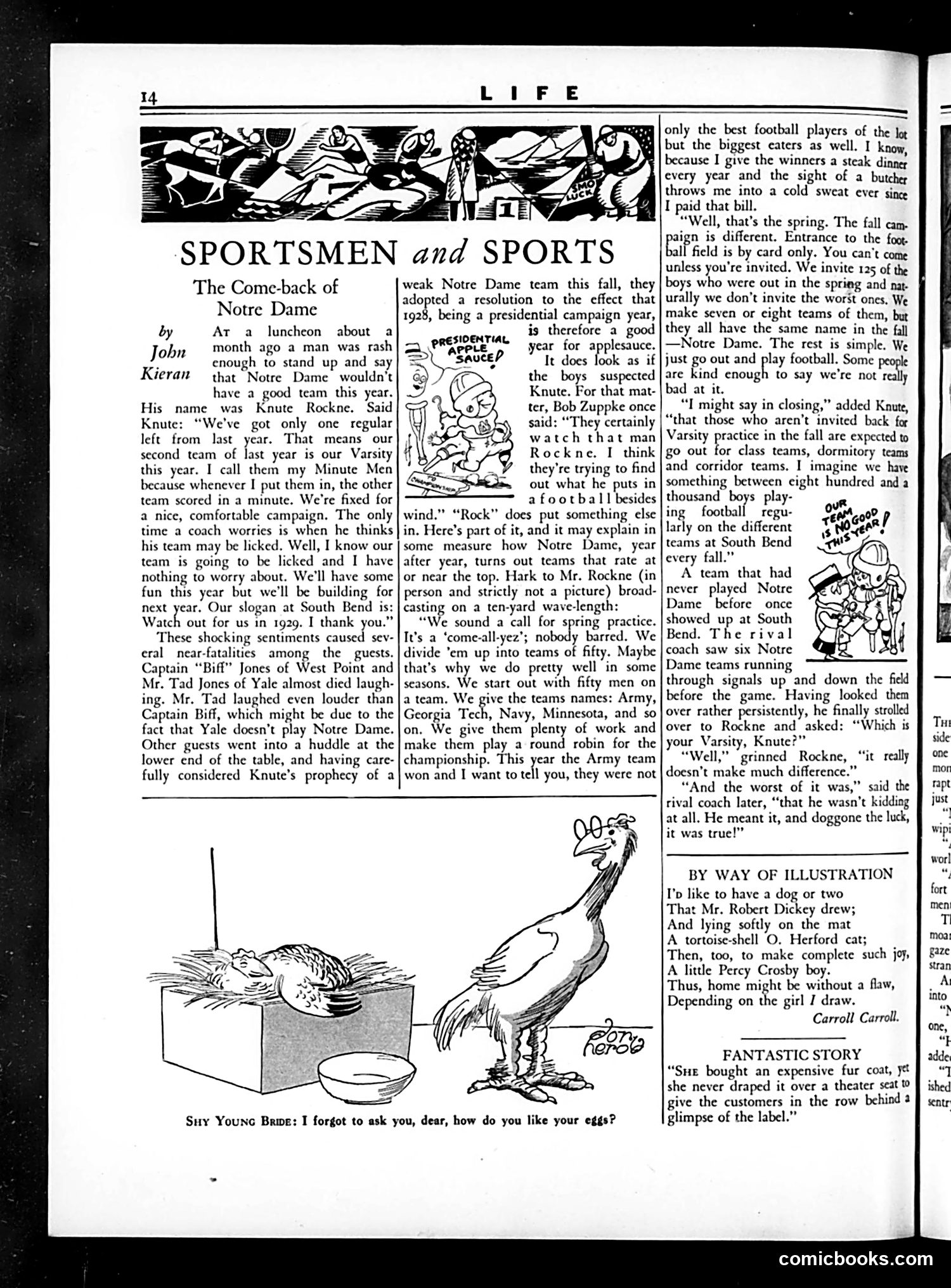
This is a sports column by John Kieran discussing Notre Dame football's comeback. The main cartoon features a **shy young bride** asking her groom how he likes his eggs—a domestic humor joke playing on newlywed awkwardness. The column discusses Coach Knute Rockne's strategy for rebuilding Notre Dame's team after a weak season, using a "presidential campaign year" approach. References to **"Rock" (Rockne)** and spring practice indicate this discusses early 1900s college football recruitment and team-building. The smaller illustrations show football players in vintage uniforms, typical of Life magazine's sports coverage mixing commentary with light visual humor about college athletics and coaching philosophy during the Golden Age of American football.
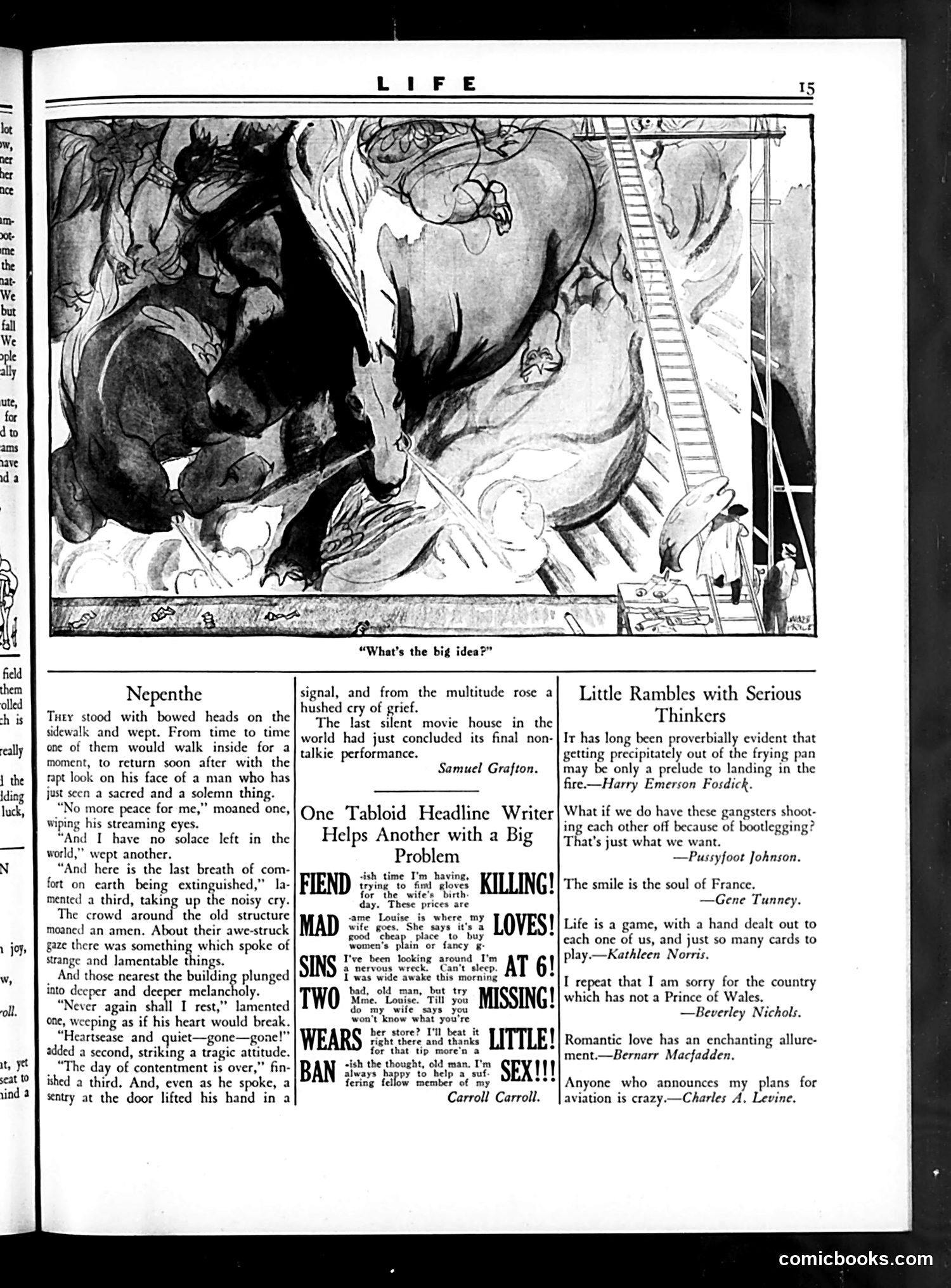
**Main Cartoon:** The large illustration titled "What's the big idea?" depicts what appears to be a silent film production scene—a common Life subject. The exaggerated figures and theatrical gestures are typical of silent-era slapstick comedy satire. **"Little Rambles with Serious Thinkers":** This is a humorous opinion column featuring brief quotes attributed to named individuals (Gene Tunney, Beverley Nichols, Charles A. Levine, etc.). The jokes mock contemporary figures and topics: aviation enthusiasm, romantic ideals, and social concerns. **Left Column:** A narrative piece titled "Nepenthe" by Samuel Grafton depicts mourners at what appears to be a film premiere, with satirical commentary on the emotional overreaction to entertainment. The page satirizes 1920s celebrity culture, silent cinema, and fashionable intellectual posturing.
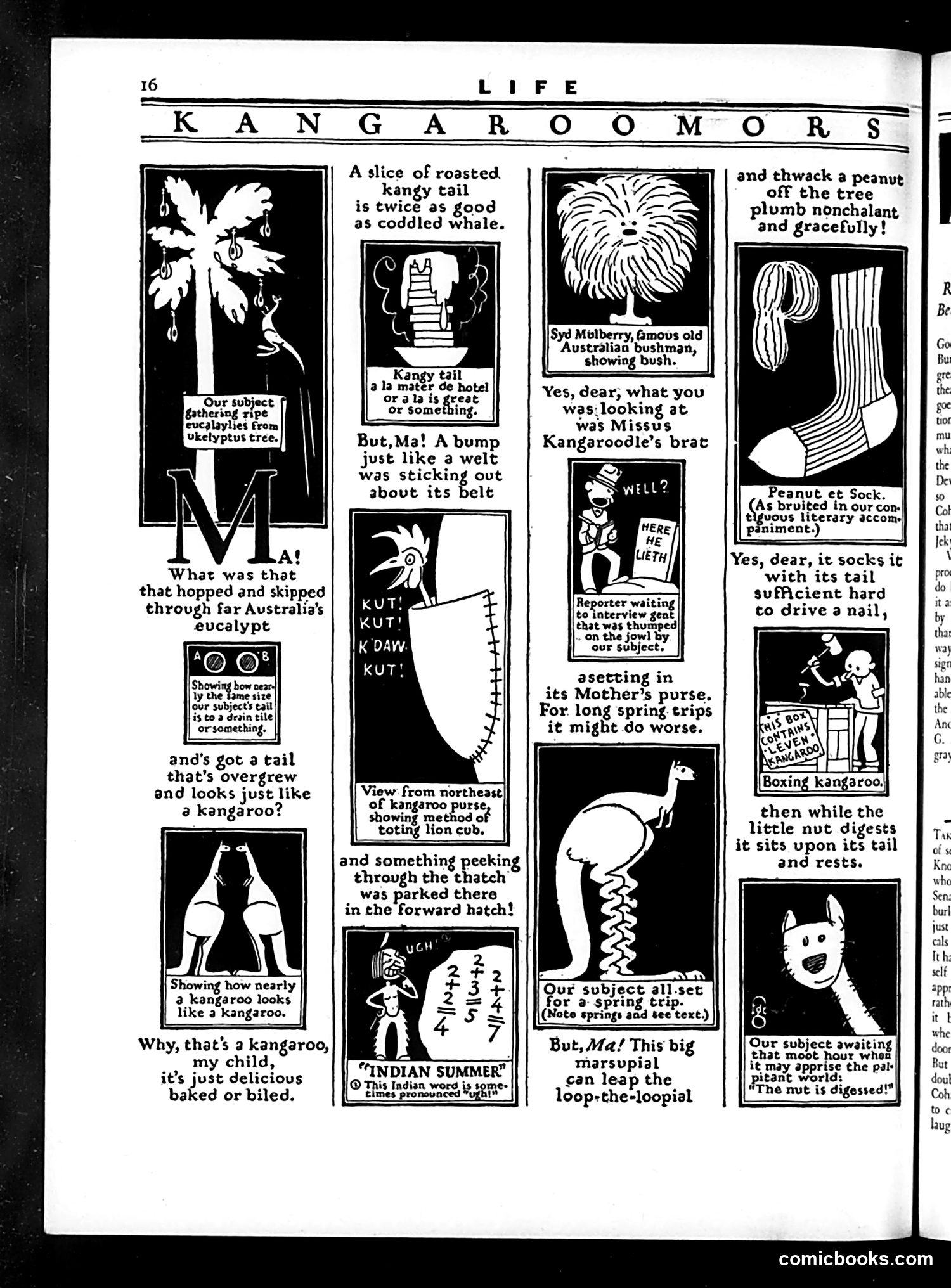
This page presents a whimsical illustrated essay about kangaroos, treating the animal as if it were a comical character with human-like qualities. The cartoons humorously depict kangaroo anatomy and behavior—their distinctive tail, hopping gait, and pouch—as if explaining them to an urban audience unfamiliar with the animal. The satire appears gentle rather than political: it mocks Victorian-era nature writing's earnest, overly formal tone by presenting absurd comparisons (kangaroos tasting like "coddled whale") and farcical scenarios (a kangaroo boxing, digesting peanuts). The anthropomorphization and deliberate misspellings ("Kut! Kut! Kaw!") add comedic effect. The reference to "Indian Summer" suggests early-20th-century American publication context. The humor relies on exoticism and the presumed unfamiliarity of American readers with Australian wildlife.
This is a theatre review column by Robert Benchley in *Life* magazine. The visible cartoons are small, generic theatrical sketches—one showing two figures in conversation, another depicting what appears to be theatrical props or scenery. The reviews discuss specific Broadway productions: "Jack Keefe" (adapted from a literary character), "Jarnegan," and "East Liss" (a melodrama). Benchley critiques performances by actors including George M. Cohan and Ring Lardner, evaluating their dramatic abilities and script choices. The writing is satirical in Benchley's characteristic style, mocking both theatrical conventions and Hollywood's perceived influence on stage productions. The column focuses on theatrical quality rather than political content—this is entertainment criticism, not political satire.
This editorial page critiques the 1928 presidential campaign between Herbert Hoover (Republican) and Al Smith (Democrat). The author attacks both campaigns' descent into personal attacks, particularly regarding religion—Smith being a Catholic and Hoover a Quaker. The cartoon(s) likely satirize the mud-slinging and religious bigotry dominating the race. The text references "Mrs. Willebrandt" (a Republican campaign surrogate) and clergy like Reverend Straton attacking Smith's Catholicism as examples of unseemly Republican tactics, while noting Democrats foolishly retaliated with similar mud. The author praises Republican Chairman Work's economic commentary about working-class debt as genuine wisdom—that Americans now view consumer debt (mortgages, radios, cars, washing machines) as signs of prosperity rather than poverty, betting on "continued prosperity." The piece reflects 1920s consumerism and the pre-Depression optimism, later revealed as dangerously naive.
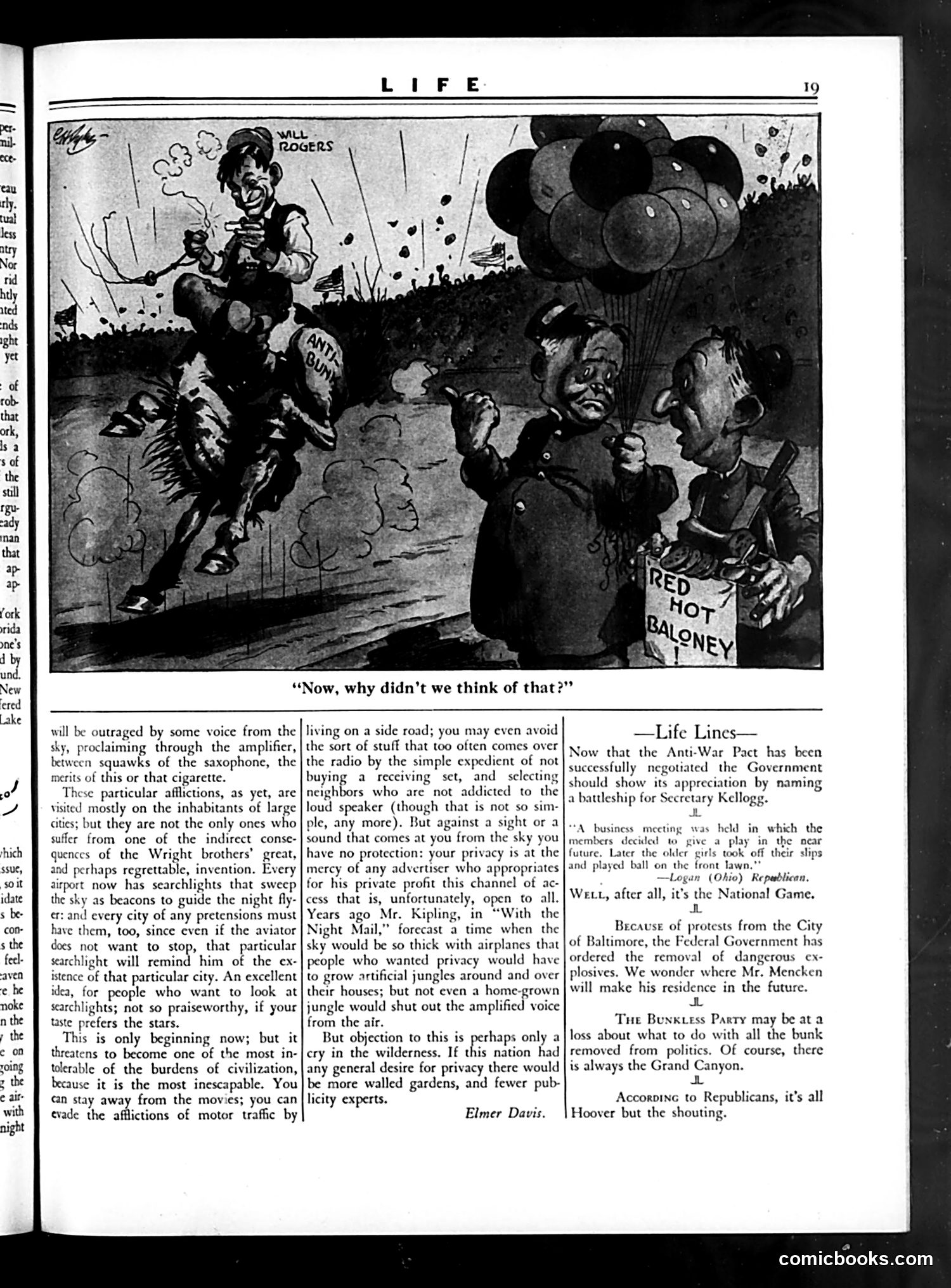
**The Main Cartoon:** This satirical cartoon depicts Will Rogers (labeled at top) as a caricatured figure demonstrating "red hot baloney" to three men below. The imagery mocks political hot air and empty rhetoric, with Rogers appearing as a charlatan showman literally selling nonsense. The "balloon" imagery suggests inflated claims. **The Surrounding Text:** The page's editorial content by Elmer Davis criticizes modern intrusions on privacy—particularly searchlights, aircraft noise, and radio advertisements that penetrate homes indiscriminately. It laments that unlike movies or traffic, citizens cannot escape aerial advertising. **The "Life Lines" Section:** These brief satirical items mock: - Secretary Kellogg (Briand-Kellogg Pact negotiator) via ironic praise - An Ohio newspaper's innocent report about schoolgirls that reads suggestively - H.L. Mencken and Baltimore politics - The Republican Party's emptiness **Overall Context:** This 1920s Life page combines visual and textual satire on political phoniness, technological intrusion, and journalistic absurdity—typical of the magazine's sophisticated humor targeting educated urban readers skeptical of politicians and advertisers.
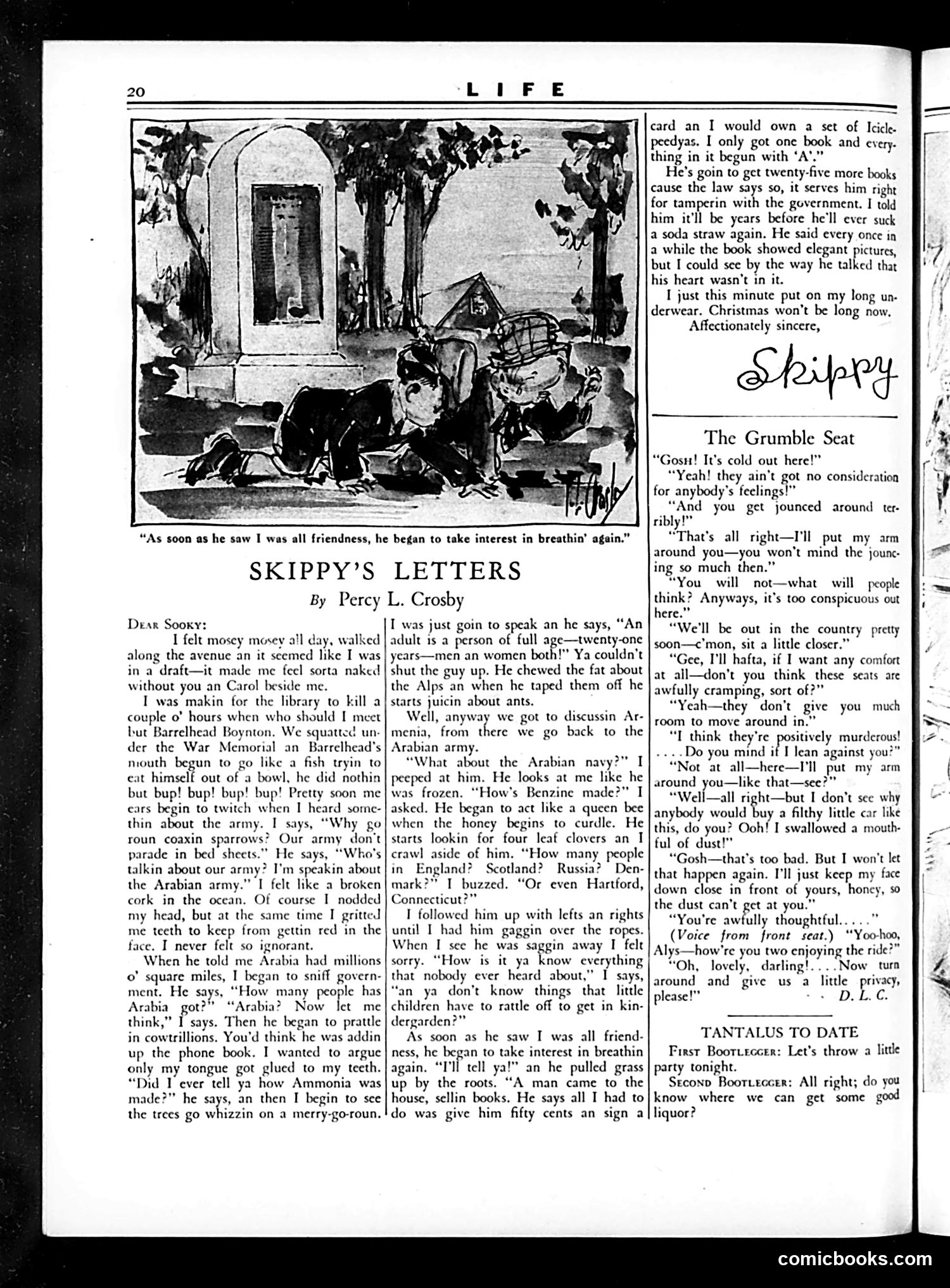
This page features "Skippy's Letters" by Percy L. Crosby, a humor column presenting correspondence from a working-class character named Skippy to his friend "Sooky." **The Main Joke:** Skippy encounters an insufferably know-it-all named Barrelhead Boynton who pontificates endlessly about obscure topics—the Arabian army, geometry, chemistry ("How's Benzine made?")—while remaining ignorant of basic facts children know. When Skippy finally confronts him, Boynton admits he bought an encyclopedia set ("Icicle-peedyas") for fifty cents, having read only the first volume starting with "A." **The Satire:** This mocks pretentious self-education and the false authority it creates. Boynton represents the type who acquires a single reference source and assumes comprehensive knowledge, while remaining embarrassingly ignorant overall. The cartoon illustrates the moment Skippy's friendliness causes Boynton to "take interest in breathin' again"—suggesting the confrontation nearly stopped him cold.
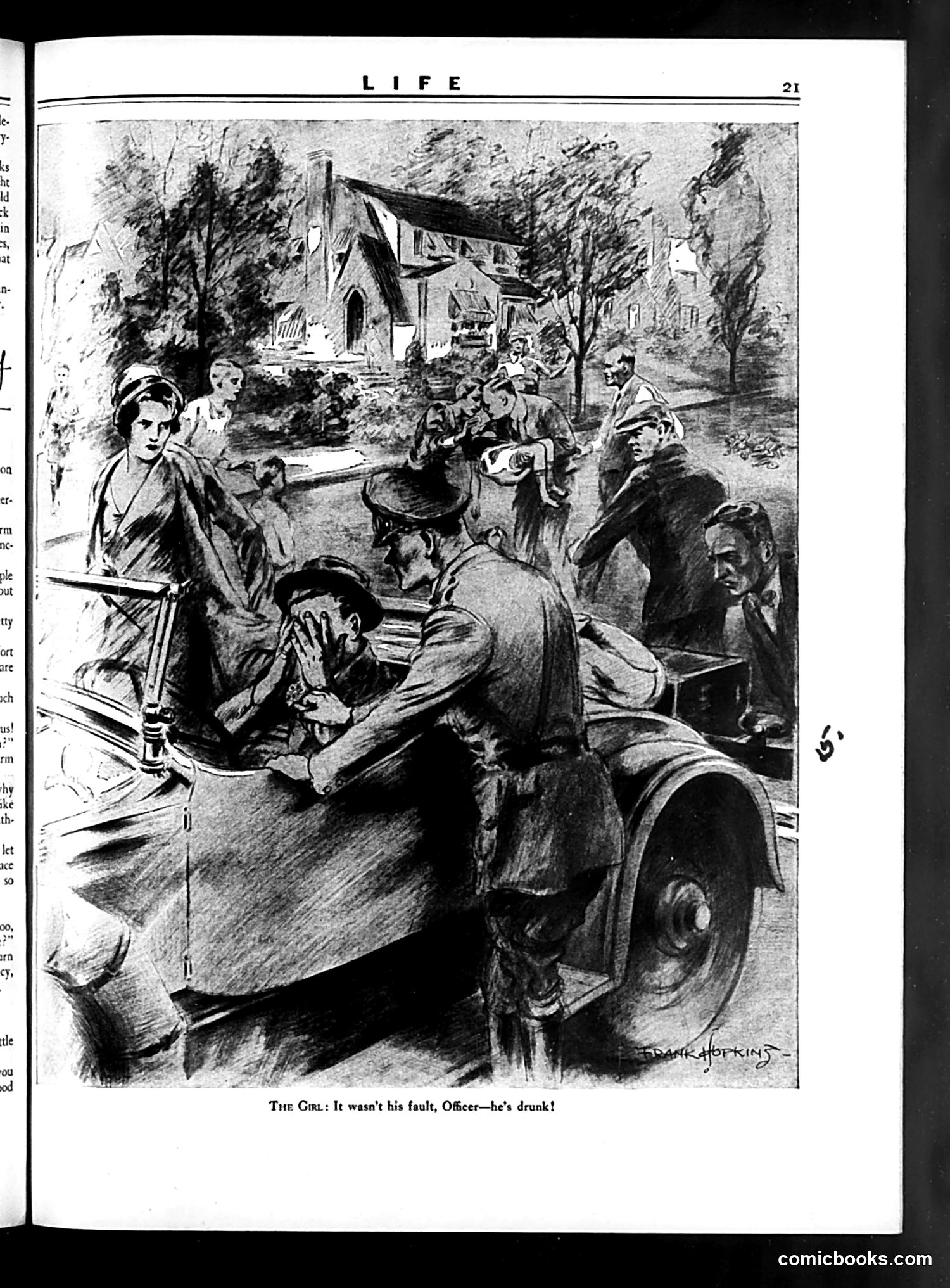
This cartoon depicts a domestic incident where a woman is defending a drunk man to a police officer. The scene shows a chaotic street setting with a vehicle and onlookers. The satire critiques the social dynamics of the era: a woman excuses a man's behavior—likely disorderly conduct or violence—by attributing it to intoxication rather than holding him accountable. The humor, though dark by modern standards, seems to mock both the woman's enabling attitude and society's tendency to treat drunkenness as an acceptable excuse for misconduct. The cartoon appears to comment on gender relations and alcohol culture in early 20th-century America, suggesting that intoxication was often used as a convenient justification for poor behavior, with women expected to protect or defend such men. The officer's presence implies legal consequences were being avoided through this rationalization.
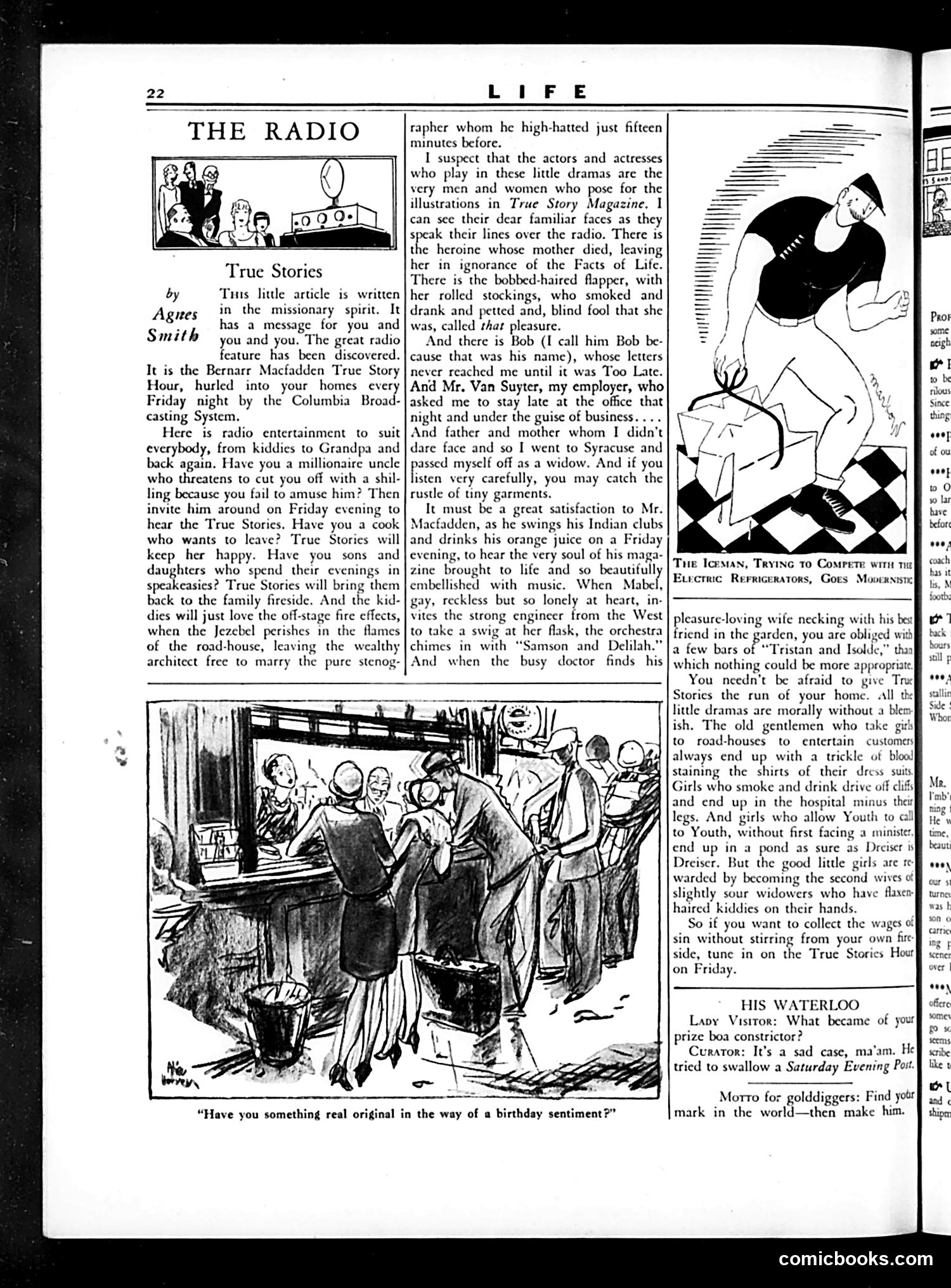
This page satirizes the "True Stories Hour," a radio program based on *True Story Magazine*—a pulp publication famous for sensationalized, moralistic tales of seduction, betrayal, and downfall. **The Satire:** Agnes Smith mocks the program's melodramatic plots and their moral messaging. She lists absurd scenarios: flappers who smoke and drink, office workers seduced by employers, women passing as widows—all presented as cautionary tales. The joke is that these "moral" stories are actually sensationalized trash entertainment disguised as uplift. **Key Targets:** - **Bernarr Macfadden**: The magazine's real publisher, promoting his radio adaptation - The hypocrisy of "family entertainment" that sensationalizes vice while claiming moral instruction - The contradiction: girls who "allow Youth to call to Youth" end up dead (like Theodore Dreiser's tragic novels), yet this is marketed as wholesome home fare **The cartoons** show the program's melodramatic staging—overwrought characters, orchestral accompaniment to domestic scandals—underscoring Smith's point about fake sincerity masquerading as moral guidance.
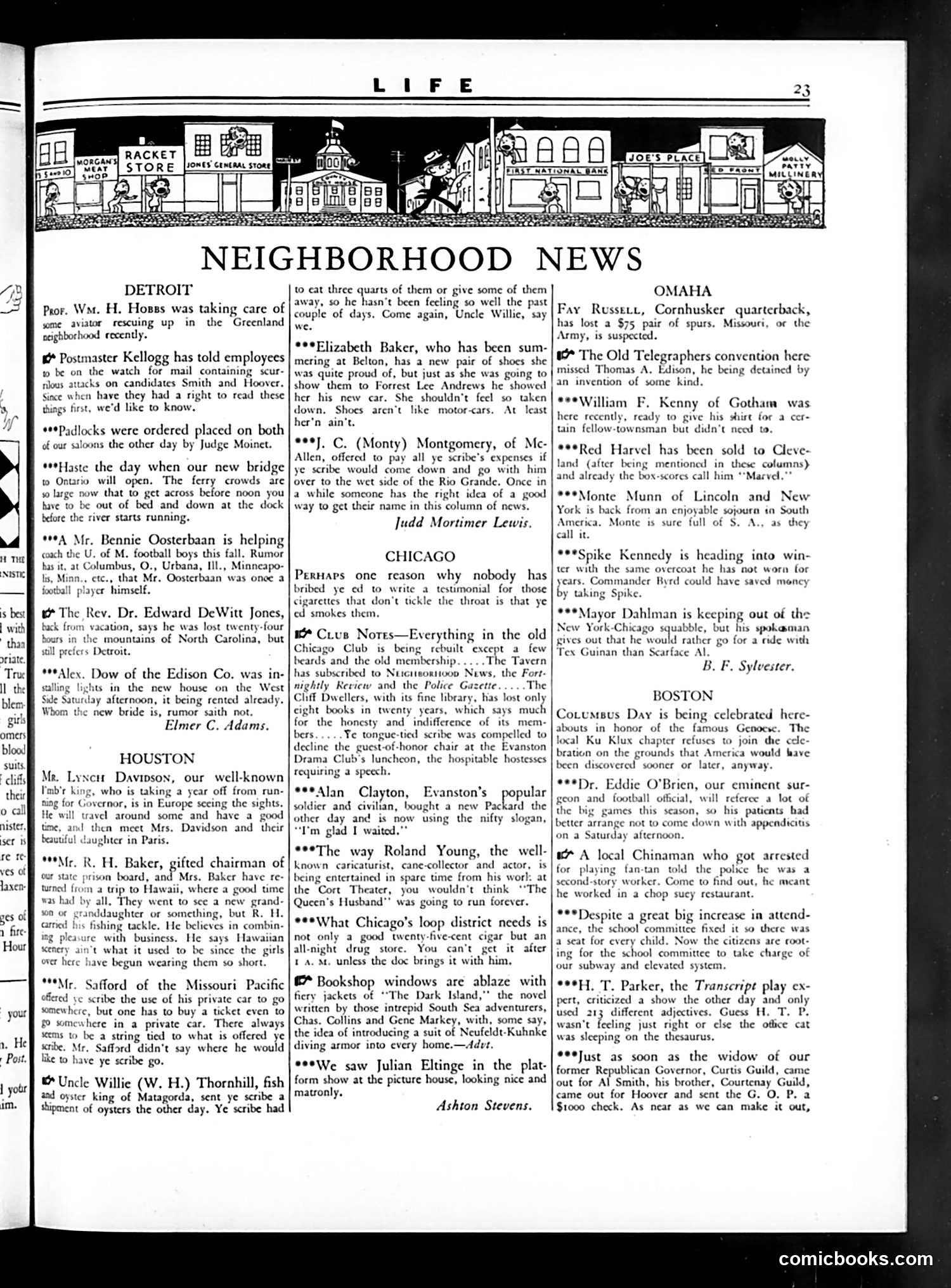
This page presents humorous local gossip columns from major American cities (Detroit, Houston, Chicago, Boston, Omaha). The content reflects 1920s social life: Prohibition-era references (saloons being padlocked), political figures (candidates Smith and Hoover mentioned), leisure activities, and scandal-mongering. The cartoonish illustration at the top depicts a typical Main Street storefront with shops like "Racket Store" and "Joe's Place"—satirizing American small-town commercialism. The jokes target: - **Bureaucratic absurdity** (postmaster censoring mail) - **Prohibition hypocrisy** (padlocking saloons) - **Social pretension** (showing off new cars over shoes) - **Small-town gossip culture** itself The anonymous columnist's sardonic tone mocks both the subjects and readers' appetite for trivial scandal. This represents Life's satirical commentary on American provincial life and middle-class vanity during the Jazz Age.
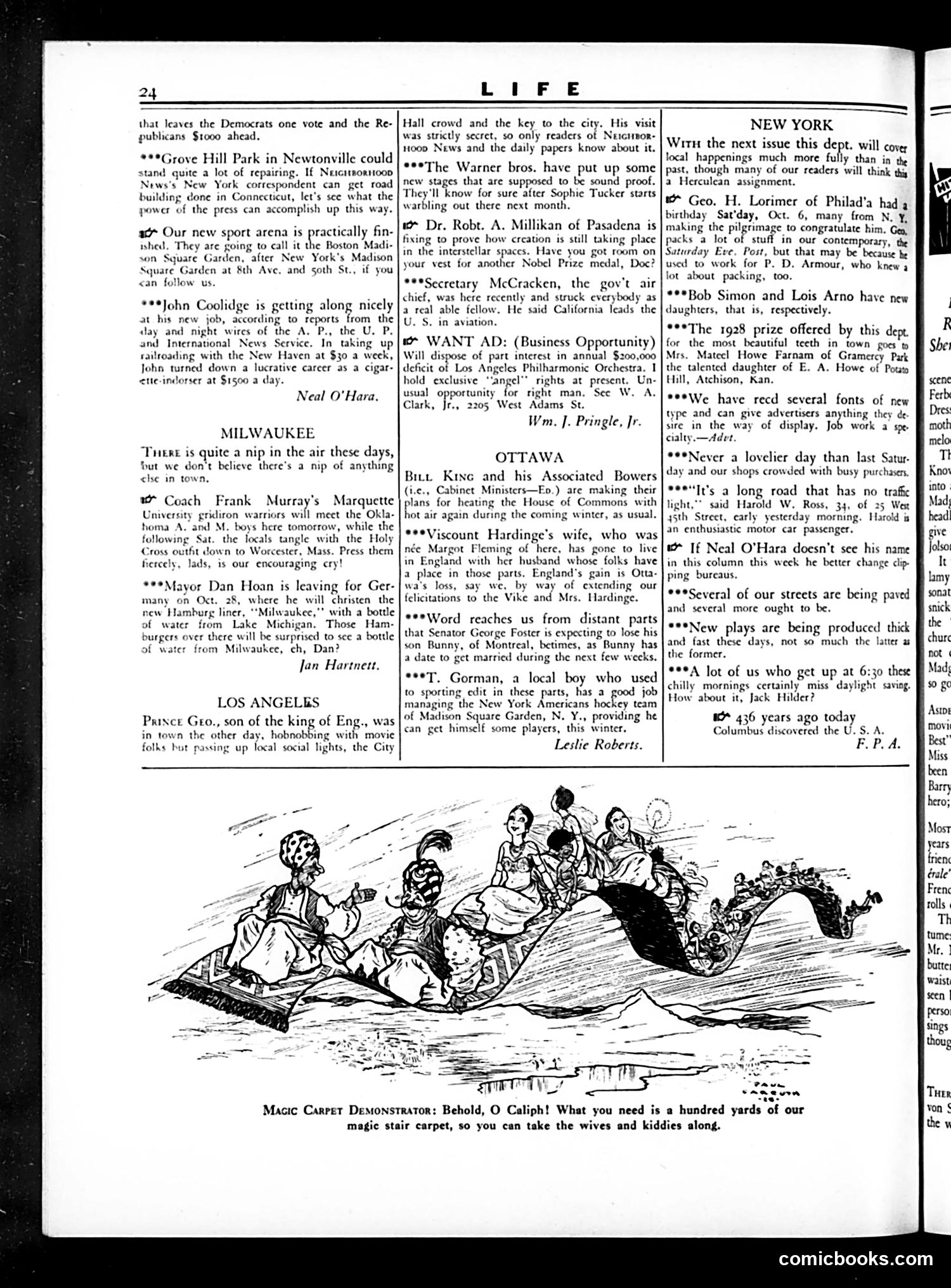
The cartoon depicts a genie-like figure demonstrating a flying "magic stair carpet" to an Eastern potentate (the "Caliph"). The demonstrator promises the carpet will allow him to transport "wives and kiddies" easily—a joke playing on Western stereotypes of Middle Eastern harems and polygamy. The satire mocks both orientalist fantasies (magical flying carpets as Arabian Nights tropes) and Western assumptions about non-Western family structures. The humor relies on the absurdist contrast: solving the practical problem of transporting multiple family members through a fantastical solution, treating the "magic carpet" as a real product demonstration rather than mythology. The caption's exaggerated sales-pitch tone ("Behold, O Caliph!") parodies both carnival barkers and the period's patronizing Western attitudes toward the Orient.
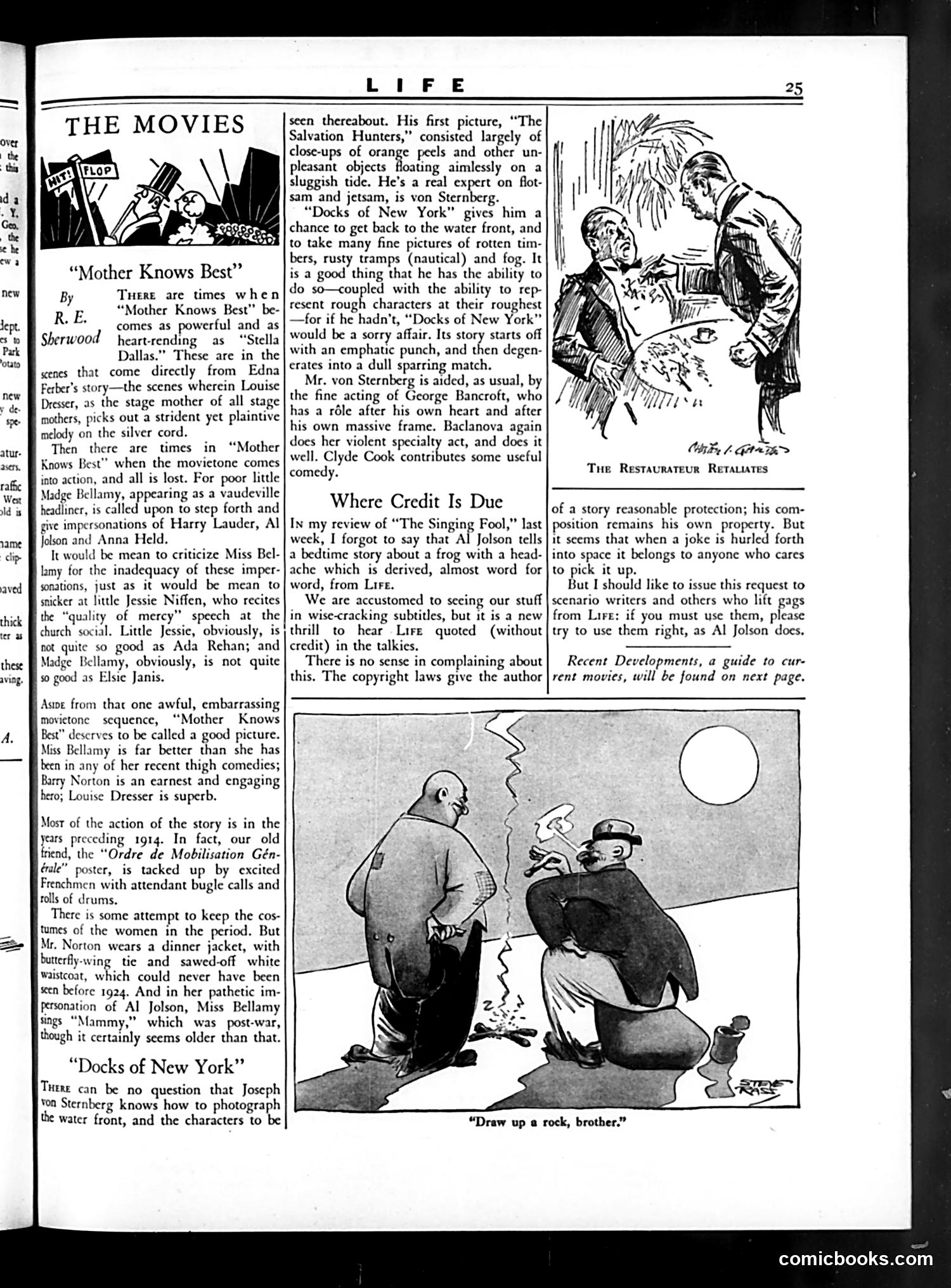
This is R.E. Sherwood's film review column from *Life* magazine. The page critiques three movies: **"Mother Knows Best"** — A drama about a stage mother (Louise Dresser), praised except for one embarrassing sequence where actress Madge Bellamy impersonates Harry Lauder, Al Jolson, and Anna Held. The critic notes period costume inconsistencies, including a dinner jacket style that wouldn't exist until 1924. **"Docks of New York"** — Director Joseph von Sternberg's film about waterfront characters, praised for cinematography but criticized for a weak plot that "degenerates into a dull sparring match." **"Where Credit Is Due"** — A complaint that Al Jolson's "The Singing Fool" used a joke directly from *Life* magazine without attribution, highlighting emerging copyright issues with sound films. The bottom cartoon, captioned "Draw up a rock, brother," appears to be an unrelated humorous illustration about two figures negotiating.
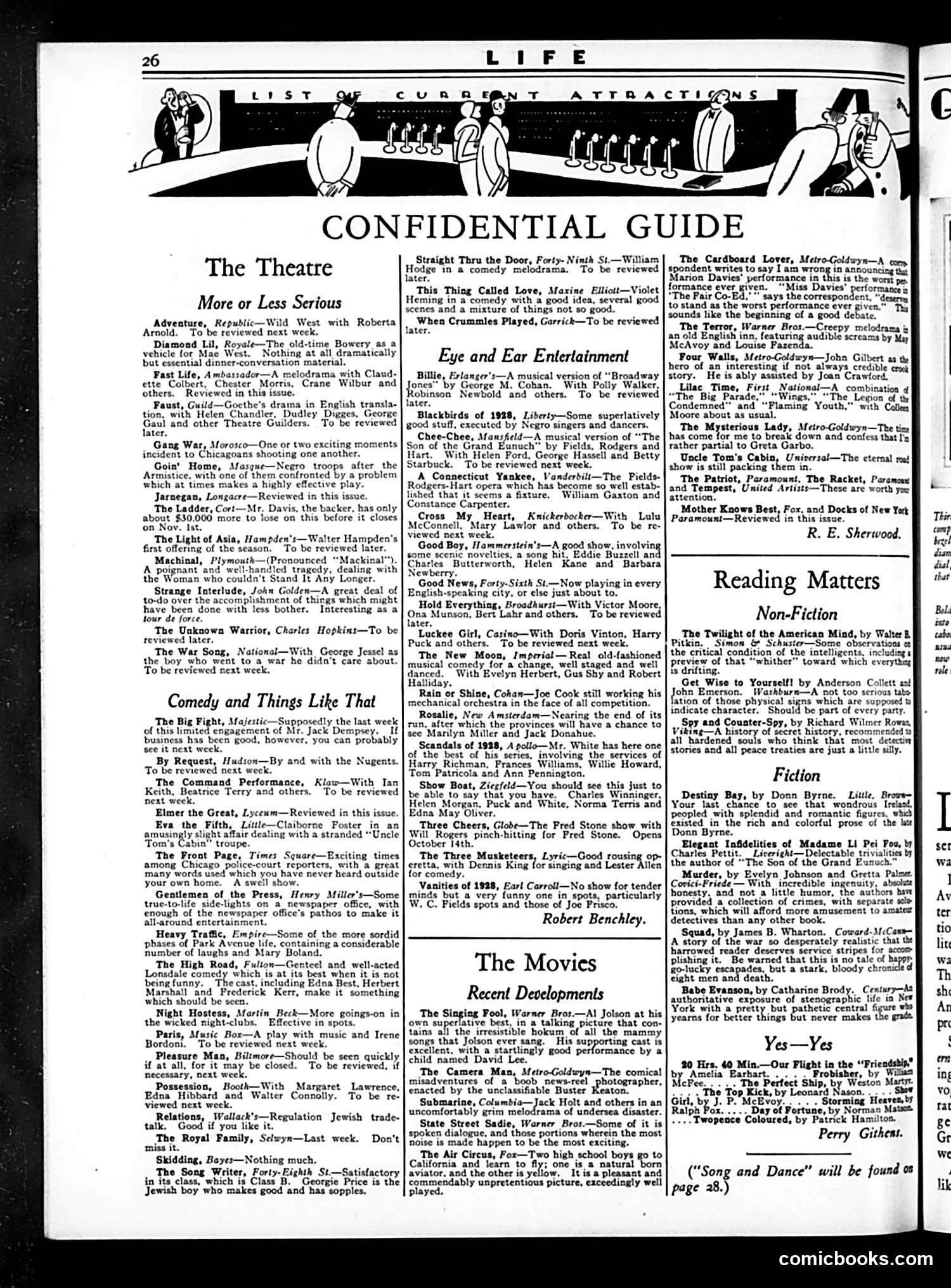
This page is primarily a **theatre listings and reviews section** rather than a political cartoon. It's a "Confidential Guide" to current Broadway productions, formatted as brief, often sarcastic capsule reviews. The satire here is **social and cultural commentary** rather than political. Life's critics employ dry wit to mock theatrical trends: Mae West's "Diamond Lil" is dismissed as having "nothing at all dramatically but essential dinner-conversation material"; "The Ladder" is mocked for its backer losing "$30,000 more" before closing; and "Strange Interlude" involves "a great deal of to-do over the accomplishment of things which might have been done with less bother." The reviews target **pretentious theatre and celebrity culture** of late 1920s Broadway. References to Jack Dempsey's boxing exhibition and various "wicked night-clubs" reflect contemporary entertainment trends. This represents Life's role as a **satirical arbiter of taste**, using humor to critique both theatrical mediocrity and audience gullibility.
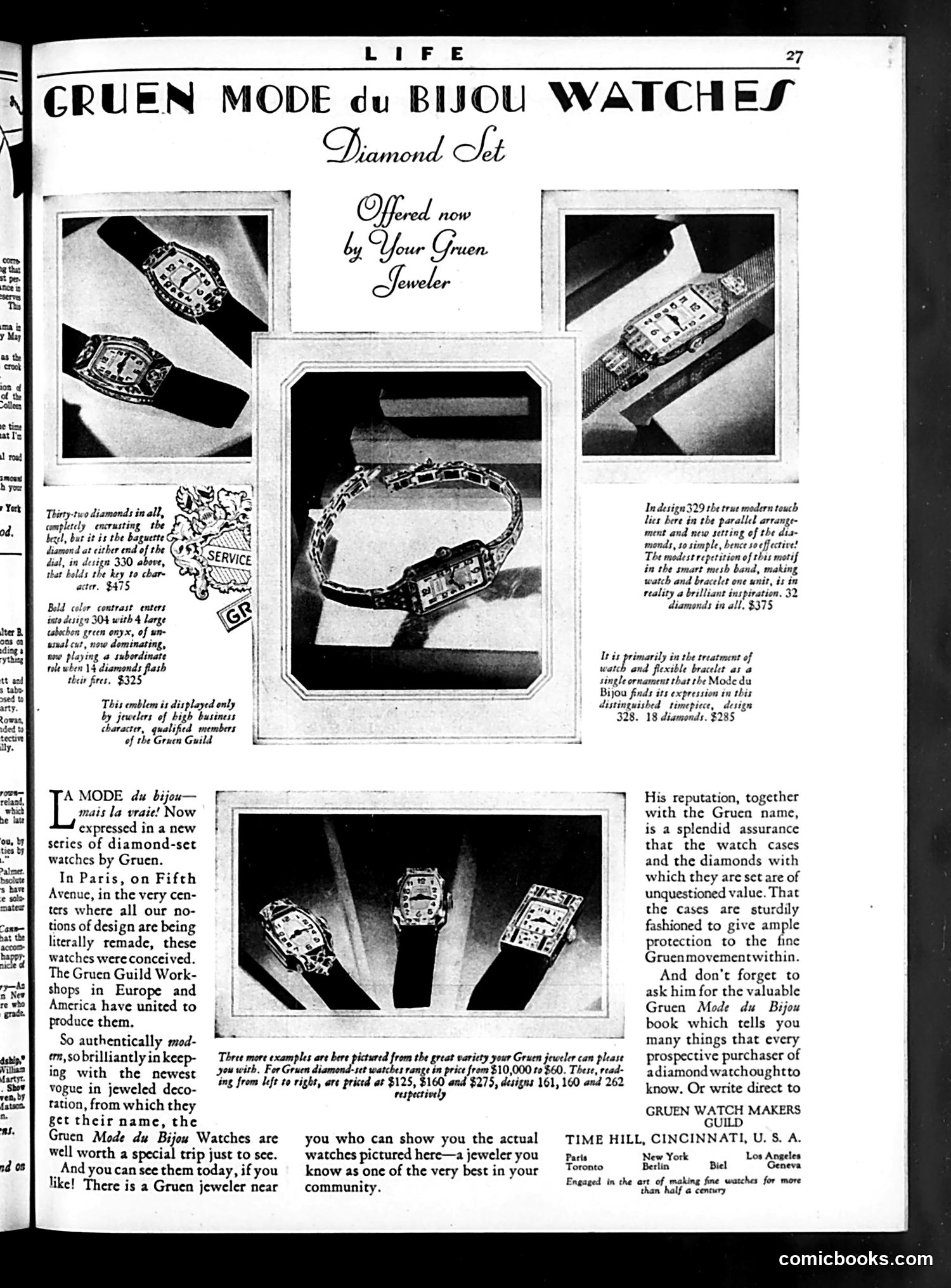
This page is not satire or political commentary. It's a straightforward advertisement for Gruen diamond-set watches, presented as a glamorous fashion spread in *Life* magazine. The content celebrates Art Deco design aesthetics ("Mode du Bijou" — "Bijou Mode," referencing Paris fashion centers and Fifth Avenue). Multiple watch designs are displayed with their prices ($125–$375) and diamond counts, positioned as haute couture accessories rather than mere timepieces. The Gruen Guild branding emphasizes exclusivity and "high business character," suggesting these watches signal wealth and refined taste. The accompanying text encourages readers to visit their local Gruen jeweler to view the actual products. This represents 1920s-30s luxury marketing: presenting expensive goods as artistic achievements and lifestyle aspirations for affluent readers.
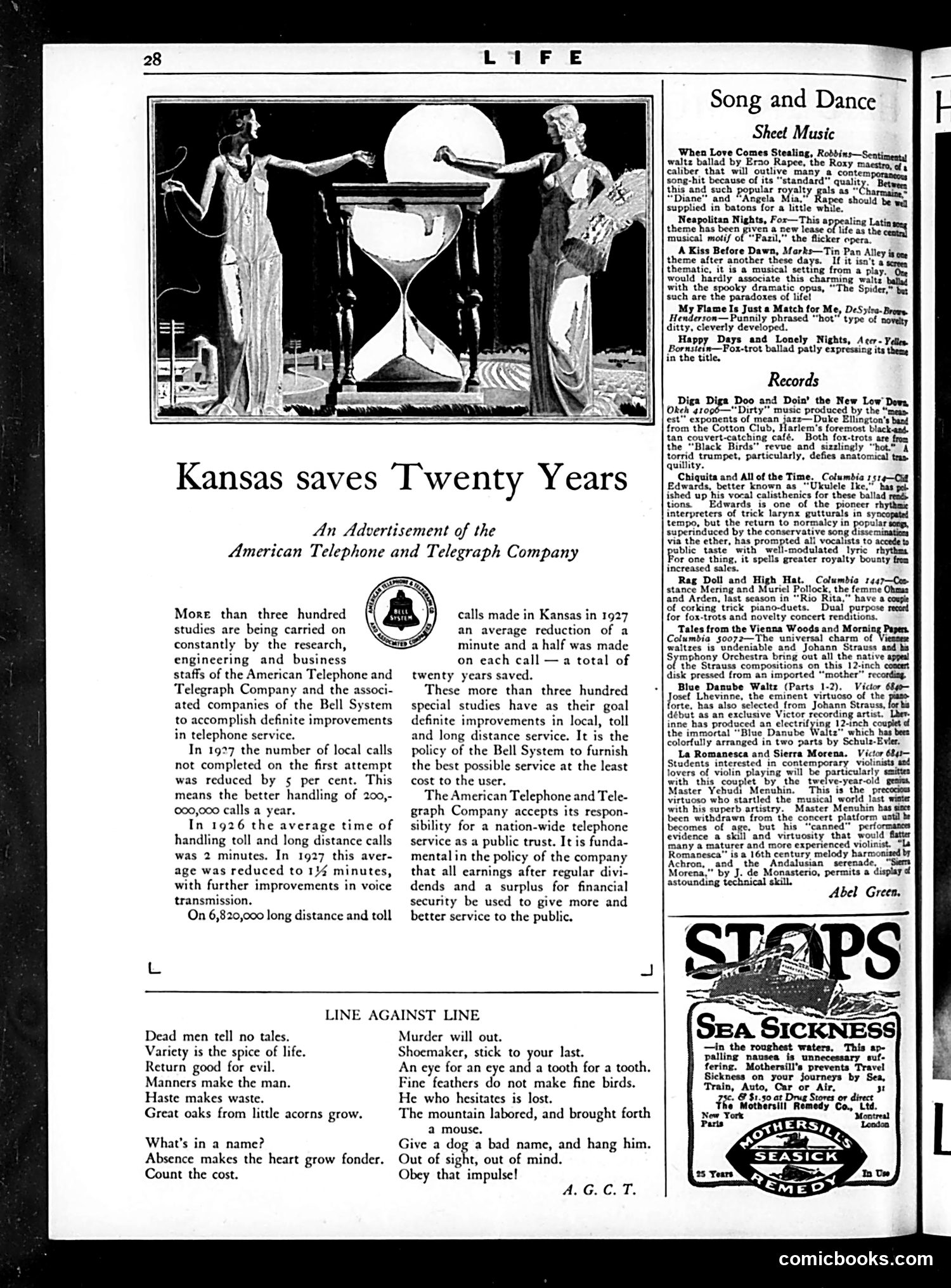
This page contains a major **corporate advertisement** for AT&T (American Telephone and Telegraph Company) disguised as editorial content, celebrating efficiency improvements in Kansas telephone service in 1927. The ad's central claim: on 6.82 million long-distance calls made in Kansas that year, average handling time dropped from 2.5 to 1 minute—totaling "twenty years saved" statewide. The large illustration depicts two classical female figures flanking an hourglass, symbolizing time itself being compressed or controlled by technological progress. Below the advertisement is "Line Against Line," a collection of contradictory proverbs (by A.G.C.T., likely the ad's author), humorously juxtaposing opposite sayings to suggest corporate doublespeak or the paradoxes of modern corporate rhetoric. The right column covers entertainment: sheet music reviews and phonograph records, including Duke Ellington's band and "Ukulele Ike" Edwards. The bottom advertises proprietary remedies (Stopes for seasickness), typical of 1920s patent medicine marketing.
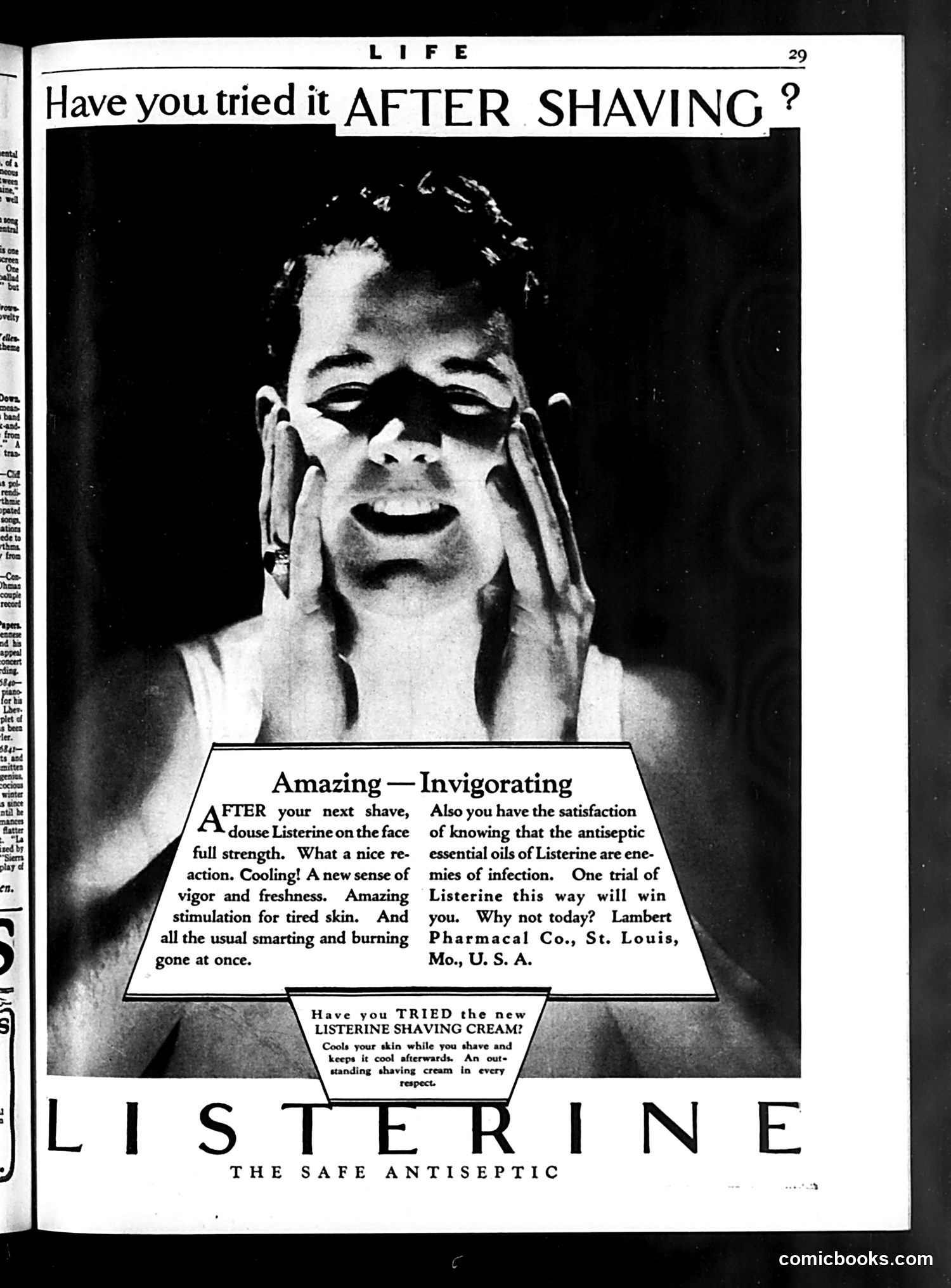
This is a **Listerine advertisement**, not a political cartoon or satire. The page shows a man applying Listerine mouthwash to his face after shaving, with an enthusiastic expression. The ad promotes an unconventional use of the product: applying the antiseptic mouthwash directly to freshly shaved skin. The copy emphasizes the "cooling" sensation, removal of "smarting and burning," and infection-prevention benefits of Listerine's "antiseptic essential oils." There is also a secondary advertisement for Listerine Shaving Cream below. By modern standards, applying mouthwash to facial skin seems odd and potentially irritating, but this reflects early 20th-century marketing that positioned Listerine as a multipurpose antiseptic remedy. This is straightforward product promotion rather than satire or commentary.
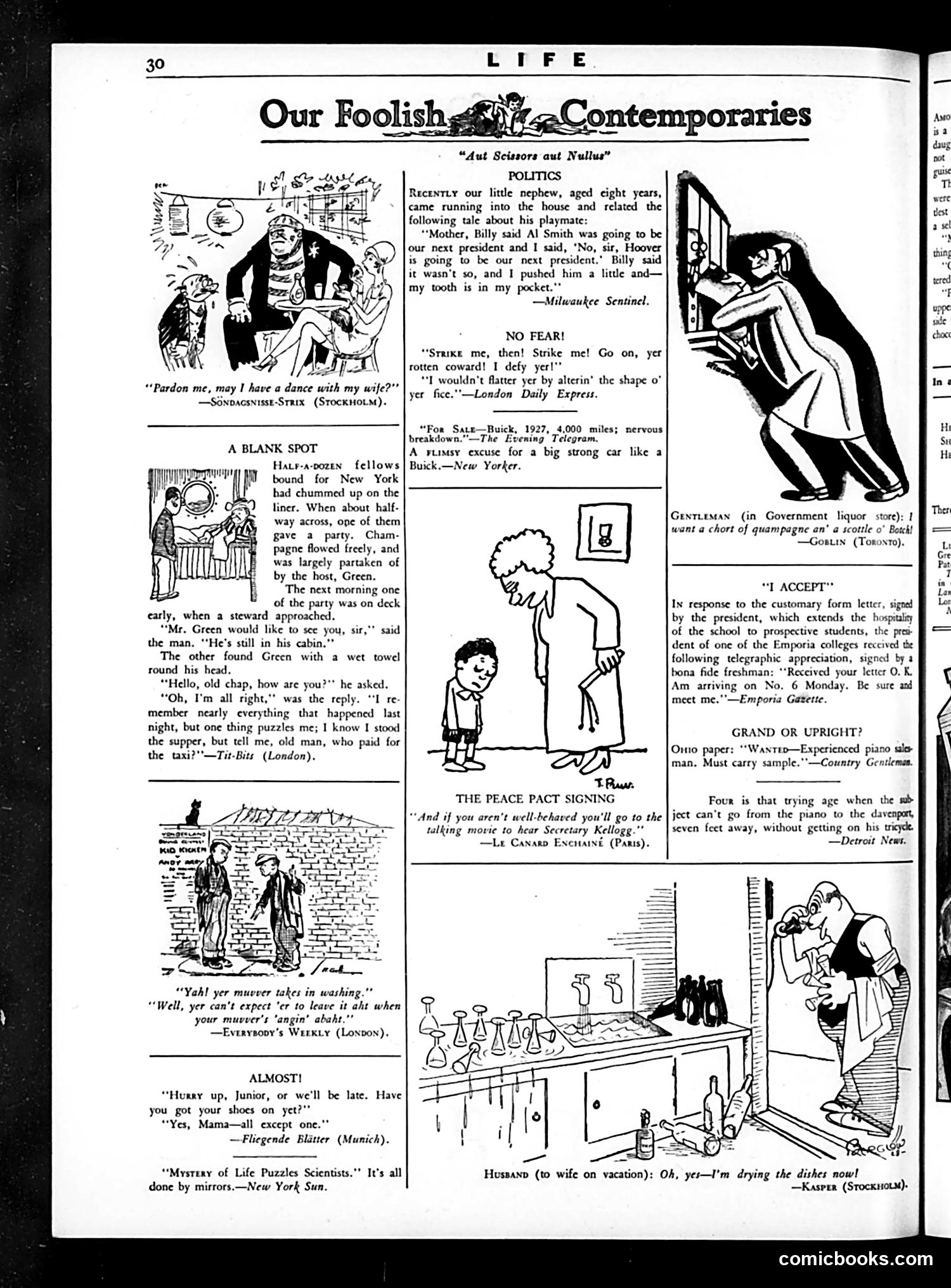
This is a humor anthology page from Life magazine featuring satirical jokes and cartoons from international sources (credited to papers in Stockholm, London, Munich, Paris, Toronto, etc.). The content includes: **Political humor**: A child's anecdote about arguing whether Al Smith or Herbert Hoover will be the next president—referencing the 1928 U.S. presidential election between these two candidates. **Social/domestic comedy**: Jokes about hangovers, children's behavior, marital dynamics, and 1920s consumer culture (like a nervous-breakdown Buick automobile). **International satire**: References to Secretary of State Kellogg's Peace Pact (likely the 1928 Kellogg-Briand Pact outlawing war), Government liquor stores (Prohibition-era context), and gender roles. The cartoons mock contemporary absurdities: a man asking his wife to dance, a wife trusting her vacationing husband with dishes, and a couple arguing about piano placement. The overall tone is light, observational humor about everyday middle-class life and politics.
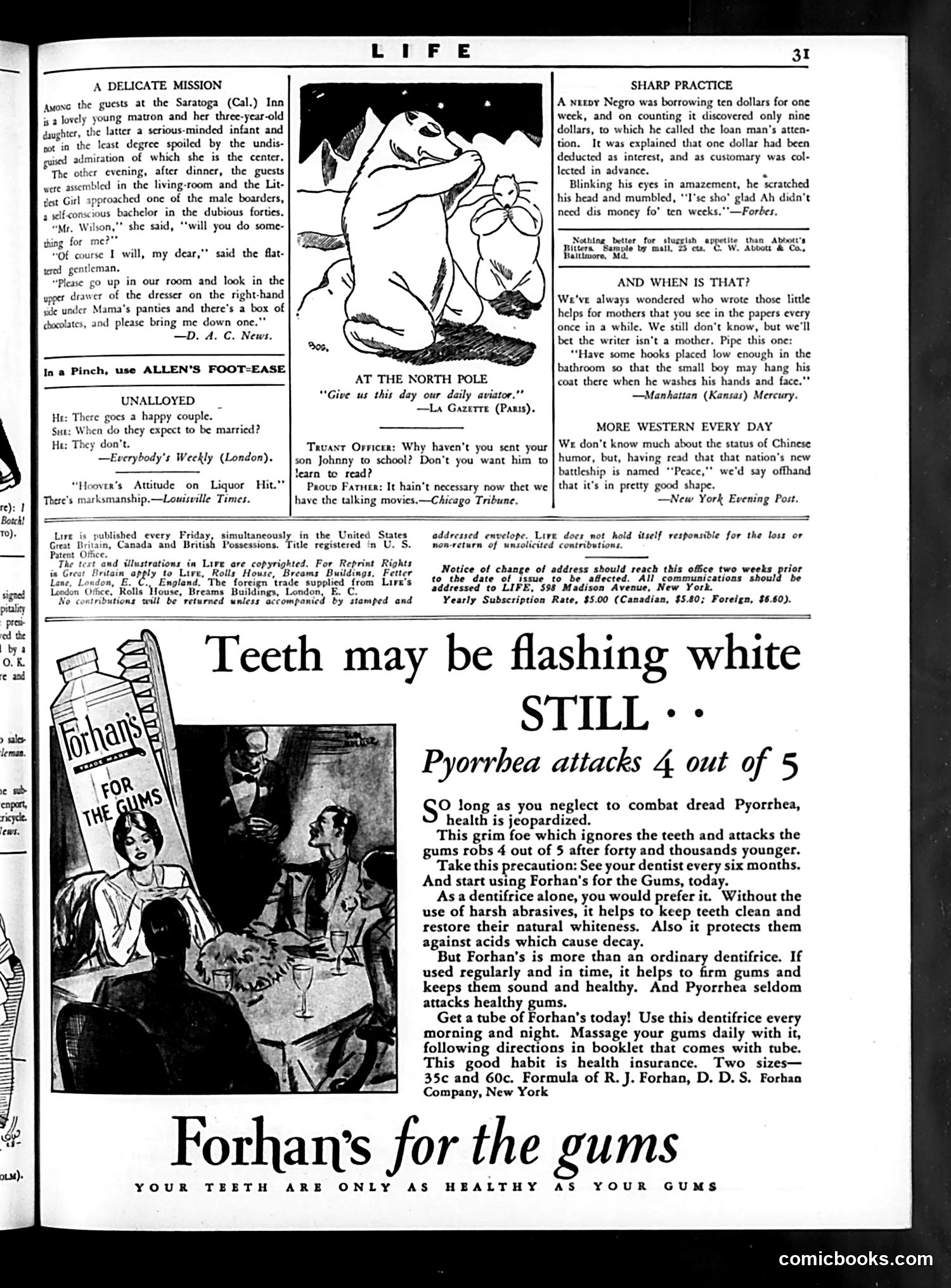
This page contains several brief humorous anecdotes typical of *Life* magazine's satirical format, plus a substantial advertisement for Forhan's toothpaste. The cartoons/jokes include: - A "delicate mission" where a young girl asks a bachelor to retrieve chocolates from her mother's underwear drawer—humor derives from the bachelor's embarrassment and the child's innocent obliviousness - A "Sharp Practice" item mocking predatory lending to Black borrowers, using racist dialect - A "Truant Officer" joke about talking movies making education unnecessary - References to Hoover's liquor policy and a Chinese battleship named "Peace" The page is dominated by a **Forhan's toothpaste advertisement** warning that pyorrhea (gum disease) affects "4 out of 5" people over forty. The ad emphasizes that despite white teeth, gums need protection—positioning Forhan's as essential preventative care. The humor reflects early-20th-century sensibilities: innocent double entendre, casual racial stereotyping, and topical references to Prohibition and modern technology.
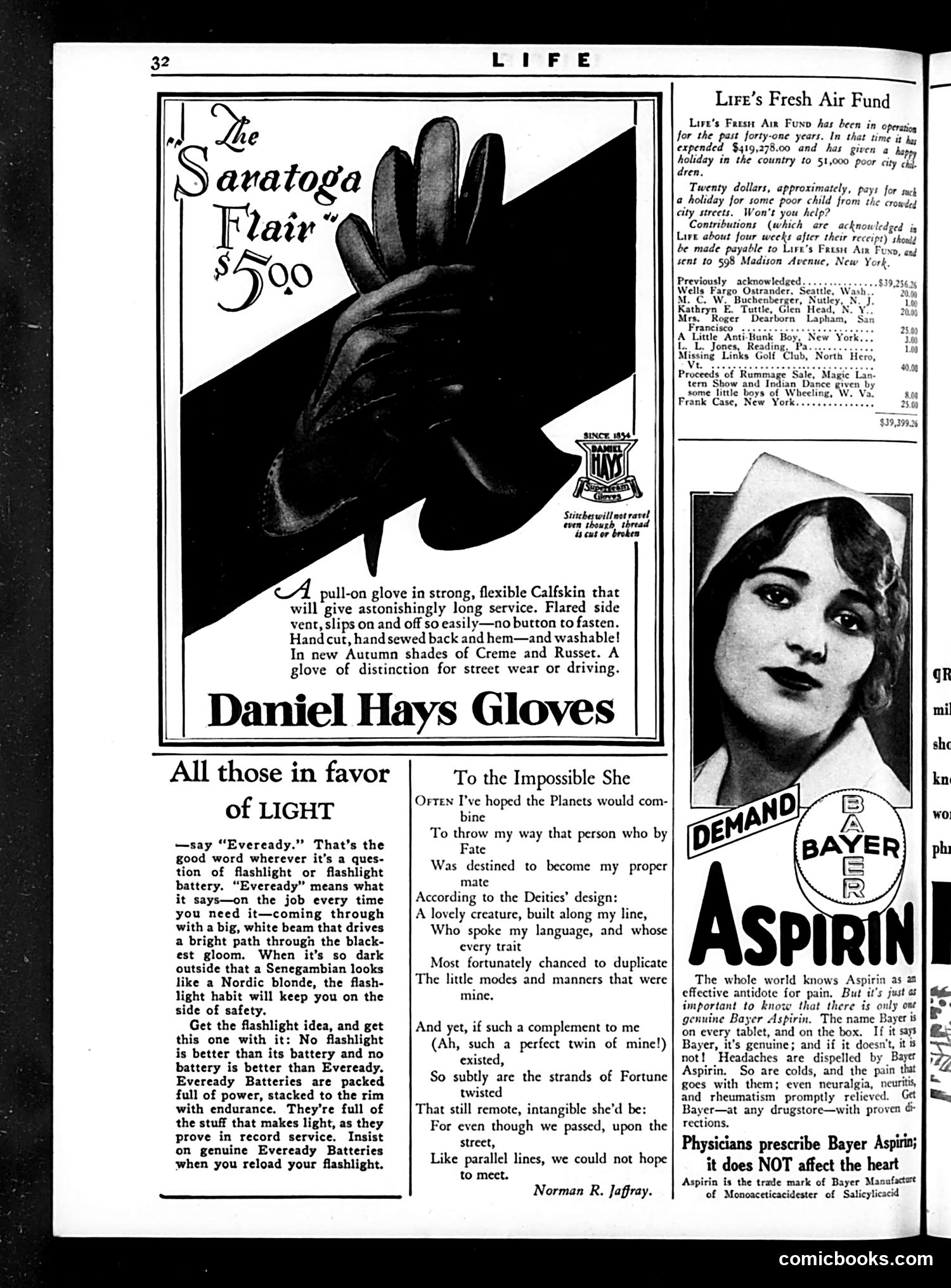
This page is primarily **advertisements and charitable notices** rather than political satire. **Content:** The main advertisements are for **Daniel Hays Gloves** ($5.00, featuring Calfskin pull-on styles) and **Eveready Batteries** (flashlights). There's also a **Bayer Aspirin** ad emphasizing it's the genuine product. **Non-commercial content:** A poem titled "To the Impossible She" by Norman R. Jaffray uses the metaphor of "parallel lines" that "could not hope to meet" to express romantic longing for an ideal soulmate destined by fate but forever out of reach—a melancholic meditation on romantic impossibility rather than satire. The **Life's Fresh Air Fund notice** describes a 41-year-old charitable initiative providing country holidays for poor urban children, soliciting donations at $20 per child. **Bottom line:** This is a standard magazine page mixing advertisements with a sentimental poem and charity notices—there is no discernible political cartoon or satire present.
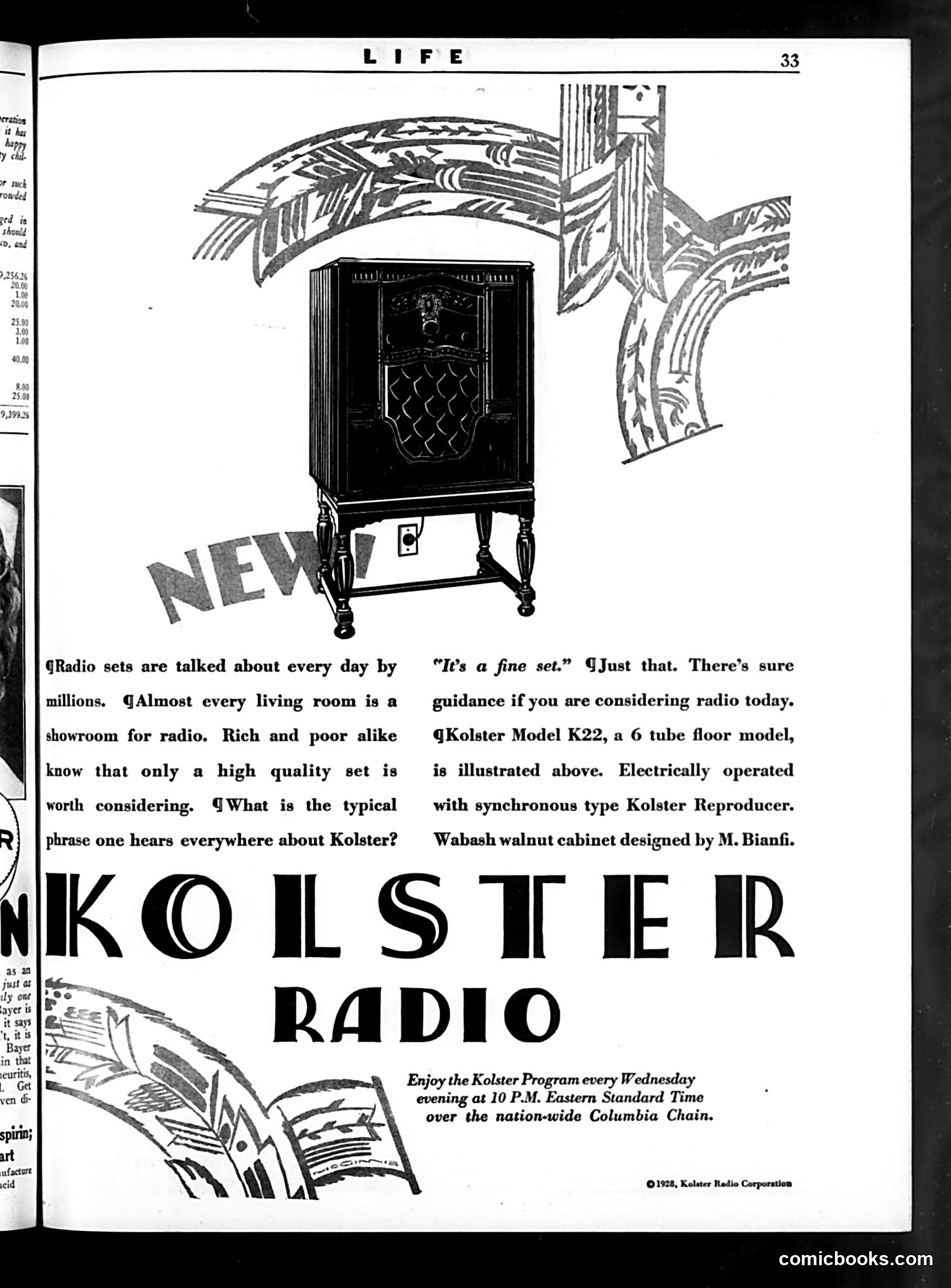
This is a **radio advertisement**, not political satire. It appears from Life magazine circa 1928 (per the copyright notice). The page promotes **Kolster Radio**, a floor-model receiver featuring a 6-tube design in a walnut cabinet. The decorative art deco illustrations above and below the radio are purely ornamental—no political figures or satirical cartoons are present. The advertisement uses typical 1920s marketing language, emphasizing that radio sets are now commonplace household items ("almost every living room is a showroom") and that only high-quality sets warrant purchase. It notes the typical endorsement phrase: "It's a fine set." The Kolster brand apparently sponsored a weekly radio program broadcast Wednesdays at 10 P.M. on the Columbia Chain network. This represents straightforward commercial advertising rather than the satirical content Life magazine was known for elsewhere.
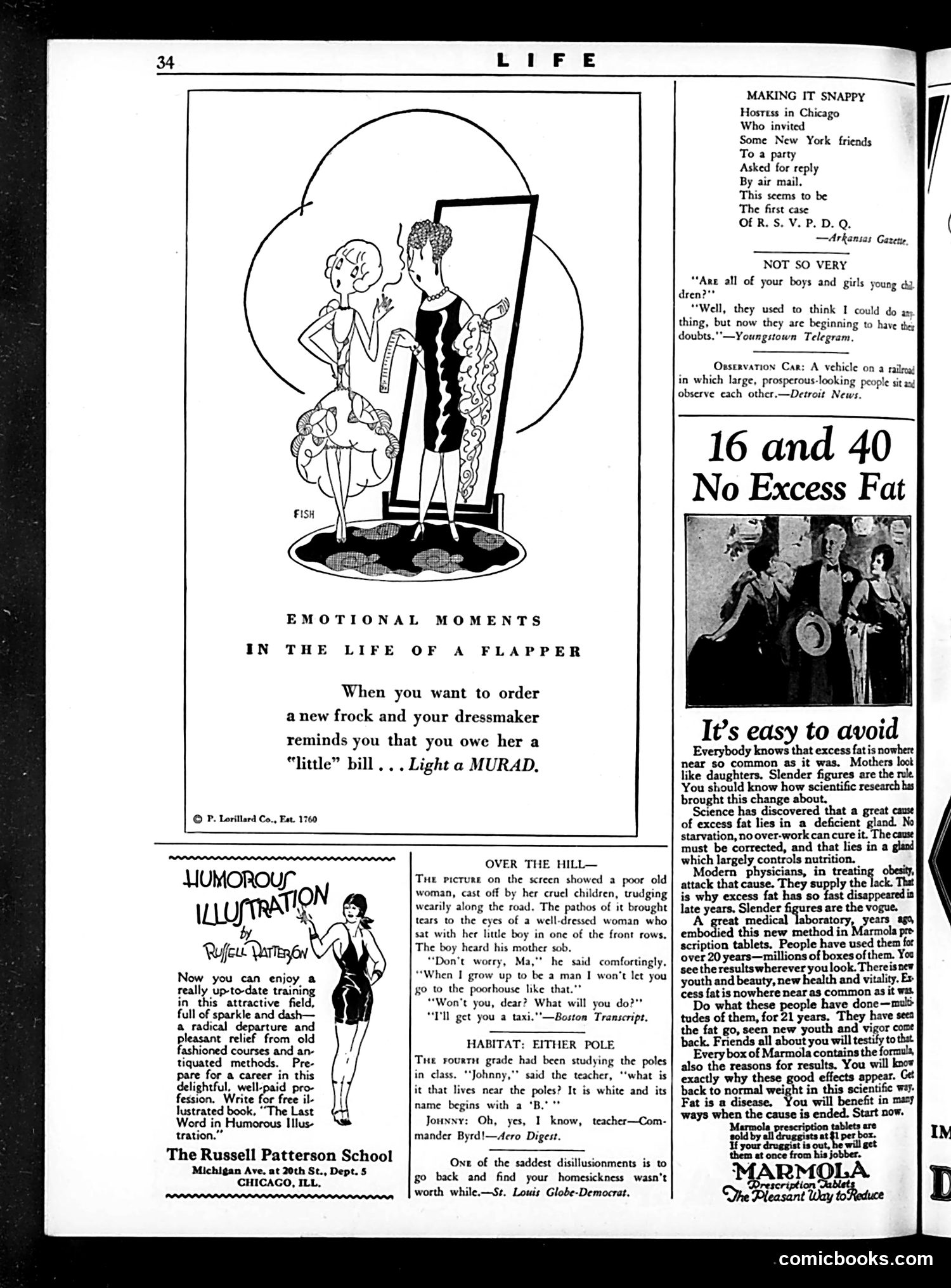
This page contains several humor pieces and advertisements typical of 1920s Life magazine: **Main Cartoon ("Emotional Moments in the Life of a Flapper"):** Depicts a young woman admiring herself in a mirror while considering purchasing a new dress, though she owes her dressmaker money. The joke plays on the "flapper" lifestyle—young women of the Jazz Age known for fashion-consciousness and spending habits. The solution offered is a Murad cigarette advertisement, humorously suggesting smoking as stress relief from financial worry. **Short Jokes:** Include observational humor about modern manners (rapid RSVP requests via airmail), parental authority eroding, and trains as "observation cars" for socializing. **Advertisements:** The page heavily features Marmola weight-loss tablets and the Russell Patterson School of illustration, reflecting 1920s preoccupations with slenderness and vocational training. The Marmola ad emphasizes that "excess fat" has become unfashionable and claims scientific glandular solutions. **Overall Context:** The page reflects 1920s values: consumerism, modern technology, changing gender roles, and beauty standards emphasizing thinness.
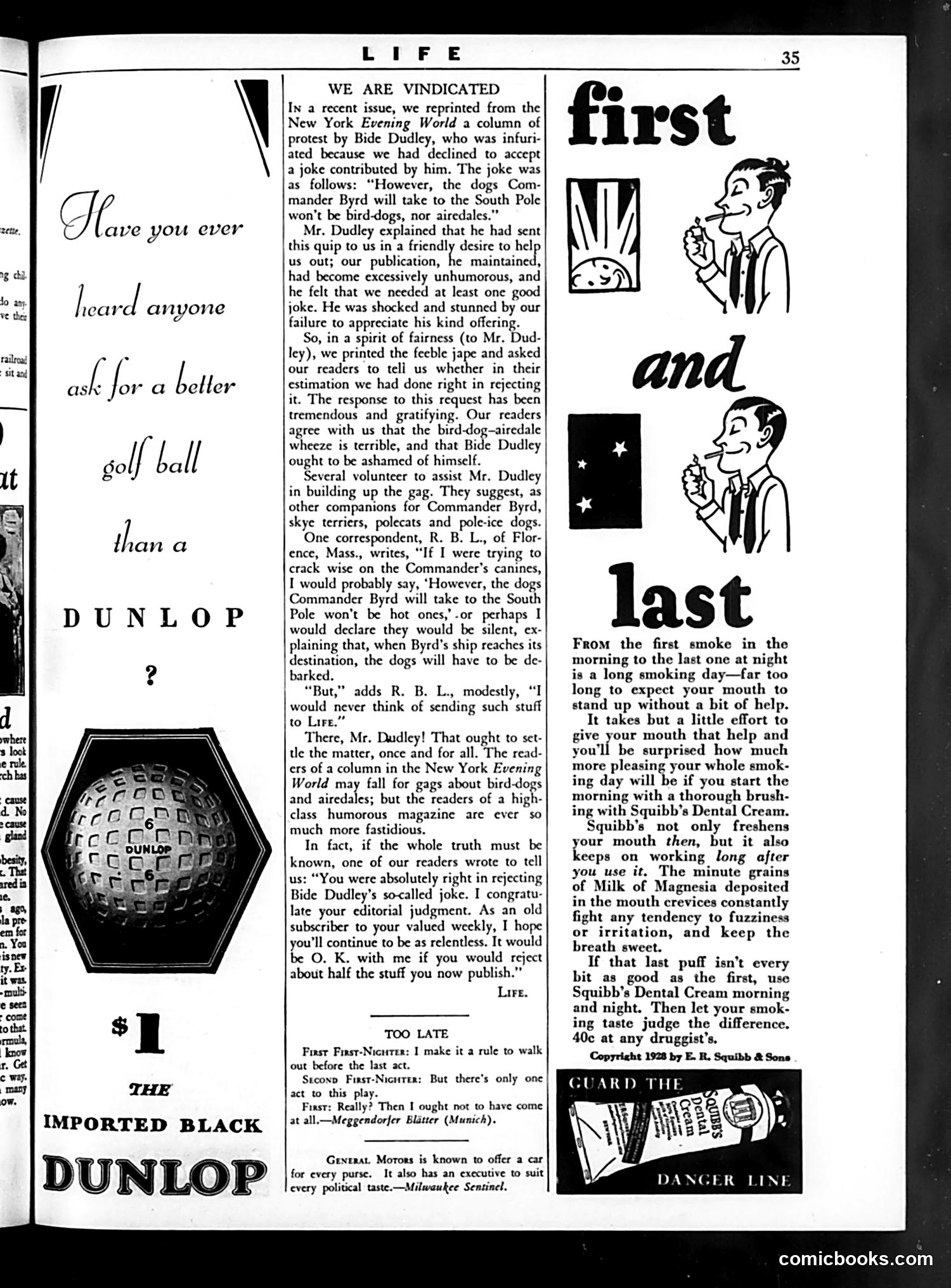
This page satirizes **Bide Dudley**, a contributor who complained to the *New York Evening World* that *Life* magazine rejected his joke about Commander Byrd's South Pole expedition dogs (a pun: "won't be bird-dogs, nor airedales"). **The satire:** *Life* printed Dudley's complaint, then asked readers to judge whether they'd made the right call rejecting it. The response vindicated the magazine—readers agreed the joke was terrible. *Life* mockingly publishes reader suggestions for even worse versions, including one that the joke should have been rejected *outright* without publishing it at all. **The point:** This is *Life's* way of publicly humiliating Dudley for his presumption and poor humor. It's an inside-baseball satire about editorial judgment and magazine standards—mocking both an unfunny contributor and, implicitly, lowbrow humor publications that accept such material. The page also contains unrelated advertisements (Dunlop golf balls, Squibb's Dental Cream) and theater jokes typical of *Life's* format.
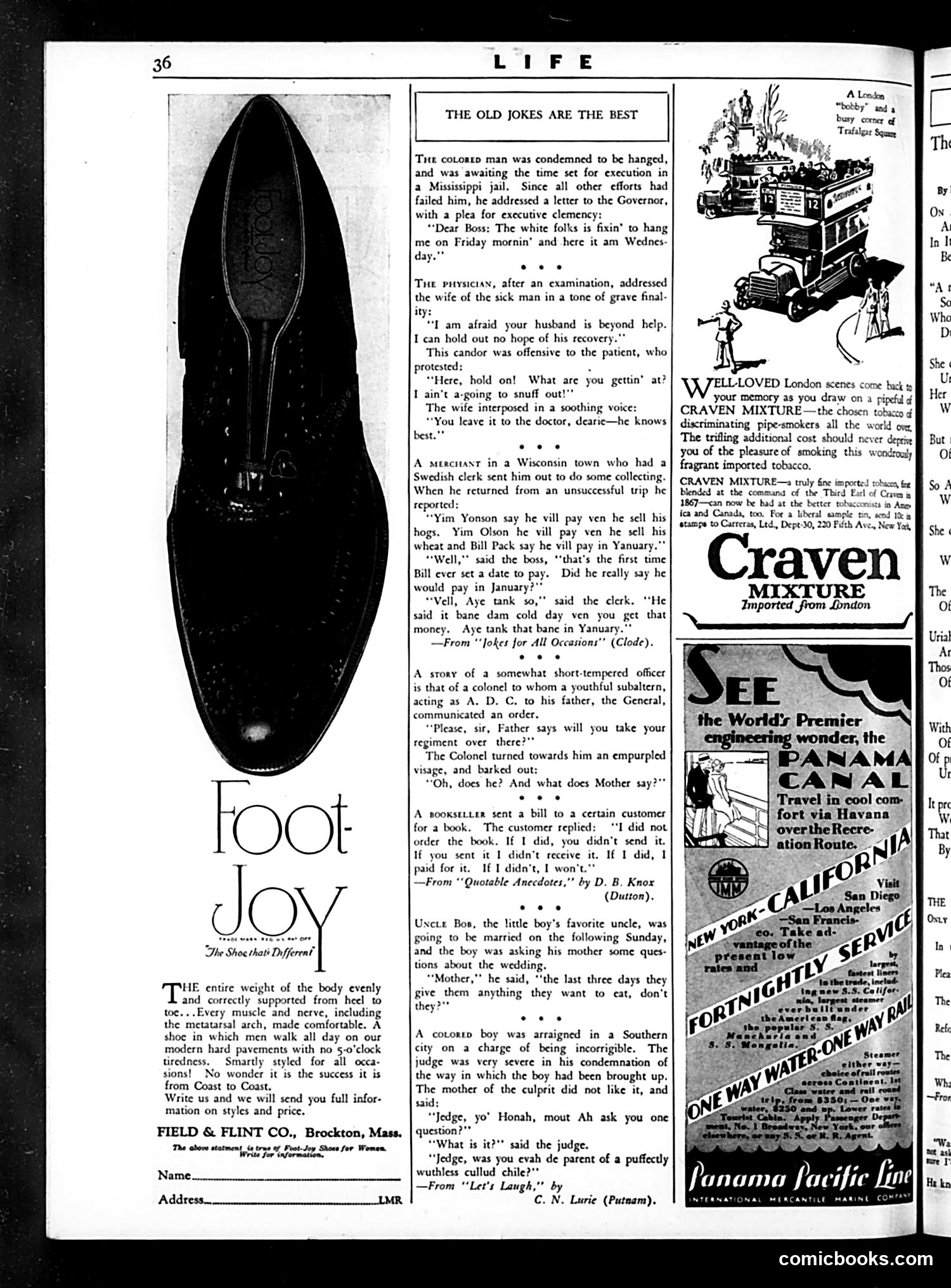
This page presents a collection of brief humorous anecdotes typical of early 20th-century American humor magazines. The jokes rely heavily on racial and ethnic stereotypes common to the era. The humor includes: 1. **A Black man awaiting execution** — the joke's "point" is his malapropism about timing 2. **A Swedish immigrant clerk** — humor based on heavily accented English ("Yim Yonson," "Aye tank") 3. **A military officer** — humor from his blunt rudeness 4. **A child's innocent question** about wedding feasts 5. **A Black woman confronting a judge** — humor derives from dialect speech and her defensive mother role The left sidebar features a "Foot-Joy" shoe advertisement emphasizing comfort and style, while the right contains ads for Craven Mixture tobacco, Panama Canal travel, and shipping services—typical period advertising. **For modern readers:** These jokes exemplify how mainstream publications openly published material based on racial and ethnic mockery as entertainment, reflecting deeply embedded prejudices of that era.
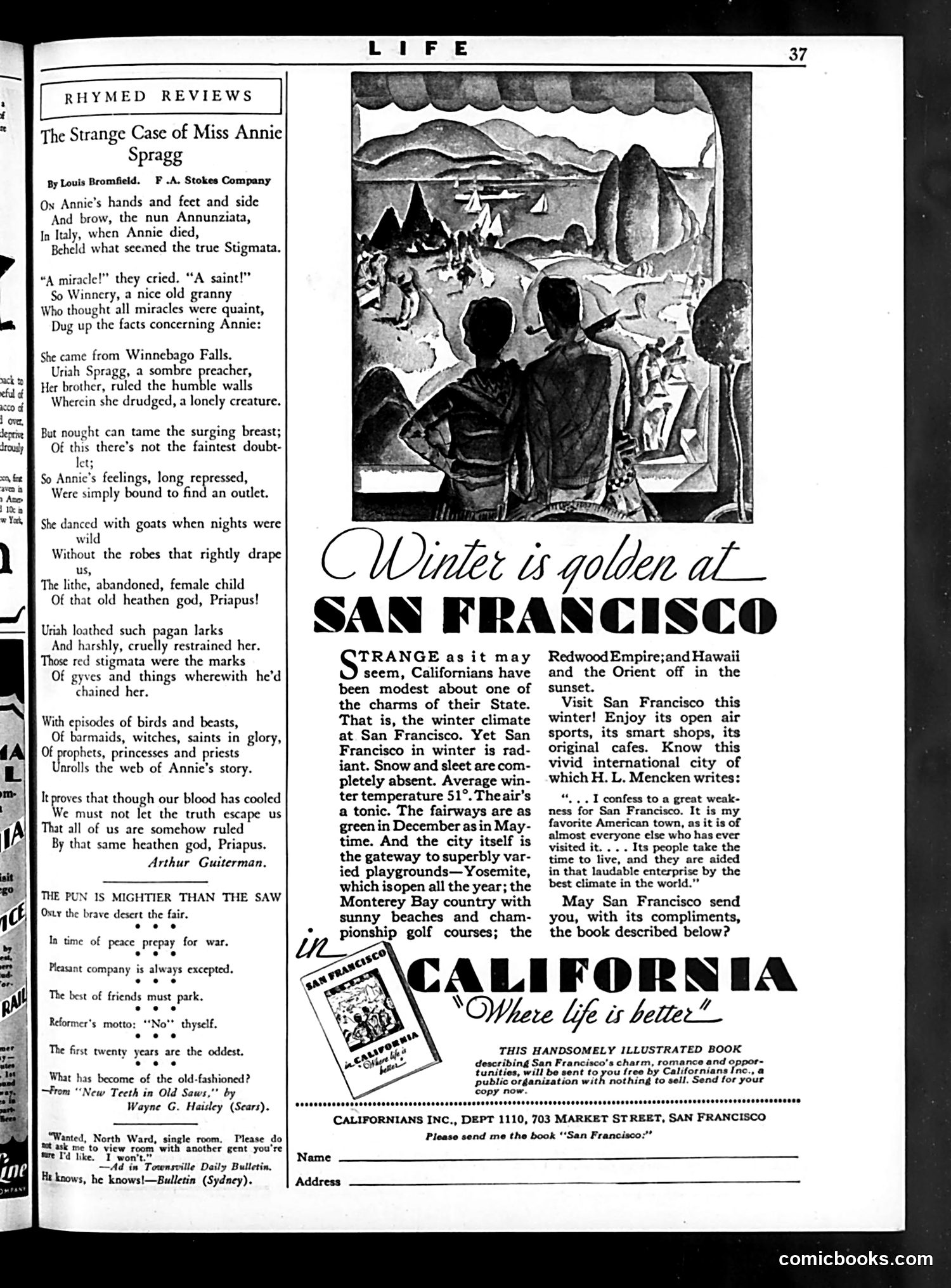
This page contains a book review in verse form by Arthur Guiterman of Louis Bromfield's novel about Annie Spragg. The poem recounts a satirical narrative: Annie, a repressed woman from rural Winnebago Falls whose strict preacher brother Uriah confines her, develops stigmata (religious wounds) that Italian nuns interpret as saintly miracles. However, an old woman named Winnery investigates and discovers the "stigmata" are actually marks from chains—evidence of Uriah's cruel abuse restraining her forbidden desires. Guiterman's satirical point, stated in the final lines, is that despite civilized pretenses, all humans remain driven by primal urges (represented by the pagan god Priapus). The poem mocks both religious fanaticism and repressive morality. The page's lower half features a San Francisco tourism advertisement, unrelated to the review.
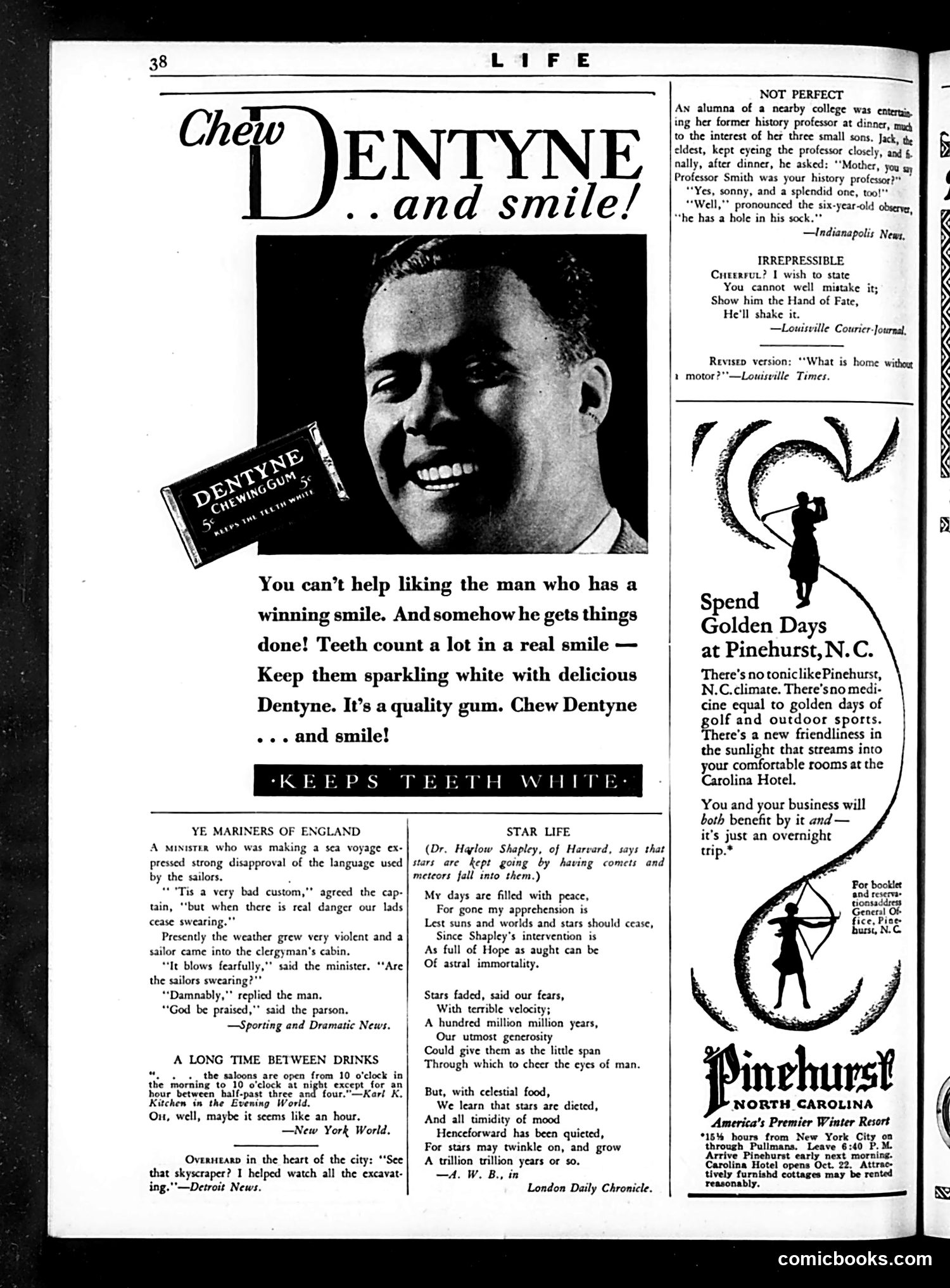
This page combines **advertising, humor columns, and light verse** typical of Life magazine's format. The main advertisement promotes **Dentyne chewing gum**, featuring a smiling man's photograph with the slogan "and smile!" The copy argues that teeth and a winning smile help people succeed socially and professionally—a straightforward pitch linking oral hygiene to personal charm. The remaining content consists of brief **humorous anecdotes and poems**: - "Ye Mariners of England" is a joke about a minister who disapproves of sailors' swearing until rough seas force them to curse—then he approves, assuming divine intervention. - "A Long Time Between Drinks" plays on Prohibition-era bar hours (10 AM–10 PM with a one-hour break), joking that the gap feels longer than an hour. - "Star Life" responds to astronomer Harlow Shapley's theory about cosmic dust sustaining stars, relieving fears of stellar extinction. The right sidebar advertises **Pinehurst, North Carolina** as a winter resort for golf and business retreats. These are light, whimsical pieces for general entertainment—no political satire is evident.
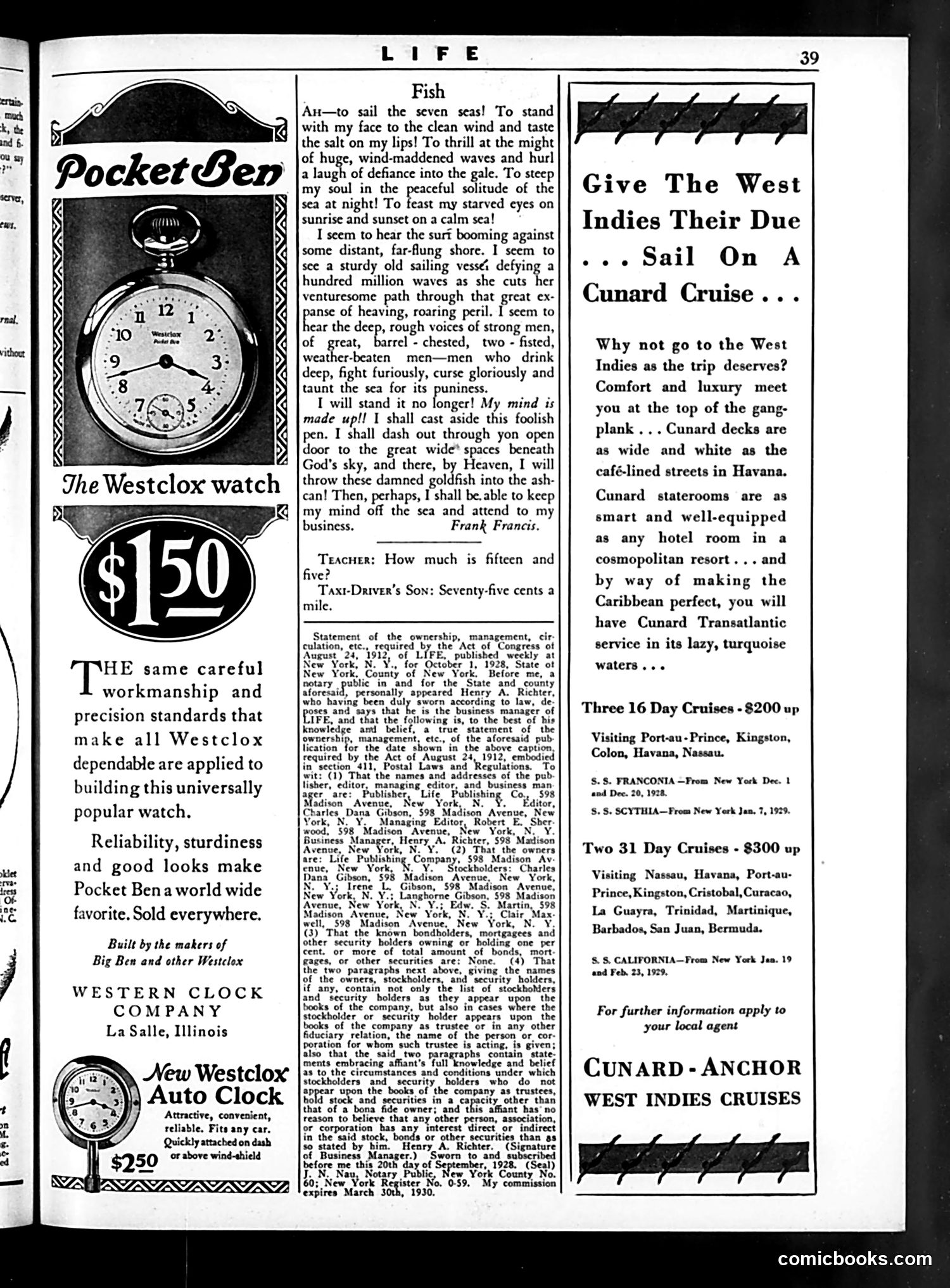
This page is primarily **advertising and legal notices**, not satirical content. The left side features two **Westclox watch advertisements** (the "Pocket Ben" watch at $150 and an auto clock at $250), emphasizing reliability and precision. The center contains a humorous short piece titled **"Fish"** by Frank Francis. It's a comic monologue where a daydreaming office worker fantasizes about romantic seafaring adventure—hearing waves, seeing weathered sailors, smelling salt air—only to conclude he'll abandon these fantasies and finally clean his goldfish bowl so he can focus on actual work. The humor lies in the contrast between grand romantic ideals and mundane domestic reality. Below that is a joke: a teacher asks "How much is fifteen and five?" A taxi driver's son answers "Seventy-five cents a mile"—satirizing how taxi drivers calculate fares by distance rather than basic arithmetic. The right side advertises **Cunard cruise lines** to the West Indies. The bottom is the magazine's required **ownership statement** (legal boilerplate mandated by Congress).
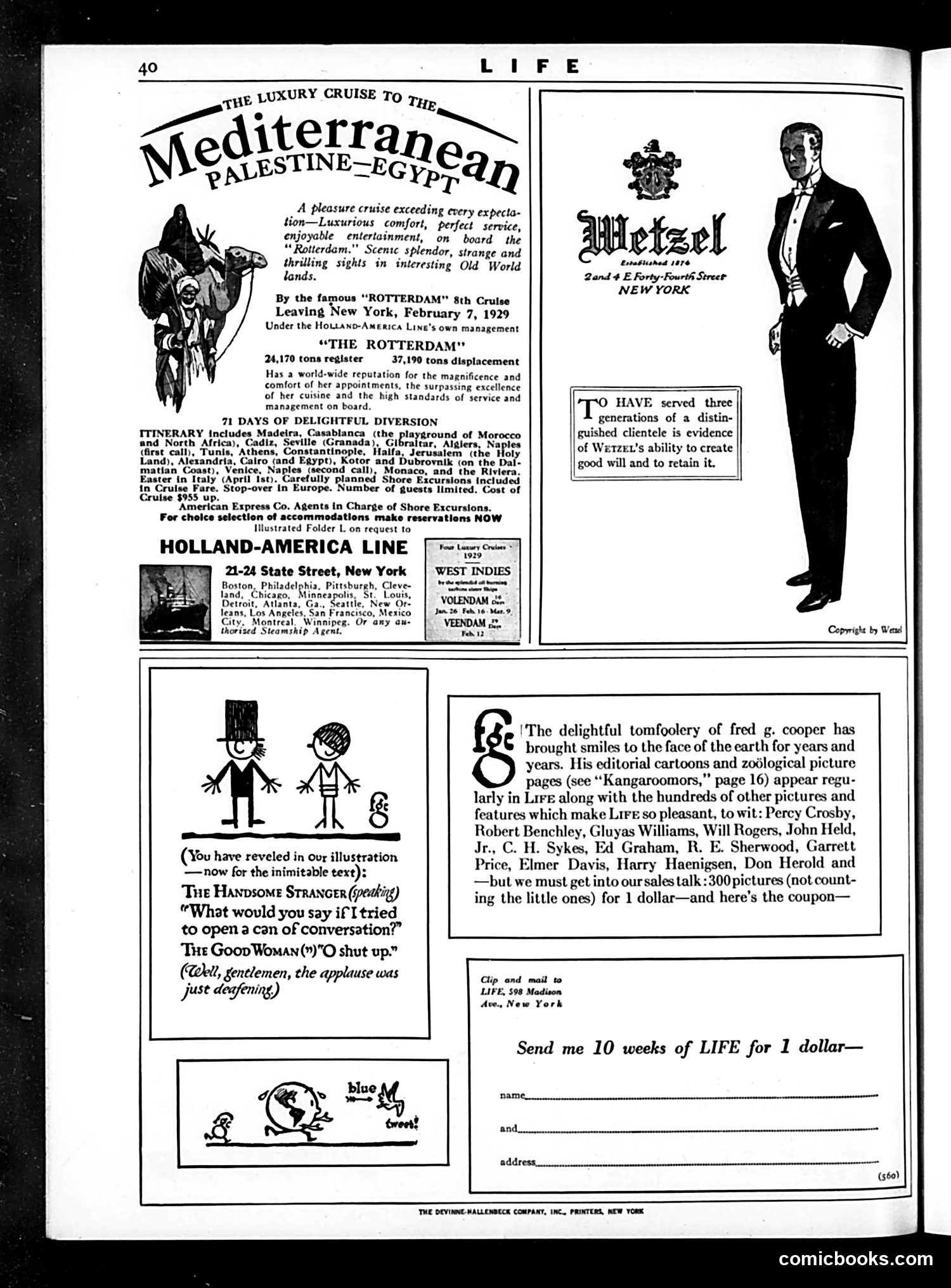
This page is primarily **advertising and promotional material** for *Life* magazine, dated 1929. The main cartoon appears in the lower left: titled "The Handsome Stranger," it depicts a simple stick-figure man attempting to flirt with a woman by asking "What would you say if I tried to open a can of conversation?" Her response—"O shut up"—delivers the joke: the woman's blunt rejection of his attempted seduction. The satire targets earnest or corny pickup lines and male presumption. The page also advertises a luxury Mediterranean cruise on the *Rotterdam* ship and promotes *Life*'s contributors (Fred G. Cooper, Percy Crosby, Will Rogers, et al.), emphasizing the magazine's humorous content. A subscription coupon offers 10 weeks for one dollar. The Wetzel's restaurant advertisement on the right is straightforward branding. Overall, the page mixes light social satire about romantic interaction with commercial promotion typical of 1920s magazines.
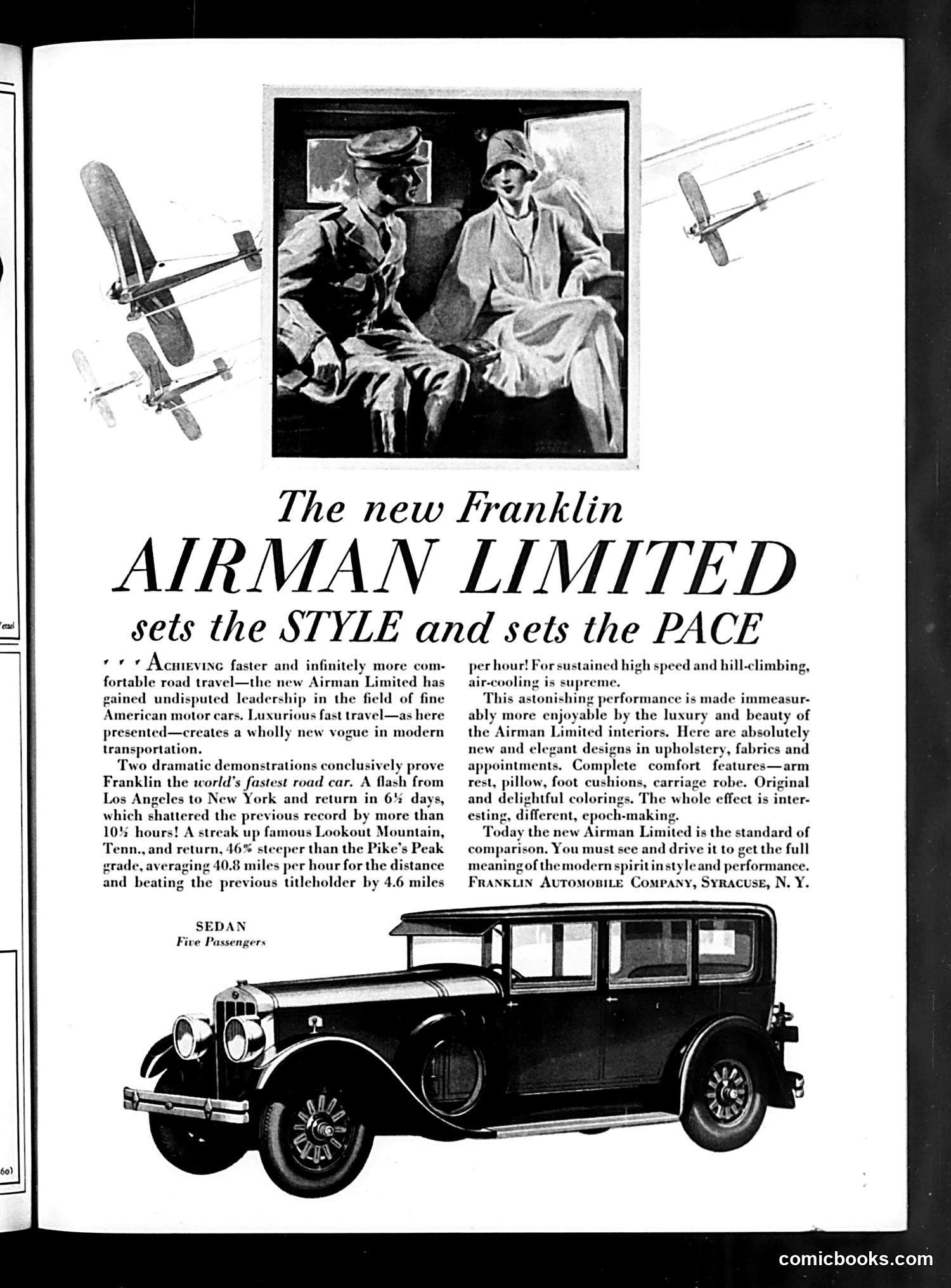
This is a **Franklin automobile advertisement**, not political satire. The page promotes the new Franklin Airman Limited sedan by claiming it "sets the STYLE and sets the PACE" in American motoring. The ad emphasizes performance records: a Los Angeles-to-New York round trip in 6½ days and a Lookout Mountain climb faster than competitors. It highlights the car's air-cooling system for sustained speed and hill-climbing ability. The top image shows two well-dressed passengers (likely representing affluent buyers) aboard the vehicle, with small aircraft illustrations flanking the scene—a visual metaphor suggesting the car's speed rivals aviation. The ad targets luxury car buyers by emphasizing both performance and comfort: elegant interiors, upholstery, pillows, foot cushions, and "epoch-making" colorings. This reflects 1920s-30s automobile marketing, when luxury cars competed on speed records and refinement as status symbols for the wealthy.
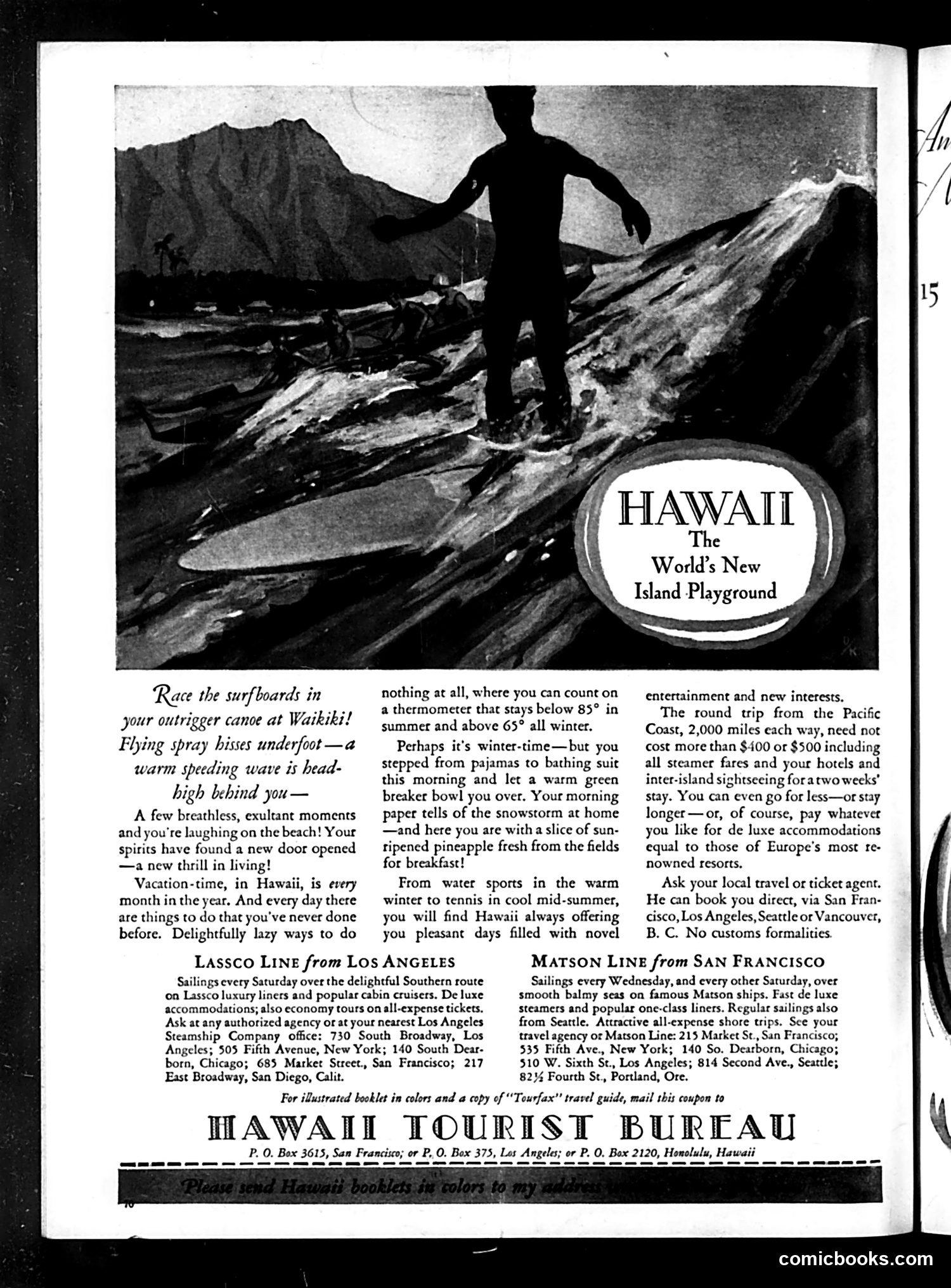
This is primarily a **tourism advertisement**, not satirical content. It promotes Hawaii as an exotic vacation destination to mainland Americans, emphasizing contrast with winter climates. **Key selling points:** - Year-round warm weather (65-85°F) versus snowstorms "at home" - Water sports (surfing, outrigger canoes) presented as thrilling novelties - Affordable pricing ($400-500 round trip) - Accessible travel via established steamship lines (Lassco and Matson) - No customs complications **Historical context:** This appears to be pre-WWII era advertising, when Hawaii was an accessible but still-exotic U.S. territory. The silhouetted surfer and tropical imagery positioned Hawaii as an adventure destination for middle-class Americans seeking escape from harsh winters and urban routine. The "thrill" rhetoric and emphasis on ease of travel reflect early 20th-century tourism marketing strategies targeting Americans with disposable income. Hawaii is sold as simultaneously foreign-feeling yet safely American (no customs issues).