
Life, 1928-10-12 · page 27 of 44
Life — October 12, 1928 — page 27: what you’re looking at
What you’re looking at
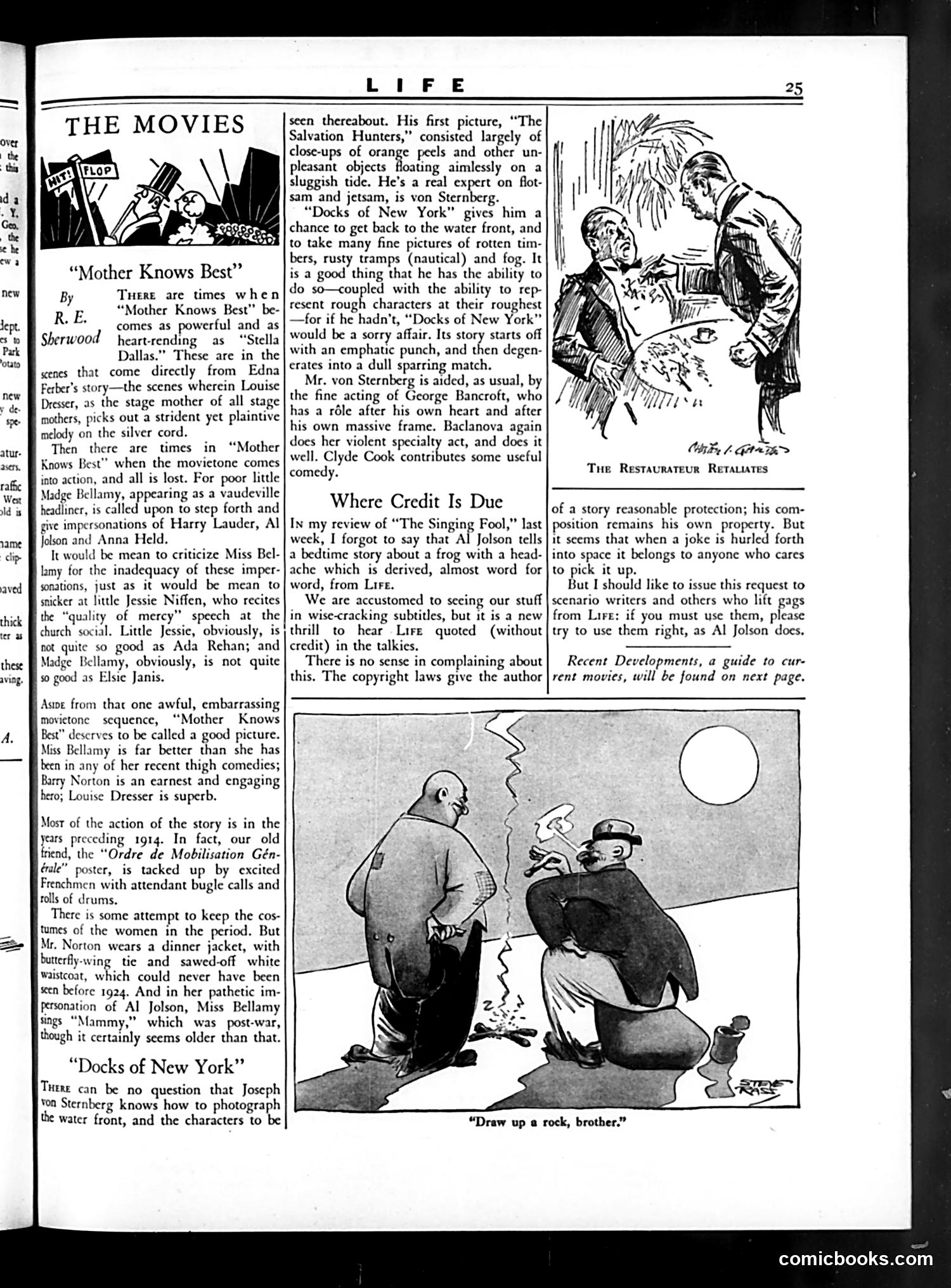
This is R.E. Sherwood's film review column from *Life* magazine. The page critiques three movies: **"Mother Knows Best"** — A drama about a stage mother (Louise Dresser), praised except for one embarrassing sequence where actress Madge Bellamy impersonates Harry Lauder, Al Jolson, and Anna Held. The critic notes period costume inconsistencies, including a dinner jacket style that wouldn't exist until 1924. **"Docks of New York"** — Director Joseph von Sternberg's film about waterfront characters, praised for cinematography but criticized for a weak plot that "degenerates into a dull sparring match." **"Where Credit Is Due"** — A complaint that Al Jolson's "The Singing Fool" used a joke directly from *Life* magazine without attribution, highlighting emerging copyright issues with sound films. The bottom cartoon, captioned "Draw up a rock, brother," appears to be an unrelated humorous illustration about two figures negotiating.
📄 Transcribed text from this page (OCR, searchable)
Machine-transcribed from the original scan — historical spelling and the odd misread are preserved.
LIFE = THE MOVIES “Mother Knows Best” By Tuere are times when RE “Mother Knows Best” be- a comes as powerful and as Sherwood heart-rending as “Stella Dallas.” These are in the senes that come directly from Edna Ferber’s story—the scenes wherein Louise Dresser, as the stage mother of all stage mothers, picks out a strident yet plaintive melody on the silver cord. Then there are times in “Mother Knows Best” when the movietone comes into action, and all is lost. For poor little Madge Bellamy, appearing as a vaudeville headliner, is called upon to step forth and give impersonations of Harry Lauder, Al Jolson and Anna Held. It would be mean to criticize Miss Bel- lamy for the inadequacy of these imper- sonations, just as it would be mean to snicker at little Jessie Niffen, who recites the “quality of mercy” speech at the church social. Little Jessie, obviously, is not quite so good as Ada Rehan; and Madge Bellamy, obviously, is not quite so good as Elsie Janis. Ase from thac one awful, embarrassing movietone sequence, “Mother Knows Best” deserves to be called a good picture. Miss Bellamy is far better than she has been in any of her recent thigh comedies; Barry Norton is an earnest and engaging hero; Louise Dresser is superb. Most of the action of the story is in the years preceding 1914. In fact, our old fiend, the “Ordre de Mobilisation Gén- éale” poster, is tacked up by excited Frenchmen with attendant bugle calls and tolls of drums. There is some attempt to keep the cos- tumes of the women in the period. But Mr. Norton wears a dinner jacket, with butterfly-wing tie and sawed-off white waistcoat, which could never have been seen before 1924. And in her pathetic im- Personation of Al Jolson, Miss Bellamy sings “Mammy,” which was post-war, though it certainly seems older than that. “Docks of New York” Tere can be no question that Joseph von Sternberg knows how to photograph water front, and the characters to be seen thereabout. His first picture, “The Salvation Hunters,” consisted largely of close-ups of orange peels and other un- pleasant objects footing aimlessly on a sluggish tide. He's a real expert on flot- sam and jetsam, is von Sternberg. “Docks of New York” gives him a chance to get back to the water front, and to take many fine pictures of rotten tim- bers, rusty tramps (nautical) and fog. It is a good thing that he has the ability to do so—coupled with the ability to rep- resent rough characters at their roughest —for if he hadn't, “Docks of New York” would be a sorry affair. Its story starts off with an emphatic punch, and then degen- a erates into a dull sparring match. Mr. von Sternberg is aided, as usual, by the fine acting of George Bancroft, who has a réle after his own heart and after his own massive frame. Baclanova again does her violent specialty act, and does it well. Clyde Cook contributes some useful comedy. Where Credit Is Due In my review of “The Singing Fool,” last week, I forgot to say that Al Jolson tells a bedtime story about a frog with a head- ache which is derived, almost word for word, from Lire. We are accustomed to seeing our stuff in wise-cracking subtitles, but it is a new thrill to hear Lire quoted (without credit) in the talkies, There is no sense in complaining about this. The copyright laws give the author UsE, / Gtx > Tue Restaurateur Retauiates of a story reasonable protection; his com- position remains his own property. But it seems that when a joke is hurled forth into space it belongs to anyone who cares to pick it up. But I should like to issue this request to scenario writers and others who lift gags from Lire: if you must use them, please try to use them right, as Al Jolson does. Recent Developments, a guide to cur- rent movies, will be found on next page. “Draw up a rock, brother.” comicbooks.com