
Life, 1928-10-12 · page 20 of 44
Life — October 12, 1928 — page 20: what you’re looking at
What you’re looking at
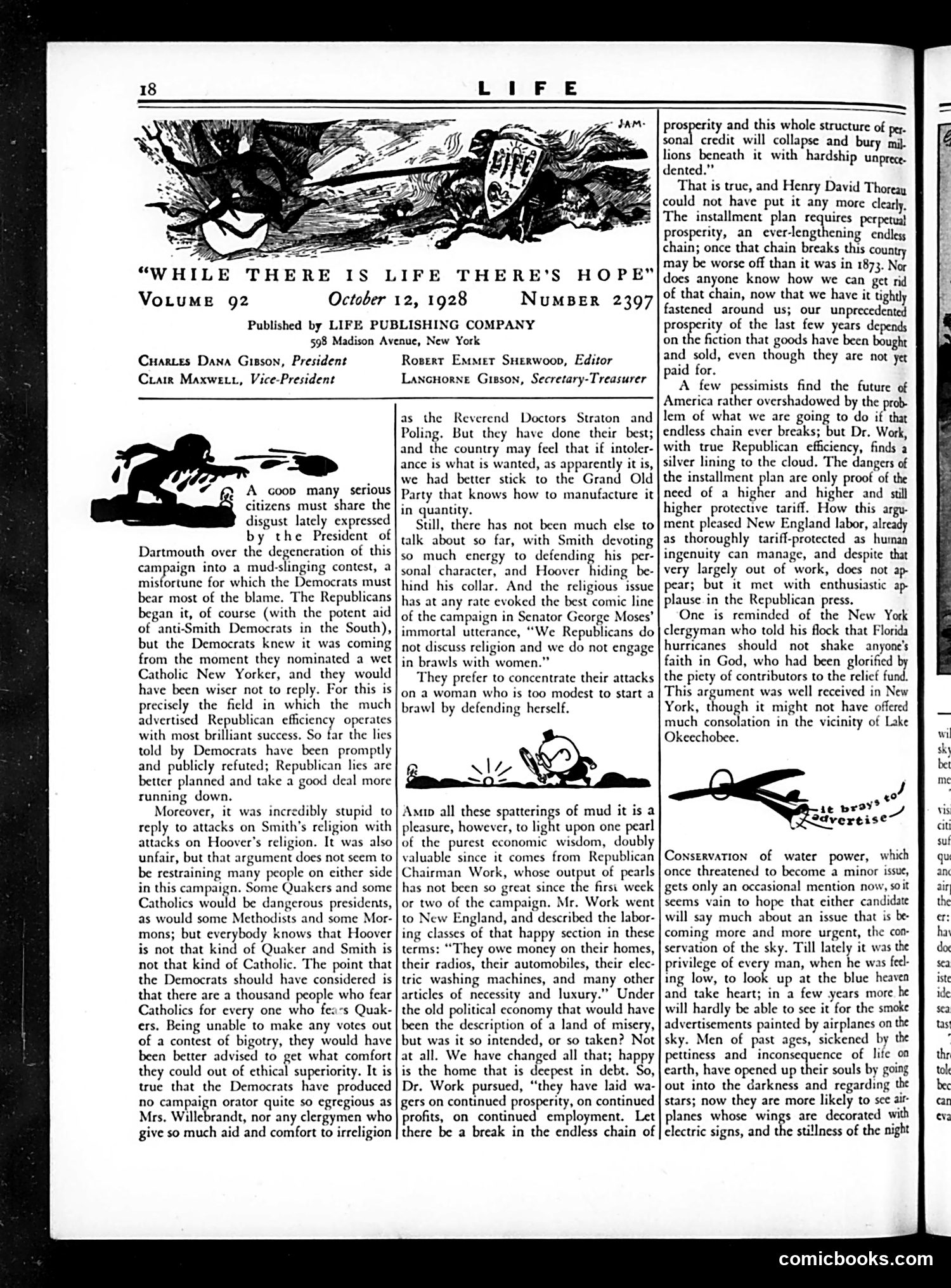
This editorial page critiques the 1928 presidential campaign between Herbert Hoover (Republican) and Al Smith (Democrat). The author attacks both campaigns' descent into personal attacks, particularly regarding religion—Smith being a Catholic and Hoover a Quaker. The cartoon(s) likely satirize the mud-slinging and religious bigotry dominating the race. The text references "Mrs. Willebrandt" (a Republican campaign surrogate) and clergy like Reverend Straton attacking Smith's Catholicism as examples of unseemly Republican tactics, while noting Democrats foolishly retaliated with similar mud. The author praises Republican Chairman Work's economic commentary about working-class debt as genuine wisdom—that Americans now view consumer debt (mortgages, radios, cars, washing machines) as signs of prosperity rather than poverty, betting on "continued prosperity." The piece reflects 1920s consumerism and the pre-Depression optimism, later revealed as dangerously naive.
📄 Transcribed text from this page (OCR, searchable)
Machine-transcribed from the original scan — historical spelling and the odd misread are preserved.
VoLuME 92 October 12, 1928 NuMBER 2397 Published by LIFE PUBLISHING COMPANY 598 Madison Avenue, New York Cuarces Dana Gisson, President Cran Maxwett, Vice-President Rosert Emmet Suerwoon, Editor LancHorne Gisson, Secretary-Treasurer > 07 @ A. coop many serious citizens must share the disgust lately expressed by the President of Dartmouth over the degeneration of this campaign into a mud-slinging contest, a mistortune for which the Democrats must bear most of the blame. The Republicans began it, of course (with the potent aid of anti-Smith Democrats in the South), but the Democrats knew it was coming from the moment they nominated a wet Catholic New Yorker, and they would have been wiser not to reply. For this is precisely the field in which the much advertised Republican efficiency operates with most brilliant success. So far the lies told by Democrats have been promptly and publicly refuted; Republican lies are better planned and take a good deal more running down. Moreover, it was incredibly stupid to reply to attacks on Smith’s religion with attacks on Hoover's religion. It was also unfair, but that argument does not seem to be restraining many people on either side in this campaign. Some Quakers and some Catholics would be dangerous presidents, as would some Methodists and some Mor- mons; but everybody knows that Hoover is not that kind of Quaker and Smith is not that kind of Catholic. The point that the Democrats should have considered is that there are a thousand people who fear Catholics for every one who fea-s Quak- ers. Being unable to make any votes out of a contest of bigotry, they would have been better advised to get what comfort they could out of ethical superiority. It is true that the Democrats have produced no campaign orator quite so egregious as Mrs, Willebrandt, nor any clergymen who give so much aid and comfort to irreligion as the Reverend Doctors Straton and Poling. But they have done their best; and the country may feel that if intoler- ance is what is wanted, as apparently it is, we had better stick to the Grand Old Party that knows how to manufacture it in quanuty. Sull, there has not been much else to talk about so far, with Smith devoting so much energy to defending his per- sonal character, and Hoover hiding be- hind his collar. And the religious issue has at any rate evoked the best comic line of the campaign in Senator George Moses’ immortal utterance, “We Republicans do not discuss religion and we do not engage in brawls with women.” They prefer to concentrate their attacks on a woman who is too modest to start a brawl by defending herself. g Nw pares Aap all these spatterings of mud it is a pleasure, however, to light upon one pearl of the purest economic wisdom, doubly valuable since it comes from Republican Chairman Work, whose output of pearls has not been so great since the first week or two of the campaign. Mr. Work went to New England, and described the labor- ing classes of that happy section in these terms: “They owe money on their homes, their radios, their automobiles, their elec- tric washing machines, and many other articles of necessity and luxury.” Under the old political economy that would have been the description of a land of misery, but was it so intended, or so taken? Not at all. We have changed all that; happy is the home that is deepest in debt. So, Dr. Work pursued, “they have laid wa- gers on conunued prosperity, on continued profits, on continued employment. Let there be a break in the endless chain of prosperity and this whole structure of per- sonal credit will collapse and bury mil. lions beneath it with hardship unprece- dented.” That is true, and Henry David Thoreay could not have put it any more clearly, The installment plan requires perpetual prosperity, an ever-lengthening endless chain; once that chain breaks this count may be worse off than it was in 1873. Nor does anyone know how we can get rid of that chain, now that we have it tightly fastened around us; our unprecedented prosperity of the last few years depends on the fiction that goods have been bought and sold, even though they are not yet paid for. A few pessimists find the future of America rather overshadowed by the prob- lem of what we are going to do if that endless chain ever breaks; but Dr. Work, with true Republican efficiency, finds a silver lining to the cloud. The dangers of the installment plan are only proof of the need of a higher and higher and still higher protective tariff. How this argu. ment pleased New England labor, already as thoroughly tariff-protected as huiman ingenuity can manage, and despite that very largely out of work, does not ap- pear; but it met with enthusiastic ap plause in the Republican press. One is reminded of the New York clergyman who told his flock that Florida hurricanes should not shake anyone's faith in God, who had been glorified the piety of contributors to the relief fund. This argument was well received in New York, though it might not have offered much consolation in the vicinity of Lake Okeechobee. 4 3 #9 ie prov” Lavertise Conservation of water power, which once threatened to become a minor issue, gets only an occasional mention now, soit seems vain to hope that either candidate will say much about an issue that is be coming more and more urgent, the con- servation of the sky. Till lately it was the privilege of every man, when he was feel- ing low, to look up at the blue heaven and take heart; in a few years more he will hardly be able to see it for the smoke advertisements painted by airplanes on the sky. Men of past ages, sickened by the pettiness and inconsequence of life on earth, have opened up their souls by going out into the darkness and regarding stars; now they are more likely to see air- planes whose wings are decorated with electric signs, and the sti!Iness of the night comicbooks.com