
A complete issue · 35 pages · 1928
Life — April 26, 1928
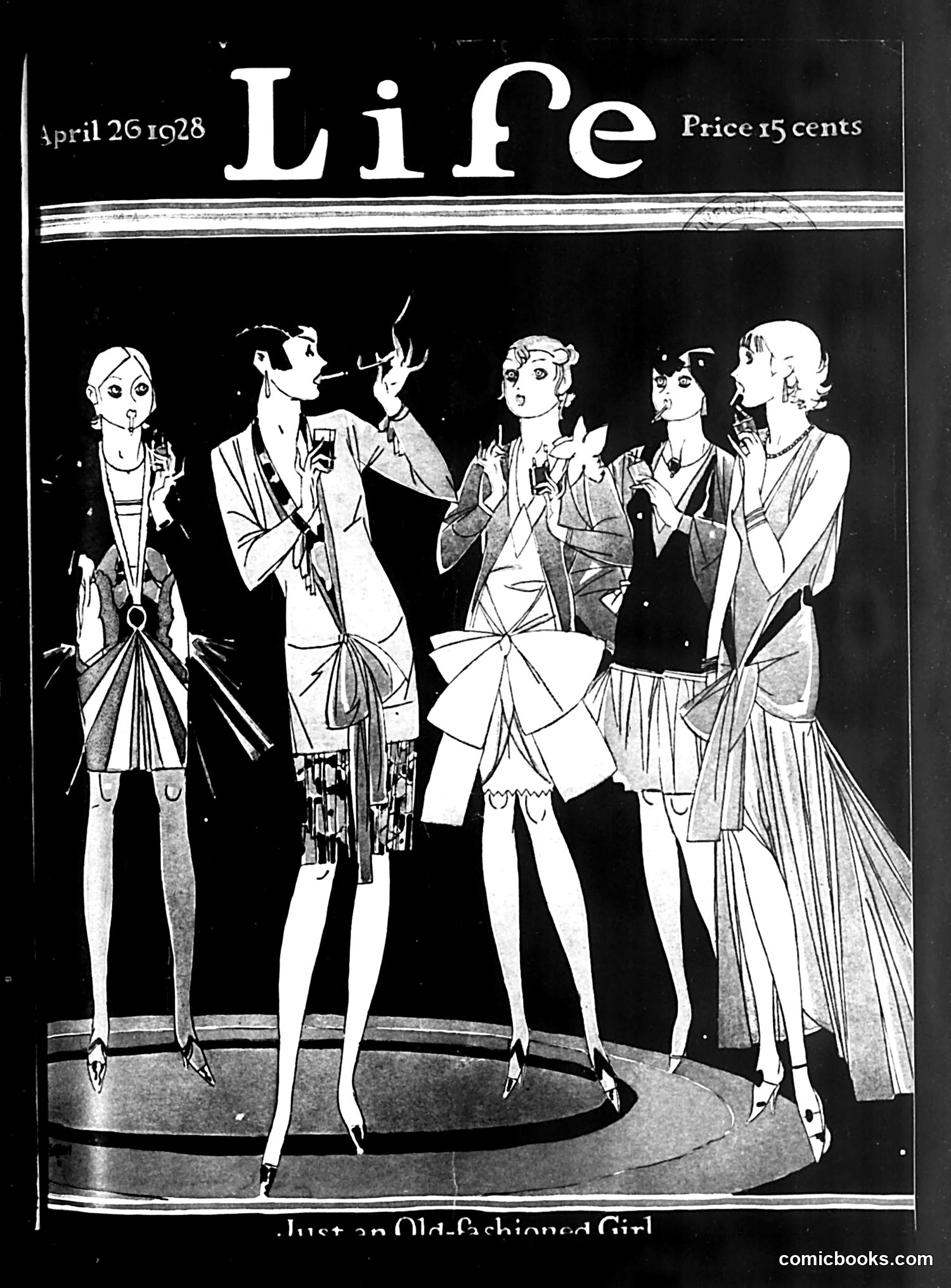
This cover illustrates "Just an Old-Fashioned Girl"—a satirical commentary on 1920s women's fashion and social change. The illustration shows five stylishly dressed women in modern flapper-style clothing with short skirts, cloche hats, and accessories like cigarette holders and jewelry. The joke appears to be ironic: the caption claims one represents an "old-fashioned girl," but all five are dressed in the very modern, scandalous fashions of the Jazz Age 1920s. This mocked the era's rapid social transformation—younger women rejecting Victorian modesty for shorter hemlines, bobbed hair, smoking, and greater independence. The satire targets either the persistence of outdated attitudes or the false claim that such modern women could be "old-fashioned" in any meaningful sense.
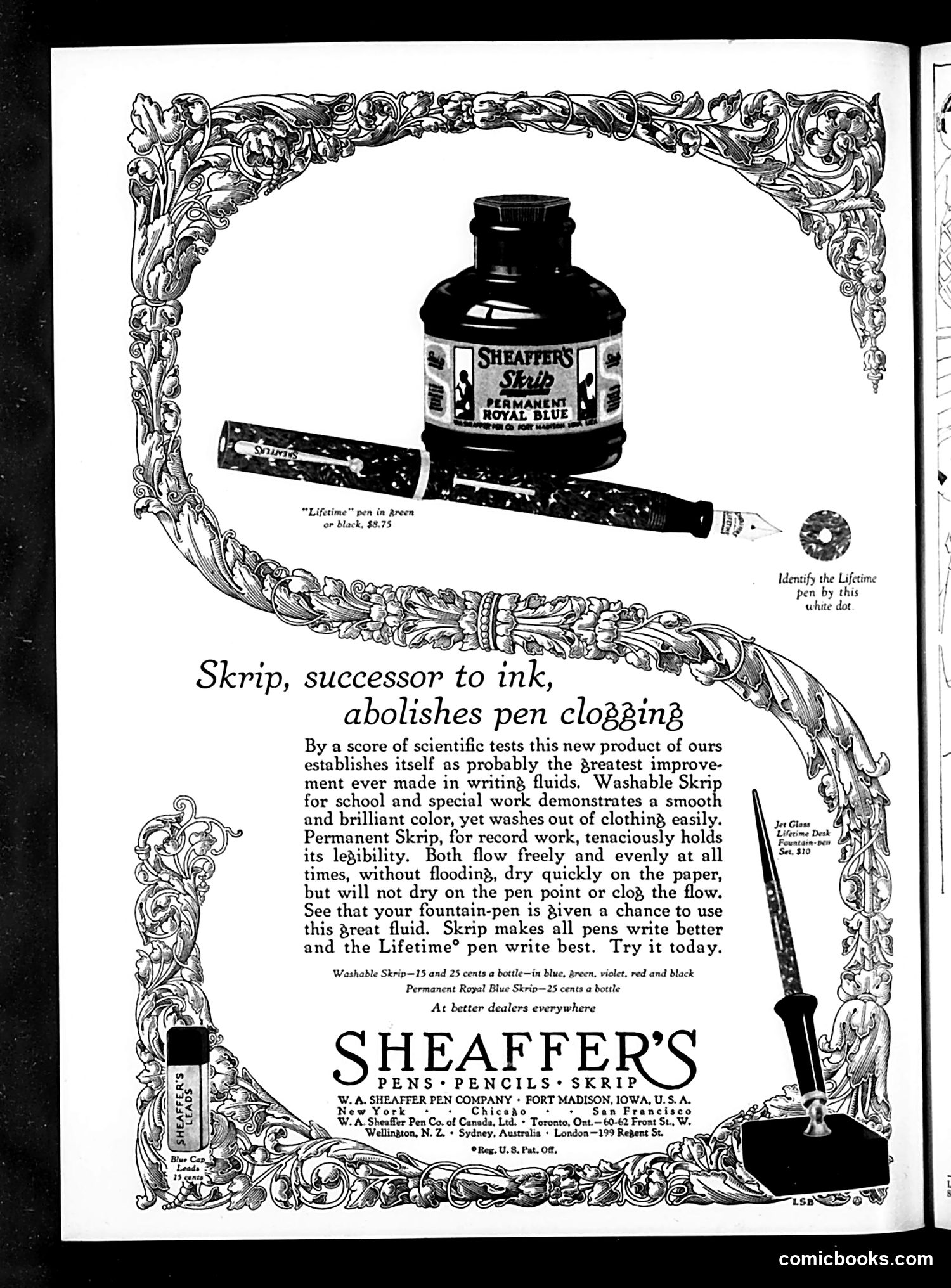
This page is a commercial advertisement for Sheaffer's Skrip writing fluid and pens, not political satire or editorial cartoon content. The ad promotes "Skrip" as a successor to ink that solves pen-clogging problems. It features ornamental borders typical of early 20th-century design and displays the product (an ink bottle and fountain pen with a "Lifetime" pen identifier). The text claims scientific superiority: the fluid flows freely, dries quickly on paper without clogging pens, and is available in washable and permanent formulas. Pricing and distribution information appear at the bottom. This represents typical magazine advertising from the era before modern product photography and design became standard.
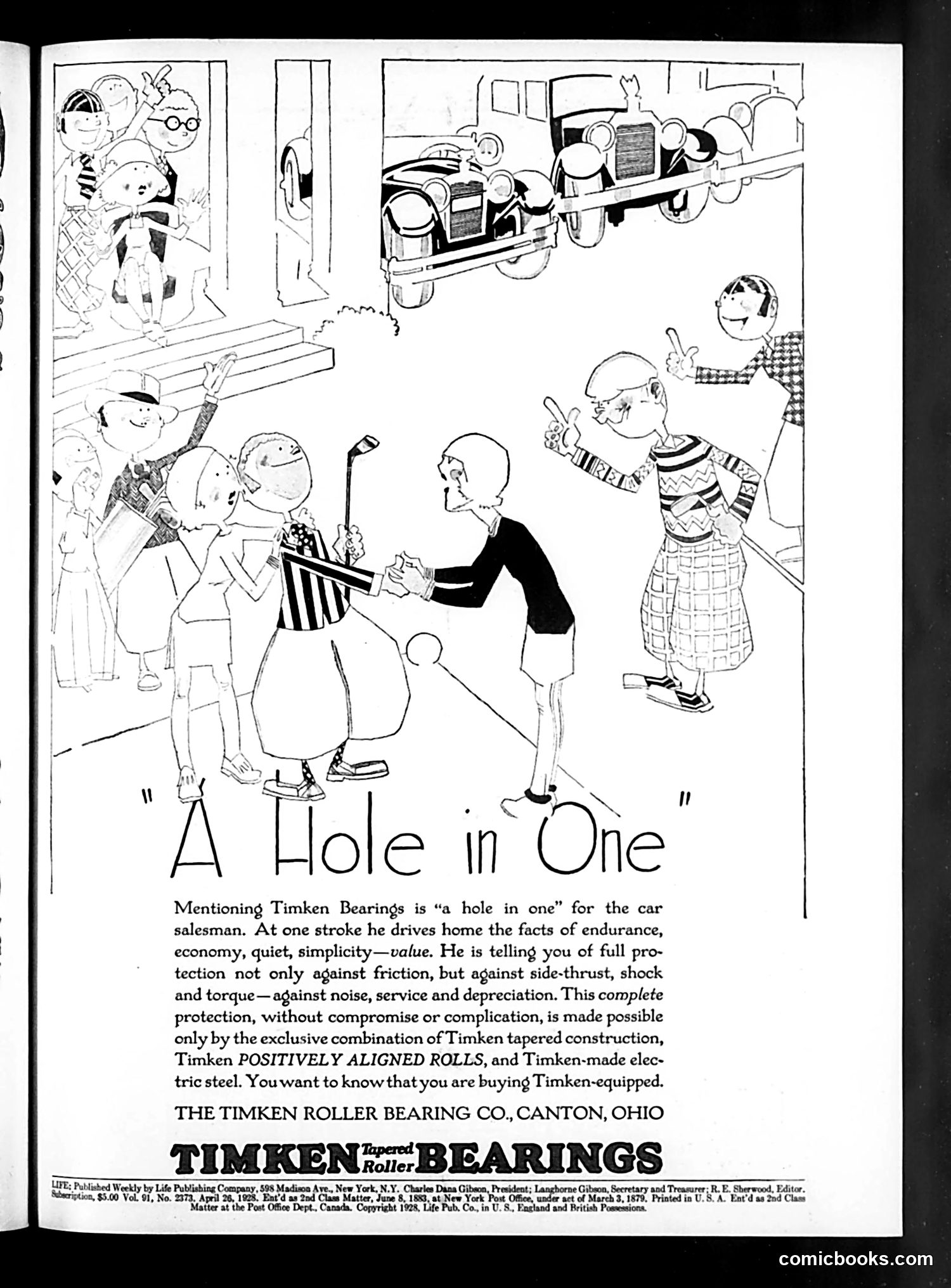
This is primarily a **vintage advertisement** for Timken Roller Bearings, using golf terminology as a sales pitch. The cartoon depicts a golfer who has achieved a "hole in one"—the phrase serves as a double entendre. The text claims that mentioning Timken Bearings to a car salesman is itself "a hole in one," because it immediately convinces buyers of the product's superiority. The ad promises comprehensive protection against friction, noise, and mechanical wear through Timken's exclusive design and materials. The whimsical cartoon style—showing a golfer celebrating while onlookers applaud—was typical of 1920s advertising that used humor and popular sports references to appeal to middle-class consumers considering automobile purchases.
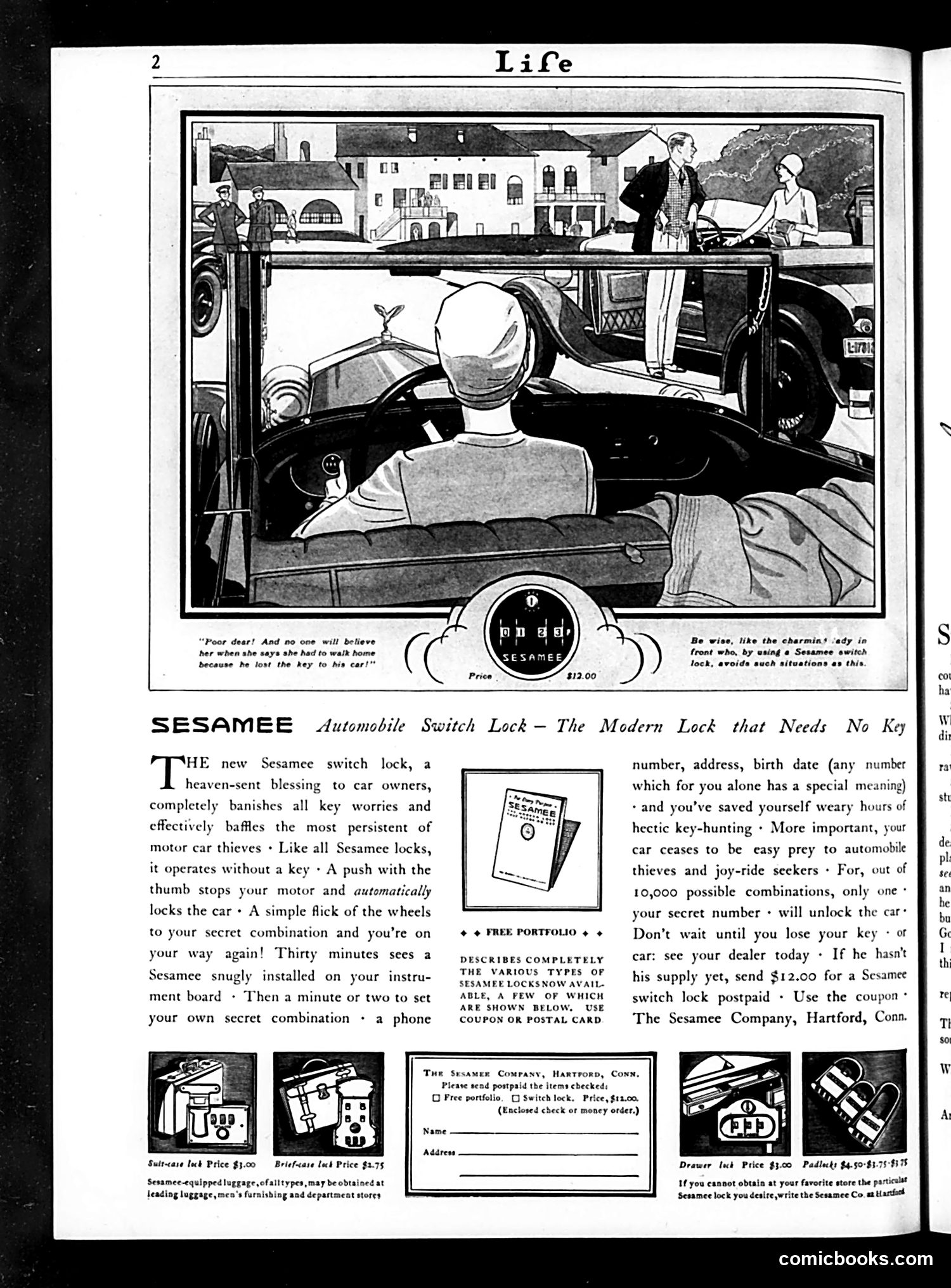
This page is primarily **advertising, not satire or political commentary**. The top illustration is a product advertisement for the Sesamee Automobile Switch Lock—a security device for cars. The cartoon scene depicts a woman in a car, with the caption warning that thieves target vehicles when owners leave keys inside. The ad promotes Sesamee's keyless locking system as a solution: owners set their own numeric combination, eliminating the vulnerability of physical keys. The remainder of the page contains product details, pricing ($12.00), ordering information via coupon, and images of various Sesamee lock models. This represents a straightforward early automotive safety product advertisement aimed at protecting cars from theft—a practical consumer concern, not political satire.
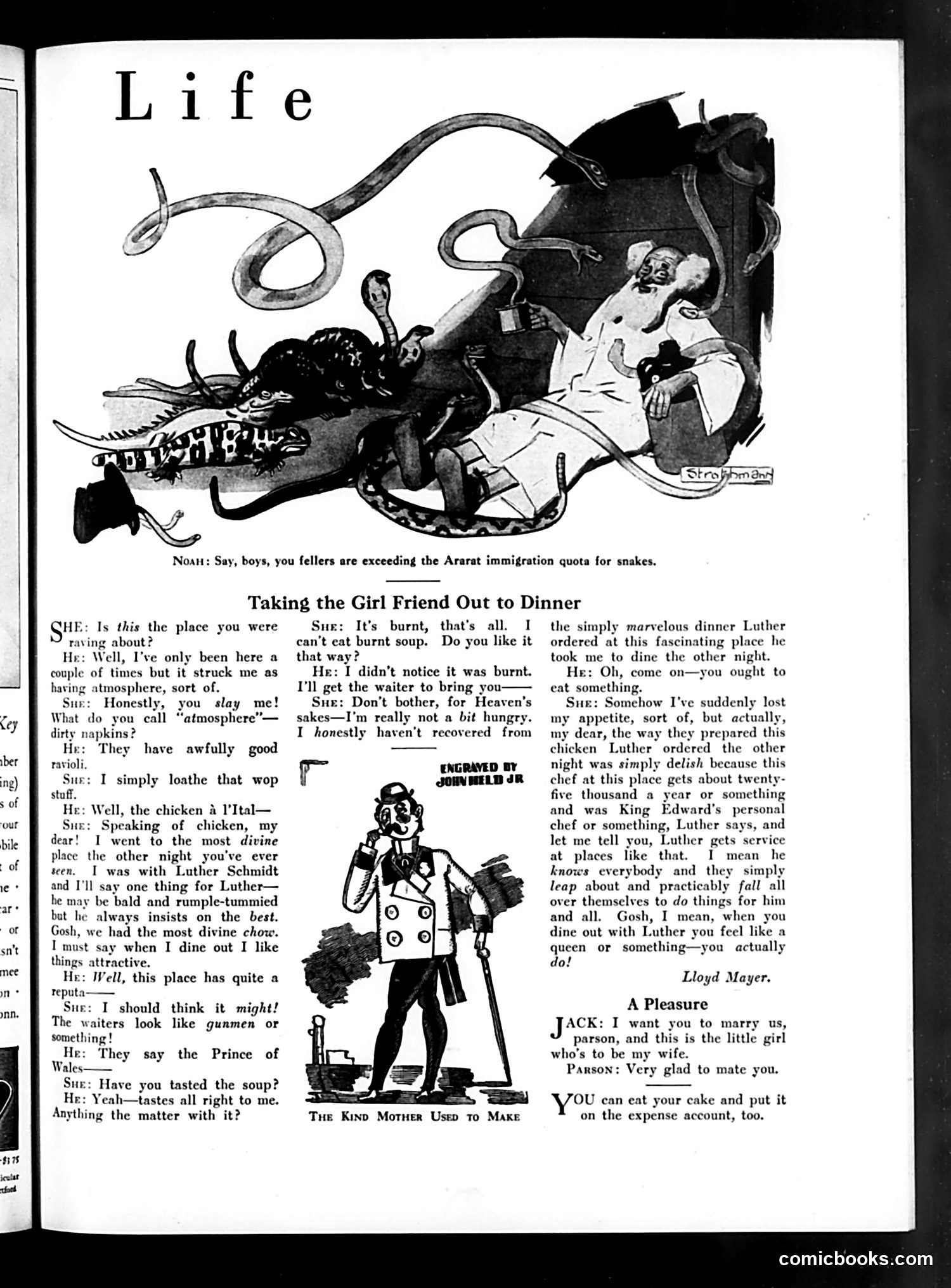
The top cartoon titled "Taking the Girl Friend Out to Dinner" satirizes the restaurant experience, likely from the 1910s-1920s. It depicts a man and woman dining while surrounded by snakes and creatures, with the caption referencing an "Ararat immigration quota for snakes"—an apparent reference to Noah's Ark and possibly immigration restrictions of that era. The dialogue mocks pretentious dining: the woman complains about burnt soup and poor service, while the man defends the restaurant as "divine" because it once served royalty. The satire targets both restaurant pretension and diners' gullibility. The lower section includes unrelated humor pieces: "The Kind Mother Used to Make" shows a figure, and "A Pleasure" presents brief comedic dialogue about marriage. The overall page demonstrates *Life* magazine's blend of visual satire and humorous commentary on social conventions.
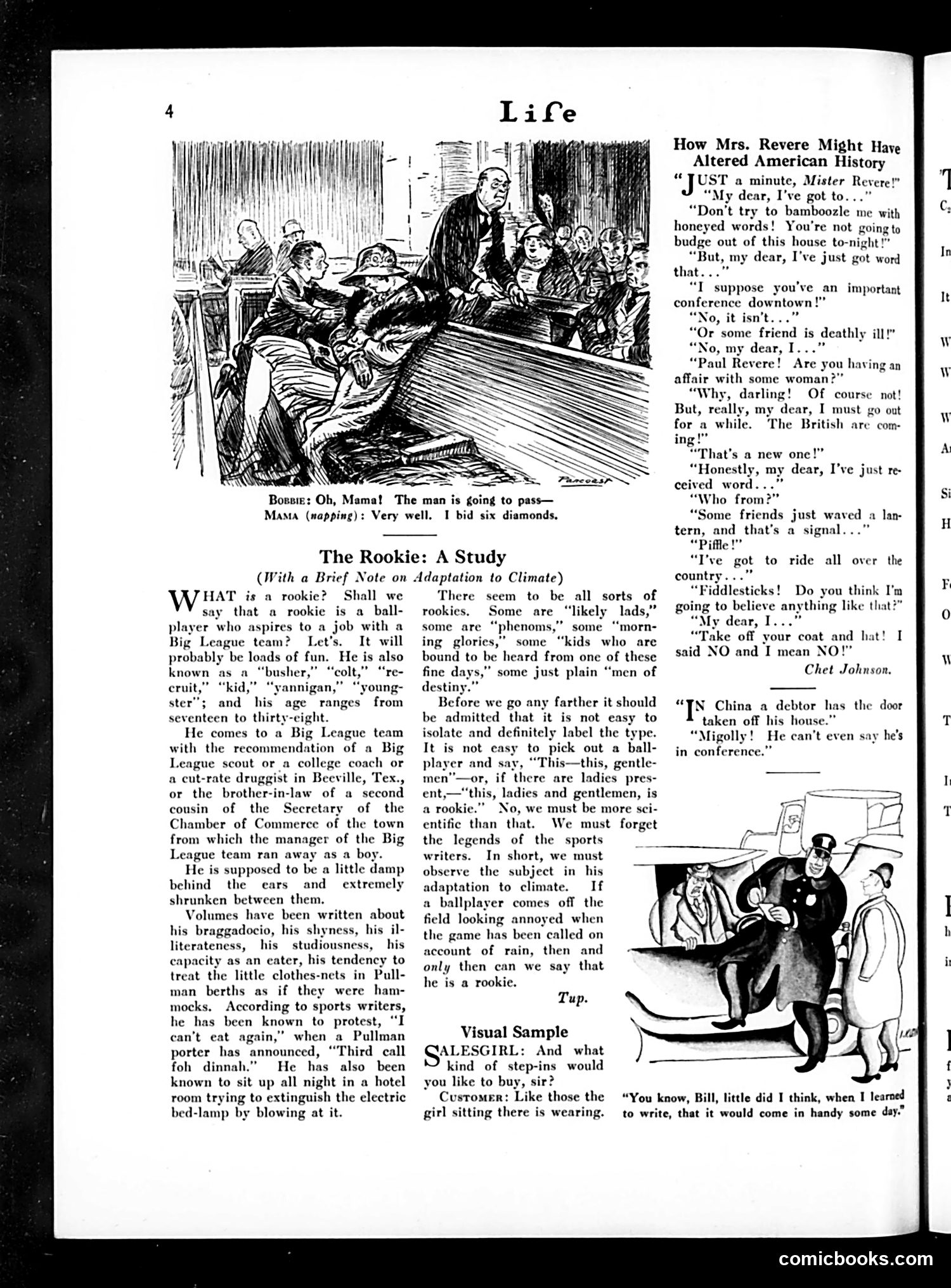
This page contains two distinct pieces: **Top cartoon** ("Bonnie? Oh, Mama!"): A domestic scene where a man lies on a couch while a woman (presumably his wife) sits nearby. The caption indicates she's refusing to leave the house, suggesting marital conflict. The humor appears to derive from a wife preventing her husband from going out, likely to an illicit meeting. **"The Rookie: A Study"**: An extended article defining the "rookie"—a novice baseball player. The text humorously catalogs his stereotypical traits: physical awkwardness, poor coordination, gullibility, and incompetence. It's a satirical character sketch mocking inexperienced ballplayers, with mentions of how he behaves on and off the field. Both pieces exemplify *Life*'s typical early 20th-century satirical approach: domestic humor and sports comedy targeting recognizable social types.
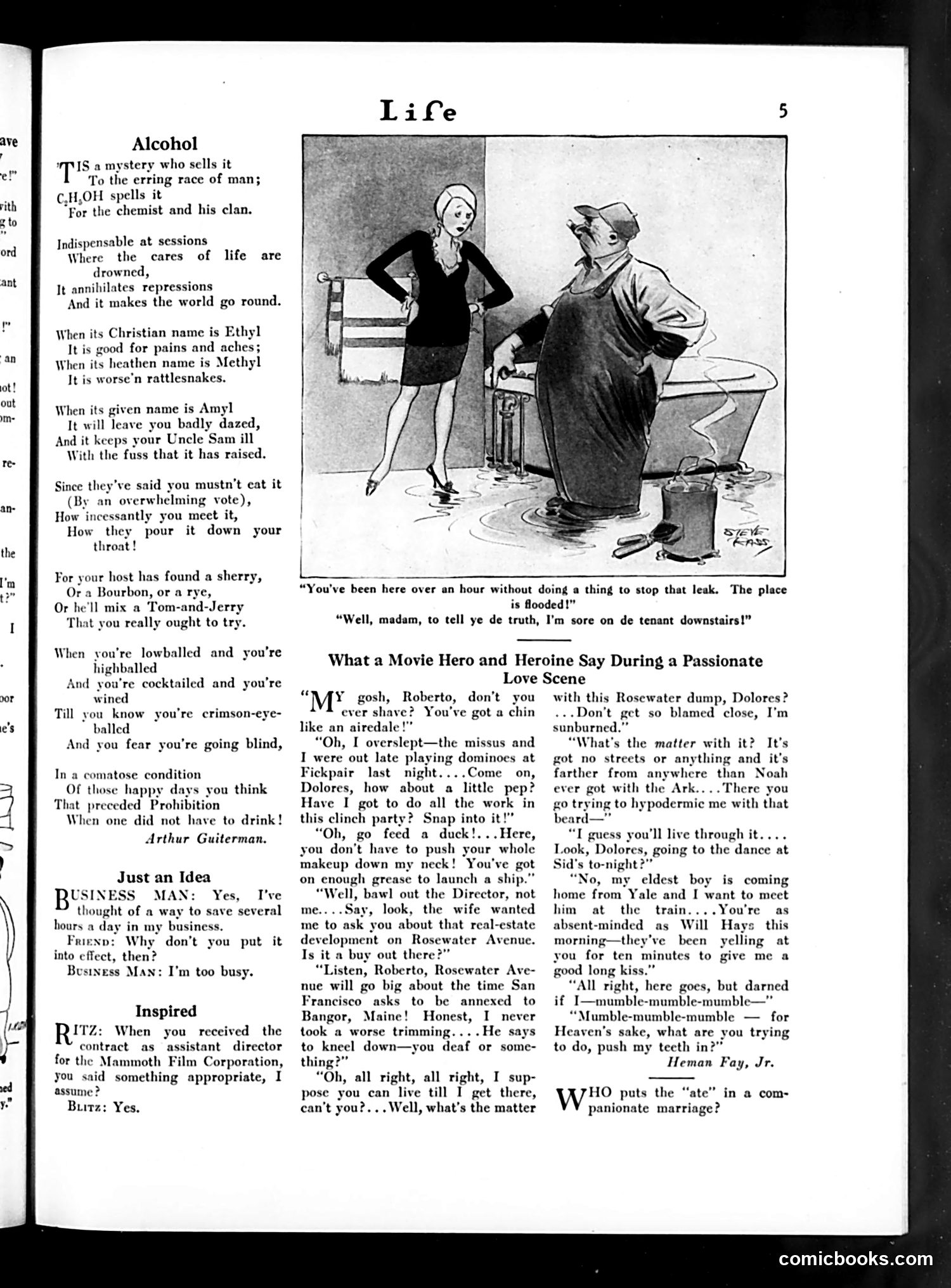
The main cartoon depicts a plumber and woman in a flooded apartment. The caption reads: "You've been here over an hour without doing a thing to stop that leak. The place is flooded!" The plumber responds: "Well, madam, to tell ye de truth, I'm sore on de tenant downstairs!" This is a working-class humor joke playing on tenant disputes and delayed repairs—the plumber won't fix the leak because he's angry at someone else in the building. The dialect speech reflects period stereotypes about immigrant or working-class tradesmen. The page also contains poetry about alcohol by Arthur Guiterman, a section titled "What a Movie Hero and Heroine Say," and brief comedic pieces. The content is typical 1920s-era satirical magazine humor targeting social situations, class dynamics, and domestic absurdities.
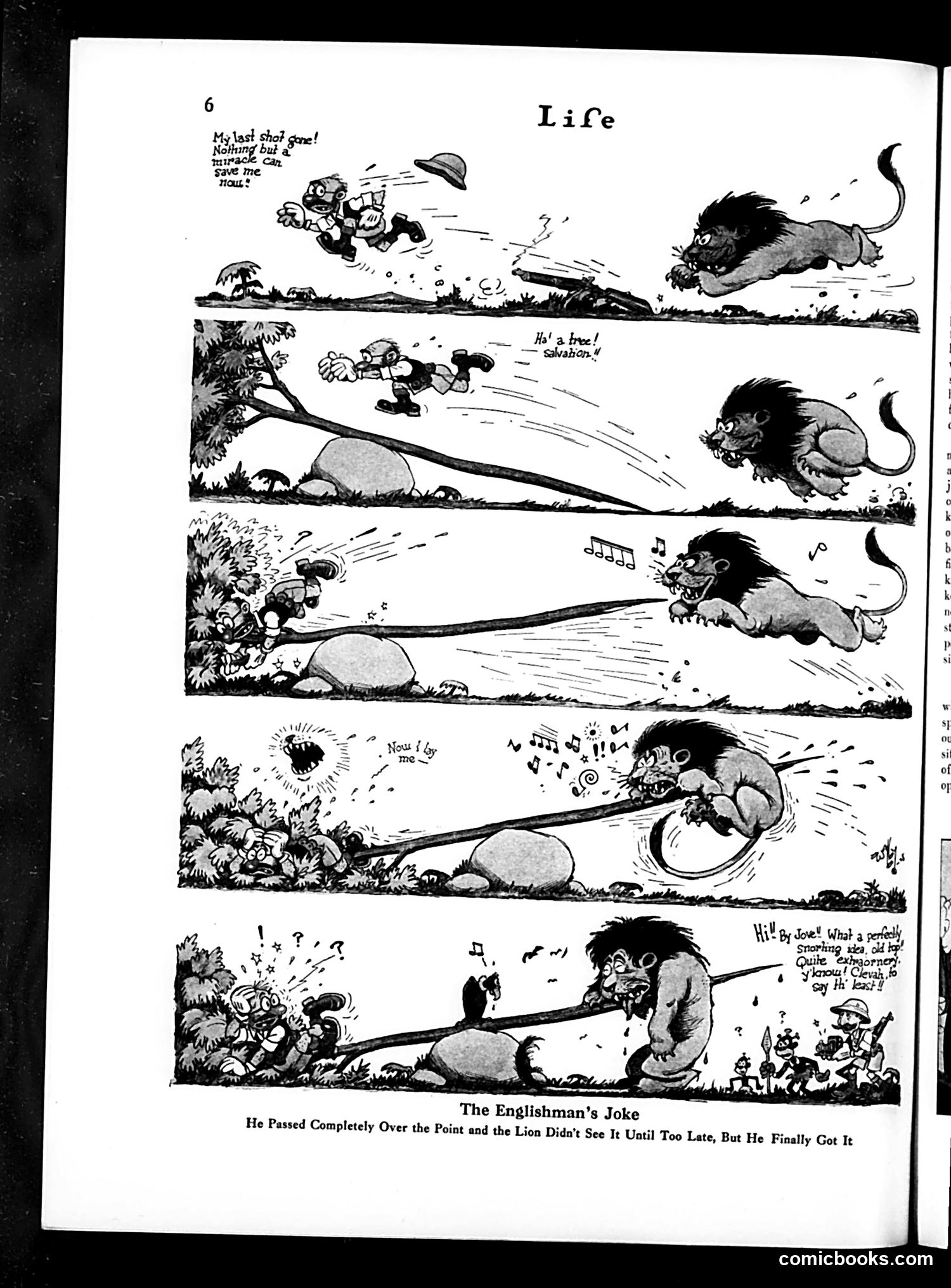
This comic strip depicts a slapstick scenario where a man (appearing to be British, given the title) repeatedly attempts to attract a lion's attention while the lion ignores him. The man tries various methods—shooting, running, playing music, making noise—each time the lion passes by without noticing. Finally, in the last panel, the lion catches and attacks him. The joke appears to satirize British understatement or obliviousness: the Englishman's polite, ineffectual attempts to get attention fail until the point becomes impossible to miss. The humor relies on the buildup of ignored provocations culminating in violent payoff. The strip's title suggests this exemplifies a particularly British style of humor—dry, understated, with ironic consequences.
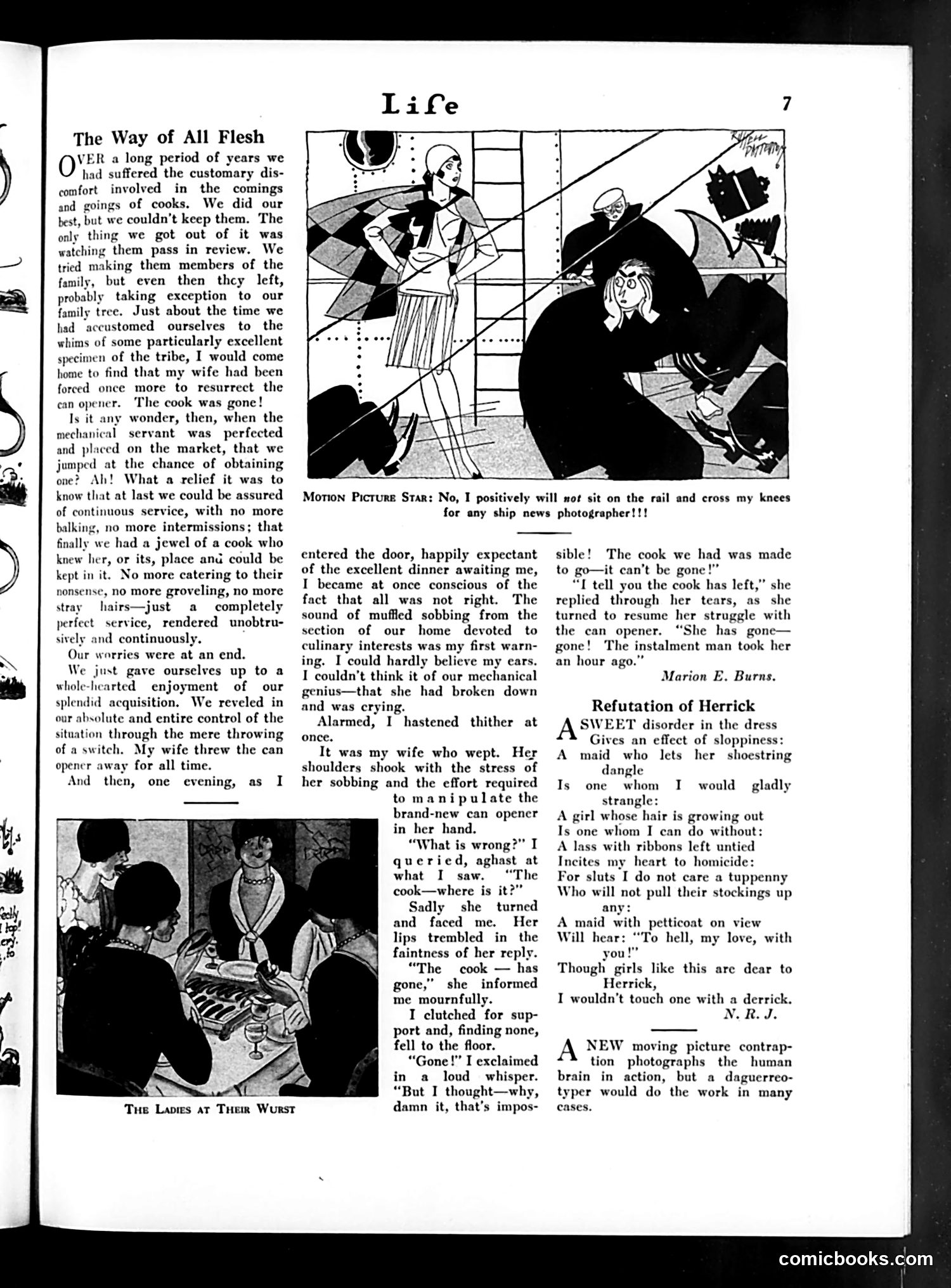
This page contains a humorous domestic narrative about hiring a mechanical can opener. The author describes years of frustration with cooks leaving their employment, finally acquiring an "mechanical servant" (an automated can opener) that promises reliable service without the difficulties of human household staff. The joke turns on irony: after celebrating this solution, the mechanical device breaks down immediately, leaving his wife in tears—the can opener "has gone." He must now wait an hour for repairs. The accompanying cartoon "The Ladies at Their Wurst" (bottom left) appears to show women dining, likely satirizing food or dining habits, though specific context is unclear from the image alone. A separate poetry section titled "Refutation of Herrick" follows.
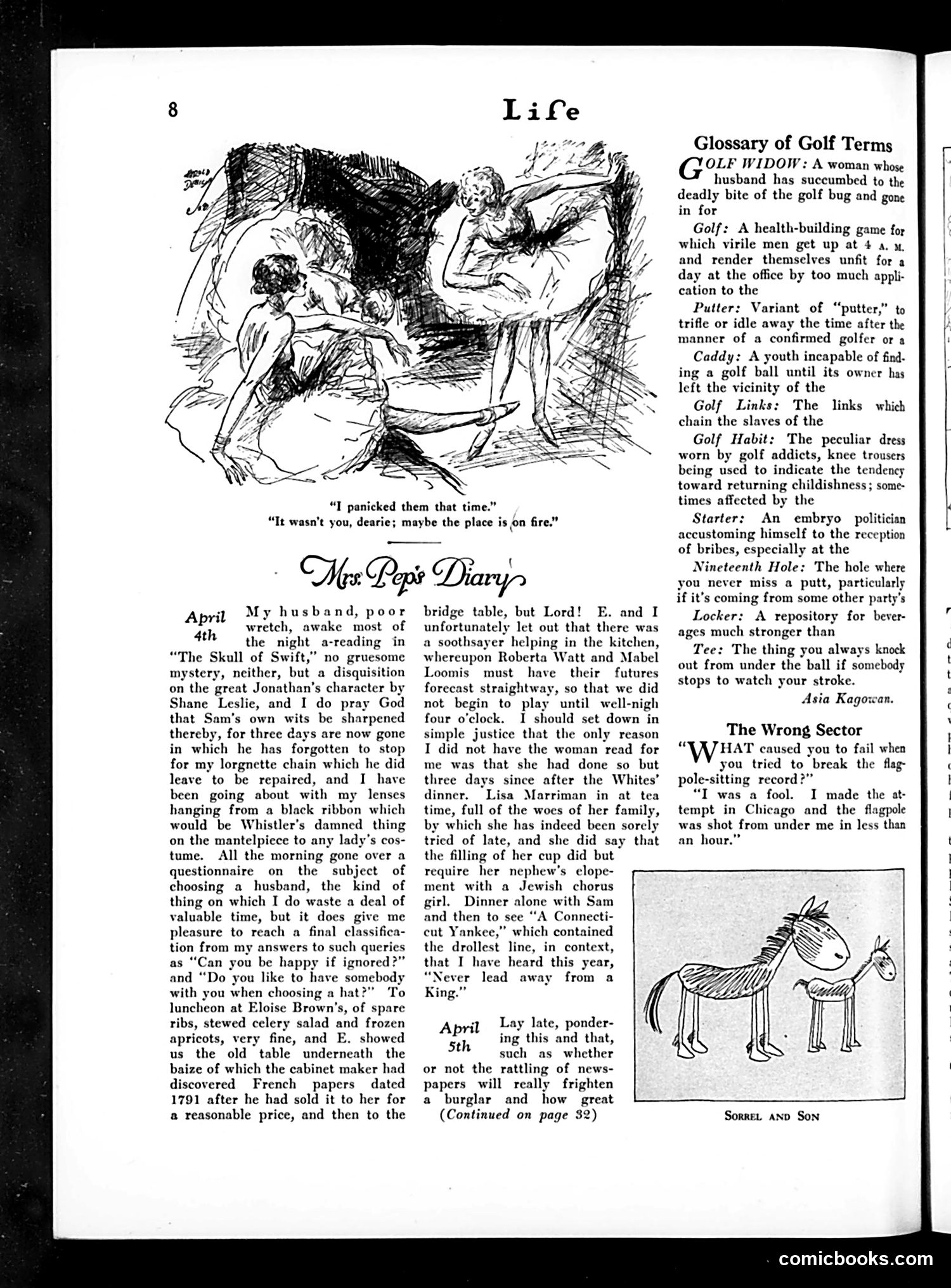
This page contains satirical humor about domestic life and golf culture. The main illustration depicts a couple in bed—the husband reading "The Skull of Sherlock," a mystery novel, while the wife appears exasperated. The accompanying text ("Mrs. Pep's Diary") humorously catalogs the author's frustrations with her husband's neglect and absent-mindedness. The "Glossary of Golf Terms" on the right satirizes golf addiction among men, using definitions like "Golf Habit" (peculiar dress worn by addicts) and "Golf Links" (chains enslaving golfers) to mock the sport's grip on participants. Below, "The Wrong Sector" presents a brief anecdote about a failed flag-pole-sitting stunt in Chicago—mocking this 1920s fad. The page's humor targets masculine domestic neglect and contemporary fads rather than specific political figures.
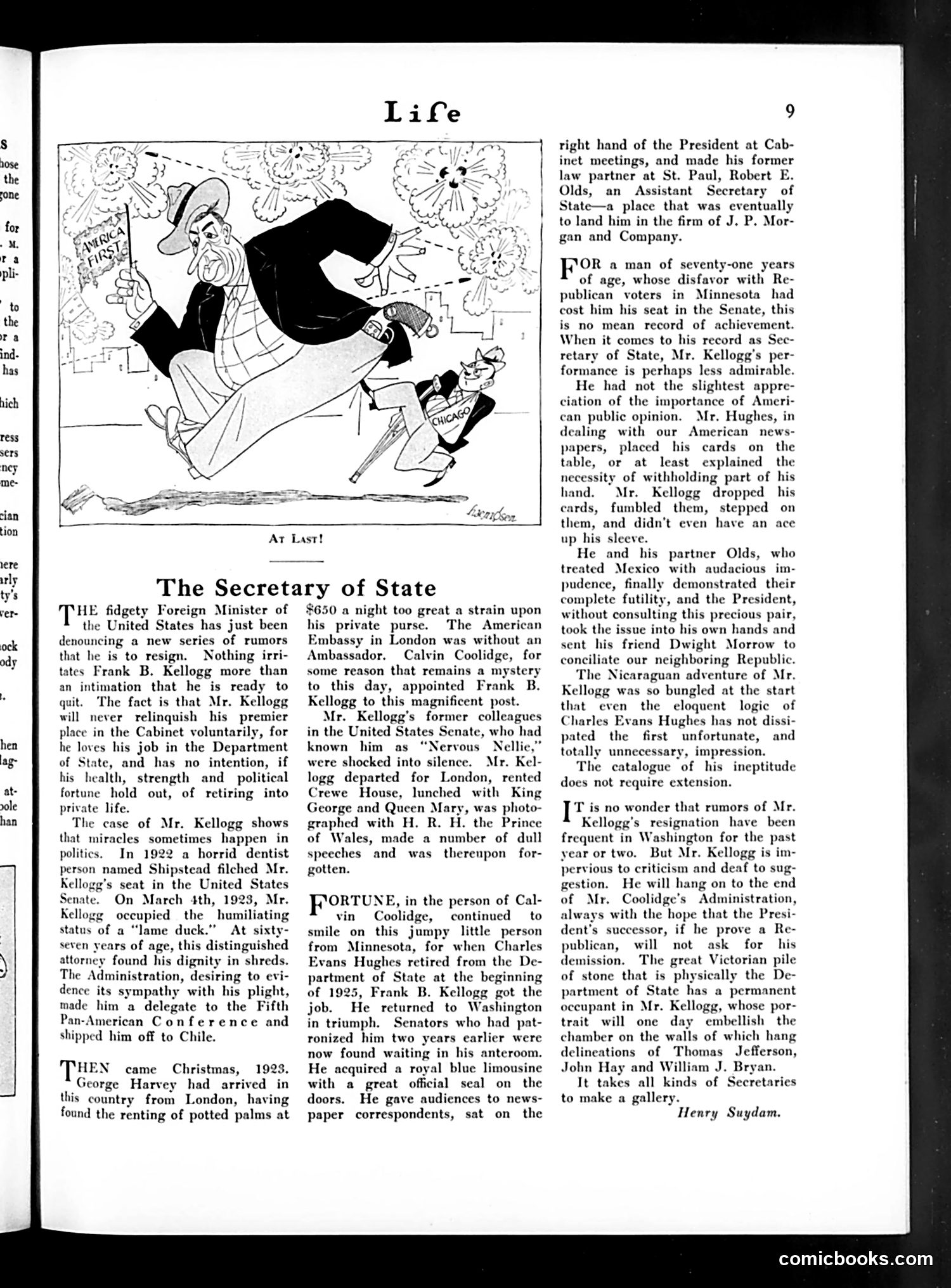
This cartoon satirizes **Frank B. Kellogg's appointment as Secretary of State**. The image shows Kellogg being launched or ejected forcefully, suggesting relief or celebration at his appointment after a long wait. The accompanying article explains that Kellogg, a "lame duck" senator from Minnesota whose 1923 election faced criticism, finally found a dignified Cabinet position. The cartoon's title "At Last!" captures the sense that both Kellogg and observers were relieved he'd secured this prestigious post, ending uncertainty about his political future. The satire appears gentle—celebrating a career move rather than mocking Kellogg directly, though his previous political struggles make the appointment's arrival feel dramatically overdue.
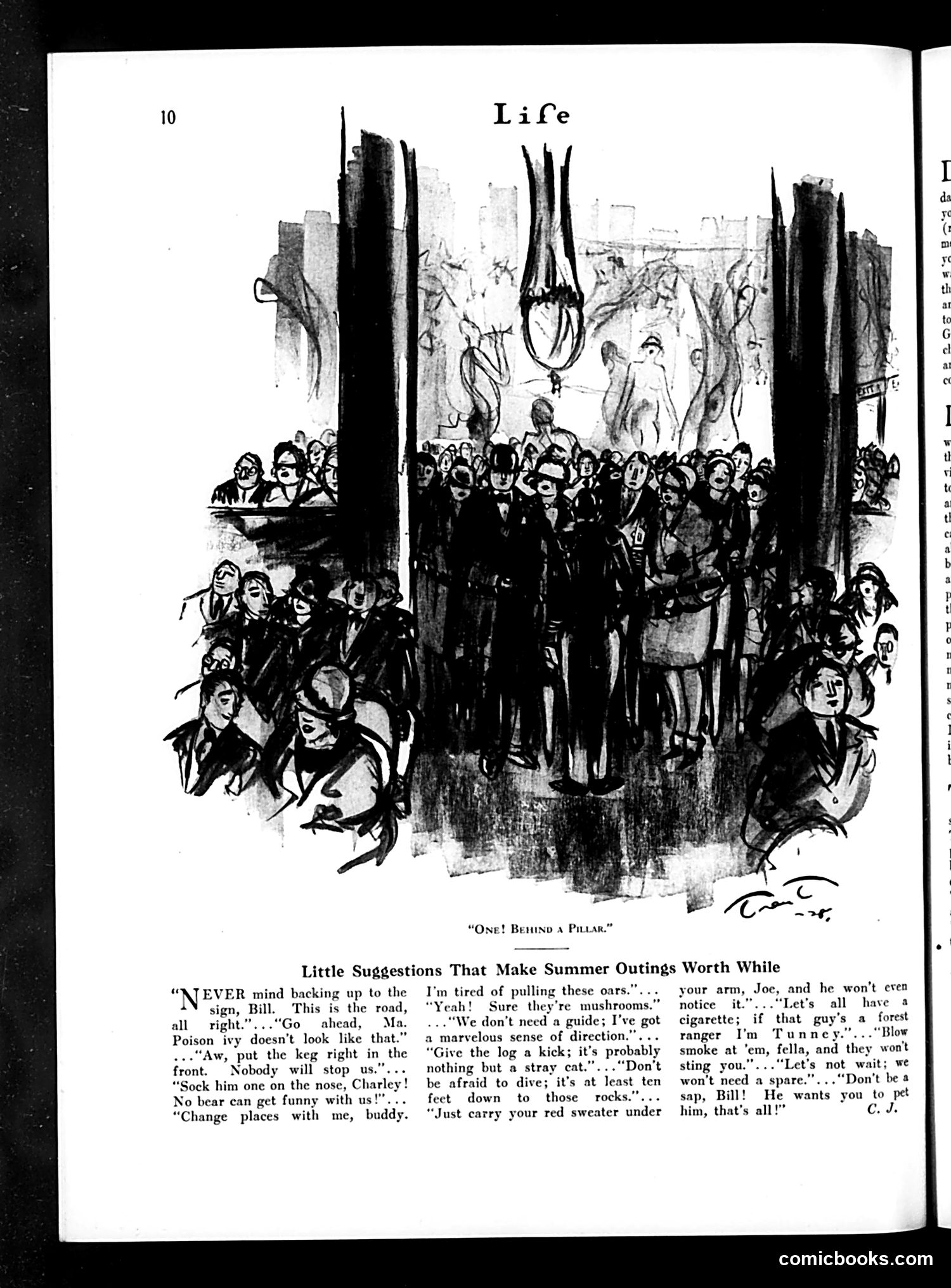
This page from *Life* magazine features a cartoon titled "One! Behind a Pillar" depicting a crowd gathered around tall pillars or columns, with figures both standing and sitting. The cartoon appears to be satirizing public behavior or social dynamics in crowds. Below the cartoon, the article "Little Suggestions That Make Summer Outings Worth While" presents humorous dialogue snippets mocking typical summer outing complaints and suggestions—references to mushrooms, oars, diving, cats, sweaters, and other casual outdoor activity details. The humor relies on absurdist non-sequiturs and deadpan responses to common tourist or recreational frustrations. The overall satire targets the banality and awkwardness of summer social gatherings and group outings among the leisured classes.
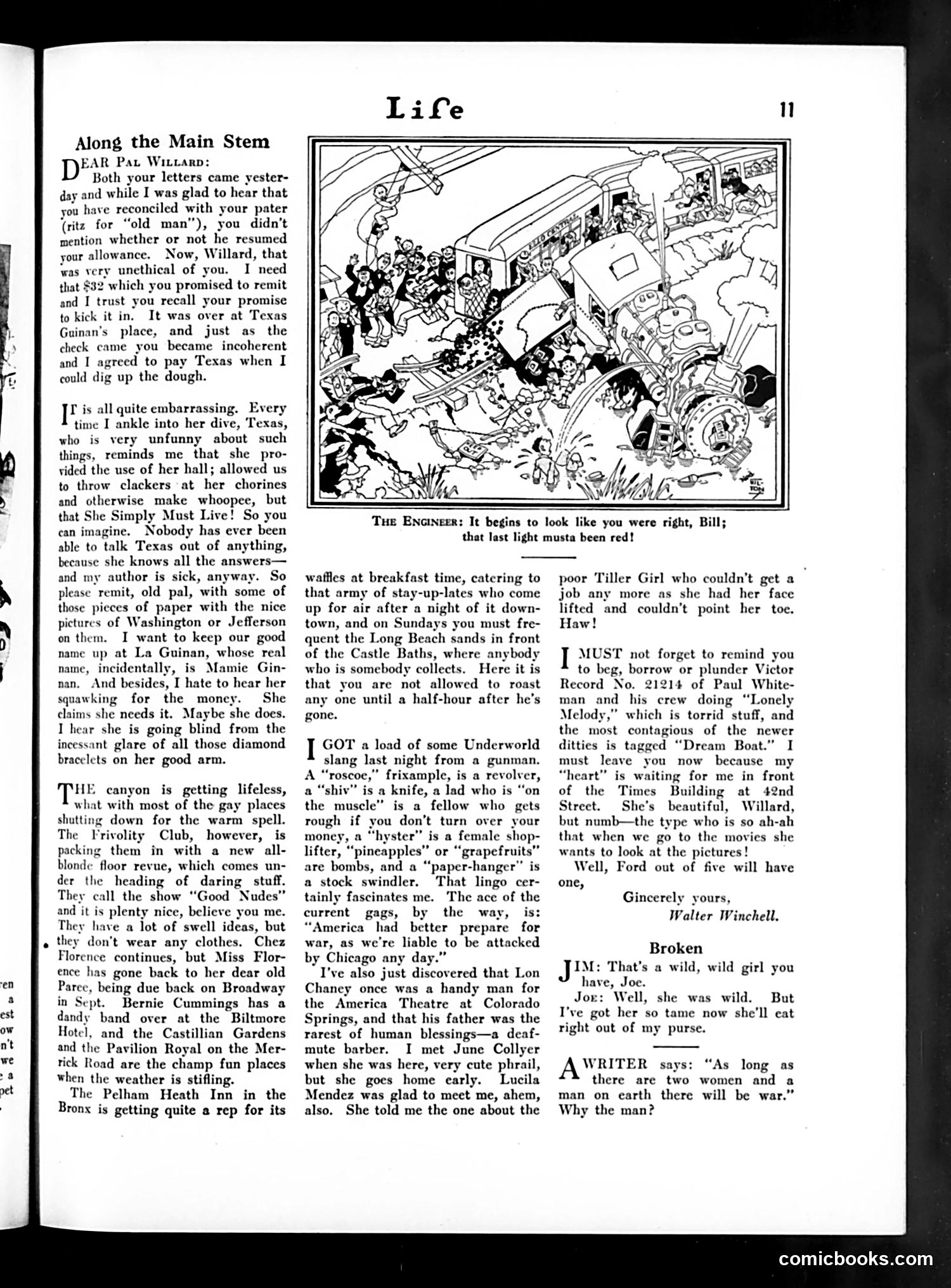
This page contains personal correspondence and commentary rather than a political cartoon. The main illustration shows a crowded, chaotic scene in what appears to be a subway or train car during rush hour—depicting urban congestion and crowded commuting conditions. The letters reference contemporary 1920s New York life: mentions of Texas Guinan (a famous nightclub hostess), Broadway shows, the Pelham Heath Inn in the Bronx, and the Underworld slang ("shiv," "frisample"). The satire targets urban inconveniences (crowded transit, high costs of living), celebrity gossip culture, and the underworld elements visible in 1920s city life. One final quote questions war and gender politics: "As long as there are two women and a man on earth there will be war." The content reflects Jazz Age urban social commentary rather than focused political satire.
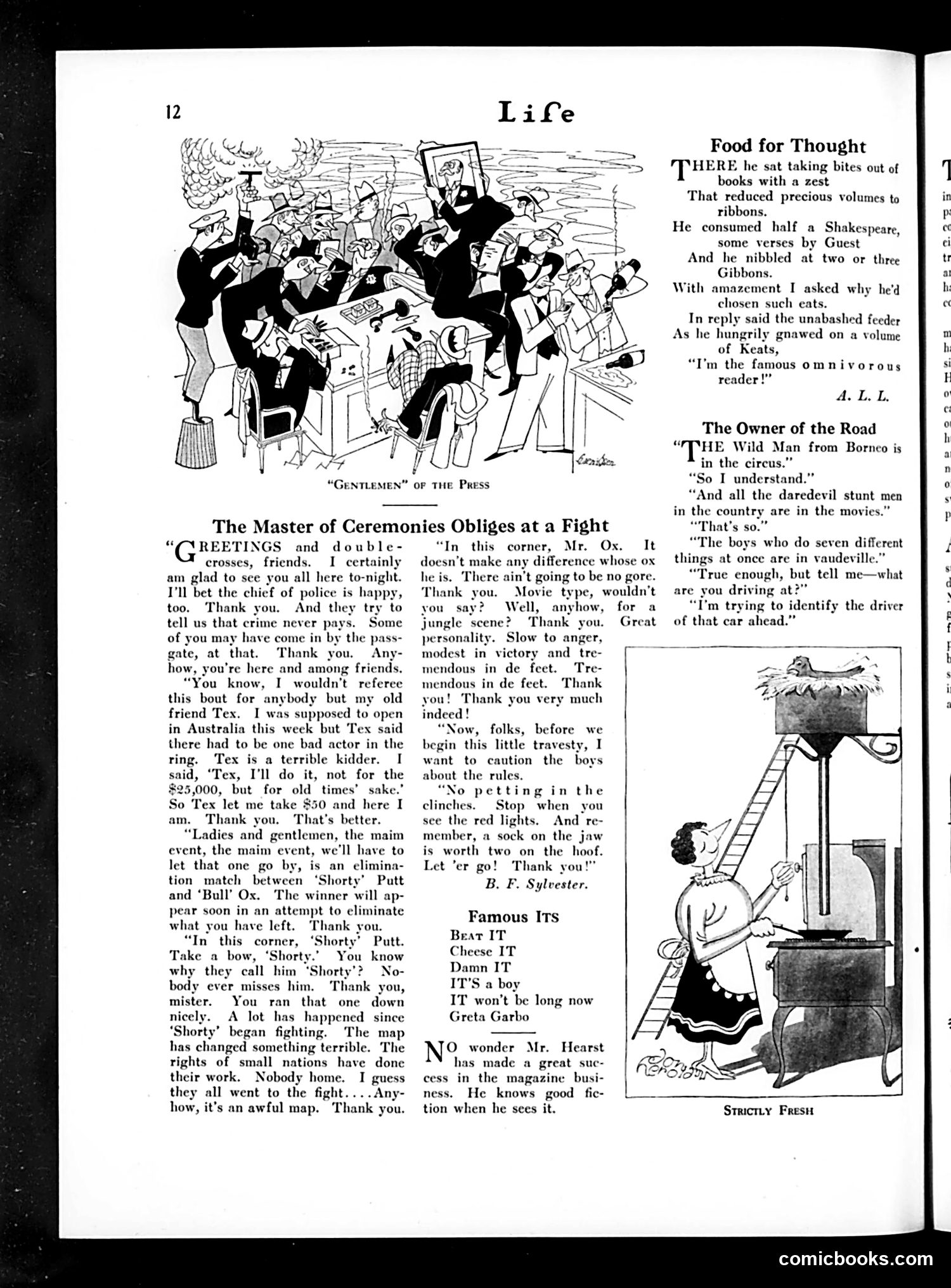
**Top Cartoon: "Gentlemen of the Press"** This illustration satirizes newspaper and magazine editors/journalists in a chaotic office scene. The crowded, energetic composition mocks the press's frantic work environment and sensationalism—a common Life magazine critique of media culture. **Main Article: "The Master of Ceremonies Obliged at a Fight"** A humorous piece where a ceremonial master describes officiating a boxing match with exaggerated politeness ("Thank you. Thank you very much"). The satire targets the absurdity of formal etiquette applied to a violent sport. **Right Column Features:** - "Food for Thought": Mocks an indiscriminate reader consuming multiple literary classics - "The Owner of the Road": Jokes about circus performers and stunt drivers - "Strictly Fresh": A cartoon about someone on a ladder (specific reference unclear) The page exemplifies Life's satirical humor targeting American social behaviors and institutions.
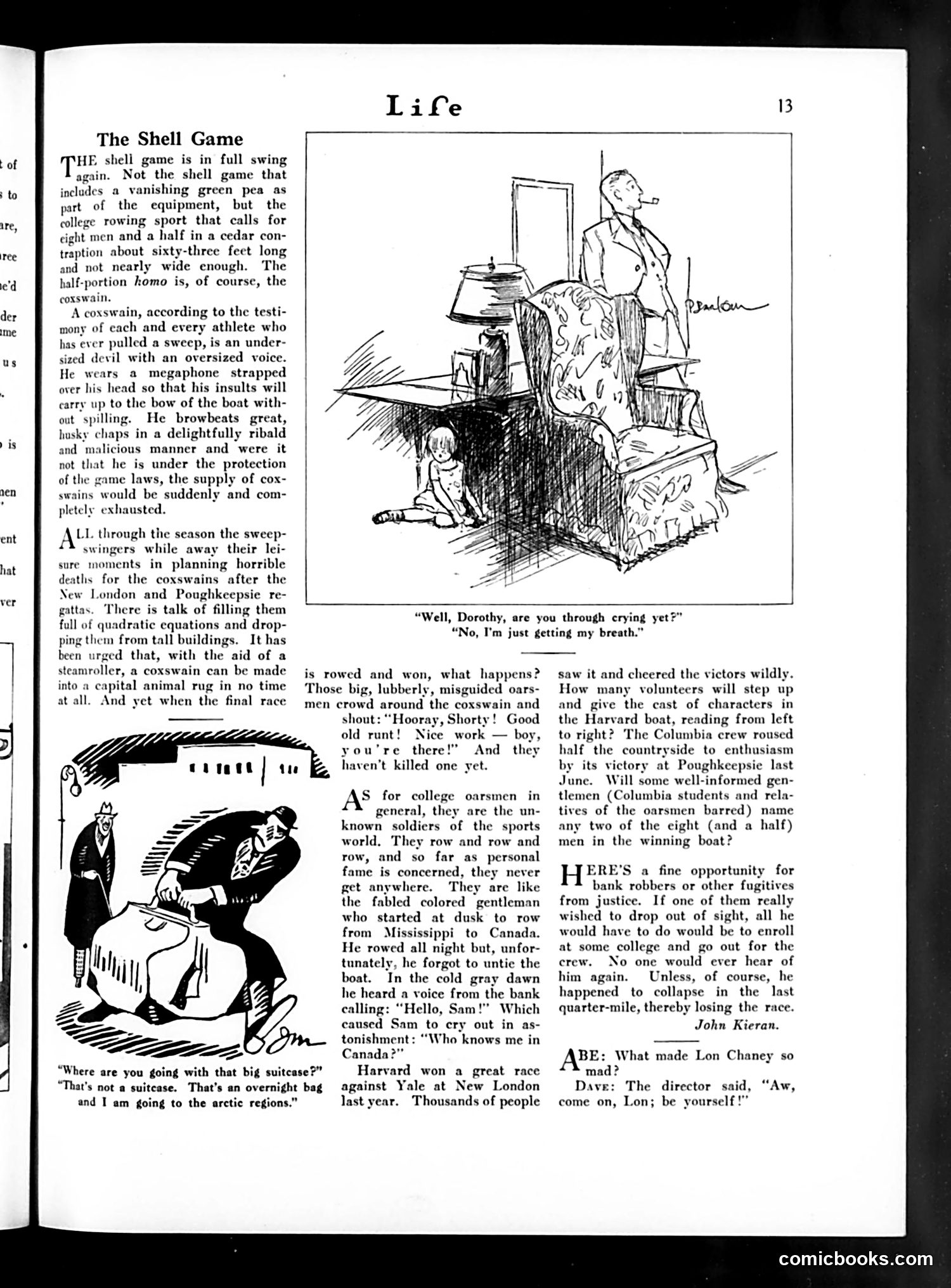
This page satirizes college rowing competitions, particularly between Harvard and Yale. The main article discusses the sport's intense rivalries and the physical demands on coxswains (boat steerers). The top illustration depicts a coxswain managing rowers, with the caption "Well, Dorothy, are you through crying yet?" — mocking the emotional intensity surrounding these races. The lower cartoon shows a man with a large suitcase, captioned "Where are you going with that big suitcase? That's not a suitcase. That's an overnight bag and I am going to the arctic regions." This appears to joke about someone fleeing after a rowing loss or scandal. The text references Harvard's victory over Yale at New London, celebrating the triumph while poking fun at college athletes' fame and single-minded devotion to rowing.
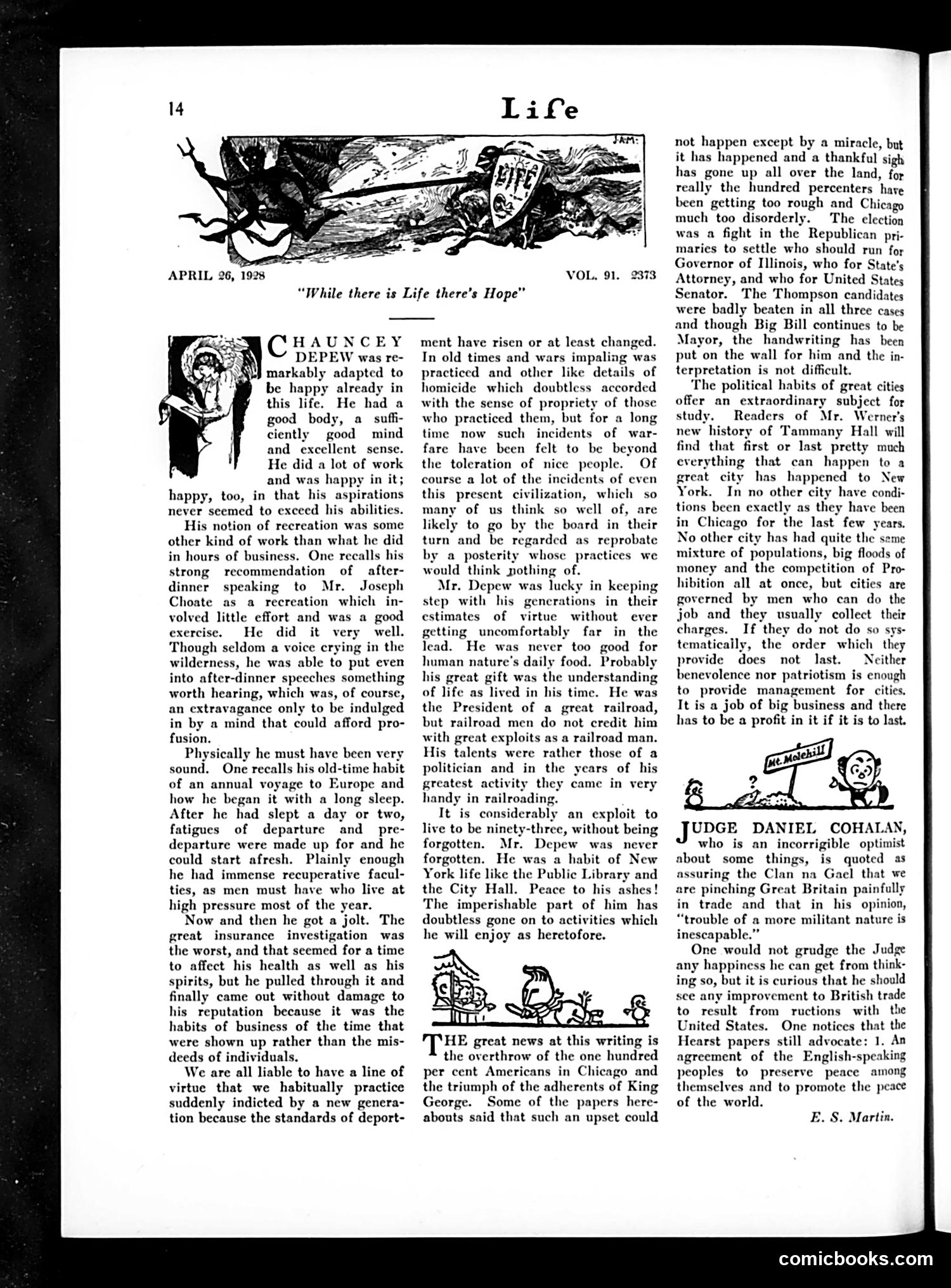
The page features an article about Chauncey Depew, a notable businessman and railroad president. The accompanying cartoon depicts Depew as a jolly, rotund figure—satirizing his comfortable wealth and good living. The text critiques Depew's somewhat naive optimism and lack of real hardship, noting he "was never too good for human nature's daily food." The article suggests his greatest talents lay in politics and railroading rather than genuine business acumen. A secondary cartoon mocks Judge Daniel Cohalan as an "incorrigible optimist" about British trade relations, sarcastically quoting him as believing trade troubles are "inescapable." The page's overall tone uses gentle mockery of prominent figures' self-assured confidence despite questionable competence or perspective.
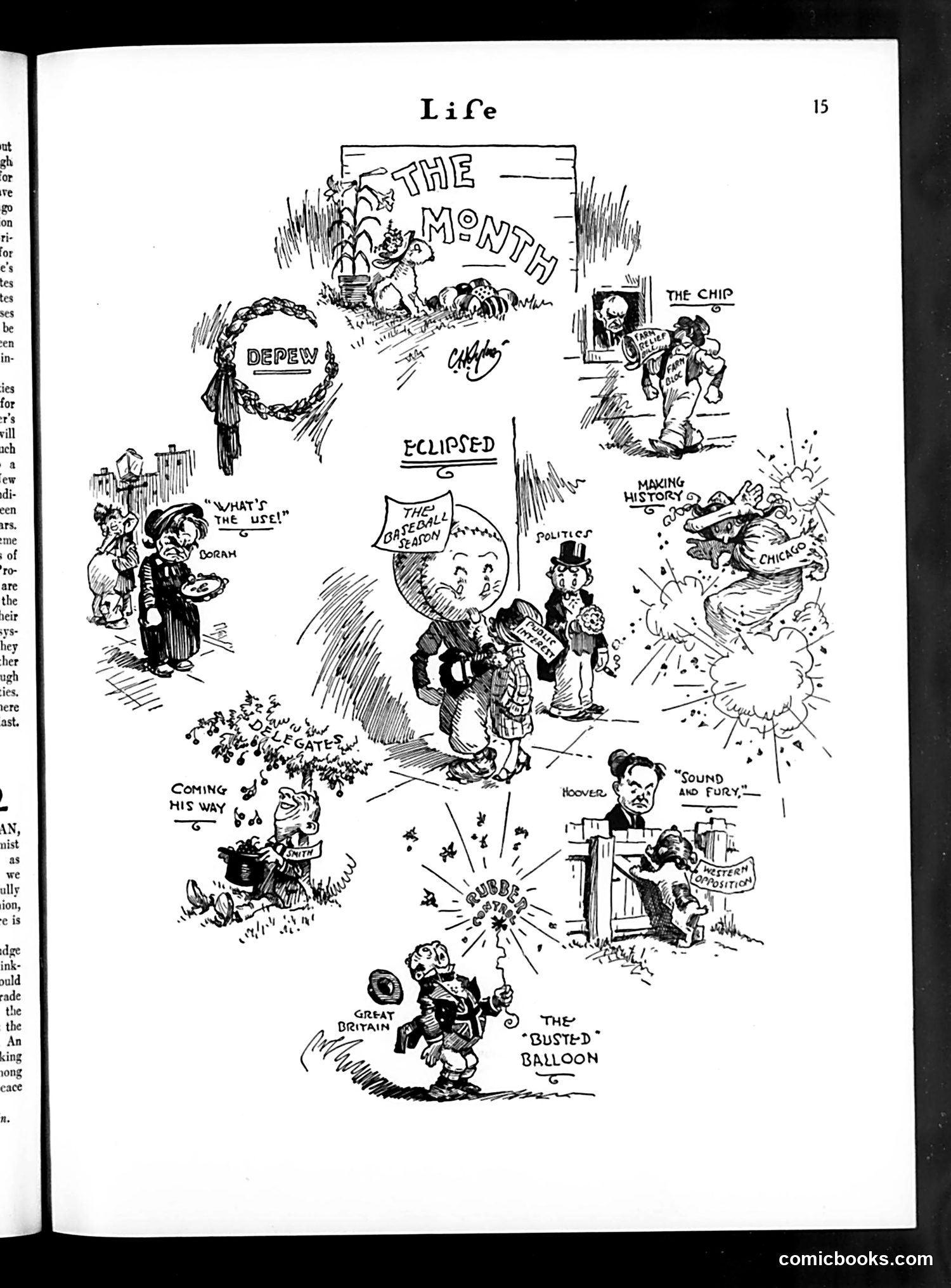
This is a composite cartoon summarizing major news events of a particular month. The visible labeled items include: - **"Depew"** - likely referring to a public figure - **"Eclipsed"** - a celestial reference, possibly to an actual eclipse that occurred - **"The Chip"** - unclear without additional context - **"Making History"** and **"Politics"** - general news categories - **"Hoover"** and **"Sound and Fury"** - references to political figures or events - **"Coming His Way"** - appears to reference approaching consequences - **"Great Britain"** and **"The 'Busted' Balloon"** - likely commentary on British politics or international relations The cartoons use caricature and visual metaphor to mock or comment on contemporary political events, though specific identifications require knowledge of the particular month depicted.
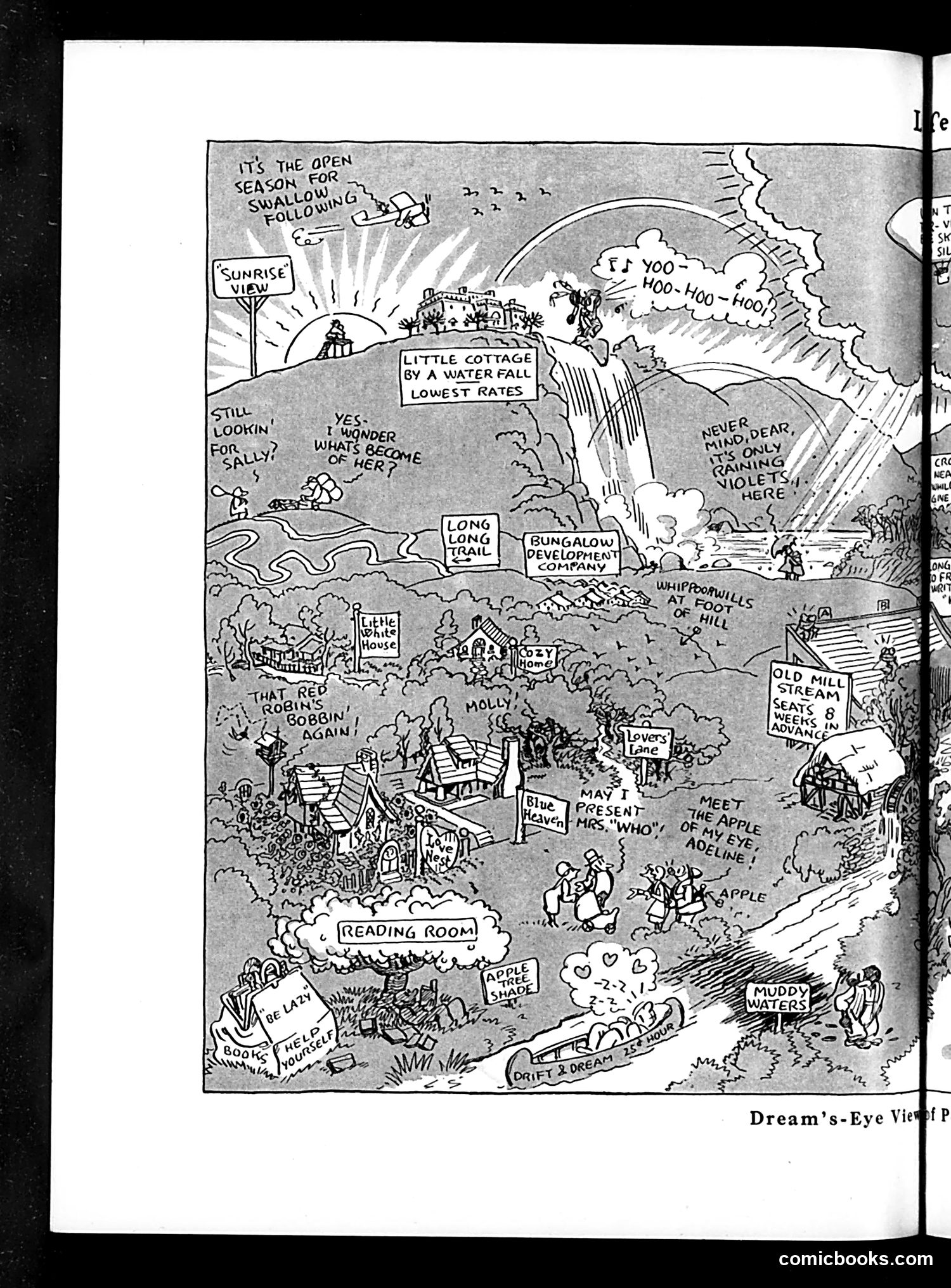
This is a whimsical map-style cartoon titled "Dream's-Eye View," depicting an idealized rural or small-town retreat. The illustration satirizes romantic notions of pastoral escape through labeled attractions like "Little Cottage by a Water Fall," "Long Long Trail," "Bungalow Development," and venues for leisurely activities ("Reading Room," "Old Mill Stream"). The humor lies in juxtaposing the peaceful, nature-focused fantasy with commercial development markers and activities ("Lovers Lane," "Apple Shade"). Speech bubbles contain clichéd romantic phrases ("Still lookin' for Sally?"). This appears to be gentle satire about urban dwellers' fantasies of countryside living and the commercialization of rural leisure—how even "escape" destinations become packaged tourist attractions with predictable amenities.
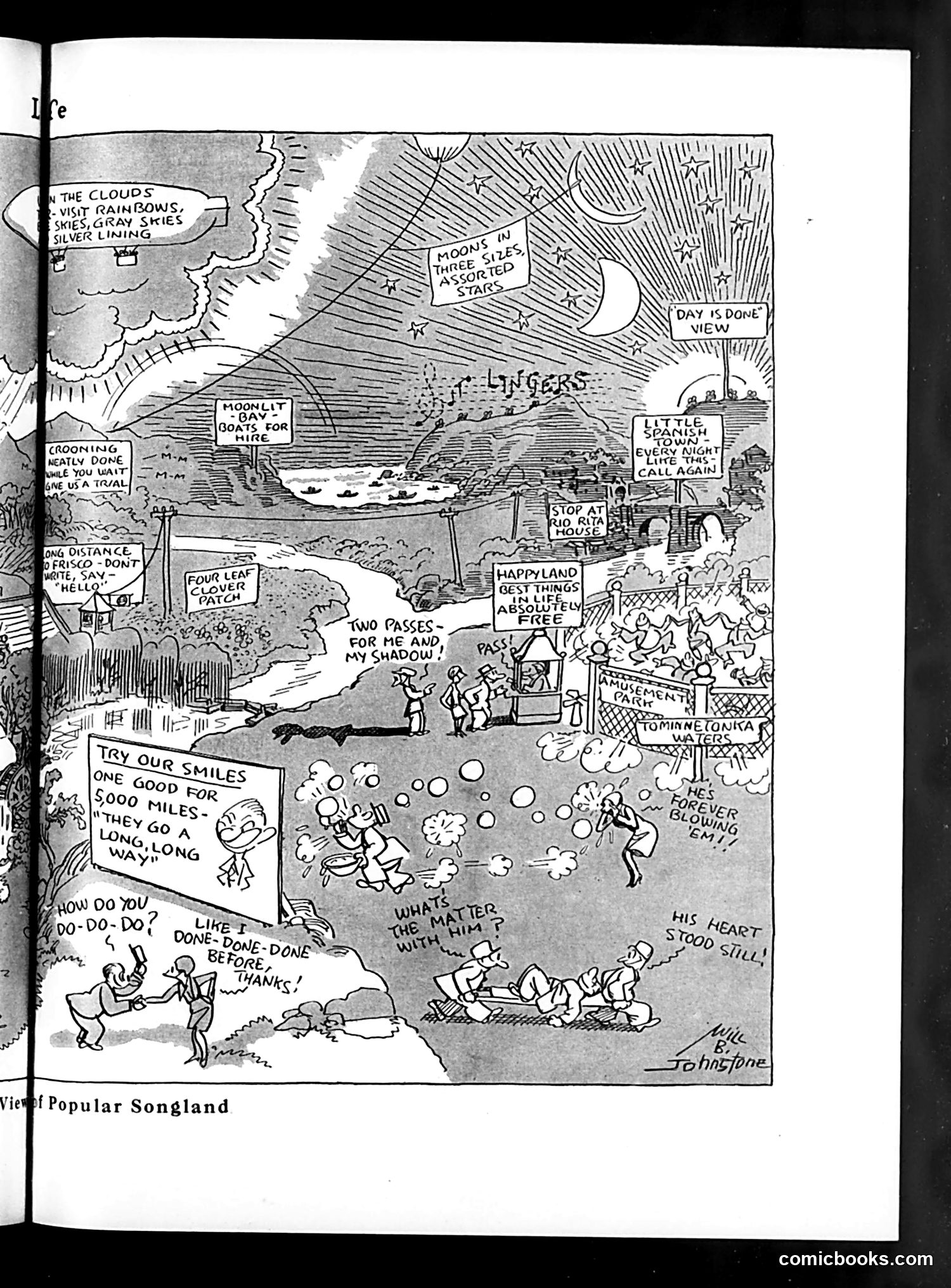
This is a whimsical map-style cartoon depicting an imaginary tourist destination called "Popular Songland." The illustration satirizes how American popular songs reference idealized, romanticized locations and scenarios. The cartoon features various song-related attractions and landmarks: "Moonlit Boats for Hire," "Four Leaf Clover Patch," "Happyland" amusement park, and a "Rio Rita" establishment. Speech bubbles reference song lyrics ("Two passes for me and my shadow," "Try our smiles, good for 5000 miles"). The satire mocks how popular songs of the era (likely 1920s-30s) painted unrealistically cheerful, manufactured versions of romantic and leisure experiences. It's essentially poking fun at the escapist fantasies sold by Tin Pan Alley songwriters and the gullibility of audiences who believed these sentimental tropes.
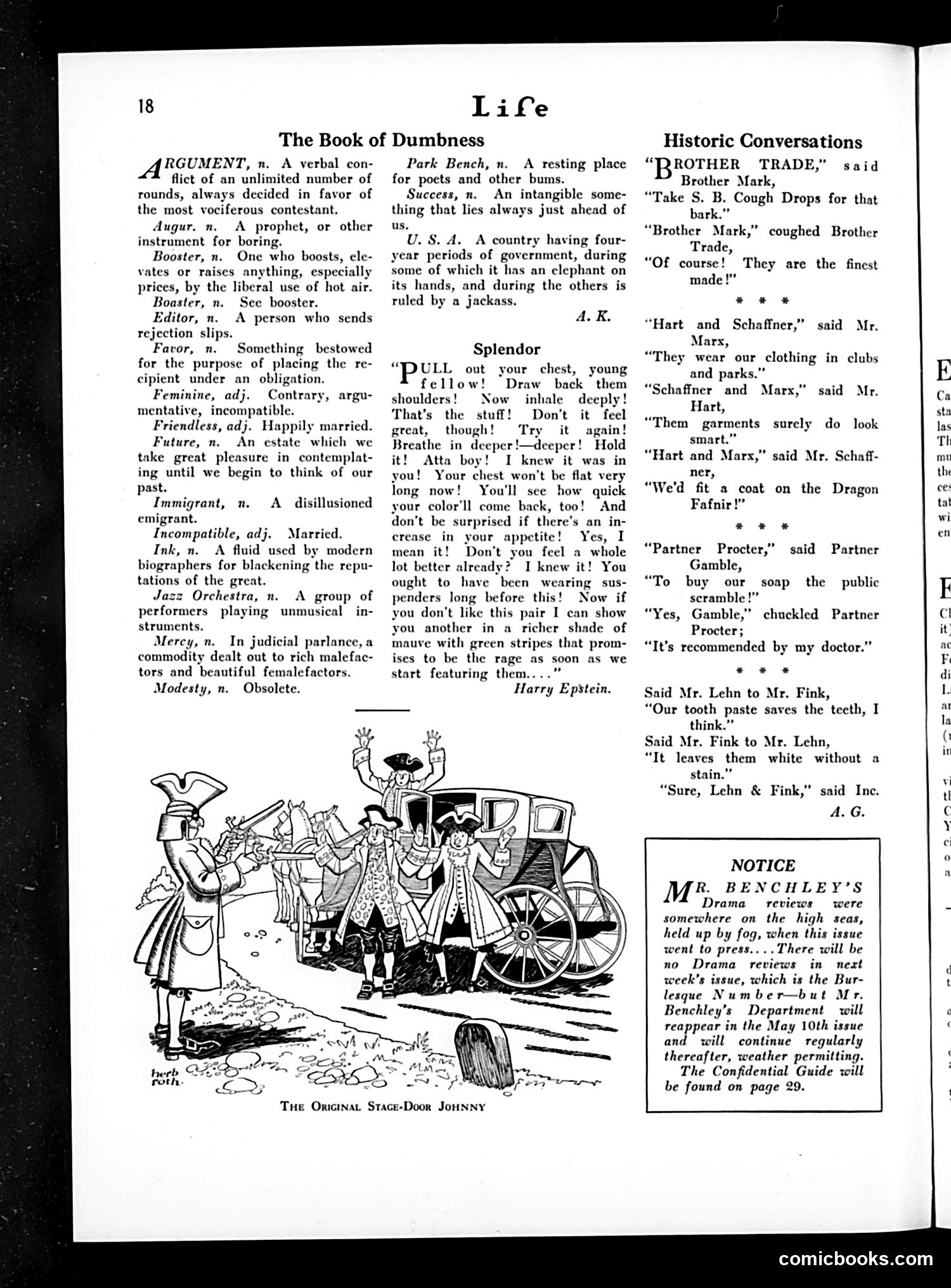
This page combines satirical dictionary definitions with advertising parodies and a cartoon. **"The Book of Dumbness"** mocks American life through fake definitions. Notable entries include: - **U.S.A.**: Satirizes alternating political parties as "an elephant" (Republicans) versus "a jackass" (Democrats) - **Incompatible/Friendless**: Cynical jabs at marriage - **Mercy**: Suggests wealthy criminals and attractive women receive preferential judicial treatment - **Modesty**: Declared "obsolete" **"Historic Conversations"** parodies famous brand name partnerships (Hart & Schaffner Marx, Procter & Gamble, Lehn & Fink) by having them speak as if they're different people complimenting each other's products—satirizing corporate advertising's false sincerity. **The cartoon** ("The Original Stage-Door Johnny") depicts a fashionably dressed man outside a theater carriage, likely mocking wealthy male admirers of actresses—a recognizable social type of the era. The overall tone is sharp social criticism wrapped in humor, typical of Life's early 20th-century satirical approach.
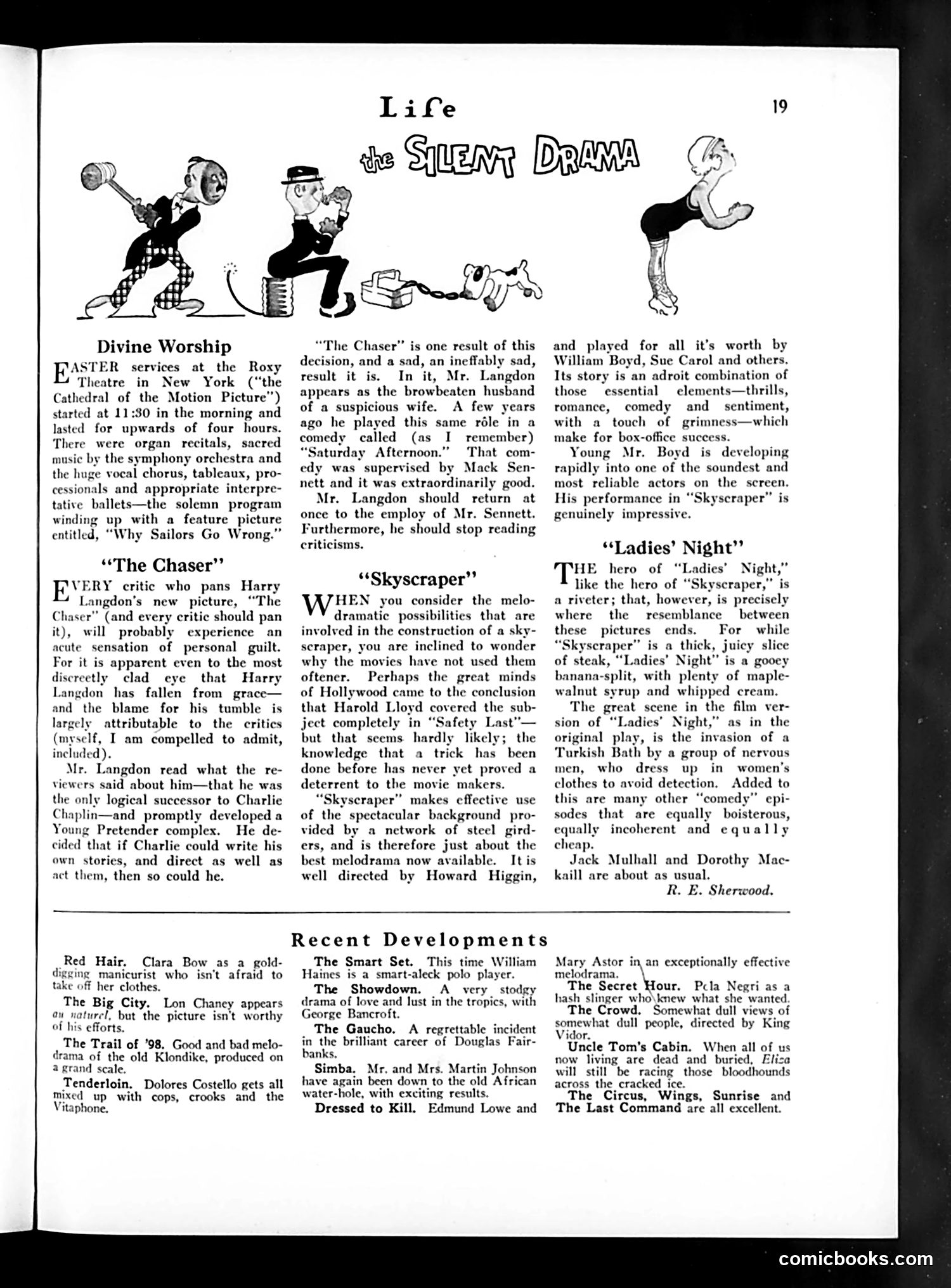
This Life magazine page reviews several silent films and satirizes movie industry dynamics circa the 1920s. **The cartoon** (top) depicts the Roxy Theatre in New York as a quasi-religious institution—"Cathedral of the Motion Picture"—mocking how movies had become a mass cultural phenomenon rivaling traditional worship. **Film reviews** critique specific actors and creative decisions: - **Harry Langdon** ("The Chaser"): The critic argues Langdon's career declined after reading favorable comparisons to Charlie Chaplin. Developing an inflated ego, Langdon began writing and directing his own films instead of working with director Mack Sennett, resulting in inferior work. The satire targets artistic hubris and critics' influence on performers. - **William Boyd** ("Skyscraper"): Praised as a reliable actor in well-constructed melodrama using skyscraper construction as backdrop. - **"Ladies' Night"**: Dismissed as inferior "banana-split" entertainment compared to "Skyscraper's" substantial "steak"—contrasting quality dramatic work with cheap comedic gimmickry (men disguising as women). The page satirizes both Hollywood's artistic pretensions and the fickle nature of silent-film stardom.
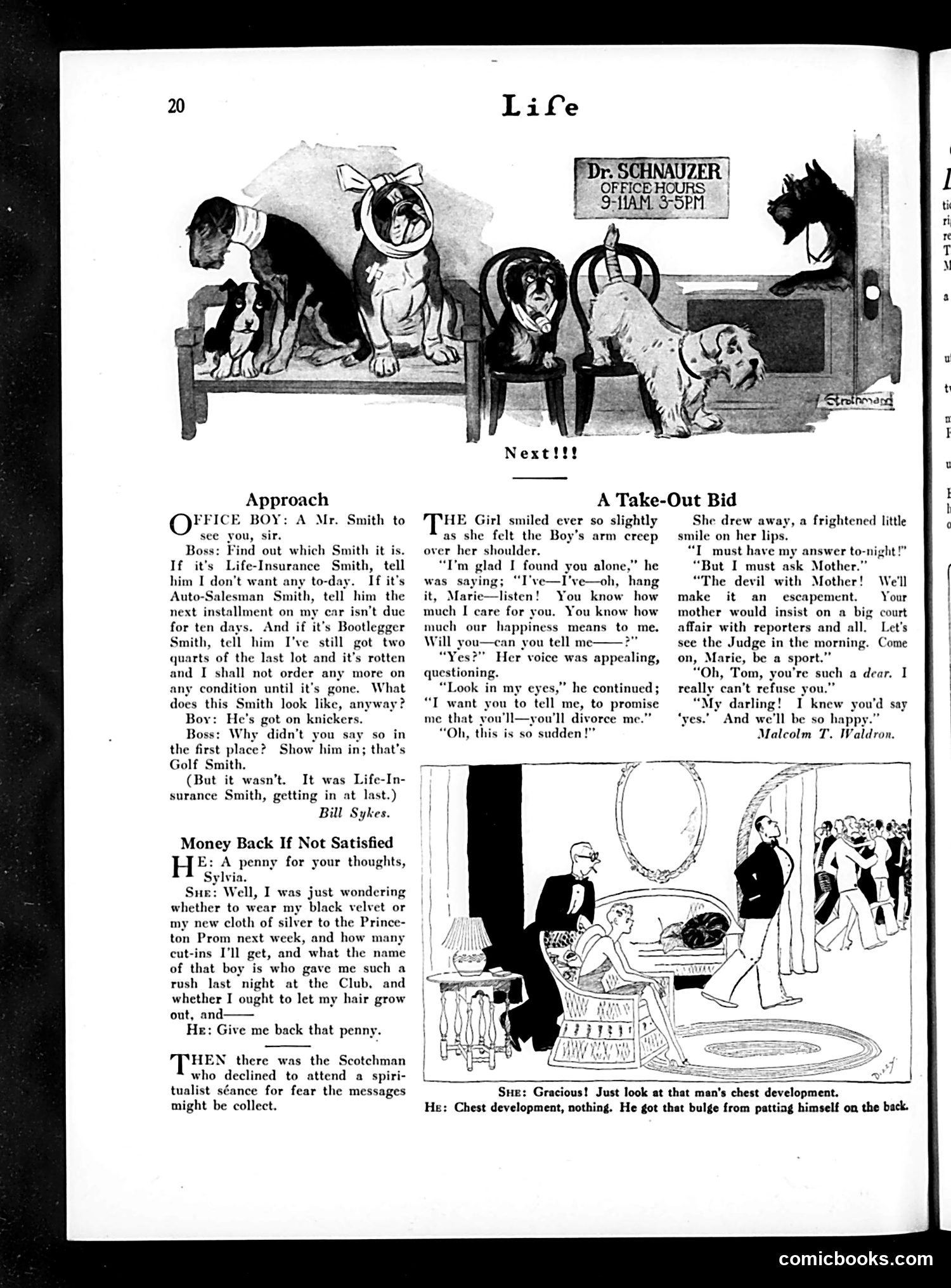
This page contains three separate humorous sketches satirizing early 20th-century American life: **"Approach"** mocks the modern office's endless stream of salesmen. The boss dismissively categorizes incoming "Smiths" by profession—life insurance, auto salesmen, and bootleggers (referencing Prohibition-era illegal alcohol). The punchline reveals he assumes "knickers" indicate a golfer, suggesting class assumptions about dress. **"Money Back If Not Satisfied"** lampoons women's materialism and frivolity. A woman's "penny for your thoughts" response—listing fashion choices, Princeton Prom attendance, male admirers—suggests women's minds fixate on superficial concerns, earning the man's sarcastic request for his penny back. **"A Take-Out Bid"** parodies marriage dissolution. A man proposing divorce frames it romantically, wanting to "elope" to avoid public scandal. The woman's delighted acceptance satirizes both marriage's fragility and women's supposed gullibility. The lower cartoon mocks male vanity: a man's "chest development" actually results from "patting himself on the back"—self-congratulation rather than fitness.
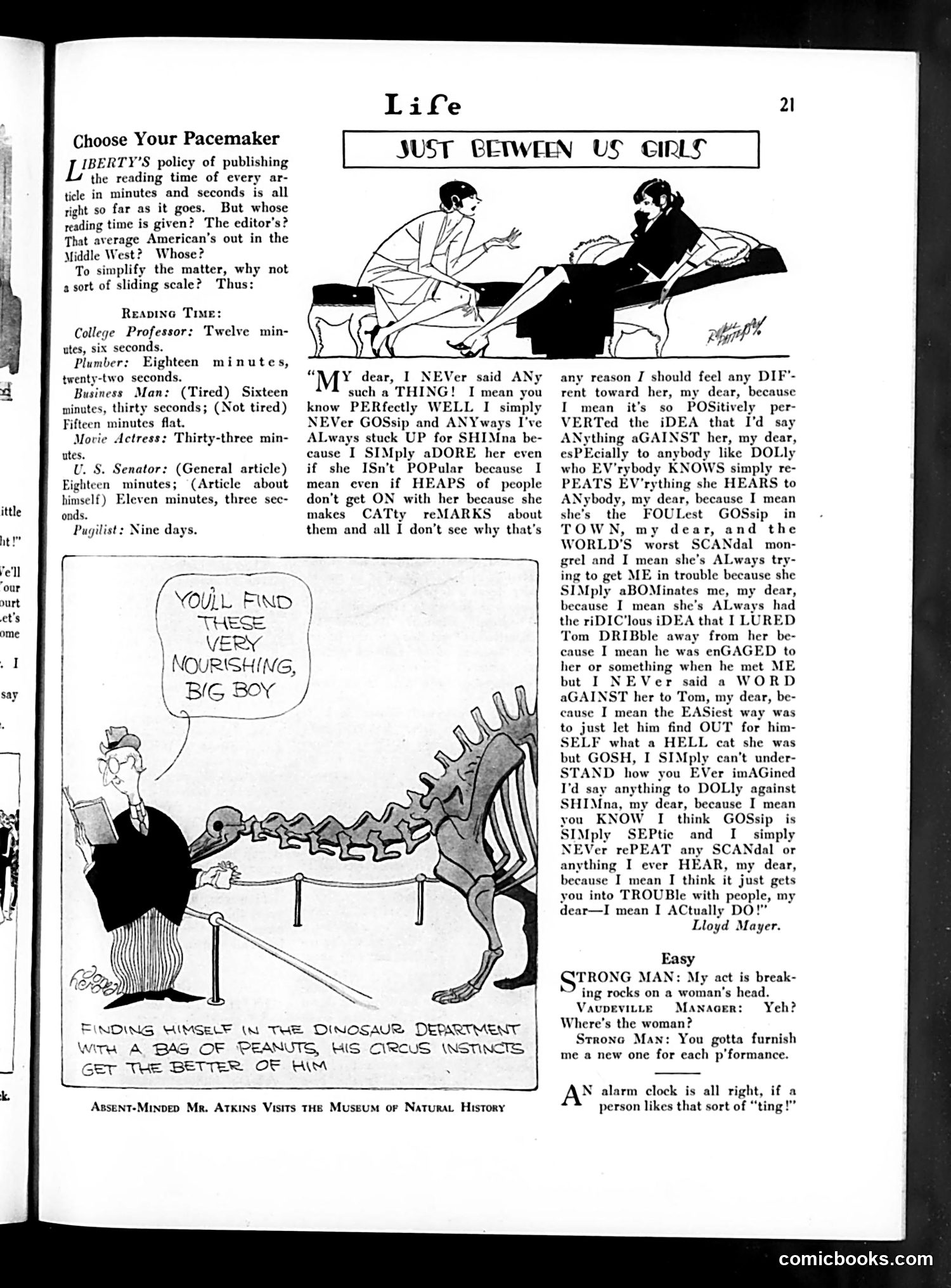
This page contains three satirical pieces typical of 1920s Life magazine humor: **"Choose Your Pacemaker"** mocks Liberty magazine's practice of listing article reading times. The satire suggests different groups read at vastly different speeds—a U.S. Senator reads faster when the article is about himself (11 minutes versus 18), while a "Pugilist" supposedly needs nine days, implying boxers are unintelligent. **"Just Between Us Girls"** parodies women's gossip through exaggerated capitalization showing selective emphasis. A woman insists she never gossips while simultaneously spreading rumors about others, revealing hypocrisy and cattiness in female social circles. **The dinosaur cartoon** shows a man feeding peanuts to a museum dinosaur skeleton, captioned that his "circus instincts" overcome him—a gentle joke about reverting to primitive behavior in unexpected settings. All three pieces trade in period stereotypes: senators' vanity, boxers' stupidity, women's cattiness, and masculine impulse-driven behavior.
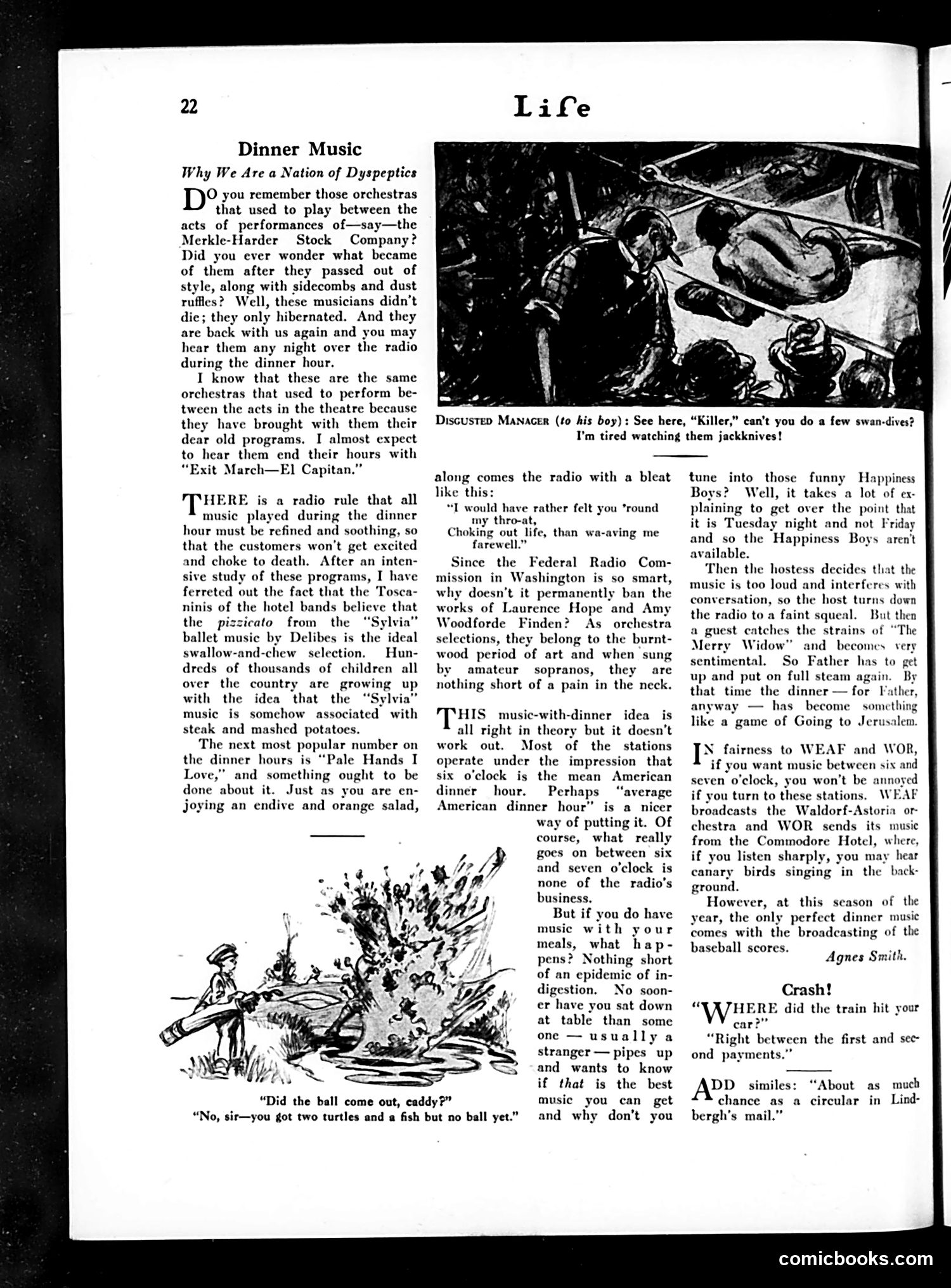
This 1920s satirical piece mocks the then-new phenomenon of radio broadcasts during dinner hours. The author argues that orchestras playing "refined and soothing" dinner music actually cause indigestion rather than aid digestion—hence Americans are a nation of dyspeptics (people with poor digestion). The satire targets: 1. **Radio stations' pretension**: They believe classical music (specifically pieces like "Sylvia" ballet music and Amy Woodforde Finden's sentimental songs) are appropriate dinner accompaniment, when they're actually distracting and irritating. 2. **Social disruption**: Dinner guests argue about song choices; hosts constantly adjust volume; the whole meal becomes chaotic rather than refined. 3. **Arbitrary scheduling**: Radio assumes 6 o'clock is "average American dinner hour," ignoring actual variations. The cartoon below shows a frustrated golf caddy, likely illustrating how dinner radio interrupts and annoys—a visual punchline about unwanted intrusions during leisure time.
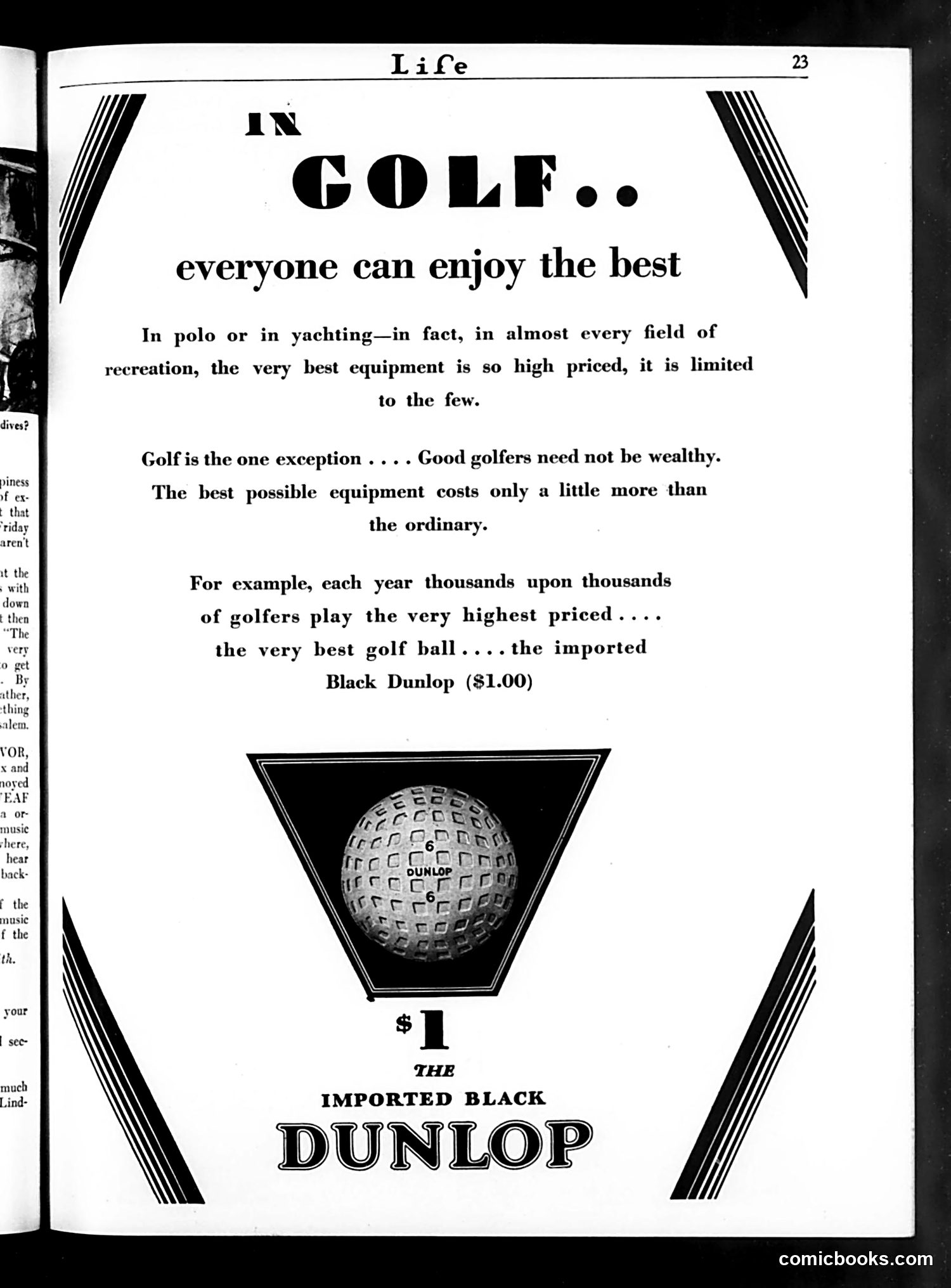
This is a **golf equipment advertisement**, not a political cartoon. The page promotes Dunlop golf balls as an affordable luxury. The advertisement's argument is that golf, unlike polo or yachting, is democratically accessible—good golfers don't need wealth. It claims the "very best" equipment costs only slightly more than ordinary gear. The specific example: the imported Black Dunlop ball at $1.00. For a modern reader: **One dollar in the early 20th century equals roughly $30-35 today**, so this wasn't truly "cheap." The satire (if present) may be subtle—the ad promises democratic access while promoting an expensive imported product. The page exploits the appeal of golf as a sport where skill matters more than wealth, making premium equipment seem like a reasonable investment for any dedicated player.
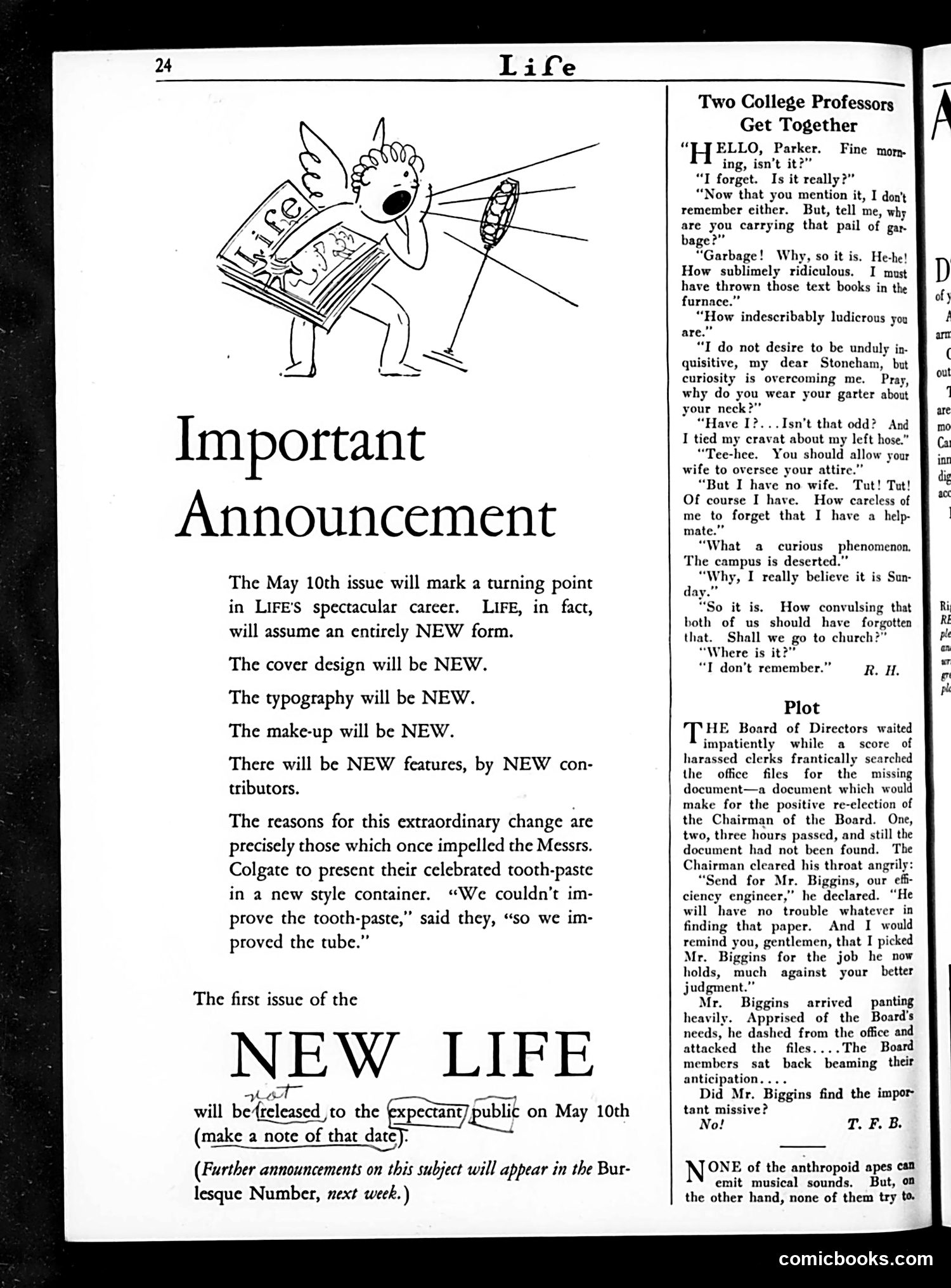
**Main Content: Magazine Redesign Announcement** The left page announces Life magazine's complete visual overhaul, comparing the refresh to Colgate toothpaste's strategy—they couldn't improve the product, so they improved the packaging. This satirizes corporate rebranding logic while promoting the magazine's May 10th redesign. **"Two College Professors" Cartoon** This sketch mocks absent-minded academics through absurdist humor. Two professors interact while comically oblivious—one carries garbage (accidentally threw textbooks in the furnace), the other wears a garter around his neck instead of his leg. Their dialogue is deliberately pretentious ("indescribably ludicrous," "curious phenomenon") while discussing mundane matters, satirizing professorial pomposity and intellectual detachment from reality. The joke: these educated men are hilariously incompetent at basic life functioning. **"Plot" Story** A brief narrative joke: an efficiency expert is summoned to find a missing document crucial for a board chairman's re-election. Despite his reputation, Mr. Biggins fails—the punchline is simply "No!"—deflating expectations of expertise.
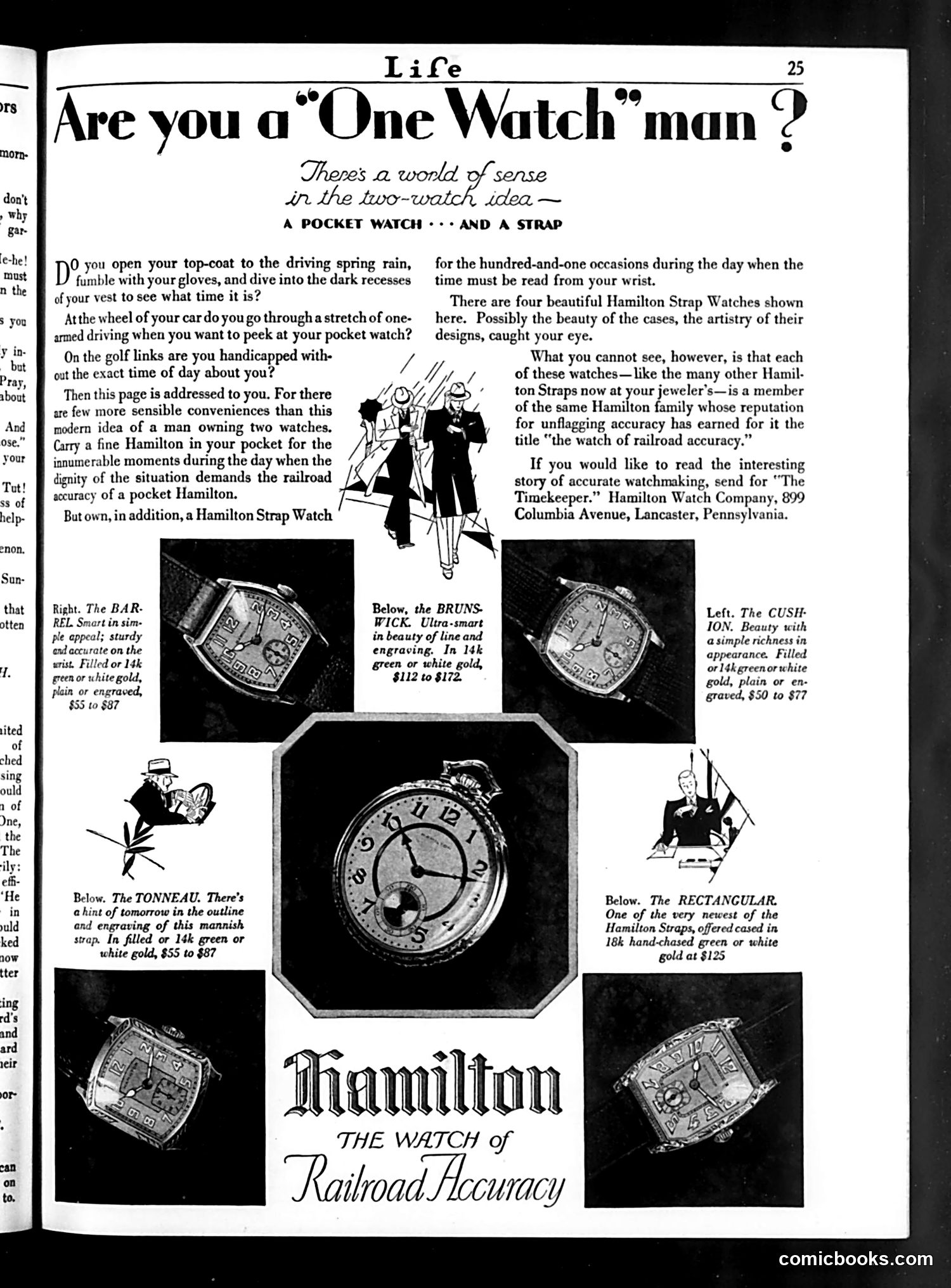
This is primarily a **Hamilton watch advertisement**, not satire. The page promotes owning two watches—a pocket watch for formal occasions and a wrist "strap watch" for everyday use. The humor is gentle and aspirational rather than satirical. The opening scenarios (fumbling in rain, one-armed driving, golfing) humorously depict relatable situations where a pocket watch is inconvenient, positioning the wrist watch as a modern solution. The cartoonish illustrations of men in these predicaments make the pitch lighthearted. The key selling point: Hamilton's reputation for **"railroad accuracy,"** a genuine brand claim from the era when precise timekeeping was essential for railroad operations and safety. This lent credibility and prestige to the brand. The advertisement targets affluent male readers who could afford multiple quality watches ($55-$172 in 1920s dollars). It frames owning two watches not as luxury but as sensible modern convenience—a relatively early promotion of wrist watches, which were then still considered less dignified than pocket watches. The page reflects early 20th-century class expectations and changing timekeeping technology.
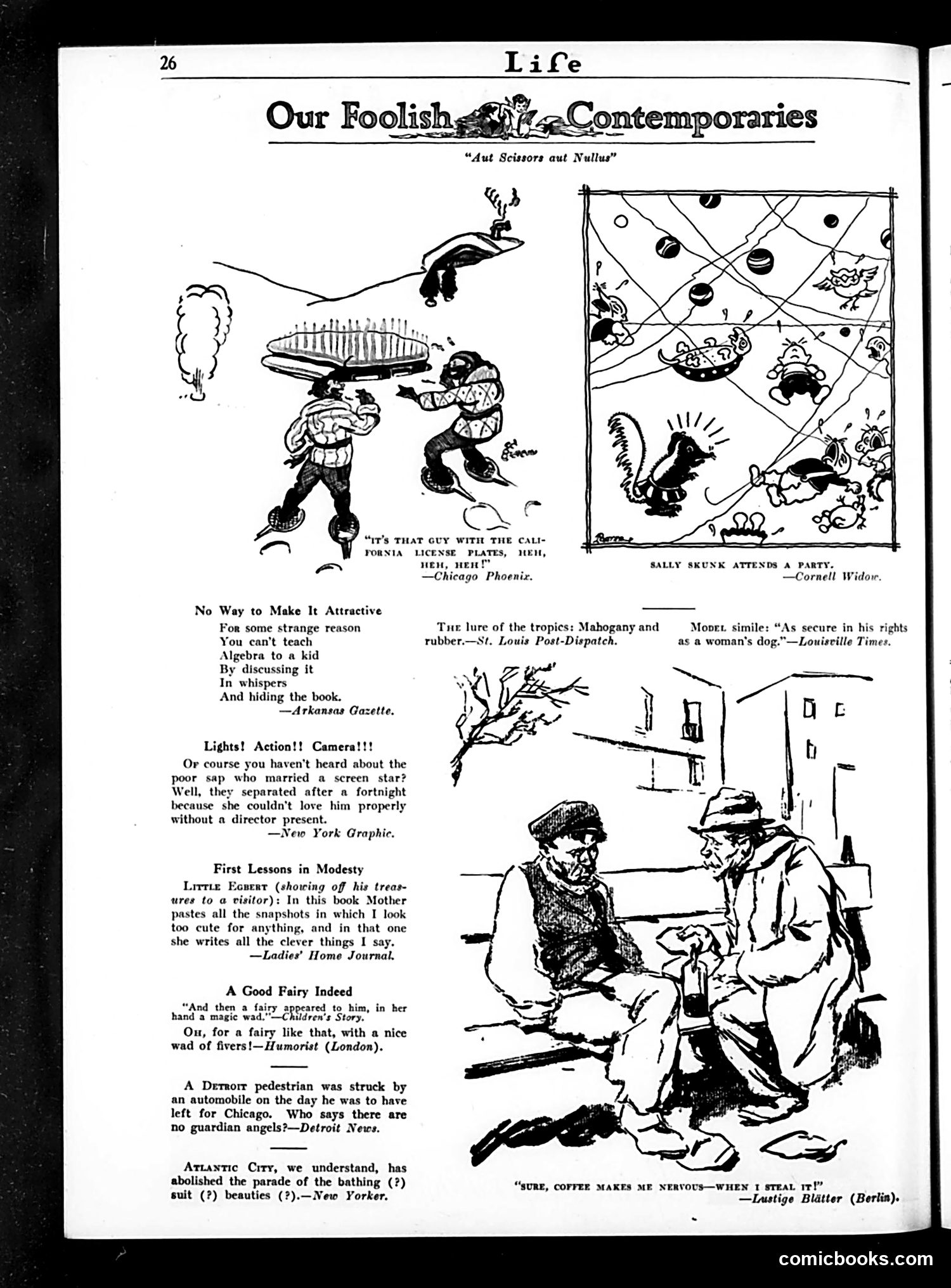
This is a humor compilation page featuring satirical quotes and cartoons from various newspapers and magazines, mocking contemporary social absurdities. **Key items:** - **Top left**: A man juggling dinner plates while balancing a UFO-shaped object—satirizing the California license plate controversy (unclear exact reference) - **Top right**: "Sally Skunk Attends a Party"—an anthropomorphic animal party scene, likely mocking pretentious social gatherings - **Bottom cartoon**: Two working-class men with tools discussing coffee—a German joke about nervousness when stealing, playing on coffee's stimulant reputation **The page's point**: Life reprints foolish or absurd observations from competing newspapers and magazines, using the Latin header "Aut Scissors aut Nullus" ("Either scissors or nothing")—meaning Life edits/cuts down the most ridiculous contemporary commentary. It's meta-satire: mocking other publications' lowbrow humor and questionable logic while simultaneously publishing that same content.
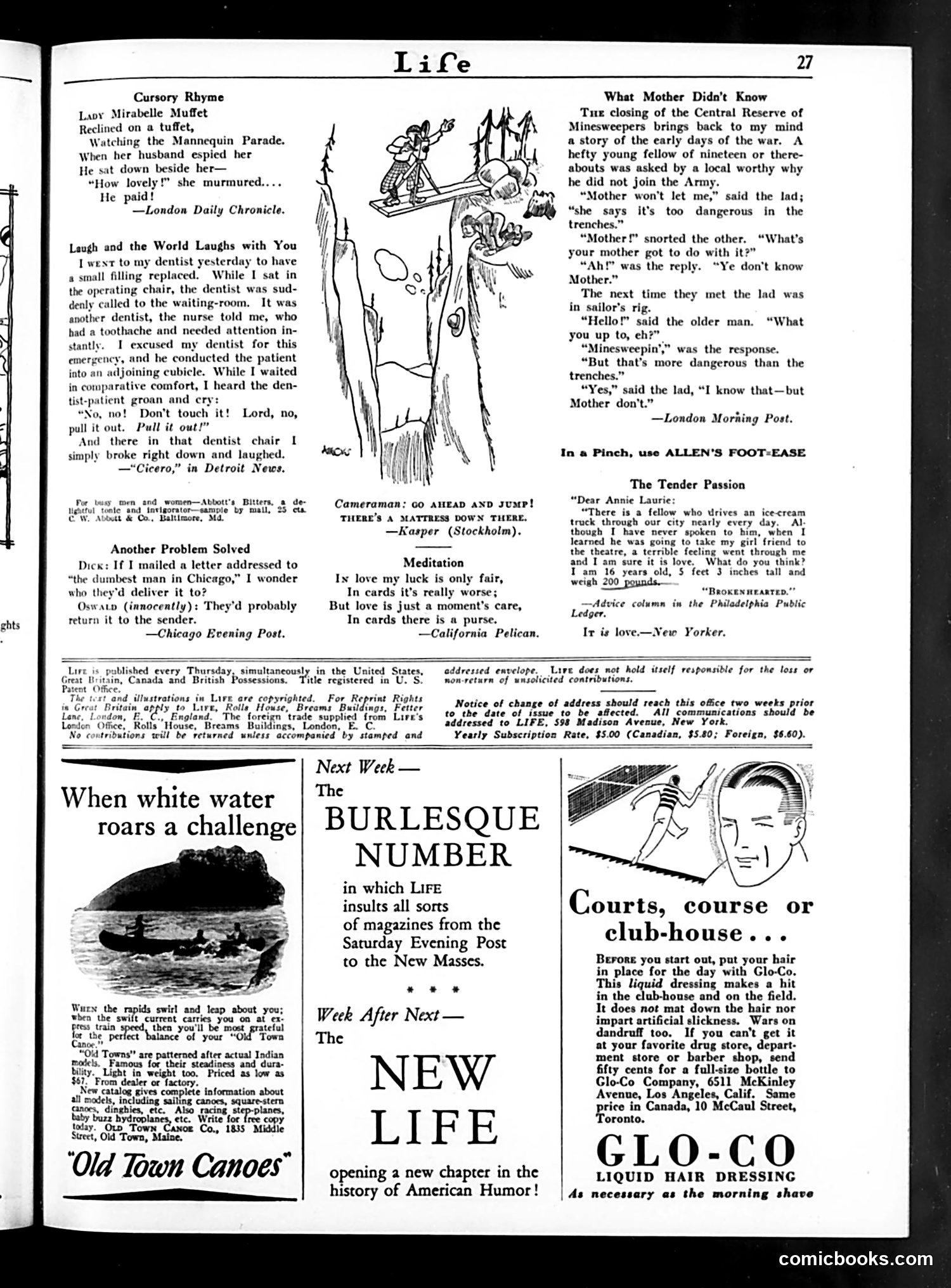
This page showcases early 20th-century satirical humor through short anecdotes and jokes. The content includes: **"What Mother Didn't Know"**: A WWI-era story about a young man who claims his mother won't let him join the Army as too dangerous—yet she allows him to become a minesweeper, an even deadlier role. The irony is that mothers' protective instincts are absurdly selective about actual danger. **"Laugh and the World Laughs with You"**: A dentist's predicament where another dentist with a toothache refuses treatment ("Don't touch it!"), causing the waiting patient to find dark humor in a colleague's pain. **Other brief jokes** mock human vanity (the mannequin parade), romantic delusion (a 16-year-old's "love" for an ice-cream vendor), and card-game luck. The page is primarily **humor/satire content** rather than political commentary, reflecting Life's tradition of publishing everyday domestic comedies and wordplay. The tone is genteel, the humor gentle—representing upper-middle-class magazine entertainment of the period.
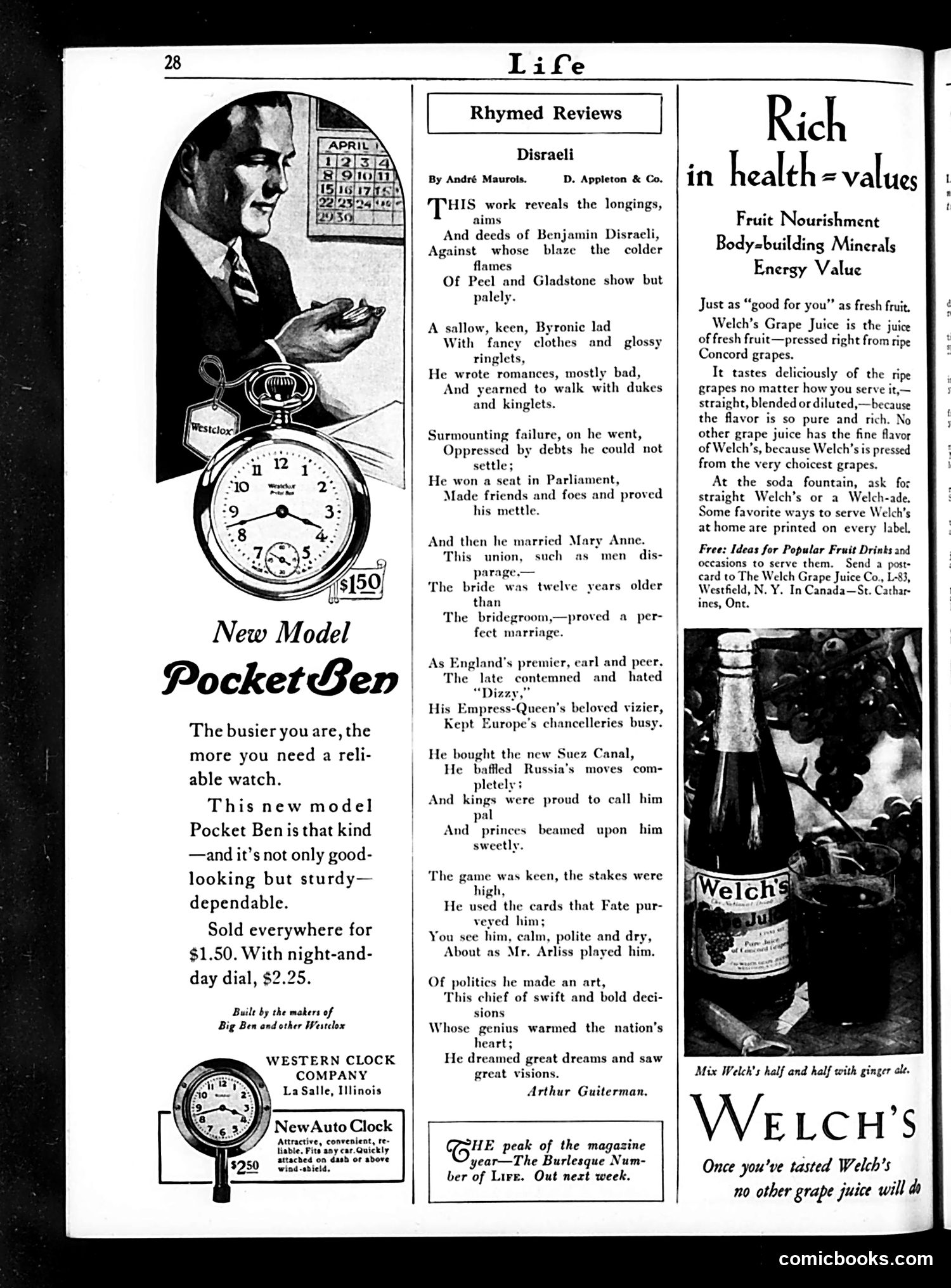
This page is primarily **advertising and book review content**, not political satire. The central item is a rhymed review of André Maurois's biography of **Benjamin Disraeli**, the 19th-century British Prime Minister. The verse humorously summarizes Disraeli's life: his dandyish youth, failed literary ambitions, financial struggles, unlikely marriage to an older woman (Mary Anne), and eventual rise to political prominence. The reference to "Mr. Arliss" suggests a contemporary stage or film portrayal of Disraeli. The page also advertises **Pocket Ben watches** (by Westclox) and **Welch's Grape Juice**, promoting the latter as a health product. The advertisement emphasizes the juice's nutritional value and purity. There is no apparent political cartoon or satire—the Disraeli review is literary commentary on a historical biography, not contemporary political commentary.
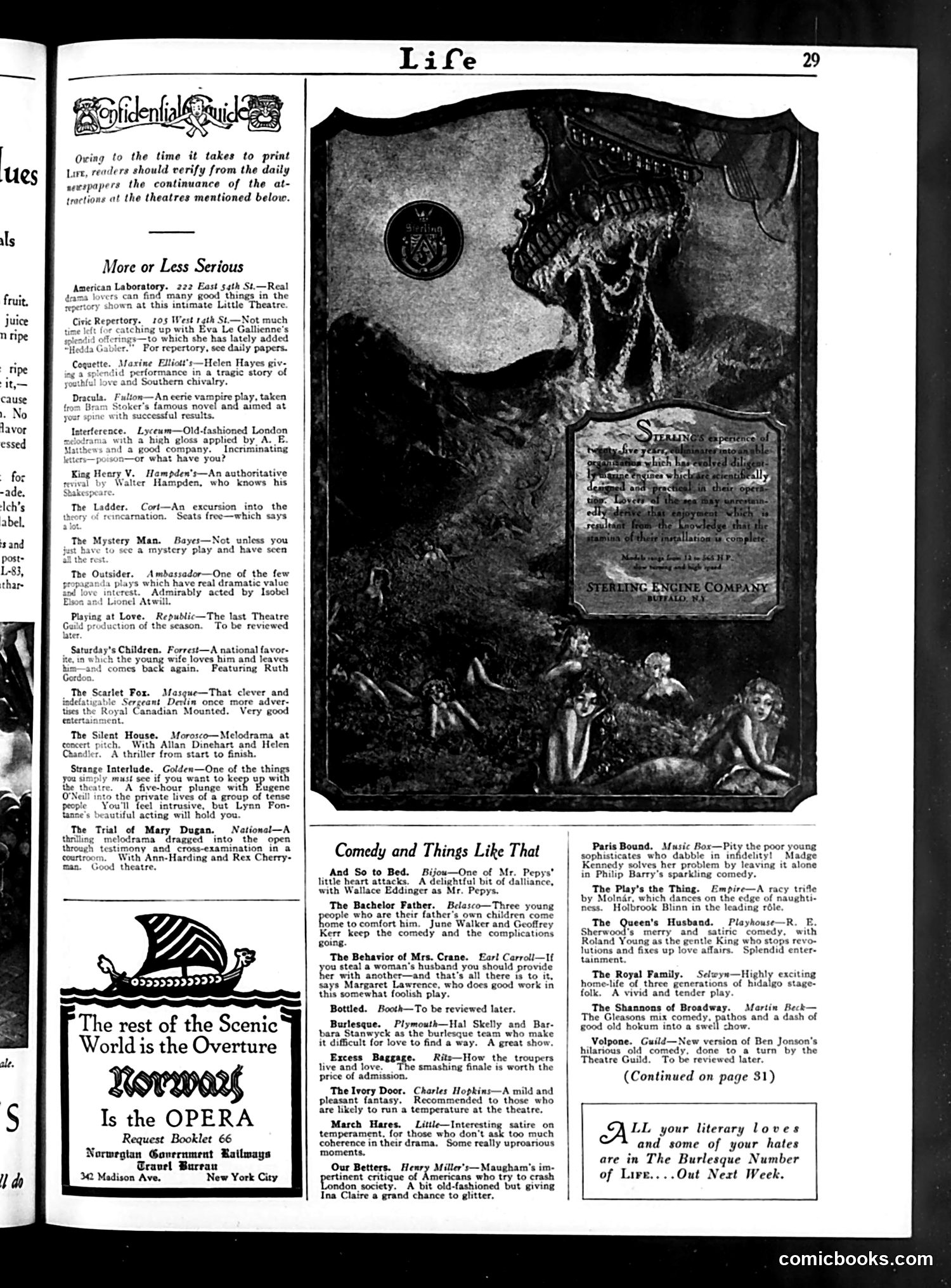
This page is primarily a **theater listings and reviews section**, not a political cartoon. It's a practical guide for New York theatergoers, listing current Broadway productions with brief critiques. The content reflects 1920s theatrical taste: serious dramas like "Strange Interlude" and "The Trial of Mary Dugan" (melodramas involving courtroom testimony and moral dilemmas), vampire plays ("Dracula"), and comedies ranging from drawing-room farce to burlesque. The right side features a **Sterling Engine Company advertisement**—an industrial/mechanical product unrelated to theater—demonstrating how magazines mixed editorial and commercial content. The lone decorative element is a ship logo for Norwegian Government Railways tourism, promoting travel. This is essentially a **service page** for urban entertainment consumers with disposable income, not satirical commentary. The "satire" in Life magazine appeared elsewhere; this section simply reflects what sophisticated 1920s audiences considered worth seeing.
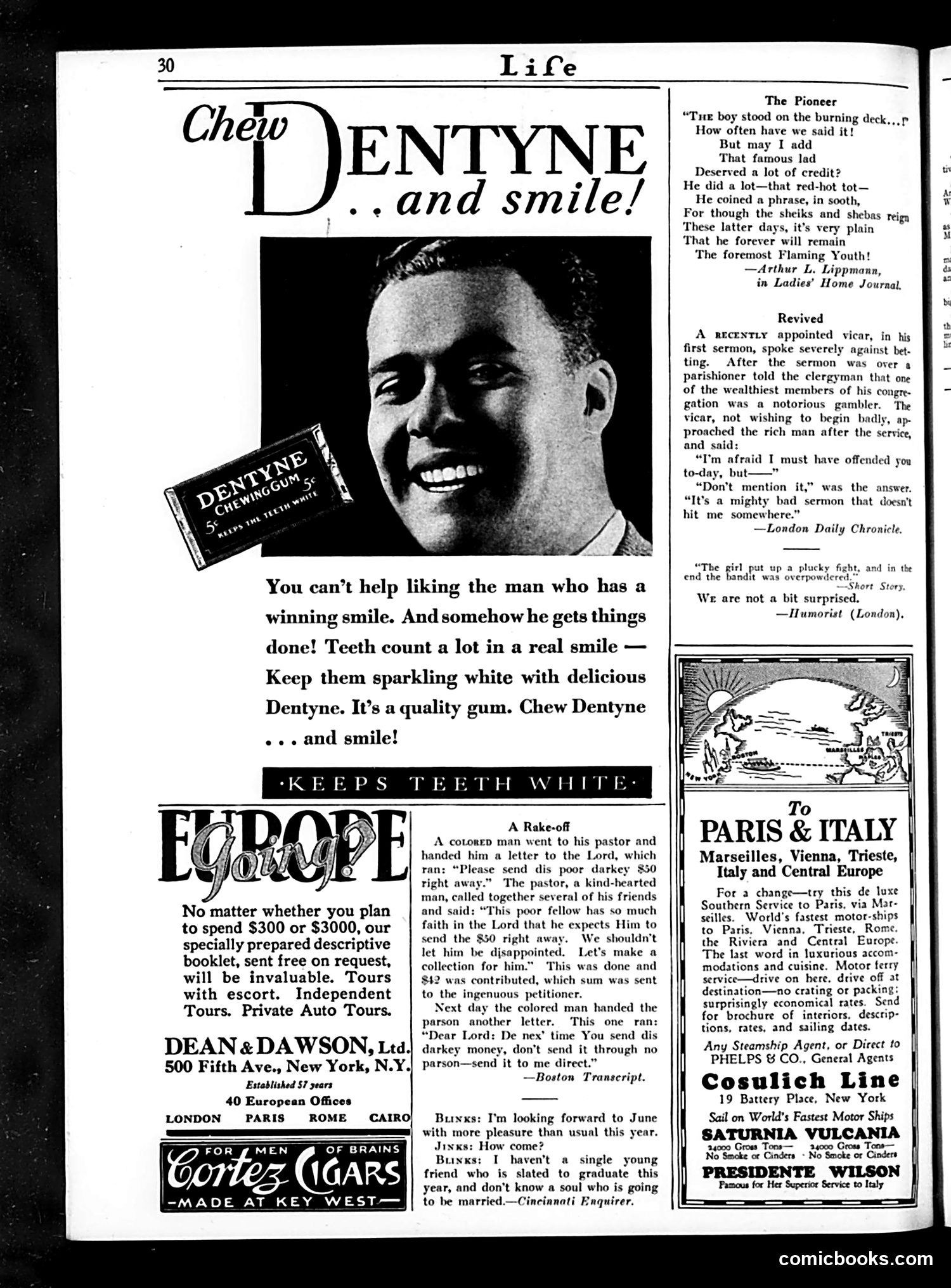
This page is primarily **advertising and humor columns**, not political cartoons. The dominant feature is a Dentyne chewing gum advertisement showing a smiling man with the slogan "Chew Dentyne and smile!" — typical early 20th-century product marketing linking dental hygiene to personal success and charm. The right column contains brief humorous anecdotes from various publications. Notable is "A Rake-off," a dialect joke featuring a Black man's letter to the Lord requesting money, later demanding it be sent directly rather than through his pastor. This reflects period racial stereotypes common in mainstream American humor. Other brief jokes address graduation season, clergy, and female bravery — all lighthearted social commentary typical of Life's humor section. The remaining content comprises travel advertisements for European tours and steamship lines. **No significant political satire or caricature appears on this page.**
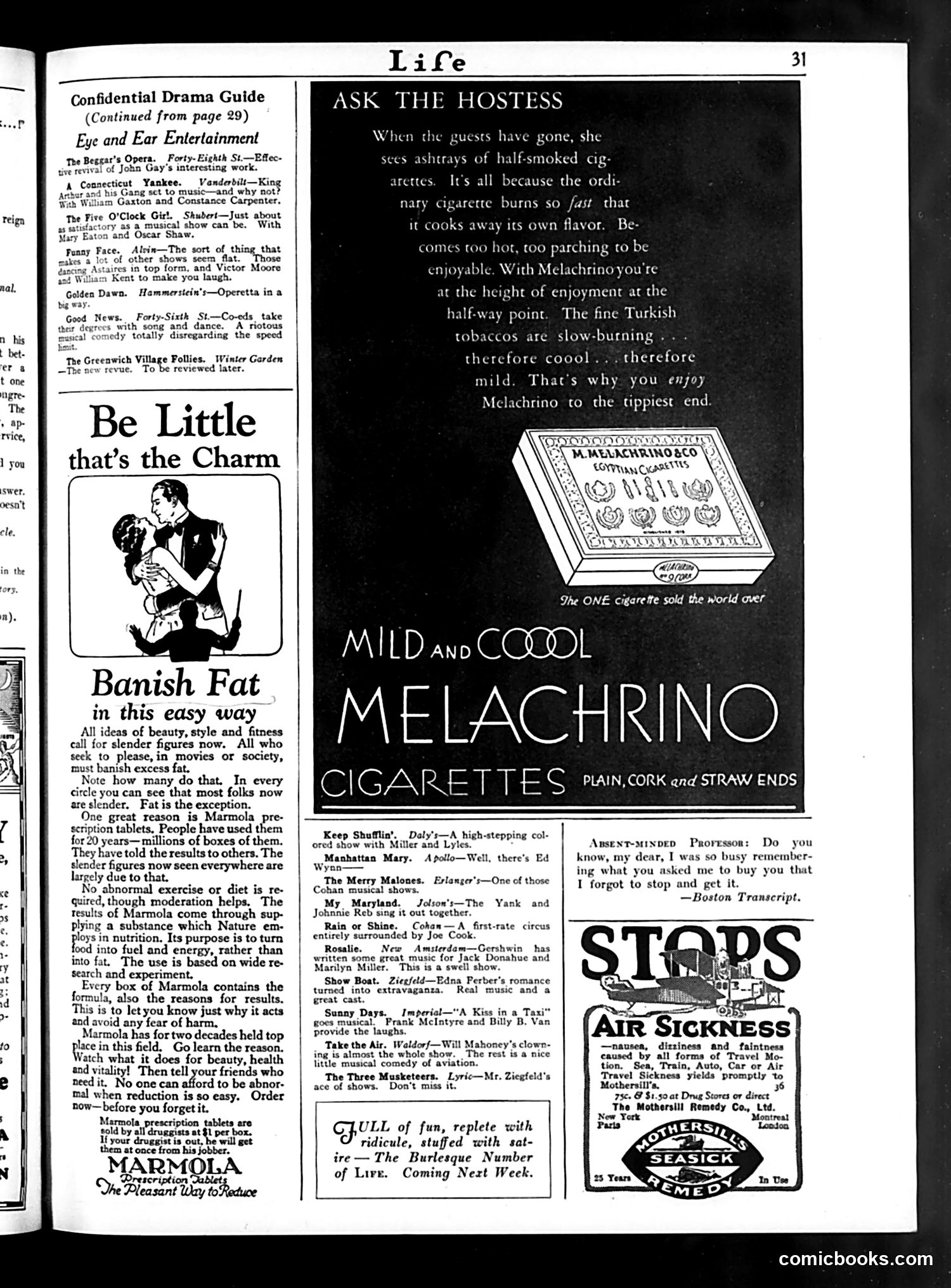
This page combines theater reviews with period advertisements. The main content includes: **"Ask the Hostess"** section: Advertises Melachrino cigarettes by explaining that Turkish tobacco burns slowly and stays "cool" throughout smoking—addressing a genuine complaint about cheaper cigarettes that burn too fast and become harsh. **"Be Little that's the Charm"** ad: Promotes Marmola prescription tablets for weight loss, reflecting 1920s beauty standards emphasizing slenderness. The copy normalizes diet pills by claiming millions used them for 20 years. **Theater reviews**: Brief notices of Broadway shows including *A Connecticut Yankee*, *The Fire O'Clock Girl*, and *Show Boat*. **"Stops Air Sickness"** ad: Advertises Mothersill's remedy for travel nausea across multiple transportation modes. The page reflects early 20th-century consumer culture: cigarette marketing emphasizing quality, diet pills presented as medical solutions to achieve fashionable thinness, and remedies for modern travel ailments. All advertisements use pseudo-scientific claims normalized for the era.
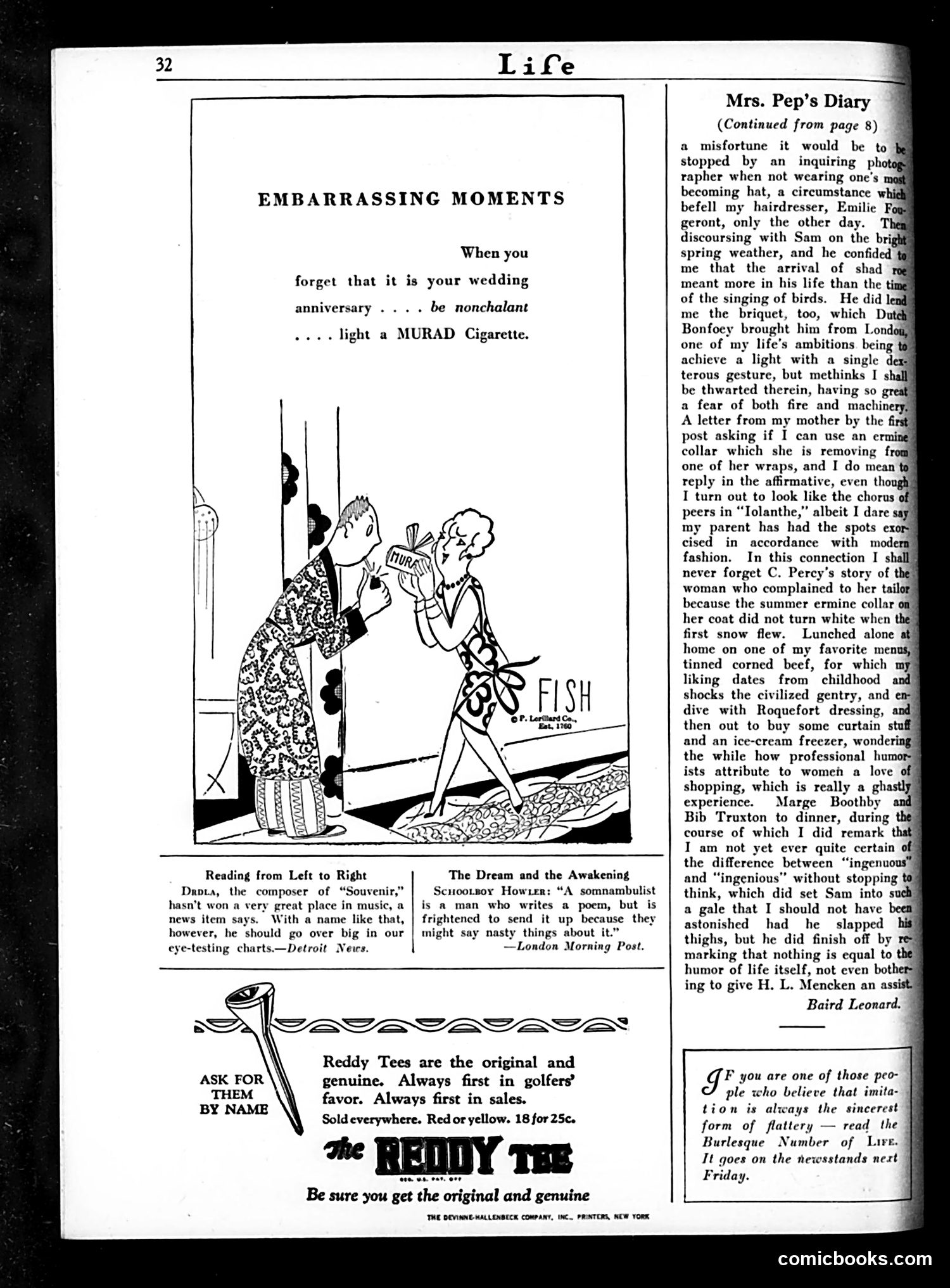
This page contains two main elements: **The "Embarrassing Moments" Cartoon** (top center): Shows a woman frantically searching through a fish market or display, apparently having forgotten her wedding anniversary. The humor satirizes the panic couples experience when forgetting important dates—the advised solution being to act casually and light a MURAD cigarette, a period cigarette brand. The joke plays on masculine bravado as a cover for social failure. **Mrs. Pep's Diary** (right column): A gossipy society column narrating the mundane observations of an upper-class woman—her hairdresser's romantic interests, acquiring an ermine collar, shopping anxieties, and dinner guests. It satirizes both women's preoccupations with fashion/shopping and pretentious social discourse, while poking fun at linguistic pretension (the "ingenuous" vs. "ingenious" confusion). The page is primarily **advertising-driven**, featuring cigarette and golf-tee promotions. The satirical content targets early-1920s consumer culture, gender roles, and social pretension through light humor rather than sharp political critique.

I can see this is a page from Life magazine, but the image is almost entirely black with only fragmentary text visible along the left margin. The OCR'd text provided consists of isolated word fragments that don't form coherent sentences, making it impossible to determine the subject matter, identify any figures or caricatures, or explain the satire or joke intended. The right side of the page appears to be a dark photograph or illustration, but no details are discernible. Without legible text or visible cartoon content, I cannot identify political or social references or explain the point of any satire to a modern reader. A clearer scan would be needed for accurate analysis.