
Life, 1928-04-26 · page 31 of 35
Life — April 26, 1928 — page 31: what you’re looking at
What you’re looking at
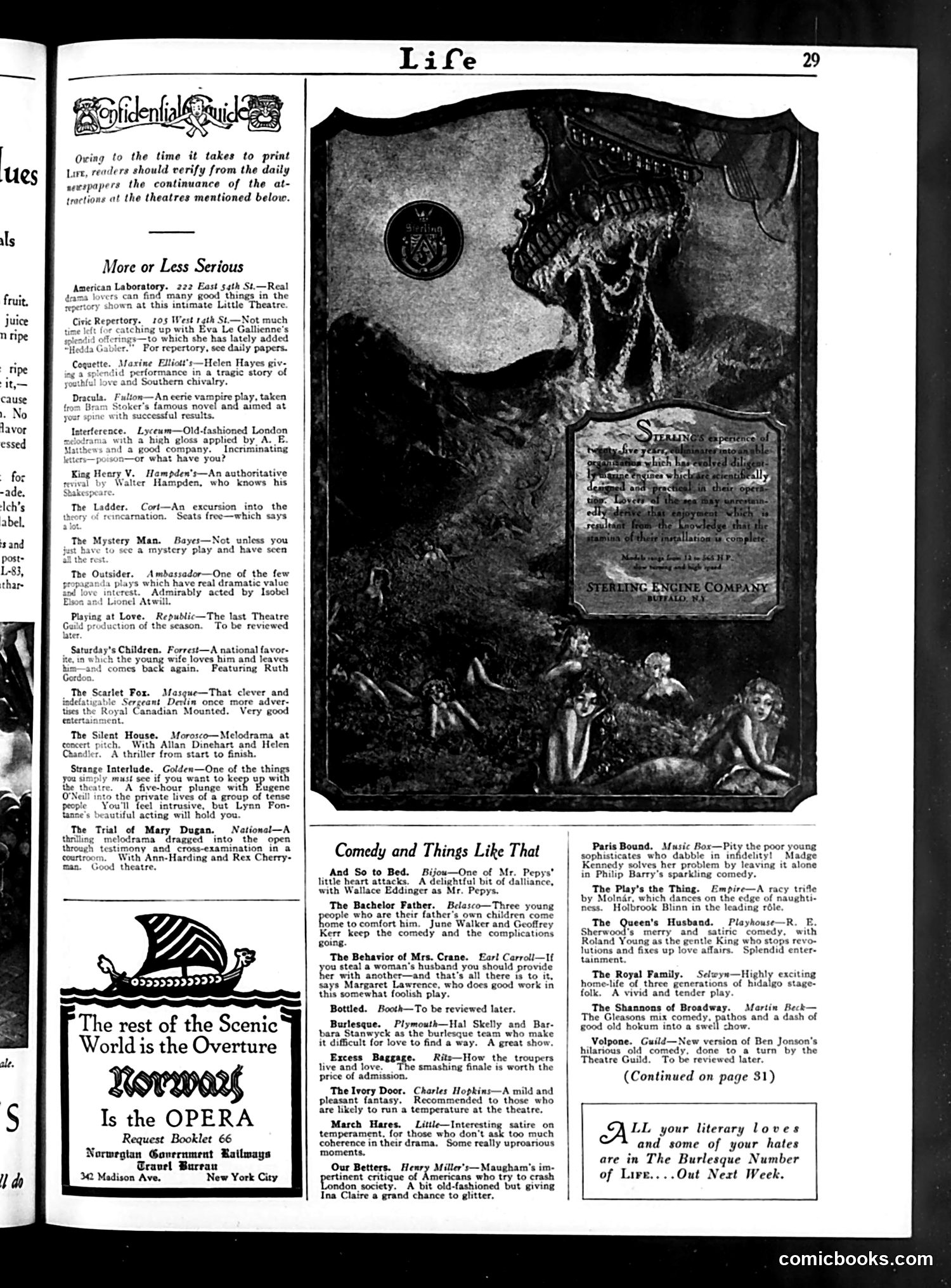
This page is primarily a **theater listings and reviews section**, not a political cartoon. It's a practical guide for New York theatergoers, listing current Broadway productions with brief critiques. The content reflects 1920s theatrical taste: serious dramas like "Strange Interlude" and "The Trial of Mary Dugan" (melodramas involving courtroom testimony and moral dilemmas), vampire plays ("Dracula"), and comedies ranging from drawing-room farce to burlesque. The right side features a **Sterling Engine Company advertisement**—an industrial/mechanical product unrelated to theater—demonstrating how magazines mixed editorial and commercial content. The lone decorative element is a ship logo for Norwegian Government Railways tourism, promoting travel. This is essentially a **service page** for urban entertainment consumers with disposable income, not satirical commentary. The "satire" in Life magazine appeared elsewhere; this section simply reflects what sophisticated 1920s audiences considered worth seeing.
📄 Transcribed text from this page (OCR, searchable)
Machine-transcribed from the original scan — historical spelling and the odd misread are preserved.
Owing to the time it takes to print Lure, readers should verify from the daily sexspapers the continuance of the at- troctions at the theatres mentioned below. More or Less Serious American Laboratory. 222 East 54th St.—Real s can find many good things in the own at this intimate Little Theatre. Repertory. 105 West rgth St—Not much tching up with Eva Le Gallienne's —to which she has lately added Por repertory, see daily papers. Maxine Elliott's—Helen Hayes giv: endid performance in a tragic story of ove and Southern chivalry. a Gabler.’ Dracula. Fulion—An cerie vampire play, taken from Bram Stoker's famous novel and aimed at yoar spine with successful results. Interference. Lyceum—Old-fashioned London olrama with a high gloss applied by A. at and a good company. Incriminating n—or what have you? King Henry V. Hampden's—An authoritative al by Walter Hampden, who knows his The Ladder. Cort—An excursion into the ry of reincarnation. Seats free—which says The Mystery Ma: just have to sce @ my Bayes—Not unless you ry play and have scen th The Outsider. Ambassador—One of the few Ja plays which have real dramatic value od love interest. Admirably acted by Isobel Eis Lionel Atwill. Playing at Love. Republic—The last Theatre tion of the season. To be reviewed Children. Forrest—A national favor he young wife loves him and leaves comes back again. Featuring Ruth The Scarlet Fox. Masque—That clever and Sergeant Devlin once more adver- yal Canadian Mounted. Very good ent. The Silent House. Morosco—Melodrama at concert pitch. With Allan Dinehart and Helen Chandler. A thriller from start to finish. Strange Interlude. Golden—One of the things must see if you want to ke Z. with A five-hour plunge with Eugene o the private lives of a group of tense people You'll feel intrusive, but Lynn Fon- fanne’s beautiful acting will hold you. The Trial of Mary Dugan. National—A thniling melodrama dragged into the open through testimony and cross-examination in a courte: With Ann-Harding and Rex Cherry- q theatre. The rest of the Scenic World is the Overture Is the OPERA Request Booklet 66 Norwegtan Government Railways Travel Burran 3Q Madison Ave. New York City Comedy and Things Like That And So to Bed. Bijou—One of Mr. Pepys’ little heart attacks. A delightful bit of dalliance, with Wallace Eddinger as Mr. Pepys. The Bachelor Father. Belasco—Three young people who are their father’s own children come Rome to comfort him. June Walker and Geoffrey Kerr keep the comedy and the complications going. The Behavior of Mrs. Crane. Lar! Carroll—It you steal a woman's husband you should provide er with another—and that's all there is to it, says Margaret Lawrence, who does good work in this somewhat foolish play. Bottled. Booth—To be reviewed later. Burlesque. Plymouth—Hal Skelly and Bar- bara Stanwyck as the burlesque team who make it difficult for love to find a way. A great show. Excess Baggs Rits—How the troupers live and love. he smashing finale is worth the price of admission. The Ivory Door. Charles Hopkins—A mild and pleasant fantasy. Recommended to those who are likely to run a temperature at the theatre. March Hares. Little—Interesting satire on temperament. for those who don't ask too much coherence in their drama. Some really uproarious moments, Our Betters. Henry Miller's—Maugham’s i Pertinent critique of Americans who try to crash ndon society. A bit old-fashioned but giving Ina Claire a grand chance to glitter. Paris Bound. Music Box—Pity the poor young sophisticates who dabble in infidelity! Madge Kennedy solves her problem by leaving it alone in Philip Barry’s sparkling comedy. The Play’s the Thing. Empire—A racy trifle dr, which dances on the edge of naughti- Holbrook Blinn in the leading réte. jueen’s Husband. Playhouse—R. E Sherwood’s merry and satiric comedy, wit Roland Young as the gentle King who stops revo- lutions and fixes up love affairs. Splendid enter- tainment. The Royal Family. Selwyn—Highly exciting home-life of three generations of hidalgo stage- folk. A vivid and tender play. The Shannons of Broadway. Martin Beck— The Gleasons mix comedy, pathos and a dash of good old hokum into « swell chow. Volpone. Guild—New version of Ben Jonson's hilarious old comedy, done to a turn by the Theatre Guild. To be reviewed later. (Continued on page 31) LL your literary loves and some of your hates are in The Burlesque Number of Lire....Out Next Week. comicbooks.com