
Life, 1928-04-26 · page 11 of 35
Life — April 26, 1928 — page 11: what you’re looking at
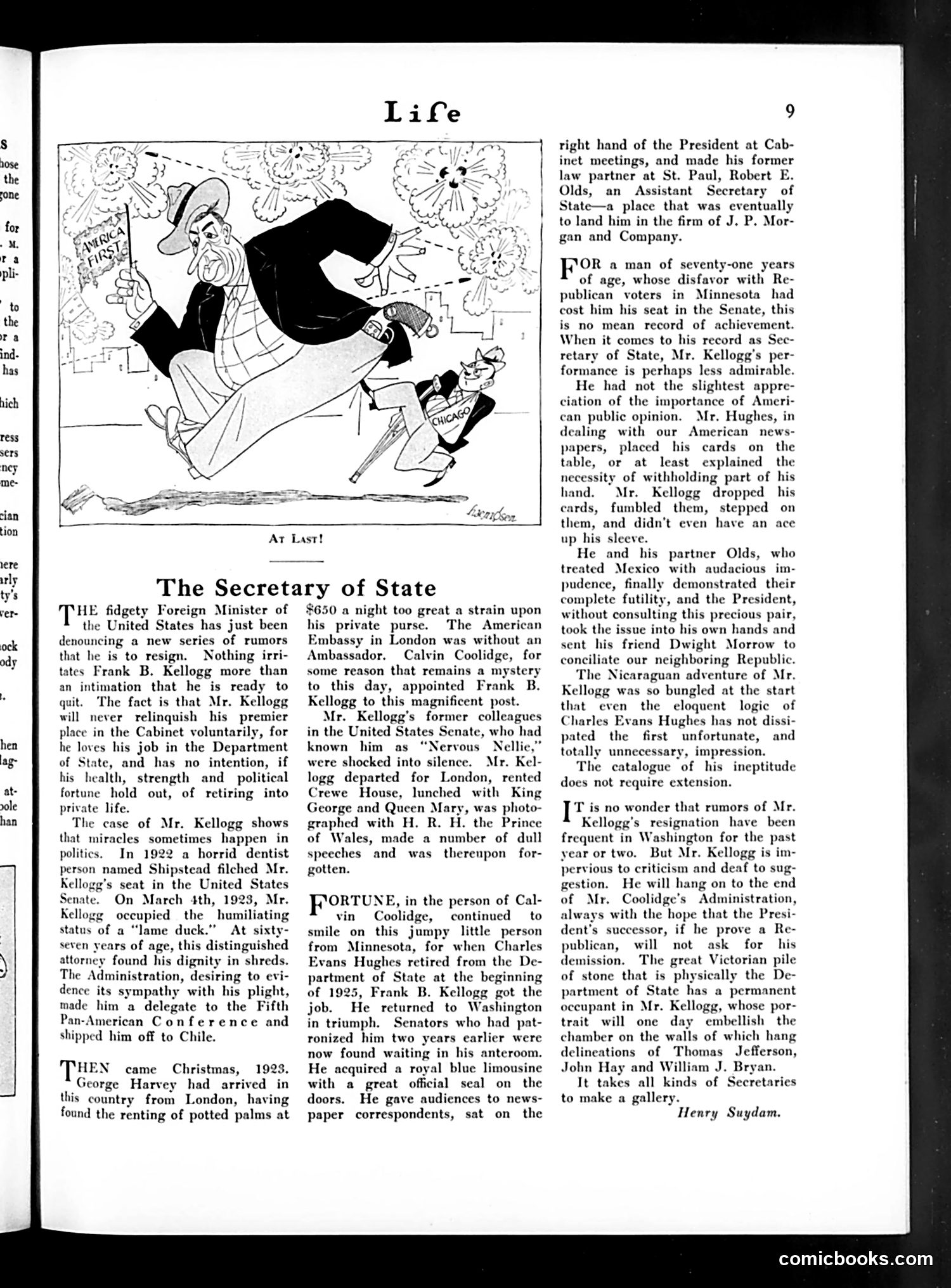
What you’re looking at
This cartoon satirizes **Frank B. Kellogg's appointment as Secretary of State**. The image shows Kellogg being launched or ejected forcefully, suggesting relief or celebration at his appointment after a long wait. The accompanying article explains that Kellogg, a "lame duck" senator from Minnesota whose 1923 election faced criticism, finally found a dignified Cabinet position. The cartoon's title "At Last!" captures the sense that both Kellogg and observers were relieved he'd secured this prestigious post, ending uncertainty about his political future. The satire appears gentle—celebrating a career move rather than mocking Kellogg directly, though his previous political struggles make the appointment's arrival feel dramatically overdue.
📄 Transcribed text from this page (OCR, searchable)
Machine-transcribed from the original scan — historical spelling and the odd misread are preserved.
At Last! The Secretary of State HE fidgety Foreign Minister of the United States has just been denouncing a new series of rumors that he is to resign. Nothing irri- tates Frank B. Kellogg more than an intimation that he is ready to quit. The fact is that Mr. Kellogg will never relinquish his premier place in the Cabinet voluntarily, for he loves his job in the Department of State, and has no intention, if his health, strength and _ political fortune hold out, of retiring into private life. The case of Mr. Kellogg shows that miracles sometimes happen in politics. In 1922 a horrid dentist person named Shipstead filehed Mr. Kellogg’s seat in the United States Senate. On March 4th, 1923, Mr. Kellogg occupied the humilia’ status of a “lame duck.” seven years of age, this attorney found his dignity i The Administration, desiring to evi- dence its sympathy with his plight, made him a delegate to the Fifth Pan-American Conference and shipped him off to Chile. H came Christmas, 1923. George Harvey had arrived in this country from London, having found the renting of potted palms at $650 a night too great a strain upon his private purse. The American Embassy in London was without an Ambassador. Calvin Coolidge, for some reason that remains a mystery to this day, appointed Frank B. Kellogg to this magnificent post. Mr. Kellogg’s former colleagues in the United States Senate, who had known him as “Nervous Nellie,” were shocked into silence. Mr. Kel- logg departed for London, rented Crewe House, lunched with King George and Queen Mary, was photo- graphed with H. R. H. the Prince of Wales, made a number of dull speeches and was therenpon for- gotten. ORTUNE, in the person of Cal- vin Coolidge, continued — to smile on this jumpy little person from Minnesota, for when Charles Evans Hughes retired from the De- partment of State at the beginning of 1925, Frank B. Kellogg got the job. He returned to Washington in triumph. Senators who had pat- ronized him two years earlier were now found waiting in his anteroom. He acquired a royal blue limousine with a great official seal on the doors. He gave audiences to news- paper correspondents, sat on the 9 right hand of the President at Cab- inet meetings, and made his former law partner at St. Paul, Robert E. Olds, an Assistant Secretary of State—a place that was eventually to land him in the firm of J. P. Mor- gan and Company. 4*OR a man of seventy-one years of age, whose disfavor with Re- publican voters in Minnesota had cost him his seat in the Senate, this is no mean record of achievement. When it comes to his record as Sec- retary of State, Mr. Kellogg's per- formance is perhaps less admirable. He had not the slightest appre- ciation of the importance of Ameri- can public opinion. Mr. Hughes, in dealing with our American news- papers, placed his cards on the table, or at least explained the necessity of withholding part of his hand. Mr. Kellogg dropped his cards, fumbled them, stepped on them, and didn’t even have an ace up his sleeve. He and his partner Olds, who treated Mexico with audacious im- pudence, finally demonstrated their complete futility, and the President, without consulting this precious pair, took the issue into his own hands and sent his friend Dwight Morrow to conciliate our neighboring Republic. The Nicaraguan adventure of Mr. Kellogg was so bungled at the start that even the eloquent logic of Charles Evans Hughes has not dissi- pated the first unfortunate, and totally unnecessary, impression. The catalogue of his ineptitude does not require extension. T is no wonder that rumors of Mr. Kellogg's resignation have been frequent in Washington for the past year or two. But Mr. Kellogg is im- pervious to criticism and deaf to sug- gestion. He will hang on to the end of Mr. Coolidge’s Administration, alw: with the hope that the Presi- dent’s successor, if he prove a Re- publican, will not ask for his demission. The great Victorian pile of stone that is physically the De- partment of State has a permanent occupant in Mr. Kellogg, whose por- trait will one day embellish the chamber on the walls of which hang delineations of Thomas Jefferson, John Hay and William J. Bryan. It takes all kinds of Secretaries to make a gallery. Henry Suydam. comicbooks.com