
Life, 1928-04-26 · page 21 of 35
Life — April 26, 1928 — page 21: what you’re looking at
What you’re looking at
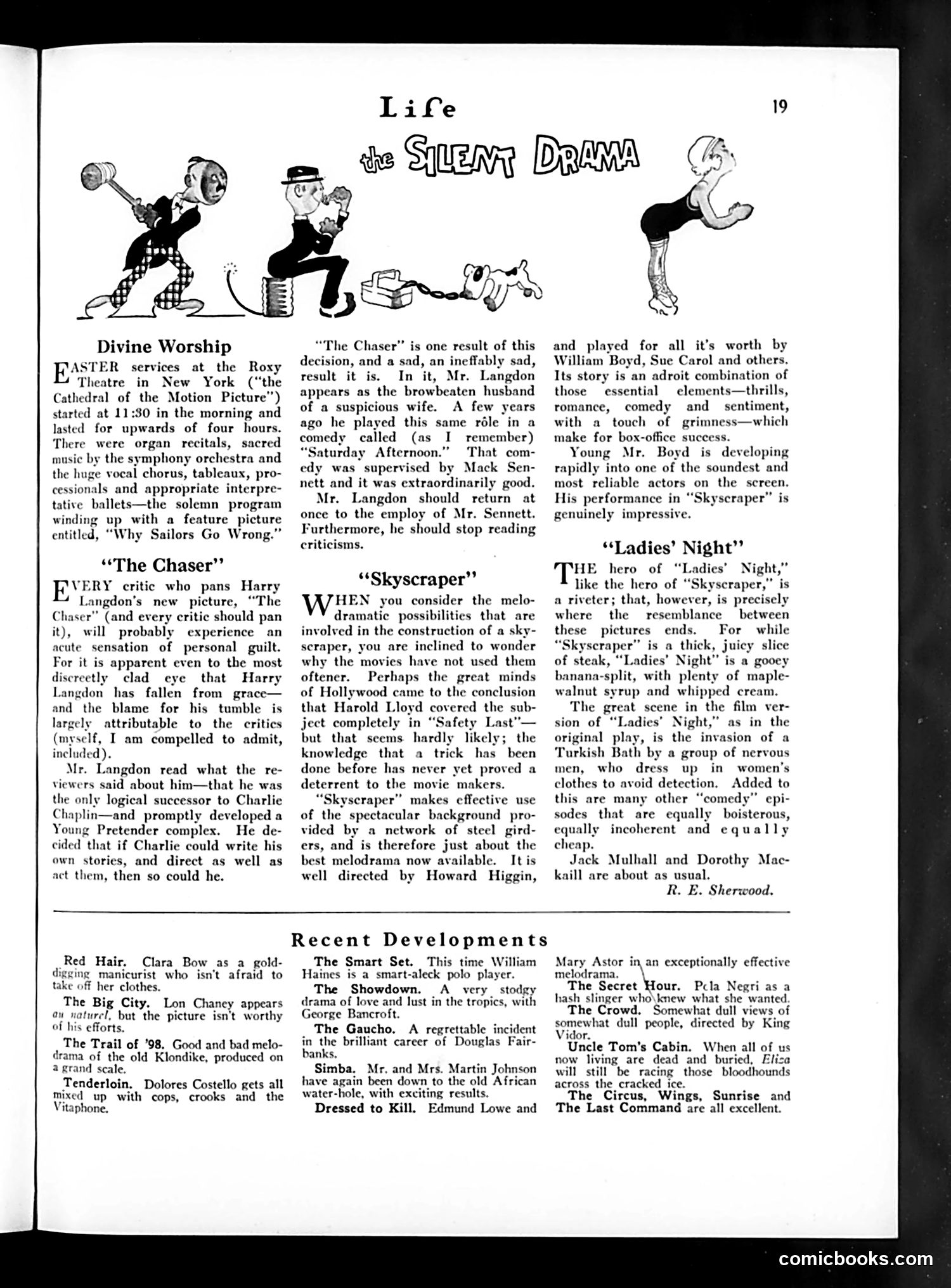
This Life magazine page reviews several silent films and satirizes movie industry dynamics circa the 1920s. **The cartoon** (top) depicts the Roxy Theatre in New York as a quasi-religious institution—"Cathedral of the Motion Picture"—mocking how movies had become a mass cultural phenomenon rivaling traditional worship. **Film reviews** critique specific actors and creative decisions: - **Harry Langdon** ("The Chaser"): The critic argues Langdon's career declined after reading favorable comparisons to Charlie Chaplin. Developing an inflated ego, Langdon began writing and directing his own films instead of working with director Mack Sennett, resulting in inferior work. The satire targets artistic hubris and critics' influence on performers. - **William Boyd** ("Skyscraper"): Praised as a reliable actor in well-constructed melodrama using skyscraper construction as backdrop. - **"Ladies' Night"**: Dismissed as inferior "banana-split" entertainment compared to "Skyscraper's" substantial "steak"—contrasting quality dramatic work with cheap comedic gimmickry (men disguising as women). The page satirizes both Hollywood's artistic pretensions and the fickle nature of silent-film stardom.
📄 Transcribed text from this page (OCR, searchable)
Machine-transcribed from the original scan — historical spelling and the odd misread are preserved.
Divine Worship E: ER services at the Roxy Theatre in New York (“the Cathedral of the Motion Picture’’) started at 11:30 in the morning and lasted for upwards of four hours. There were organ recitals, sacred music by the symphony orchestra and the huge vocal chorus, tableaux, pro- cessionals and appropriate interpre- tative ballets—the solemn program winding up with a feature picture entitled, “Why Sailors Go Wrong.” “The Chaser” EVERY critic who pans Harry Langdon’s new picture, “The Chaser” (and every critic should pan it), will probably experience an acute sensation of personal guilt. For it is apparent even to the most discreetly clad eye that Harry Langdon has fallen from grace— and the blame for his tumble is largely attributable to the critics (myself, I am compelled to admit, included). Mr. Langdon read what the re- viewers said about him—that he was the only logical successor to Charlie Chaplin—and promptly developed a Young Pretender complex. He de- cided that if Charlie could write his own stories, and direct as well as act them, then so could he. The Chaser” is one result of this decision, and a sad, an ineffably sad, result it is. In it, Mr. Langdon appears as the browbeaten husband of a suspicious wife. A few years ago he played this same réle in a comedy called (as I remember) “Saturday Afternoon.” That com- edy was supervised by Mack Sen- nett and it was extraordinarily good. Mr. Langdon should return at once to the employ of Mr. Sennett. Furthermore, he should stop reading criticisms. ‘‘Skyscraper”’ WHEN you consider the melo- d ramatic possibilities that are involved in the construction of a sky- scraper, you are inclined to wonder why the movies have not used them oftener. Perhaps the great minds of Hollywood came to the conclusion that Harold Lloyd covered the sub- ject completely in “Safety Last”— but that seems hardly likely; the knowledge that a trick has been done before has never yet proved a deterrent to the movie makers. “Skyscraper” makes effective use of the spectacular background pro- vided by a network of steel gird- ers, and is therefore just about the best melodrama now available. It is well directed by Howard Higgin, and played for all it’s worth by William Boyd, Sue Carol and others. Its story is an adroit combination of those essential elements—thrills, romance, comedy and _ sentiment, with a touch of grimness—which make for box-office success. Young Mr. Boyd is developing rapidly into one of the soundest and most reliable actors on the screen. His performance in “Skyscraper” is genuinely impressive. “Ladies’ Night” HE hero of “Ladies’ Night,” like the hero of “Skyscraper,” is a riveter; that, however, is precisely where the resemblance between these pictures ends. For while “Skyscraper” is a thick, juicy slice of steak, “Ladies’ Night” is a gooey banana-split, with plenty of maple- walnut syrup and whipped cream. The great scene in the film ver- sion of ‘Ladies’ Night,” as in the original play, is the invasion of a Turkish Bath by a group of nervous men, who dress up in women’s clothes to avoid detection, Added to this are many other “comedy” epi- sodes that are equally boisterous, equally incoherent and equally cheap. Jack Mulhall and Dorothy Mac- kaill are about as usual. R. E. Sherwood. Red Hair. Clara Bow as a gold- digging manicurist who isn’t afraid to take off her clothes. The Big City. Lon Chaney appears au naturel, but the picture isn't worthy is efforts. The Trail of ’98, Good and bad melo- drama of the old Klondike, produced on a grand scale. Tenderloin. Dolores Costello gets all mixed up with cops, crooks and the Vitaphone. Recent Developments The Smart Set. Haines is a smart-aleck polo player. This time William The Showdown. A _ very stodgy drama of love and lust in the tropics, with George Bancroft. The Gaucho. A regrettable incident in the brilliant career of Douglas Fair- banks, Simba, Mr. and Mrs. Martin Johnson have again been down to the old African water-hole, with exciting results. Dressed to Kill. Edmund Lowe and Mary Astor in an exceptionally effective melodrama, \ The Secret Hour. Pcla Negri as a hash slinger who\knew what she wanted. i¢ Crowd. Somewhat dull views of somewhat dull people, directed by King Vidor. Uncle Tom's Cabin. When all of us now living are dead and buried, Eliza will still be racing those bloodhounds across the cracked ice. The Circus, Wings, Sunrise and The Last Command are all excellent. comicbooks.com