
Life, 1928-04-26 · page 24 of 35
Life — April 26, 1928 — page 24: what you’re looking at
What you’re looking at
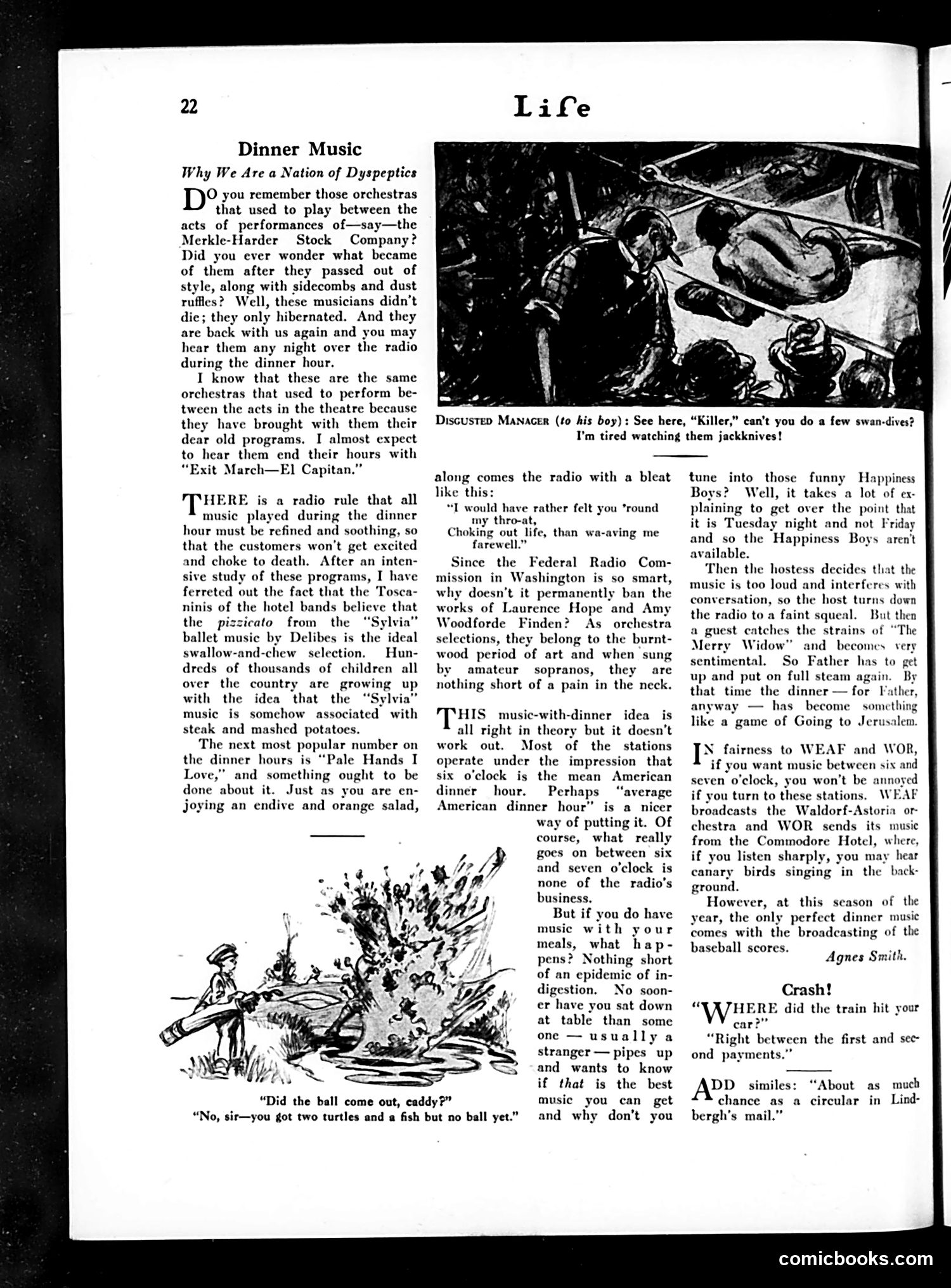
This 1920s satirical piece mocks the then-new phenomenon of radio broadcasts during dinner hours. The author argues that orchestras playing "refined and soothing" dinner music actually cause indigestion rather than aid digestion—hence Americans are a nation of dyspeptics (people with poor digestion). The satire targets: 1. **Radio stations' pretension**: They believe classical music (specifically pieces like "Sylvia" ballet music and Amy Woodforde Finden's sentimental songs) are appropriate dinner accompaniment, when they're actually distracting and irritating. 2. **Social disruption**: Dinner guests argue about song choices; hosts constantly adjust volume; the whole meal becomes chaotic rather than refined. 3. **Arbitrary scheduling**: Radio assumes 6 o'clock is "average American dinner hour," ignoring actual variations. The cartoon below shows a frustrated golf caddy, likely illustrating how dinner radio interrupts and annoys—a visual punchline about unwanted intrusions during leisure time.
📄 Transcribed text from this page (OCR, searchable)
Machine-transcribed from the original scan — historical spelling and the odd misread are preserved.
22 Dinner Music Why We Are a Nation of Dyspeptics Dp? you remember those orchestras that used to play between the acts of performances of—say—the Merkle-Harder Stock Company? Did you ever wonder what became of them after they passed out of style, along with sidecombs and dust ruffles? Well, these musicians didn’t die; they only hibernated. And they are back with us again and you may hear them any night over the radio during the dinner hour. I know that these are the same orchestras that used to perform be- tween the acts in the theatre because they have brought with them their dear old programs. I almost expect to hear them end their hours with “Exit March—El Capitan.” HERE is a radio rule that all music played during the dinner hour must be refined and soothing, so that the customers won't get excited and choke to death. After an inten- sive study of these programs, I have ferreted out the fact that the Tosca- ninis of the hotel bands believe that the pizzicato from the * ballet music by Delibes is the ideal swallow-and-chew selection. | Hun- dreds of thousands of children all over the country are growing up with the idea that the Ivia” music is somehow associated with steak and mashed potatoes. The next most popular number on the dinner hours is “Pale Hands I Love,” and something ought to be done about it. Just as you are en- joying an endive and orange salad, “Did the ball come out, caddy?” “No, sir—you got two turtles and a fish but no ball yet.” Discustep MANAGER (to his boy): See here, “Killer,” can’t you do a few swan-dives? I'm tired watching them jackknives! along comes the radio with a bleat like this: “I would have rather felt you ’round my thro-at, Choking out life, than wa-aving me farewell.” Since the Federal Radio Com- mission in Washington is so smart, why doesn’t it permanently ban the works of Laurence Hope and Amy Woodforde Finden? As orchestra selections, they belong to the burnt- wood period of art and when sung by amateur sopranos, they are nothing short of a pain in the neck. HIS music-with-dinner idea is all right in theory but it doesn’t work out. Most of the stations operate under the impression that six o'clock is the mean American dinner hour. Perhaps “average American dinner hour” is a nicer y of putting it. Of course, what really goes on between six and seven o'clock is none of the radio's business, But if you do have music with your meals, what hap- pens? Nothing short of an epidemic of in- digestion. No soon- er have you sat down at table than some one — usually a stranger — pipes up and wants to know if that is the best music you can get and why don’t you tune into those funny Happiness Boys? Well, it takes a lot of ex- plaining to get over the point that it is Tuesday night and not Friday and so the Happiness Boys aren't available. Then the hostess decides that the music is too loud and interferes with conversation, so the host turns down the radio to a faint squ But then a guest catches the strains of “The Merry Widow" and becomes very sentimental. So Father has to get up and put on full steam again. By that time the dinner — for Father, anyway — has become something like a game of Going to Jerusalem. N fairness to WE if you it music betwi seven o'clock, you won't be anno: if you turn to these stations, WEAF broadcasts the Waldorf-Astoria or- chestra and WOR sends its music from the Commodore Hotel, where, if you listen sharply, you may hear canary birds singing in the back- ground. However, at this season of the year, the only perfect dinner music comes with the broadcasting of the baseball scores. and WOR, ix and Agnes Smith. Crash! s HERE did the train hit your ond payment much Lind- DD ssimiles: ‘About as chance as a circular in bergh’s mail.” comicbooks.com