
A complete issue · 38 pages · 1928
Life — February 16, 1928
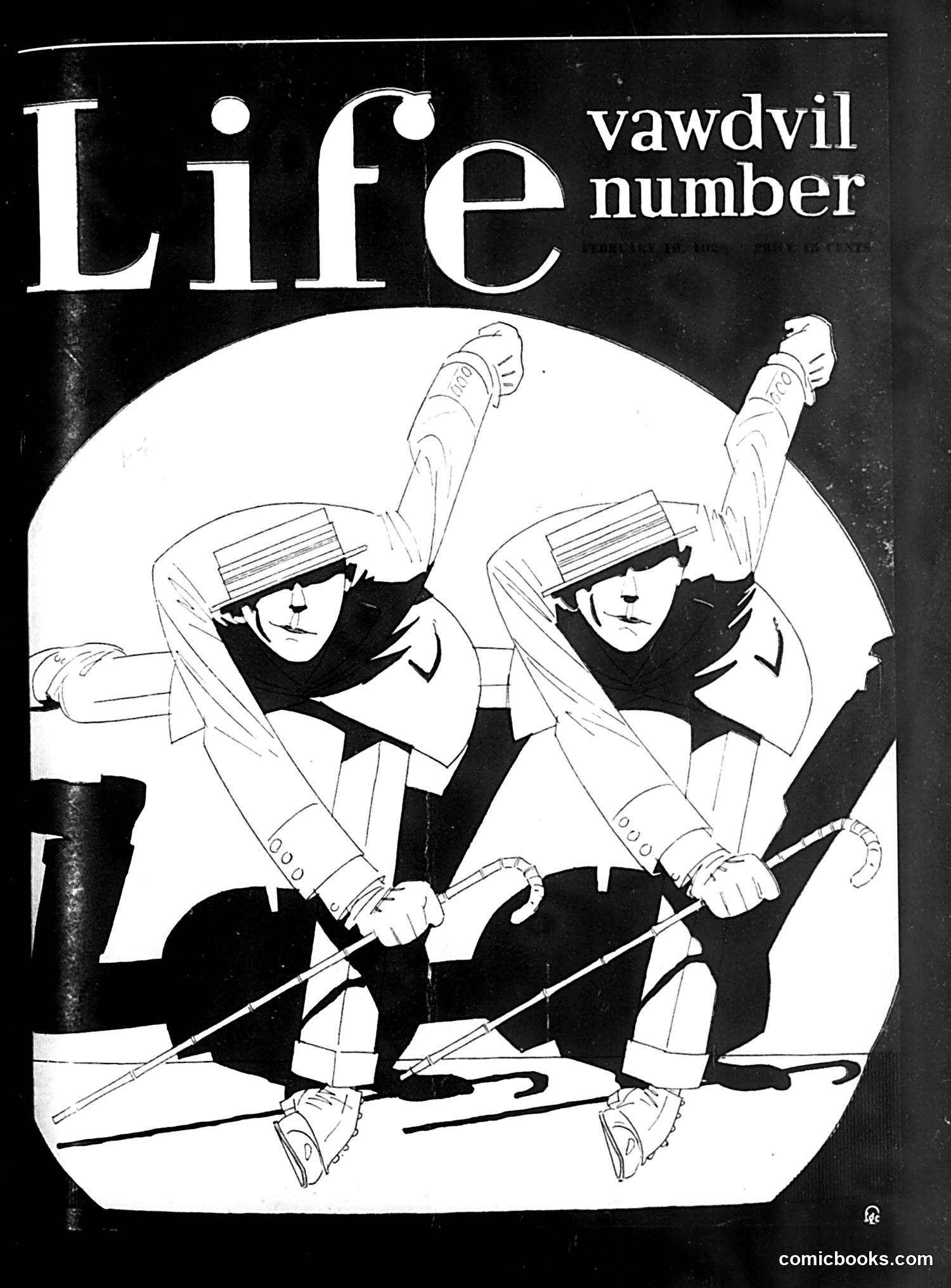
This appears to be a cover or feature from **Life magazine's "Vawdvil Number"** (Vaudeville Number), a special issue celebrating theatrical entertainment. The illustration depicts **two identical figures in matching boater hats and formal coats**, performing what appears to be a **synchronized ski routine or comedic dance with ski poles**. The mirrored poses and matching outfits suggest either **vaudeville performers doing a comedy act or a commentary on identical twin performers** — a popular vaudeville act format. The satire likely plays on vaudeville's theatrical excess and the era's fascination with novelty acts. The formal attire combined with the absurd ski-dancing creates humor through incongruity — gentlemen in formal dress engaged in physical comedy, typical of early 20th-century theatrical satire. Without additional context, the specific performers or reference remain unclear, though the image captures the playful spirit Life magazine brought to entertainment coverage.
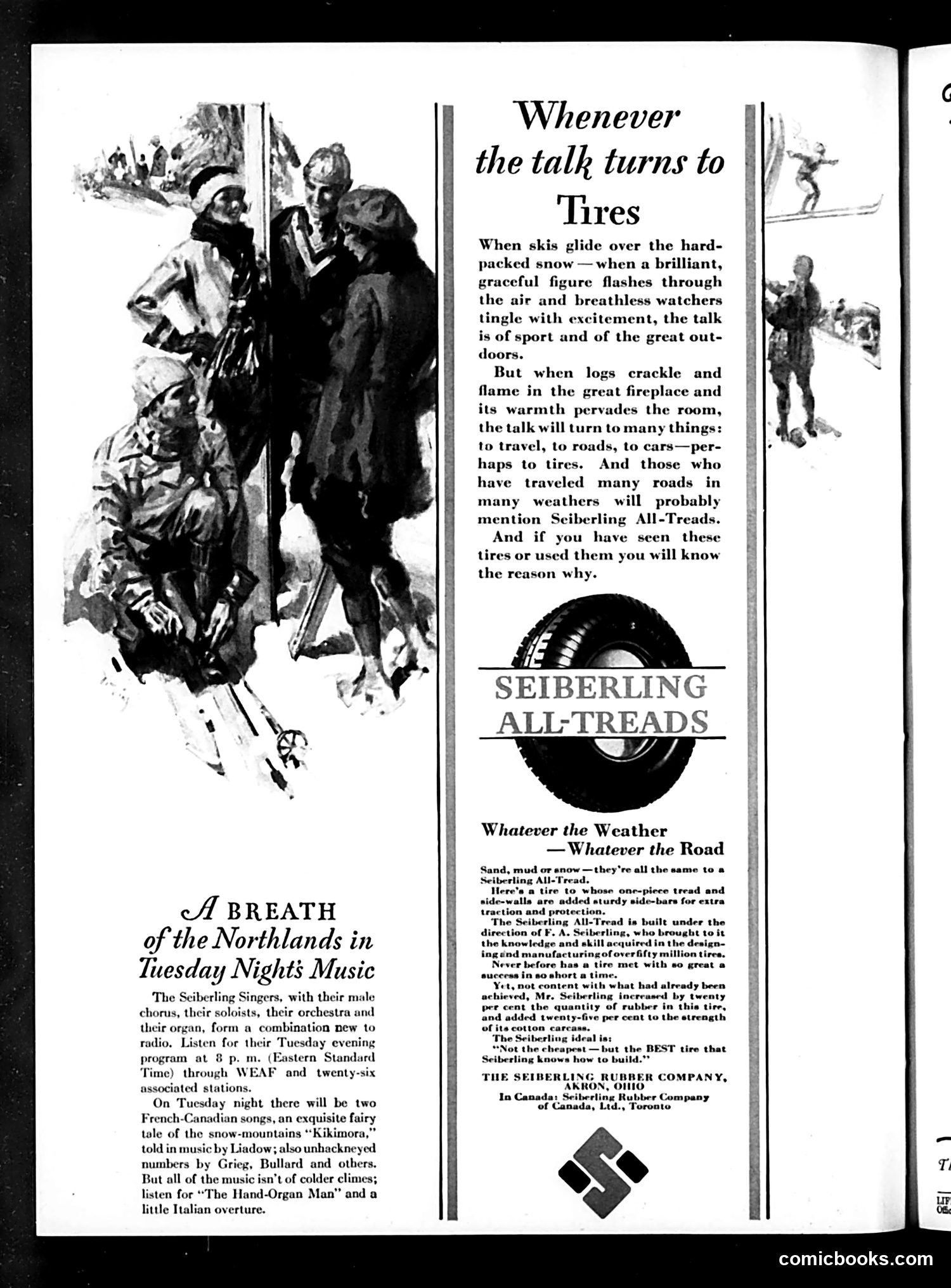
This page contains two distinct advertisements rather than political cartoons. **Left side:** An advertisement for "A Breath of the Northlands in Tuesday Nights Music," promoting the Seiberling Singers' radio program featuring French-Canadian songs and classical music selections. **Right side:** An advertisement for Seiberling All-Treads tires. The copy uses a framing device about fireside conversations—when people discuss skiing and outdoor sports, the talk turns to tires and travel. The ad claims that experienced travelers mention Seiberling All-Treads because they perform reliably "Whatever the Weather—Whatever the Road." Both advertisements use the Seiberling company name and branding. The tire ad emphasizes product durability through testimonial-style marketing, a common advertising approach of this era. Neither contains political satire or social commentary.
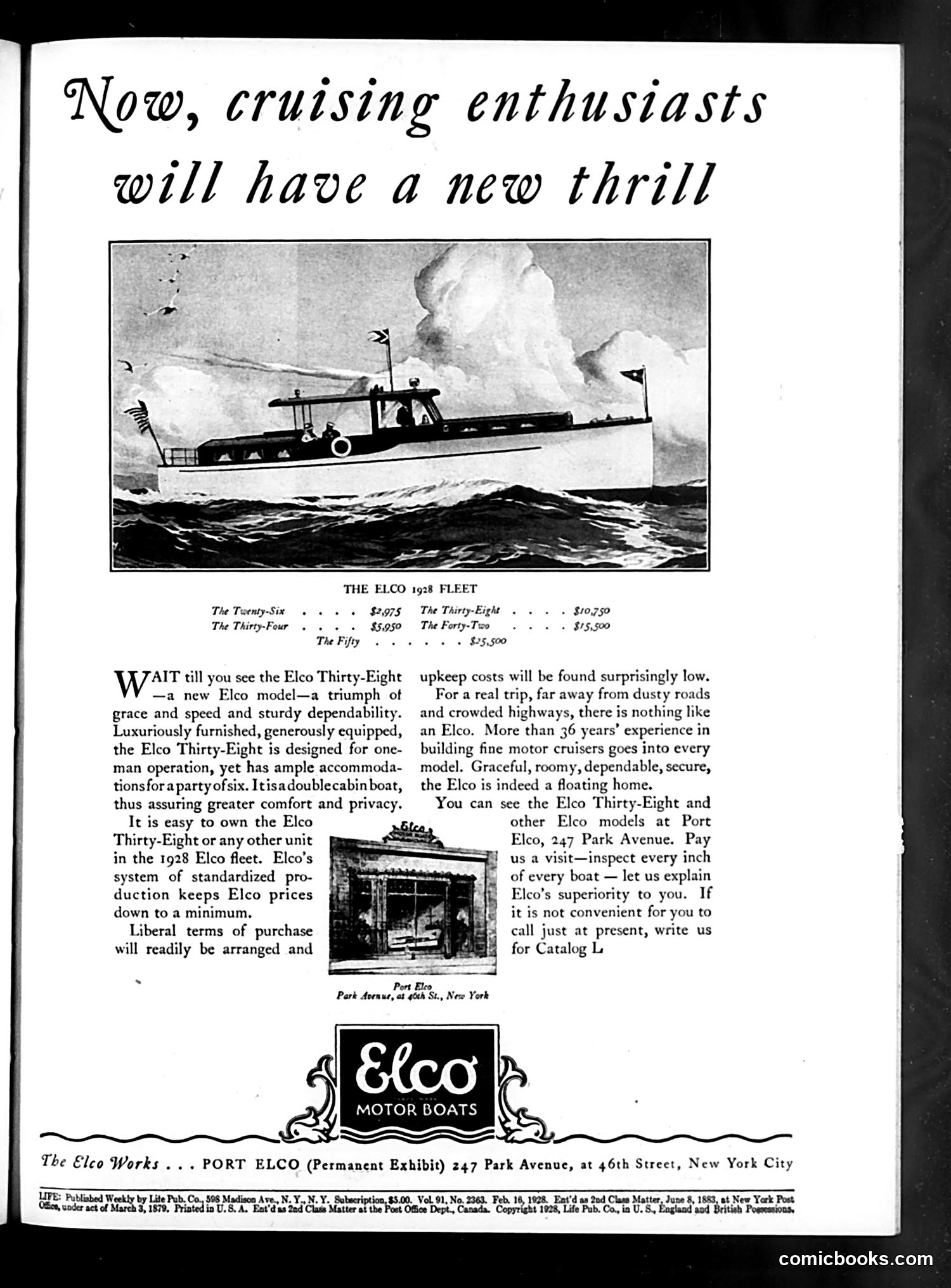
This page is **primarily an advertisement**, not satirical content. It promotes Elco motor boats, specifically the 1928 fleet models (Twenty-Six, Thirty-Four, Thirty-Eight, Forty-Two, and Fifty). The ad targets leisure cruising enthusiasts, emphasizing luxury, comfort, and dependability. Key selling points include one-man operation capability, spacious accommodations for six passengers, low operating costs, and 36 years of manufacturing experience. The main image shows a sleek motorboat cutting through waves. A smaller photograph displays Port Elco, a showroom at 247 Park Avenue in New York City where customers could inspect boats. There is **no political satire or social commentary** on this page—it's a straightforward commercial promoting recreational boating as an accessible leisure activity for affluent 1928 Americans.
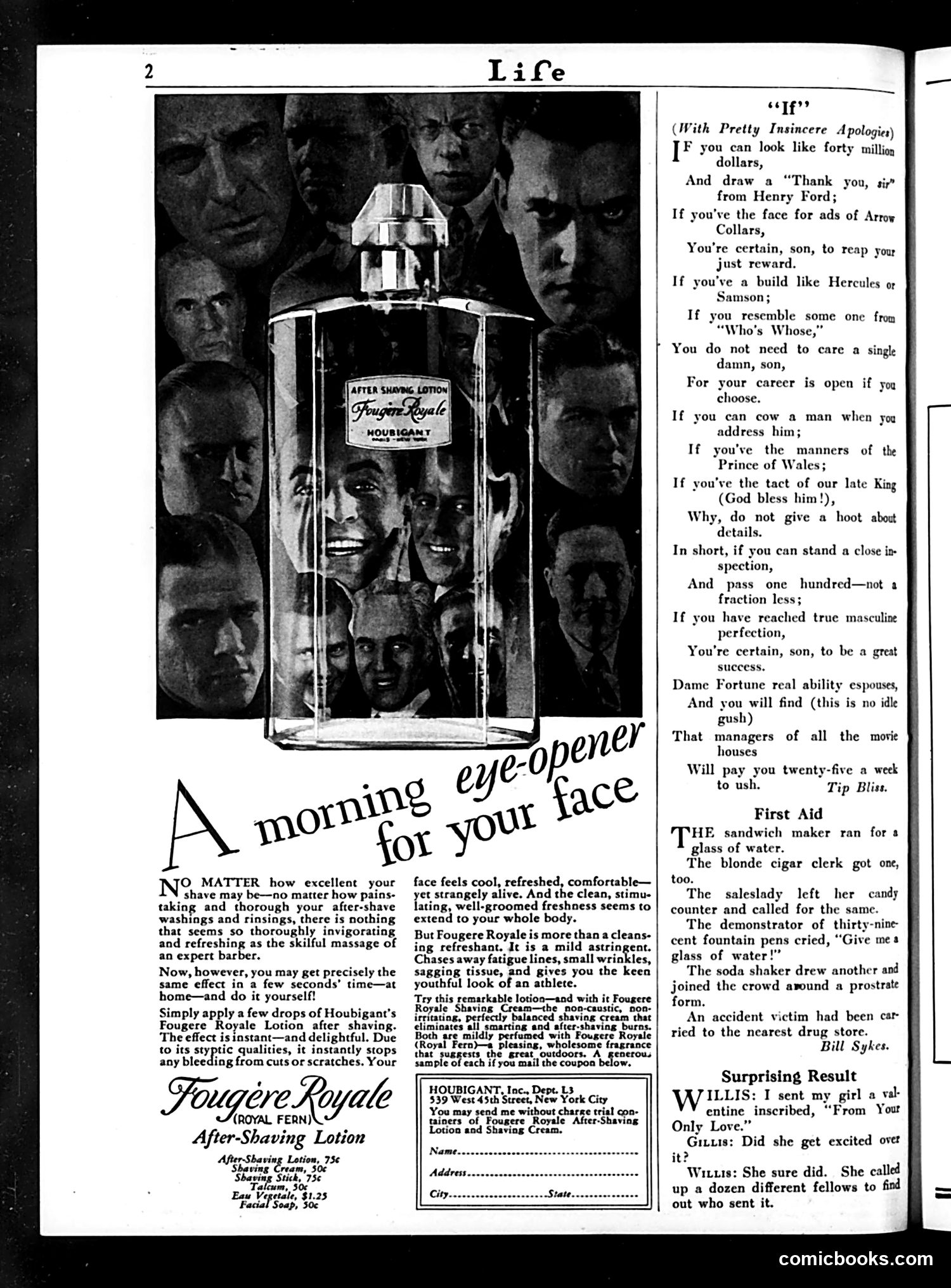
This page is primarily **advertising**, not political satire. The dominant content is a large advertisement for "Fougère Royale" (Royal Fern) After-Shaving Lotion, featuring a bottle surrounded by men's faces. The right column contains three unrelated comic anecdotes: - **"If"**: A humorous poem about achieving success in business/entertainment through appearance and demeanor - **"First Aid"**: A brief joke about a sandwich maker getting water - **"Surprising Result"**: A short comedic dialogue about a girl sending a boyfriend an inscribed photo These are typical **Life magazine humor pieces** — light social comedy with no deeper political meaning. The satire is gentle and domestic, poking fun at modern manners, salespeople, and romantic misunderstandings rather than addressing serious issues.
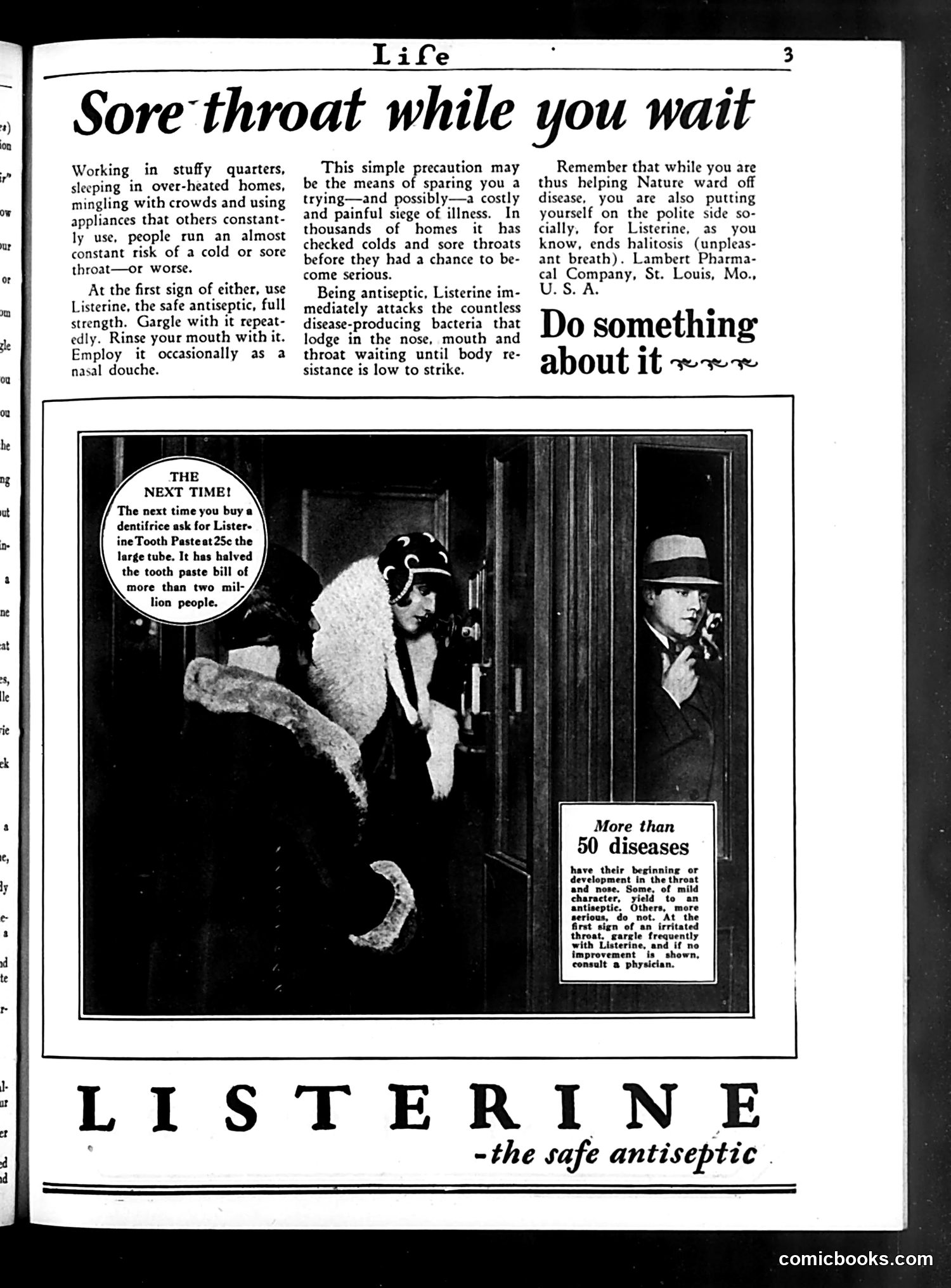
This is primarily a **Listerine advertisement** disguised as health advice. The page warns readers about sore throats from working in "stuffy quarters" and crowded conditions—likely referencing post-WWI urban/industrial environments. The advertisement promotes Listerine as an antiseptic mouthwash that kills bacteria causing throat infections. The accompanying illustration shows a well-dressed couple—the man appears concerned while observing the woman, suggesting Listerine prevents social embarrassment from illness or halitosis. The satirical angle is subtle: the page frames disease prevention as a social/moral obligation. A callout box promotes Listerine toothpaste, claiming it prevents diseases affecting "more than 50 diseases." This is classic early-20th-century medical advertising hyperbole, conflating hygiene products with disease prevention to drive consumer anxiety and sales.
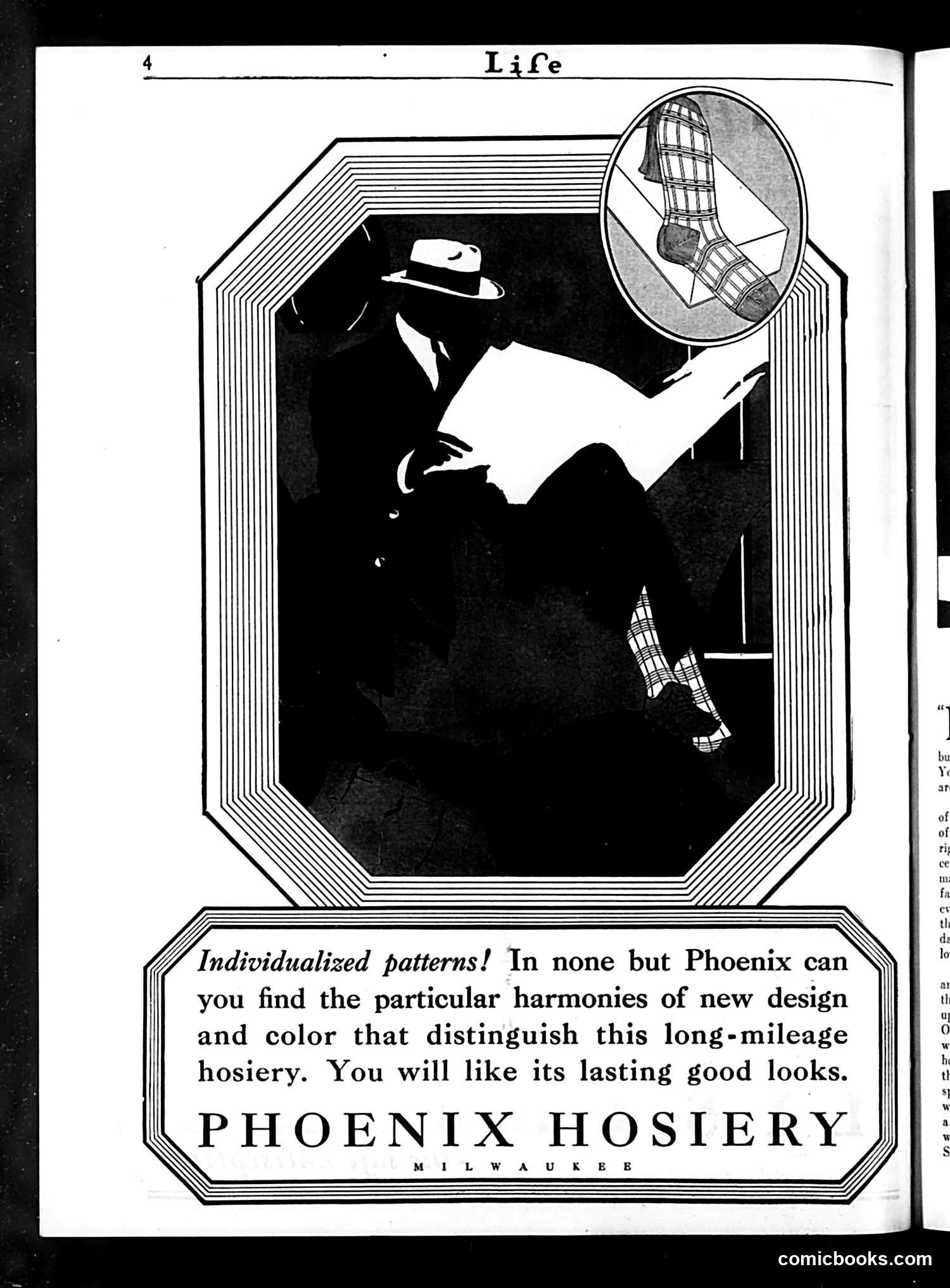
This page is **primarily an advertisement**, not editorial content. It advertises Phoenix Hosiery from Milwaukee, featuring a stylized illustration of a man in a fedora and suit examining or reading something (possibly a newspaper or document) while seated. An inset circular detail shows close-up hosiery patterns. The ad's sales pitch emphasizes "individualized patterns" and "new design and color" as distinguishing features of Phoenix brand stockings, claiming superior durability ("lasting good looks"). There is no political cartoon or satire present. The illustration is simply meant to present the product attractively to Life magazine's readers—a conventional advertisement using Art Deco styling typical of early-to-mid 20th century commercial design. The man's appearance and setting suggest an affluent, professional male consumer.
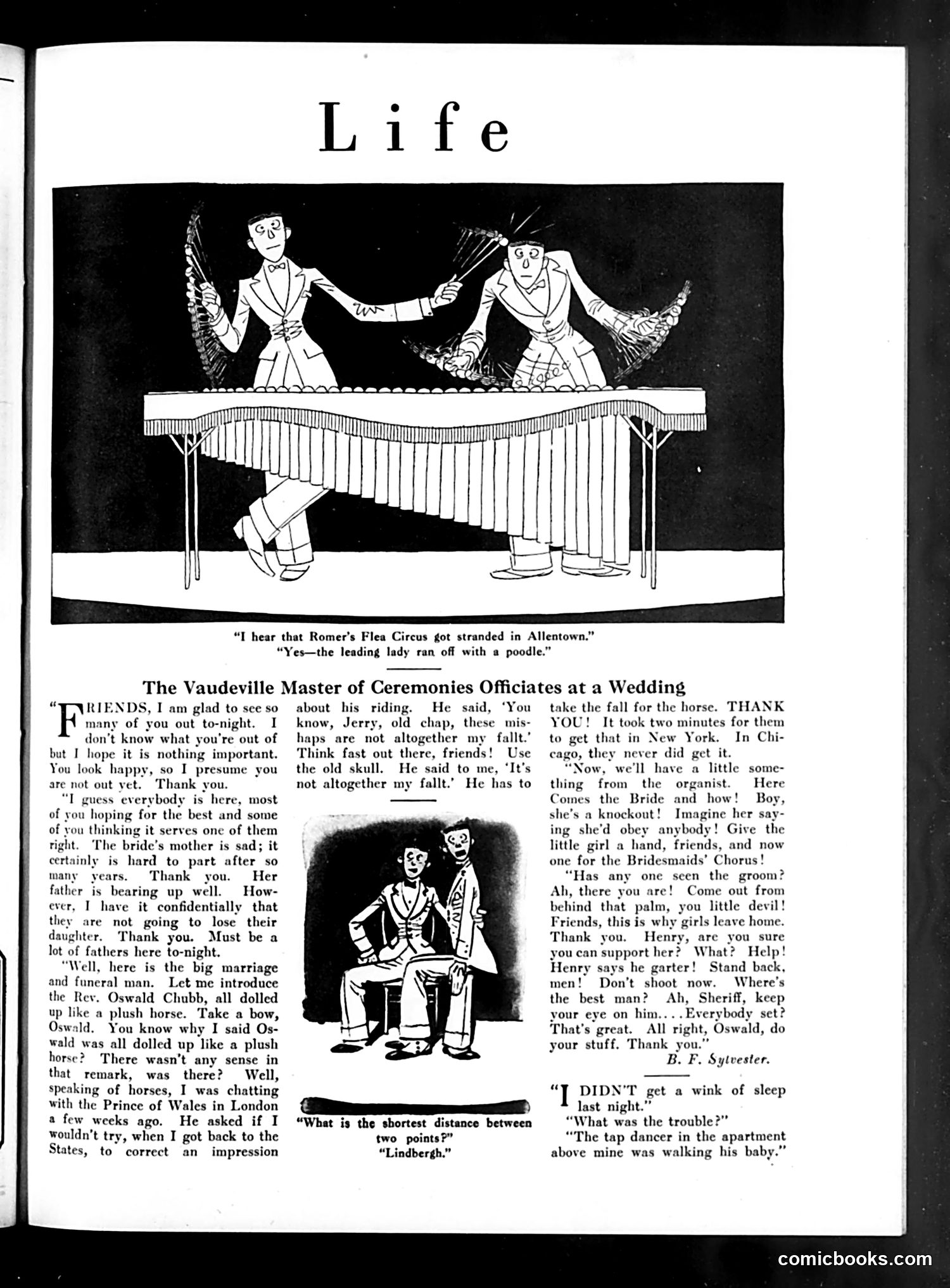
This page from *Life* magazine contains humorous wedding-related content. The top illustration shows two vaudeville performers juggling at what appears to be a theatrical wedding ceremony, satirizing the theatrical spectacle sometimes made of such events. The main text, "The Vaudeville Master of Ceremonies Officiates at a Wedding," is a comedic monologue by someone identified as "B. F. Syleester" (or similar). The master of ceremonies delivers absurd, rambling remarks at a wedding, making crude jokes and inappropriate comments typical of early 20th-century vaudeville humor—such as jokes about the groom's horsemanship and crude references to newlywed life. The scattered jokes below (like the "shortest distance between two points" riddle) are typical period humor filler. The satire mocks both vaudeville entertainment conventions and poor wedding etiquette.
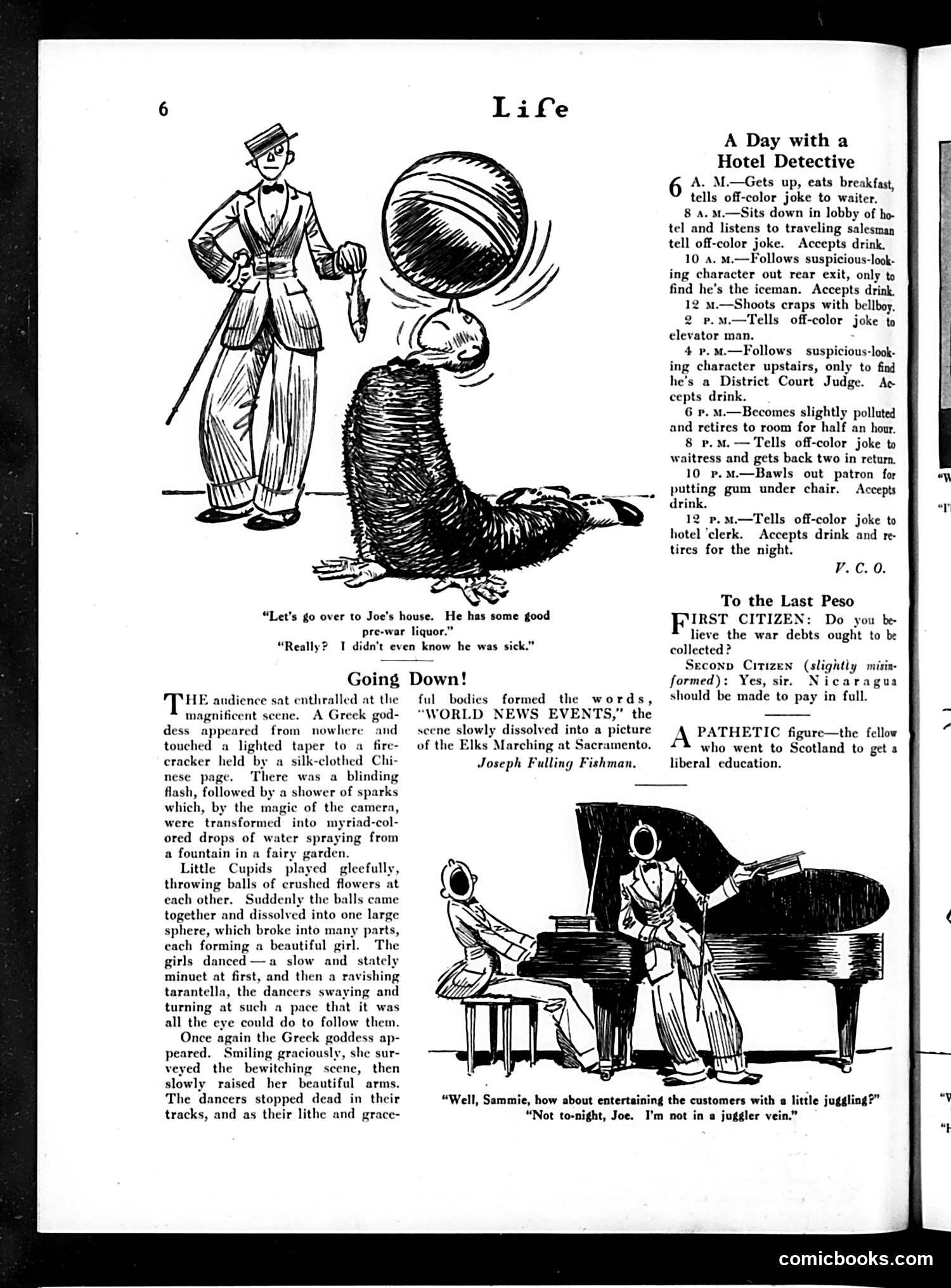
The top cartoon satirizes hotel detectives as bumbling, overzealous characters who spend their day following suspicious guests, only to discover they're innocent people (a traveling salesman, a District Court Judge). The detective accepts numerous drinks throughout the day, becoming progressively intoxicated by evening. The lower section, "Going Down!," describes an elaborate stage magic trick where Cupids and flowers dissolve into water drops from a fountain, forming a large sphere that breaks apart to reveal a beautiful dancing girl. The text emphasizes the visual spectacle and graceful choreography of this theatrical illusion. Both pieces mock pretension—one through incompetent law enforcement, the other celebrating theatrical artifice and entertainment.
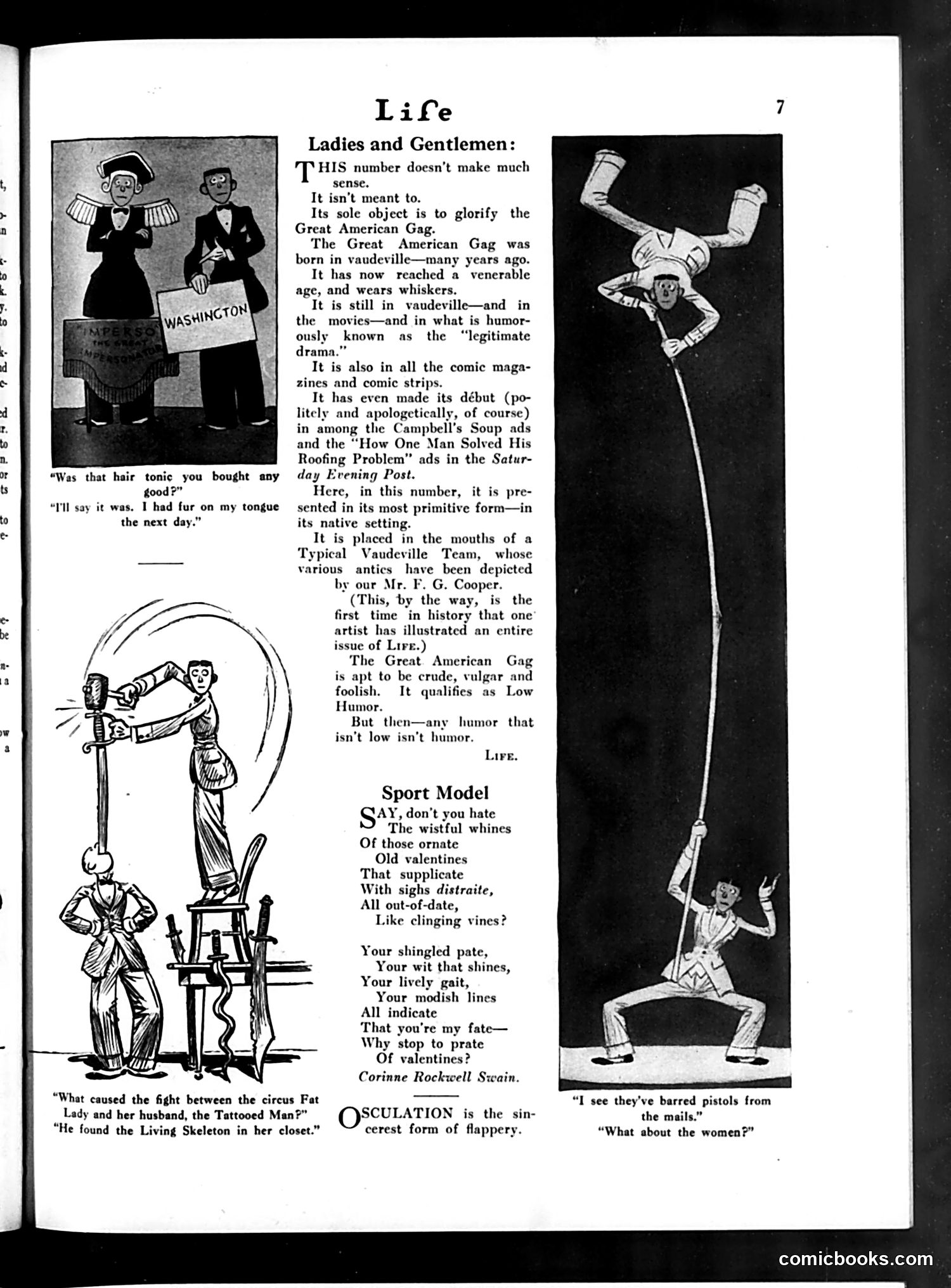
This page satirizes the "Great American Gag"—a long-running vaudeville comedy routine that had persisted for years. The opening cartoon mocks its ubiquity across entertainment media: vaudeville, movies, comic magazines, and even advertisements (Campbell's Soup, Saturday Evening Post ads). The illustrations show classic vaudeville physical comedy: performers in exaggerated poses—upside-down acrobats, contorted positions. The satire's point: this ancient gag format, though "crude, vulgar and foolish," remains pervasive as "Low Humor," yet Life argues "any humor that isn't low isn't humor." The "Sport Model" poem by Corinne Rockwell Swain appears below, addressing outdated Valentine's Day sentiment—a separate satirical piece mocking romantic clichés.
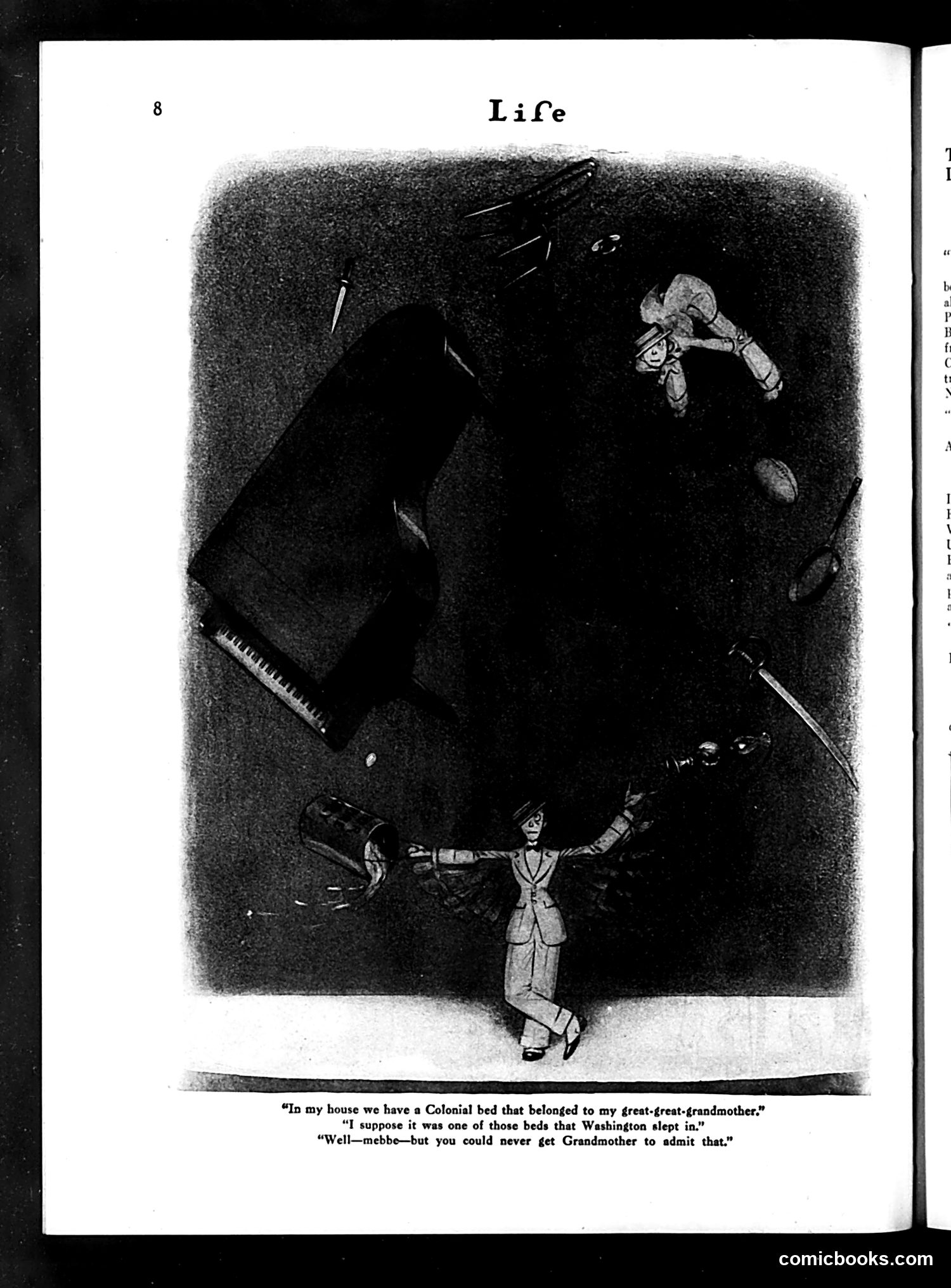
This satirical cartoon depicts a domestic scene where a woman stands beneath an enormous shadowy figure (likely representing her husband or male authority figure) who looms menacingly overhead. The woman appears small and controlled in contrast. The caption reveals the joke's target: snobbery and exaggeration about family heritage. A woman boasts about owning a "Colonial bed that belonged to my great-great-grandmother," claiming it may have belonged to George Washington. Her companion responds skeptically that "you could never get Grandmother to admit that"—suggesting the woman would stubbornly deny any non-prestigious origins for the furniture. The cartoon satirizes Americans' pretentious claims about historical significance and ancestral importance, a common target of Life magazine's social commentary.
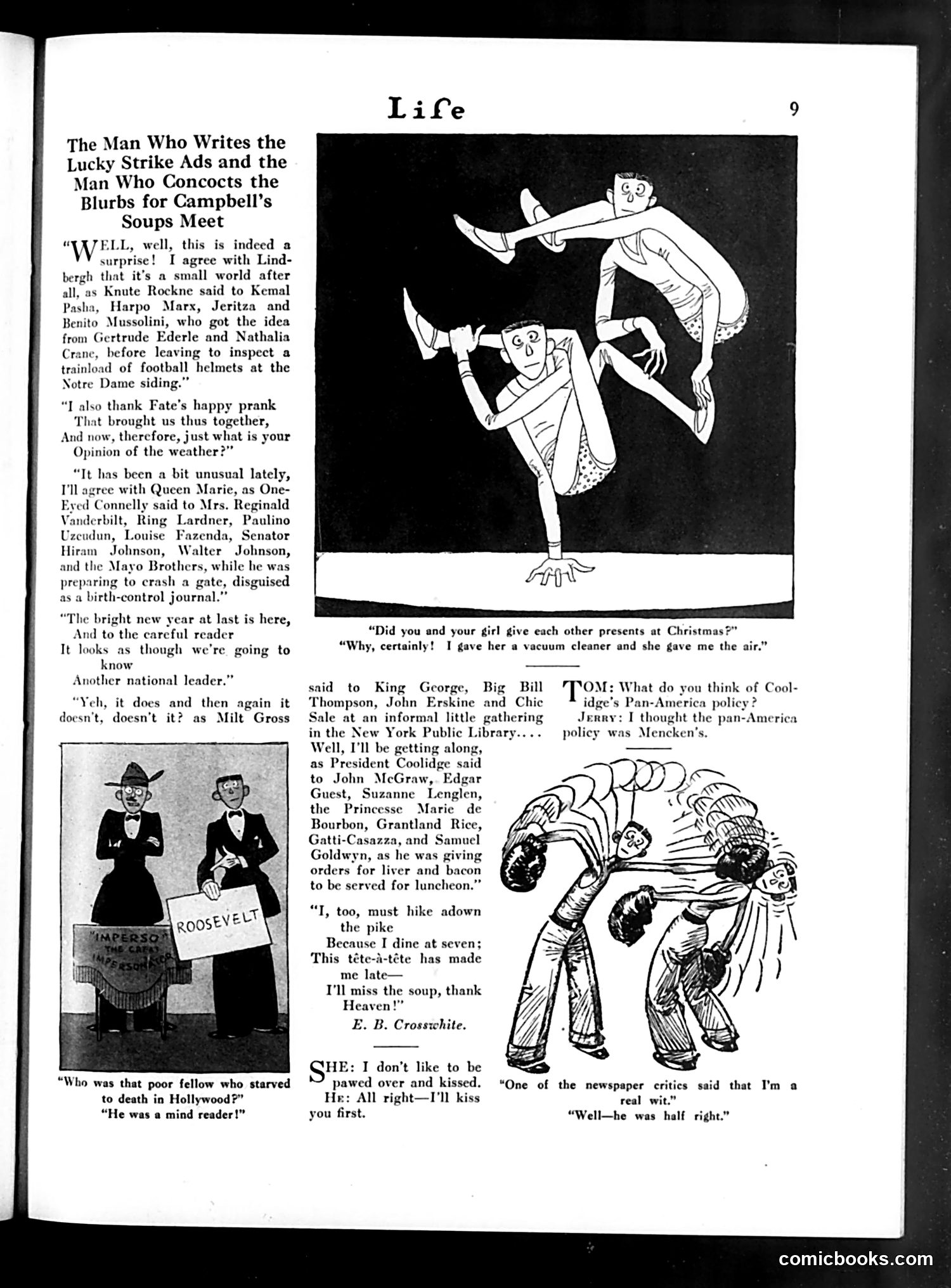
This page contains satirical commentary on early 1920s political and social figures. The left cartoon shows two men labeled "Impersonator" and "Roosevelt," suggesting satire about someone impersonating the famous Roosevelt political family. The top illustration depicts figures in acrobatic poses, likely mocking prominent contemporaries (the text mentions Queen Marie, King George, and various American political/cultural figures). The right section includes jokes about Coolidge's Pan-American policy and dining etiquette, referencing President Calvin Coolidge, who was known for taciturn behavior. Overall, the page satirizes prominent politicians, royalty, and society figures of the early 1920s through visual caricature and witty commentary—typical of Life magazine's role as a vehicle for political and social humor during this era.
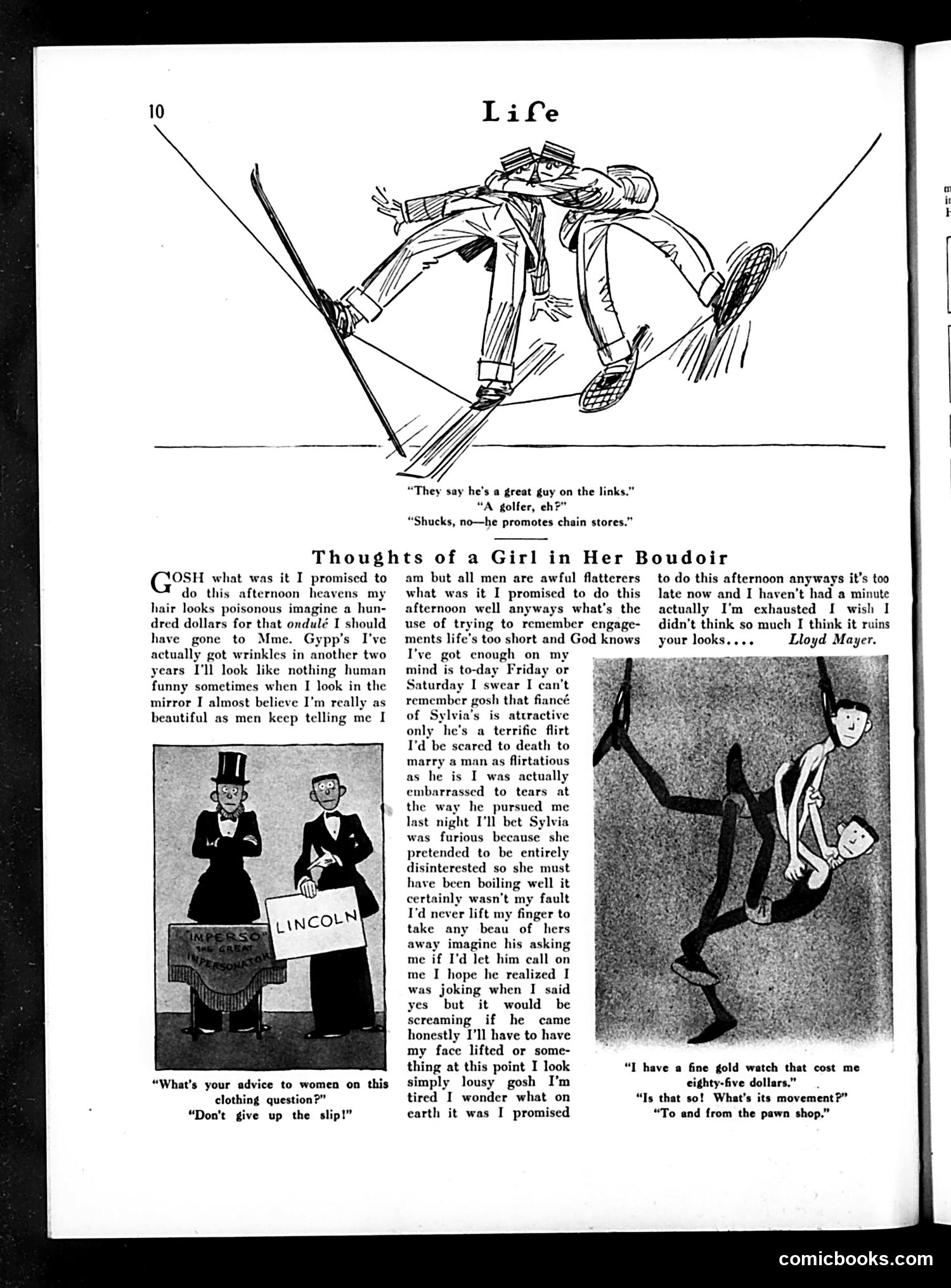
This page contains two satirical cartoons from early 20th-century Life magazine. **Top cartoon**: Shows a golfer falling while skiing, with the caption "They say he's a great guy on the links" / "A golfer, eh?" / "Shucks, no—he promotes chain stores." This mocks someone prominent in retail (chain stores were relatively new and controversial) who receives undeserved social prestige. **Bottom section**: "Thoughts of a Girl in Her Boudoir" is a humorous monologue by a woman reflecting on various romantic and social anxieties. The accompanying photos show her contemplating a gold watch and discussing its pawn-shop origins—satirizing consumerism and women's financial insecurity. Both pieces satirize American social pretension, gender relations, and emerging consumer culture, using humor to critique status-seeking behaviors of the era.
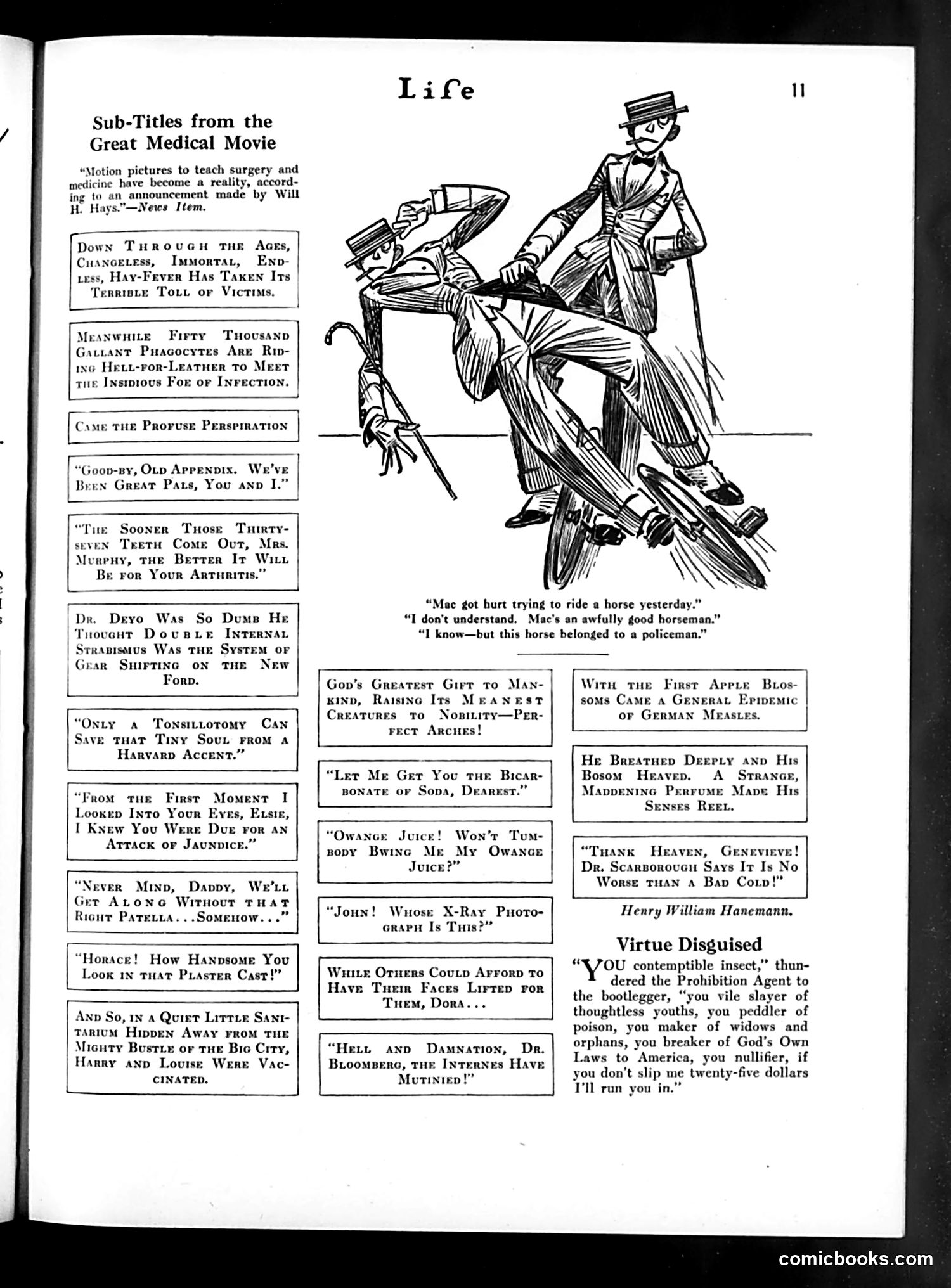
This page satirizes early medical films. The left column lists absurd subtitle examples from "The Great Medical Movie," mocking how such films dramatically oversell mundane medical procedures—like surgery curing arthritis or a tonsillectomy saving someone from a "Harvard Accent." The central cartoon shows two men on a bicycle with exaggerated, theatrical poses, accompanying dialogue about a horseman injury. This illustrates how medical films present ordinary medical situations with melodramatic flair. The right section continues mocking medical movie tropes, with quotes like thanking a doctor for preventing measles complications, and ends with "Virtue Disguised"—a satirical condemnation of a Prohibition Agent, suggesting filmmakers hypocritically present destructive figures as heroes. The satire targets both the overwrought presentation style of early medical cinema and moral contradictions in how society elevated certain authorities.
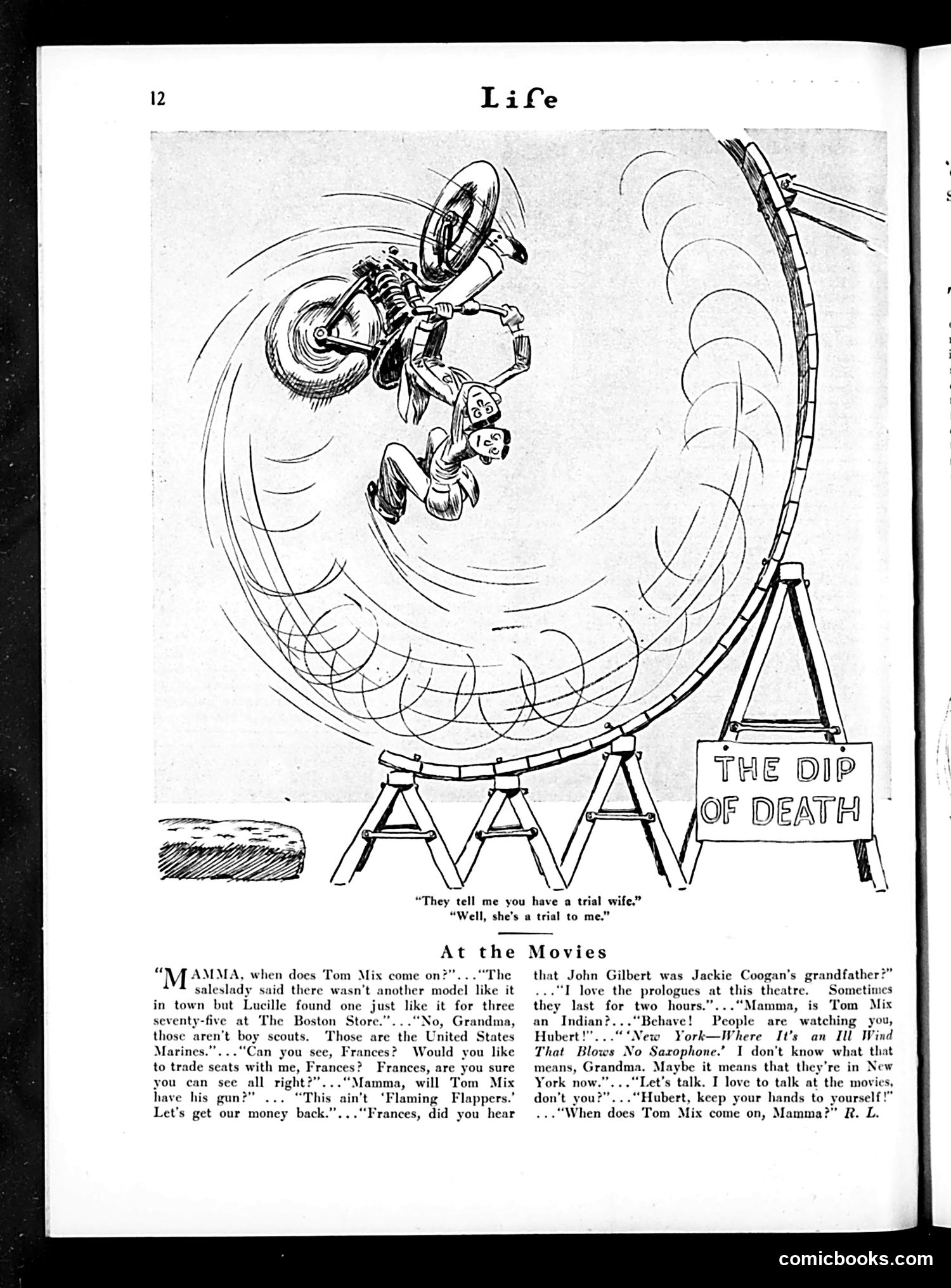
This cartoon satirizes the popularity of dangerous thrill rides at amusement parks and carnivals. It depicts a loop-the-loop ride labeled "THE DIP OF DEATH," with riders experiencing the extreme G-forces at the bottom. The accompanying dialogue mocks movie-theater patrons' gossip, particularly references to Tom Mix (a famous silent film cowboy star) and discussions about various movies including Jackie Coogan and "New York—Where It's an Ill Wind That Blows No Saxophone." The overall satire conflates two contemporary obsessions: extreme mechanical thrills at amusement parks and entertainment-obsessed moviegoers. The "trial wife" joke at the bottom appears unrelated social commentary typical of Life magazine's miscellaneous humor pages.
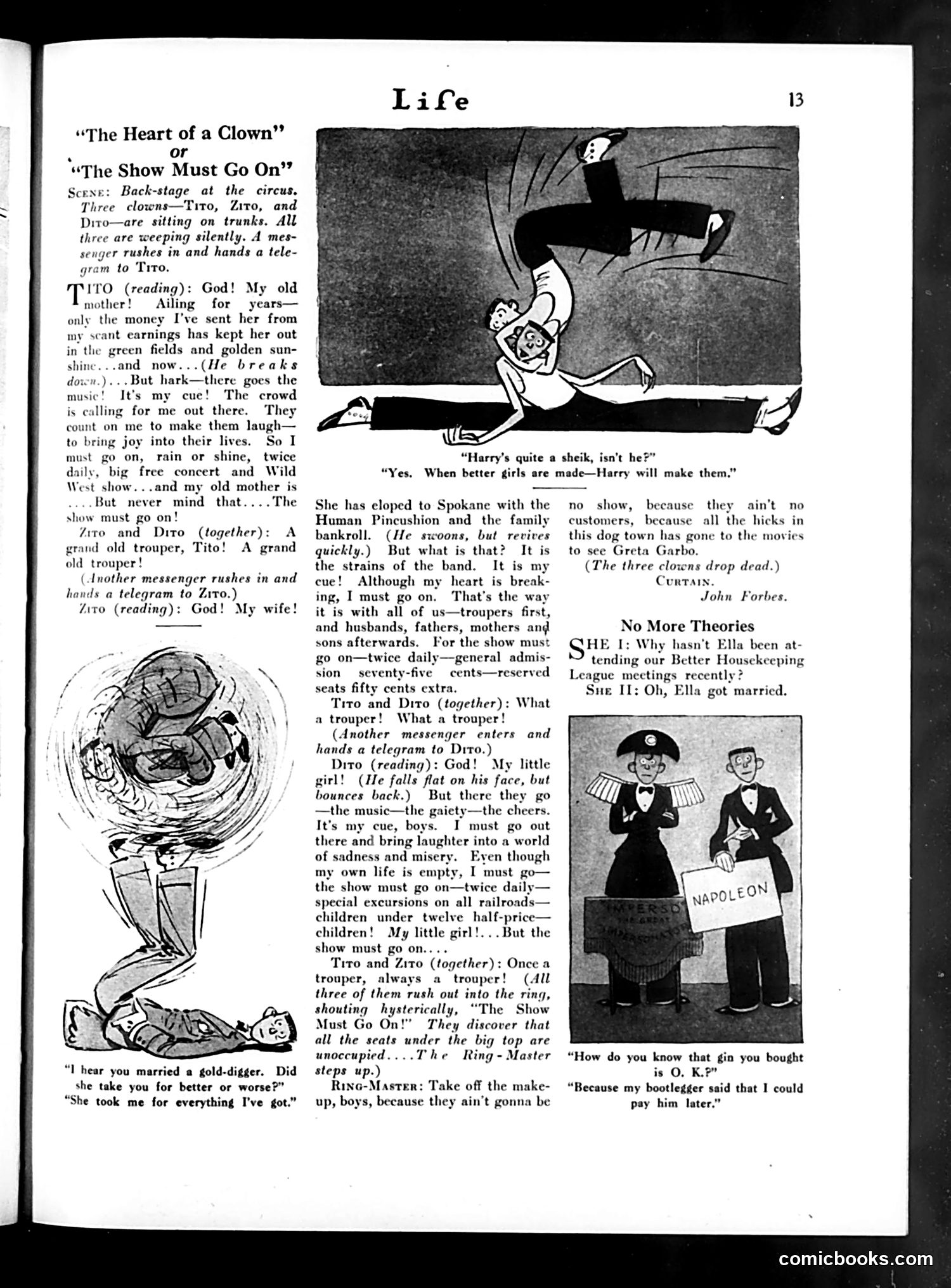
This page contains a theatrical sketch titled "The Heart of a Clown" / "The Show Must Go On," depicting three circus clowns (Tiro, Ziro, and Diro) receiving bad news backstage—apparently about a family member or romantic partner—yet choosing to perform anyway. The satire critiques the "show must go on" mentality: despite personal heartbreak, these performers prioritize entertaining audiences ("bring joy into their lives") over their own suffering. The accompanying cartoons mock class pretension and materialism: one depicts someone who married for money; another shows two figures labeled "Napoleon," joking about bootleggers and O.K. gin during Prohibition. The overall theme reflects early 1920s attitudes toward entertainment, sacrifice, and social hypocrisy.
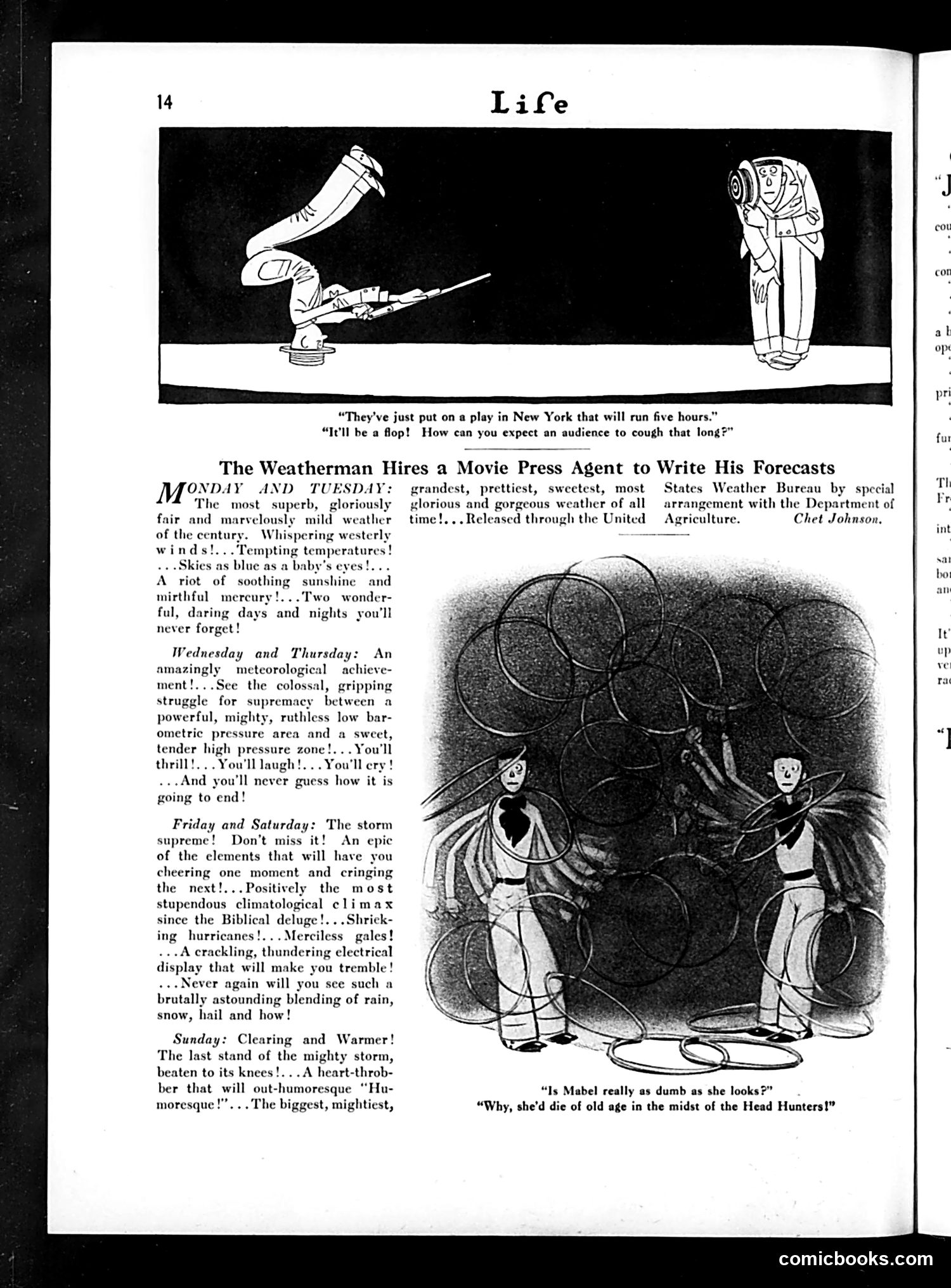
This page satirizes the theatrical presentation of weather forecasts. The top cartoon shows a man literally "fishing" for an audience—a pun on how a five-hour play about weather forecasts might struggle to attract viewers. The main article, "The Weatherman Hires a Movie Press Agent to Write His Forecasts," mocks the U.S. Weather Bureau's increasingly theatrical language. Rather than plain predictions, the forecasts are written with Hollywood drama—promising "epic" storms, "stupendous climatological climax," and "brutally astounding blending of rain, snow, hail." The bottom cartoon depicts women discussing someone named Mabel, questioning whether she'd "die of old age in the midst of the Head Hunters," suggesting Mabel is caught between extreme weather conditions the forecasts describe. The satire critiques both sensationalized weather reporting and 1920s-30s media excess.
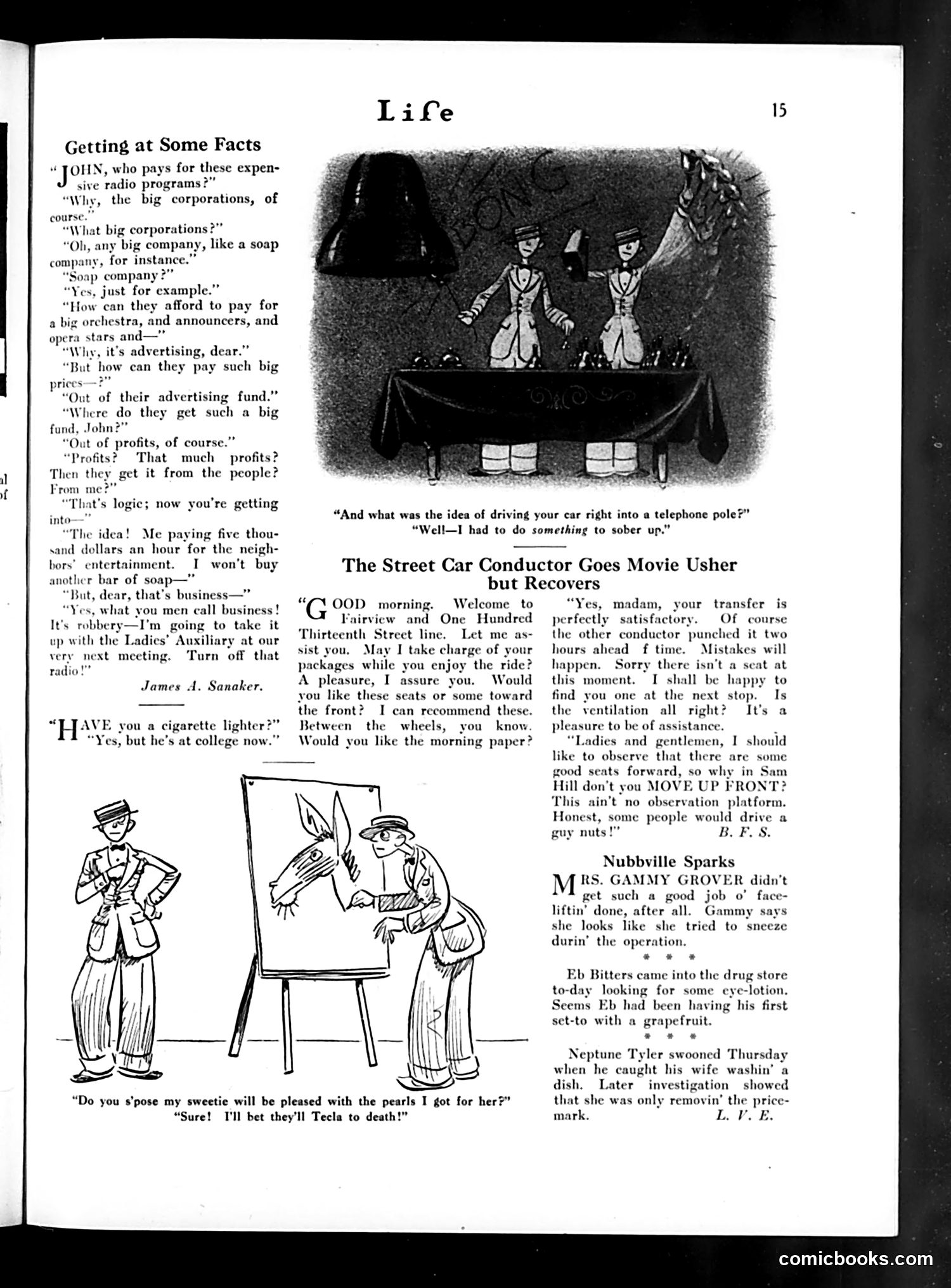
This page contains several humor pieces mocking early 20th-century American consumer culture and social pretension: **"Getting at Some Facts"** satirizes radio advertising economics—a dialogue where "John" naively asks how corporations afford expensive radio programming, learning it's funded through advertising profits extracted from consumers themselves. The satire targets consumer ignorance about commercial sponsorship. **The cartoon below** shows two men discussing car insurance, with one admitting he "had to do *something* to sober up"—likely implying he caused an accident while intoxicated. **"The Street Car Conductor Goes Movie Usher"** mocks working-class job transitions during economic shifts, depicting someone applying movie-theater etiquette to an unfamiliar role. **"Nubbville Sparks"** contains brief, gossipy anecdotes about small-town characters and their mundane domestic mishaps, typical of period humor columns.
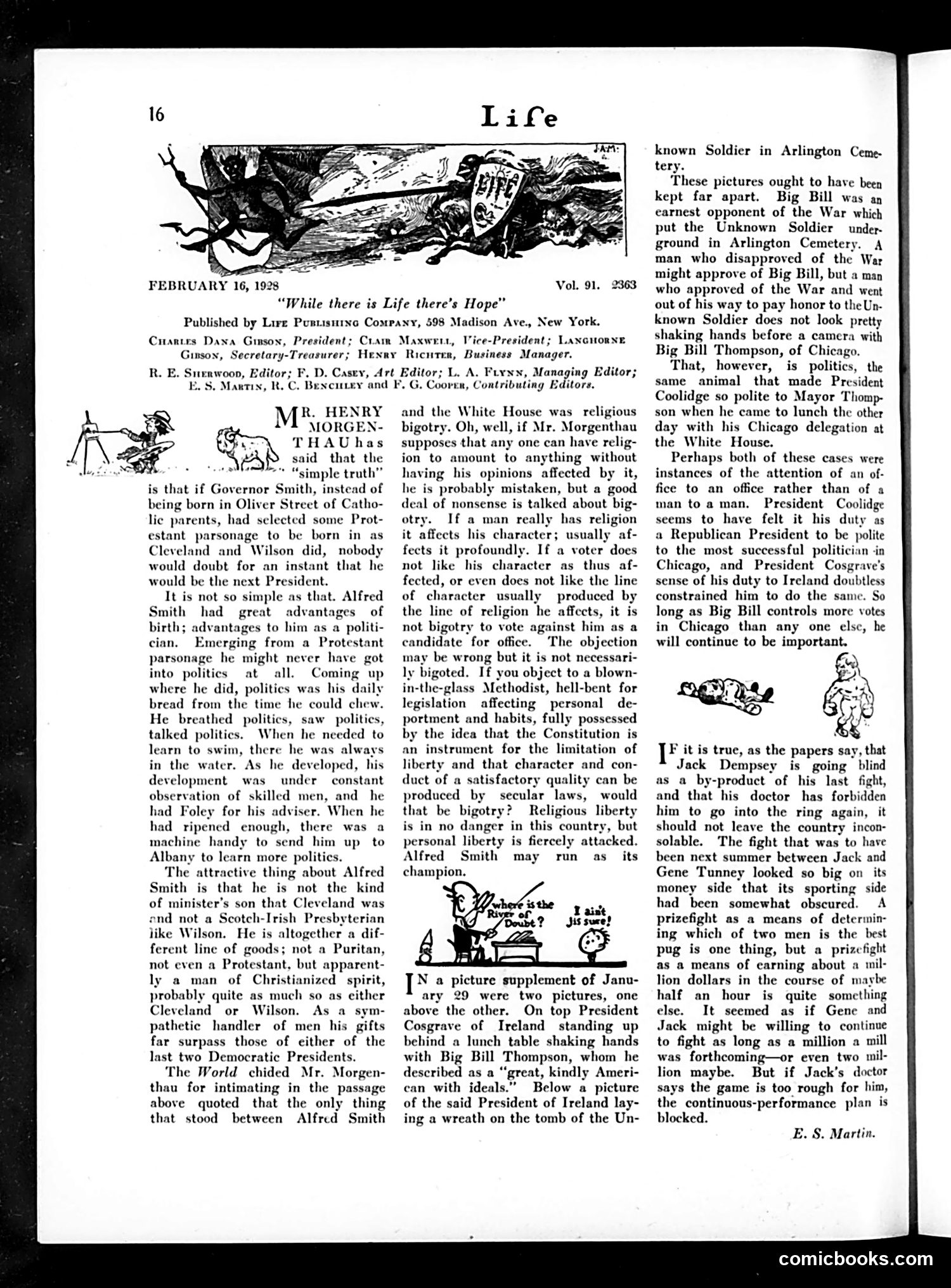
This page contains political commentary on Alfred Smith's presidential ambitions. The main article discusses Smith's Catholic faith and its potential impact on his political viability, questioning whether religious affiliation should affect electoral fitness. The cartoons appear to satirize political hypocrisy: one depicts figures discussing religion's role in governance, while another shows what appears to be a boxing-related joke (referencing Jack Dempsey's rumored comeback). The underlying theme critiques how politicians and the public handle religious prejudice in elections—specifically whether a candidate's Catholicism should disqualify him from office, despite constitutional protections. The satire targets both those who would discriminate and those who defend such discrimination as "liberty." The commentary suggests these were contentious political issues of the 1928 campaign season.
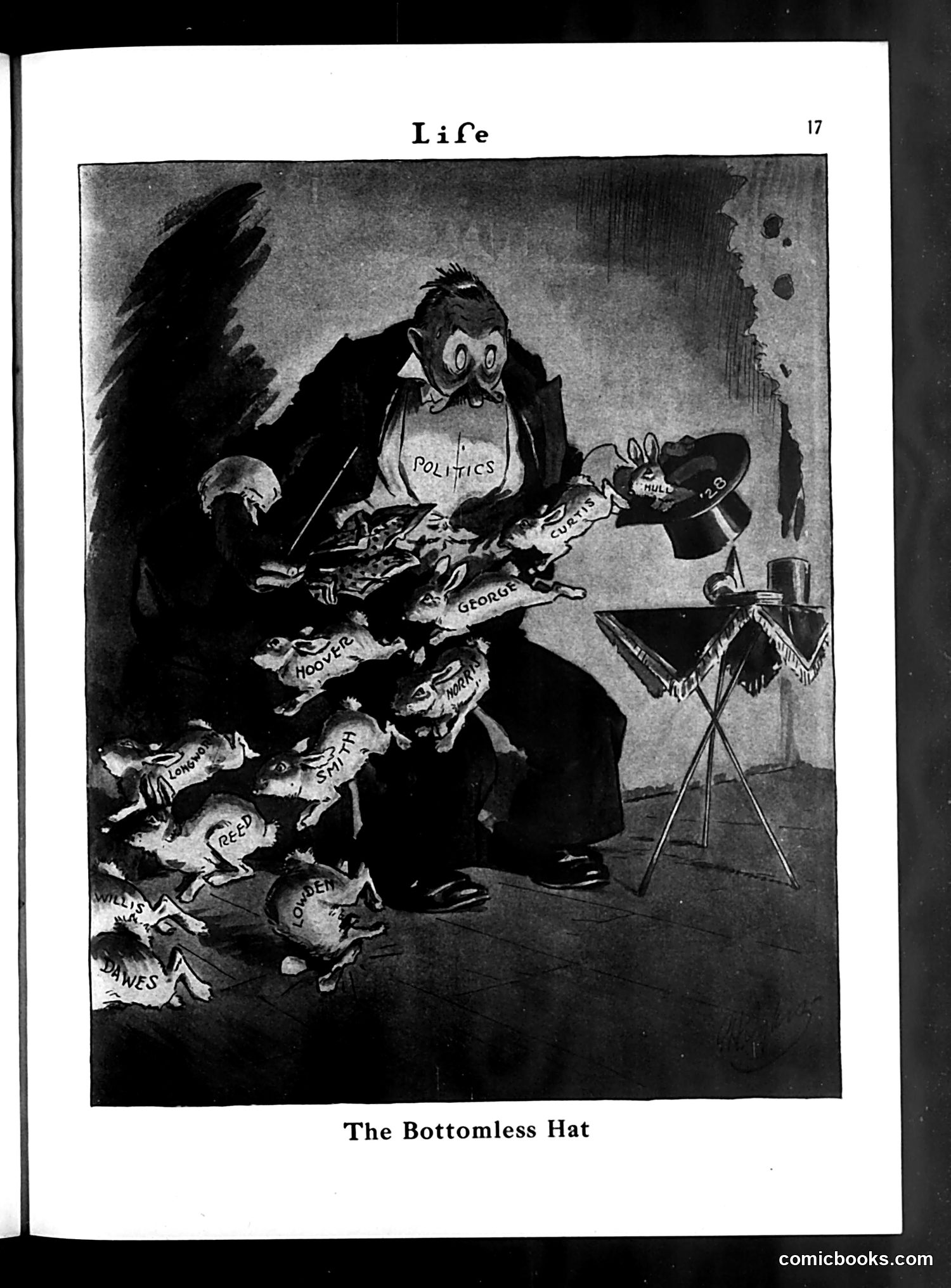
This political cartoon depicts a figure labeled "POLITICS" juggling rats or mice, each labeled with names including "GEORGE," "HOOVER," "LONG," "REED," "WILLIS," "DAWES," and others. The juggler wears enormous spectacles and appears frazzled, struggling to keep all the creatures aloft while standing beside a tripod (possibly representing a camera or observation apparatus). The satire suggests that American politics circa the 1920s-early 1930s was chaotic and unmanageable—multiple political figures competing for attention and control. The "bottomless hat" title likely references the magician's trick of producing endless objects, implying politics generates endless problems or competing interests. The caricature mocks the inability of political leadership to maintain order among competing factions or personalities.
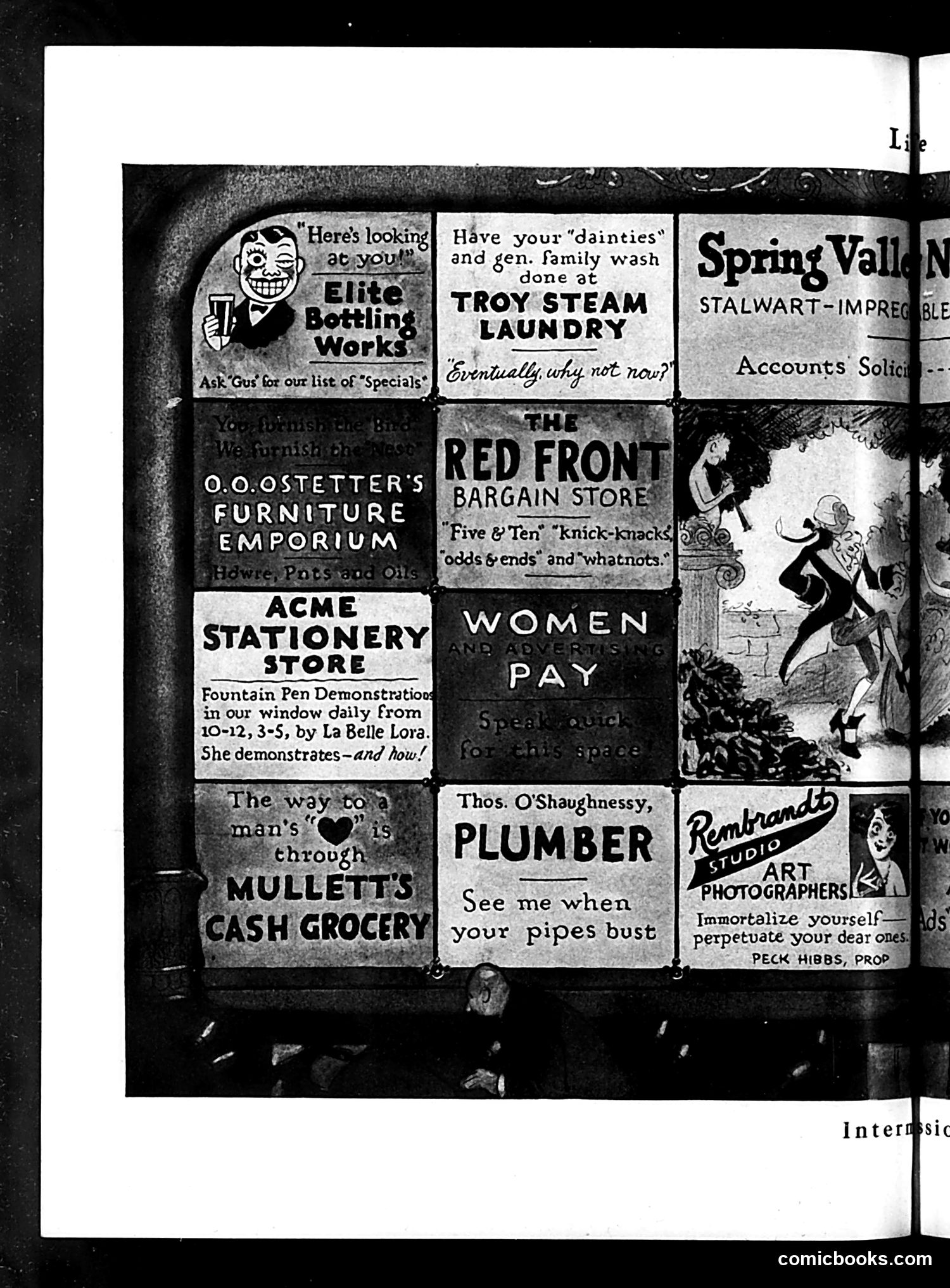
This is primarily a **local business advertising page**, not political satire. It displays vintage classified-style ads for small-town services and shops, likely from the 1920s-1930s based on the typography and illustration style. The ads feature period humor and marketing appeals: - **Elite Bottling Works** uses a grinning face mascot with casual "Here's looking at you" - **Troy Steam Laundry** adopts a conversational tone ("Eventually, why not now?") - **Mullett's Cash Grocery** uses romantic language ("The way to a man's ❤ is through...") - **The Red Front Bargain Store** advertises variety goods - **Rembrandt Art Studio** offers photography services with sentimental appeal The page reflects everyday commercial life in early 20th-century America—plumbers, laundries, furniture stores, and portrait photographers serving local communities. The crude drawings and punchy taglines represent typical period advertising before modern marketing sophistication.
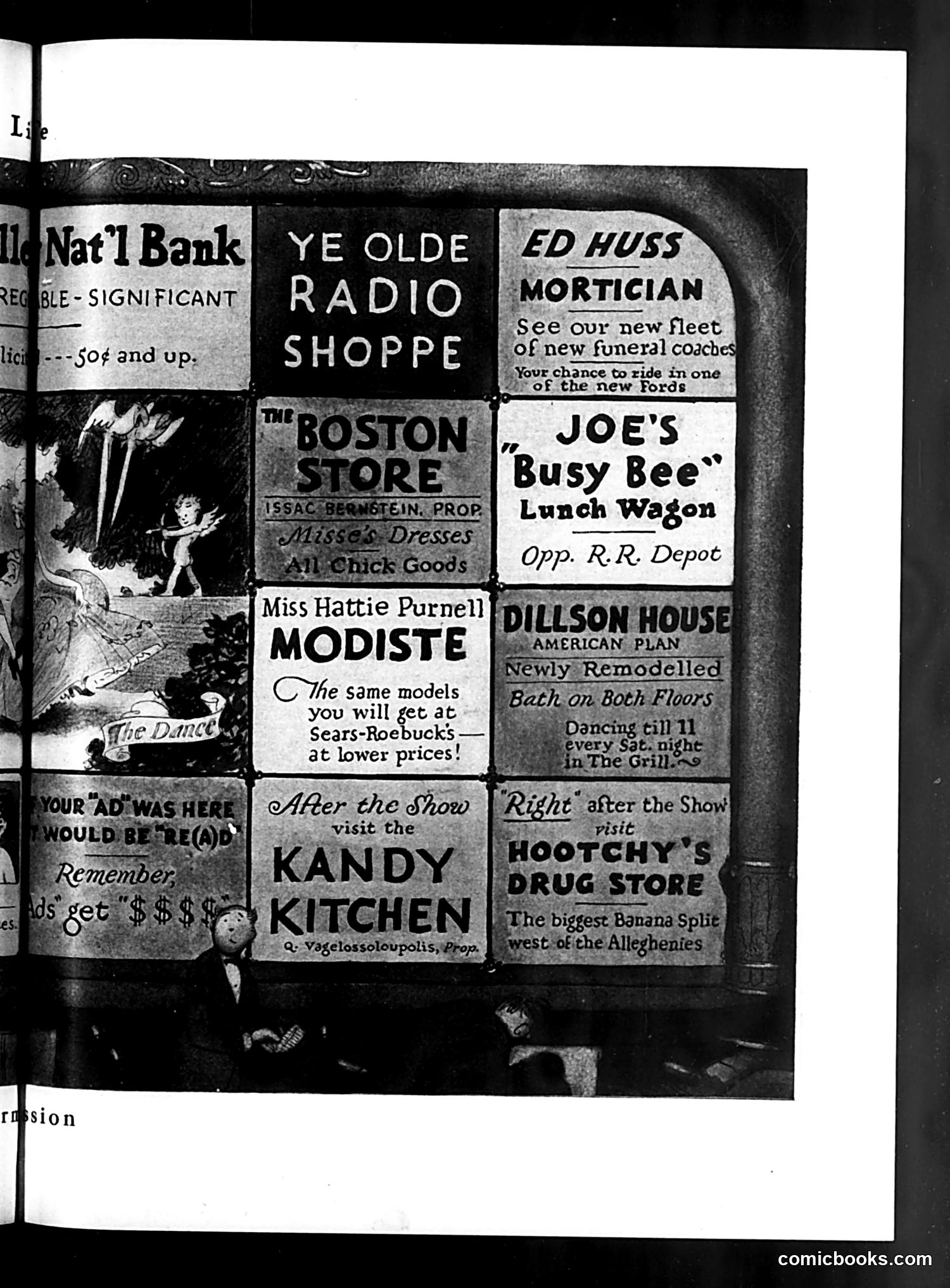
This page is primarily **advertising**, not editorial cartoon content. It shows a collection of early 20th-century local business advertisements arranged in a grid format on what appears to be a theater or storefront window. The ads include: a National Bank, Ye Olde Radio Shoppe, Ed Huss Mortician (advertising "new funeral coaches" using Ford vehicles), The Boston Store (dresses), Joe's "Busy Bee" Lunch Wagon, Miss Hattie Purnell's Modiste shop, Dillson House hotel, Kandy Kitchen, and Hootchy's Drug Store. The only potential satire is **Ed Huss's mortician ad**, which humorously promotes riding in new funeral coaches as a consumer perk—treating death transport like automobile showroom appeal. Otherwise, this is a straightforward period documentation of small-town American commerce and advertising practices.
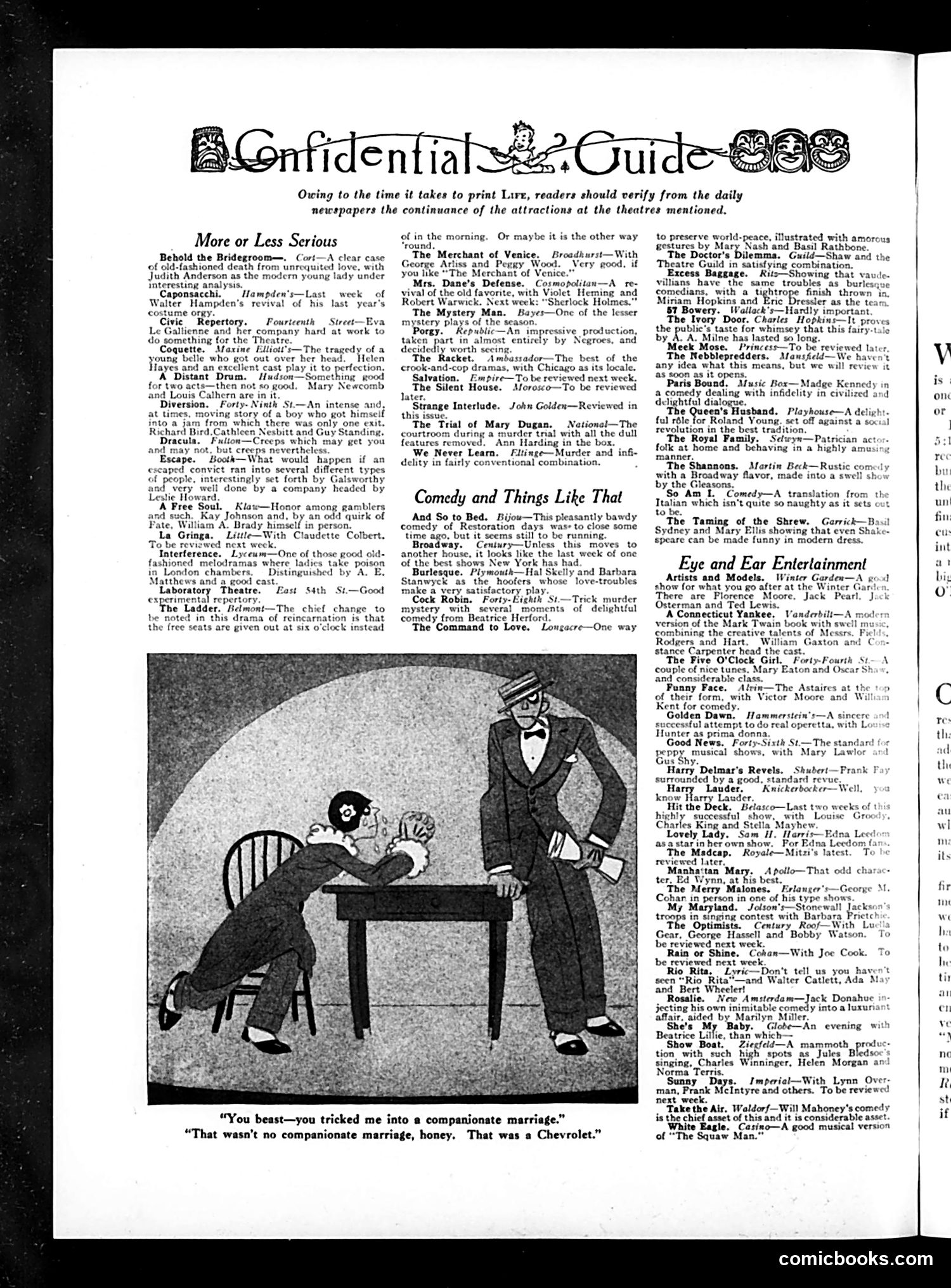
This is a **theater review and entertainment section** from Life magazine (likely 1920s-early 1930s, based on style and references). The **cartoon at bottom** is a marriage joke playing on the term "companionate marriage"—a 1920s social debate about modern marriages based on companionship rather than tradition. A man tricks a woman into such an arrangement, but she retorts that what they actually had was a **Chevrolet**—implying he seduced her with an automobile instead of genuine commitment. The joke mocks both the fashionable concept of "companionate marriage" and the era's car culture. The **page content** is straightforward theater listings and brief reviews of current Broadway productions, including plays like *Porgy*, *The Racket*, and *Strange Interlude*. Notable: *Porgy* is described as "taken part in almost entirely by Negroes"—period language reflecting 1920s racial attitudes. There's no overt political satire here—it's entertainment journalism with one social-commentary joke about changing marriage customs.
This is a theater review of Eugene O'Neill's play "Strange Interlude," praising its importance while critiquing its method. The critic sat through a marathon performance (5:15 PM to 11 PM with dinner break). **Main complaint**: O'Neill uses the theatrical "aside"—characters speaking their inner thoughts aloud to the audience. The reviewer finds this technique lazily expository and melodramatic, comparing it unfavorably to old-fashioned plays like "The Wolves of St. Agnes." **The satire's point**: The critic suggests O'Neill's thoughts lack subtlety—"any alert child" could guess them. Better playwrights conceal character psychology within dialogue rather than having actors simply announce it. **Praise despite criticism**: The reviewer acknowledges the play's importance and gripping power, though admitting uncertainty whether the faults lie with O'Neill or the audience. The small illustrations (figures in repose) appear decorative rather than satirical—typical period magazine formatting.
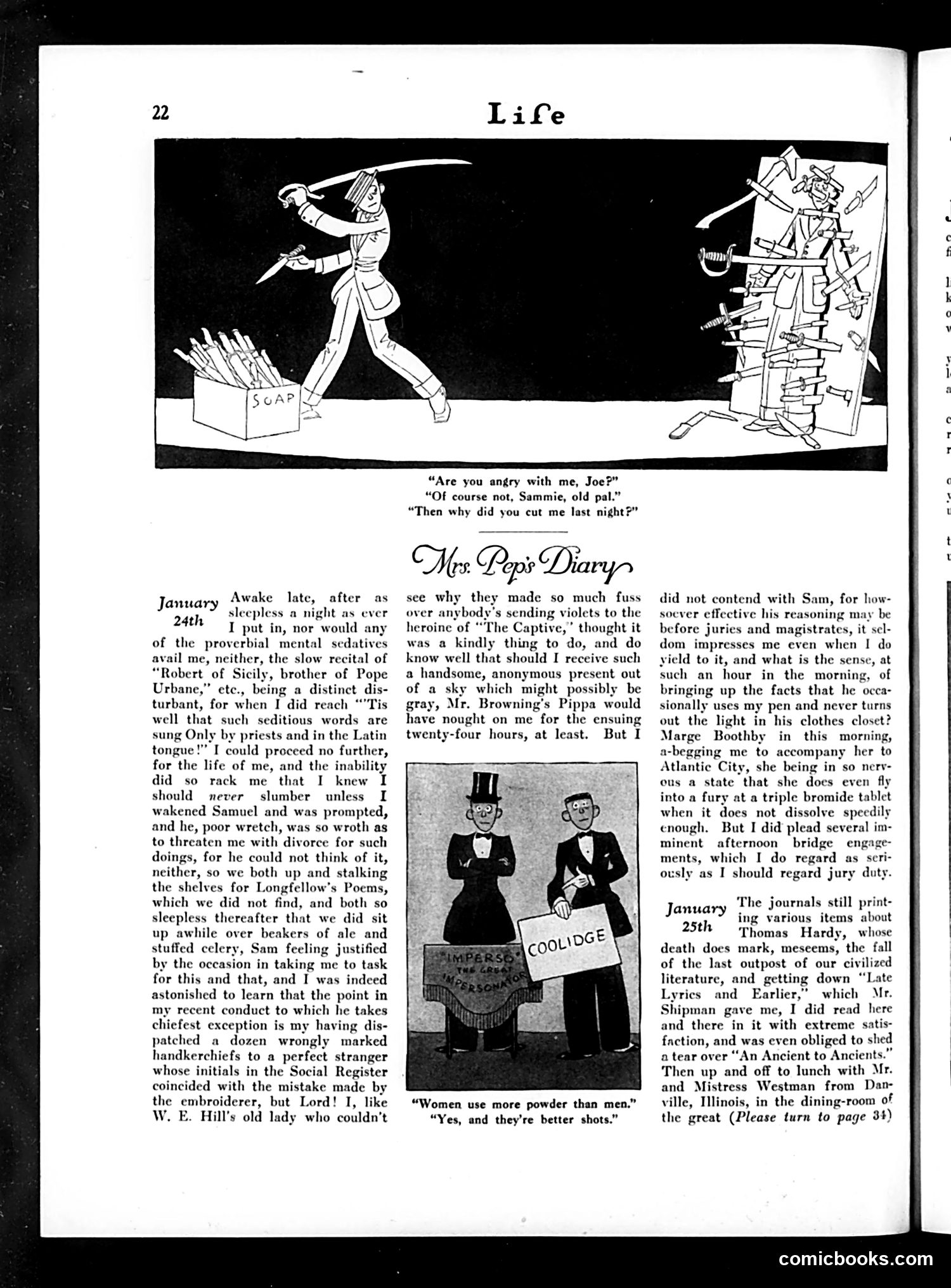
**The Top Cartoon** depicts a figure wielding a sword against a pile labeled "SOAP," while another figure stands amid stacked boxes. The caption jokes about marital discord: "Are you angry with me, Joe?" / "Of course not, Sammie, old pal." / "Then why did you cut me last night?" This is a visual pun: the figure literally "cuts" soap (shown as shredded), but the dialogue treats it as social snubbing. It satirizes domestic quarrels over minor slights and misunderstandings between spouses. **The Bottom Cartoon** shows two formally-dressed men labeled "IMPRESSING COOLIDGE." The joke reads: "Women use more powder than men." / "Yes, and they're better shots." This references 1920s gender politics—specifically women's newfound independence and voting rights (the 19th Amendment passed in 1920). The "powder" double meaning plays on cosmetics versus gunpowder, suggesting women are both more fashionable and more formidable than men assume. The reference to "Coolidge" (likely President Calvin Coolidge) adds political context to the humor about changing gender dynamics.
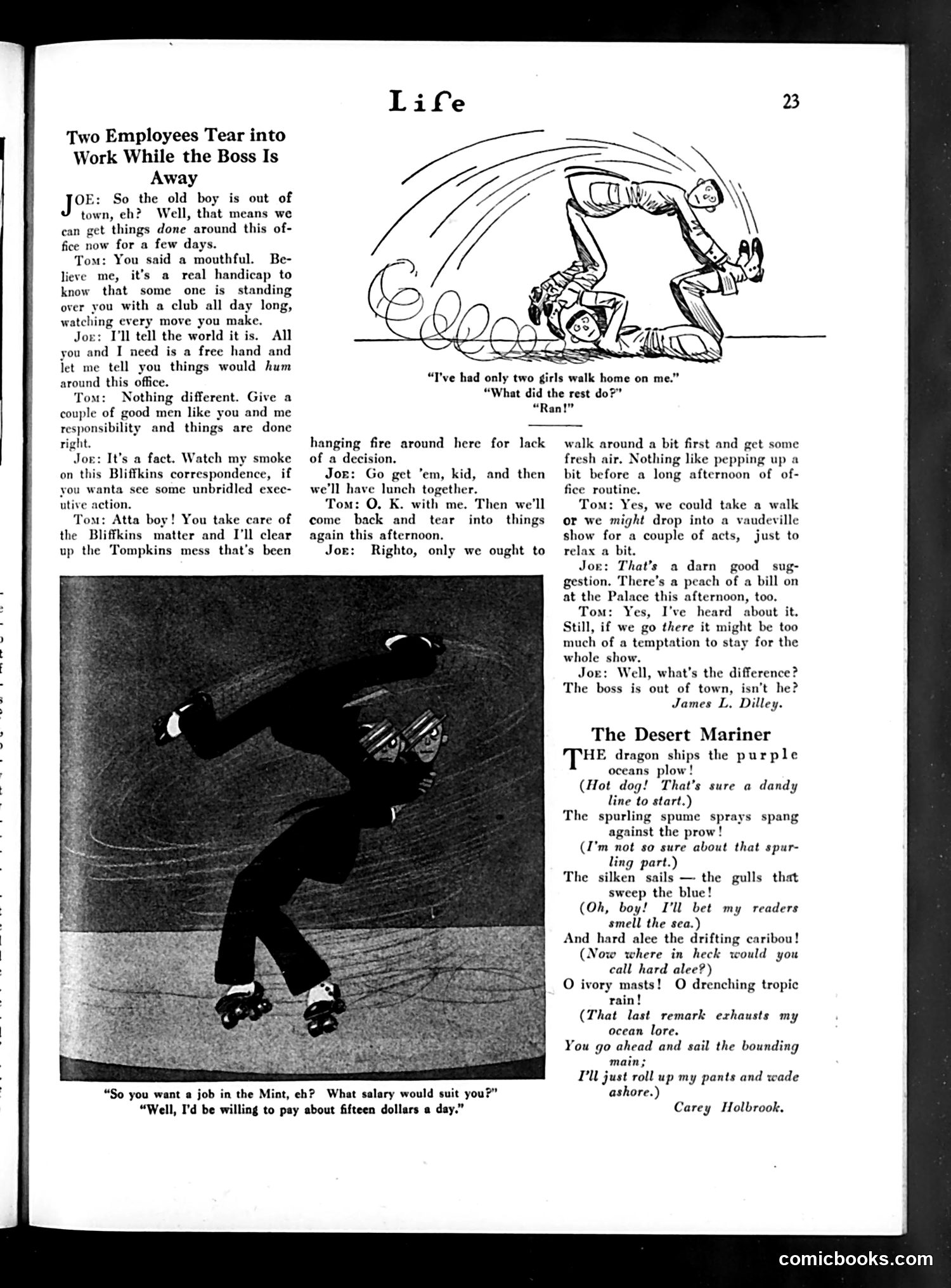
**Top Section ("Two Employees Tear into Work"):** This is a workplace satire about employee behavior when supervisors are absent. Two office workers, Joe and Tom, boast they'll be productive without the boss "standing over you with a club," but their actual plan reveals the joke: they'll work briefly, then take extended lunch breaks, visit vaudeville shows, and generally slack off—justifying it because "the boss is out of town." The humor satirizes the gap between what workers *claim* they'll accomplish without oversight and what they actually do. **Bottom Section ("The Desert Mariner"):** This is a literary parody by Carey Holbrook mocking overwrought romantic poetry about seafaring. Each flowery line about "dragon ships" and "ivory masts" is followed by bracketed commentary exposing the author's pretension—admitting uncertainty about nautical terms, running out of ocean knowledge, and preferring to simply "wade ashore" rather than maintain the grandiose fantasy. It ridicules affected, bombastic poetry writing.
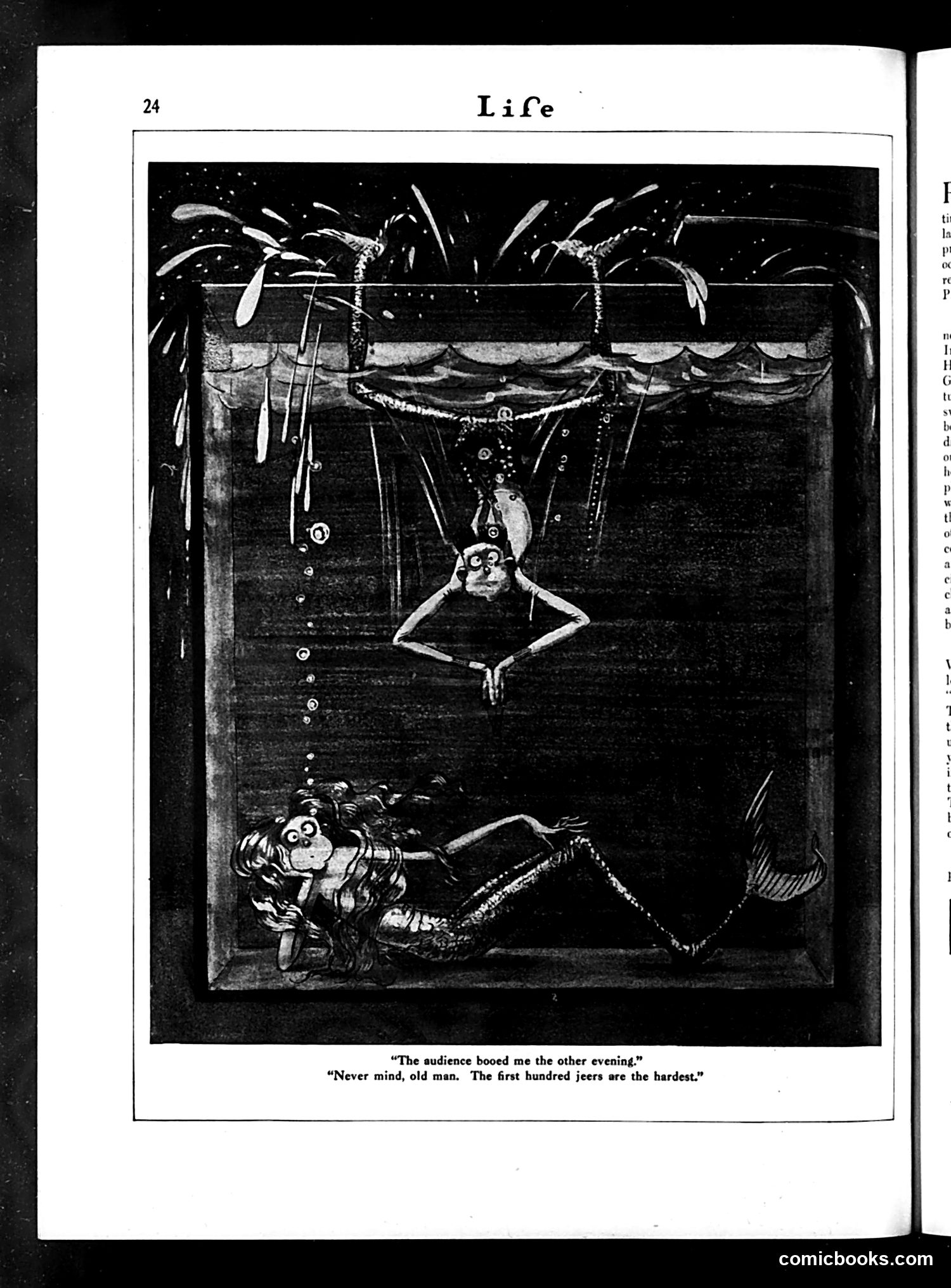
This is a single-panel satirical cartoon depicting what appears to be a theatrical or performance scenario. Two monkey-like figures are shown in an enclosed space—one suspended above, one reclining below—with an audience visible at the top. The caption reads: "The audience booed me the other evening. Never mind, old man. The first hundred jeers are the hardest." The satire appears to mock performers or entertainers who face harsh audience rejection. The monkey caricatures suggest the subjects are treated as lowbrow or unseemly performers. The joke implies that enduring initial ridicule from audiences becomes easier over time—a cynical commentary on show business or public performance. The specific historical context and identities of any referenced figures remain unclear without additional documentation.
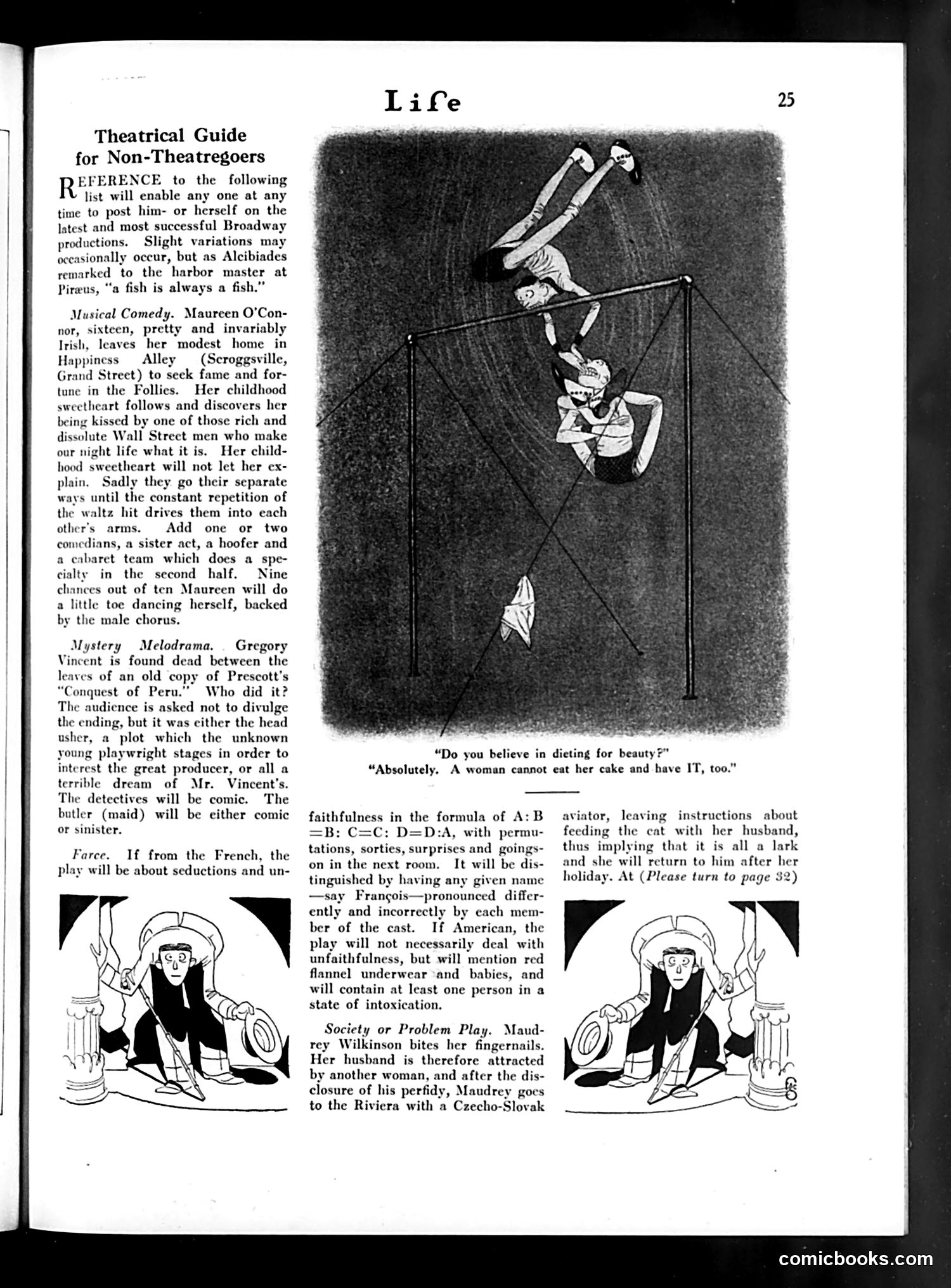
This is satirical commentary on Broadway's formulaic plots circa the 1920s. Life magazine mocks four standard theatrical genres: **Musical Comedy**: A poor Irish girl seeks fame in the Follies, is discovered kissing a wealthy man, loses her sweetheart, but is reunited through a catchy waltz. She performs a tap-dance finale with the male chorus. **Mystery Melodrama**: A body discovered in a book; the killer is either the head usher or it's all a dream. Comic detectives and butler/maid appear. **Farce**: Either French (obsessing over "seductions," using a French name mispronounced differently by each cast member) or American (featuring red underwear, babies, and a drunk character). **Society/Problem Play**: A woman bites her nails, her husband strays, she leaves for the Riviera with a Czechoslovak aviator—but treats it casually, implying she'll return. The cartoon caption jokes that women can't "have their cake and eat it too"—satirizing how these plays pretend serious moral situations are ultimately trivial.
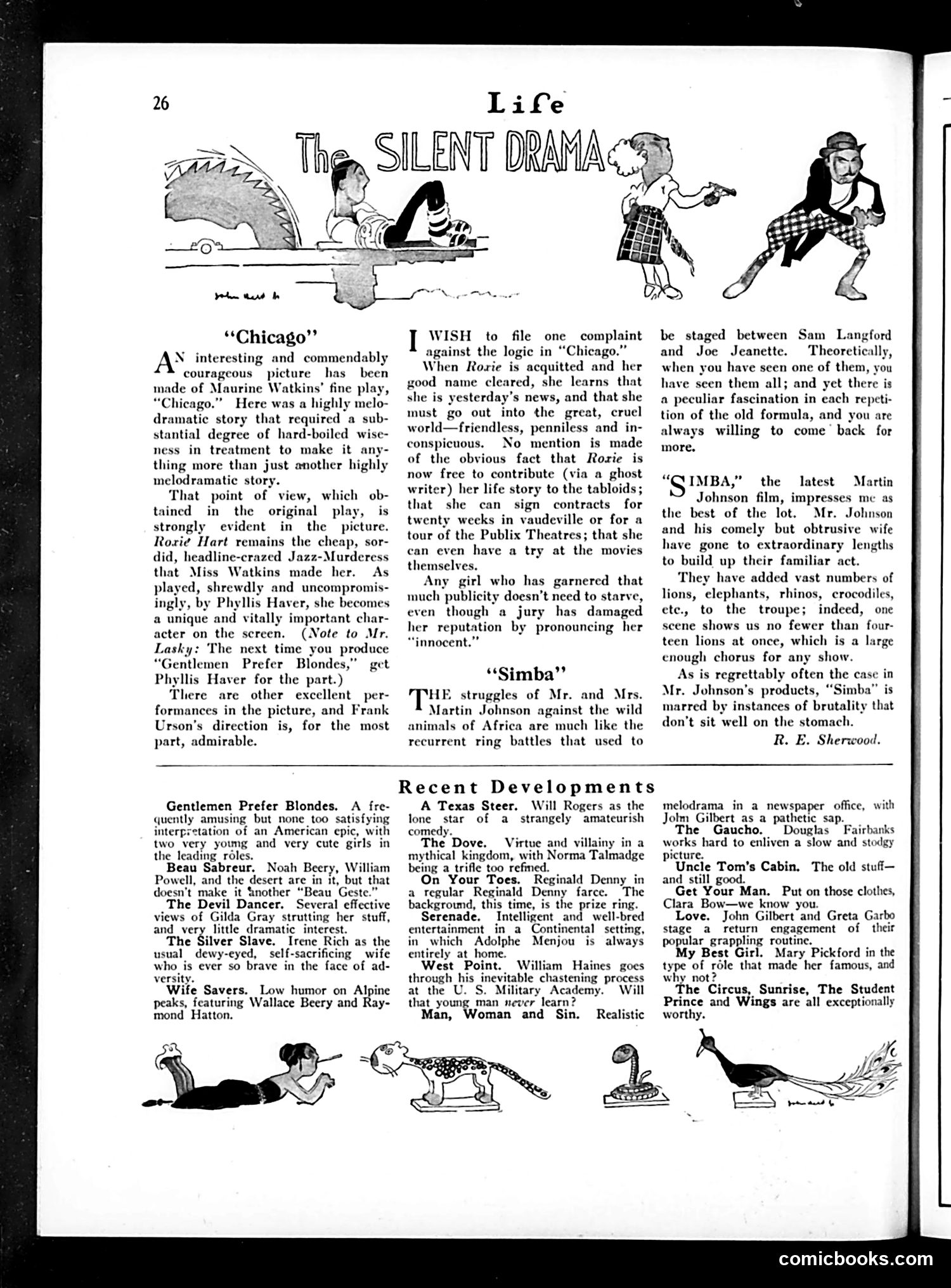
This page reviews several 1920s silent films. The main critiques focus on: **"Chicago"**: A film adaptation of Maurine Watkins' play about Roxie Hart, a sensationalist "Jazz-Murderess." The reviewer praises the film's hard-boiled tone and Phyllis Haver's performance, but complains about illogical plotting—specifically that Roxie, after being acquitted of murder, wouldn't actually need to starve, given she could capitalize on her newfound notoriety through vaudeville, ghost-written memoirs, or film roles. **"Simba"**: A Martin Johnson wildlife documentary-adventure film featuring real African animals. The reviewer finds it engaging but notes it contains brutality that "doesn't sit well on the stomach." The page includes a decorative header showing a sawing act and comedic figures, plus brief reviews of other contemporary releases ("Gentlemen Prefer Blondes," "Beau Sabreur," "The Devil Dancer," etc.). This reflects typical 1920s film criticism focused on entertainment value and moral/social concerns.
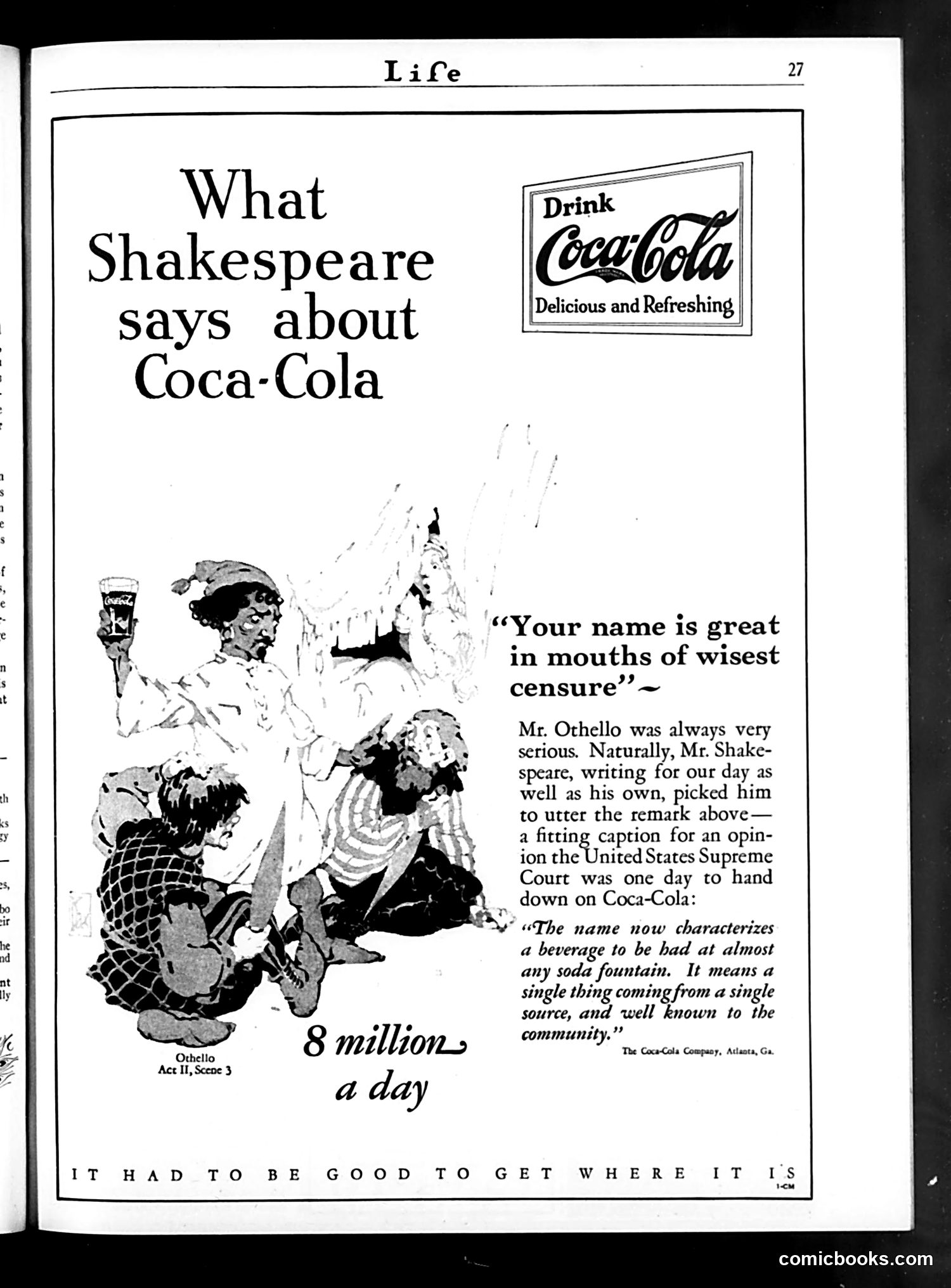
This is a **Coca-Cola advertisement** disguised as satirical content. It uses Shakespeare's *Othello* to humorously defend Coca-Cola's brand name against legal challenge. The cartoon depicts characters from *Othello* (Act II, Scene 3)—apparently Othello and other figures—with a glass of Coca-Cola. The joke: Shakespeare's line about a name being "great in mouths of wisest censure" is reapplied to Coca-Cola's trademark. The advertisement references an actual **U.S. Supreme Court ruling** regarding Coca-Cola, stating the brand name characterizes a specific beverage from a single source—legally protecting the trademark. By attributing this concept to Shakespeare writing "for our day," the ad suggests the drink's reputation is timeless and universally recognized. The bottom tagline, "It had to be good to get where it is," emphasizes Coca-Cola's market dominance (8 million sold daily). This is sophisticated corporate messaging using literary authority and legal validation to reinforce brand prestige.
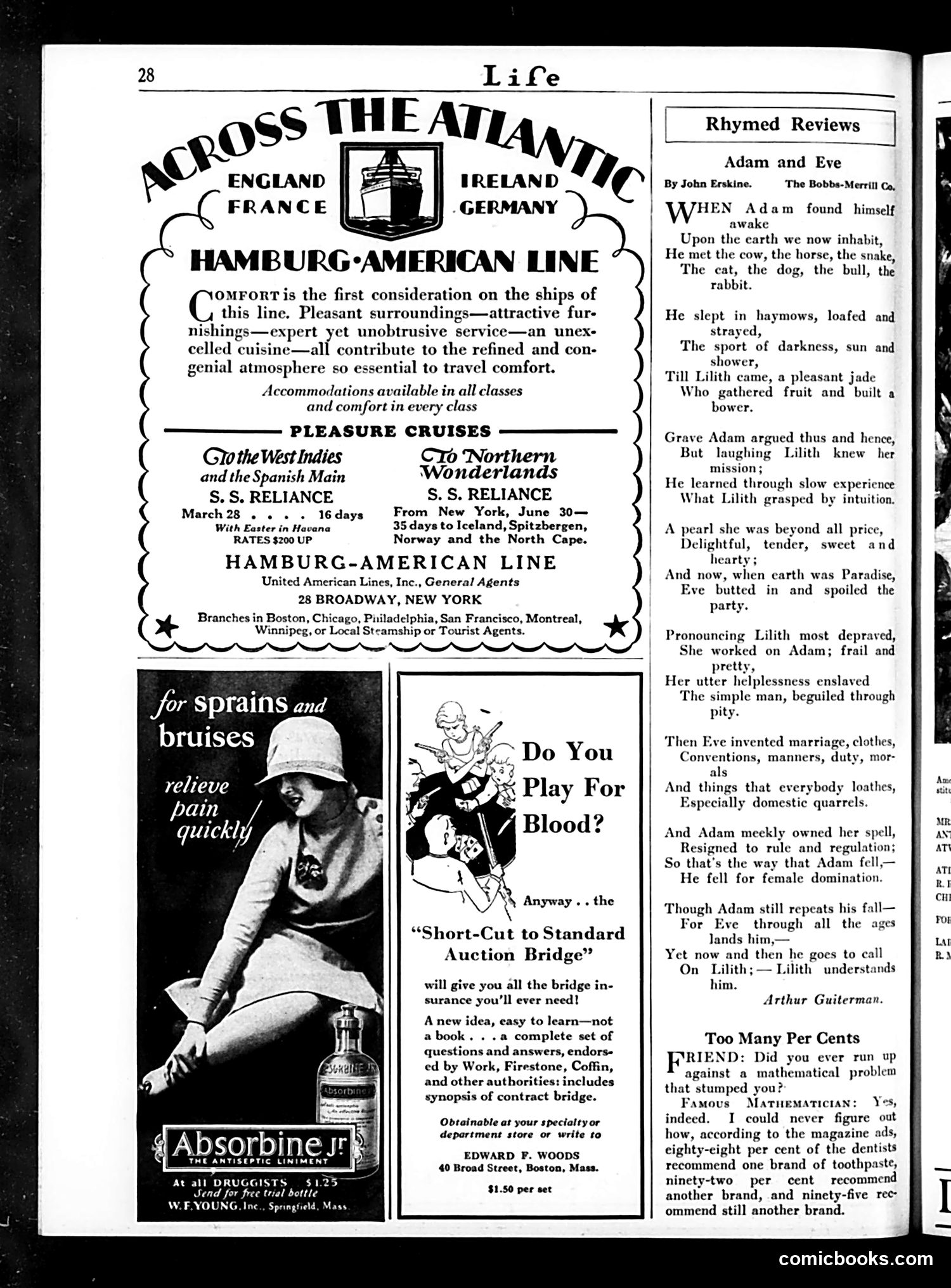
This page is primarily **advertising and literary content** rather than political satire. The main elements are: **Advertisements:** - Hamburg-American Line cruise ships offering transatlantic and pleasure voyages - Absorbine Jr. liniment for sprains and bruises - "Short-Cut to Standard Auction Bridge"—a card game instruction set **Literary Content:** The "Rhymed Reviews" section features John Erskine's *Adam and Eve*, a comedic poem retelling Genesis. The satire here targets **gender dynamics and female influence**: Eve is portrayed as the villain who introduces civilization's burdens (marriage, conventions, domestic quarrels) to mankind, whereas the earlier figure Lilith represented carefree pleasure. The joke is that Adam "fell for female domination"—a play on the Fall of Man. **Humor:** The "Too Many Per Cents" joke mocks advertising's mathematical absurdity: competing toothpaste brands each claim endorsement by implausibly high percentages of dentists, making the statistics logically impossible. The page reflects 1920s-era concerns about gender roles and advertising credibility.
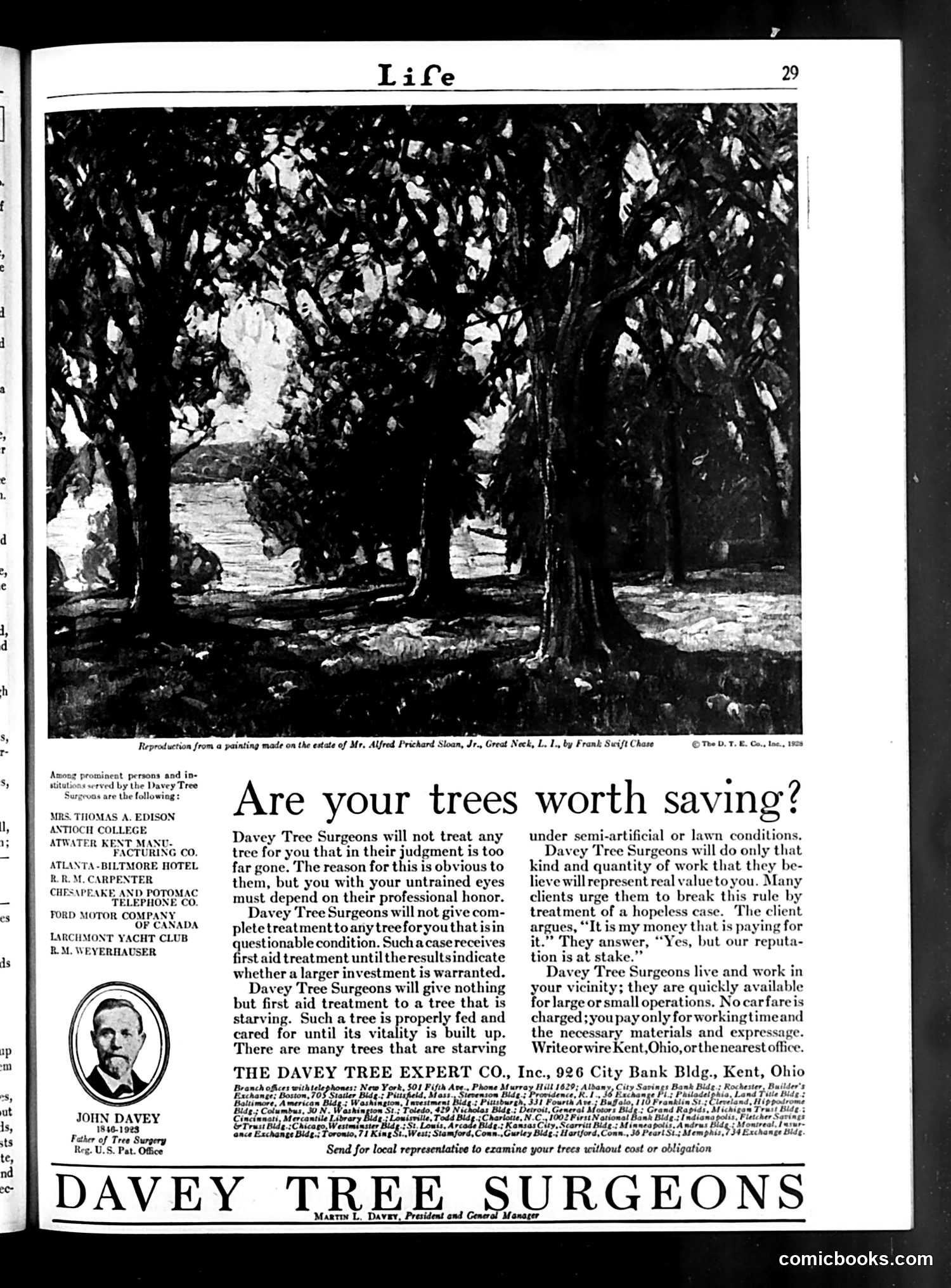
This page is primarily **advertising for Davey Tree Surgeons**, not satire or political commentary. The advertisement features a photograph of a tree-lined avenue at the top and promotes professional tree care services. The ad's rhetorical strategy uses ethical appeals—emphasizing that Davey Tree Surgeons will only perform work they professionally believe is warranted, refusing to over-treat dying trees or perform unnecessary expensive procedures. The company positions itself as trustworthy and honest, contrasting with implied unscrupulous competitors. A portrait of **John Davey (1846-1923)**, labeled "Father of Tree Surgery," establishes the company's legitimacy and history. The advertisement lists numerous branch offices across North America, suggesting a well-established national operation. Rather than satire, this represents **early-20th-century corporate image-building** in Life magazine, appealing to affluent homeowners concerned with maintaining estates and lawns—an audience likely to read Life.
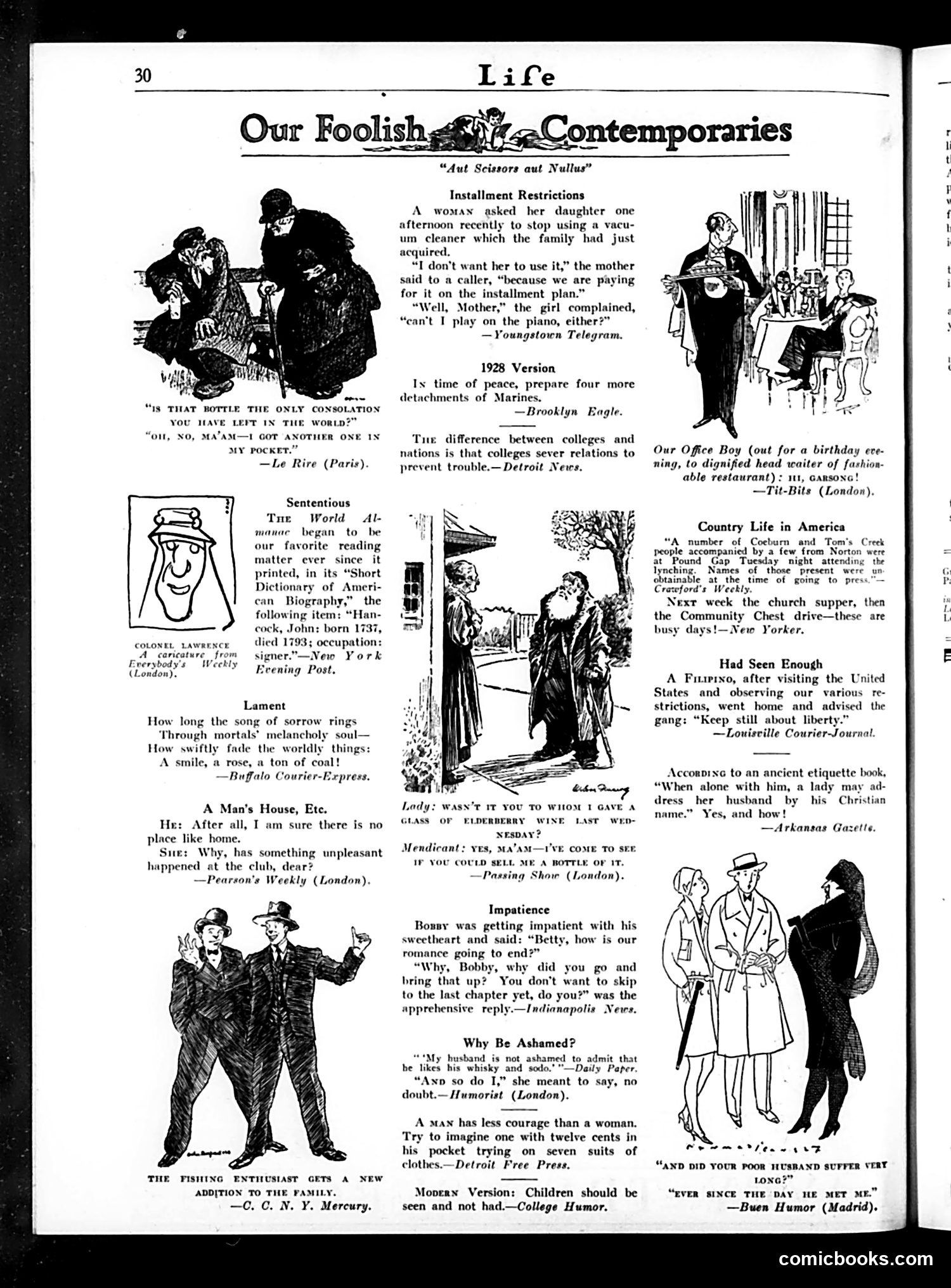
This page collects brief humorous anecdotes and jokes from newspapers and magazines worldwide, mocking contemporary absurdities. Key targets include: **Social/Economic Commentary**: An "Installment Restrictions" joke mocks Depression-era consumer debt—a family won't let their daughter use a newly purchased vacuum cleaner because they're still paying installments on it, highlighting the financial anxieties of the period. **Anti-war sentiment**: A 1928 joke sarcastically suggests preparing for war during peacetime. **Gender dynamics**: Multiple jokes mock marital relationships and women's roles—husbands avoiding home, women's limited autonomy, and marriage dissatisfaction. **Casual violence reference**: A Crawford's Weekly excerpt matter-of-factly mentions a lynching attendance, presented without editorial comment, reflecting how normalized racial violence was in mainstream publications of this era. The page's title ("Aut Scissors aut Nullus"—"Either scissors or nothing") suggests cutting foolishness from public discourse. International sources (Paris, London, Madrid) emphasize that foolishness is universal.
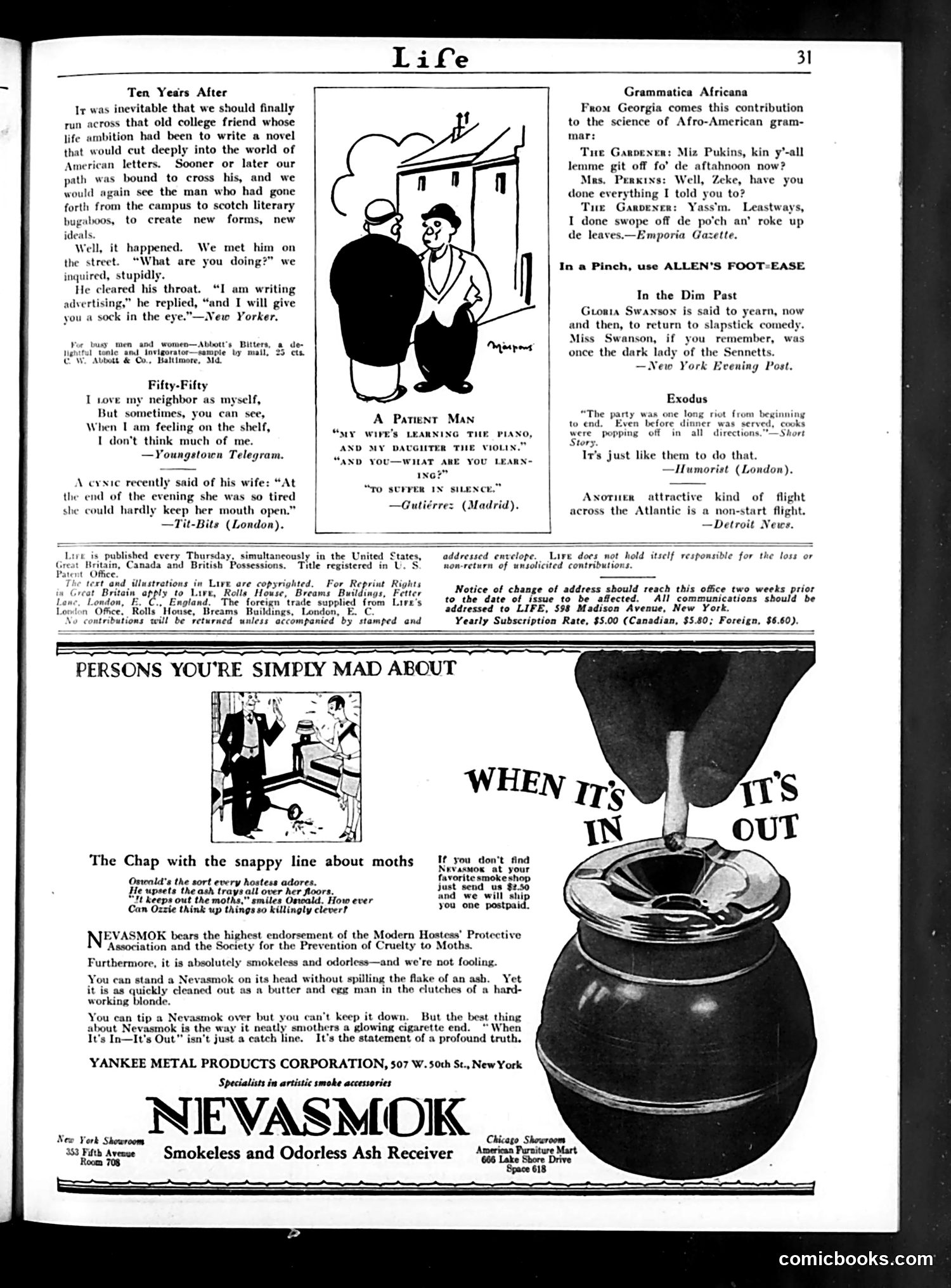
This page contains several short humorous pieces and advertisements typical of 1920s Life magazine. **"Ten Years After"** satirizes the common fate of college idealists—a young man who dreamed of writing serious literature instead became an advertising copywriter, a comedown he acknowledges with bitter humor. **"A Patient Man"** is a joke about domestic noise: a man's wife learns piano, daughter learns violin, and he must learn "to suffer in silence"—a relatable complaint about household cacophony. **"Grammatica Africana"** presents a stereotypical dialogue between a Black gardener and his employer using exaggerated dialect ("Miz Pukins," "aftahnoon," "swope"). This reflects the period's casual racial humor, now recognized as offensive. The **Nevasmok advertisement** dominates the lower half, promoting a smokeless ashtray. The humor plays on hosting etiquette—the product catches cigarette ash without mess, appealing to fastidious hostesses concerned about moths and cleanliness. Overall, this is typical 1920s humor: employment anxieties, domestic complaints, period-specific racist caricature, and consumer-focused advertising.
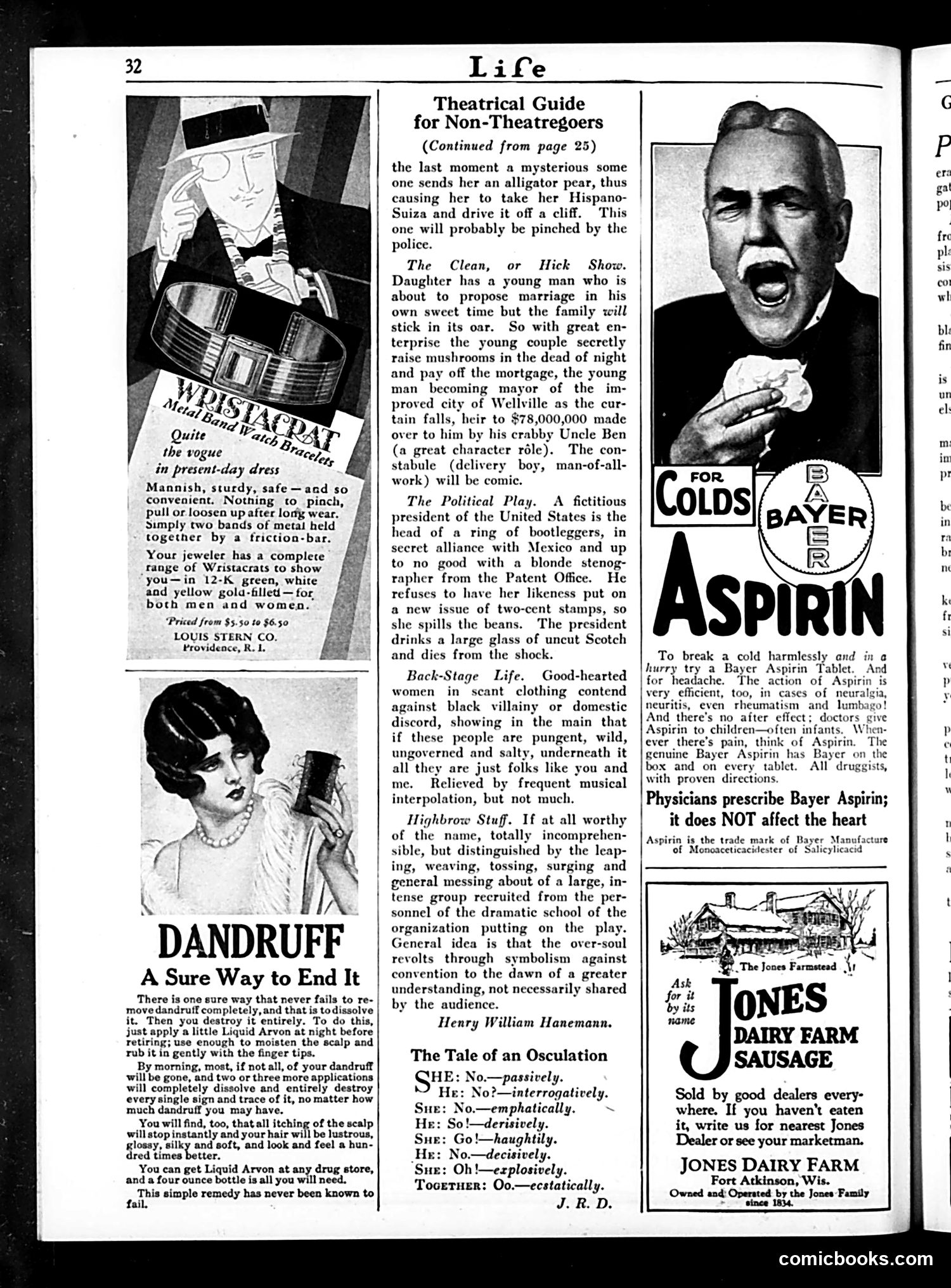
This page is primarily **advertising and humor columns**, not political satire. The content includes: **"Theatrical Guide for Non-Theatregoers"** satirizes predictable Broadway plot formulas of the 1920s era: the "Clean Show" (moralistic rural plots), "Political Play" (corrupt president dies from shock after scandal), "Back-Stage Life" (virtuous women fighting villains), and "Highbrow Stuff" (incomprehensible experimental theater). The humor targets both theatrical clichés and audience pretensions. **"The Tale of an Osculation"** is a light joke about kissing, using pseudo-intellectual language. **Advertisements** dominate the page: Wristacrats watches ("mannish" jewelry for modern dress), Liquid Arvon (dandruff cure), Bayer Aspirin, and Jones Dairy Farm Sausage. The page reflects 1920s consumer culture and theatrical trends rather than serious political commentary. The cartoon illustration shows a man in formal dress—likely representing theatrical fashion or the "present-day dress" mentioned in the Wristacrats ad.
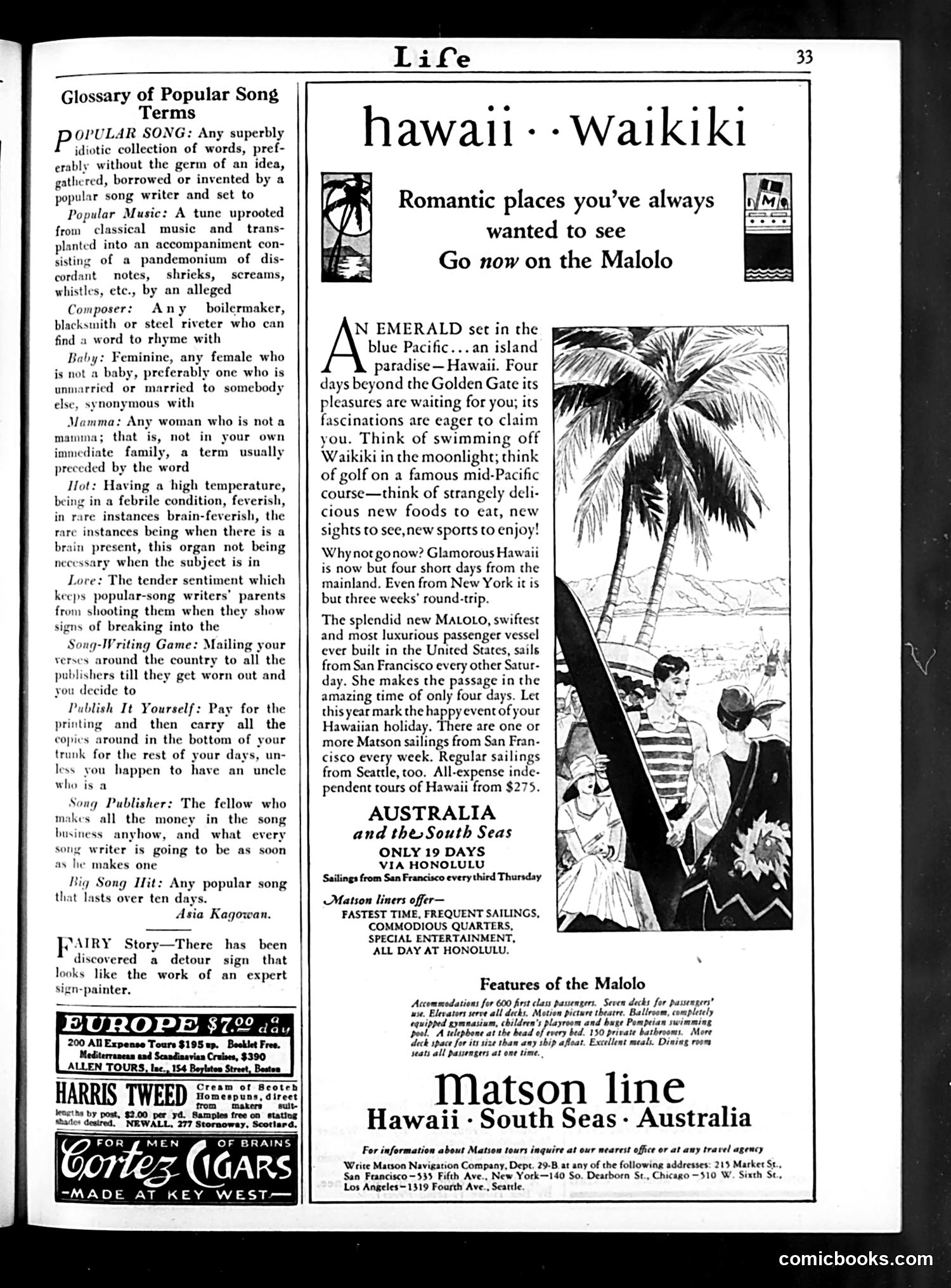
This page is primarily **advertising and travel promotion**, not political satire or editorial cartoon content. The main feature is a **Matson Line advertisement** promoting Hawaiian and South Pacific travel, featuring the luxury ship *Malolo*. The accompanying illustration shows a romantic beach scene with a couple in 1920s attire beneath palm trees—standard period travel marketing imagery appealing to leisured Americans. The only satirical content is the opening **"Glossary of Popular Song Terms"** by Asia Kagowan, which mocks 1920s Tin Pan Alley songwriting. It offers tongue-in-cheek definitions ridiculing popular music as "idiotic" collections written by untalented "boilermakers" and "steel riveters," and defines a "Big Song Hit" as anything lasting over ten days. This reflects intellectual disdain for commercial popular music common among highbrow critics of that era. The page also includes period advertisements for European tours, Harris Tweed clothing, and Cortez cigars—typical Life magazine filler rather than satirical content.
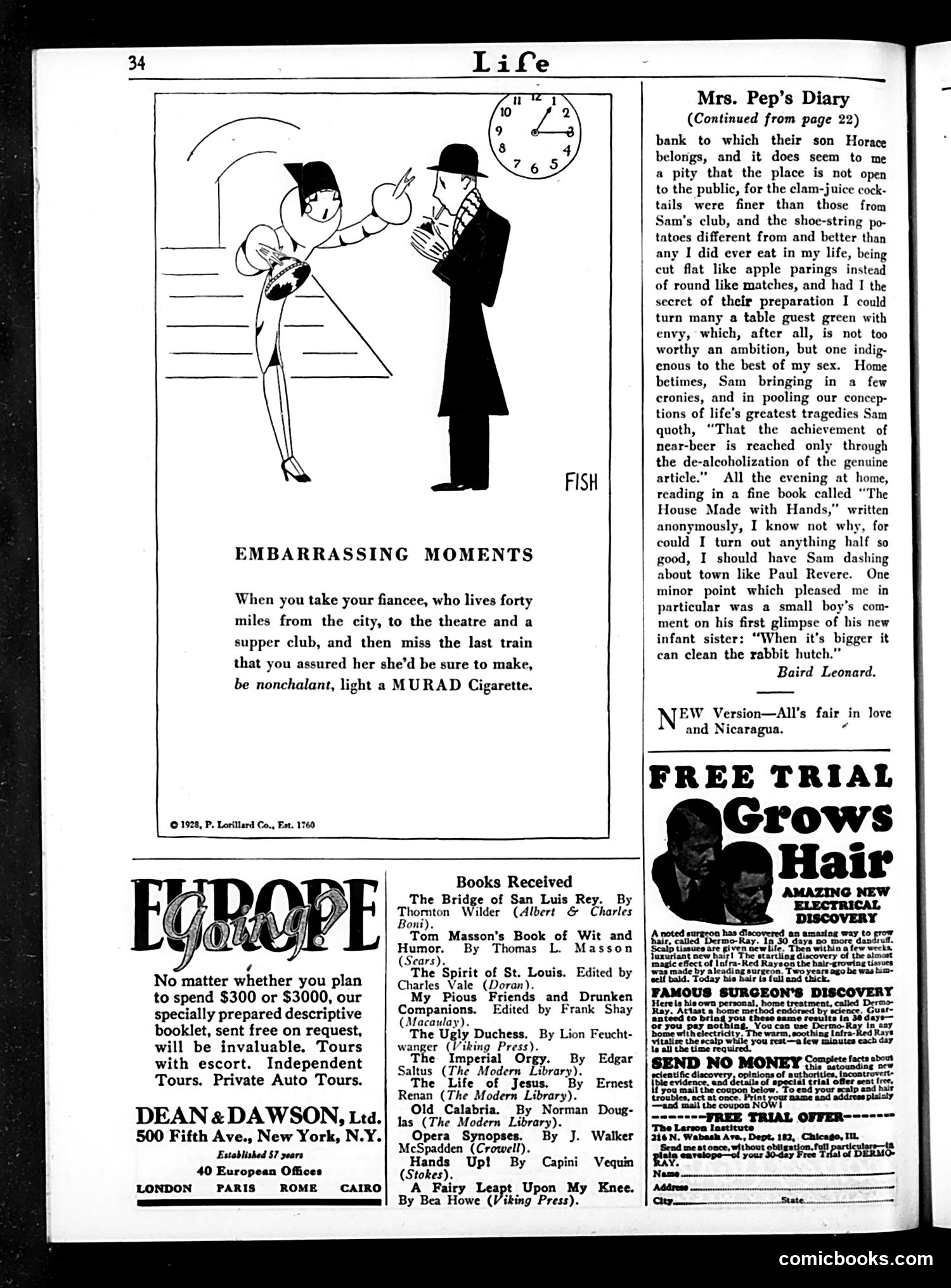
This 1928 advertisement masquerades as editorial content. The cartoon depicts a young woman kicking her leg up in frustration while a formally-dressed man stands beside her, calmly lighting a cigarette. The caption reads: "When you take your fiancee, who lives forty miles from the city, to the theatre and a supper club, and then miss the last train that you assured her she'd be sure to make, be nonchalant, light a MURAD Cigarette." The satire targets masculine nonchalance and poor planning. The man has stranded his date far from home—a serious social transgression in the 1920s when unescorted women traveling late at night risked scandal. Rather than apologize or fix the situation, he responds with indifference, smoking a cigarette. The joke mocks both his callousness and the cigarette brand's implicit promise that smoking conveys sophistication and composure. The woman's exasperation (shown through her physical reaction) undercuts this pretense entirely.
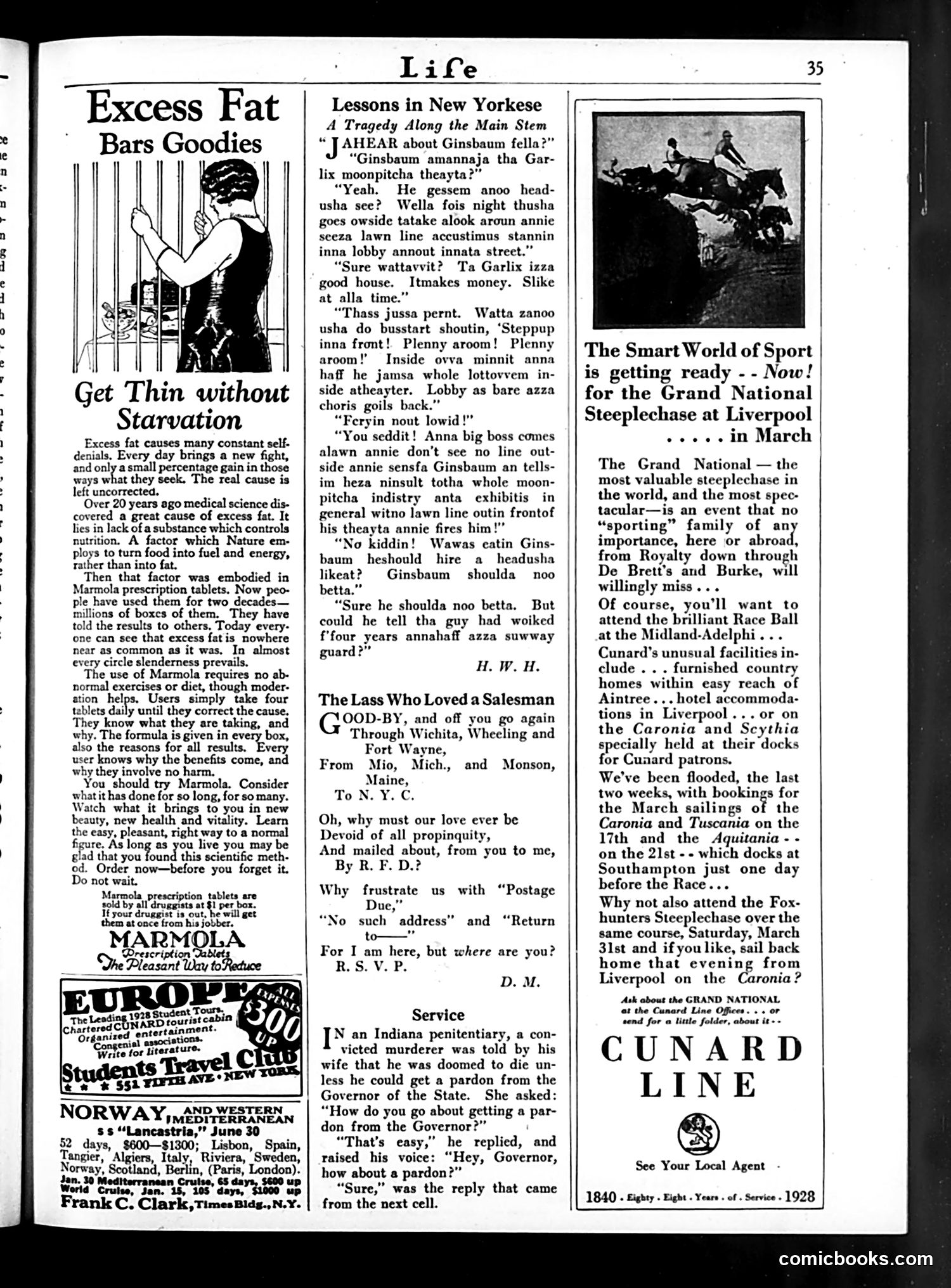
**The "Excess Fat Bars Goodies" cartoon** satirizes 1920s weight-loss advertising. The illustration shows a woman at a window, presumably denied pastries—the joke being that the advertised Marmola tablets promised slenderness "without starvation," yet the cartoon implies deprivation anyway. This mocks the contradiction in such claims. **"Lessons in New Yorkese"** is a humor piece mimicking thick New York accent and dialect ("Tahear," "inna lobby," "Wattavvit?"). It tells a story about a theater manager named Ginsbaum who fires a long-suffering usher for not maintaining crowd control outside the theater. The satire targets both working-class speech patterns and workplace absurdity—the manager punishes an employee for doing his job "too well." **The remaining content** includes sentimental stories ("The Lass Who Loved a Salesman"), travel advertisements, and a brief anecdote about a prison inmate. These occupy typical magazine filler space from this era.
This page is primarily **advertising and editorial content**, not a political cartoon. The left side promotes *Life* magazine subscriptions, highlighting upcoming special issues (St. Patrick's, Easter, Travel, Burlesque numbers) and announcing a redesigned typographical format beginning in March. It advertises a ten-week trial subscription for one dollar. The right side presents "The Winning Answer to Kay's Seventh Letter"—apparently a reader contest where "Kay" made geographical errors describing a California trip (San Francisco, Los Angeles, Hollywood). The editor, Elmer D. Bushnell, humorously corrects detailed mistakes: misidentified prisons, misspelled establishments (Cliff House vs. Clover Field), incorrect film studio locations, and the mistaking of a waiter for actor Gilbert Roland. Prize winners are listed below. This reflects *Life*'s satirical approach through factual humor rather than visual cartoon commentary.