
Life, 1928-02-16 · page 18 of 38
Life — February 16, 1928 — page 18: what you’re looking at
What you’re looking at
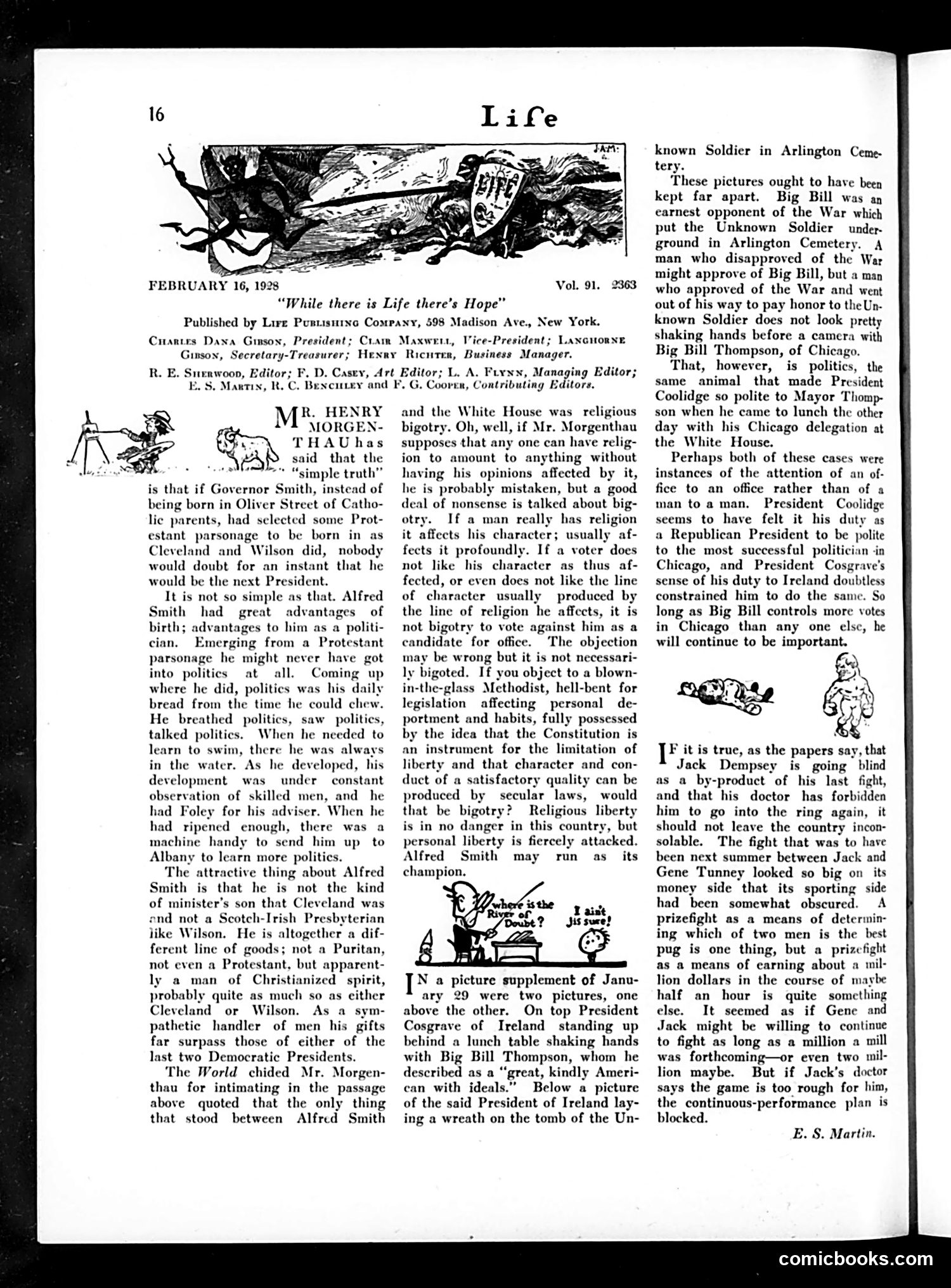
This page contains political commentary on Alfred Smith's presidential ambitions. The main article discusses Smith's Catholic faith and its potential impact on his political viability, questioning whether religious affiliation should affect electoral fitness. The cartoons appear to satirize political hypocrisy: one depicts figures discussing religion's role in governance, while another shows what appears to be a boxing-related joke (referencing Jack Dempsey's rumored comeback). The underlying theme critiques how politicians and the public handle religious prejudice in elections—specifically whether a candidate's Catholicism should disqualify him from office, despite constitutional protections. The satire targets both those who would discriminate and those who defend such discrimination as "liberty." The commentary suggests these were contentious political issues of the 1928 campaign season.
📄 Transcribed text from this page (OCR, searchable)
Machine-transcribed from the original scan — historical spelling and the odd misread are preserved.
known Soldier in Arlington Ceme tery. These pictures ought to have been kept far apart. Big Bill was an earnest opponent of the War which put the Unknown Soldier under- ground in Arlington Cemetery. A man who disapproved of the War might approve of Big Bill, but a man who approved of the War and went out of his way to pay honor to theUn- known Soldier does not look pretty shaking hands before a camera with Big Bill Thompson, of Chicago. That, however, is politics, the same animal that made President FEBRUARY 16, 1928 “While there is Life there’s Hope” Published by Lire Puntisutno Company, 598 Madison Ave., New York. Cuartes Dana Ginson, President; Cram Maxwr Ginsox, Secretary-Treasurer; Hexny Ricn R. E. Suenwoon, Editor; F, D. Casey, Art . Mantis, R. C. Bencutey and F, Vol. 91. 2363 Vice-President; Laxcuorne Business Manager. xx, Managing Editor; vontributing Editors. R. HENRY M MORGEN- yy oes THAU has eee said that the cee hes’ “simple truth” is that if Governor Smith, instead of being born in Oliver Street of Catho- lic parents, had selected some Prot- estant parsonage to be born in as Cleveland and Wilson did, nobody would doubt for an instant that he would be the next President. It is not so simple as that. Alfred had great Smith advantages of birth; advantages to him as a politi- cian. Emerging from a Protestant parsonage he might never have got into politics at all. Coming up where he did, politics was his daily bread from the time he could chew. He breathed politics, saw politics, talked politics. When he needed to learn to swim, there he was always in the water. As he developed, his development was under constant observation of skilled men, and he had Foley for his adviser. When he had ripened enough, there was a machine handy to send him up to Albany to learn more politics. The attractive thing about Alfred Smith is that he is not the kind of minister’s son that Cleveland was ond not a Scotch-Irish Presbyterian like Wilson. He is altogether a dif- ferent line of goods; not a Puritan, not even a Protestant, but apparent- ly a man of Christianized spirit, probably quite as much so as cither Cleveland or Wilson. As a sym- pathetic handler of men his gifts far surpass those of either of the last two Democratic Presidents. The World chided Mr. Morgen- thau for intimating in the passage above quoted that the only thing that stood between Alfred Smith and the White House was religious bigotry. Oh, well, if Mr. Morgenthau supposes that any one can have relig- ion to amount to anything without having his opinions affected by it, he is probably mistaken, but a good deal of nonsense is talked about big- otry. If a man really has religion it affects his character; usually af- fects it profoundly. If a voter does not like his character as thus af- fected, or even does not like the line of character usually produced by the line of religion he affects, it is not bigotry to vote against him as a candidate for office. The objection may be wrong but it is not necessari- ly bigoted. If you object to a blown- in-the-glass Methodist, hell-bent for legislation affecting personal de- portment and habits, fully possessed by the idea that the Constitution is an instrument for the limitation of liberty and that character and con- duct of a satisfactory quality can be produced by secular laws, would that be bigotry? Religious liberty is in no danger in this country, but personal liberty is fiercely attacked. Alfred Smith may run as_ its champion, re) IX a picture supplement of Janu- ary 29 were two pictures, one above the other. On top President Cosgrave of Ireland standing up behind a lunch table shaking hands with Big Bill Thompson, whom he described as a “great, kindly Ameri- can with ideals.” Below a picture of the said President of Ireland lay- ing a wreath on the tomb of the Un- Coolidge so polite to Mayor Thomp- son when he came to lunch the other day with his Chicago delegation at the White House. Perhaps both of these cases were instances of the attention of an of- fice to an office rather than of a man toa man, President Coolidge seems to have felt it his duty as a Republican President to be polite to the most successful politician -in Chicago, and President Cosgrave's sense of his duty to Ireland doubtless constrained him to do the same. So long as Big Bill controls more votes in Chicago than any one else, he will continue to be important. F it is true, as the papers say, that Jack Dempsey is going blind as a by-product of his last fight, and that his doctor has forbidden him to go into the ring again, it should not leave the country incon- solable. The fight that was to have been next summer between Jack and Gene Tunney looked so big on its money side that its sporting side had been somewhat obscured. A prizefight as a means of determin- ing which of two men is the best pug is one thing, but a prizefight as a means of earning about a mil- lion dollars in the course of maybe half an hour is quite something else. It seemed as if Gene and Jack might be willing to continue to fight as long as a million a mill was forthcoming—or even two mil- lion maybe. But if Jack’s doctor says the game is too rough for him, the continuous-performance plan is blocked. E. S. Martin. comicbooks.com