
Life, 1928-02-16 · page 23 of 38
Life — February 16, 1928 — page 23: what you’re looking at
What you’re looking at
This is a theater review of Eugene O'Neill's play "Strange Interlude," praising its importance while critiquing its method. The critic sat through a marathon performance (5:15 PM to 11 PM with dinner break). **Main complaint**: O'Neill uses the theatrical "aside"—characters speaking their inner thoughts aloud to the audience. The reviewer finds this technique lazily expository and melodramatic, comparing it unfavorably to old-fashioned plays like "The Wolves of St. Agnes." **The satire's point**: The critic suggests O'Neill's thoughts lack subtlety—"any alert child" could guess them. Better playwrights conceal character psychology within dialogue rather than having actors simply announce it. **Praise despite criticism**: The reviewer acknowledges the play's importance and gripping power, though admitting uncertainty whether the faults lie with O'Neill or the audience. The small illustrations (figures in repose) appear decorative rather than satirical—typical period magazine formatting.
📄 Transcribed text from this page (OCR, searchable)
Machine-transcribed from the original scan — historical spelling and the odd misread are preserved.
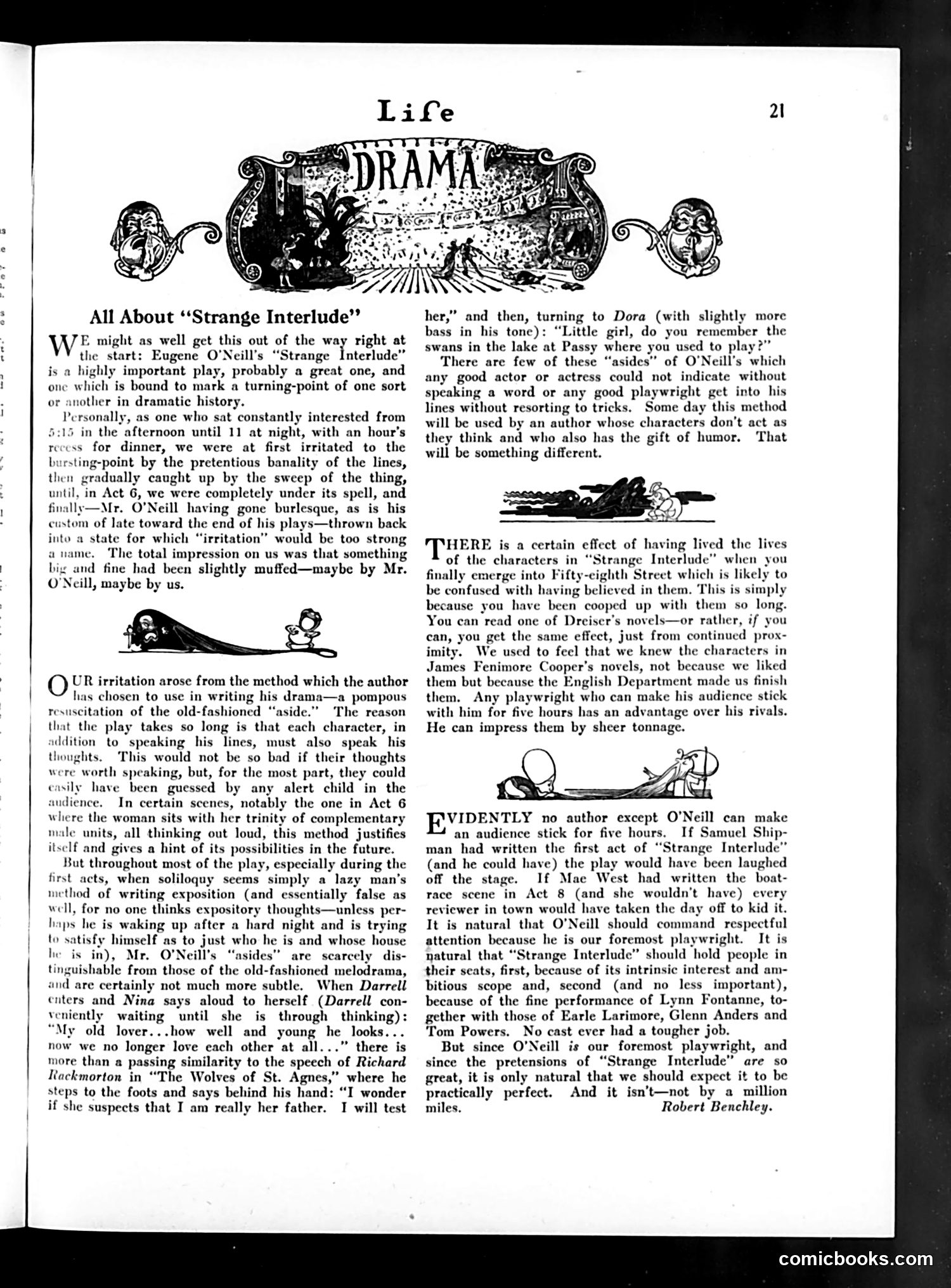
All About “Strange Interlude” WE might as well get this out of the way right at the start: Eugene O'Neill's “Strange Interlude” is a highly important play, probably a great one, and one which is bound to mark a turning-point of one sort or another in dramatic history. Personally, as one who sat constantly interested from 5:15 in the afternoon until 11 at night, with an hour's recess for dinner, we were at first irritated to the bursting-point by the pretentious banality of the lines, then gradually caught up by the sweep of the thing, until, in Act 6, we were completely under its spell, and finally—Mr. O'Neill having gone burlesque, as is his custom of late toward the end of his plays—thrown back into a state for which “irritation” would be too strong aname. The total impression on us was that something and fine had been slightly muffed—maybe by Mr. O'Neill, maybe by us. UR irritation arose from the method which the author has chosen to use in writing his drama—a_ pompous resuscitation of the old-fashioned “aside.” The reason that the play takes so long is that each character, in addition to speaking his lines, must also speak his thoughts. This would not be so bad if their thoughts were worth speaking, but, for the most part, they could casily have been guessed by any alert child in the audience, In certain scenes, notably the one in Act 6 where the woman sits with her trinity of complementary male units, all thinking out loud, this method justifies itself and gives a hint of its possibilities in the future. But throughout most of the play, especially during the first s, when soliloquy seems simply a lazy man’s method of writing exposition (and essentially false as well, for no one thinks expository thoughts—unless_ per- haps he is waking up after a hard night and is trying to satisfy himself as to just who he is and whose house he is in), Mr. O'Neill's “asides” are scarcely dis- tinguishable from those of the old-fashioned melodrama, and are certainly not much more subtle. When Darrell enters and Nina says aloud to herself (Darrell con- iently waiting until she is through thinking): old lover...how well and young he looks. . . now we no longer love each other at all...” there is e than a passing similarity to the speech ‘of Richard Rackmorton in “The Wolves of St. Agnes,” where he steps to the foots and says behind his hand: “I wonder if she suspects that I am really her father. I will test her,” and then, turning to Dora (with slightly more bass in his tone): “Little girl, do you remember the swans in the lake at Passy where you used to play?” There are few of these “asides” of O'Neill's which any good actor or actress could not indicate without speaking a word or any good playwright get into his lines without resorting to tricks. Some day this method will be used by an author whose characters don't act as they think and who also has the gift of humor. That will be something different. ae HERE is a certain effect of having lived the lives of the characters in “Strange Interlude” when you finally emerge into likely to be confused with ng believed in them. because you have been cooped up with them so » long. You can read one of Dreiser's novels—or rather, if you can, you get the same effect, just from continued prox- imity. We used to feel that we knew the characters in James Fenimore Cooper's novels, not because we liked them but because the English Department made us finish them. Any playwright who can make his aud stick with him for five hours has an advantage over his rivals. He can impress them by sheer tonnage. VIDENTLY no author except O'Neill can make an audience stick for five hours. If Samuel Ship- man had written the first act of “Strange Interlude” (and he could have) the play would have been laughed off the stage. If Mae West had written the boat- race scene in Act 8 (and she wouldn't have) every reviewer in town would have taken the day off to kid it. It is natural that O'Neill should command respectful attention because he is our foremost playwright. It is natural that “Strange Interlude” should hold people in their seats, first, because of its intrinsic interest and am- bitious scope and, second (and no less important), because of the fine performance of Lynn Fontanne, to- gether with those of Earle Larimore, Glenn Anders and Tom Powers. No cast ever had a tougher job. But since O'Neill is our foremost playwright, and since the pretensions of “Strange Interlude” are so great, it is only natural that we should expect it to be practically perfect. And it isn’t—not by a million miles. Robert Benchley. comicbooks.com