
Life, 1928-02-16 · page 28 of 38
Life — February 16, 1928 — page 28: what you’re looking at
What you’re looking at
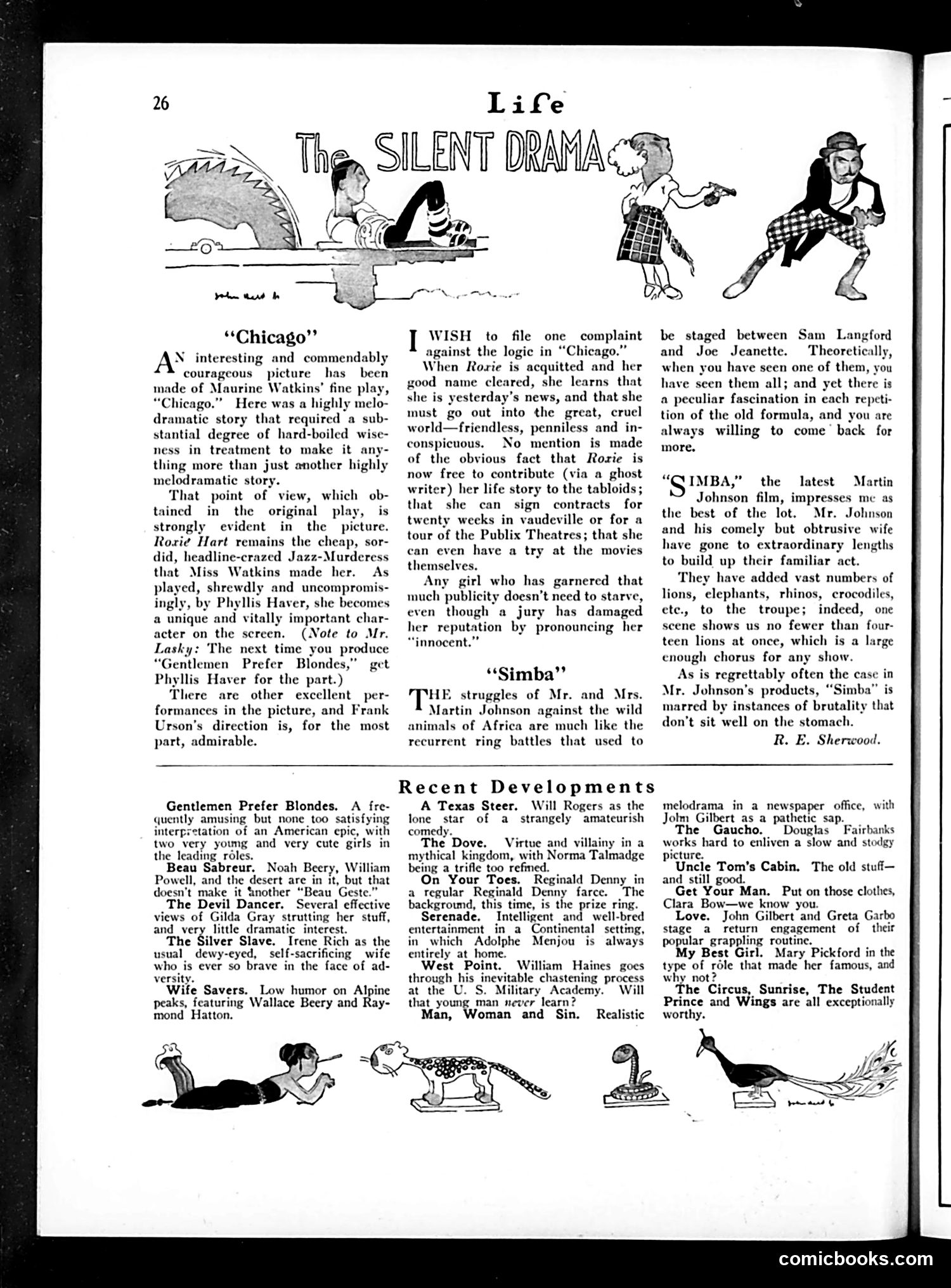
This page reviews several 1920s silent films. The main critiques focus on: **"Chicago"**: A film adaptation of Maurine Watkins' play about Roxie Hart, a sensationalist "Jazz-Murderess." The reviewer praises the film's hard-boiled tone and Phyllis Haver's performance, but complains about illogical plotting—specifically that Roxie, after being acquitted of murder, wouldn't actually need to starve, given she could capitalize on her newfound notoriety through vaudeville, ghost-written memoirs, or film roles. **"Simba"**: A Martin Johnson wildlife documentary-adventure film featuring real African animals. The reviewer finds it engaging but notes it contains brutality that "doesn't sit well on the stomach." The page includes a decorative header showing a sawing act and comedic figures, plus brief reviews of other contemporary releases ("Gentlemen Prefer Blondes," "Beau Sabreur," "The Devil Dancer," etc.). This reflects typical 1920s film criticism focused on entertainment value and moral/social concerns.
📄 Transcribed text from this page (OCR, searchable)
Machine-transcribed from the original scan — historical spelling and the odd misread are preserved.
“Chicago” interesting and commendably courageous picture has been made of Maurine Watkins’ fine play, “Chicago.” Here was a highly melo- dramatic story that required a sub- stantial degree of hard-boiled wis ness in treatment to make it any thing more than just another highly melodramatic story. That point of view, which ob- tained in the original play, is strongly evident in the picture. Roxie Hart remains the cheap, sor- did, headline-crazed Jazz-Murderess that Miss Watkins made her. As played, shrewdly and uncompromis- ingly, by Phyllis Haver, she becomes a unique and vitally important char- acter on the screen, (Note to Mr. The next time you produce iiuewen Prefer Blondes,” get Phyllis Haver for the part.) There are other excellent pe formances in the picture, and Frank Urson’s direction is, for the most part, admirable. WISH to file one complaint against the logic in “Chicago.” When Roxie is acquitted and her good name cleared, she learns that she is yesterday’s news, and that she must go out into the great, cruel world—friendless, penniless and in- conspicuous. No mention is made of the obvious fact that Rozie is now free to contribute (via a ghost writer) her life story to the tabloids; that she can sign contracts for twenty weeks in vaudeville or for a tour of the Publix Theatres; that she can even have a try at the movies themselves. Any girl who has garnered that much publicity doesn’t need to starve, even though a jury has damaged her reputation by pronouncing her “innocent.” “Simba”’ HE struggles of Mr. and Mrs. Martin Johnson against the wild animals of Africa are much like the recurrent ring battles that used to be staged between Sam Langford and Joe Jeanette. Theoretically, when you have seen one of them, you have seen them all; and yet there is a peculiar fascination in each repeti- tion of the old formula, and you are always willing to come’ back for more, IMBA,” the latest Martin Johnson film, impresses me as the best of the lot. Mr. Johnson and his comely but obtrusive wife have gone to extraordinary lengths to build up their familiar act. They have added vast numbers of lions, elephants, rhinos, crocodiles, ete, to the troupe; indeed, one scene shows us no fewer than four- teen lions at once, which is a large enough chorus for any show. As is regrettably often the case in Mr. Johnson's products, “Simba” is marred by instances of brutality that don’t sit well on the stomach. R. E. Sherwood. Gentlemen Prefer Blondes. A fre- quently amusing but none too satisfying interpretation of an American epic, with two very young and very cute girls in the leading rdles. Beau Sabreur. Noah Beery, William Powell, and the desert are in it, but that doesn't make it nother “Beau Geste.” The Devil Dancer. Several effective views of Gilda Gray strutting her stuff, and very little dramatic interest. The Silver Slave. Irene Rich as the usual dewy-eyed, self-sacrificing wife who is ever so brave in the face of ad- versity. Wife Savers. Low humor on Al, peaks, featuring Wallace Beery and mond Hatton. ine ay> Recent Developments A Texas Steer. lone star of a comedy. The Dove. Virtue and villainy in a mythical kingdom, with Norma Talmadge being a trifle too refmed. On Your Toes. Reginald Denny in a regular Reginald Denny farce. The background, this time, is the prize ring. Serenade. Intelligent and well-bred entertainment in a Continental setting, in which Adolphe Menjou is always entirely at home. West Point. William Haines goes through his inevitable chastening process at the U. S. Military Academy. Will that young man never learn? Man, oman and Sin. Will Rogers as the strangely amateurish Realistic melodrama in a newspaper office, with Jotm Gilbert as a pathetic sap. The Gaucho. Douglas Fairbanks works hard to enliven a slow and stodgy picture. Uncle Tom's Cabin. The old stuff— and still good. Get Your Man. Put on those clothes, Clara Bow—we know you. Love. John Gilbert and Greta Garbo stage a return engagement of their popular grappling routine. Best Girl. Mary Pickford in the type of réle that made her famous, and why not? The Circus, Sunrise, The Student Prince and Wings are all exceptionally worthy. comicbooks.com