
A complete issue · 39 pages · 1928
Life — January 12, 1928
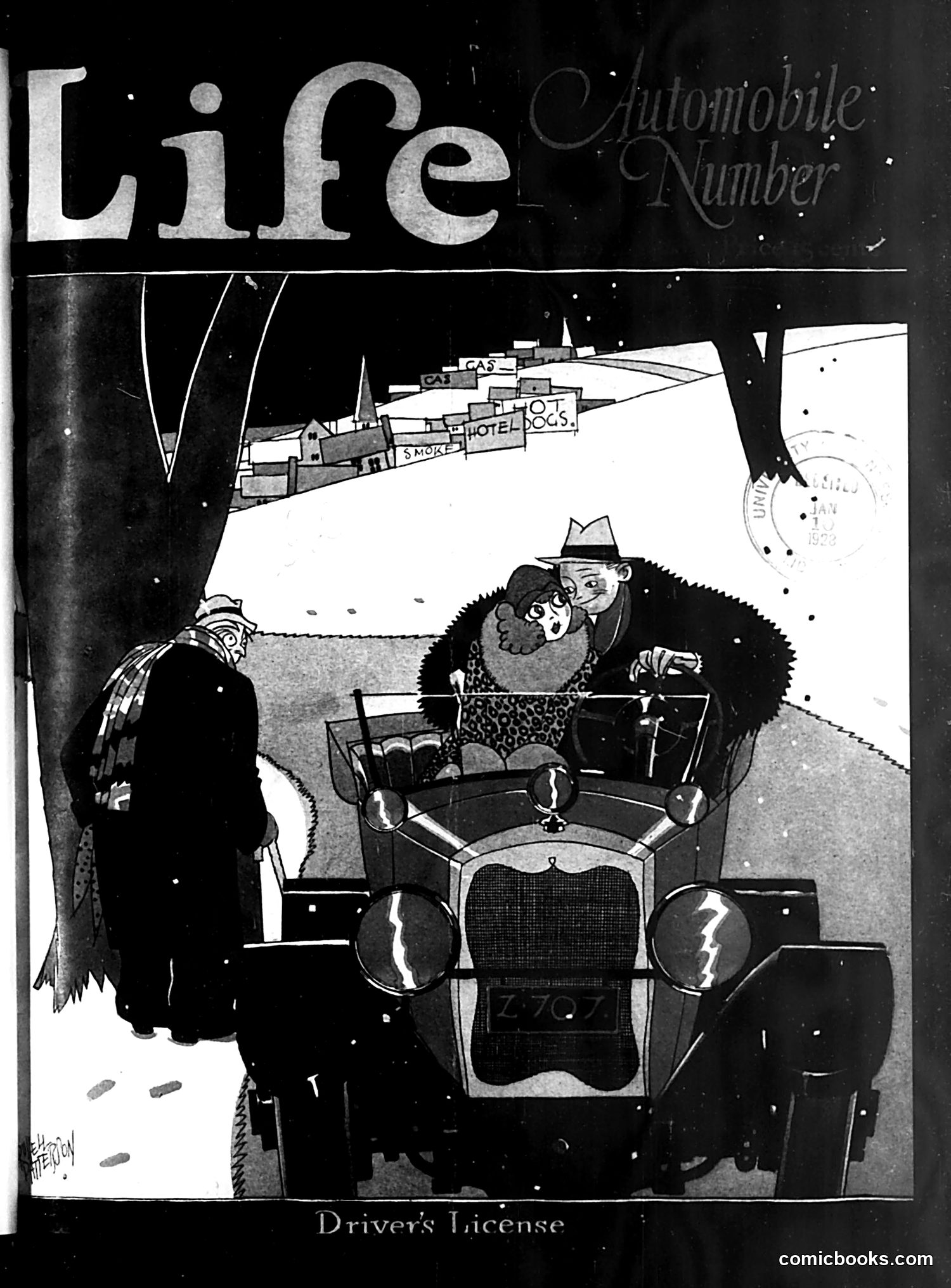
This appears to be a satirical cartoon about automobile licensing, likely from the early 20th century when driver's licenses were new regulations. The cartoon shows a man in a car encountering what appears to be a police officer or authority figure examining his vehicle. The satire likely mocks the bureaucratic process of obtaining driving privileges—a new governmental requirement that many found intrusive or absurd. The figure on the left's exaggerated posture suggests mockery of official inspection procedures. The text "Driver's License" at the bottom confirms this is social commentary on emerging automotive regulations. Given the vintage style and "Life" magazine's satirical tradition, this probably critiques either the hassle of new licensing laws or questions about who should be permitted to drive—a common satirical target during early motoring's expansion.
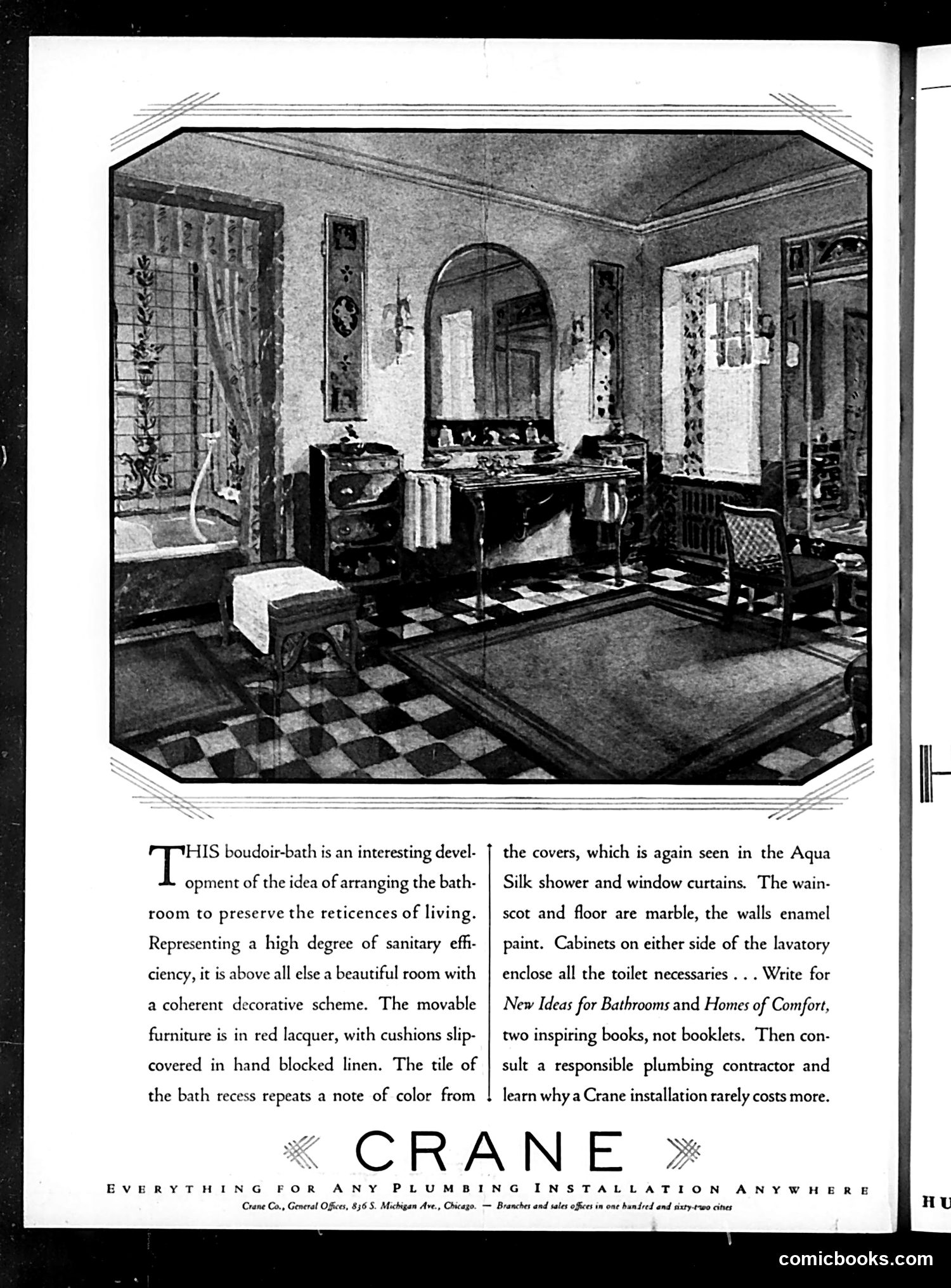
This is **not a political cartoon or satirical content**—it's a straightforward **advertisement for Crane plumbing fixtures**, disguised as lifestyle editorial. The image shows a luxurious "boudoir-bath" bathroom design from what appears to be the 1920s-1930s. The accompanying text describes high-end bathroom amenities: red lacquer furniture, marble floors and wainscoting, enamel-painted walls, and coordinated "Aqua Silk" shower and window curtains. The advertisement promotes Crane as a premium plumbing company, emphasizing both sanitary efficiency and aesthetic beauty. It encourages readers to request design books ("New Ideas for Bathrooms and Homes of Comfort") and consult plumbing contractors about Crane installations. This represents early 20th-century advertising that positioned luxury bathroom design as aspirational lifestyle content rather than mere utility.
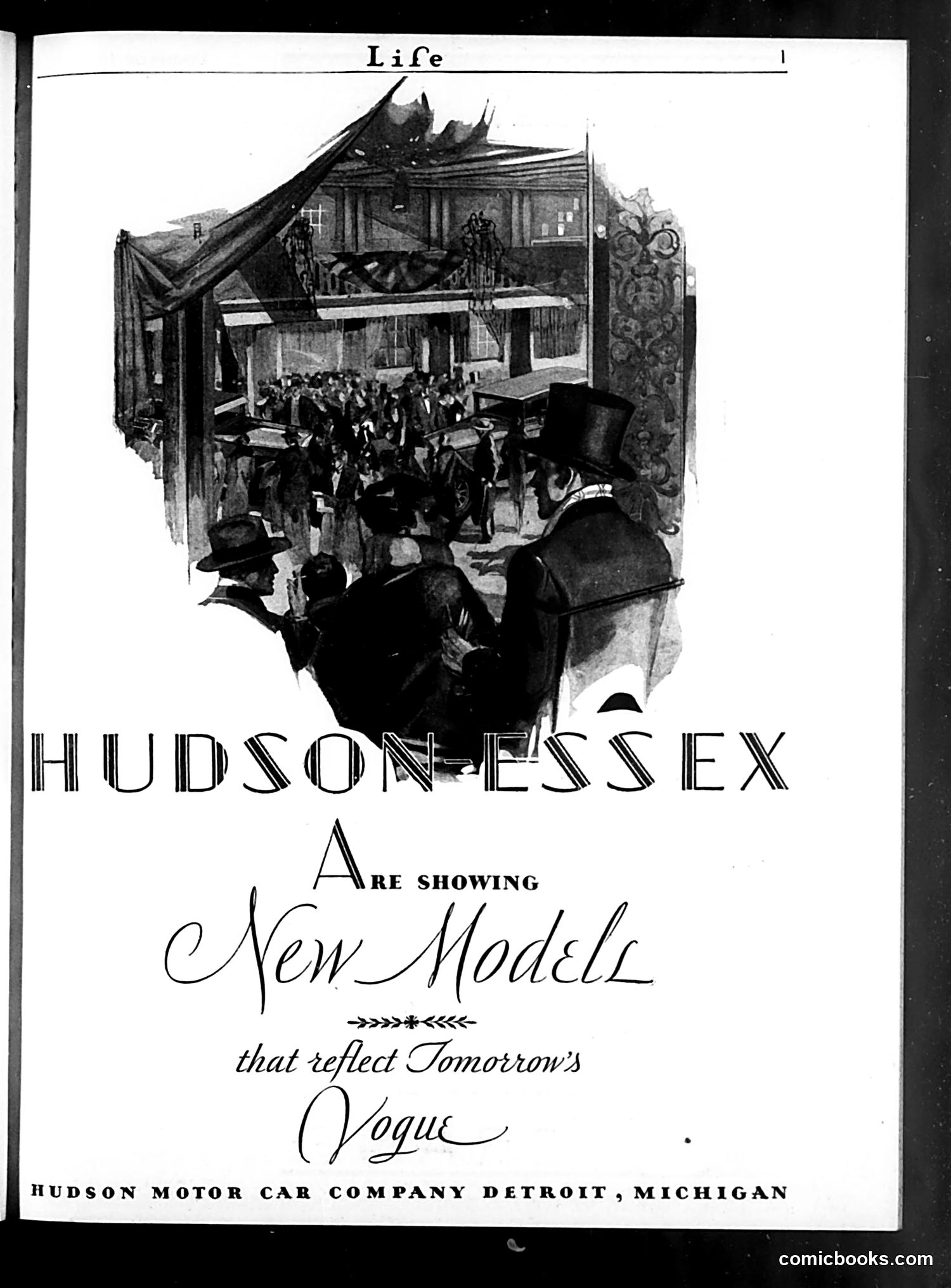
This is primarily **advertising, not satire or political commentary**. The page is a Hudson Motor Car Company advertisement from Detroit, Michigan, appearing in *Life* magazine. The image shows an elegant interior scene—appears to be a fashion showroom or social gathering—with well-dressed figures in formal attire (top hats visible). The advertisement's message is straightforward commercial copy: Hudson-Essex automobiles are displaying "New Models that reflect Tomorrow's Vogue." The company uses the language of fashion and sophistication to market their vehicles, suggesting that owning a Hudson-Essex aligns one with fashionable, forward-thinking taste. There is no apparent political satire or social criticism here—it's a period advertisement emphasizing modernity and style.
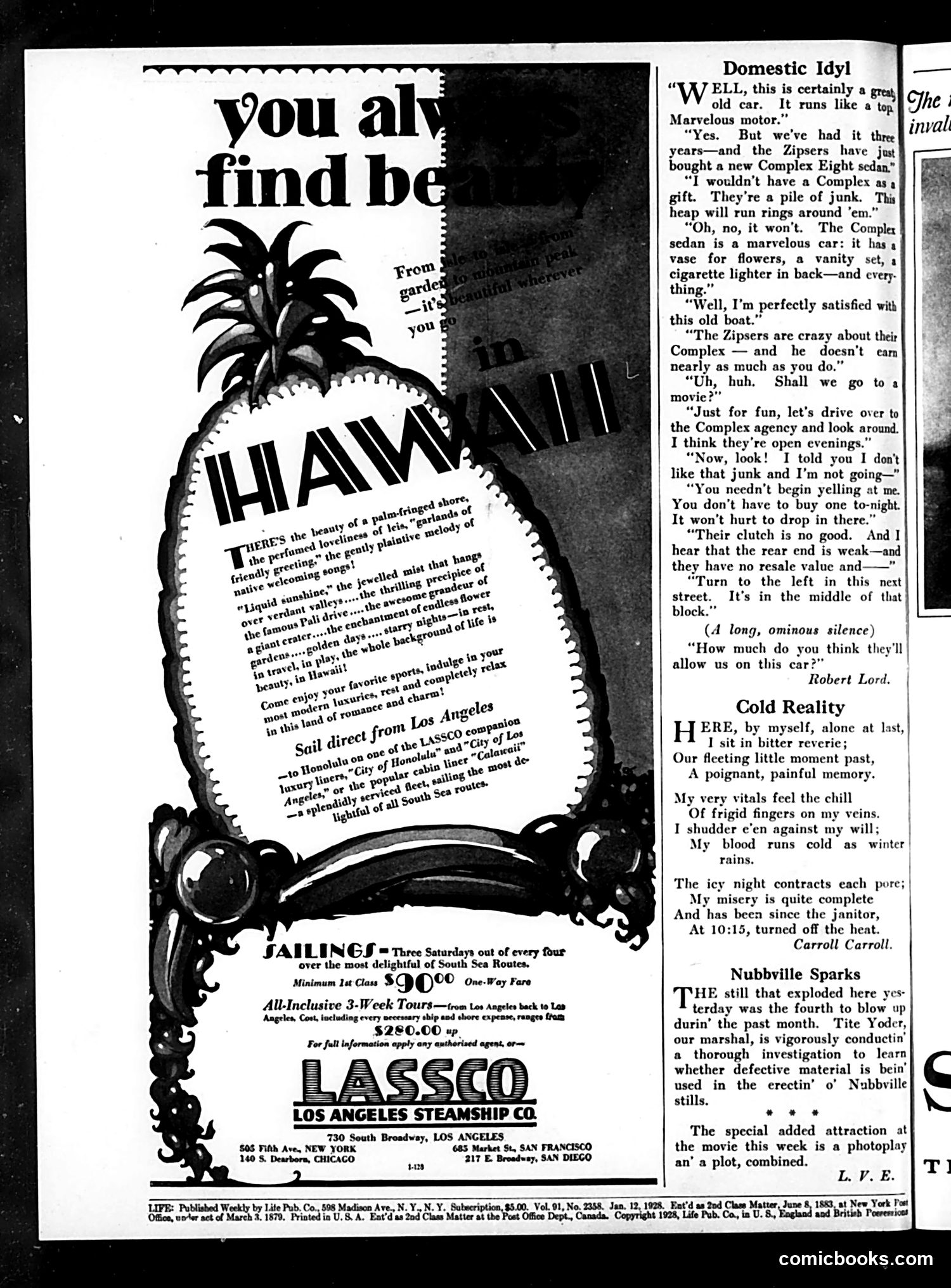
This page is primarily **advertising and literary content** rather than political satire. The dominant feature is a LASSO cruise line advertisement featuring a large pineapple—clearly referencing Hawaii as an exotic travel destination. The ad promotes three-Saturday sailings from Los Angeles to Hawaii, emphasizing the "beauty of a palm-fringed shore" and leisurely ocean travel. The right column contains three separate literary pieces: "Domestic Idyl" (a humorous dialogue about automobiles), "Cold Reality" (a melancholic poem about heartbreak), and "Nubbville Sparks" (a brief news item about an industrial accident investigation). The page reflects **1920s leisure culture and advertising**, promoting tourism and steamship travel as aspirational entertainment for middle-class American readers.
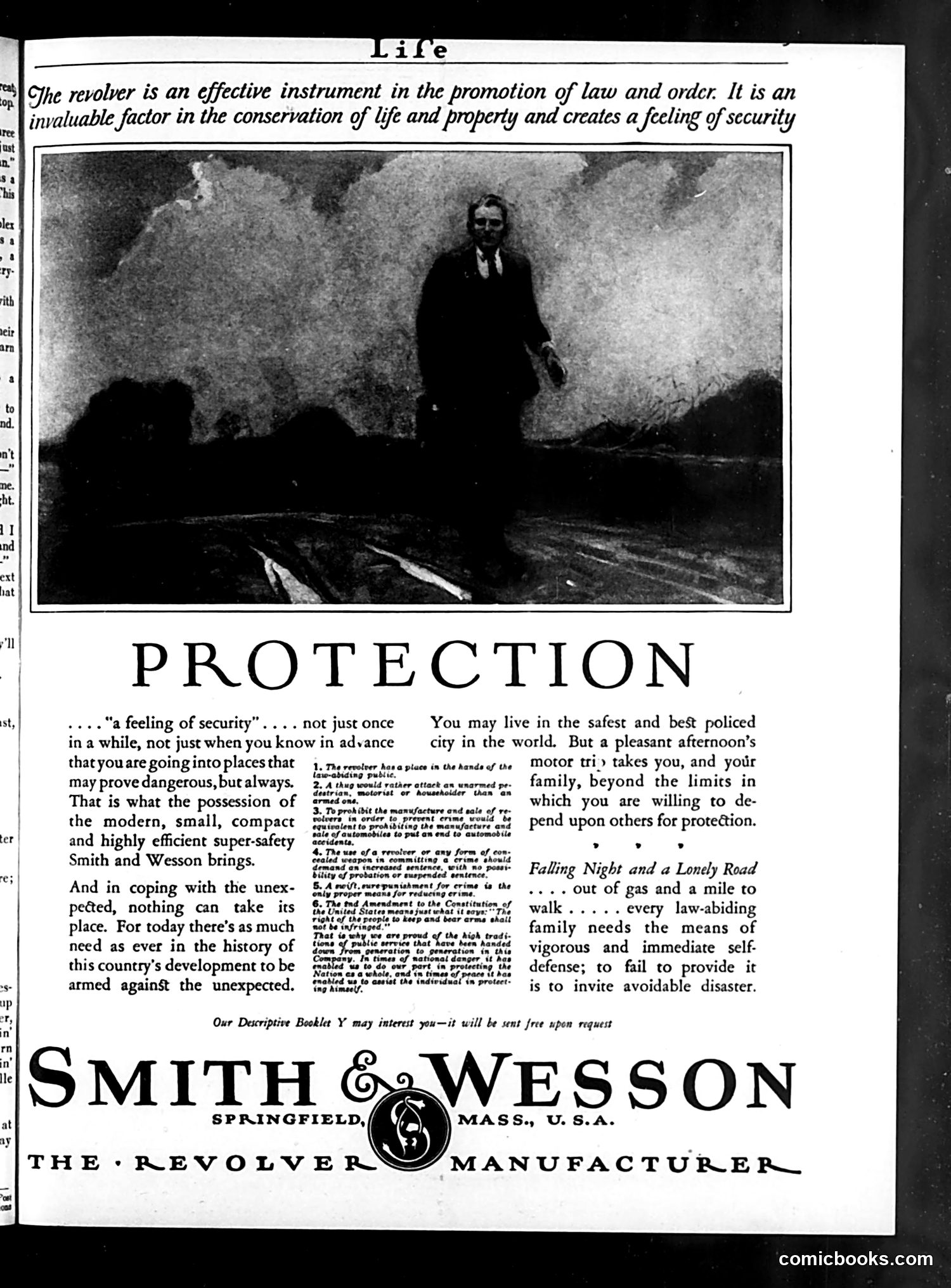
This is primarily a **Smith & Wesson revolver advertisement**, not satire or political commentary. The "Life" magazine page uses the headline "PROTECTION" to market firearms for personal security. The image shows a silhouetted figure standing over what appears to be an unconscious person, illustrating a self-defense scenario. The accompanying text argues that revolvers are necessary for law and order, protecting life and property, and creating "a feeling of security." The advertisement emphasizes scenarios like "Failing Night and a Lonely Road" where citizens supposedly need armed self-defense, since they "cannot depend upon others for protection." This represents **early 20th-century marketing rhetoric** linking gun ownership to personal safety and responsibility—messaging that remains familiar in modern gun-rights discourse.
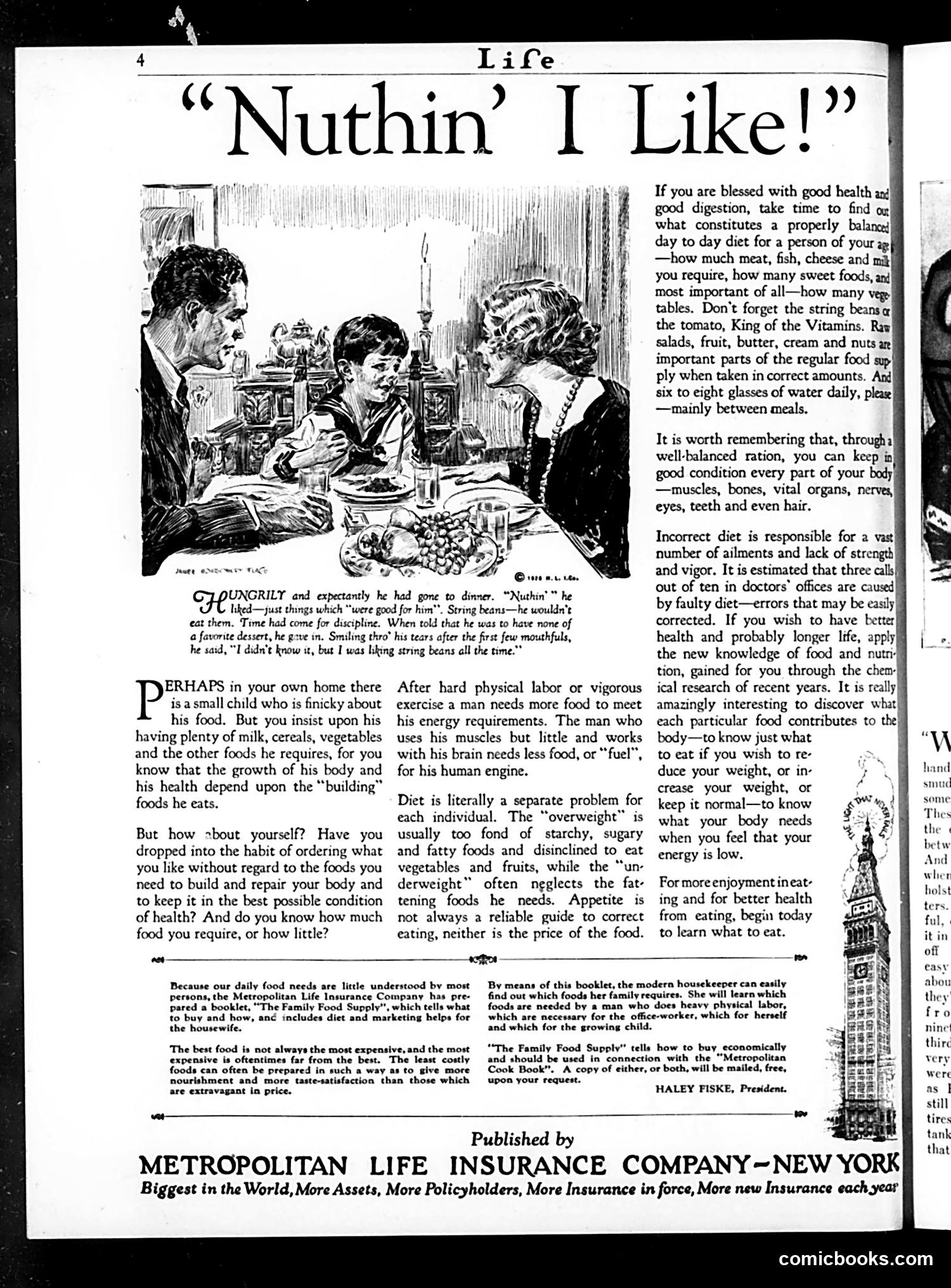
This page combines a humorous domestic scene with nutritional advice. The cartoon depicts a finicky child at dinner refusing food while parents look on—a common household scenario. The caption reveals the child's complaint: he dislikes vegetables and "string beans," insisting he's "living string beans all the time." The satire targets parental struggle with childhood nutrition. The accompanying text discusses proper diet, balanced nutrition, and the importance of vegetables—suggesting the magazine is offering practical guidance to readers about feeding reluctant eaters. This appears to be both entertainment and consumer education, typical of *Life* magazine's format. The piece is published by Metropolitan Life Insurance Company, suggesting this was educational advertising promoting health awareness among potential customers.
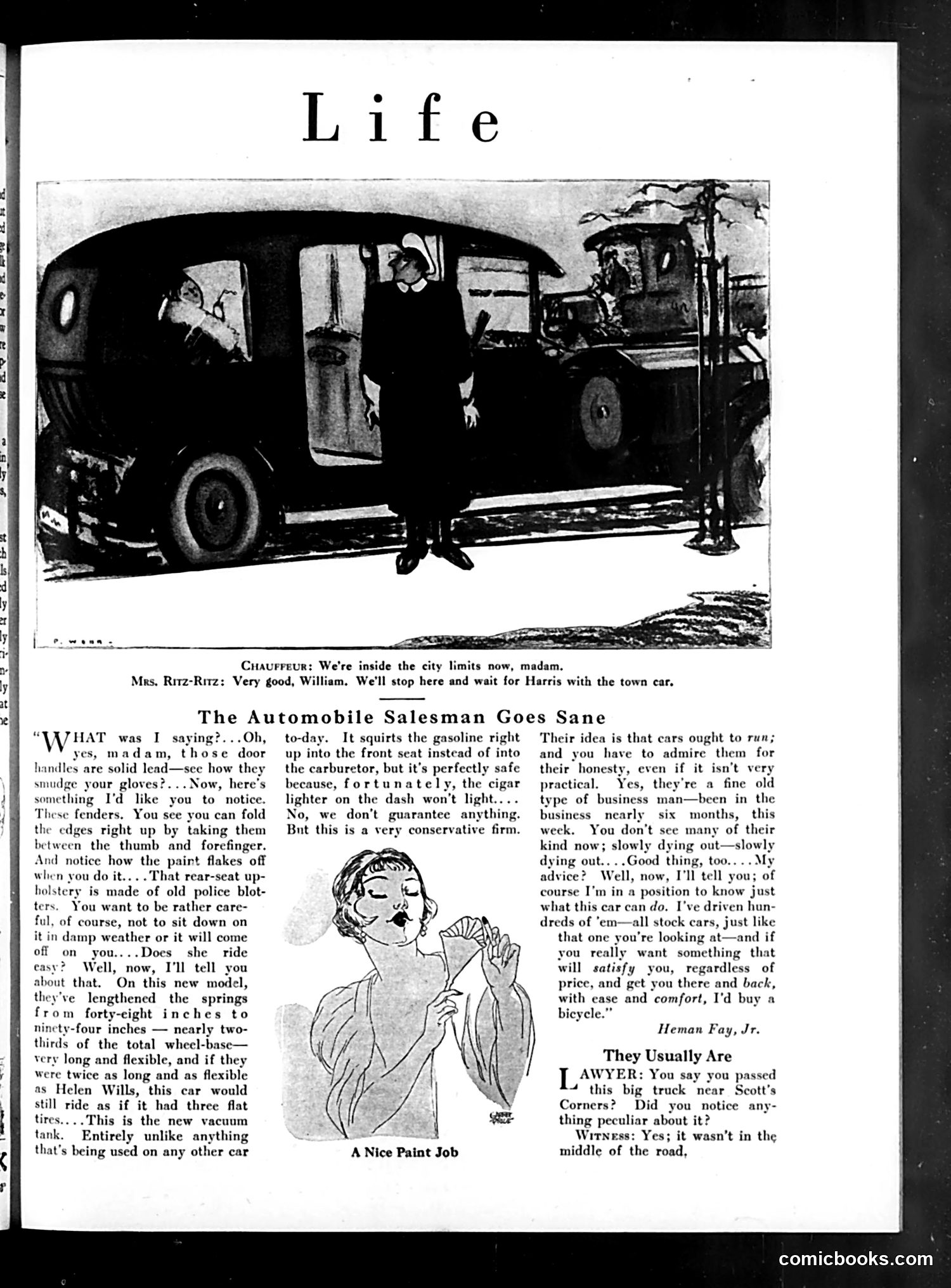
This page satirizes automobile salesmen and early car culture (appears to be 1920s era based on vehicle styles). The top illustration shows a chauffeur and wealthy woman (Mrs. Ritz-Ritz) with their automobile, establishing an upper-class setting. The main article, "The Automobile Salesman Goes Sane," mocks car salesmen's exaggerated claims and deceptive practices. The salesman boasts about features while acknowledging the car has serious problems—doors that won't close properly, faulty door handles, worn upholstery, and a malfunctioning cigar lighter. The humor lies in his admission that he cannot "guarantee anything" while still pushing the sale. The illustration "A Nice Paint Job" and the sidebar "They Usually Are" further ridicule how salesmen exploit cosmetic improvements to mask mechanical failures, reflecting public skepticism about early automotive commerce.
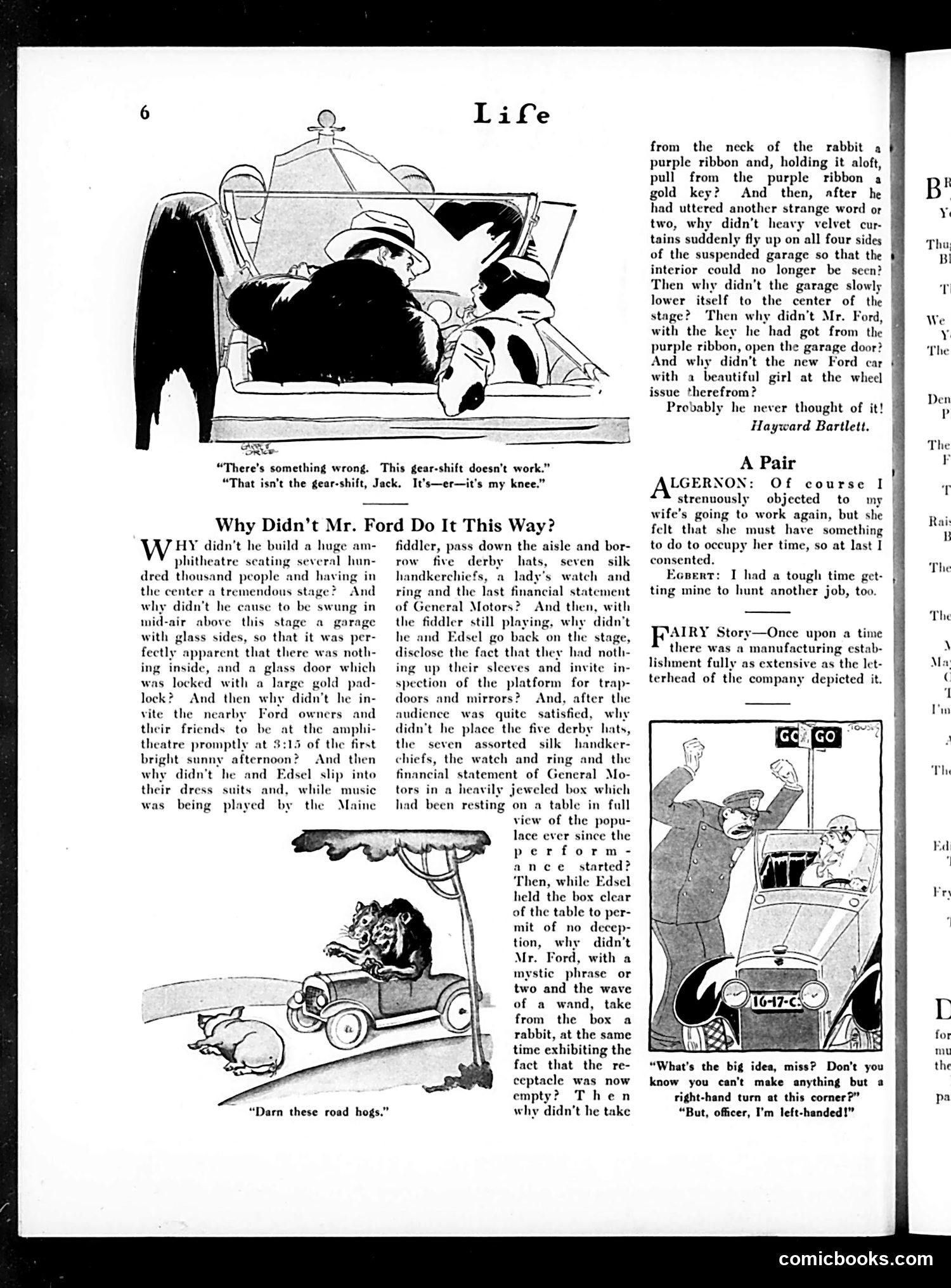
This page contains satirical commentary on Henry Ford and early automobile manufacturing. The main article, "Why Didn't Mr. Ford Do It This Way?" presents absurdist questions mocking Ford's design choices—why not build an amphitheater into the car? Why not include a gold-locked garage? The accompanying cartoons exaggerate these ideas: one shows a man in a tiny car unable to make a left turn, captioned with dialogue about being left-handed. The satire targets Ford's famous efficiency obsessions and mass-production methods. By proposing increasingly ridiculous automotive "features," the author ridicules both Ford's engineering decisions and the broader American fascination with automotive innovation during the automobile boom. The humor relies on readers' familiarity with Ford's cultural prominence and reputation for unconventional thinking.
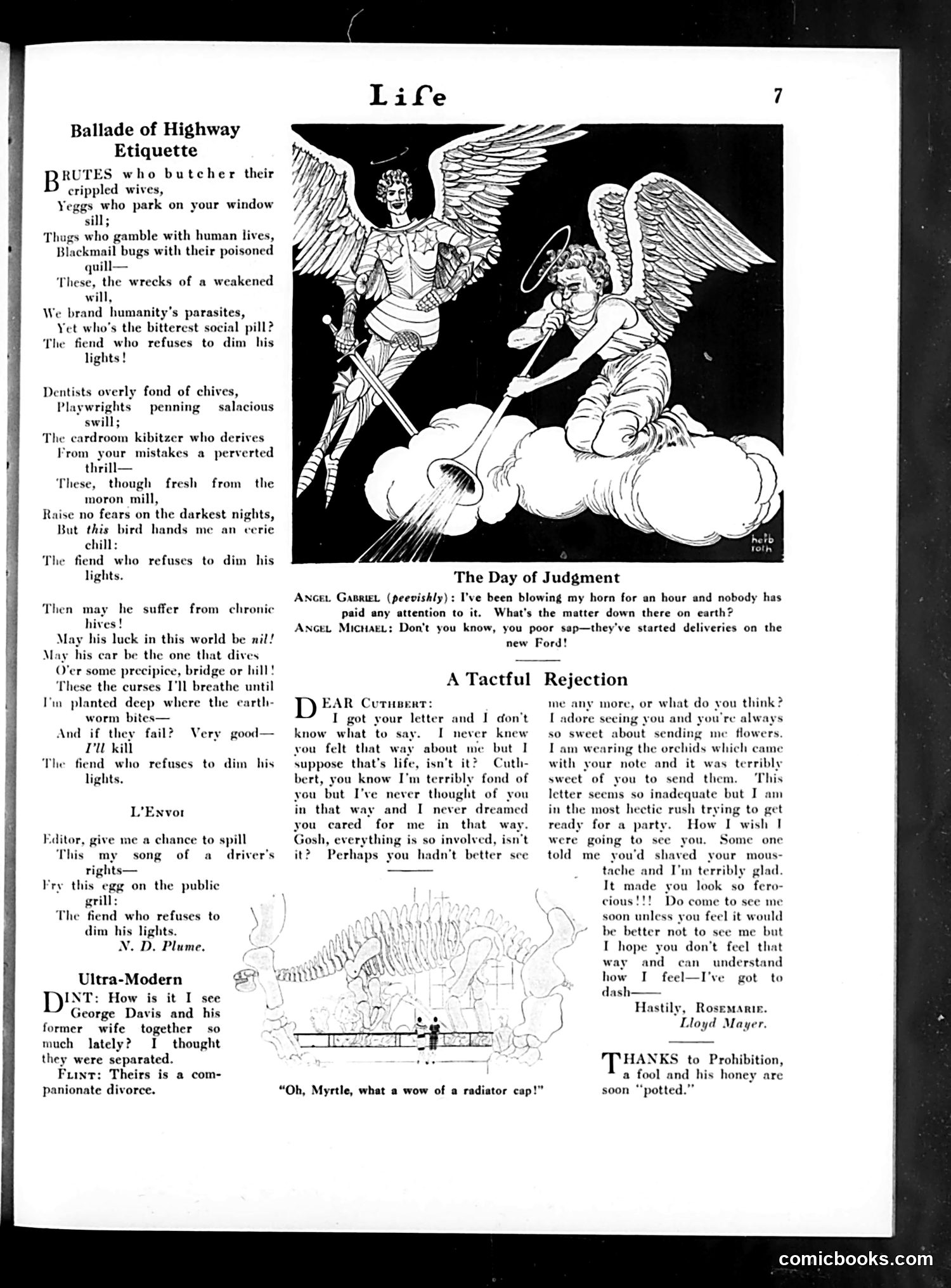
This cartoon depicts two angels on a cloud, with one blowing a trumpet while the other sits nearby looking frustrated. The caption reads: "Angel Gabriel (peevishly): 'I've been blowing my horn for an hour and nobody has paid any attention to it. What's the matter down there on earth?'" **The satire:** This jokes about modern indifference to traditional religious authority and spiritual warnings. Gabriel's failure to get humanity's attention despite the iconic trumpet blast of the Last Judgment suggests that early 20th-century society has become so distracted or irreverent that even apocalyptic religious signaling cannot command attention. The angel's peevish tone emphasizes the absurdity—even divine judgment struggles against worldly indifference.
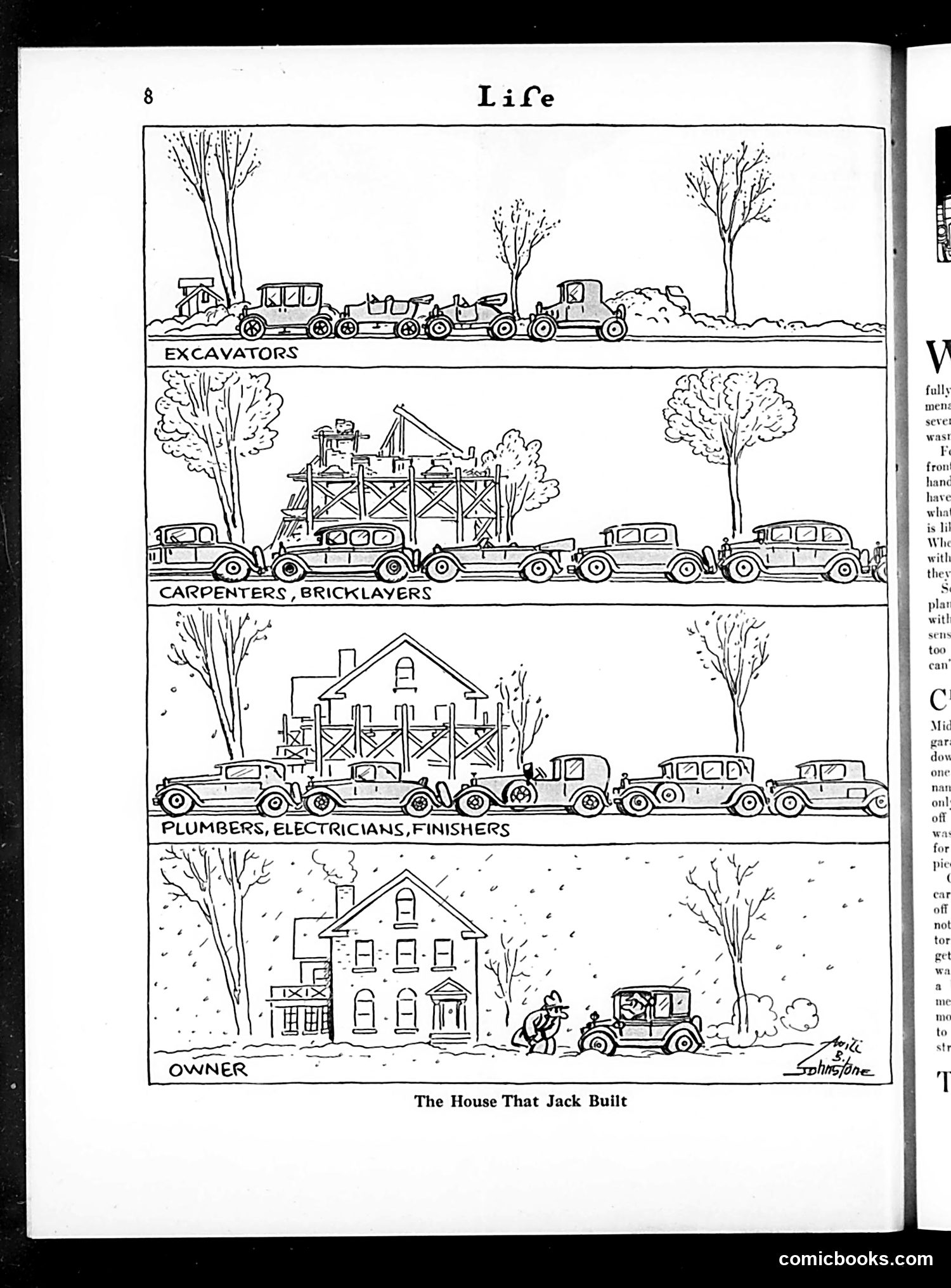
This cartoon illustrates the economic chain of construction work through the nursery rhyme structure "The House That Jack Built." Each panel shows a different stage: 1. **Excavators** - clearing the land with heavy machinery 2. **Carpenters, Bricklayers** - building the structure 3. **Plumbers, Electricians, Finishers** - completing systems and details 4. **Owner** - finally enjoying the completed home The satire critiques how many workers and trades must labor before a single homeowner reaps the benefit. By invoking the familiar cumulative nursery rhyme, it humorously highlights the complex division of labor and economic interdependence required for something as basic as home construction—suggesting the owner's simple enjoyment masks an elaborate chain of working-class effort.
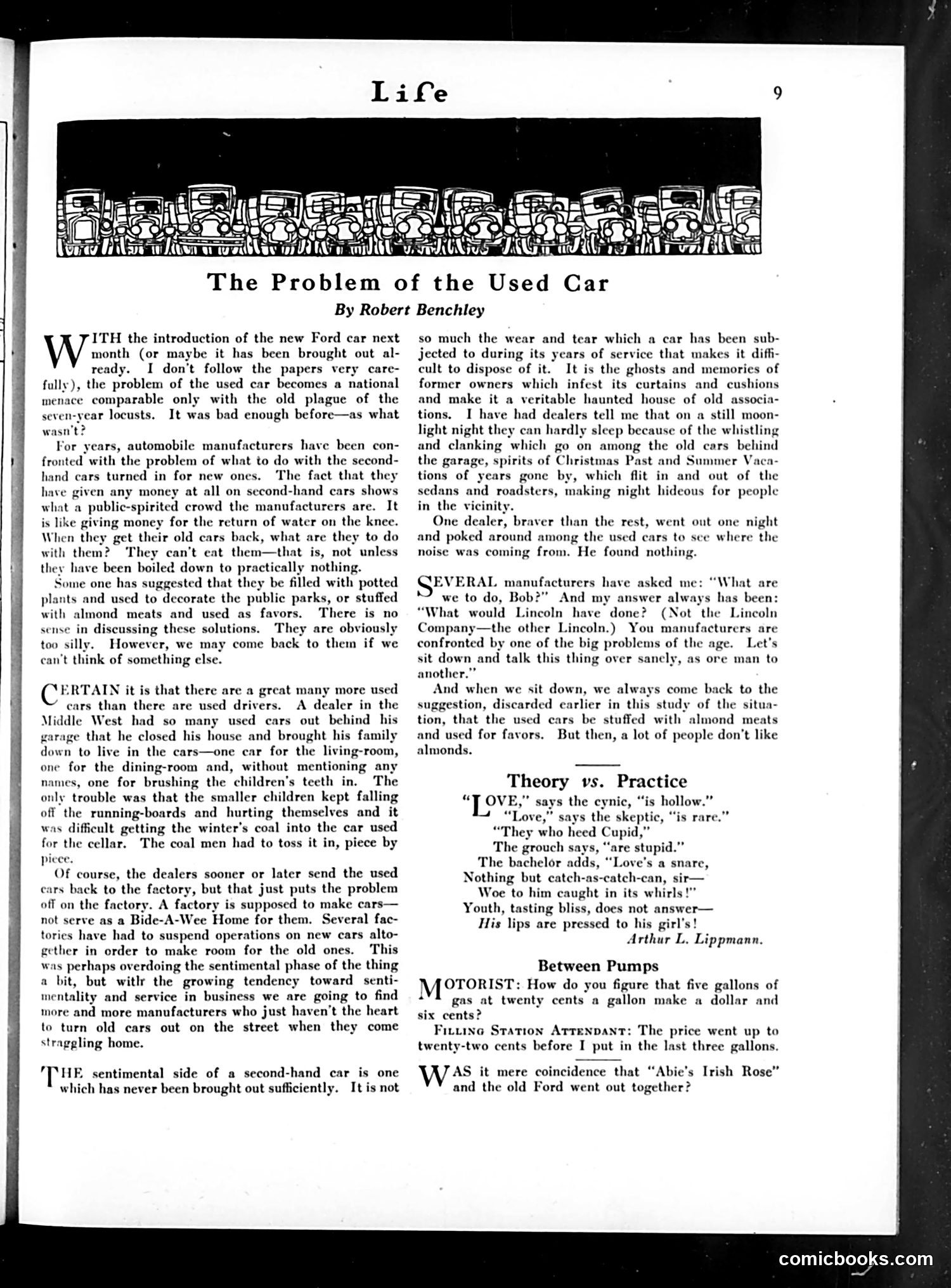
This page from *Life* magazine satirizes the used car market crisis of the early automotive era. The cartoon strip at top shows a row of identical, battered used cars—visual shorthand for the glut of secondhand vehicles flooding the market. Robert Benchley's article argues that used cars have become an unsolvable problem: manufacturers overproduce new cars, flooding dealers with trade-ins they cannot sell. The sentimental attachment owners feel to old cars complicates disposal. Benchley humorously suggests absurd solutions (grinding cars into almond meats for public parks) while noting dealers' genuine desperation. The page includes witty asides mocking romance, gas-station conversations, and automotive sentimentality—typical *Life* magazine humor reflecting Depression-era concerns about industrial overproduction and economic waste.
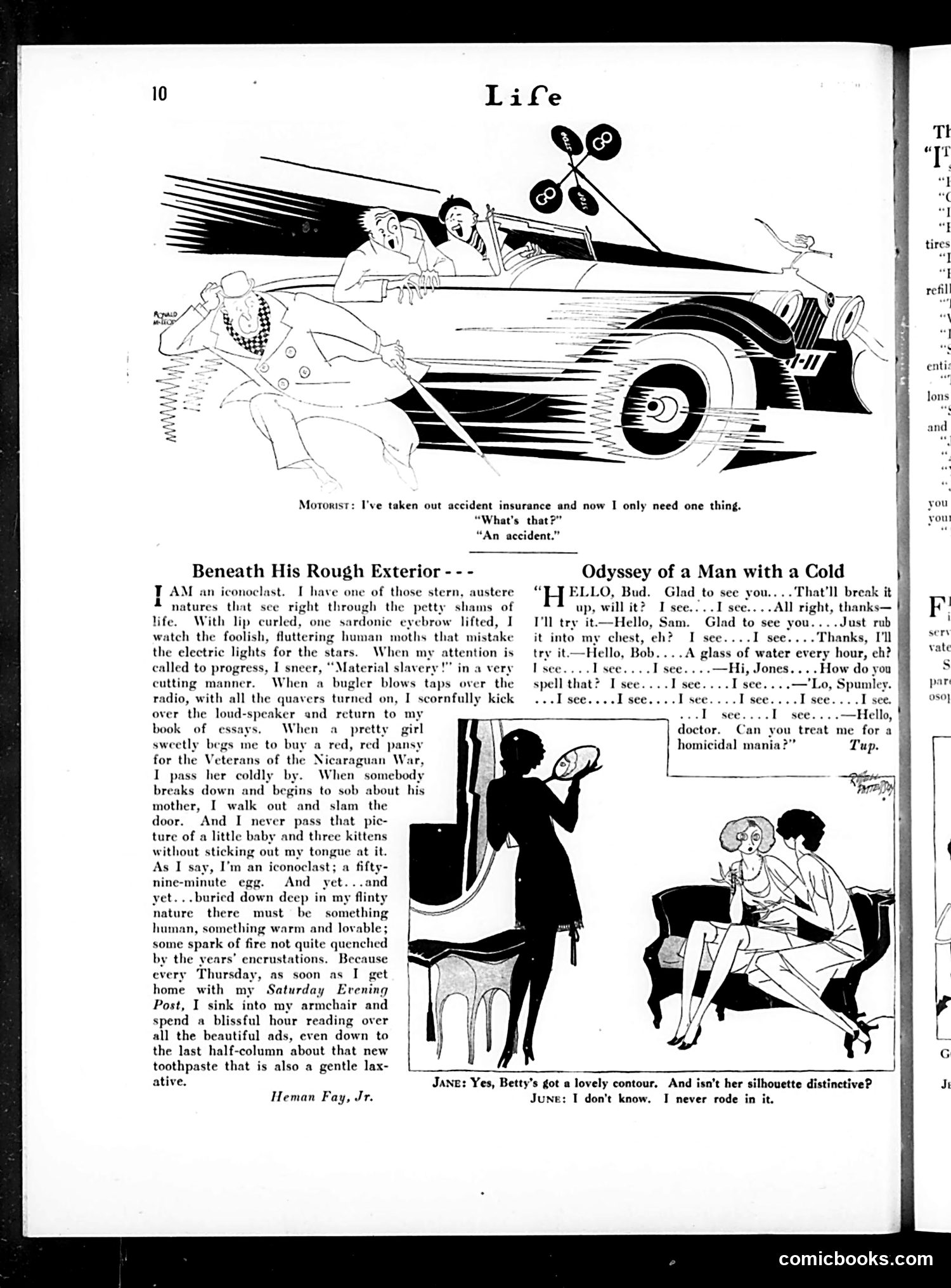
This page contains three distinct pieces: 1. **Top cartoon**: A motorist has crashed into a boat. The joke plays on insurance terminology—the driver says he now only needs "one thing" to complete his misfortune: "An accident" (implying the crash itself doesn't count as one). 2. **"Beneath His Rough Exterior"**: A humorous essay by Heman Fag, Jr., where a cynical, gruff man confesses he's actually sentimental underneath—reading *Saturday Evening Post* and becoming emotional over advertisements. 3. **"Odyssey of a Man with a Cold"**: A comic dialogue showing a man calling various people (Bud, Sam, Bob, Jones, Smutley) while sick, each conversation frustratingly brief. A separate panel shows two women (Jane and June) discussing a woman's "lovely contour" and silhouette—June admits she's never ridden in the car being discussed.
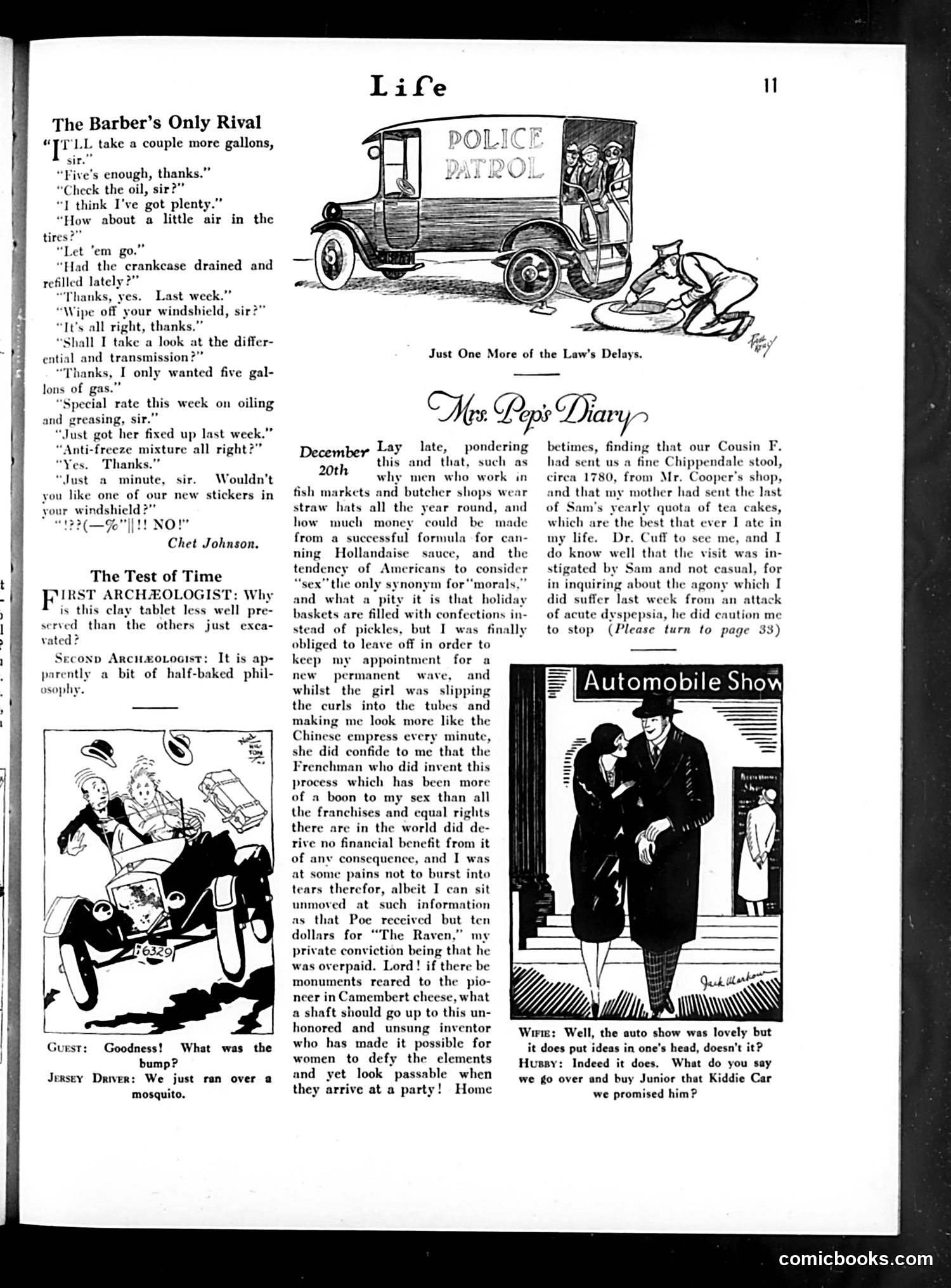
This page contains several satirical pieces reflecting early 20th-century American life: **"The Barber's Only Rival"** presents a humorous dialogue between a gas station attendant and customer, satirizing how automobile maintenance has become as detailed and time-consuming as a barber's services—suggesting cars require constant, specialized care. **"The Test of Time"** features archaeologists debating why clay tablets survive longer than modern materials, with the punchline being Jersey Driver's quip about running over a mosquito—mocking the perceived indestructibility of automobiles. **"Mrs. Pep's Diary"** discusses permanent waves (a 1920s hair treatment) and holiday preparations, reflecting contemporary women's social concerns. **"Automobile Show"** depicts a couple at a car exhibition, with dialogue about purchasing a "Junior" or "Kiddie Car"—likely a toy automobile.
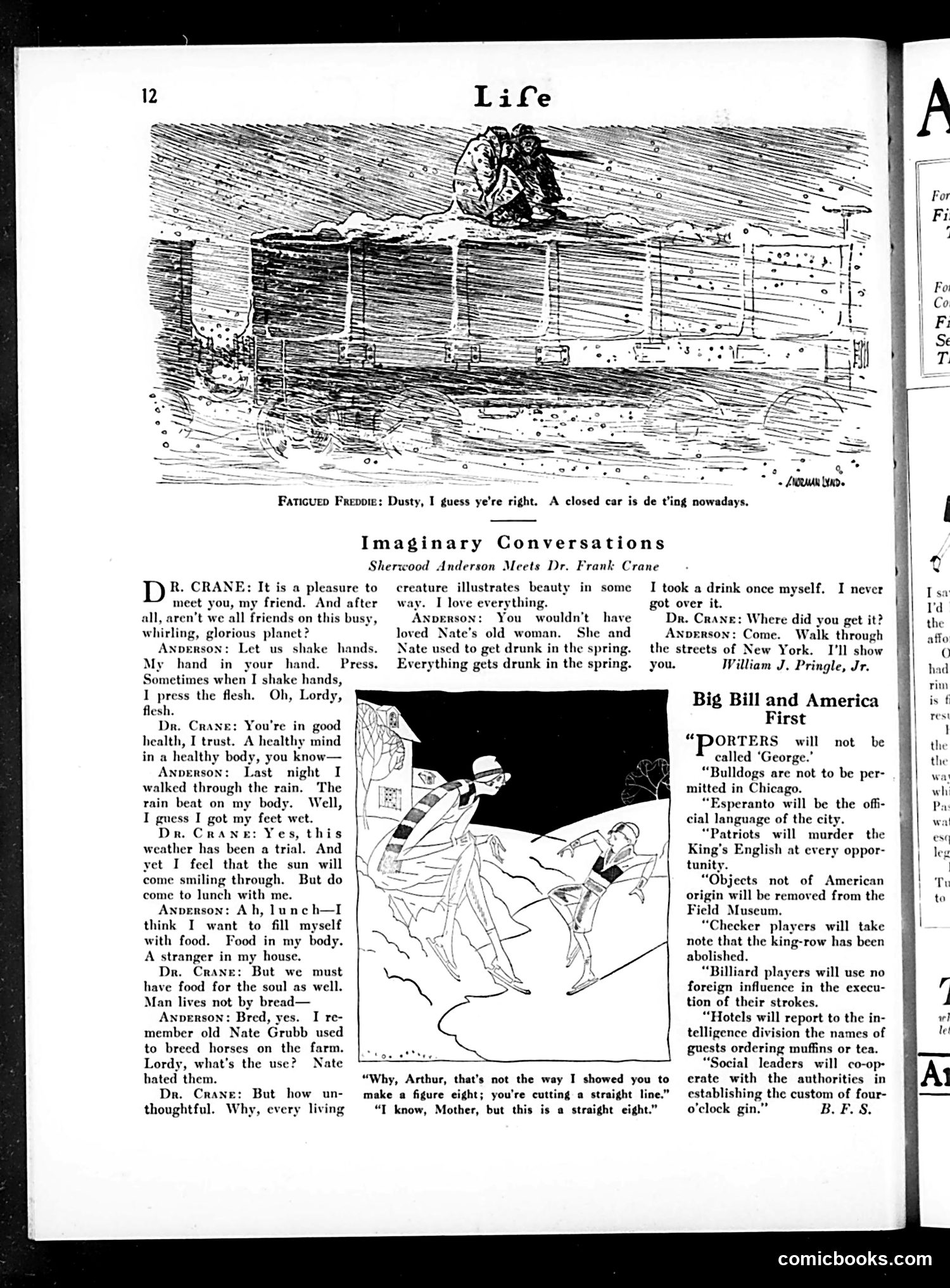
The page contains two distinct pieces: 1. **Top cartoon**: Shows a streetcar with a passenger complaining to the conductor about a "closed car" being outdated ("de ring nowadays"). This satirizes early 20th-century racial segregation practices where streetcars maintained separate seating sections—the "closed car" likely referring to segregated compartments. The joke targets this discriminatory system as antiquated. 2. **"Big Bill and America First"**: A satirical list mocking apparent nativist policies, likely from the World War I era. It ridicules proposals to ban foreign words (calling porters "George," banning Italian "Esperanto"), remove "un-American" objects from museums, and eliminate foreign cultural influences. The satire critiques xenophobic nationalism by listing absurd restrictions, suggesting such policies are reactionary and impractical.
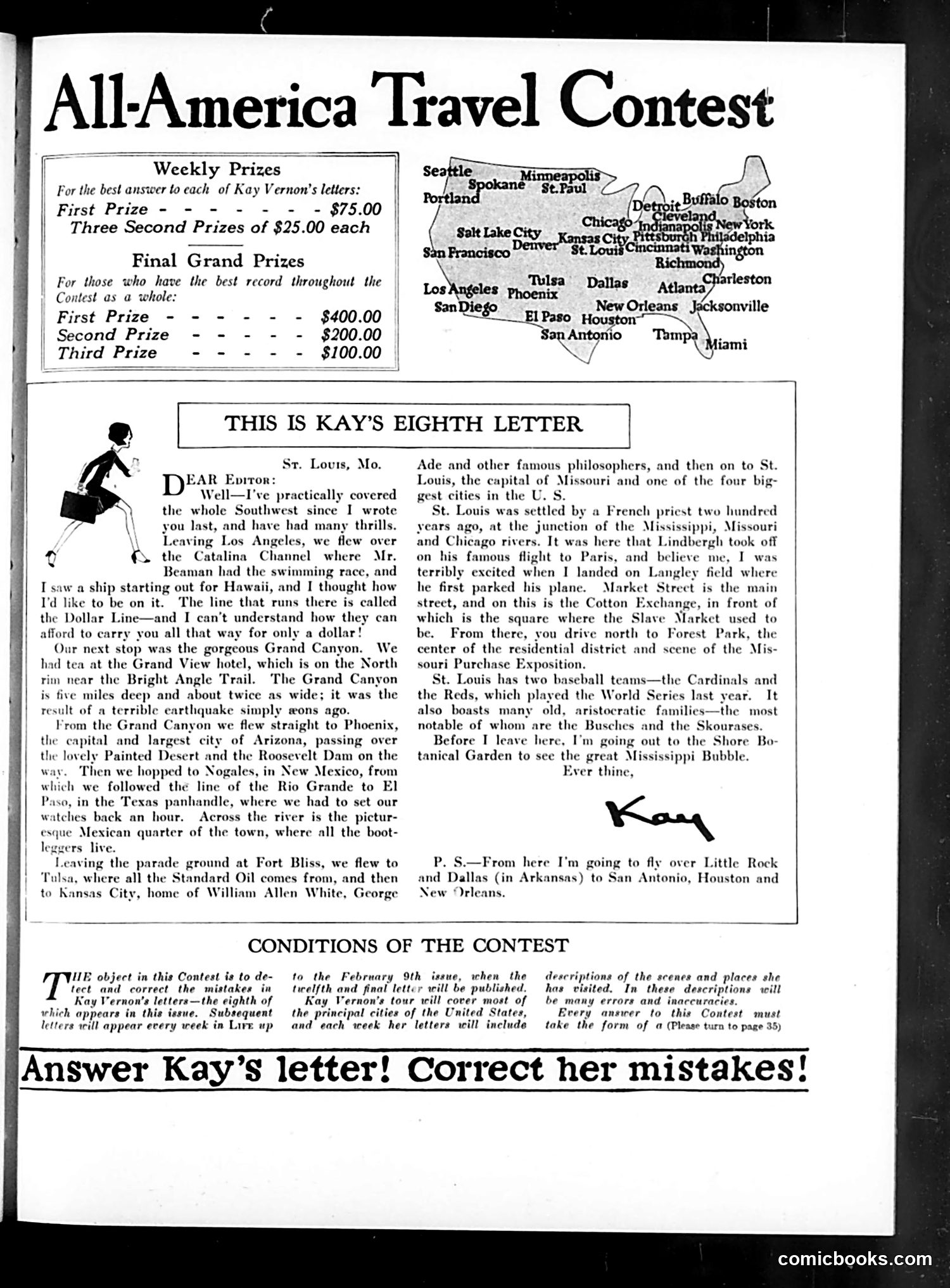
This page announces a contest where readers submit letters correcting errors in travel descriptions written by "Kay." The eighth letter describes a trip through the American Southwest and Midwest, mentioning the Grand Canyon, Phoenix, St. Louis, and other cities. The contest mechanics are straightforward: readers identify factual mistakes in Kay's geography or descriptions and win weekly or grand prizes (up to $400). The illustration shows a woman in travel attire, representing Kay as an adventurer. This appears to be a popular *Life* magazine feature—likely from the 1920s-30s based on design—that combined travel writing with reader engagement and a quiz element, making geography entertaining while promoting the magazine's circulation.
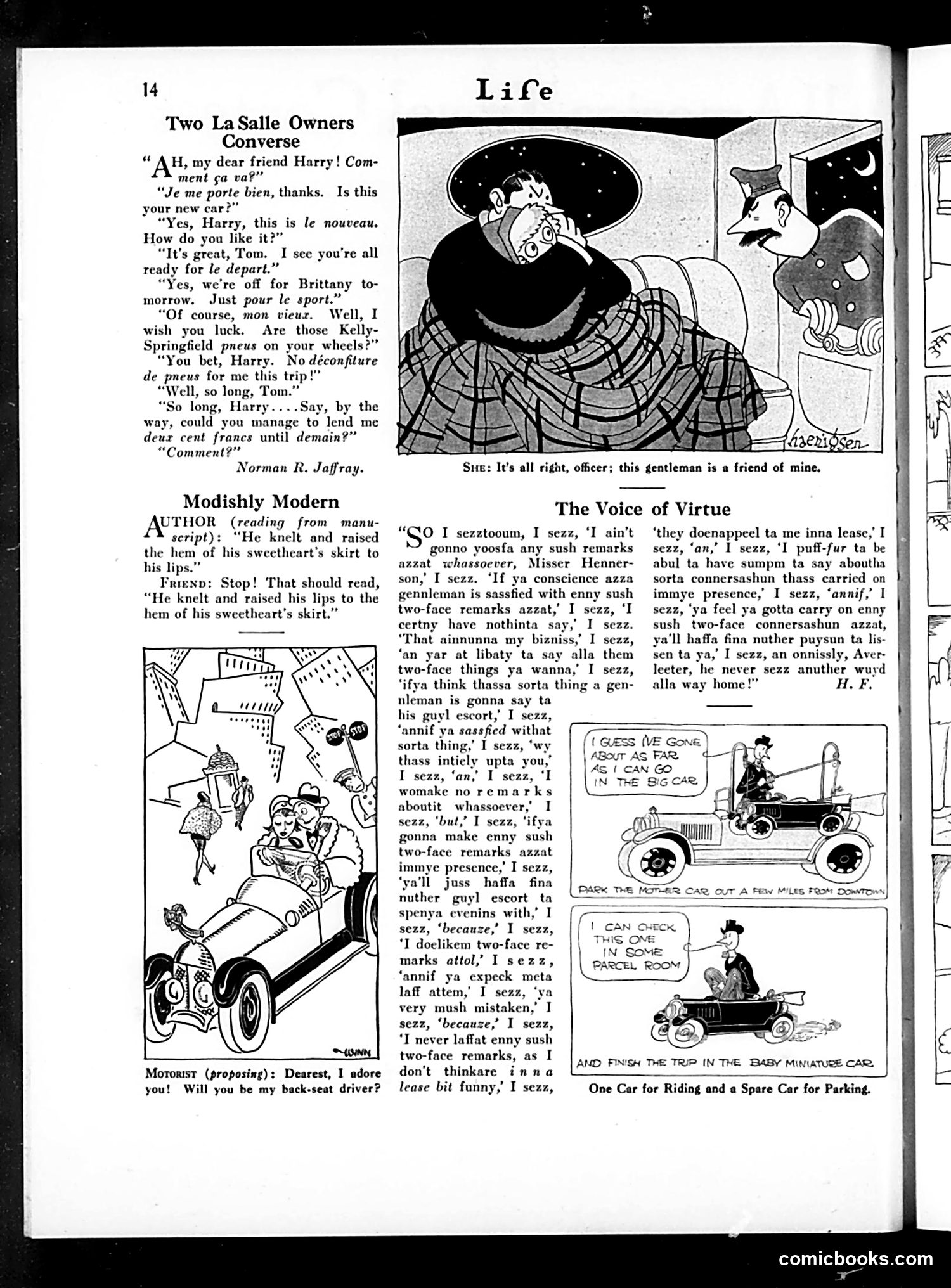
This page contains three separate humor pieces: 1. **"Two La Salle Owners Converse"**: A dialogue between car owners discussing a trip to Brittany, mixing English with French phrases ("pour le sport," "mon vieux"). The humor relies on casual affectation of French language among the wealthy. 2. **"Modishly Modern"**: Satirizes overly literal reading of romantic literature. A publisher corrects an author's phrase "knelt and raised the hem of his sweetheart's skirt" to the more explicit "knelt and raised his lips to the hem of her sweetheart's shirt"—mocking prudish editorial standards. 3. **"The Voice of Virtue"**: Features a motorist's extended monologue using repeated "I sezz" (dialect speech) to criticize two-faced moralists who lecture others while behaving badly themselves. The cartoons mock class pretension, literary censorship, and hypocrisy.
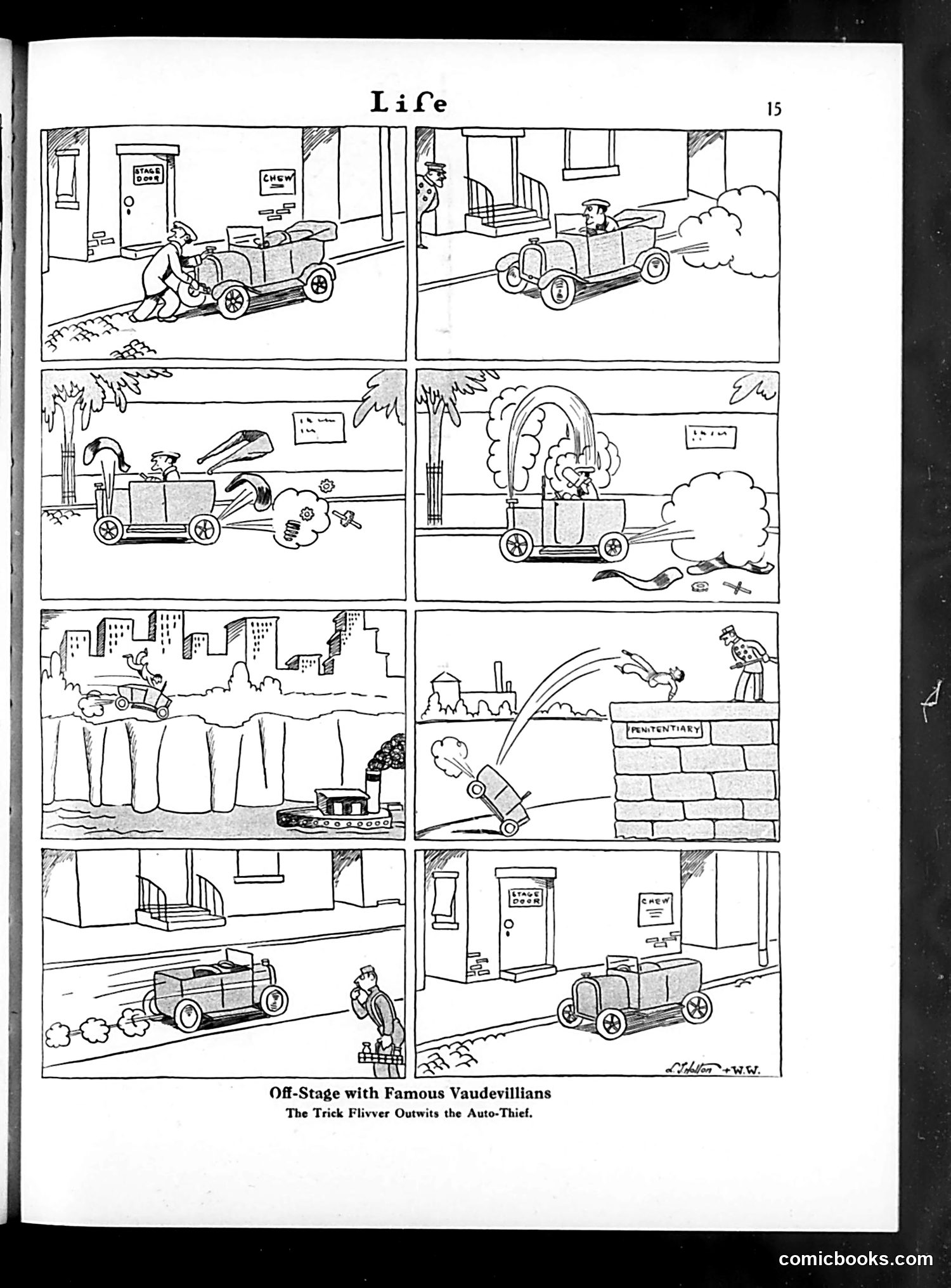
This is a comic strip titled "Off-Stage with Famous Vaudevillians: The Trick Flivver Outwits the Auto-Thief." The narrative follows a vaudeville performer in a rickety car ("flivver"—slang for an unreliable automobile, often referring to Model T Fords) who outwits a car thief through a series of comedic mishaps. The thief attempts various theft methods across eight panels, but the car's unpredictability works against him—it stalls, explodes, crashes, and launches him into a wall. The humor derives from the era's common frustration with early automobiles' mechanical unreliability, portrayed here as accidentally beneficial. The "vaudevillian" context references performers who used such gags in stage acts. This reflects 1920s-era anxiety about automobile technology while celebrating slapstick comedy conventions popular in vaudeville entertainment.
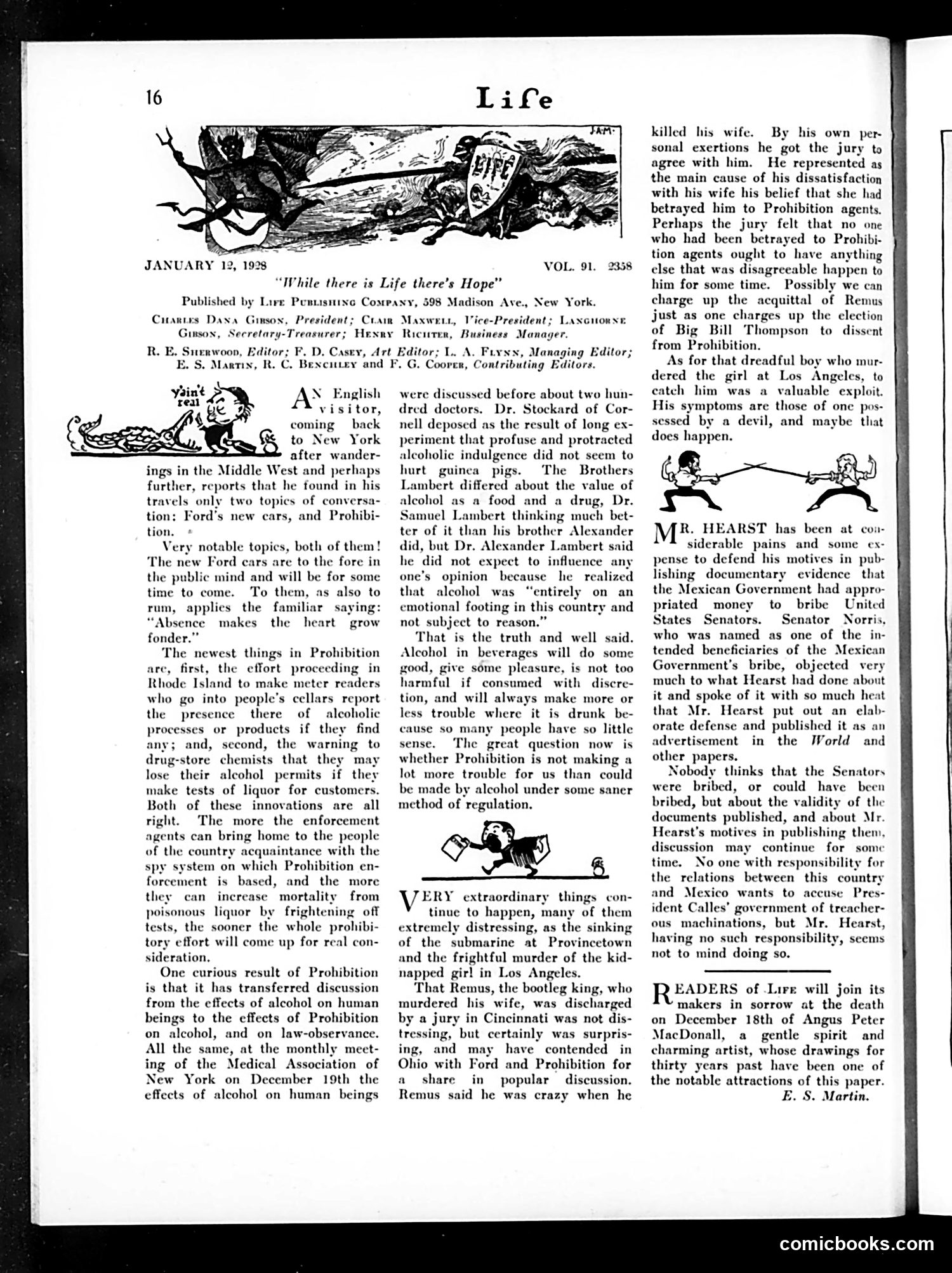
This page discusses Prohibition enforcement and its social effects. The main text critiques the unintended consequences of alcohol bans, noting that Prohibition has shifted debate about alcohol's effects from medical/scientific discussion to political arguments about enforcement. A notable section discusses **Remus**, described as a "bootleg king" who murdered his wife. A jury acquitted him in Cincinnati, which the writer finds surprising. The article suggests Remus may have blamed Prohibition agents for his troubles—a pointed commentary on how Prohibition created criminal enterprises and complex legal situations. The page also mentions **Mr. Hearst** defending his publication of Mexican government bribery documents to U.S. Senators, framing it as patriotic journalism rather than sensationalism. The small cartoons illustrate physical confrontation, likely depicting conflict between Prohibition enforcers and bootleggers.
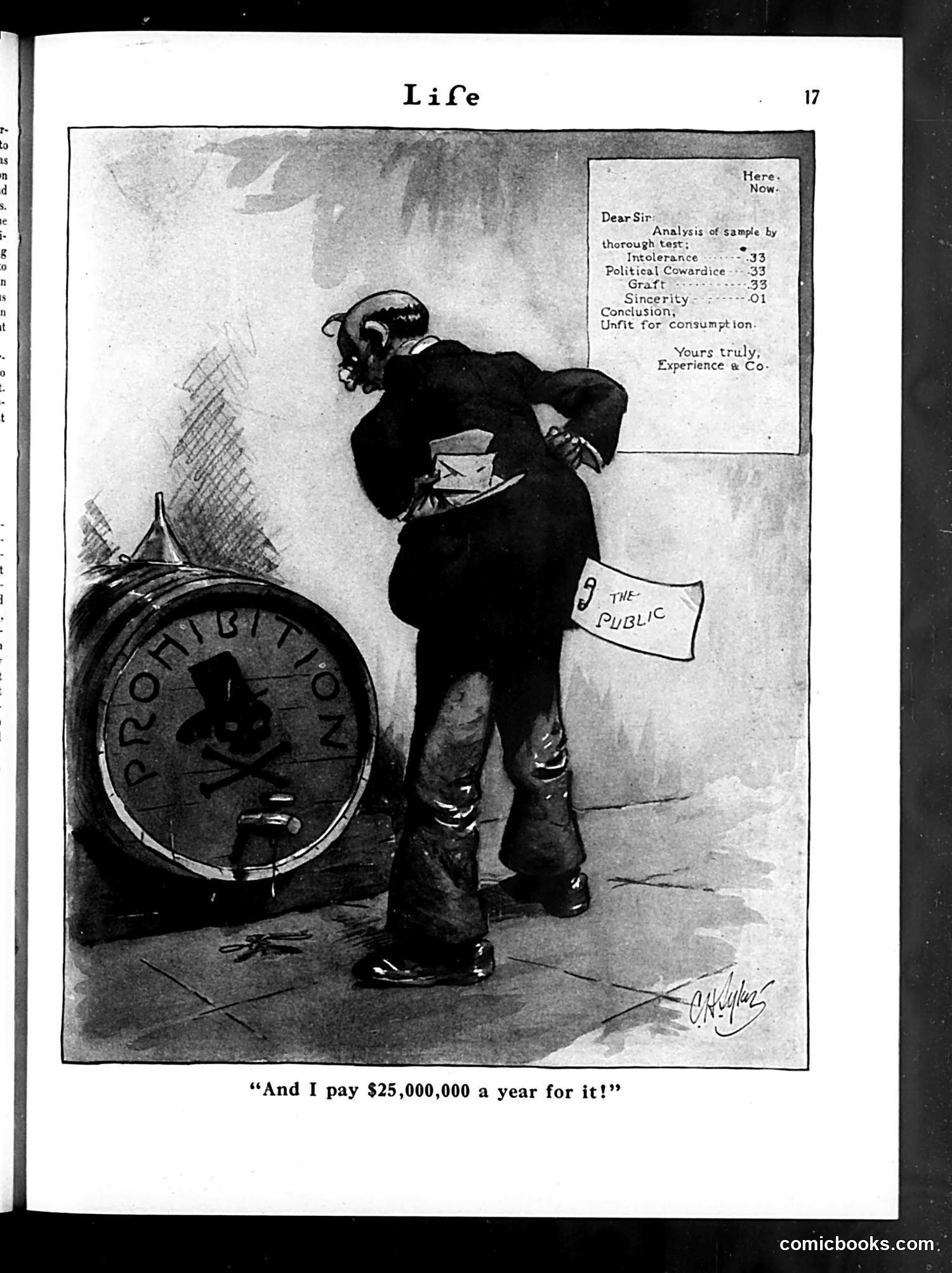
This satirical cartoon depicts a figure in formal attire holding a letter from "Experience & Co." The letter—a mock "analysis" report—rates the subject poorly on tolerance, political cowardice, graft, and sincerity, concluding he is "unfit for consumption." The figure stands beside a large poison bottle labeled "PROHIBITION," suggesting this cartoon criticizes Prohibition era corruption and hypocrisy. The substantial annual sum mentioned ($25,000,000) likely references government spending or bribes related to Prohibition enforcement, which was notoriously ineffective and corrupt during the 1920s-early 1930s. The cartoon satirizes both Prohibition's failure and the corruption it bred, portraying "Experience" mocking whoever profits from or administers this failed policy.
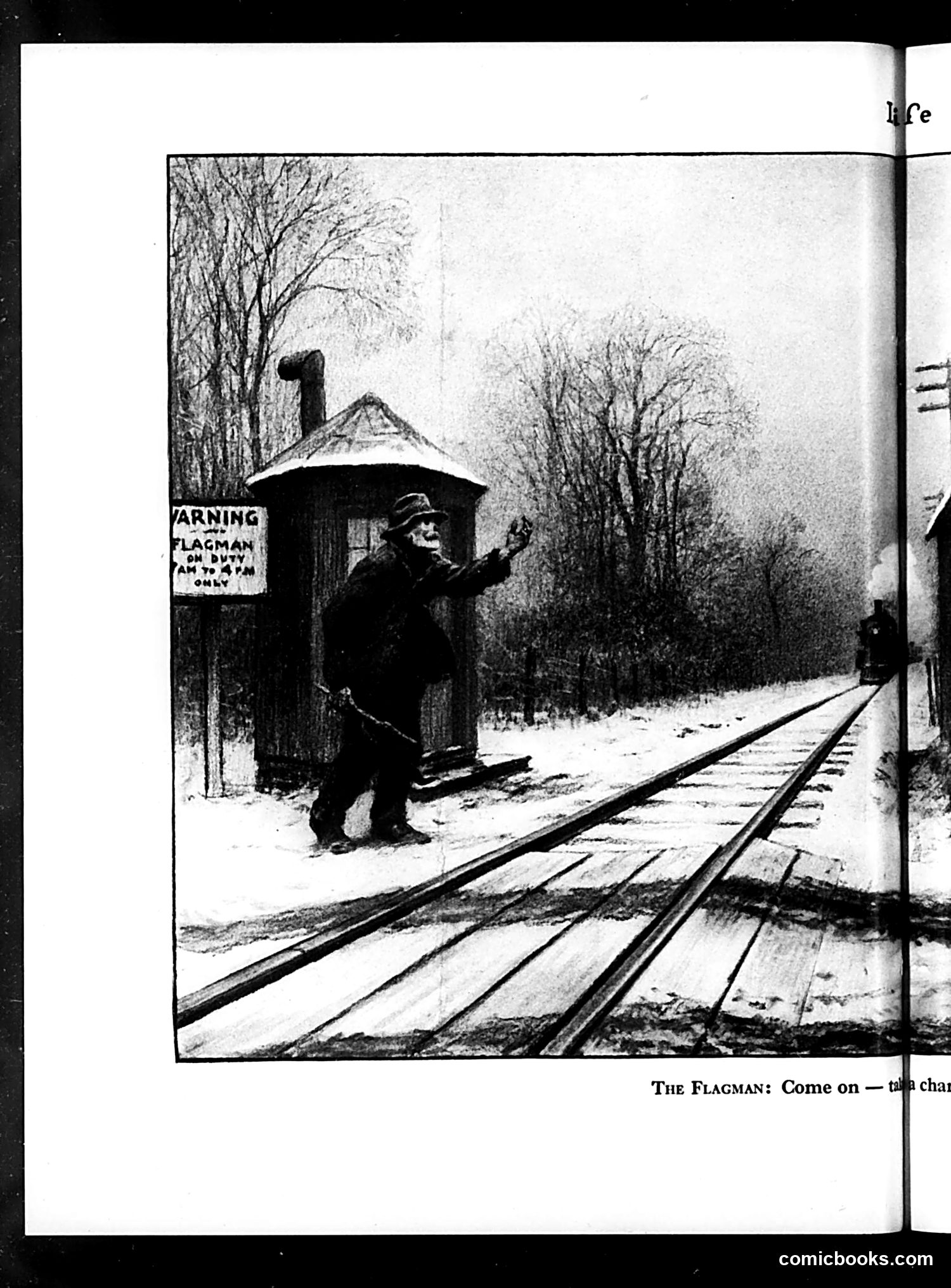
This is a satirical illustration showing a railroad flagman at a crossing warning sign. The sign reads "WARNING FLAGMAN ON DUTY 8 AM TO 4 PM ONLY," establishing the joke's premise. The cartoon appears to satirize railroad safety regulations or labor practices, likely from the early 20th century. The flagman is depicted waving a warning flag toward an approaching train, but the humor lies in the irony suggested by the sign—the implication that railroad crossing safety is only maintained during limited business hours, leaving trains and travelers vulnerable outside those times. The caption begins "The Flagman: Come on—" but is cut off, preventing complete interpretation of the punchline. The satire critiques inadequate or absurdly limited safety protocols.
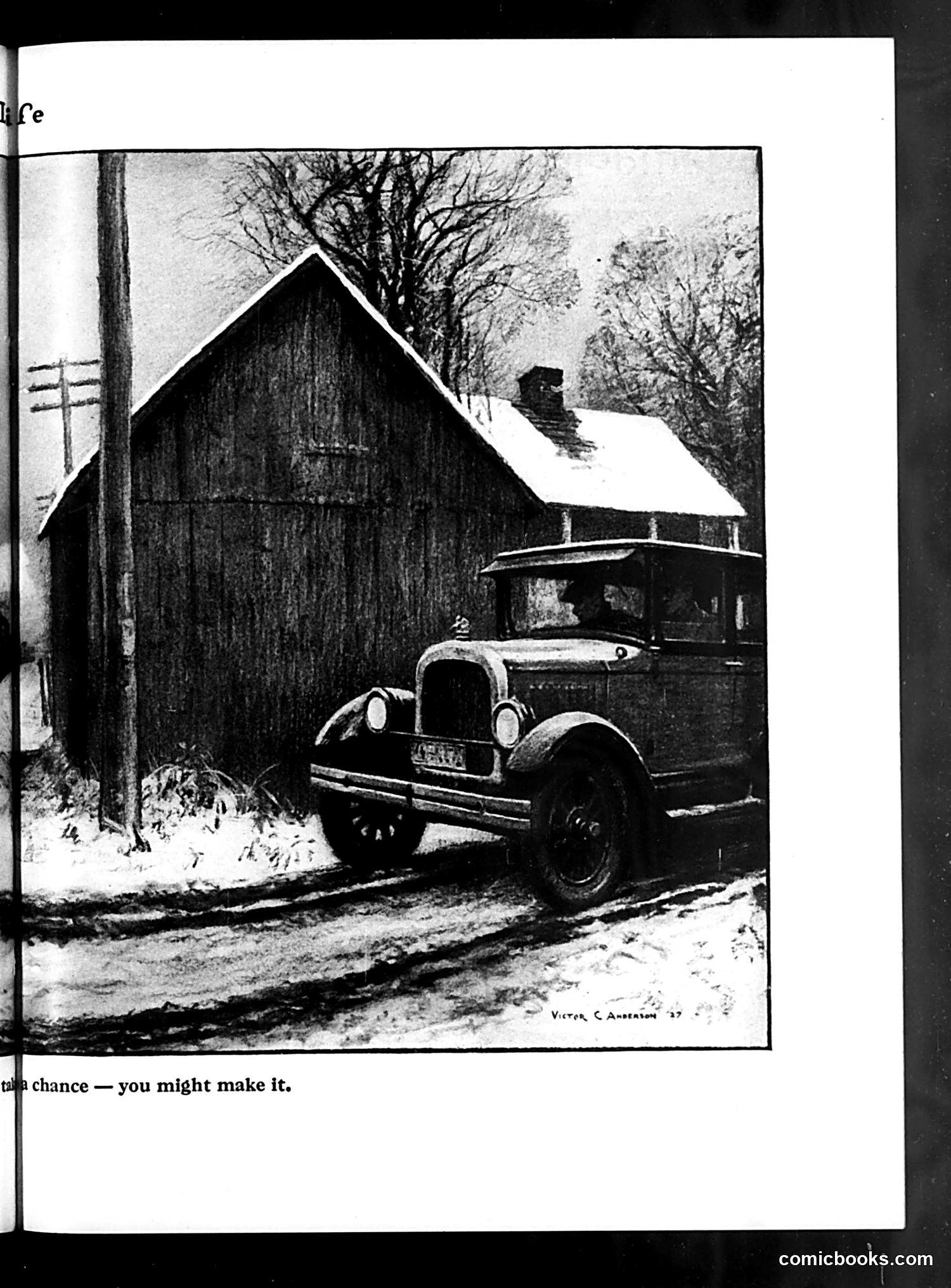
This appears to be an advertisement or illustrative photograph rather than a political cartoon. It shows a vintage automobile (appears to be from the 1920s based on the styling) parked beside a dilapidated wooden barn or farm building with snow on the roof. A utility pole stands nearby. The visible text fragment reads "chance — you might make it," suggesting this is part of a larger advertisement, likely promoting automobiles or automotive reliability. The juxtaposition of the modern car against the weathered rural building may be emphasizing the car's durability or the contrast between rural and modern life. The credit line reads "Vieron, C Anderson '27," indicating this is from 1927. Without the complete advertisement text, the specific message remains unclear, but it appears to be a promotional image rather than political satire.
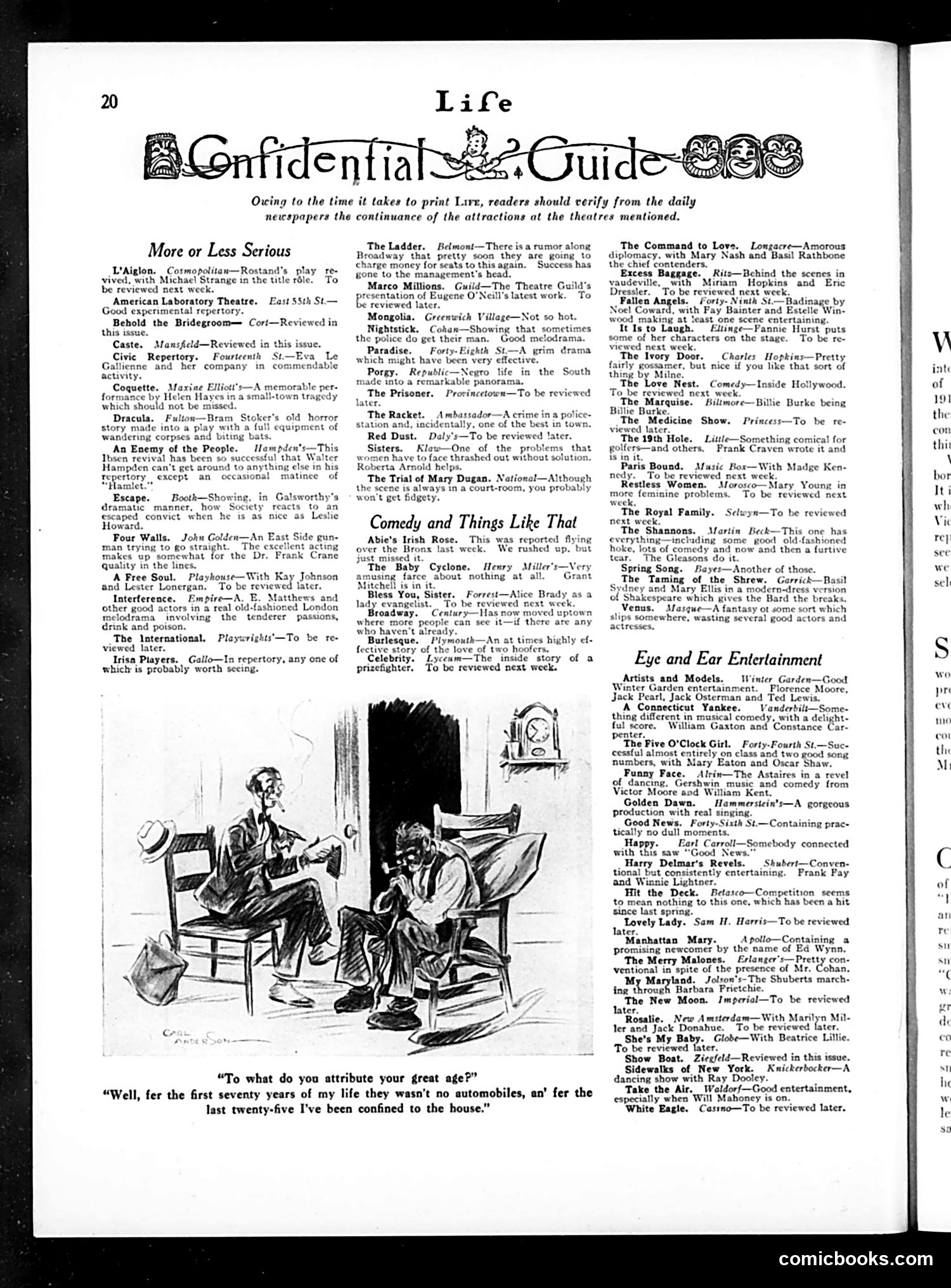
This page is a theater guide and review section from Life magazine, featuring entertainment listings and a single cartoon. **The Cartoon:** The illustration depicts two elderly men in conversation. One asks, "To what do you attribute your great age?" The other replies: "Well, fer the first seventy years of my life they wasn't no automobiles, an' fer the last twenty-five I've been confined to the house." **The Satire:** This is social commentary on early automotive culture. The joke contrasts two eras: pre-automobile life (when people moved freely outdoors) versus the automobile age (when the speaker has been "confined to the house," presumably due to accidents, congestion, or general dangers from cars). The humor lies in the irony that automobiles—supposedly liberating technology—have actually trapped people indoors, likely through fear or injury. This reflects 1920s anxieties about automobiles as dangerous, chaotic urban hazards before safety regulations existed. **Context:** Life was a satirical weekly known for social commentary. This cartoon critiques the unintended consequences of technological "progress"—a common theme during the rapid industrialization of the 1920s.
This is a theater review column criticizing playwright George Kelly's work, specifically his play "Behold the Bridegroom." The critic praises Kelly's ability to captivate audiences despite slow pacing and minimal plot, crediting actress Judith Anderson's performance. However, the review identifies a flaw: Kelly's signature strength—realistic small-talk dialogue that works brilliantly in his comedies—becomes tedious in this tragedy, where the stripped-down structure offers no comic relief to offset mundane conversation. The piece contrasts Kelly's approach with Cosmo Hamilton's "Caste," whose deliberately grandiose dialogue ("pomegranates") makes small moments feel important. The critic notes audiences weren't offended by anti-Semitic elements in "Caste" as expected, suggesting changing social attitudes. Overall, it's a sophisticated assessment of theatrical technique and dialogue's varying effectiveness across genres.
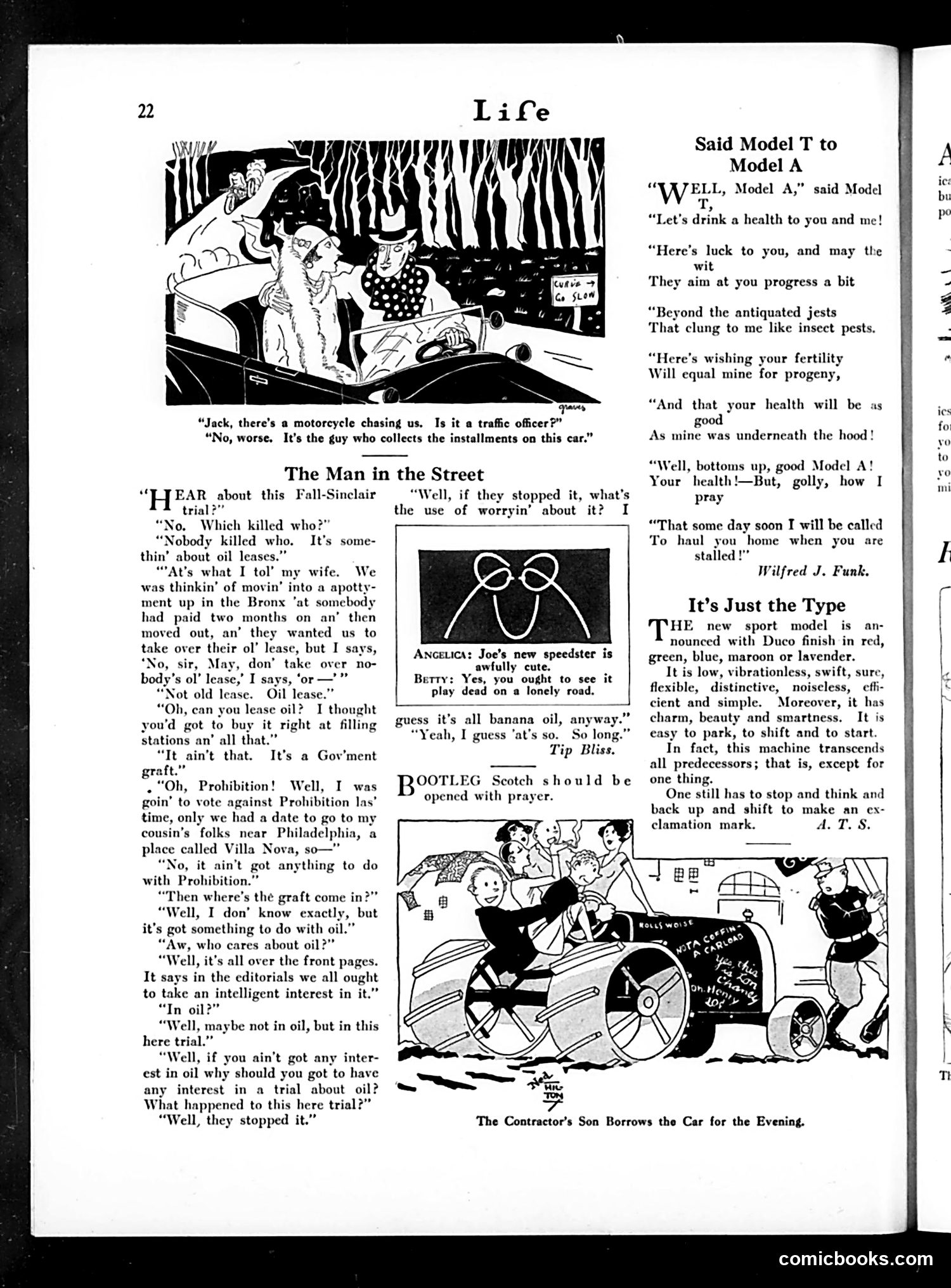
This page satirizes 1920s American culture through multiple cartoons and humor pieces. **"The Man in the Street"** mocks public ignorance of current events, specifically the Fall-Sinclair oil-lease scandal (a major political corruption case of the era). Two working-class men discuss the trial, but neither understands or cares about oil leases—one confuses it with apartment leases, another with Prohibition. The joke: average citizens are indifferent to serious government graft despite editorials urging civic engagement. **"Said Model T to Model A"** personifies automobiles as generational rivals. The older Model T toasts the newer Model A, grudgingly acknowledging its superiority while joking it will eventually need towing—suggesting the Model T's obsolescence despite its historical dominance. **"It's Just the Type"** praises a new sport car's technical innovations, ending with a wry twist: despite all modern advances, drivers still struggle with basic mechanics (the "exclamation mark" likely refers to gear-shifting difficulties). The opening cartoon jokes about car payments—the "guy who collects installments" is more threatening than a traffic officer, reflecting Depression-era anxieties about consumer debt.
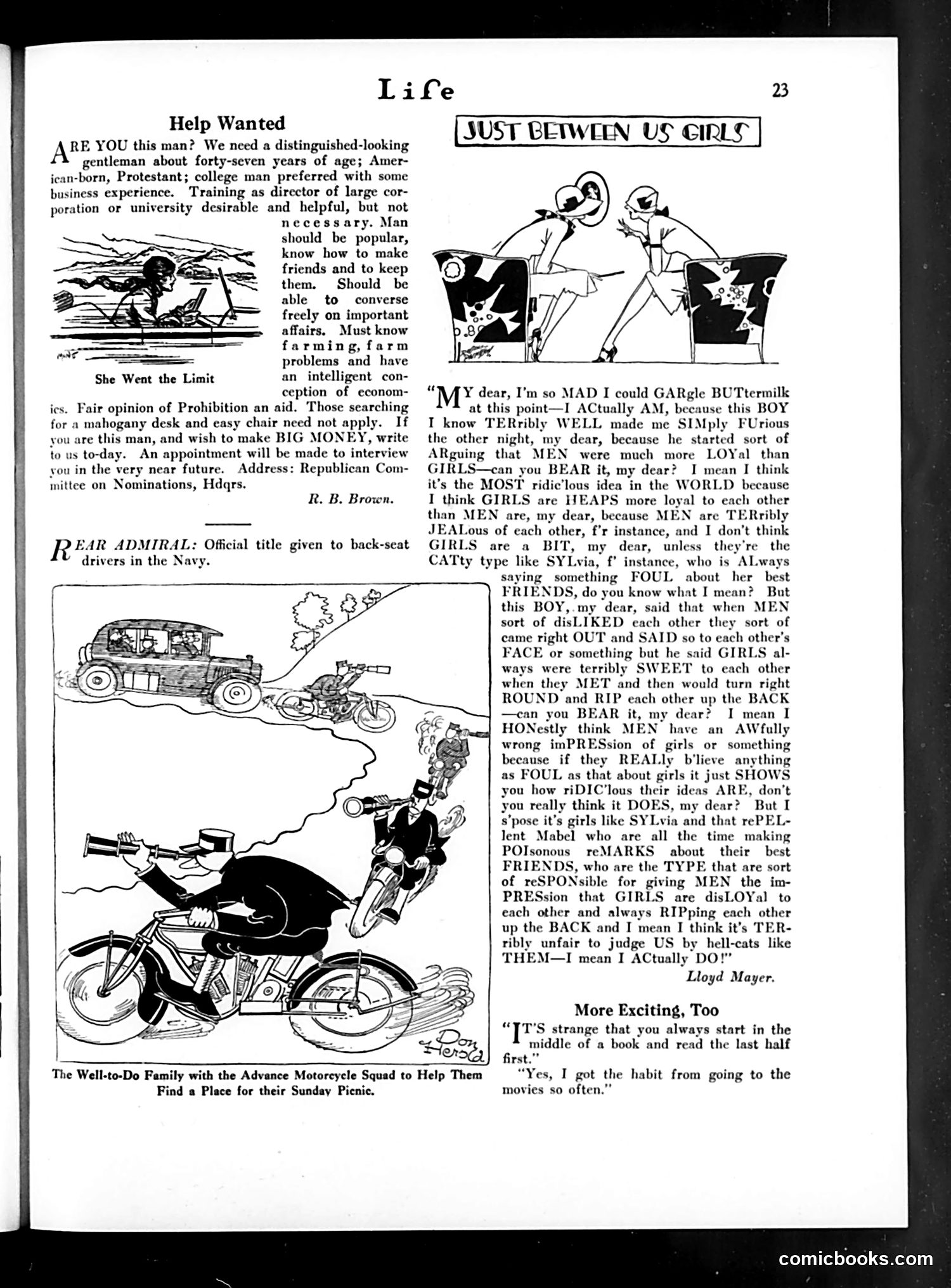
This page contains three satirical pieces typical of 1920s Life magazine humor: **"Help Wanted"** mockingly advertises for a Republican presidential nominee—a distinguished, Protestant, business-minded man who understands farming and economics. The satire lies in treating candidate selection as a routine job posting, suggesting the Republican Party is simply filling a position rather than selecting a leader of conviction. **"Just Between Us Girls"** presents a gossipy monologue (by Lloyd Mayer) where a woman defends girls' loyalty against a man's claim that men are more loyal. She argues men are jealous while girls are disloyal only when "catty." The humor relies on the speaker's contradictory logic and exaggerated social anxiety—a satire of both female gossip culture and shallow romantic discourse of the era. **"Rear Admiral"** is a brief joke defining the naval term as applying to backseat drivers. The motorcycle family cartoon depicts chaos during a Sunday outing, satirizing the disruption caused by automobile culture. The overall tone reflects Jazz Age skepticism toward social institutions, gender relations, and modern leisure.
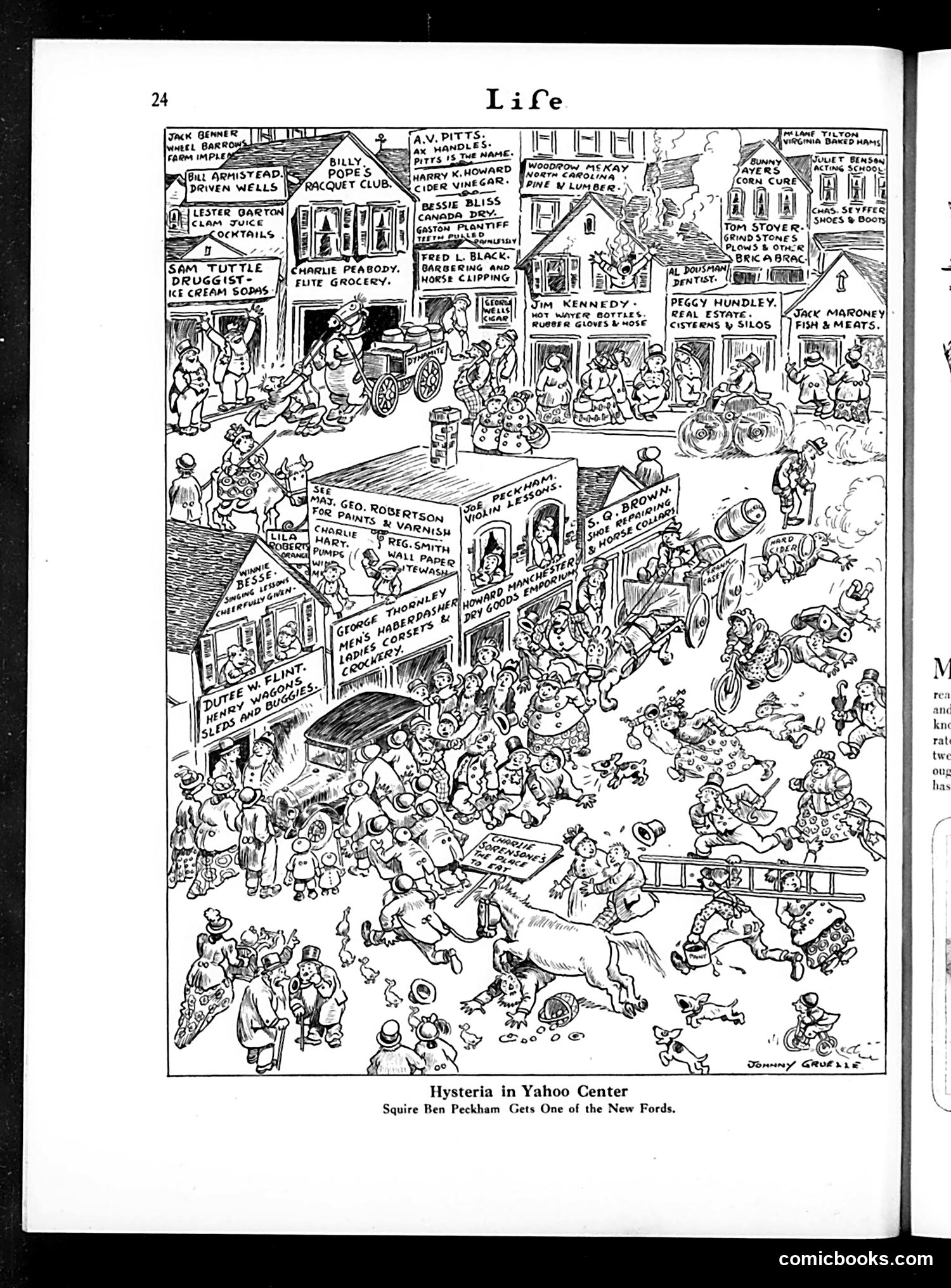
This satirical illustration depicts small-town chaos caused by a wealthy local figure's purchase of a new Ford automobile. The title references "Squire Ben Peckham," apparently a prominent community member whose car acquisition triggers pandemonium. The cartoon mocks rural America's fascination with early automobiles (the "New Fords" reference suggests the Model T era, early 1900s). The crowded street scene shows townspeople—labeled with local business names like "Sam Tuttle Druggist" and "Charlie Peabody Elite Grocery"—in frenzied excitement. A horse appears startled amid the chaos. The satire targets both small-town provincialism and the transformative (disruptive) impact of modern technology on traditional communities. The "hysteria" suggests that automotive novelty causes absurd social disruption in places where such conveniences were previously unknown. The detailed business labels emphasize this is specifically about ordinary Americans in unremarkable towns.
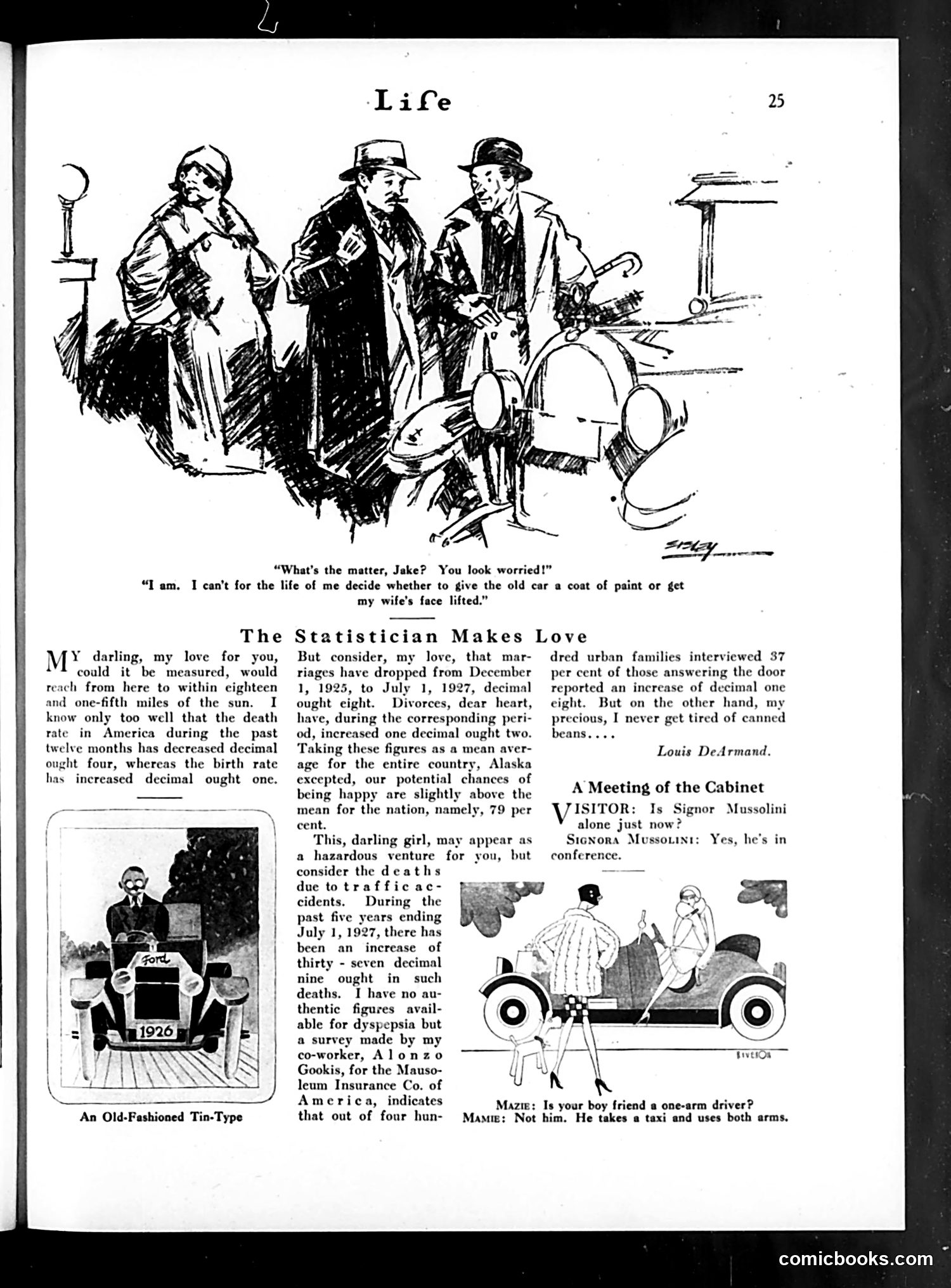
**"The Statistician Makes Love"** satirizes the modern tendency to reduce human experience—including romance—to cold statistical analysis. A man courts his girlfriend by citing marriage/divorce rates, death statistics, and traffic accident data instead of expressing genuine emotion. The joke is that this approach is absurdly unromantic: he proves mathematically they have a 79% chance of happiness, then undermines even that by citing traffic fatalities and dyspepsia surveys. **"A Meeting of the Cabinet"** is a brief joke about Mussolini (Italy's fascist leader by 1927) being perpetually in conferences—suggesting he's always busy with government affairs. **"One-Arm Driver"** is a contemporary joke about young couples in automobiles, where the boy driver keeps one hand on the steering wheel and the other around his girlfriend; a taxi driver uses both hands properly. The page satirizes modern life's obsession with data and statistics, and courtship customs of the Jazz Age.
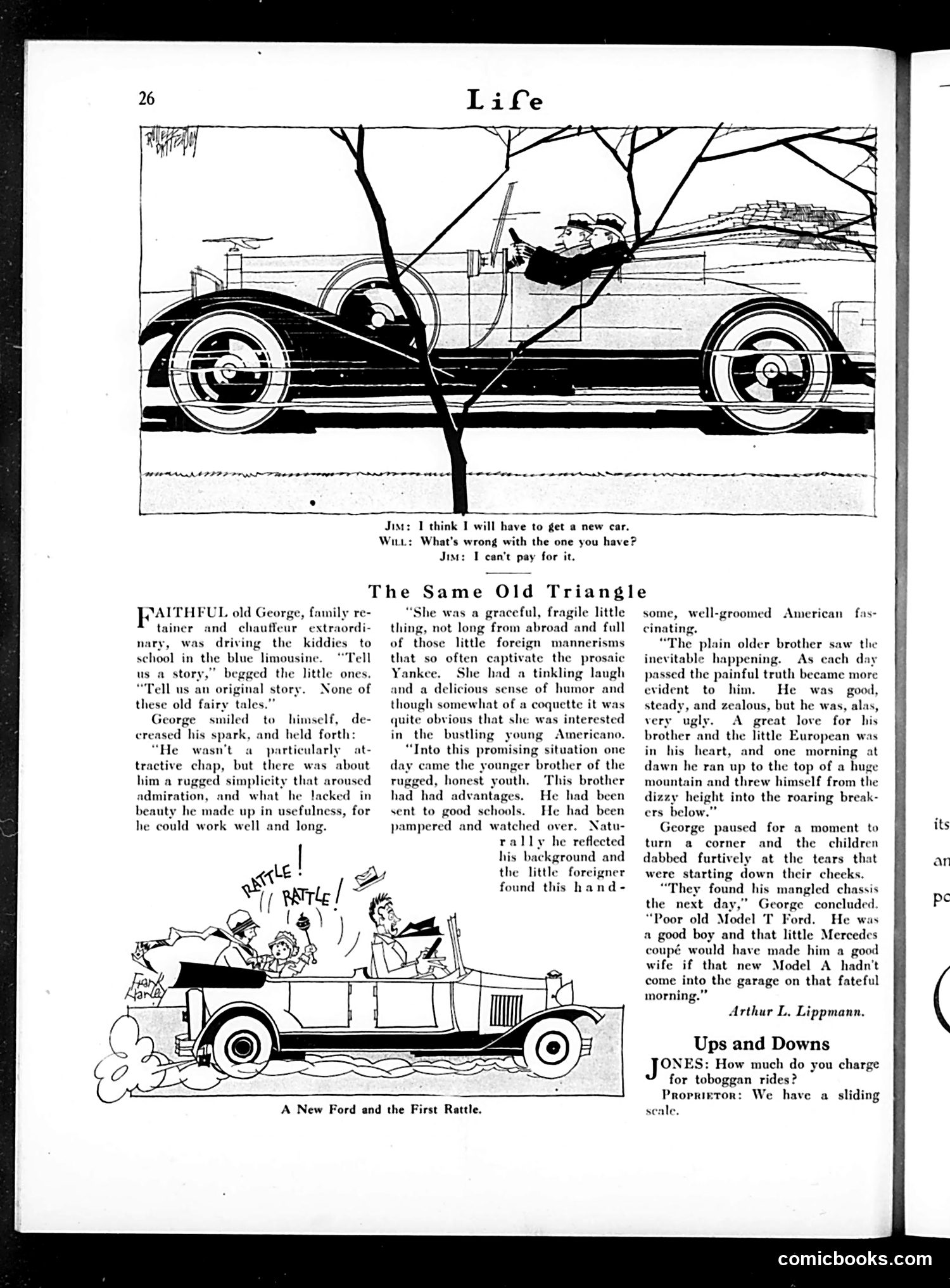
This page contains two satirical pieces about automobiles during the early automotive era. **Top cartoon:** A simple joke about financial hardship—Jim wants a new car not because his current one is broken, but because he cannot afford the payments. The humor targets Depression-era economic struggles. **"The Same Old Triangle" story:** A chauffeur named George tells children a fairy tale, but replaces traditional characters with cars. A plain, hardworking "Model T Ford" loves a foreign "Mercedes coupé," but loses her to a wealthy "Model A." Heartbroken, the Model T throws himself off a cliff. The satire mocks both romantic melodrama and American car culture—treating automobiles as characters with class status and romantic worth. Model T represents the everyman; the luxurious Mercedes and newer Model A represent wealth and status. **"A New Ford and the First Rattle" cartoon:** Shows a family in a car having a collision, with "rattle" being a pun on both the sound and the verb meaning to shake or disturb. **"Ups and Downs":** A pun—the proprietor uses "sliding scale" (variable pricing) literally rather than figuratively for toboggan rides.
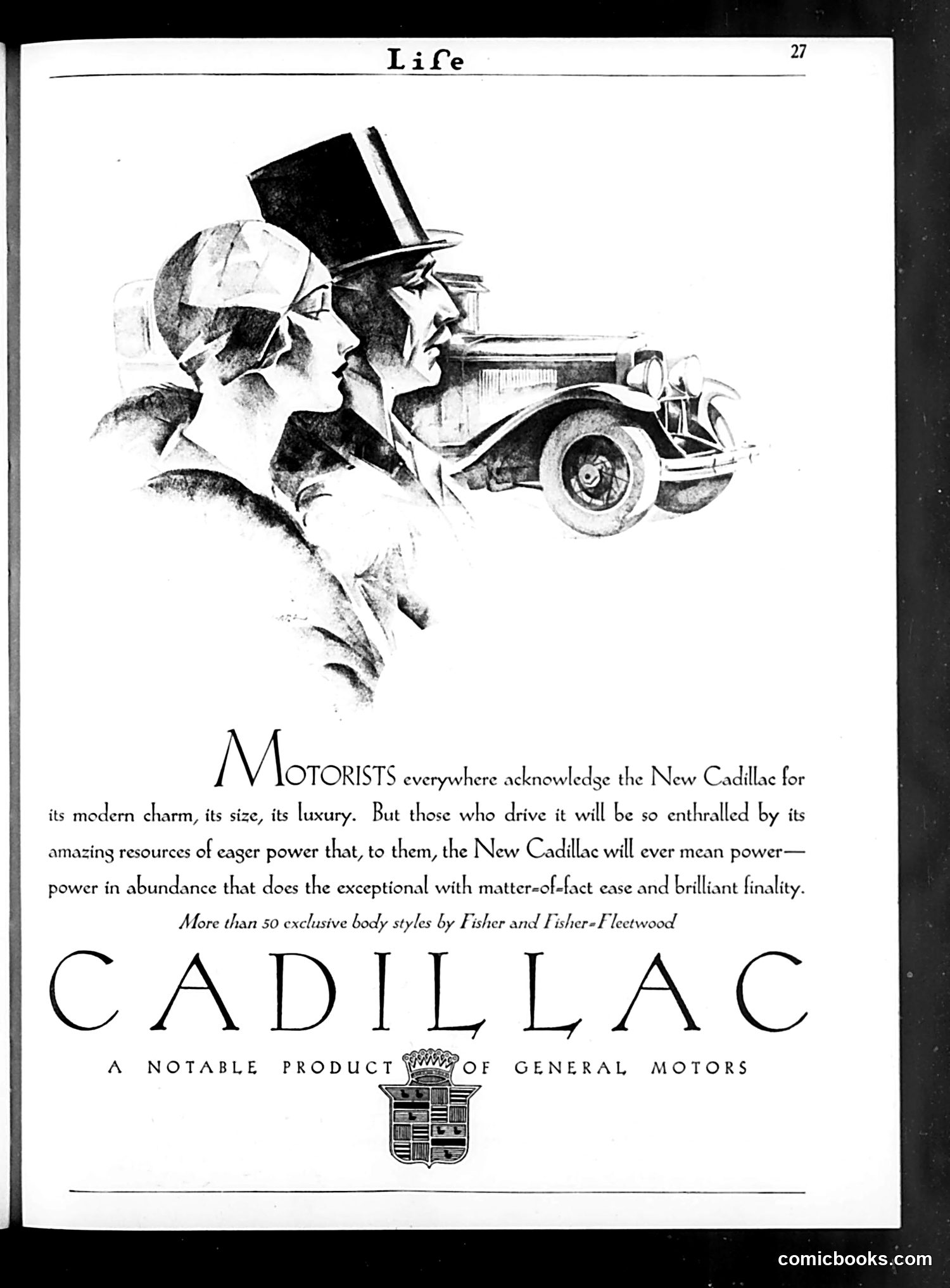
This is a **Cadillac automobile advertisement**, not political satire. The page features an illustrated portrait of an elegantly dressed couple (a woman in a cloche hat and fur stole, a man in a top hat) alongside a sketched luxury automobile. The ad copy uses hyperbolic language typical of 1920s advertising, claiming the "New Cadillac" offers "power in abundance" and will "enthrall" drivers. It emphasizes luxury features—custom body styles by prestigious coachmakers Fisher and Fisher-Fleetwood—and positions Cadillac as a status symbol for the wealthy. The imagery and messaging target affluent consumers, associating the car with sophistication and modern elegance. There is **no political or social satire** here; this is straightforward luxury marketing from General Motors' premium brand.
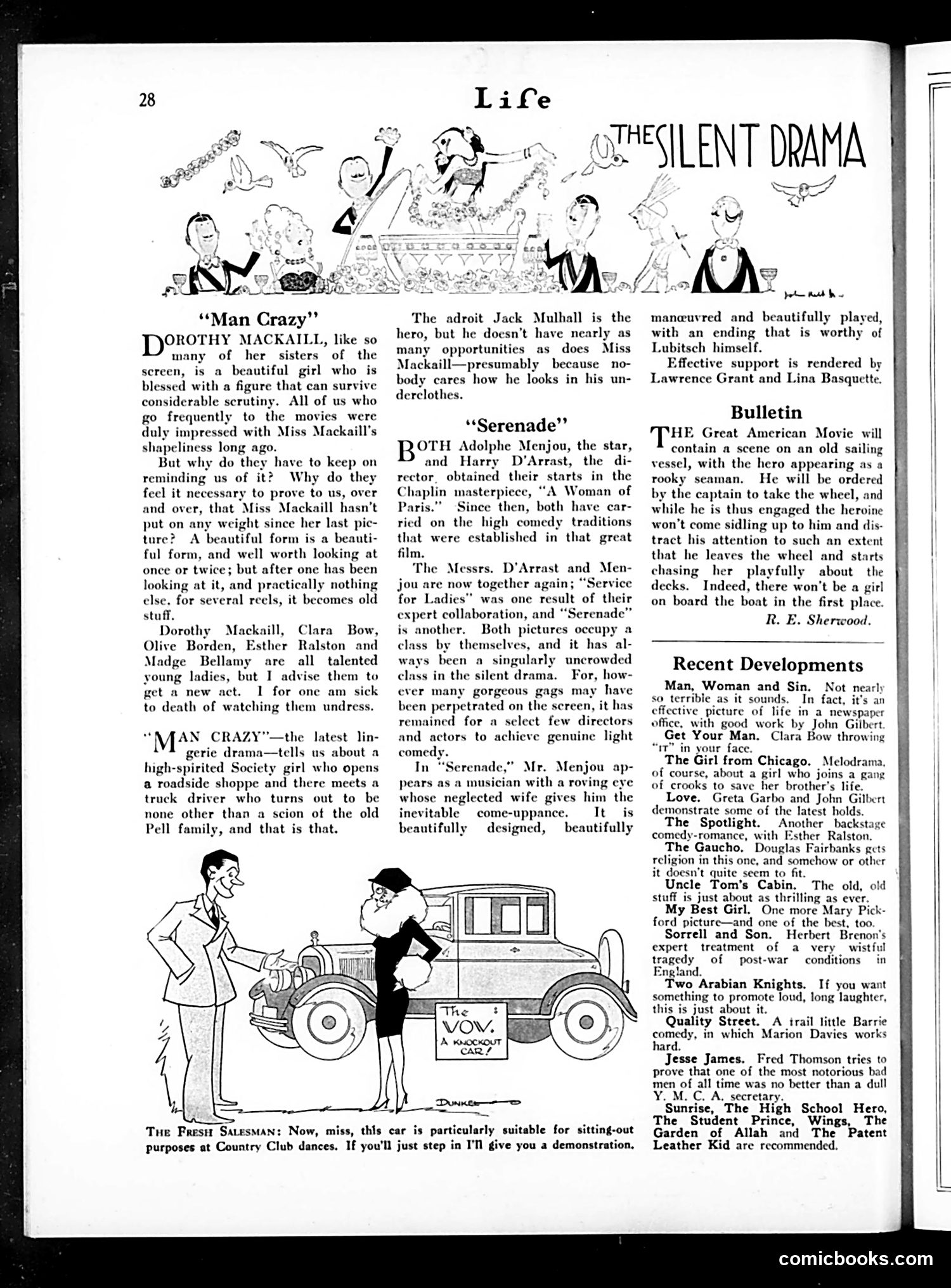
This is a film review page from Life magazine's "Silent Drama" section, critiquing 1920s movies. The main cartoon satirizes automobile salesmen's deceptive sales tactics—the salesman is pitching a car to a young woman by emphasizing its usefulness for "sitting-out purposes at Country Club dances," a euphemism for romantic encounters away from supervision. The reviews critique silent films' reliance on actresses' bodies rather than talent. The critic mocks "Man Crazy" (starring Dorothy Mackaill) for repeatedly undressing its female lead to showcase her figure, calling this lazy filmmaking. By contrast, "Serenade" (with Adolphe Menjou) is praised for genuine comedy craftsmanship. The bulletin sardonically notes that true American cinema shouldn't feature women distracting male heroes—a comment on how films routinely centered male protagonists while reducing women to romantic distractions.
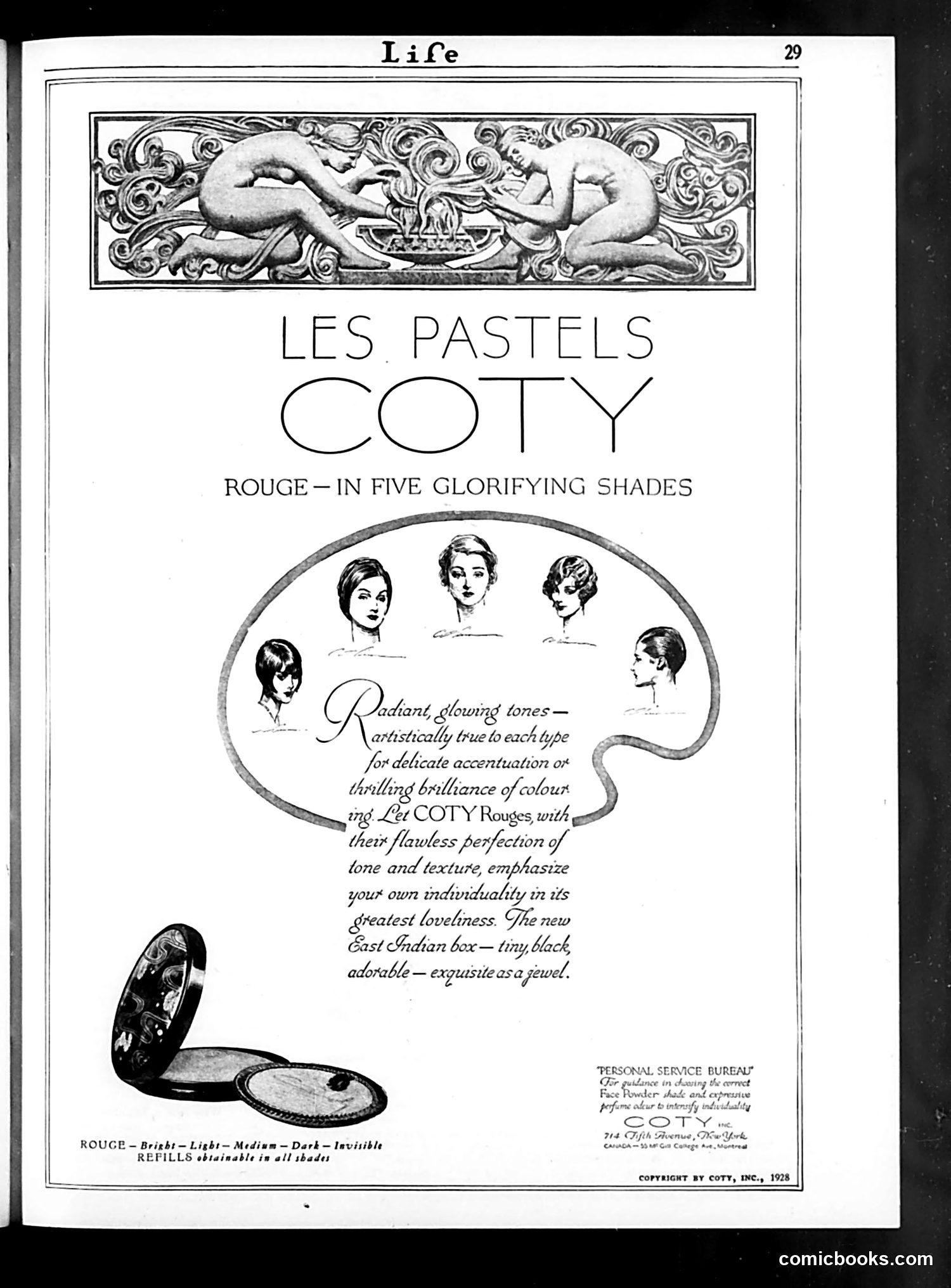
This page is primarily an advertisement, not political satire. It promotes "Les Pastels Coty" rouge—a cosmetic product by the Coty company (dated 1928). The ornamental header features classical cherubs; below are five illustrated female faces showing different complexions and hairstyles, demonstrating how the rouge looks "artistically true to each type." The ad emphasizes the product's "five glorifying shades" and appeals to individual beauty enhancement. The elegant palette-shaped container is showcased at bottom left. The text uses period-appropriate language ("greatest loveliness," "exquisite as a jewel") to market the rouge as a luxury item that accentuates natural skin tones. There is no political cartoon or satire present—this is straightforward 1920s beauty advertising targeting women concerned with fashionable cosmetics and personal individuality.
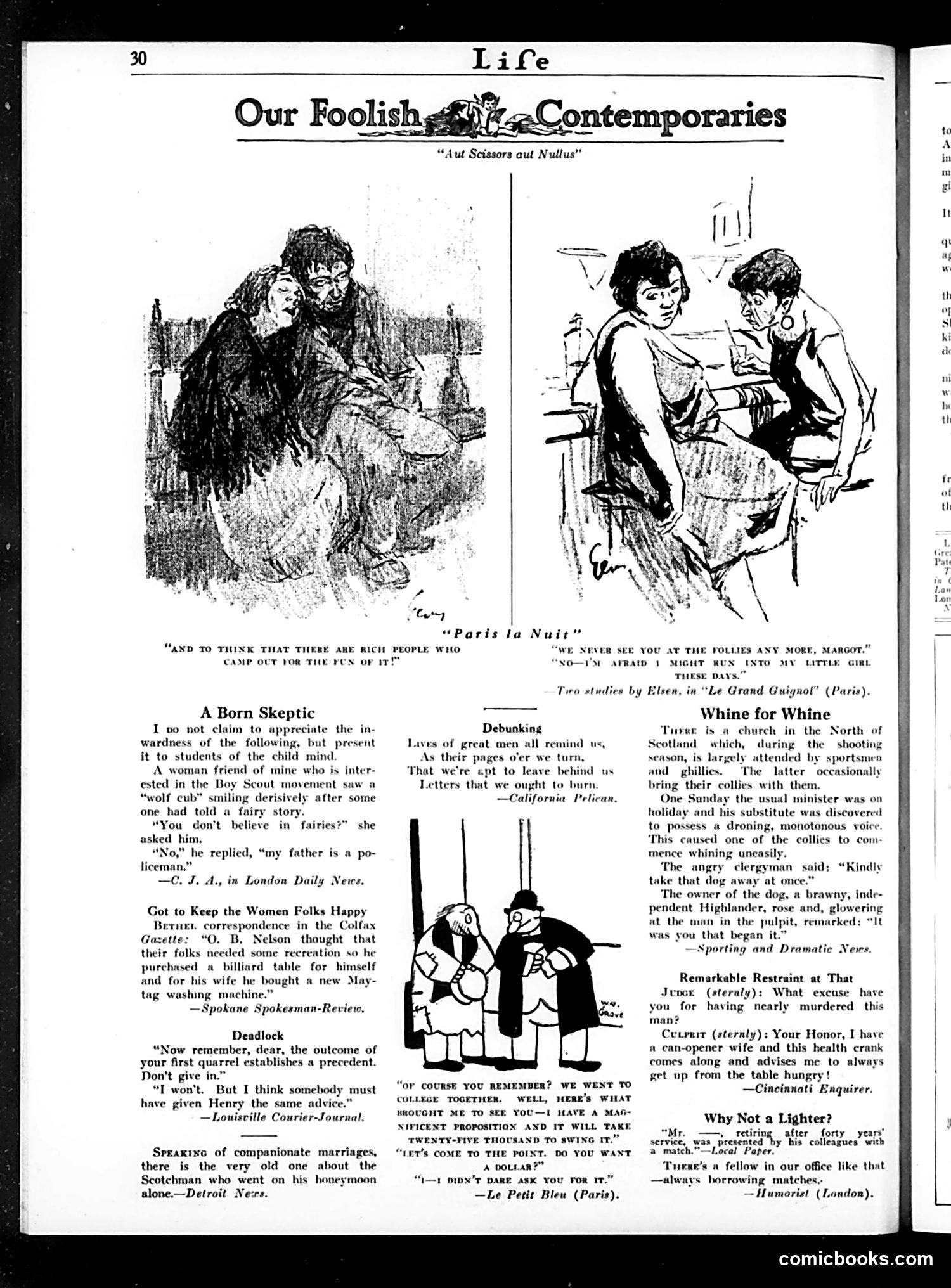
This page collects humorous anecdotes and cartoons satirizing everyday social situations. The two illustrated cartoons at top show Parisian nightlife scenes mocking wealthy people's recreational pursuits. The text pieces below ridicule various contemporary attitudes: - **"A Born Skeptic"**: A child doubts fairy tales because his father is a policeman (implying dishonesty in authority) - **"Got to Keep the Women Folks Happy"**: Satirizes gender expectations—a man buys himself a billiard table but his wife gets a washing machine - **"Deadlock"**: Mocks couples' competitive arguing over who should concede first - **"Whine for Whine"**: A Scottish church story where a dog whines during a minister's monotonous sermon; when told to remove it, the dog's owner retorts the *minister* started the noise The overall tone mocks middle-class hypocrisy, gender role conventions, and human stubbornness through gentle, relatable scenarios rather than political commentary.
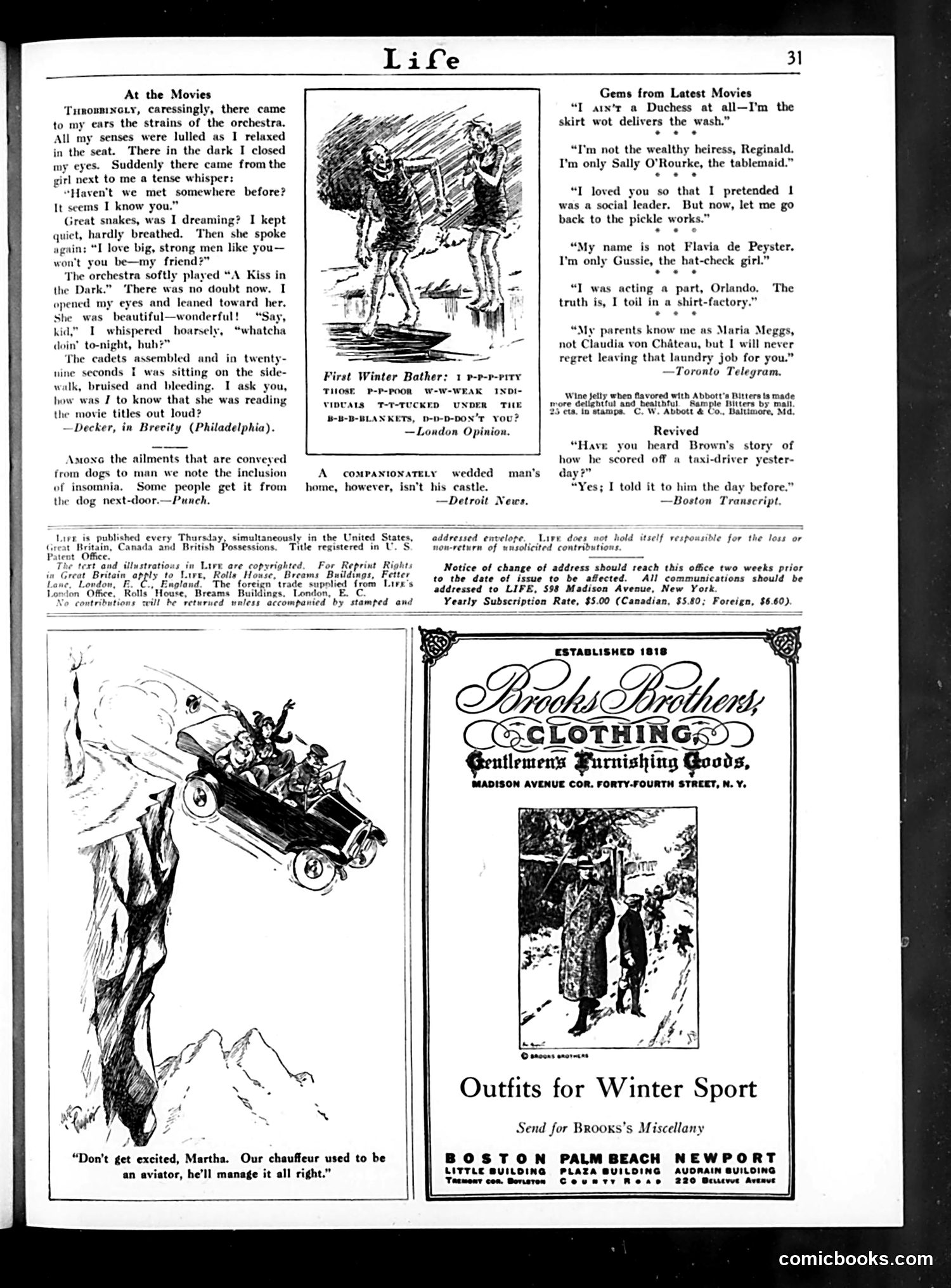
This page contains satirical humor typical of early 20th-century Life magazine, mixing short jokes with advertisements. **"At the Movies"** mocks the common movie-theater pickup line. A man believes a woman is flirting with him in the dark theater, but discovers too late she was simply reading the movie titles aloud to herself—resulting in him being thrown out. The satire targets both forward male behavior and the embarrassment of mistaking innocent actions for romantic interest. **"Gems from Latest Movies"** satirizes silent film plots where working-class women (washer girls, housemaids, laundry workers, hat-check girls) pretend to be wealthy aristocrats, then reveal their true identity to their romantic interest. The repeated pattern mocks Hollywood's formulaic class-romance narratives and the implausibility of such deceptions. Other brief jokes reference insomnia from neighborhood dogs and marital life jokes. The page is primarily **advertising** for Brooks Brothers clothing and Abbott's Bitters, with a humorous illustration of someone in a car on a cliff edge.
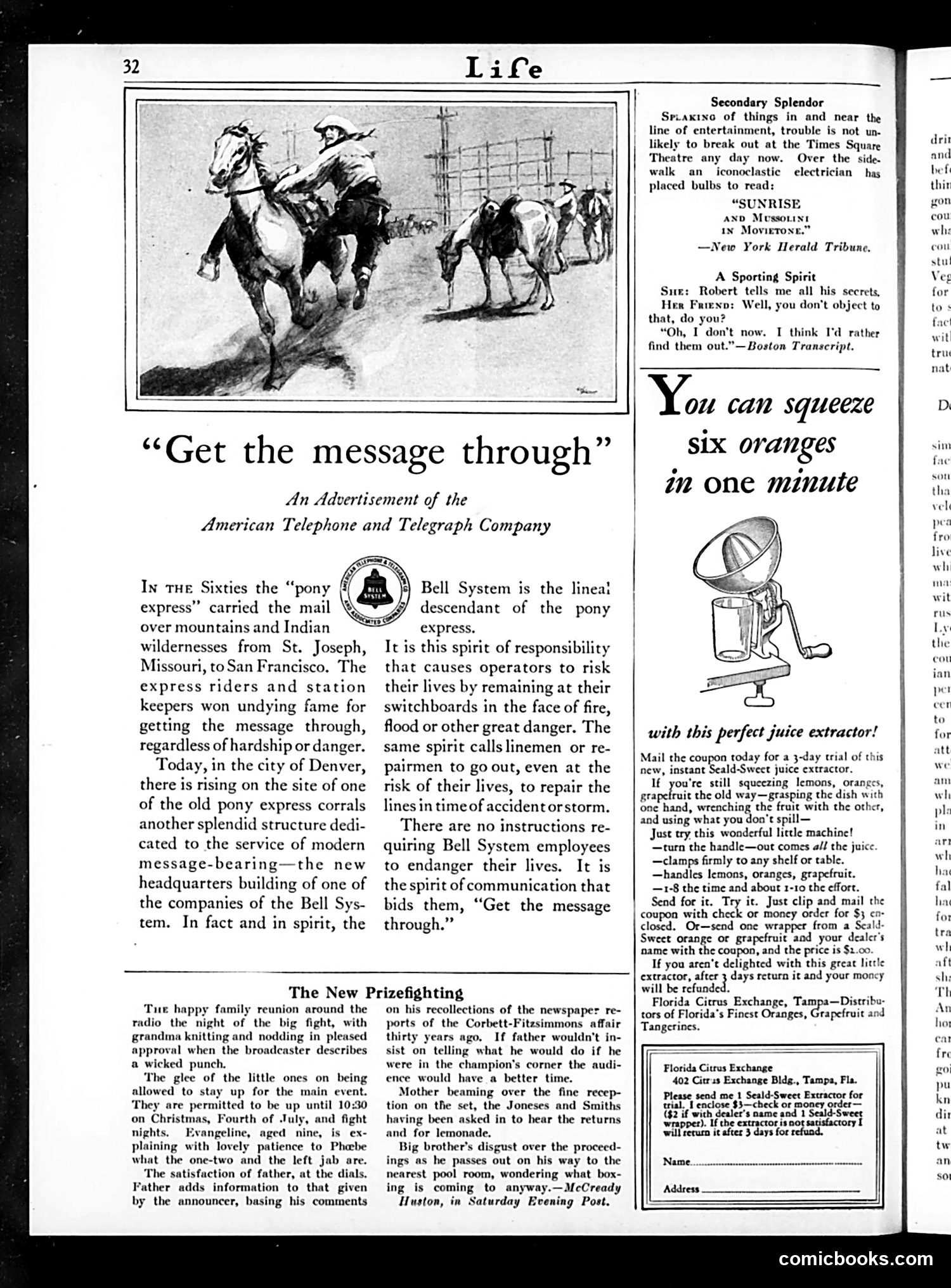
This page contains **one major advertisement and two brief humorous pieces**, typical of Life magazine's satirical format. The **main advertisement for Bell Telephone** uses patriotic nostalgia, comparing telephone operators and linemen to Pony Express riders of the 1860s. It argues that both share a spirit of duty to "get the message through" despite danger—whether facing storms on horseback or fire and flood at switchboards. This was corporate messaging meant to glorify telephone workers during an era of labor tensions. The **"New Prizefighting" piece** satirizes radio broadcasts of boxing matches, mocking how families gather around the radio, with father offering outdated commentary from the Corbett-Fitzsimmons fight (1890s), while children stay up late and mother serves lemonade. The humor lies in depicting prizefighting as now a domestic entertainment rather than a live spectacle. The remaining items are minor jokes and a juice extractor advertisement—standard filler for the era.
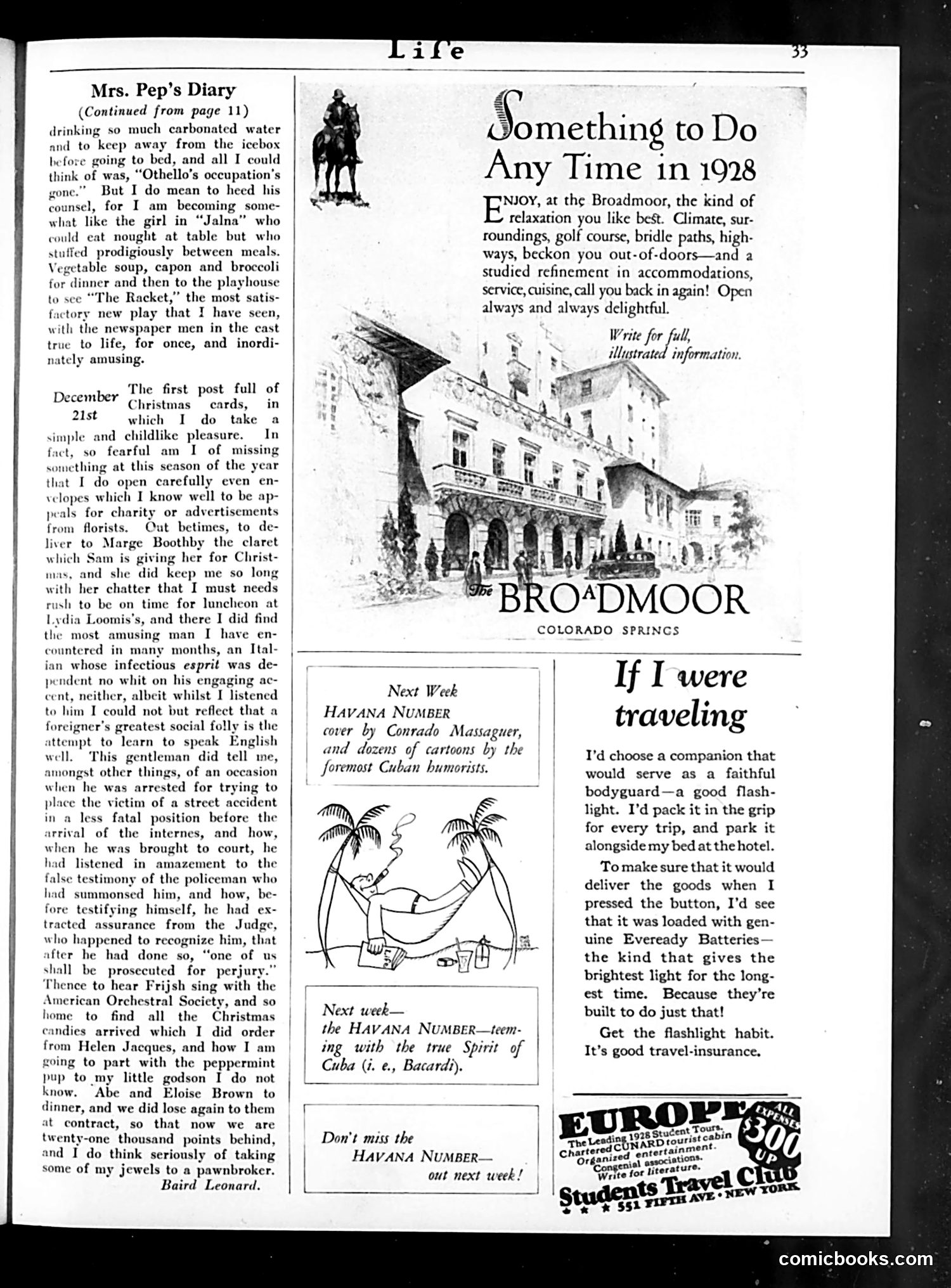
This page is primarily **advertising and promotional material** rather than political satire. The main elements are: **Mrs. Pep's Diary (left column):** A society gossip column documenting a wealthy woman's social activities—dinners, theater, Christmas card anxiety, card games, and encounters with amusing acquaintances. References "The Racket" (a contemporary play) and mentions losing at contract bridge. The tone is satirical of upper-class pretension but not overtly political. **Advertisements (right side):** The Broadmoor resort in Colorado Springs and Eveready Batteries dominate the space. A smaller ad promotes the "Students Travel Club" for European tours. **Upcoming content:** Life announces next week's "Havana Number" with Cuban cartoonist Conrado Massaguer and cartoons emphasizing Cuba's association with Bacardi rum—reflecting Prohibition-era fascination with accessing alcohol abroad. The page reflects 1928's consumer culture and leisure travel advertising rather than containing political commentary or recognizable caricatures requiring historical context.
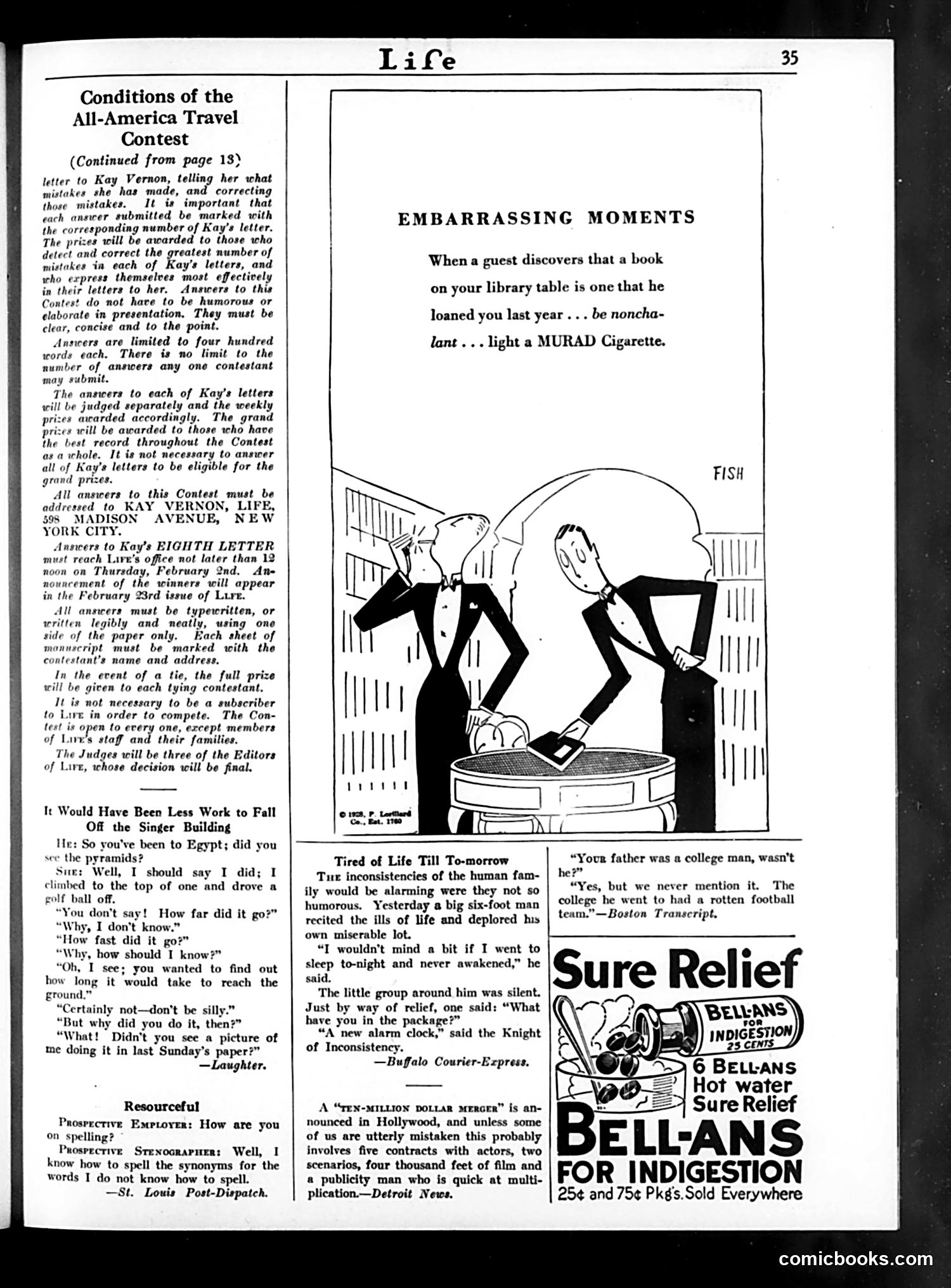
This page from *Life* magazine contains several distinct pieces: **"Embarrassing Moments" cartoon and ad**: The illustration shows two men fishing, apparently to distract from an awkward social situation. The accompanying text suggests using a cigarette (MURAD brand) to nonchalantly handle embarrassment—here, when a guest discovers you still have a book he lent you a year ago. This reflects early 20th-century social anxiety about appearing forgetful or negligent. **"Tired of Life Till To-morrow" joke**: Satirizes human inconsistency—a man dramatically complains life is unbearable and he'd prefer never to wake up, yet moments later reveals he just bought a new alarm clock. The humor lies in this contradiction between his despair and his practical concern for punctuality. **Other brief comedic pieces**: Include jokes about climbing Egyptian pyramids, spelling abilities, and Hollywood production inefficiency. The page is primarily humorous filler content mixed with contest rules and period advertising, reflecting *Life*'s role as a satirical magazine focused on social observation and everyday absurdities rather than political commentary.
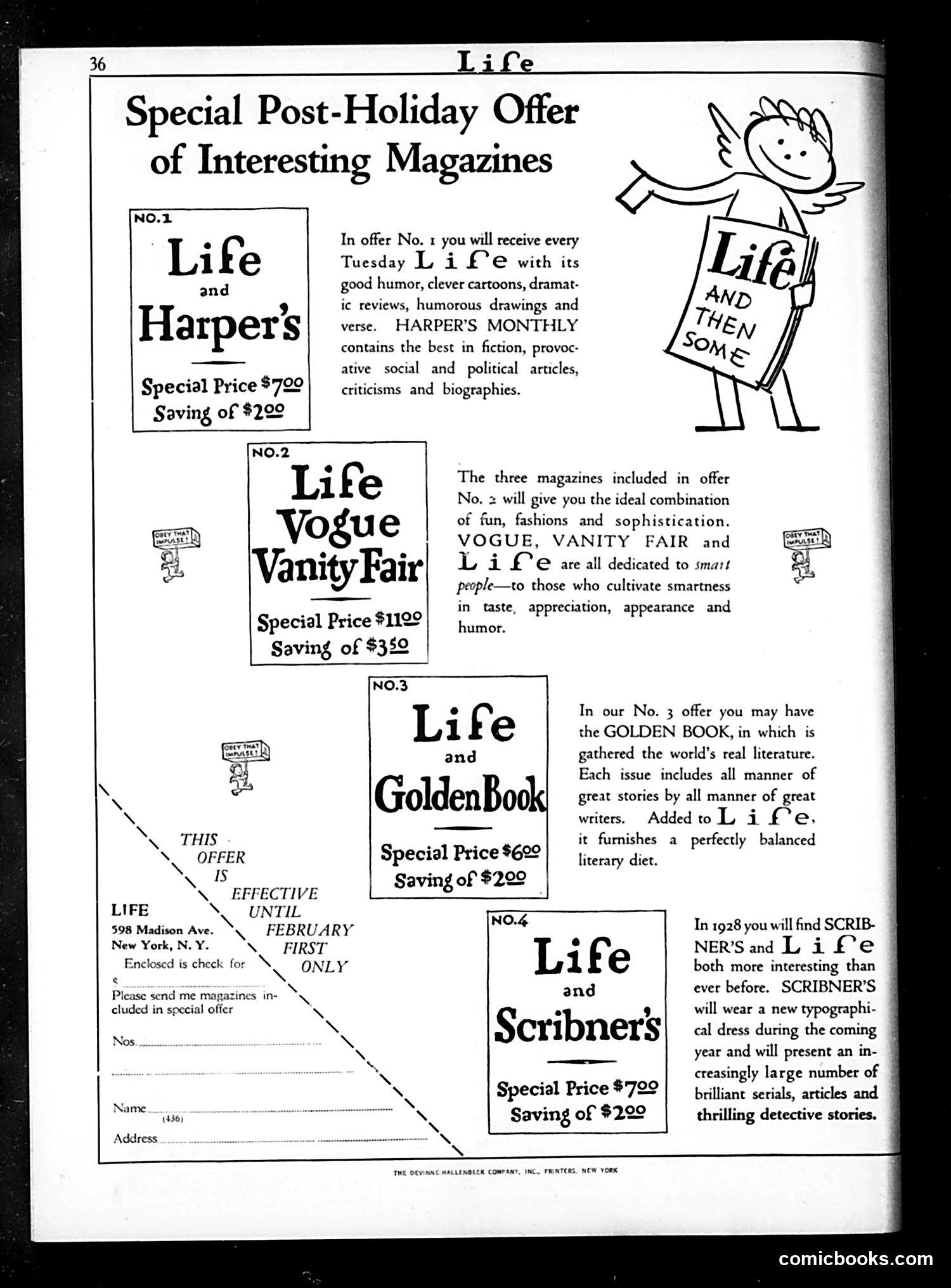
This is primarily a **subscription advertisement**, not a satirical cartoon page. It promotes four bundled magazine offers for the post-holiday season (circa 1927-1928, based on the "1928" reference). The small cartoon at top right—a simple stick figure holding a stack of magazines—is purely decorative, conveying the concept of reading material rather than making a satirical point. The page's content reflects **1920s consumer culture and class marketing**: - **Offer No. 1** pairs Life (humor/cartoons) with Harper's Monthly (serious literature/politics) - **Offer No. 2** groups Vogue, Vanity Fair, and Life as magazines for "smart people" cultivating taste and sophistication - **Offer No. 3** adds The Golden Book (classic literature) for "perfectly balanced" reading - **Offer No. 4** promotes Scribner's alongside Life, noting typographical improvements and detective stories The language emphasizes **aspirational sophistication**—targeting middle-to-upper-class readers who valued both humor and highbrow culture. The savings amounts (22¢ to $3.30) suggest early 20th-century subscription pricing. This is essentially a **marketing document**, not satire.

I can see this is a black and white image that appears to be from a historical publication, but the image quality is too degraded for me to reliably read text or identify specific figures with confidence. The right side shows what appears to be celestial or atmospheric imagery with some circular patterns, and there are scattered dots suggesting stars. However, I cannot make out clear details of any cartoon figures, caricatures, or text well enough to accurately explain the satirical content or political references to a modern reader without risking inaccuracy. To properly analyze this page, a higher-resolution or clearer version would be needed.