
Life, 1928-01-12 · page 18 of 39
Life — January 12, 1928 — page 18: what you’re looking at
What you’re looking at
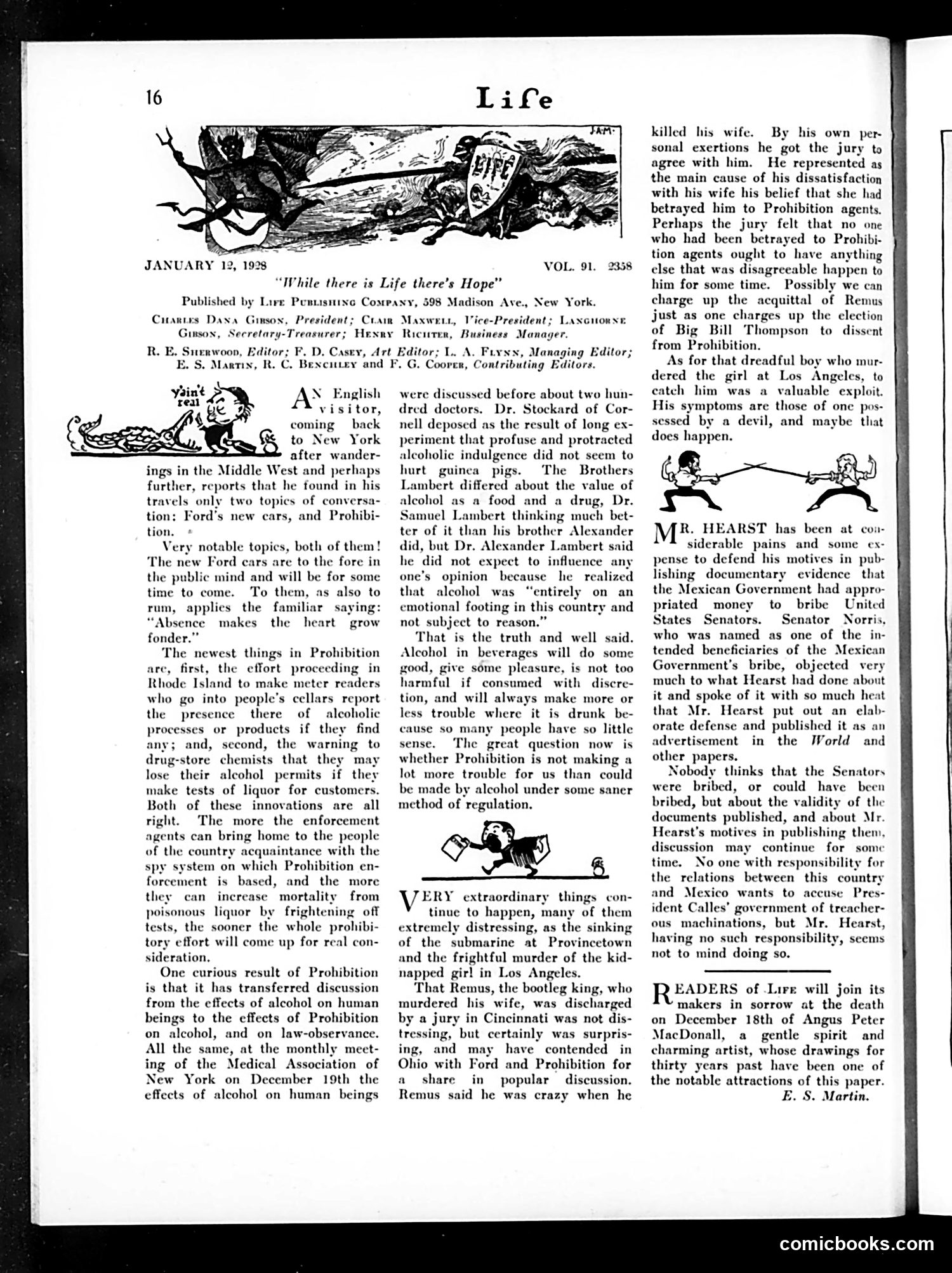
This page discusses Prohibition enforcement and its social effects. The main text critiques the unintended consequences of alcohol bans, noting that Prohibition has shifted debate about alcohol's effects from medical/scientific discussion to political arguments about enforcement. A notable section discusses **Remus**, described as a "bootleg king" who murdered his wife. A jury acquitted him in Cincinnati, which the writer finds surprising. The article suggests Remus may have blamed Prohibition agents for his troubles—a pointed commentary on how Prohibition created criminal enterprises and complex legal situations. The page also mentions **Mr. Hearst** defending his publication of Mexican government bribery documents to U.S. Senators, framing it as patriotic journalism rather than sensationalism. The small cartoons illustrate physical confrontation, likely depicting conflict between Prohibition enforcers and bootleggers.
📄 Transcribed text from this page (OCR, searchable)
Machine-transcribed from the original scan — historical spelling and the odd misread are preserved.
VOL. 91. 2358 “While there is Life there’s Hope” Published by Lire Puntisnixnc Company, 598 Madison Ave., New York. Citartes Dana Ginsox, President; Cram Maxwett, Vice-President; Laxcuorxe Ginsox, Secretary-Treasurer; Hexny Riciuter, Business Manager. nwoon, Editor; F. D. Casey, Art Editor; E. S. Martin, R. C. Bexciutey and F. G. Coorer, Contribs yaint an real a AN Enslish visitor, coming — back to New York after wander- ings in the Middle West and perhaps further, reports that he found in his travels only two topics of conve tion: Ford's new cars, and Prohibi- tion. Very notable topics, both of them! The new Ford cars are to the fore in the public mind and will be for some time to come. To them, as also to rum, applies the familiar saying: “Absence makes the heart grow fonder.” The newest things in Prohibition are, first, the effort proceeding in Rhode Island to make meter readers who go into people’s cellars report the presence there of alcoholic processes or products if they find any; and, second, the warning to drug-store chemists that they may lose their alcohol permits if they make tests of liquor for customers. Both of these innovations are all right. The more the enforcement agents can bring home to the people of the country acquaintance with the spy system on which Prohibition en- forcement is based, and the more they can increase mortality from poisonous liquor by frightening off tests, the sooner the whole prohibi- tory effort will come up for real con- sideration. One curious result of Prohibition is that it has transferred discussion from the effects of alcohol on human beings to the effects of Prohibition on alcohol, and on law-observance. All the same, at the monthly meet- ing of the Medical Association of New York on December 19th the effects of alcohol on human beings L. A. Fuss, Managing Editor; 19 Editors. were discussed before about two hun- dred doctors. Dr. Stockard of Cor- nell deposed as the result of long ex- periment that profuse and protracted alcoholic indulgence did not seem to hurt guinea pigs. The Brothers Lambert differed about the value of alcohol as a food and a drug, Dr. Samuel Lambert thinking much bet- ter of it than his brother Alexander did, but Dr. Alexander Lambert said he did not expect to influence any one’s opinion because he realized that alcohol was “entirely on an emotional footing in this country and not subject to reason.” That is the truth and well said. Alcohol in beverages will do some good, give some pleasure, is not too harmful if consumed with discre- tion, and will always make more or less trouble where it is drunk be- cause so many people have so little sense. The great question now is whether Prohibition is not making a lot more trouble for us than could be made by alcohol under some saner method of regulation. Very extraordinary things con- tinue to happen, many of them extremely distressing, as the sinking of the submarine at Provincetown and the frightful murder of the kid- napped girl in Los Angeles. That Remus, the bootleg king, who murdered his wife, was discharged by a jury in Cincinnati was not dis- tressing, but certainly was surpris- ing, and may have contended in Ohio with Ford and Prohibition for a share in popular discussion. Remus said he was crazy when he killed his wife. By his own per- sonal exertions he got the jury to agree with him. He represented as the main cause of his dissatisfaction with his wife his belief that she had betrayed him to Prohibition agents. Perhaps the jury felt that no one who had been betrayed to Prohibi- tion agents ought to have anything else that was disagreeable happen to him for some time. Possibly we can charge up the acquittal of Remus just as one charges up the election of Big Bill Thompson to dissent from Prohibition. As for that dreadful boy who mur- dered the girl at Los Angeles, to catch him was a valuable exploit. His symptoms are those of one pos- sessed by a devil, and maybe that does happen. R. HEARST has been at con- siderable pains and some ex- pense to defend his motives in pub- lishing documentary evidence that the Mexican Government had appro- priated money to bribe United States Senators. Senator Norris, who was named as one of the in- tended beneficiaries of the Mexican Government's bribe, objected very much to what Hearst had done about it and spoke of it with so much heat that Mr. Hearst put out an elab- orate defense and published it as an advertisement in the World and other papers. Nobody thinks that the Senators were bribed, or could have been bribed, but about the validity of the documents published, and about Mr. Hearst's motives in publishing th discussion may continue for some time. No one with responsibility for the relations between this country and Mexico wants to accuse Pres- ident Calles’ government of treacher- ous machinations, but Mr. Hearst, having no such responsibility, seems not to mind doing so. EADERS of -Lire will join its makers in sorrow at the death on December 18th of Angus Peter MacDonall, a gentle spirit and charming artist, whose drawings for thirty years past have been one of the notable attractions of this paper. E. S. Martin. comicbooks.com