
Life, 1928-01-12 · page 23 of 39
Life — January 12, 1928 — page 23: what you’re looking at
What you’re looking at
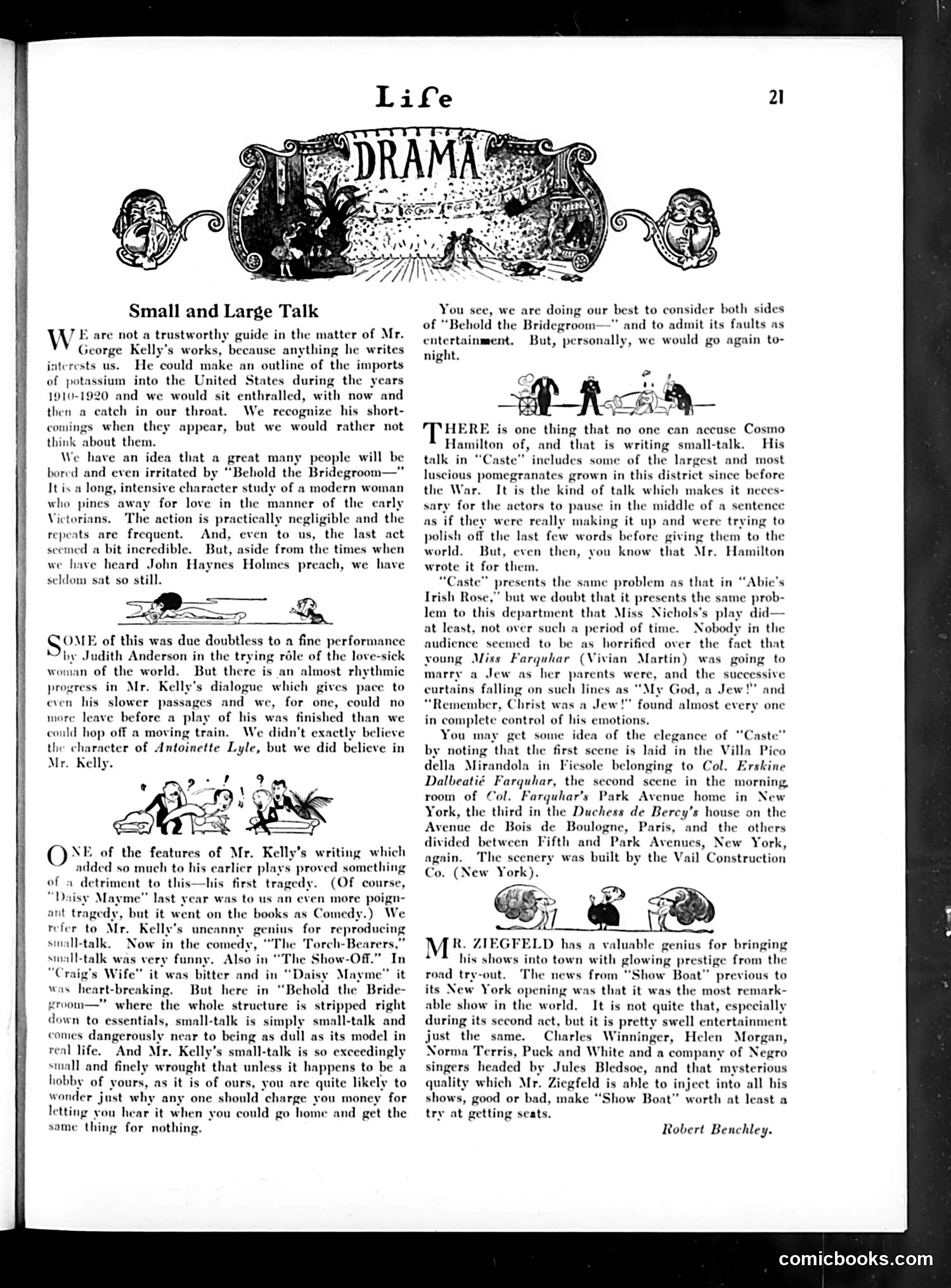
This is a theater review column criticizing playwright George Kelly's work, specifically his play "Behold the Bridegroom." The critic praises Kelly's ability to captivate audiences despite slow pacing and minimal plot, crediting actress Judith Anderson's performance. However, the review identifies a flaw: Kelly's signature strength—realistic small-talk dialogue that works brilliantly in his comedies—becomes tedious in this tragedy, where the stripped-down structure offers no comic relief to offset mundane conversation. The piece contrasts Kelly's approach with Cosmo Hamilton's "Caste," whose deliberately grandiose dialogue ("pomegranates") makes small moments feel important. The critic notes audiences weren't offended by anti-Semitic elements in "Caste" as expected, suggesting changing social attitudes. Overall, it's a sophisticated assessment of theatrical technique and dialogue's varying effectiveness across genres.
📄 Transcribed text from this page (OCR, searchable)
Machine-transcribed from the original scan — historical spelling and the odd misread are preserved.
Small and Large Talk are not a trustworthy guide in the matter of Mr. seorge Kelly’s works, because anything he writes interests us. He could make an outline of the imports of potassium into the United States during the years 1910-1920 and we would sit enthralled, with now and then a catch in our throat. We recognize his short- comings when they appear, but we would rather not think about them. We have an idea that a great many people will be bored and even irritated by “Behold the Bridegroom—” It is a long, intensive character study of a modern woman who pines av for love in the manner of the early Victorians. The action is practically negligible and the repeats are frequent. And, even to us, the last act seemed a bit incredible. But, aside from the times when we have heard John Haynes Holmes preach, we have seldom sat so still. OME of this was due doubtless to a fine performance “by Judith Anderson in the trying réle of the love-sick woman of the world. But ther an almost rhythmic progress in Mr. Kelly’s dialogue which gives pace to even his slower passages and we, for one, could no more leave before a play of his was finished than we could hop off a moving train. We didn’t exactly believe the character of Antoinette Lyle, but we did believe in Mr. Kelly. eS C NE. of the features of Mr. Kelly’s writing which added so much to his earlier plays proved something of a detriment to this—his first tragedy. (Of course, “Daisy Mayme” last year was to us an even more poign- ant tragedy, but it went on the books as Comedy.) We refer to Mr. Kelly’s uncanny us for reproducing small-talk. Now in the comedy, “The suvll-talk was very funny. Also in‘ ‘The “Craig’s Wife was bitter and in “Daisy was heart-breaking. But here in “Behold the Bride- groom—” where the whole structure is stripped right down to essentials, small-talk is simply small-talk and comes dangerously near to being as dull as its model in real life. And Mr. Kelly’s small-talk is so exceedingly small and finely wrought that unless it happens to be a hobby of yours, as it is of ours, you are quite likely to wonder just why any one should “charge 4 you money for letting you hear it when you could go home and get the same thing for nothing. You see, we are doing our best to consider both sides of “Behold the Bridegroom—" and to admit its faults as entertainment. But, personally, we would go ag: night. HERE is one thing that no one can accuse Cosmo Hamilton of, and that is writing ll-talk. His talk in “Caste” includes some of the largest and most luscious pomegranates grown in this district since before the War. It is the kind of talk which makes it neces- ary for the actors to pause in the middle of a sentence as if they were really making it up and were trying polish off the last few words before giving them to the world. But, even then, you know that Mr. Hamilton it for them. ste” presents the same problem as that in “Abie's Trish Rose,” but we doubt that it presents the same prob- lem to this department that Miss Nichols’s play did— at least, not over such a period of time. Nobody in the audience seemed to be as horrified over the fact that young Miss Farquhar (Vivian Martin) was going to marry a Jew as her parents were, and the suc curtains falling on such lines as “My God, a Jew “Remember, Christ was a Jew!" found almost every ¢ in complete control of his emotions. You may get some idea of the elegance of “Caste” by noting that the first scene is laid in the Villa Pico della Mirandola in Fiesole belonging to Col. Erskine Dalbeatié Farquhar, the second scene in the morning room of Col. Farquhar’s Park Avenue home in New York, the third in the Duchess de Bercy’s house on the Avenue de Bois de Boulogne, Paris, and the others divided between Fifth and Park Avenues, New York, again. The scenery was built by the Vail Construction Co. (New York). N R. ZIEGFELD has a valuable genius for bringing AVE his shows into town with glowing prestige from the road try-out. The news from “Show Boat” previous to its New York opening was that it was the most remark- able show in the world, It is not quite that, especially during its second act, but it is pretty swell entertainment just the same. Charles Winninger, Helen Morgan, Norma Terris, Puck and White and a company of Negro singers headed by Jules Bledsoe, and that mysterious quality which Mr. Ziegfeld is able to inject into all his shows, good or bad, make “Show Boat” worth at least a try at getting seats. Robert Benchley. comicbooks.com