
Life, 1928-01-12 · page 22 of 39
Life — January 12, 1928 — page 22: what you’re looking at
What you’re looking at
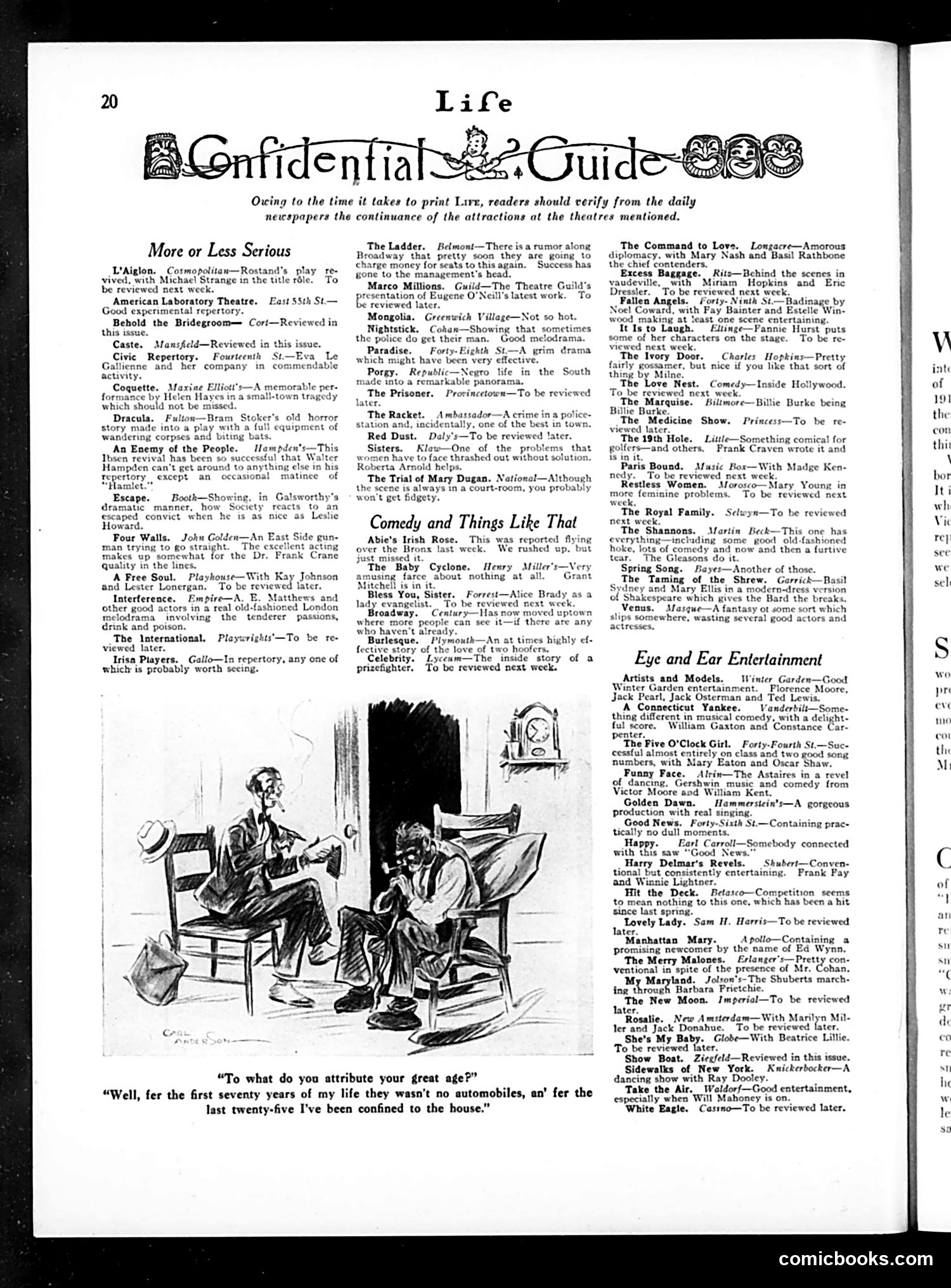
This page is a theater guide and review section from Life magazine, featuring entertainment listings and a single cartoon. **The Cartoon:** The illustration depicts two elderly men in conversation. One asks, "To what do you attribute your great age?" The other replies: "Well, fer the first seventy years of my life they wasn't no automobiles, an' fer the last twenty-five I've been confined to the house." **The Satire:** This is social commentary on early automotive culture. The joke contrasts two eras: pre-automobile life (when people moved freely outdoors) versus the automobile age (when the speaker has been "confined to the house," presumably due to accidents, congestion, or general dangers from cars). The humor lies in the irony that automobiles—supposedly liberating technology—have actually trapped people indoors, likely through fear or injury. This reflects 1920s anxieties about automobiles as dangerous, chaotic urban hazards before safety regulations existed. **Context:** Life was a satirical weekly known for social commentary. This cartoon critiques the unintended consequences of technological "progress"—a common theme during the rapid industrialization of the 1920s.
📄 Transcribed text from this page (OCR, searchable)
Machine-transcribed from the original scan — historical spelling and the odd misread are preserved.
Owing to the time it takes to print Live, readers should verify from the daily newspapers the continuance of the attractions at the theatres mentioned. More or Less Serious ‘Aiglon. Cormopolitan—Rostand's play re- vived, with Michael Strange in the ttle réle. To be reviewed next week. American Laboratory Theatre. Good experimental repertory. Behold the Bridegroom— Cor!—Reviewed in this issue. Caste. Mansfeld—Reviewed in this issue. Repertory. Fourtes and her compan: 4 SSth St— Coquette. Maxine formance by Helen H. which sh Dracula. story made into a y wandering corpses an ‘An Enemy of the People. Thsen revival has been so successful that Walter Hampden can’t get aro ing else Tepertory,, except c matinee of s—A memorable per- a small-town tragedy . in Galsworthy dramatic manner, reacts to a escaped convict when he 1s as nice as Leslie Howard. Four Walls. John Golden—An East Side gui man trying to go straight. The exce makes up somewhat for the Dr. Fr: quality in the lines. A Free Soul. Playkouse—With Kay Johnson and Lester Lonergan. To be reviewed later. Interference. Empire—A. E. Matthews and other good actors in a real old-fashioned London melodrama involving the tenderer passions, drink and poison. The International. Playwrights'\—To be re- viewed later. Irisa Players. Gallo—In repertory, any one of which is probably worth seeing. The Ladder. Belmont—There is a rumor along Broadway that pretty soon they are going to rge money for seats to thisagain, Success has gone to the management's head. Marco Millions. Guild—The Theatre G presentation of Eugene O'Neill’ latest work. be reviewed later. Mongolia. Greenwich Village—Not so hot. Nightstick. Cohan—Showing that sometimes the police do get their man. Good melodrama. Paradise. Forty-Eighth St—A grim drama which might have been very effective. Porgy. Republic—Negro life in the South made into a remarkable panorama. The Prisoner. Prorincetown—To be reviewed later. The Racket. Ambassador—A crime in a police- station and, incidentally, one of the own. Red Dust. Daly's—To be reviewed !ater. Sisters. Klaw—One of the problems that n have to face thrashed out without solution. Roberta Arnold helps. The Trial of Mary Dugan. Notional—! the scene is always in a court-room, you won't get fidgety. Comedy and Things Like That Abie'’s Irish Rose. This was reported fly over the Bronx last week. We rushed up, bu! just missed it, The Baby Cyclone. Henry Miller’s—Very amusing farce about nothing at all ant Mitchell is in it. Bless You, Sister. Forrest—Alice Brady as a ngelist. To be reviewed k. ‘Century—Has ni who haven't already Burlesque. Ply nes highly ef- fective story of th 0 hoofers. Celebrity. Lyceum—The inside story of a prizefighter. To be reviewed next week. “To what do you attribute your great age?” “Well, fer the first seventy years of my life they wasn’t no automobiles, an’ fer the last twenty-five I've been confined to the house.” The Command to Love. Longacre—Amorous diplomacy, with Mary Nash and Basil Rathbone the chief contenders. Excess Baggage. | Rits—Behind the scenes in vaudeville, with Miriam Hopkins and Enc Dressler. "To be reviewed next week. Fallen Angels. forty. Ninth St.—Badinage by Noel Coward, with Fay Bainter and Estelle Win- wood making at least one scene entertaining. It Isto Laugh. Eltinge—Pannie Hurst puts some of her characters on the stage. To be re- viewed next week. The Ivory Door. Charles Hopkins—Pretty fairly gossamer, but nice if you like that sort of thing by Milne: The Love Nest. Comedy—Inside Hollywood. To be reviewed next week, The Marquise. Bilimore—Billie Burke being Billie Burke. The Medicine Show. Princess—To be re- viewed later, The 19th Hole. Littl—Something comical for golfers—and others, Prank Craven wrote it and is in it Paris Bound, Music Box—With Madge Ken- nedy. To be reviewed next week. Restless Women. Morosco—Mary Young in more feminine problems. To be reviewed next week, The Royal Family. Selwyn—To be reviewed next week, The Shannons. Martin Beck—This one has everything—incliding some good old-fashioned hoke, lots of com and now and then a furtive tear.” “The Gleasons do it Spring Song. Bayes—Another of those. The Taming of the Shrew, Garrich—Basil Sydney and Mary Ellis ina modern-dress version of Shakespeare which gives the Bard the breaks. Venus. Masque—A fantasy ot some sort which slips somewhere, wasting several good actors and actresses, Eye and Ear Entertainment Artists and Models. Winter Garden—Good Winter Garden entertainment. Florence Moore, Jack Pearl, Jack Osterman and Ted Lewis. A Connecticut Yankee. Vanderdili— thing different in musical comedy, with a d ful score, William Gaxton and Constance penter. The Five O'Clock Girl. Forty-Fourth St.—Suc- cessful almost entirely on class and two good song numbers, with Mary Eaton and Oscar Shaw. Funny Face. Alrin—The Astaires in a revel of dancing, Gershwin music and comedy from Victor Moore and William Kent. Golden Dawn. Hammerstein’s—A gorgeous Production with real singing. Good News. Forty-Sixth St-—Containing prac- tically no dull moments. Happy. Earl Carroll—Somebody connected with this saw “Good News. _ Harry Delmar’s Revels. Shubert—Conven- tional but consistently entertaining. Prank Pay and Winnie Lightner. Hit the Deck. Betasco—Competition seems to mean nothing to this one, which has been a hit Since last spring. Lovely Lady. Sam H. Harris—To be reviewed later. Manhattan Mary. A pollo—Containing a promising newcomer by the name of Ed Wynn. The Merry Malones. Evlanger's—Pretty con- ventional in spite of the presence of Mr. Cohan. My Maryland. Jolson's-The Shuberts march- ing through Barbara Prietchie. The New Moon. Imperial—To be reviewed later. Rosalie. New Amsterdam—With Marilyn Mil- ler and Jack Donahue. To be reviewed later. She's My Baby. Globe—With Beatrice Lillie. To be reviewed later. . Show Boat. Ziegfeld—Reviewed in this issue. Sidewalks of New York. Knickerbocker—A dancing show with Ray Dooley. . Take the Air. Waldorf—Good entertainment, especially when Will Mahoney is on. White Eagle. Castno—To be reviewed later. comicbooks.com v inte of 191 the thi bor Iti wh Vic re] see we sel w gr