
Life, 1928-01-12 · page 11 of 39
Life — January 12, 1928 — page 11: what you’re looking at
What you’re looking at
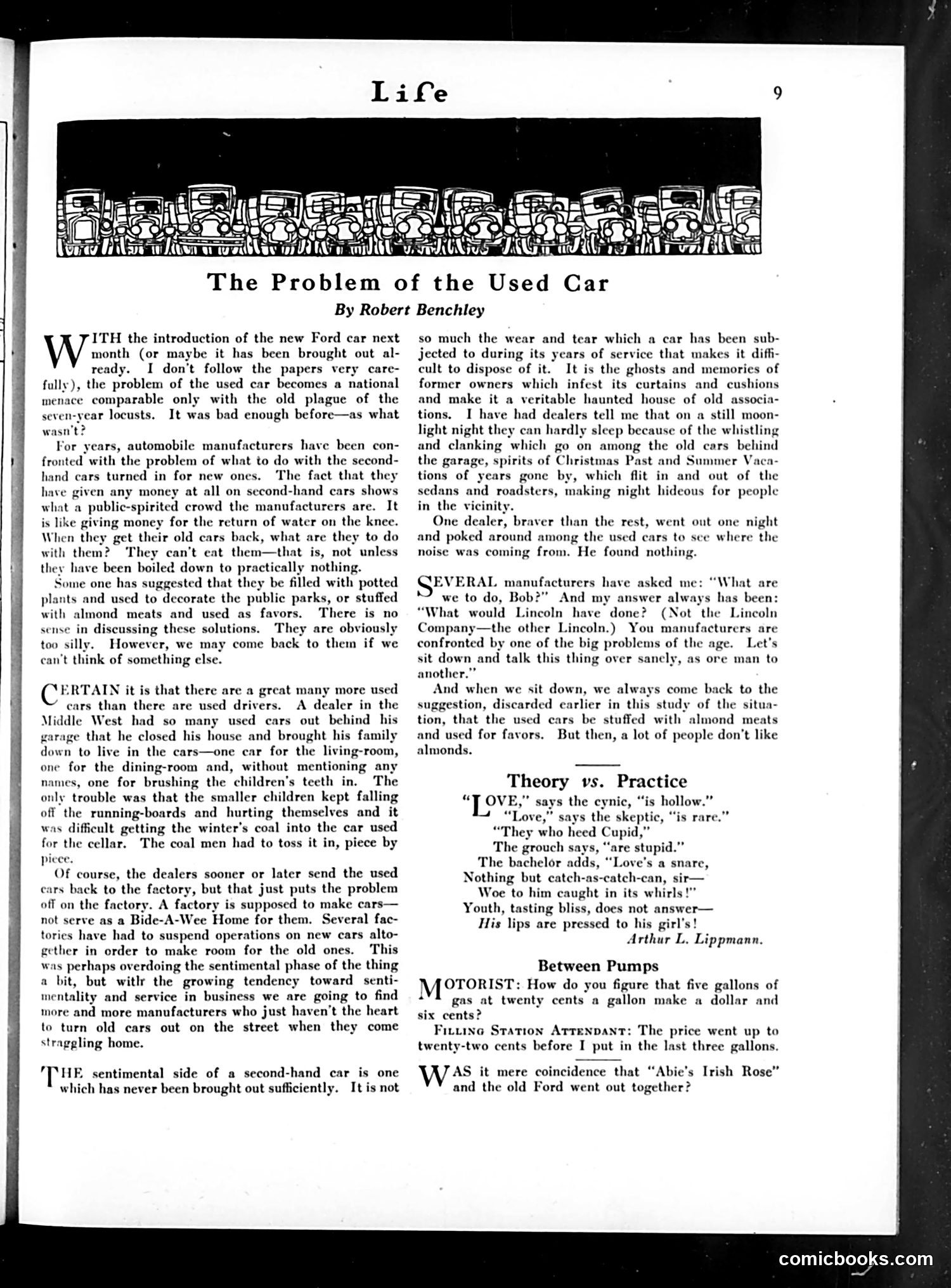
This page from *Life* magazine satirizes the used car market crisis of the early automotive era. The cartoon strip at top shows a row of identical, battered used cars—visual shorthand for the glut of secondhand vehicles flooding the market. Robert Benchley's article argues that used cars have become an unsolvable problem: manufacturers overproduce new cars, flooding dealers with trade-ins they cannot sell. The sentimental attachment owners feel to old cars complicates disposal. Benchley humorously suggests absurd solutions (grinding cars into almond meats for public parks) while noting dealers' genuine desperation. The page includes witty asides mocking romance, gas-station conversations, and automotive sentimentality—typical *Life* magazine humor reflecting Depression-era concerns about industrial overproduction and economic waste.
📄 Transcribed text from this page (OCR, searchable)
Machine-transcribed from the original scan — historical spelling and the odd misread are preserved.
The Problem of the Used Car By Robert Benchley month (or maybe it has been brought out al- ready. I don’t follow the papers very care- fully), the problem of the used car becomes a national menace comparable only with the old plague of the seven-year locusts. It was bad enough before—as what wasn't? For years, automobile manufacturers have been con- fronted with the problem of what to do with the second- hand cars turned in for new ones. The fact that they have given any money at all on second-hand cars shows what a public-spirited crowd the manufacturers are. It is like giving money for the return of water on the knee. When they get their old cars back, what are they to do with them? They can’t cat them—that is, not unless they have been boiled down to practically nothing. Some one has suggested that they be filled with potted plants and used to decorate the public parks, or stuffed with almond meats and used as favors. There is no sense in discussing these solutions. They are obviously too silly. However, we may come back to them if we can’t think of something else. W oon the introduction of the new Ford car next Cc ERTAIN it is that there are a great many more used cars than there are used drivers. A dealer in the Middle West had so many used cars out behind his garage that he closed his house and brought his family down to live in the cars—one car for the living-room, one for the dining-room and, without mentioning any names, one for brushing the children’s teeth in. The only trouble was that the smaller children kept falling off the running-boards and hurting themselves and it was difficult getting the winter's coal into the car used for the cellar. The coal men had to toss it in, piece by piece, Of course, the dealers sooner or later send the used cars back to the factory, but that just puts the problem off on the factory. A factory is supposed to make cars— not serve as a Bide-A-Wee Home for them. Several fac- tories have had to suspend operations on new cars alto- gether in order to make room for the old ones. This was perhaps overdoing the sentimental phase of the thing a bit, but witlr the growing tendency toward senti- mentality and service in business we are going to find more and more manufacturers who just haven't the heart to turn old cars out on the street when they come straggling home. ‘THE. sentimental side of a second-hand car is one which has never been brought out sufficiently. It is not so much the wear and tear which a car has been sub- jected to during its years of service that makes it diffi- cult to dispose of it. It is the ghosts and memories of former owners which infest its curtains and cushions and make it a veritable haunted house of old associa- tions. I have had dealers tell me that on a still moon- light night they can hardly sleep because of the whistling and clanking which go on among the old cars behind the garage, spirits of Christmas Past and Summer Vaca- tions of years gone by, which flit and out of the sedans and roadsters, making night hideous for people in the vicinity. One dealer, braver than the rest, went out one night and poked around among the used cars to see where the noise was coming from. He found nothing. SEVERAL manufacturers have asked me: “What are we to do, Bob?” And my answer always has been: “What would Lincoln have done? (Not the Lincoln Company—the other Lincoln.) You manufacturers are confronted by one of the big problems of the age. Let's sit down and talk this thing over sanely, as ore man to another.” And when we sit down, we always come back to the suggestion, discarded earlier in this study of the situa- tion, that the used cars be stuffed with almond meats and used for favors. But then, a lot of people don’t like almonds. K Theory vs. Practice “LOVE” says the cynic, “is hollow.” “Love,” says the skeptic, “is rare.” “They who heed Cupid,” The grouch says, “are stupid.” The bachelor adds, “Love's a snare, Nothing but catch-as-catch-can, sir— Woe to him caught in its whirls! Youth, tasting bliss, does not answer— His lips are pressed to his girl's! Arthur L, Lippmann. Between Pumps MOrorist: How do you figure that five gallons of gas at twenty cents a gallon make a dollar and six cents? Fituine Station Artenpant: The price went up to twenty-two cents before I put in the last three gallons. AS it mere coincidence that ‘“Abie’s Irish Rose” and the old Ford went out together? comicbooks.com