
Life, 1928-01-12 · page 30 of 39
Life — January 12, 1928 — page 30: what you’re looking at
What you’re looking at
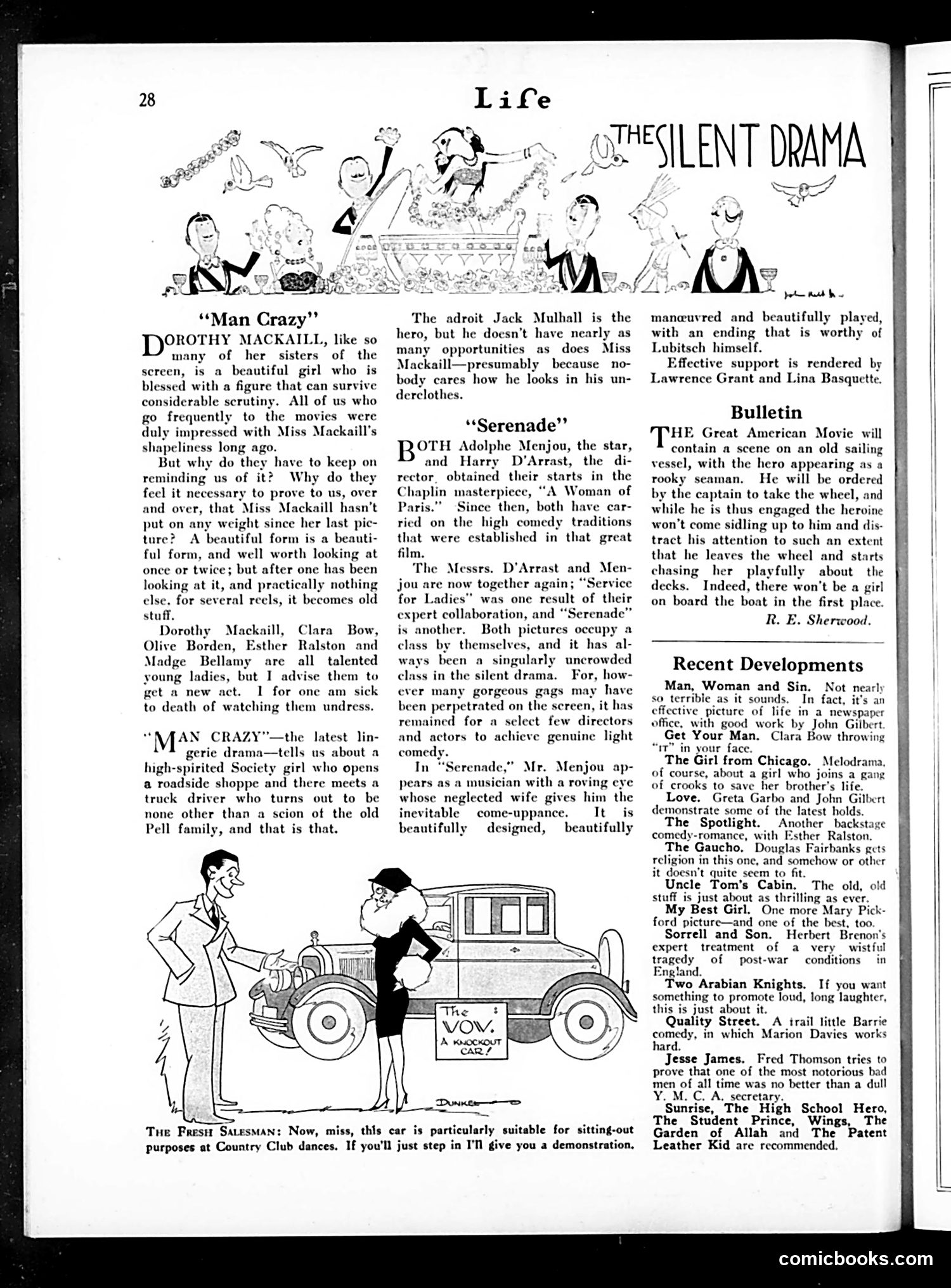
This is a film review page from Life magazine's "Silent Drama" section, critiquing 1920s movies. The main cartoon satirizes automobile salesmen's deceptive sales tactics—the salesman is pitching a car to a young woman by emphasizing its usefulness for "sitting-out purposes at Country Club dances," a euphemism for romantic encounters away from supervision. The reviews critique silent films' reliance on actresses' bodies rather than talent. The critic mocks "Man Crazy" (starring Dorothy Mackaill) for repeatedly undressing its female lead to showcase her figure, calling this lazy filmmaking. By contrast, "Serenade" (with Adolphe Menjou) is praised for genuine comedy craftsmanship. The bulletin sardonically notes that true American cinema shouldn't feature women distracting male heroes—a comment on how films routinely centered male protagonists while reducing women to romantic distractions.
📄 Transcribed text from this page (OCR, searchable)
Machine-transcribed from the original scan — historical spelling and the odd misread are preserved.
“Man Crazy” OROTHY MACKAILL, like so many of her sisters of the screen, is a beautiful girl who is blessed with a figure that can survive considerable scrutiny. All of us who go frequently to the movies were duly impressed with Miss Mackaill’s shapeliness long ago. But why do they have to keep on reminding us of it? Why do they feel it necessary to prove to us, over and over, that Miss Mackaill hasn't put on any weight since her last pic- ture? A beautiful form is a beauti- ful form, and well worth looking at once or twice; but after one has been looking at it, and practically nothing else, for several reels, it becomes old stuff. Dorothy Mackaill, Clara Bow, Olive Borden, Esther Ralston and Madge Bellamy are all talented young ladies, but I advise them to get a new a 1 for one am sick to death of watching them undress. “MAN CRAZY"—the latest lin- gerie drama—tells us about a ted Society girl who opens s shoppe and there meets a truck driver who turns out to be none other than a scion of the old Pell family, and that is that. Tue Presi Sat SPSILENT DRAMA The adroit Jack Mulhall is the hero, but he doesn’t have nearly as many opportunities as does Miss Mackaill—presumably because no- body cares how he looks in his un- derclothes. “‘Serenade”’ OTH Adolphe Menjou, the star, and Harry D’Arrast, the di- rector, obtained their starts in the Chaplin masterpiece, “A Woman of Paris.” Since then, both have car- ried on the high comedy traditions that were established in that great film. The Messrs. D’Arrast and Men- jou are now together again; “Service for Ladies” was one result of their expert collaboration, and “Serenade” nother. Both pictures occupy a class by themselves, and it has al- ways been a singularly uncrowded class in the silent drama. For, how- ever many gorgeous gags may have been perpetrated on the screen, it has remained for a select few directors and actors to achieve genuine light comedy. In “Serenade,” Mr. Menjou ap- pears as a musician with a roving eye whose neglected wife gives him the inevitable come-uppance. It is beautifully designed, _ beautifully MAN: Now, miss, this car is particularly suitable for sitting-out purposes at Country Club dances, If you'll just step in I'll five you a demonstration, = maneuvred and beautifully played, with an ending that is worthy of Lubitsch himself. Effective support is rendered by Lawrence Grant and Lina Basquette. Bulletin HE Great American Movie will contain a scene on an old sailing vessel, with the hero appearing as a rooky seaman. He will be ordered by the captain to take the wheel, and while he is thus engaged the heroine won't come sidling up to him and dis- tract his attention to such an extent that he leaves the wheel and starts chasing her playfully about the decks. Indeed, there won't be a girl on board the boat in the first place. R. E. Sherwood. Recent Developments Man, Woman and Sin. so terrible as it sounds. In fact, it’s an effective picture of life in a newspaper office, with good work by John Gilbert Get Your Man. Clara Bow throwing “rr” in your face. The Girl from Chicago. Melodrama, of course, about a girl who joins a gang of crooks to save her brother's life. Love. Greta Garbo and John Gilbert demonstrate some of the latest holds. The Spotlight. Another backstage comedy-romance, with Esther Ralston. The Gaucho, Douglas Fairbanks gets religion in this one, and somehow or other it doesn’t quite seem to fit. The old, old Not nearly Uncle Tom's Cabin. stuff is just about as thrilling as ever. My Best Girl. One more Mary Pick- ford picture—and one of the best, too. Sorrell and Son. Herbert Brenon's expert treatment of a very wistful tragedy of post-war conditions in England. Two Arabian Knights. If you want something to promote loud, long laughter, this is just about it. Quality Street. A trail little Barrie comedy, in which Marion Davies works hard. Jesse James. Fred Thomson tries to prove that one of the most notorious bad men of all time was no better than a dull Y. M. C, A. secretary. Sunrise, The High School Hero, The Student Prince, Wings, The Garden of Allah and The Patent Leather Kid are recommended. comicbooks.com