
Life, 1928-01-12 · page 6 of 39
Life — January 12, 1928 — page 6: what you’re looking at
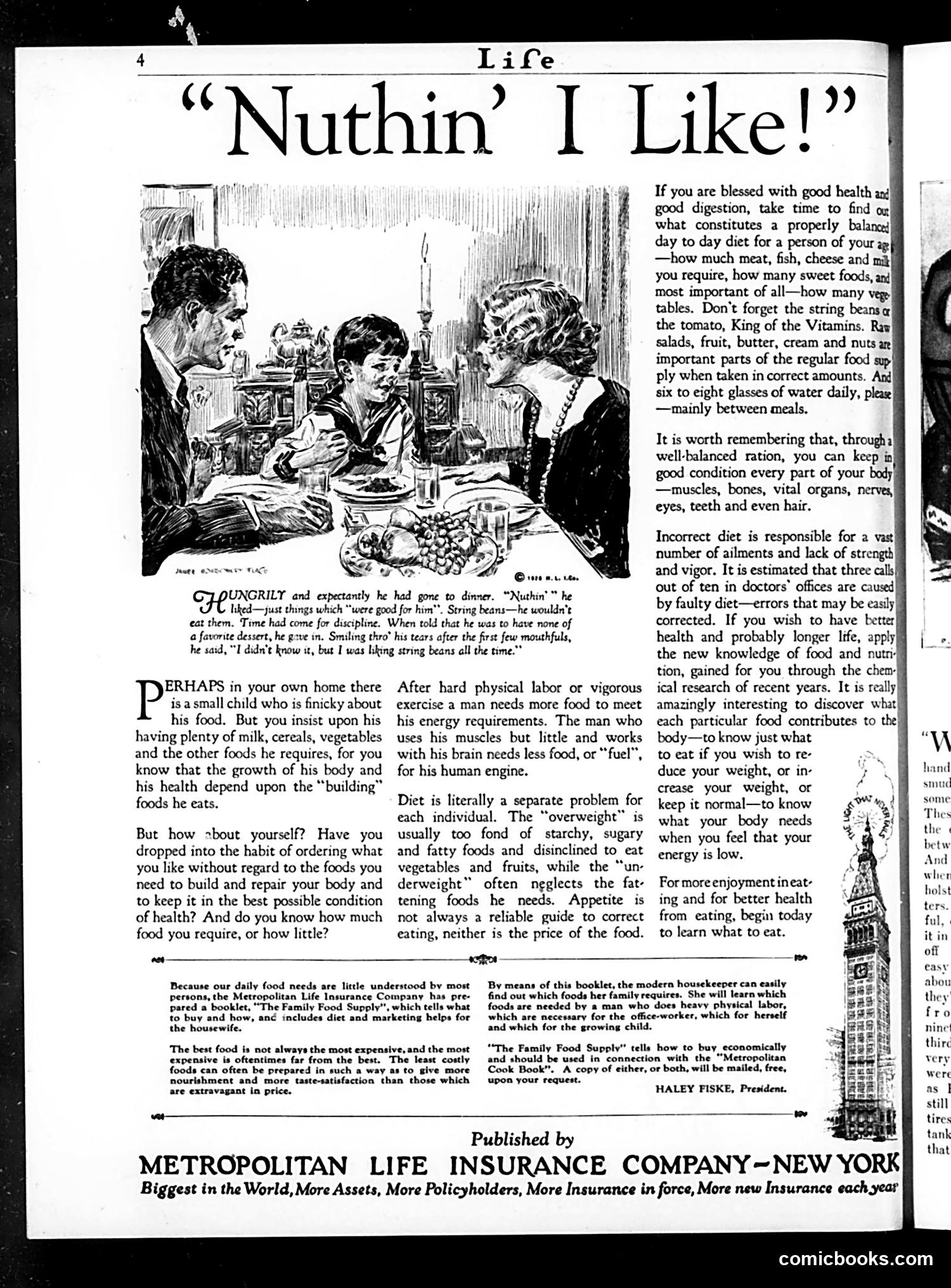
What you’re looking at
This page combines a humorous domestic scene with nutritional advice. The cartoon depicts a finicky child at dinner refusing food while parents look on—a common household scenario. The caption reveals the child's complaint: he dislikes vegetables and "string beans," insisting he's "living string beans all the time." The satire targets parental struggle with childhood nutrition. The accompanying text discusses proper diet, balanced nutrition, and the importance of vegetables—suggesting the magazine is offering practical guidance to readers about feeding reluctant eaters. This appears to be both entertainment and consumer education, typical of *Life* magazine's format. The piece is published by Metropolitan Life Insurance Company, suggesting this was educational advertising promoting health awareness among potential customers.
📄 Transcribed text from this page (OCR, searchable)
Machine-transcribed from the original scan — historical spelling and the odd misread are preserved.
Life Nuthin’ I Like!” © tore we utes IUNGRILY and expectantly he had gone to dinner. “Nuthin’™ he Iuked—just things which “were good for him’. String beans—he wouldn't eat them. Time had come for discipline. When told that he was to have none of @ favorite dessert, he gave in. Smiling thro’ his tears after the first few mouthfuls, he said, “I didn’t know it, but I was biking string beans all the time.”* ERHAPS in your own home there P is asmall child who is finicky about his food. But you insist upon his having plenty of milk, cereals, vegetables and the other foods he requires, for you know that the growth of his body and his health depend upon the “building” foods he eats. But how -bout yourself? Have you dropped into the habit of ordering what you like without regard to the foods you need to build and repair your body and to keep it in the best possible condition of health? And do you know how much food you require, or how little? After hard physical labor or vigorous exercise a man needs more food to meet his energy requirements. The man who uses his muscles but little and works with his brain needs less food, or “fuel”, for his human engine. Diet is literally a separate problem for each individual. The “overweight” is usually too fond of starchy, sugary and fatty foods and disinclined to eat vegetables and fruits, while the “un- derweight” often neglects the fat- tening foods he needs. Appetite is not always a reliable guide to correct eating, neither is the price of the food. If you are blessed with good health anj good digestion, take time to find og what constitutes a properly balance day to day diet for a person of your a —how much meat, fish, cheese and mi you require, how many sweet foods, ani most important of all—how many tables. Don’t forget the string beans q the tomato, King of the Vitamins. Ray salads, fruit, butter, cream and nuts ar important parts of the regular food sup’ ply when taken in correct amounts. And six to eight glasses of water daily, pleae —mainly between meals. It is worth remembering that, through well-balanced ration, you can keep in good condition every part of your body —muscles, bones, vital organs, nerves, eyes, teeth and even hair. Incorrect diet is responsible for a vast number of ailments and lack of strength and vigor. It is estimated that three calls) out of ten in doctors’ offices are caused by faulty diet—errors that may be easily|] corrected. If you wish to have better health and probably longer life, apply the new knowledge of food and nutri tion, gained for you through the chem-j ical research of recent years. It is really) amazingly interesting to discover what! each particular food contributes to the) body—to know just what / to eat if you wish to re- duce your weight, or in- crease your weight, or keep it normal—to know what your body needs when you feel that your energy is low. For more enjoyment ineat- ing and for better health from eating, begin today to learn what to eat. Because our daily food needs are little understood by most persons, the Metropolitan Life Insurance Company has pre- pared a booklet, “The Family Food Supply”, which tells what to buy and how, and includes diet and marketing helps for the housewife. The best food is not always the most expensive, and the most expensive is oftentimes far from the best. The least costly foods can often be prepared in such a way as to give more nourishment and more taste-satisfaction than those which are extravagant in price. a upon your request. “The Family Food Supply” tells how to buy economically and should be used in connection with the “Metropolitan Cook Book”. A copy of either, or both, will be mailed, free, HALEY FISKE, President. By means of this booklet, the modern housekeeper can easily find out which foods her family requires. She will learn which foods are needed by a man who does heavy physical labor, which are necessary for the office-worker, which for herself and which for the growing child. STILT s i] Published by METROPOLITAN LIFE INSURANCE COMPANY~NEW YORK Biggest in the World, More Assets, More Policyholders, More Insurance in force, More new Insurance each yea? ™“ hand smud some Thes the | betw And wher holst ters. ful, it in off easy abou they fro nine! thire very were as | still tires tank that comicbooks.com