
A complete issue · 44 pages · 1927
Life — November 3, 1927
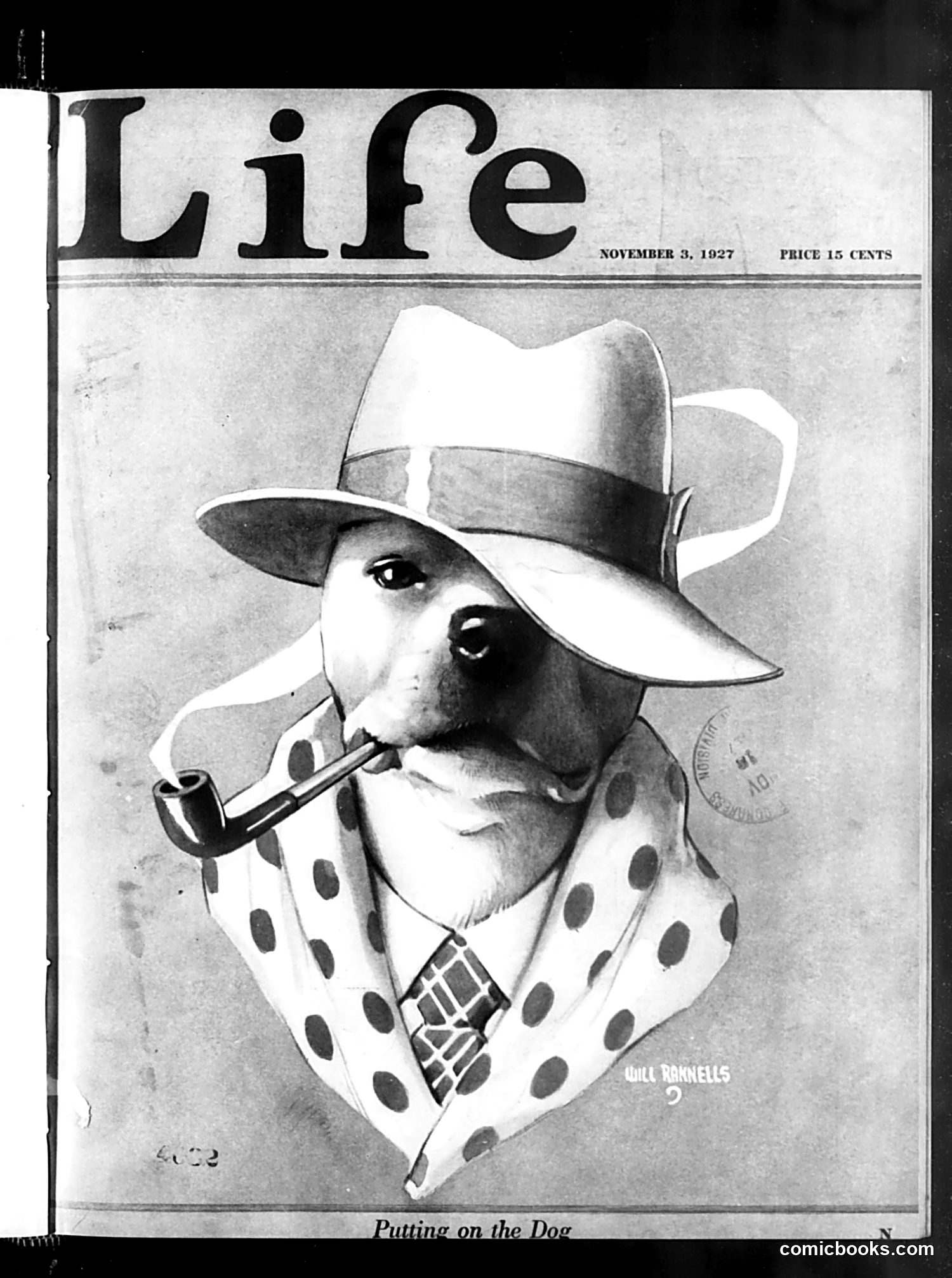
This cover depicts a dog dressed in exaggerated finery: a large cowboy hat, smoking a pipe, wearing a polka-dotted jacket and checkered neckerchief. The phrase "putting on the dog" is a 1920s slang expression meaning to show off or dress ostentatiously. The illustration, credited to Gill Barnells, satirizes the era's tendency toward pretentious displays of wealth and fashion during the prosperous Roaring Twenties. The absurdity of the anthropomorphized dog in ridiculous Western and formal attire mocks both excessive materialism and the affectations of the period. The humor relies on the contrast between the animal subject and the human vanities being lampooned.
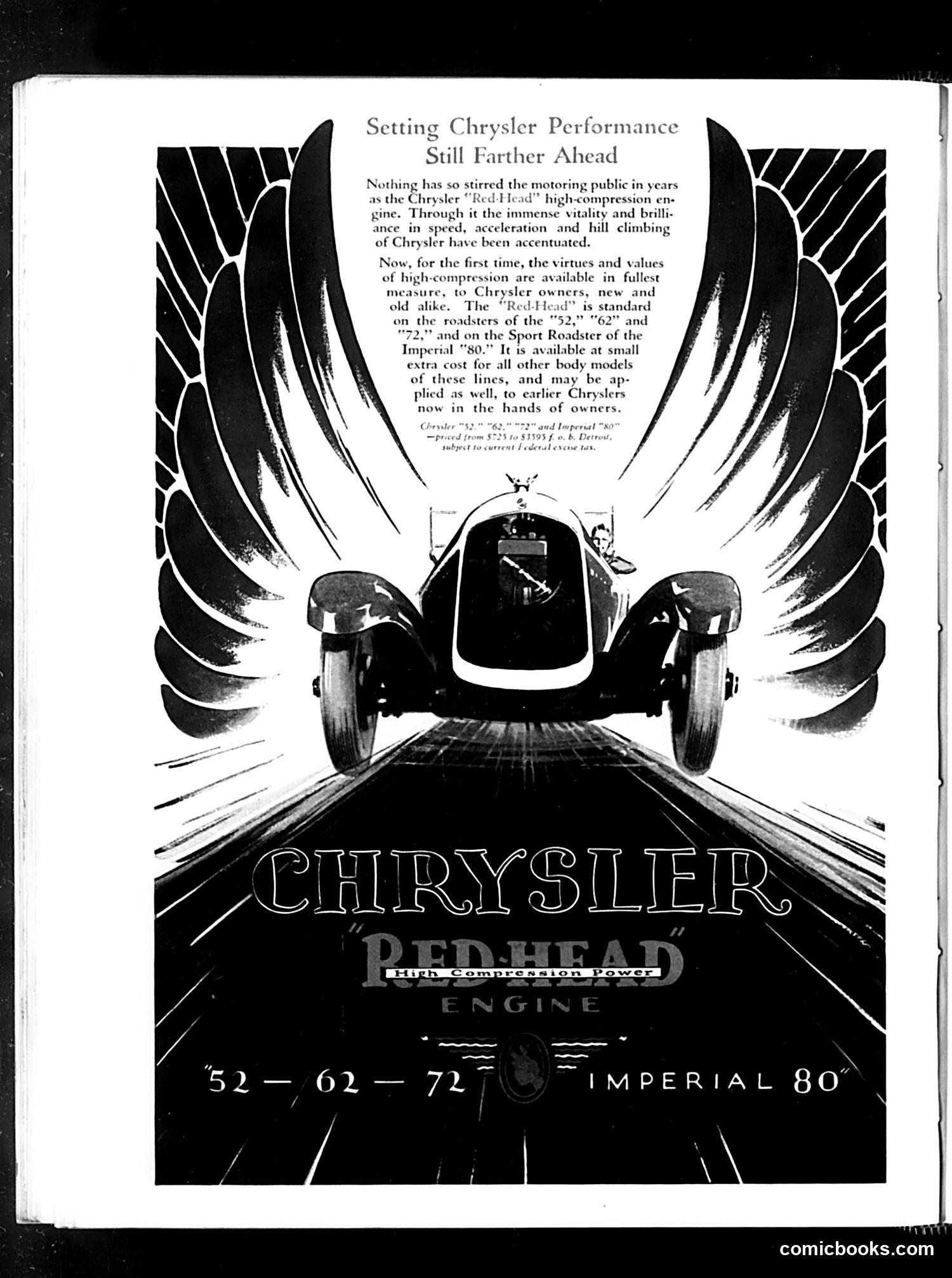
This is a **Chrysler automobile advertisement**, not political satire. The page promotes Chrysler's "Red Head" high-compression engine, claiming it sets performance "still further ahead" of competitors. The dramatic imagery shows a racing car speeding down a road, flanked by stylized wing-like shapes suggesting speed and power. The design evokes Art Deco aesthetics popular in 1920s advertising. The text emphasizes the engine's availability across multiple Chrysler models ("52," "62," "72," and "Imperial 80"), positioned as a selling point for both new and existing Chrysler owners. This represents **straightforward product marketing** rather than satirical commentary—typical of Life magazine's advertising content during the automotive industry's competitive expansion period.
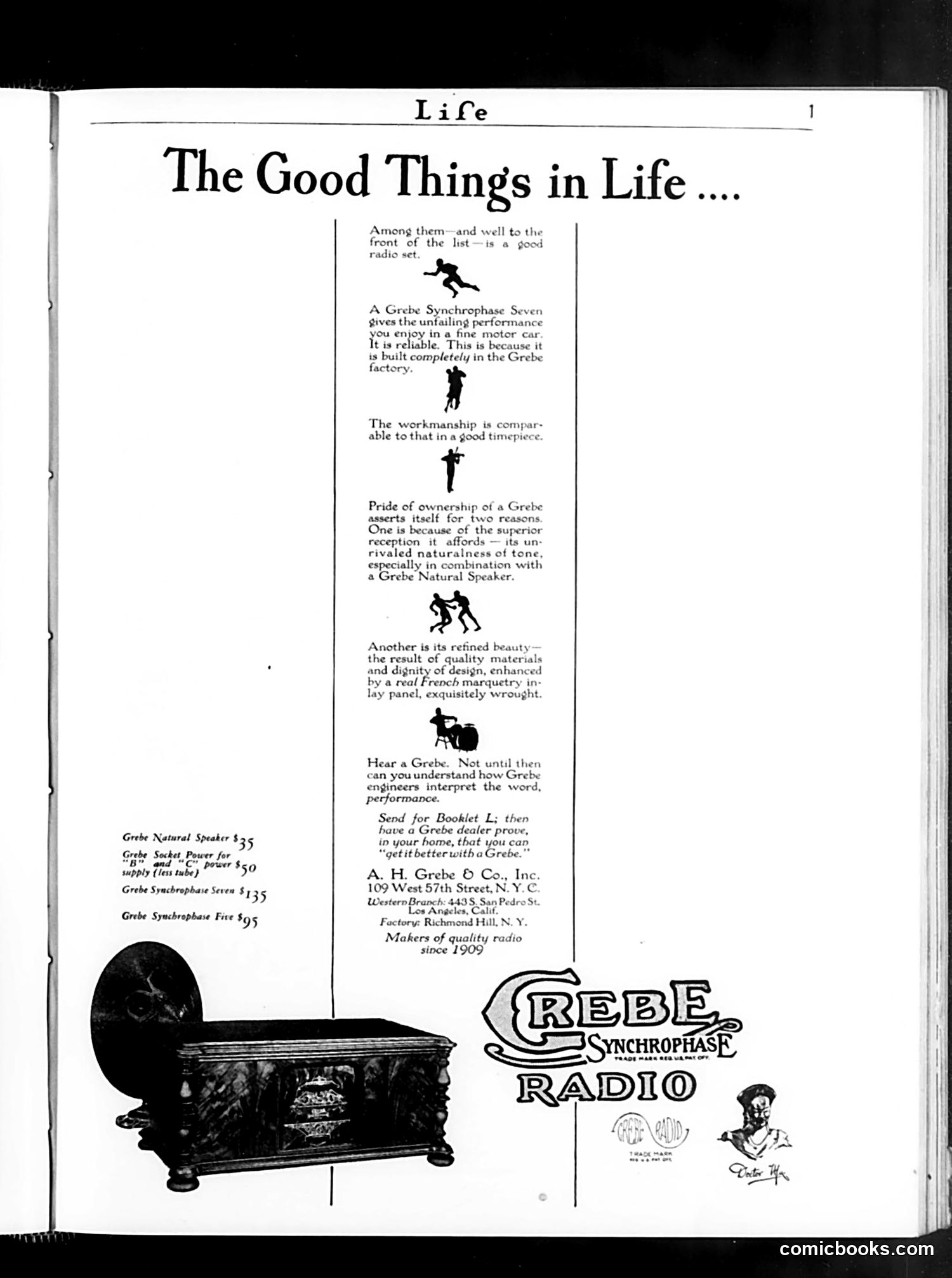
This is primarily **advertising disguised as editorial content**—a common practice in early 20th-century magazines. The page promotes Grebe brand radios and phonographs, manufactured by A. H. Grebe & Co., Inc. The "Good Things in Life" framing uses silhouettes of people enjoying activities (radio listening, dancing, socializing) to suggest that owning Grebe products enhances daily pleasures. The text emphasizes quality craftsmanship, reliability, and "natural" sound reproduction—key selling points for early radio technology when competition was fierce. The decorative radio illustration and the "Grebe Synchrophase" branding dominate the layout. This isn't satire or political commentary; it's straightforward product promotion leveraging Life magazine's prestige and readership to market consumer electronics during radio's commercial boom.
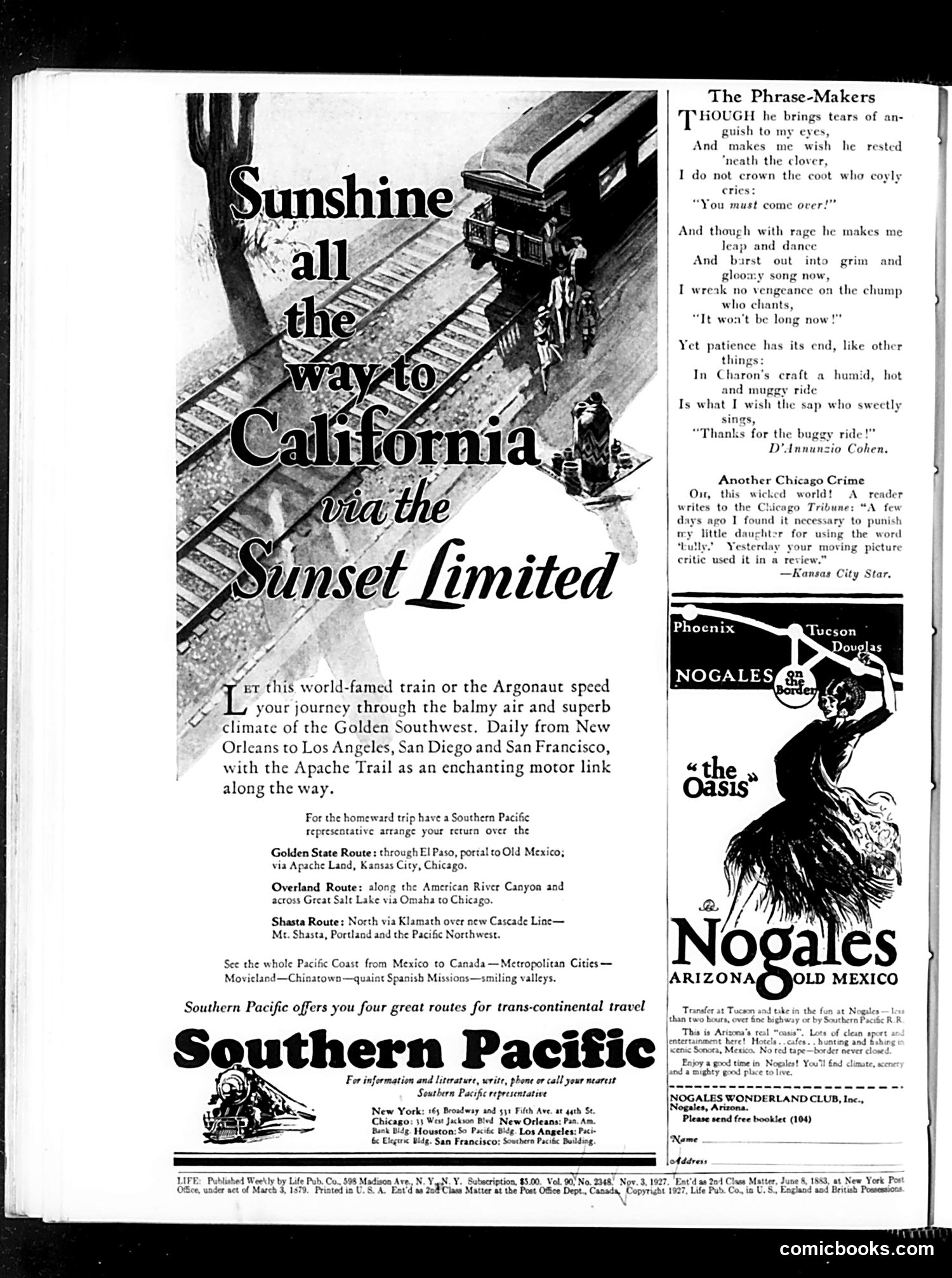
This page is **primarily advertising**, not political satire. The dominant left-hand advertisement promotes Southern Pacific Railroad's "Sunset Limited" train service to California, emphasizing scenic routes and comfortable travel through the American Southwest. The right side contains a poem titled "The Phrase-Makers" criticizing unnamed individuals who use clichéd expressions like "You must come over!" and "It won't be long now!" — likely satirizing pretentious social conventions of the 1920s era. Below is an advertisement for "Nogales: Arizona Gold Mexico," promoting tourism to the Arizona-Mexico border region as "the oasis." There is **no political cartoon** on this page. The content reflects early 20th-century commercial advertising and light social commentary about affectation.
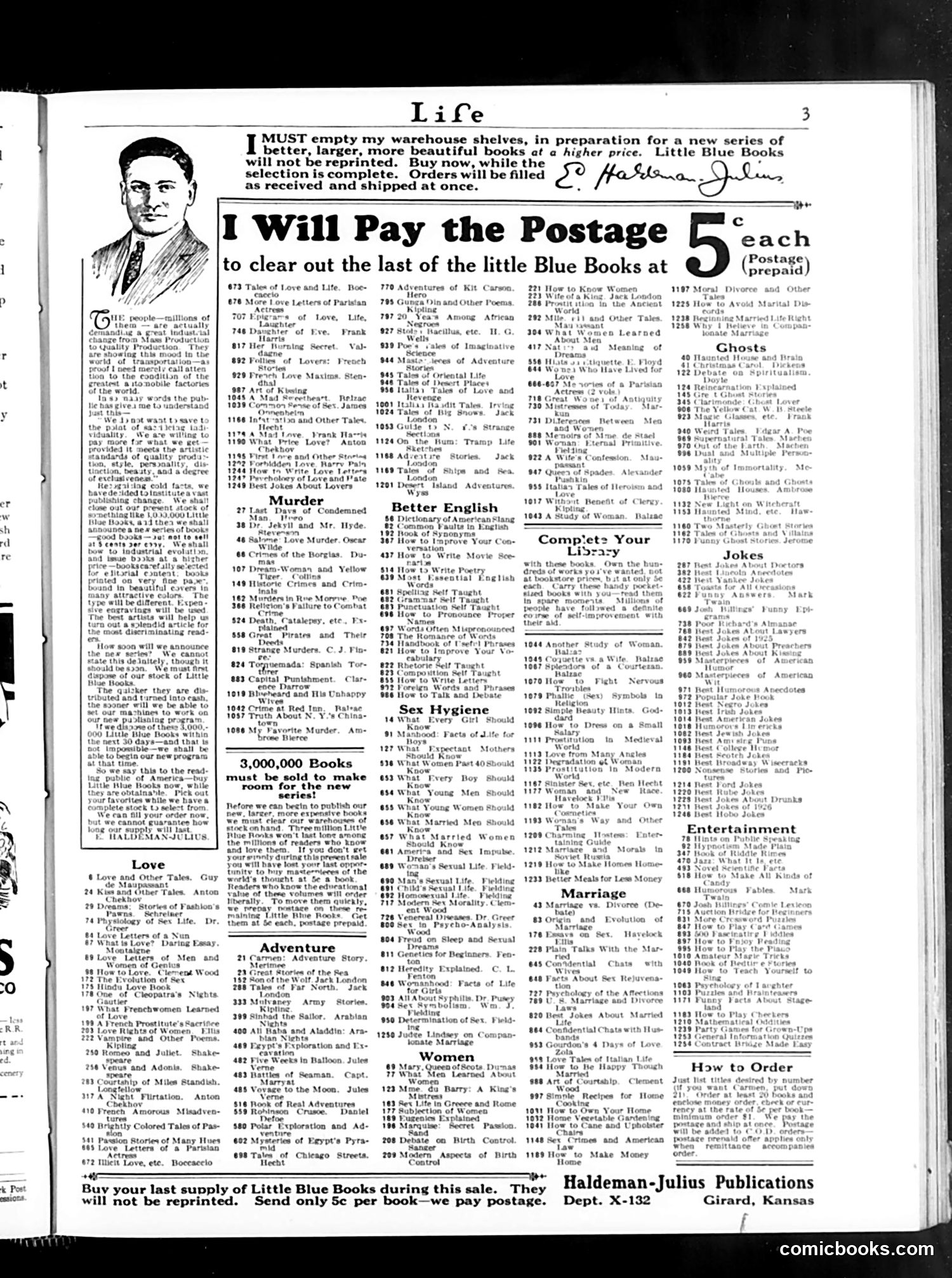
This page is primarily a **mail-order advertisement** for Little Blue Books—affordable, pocket-sized paperbacks published by Haldeman-Julius Publications in Girard, Kansas. The advertisement dominates the page, listing hundreds of titles across various categories: fiction, self-help, sex education, adventure stories, and "Better English" guides. The small portrait at top left appears to be the publisher or company founder. The key sales pitch emphasizes clearance pricing (5¢ per book with postage prepaid) and claims "3,000,000 Books must be sold to make room for the new" series. This reflects the publisher's mass-market strategy—offering inexpensive, accessible literature to working-class readers. The advertisement includes ordering instructions and notes books "will not be reprinted," creating urgency. Overall, this represents early 20th-century democratized publishing rather than satirical content.
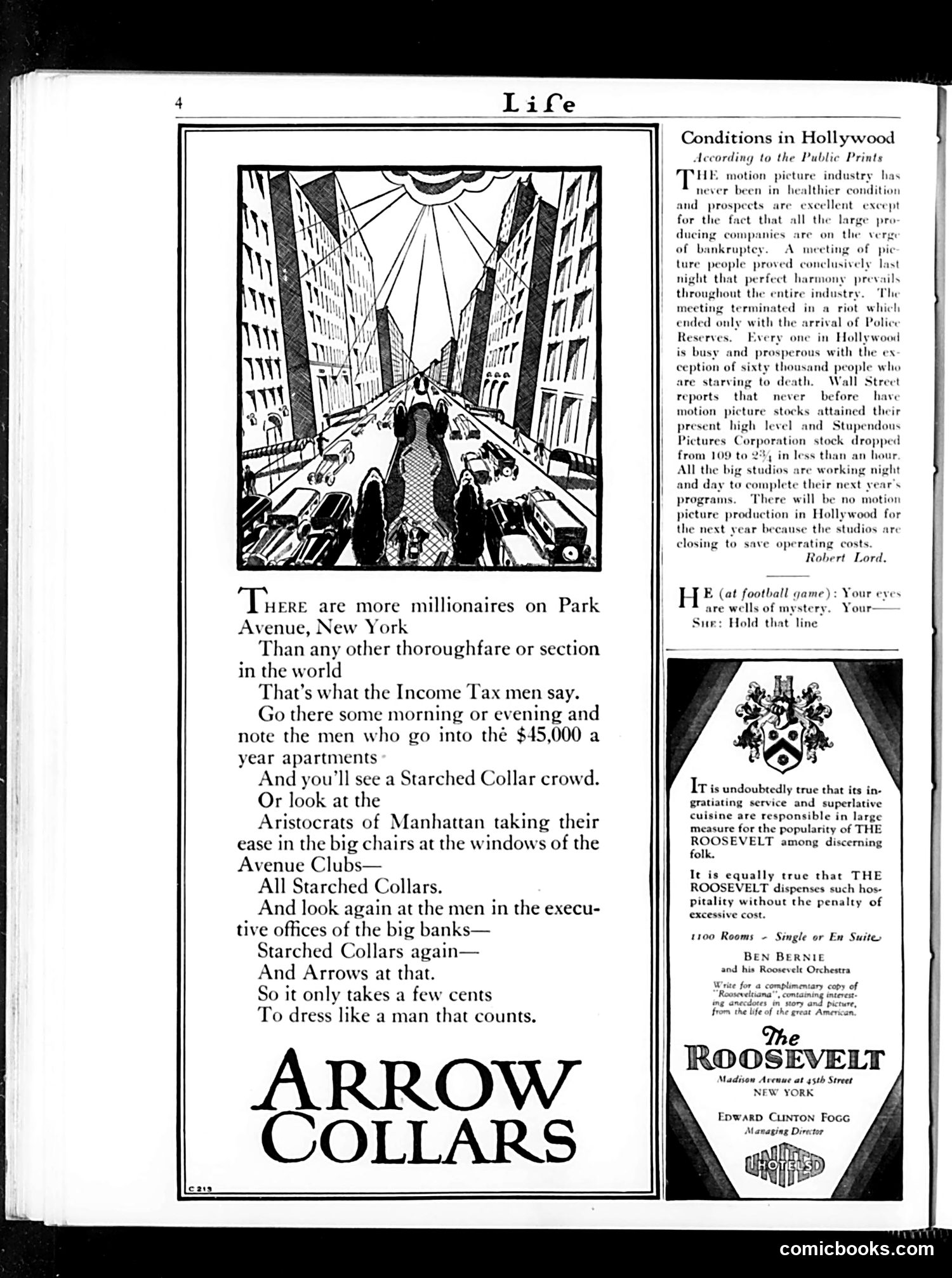
This page is primarily **advertising** for Arrow Collars, a men's shirt collar brand. The large illustration depicts a Manhattan street scene with well-dressed businessmen in stiff, formal collars—the product being promoted. The accompanying poem satirizes **wealth inequality and class appearance** on Park Avenue, New York. It notes that millionaires and executives all wear the same stiff collars ("Starched Collar crowd"), suggesting that expensive clothing merely mimics cheaper alternatives. The satirical point: formal dress requires only "a few cents," implying that status symbols are superficial and affordable imitations fool no one who understands true wealth. The page also advertises The Roosevelt hotel, which emphasizes its "superlative cuisine" and affordable hospitality. The content reflects **1920s-era consumer culture** and class commentary typical of Life magazine's satirical approach.
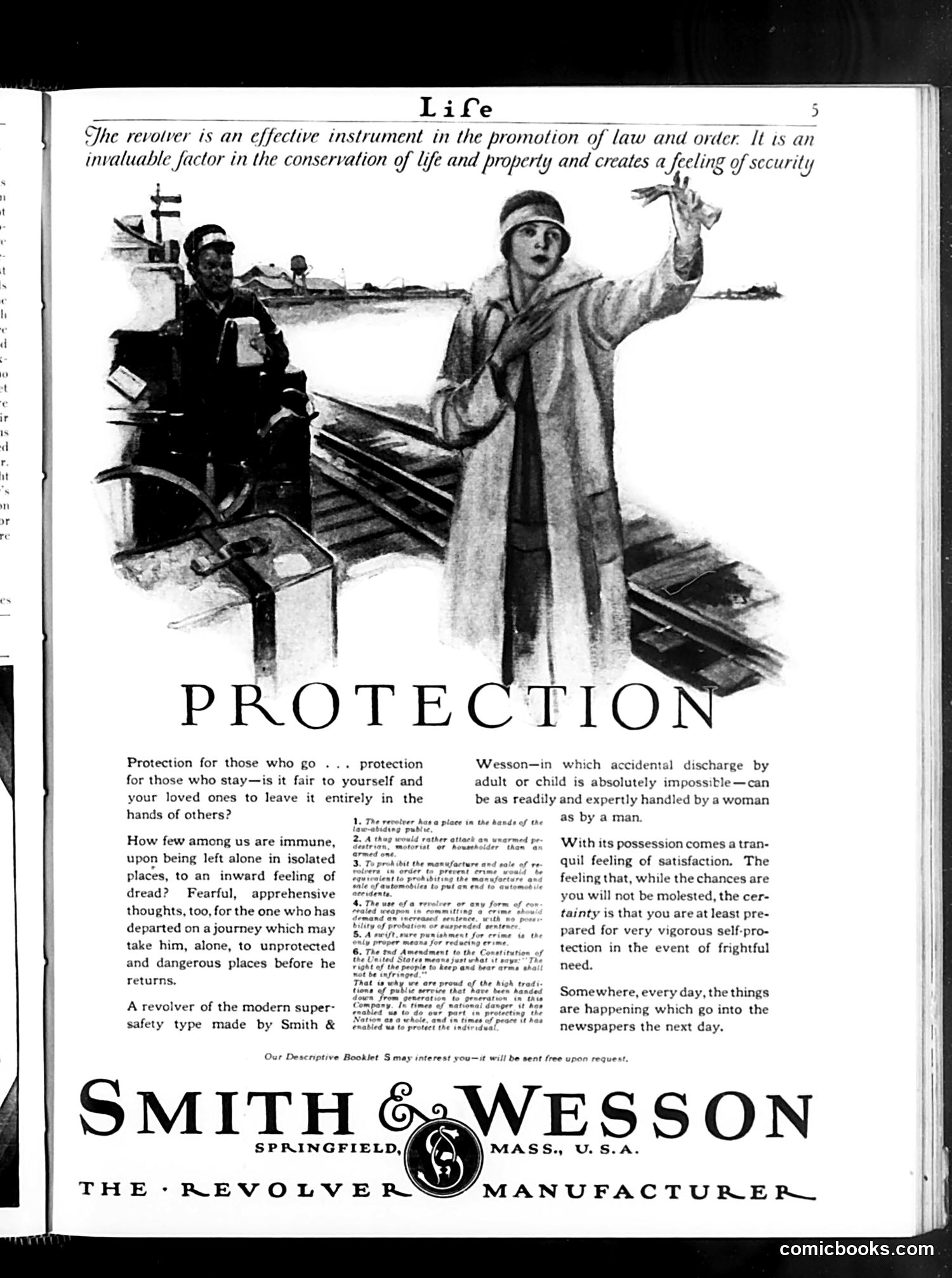
This is a **Smith & Wesson revolver advertisement**, not political satire. The page uses the headline "PROTECTION" to market firearms for personal safety. The illustration depicts a woman in a coat gesturing confidently while a man sits nearby with a revolver visible. The accompanying text emphasizes that revolvers provide security for travelers—particularly women—journeying through "unprotected and dangerous places." The ad argues that possessing a revolver creates "a tranquil feeling of satisfaction" and ensures "self-protection...in the event of frightful need." It specifically notes the Wesson revolver can be "as readily and expertly handled...by a woman as by a man." This reflects early 20th-century marketing that positioned firearms as essential personal security tools, particularly targeting female consumers with messaging about vulnerability while traveling.
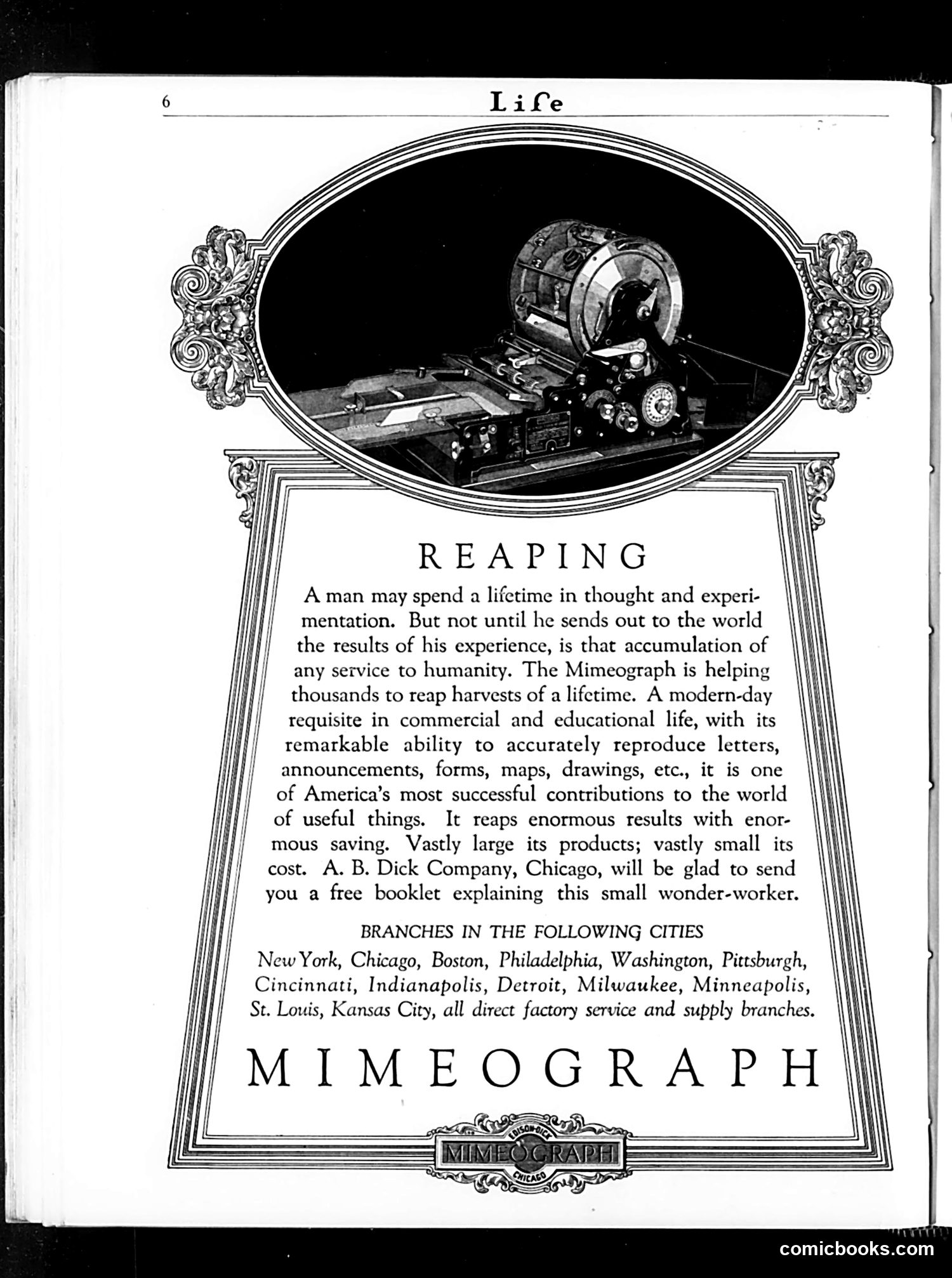
This page is primarily **advertising, not satire or political commentary**. The A.B. Dick Company is promoting the Mimeograph, a early mechanical copying device shown in the photograph at top. The ad's headline "REAPING" uses agricultural metaphor: just as farmers reap harvests from planting, businesses can "reap" the benefits of the mimeograph's efficiency. The text emphasizes the machine's practical value—it reproduces letters, announcements, forms, and drawings accurately while saving time and money. The ad notes this represents America's successful contribution to "useful things." The company lists branches across major U.S. cities and offers a free explanatory booklet. There is no political satire here—this is straightforward industrial advertising aimed at commercial and educational buyers in the early 20th century.
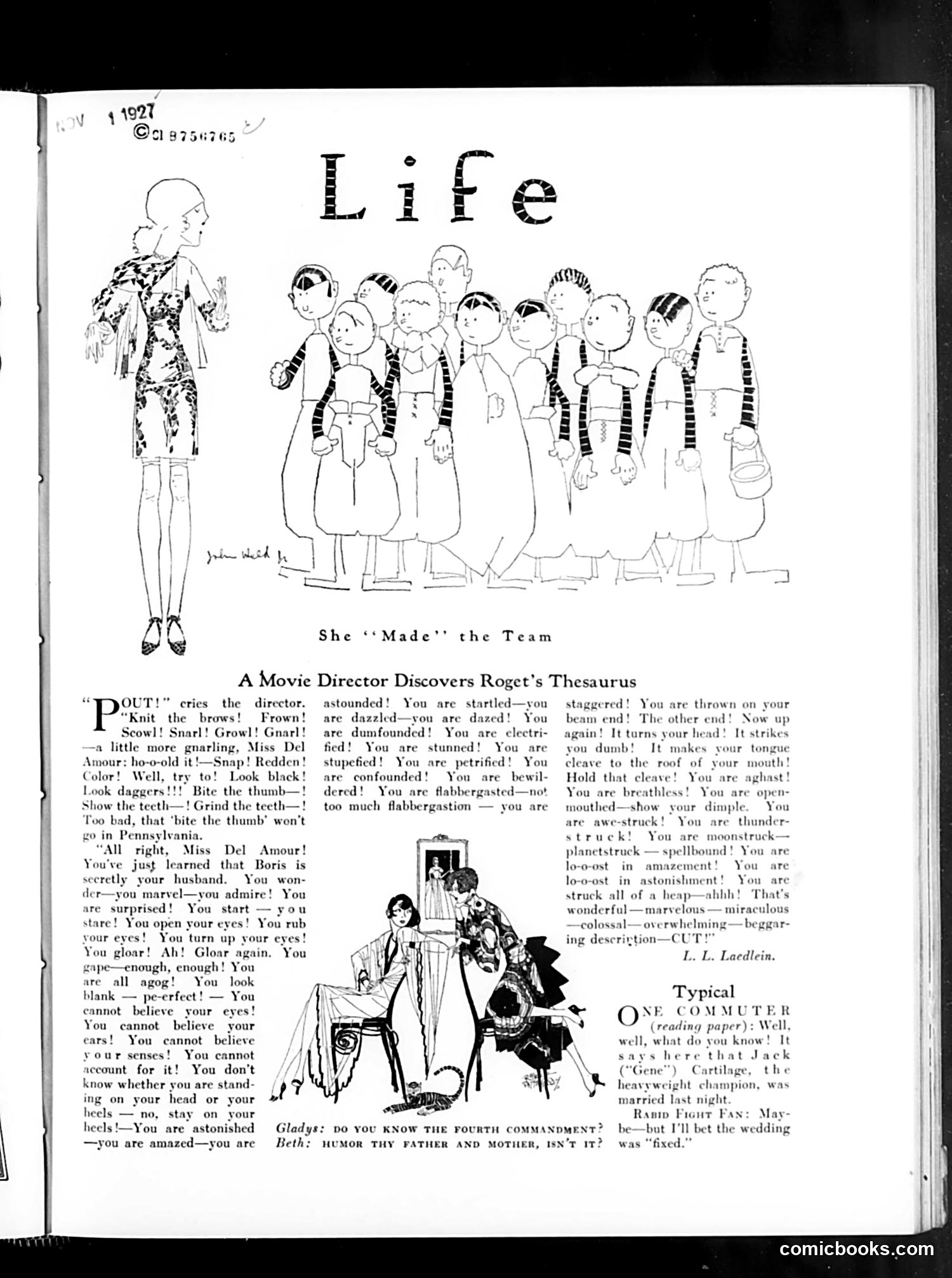
This page satirizes the "New Woman" of the 1920s Jazz Age. The illustration at top shows a fashionably dressed woman (labeled "She 'Made' the Team") leading a group of plainly-dressed children, reversing traditional gender roles where men lead families. The main article, "A Movie Director Discovers Roget's Thesaurus," mocks how movie directors manipulated actresses with excessive, repetitive praise and commands ("You are dazzled! You are stunned! You are electrified!"). The joke critiques both the artificiality of film direction and the gullibility of actresses. The sidebar dialogue between characters "Gladys," "Beth," and "Radio Fan" references marriage and the "Fourth Commandment" (honoring parents), suggesting anxiety about modern women's independence from traditional family authority. The satire targets changing social norms around women's autonomy and roles.
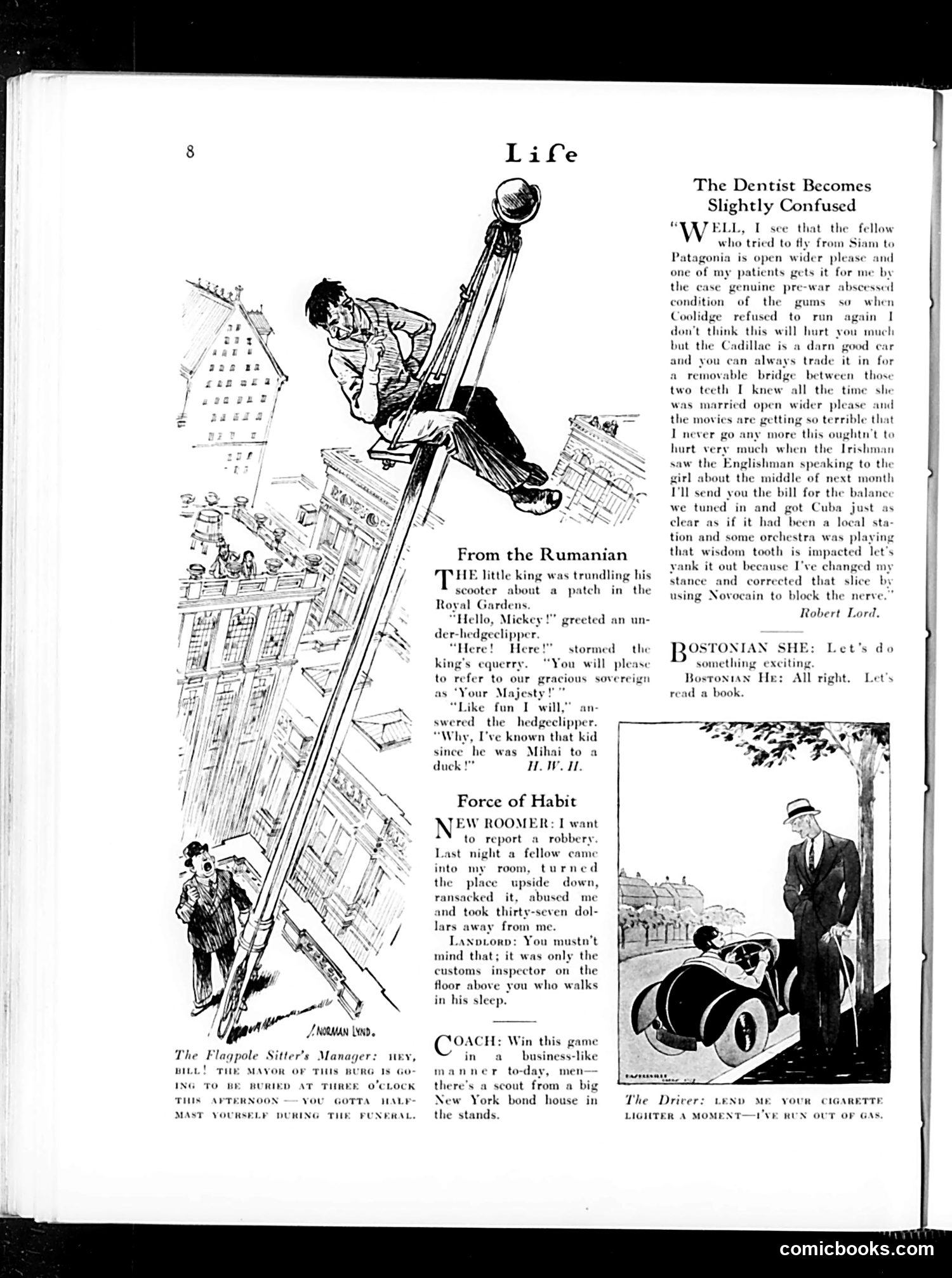
This page contains several humor pieces typical of Life's satirical style: **"The Dentist Becomes Slightly Confused"** features a dentist's rambling monologue about his patients' dental work, gossiping about their personal lives while supposedly treating them. The satire targets how dentists often talk excessively during procedures. **"From the Rumanian"** shows a hedgehog correcting a child's address to royalty—a absurdist humor piece playing on formality and rank. **"Force of Habit"** depicts a landlord dismissing a robbery report, assuming it's just the customs inspector above—satirizing both tenants' acceptance of poor conditions and bureaucratic indifference. **"The Driver"** shows a man asking for a cigarette lighter while being driven, likely commenting on casual behavior or material excess. The cartoons use exaggeration and situational irony typical of 1920s-30s American humor magazines.
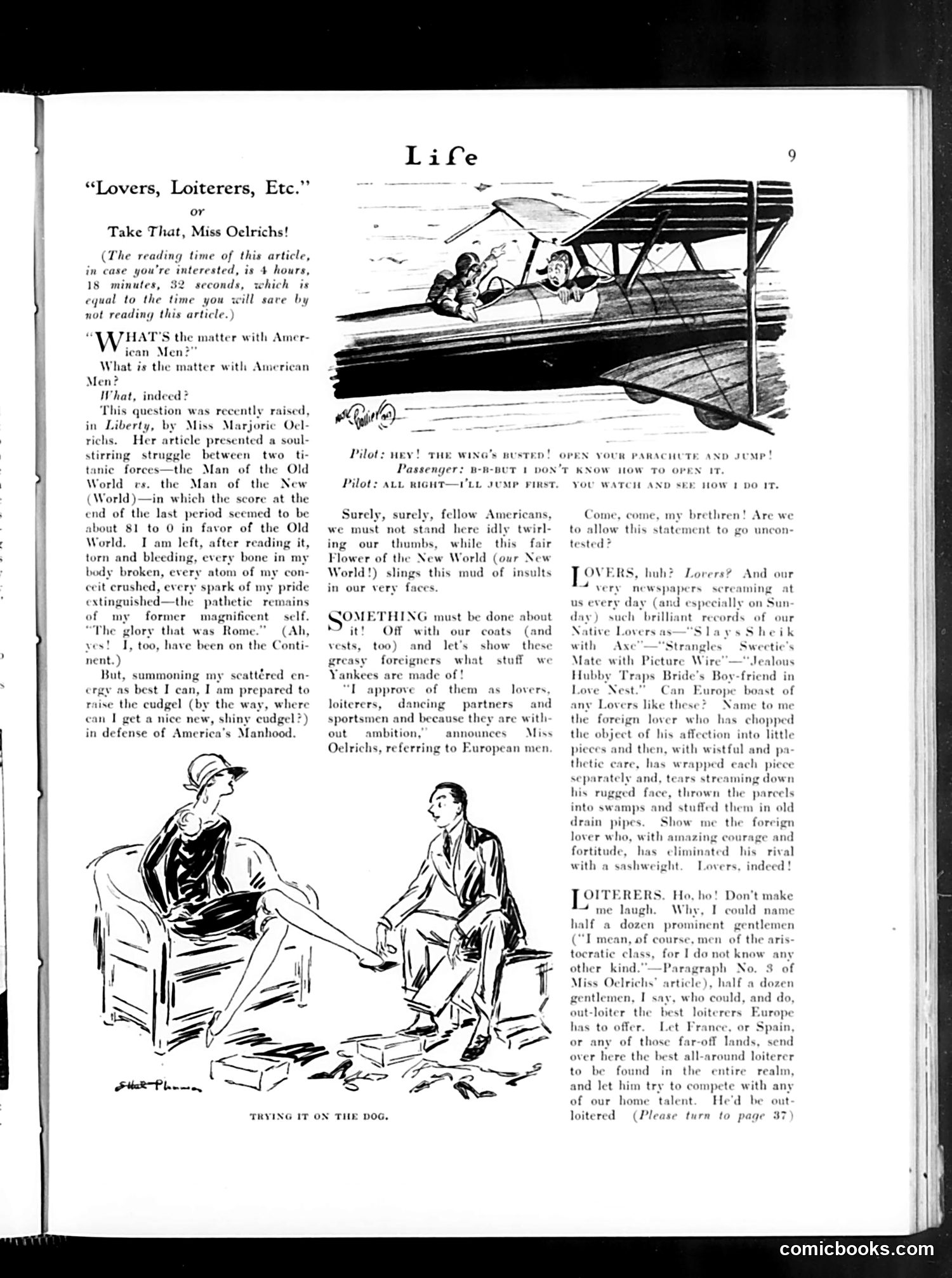
This page satirizes American masculinity and national pride through two cartoons. The upper cartoon depicts an airplane scene where the pilot instructs passengers to jump with parachutes—a humorous commentary on American daring or recklessness. The lower cartoon titled "TRYING IT ON THE DOG" shows a man and woman in conversation, apparently testing social behavior. The article text critiques American men as "lovers, loiterers," comparing them unfavorably to European men. Miss Oelrichs argues American men lack the romantic sophistication of foreigners and suggests showcasing better examples of American manhood. The satire targets perceived American cultural inadequacy and masculine insecurity relative to European standards—a common early 20th-century concern among American intellectuals.
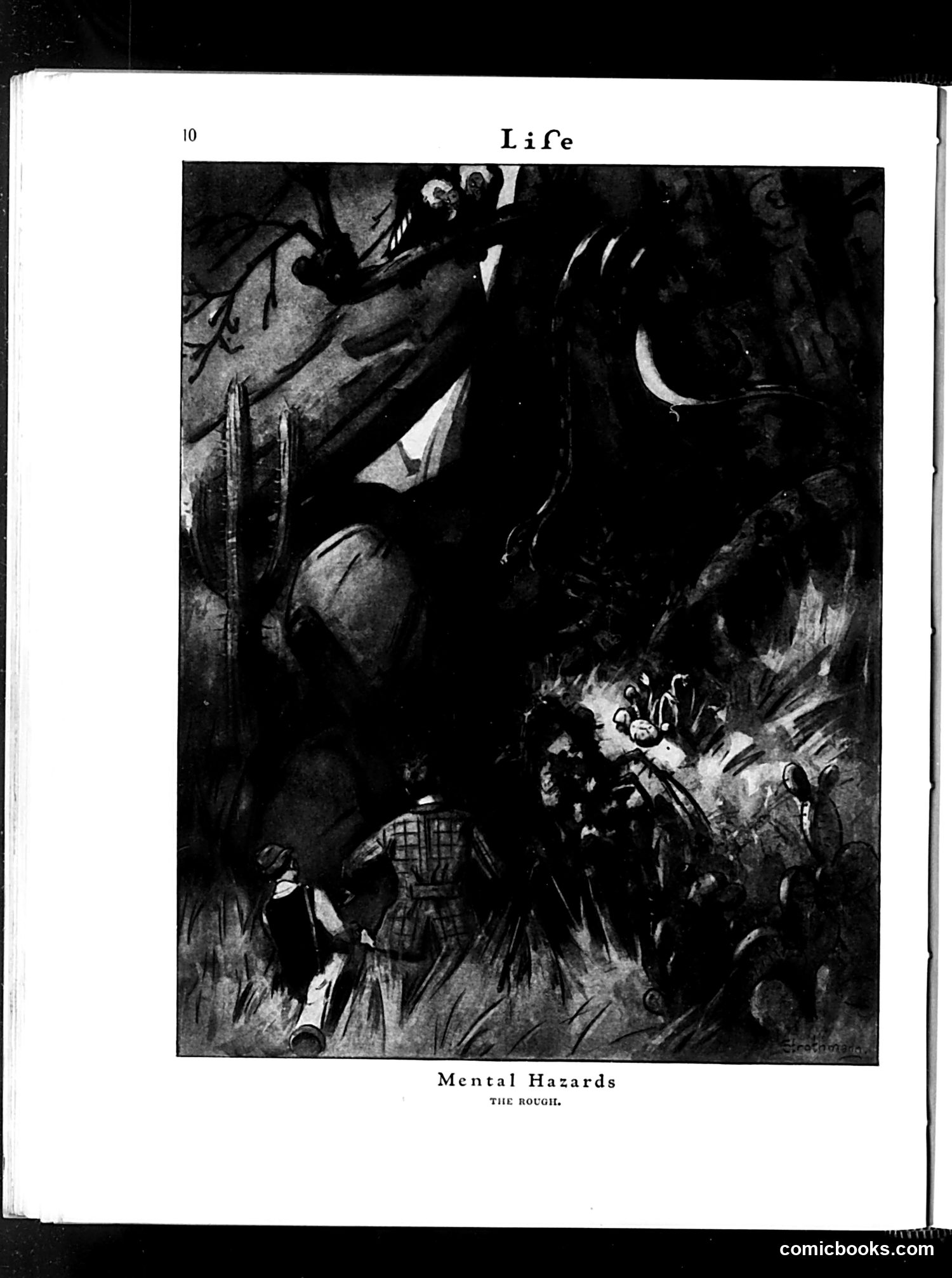
This is a satirical illustration titled "Mental Hazards" subtitled "The Rough," published in *Life* magazine. The dark, chaotic scene depicts what appears to be a dangerous or disturbing urban setting—likely slum conditions or a rough neighborhood. The imagery suggests social commentary on the mental and psychological dangers posed by poverty, crime, or urban decay on inhabitants, particularly vulnerable populations. The crowded, shadowy composition with multiple figures conveys chaos and moral peril. Without additional context or visible publication date, the specific historical reference remains unclear, though the style and subject matter suggest early 20th-century American social concerns. The satire critiques environmental conditions that threaten mental wellbeing and morality.
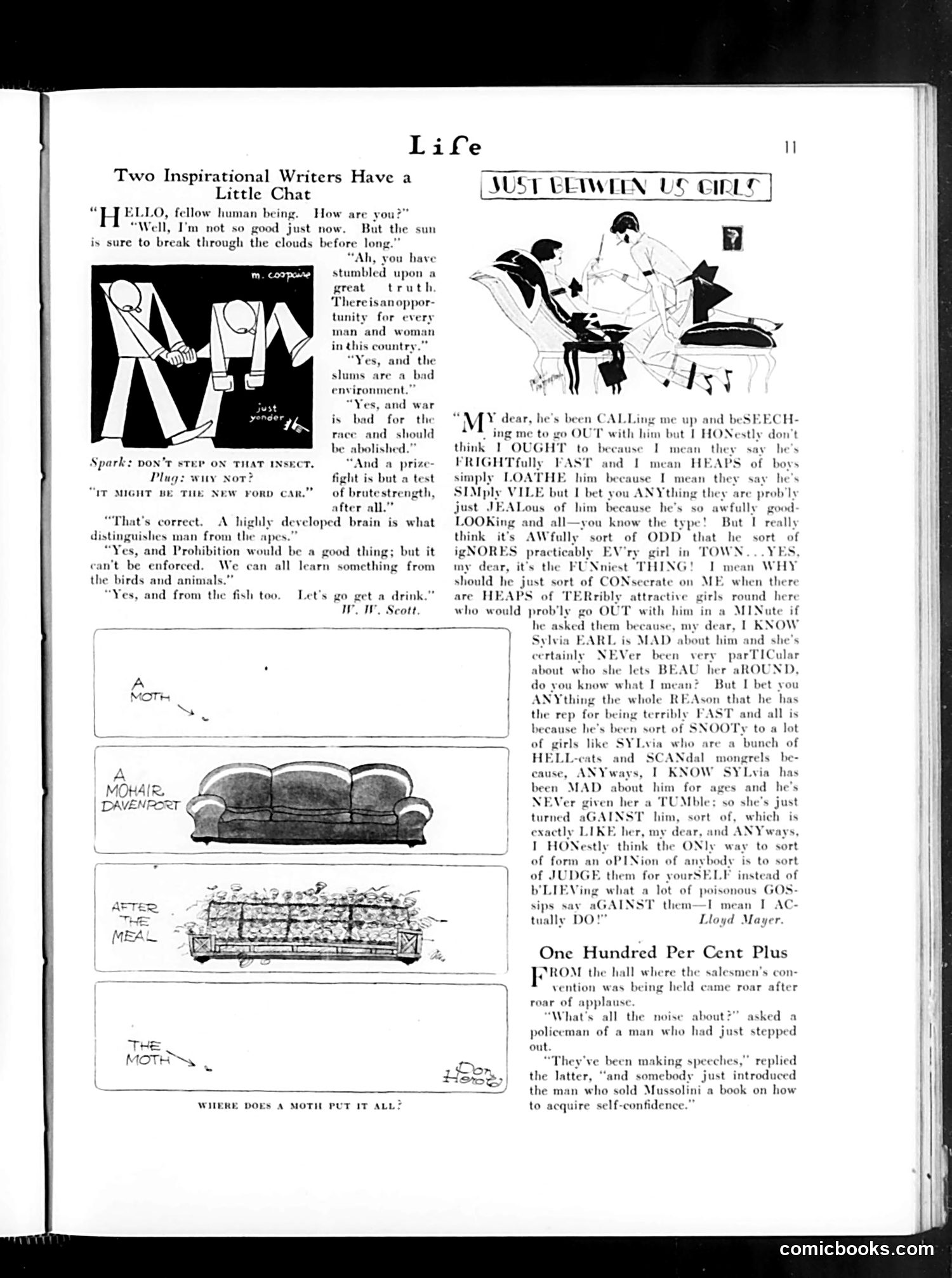
This page contains satirical commentary on gender relations and social attitudes circa early-to-mid 20th century. **"Two Inspirational Writers Have a Little Chat"** mocks philosophical discourse about human nature, prohibition, and social improvement through a dialogue between two figures (artist-attributed to M. Cosgrave). **"Just Between Us Girls"** is a gossip column in exaggerated typography where a woman complains about her suitor's behavior—calling him "FRIGHTFULLY FAST," "LOATHE," and "SNOOTY." The satire targets both overwrought female romantic anxiety and male social pretension of the era. **"One Hundred Per Cent Plus"** jokes about a salesman selling Mussolini a book on self-confidence, satirizing both fascist authoritarianism and American sales culture's promises of personal transformation. The humor relies on period-specific gender stereotypes and political references now requiring historical context.
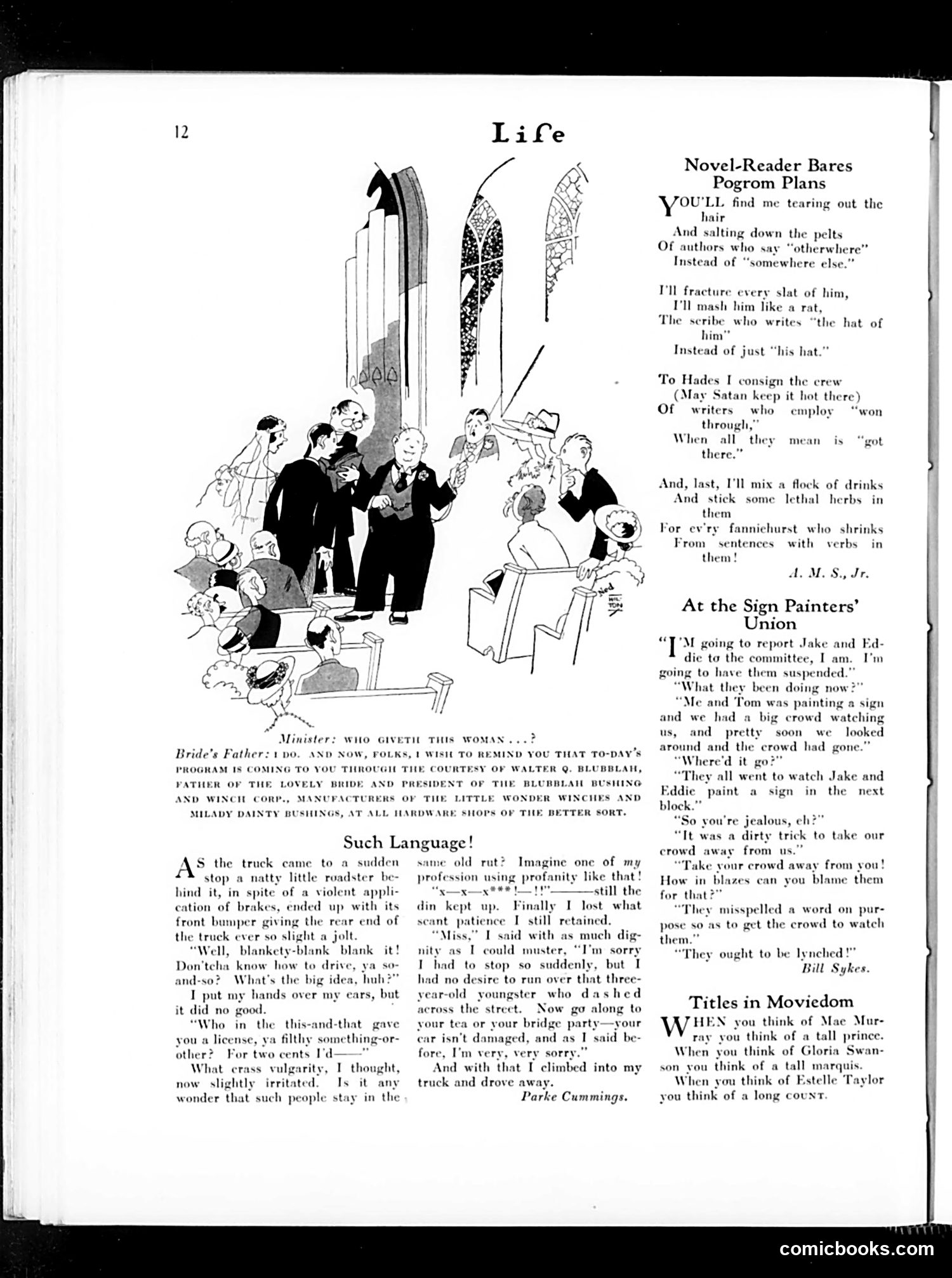
This page contains humorous essays and illustrations rather than political cartoons. The main illustration depicts a domestic scene with a minister present, captioned "Minister: who giveth this woman...?" The accompanying text parodies formal wedding language. "Such Language!" is a comedic essay about a traffic accident where a truck driver loses his temper and uses profanity. The author comments ironically on the irony of such vulgar language from someone complaining about bad driving—a social critique of hypocrisy. Other sections include "Novel-Reader Bares Pogrom Plans" (mocking overwrought literary revenge fantasies), "At the Sign Painters' Union" (workplace comedy about painter rivalry), and "Titles in Moviedom" (humor about tall actors receiving grandiose film titles). The page emphasizes satire of everyday social behavior rather than political content.
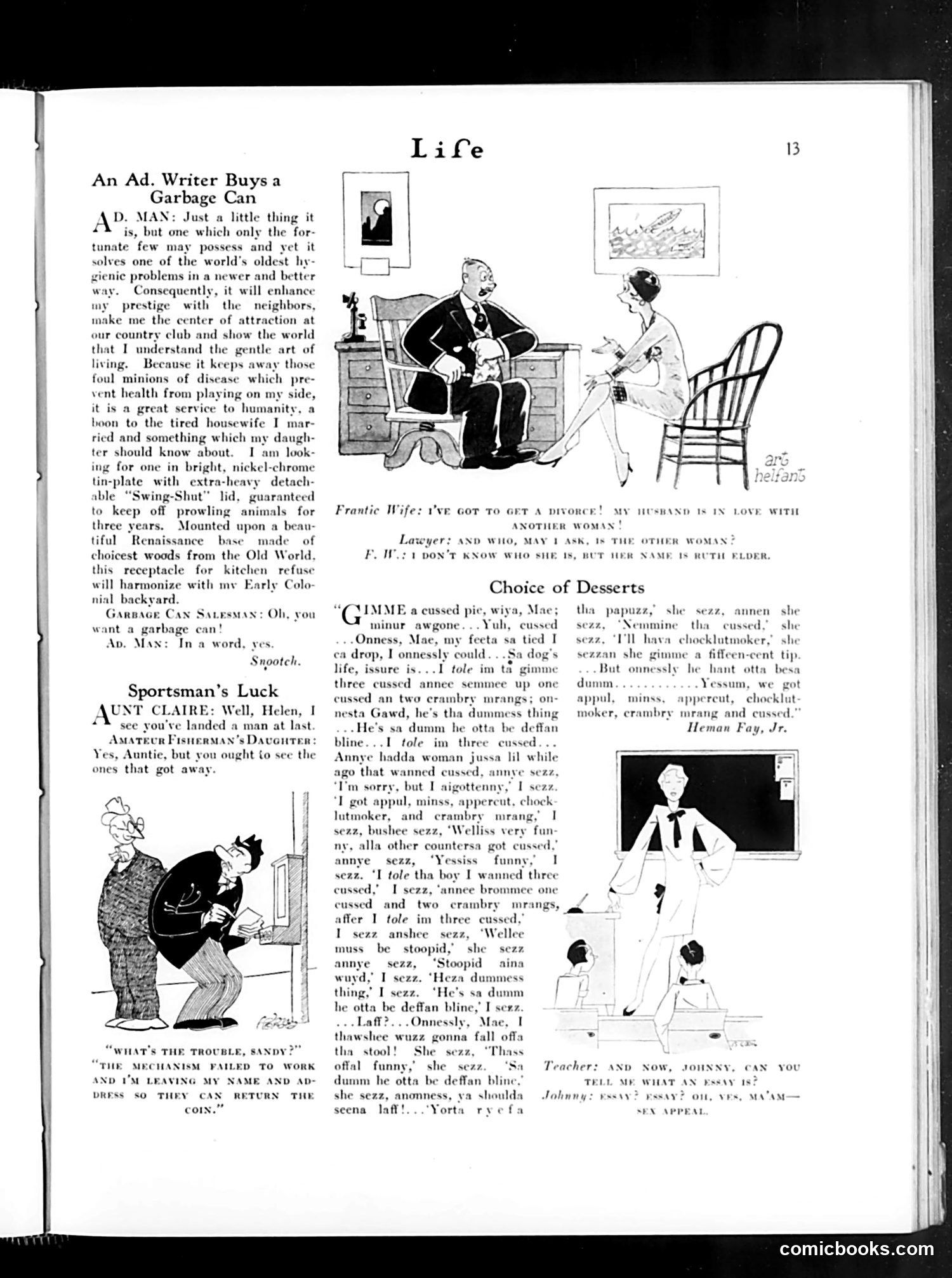
This page contains three separate humorous pieces typical of 1920s-30s satirical humor: 1. **"An Ad Writer Buys a Garbage Can"**: A man boasts to his wife about purchasing an expensive garbage receptacle, claiming it enhances their social status and solves hygiene problems. 2. **"Sportsman's Luck"**: A man has apparently shot someone during a hunting trip; his aunt Claire advises him to cover it up rather than report it to authorities. 3. **"Choice of Desserts"**: A frustrated wife catalogs her cursing ("I sezz," "anisee sezz") in response to her husband's infidelity, using exaggerated working-class dialect for comedic effect. The humor relies on domestic discord, class anxieties, and period-specific social commentary about marriage, masculinity, and propriety.
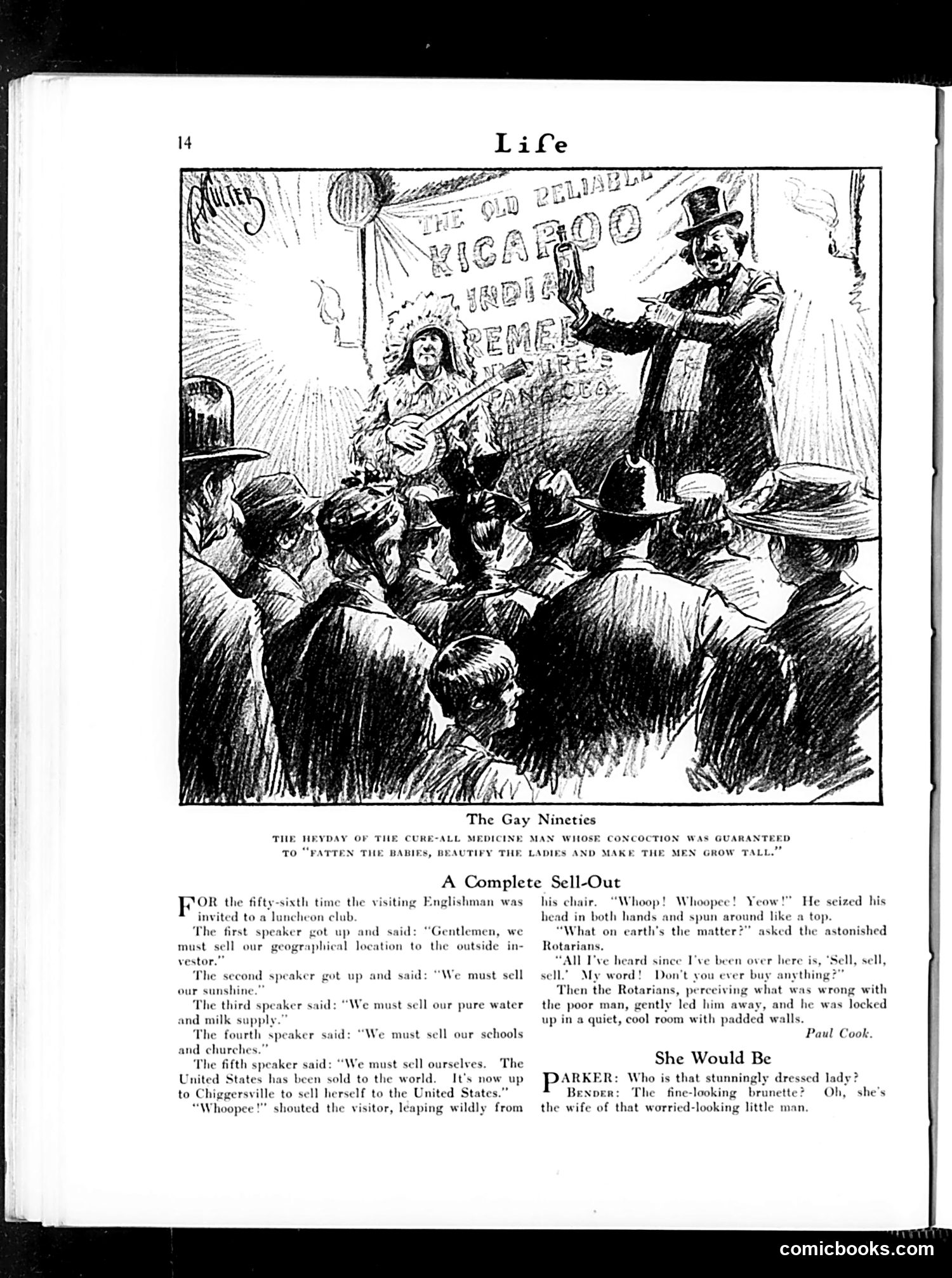
This satirical cartoon depicts a medicine-man pitchman addressing a crowd at what appears to be a Rotary Club meeting. The caption indicates he's hawking a "cure-all medicine" guaranteed to "fatten the babies, beautify the ladies and make the men grow tall." The joke satirizes both the charlatan medicine industry and American commercialism broadly. The five preceding speakers have each advocated "selling" something—sunshine, water, milk, schools, and ultimately "ourselves." The visiting Englishman's reaction ("Whoopee!") and subsequent dialogue about the U.S. selling itself to Cliggersville critiques how thoroughly commercialized American society has become—everything, even basic human values and institutions, has become a commodity for profit.
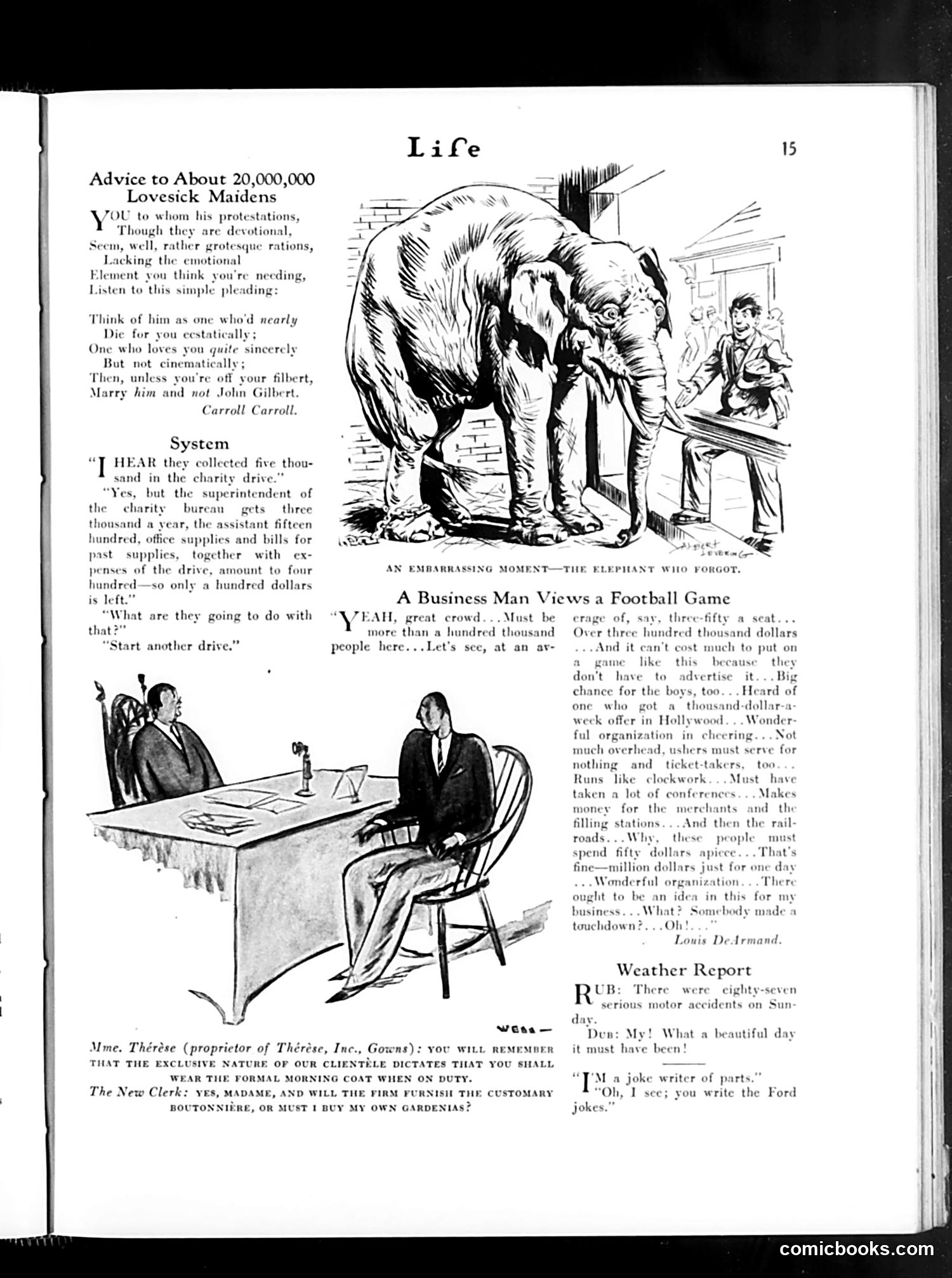
This page contains three satirical pieces: 1. **"Advice to About 20,000,000 Lovesick Maidens"**: A poem by Carroll advising young women to marry men who love them "nearly" and "purely" rather than those with merely physical attraction—social commentary on marriage expectations. 2. **"An Embarrassing Moment—The Elephant Who Forgot"**: A cartoon showing an elephant in an awkward social situation, likely satirizing absent-mindedness or social blunders. 3. **"A Business Man Views a Football Game"**: A businessman monologuing about football's inefficient organization compared to business operations—satirizing how businessmen approach every activity through a commercial/efficiency lens, missing the sport's entertainment value. The page mocks early 20th-century attitudes toward romance, social propriety, and American business culture's obsession with profit and organization.
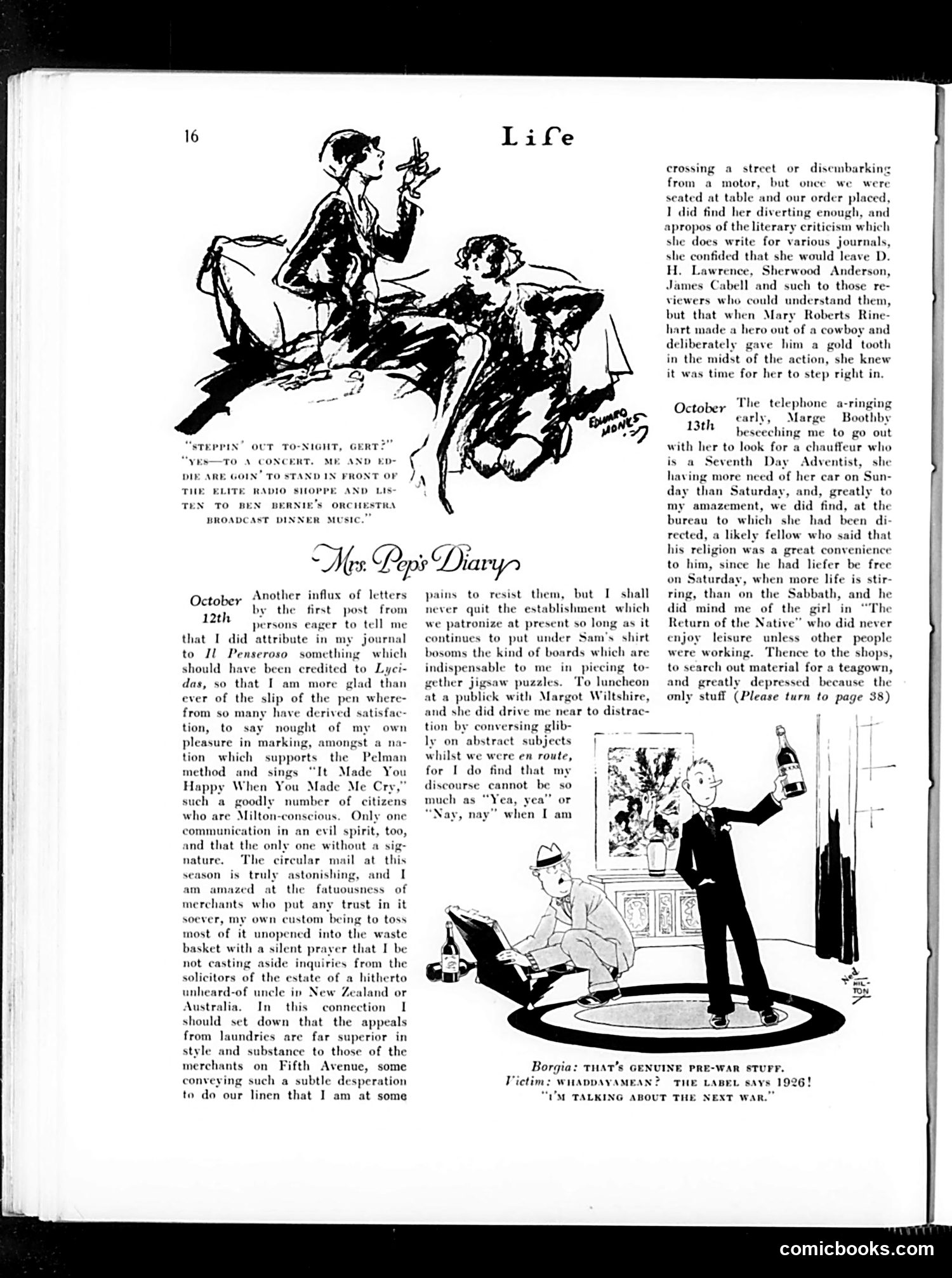
This page features **Mrs. Pops's Diary**, a satirical column mocking the social pretensions and consumer habits of upper-middle-class women. The diary entry (October 12th) ridicules the author's eagerness to name-drop fashionable consumption—attending concerts, patronizing exclusive shops, and participating in charity boards—while maintaining moral superiority. The satire targets the performative nature of "society" life. The bottom cartoon depicts a scene about **pre-war clothing ("1926" referenced)**. A man displays a suit while others examine it, with dialogue mocking whether "genuine" pre-war garments are still wearable or merely nostalgic artifacts. This satirizes post-war consumerism and the marketing of "vintage" goods as luxury items. Both segments ridicule 1920s bourgeois social climbing and consumer culture.
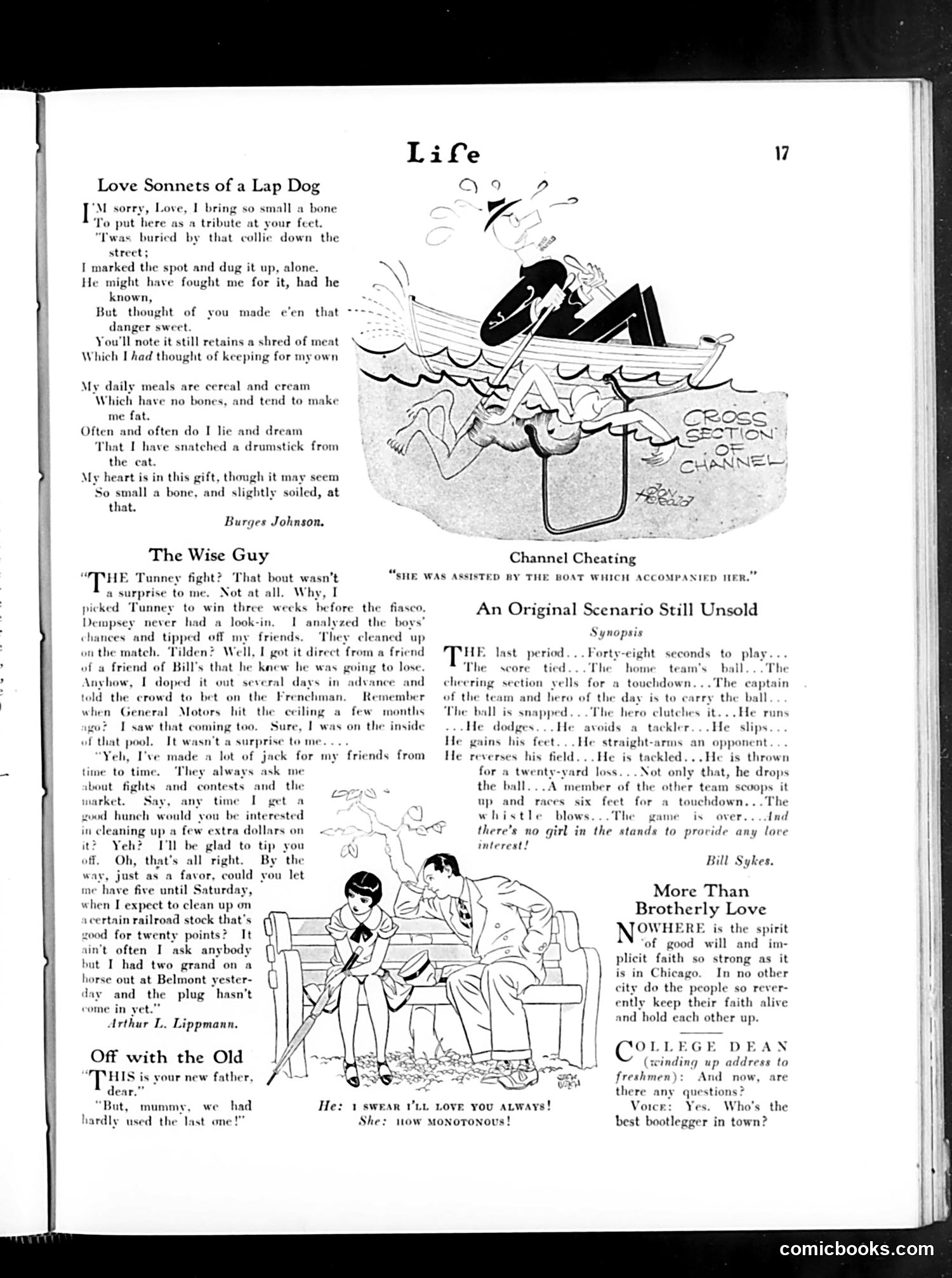
This page from *Life* magazine contains several humorous pieces about relationships and sports. "Love Sonnets of a Lap Dog" presents romantic verses from a small dog's perspective, playing on the sentimental pet-owner dynamic. "The Wise Guy" depicts a character boasting about fixing a boxing match—a reference to widespread fight-fixing scandals common in early-20th-century sports. "Channel Cheating" shows a couple where the woman is assisted by a boat, satirizing cheating in some competition. The illustration labeled "Off with the Old" depicts a man introducing his new wife to his child, with the child's reluctant response, mocking remarriage dynamics. Overall, the page humorously examines domestic relationships, sports corruption, and social awkwardness through satire.
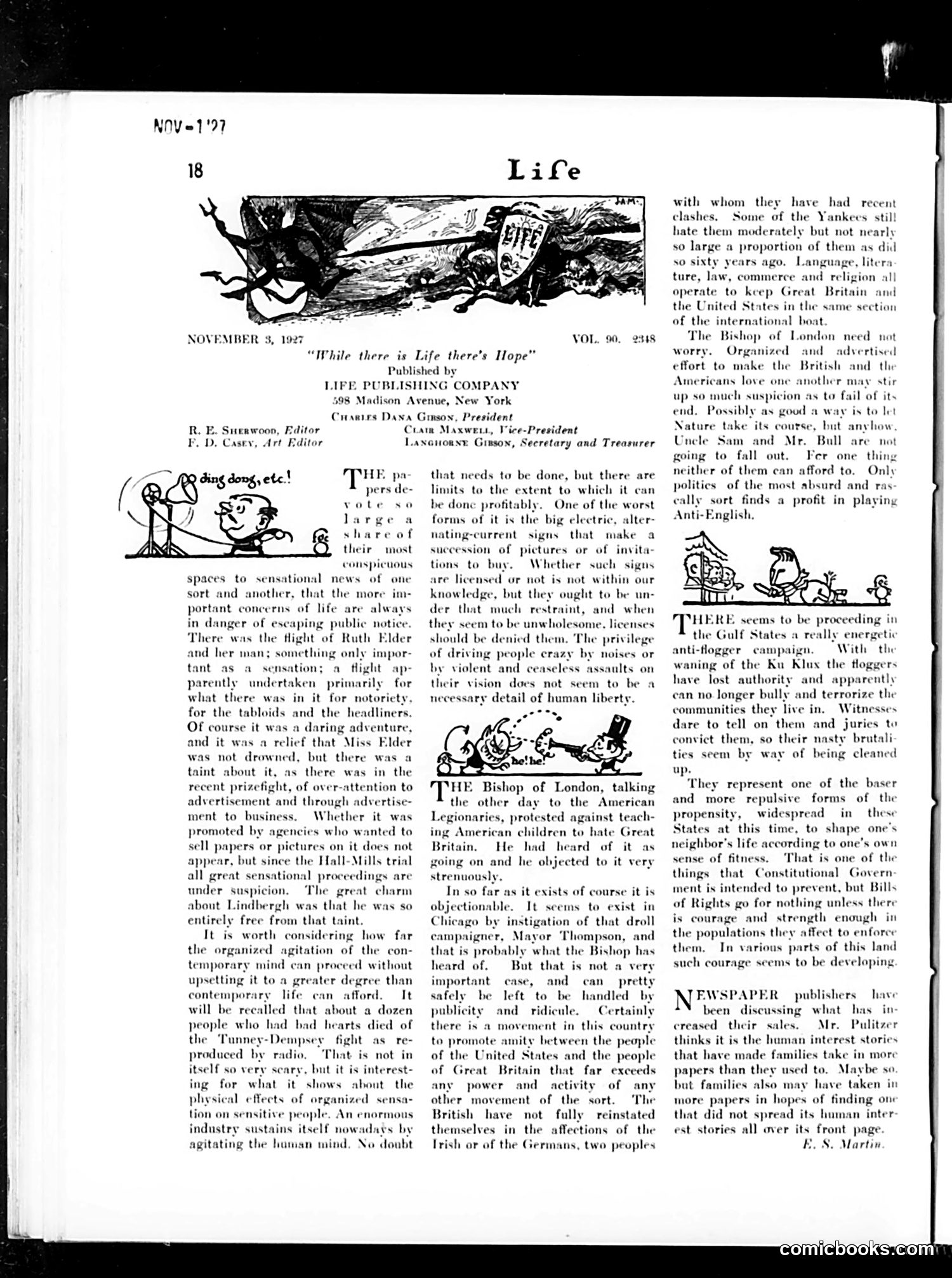
This page contains editorial commentary on contemporary American sensationalism and British-American relations, illustrated with small cartoons. **The main critiques:** 1. **Sensational media**: The editors condemn newspapers' obsession with flashy stories (Ruth Elder's flight, the Tunney-Dempsey boxing match broadcast) while ignoring serious news. They contrast this unfavorably with Lindbergh's transatlantic flight, which lacked commercial hype. 2. **Advertising excess**: Life attacks electric signs with alternating images that assault viewers' senses, arguing such "unwholesome" stimuli shouldn't be protected as "human liberty." 3. **Anti-British propaganda in Chicago**: The Bishop of London protested American schools teaching children to hate Britain. Life attributes this to Mayor Thompson's "droll campaigner" activities in Chicago, dismissing it as a minor issue best handled by "publicity and ridicule." The overall tone suggests Life positioned itself as defending serious journalism and cultural decorum against sensationalism and jingoism.
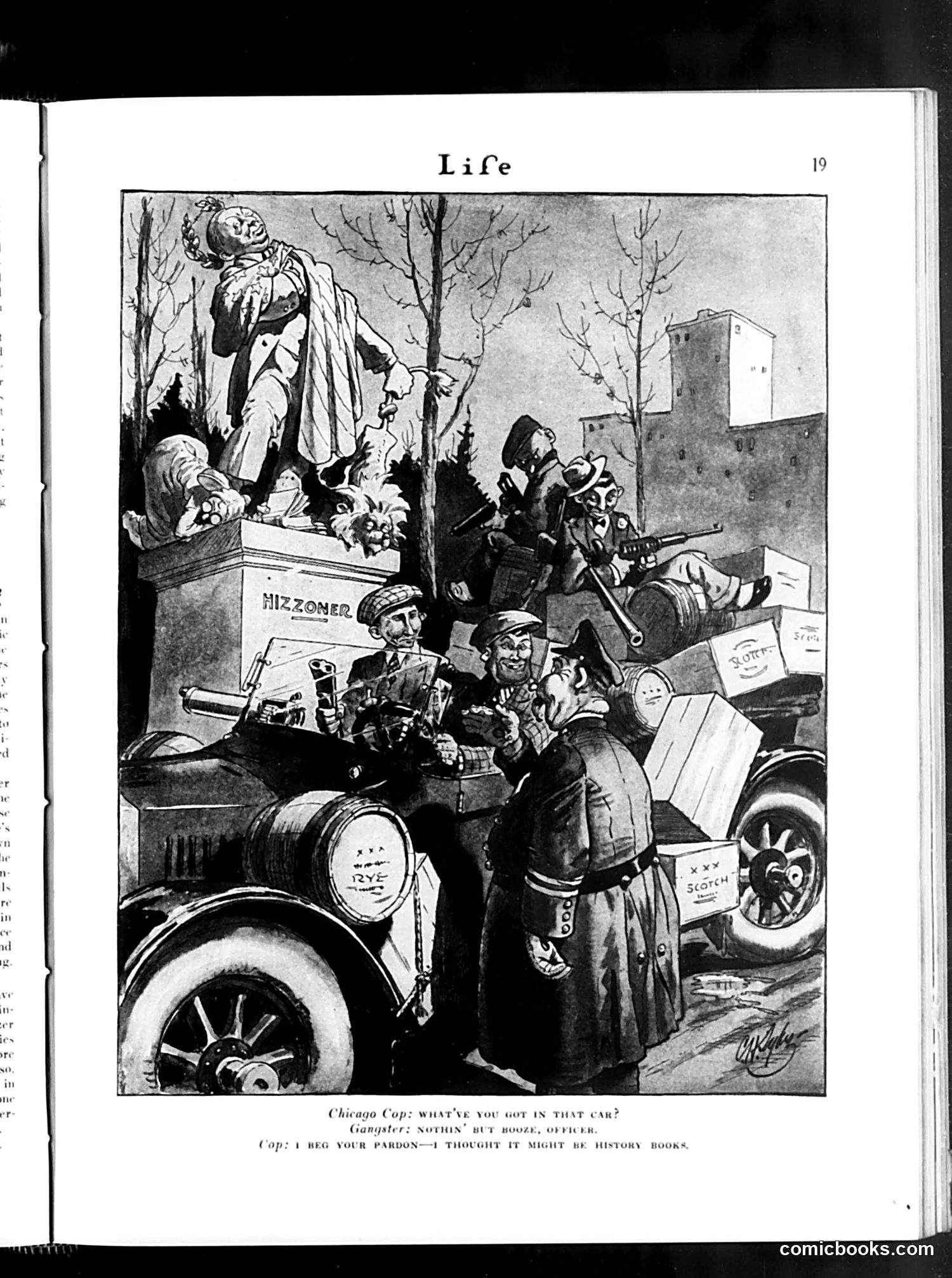
This is a satirical cartoon about Prohibition-era Chicago crime. A Chicago police officer stops a car driven by a gangster and asks what he's carrying. The gangster replies it's "nothin' but booze," and the cop jokes he thought it "might be history books"—sarcastically suggesting the gangster should be carrying educational material instead. The cartoon mocks the widespread corruption of Chicago police during Prohibition (1920-1933). It implies cops were so accustomed to gangsters openly transporting illegal alcohol that the officer treats it as routine, almost humorous. The joke criticizes law enforcement's failure to enforce Prohibition laws, suggesting police were either complicit or so overwhelmed by bootlegging that they'd stopped taking it seriously. The bare trees and fortress-like tower suggest a bleak urban landscape dominated by organized crime.
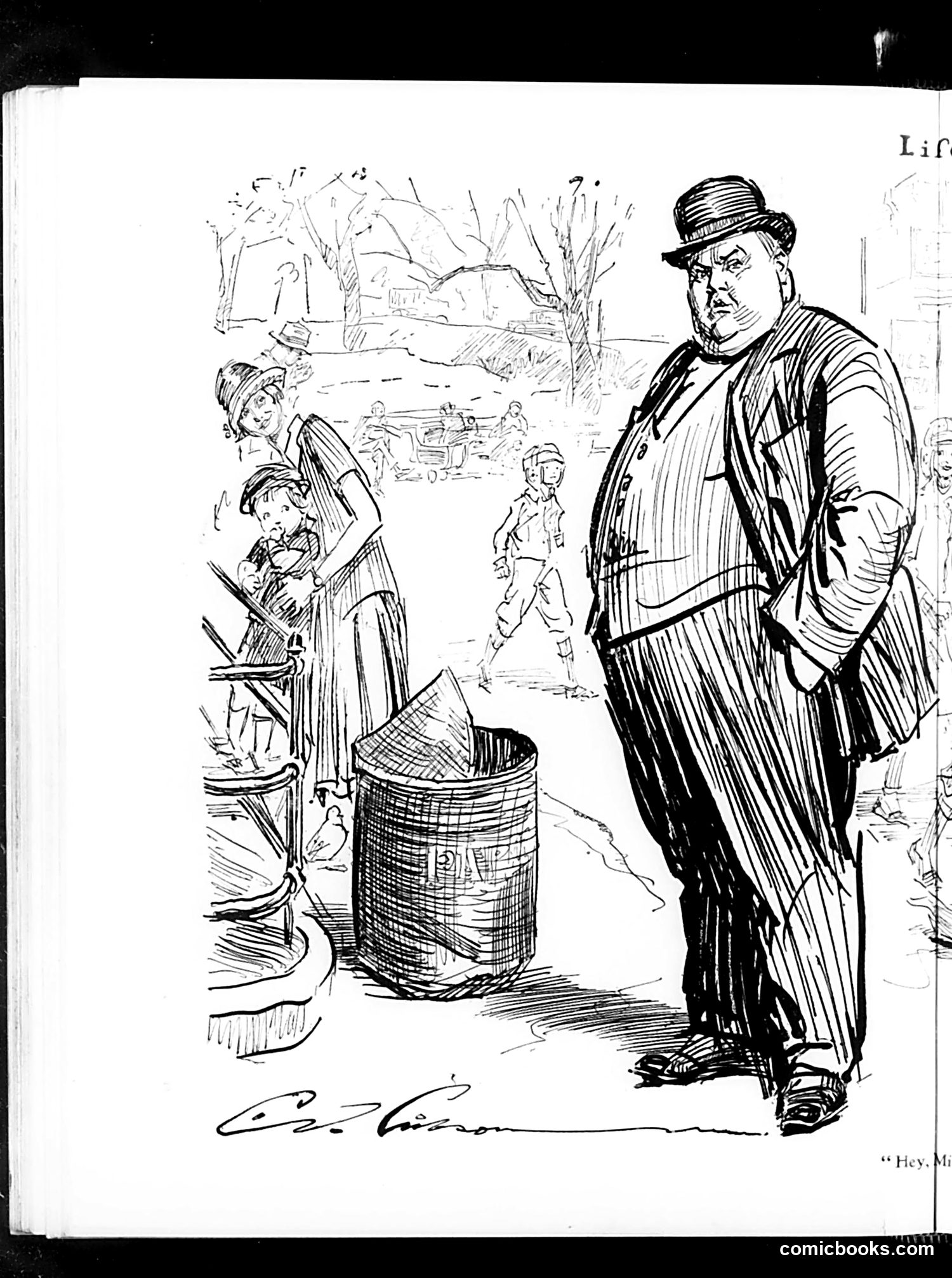
This appears to be an early 20th-century Life magazine cartoon satirizing urban poverty and child welfare. The scene shows a well-dressed, portly man in a bowler hat confronting a woman (likely a mother) holding children near a trash can marked "PAL" in what appears to be a slum setting. The cartoon critiques wealthy indifference to poor families living in squalid conditions. The man's prosperous appearance contrasts sharply with the family's desperation—they're scavenging near garbage. The visible text fragment "Hey, M..." (incomplete in this excerpt) likely contained dialogue emphasizing the social commentary about class disparity and children's welfare during an era of increasing progressive reform movements.
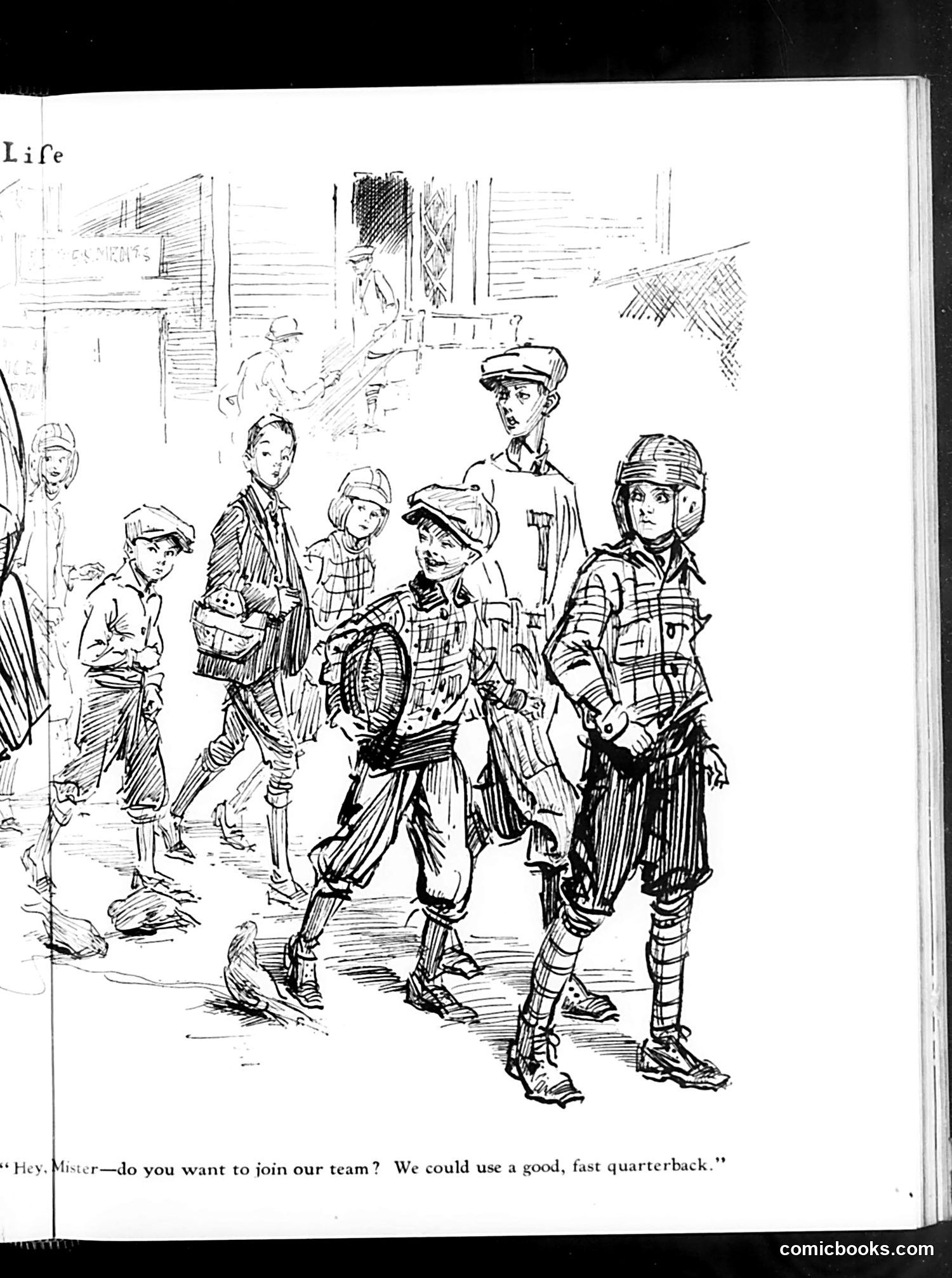
This is a cartoon from *Life* magazine depicting a street scene where children are recruiting someone to play quarterback for their informal baseball or football team. The figures are drawn in early-20th-century style with period clothing and caps. The humor appears to be straightforward: children approach an adult (likely a working man, given his appearance) with an enthusiastic sports recruitment pitch. The joke relies on the contrast between the children's casual street game and their serious, businesslike tone in "recruiting" an adult player. Without additional context about when this was published or who the adult figure might represent, the cartoon seems to be simple social satire about childhood sports culture rather than specific political commentary. It captures a common American street scene of the era.
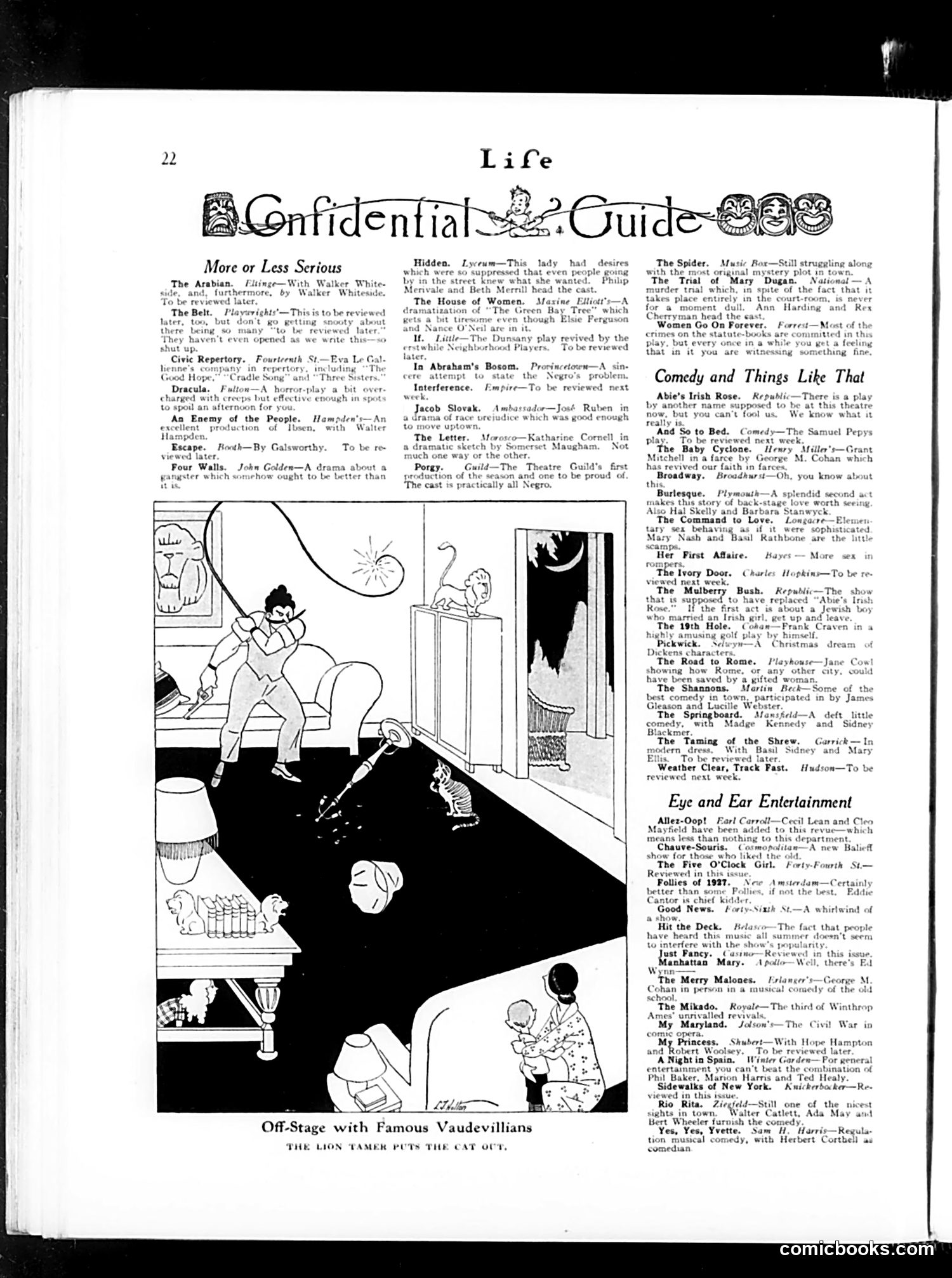
This cartoon depicts a backstage scene where a lion tamer has literally ejected a cat from what appears to be a theatrical dressing room or performance space. The humor is visual and literal: the caption plays on the phrase "put the cat out" (meaning to eject someone), visualized as an actual large cat being forcibly removed. The page itself is a theater guide listing Broadway and vaudeville shows of the era, with brief reviews. The cartoon serves as comic relief among the entertainment listings. "Vaudevillians" refers to performers in vaudeville—variety entertainment popular in early 20th-century America featuring acrobats, comedians, musicians, and animal acts. The joke relies on absurdist physical comedy typical of 1920s humor, with no deeper political or social commentary evident.
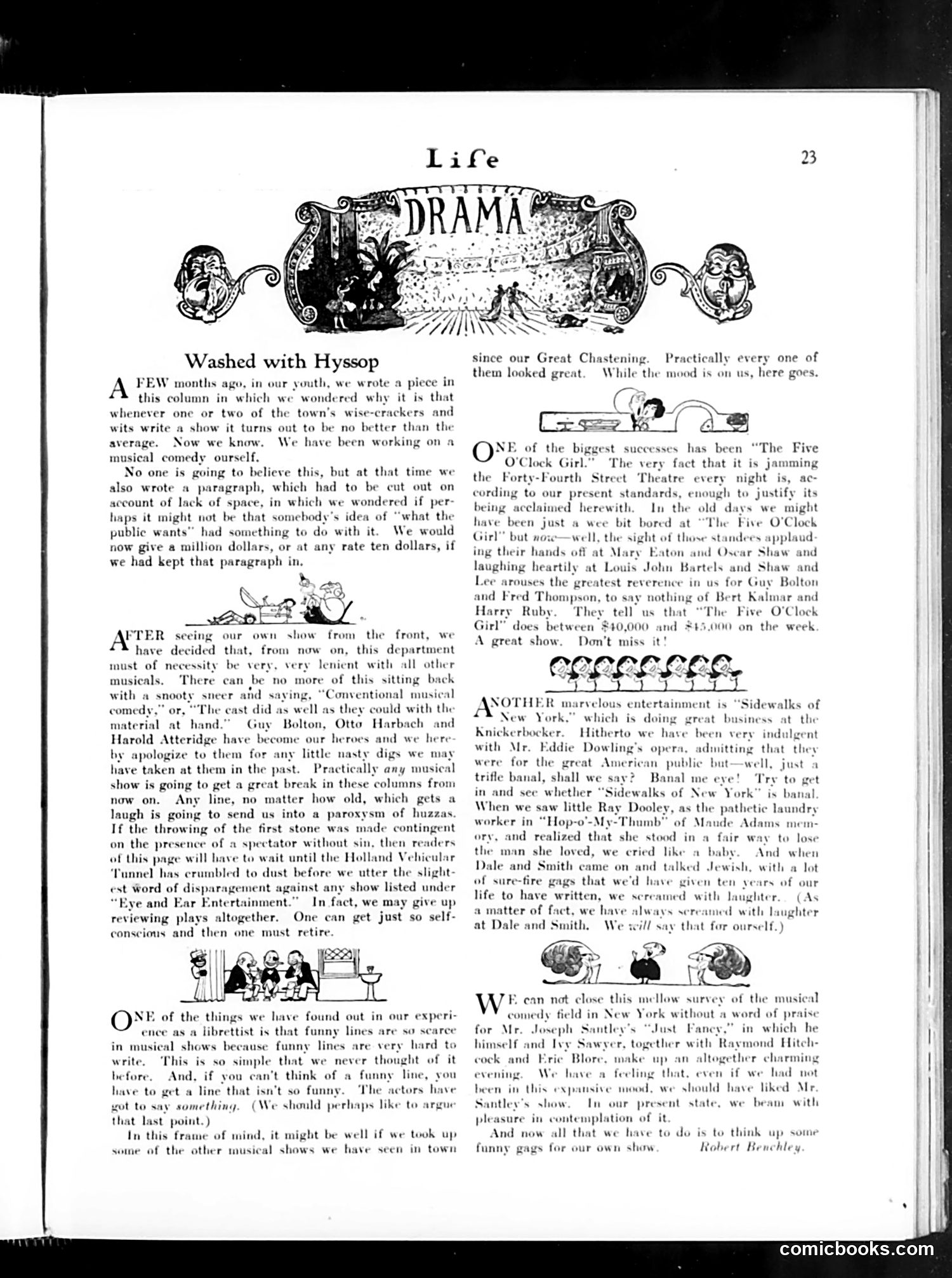
This is a humorous essay by Robert Benchley (bylined at bottom) about writing musical comedy. The author confesses that after attempting to write a show himself, he's become sympathetic to other playwrights' struggles—funny lines are genuinely difficult to write. The piece praises two current Broadway hits: "The Five O'Clock Girl" (featuring Mary Eaton and Oscar Shaw at the Forty-Fourth Street Theatre, earning $40,000-$45,000 weekly) and "Sidewalks of New York" at the Knickerbocker, which features Ray Dooley. The satire is self-deprecating: Benchley admits he previously criticized musicals harshly but now, having experienced the creative difficulty firsthand, he's reformed his snobbish attitude. He humorously pledges to stop being a harsh theater critic. The small illustrations show theatrical scenes and performers, typical of Life's drama coverage. This reflects 1920s Broadway's prominence in American culture and entertainment journalism.
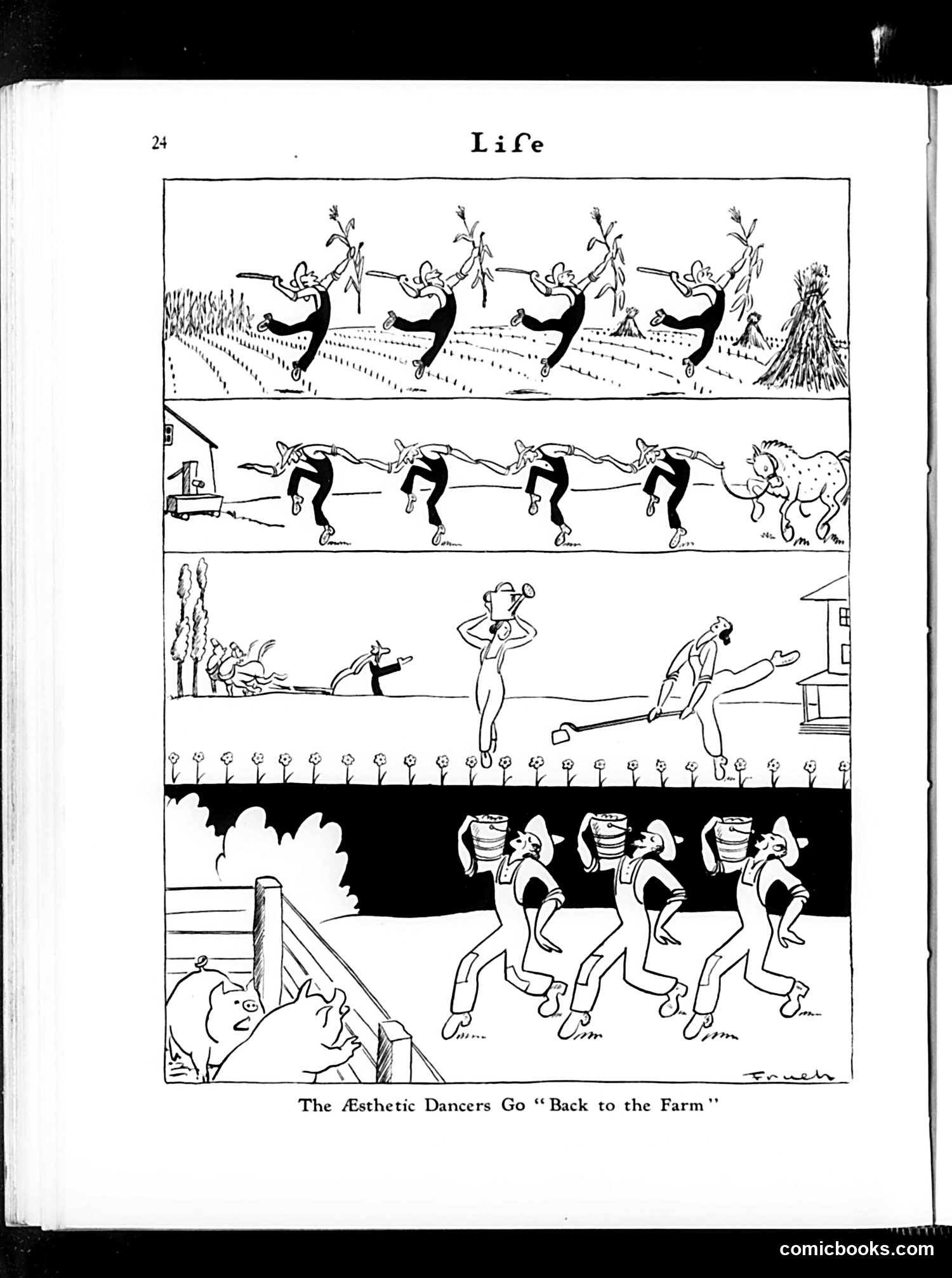
This satirical cartoon mocks the "aesthetic movement" — an late 19th-century artistic trend emphasizing beauty and refined taste. The joke shows fashionable aesthetic dancers (portrayed in stylized, affected poses) progressively abandoning their pretentious urban lifestyle and returning to manual farm labor. The panels depict the dancers' gradual transition: from graceful, affected movements in fields, to more strenuous farm work, culminating in them carrying buckets and doing heavy labor alongside pigs. The satire suggests that aesthetes' refined philosophy cannot survive real-world practicality — their artistic pretensions crumble when confronted with actual agricultural work. The cartoon ridicules both the affectations of the aesthetic movement and the gap between artistic idealism and harsh reality.
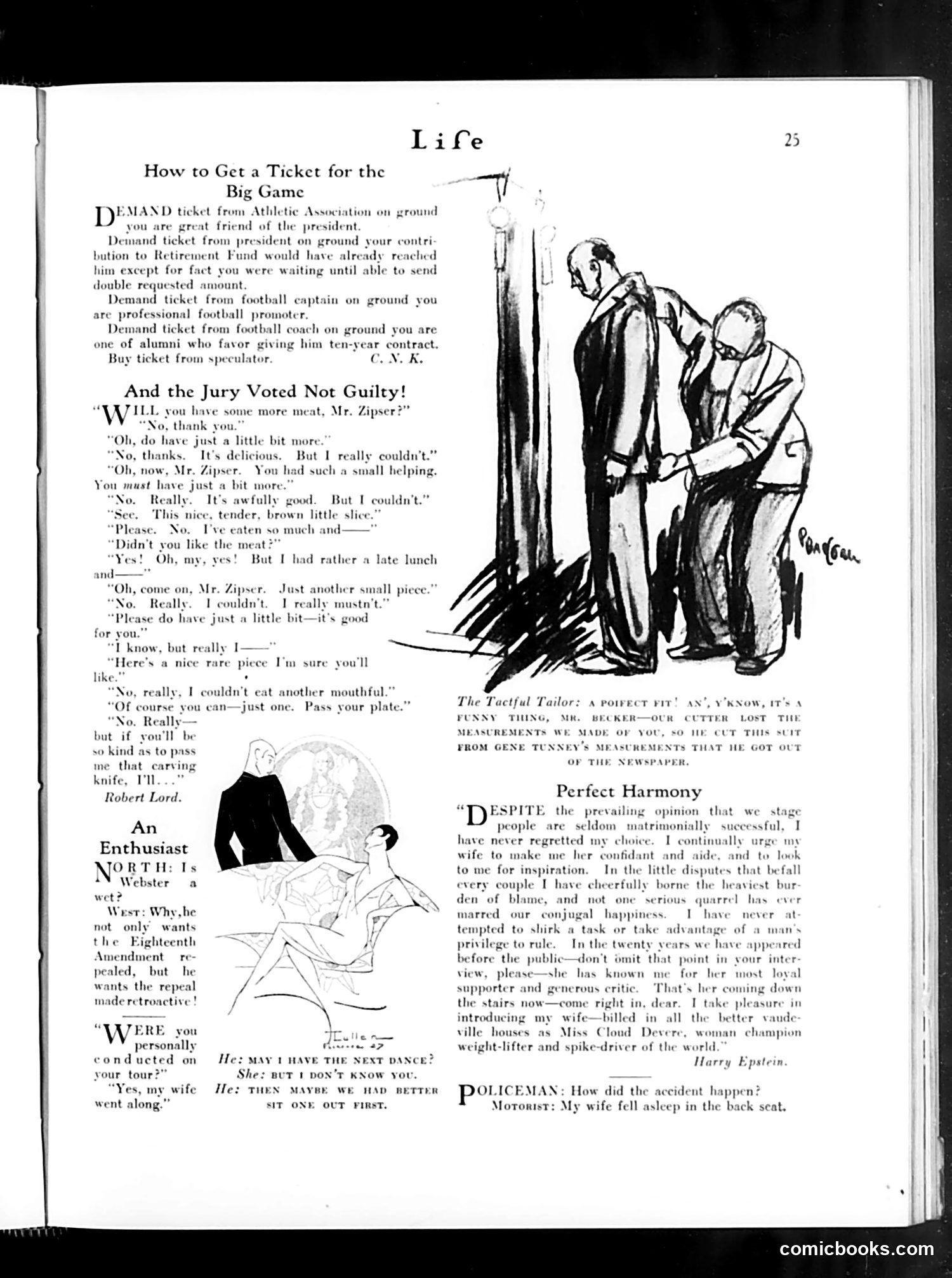
This page contains several satirical pieces mocking early 20th-century American social conventions: **"How to Get a Ticket for the Big Game"** humorously catalogs absurd ways to obtain football tickets through manipulation—leveraging friendships with university presidents, threatening donation withdrawals, or claiming professional promotion credentials. The joke reflects how collegiate athletics created a secondary ticket market and social favoritism. **"And the Jury Voted Not Guilty!"** depicts relentless social pressure to overeat at dinner. The hostess repeatedly insists Mr. Zipser accept more meat despite his polite refusals, satirizing oppressive Victorian-era hospitality customs where refusing food was considered insulting. **"The Tactful Tailor"** jokes that a tailor mistakenly used boxer Gene Tunney's measurements (obtained from newspaper photos) to cut a suit, humorously explaining a poor fit. **"Perfect Harmony"** ironically presents a man bragging about his submissive marriage while his wife—billed as "Miss Cloud Devere, woman champion weight-lifter and spike-driver"—descends the stairs. The satire undercuts his claims of marital superiority. **The final joke** presents a motorist claiming his wife fell asleep in the back seat during an accident—implying careless driving.
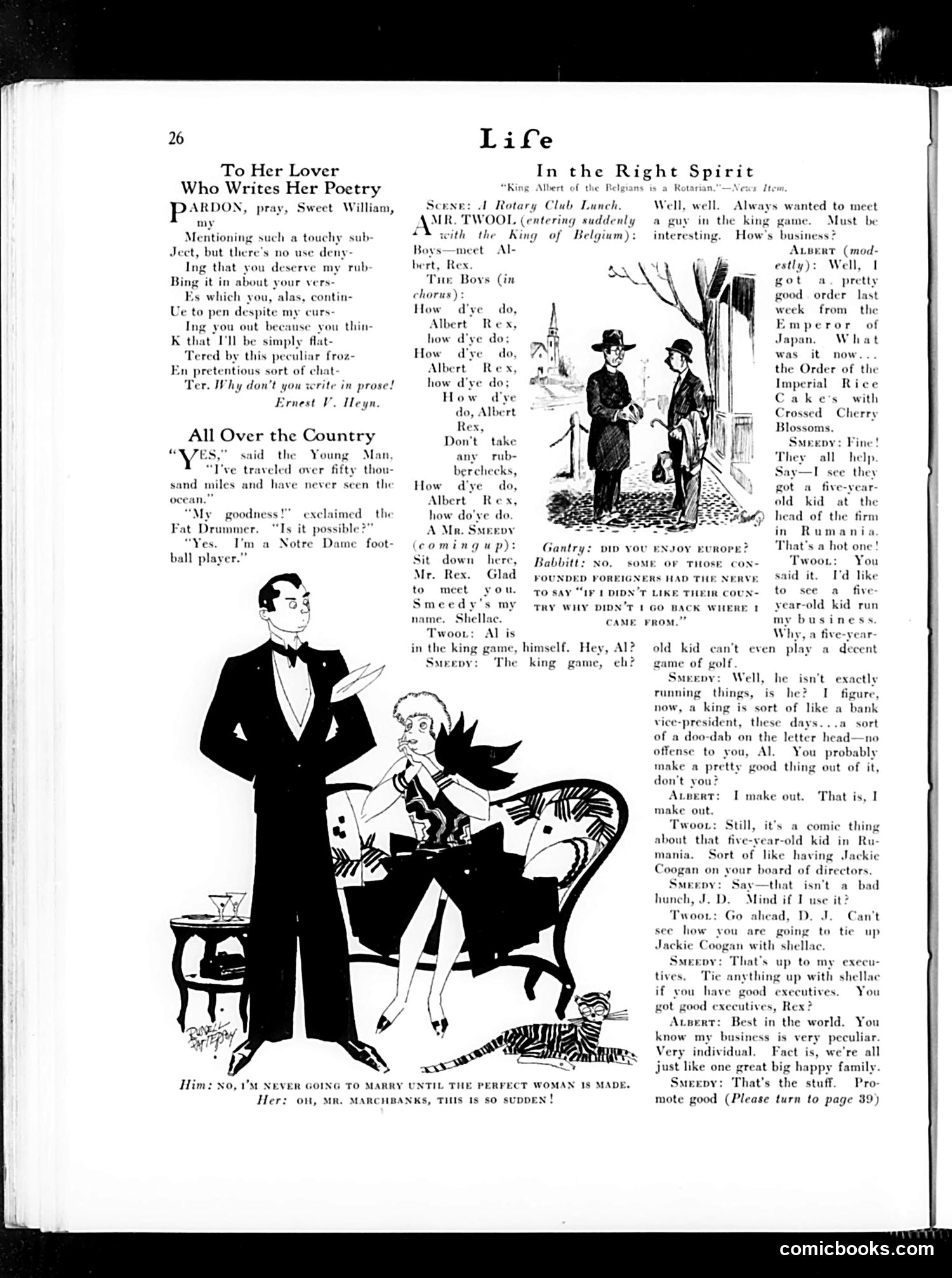
This page from *Life* magazine contains two satirical pieces: **"All Over the Country"** mocks American business culture and superficial conversation. A young man brags about traveling fifty thousand miles without seeing the ocean, revealing his ignorance; a fat drummer expresses astonishment. The joke satirizes both the traveler's obliviousness and the drummer's gullibility. **"In the Right Spirit"** satirizes the Rotary Club (a service organization for businessmen) by imagining King Albert of Belgium attending a lunch meeting. American businessmen treat him as merely another peer, discussing him like a "bank vice-president" rather than royalty. The humor comes from the mundane, corporate way they interact with actual royalty—reducing him to business jargon and organizational structure. References to a five-year-old Rumanian child (likely Leopold III's heir) and actress Jackie Coogan add contemporary detail, but the core satire targets how American business culture flattens all distinctions into corporate speak.
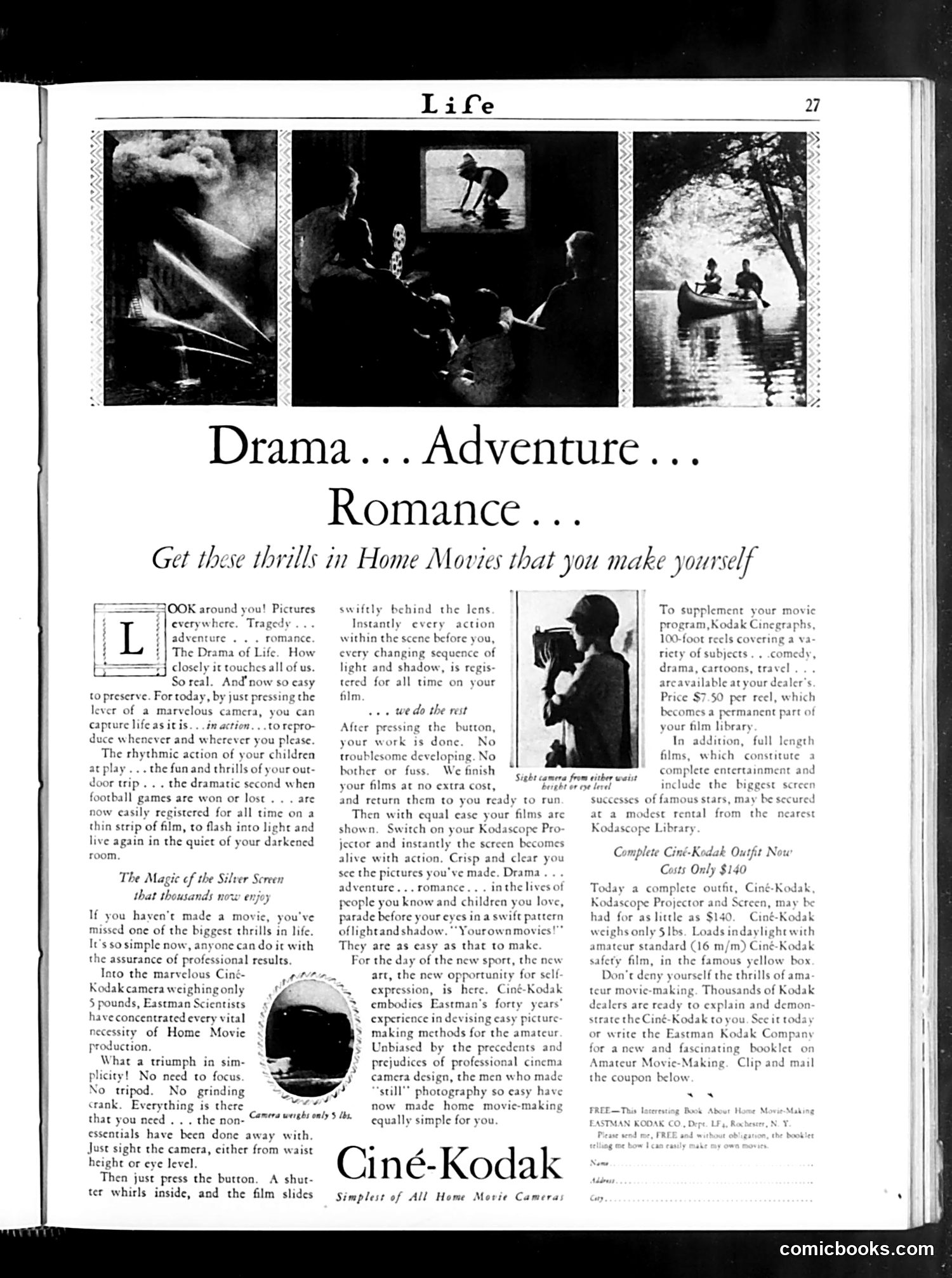
This is primarily **advertising copy, not satire or political commentary**. The page promotes Ciné-Kodak home movie cameras to amateur consumers. The three photographs at top illustrate the product's appeal: dramatic scenes (possibly from commercial films) suggesting what home users can capture themselves—domestic moments, outdoor adventures, romantic scenes. The text emphasizes accessibility and simplicity: the camera requires no focusing, tripod, or cranking. Users simply "press the button" and Kodak handles developing ("we do the rest"). The messaging targets middle-class families wanting to preserve memories and experience the "thrill" of filmmaking previously limited to professionals. Key selling points include affordability ($140 for a complete outfit), ease of use ("anyone can do it"), and the emotional appeal of reliving family moments. The language—"Drama...Adventure...Romance"—romanticizes ordinary domestic life as cinematic. This reflects 1920s-1930s consumer culture: democratizing technology and framing leisure activities around capturing and replaying personal experience.
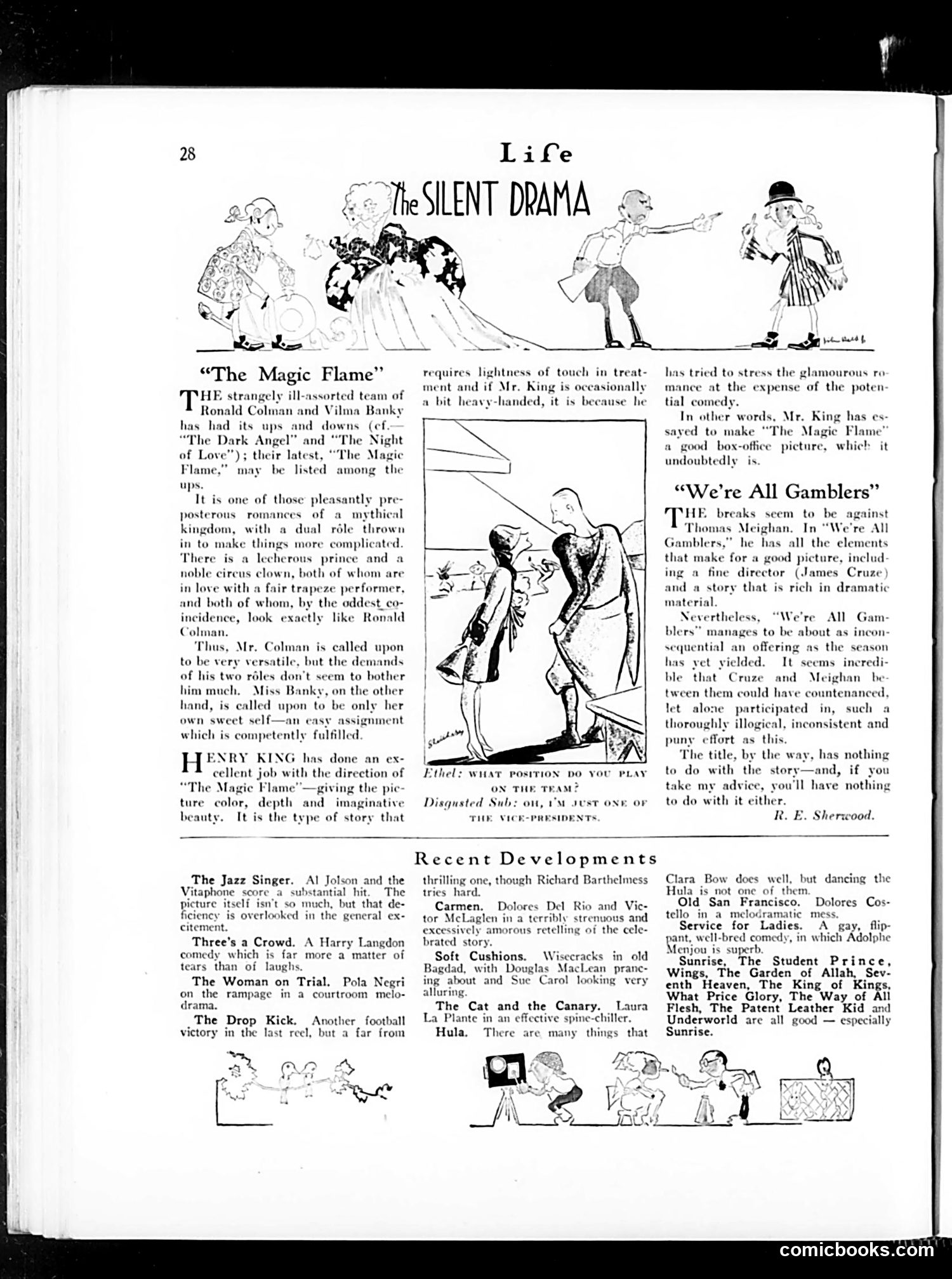
This page reviews current silent films (circa mid-1920s based on titles like *The Jazz Singer*). The main cartoon shows two characters in period costume—one says "What position do you play on the team?" The other, labeled "Disgusted Sub," replies "Out, I'm just one of the vice-presidents." **The satire:** This mocks the film *"We're All Gamblers,"* suggesting it has too many incompetent decision-makers ("vice-presidents") rather than unified creative vision. The reviewer (R.E. Sherwood) criticizes director James Cruze and star Thomas Meighan for creating an "illogical, inconsistent and puny effort." The page also reviews *"The Magic Flame"* with Ronald Colman and Vilma Banky, praising director Henry King's work while noting he occasionally over-emphasizes romance at comedy's expense. **For modern readers:** This represents how film criticism worked in the 1920s—focused on star power, directorial skill, and narrative coherence. The cartoon's "vice-presidents" joke reflects period anxieties about committee-driven creative decisions undermining artistic quality.
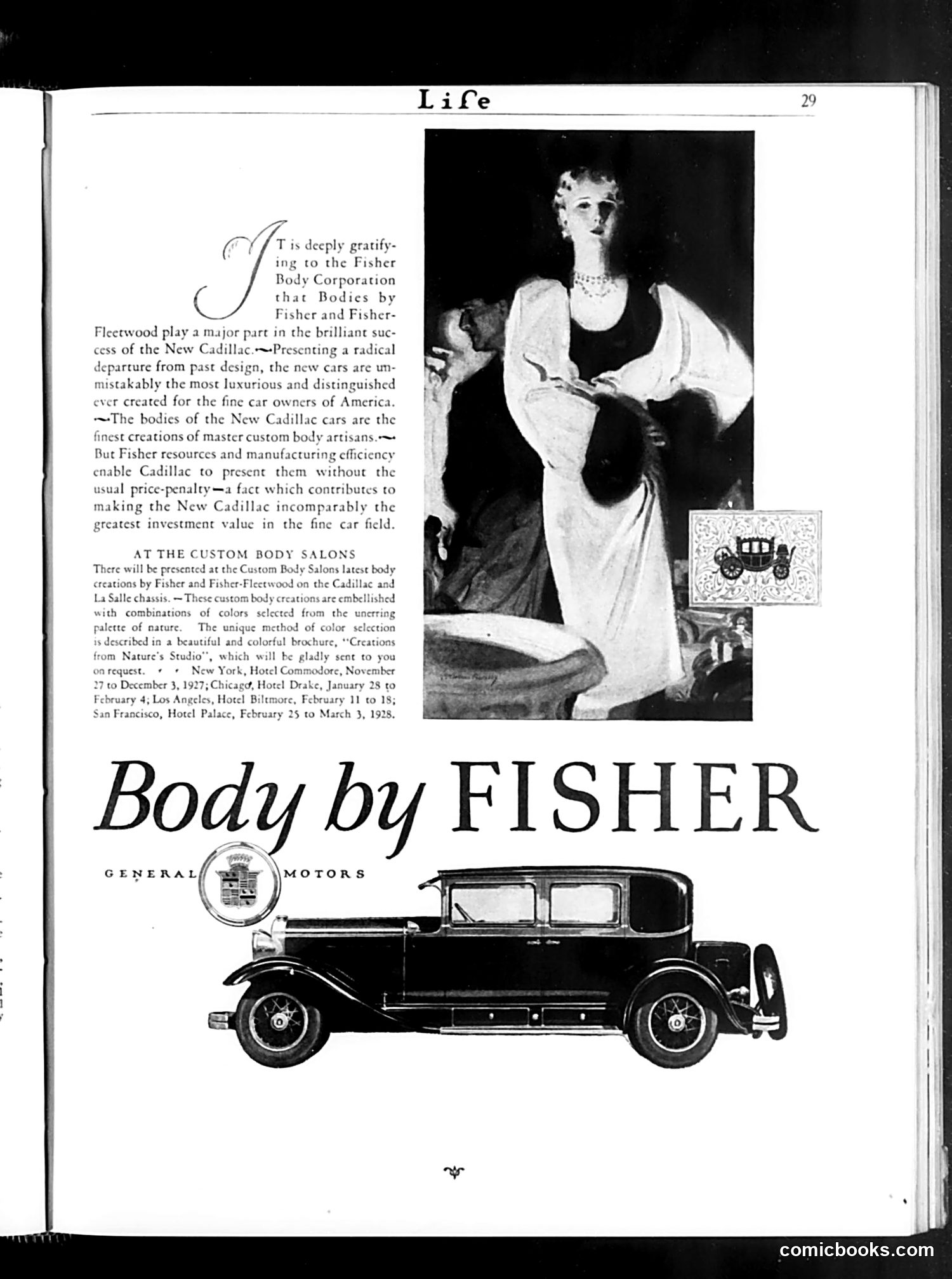
This page is primarily a **1927-1928 automobile advertisement**, not political satire. It promotes Cadillac cars with custom bodies built by Fisher Body Corporation (a General Motors subsidiary). The photograph shows a woman in elegant 1920s evening wear, representing the luxury market Fisher targeted—affluent Americans who could afford custom-bodied automobiles. The accompanying text emphasizes that Fisher's manufacturing efficiency allows Cadillac to offer luxurious custom bodies without typical price premiums, making them "the greatest investment value in the fine car field." The lower section announces "Custom Body Salons" touring major U.S. cities (New York, Chicago, Los Angeles, San Francisco) from November 1927 through March 1928, where potential buyers could view Fisher's latest body designs. This reflects the 1920s boom era when custom automobile bodies represented status symbols for the wealthy. There is no evident political cartoon or satire on this page—it is straightforward luxury goods marketing.
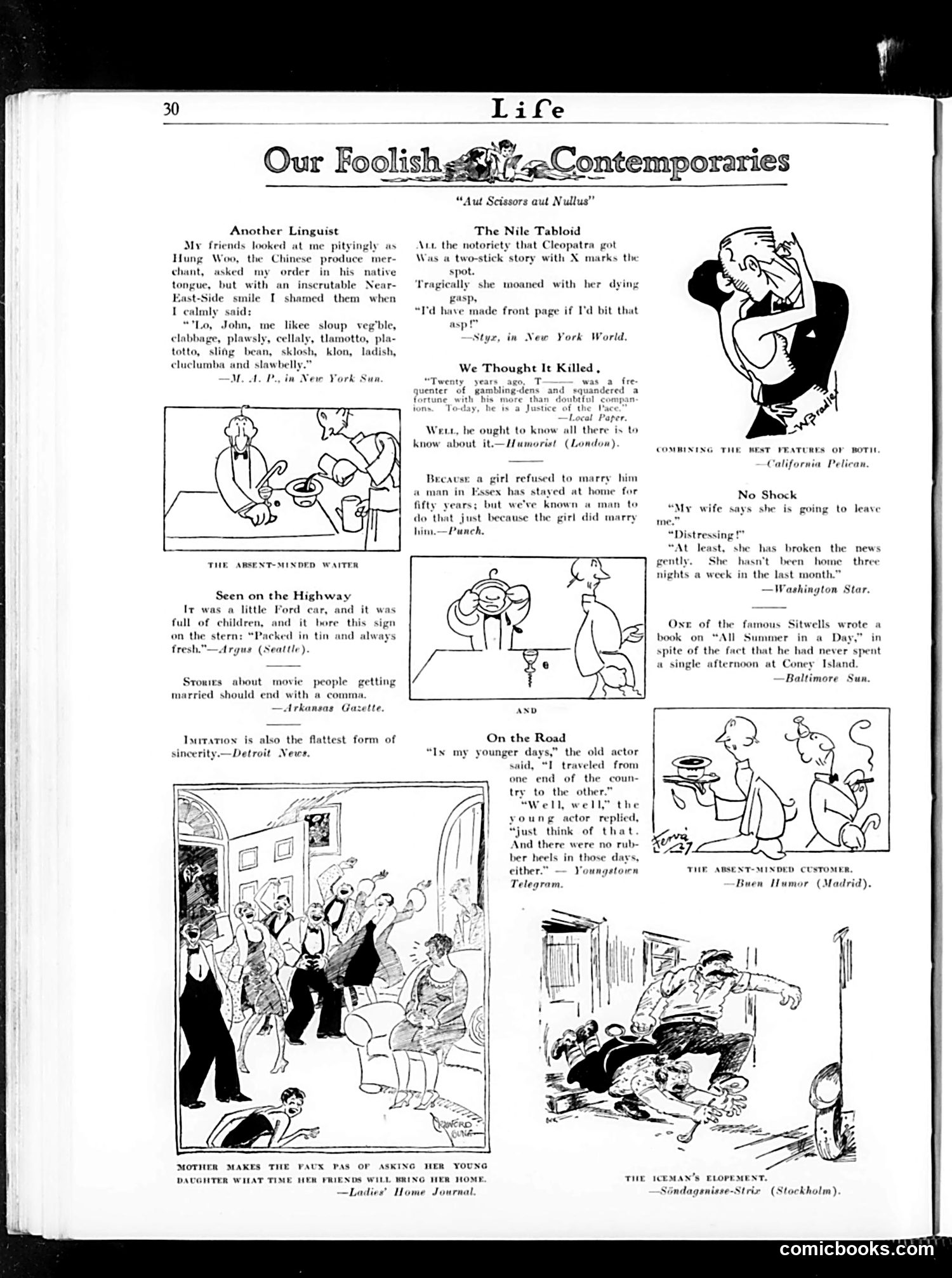
This is a satirical humor compilation mocking contemporary social absurdities and newspaper quirks. Key sections: **"Another Linguist"**: Jokes about pretentious language use—a man attempts to impress friends by rattling off Chinese vegetable names to a Chinese merchant, only to be humbled by the merchant's perfect English. **Various short quips** mock: absent-minded waiters, a car advertisement with an unintentionally funny sign about children, and a man who isolated himself for fifty years after rejection. **"On the Road"**: Contrasts an old actor's tales of youthful travel hardships with modern comforts—satire on nostalgia and generational differences. The cartoons illustrate these anecdotes with exaggerated line drawings typical of 1920s-30s humor journalism. The page's title—"Aut Scissors aut Nullus" (roughly "either wit or nothing")—frames the magazine's mission: collecting amusing human foibles and newspaper absurdities for educated readers' entertainment. The sourcing of jokes to various newspapers emphasizes Life's role curating contemporary humor.
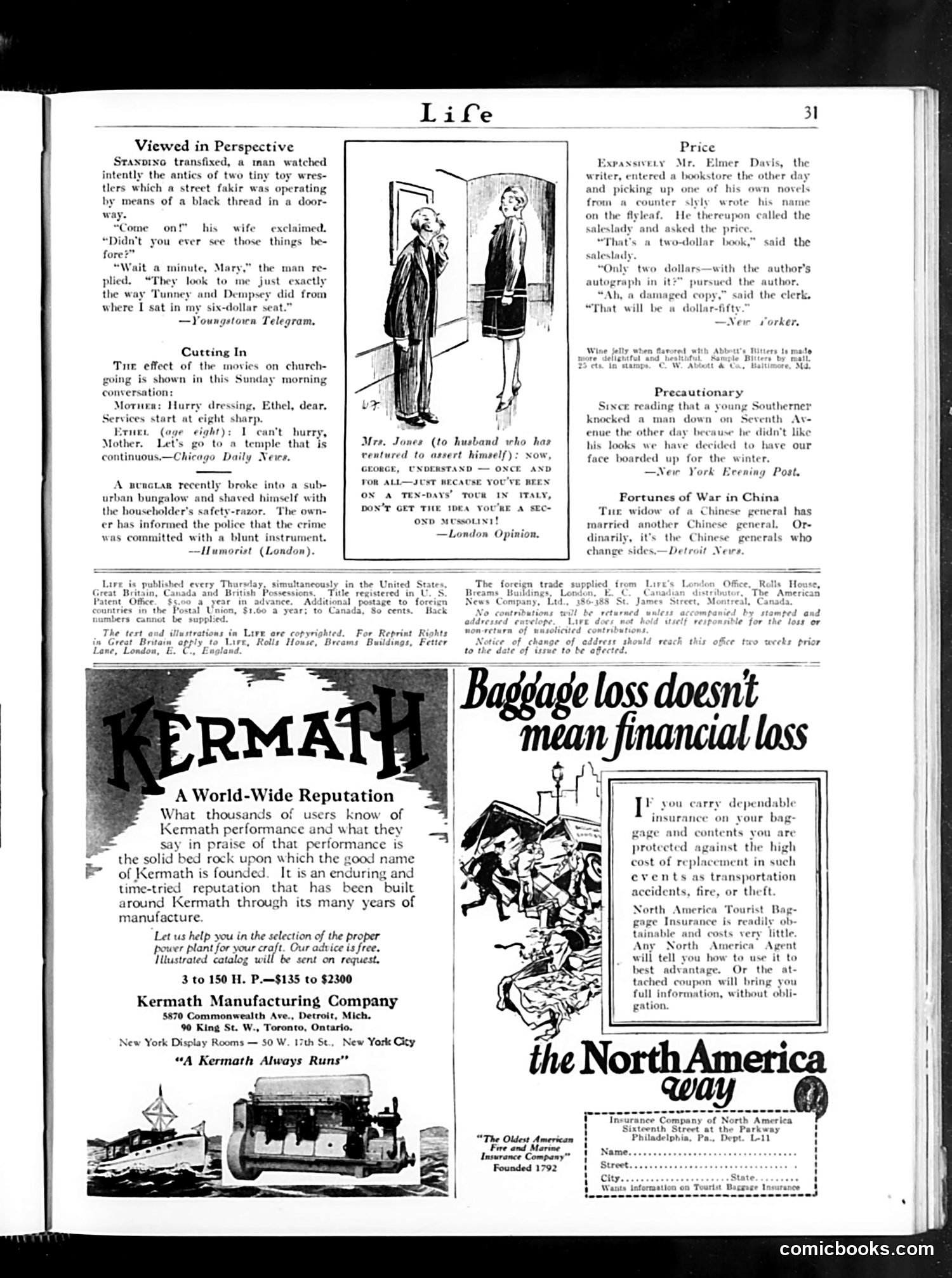
This page contains several short satirical pieces typical of Life's humor format: **"Viewed in Perspective"** mocks the 1926 Dempsey-Tunney boxing match—a man watching toy wrestlers says they resemble the famous fight he watched from a cheap six-dollar seat, suggesting the expensive live event was as small and unimpressive as watching toys. **"Cutting In"** jokes about cinema's impact on church attendance: a woman prefers a continuous-showing movie theater to traditional Sunday services, reflecting 1920s anxieties about film replacing religious observance. **Other brief items** satirize: a burglar using a safety-razor (commenting on crime or tools), an author's damaged book with his autograph becoming "worthless," and absurd domestic dynamics (a wife warning her husband not to act superior after his Italy vacation). **"Fortunes of War in China"** presents dark humor about Chinese generals—noting that widow remarrying another general is unremarkable since "Chinese generals change sides" regularly, referencing the era's Chinese warlord conflicts. The page also contains straightforward advertisements for Kermath engines and North America baggage insurance, typical of period magazines.
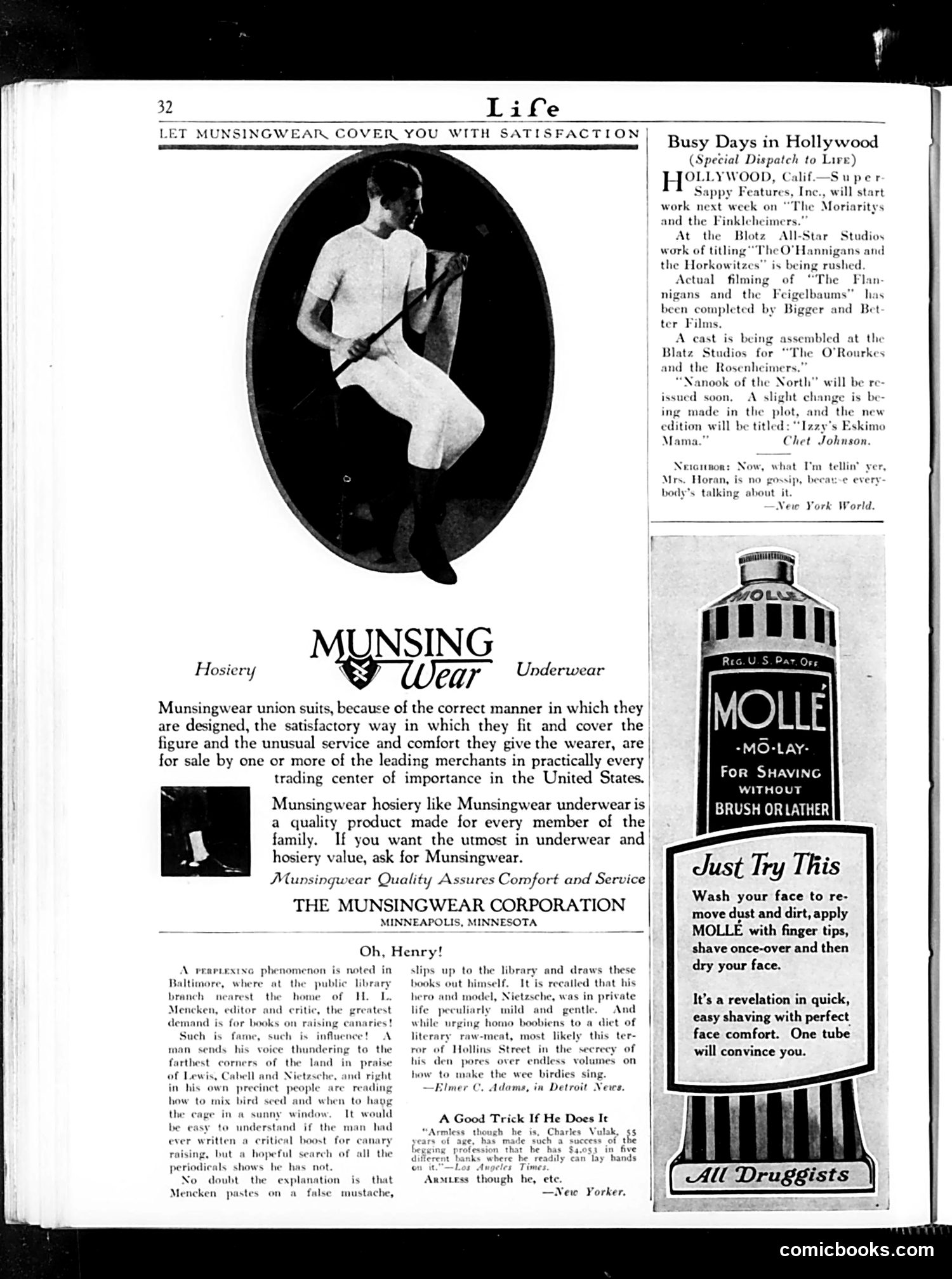
This page contains several unrelated satirical pieces typical of Life's format: **"Busy Days in Hollywood"** mocks the film industry's ethnic-themed movies by listing absurdly mixed titles ("The O'Hannigans and the Horkowitzes," "Izzy's Eskimo Mama"). The satire targets Hollywood's casual, often stereotypical approach to ethnicity in filmmaking during this era. **"Oh, Henry!"** references H.L. Mencken, the Baltimore editor and cultural critic. The joke is that library patrons near Mencken's home are suddenly checking out books on raising canaries—apparently influenced by his outspoken opinions on unrelated subjects. It satirizes Mencken's outsized cultural influence and people's tendency to follow intellectual figures even into absurd territory. **"A Good Trick If He Does It"** is a brief, unclear satirical note about a magician's claim. The remainder is **advertising**: Munsingwear underwear/hosiery and Mollé shaving cream—standard commercial content of the era.
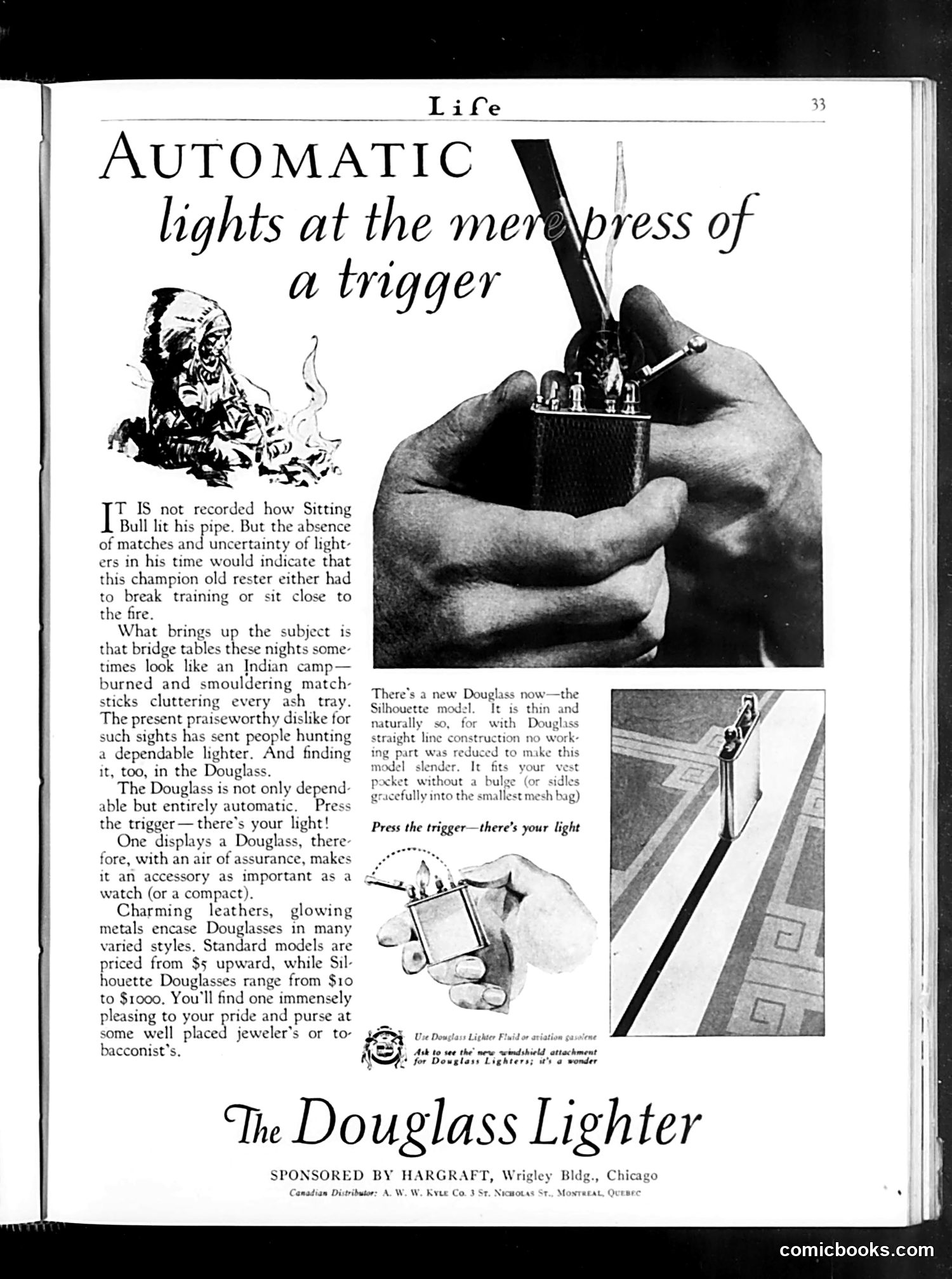
This is primarily a **product advertisement**, not political satire. The page promotes an automatic lighter with a trigger mechanism. The humor relies on a **cultural reference to Sitting Bull**, the famous Native American leader. The ad opens with a joke: since matches and lighters didn't exist in Sitting Bull's era, he would have had to abandon his dignified reputation as a composed "rester" (a pun on his name) and sit near fires like everyone else. This reference serves as a **lighthearted hook** for the advertisement's actual point: modern bridge-game players (a popular social activity of the era) were creating messy, burnt matchsticks on tables. The Douglass lighter solves this problem with automatic ignition—just press the trigger. The ad emphasizes the lighter as a **status accessory** comparable to watches or compacts, available in luxury versions priced up to $1000, suggesting it appeals to affluent consumers seeking both functionality and style.
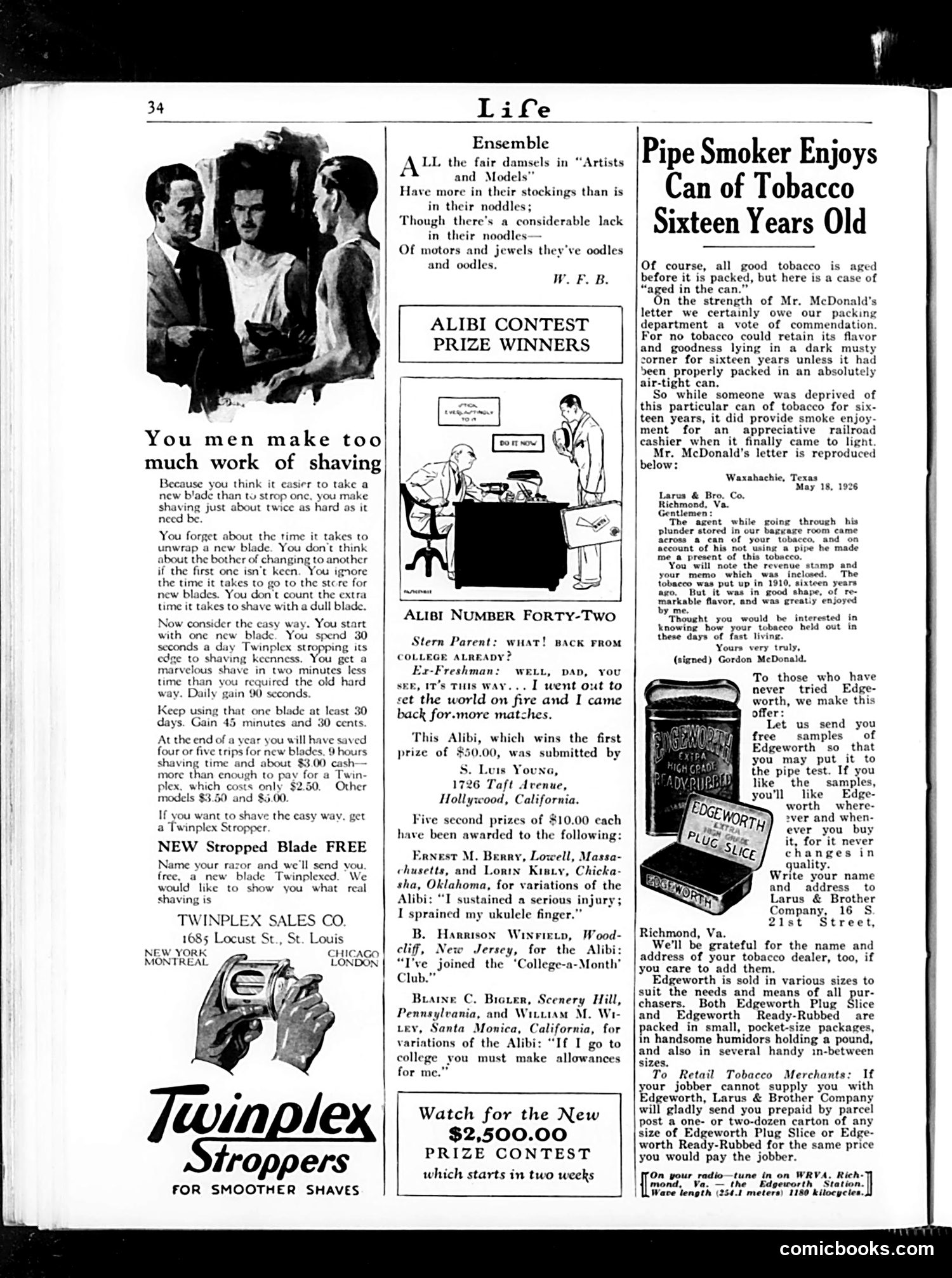
This page from Life magazine (May 1926) contains three distinct sections: **Main Advertisement:** Twinplex Stropper razors use economic logic to sell blade maintenance—arguing that stropping one blade saves money and time versus constantly buying new ones. The pitch targets men's practical concerns about cost and convenience. **"Ensemble" Verse & "Alibi Contest":** A humorous poetry snippet mocks women in the theatrical production "Artists and Models," suggesting they're physically attractive but intellectually empty ("stockings" have more substance than "noddles"/heads). The alibi contest shows readers submitting clever excuses—a college student tells his father he went out "to set the world on fire" but came back "for more matches," winning $50. **Tobacco Advertisement:** An unusual testimonial claims a can of Edgeworth tobacco from 1910 remained perfectly preserved for 16 years due to air-tight packaging. This serves as an endorsement of product quality and longevity. The page reflects 1920s consumer culture: practical product endorsements mixed with light social satire about gender and collegiate life.
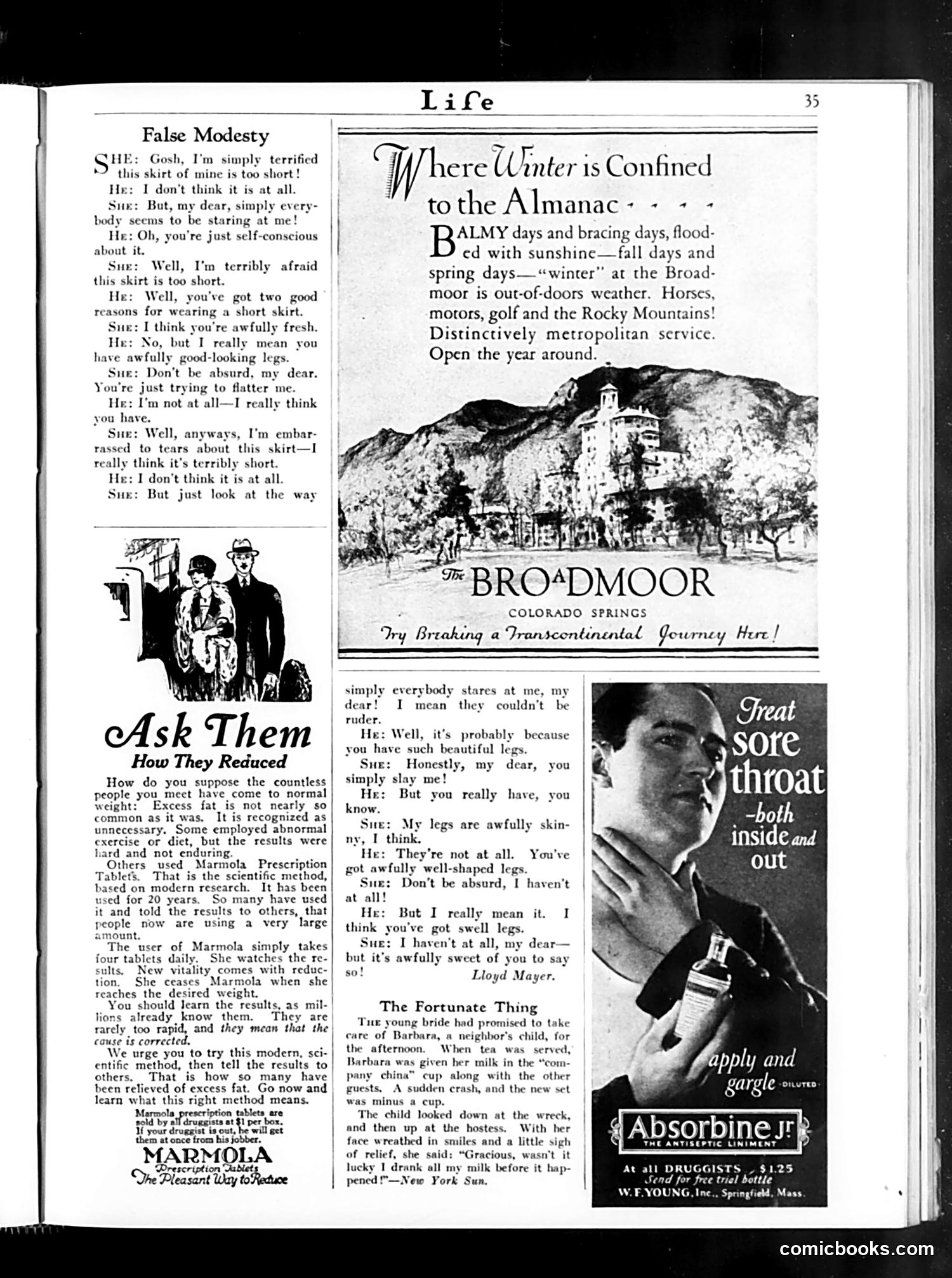
This page features a comedic dialogue between a woman and man about her short skirt. The joke plays on 1920s social anxieties about changing women's fashion—hemlines were rising dramatically during this era, causing considerable public debate about propriety and morality. The satire works through ironic reversal: the woman claims embarrassment about her skirt being "terribly short," yet when the man compliments her legs, she deflects with false modesty, denying his praise while continuing to fish for more compliments. The title "False Modesty" labels her performance—she's performatively shy while actually seeking validation. The cartoon captures the era's complex gender dynamics: women's liberation (wearing shorter skirts) clashing with Victorian expectations of demureness. The woman gets what she wants (admiration) while maintaining plausible deniability through feigned reluctance. The humor relies on readers recognizing this common social dance and the hypocrisy it reveals.
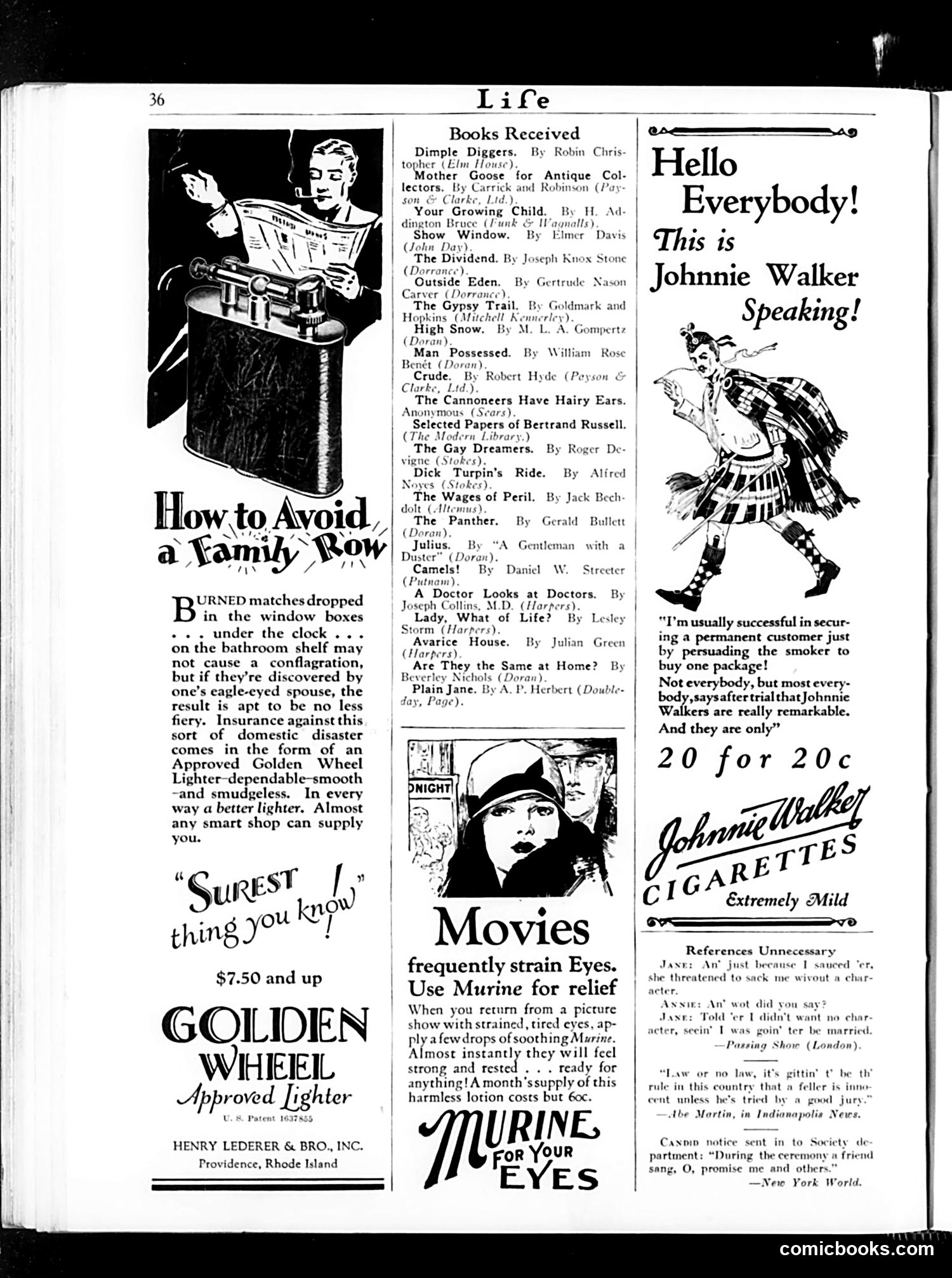
This page consists primarily of **advertising and book reviews**, not political satire. The main content includes: **"How to Avoid a Family Row"** advertises the Golden Wheel Lighter by depicting a domestic dispute scenario—a husband caught with matches (suggesting infidelity or deception) faces an angry spouse. The lighter is pitched as preventing such "disasters" through reliability. **"Hello Everybody! This is Johnnie Walker Speaking!"** is a cigarette advertisement using a character endorsement. Johnnie Walker cigarettes are promoted as so good that one pack converts smokers into permanent customers, priced at "20 for 20c." **"Movies frequently strain Eyes"** promotes Murine eyedrops for cinema-goers. The **"References Unnecessary"** section contains humor snippets from British and American publications about marriage misunderstandings and legal matters—light domestic comedy, not political commentary. This is fundamentally a **commercial magazine page** from the early 20th century, mixing advertisements with humor and book listings. There are no political cartoons or satirical commentary present.
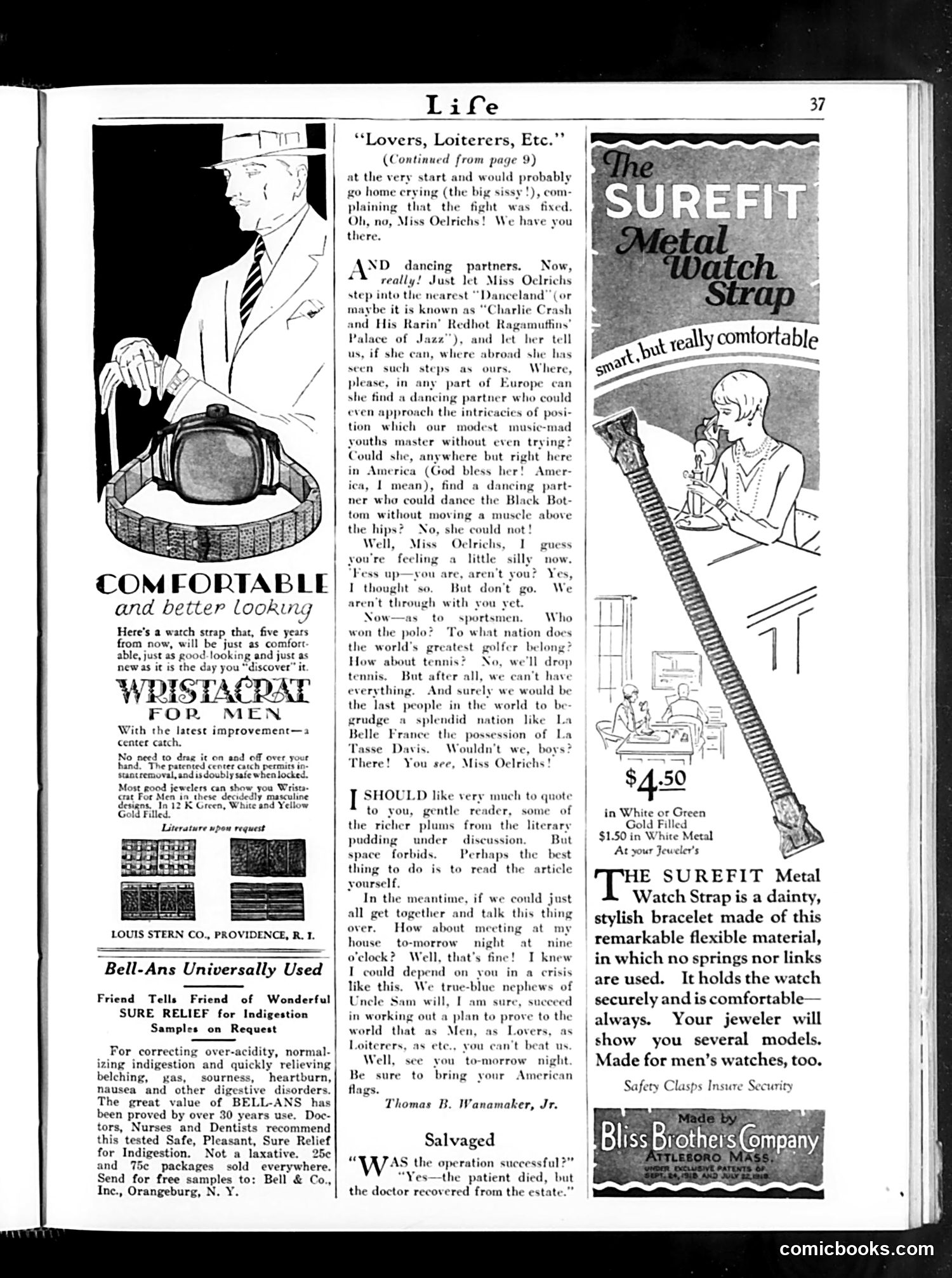
This page primarily consists of **advertisements and a satirical article** rather than political cartoons. The main text, "Lovers, Loiterers, Etc.," is a humorous essay mocking American cultural pride. The author (Thomas B. Wanamaker, Jr.) addresses a presumably wealthy woman, "Miss Oelrichs," suggesting she won't find adequate dancing partners in Europe. He then boasts that Americans excel at sports and modern entertainment—specifically referencing jazz dancing like the "Black Bottom" and "Ragamuffins' Palace of Jazz." The piece satirizes American exceptionalism and cultural superiority, particularly regarding entertainment and athletics. A separate brief joke titled "Salvaged" appears at bottom, making dark humor about a failed surgery where "the patient died, but the doctor recovered from the estate"—commenting on medical malpractice or greed. The remaining content consists of period product advertisements for watch straps, indigestion relief (Bell-Ans), and jewelry—typical 1920s marketing.
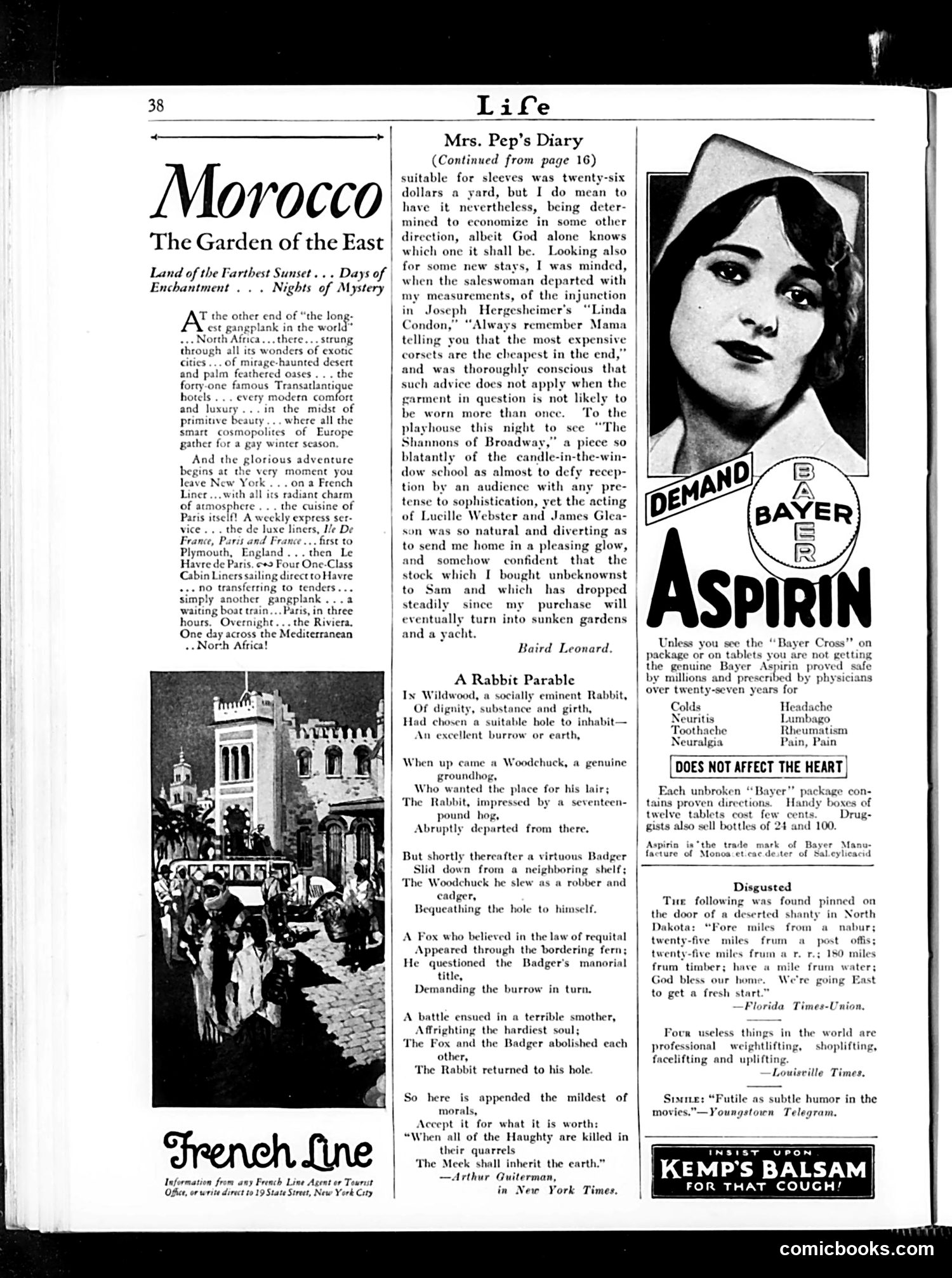
This page contains travel advertising for Morocco via French ocean liners, a society gossip column ("Mrs. Pep's Diary"), and a fable with political undertones. **"A Rabbit Parable"** is a satirical allegory about territorial disputes and power struggles. The sequence—Rabbit displaced by Woodchuck, Woodchuck killed by Badger, Badger and Fox destroying each other, Rabbit reclaiming the hole—appears to reference European colonial rivalries and conflicts, particularly in North Africa. The moral ("When all of the Haughty are killed in their quarrels / The Meek shall inherit the earth") suggests that while powerful nations exhaust themselves fighting, humble peoples may ultimately benefit. This likely comments on post-WWI geopolitics and competing imperial interests in Morocco, a region that was then the subject of international tension. The page also includes period advertisements for Bayer Aspirin, emphasizing its safety and medical endorsement.
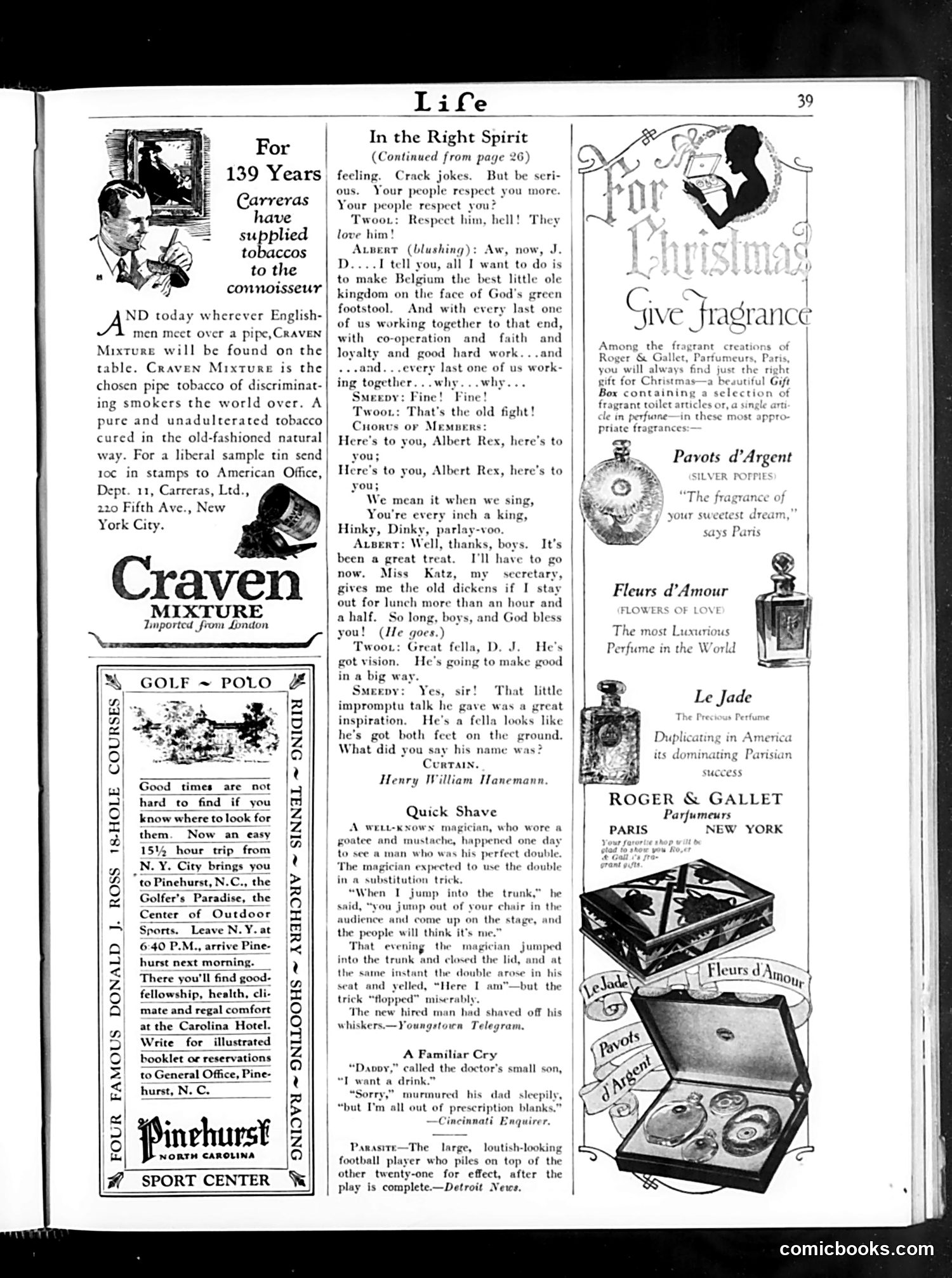
This page contains **primarily advertisements** interspersed with several brief humor pieces and a theatrical dialogue excerpt. The main content is "In the Right Spirit," a continuation of a play scene featuring **Albert Rex**, an apparent Belgian official or politician, addressing subordinates. The satire depicts Rex as a well-meaning but verbose idealist, spouting grandiose rhetoric about making "Belgium the best little ole kingdom" through cooperation and hard work. His subordinates respond with mock enthusiasm ("Respect him, hell! They love him!"), suggesting the satire targets **overwrought patriotic speeches and self-aggrandizing politicians** who obscure simple messages in flowery language. The page's humor pieces—including jokes about a magician's failed trick and a doctor's son asking for a drink—are simple, apolitical gags typical of 1920s-era Life magazine. The remaining space features **luxury product advertisements**: Craven tobacco, Pinehurst golf resort, and French perfumes (Roger & Gallet), reflecting Life's affluent readership.
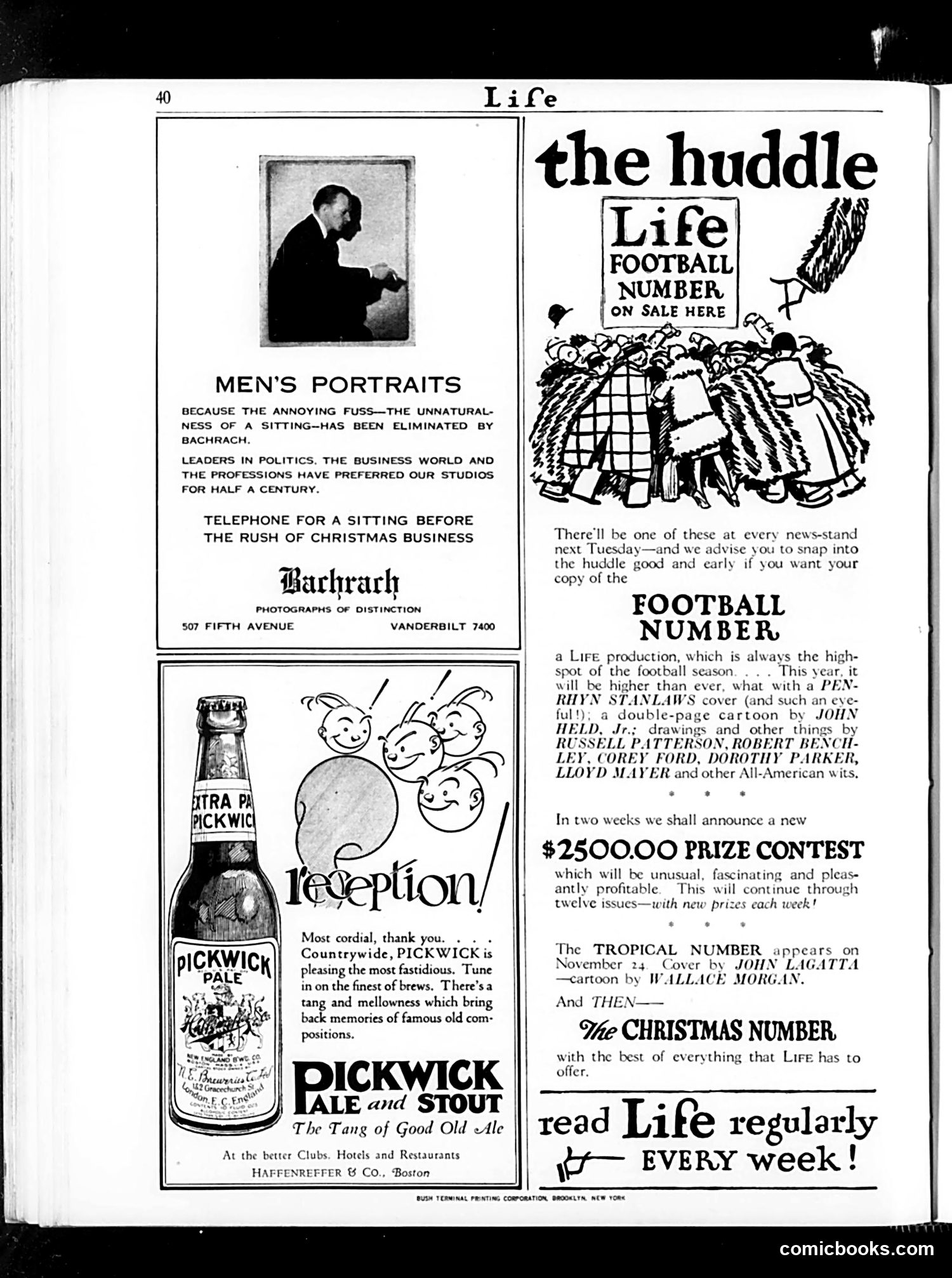
This is primarily a **advertisements and promotional page** from Life magazine, circa early 20th century. **Content:** - **Bachrach advertisement** (top left): A photography studio promoting portrait services, claiming to eliminate the "annoying fuss" of formal sittings. They note prominent political and business leaders have used them for half a century. - **Pickwick Pale & Stout advertisement** (bottom left): A beer advertisement emphasizing quality and nostalgia ("memories of famous old compositions"). - **Life's promotional content** (right side): Announcements for upcoming special issues—a **Football Number** featuring cartoonists like Penrhyn Stanlaws and humorists like Dorothy Parker; a **$2,500 prize contest**; a **Tropical Number**; and the **Christmas Number**. **Social context:** This reflects pre-Prohibition era advertising and Life's position as a major entertainment/humor magazine competing for readers with special themed issues and contests.
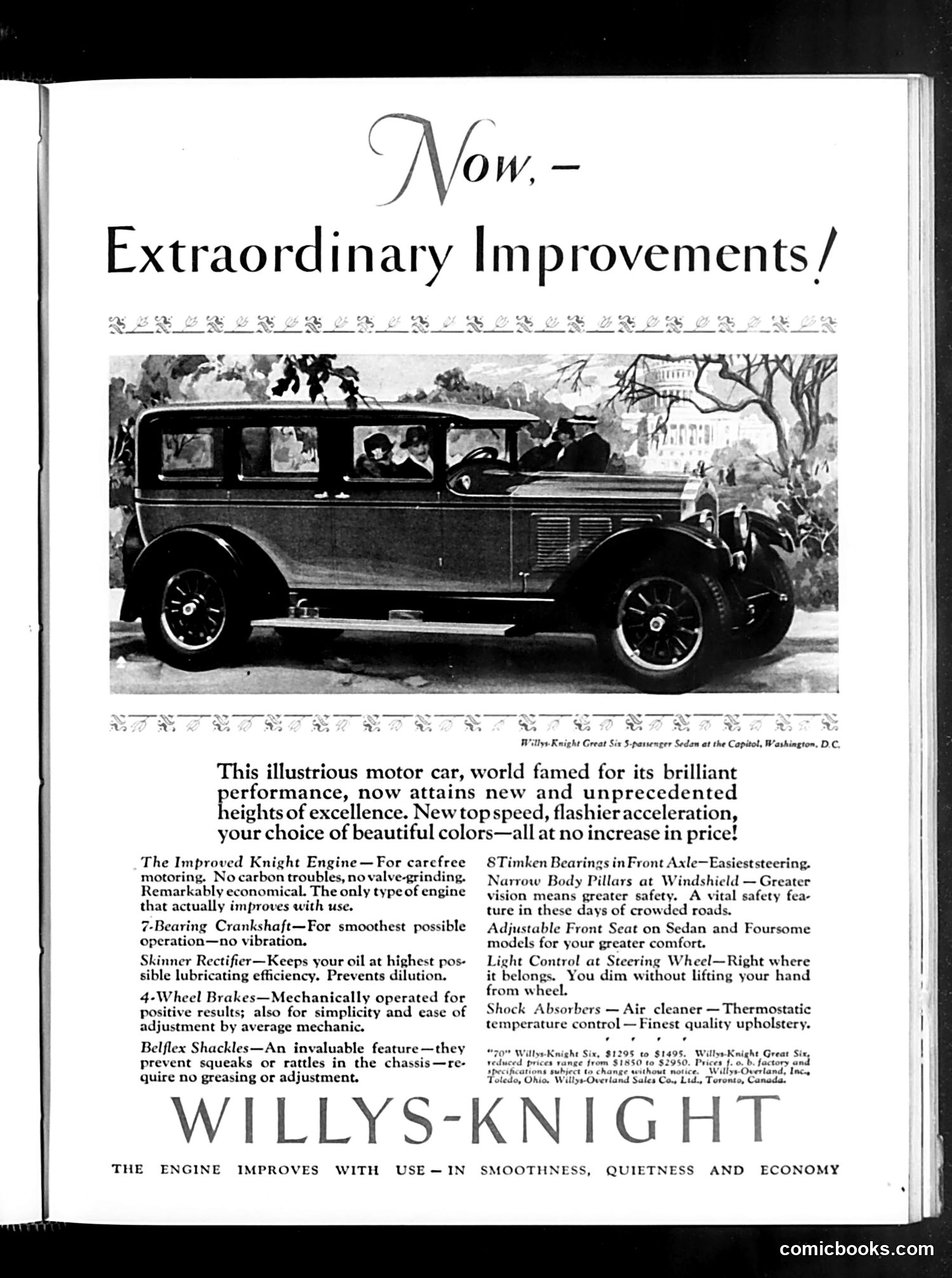
This is **not a cartoon or satire**—it's a straightforward advertisement for the Willys-Knight automobile, positioned as a prestige product. The page showcases a luxury sedan photographed at the U.S. Capitol building in Washington, D.C., a deliberate choice signaling the car's association with power and governmental authority. The ad emphasizes "extraordinary improvements" and "new and unprecedented heights of excellence" while claiming no price increase—a classic marketing claim. The detailed technical specifications (7-bearing crankshaft, 4-wheel brakes, shock absorbers) appeal to buyers concerned with modern engineering. The tagline "The Engine Improves with Use" suggests reliability and longevity. For modern readers: this represents early automotive advertising's strategy of using institutional prestige and technical jargon to justify premium pricing during the 1920s-30s era, when automobile technology was still novel and status-conscious consumers viewed car ownership as evidence of sophistication and success.
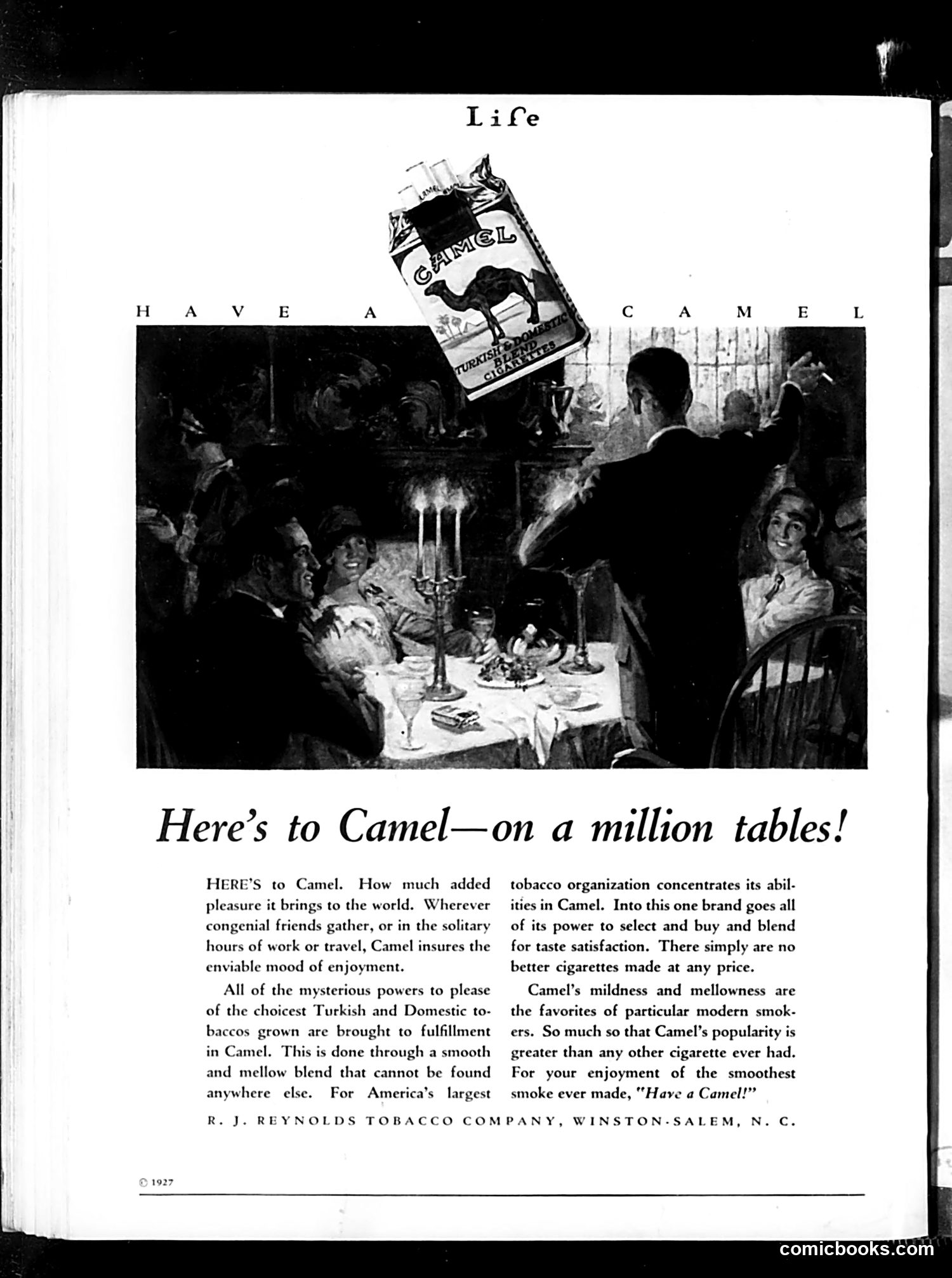
This is a **cigarette advertisement**, not satire or political commentary. The page shows a glamorous dinner party scene with well-dressed guests enjoying themselves, a large Camel cigarette package suspended overhead, and candlelit tables. The ad's tagline—"Here's to Camel—on a million tables!"—associates smoking with sophisticated social pleasure and leisure. The copy emphasizes Camel's "mildness and mellowness," claiming it's "America's largest tobacco organization's" finest product, blending Turkish and Domestic tobaccos. The ad targets "modern smokers" seeking refined enjoyment. This 1927 advertisement predates the surgeon general's health warnings (1960s onwards) and represents an era when tobacco companies openly marketed cigarettes as symbols of elegance, sociability, and good taste—without health disclaimers or public controversy.