
Life, 1927-11-03 · page 25 of 44
Life — November 3, 1927 — page 25: what you’re looking at
What you’re looking at
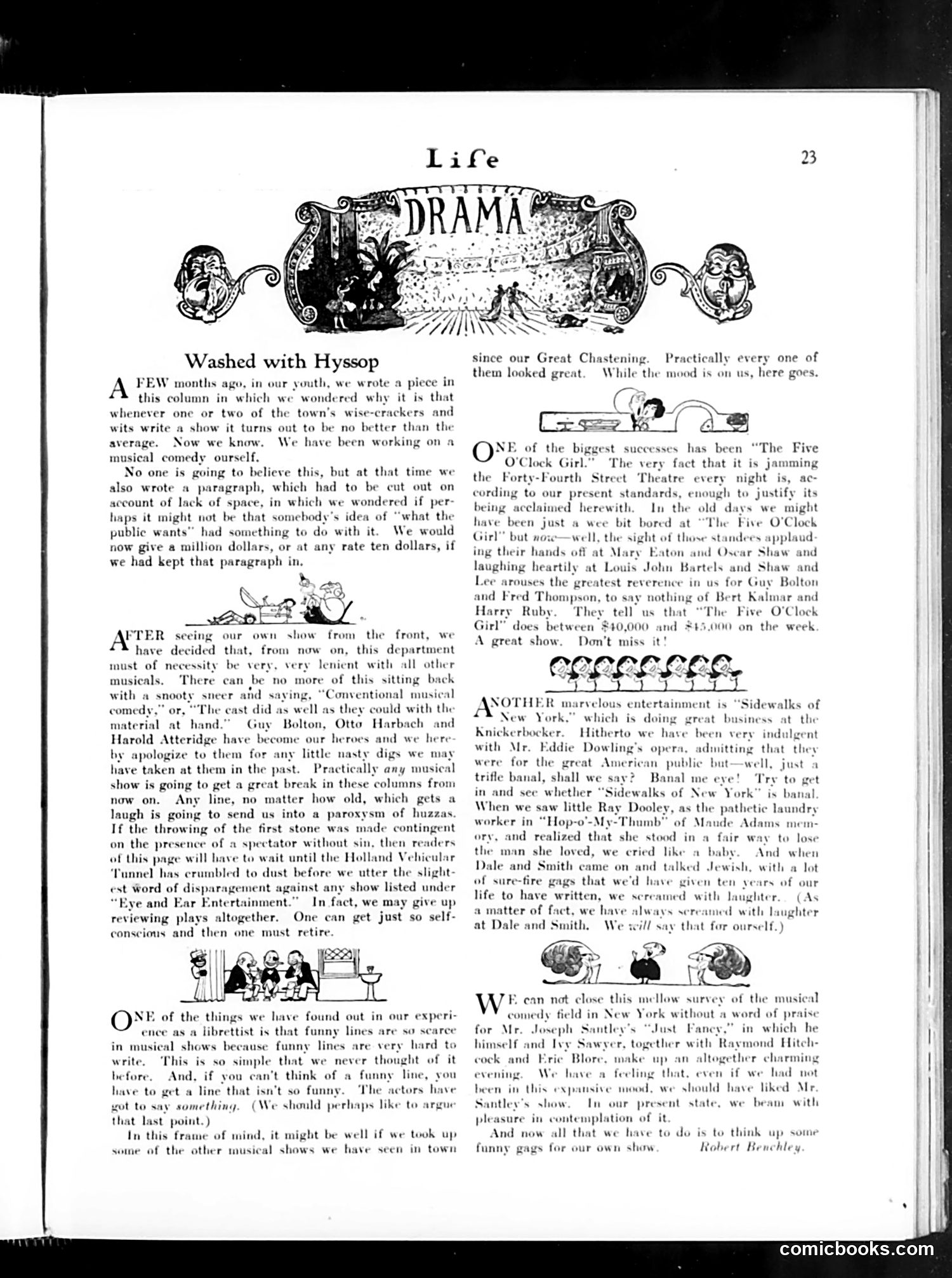
This is a humorous essay by Robert Benchley (bylined at bottom) about writing musical comedy. The author confesses that after attempting to write a show himself, he's become sympathetic to other playwrights' struggles—funny lines are genuinely difficult to write. The piece praises two current Broadway hits: "The Five O'Clock Girl" (featuring Mary Eaton and Oscar Shaw at the Forty-Fourth Street Theatre, earning $40,000-$45,000 weekly) and "Sidewalks of New York" at the Knickerbocker, which features Ray Dooley. The satire is self-deprecating: Benchley admits he previously criticized musicals harshly but now, having experienced the creative difficulty firsthand, he's reformed his snobbish attitude. He humorously pledges to stop being a harsh theater critic. The small illustrations show theatrical scenes and performers, typical of Life's drama coverage. This reflects 1920s Broadway's prominence in American culture and entertainment journalism.
📄 Transcribed text from this page (OCR, searchable)
Machine-transcribed from the original scan — historical spelling and the odd misread are preserved.
Washed with Hyssop A FEW months ago, in our youth, we wrote a piece in this column in which we wondered why it is that whenever one or two of the town’s wise-crackers and wits write a show it turns out to be no better than the average. Now we know. We have been working on a musical comedy ourself. No one is going to believe this, but at that time we also wrote a paragraph, which had to be cut out on account of lack of space, in which we wondered if per- haps it might not be that somebody's idea of “what the public wants” had something to do with it. We would now give a million dollars, or at any rate ten dollars, if we had kept that paragraph in. R seeing our own show from the front, we decided that, from now on, this department must of necessity be very, very lenient with all other musicals. There can be no more of this sitting back with a snooty sneer ahd sayi Conventional musical . The cast did as well as they could with the material at hand.” Guy Bolton, Otto Harbach and Harold Atteridge have become our heroes and we here by apologize to them for any little nasty digs we may have taken at them in the past. Practically any musical show is going to get a great break in these columns from now on. Any line, no matter how old, which gets a laugh is going to send us into a paroxysm of huzzas If the throwing of the first stone was made contingent on the presence of a spectator without sin, then readers of this page will have to wait until the Holland Vehicular ‘Tunnel has crumbled to dust before we utter the slight- est Word of disparagement against any show listed under e and Ear Entertainment.” In fact, we may give up ing plays altogether. One can get just so self- conscious and then one must retire have comedy,” « re} E of the things we have found out in our experi- a librettist is that funny lines are so scarce in musical shows because funny lines are very hard to This is so simple that we never thought of it And, if you can’t think of a funny lin have to get a line that isn’t so funny. The act (We should perhaps like ence write. before. got to say something. that last point.) In this frame of mind, it might be well if we took up seen in town other musical shows we have Practically one of While the mood is on us, here goes. = a Ss NE of the biggest successes has been “The Five O'Clock Girl.” The very fact that it is jamming the Forty-Fourth Street Theatre every night is, ac- cording to our present standards, enough to justify its being In the old days we might have been just bit bored at “The O'Clock Girl well, the sight of those standees applaud ing their hands off at Mary Eaton and Oscar Shaw and laughing heartily at Louis Johu Bartels and Shaw and Lee arouses the greatest reverence in us for Guy Bolton and Fred Thompson, to say nothing of Bert Kalmar and Harry Ruby They tell us that “The Five O'Clock Girl” does between $40,000 and 245.000 on the week A great show. Don't miss it! NOTHER marvelous entertainment is #4 New York,” Knickerbocker. since our Great Chastening them looked great every acclaimed herewith. a Wee Five but nox Sidewalks of which is doing great business at the Hitherto we have been very ind nt with Mr. Eddie Dowling’s opera, admitting that they were for the great American public but—well, just a trifle 1, shall we say? Banal me eye! Try to get in and see whether “Sidewalks of New York” is banal When we saw little Ray Dooley, as the pathetic laundry worker in “Hop-o'-My-Thumb” of Maude , and realized that she stood in a fair way the man she loved, we cried like a baby. And when Dale and Smith came on and talked Jewish, with a lot of sure-fire gags that we'd have given ten vears of our life to have written, we screamed with laughter. (As a ter of fact, we have always sereamed with laughter at Dale and Smith, We will say that for ourself.) Adams mem- ory, to lose Gd ; We can nat close this mellow survey of the musical comedy field in New York without a word of praise for Mr which he himself and Ivy Sawyer, together with Raymond Hiteh- cock and Erie Blore, ther charming evening, We a feel had not been in this expansive iv liked Mr with Joseph Santley’s “Just Fancy,” in make up an altog have ue that, even if we we sl do have Santley’s show In our present state, we beam pleasure in contemplation of it And now all that we have to do is to think up some funny gags for our own show Robert Benchley comicbooks.com