
A complete issue · 38 pages · 1927
Life — March 24, 1927
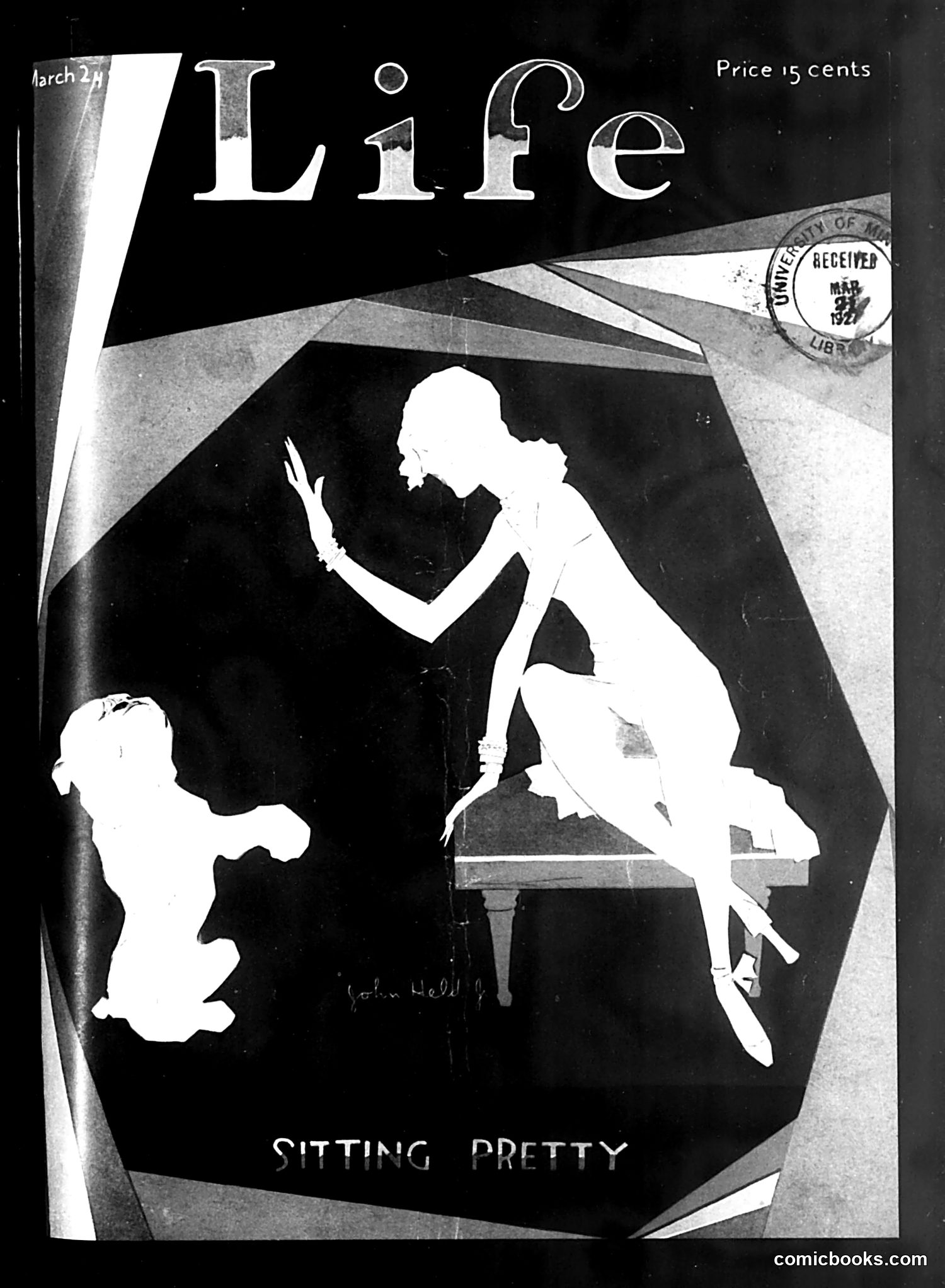
This early 20th-century Life magazine cover uses silhouette art to depict a woman admiring herself in a mirror, titled "Sitting Pretty." The image satirizes female vanity and self-absorption during an era of changing women's social roles. The stark black-and-white silhouette style was popular for satirical commentary. The woman's posed, self-admiring posture—checking her reflection while sitting—suggests complacency or superficiality. The magazine's price of 15 cents and the library stamp indicate this is a preserved archival copy. Without additional context, the specific social commentary remains unclear, though it likely reflects broader early-1900s satirical attitudes toward women's leisure, appearance-consciousness, or evolving independence. The Art Deco-influenced design was typical of Life's visual style during this period.
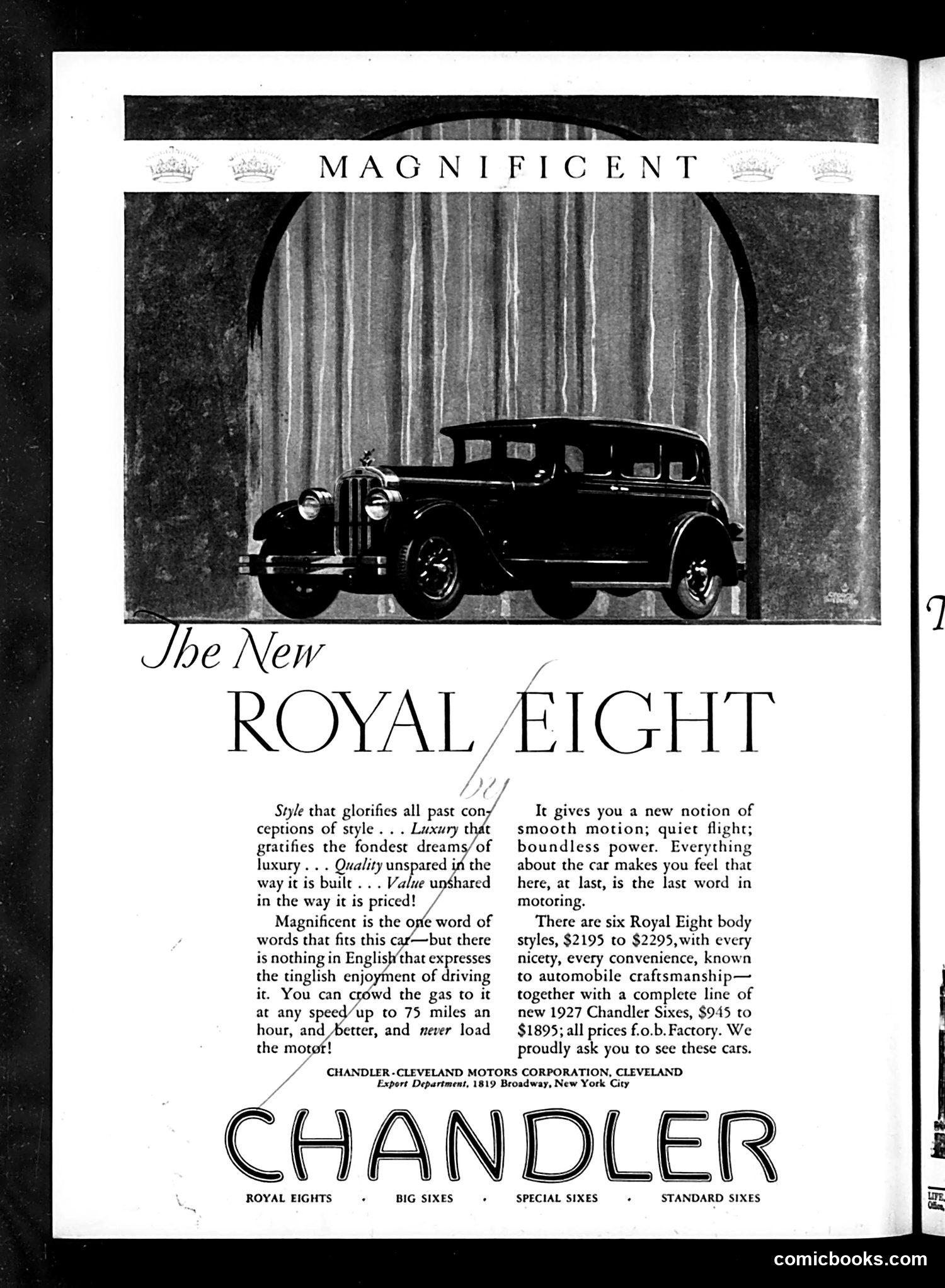
This is primarily a **luxury automobile advertisement**, not political satire. It promotes the new Royal Eight automobile by Chandler-Cleveland Motors Corporation, Cleveland. The ad uses the word "Magnificent" as its central theme, emphasizing the car's style, quality, and value. It highlights performance specs (75 mph capability) and pricing ($2195-$2295 for Royal Eight models, with Chandler Sixes ranging $915-$1895). The only visual element is a photograph of the sleek black Royal Eight automobile positioned against a curtained backdrop, designed to convey elegance and prestige. There is **no cartoon, caricature, or political satire** on this page. It's straightforward 1920s luxury-goods marketing targeting affluent readers of *Life* magazine.

This page is **entirely an advertisement**, not editorial content or satire. The American Radiator Company is marketing their "CORTO" radiator model. The ad emphasizes that this heating device combines practical functionality with aesthetic beauty—a deliberate design philosophy stated as "a reversion to the idea that practical things should be beautiful as well as useful." The radiator itself, shown at top, features vertical fluting and decorative elements. The ad stresses the CORTO costs no more than ordinary radiators while being more elegant, space-efficient, and "unobtrusive." There is no political cartoon or satire here—this is straightforward early 20th-century industrial advertising emphasizing modernist design principles and American manufacturing excellence.
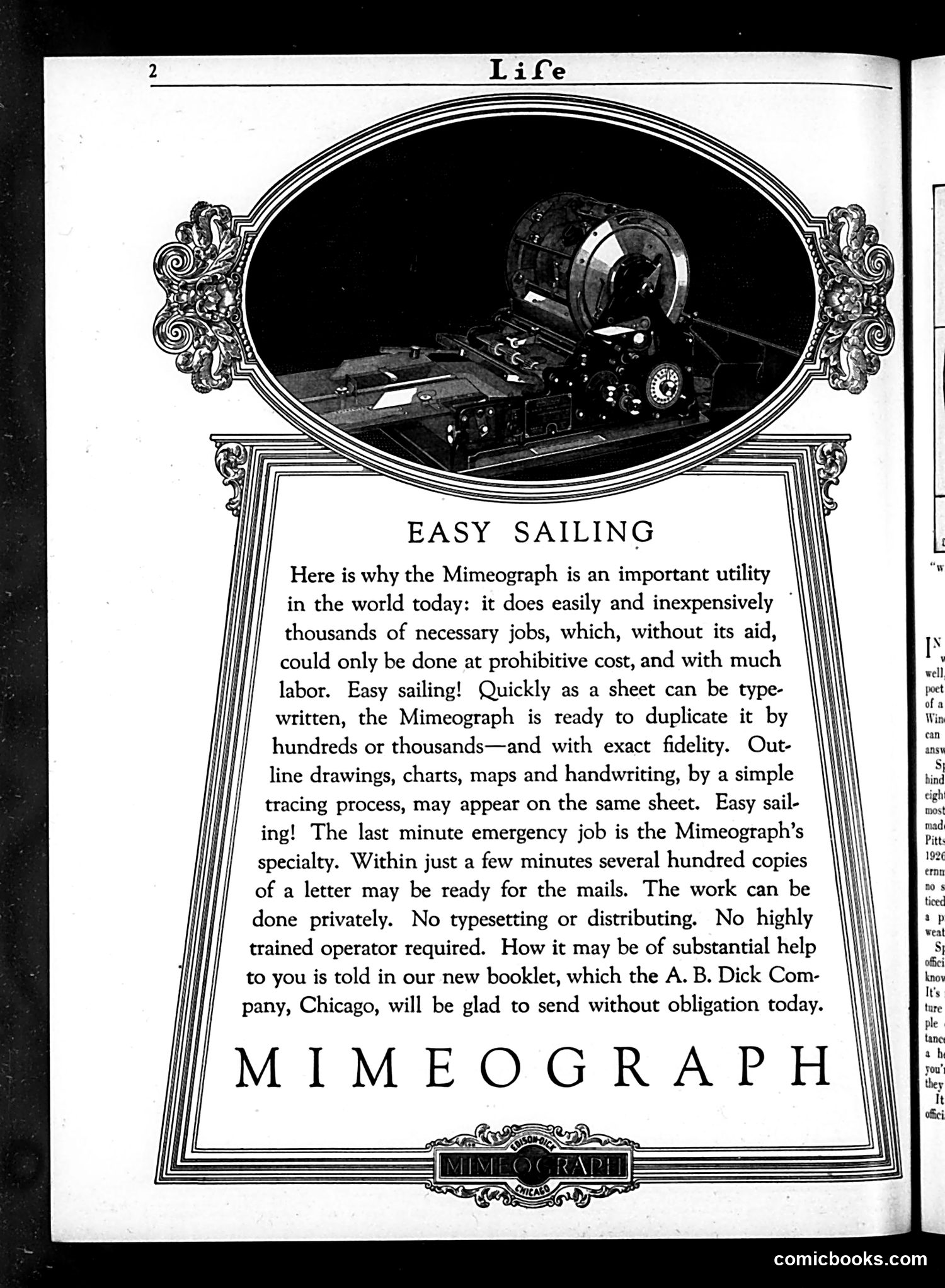
This is primarily an **advertisement for the Mimeograph machine**, not satire or political content. The page appears in *Life* magazine (page 2) and promotes the mimeograph as a practical business tool. The ad's humor is gentle and commercial rather than satirical: the phrase "Easy Sailing" uses nautical metaphor to describe the machine's simplicity. It emphasizes the mimeograph's utility for duplicating documents quickly and inexpensively—typewritten sheets, drawings, charts, maps, and handwriting—without requiring trained operators or professional typesetting. The pitch targets business users facing urgent deadlines, promising "within just a few minutes several hundred copies" ready for mailing. The A.B. Dick Company (Chicago) offered a promotional booklet to interested readers. This represents early 20th-century office technology marketing.
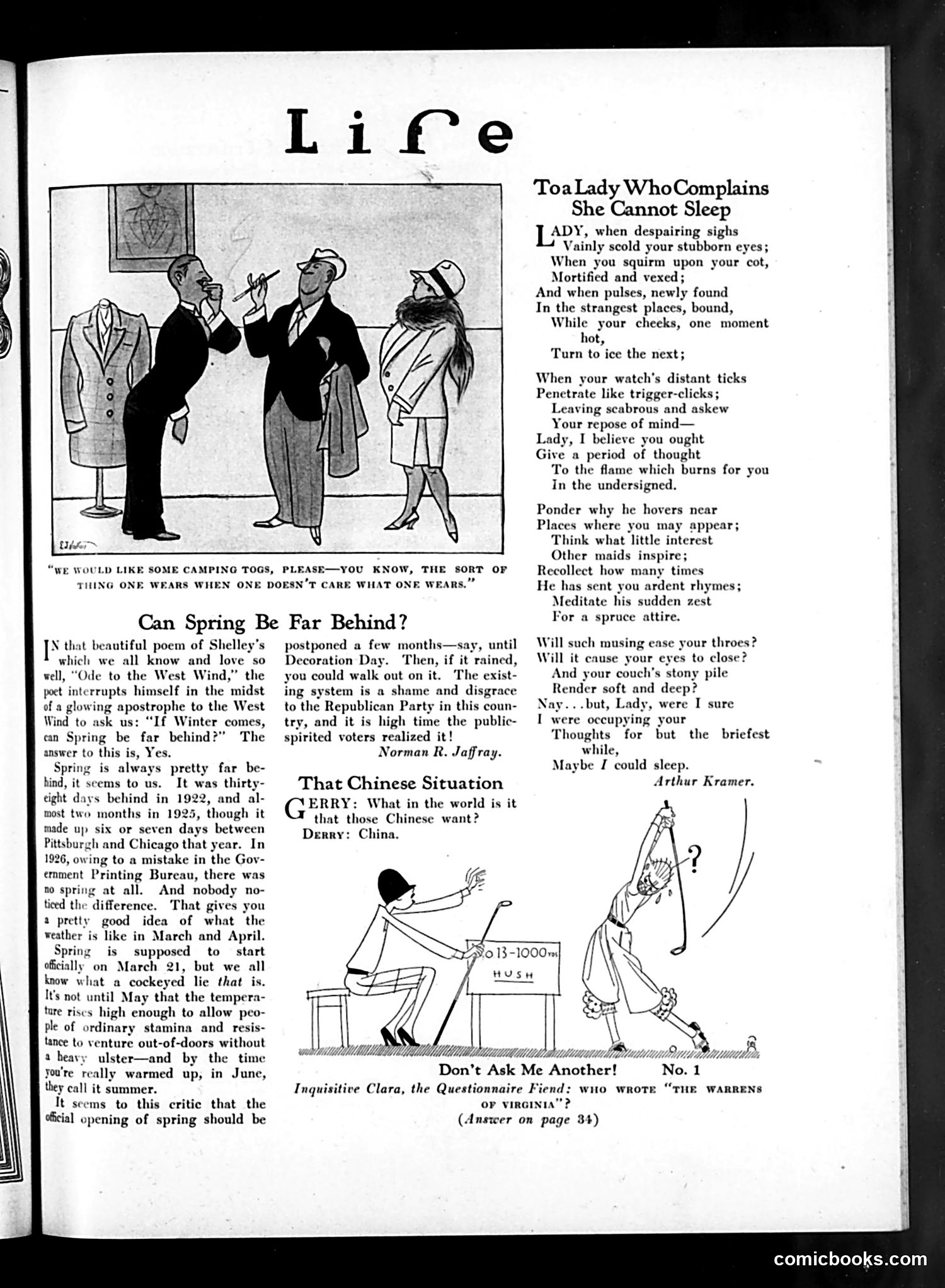
This page contains several satirical pieces reflecting 1920s concerns: **"Can Spring Be Far Behind?"** critiques delayed spring weather in 1925-1926, arguing the government's Printing Bureau error caused a "spring shortage." The humor mocks both unpredictable weather and bureaucratic incompetence. **"That Chinese Situation"** shows a cartoon where someone labeled "China" appears coerced by Western powers (depicted as a figure pulling/controlling). This references Western imperial interference in Chinese politics during the period of warlord fragmentation and foreign intervention. **"To a Lady Who Complains She Cannot Sleep"** is a humorous poem addressing insomnia, likely aimed at upper-class readers experiencing anxiety about modern life. The cartoons reflect American anxiety about both domestic inefficiency and international power dynamics of the era.
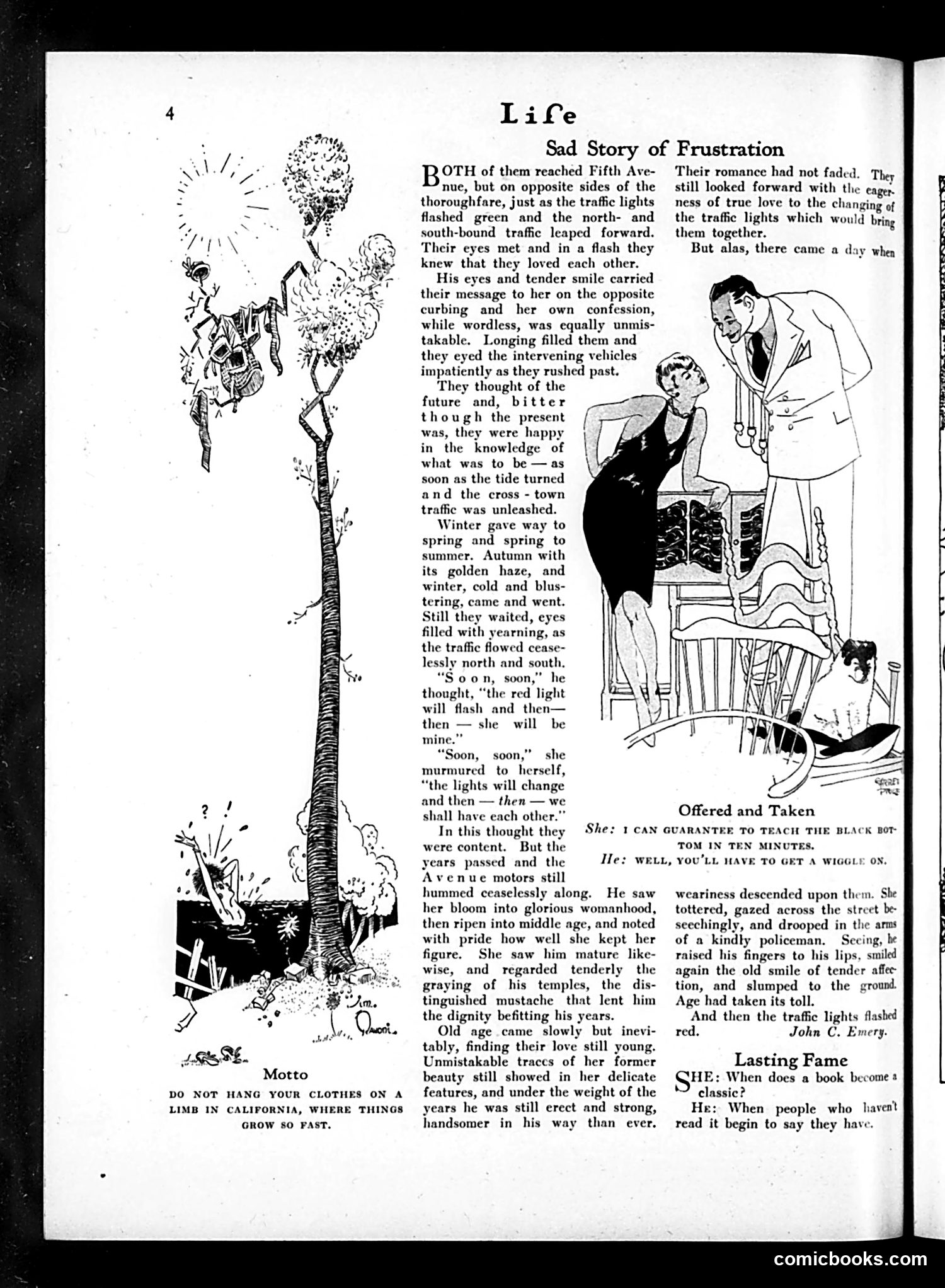
This page contains three distinct pieces: 1. **"Sad Story of Frustration"** (top): A romantic narrative about two lovers separated by Fifth Avenue traffic, unable to cross and meet despite their longing. The story satirizes modern urban life's obstacles to human connection. 2. **Left illustration**: A stylized tree with figures, accompanying a "Motto" about not hanging clothes on a limb in California where things grow fast—likely satirizing California's rapid development or exaggerated growth claims. 3. **"Offered and Taken" and "Lasting Fame"** (bottom): Brief humorous dialogues about trivial domestic matters (teaching a dog tricks, book fame), representing typical satirical vignettes common to Life magazine's social commentary format. The overall page reflects early-to-mid 20th century concerns about urbanization and modern life's absurdities.
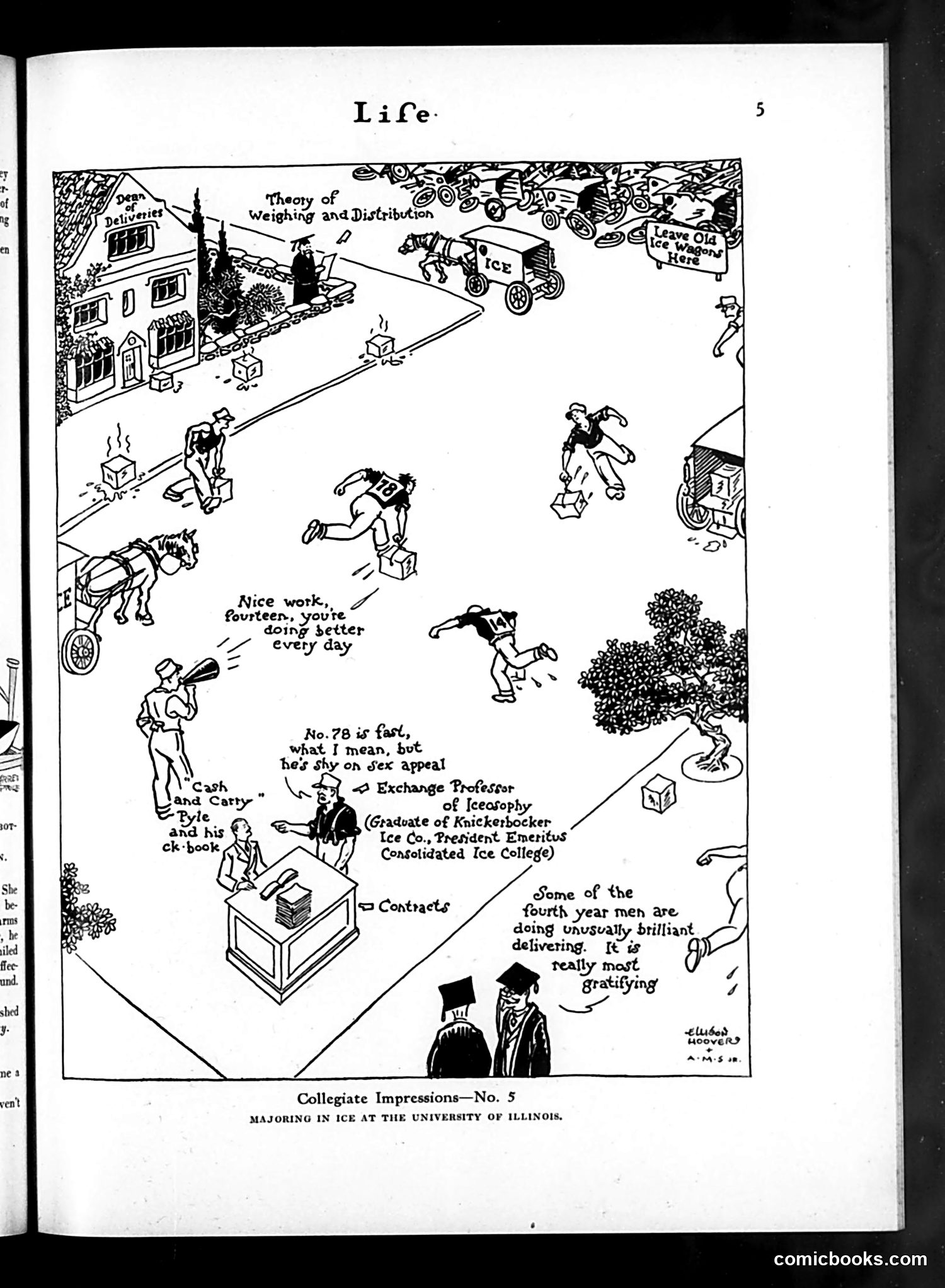
This satirical cartoon depicts the ice delivery business as a major field of study at the University of Illinois. The scene shows students actively delivering ice blocks throughout a neighborhood, with supervisory figures discussing their performance. The satire targets the gap between academic pretense and practical labor. "Exchange Professor of Iconography" and "Graduate of Knickerbocker Ice Co." are mock-academic titles given to ice company workers, inflating menial labor with grandiose credentials. The "Theory of Weighing and Distribution" sign mockingly treats ice delivery as intellectual discipline. The cartoon suggests that some students were actually majoring in practical ice-delivery work rather than traditional academics—either for necessity or because the work paid better than typical student jobs, making higher education seem disconnected from real employment realities.
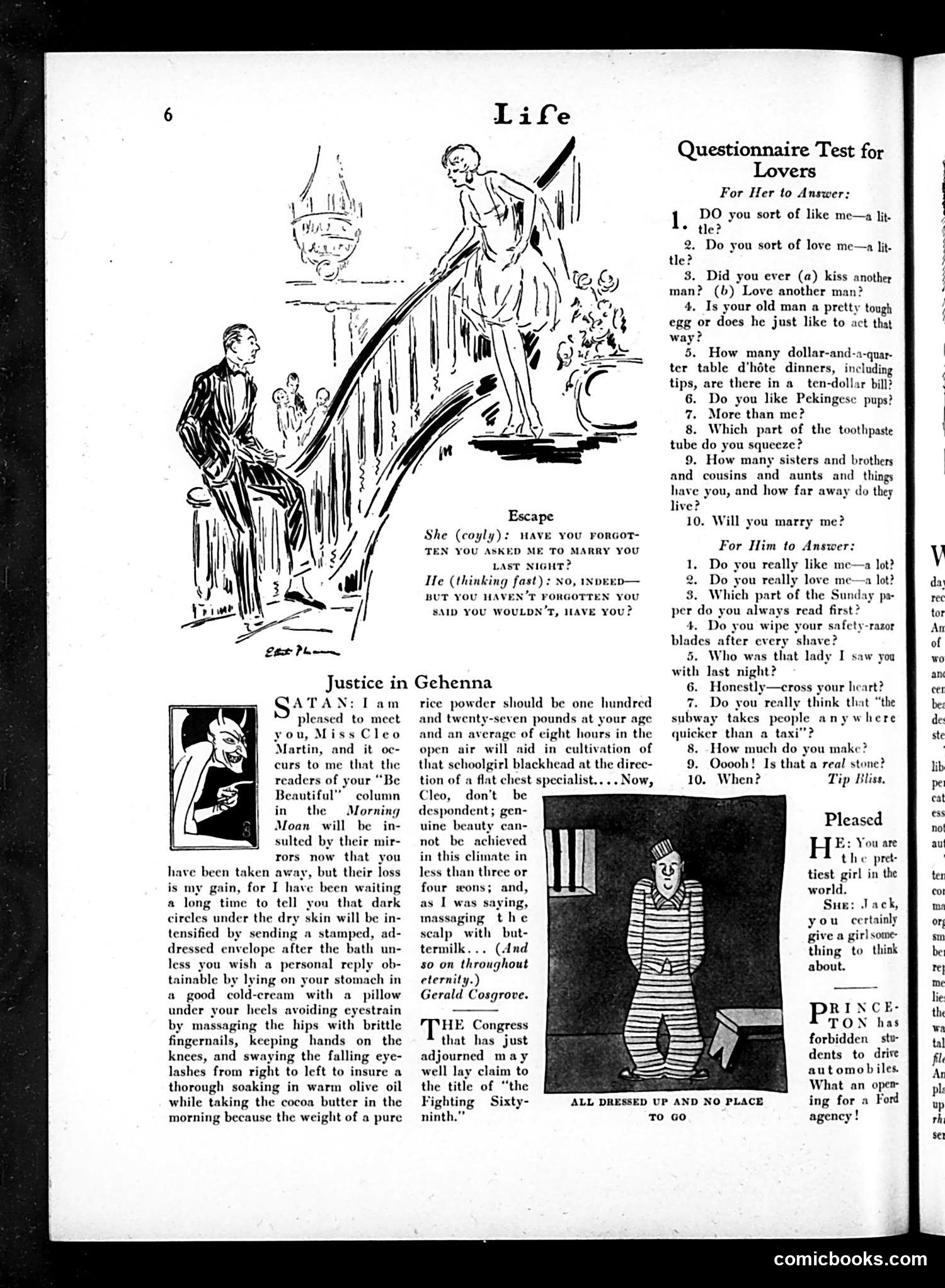
This page contains humorous satirical content typical of early-20th-century Life magazine. The "Questionnaire Test for Lovers" mocks romantic relationships through absurd questions for both men and women—asking about infidelity, physical appearance, and marriage intentions with tongue-in-cheek humor. "Justice in Gehenna" features Satan complaining to Cleopatra about beauty advice columnists in the *Morning Moon*, sarcastically suggesting their tips (facial treatments, massage techniques) constitute torture worse than damnation itself. This satirizes the era's proliferating beauty-advice columns and their often-ridiculous or uncomfortable remedies. The "Pleased" and "Prince" vignettes are brief romantic comedies about courtship dynamics and automotive restrictions. Overall, the page satirizes contemporary social trends: dating customs, women's beauty culture, and courtship rules through absurdist humor.
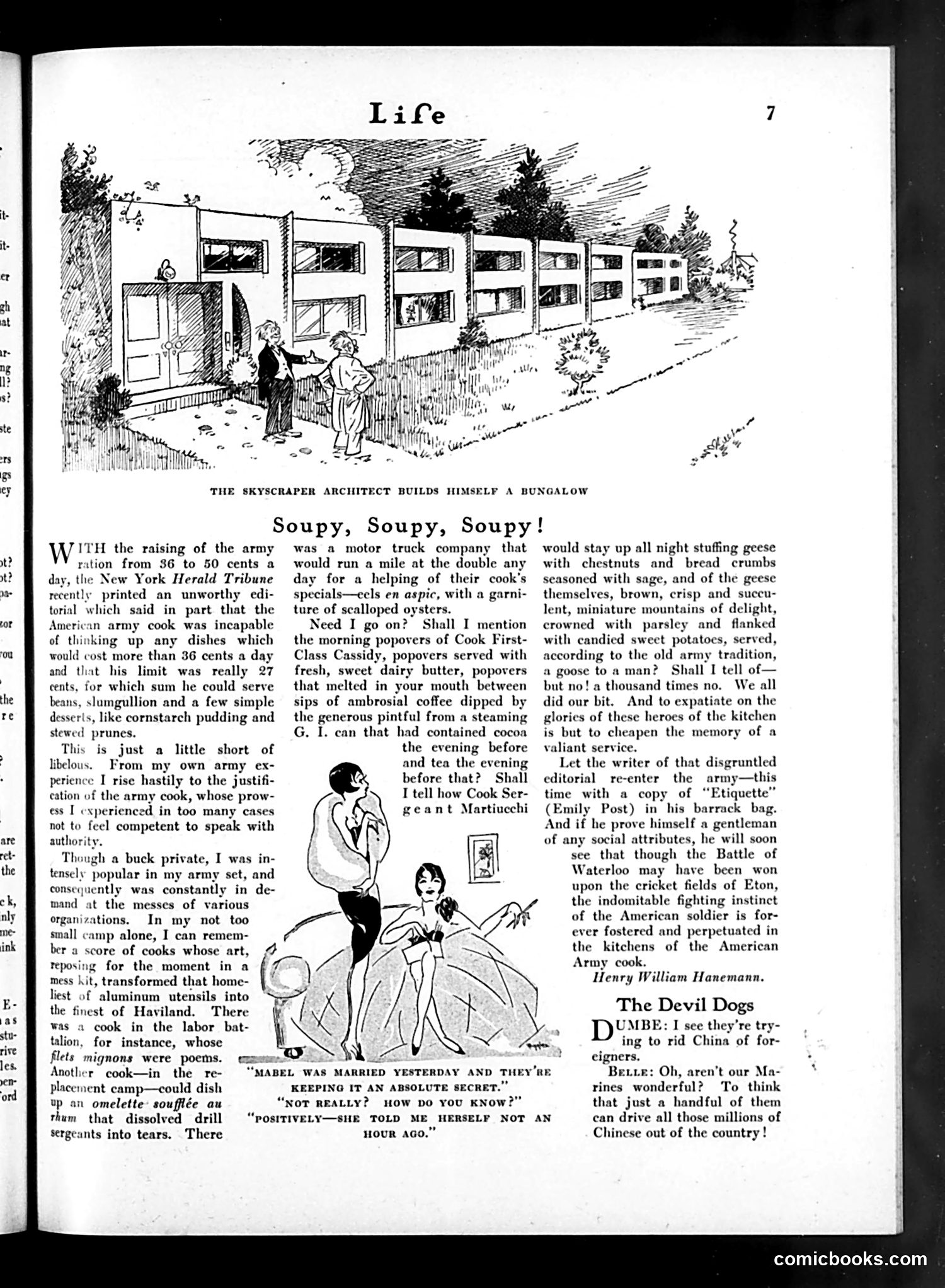
This page contains two satirical pieces about early 20th-century American life. **"Soupy, Soupy, Soupy!"** discusses army rations and mess cooking. The author, a former buck private, critiques the poor quality of military food—particularly soup—while defending American army cooks against unfair editorial criticism. He argues that despite low budgets (27-50 cents per soldier daily), army cooks performed admirably under difficult conditions. **"The Devil Dogs"** is a brief dialogue between two women (Dumbe and Belle) joking about using Chinese immigrants to "rid China of foreigners." The offensive humor reflects contemporary xenophobic attitudes toward Chinese people. The illustration shows a couple (captioned "Mabel was married yesterday") keeping a secret. The cartoons exemplify Life's mix of military critique and period-typical prejudiced humor.
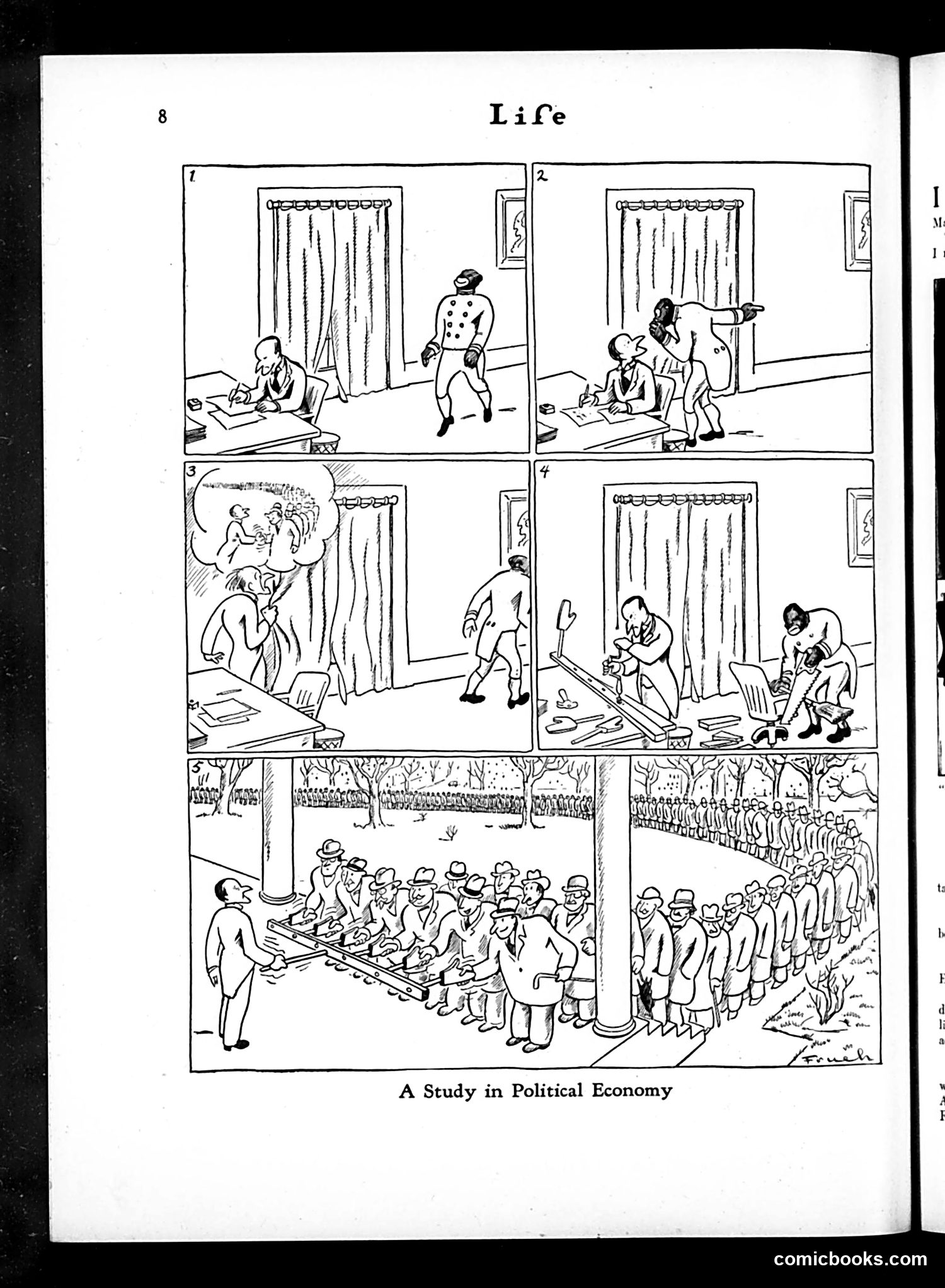
This six-panel comic illustrates the principle of wealth concentration and labor exploitation. In panels 1-4, a well-dressed businessman repeatedly interrupts a child's work at a desk, each time causing disruption and chaos—the child's papers scatter, tools fall. Panels 5-6 shift to an outdoor scene where many laborers gather around a single supervisor holding what appears to be a log or beam. The composition suggests a large workforce serving one authority figure. The satire critiques how capital (represented by the businessman/supervisor) repeatedly disrupts or controls labor, ultimately concentrating power and resources among few while many workers remain subordinate. The title "A Study in Political Economy" indicates this documents systemic economic inequality and the hierarchical relationship between capital and labor.
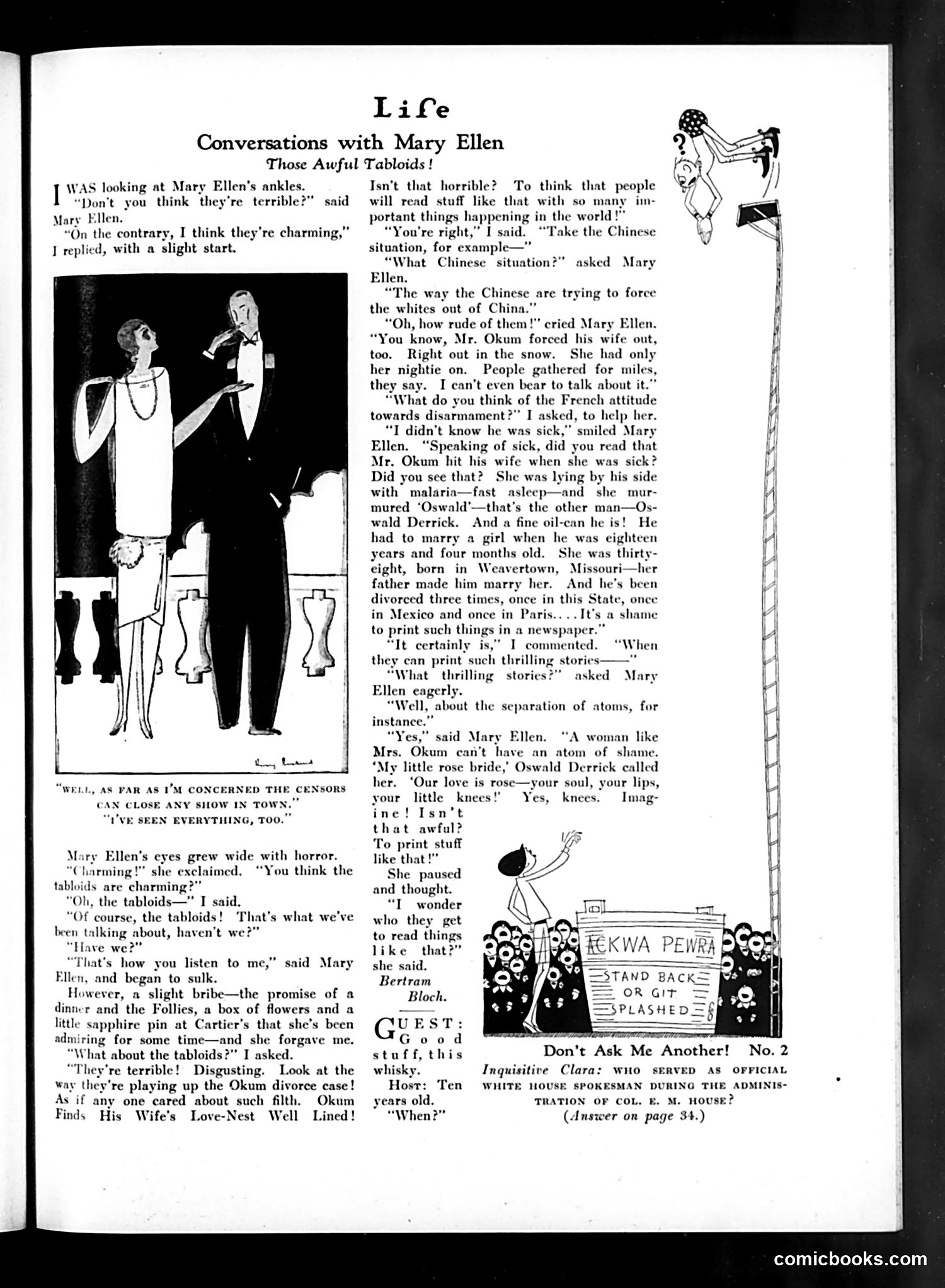
This satirical piece mocks newspaper tabloid journalism and sensationalism of the era. The conversation features a character named Mary Ellen critiquing how newspapers cover scandalous stories—particularly marital drama and infidelity involving figures like "Mr. Okum" (likely a real contemporary scandal). The cartoon ridicules both: 1. **Tabloid excess**: Papers publishing salacious personal details about divorce, affairs, and intimate matters 2. **Public appetite**: The willingness of readers to consume such content despite "important things happening in the world" The illustration shows a fashionable woman and man in evening dress, typical of Life's style. The satire suggests newspapers prioritize celebrity gossip over substantive news, treating readers as hungry for scandal rather than information. The tone is disapproving of this cultural tendency toward sensationalism.
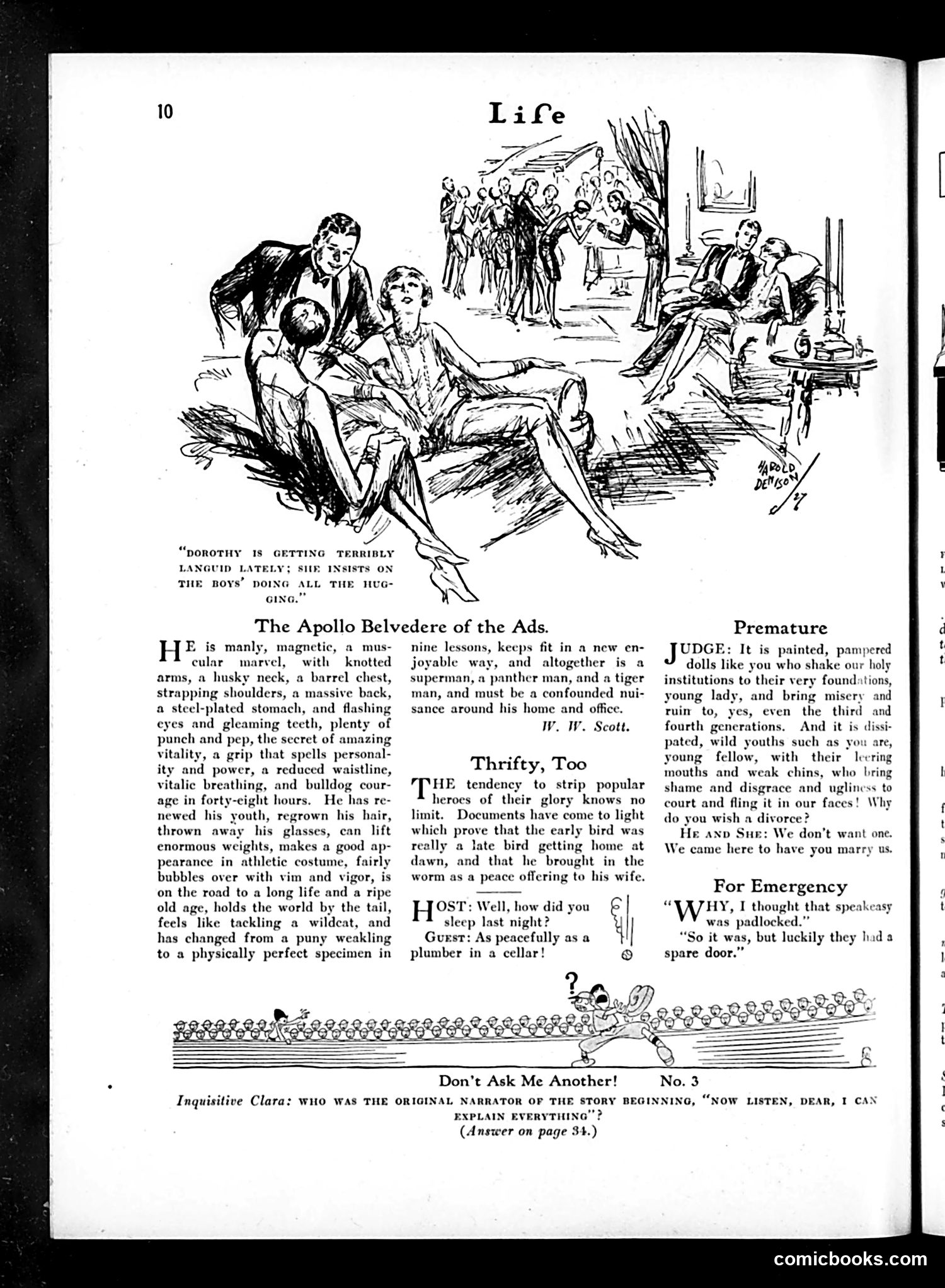
This page contains three satirical pieces about character types: **"The Apollo Belvedere of the Ads"** depicts an idealized male figure described as manly, magnetic, and muscular—a common advertising archetype of the era. The satire mocks how advertisements present an impossibly perfect physical specimen as the standard man. **"Thrifty, Too"** satirizes popular heroes whose "glory knows no limit," suggesting that historical figures are retroactively credited with exaggerated virtues and accomplishments. **"Premature"** critiques the tendency to marry off young women to older men, ruining their prospects through ill-advised unions. The bottom section includes two brief humorous exchanges ("For Emergency" and "Don't Ask Me Another!") and a trivia question for readers. The illustrated style and content are typical of early-20th-century American humor magazines.
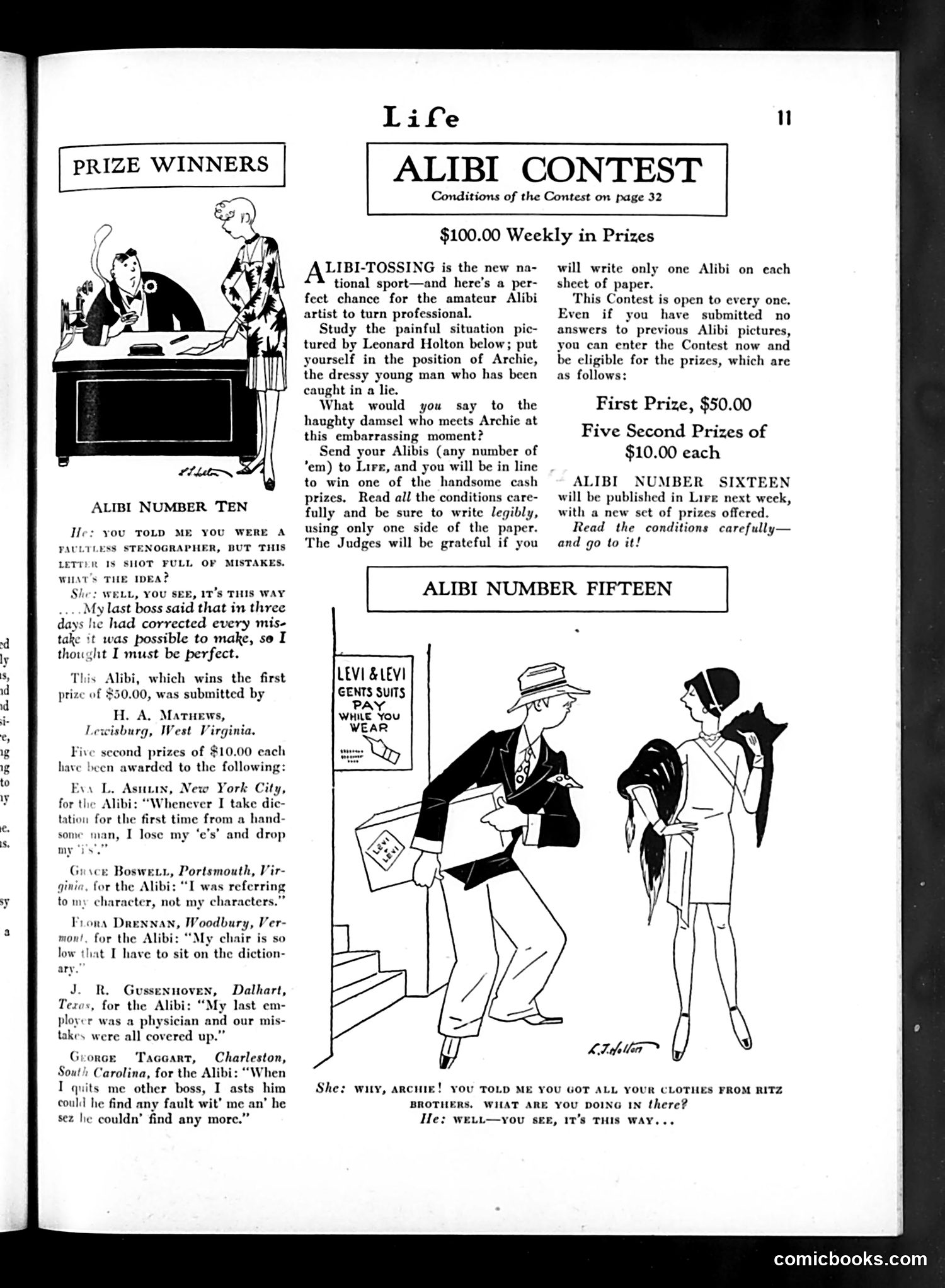
This page features Life magazine's "Alibi Contest"—a humor competition asking readers to submit creative excuses (alibis) for embarrassing situations. The top cartoon shows "Alibi Number Ten," depicting a stenographer caught in a lie by his boss, who discovered the employee falsely claimed to have corrected every mistake in his work when he actually hadn't. Below is "Alibi Number Fifteen," illustrated with a cartoon of a man caught shopping at Ritz Brothers' clothing store while telling his wife he was elsewhere. The joke plays on the common domestic scenario of a husband caught in an obvious lie about his whereabouts. The contest offered $100 weekly in cash prizes, encouraging readers to submit creative excuses for various awkward social situations—essentially monetizing everyday human dishonesty for entertainment.
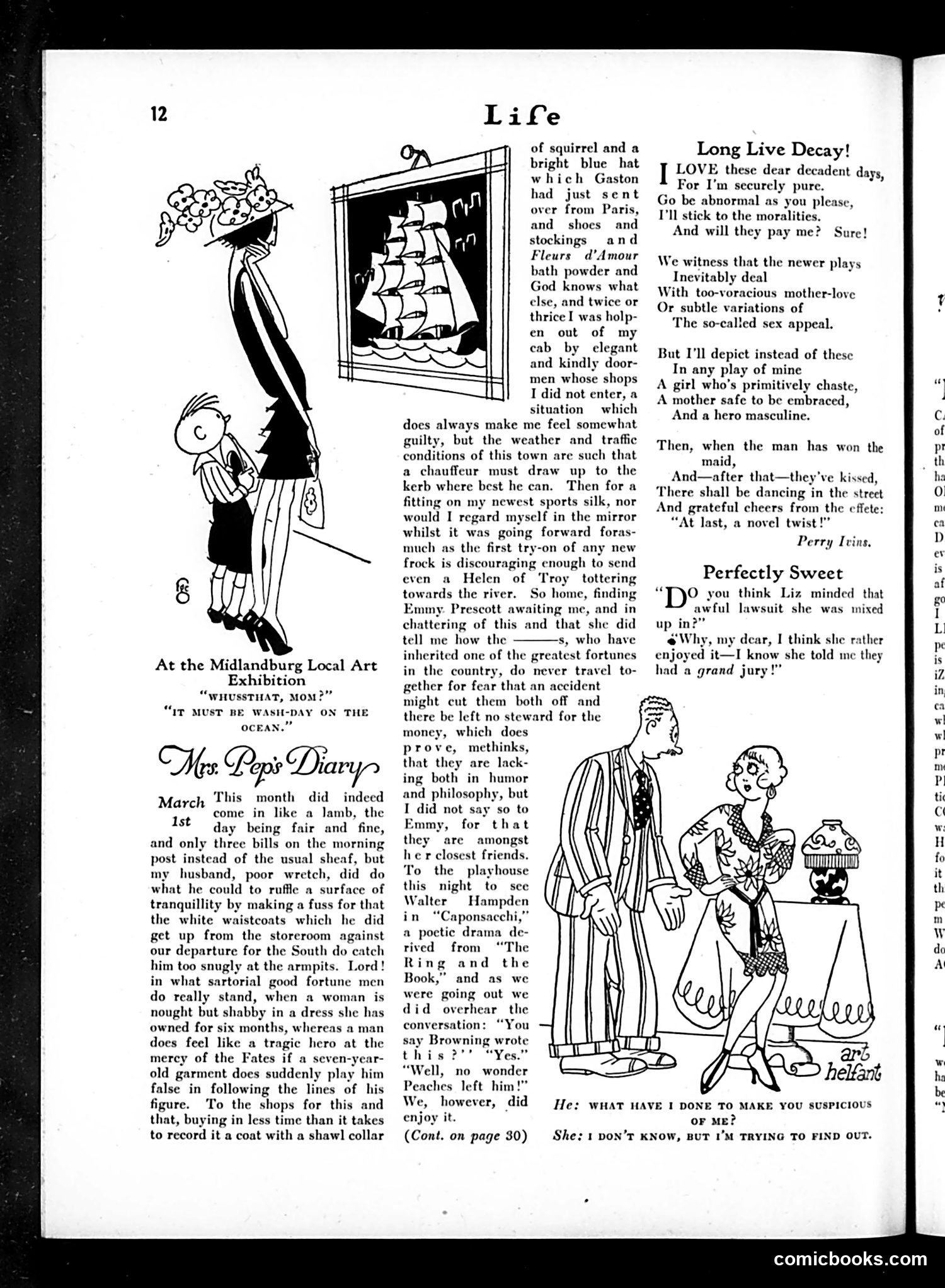
This page contains three distinct pieces: a fashion illustration, "Mrs. Pep's Diary" (a personal column), and a comic titled "Perfectly Sweet." **The Fashion Illustration** (top left) shows a woman with shopping bags viewing a ship in a framed picture—likely depicting leisured shopping and travel fantasies. **"Mrs. Pep's Diary"** recounts mundane domestic complaints: poor weather, inadequate meat from the butcher, and the inconvenience of shopping. The author expresses frustration with wartime or postwar shortages and inconveniences of city life. **"Perfectly Sweet"** (bottom) depicts a domestic scene where a man appears suspicious of his wife's innocence regarding something she's done. The caption suggests marital tension and miscommunication—she claims innocence while he remains skeptical. These pieces collectively satirize middle-class life's petty annoyances and domestic friction.
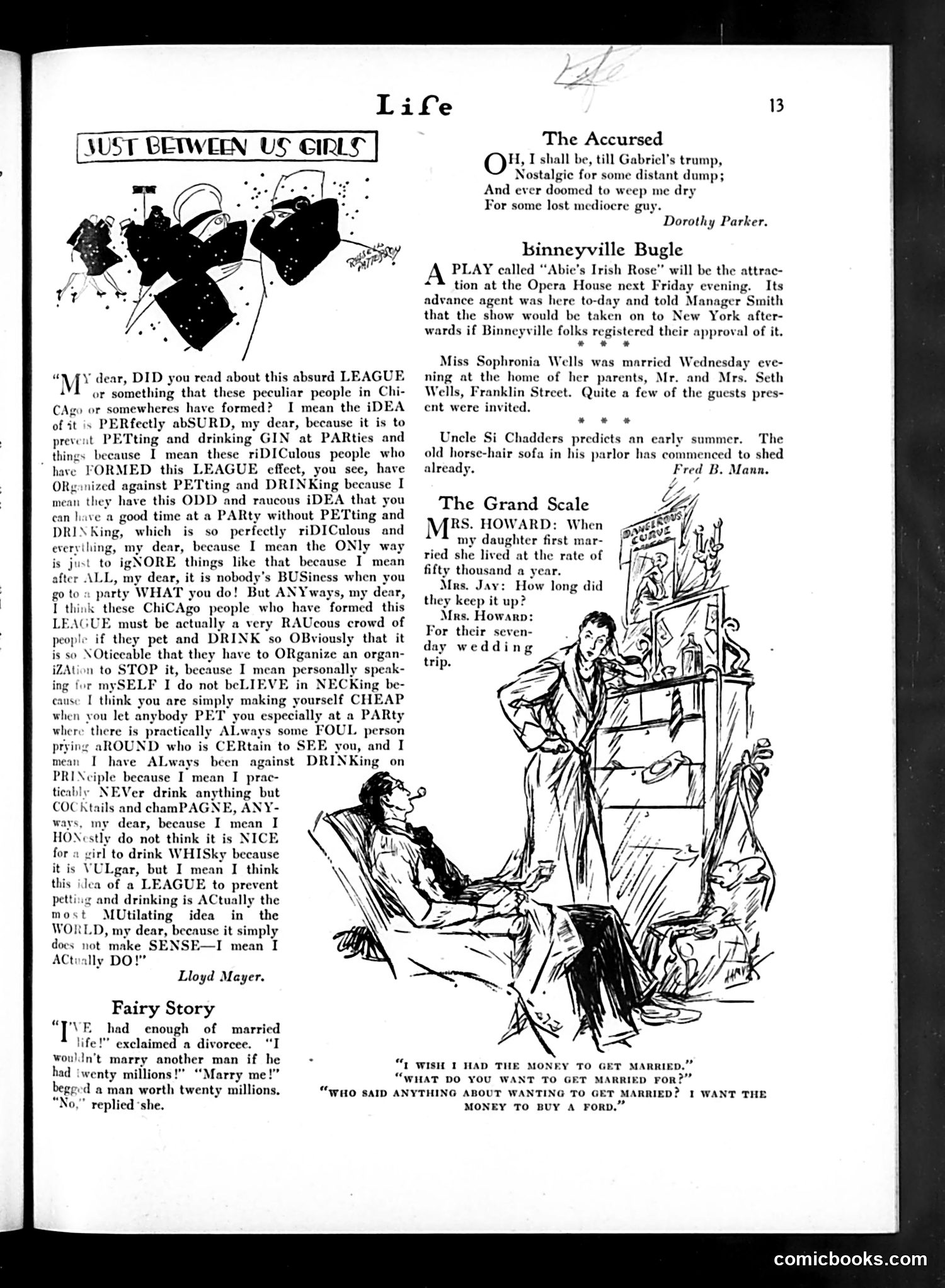
This page contains several satirical pieces mocking 1920s social trends: **"Just Between Us Girls"** (top left): A cartoon criticizing a "League" formed to prevent drinking and partying. The writer (Lloyd Meyer) sarcastically attacks the idea as prudish and impractical, arguing that organized sobriety is absurd and that people will drink anyway. This satirizes Prohibition-era temperance movements. **"The Grand Scale"**: A cartoon showing a woman discussing marriage costs with others, concluding she wants money to buy a Ford rather than a husband—mocking both materialistic marriage attitudes and the growing consumerism around automobiles. **Other brief items**: Include gossip about local events (a theatrical production, a wedding) and a "Fairy Story" joke about a divorceé's mercenary marriage expectations. The page reflects Jazz Age skepticism toward moral reform movements.
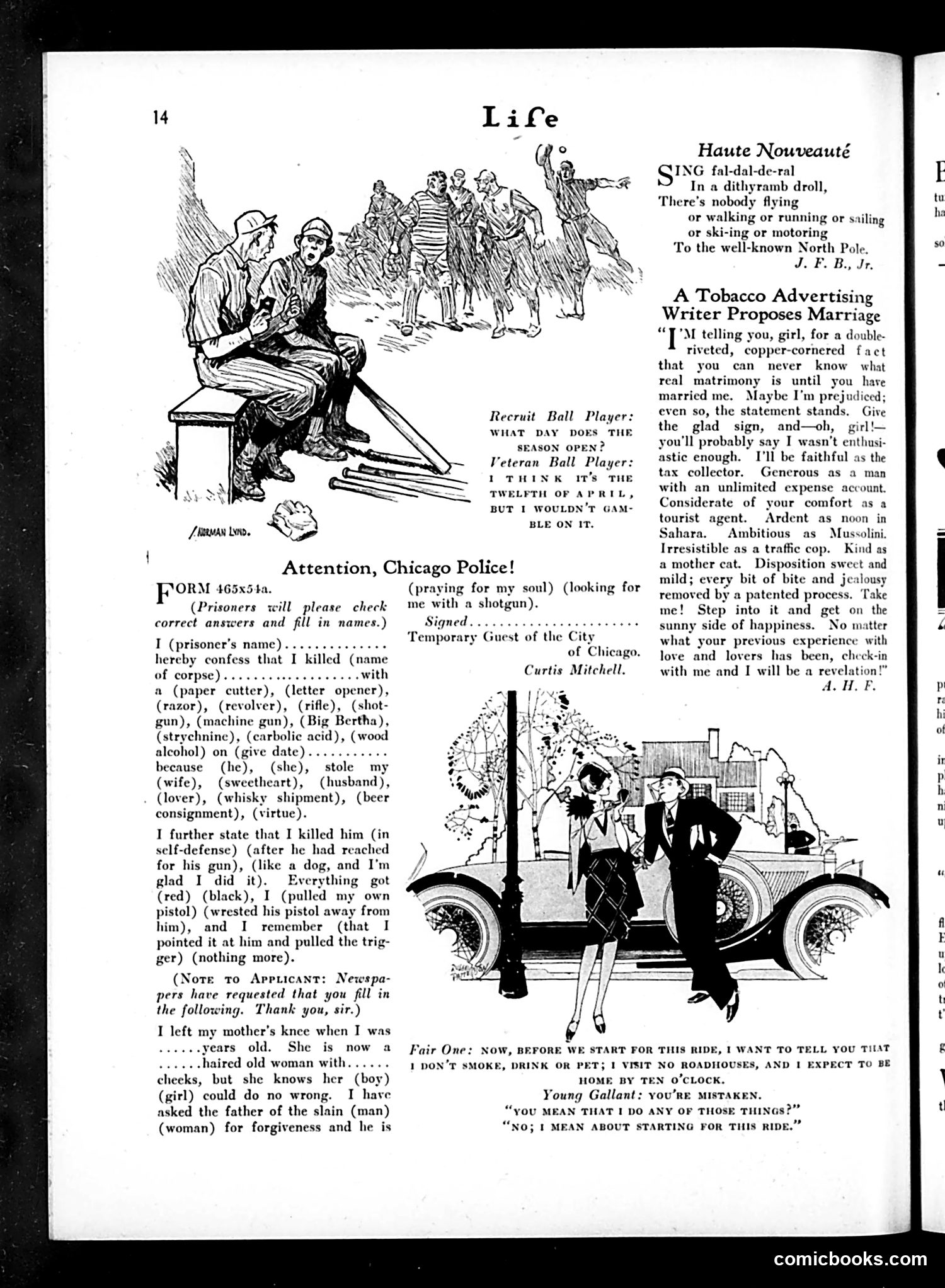
This page contains several satirical pieces targeting early 20th-century social conventions: **"Attention, Chicago Police!"** is a darkly humorous confessional supposedly from a prisoner seeking forgiveness. The joke appears to be that the "crimes" listed are absurdly trivial (stealing a wife, sweetheart, etc.) mixed with actual weapons, mocking how people rationalize serious wrongs. **The automobile cartoon** depicts a young woman and man in a car with specific comic dialogue about the ride's conditions—she sets strict rules (no smoking, drinking, or late returns), while he misunderstands, thinking she meant something else. The joke relies on flirtation and misunderstanding about the automobile as a dating space. **The tobacco advertisement** humorously "proposes marriage" using exaggerated claims about a product's virtues, satirizing advertising's overwrought promises.
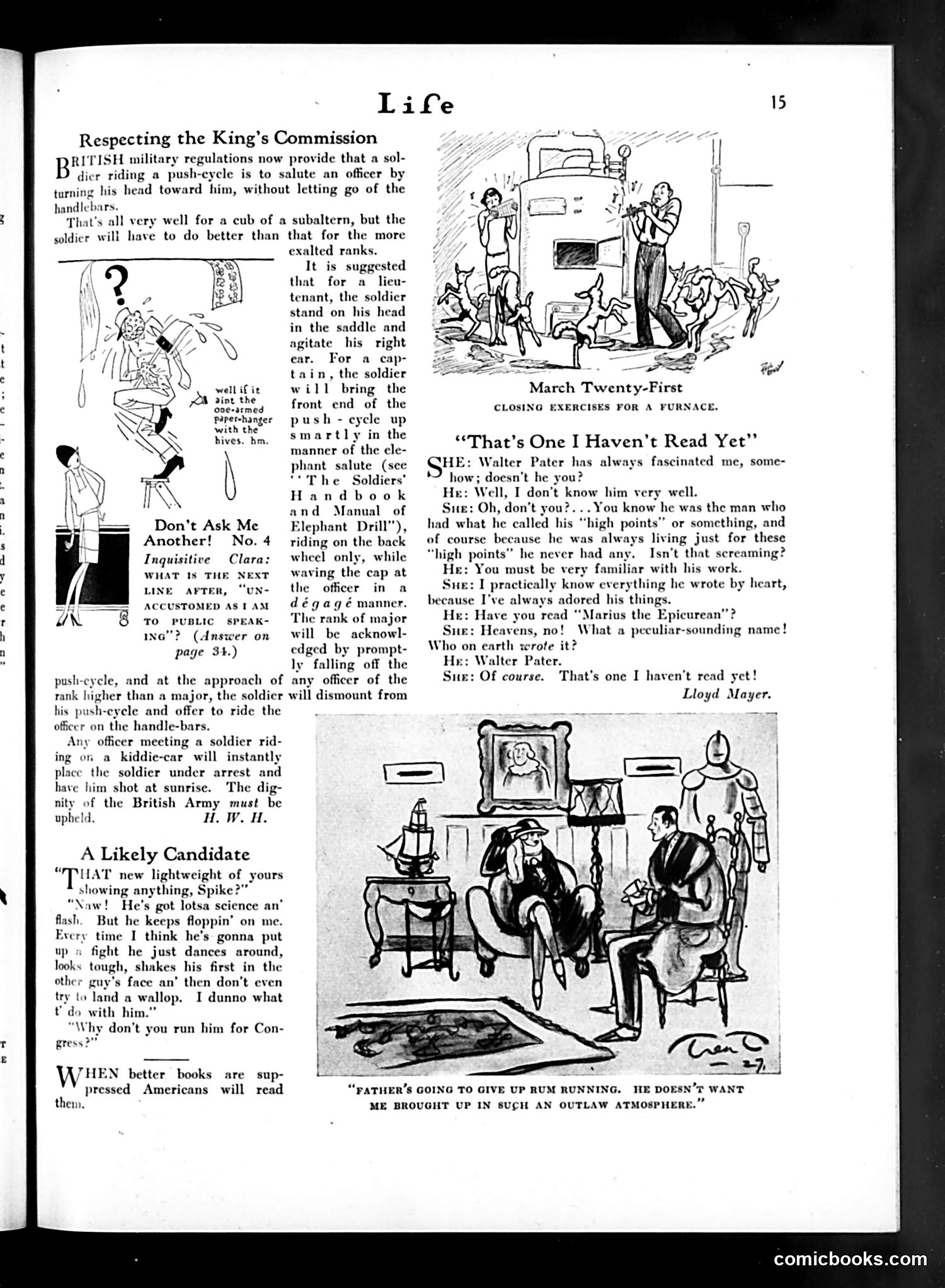
This page contains several humor pieces satirizing military life and literary taste. **"Respecting the King's Commission"** mocks British Army regulations about saluting officers on bicycles—absurd rules requiring soldiers to perform exaggerated gestures (standing on saddles, waving arms) when encountering officers on cycles. The satire targets military bureaucracy's disconnect from practical sense. **"That's One I Haven't Read Yet"** features a dialogue where a woman admits unfamiliarity with Walter Pater (a real Victorian aesthetic critic). The joke plays on pretentious intellectual name-dropping among educated classes. **"A Likely Candidate"** jokes about a lightweight boxer who "got lotsa science" but can't fight effectively—he just dances around uselessly. The bottom cartoon satirizes upper-class affectation, showing a father rejecting "rum running" as inappropriate atmosphere for his home.
The masthead cartoon depicts **a dead or dying figure labeled "PIPE"** (likely representing a peace agreement or treaty). The image satirizes failed diplomatic efforts, particularly regarding China policy debates in the U.S. Senate. The editorial discusses whether the U.S. should build naval cruisers and whether foreign policy should prioritize peace. It critiques Senate disagreement over spending on warships versus diplomatic solutions, suggesting senators are acting irresponsibly during a precarious international moment. The cartoon's corpse symbolizes that these peace initiatives are "dead"—killed by Senate inaction and political disagreement—making the publication's skepticism about politicians' ability to maintain peace visually explicit.
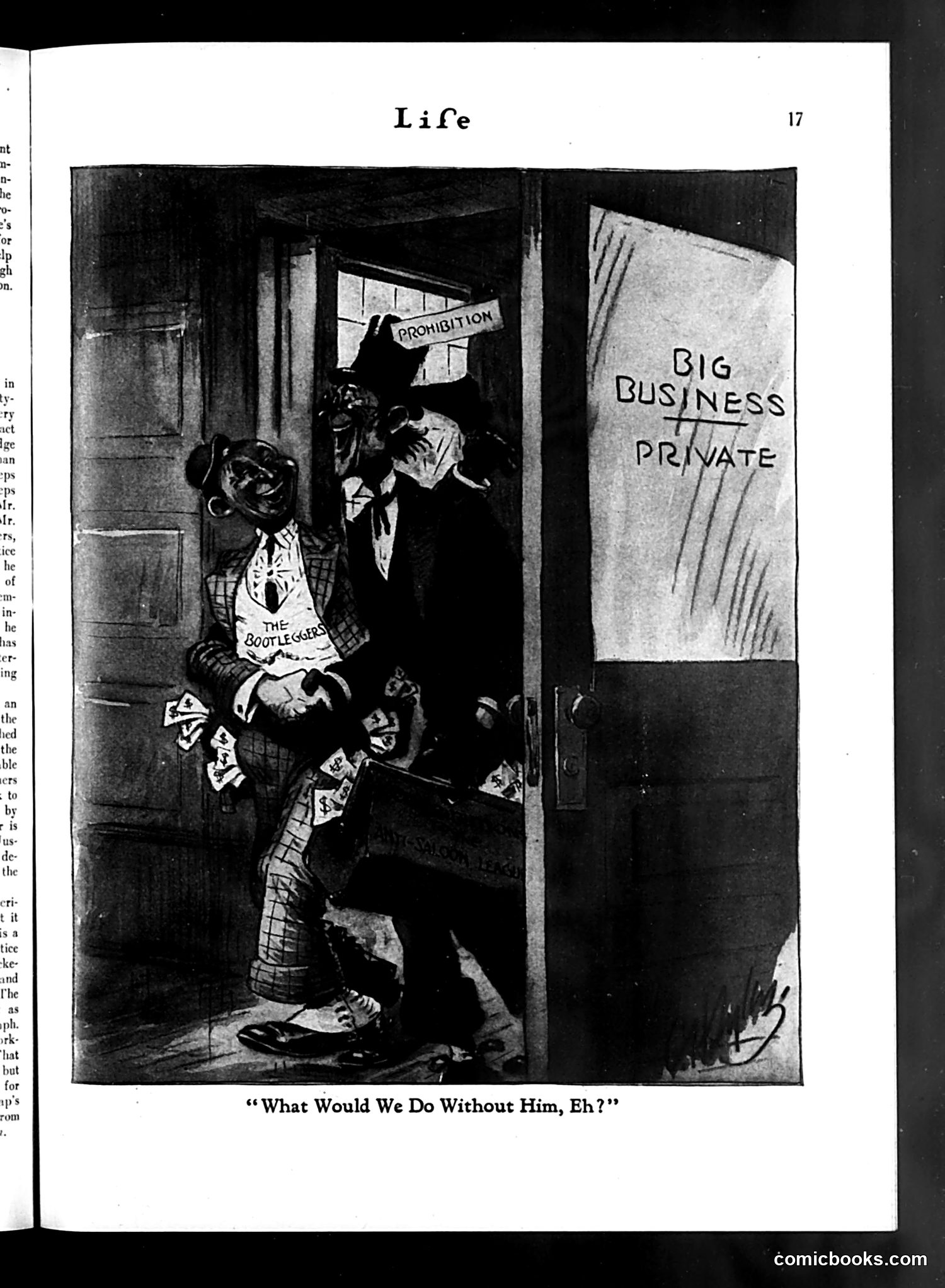
This Prohibition-era cartoon satirizes organized crime's grip on American society during alcohol prohibition. The image depicts "The Bootlegger"—a figure dressed in checkered pants distributing money—conducting "Big Business" from a speakeasy marked "Prohibition." The satire's point: prohibition laws, intended to eliminate vice, instead created a thriving black market that enriched criminals and corrupted society. The bootlegger has become indispensable to the economy and social life, with the title's rhetorical question suggesting Americans had grown dependent on illegal alcohol suppliers. This reflects contemporary criticism that Prohibition (1920-1933) failed to eliminate drinking while empowering gangsters and organized crime syndicates throughout the country.
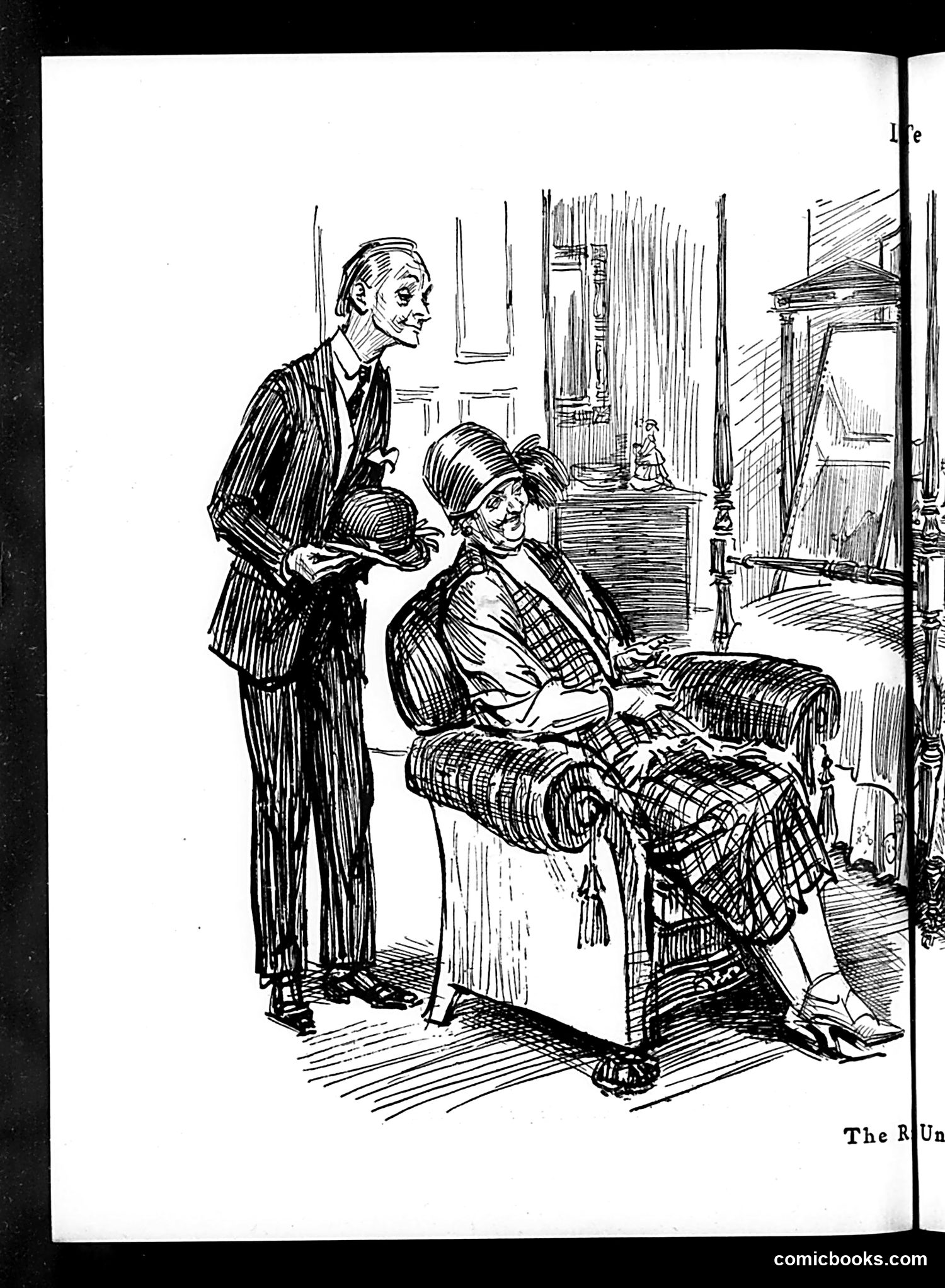
This appears to be a page from *Life* magazine featuring a satirical cartoon. The image shows two figures in an interior setting: a tall, thin man in a pinstriped suit standing and holding what appears to be a hat, and a seated woman wearing a hat and checkered clothing. The partial text visible reads "The R Un" (likely "The Run" or part of a longer title), suggesting this cartoon illustrates a social or political scenario. However, **without complete OCR text or a visible caption, the specific satire, identities of the figures, and historical context remain unclear**. The style and clothing suggest early-to-mid 20th century. To accurately explain the joke or reference, the full caption and publication date would be necessary.
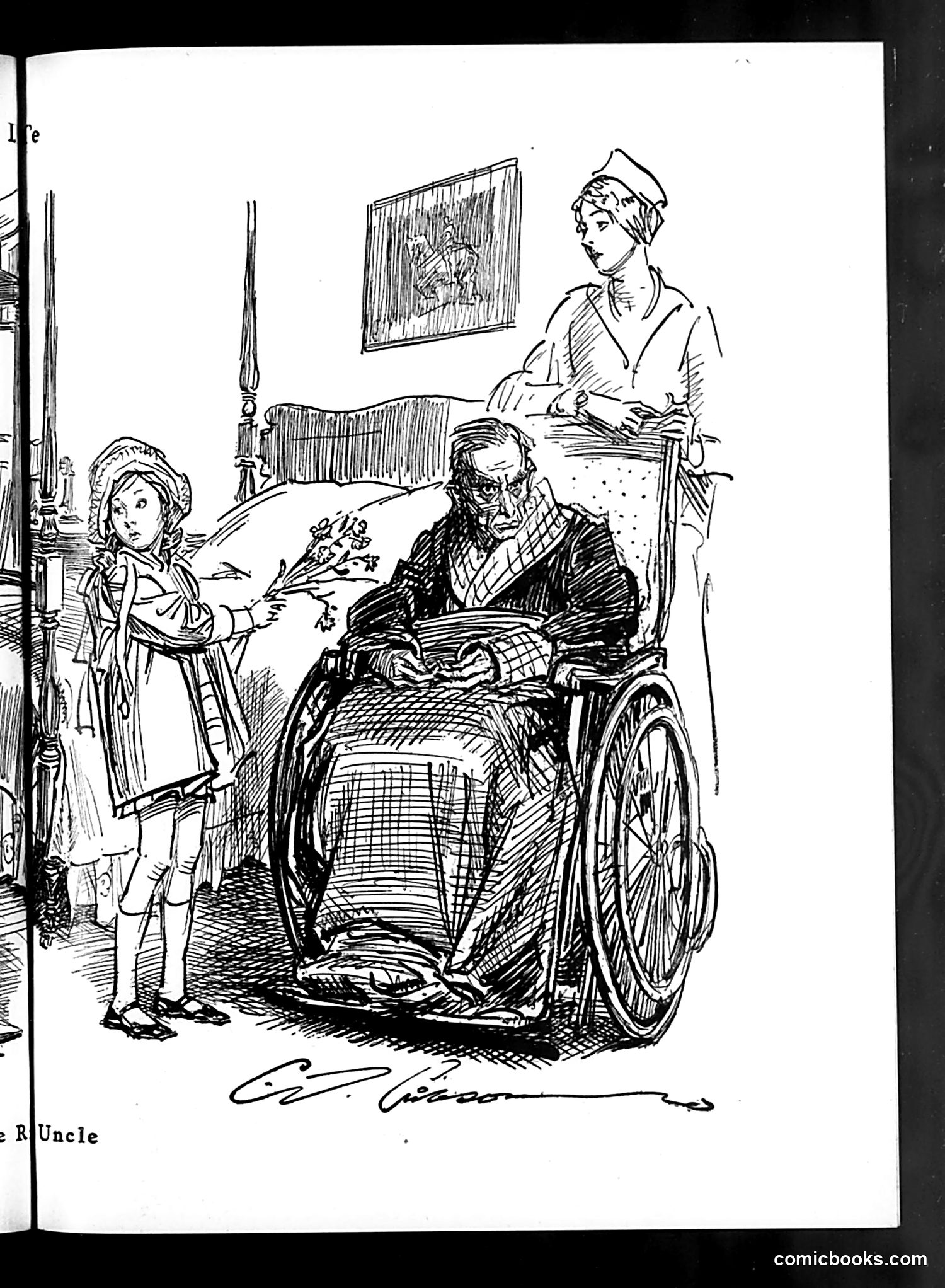
This pen-and-ink illustration depicts an elderly man in a wheelchair being attended to by two women in what appears to be a bedroom. The figure labeled "Uncle" at bottom left suggests this is a domestic scene, likely from an early 20th-century Life magazine illustration. The drawing style and composition suggest this is narrative illustration rather than political satire. Without clear text identifying specific characters or events, the precise satirical point remains unclear. The scene appears to comment on domestic care or family dynamics of the era, but the exact social or political reference it targets cannot be confidently determined from the image alone. The artwork demonstrates Life magazine's use of detailed character illustration for its humorous commentary.
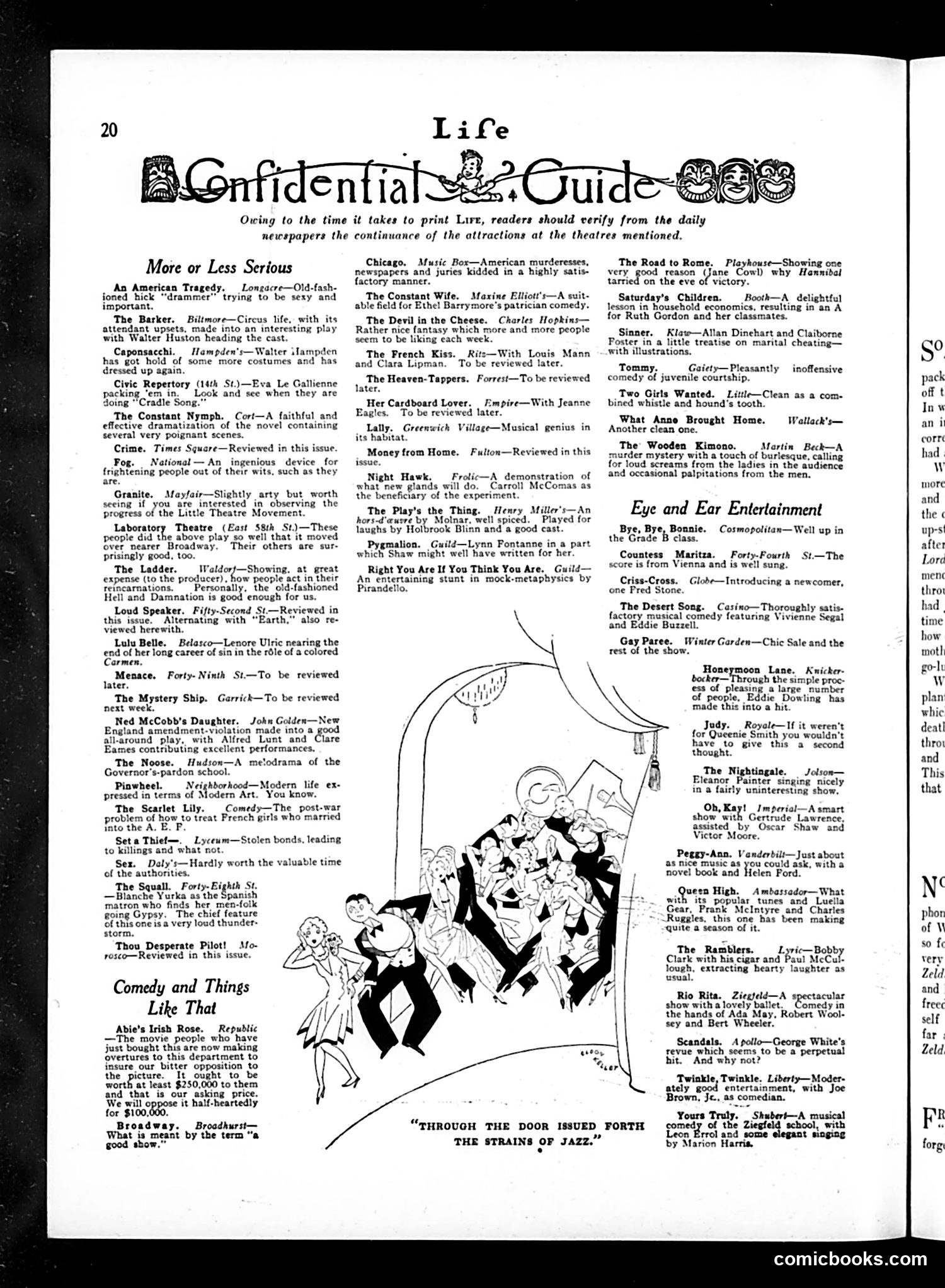
This page is a theater guide reviewing Broadway productions from what appears to be the 1920s. The main cartoon, captioned "THROUGH THE DOOR ISSUED FORTH THE STRAINS OF JAZZ," depicts elegantly dressed people in formal wear bursting energetically through a doorway, with a musician visible inside. The joke satirizes the Jazz Age's cultural collision: the contrast between traditional "proper" society (represented by formal dress and restraint) and the wild, uninhibited energy of jazz culture. The exaggerated poses suggest how shocking this modern music felt to conventional audiences. The surrounding theater reviews reinforce this cultural moment—productions like "An American Tragedy" and "Ned McCobb's Daughter" reflect 1920s social anxieties, while lighter comedies dominate. The reviewer's acerbic tone (mocking "A. E. F." war references, dismissing certain plays) typifies Life's satirical stance on contemporary entertainment and social manners during the Prohibition and Jazz Age era.
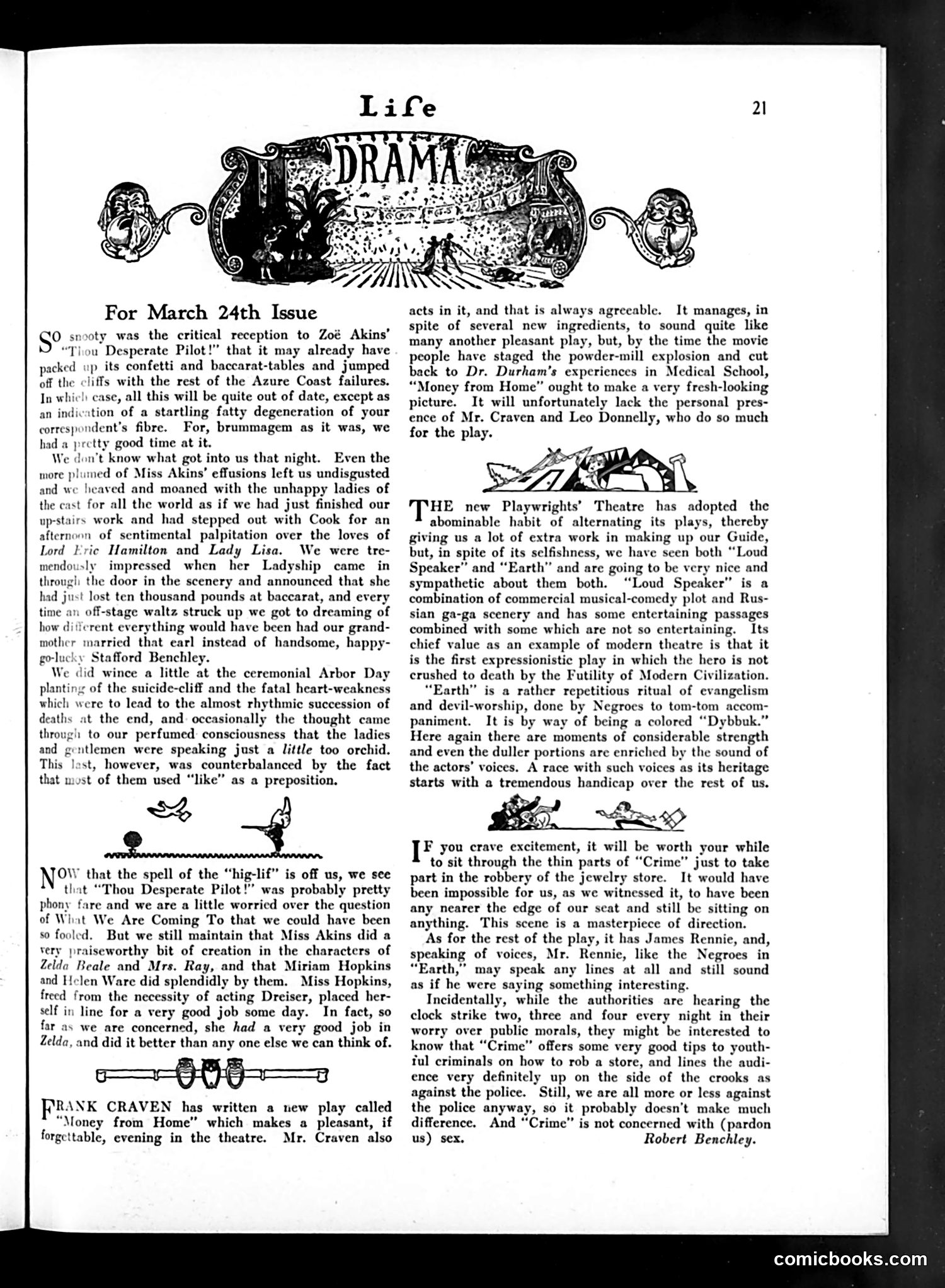
This is a theater review column covering Broadway productions for Life's March 24th issue. The critic discusses several plays: **"Thou Desperate Pilot"** by Zoé Akins—a melodramatic society play set on the French Riviera involving baccarat, suicide cliffs, and aristocratic entanglements. The reviewer admits being emotionally manipulated by it despite recognizing its phoniness, praising actress Miriam Hopkins's performance. **"Money from Home"** by Frank Craven—described as pleasant but forgettable, though expected to improve as a film with added spectacle. **"Loud Speaker"** and **"Earth"** at the Playwrights' Theatre—the former a musical-comedy hybrid with Russian Expressionist staging; the latter a ritualistic drama featuring Black performers with tom-tom accompaniment. The column exemplifies 1920s theater criticism: sophisticated mockery of sentimental melodrama, appreciation for competent acting despite weak material, and casual racial characterization typical of that era.
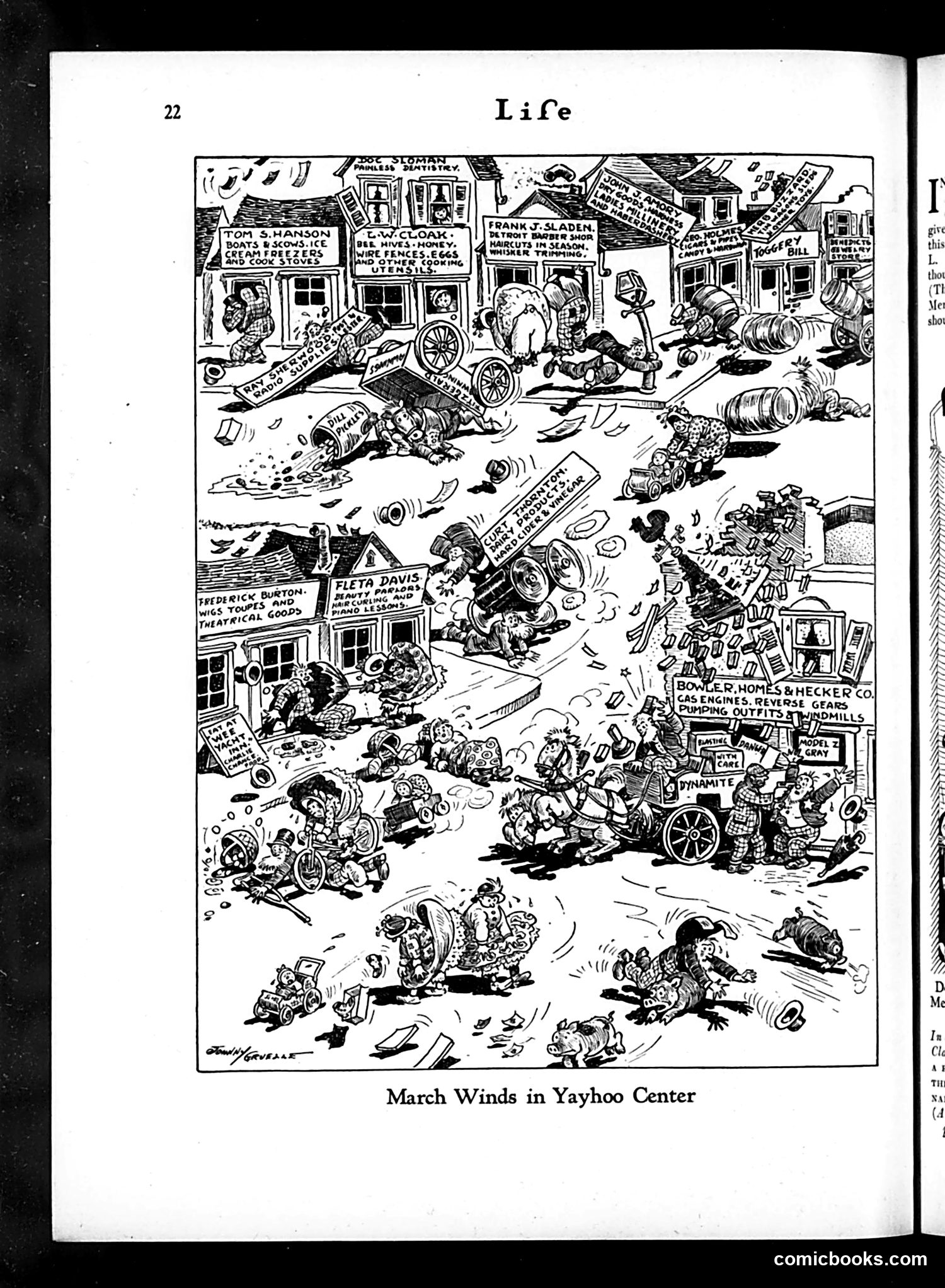
This is a satirical cartoon depicting chaos in a small town during windy March weather. The illustration shows exaggerated destruction caused by strong winds—overturned barrels, scattered debris, people and objects tumbling about, and general disorder throughout the street. The humor lies in the contrast between the innocent natural phenomenon (March winds) and the comically catastrophic results. Various business signs visible on storefronts (including references to Tom Hanson's produce, E.W. Cloak's hardware, and other merchants) suggest this represents a typical American commercial district experiencing nature's disruption. "Yayhoo Center" appears to be a fictional or generic small-town name used for satirical effect. The cartoon mocks both the vulnerability of small-town commerce to weather and the general chaos of everyday life, rendered in exaggerated, humorous detail typical of *Life* magazine's visual humor style.
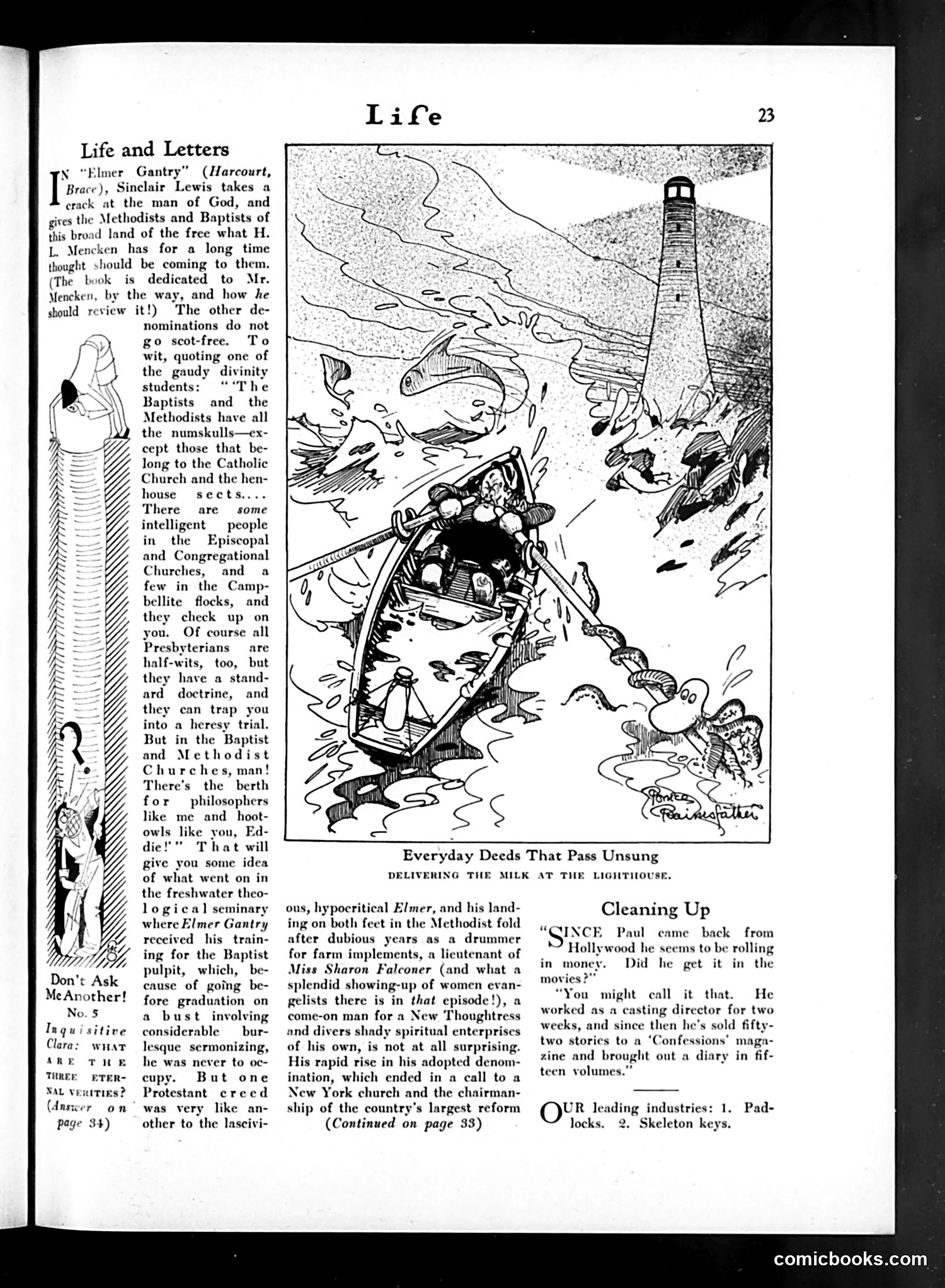
This page reviews Sinclair Lewis's novel *Elmer Gantry* (1927), a scathing critique of Protestant clergy hypocrisy. The text quotes Lewis's mockery of Baptist and Methodist churches as havens for the intellectually mediocre, while Episcopal and Presbyterian denominations fare slightly better in the satirist's hierarchy of competence. The cartoon "Delivering the Milk at the Lighthouse" depicts everyday life with mild humor about routine work. Below, "Cleaning Up" is a joke about Paul, a Hollywood casting director who's grown wealthy by selling confessional magazine stories and publishing a diary—implying he's profiting from exposing others' secrets or fabricating scandalous material. The page also includes "Don't Ask Me Another!"—a trivia game asking readers to identify "three eternal verities." Overall, the content reflects 1920s intellectual skepticism toward organized religion and Hollywood's emerging celebrity culture.
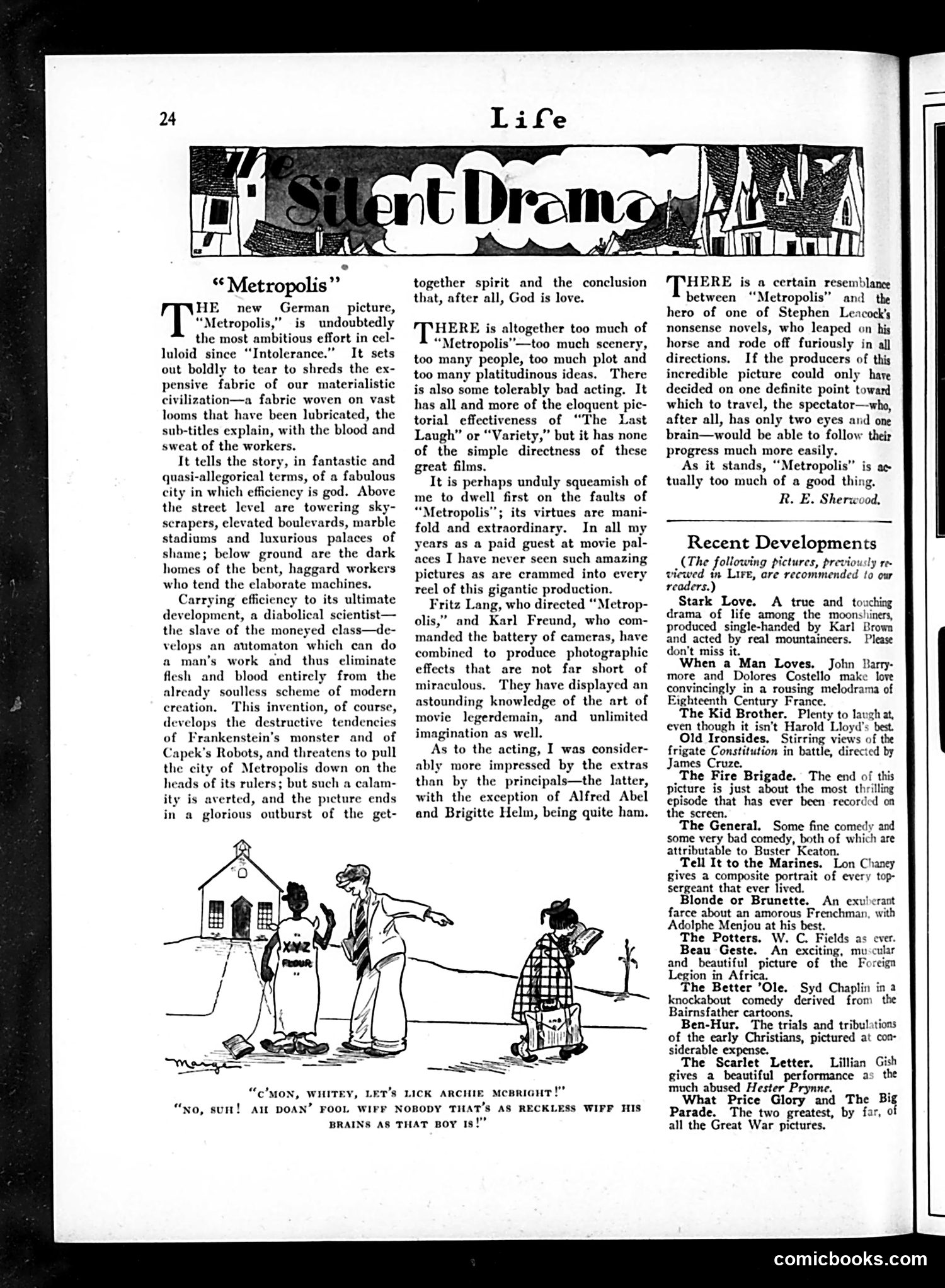
This page reviews Fritz Lang's 1927 German film *Metropolis*, a science-fiction epic about a dystopian city divided between wealthy surface-dwellers and oppressed underground workers. The reviewer (R.E. Sherwood) praises its visual effects and ambition while criticizing its excessive length, melodramatic plot, and ham acting—except for Alfred Abel and Brigitte Helm. The cartoon below illustrates the film's class-conflict theme: two working-class characters debate whether to fight their oppressor "Archie McBright," with one warning the other against recklessness. It captures the film's central tension between worker rebellion and cautious restraint. The page also lists recent film releases, recommending *Stark Love* and *When a Man Loves*.
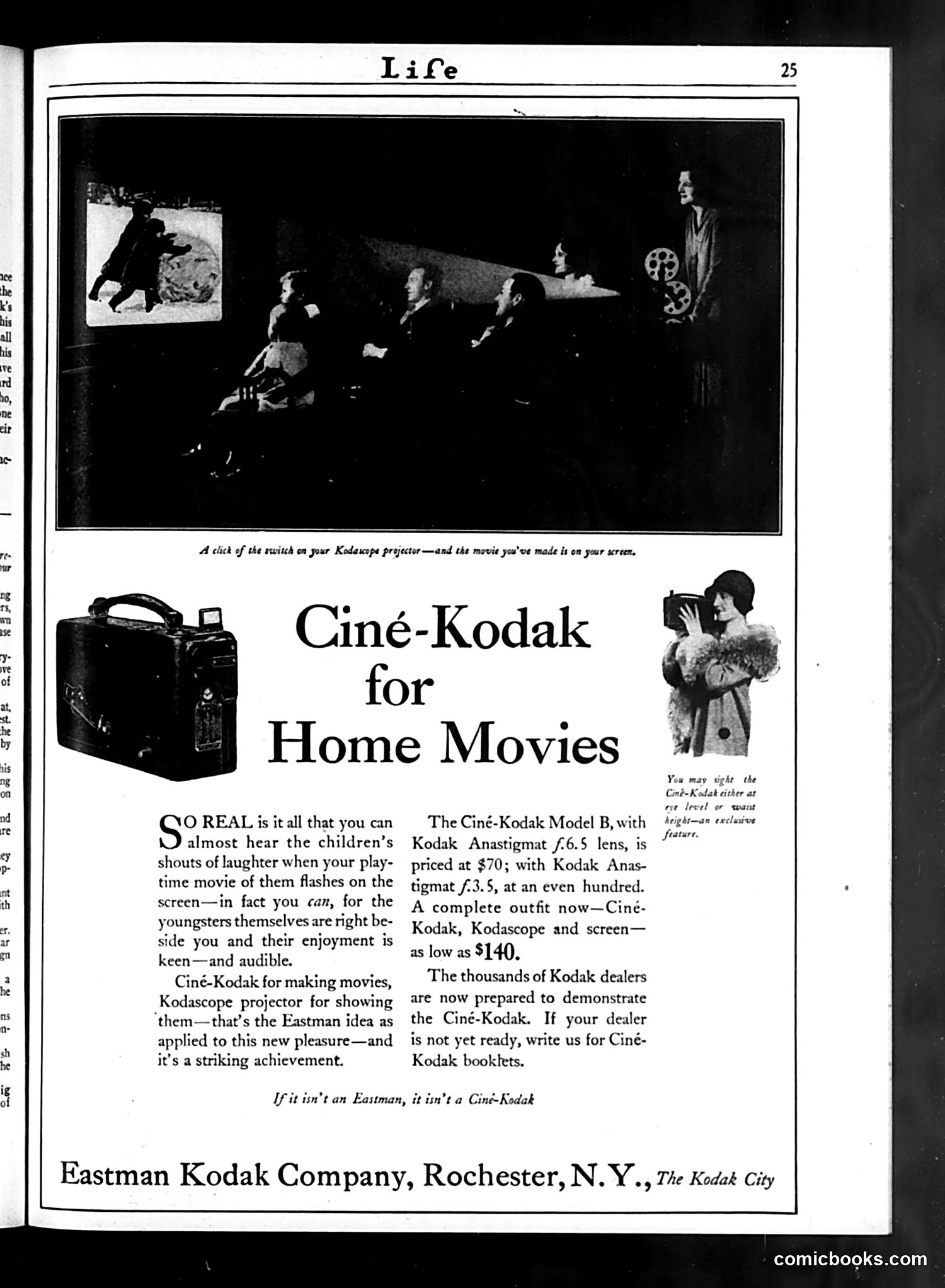
This page is primarily a **product advertisement**, not a political cartoon. It promotes Eastman Kodak's new Ciné-Kodak home movie camera system. The top photograph shows a family watching a projected film in their living room—a scene meant to appeal to middle-class consumers by depicting the novelty and pleasure of homemade movies. The image emphasizes accessibility: families could now affordably create and screen their own films at home. The advertisement highlights two products: the Ciné-Kodak camera ($70-$100) and the Kodascope projector. It markets this as an "Eastman idea"—democratizing filmmaking for ordinary households rather than professionals. The tagline "If it isn't an Eastman, it isn't a Ciné-Kodak" establishes brand authority. For modern readers: this represents early consumer electronics marketing, targeting post-WWI prosperity and growing middle-class leisure time. There is no satire or political content—it's straightforward commercial persuasion emphasizing family entertainment and technological progress.
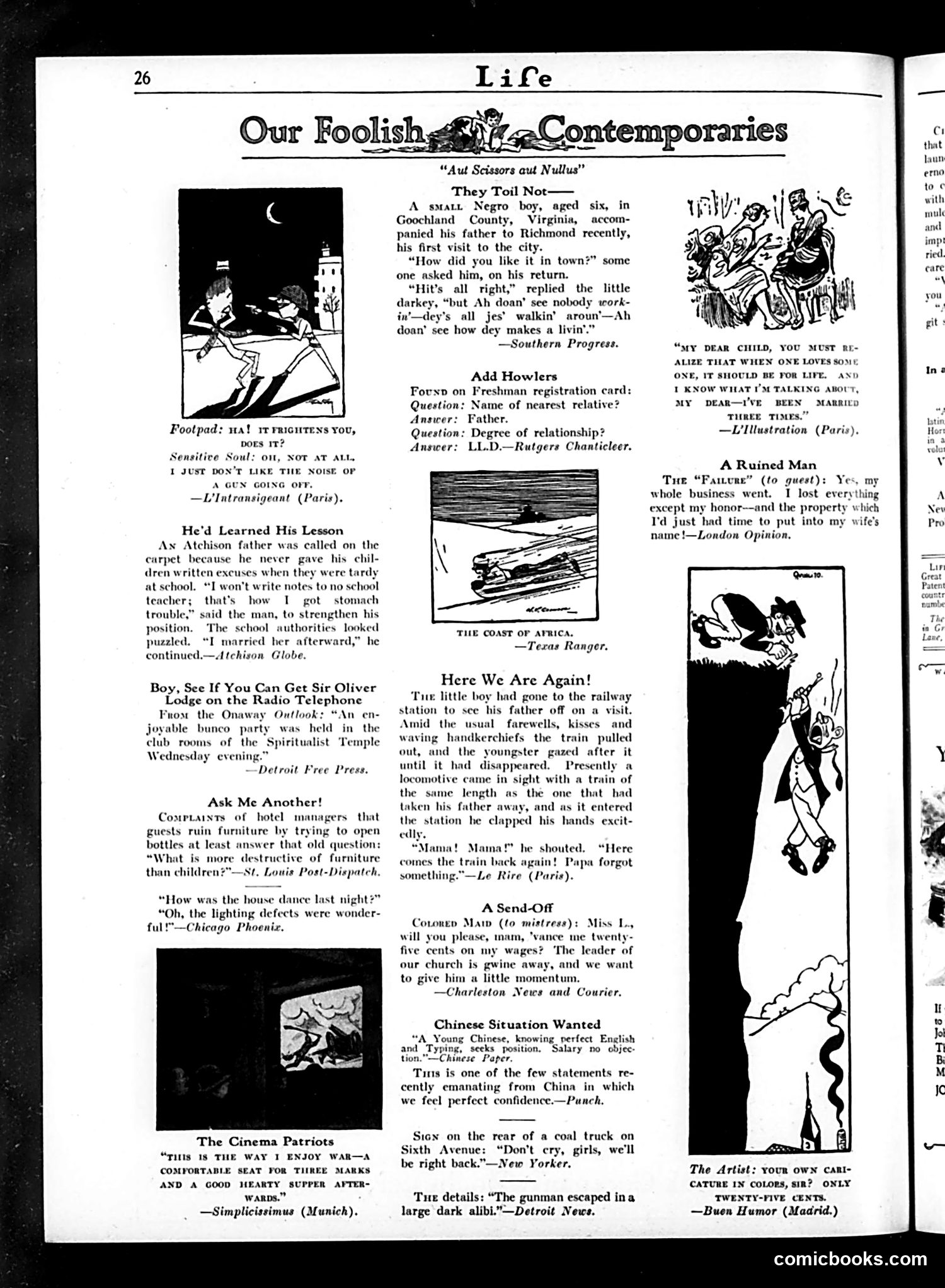
This page collects brief humorous anecdotes and cartoons satirizing contemporary foolishness, reprinted from international newspapers and magazines. Key items include: **The cartoons** mock physical cowardice (a man frightened by gunfire) and marital hypocrisy (a man claiming his stomach troubles came from refusing to write school excuses, then marrying the teacher anyway—suggesting he was actually afraid of authority figures). **The jokes** target various targets: a Black child's observation that city people don't work (relying on racial stereotypes); spiritualists' credulity; hotel guests destroying furniture; a child's innocent confusion watching trains; and a church leader's hypocrisy (asking for money while claiming moral leadership). **The social satire** reflects early 20th-century concerns: marriage/divorce attitudes, parenting, spiritualism fads, and class anxieties. The reprinting from foreign sources emphasizes Life's cosmopolitan, intellectual stance—treating foolishness as universal rather than distinctly American.
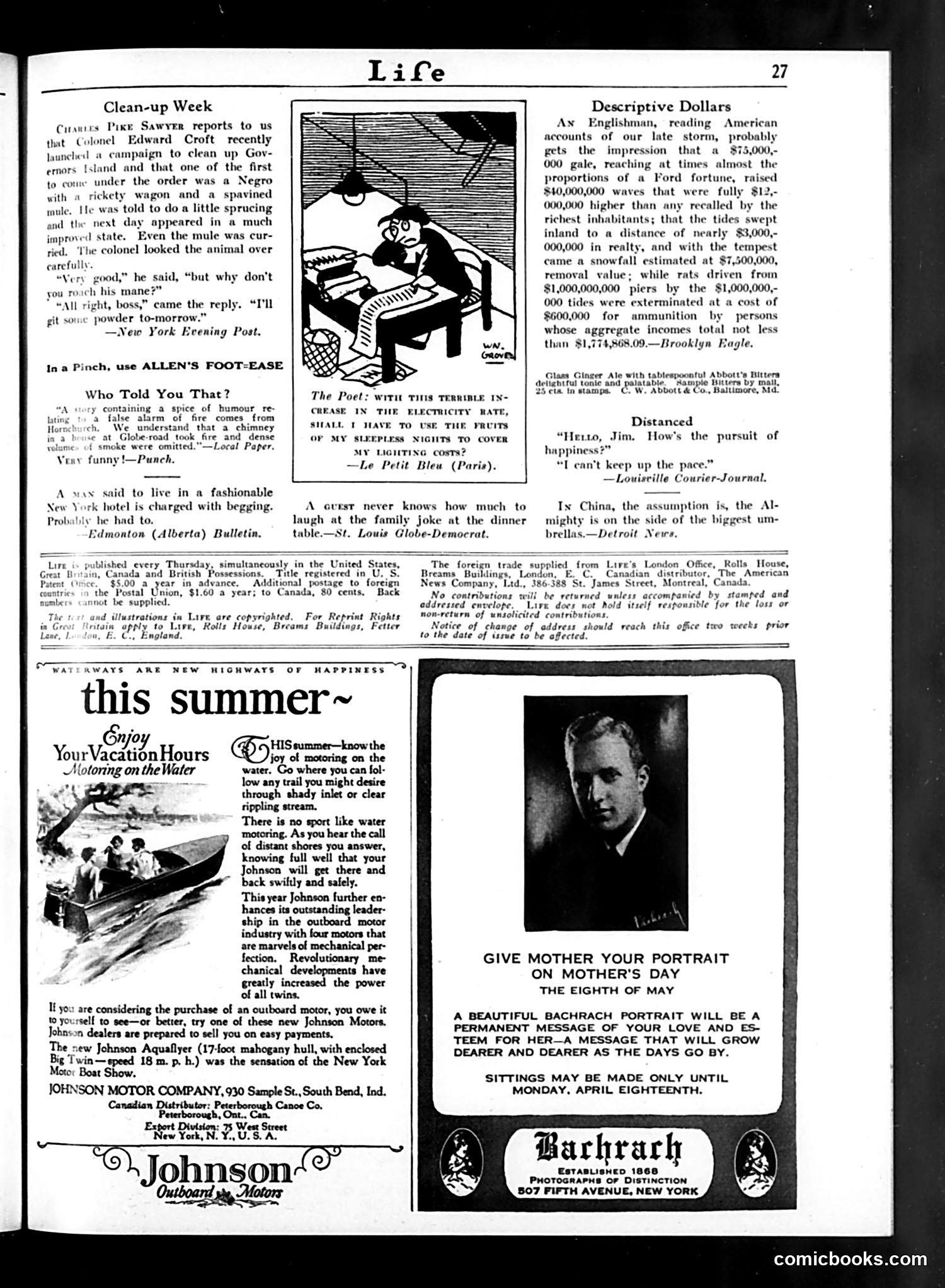
This page contains several brief satirical items typical of Life's humor format: **"Clean-up Week"** depicts a racial stereotype: a Black man with a mule on Governors Island is ordered to improve his appearance. The joke relies on the racist trope of Black workers being told to "spruce up," with the punchline being his promise to powder the mule's mane—playing on assumptions about poor grooming. **"The Poet"** mocks a poet complaining that high electricity rates force him to use candles at night, ironically calling fruits of sleepless nights "my lighting costs"—satirizing impoverished artists' financial struggles. **"Who Told You That?"** makes dark humor from a false fire alarm at a chimney fire, with the punchline questioning who reported it. **"Distanced"** contrasts American and Chinese perspectives: Americans joke about happiness while the Chinese pragmatically attribute strength to umbrella size—a cultural commentary. The page is primarily **satirical filler content** interspersed with period advertisements (Johnson Motors, Bachrach photography). The racial humor reflects the era's casual bigotry in mainstream publications.
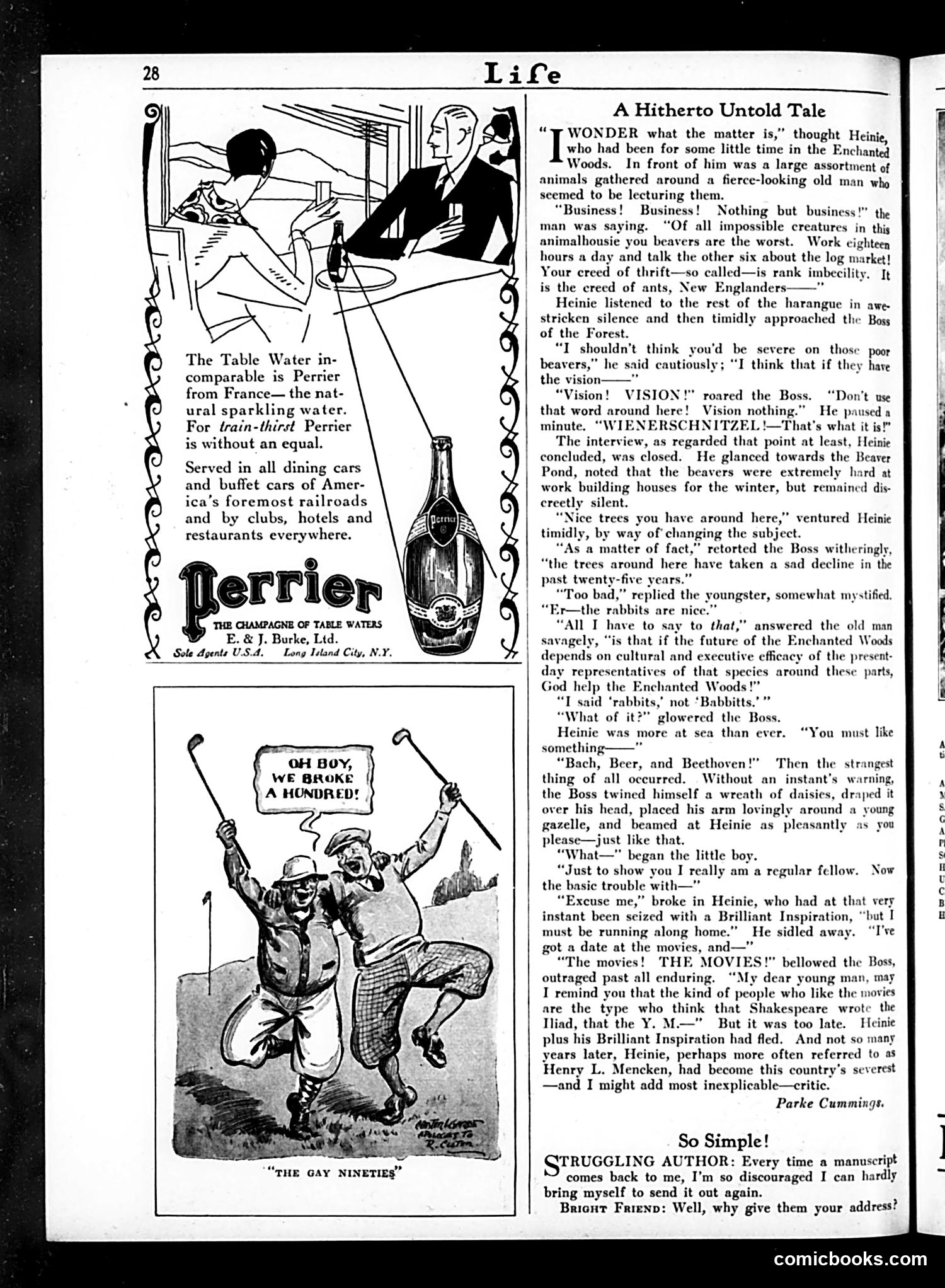
This story presents a fictional origin myth for **Henry L. Mencken**, the famous American critic, by imagining young "Heinie" meeting a grumpy forest Boss character. The joke is that this encounter shaped Mencken's famously caustic worldview. The story mocks American philistinism through the Boss's complaints: he scorns beavers for valuing work and thrift (sarcastically linking them to New Englanders and "Babbitts"—Sinclair Lewis's symbol of conformist mediocrity), criticizes trees' decline, dismisses rabbits, and explodes at mention of movies and popular culture. The punchline suggests that Mencken's later reputation as a severe cultural critic—his contempt for mass taste and conventional thinking—stems from this early exposure to a cranky intellectual authority figure. It's a lighthearted explanation for Mencken's actual critical stance toward American culture and taste, which Life's readers would recognize as familiar and fitting.
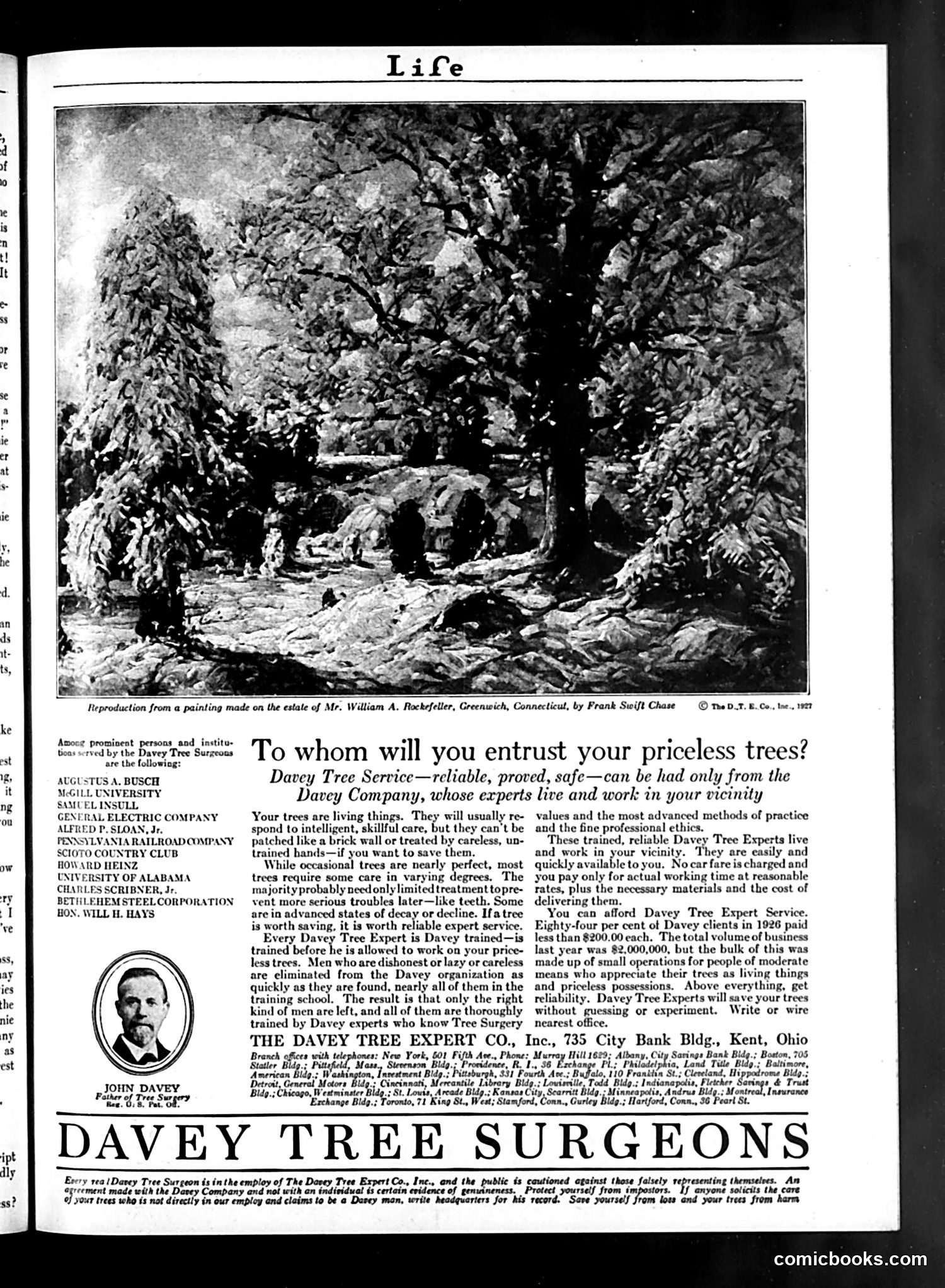
This page is primarily a **commercial advertisement**, not satire or political commentary. It promotes the Davey Tree Expert Company's tree surgery services. The image shows a romanticized forest scene (a painting from William A. Rockefeller's Greenwich estate), meant to evoke the prestige clientele served by Davey Tree. The advertisement's strategy is to build credibility by listing prominent institutions and wealthy individuals as clients—including Samuel Insull, General Electric Company, and various railroads. A portrait of John Davey, identified as the "Founder of Tree Surgery," appears as an authority figure. The text frames tree care as professional expertise requiring trained specialists, comparing tree maintenance to dental work. It emphasizes reliability and warns against unlicensed competitors, noting that 84% of clients paid under $200 in 1926—positioning the service as affordable for the middle class despite elite associations. This reflects early 20th-century American advertising that leveraged celebrity endorsements and professional credentials to market services.
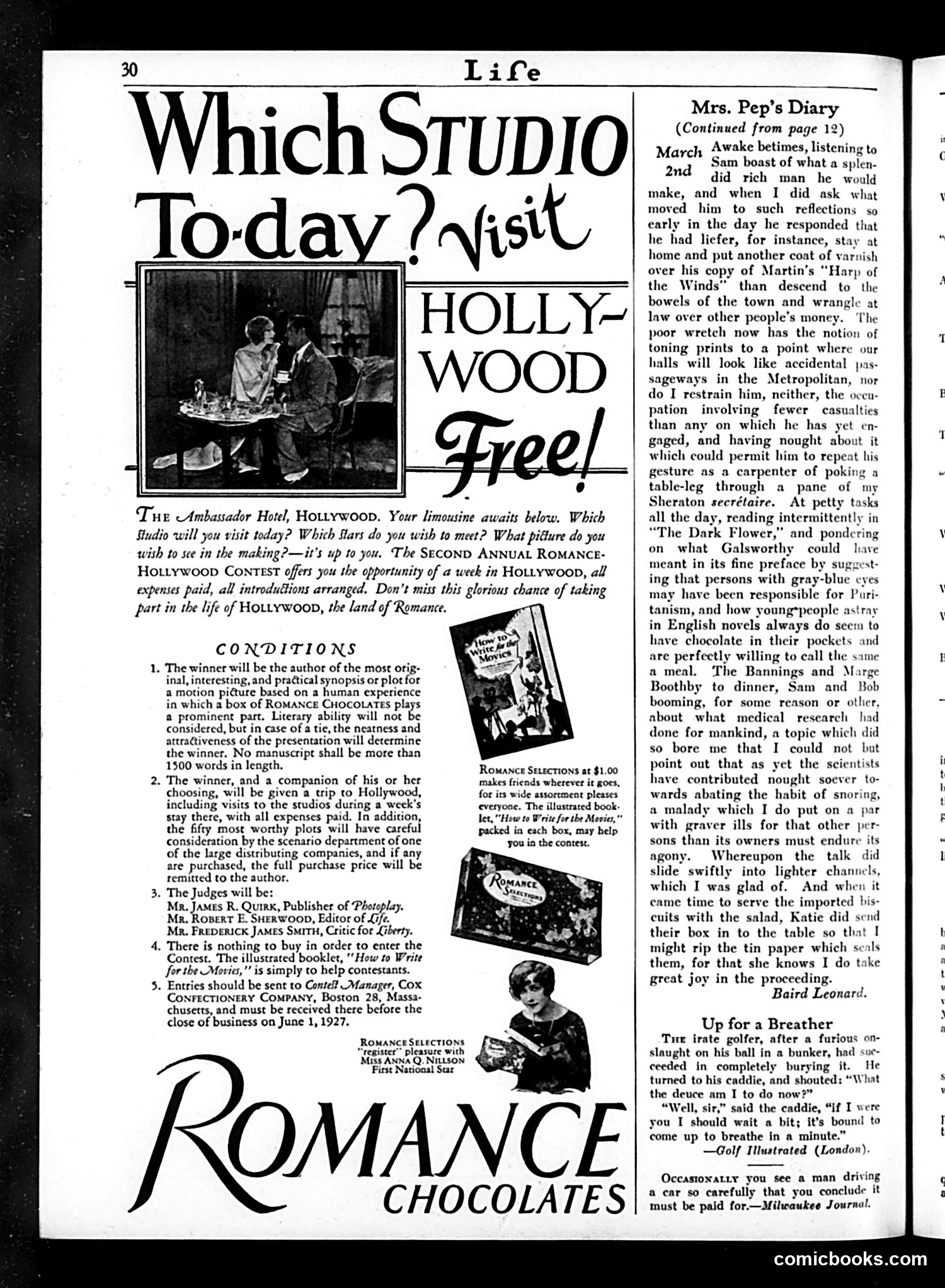
This is primarily a **advertisement disguised as editorial content**—a "Second Annual Romance-Chocolates Contest" offering a trip to Hollywood as the prize. The contest asks readers to submit movie plot ideas featuring Romance Chocolates, with judging by major magazine editors and critics. The page satirizes **Hollywood's allure and the fantasy of stardom** in the 1920s. The headline "Which Studio Today? Visit" mocks how accessible and glamorous the studios pretend to be, while the contest copy uses breathless language ("the land of Romance") to sell the dream. On the right, "Mrs. Pep's Diary" contains genteel domestic humor typical of 1920s Life—mundane marital observations about a husband varnishing furniture and reading "The Dark Flower," mixed with snobbish commentary about young people and novels. Together, the pages contrast **manufactured Hollywood fantasy** with **middle-class reality**, though both are clearly marketed at the same aspirational audience seeking escape and sophistication.
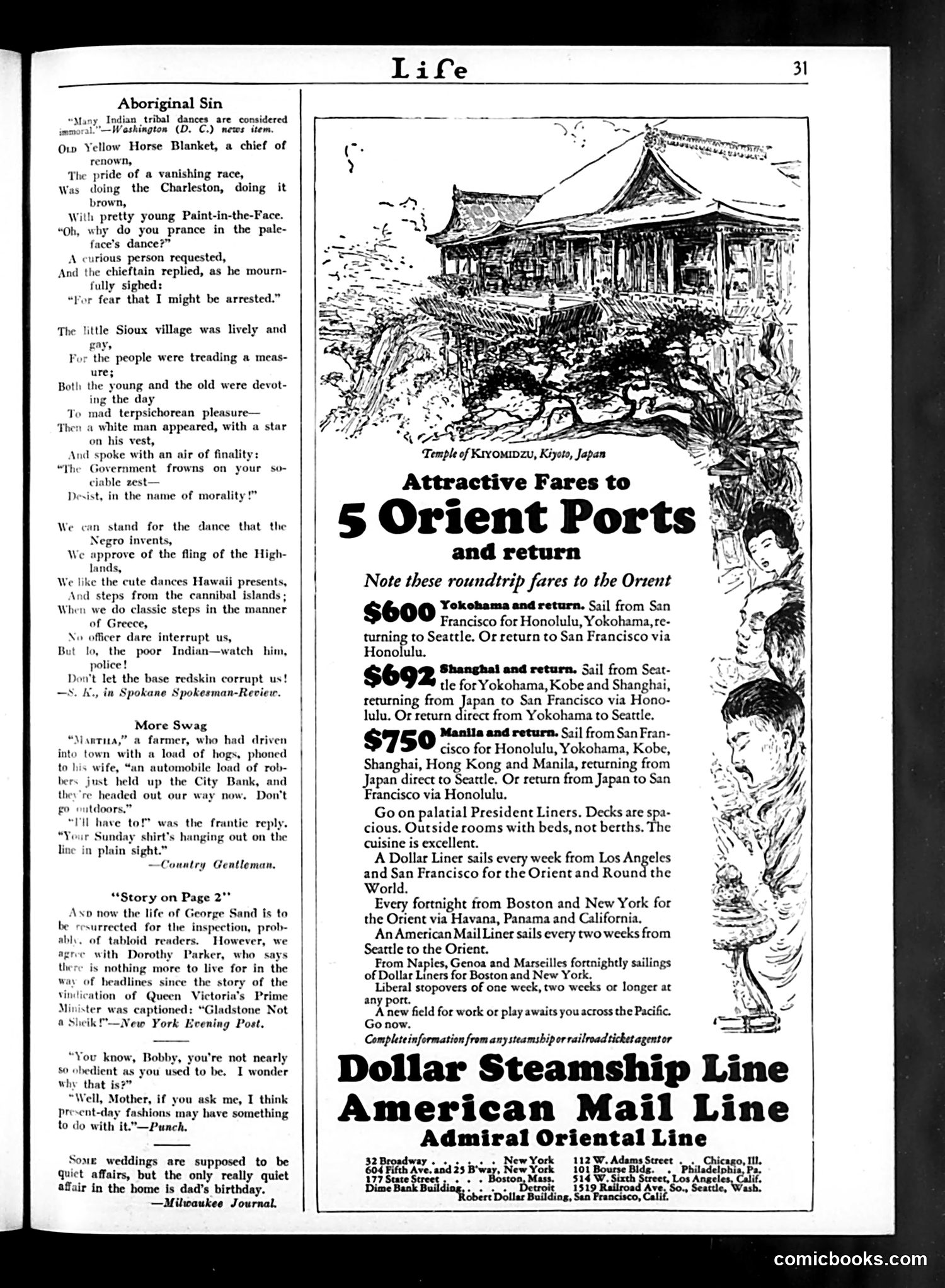
This poem satirizes the U.S. government's hypocrisy in policing Native American cultural practices. The setup: a Sioux chief named "Yellow Horse Blanket" is doing the Charleston (a trendy 1920s dance) with a young woman, but when questioned, he admits he's only dancing the "pale-face's dance" out of fear of arrest. The satire's bite: a white government official arrives and shuts down the village's traditional dancing in the name of "morality," claiming the Indian dances are immoral. The poem then lists dances from other cultures—Negro jazz, Scottish Highland dancing, Hawaiian hula, even Greek classical steps—that white society openly enjoys and permits without interference. **The point**: The government condemns Native American cultural expression as "corrupt" while freely adopting and celebrating the same innovations and traditions from other groups. It's naked racial discrimination dressed up as moral concern. The page contrasts this with a travel advertisement, creating ironic juxtaposition between America's celebrated cosmopolitan openness and its actual treatment of indigenous peoples.
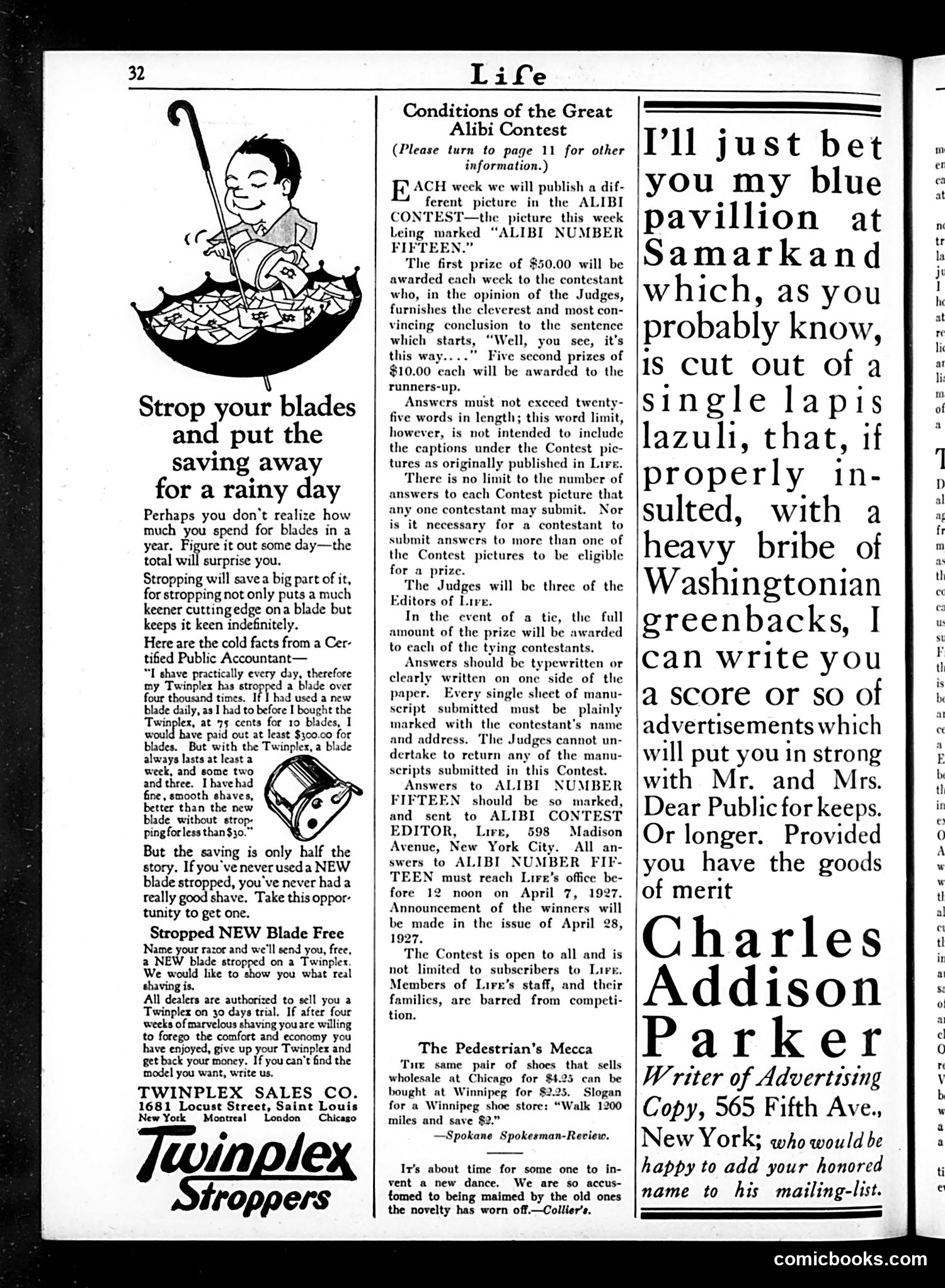
This page contains **primarily advertising and contest information**, not political satire. **Left side:** A Twinplex razor-stropper advertisement featuring a cheerful man in a boat made of money. The pitch: stropping razors keeps blades sharp longer, saving money yearly (the accountant example claims $270+ savings versus buying new blades). It's straightforward product marketing using a humorous visual. **Center:** Details for Life's "Alibi Contest"—a humor competition where readers submit funny explanations beginning "Well, you see, it's this way...." Winners received $50 weekly; runners-up got $10. Entries were due April 7, 1927. **Right side:** Charles Addison Parker (a writer of advertising copy) jokingly offers to write humorous advertisements for a fee, mentioning his blue pavilion in "Samarkand"—this is self-promotional banter. **Bottom:** A brief joke about shoe prices in Winnipeg versus Chicago. The page reflects 1920s consumer culture and Life's typical blend of advertising, contests, and light humor.
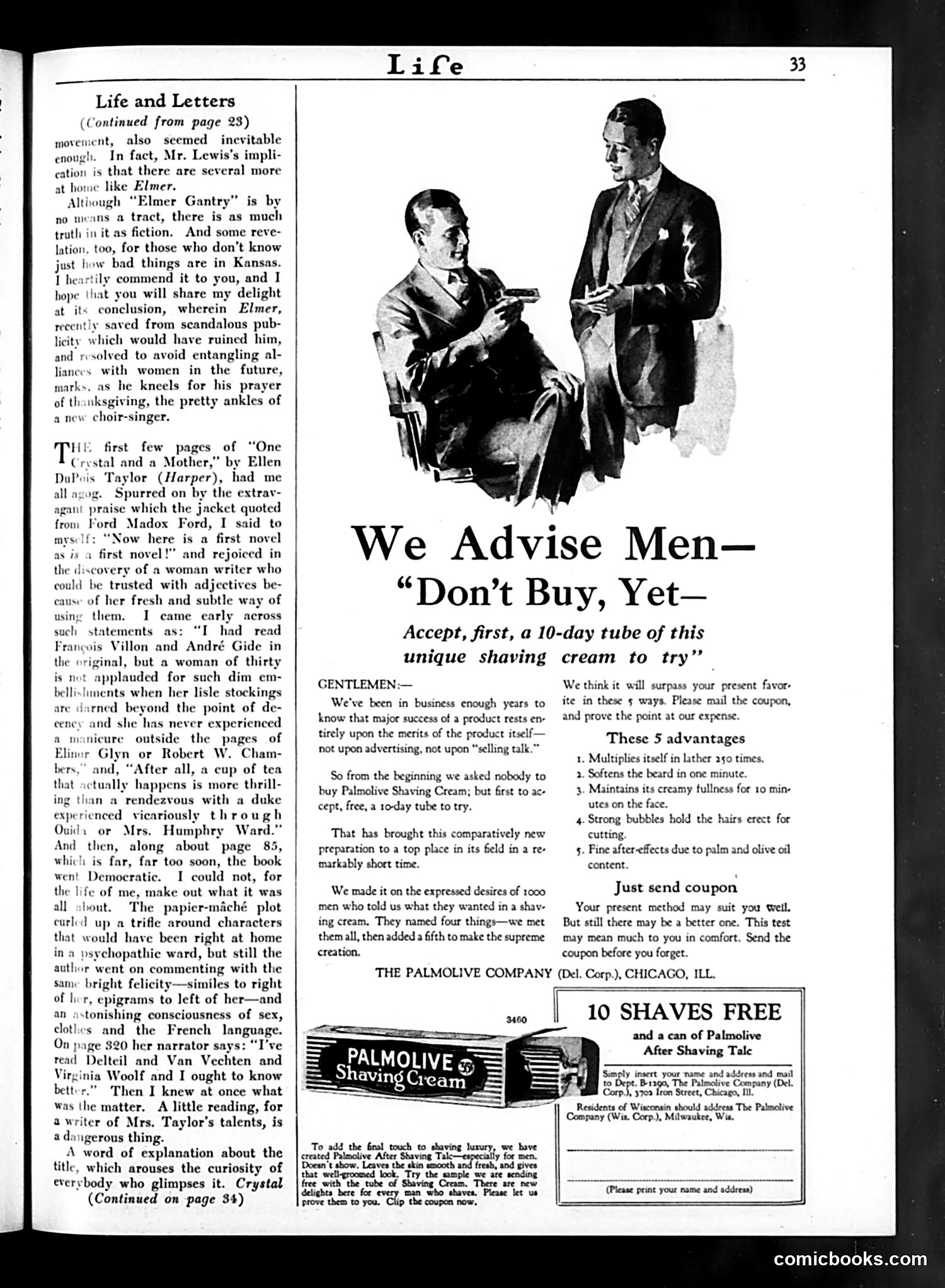
This page contains two distinct sections: **Literary Criticism (left):** A book review column discussing recent novels, notably Sinclair Lewis's *Elmer Gantry*. The reviewer praises Lewis's satirical portrait of religious hypocrisy in Kansas, particularly the protagonist's final ironic moment of spiritual devotion while eyeing a choir singer's ankles. The column also critiques Ellen DuPois Taylor's debut novel *One Crystal and a Mother*, initially praising her wit and sophistication before condemning a jarring tonal shift around page 85 as "Democratic" in nature—the reviewer considers this a failure caused by the author's limited literary experience. **Advertisement (right):** A full-page Palmolive Shaving Cream ad featuring an illustration of two well-dressed men in conversation. The ad employs a marketing strategy emphasizing product quality over salesmanship, offering a free 10-day trial tube rather than direct sales pitches. This reflects early 20th-century advertising philosophy prioritizing product merit demonstration.
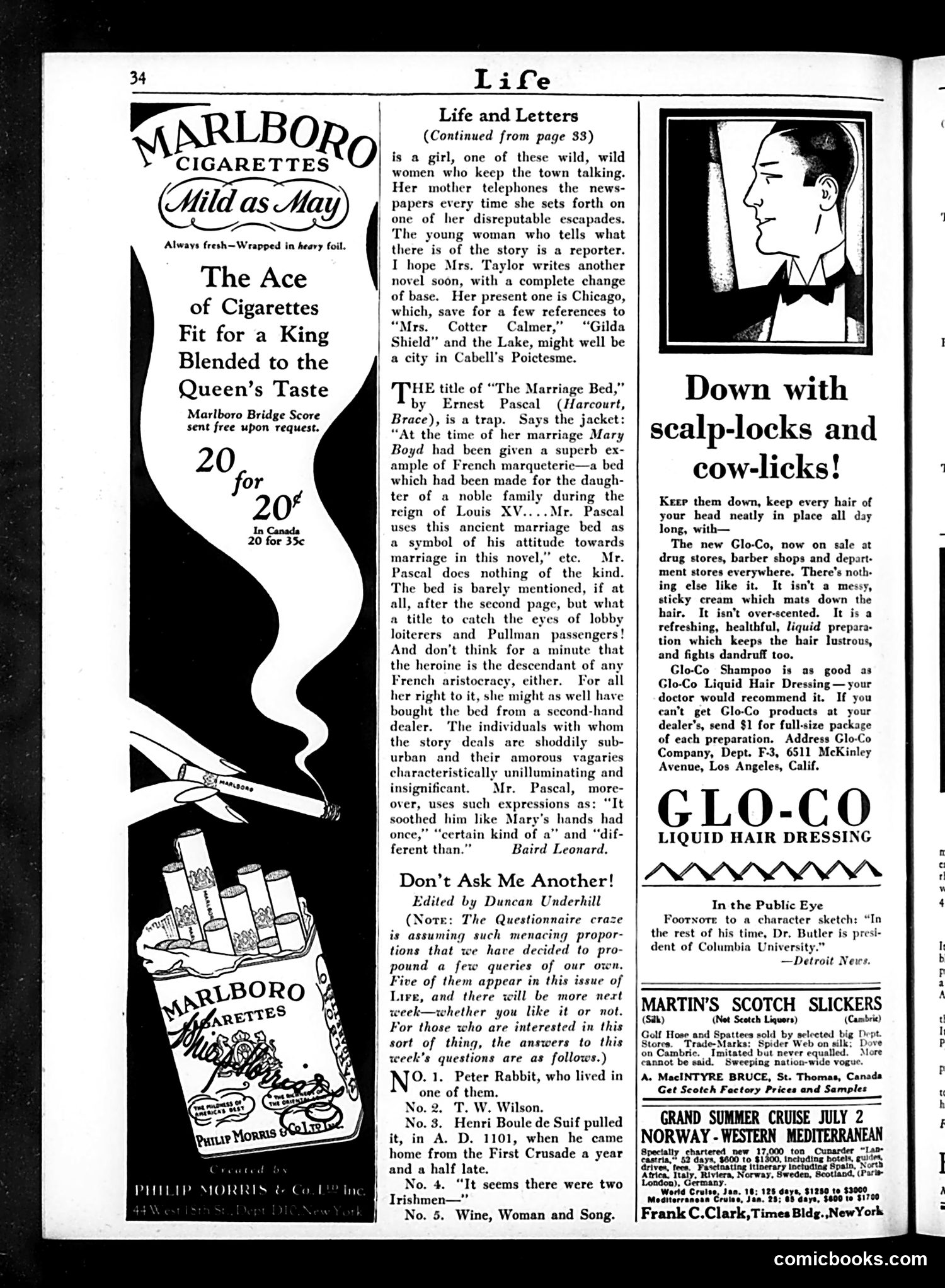
This page is primarily **advertising and book reviews**, with no political cartoons requiring historical explanation. The left side features **Marlboro Cigarettes ads** (Philip Morris brand), emphasizing luxury ("Fit for a King," "Queen's Taste") with 1920s-style imagery of cigarettes and a package. The main text comprises **book reviews** critiquing contemporary novels: one about a scandalous Chicago woman, and another about "The Marriage Bed" by Ernest Pascal—where the reviewer mocks the misleading title (implying a fancy French heirloom bed) when the actual story involves "shoddily suburban" characters with "amorous vagaries" of no consequence. Below is a humorous **questionnaire section** with absurdist answers (Peter Rabbit, T.W. Wilson, etc.). The right side contains **product advertisements**: Glo-Co hair dressing ("Down with scalp-locks and cow-licks!"), Martin's Scotch Slickers, and a cruise advertisement. The page reflects 1920s consumer culture and literary criticism rather than political satire.
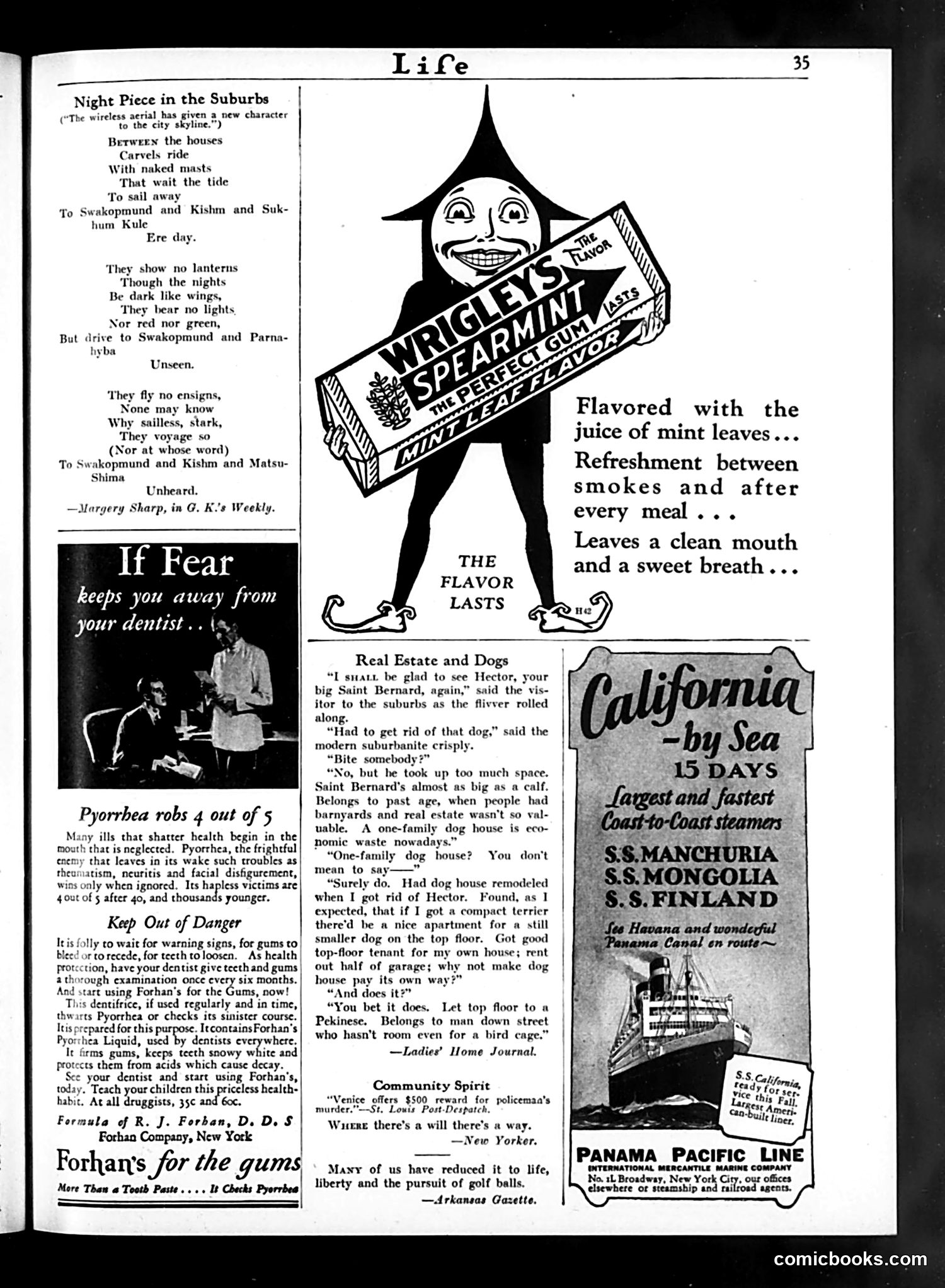
This page contains several distinct pieces of satirical content: **"Night Piece in the Suburbs"**: A poem by Margery Sharp mocking the mysterious, silent activity of ships in suburban harbors—likely referencing WWI-era submarine activity or blockade running, given references to German colonial ports (Swakopmund, Kishm). The poem's repetition of "unseen" and "unheard" satirizes the secretive wartime maritime traffic. **Advertising**: The page is dominated by product ads (Wrigley's gum, Forhan's toothpaste, steamship lines), typical of Life's commercial model. **"Real Estate and Dogs"**: A humor piece satirizing 1920s suburban efficiency culture—a homeowner has monetized every space, even converting his dog house into rental apartments. It mocks modern suburbanites' obsession with profit-maximization over sentiment or tradition. **"Community Spirit"**: A brief joke about St. Louis offering a reward for solving a murder, with the punchline that money motivates civic duty—a cynical jab at American materialism. The page reflects post-WWI American concerns: wartime paranoia, modern commercial culture, and suburban expansion.
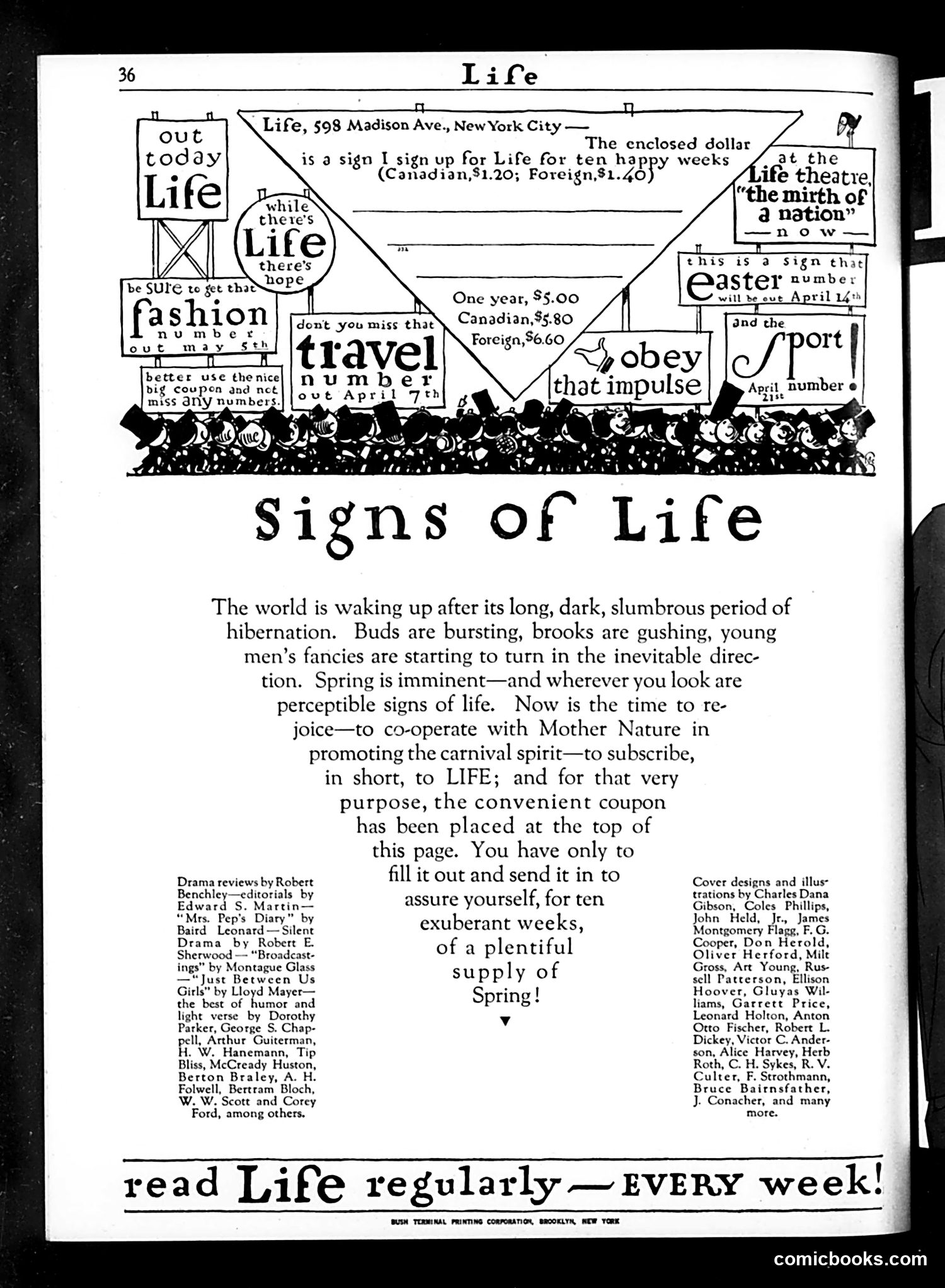
This is a **subscription advertisement** for *Life* magazine, a prominent American humor and satire publication. The page uses spring as a metaphor to pitch yearly subscriptions. The top section shows a stylized illustration of theater marquees and signs advertising *Life*'s content and pricing (ten weeks for $1; one year for $5). Below, the main text employs seasonal imagery—"buds bursting," "brooks gushing," and young men's romantic stirrings—as a playful appeal to readers to "subscribe to LIFE" and embrace the "carnival spirit." The advertisement lists prominent *Life* contributors: humorists (Robert Benchley, Dorothy Parker), illustrators (Charles Dana Gibson, John Held Jr.), and dramatists. This roster establishes *Life*'s cultural prestige and appeal to educated, affluent readers. The coupon at the top invites readers to subscribe. The closing line—"read Life regularly — EVERY week!"—emphasizes *Life*'s weekly publication schedule. This represents early 20th-century magazine marketing: using clever wordplay and seasonal themes to encourage subscriptions during spring.