
Life, 1927-03-24 · page 26 of 38
Life — March 24, 1927 — page 26: what you’re looking at
What you’re looking at
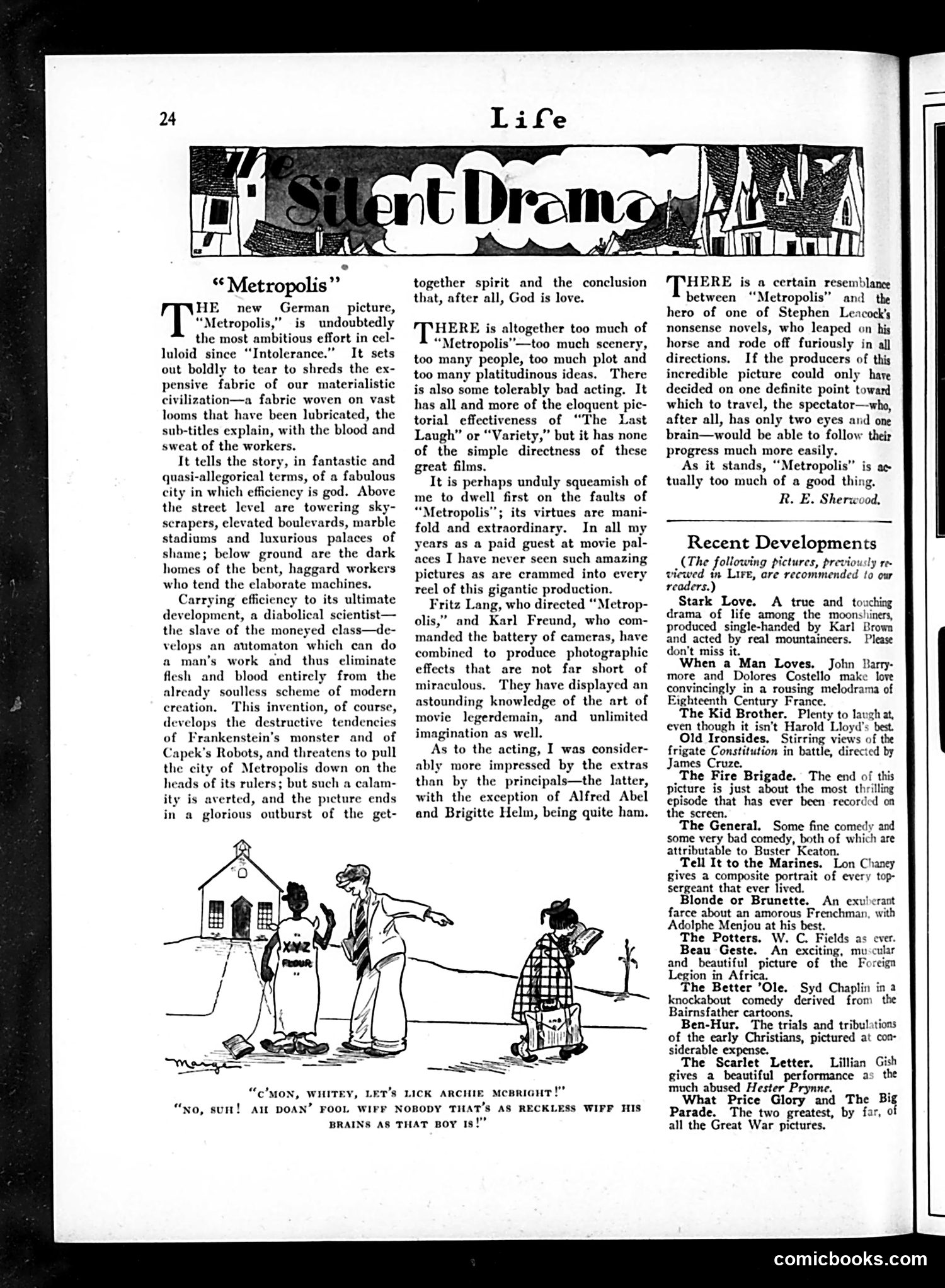
This page reviews Fritz Lang's 1927 German film *Metropolis*, a science-fiction epic about a dystopian city divided between wealthy surface-dwellers and oppressed underground workers. The reviewer (R.E. Sherwood) praises its visual effects and ambition while criticizing its excessive length, melodramatic plot, and ham acting—except for Alfred Abel and Brigitte Helm. The cartoon below illustrates the film's class-conflict theme: two working-class characters debate whether to fight their oppressor "Archie McBright," with one warning the other against recklessness. It captures the film's central tension between worker rebellion and cautious restraint. The page also lists recent film releases, recommending *Stark Love* and *When a Man Loves*.
📄 Transcribed text from this page (OCR, searchable)
Machine-transcribed from the original scan — historical spelling and the odd misread are preserved.
° “Metropolis” HE new German picture, “Metropolis,” is undoubtedly the most ambitious effort in cel- luloid since “Intolerance.” It sets out boldly to tear to shreds the ex- pensive fabric of our materialistic civilization—a fabric woven on vast looms that have been lubricated, the sub-titles explain, with the blood and sweat of the workers. It tells the story, in fantastic and Negorical terms, of a fabulous city in which efficiency is god. Above the street level are towering sky- scrapers, elevated boulevards, marble stadiums and luxurious palaces of shame; below ground are the dark homes of the bent, haggard workers who tend the elaborate machines. Carrying efficiency to its ultimate development, a diabolical scientist— the slave of the moneyed class—de- velops an automaton which can do a man’s work and thus eliminate flesh and blood entirely from the already soulless scheme of modern creat This invention, of course, develops the destructive tendencies of Frankenstein’s monster and of Capek’s Robots, and threatens to pull the city of Metropolis down on the heads of its rulers; but such a calam- ity is averted, and the picture ends in a glorious outburst of the get- together spirit and the conclusion that, after all, God is love. HERE is altogether too much of “Metropolis’—too much scenery, too many people, too much plot and too many platitudinous ideas, There is also some tolerably bad acting. It has all and more of the eloquent pic- torial effectiveness of “The Last Laugh” or “Variety,” but it has none of the simple directness of these great films. It is perhaps unduly squeamish of me to dwell first on the faults of “Metropolis”; its virtues are mani- fold and extraordinary. In all my years as a paid guest at movie pal- aces I have never seen such amazing pictures as are crammed into every reel of this gigantic production. Fritz Lang, who directed ““Metrop- olis,” and Karl Freund, who com- manded the battery of cameras, have combined to produce photographic effects that are not far short of miraculous. They have displayed an astounding knowledge of the art of movie legerdemain, and unlimited imagination as well. As to the acting, I was consider- ably more impressed by the extras than by the principals—the latter, with the exception of Alfred Abel and Brigitte Helm, being quite ham. “C'MON, WHITEY, LET’S LICK ARCHIE McBRIGHT!” “xo, sun! Al DOAN’ FOOL WI NOBODY THAT’S AS RECKLESS WIFF HIS BRAINS AS THAT Boy Is!” HERE is a certain resemblance between “Metropolis” and the hero of one of Stephen Leacock’s nonsense novels, who leaped on his horse and rode off furiously in all directions. If the producers of this incredible picture could only have decided on one definite point toward which to travel, the spectator—who, after all, has only two eyes and one brain—would be able to follow their progress much more easily, As it stands, “Metropolis” is ac tually too much of a good thing. R. E. Sherwood, Recent Developments (The following pictures, previously re viewed in Lire, are recommended to ou readers.) Stark Love. A true and touching drama of life among the moonshiners, produced single-handed by Karl Brown and acted by real mountaineers. Please don’t miss it. When a Man Loves. John Barry- more and Dolores Costello make love convincingly in a rousing melodrama of Eighteenth Century France. The Kid Brother, Plenty to laugh at, even though it isn't Harold Lloyd’s best. Old Ironsides. Stirring views of the frigate Constitution in battle, directed by James Cruze. The Fire Brigade. The end of this picture is just about the most. thrilling episode that has ever been recorded on the screen. The General. Some fine comedy and some very bad comedy, both of which are attributable to Buster Keaton. Tell It to the Marines. Lon Chaney gives a composite portrait of every top- Sergeant that ever lived. Blonde or Brunette. An exuberant farce about an amorous Frenchman, with Adolphe Menjou at his best. The Potters. W. C. Fields as Beau Geste. An exciting, mu and_ beautiful picture of the Foreign Legion in Africa. The Better ’Ole. Syd Chaplin ina knockabout comedy derived from the Bairnsfather cartoons. Ben-Hur. The trials and tribulations of the early Christians, pictured at con- siderable expense. The Scarlet Letter. Lillian Gish gives a beautiful performance as the much abused Hester Prynne. rs What Price Glory and The Big Parade. The two greatest, by far, of all the Great War pictures. comicbooks.com |