
Life, 1927-03-24 · page 9 of 38
Life — March 24, 1927 — page 9: what you’re looking at
What you’re looking at
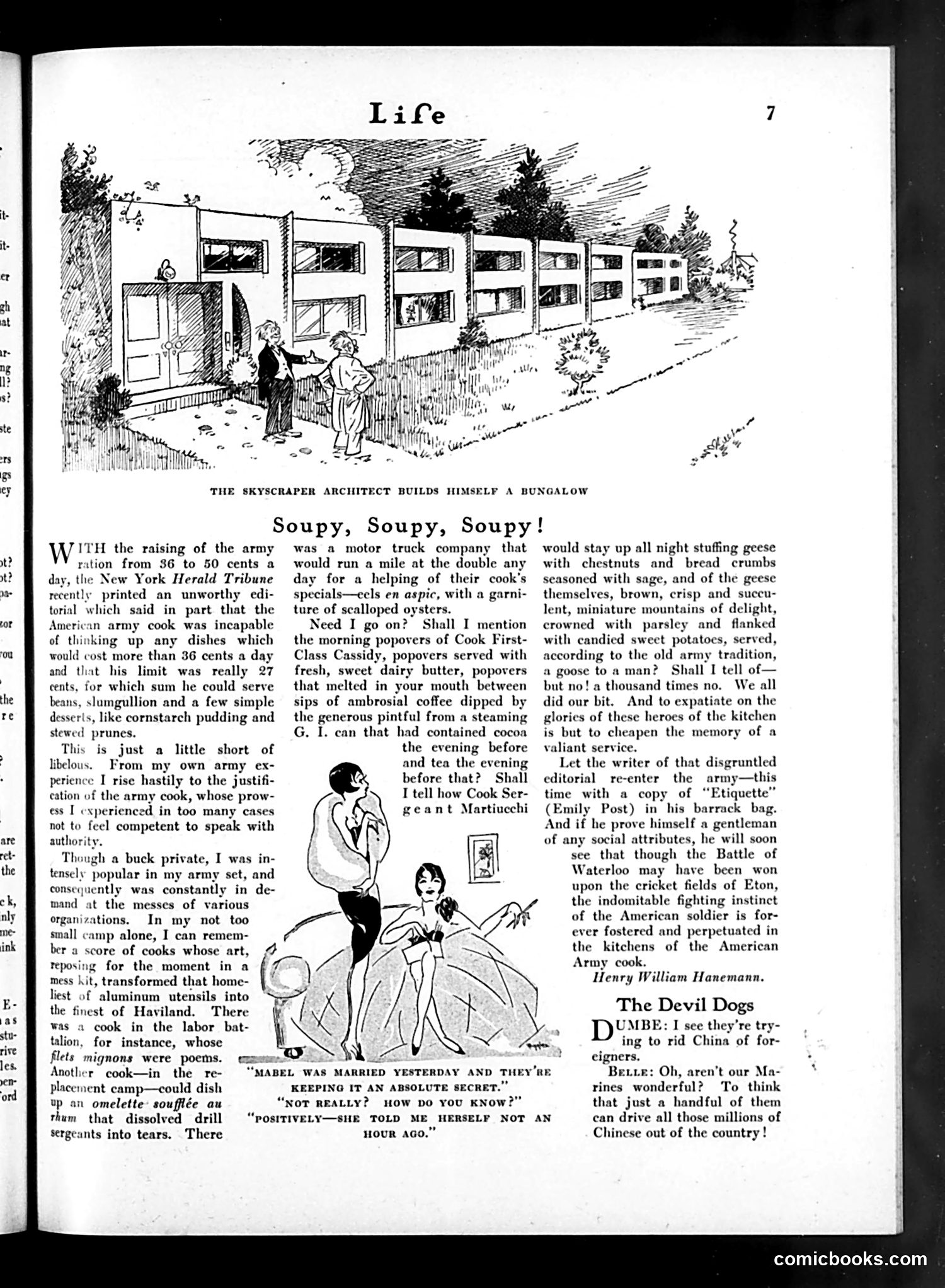
This page contains two satirical pieces about early 20th-century American life. **"Soupy, Soupy, Soupy!"** discusses army rations and mess cooking. The author, a former buck private, critiques the poor quality of military food—particularly soup—while defending American army cooks against unfair editorial criticism. He argues that despite low budgets (27-50 cents per soldier daily), army cooks performed admirably under difficult conditions. **"The Devil Dogs"** is a brief dialogue between two women (Dumbe and Belle) joking about using Chinese immigrants to "rid China of foreigners." The offensive humor reflects contemporary xenophobic attitudes toward Chinese people. The illustration shows a couple (captioned "Mabel was married yesterday") keeping a secret. The cartoons exemplify Life's mix of military critique and period-typical prejudiced humor.
📄 Transcribed text from this page (OCR, searchable)
Machine-transcribed from the original scan — historical spelling and the odd misread are preserved.
i Niet ia a) THE SKYSCRAPER ARCHITECT BUILDS HIMSELF A BUNGALOW Soupy, Soupy, Soupy! WH the raising of the army ration from 36 to 50 cents a day, the New York Herald Tribune recently printed an unworthy edi- torial which said in part that the American army cook was incapable of thinking up any dishes which would cost more than 36 cents a day and that his limit was really 27 cents, for which sum he could serve beans, slumgullion and a few simple desserls, like cornstarch pudding and stewed prunes. This is just a little short of libelous. From my own army ex- perience I rise hastily to the justifi- cation of the army cook, whose prow- ess I experienced in too many cases not to feel competent to speak with authority. Though a buck private, I was in- tensely popular in my army set, and consequently was constantly in de- mand at the messes of various organizations. In my not too small camp alone, I can remem- ber a score of cooks whose art, reposing for the moment in a mess hit, transformed that home- liest of aluminum utensils into the finest of Haviland. There was a cook in the labor bat- talion, for instance, whose filets mignons were poems. Anotlicr cook—in the re- placement camp—could dish up an omelette: soufflée au thum that dissolved drill sergeants into tears. There co “NOT REALLY? “POSITIVELY—SHE TOLD ME HERSELF NOT AN was a motor truck company that would run a mile at the double any day for a helping of their cook's specials—eels en aspic, with a garni- ture of scalloped oysters. Need I go on? Shall I mention the morning popovers of Cook First- Class Cassidy, popovers served with fresh, sweet dairy butter, popovers that melted in your mouth between sips of ambrosial coffee dipped by the generous pintful from a steaming G. I. can that had contained cocoa the evening before and tea the evening before that? Shall I tell how Cook Ser- geant Martiucchi “MABEL WAS MARRIED YESTERDAY AND THEY'RE KEEPING IT AN ABSOLUTE SECRET.” HOW Do you KNow?” HOUR Go.” would stay up all night stuffing geese with chestnuts and bread crumbs seasoned with sage, and of the geese themselves, brown, crisp and succu- lent, miniature mountains of delight, crowned with parsley and flanked with candied swect potatoes, served, according to the old army tradition, a goose toa man? Shall I tell of— but no! a thousand times no. We all did our bit. And to expatiate on the glories of these heroes of the kitchen is but to cheapen the memory of a valiant service. Let the writer of that disgruntles ed editorial re-enter the time with a copy of (Emily Post) in his bar And if he prove himself a gentleman of any social attributes, he will soon see that though the Battle of Waterloo may have been won upon the cricket fields of Eton, the indomitable fighting instinct of the American soldier is for- ever fostered and perpetuated in the kitchens of the American Army cook. Henry William Hanemann. The Devil Dogs UMBE: I see they’re try- ing to rid China of for- eigners. Bette: Oh, aren't our Ma- rines wonderful? To think that just a handful of them can drive all those millions of Chinese out of the country! comicbooks.com