
Life, 1927-03-24 · page 22 of 38
Life — March 24, 1927 — page 22: what you’re looking at
What you’re looking at
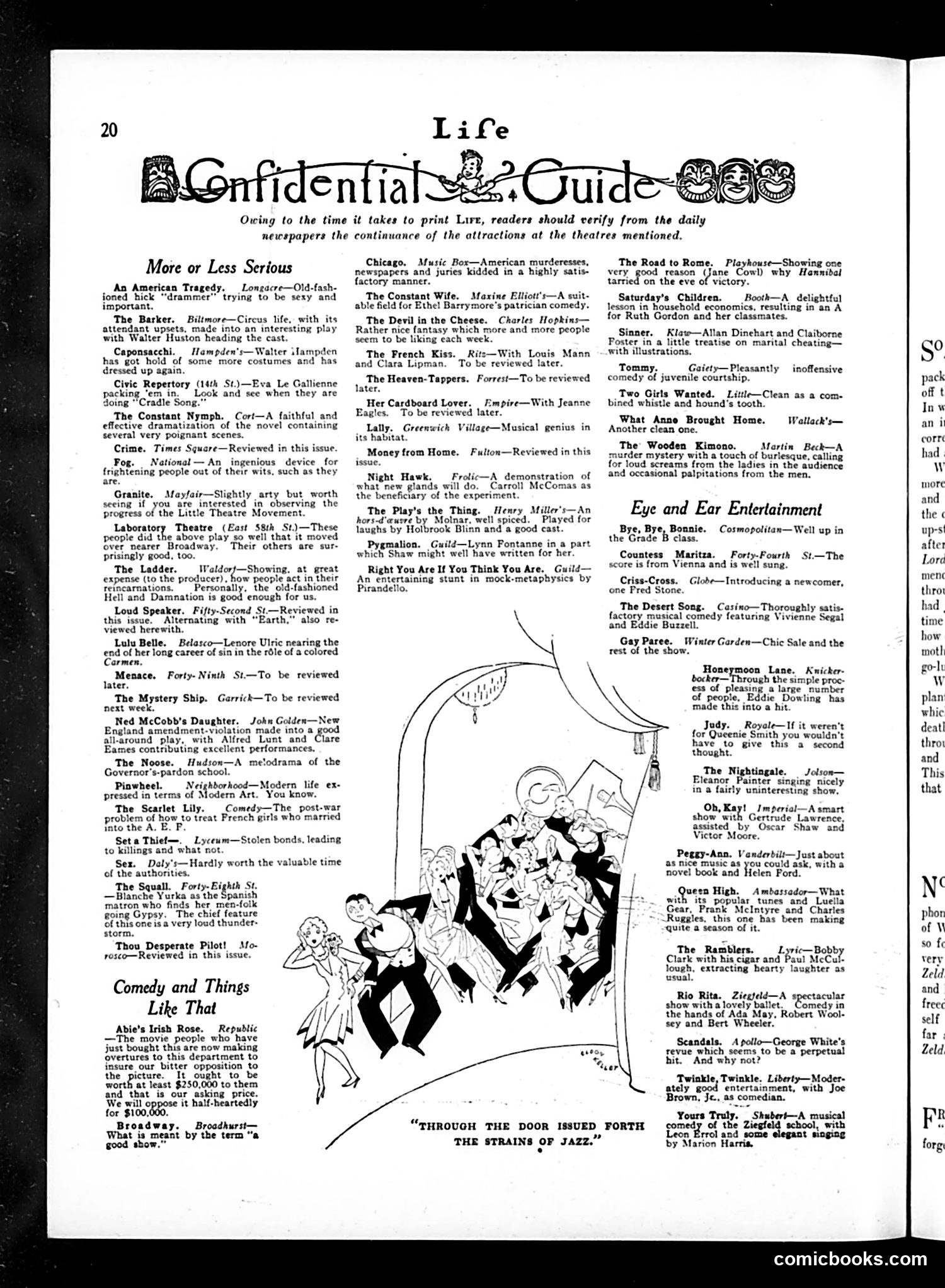
This page is a theater guide reviewing Broadway productions from what appears to be the 1920s. The main cartoon, captioned "THROUGH THE DOOR ISSUED FORTH THE STRAINS OF JAZZ," depicts elegantly dressed people in formal wear bursting energetically through a doorway, with a musician visible inside. The joke satirizes the Jazz Age's cultural collision: the contrast between traditional "proper" society (represented by formal dress and restraint) and the wild, uninhibited energy of jazz culture. The exaggerated poses suggest how shocking this modern music felt to conventional audiences. The surrounding theater reviews reinforce this cultural moment—productions like "An American Tragedy" and "Ned McCobb's Daughter" reflect 1920s social anxieties, while lighter comedies dominate. The reviewer's acerbic tone (mocking "A. E. F." war references, dismissing certain plays) typifies Life's satirical stance on contemporary entertainment and social manners during the Prohibition and Jazz Age era.
📄 Transcribed text from this page (OCR, searchable)
Machine-transcribed from the original scan — historical spelling and the odd misread are preserved.
Owing to the time it takes to print Lire, readers should verify from the daily newspapers the continuance of the attractions at the theatres mentioned. More or Less Serious An American Tragedy. _Longacre—Old-fash- ioned hick “drammer" trying to be sexy and important. The Barker. Biltmore—Circus life, with its attendant upsets, made into an interesting play with Walter Huston heading the cast. Caponsacehi. Hampden's—Walter Hampden has got hold of some more costumes and has dressed up again. Civic Repertory (14th St.)—Eva Le Gallienne packing ‘em in. k and see when they are doing "Cradle Song.”* The Constant Nymph. Corf—A faithful and effective dramatization of the novel containing several very poignant scenes. Crime. Times Square—Reviewed in this issue. Fog. Notional — An ingenious device for frightening people out of their wits, such as they are. Granite. Mayfair—Slightly arty but worth seeing if you are interested in observing the progress of the Little Theatre Movement. Laboratory Theatre (East S8th St.)—These people did the above play so well that it moved over nearer Broadway. Their others are sur- prisingly good, too. The Ladder. —_Waldor{—Showing. at great expense (to the producer), how people act in their reincarnations. Personally, the old-fashioned Hell and Damnation is good ‘enough for us. Loud Speaker. Fifty-Second St—Reviewed in this issue. Alternating with “Earth,” also re- viewed herewith. Lulu Belle. Belasco—Lenore Ulric nearing the end of her long career of sin in the rdle of a colored Carmen, Menace. Forty-Ninth St—To be reviewed later, The Mystery Ship. Garrick—To be reviewed next week. Ned McCobb’s Daughter. John Golden—New England amendment-viclation made into a good all-around play, with Alfred Lunt and Clare Eames contributing excellent performances, The Noose. Hudson—A melodrama of the Governor’s-pardon school. Pinwheel. Neighborhood—Modern life ex- pressed in terms of Modern Art. You know. The Scarlet Lily, _Comedy—The pos problem of how to treat Prench girls who married into the A. E. P. Seta Thief—. Lyceum—Stolen bonds. leading to killings and what not Sex. Daly's—Hardly worth the valuable time of the authorities. The Squall. Forty-Eighth St. —Blanche Yurka as the Spanish matron who finds her men-folk going Gypsy. The chief feature of this one is a very loud thunder- storm. Thou Desperate Pilot! Mo- rosco—Reviewed in this issue. Comedy and Things Like That Abie’s Irish Rose. Republic —The movie people who have just bought this are now making overtures to this department to insure our bitter opposition to the picture. It ought to be worth at least $250,000 to them and that is our asking price. ‘We will oppose it half-heartedly for $100,000, Broadway. Broadhurst— tis meant by the term “a good show.” Chicago. Music Box—American murderesses, newspapers and juries kidded in a highly satis- factory manner. The Constant Wife. Maxine Elliott's—A suit- able field for Ethe! Barrymore's patrician comedy. The Devil in the Cheese. Charles Hopkins— Rather nice fantasy which more and more people seem to be liking each week. The French Ki: Rite—With Louis Mann and Clara Lipman. To be reviewed later. 1 The Heaven-Tappers. Forrest—To be reviewed jater, Her Cardboard Lover. ire—With Jeanne Eagles. To be reviewed later. Lally. Greenwich Village—Musical genius in its habitat. Money from Home. Fulton—Reviewed in this issue. Night Hawk. — Frolic—A demonstration of what new glands will do. Carroll McComas as the beneficiary of the experiment. The Play's the Thing. Henry Miller’s—An hors-d’eutre by Molnar, well spiced. Played for laughs by Holbrook Blinn and a good cast. Pygmalion. Guild—Lynn Pontanne in a part which Shaw might well have written for her. Right You Are If You Think You Are. Guild— An entertaining stunt in mock-metaphysics by Pirandello, “THROUGH THE DOOR ISSUED FORTH THE STRAINS OF Jazz.” e The Road to Rome. Playhouse—Showing one very py reason (Jane Cowl) why Hannibal tarried on the eve of victory. Saturday's Children. Booth—A_ delightful lesson in household economics, resulting in an A for Ruth Gordon and her classmates. Sinner. Klaw—Allan Dinehart and Claiborne Foster in a little treatise on marital cheating— with illustrations, Tommy. Gaiety—Pleasantly inoffensive comedy of juvenile courtship. Two Girls Wanted. Little—Ct . bined whistle and hound’s tooth. | What Anne Brought Home. Another clean one. The’ Wooden Kimono. = Martin Beck—A murder mystery with a touch of burlesque. calling for loud screams from the ladies in the audience and occasional palpitations from the men. Wallack's— Eye and Ear Entertainment Bye, Bye, Bonnie. Cosmopolitan—Well up i the Grade B class. — Countess Maritza. Forty.Fourth St.—The score is from Vienna and is well sung. Criss-Cross. Globe—Introducing a newcomer, ‘one Pred Stone. The Desert Song. Cesino—Thoroughly satis- factory musical comedy featuring Vivienne Segal and Eddie Buzzell. Gay Paree. Winter Garden—Chic Sale and the rest of the show. Honeymoon Lane. Knicker- bocker—Through the simple proc- ess of pleasing a large number of people, Eddie Dowling has made this into a hit. Judy. Royole—If it weren't for Queenie Smith you wouldn't have to give this a second thought. The Nightingale. Jolson— Eleanor Painter singing nicely in a fairly uninteresting show. Oh, Kay! Jmperial—A smart show ‘with Gertrude Lawrence, assisted by Oscar Shaw and Victor Moore. Peggy-Ann. Vanderdilt—Just about as nice music as you could ask, with novel book and Helen Ford. we Queen High, | Ambassador—What with its popular tunes and Luella Gear, Prank McIntyre and Charles ~Ruggles, this one has been making ‘quite a Season of it. The Ramblers. — Lyric—Bobb Clark with his cigar and Paul McCul- lough, extracting hearty laughter as usual, Rio Rita. Ziegfelé—A spectacular show with alovely ballet. Comedy in the hands of Ada May, Robert Wool- sey and Bert Wheeler. A pole ecens White's seems to a tu And why not? pare Twinkle. Liberty—Moder- entertainment, with Joe . a8 comedian. Yours Truly. Shubert—A musical comedy of the Ziegfeld school, with Leon Errol and some elegant soging by Marion Harris, S° pack off t In an i corré had W more and the « up-st after Lord mene thro had | time how moth go-l W plan whic deat throt and This that NS phon of V so fe very Zeld and free¢ self far Zeld F forg comicbooks.com