
Life, 1927-03-24 · page 23 of 38
Life — March 24, 1927 — page 23: what you’re looking at
What you’re looking at
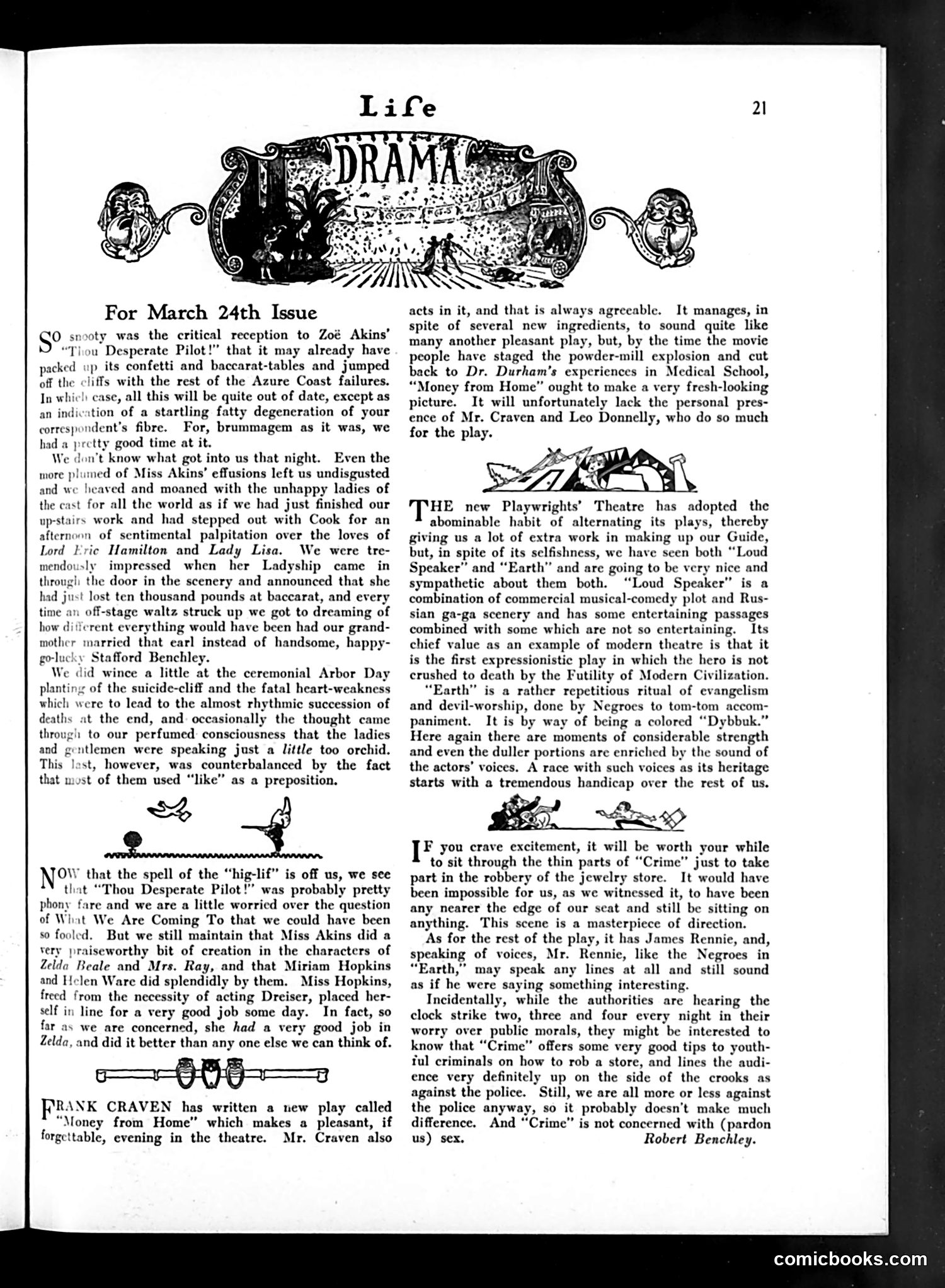
This is a theater review column covering Broadway productions for Life's March 24th issue. The critic discusses several plays: **"Thou Desperate Pilot"** by Zoé Akins—a melodramatic society play set on the French Riviera involving baccarat, suicide cliffs, and aristocratic entanglements. The reviewer admits being emotionally manipulated by it despite recognizing its phoniness, praising actress Miriam Hopkins's performance. **"Money from Home"** by Frank Craven—described as pleasant but forgettable, though expected to improve as a film with added spectacle. **"Loud Speaker"** and **"Earth"** at the Playwrights' Theatre—the former a musical-comedy hybrid with Russian Expressionist staging; the latter a ritualistic drama featuring Black performers with tom-tom accompaniment. The column exemplifies 1920s theater criticism: sophisticated mockery of sentimental melodrama, appreciation for competent acting despite weak material, and casual racial characterization typical of that era.
📄 Transcribed text from this page (OCR, searchable)
Machine-transcribed from the original scan — historical spelling and the odd misread are preserved.
For March 24th Issue soty was the critical reception to Zoé Akins’ ou Desperate Pilot!” that it may already have confetti and baccarat-tables and jumped cliffs with the rest of the Azure Coast failures. ) case, all this will be quite out of date, except as ition of a startling fatty degeneration of your correspondent’s fibre. For, brummagem as it was, we ctty good time at it. on't know what got into us that night. Even the ed of Miss Akins’ effusions left us undisgusted ved and moaned with the unhappy ladies of the cast for all the world as if we had just finished our up-stairs work and had stepped out with Cook for an afternoon of sentimental palpitation over the loves of Lord Eric Hamilton and Lady Lisa. We were tre- mendously impressed when her Ladyship came in the door in the scenery and announced that she lost ten thousand pounds at baccarat, and every n off-stage waltz struck up we got to dreaming of how ditferent everything would have been had our grand- mother married that earl instead of handsome, happy- go-lucky Stafford Benchley. We did wince a little at the ceremonial Arbor Day planting of the suicide-cliff and the fatal heart-weakness which were to lead to the almost rhythmic succession of deaths at the end, and occasionally the thought came through to our perfumed: consciousness that the ladies and gentlemen were speaking just a little too orchid. This lost, however, was counterbalanced by the fact that must of them used “like” as a preposition, 3% OW that the spell of the “hig-lif” is off us, we see that “Thou Desperate Pilot!” was probably pretty phony fare and we are a little worried over the question of What We Are Coming To that we could have been so fooled. But we still maintain that Miss Akins did a very praiseworthy bit of creation in the characters of Zelda Beale and Mrs. Ray, and that Miriam Hopkins and Helen Ware did splendidly by them. Miss Hopkins, freed from the necessity of acting Dreiser, placed her- self in line for a very good job some day. In fact, so far as we are concerned, she had a very good job in Zelda, and did it better than any one else we can think of. —=§8§=—= RANK CRAVEN has written a new play called “Money from Home” which makes a pleasant, if forgettable, evening in the theatre. Mr. Craven also acts in it, and that is always agreeable. It manages, in spite of several new ingredients, to sound quite like many another pleasant play, but, by the time the movie people have staged the powder-mill explosion and cut back to Dr. Durham's experiences in Medical School, “Money from Home” ought to make a very fresh-looking picture. It will unfortunately lack the personal pres- ence of Mr. Craven and Leo Donnelly, who do so much for the play. HE new Playwrights’ Theatre has adopted the abominable habit of alternating its plays, thereby giving us a lot of extra work in making up our Guide, but, in spite of its selfishness, we have seen both “Loud Speaker” and “Earth” and are going to be very nice and sympathetic about them both. “Loud Speaker’ is a combination of commercial musical-comedy plot and Rus- sian ga-ga scenery and has some entertaining passages combined with some which are not so entertaining. Its chief value as an example of modern theatre is that it is the first expressionistic play in which the hero is not crushed to death by the Futility of Modern Civilization. “Earth” is a rather repetitious ritual of evangelism and devil-worship, done by Negroes to tom-tom accom- paniment. It is by way of being a colored “Dybbuk.” Here again there are moments of considerable strength and even the duller portions are enriched by the sound of the actors’ voices. A race with such voices as its heritage starts with a tremendous handicap over the rest of us. IF you crave excitement, it will be worth your while to sit through the thin parts of “Crime” just to take part in the robbery of the jewelry store. It would have been impossible for us, as we witnessed it, to have been any nearer the edge of our seat and still be sitting on anything. This scene is a masterpiece of direction. As for the rest of the play, it has James Rennie, and, speaking of voices, Mr. Rennie, like the Negroes in “Earth,” may speak any lines at all and still sound as if he were saying something interesting. Incidentally, while the authorities are hearing the clock strike two, three and four every night in their worry over public morals, they might be interested to know that “Crime” offers some very good tips to youth- Tul criminals on how to rob a store, and lines the audi- ence very definitely up on the side of the crooks as against the police. Still, we are all more or less against the police anyway, so it probably doesn’t make much difference. And “Crime” is not concerned with (pardon us) sex. Robert Benchley. comicbooks.com