
A complete issue · 40 pages · 1926
Life — July 1, 1926
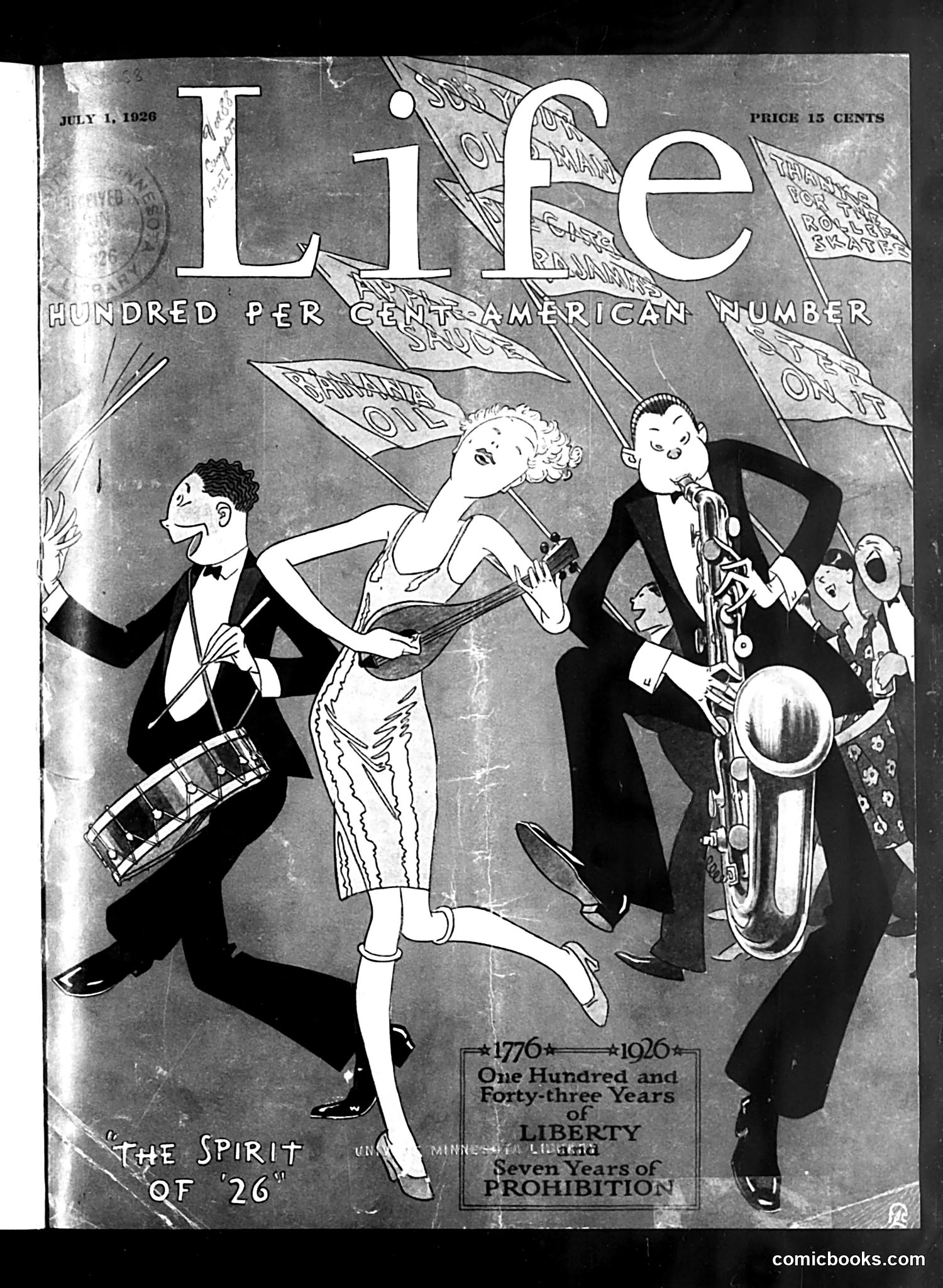
This cover satirizes the contrast between America's founding ideals and Prohibition's effects. The large "LIFE" masthead overlays a jazz-age party scene—musicians and a dancing woman in 1920s dress—labeled "The Spirit of '26." The bottom box notes "1776-1926: One Hundred and Forty-three Years of LIBERTY" but adds "Seven Years of PROHIBITION," highlighting the irony that Prohibition (enacted 1919) contradicted American freedom principles. The cartoon mocks how Prohibition, intended to reduce vice, instead fueled a vibrant underground party culture and jazz scene. The gap between stated values and lived reality—celebrating "liberty" while banning alcohol—is the central satirical point. The image suggests Prohibition was un-American, restricting rather than protecting freedom.
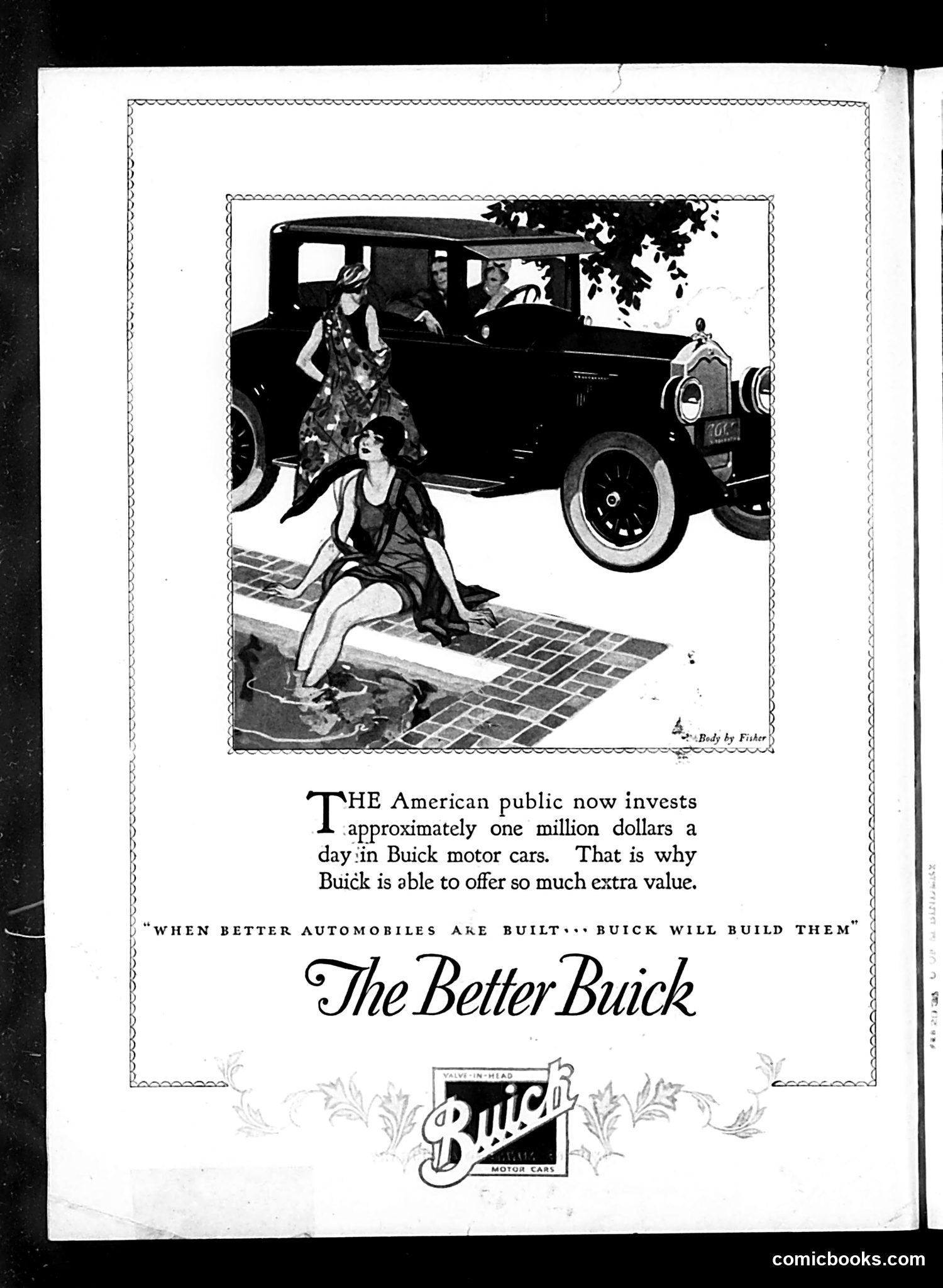
This page is a **Buick automobile advertisement**, not satire or political commentary. The illustration shows a fashionable 1920s woman in a bathing suit posing near a Buick car, with other figures visible in the vehicle. The ad's "message" is purely commercial: it claims Americans invest approximately one million dollars daily in Buick cars, therefore Buick can offer "extra value." The tagline—"When better automobiles are built... Buick will build them"—is aspirational marketing, not social criticism. The bathing suit figure reflects typical 1920s advertising aesthetics, using attractive imagery to sell automobiles to the affluent market Life's readers represented. This represents standard period advertising practice rather than editorial commentary.
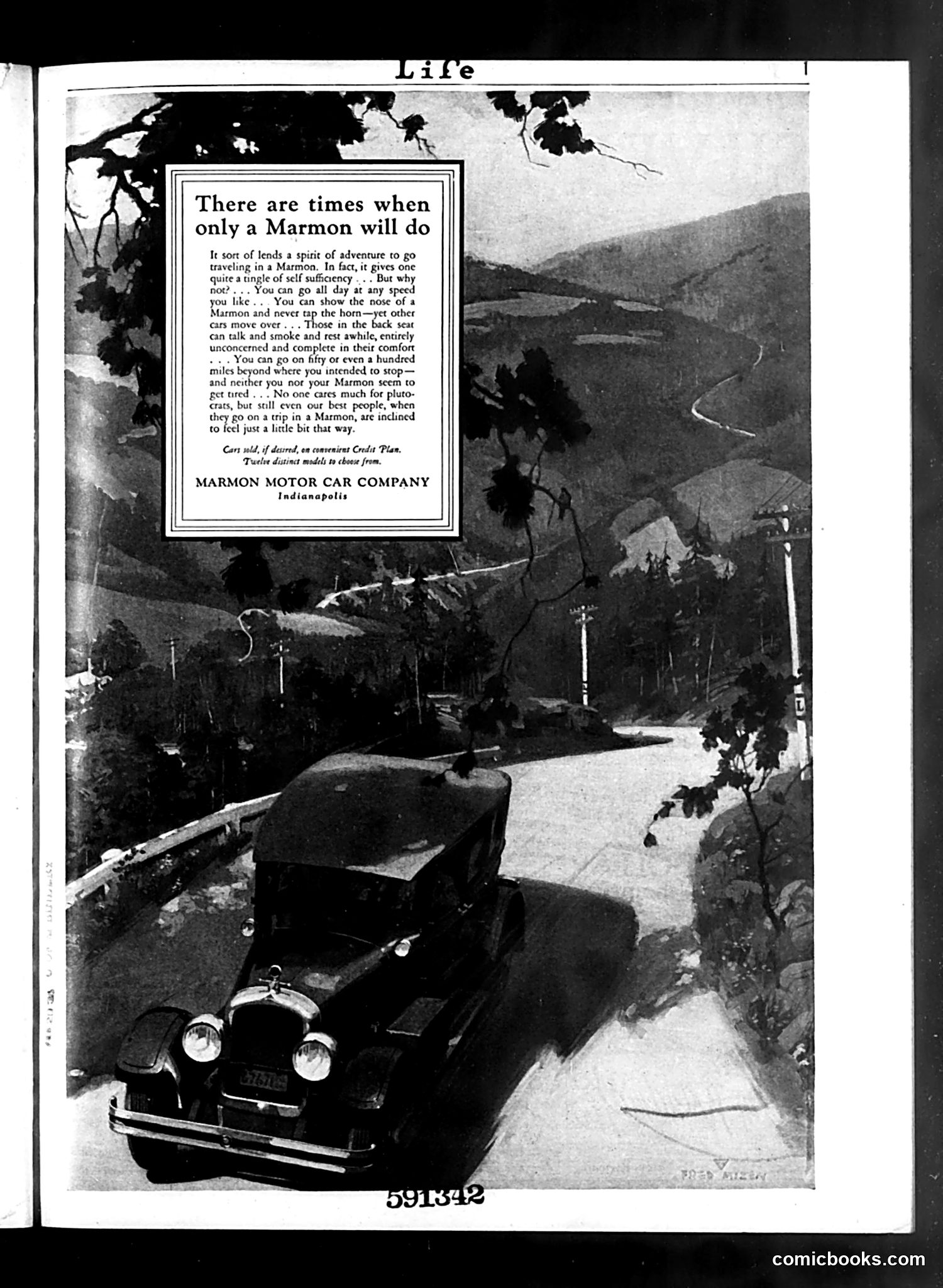
This is primarily **an advertisement for Mormon Motor Car Company** (Indianapolis), not a satirical cartoon. The ad's headline claims "There are times when only a Mormon will do," using religious identity as a marketing gimmick. The text humorously suggests that Mormon automobiles offer superior comfort and reliability for long-distance travel—passengers can be "unconcerned and complete in their comfort" while traveling hundreds of miles. The ad plays on Mormon cultural stereotypes of reliability and steadfastness. The photograph shows a Mormon car on a scenic mountain road, emphasizing the vehicle's ability to handle challenging terrain. This appears to be straightforward early automotive advertising leveraging religious identity for brand appeal, rather than political satire.
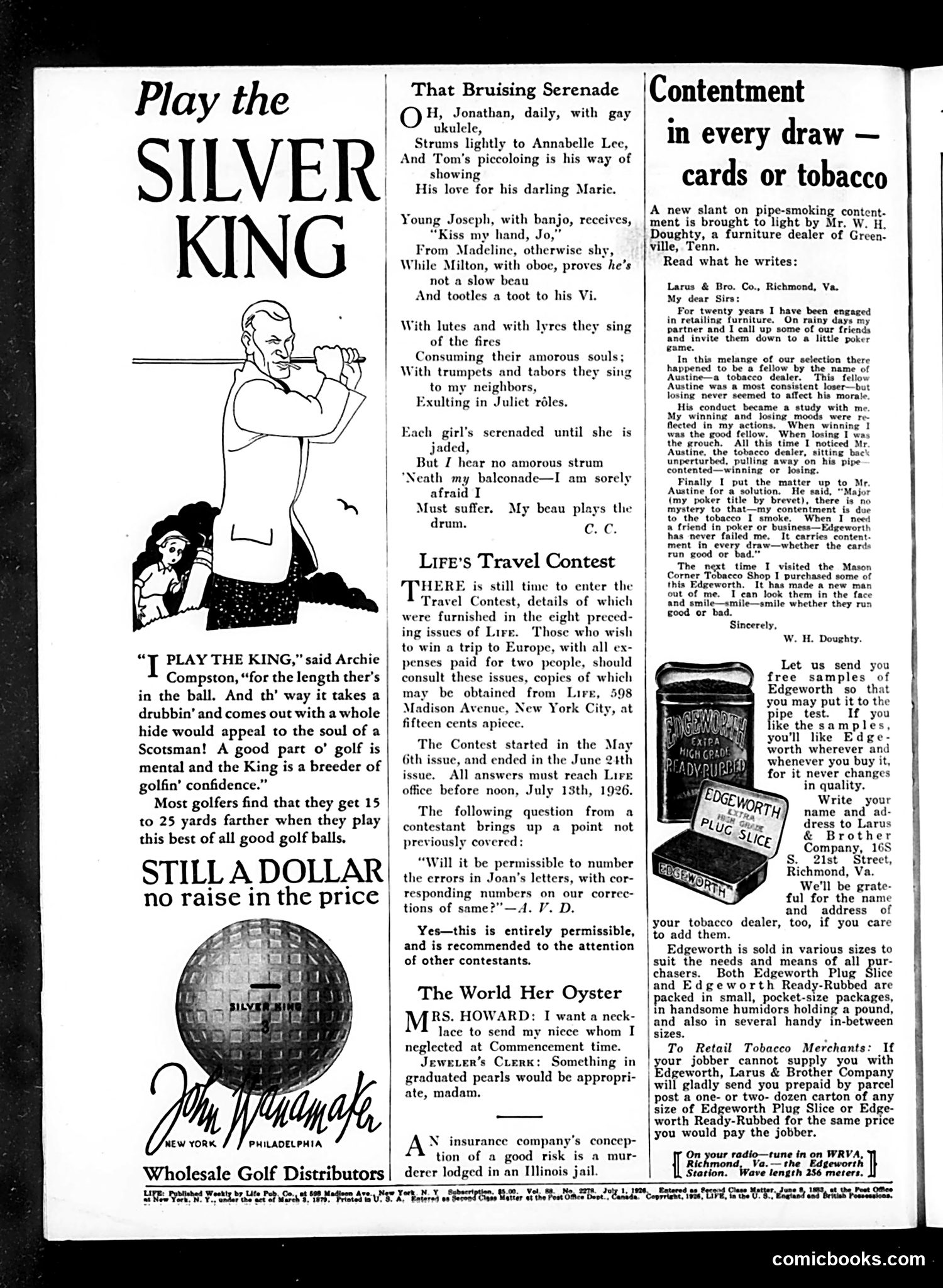
This page is primarily **advertising and light humor** rather than political satire. The left side features a **golf ball advertisement** for "Silver King" balls, with a illustrated golfer. The copy claims these balls travel 15-25 yards farther than competitors, yet cost the same dollar price—a sales pitch emphasizing value. The center contains humorous reader submissions: "That Bruising Serenade" (a comedic poem about musicians), "Life's Travel Contest" (a reader competition), and "The World Her Oyster" (brief witty exchanges). The right side is a **tobacco advertisement** from W.H. Doughty promoting Edgeworth pipe tobacco, featuring testimonial copy about contentment from smoking. The page reflects **1920s consumer culture**—golf equipment, reader participation contests, and tobacco marketing were common Life magazine content.
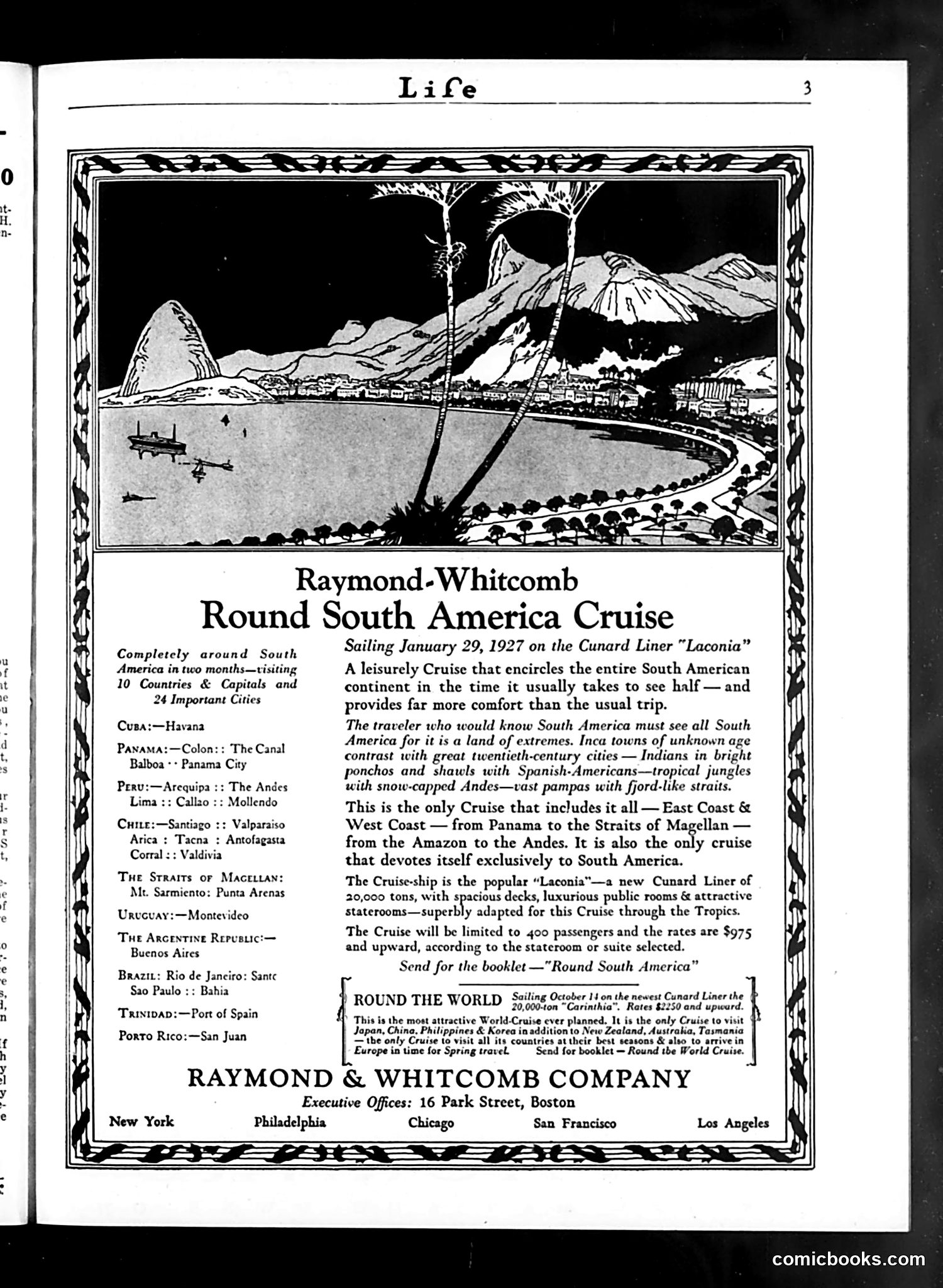
This page is **not a cartoon or satirical content** — it's a **cruise ship advertisement** from Life magazine, circa 1927. The image shows a stylized art deco illustration of a tropical coastline with a ship, palm trees, and mountains, advertising Raymond-Whitcomb Company's "Round South America Cruise" aboard the Cunard Liner *Laconia*, departing January 29, 1927. The ad lists 10 countries and capitals visited, emphasizing luxury accommodations for 400 passengers at $975 upward. It highlights this as the "only cruise" covering the entire South American continent and visiting both coasts. A secondary box advertises another Raymond-Whitcomb offering: a "Round the World" cruise on a newer Cunard vessel. This represents early-20th-century luxury tourism marketing to affluent American readers.
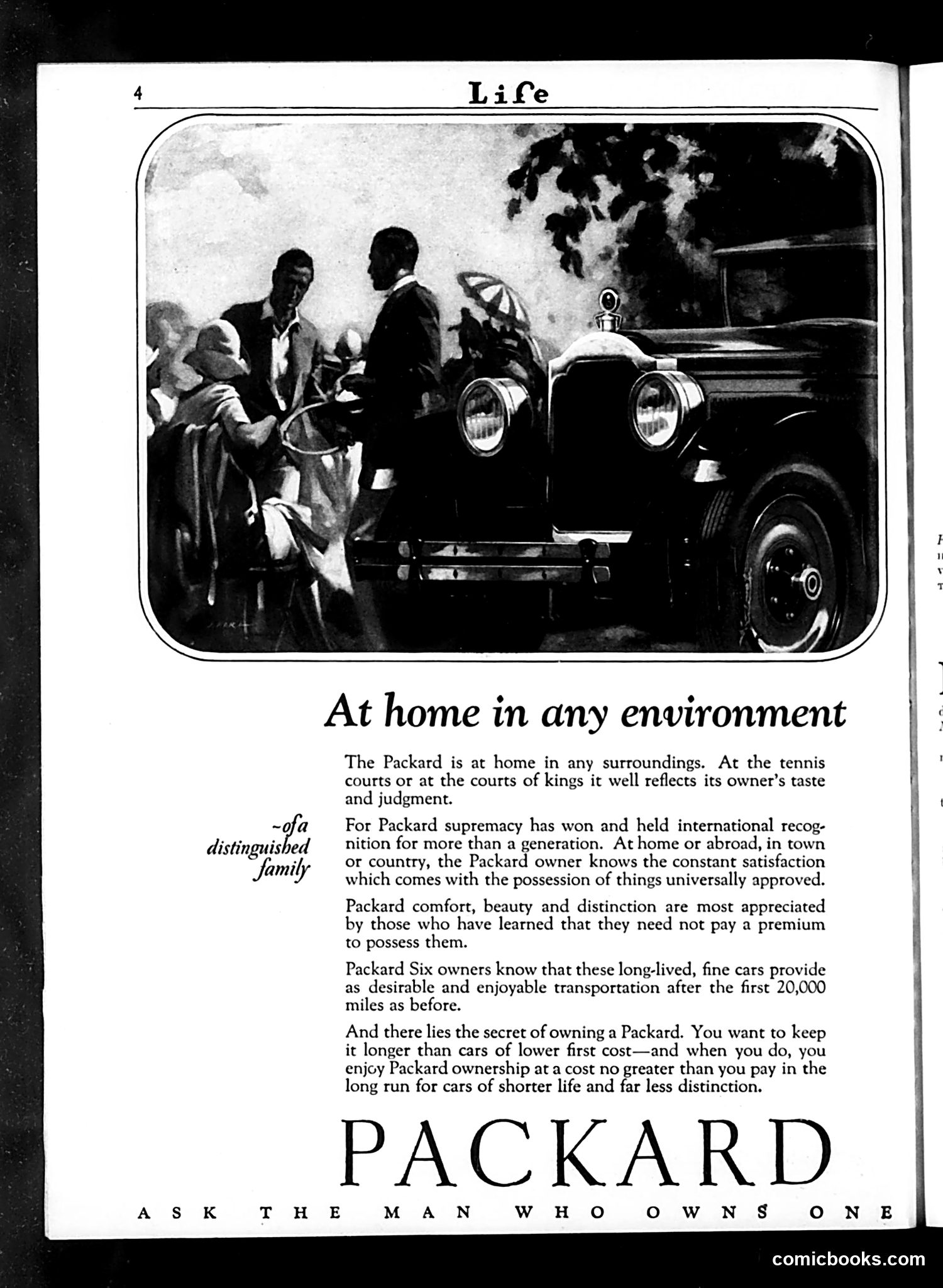
This page is primarily **a Packard automobile advertisement**, not satire or political commentary. The image shows well-dressed men and women gathered around a luxury car at what appears to be a social venue (possibly tennis courts, given the text's reference). The advertisement emphasizes that Packard automobiles suit any social environment and reflect the owner's refined taste and judgment. The marketing pitch stresses **value retention**: Packard cars remain desirable and comfortable after 20,000 miles, unlike cheaper vehicles. The ad targets affluent readers by suggesting Packard ownership costs no more long-term than buying inferior cars repeatedly—a status symbol presented as practical economics. No political figures or satirical commentary is present; this is straightforward luxury-brand advertising appealing to wealthy, socially aspirational readers of Life magazine.
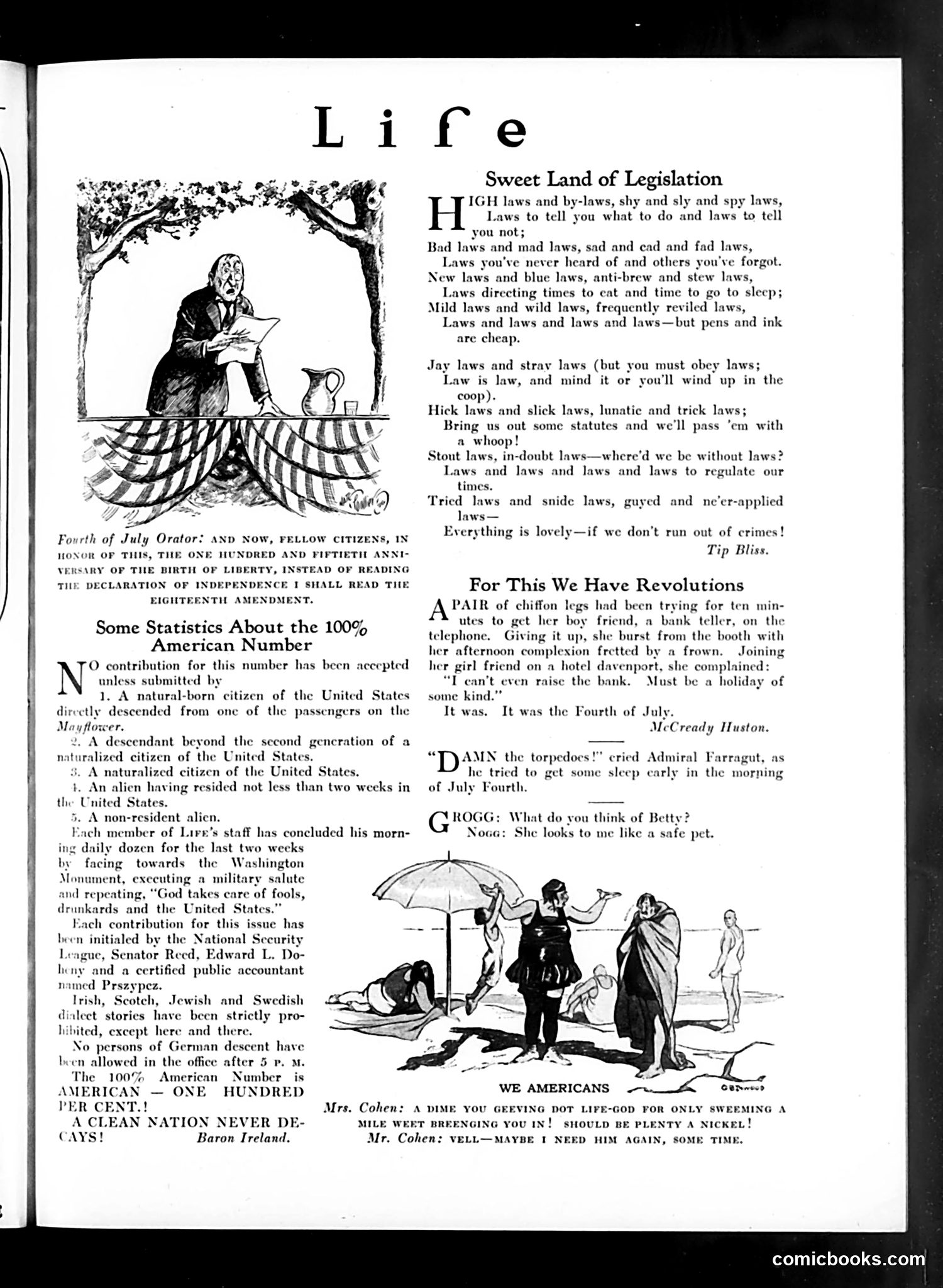
This page combines satirical poetry and social commentary from what appears to be an early 20th-century American context. **"Sweet Land of Legislation"** is a humorous poem mocking the proliferation of laws and regulations in America, suggesting they're excessive, contradictory, and often pointless ("pens and ink are cheap"). **"Some Statistics About the 100% American Number"** presents tongue-in-cheek criteria for "true" American citizenship—requiring Mayflower ancestry, specific residency periods, and military service. This satirizes nativist fervor and restrictive immigration attitudes of the era. **"For This We Have Revolutions"** and the beach scene cartoon mock material excess and social hypocrisy—a woman complains about bank deposits while her friend frets over Fourth of July frivolities. The cartoons target bureaucratic absurdity, gatekeeping Americanism, and shallow bourgeois concerns dressed up as patriotic virtue.
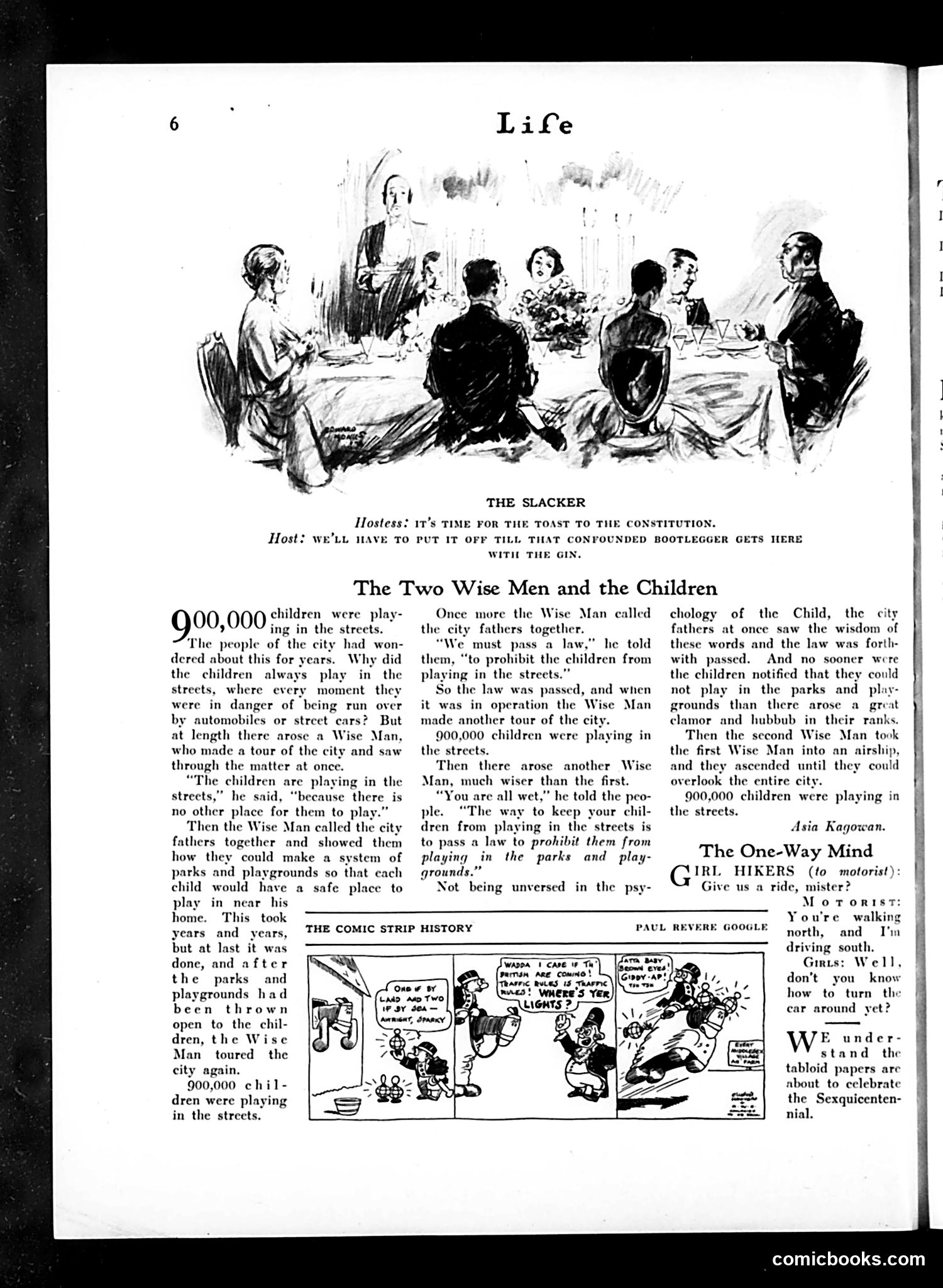
This page contains two satirical pieces about urban social issues: **"The Slacker"** (top cartoon): Shows a dinner party where the hostess proposes toasting the Constitution, but the host interrupts, suggesting they must wait until "that compounded bootlegger gets here with the gin." This references Prohibition-era hypocrisy—supposedly law-abiding citizens openly flouting liquor laws. **"The Two Wise Men and the Children"** (main story): Critiques how city officials addressed child street-play safety. Rather than creating safe play spaces, they passed laws *prohibiting* children from playing in streets and parks. The satire suggests the "wise men" chose prohibition over practical solutions—a characteristically bureaucratic response mocked as foolish. Both pieces satirize how authorities respond to social problems through restriction rather than constructive reform.
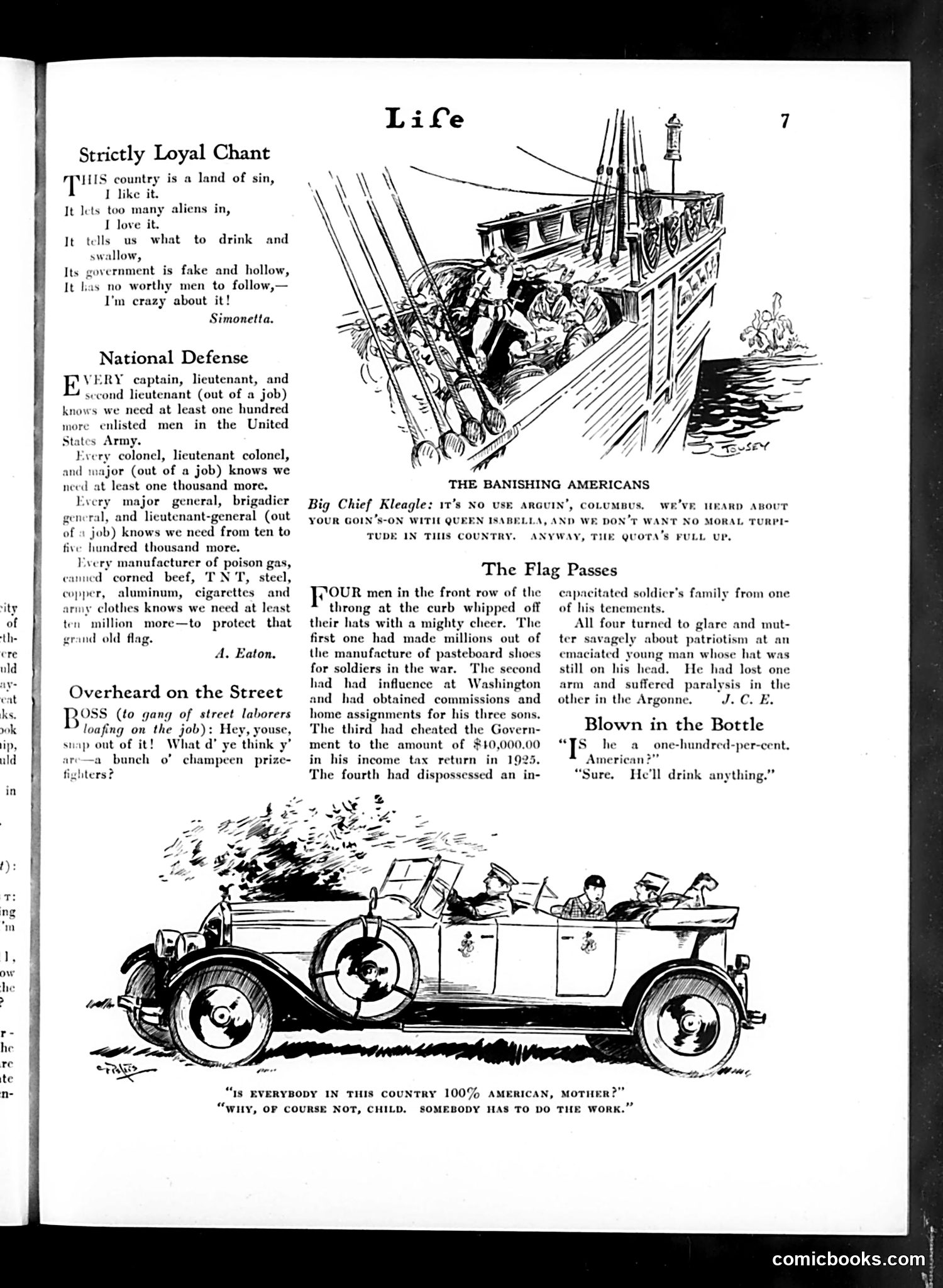
This page contains three satirical pieces critiquing American society during what appears to be the WWI era: **"Strictly Loyal Chant"** mocks patriotic fervor by having "Simonella" praise the country while admitting it's corrupt ("fake and hollow," "no worthy men to follow"). **"National Defense"** sarcastically catalogs military staffing needs, listing increasingly absurd requirements (officers, manufacturers of poison gas, corned beef, TNT, steel, copper, aluminum, cigarettes, cloth). **"The Banishing Americans"** cartoon depicts wealthy industrialists or politicians on a ship, suggesting they're literally abandoning America. The lower cartoon shows street laborers in an overloaded truck, captioned with dialogue questioning whether "everybody in this country is 100% American"—highlighting the hypocrisy of patriotic demands placed on working-class immigrants while elites avoid sacrifice.
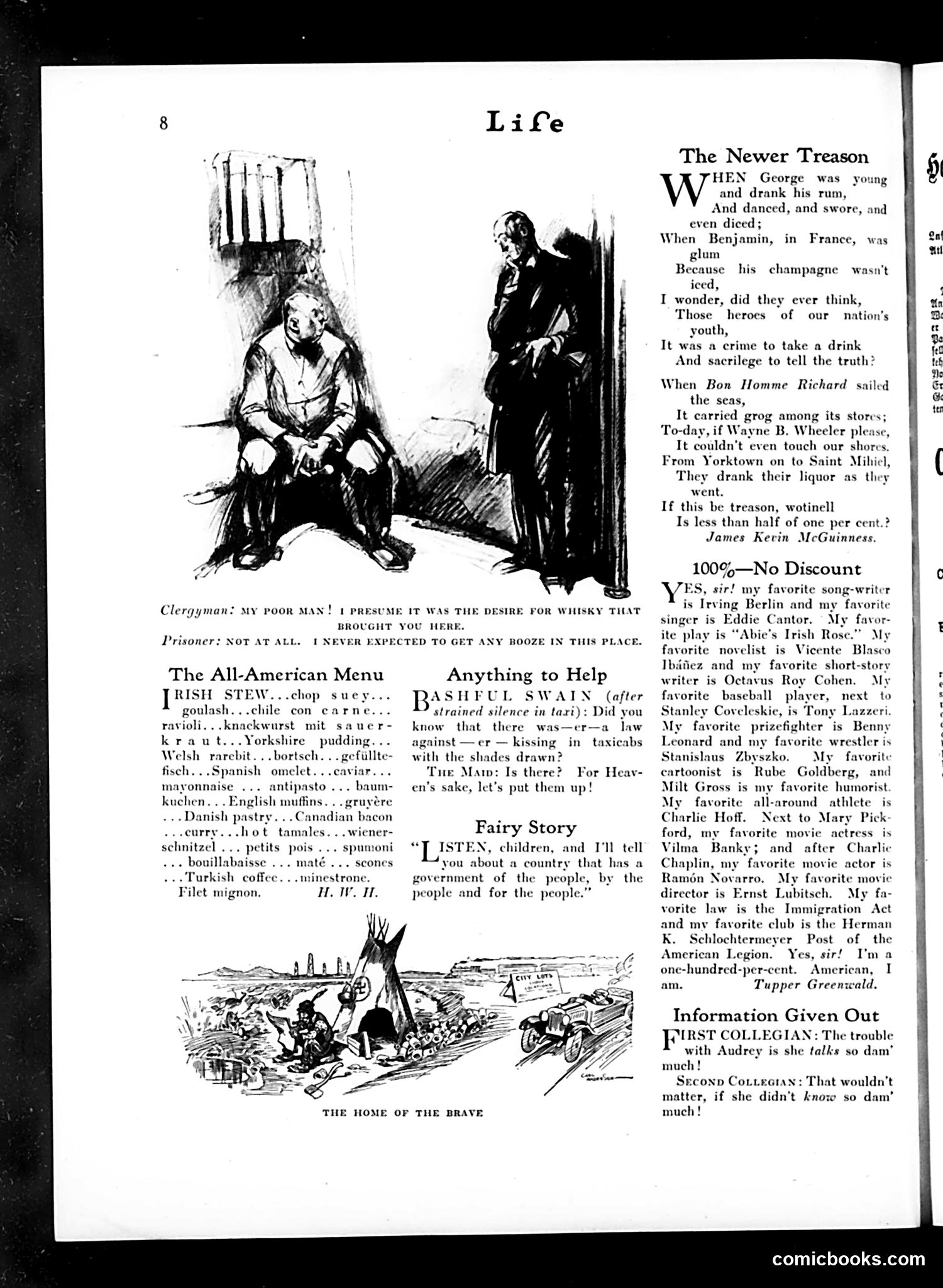
This page satirizes American youth who drank alcohol during Prohibition. The cartoon depicts a clergyman confronting a prisoner, accusing him of smuggling whiskey. The accompanying poem by James Kevin McGuinness criticizes young men like "George" and "Benjamin" who drink champagne in France while claiming patriotism—calling this behavior treasonous compared to historical heroes. The satire targets the hypocrisy of wealthy Americans who violated Prohibition laws abroad while presenting themselves as patriots. The "newer treason" refers to moral corruption through alcohol consumption, presented as betraying the nation's values. This reflects 1920s-era anti-alcohol sentiment and class tensions regarding enforcement of Prohibition laws.
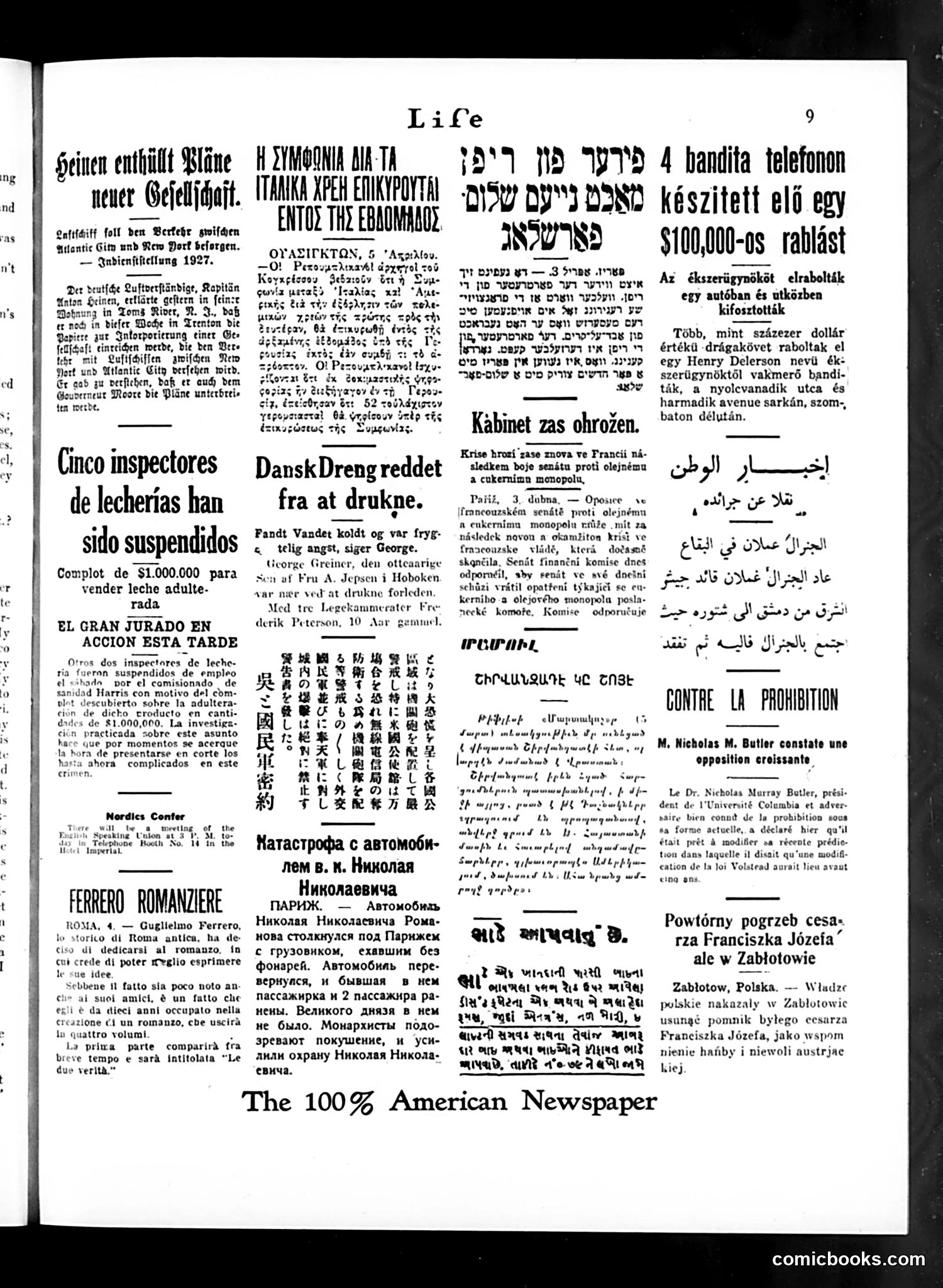
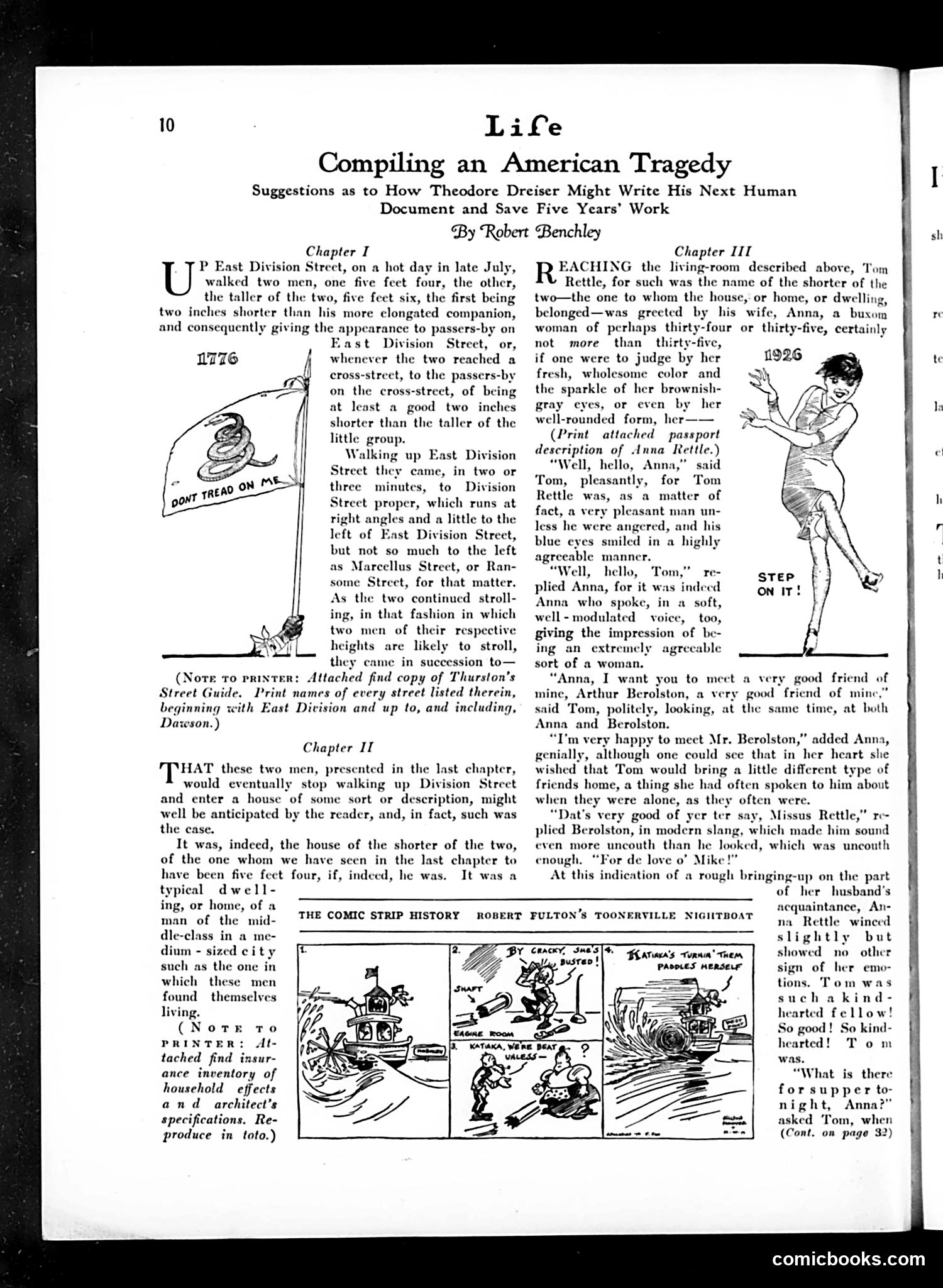
This page presents a serialized short story titled "Compiling an American Tragedy" by Robert Benchley, subtitled as suggestions for how Theodore Dreiser might write his next novel while saving five years' work. The narrative describes two men of different heights walking on East Division Street in 1776, establishing a fictional premise. Chapter III introduces Tom Rettle and his wife Anna in their home. The embedded comic strip at bottom, credited to Robert Fulton's "Toonerville Nightboat," appears unrelated to the main story—it's a separate humorous feature common in Life magazine's format. The page mixes literary satire with visual humor, typical of Life's early-to-mid 20th century approach of blending fiction, commentary, and comics for sophisticated urban readers.
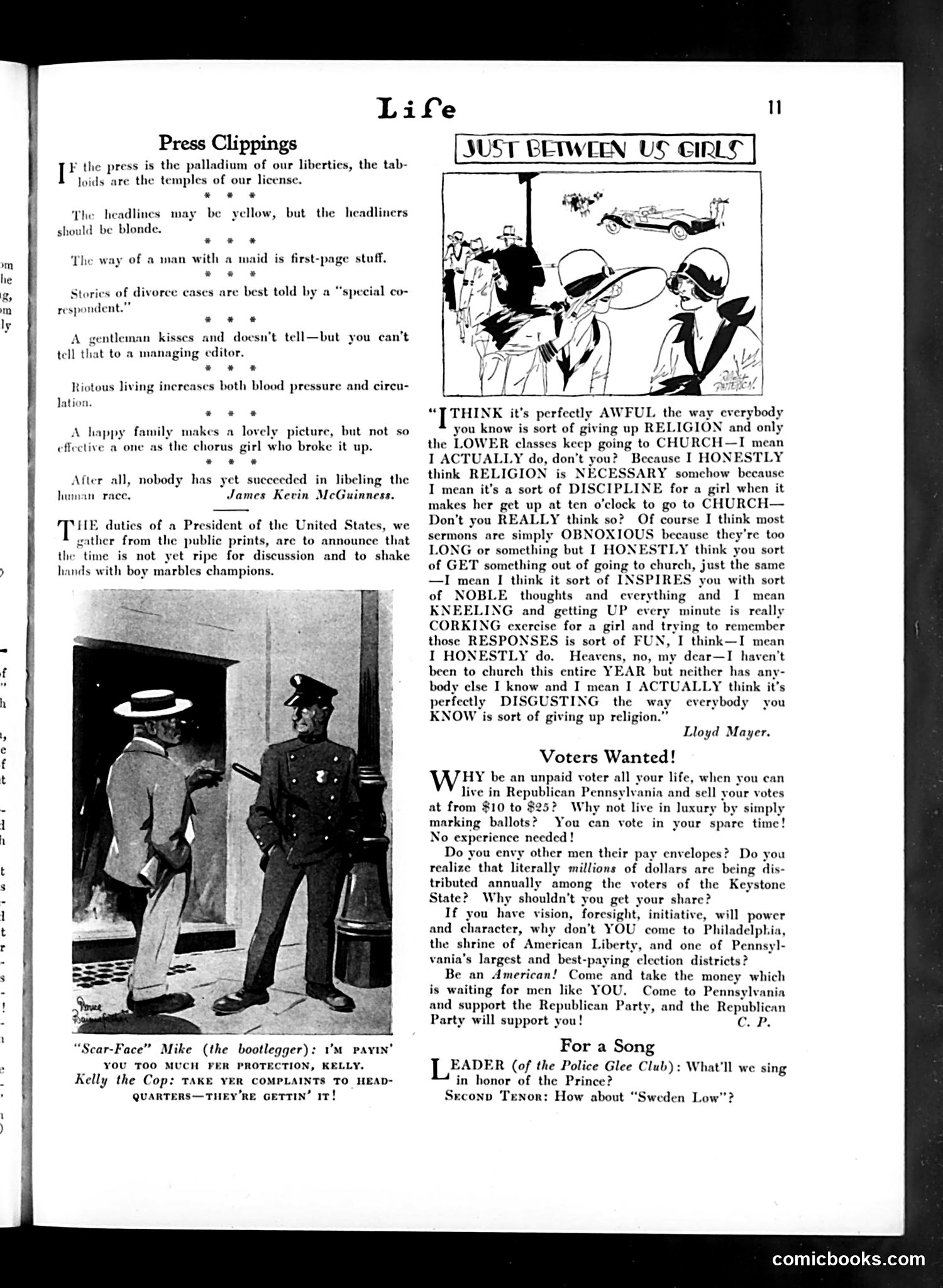
The bottom illustration depicts a police officer confronting a man in a hat, labeled "Scar-Face" Mike (the bootlegger). During Prohibition, bootleggers illegally manufactured and sold alcohol. The joke plays on the dynamic: Mike pays Officer Kelly excessive "protection money" to ignore his illegal activities, then complains to headquarters about being overcharged. The caption has Kelly respond sarcastically that Mike is paying too much *for protection*—implying corruption is so rampant that even criminals expect official extortion as standard practice. This satirizes widespread police corruption during Prohibition, when officers routinely accepted bribes to overlook illegal alcohol production and distribution.
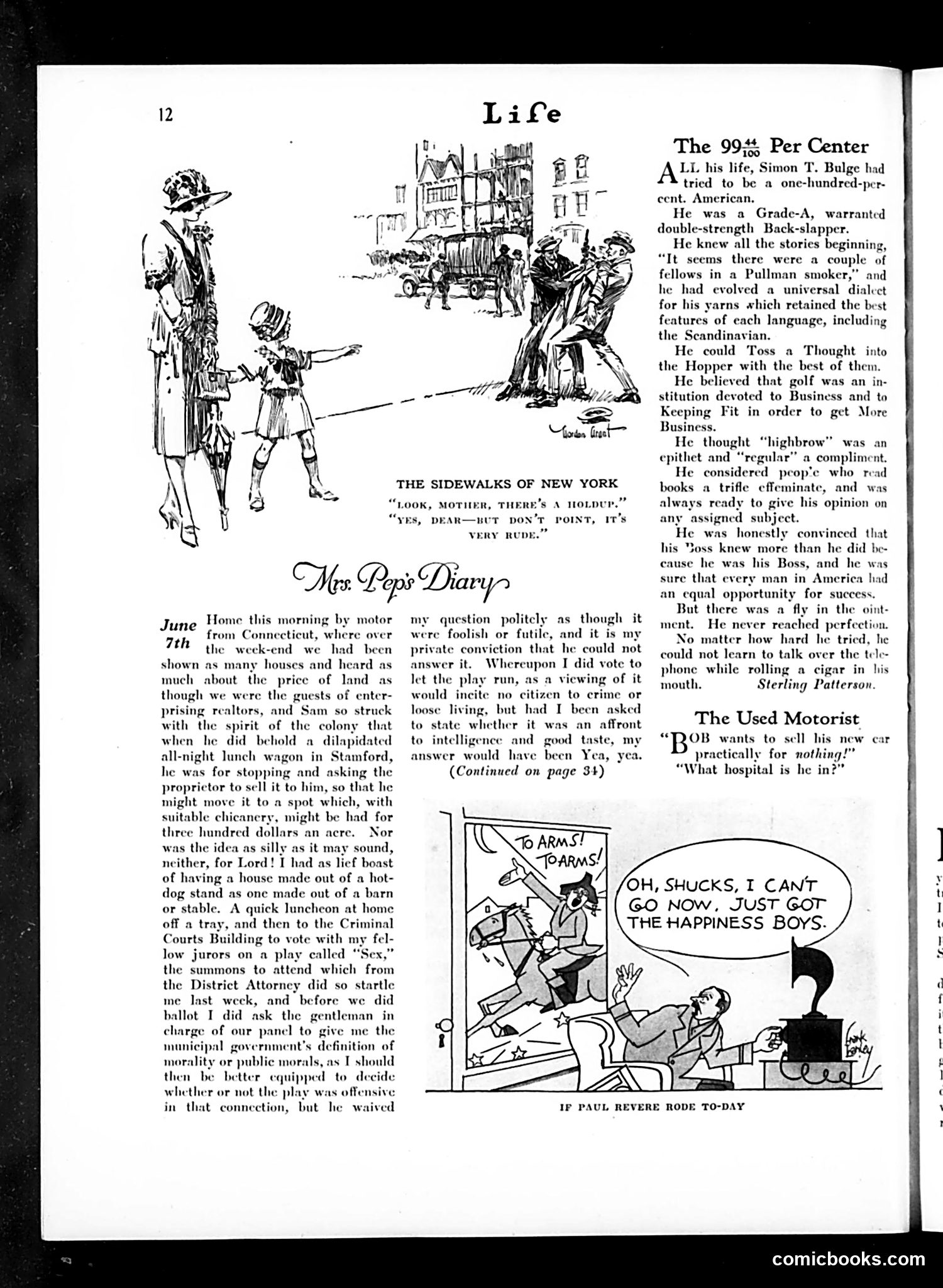
**"Mrs. Peps's Diary"** describes a Connecticut weekend visit where the narrator encounters nouveau-riche entertainers and disputes over land prices and morality—satirizing the clash between old-money sensibilities and nouveau-riche ostentation in 1920s suburban development. **"The Sidewalks of New York"** cartoon shows a well-dressed woman correcting a child's manners ("Look, mother, there's a holdup"/"Yes, dear—but don't point, it's very rude"), darkly joking that street crime in New York was so commonplace that it warranted polite social discretion rather than acknowledgment. **"The Used Motorist"** cartoon depicts someone injured by a car, asking about the vehicle's sale price rather than the driver's concern—satirizing American commercialism and indifference to human welfare.
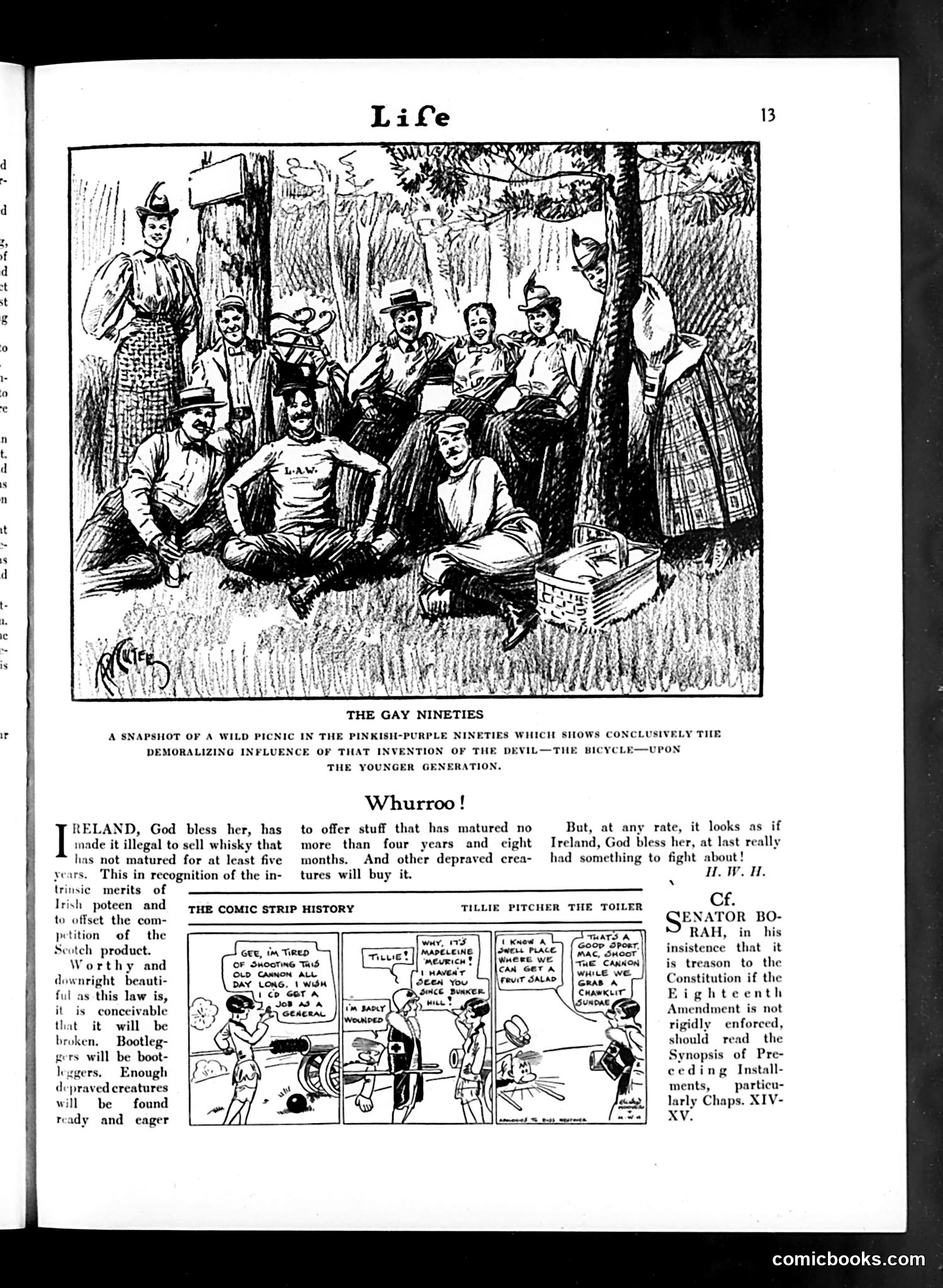
**Main Cartoon ("The Gay Nineties"):** A satirical illustration depicting a 1890s-era picnic scene. The caption explicitly identifies this as commentary on the "pinkish-purple nineties" and critiques the bicycle's "demoralizing influence upon the younger generation." The gathering shows elaborately dressed figures in period clothing engaged in leisure activities, mocking both the era's fashion and moral anxieties about new technologies corrupting youth. **"Whurroo!" Article:** Text about Irish whiskey regulations, discussing legal maturation requirements and bootleggers—clearly referencing Prohibition-era concerns. **"Comic Strip History: Tillie Pitcher the Toiler":** A four-panel comic strip featuring a character named Tillie in various domestic/working scenarios with dialogue, representing early comic strip format. The page satirizes both nostalgia for the 1890s and contemporary (Prohibition-era) social anxieties.
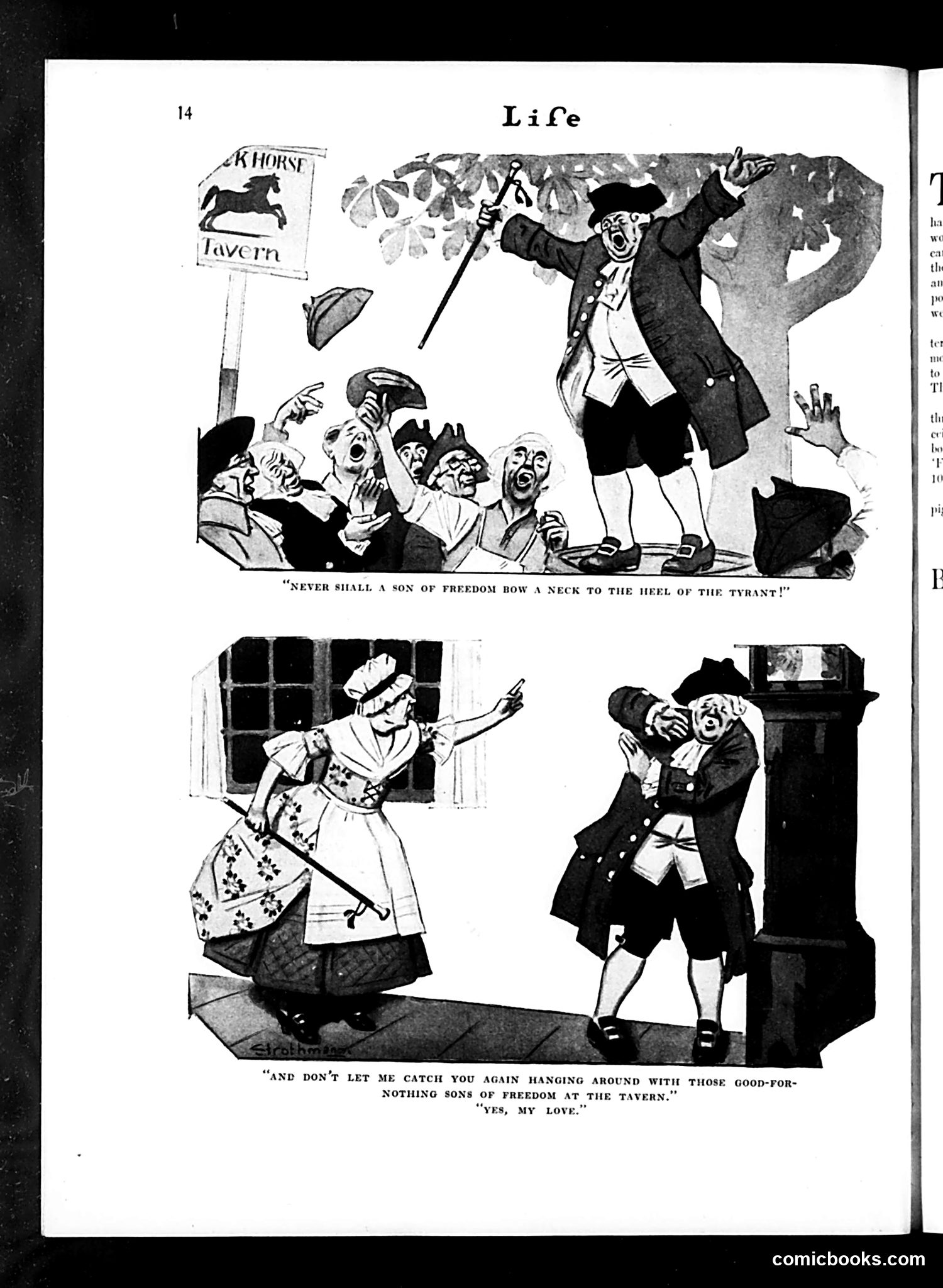
This page contains two related satirical cartoons about British patriotism and the "Sons of Freedom" movement, likely from the early 20th century. **Top cartoon**: A patriotic orator stands elevated, passionately declaring "Never shall a son of freedom bow a neck to the heel of the tyrant!" while addressing a crowd below a tavern sign marked "K Horse Tavern." **Bottom cartoon**: Shows the same rhetoric's hypocrisy—a woman confronts a man caught socializing at the tavern, saying she won't tolerate him "hanging around with those good-for-nothing sons of freedom at the tavern." He responds submissively, "Yes, my love." **The satire**: The cartoons mock the gap between grandiose patriotic speeches and actual domestic submission, particularly highlighting how male "freedom fighters" paradoxically obey their wives—suggesting selective application of independence principles.
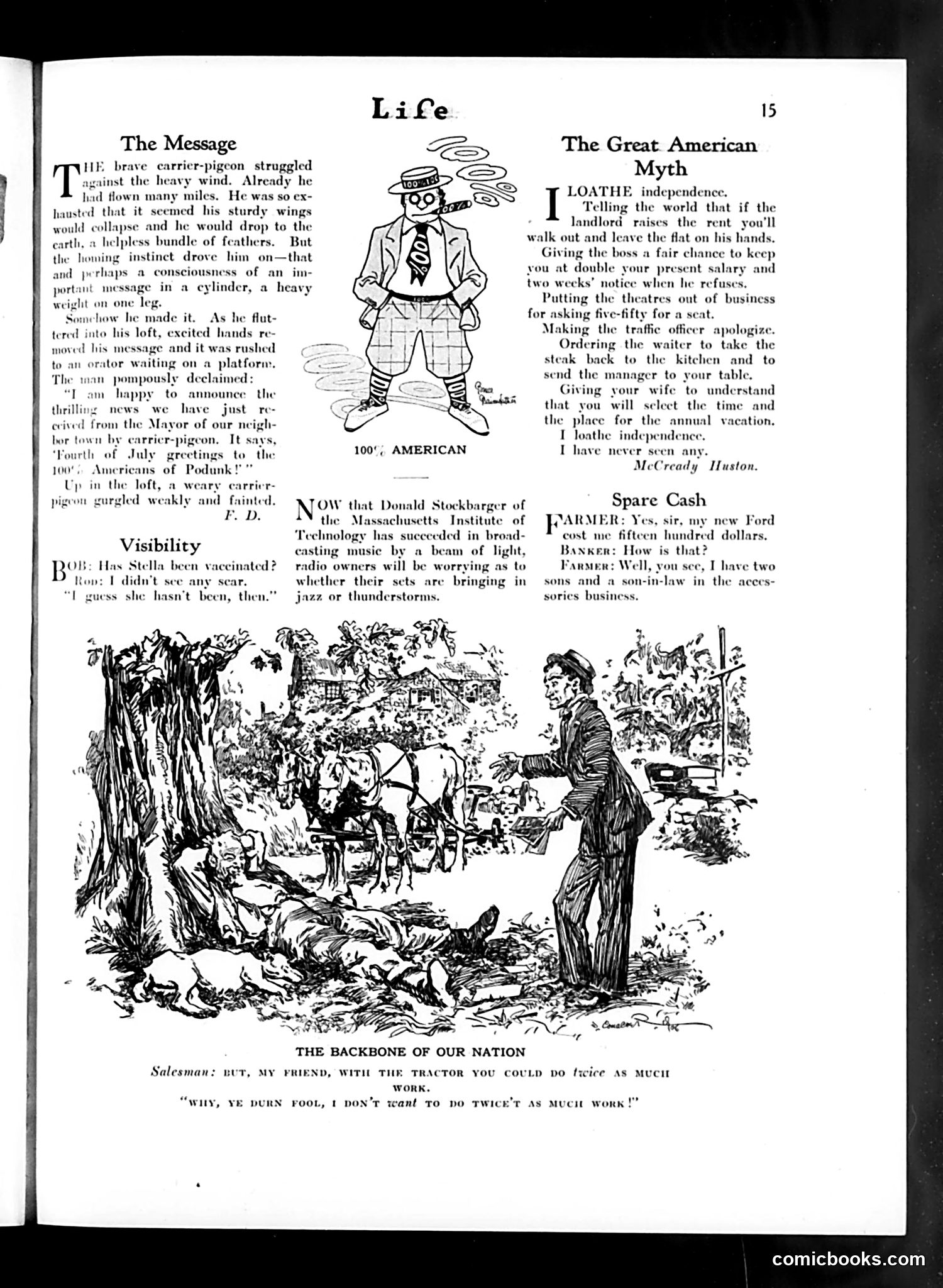
This page contains three satirical sections mocking American life and pretension. **"The Message"** ridicules a carrier pigeon delivering urgent news—a commentary on outdated communication methods being superseded by modern technology. **"The Great American Myth"** lists hypocritical behaviors wealthy Americans claim to value but don't practice: landlords raising rent, bosses denying raises, theater patrons complaining about prices, and husbands controlling vacation planning. The satire suggests Americans romanticize independence while actually accepting dependence and exploitation. **"The Backbone of Our Nation"** cartoon depicts a farmer refusing a tractor salesman's offer, claiming he won't work twice as hard. The irony critiques rural resistance to mechanization while paradoxically being called the nation's backbone—suggesting farmers are backward despite supposedly representing American strength.
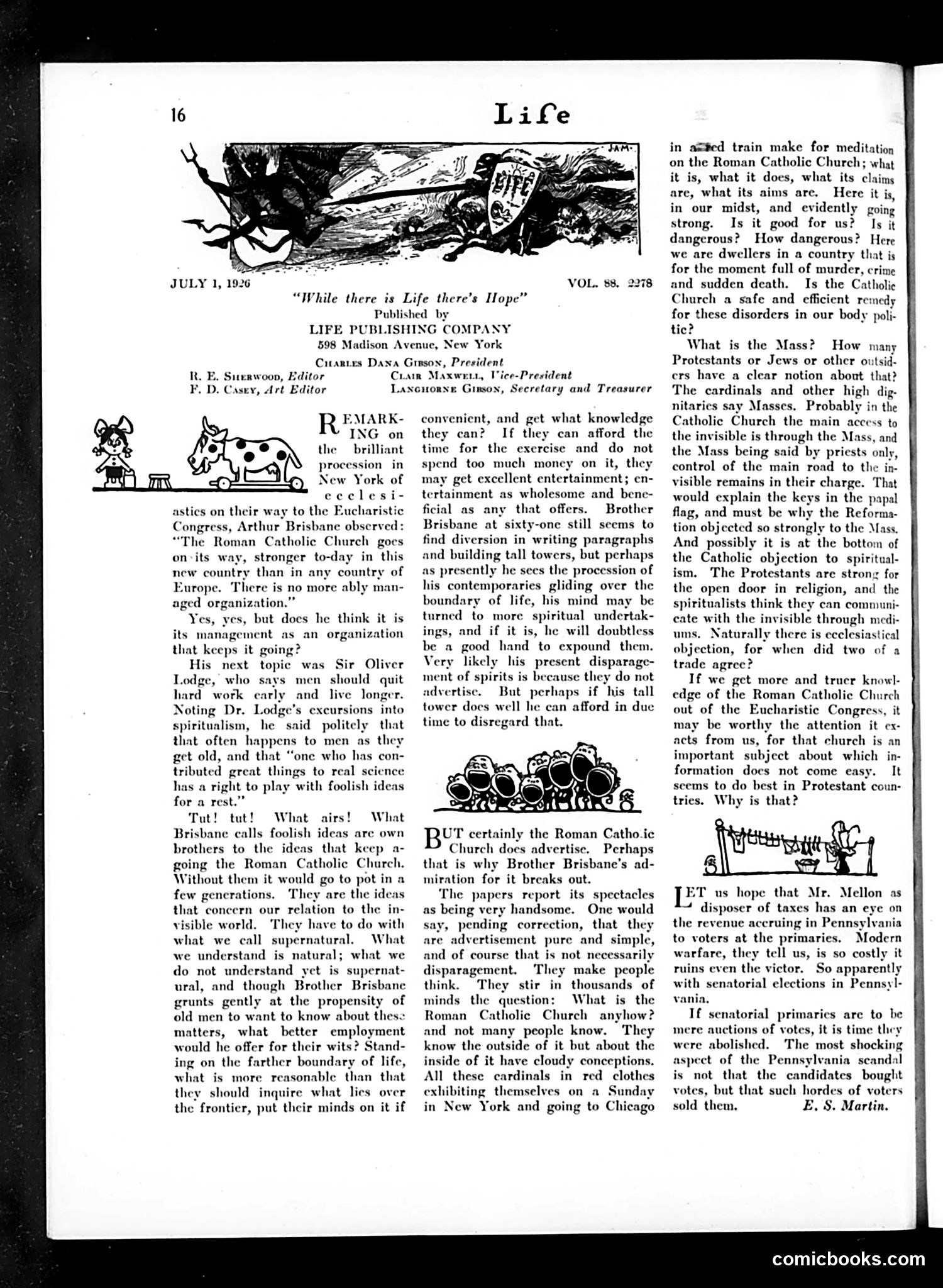
This page contains two editorial pieces criticizing the Roman Catholic Church's prominence and influence in American public life. The left column, titled "Remarks," discusses Arthur Brisbane's observation that the Catholic Church is "stronger today in this new country than in any old country of Europe." The author questions whether this growth is beneficial and cites Sir Oliver Lodge's warnings against spiritualism gaining influence in science. The right column directly criticizes Catholic Church advertising and its spectacles, specifically mentioning cardinals in red clothes "exhibiting themselves on a Sunday in New York and going to Chicago." It concludes with commentary on Pennsylvania senatorial elections, alleging that voters were "sold" by political operatives. Both pieces reflect 1920s Protestant anxiety about Catholic institutional expansion in America.
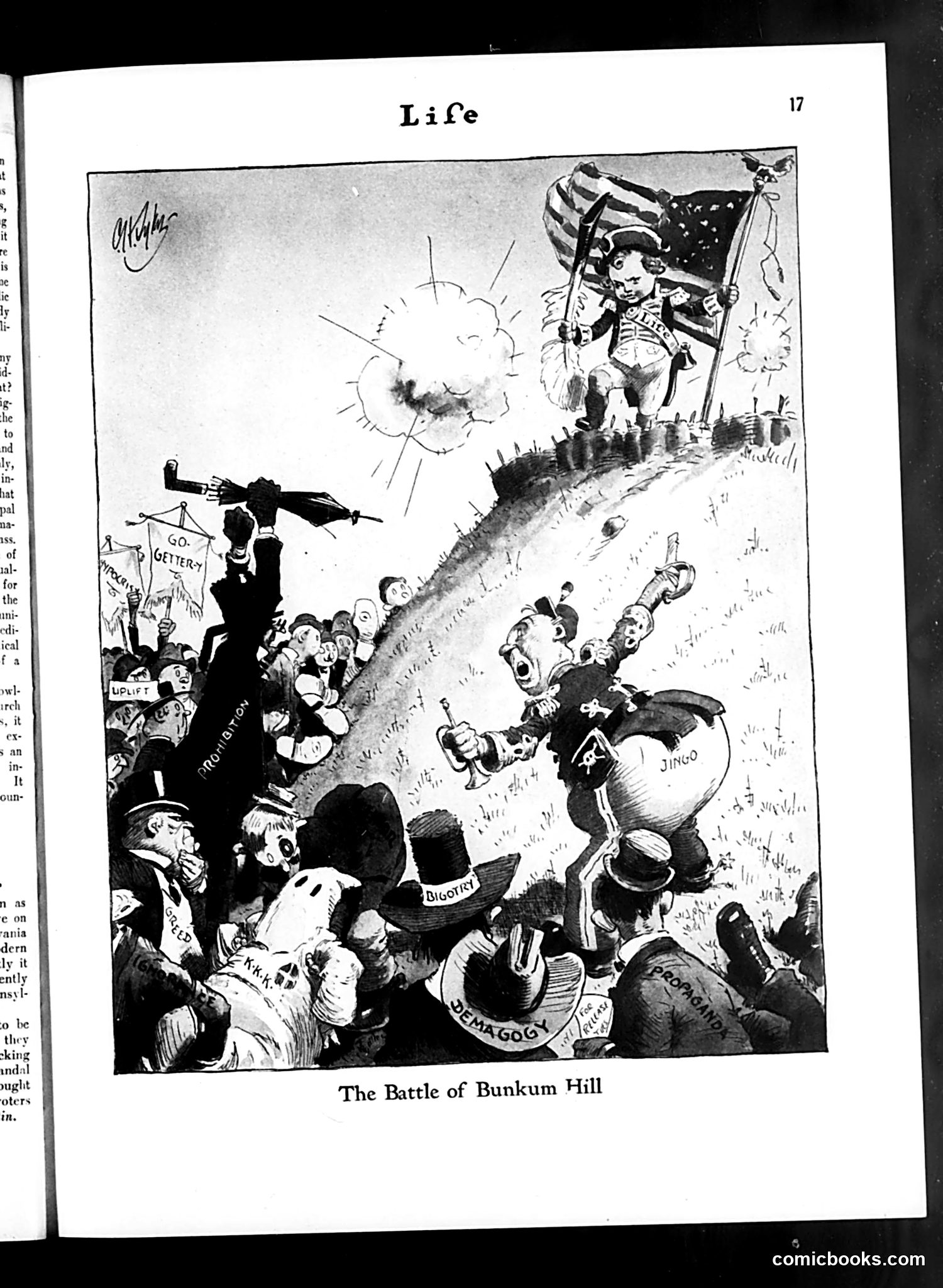
This political cartoon satirizes what appears to be a chaotic political conflict or campaign struggle. The composition shows two opposing forces clashing on a hillside: on the left, a crowd with signs reading "GO GETTER" and "UPLIFT"; on the right, figures labeled "JINGO" and what appears to be "DEMAGOGUE" and "SEMAGOGUERY." At the hilltop, a figure waves an American flag triumphantly. An explosion bursts between the factions, suggesting violent discord. The cartoon's title puns on "Bunker Hill" (the Revolutionary War battle), sardonically comparing contemporary political fighting to that historic conflict. The labeled groups suggest the cartoon criticizes both progressive ("Go Getter," "Uplift") and reactionary/nationalist ("Jingo") forces as equally absurd and destructive to the nation. The exact date and specific political moment remain unclear without additional context.
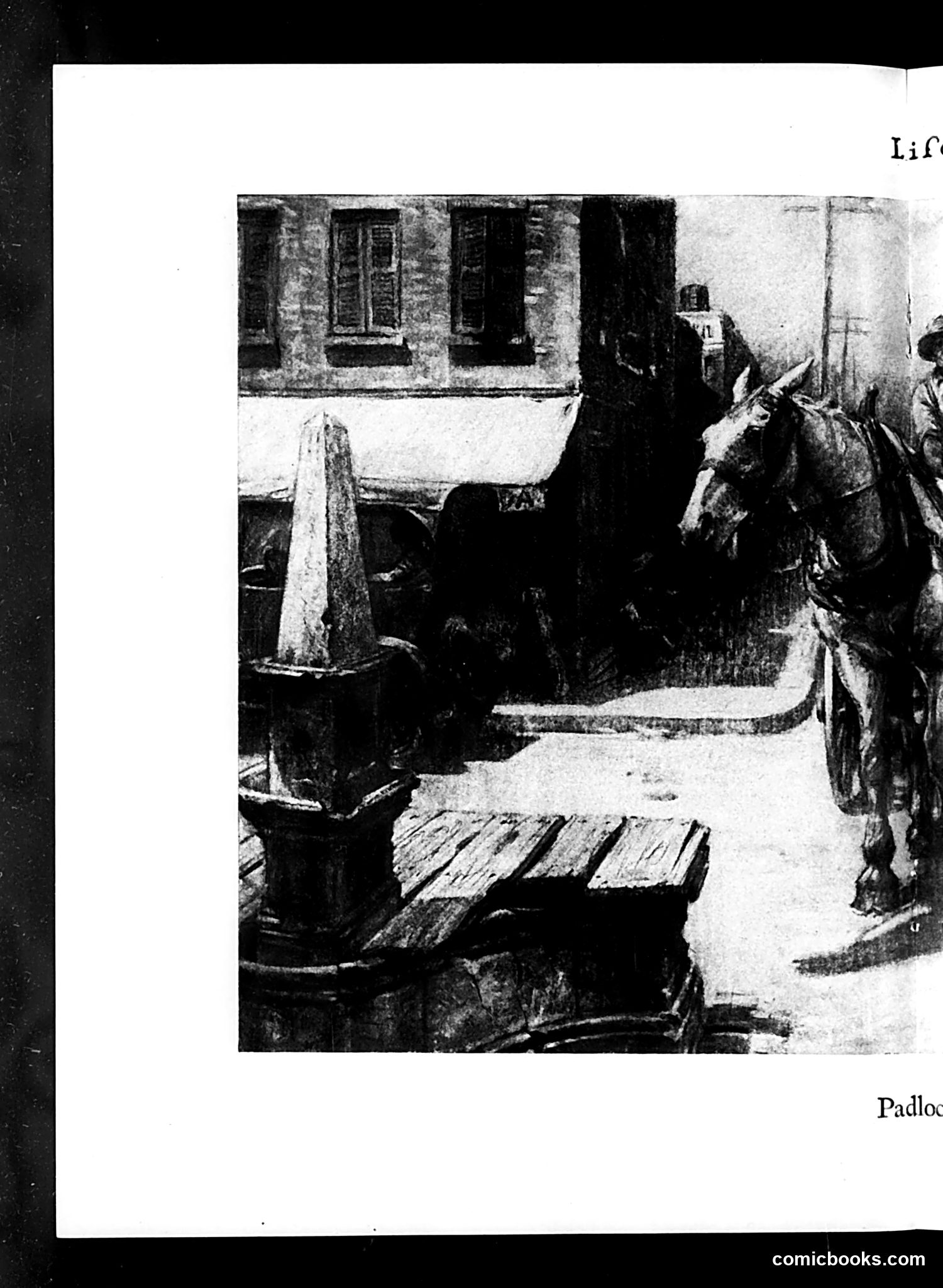
This appears to be a political cartoon depicting a scene at what looks like a building entrance. A mounted figure (possibly representing law enforcement or authority) is shown near a padlocked door or gate. The image suggests themes of closure, restriction, or legal prohibition. Without clearer text or publication date visible, the specific historical reference is unclear. However, given Life magazine's satirical nature and the "padlock" imagery, this likely comments on business closures, prohibition enforcement, or some form of government restriction during the early-to-mid 20th century. The mounted official and architectural setting suggest urban enforcement action, but the exact political or social critique cannot be definitively determined from this image alone.
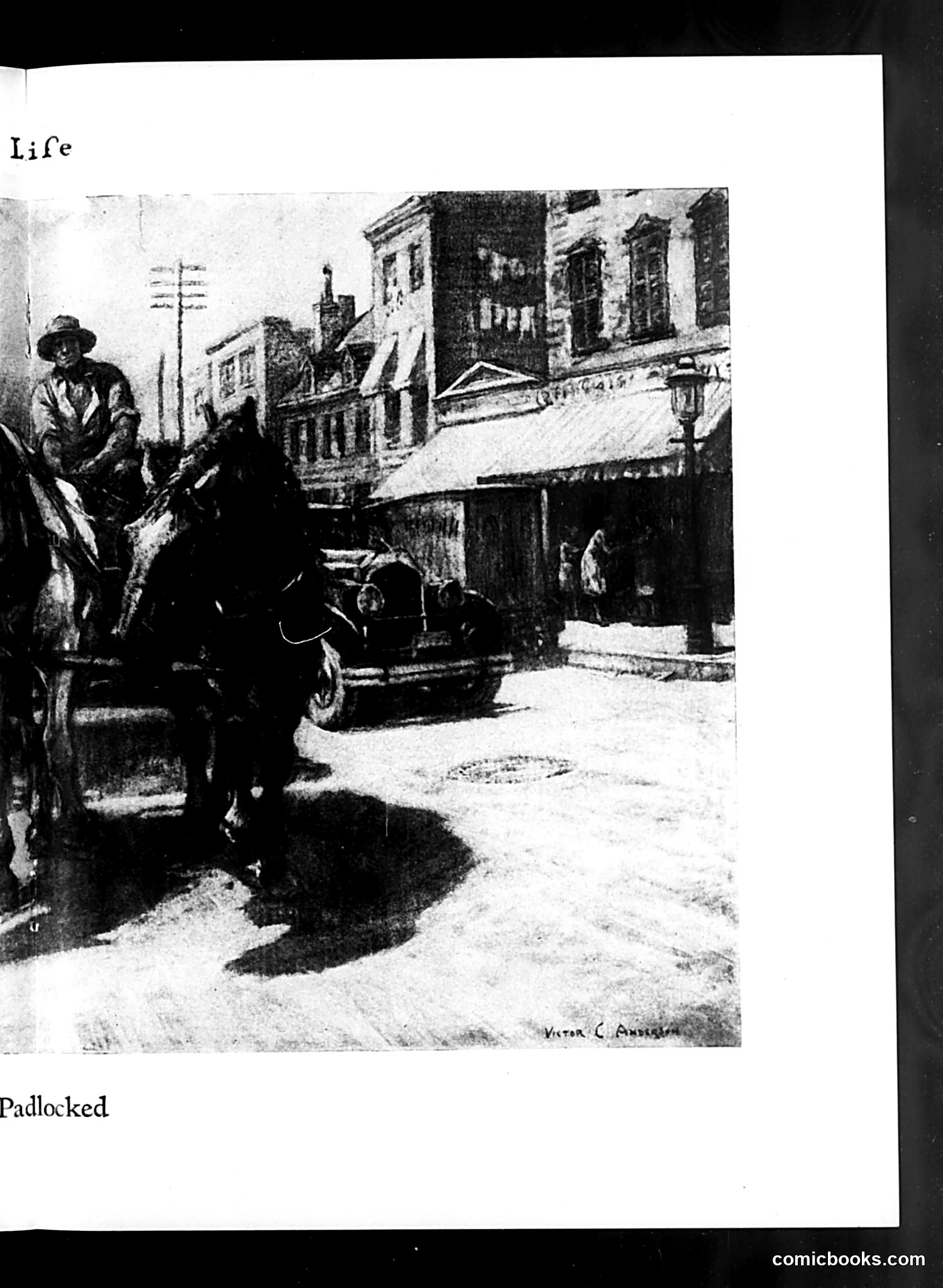
This illustration depicts a street scene with a man on horseback near a storefront with a padlocked door. The title "Padlocked" appears to be satirizing enforcement of Prohibition—the constitutional ban on alcohol sales (1920-1933). The padlocked storefront likely represents a shuttered saloon or speakeasy that has been raided and closed by federal authorities. The figure on horseback may represent law enforcement or a Prohibition agent. The street scene with period buildings and a utility pole suggests an American urban setting during the Prohibition era. The satire comments on the widespread effort to enforce alcohol bans, though the full political or social commentary remains unclear without additional context about Life's editorial stance at this moment.
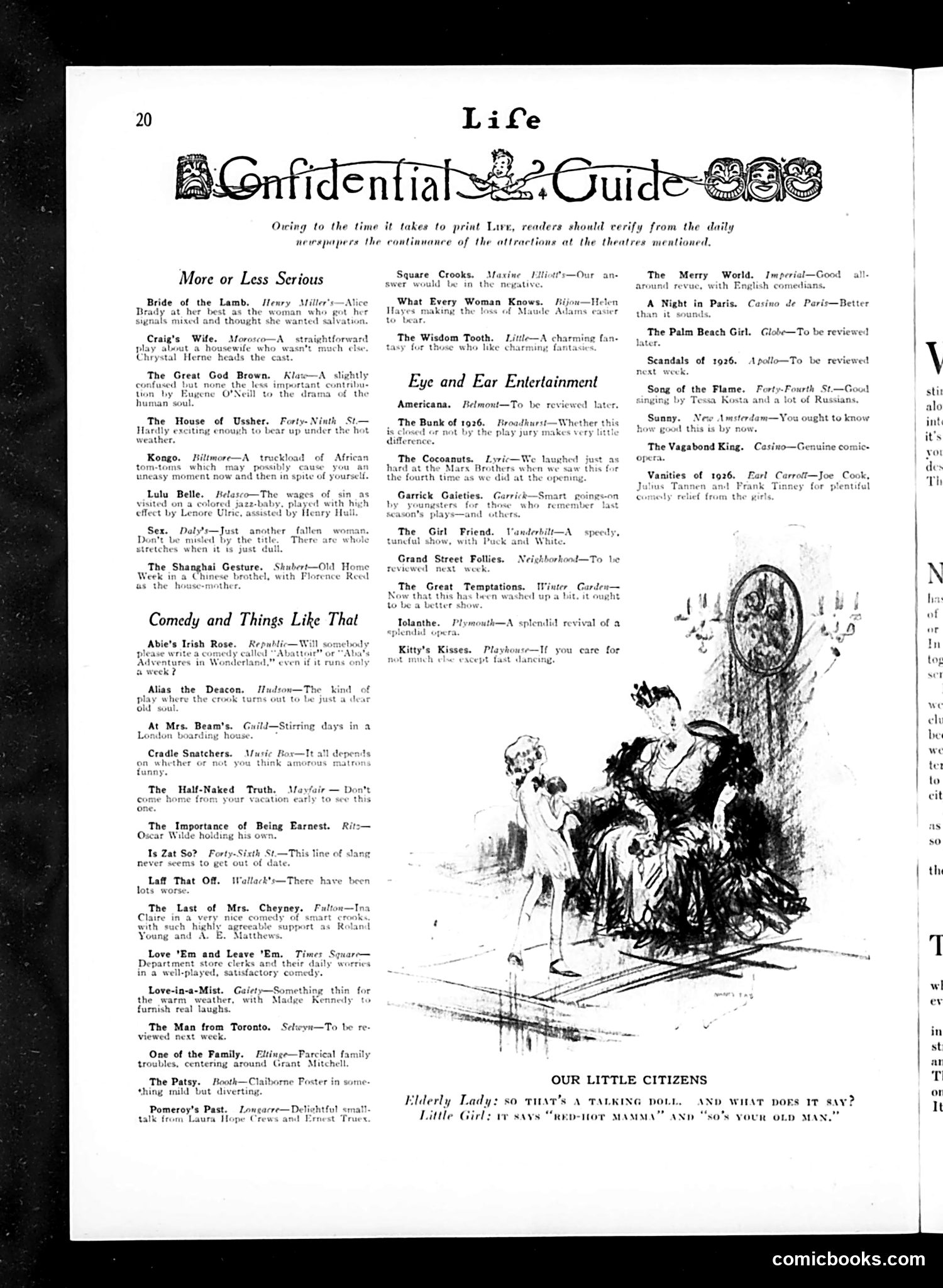
This cartoon satirizes early 20th-century child-rearing and parental anxieties about new technology. An elderly woman examines a talking doll with bewilderment while a young girl explains its capabilities. The joke targets two concerns: First, the novelty and slight discomfort adults felt toward mechanized toys that mimicked human speech—a genuinely new phenomenon in the 1920s. Second, it satirizes what children actually learn from such toys: the girl proudly demonstrates the doll says "red-hot mamma" (slang for an attractive woman) and "so's your old man" (a comeback insult)—hardly the genteel phrases manufacturers likely intended. The caption emphasizes the irony: the elderly lady's confusion ("so that's a talking doll") contrasts sharply with the child's casual familiarity with modern technology. The satire mocks both the innocence of early toy marketing and the unintended consequences of putting popular slang into children's hands through mechanical means.
This is a theater review essay by Robert Benchley assessing Broadway's 1925-26 season. The page contains no political cartoons—it's satirical prose commentary on theatrical trends. Benchley humorously critiques three overused theatrical conventions: 1. **Toy numbers**: Musical sequences where performers pantomime toy movements at midnight—a thirty-year-old cliché he demands stop immediately. 2. **Burlesque spring dances**: Comic routines with scattered imitation flowers and exaggerated drummer sound effects, now "at its low ebb." 3. **The Charleston**: The wildly popular 1920s dance, now ubiquitous in revues. Benchley protests its overuse, noting it originated "on Broadway fully three years ago by the Negroes" but audiences see identical performances constantly. The opening discusses the season's treatment of sex as a theatrical subject—nine of twenty-three hits engaged with sexual themes, which Benchley presents as mildly scandalous but ultimately acceptable.
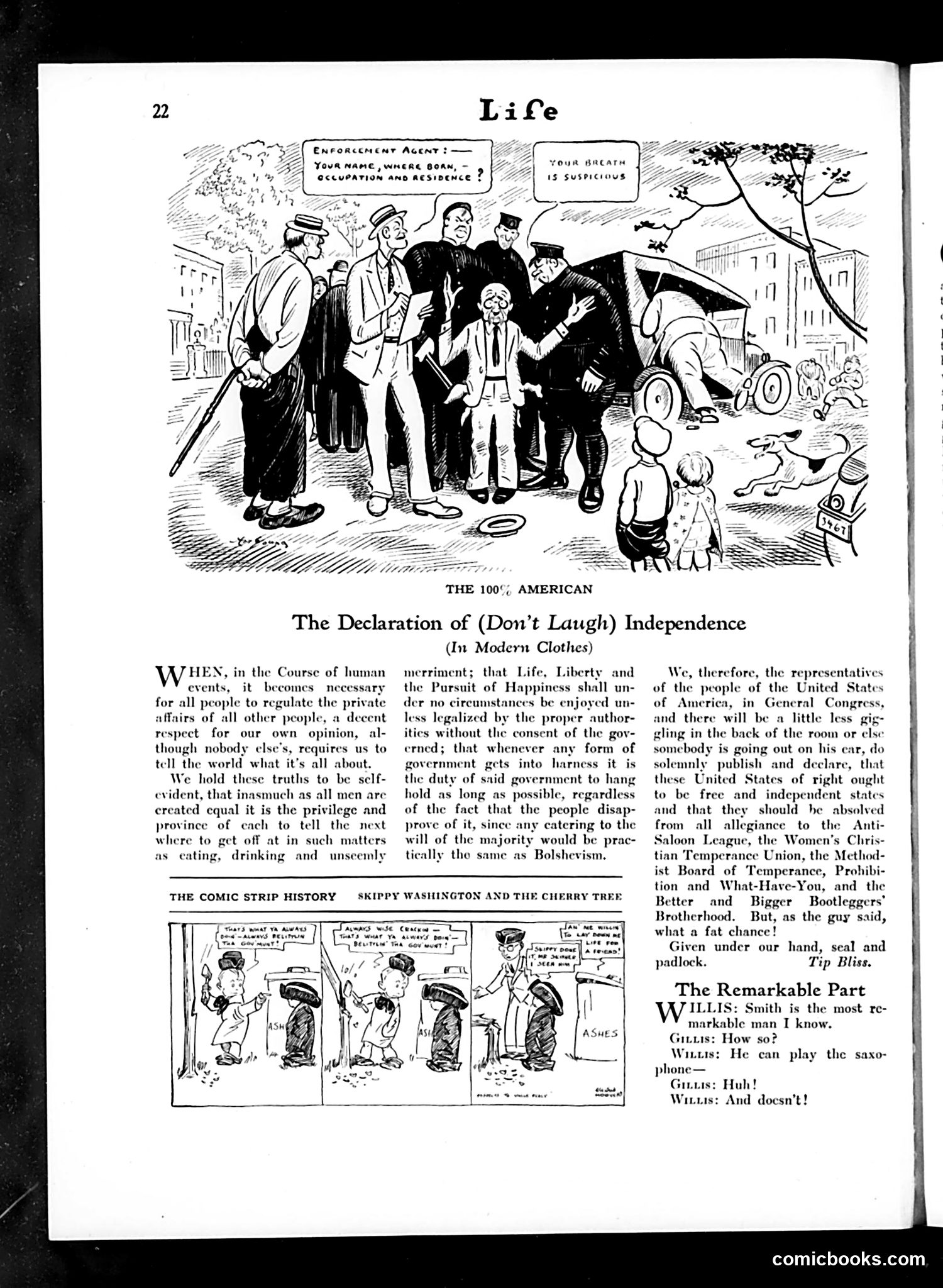
This page satirizes Prohibition-era America (likely 1920s). The top cartoon mocks Prohibition enforcement agents interrogating citizens about their "occupation and residence"—suggesting invasive government overreach into private life. "The Declaration of (Don't Laugh) Independence" parodies the founding document, inverting its principles. Instead of protecting liberty, it portrays government as tyrannical, regulating eating, drinking, and "unseemly merriment." The satire explicitly compares government overreach to Bolshevism, equating regulation with communism—a common conservative critique of the era. The declaration humorously promises freedom from the "Anti-Saloon League, Women's Christian Temperance Union...and Bootleggers' Brotherhood," mocking the competing forces controlling American morality. The final joke—"what a fat chance!"—dismisses any actual freedom under such conditions. The comic strip below is unrelated slice-of-life humor.
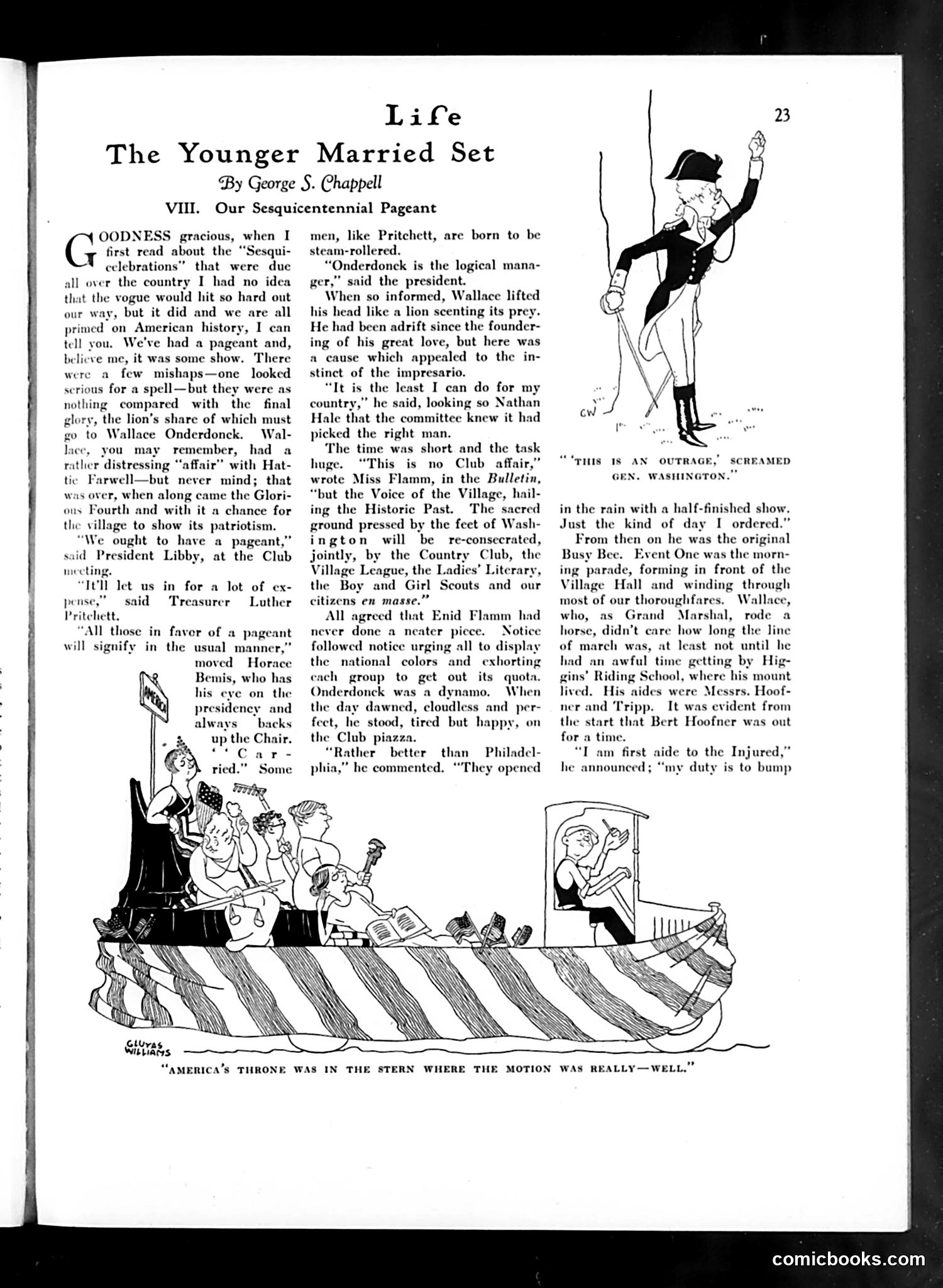
This George S. Chappell article satirizes a small town's 1926 celebration of America's 150th anniversary (sesquicentennial). The narrative follows Wallace Onderdonck, appointed to manage the village's patriotic pageant—a role that becomes his redemption after a romantic scandal with "Hattie Farwell." The cartoon depicts the pageant as a ship, with America as a throne positioned in the stern. General Washington complains ("THIS IS AN OUTRAGE") about the chaotic motion, while various town groups jostle for prominence on the vessel. The satire mocks small-town civic pomposity: how ordinary people inflate minor community events into grand historical recreations, how pageant-planning becomes competitive status-seeking, and how individuals like Onderdonck exploit such occasions for personal rehabilitation. The ship imagery suggests the town's pretensions are unsteady and ridiculous—patriotic pageantry becomes just another venue for local social drama and ambition rather than genuine historical reverence.
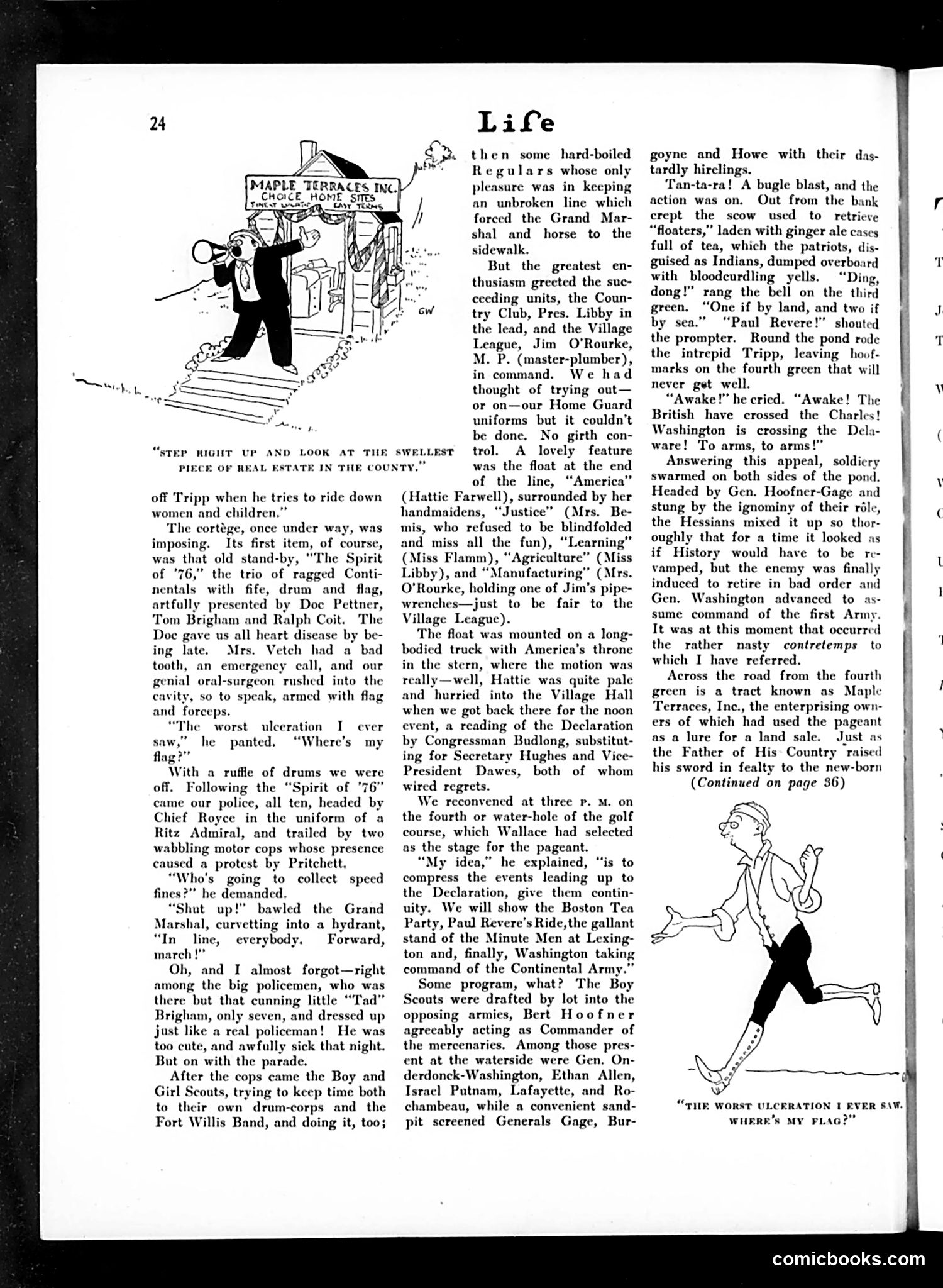
This page depicts a small-town Fourth of July pageant celebrating American independence. The main illustration shows a man at a real estate podium—a satirical juxtaposition mocking commercialism infiltrating patriotic celebration. The text humorously details a parade featuring standard patriotic elements: "Spirit of '76" Continental soldiers, police, Boy and Girl Scouts, and a float personifying "America" surrounded by allegorical figures (Justice, Learning, Agriculture, Manufacturing). The satire targets American civic life circa 1920s: the pageant's awkward execution (a dentist's emergency delays the parade; a child dressed as a policeman gets sick), petty local politics (the Grand Marshal on horseback forcing pedestrians aside), and the absurdity of recreating Revolutionary War scenes at a golf course using Boy Scouts and ginger ale cases as props. The small cartoon shows someone exclaiming "Where's my flag?"—likely satirizing misplaced patriotic priorities amid the chaos.
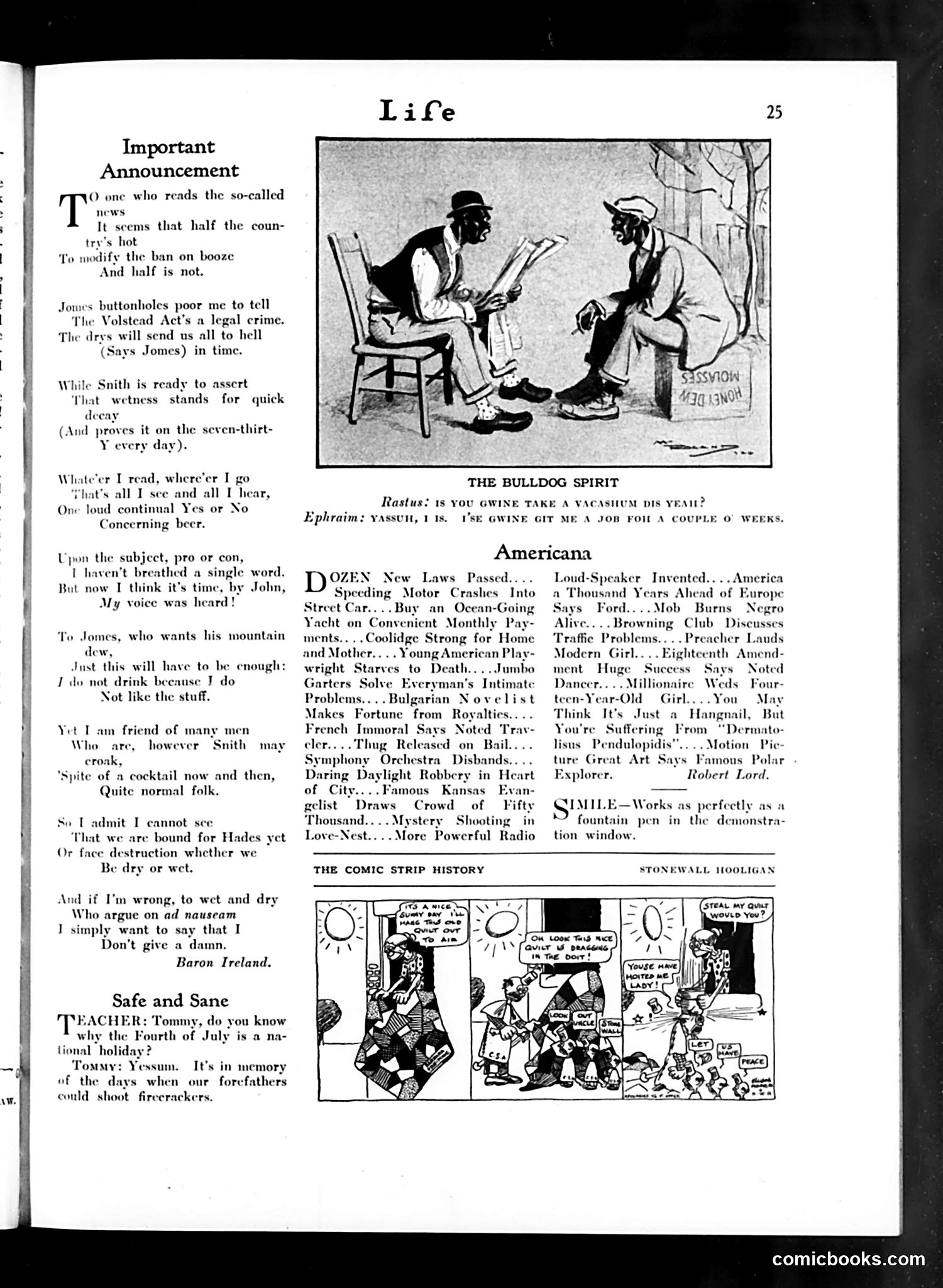
**Main Content: Prohibition-Era Satire** The page satirizes America's fierce cultural divide over Prohibition (the Volstead Act banning alcohol). An anonymous writer ("Baron Ireland") complains that everyone obsesses over whether alcohol should be legal—half the country "hot / To modify the ban on booze / And half is not." The author humorously declares neutrality, claiming he simply doesn't drink because he dislikes it, and dismisses both "wets" (anti-Prohibition) and "drys" (pro-Prohibition) as equally tedious. **The Cartoon ("The Bulldog Spirit"):** Two Black men discuss taking summer jobs—a mild, apolitical joke with period-typical racial caricature. **"Safe and Sane":** A teacher explains Independence Day to a student, who mistakenly thinks it commemorates firecrackers rather than independence—gentle absurdist humor. **"Americana":** A rapid-fire list of contemporary American headlines mixing tragedy, frivolity, and social commentary—reflecting Life's satirical view of modern American excess and contradiction. The overall message: American society is fractured and distracted by competing moral crusades.
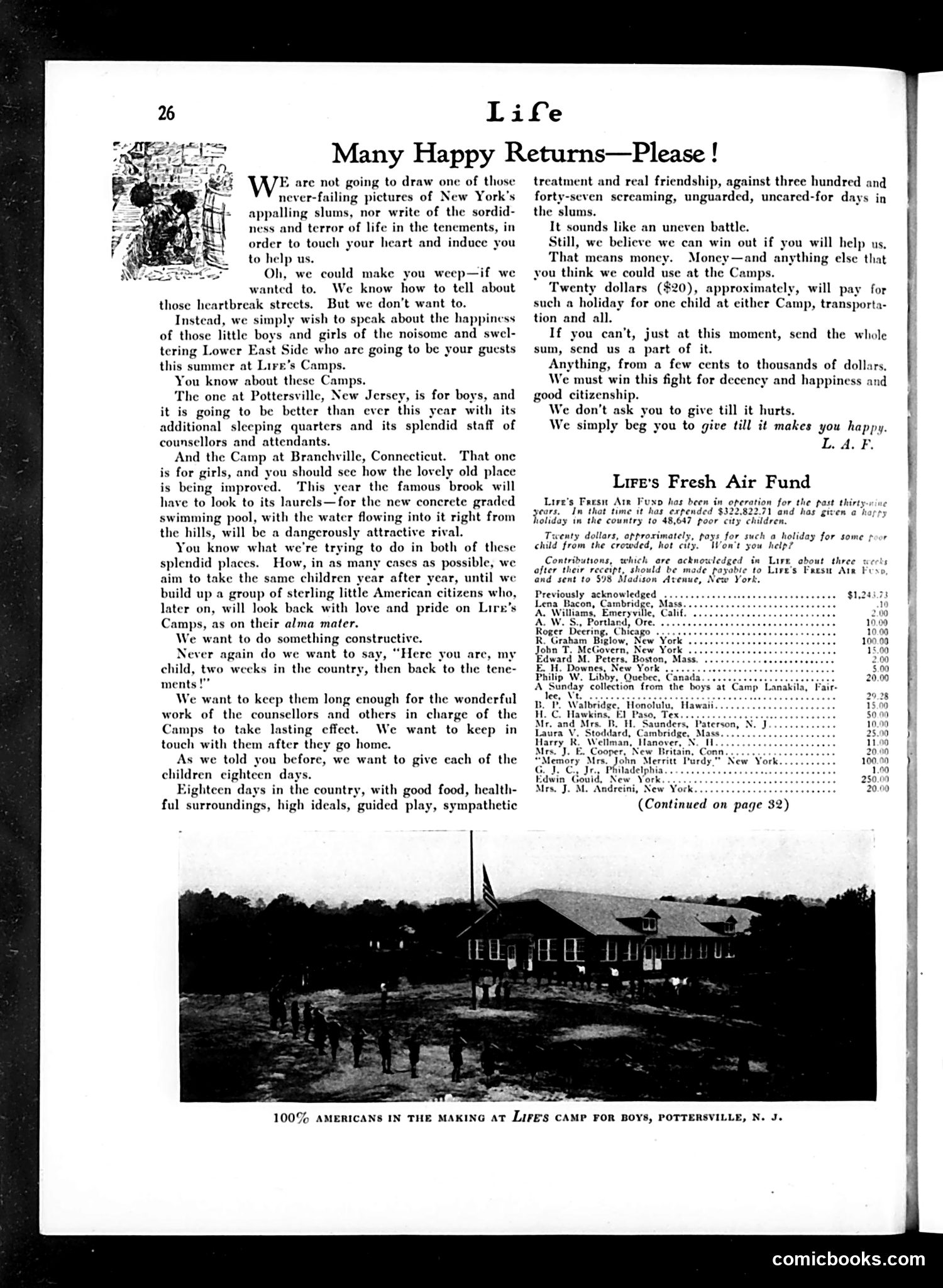
This page is a **fundraising appeal**, not a political cartoon. The publication solicits donations for Life's Fresh Air Fund—an established charitable program (operating 39 years by this date) providing summer camp vacations for poor children from New York City's Lower East Side tenements. The page contrasts two realities: 347 days of urban squalor versus 18 days of countryside rehabilitation at camps in Potterville, New Jersey (boys) and Branchville, Connecticut (girls). The appeal argues that brief charity is insufficient—sustained intervention builds "sterling little American citizens." The photograph shows the boys' camp facility. The accompanying donor list demonstrates middle-class support. The text's tone is earnest social reform, typical of Progressive Era charity work. The "$20 per child" figure emphasizes accessibility of giving. This represents early-20th-century American paternalism: privileged classes "uplifting" poor urban youth through nature and moral instruction, framed as patriotic citizenship-building.
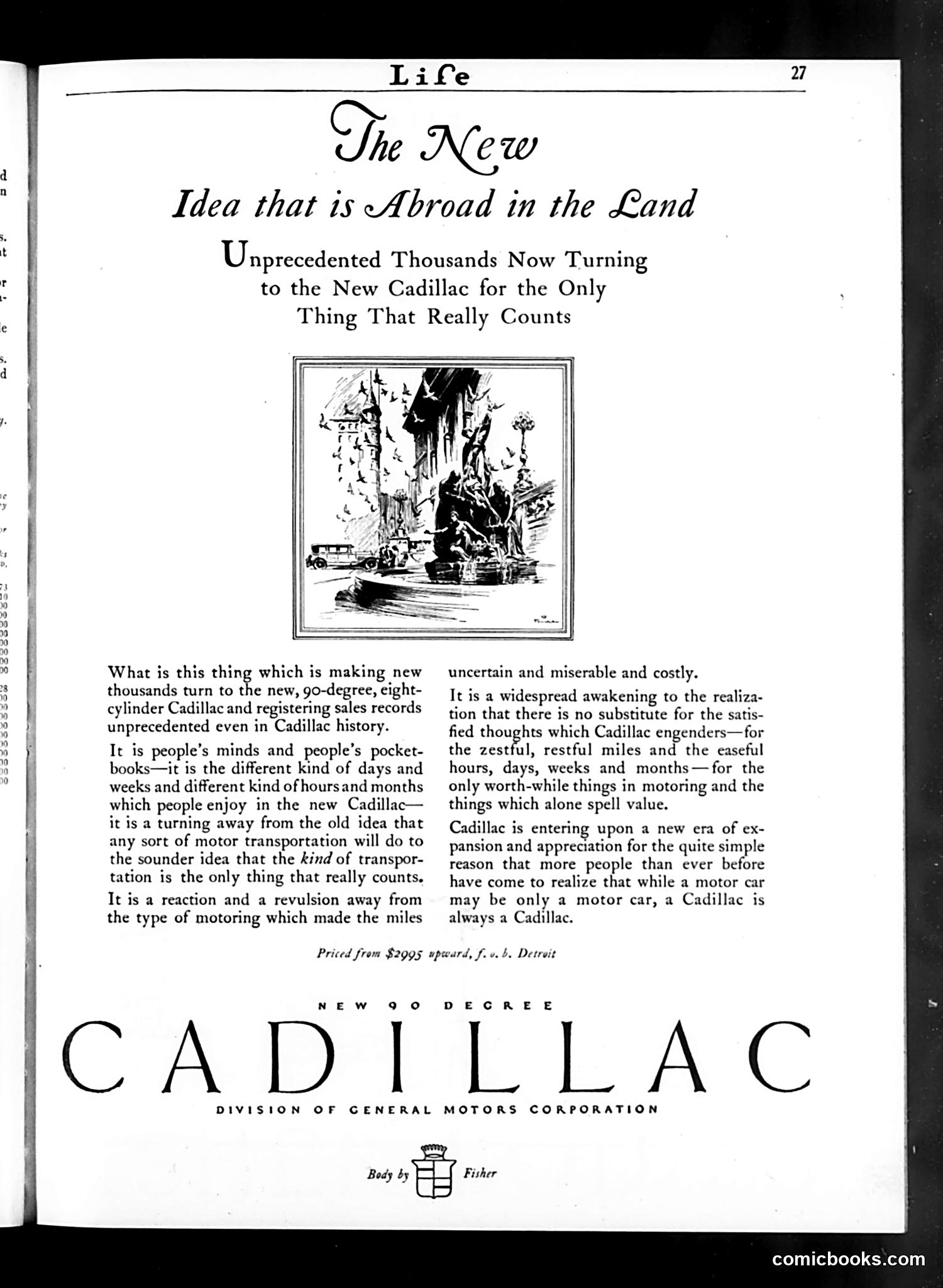
This is primarily a **Cadillac automobile advertisement**, not political satire. The page appears from *Life* magazine's advertising section (page 27). The ad promotes the new Cadillac by claiming it represents a philosophical shift: people are no longer buying cars merely for transportation, but for the *experience* and *status* they provide. The accompanying sketch shows a luxurious car near an elegant building, emphasizing upscale lifestyle. The text's ironic tone—describing the "new idea" that a Cadillac "is always a Cadillac" (meaning its superior quality justifies premium pricing)—may have subtle satirical undertones about American consumerism and aspirational buying. However, this appears to be the ad's own rhetorical strategy rather than *Life* magazine satirizing Cadillac. The starting price of $2,995 (1920s dollars) positioned it as a luxury good for the wealthy. The "Body by Fisher" credit indicates coachwork craftsmanship.
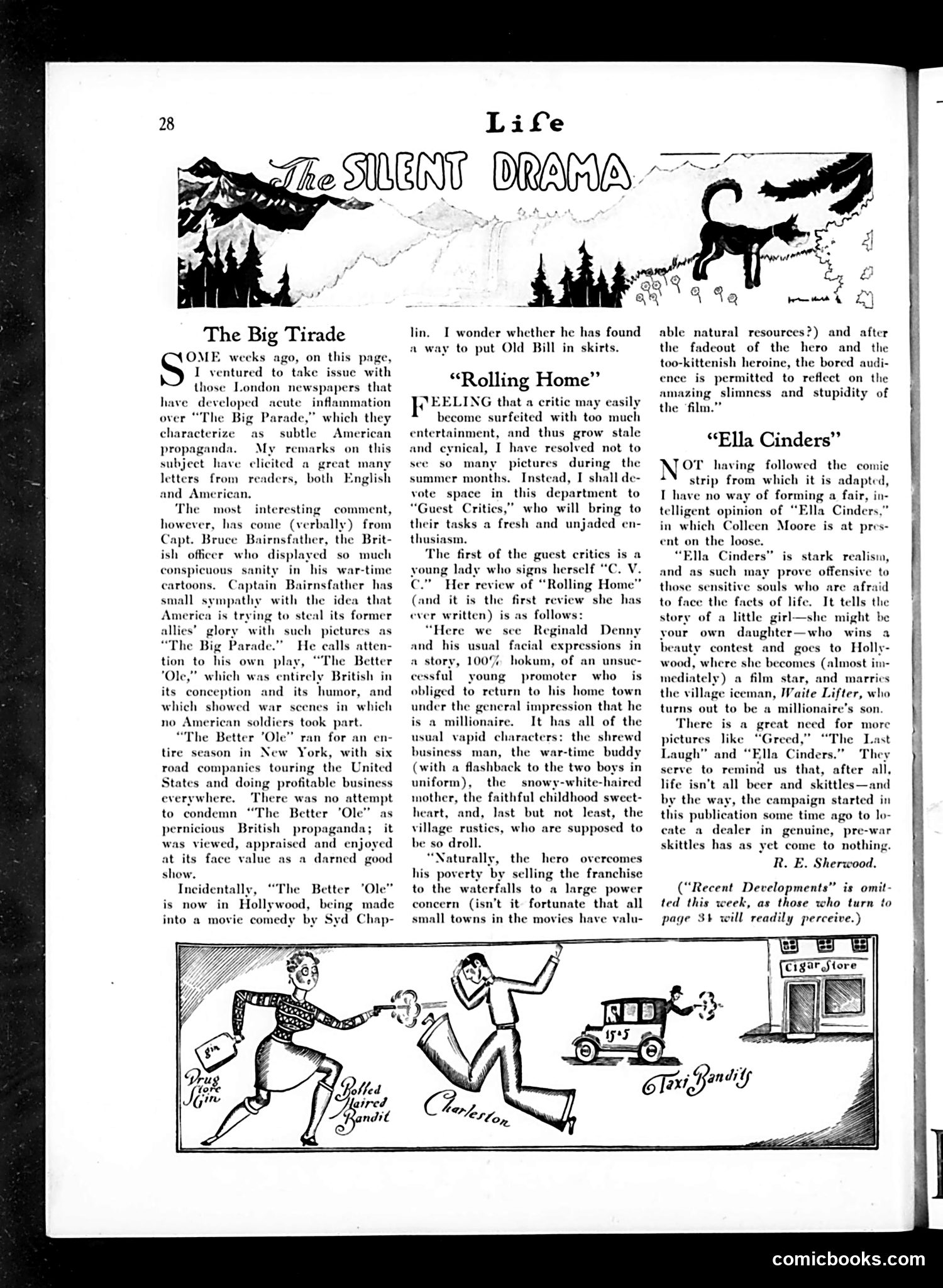
This page discusses early 1920s film criticism and transatlantic cinema tensions. The main article defends American war film "The Big Parade" against British accusations of propaganda. Captain Bruce Bairnsfather (a famous British WWI cartoonist) points out the hypocrisy: his own British war play "The Better 'Ole" was commercially successful in America without accusation of propaganda. The "Guest Critics" section introduces amateur film reviews. A young female critic ("C.V.C.") harshly pans "Rolling Home" (starring Reginald Denny), mocking its hackneyed plot about a fake millionaire. Another review discusses "Ella Cinders," praising it as "stark realism" that honestly depicts a small-town girl's rise to stardom and marriage—comparing it favorably to serious films like "Greed." The bottom cartoon satirizes silent-film stock characters: the "Vamp," "Old Retired Spanish," "Clarkton" (possibly), and "Taxi Bandit." The satire targets formulaic 1920s cinema and the pretentiousness of film criticism.
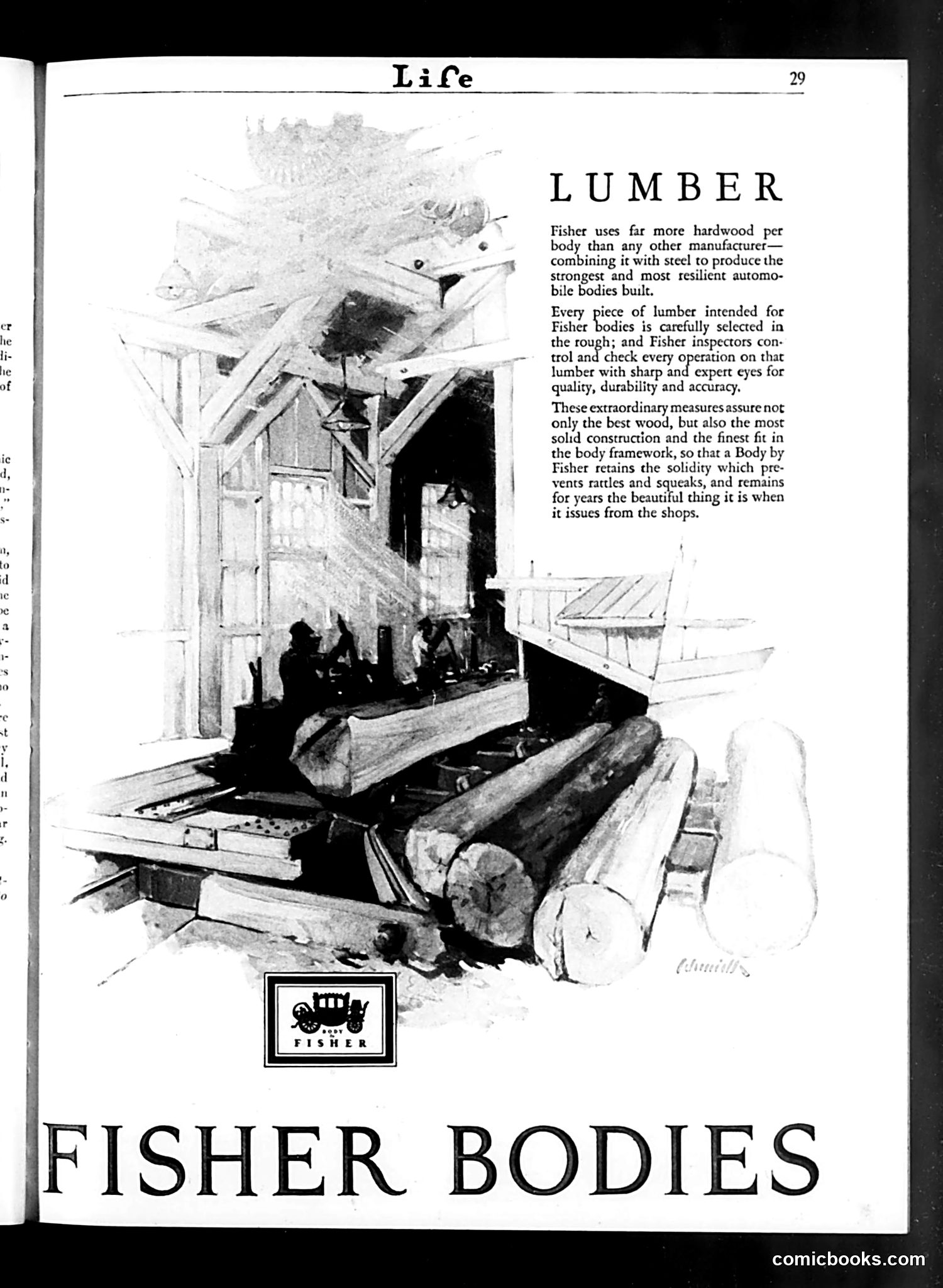
This is **not a cartoon or satire**, but rather a **Fisher Body advertisement** from Life magazine. Fisher Body was an automobile body manufacturer (later acquired by General Motors). The image shows logs and lumber being processed at a mill, illustrating Fisher's manufacturing process. The accompanying text is a straightforward corporate advertisement emphasizing Fisher's quality standards: they use premium hardwood, carefully inspect materials, and combine wood with steel to create durable, rattle-free automobile bodies. The Fisher logo appears at bottom center. This is purely commercial messaging highlighting the company's craftsmanship and material selection as selling points to consumers—a common approach in early-to-mid 20th century automotive advertising when wooden body frames were still standard in car construction.
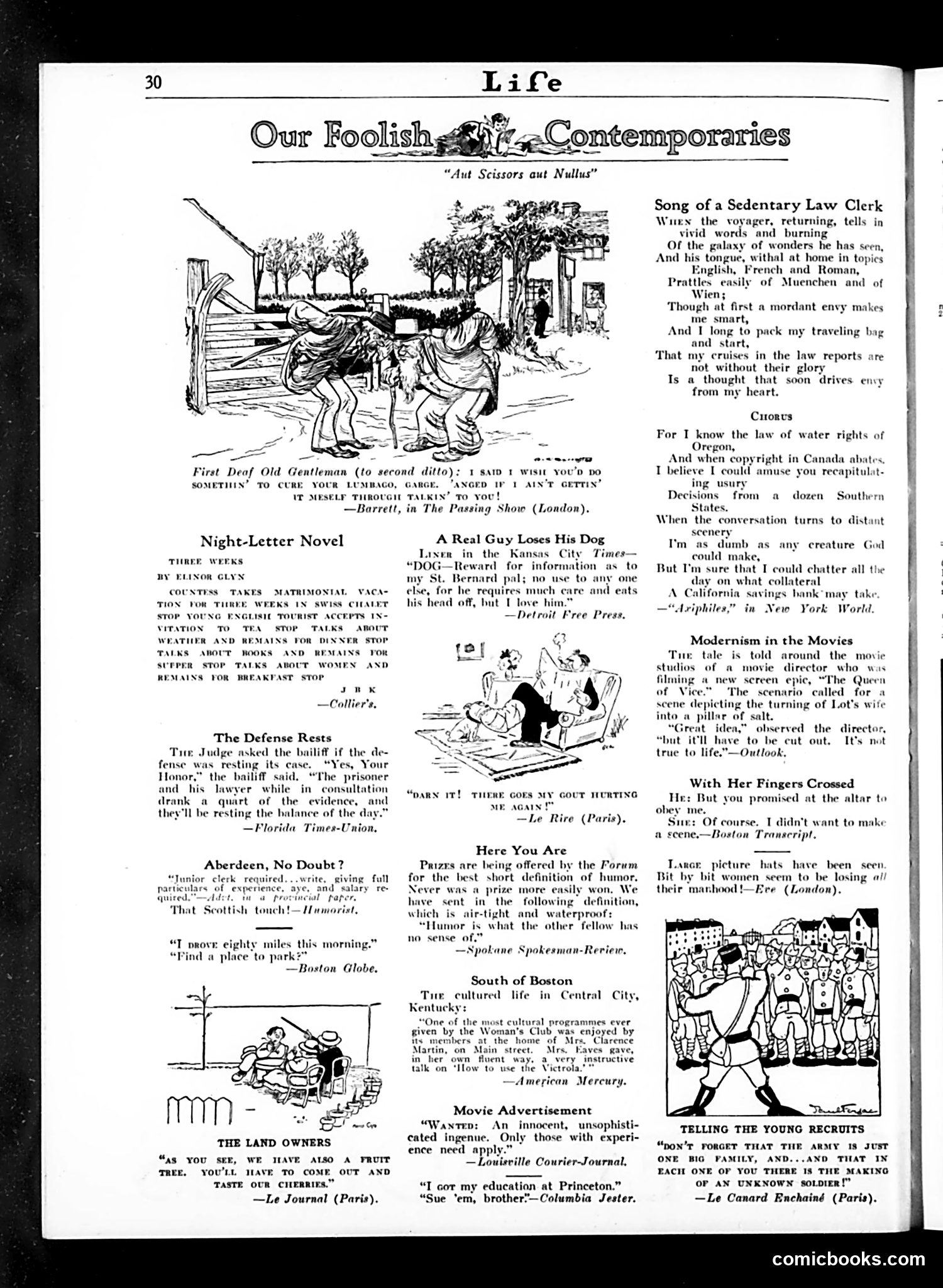
This page from *Life* magazine collects various humorous short pieces and cartoons mocking contemporary foibles. Key items include: **"Our Foolish Contemporaries"**: The main cartoon depicts two deaf elderly men discussing remedies, satirizing how people offer unsolicited medical advice. **"Night-Letter Novel"**: A parody of serialized fiction (likely referencing Elinor Glyn's romance novels), mocking how trivial conversations stretch across multiple installments. **Various one-liners** skewering: - Judges/legal system (evidence literally consumed) - Job advertisements with unrealistic standards - Movie industry pretensions (seeking "innocent" actresses while requiring experience) - Snobbish cultural aspirations (a Kentucky Woman's Club lecture on operating a phonograph) - Class anxieties (the sedentary law clerk envying travelers) The satire targets early 20th-century American social pretension, bureaucratic absurdity, and the growing entertainment industry. The tone assumes readers recognize references to contemporary publications and social trends—particularly the rise of mass media and the anxieties of white-collar workers.
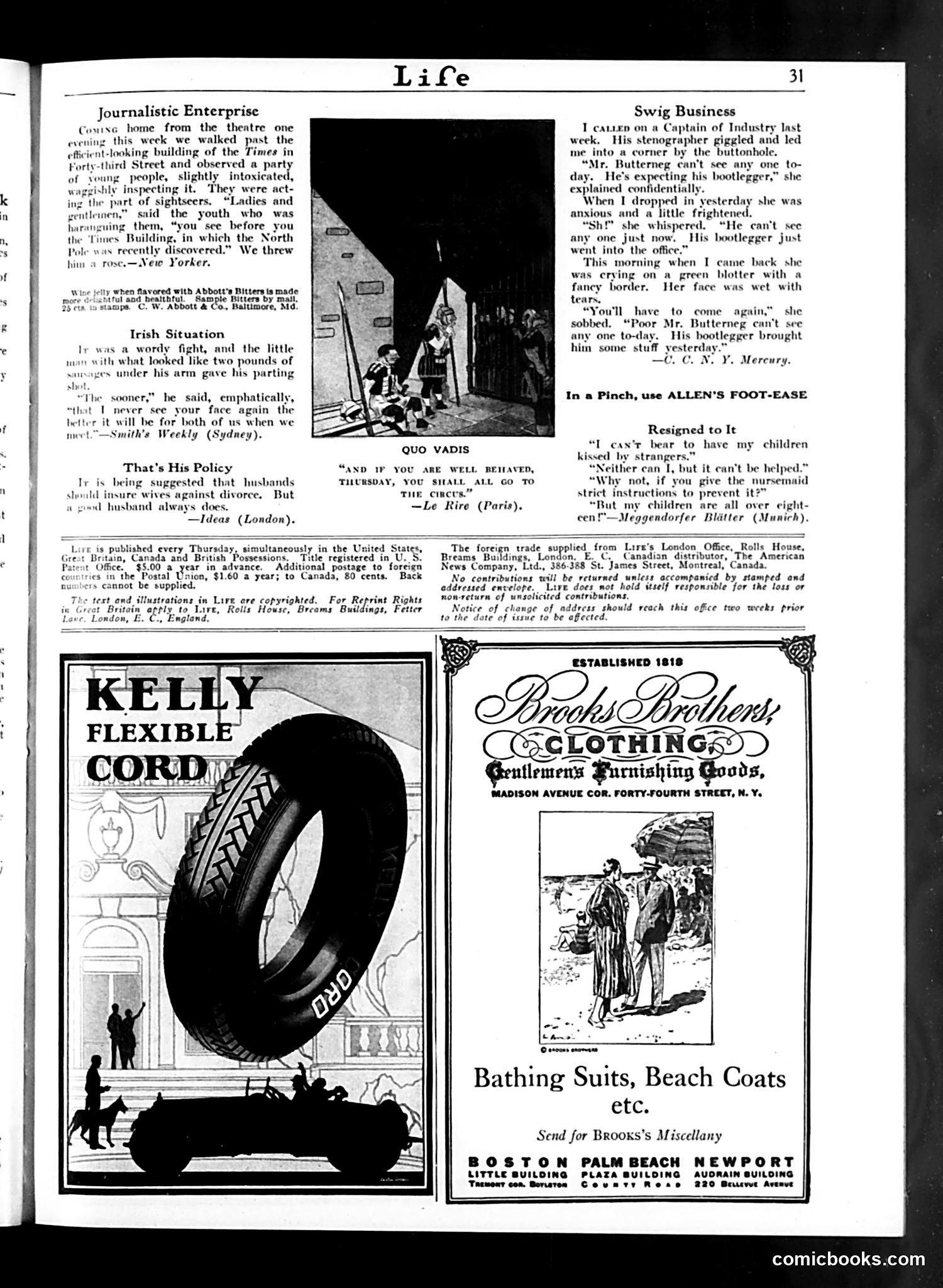
This page from Life magazine contains several satirical pieces reflecting 1920s American concerns: **"Journalistic Enterprise"**: Mocks the New York Times building, with drunk tourists pretending to be sightseers—satire on sensationalism and media spectacle. **"Irish Situation"**: A brief joke about Irish marital conflict, likely referencing contemporary tensions in Ireland during the independence period. **"Quo Vadis"** (the centered cartoon quote): References the famous novel/film, appearing to comment on moral behavior and consequences—the phrase "if you are well behaved Thursday, you shall all go to the circus" suggests satire on social control or promises. **"That's His Policy"**: Dark humor about divorce insurance for husbands—satirizing marriage instability among wealthy men. **"Swig Business"**: Satirizes Prohibition-era corruption, depicting a businessman ("Captain of Industry") whose schedule revolves around meeting his bootlegger rather than conducting business. The stenographer's distress reflects the absurdity of bootlegging's integration into respectable commerce. The page is primarily advertising-focused, with Kelly Flexible Cord and Brooks Brothers clothing ads.
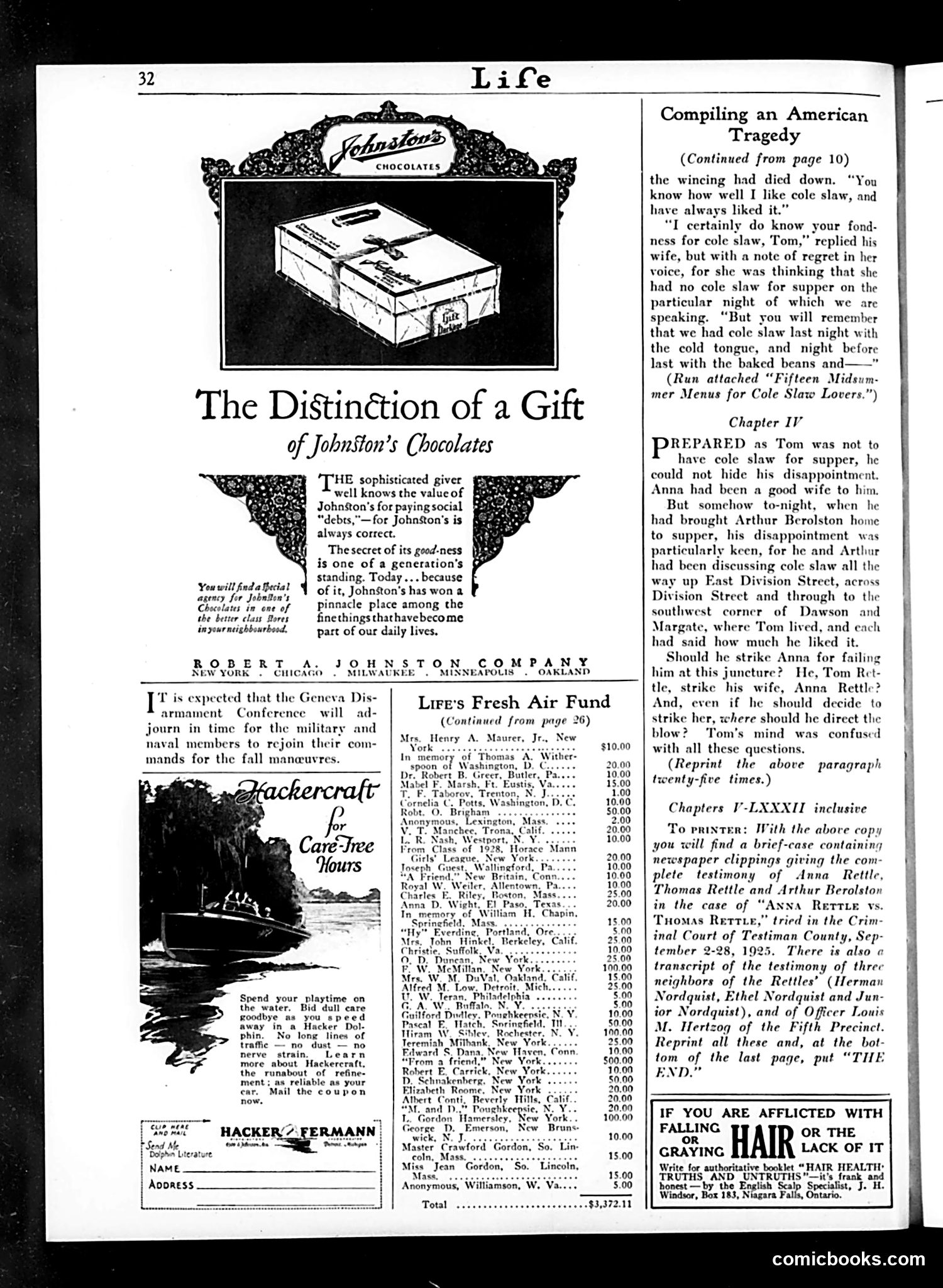
This page mixes advertisements with editorial content satirizing serious literature. The main satire targets Theodore Dreiser's *An American Tragedy* (1925), a dense naturalistic novel about murder and class struggle. Life's "Compiling an American Tragedy" mockingly reduces Dreiser's weighty narrative to absurdist domestic trivia: a husband named Tom is devastated because his wife Anna hasn't prepared cole slaw for supper—despite serving it the previous two nights. The satire copies Dreiser's overwrought psychological realism ("Tom's mind was confused with all these questions") applied to utterly trivial concerns. Instructions to "reprint the above paragraph twenty-five times" mock Dreiser's exhaustive, repetitive style. The surrounding ads (Johnston's Chocolates, Hackercraft boats, hair remedies) are period typical. A brief note mentions the Geneva Disarmament Conference. The joke: Life ridicules modernist literature's pretensions by applying its serious techniques to meaningless subject matter—suggesting Dreiser's acclaimed novel is equally overwrought about nothing important.
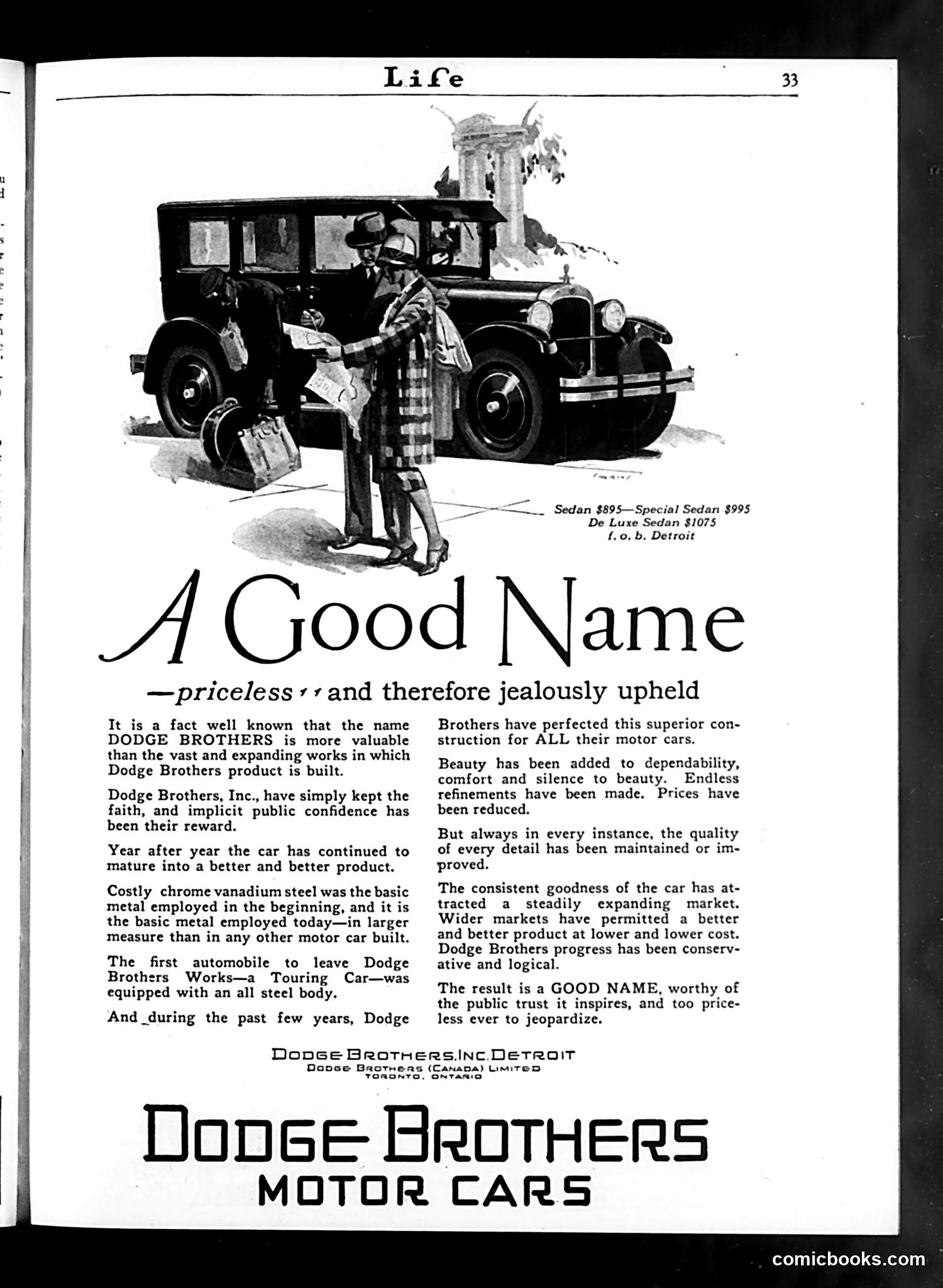
This is a **Dodge Brothers automobile advertisement**, not satire or political commentary. The page from *Life* magazine (page 33) is a straightforward product advertisement promoting Dodge motor cars. The illustration shows a well-dressed man with luggage standing before a Dodge sedan, with a ruined tower visible in the background—likely evoking European travel or tourism to suggest the car's reliability and quality for long-distance journeys. The advertisement's central argument is that "Dodge Brothers" as a brand name represents consistent quality and public trust. The text emphasizes: - Years of progressive improvement - Use of durable materials (chrome vanadium steel, all-steel bodies) - Maintained quality despite price reductions - Conservative, logical business practices There is **no satire present**. This is commercial advertising rhetoric typical of 1920s car marketing, emphasizing reliability, heritage, and value. The phrase "A Good Name—priceless and therefore jealously upheld" is the selling point: buy Dodge because the brand's reputation guarantees quality.
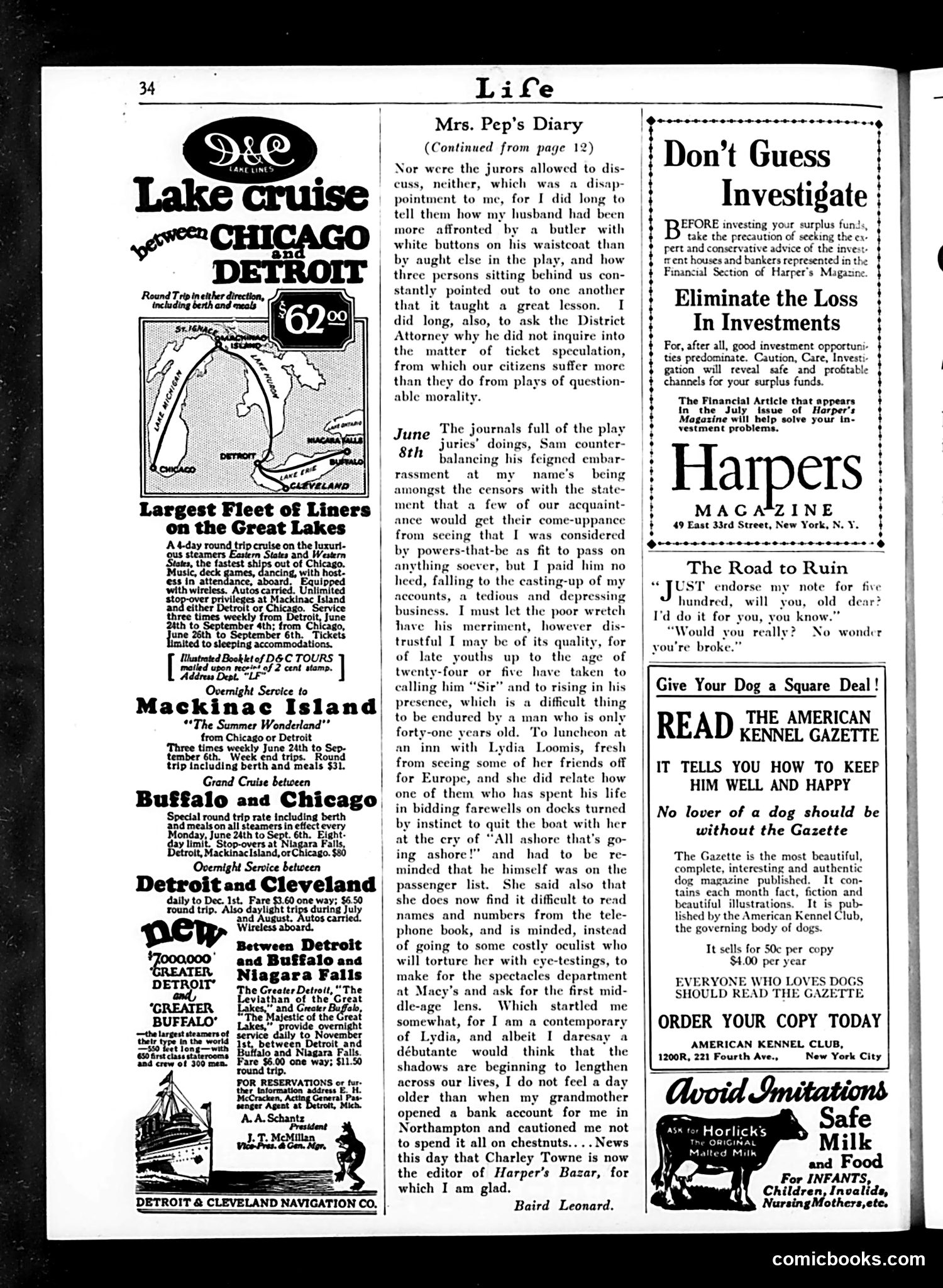
This page is primarily **advertisements and serialized social commentary**, not political cartoons. The left side features **steamship cruise ads** for Great Lakes travel between Chicago, Detroit, and Buffalo—leisure tourism marketing common in 1920s magazines. The center contains **"Mrs. Pep's Diary,"** a continuing satirical column about an upper-class woman's observations. Here she describes jury duty for an unspecified play trial, mocking her husband's concern about a butler's costume details over moral questions, and critiquing how jurors cannot discuss the case publicly. She also notes ticket speculation affects citizens more than "questionable morality" in theater—social commentary on class-based concerns. The diary entries are lightly satirical observations of contemporary manners: aging women struggling to read phone books, references to Macy's spectacles, and mentions of friends departing for Europe. The humor relies on recognizing everyday upper-class anxieties rather than explicit political messaging. The right side contains **advertisements** for investment advice, *Harper's Magazine*, dog care guides, and safe milk for infants—typical period consumer messaging.
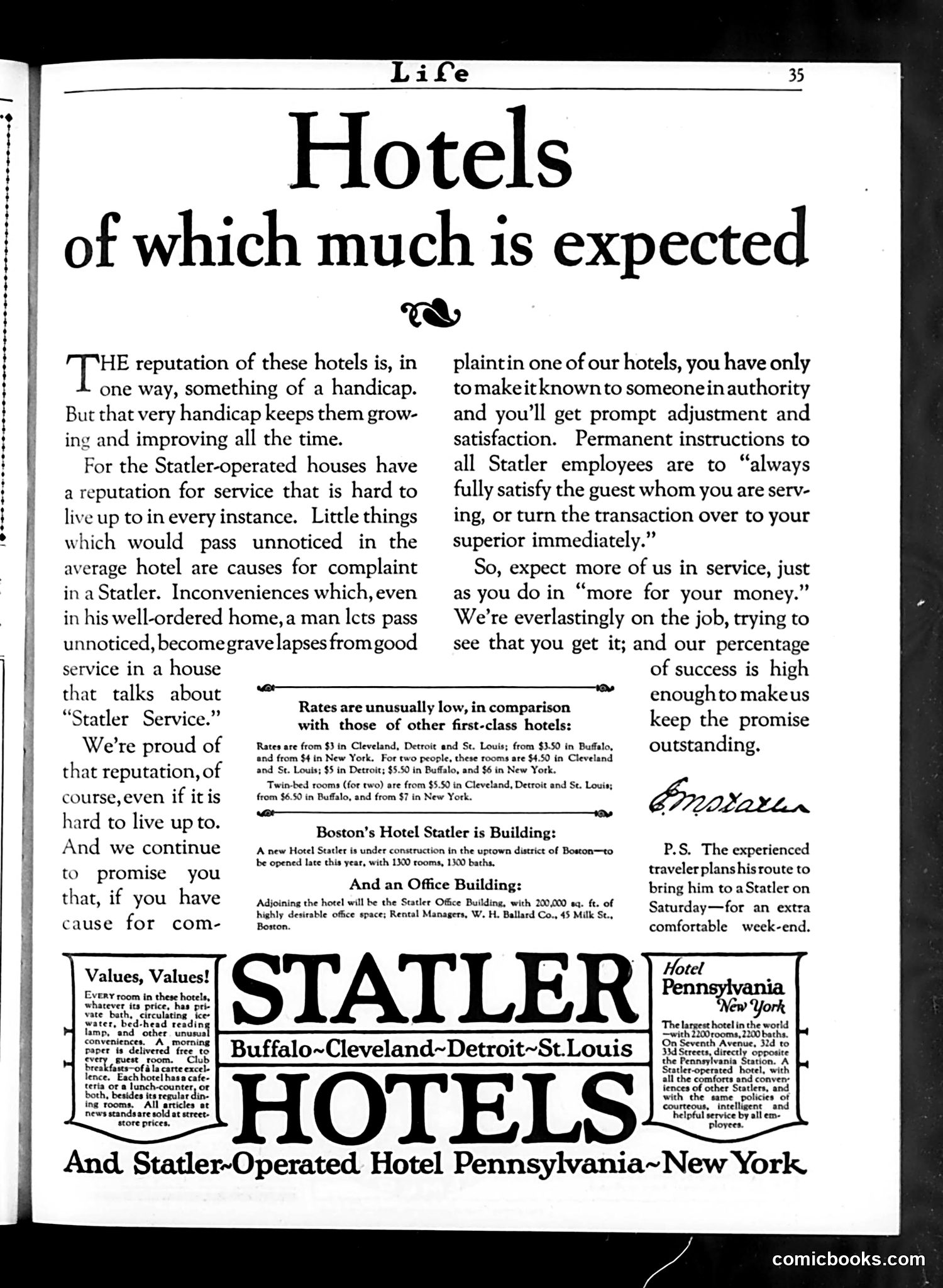
This is a **full-page advertisement**, not a political cartoon. It promotes Statler Hotels, a chain operating in Buffalo, Cleveland, Detroit, and St. Louis, with new locations planned in Boston and New York. The ad addresses a business challenge: Statler's *reputation* for excellent service creates high customer expectations that are difficult to consistently meet. The company acknowledges this "handicap"—minor service failures that would pass unnoticed elsewhere become complaints at a Statler because guests expect perfection. The copy positions this as a *strength*, arguing that the company's permanent instruction to "always fully satisfy the guest" drives continuous improvement. It's essentially marketing the pressure of their own reputation as evidence of quality. The ad emphasizes competitive pricing (rooms from $3-$7) and specific amenities (private baths, reading lamps), targeting business travelers planning weekend stays. This reflects early-20th-century hotel industry competition based on standardized service and value.
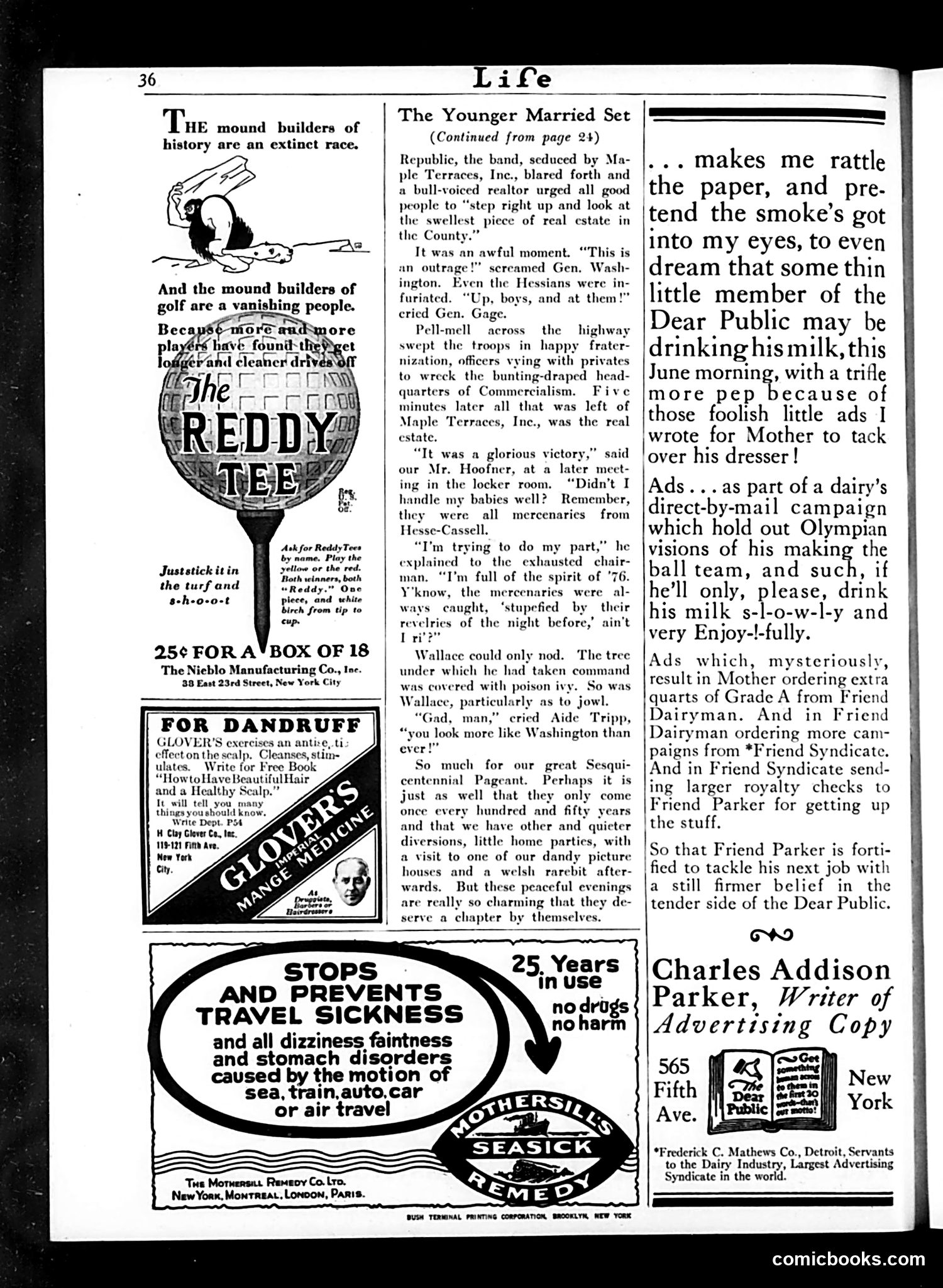
This page contains a satirical article by advertising copywriter Charles Addison Parker mocking his own profession. The piece is framed as a narrative about a Revolutionary War reenactment pageant disrupted by a real-estate company's commercial exploitation. The satire contrasts patriotic Revolutionary imagery—Washington, Hessians, the "spirit of '76"—with cynical commerce (Maple Terraces, Inc.). Parker then turns inward, confessing his complicity: he cynically writes milk advertisements targeting children and mothers, manipulating them through appeals about athletic prowess. He traces the chain of influence: his ads → mothers buy milk → dairies order more campaigns → Parker receives royalty checks, enriching him through manufactured desire. The satire targets both advertising's manipulation of consumers and the industry's hollow triumphalism about the "Dear Public." It's a self-aware critique of advertising as morally questionable persuasion serving commercial rather than human interests.
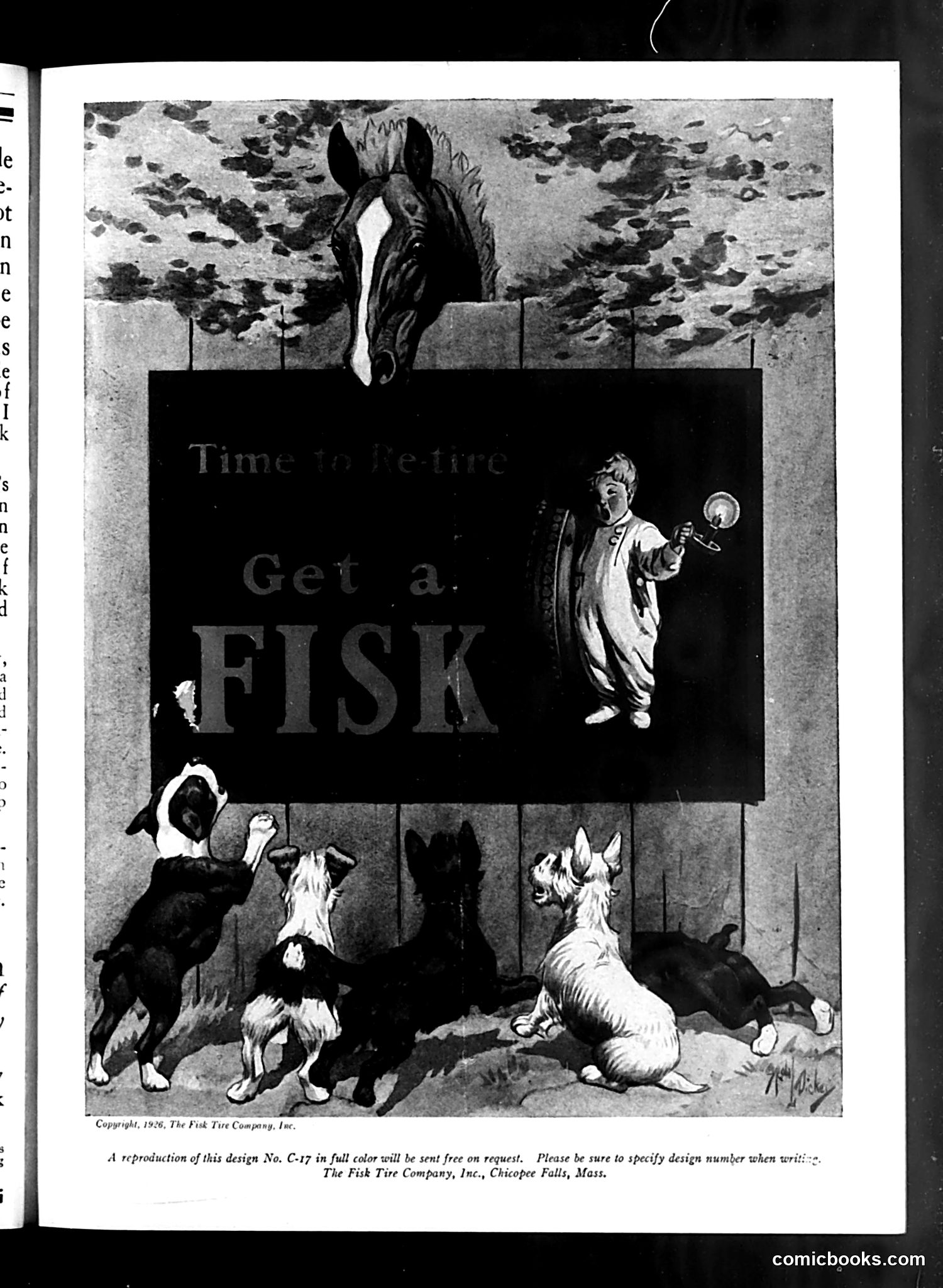
This is a **Fisk Tire Company advertisement** from 1926, not political satire. The image features the famous "Fisk Boy" mascot—a cherubic child in pajamas holding a tire—looking tired and yawning while holding up a clock showing bedtime. The advertisement's slogan reads "Time to retire / Get a Fisk" (a pun on "retire" meaning both going to bed and replacing worn tires). Below, several dogs look up at the boy and a horse peers over a fence, all watching this bedtime scene. The humor plays on the double meaning of "retire": it's a lighthearted pitch suggesting tired drivers (and their worn-out tires) should "retire" them and get Fisk replacements. The imagery of childhood bedtime creates an innocent, memorable marketing appeal typical of early 20th-century advertising.
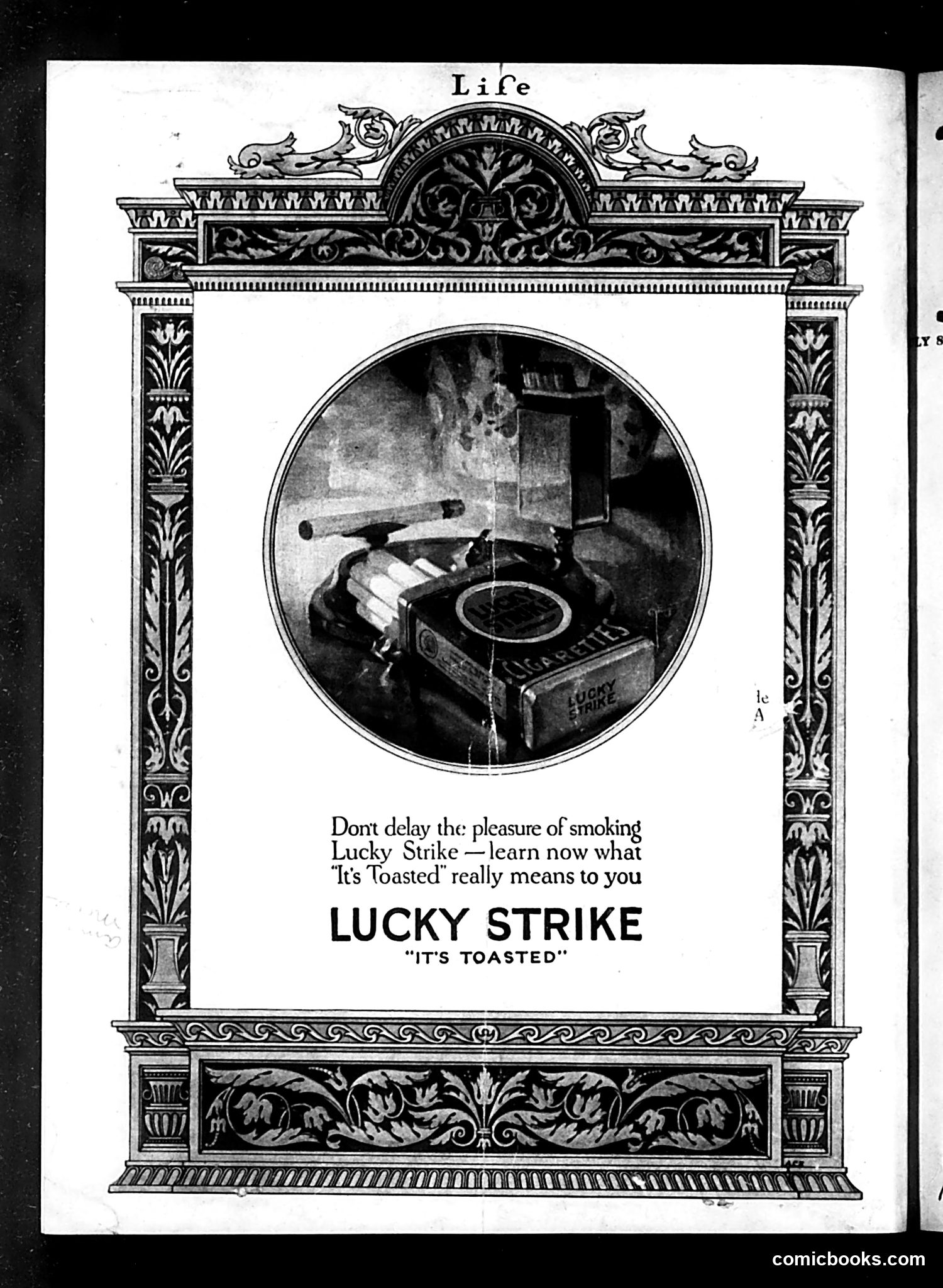
This is a Lucky Strike cigarette advertisement from Life magazine. Rather than satire or a political cartoon, it's a straightforward commercial advertisement encouraging readers to smoke Lucky Strikes and experience their "toasted" tobacco process. The image shows a telescope pointed at what appears to be a globe or celestial object, suggesting an aspirational, scientific approach to the product. The decorative neoclassical frame emphasizes sophistication and premium quality. The "It's Toasted" slogan was Lucky Strike's actual marketing claim, referring to their tobacco toasting process. The ad uses Life's upscale format to position smoking as an elegant pleasure worth pursuing immediately. By modern standards, this represents the era when cigarette advertising was legal and common in mainstream publications, before health warnings became mandatory.