
Life, 1926-07-01 · page 14 of 40
Life — July 1, 1926 — page 14: what you’re looking at
What you’re looking at
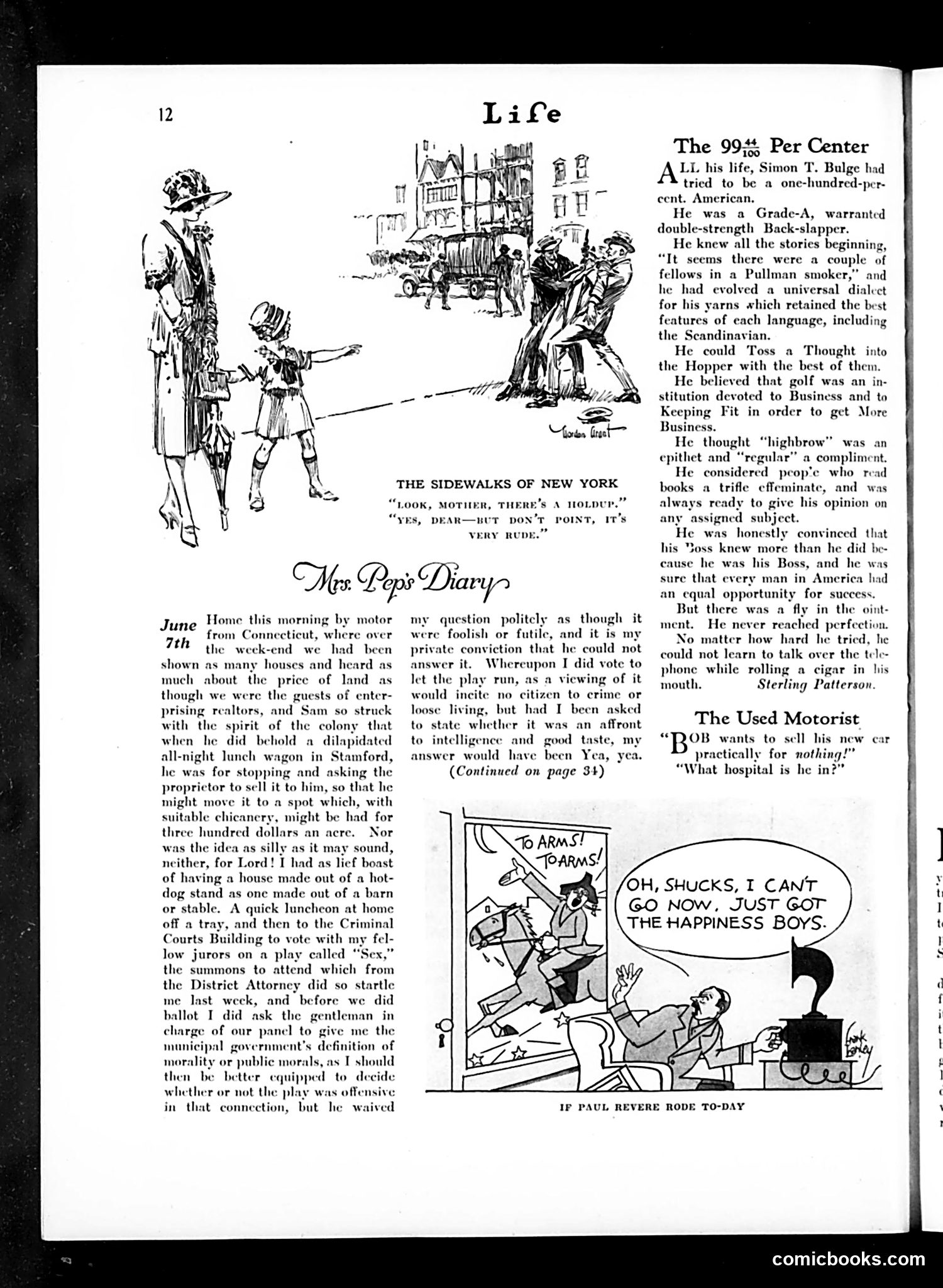
**"Mrs. Peps's Diary"** describes a Connecticut weekend visit where the narrator encounters nouveau-riche entertainers and disputes over land prices and morality—satirizing the clash between old-money sensibilities and nouveau-riche ostentation in 1920s suburban development. **"The Sidewalks of New York"** cartoon shows a well-dressed woman correcting a child's manners ("Look, mother, there's a holdup"/"Yes, dear—but don't point, it's very rude"), darkly joking that street crime in New York was so commonplace that it warranted polite social discretion rather than acknowledgment. **"The Used Motorist"** cartoon depicts someone injured by a car, asking about the vehicle's sale price rather than the driver's concern—satirizing American commercialism and indifference to human welfare.
📄 Transcribed text from this page (OCR, searchable)
Machine-transcribed from the original scan — historical spelling and the odd misread are preserved.
= rion Cast THE SIDEWALKS OF NEW YORK “LOOK, MOTHER, THE: ‘S.A HOLDUP.” “YES, DEAR—BUT DON’T POINT, IT's June Home this morning by motor from Connecticut, where over 7th the week-end we had been shown as many houses and heard as much about the price of land as though we were the guests of enter- prising realtors, and Sam so. struck with the spirit of the colony that when he did behold a dilapidated all-night lunch wagon in Stamford, he was for stopping and asking the proprictor to sell it to him, so that he might move it to a spot which, with suitable chicanery, might be had for acre. Nor \ y sound, neither, for Lord! I had as lief boast of having a house made out of a hot- dog stand as one made out of a barn or stable. A quick Juncheon at home off a tray, and then to the Criminal Courts Building to vote with my fel- low jurors on a play called “Sex,” the summons to attend which from the District Attorney did so startle me last week, and before we did ballot I did ask the gentleman in charge of our panel to give me the government's definition of morality or public morals, as I should then be better equipped to decide whether or not the play was offensive in that connection, but he waived VERY RUDE.” my question politcly as though it were foolish or futile, and it is my private conviction that he could not answer it. Whereupon I did vote to let the play run, as a viewing of it would ‘ite no citizen to crime or loose living, but had I been asked to state whether it was an affront to intelligence and good taste, my answer would have been Yea, yea. (Continued on page 3+) The 9944 Per Center ALE his life, Simon T. Bulge had tried to be a one-hundred-per- cent. American, He was a Grade-A, warranted double-strength Back-slappe He knew all the stories beginning, ns there were a couple of n a Pullman smoker,” ¢ he had evolved a universal dialect for his yarns which retained the best of each language, including the Scandinavian. He could Toss a Thought into the Hopper with the best of them. He believed that golf was an in- stitution devoted to Business and to Keeping Fit in order to get More Business. He thought “highbrow” was an epithet and “regular” a compliment. He considered peop’e who read books a trifle effeminate, and was always ready to give his opinion on any assigned subject. He was honestly convinced that his “oss knew more than he did be- cause he was his Boss, and he sure that every man in Ame an equal opportunity for suc But there was a fly in the oint- ment. He never reached perfectiv No matter how hard he tried, he could not learn to talk over the tele- phone while rolling a cigar in his mouth, Sterling Patterson. The Used Motorist “ROB wants to sell his new car practically for nothing!” “What hospital is he in?” ‘OH, SHUCKS, I CANT GO NOW, JUST GOT THE HAPPINESS BOYS. IF PAUL REVERE RODE TO-DAY comicbooks.com