
Life, 1926-07-01 · page 8 of 40
Life — July 1, 1926 — page 8: what you’re looking at
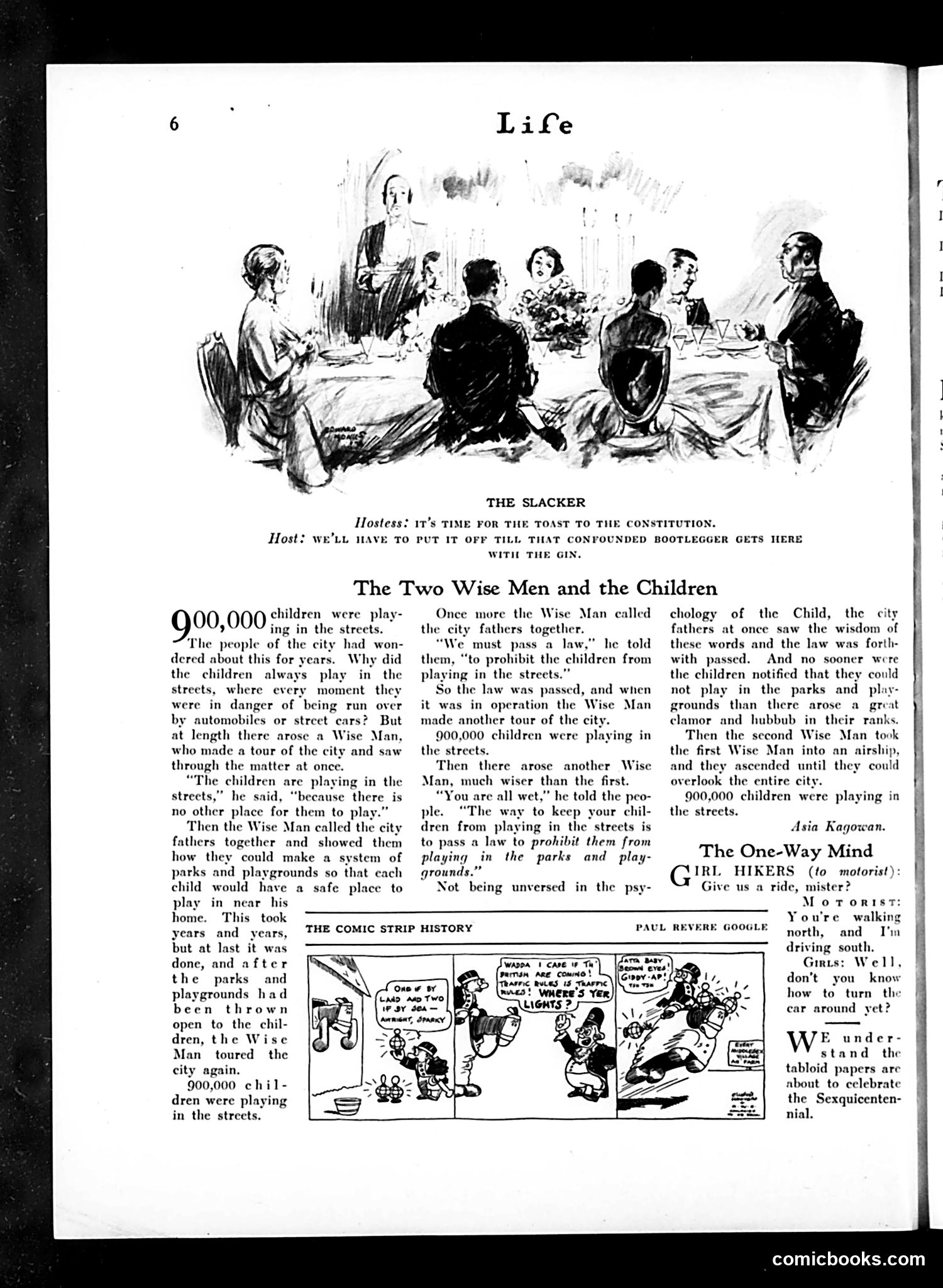
What you’re looking at
This page contains two satirical pieces about urban social issues: **"The Slacker"** (top cartoon): Shows a dinner party where the hostess proposes toasting the Constitution, but the host interrupts, suggesting they must wait until "that compounded bootlegger gets here with the gin." This references Prohibition-era hypocrisy—supposedly law-abiding citizens openly flouting liquor laws. **"The Two Wise Men and the Children"** (main story): Critiques how city officials addressed child street-play safety. Rather than creating safe play spaces, they passed laws *prohibiting* children from playing in streets and parks. The satire suggests the "wise men" chose prohibition over practical solutions—a characteristically bureaucratic response mocked as foolish. Both pieces satirize how authorities respond to social problems through restriction rather than constructive reform.
📄 Transcribed text from this page (OCR, searchable)
Machine-transcribed from the original scan — historical spelling and the odd misread are preserved.
THE SLACKER Hostess: 11's TIME FOR THE TOAST TO THE CONSTITUTION. Host? we’Lt Ave TO PUT IT OFF TILL THAT CONFOUNDED BOOTLEGGER GETS HERE WITH THE GIN. The Two Wise Men and the Children children were play- 00,000 pla ing in the streets. The people of the city had won- dered about this for years. Why did the children always play in the streets, where every moment they were in danger of being run over by automobiles or street cars? But at length there arose a Wise Man, who made a tour of the city and saw through the matter at once. “The children are playing in the streets,” he said, “because there is no other place for them to play.” Then the Wise Man called the city fathers together and showed them how they could make a system of parks and playgrounds so that each child would have a safe place to play in near his home. This took years and years, but at last it was Once more the Wise Man called the city fathers together. “We must pass a law,” he told them, “to prohibit the children from playing in the streets.” So the law was passed, and when it was in operation the Wise Man made another tour of the city. 900,000 children were playing in the streets. Then there arose another Wise Man, much wiser than the first. “You are all wet,” he told the peo- ple. “The way to keep your chil- dren from playing in the streets is to pass a law to prohibit them from playing in the parks and play- grounds.” Not being unversed in the psy- THE COMIC STRIP HISTORY chology of the Child, the city fathers at once saw the wisdom of these words and the law was forth- with passed. And no sooner were the children notified that they could not play in the parks and_ play- grounds than there arose a_ great clamor and hubbub in their ranks. Then the second Wise Man took the first Wise Man into an airship, and they ascended until they could overlook the entire city. 900,000 children were playing in the streets. Asia Kagowan. The One-Way Mind IRL HIKERS (to motorist): Give us a ride, mister? MoT ortst: You're walking north, and = I'm driving south. done, and after the parks and playgrounds had been thrown open to the chil- dren, the Wise Man toured the city again. 900,000 chil- dren were playing in the streets. Gints: Well, don’t you know how to turn the car around yet? E under- stand the tabloid papers are about to celebrate the Sexquicenten- nial. comicbooks.com