
Life, 1926-07-01 · page 23 of 40
Life — July 1, 1926 — page 23: what you’re looking at
What you’re looking at
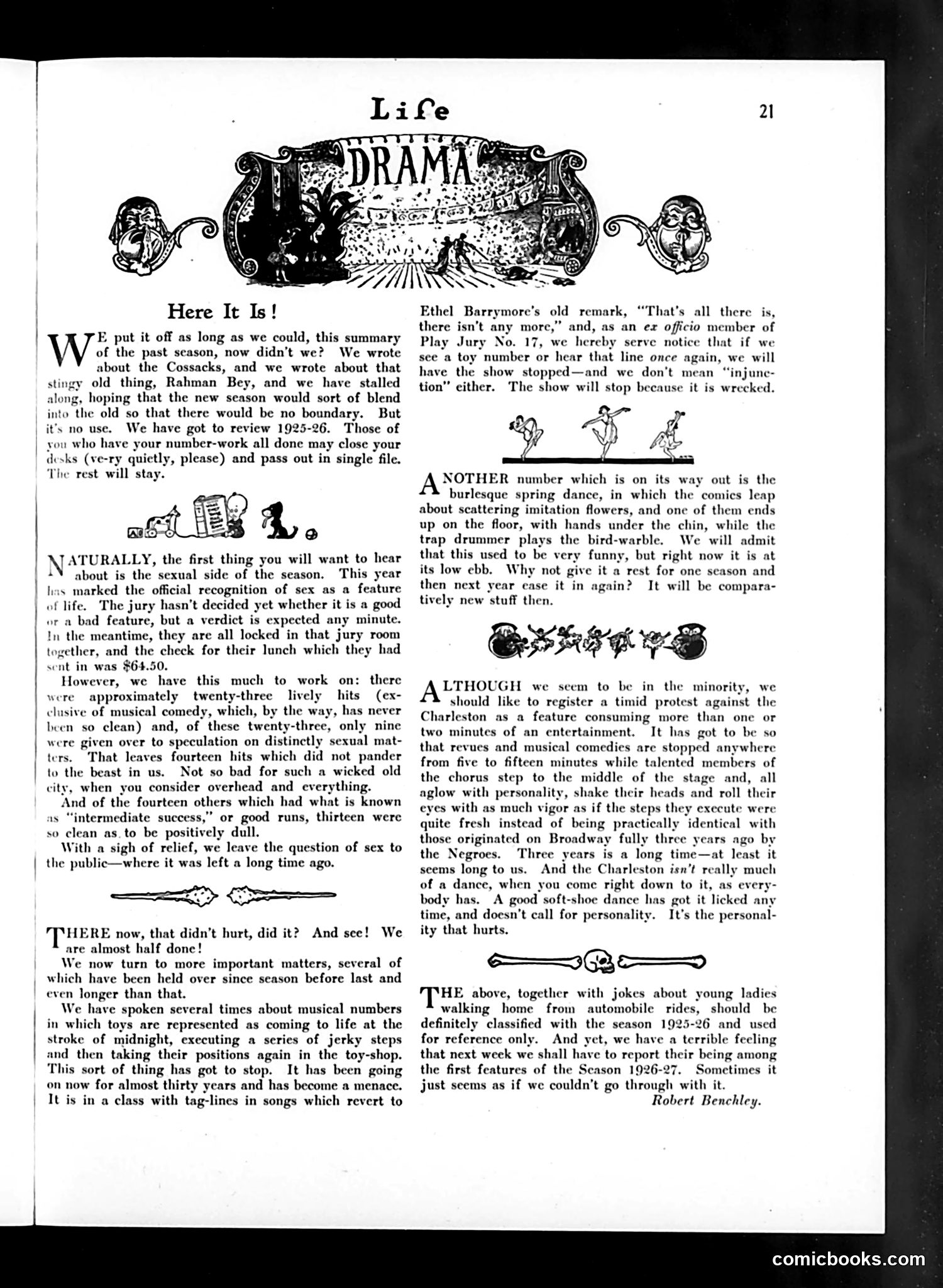
This is a theater review essay by Robert Benchley assessing Broadway's 1925-26 season. The page contains no political cartoons—it's satirical prose commentary on theatrical trends. Benchley humorously critiques three overused theatrical conventions: 1. **Toy numbers**: Musical sequences where performers pantomime toy movements at midnight—a thirty-year-old cliché he demands stop immediately. 2. **Burlesque spring dances**: Comic routines with scattered imitation flowers and exaggerated drummer sound effects, now "at its low ebb." 3. **The Charleston**: The wildly popular 1920s dance, now ubiquitous in revues. Benchley protests its overuse, noting it originated "on Broadway fully three years ago by the Negroes" but audiences see identical performances constantly. The opening discusses the season's treatment of sex as a theatrical subject—nine of twenty-three hits engaged with sexual themes, which Benchley presents as mildly scandalous but ultimately acceptable.
📄 Transcribed text from this page (OCR, searchable)
Machine-transcribed from the original scan — historical spelling and the odd misread are preserved.
Here It Is! E put it off as long as we could, this summary \ V of the past season, now didn’t we? We wrote about the Cossacks, and we wrote about that stingy old thing, Rahman Bey, and we have stalled along, hoping that the new season would sort of blend into the old so that there would be no boundary. But it’s no use. We have got to review 1925-26. Those of | you who have your number-work all done may close your desks (ve-ry quietly, please) and pass out in single file. The rest will stay. J ATURALLY, the first thing you will want to hear about is the sexual side of the season. This year lias marked the official recognition of sex as a feature of life. The jury hasn't decided yet whether it is a good or a bad feature, but a verdict is expected any minute. In the meantime, they are all locked in that jury room together, and the check for their lunch which they had sent in was $64.50. However, we have this much to work on: there approximately twenty-three lively hits (ex- were | clusive of musical comedy, which, by the way, has never been so clean) and, of these twenty-three, only nine were given over to speculation on distinctly sexual mat- ters. That leaves fourteen hits which did not pander to the beast in us. Not so bad for such a wicked old city, when you consider overhead and everything. And of the fourteen others which had what is known as “intermediate succe: or good runs, thirteen were so clean as. to be po: ly dull. With a sigh of relief, we leave the question of sex to the public—where it was left a long time ago. "THERE now, that didn’t hurt, did it? are almost half donc! We now turn to more important matters, several of which have been held over since season before last and even longer than that. We have spoken several times about musical numbers in which toys are represented as coming to life at the stroke of midnight, executing a series of jerky steps and then taking their positions again in the toy-shop. This sort of thing has got to stop. It has been going on now for almost thirty years and has become a menace. It is in a class with tag-lines in songs which revert to And see! We 21 Ethel Barrymore's old remark, “That's all there is, there isn’t any more,” and, as an ex officio member of Play Jury No. 17, we hereby serve notice that if we see a toy number or hear that line once again, we will have the show stopped—and we don’t n “injune- tion” either. The show will stop because it is wrecked. NOTHER number which is on its way out is the burlesque spring dance, in which the comics leap about scattering imitation flowers, and one of them ends up on the floor, with hands under the chin, while the trap drummer plays the bird-warble. We will admit that this used to be very funny, but right now it is at its low ebb. Why not give it a rest for one season and then next year ease it in again? It will be compara- tively new stuff then. GPEIGC EG LTHOUGH we seem to be in the minority, we should like to register a timid protest against the Charleston as a feature consuming more than one or two minutes of an entertainment. It has got to be so that revues and musical comedies are stopped anywhere from five to fifteen minutes while talented members of the chorus step to the middle of the stage and, all aglow with personality, shake their heads and roll their eyes with as much vigor as if the steps they execute were quite fresh instead of being practically identical with those originated on Broadway fully three years ago by the Negroes. Three years is a long time—at least it seems long to us. And the Charleston isn’t really much of a dance, when you come right down to it, as every- body has. A good soft-shoe dance has got it licked any time, and doesn’t call for personality. It’s the personal- ity that hurts. — 303 HE above, together with jokes about young ladies walking home from automobile rides, should be definitely classified with the season 1 6 and used for reference only. And yet, we have a terrible feeling that next week we shall have to report their being among the first features of the Season 19% Sometimes it just seems as if we couldn’t go through with it. Robert Benchley. comicbooks.com