
Life, 1926-07-01 · page 30 of 40
Life — July 1, 1926 — page 30: what you’re looking at
What you’re looking at
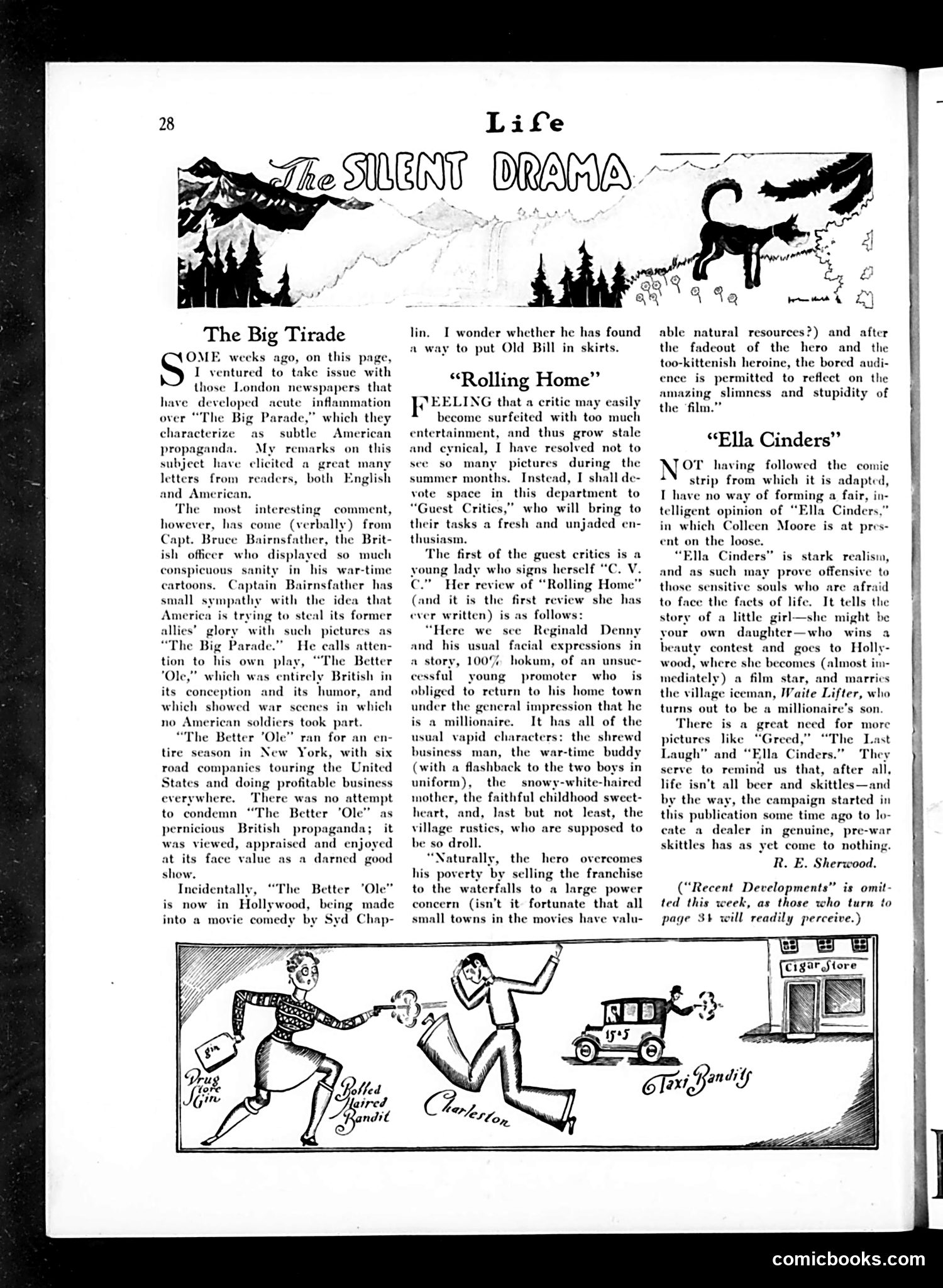
This page discusses early 1920s film criticism and transatlantic cinema tensions. The main article defends American war film "The Big Parade" against British accusations of propaganda. Captain Bruce Bairnsfather (a famous British WWI cartoonist) points out the hypocrisy: his own British war play "The Better 'Ole" was commercially successful in America without accusation of propaganda. The "Guest Critics" section introduces amateur film reviews. A young female critic ("C.V.C.") harshly pans "Rolling Home" (starring Reginald Denny), mocking its hackneyed plot about a fake millionaire. Another review discusses "Ella Cinders," praising it as "stark realism" that honestly depicts a small-town girl's rise to stardom and marriage—comparing it favorably to serious films like "Greed." The bottom cartoon satirizes silent-film stock characters: the "Vamp," "Old Retired Spanish," "Clarkton" (possibly), and "Taxi Bandit." The satire targets formulaic 1920s cinema and the pretentiousness of film criticism.
📄 Transcribed text from this page (OCR, searchable)
Machine-transcribed from the original scan — historical spelling and the odd misread are preserved.
The Big Tirade OME weeks ago, on this page, S I ventured to take issue with those London newspapers that have developed acute inflammation over “The Big Parade,” which they characterize as subtle American propaganda. My remarks on this subject have clicited a great many letters from readers, both English and American. The most interesting comment, however, has come (verbally) from Capt. Bruce Bairnsfather, the Brit- ish officer who displayed so much conspicuous sanity in cartoons, small sy his war-time Captain Bairnsfather has ypathy with the idea that is trying to steal its former lory ‘with such pictures as he Big Parade.” He calls atten- tion to his own play, “The Better “Ole,” which was entirely British in its conception and its humor, and which showed war scenes in which no American soldiers took part. fhe Better ’Ole” ran for an en- New York, with six road companies touring the United States and doing profitable bus everywhere, There was no attempt to condemn “The Better ‘Ole’ as pernicious British propaganda; it was viewed, apy d and enjoyed at its face value as a darned good show. Incidentally, “The Better ‘Ole” is now in Hollywood, being made into a movie comedy by Syd Chap- tire season in s Life ec EN D DRAMA. ~ rae 2 sad a I wonder whether he has found to put Old Bill in skirts. lin. a way “Rolling Home” K EELING that a critic may easily become surfeited with too much entertainment, and thus grow stale and cynical, I have resolved not to many pictures during the Instead, I shall de- vote space in this department to “Guest Critics,” who will bring to their tasks a fresh and unjaded en- thusiasm. The first of the guest critics is a young lady who signs herself “C. V. C.” Her review of “Rolling Home” (and it is the first review she has ever written) is as follows: “Here we Reginald Denny and his usual facial expressions in a story, 100% hokum, of an unsuc- cessful young promoter who is obliged to return to his home town under the general impression that he is a millionaire. It has all of the usual vapid characters: the shrewd business man, the war-time buddy (with a flashback to the two boys in uniform), the snowy-white-haired mother, the faithful childhood sweet- heart, and, last but not least, the village rustics, who are supposed to be so droll. “Naturally, the hero overcomes his poverty by selling the franchise to the waterfalls to a large power concern (isn’t it fortunate that all small towns in the movies have valu- see so summer months. in see Q) able natural resources?) and after the fadeout of the hero and the too-kittenish heroine, the bored audi- ence is permitted to reflect on the amazing slimness and stupidity of the “film.” “Ella Cinders” OT having followed the comic strip from which it is adapted, I have no way of forming a fair, ir telligent opinion of “Ella Cinders in which Colleen Moore is at pres- ent on the loo: “Ella Cinders” is stark realisia, and as such may prove offensive to those sensitive souls who are afraid to face the facts of life. It tells the story of a little girl—she might be your own daughter—who w a uty contest and goes to Holly- wood, where she becomes (almost im- mediately) a film star, and marries the village iceman, Waite er, who turns out to be a millionaire’s son. There is a great need for more pictures like “Greed,” “The Last Laugh” and “Ella Cinders.” They serve to remind us that, after all, life isn’t all beer and skittles—and the campaign started in publication some time ago to lo- a dealer in genuine, pre-war tles has as yet come to nothing. R. E. Sherwood. a by the w thi (“Recent Developments” is omit- ted this week, as those who turn to page 3% will readily perceive.) comicbooks.com 5