
Life, 1926-07-01 · page 12 of 40
Life — July 1, 1926 — page 12: what you’re looking at
What you’re looking at
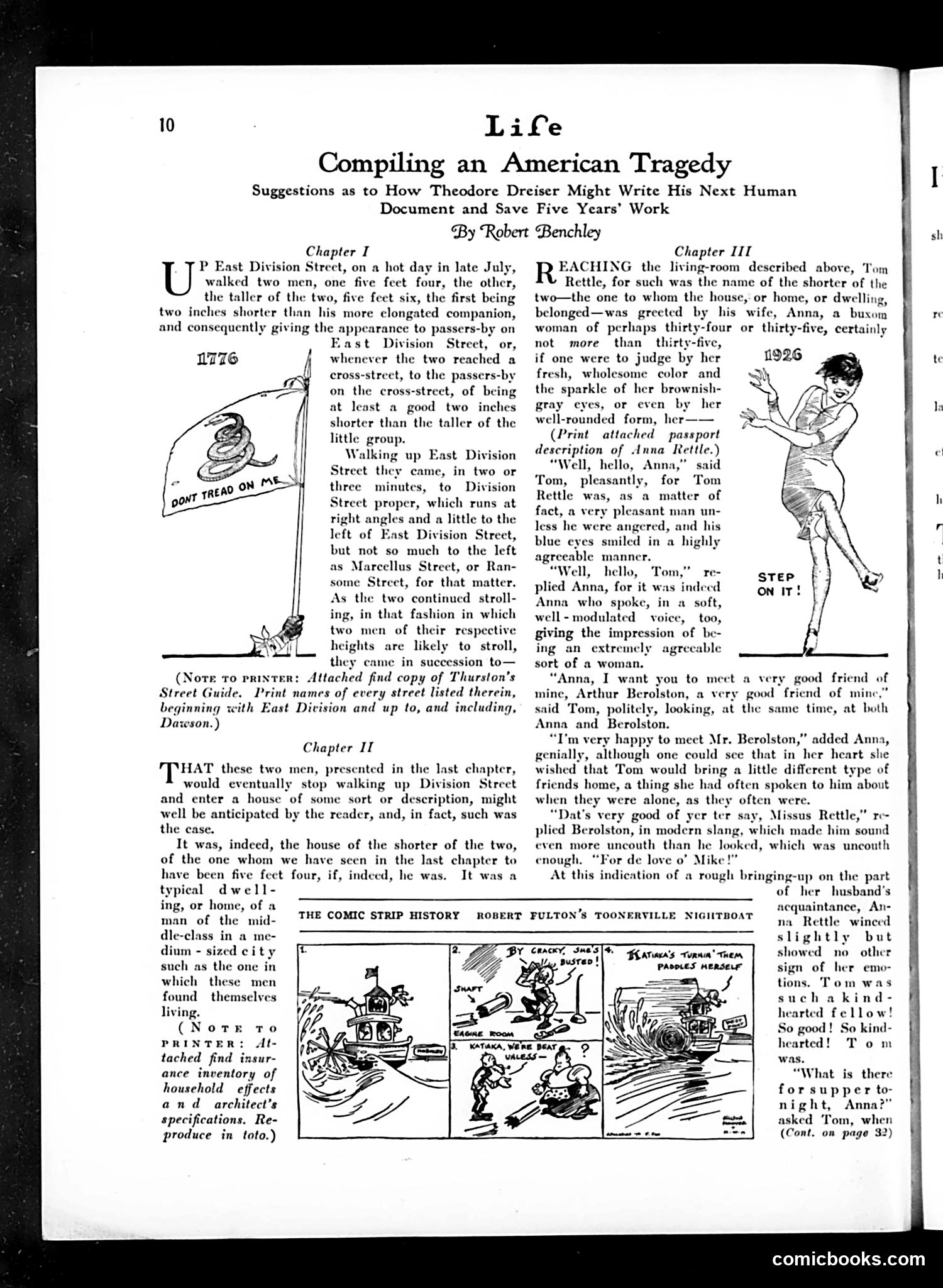
This page presents a serialized short story titled "Compiling an American Tragedy" by Robert Benchley, subtitled as suggestions for how Theodore Dreiser might write his next novel while saving five years' work. The narrative describes two men of different heights walking on East Division Street in 1776, establishing a fictional premise. Chapter III introduces Tom Rettle and his wife Anna in their home. The embedded comic strip at bottom, credited to Robert Fulton's "Toonerville Nightboat," appears unrelated to the main story—it's a separate humorous feature common in Life magazine's format. The page mixes literary satire with visual humor, typical of Life's early-to-mid 20th century approach of blending fiction, commentary, and comics for sophisticated urban readers.
📄 Transcribed text from this page (OCR, searchable)
Machine-transcribed from the original scan — historical spelling and the odd misread are preserved.
Life Compiling an American Tragedy Suggestions as to How Theodore Dreiser Might Write His Next Human Document and Save Five Years’ Work By Robert Benchley Chapter I P East Division Street, on a hot day in late July, [ walked two men, one five feet four, the other, the taller of the two, five feet six, the first being two inches shorter than his more elongated companion, and consequently giving the appearance to passers-by on East Division Street, or, 1776 whenever the two reached a cross-street, to the passers-by on the cross-street, of being at least a good two inches shorter than the taller of the little group. Walking up East Division Street they came, in two or three minutes, to Division Street proper, which runs at right angles and a little to the left of East Division Street, but not so much to the left as Marcellus Street, or Ran- some Street, for that matter. As the two continued stroll- pl ing, in that fashion in which cl two men of their respective heights are likely to stroll, they came in succession to— (Norte ro printer: Attached find copy of Thurston’s Street Guide. Print names of every street listed therein, beginning with East Division and up to, and including, Dawson.) Chapter II HAT these two men, presented in the last chapter, would eventually stop walking up Division Street and enter a house of some sort or description, might well be anticipated by the reader, and, in fact, such was the cas It was, indeed, the house of the shorter of the two, of the one whom we have seen in the last chapter to have been five feet four, if, indeed, he was. It was a typical dwell- ing, or home, of a man of the mid- dle-class in a me- dium - sized city such as the one in which these men found themselves living. (NotreE to PRINTER: At- tached find insur- ance inventory of household effects and _ architect’s specifications. Re- produce in toto.) THE COMIC STRIP HISTORY ROBERT FULTON’S TOONERVILLE NIGHTBOAT BY Ceacny, Ines] *, Chapter IIT REACHING the living-room described above, Tom Rettle, for such was the name of the shorter of the two—the one to whom the house, or home, or dwelling, belonged—was greeted by his wife, Anna, a buxom woman of perhaps thirty-four or thirty-five, certainly not more than thirty 5 ‘ if one were to judge by her fresh, wholesome color and the sparkle of her brownish- gray eyes, or even by her well-rounded form, her—— (Print attached passport description of Anna Rettle.) “Well, hello, Anna,” said Tom, pleasantly, for Tom Rettle was, as a matter of fact, a very pleasant man un- less he were angered, and his blue eyes smiled in a nly agreeable manner. “Well, hello, Tom,” re- plied Anna, for it was indeed Anna who spoke, in a soft, well- modulated voice, too, giving the impression of be- ing an extremely agrecable sort of a woman, “Anna, I want you to meet a very good friend mine, Arthur Berolston, a very good friend of minc said Tom, politely, looking, at the same time, at both Anna and Berolston. “I'm very happy to mect Mr. Berolston,” added Anna, genially, although one could sce that in her heart she wished that Tom would bring a little different type of friends home, a thing she had often spoken to him about when they were alone, as they often were. “Dat's very good of yer ter say, Missus Rettle,” re- plied Berolston, in modern slang, which made him sound even more uncouth than he looked, which was uncouth enough. “For de love o’ Mike!" At this indication of a rough bringing-up on the part of her husband's acquaintance, An- na Rettle winced slightly but showed no other sign of her emo- tions. Tom was such a kind- hearted fellow! So good! So kind- hearted! To m was. “What is there forsupper to- night, Anna?” asked Tom, when (Cont. on page 32) Fh atiaca’s Turnin' them ' Leyla PADOLES HERSELF comicbooks.com