
A complete issue · 36 pages · 1925
Life — October 1, 1925
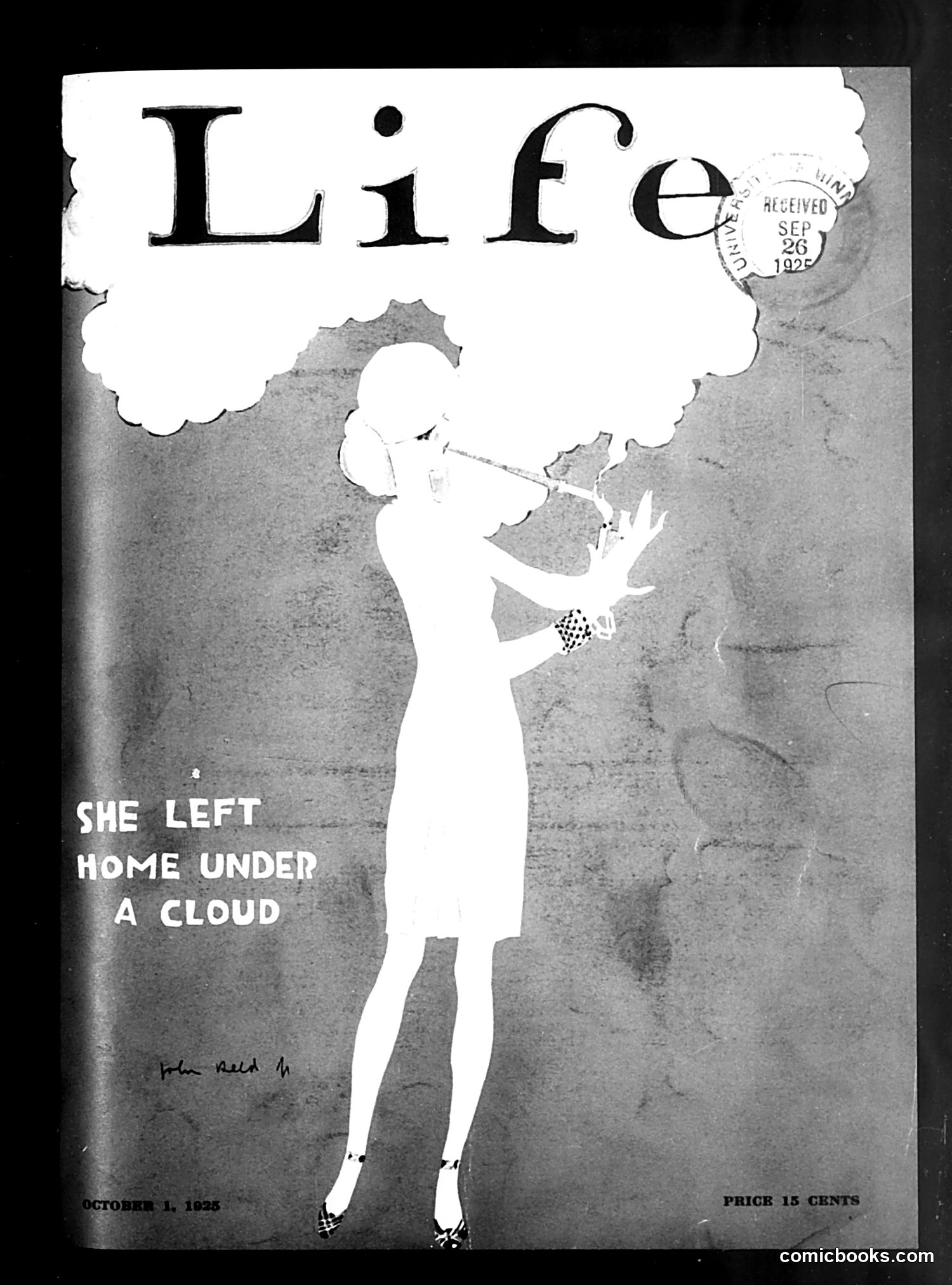
This cover satirizes a woman who has left her home "under a cloud"—meaning she's departed under scandalous or disgraceful circumstances. The illustration shows a stylishly dressed woman smoking a cigarette, depicted in the Art Deco style popular in the 1920s. The image likely comments on the social anxieties of the Jazz Age regarding women's changing behavior and independence. The woman's fashionable appearance, smoking, and apparent elopement or departure without family approval reflects contemporary concerns about "modern women" defying traditional domestic roles and parental authority. The title is a double entendre: both a literal cloud in the background and the figurative phrase meaning scandalous departure. This was typical satire for Life magazine's commentary on 1920s social upheaval.
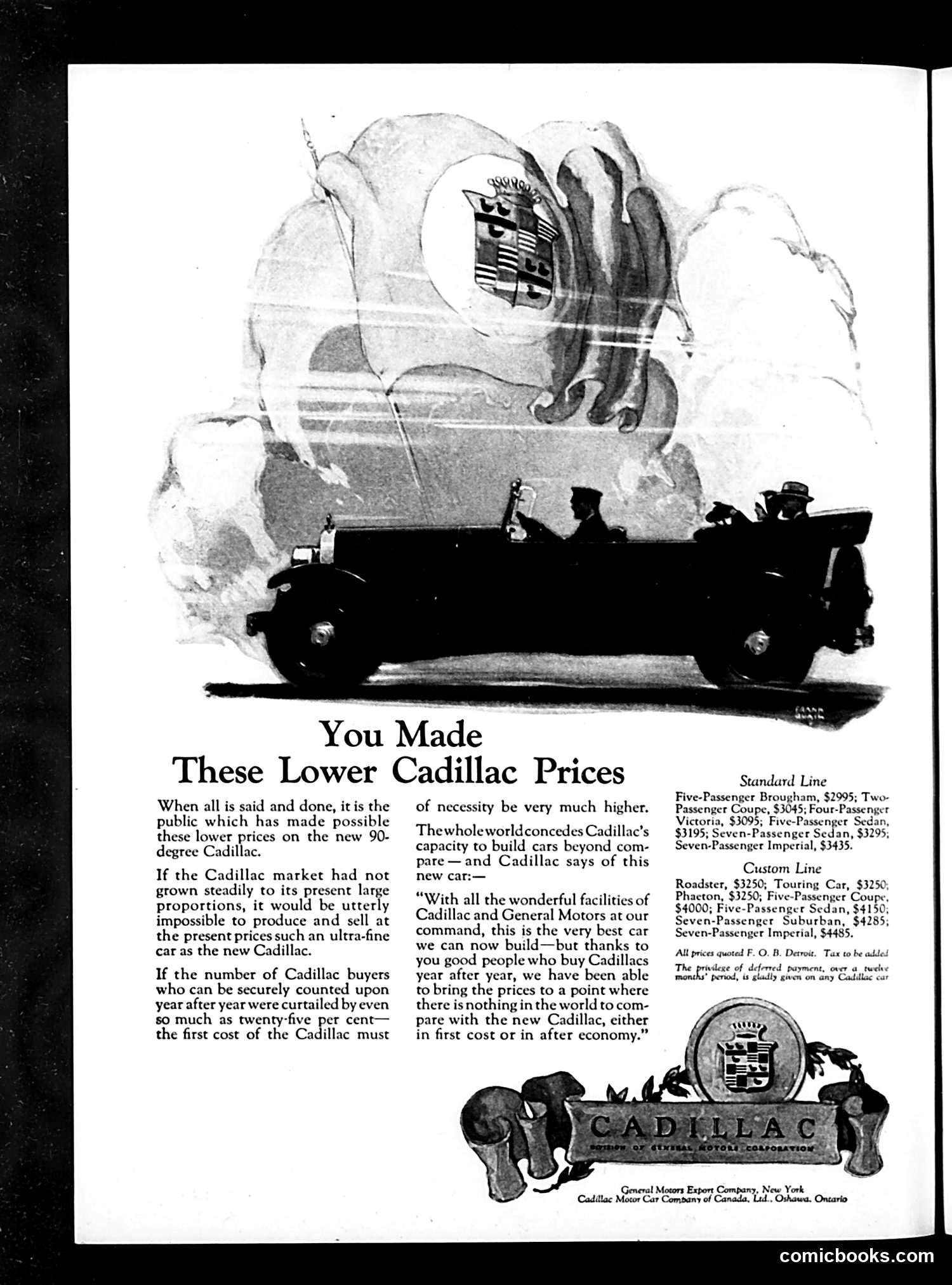
This is primarily a **Cadillac automobile advertisement**, not political satire. However, it uses ironic framing typical of 1920s advertising. The headline "You Made These Lower Cadillac Prices" credits consumers for the price reductions through their purchasing loyalty. The accompanying illustration shows a large luxury car floating above a working-class open touring car, visually contrasting Cadillac's premium positioning with claims of affordability. The text quotes a Cadillac executive attributing lower prices to consumer demand and General Motors' manufacturing capacity—a self-congratulatory message common in corporate advertising of the era. The satire (if intended) appears subtle: the irony that "the public" receives credit for corporate pricing decisions. For modern readers, this reflects early twentieth-century marketing strategies emphasizing consumer agency while serving corporate interests.
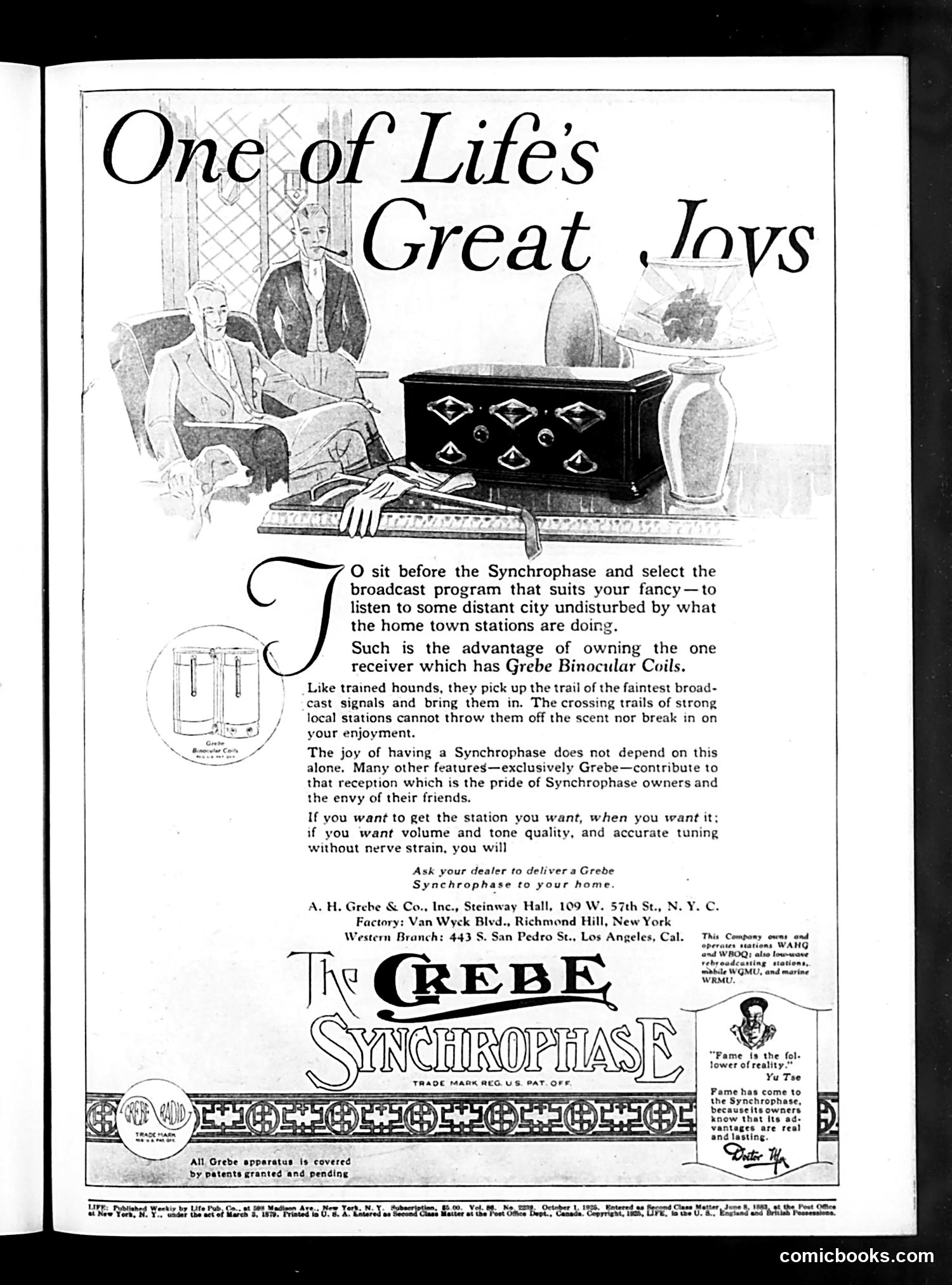
This is primarily a **product advertisement**, not political satire. It promotes the Grebe Synchrophase radio receiver, manufactured by A. H. Grebe & Co., Inc. in New York. The ad's appeal centers on **selective listening**: the illustration shows well-dressed people enjoying radio broadcasts from distant cities while avoiding local station interference. The "Grebe Binocular Coils" metaphor compares radio tuning to binoculars—precisely targeting chosen signals while filtering out unwanted ones. The text emphasizes luxury and control: listeners can hear "some distant city undisturbed." This reflects 1920s radio's novelty and appeal to affluent consumers who valued both entertainment access and social status. The closing tagline, "Fame is the follower of reality," suggests the product's reliability and quality. No political figures or satire appear present.
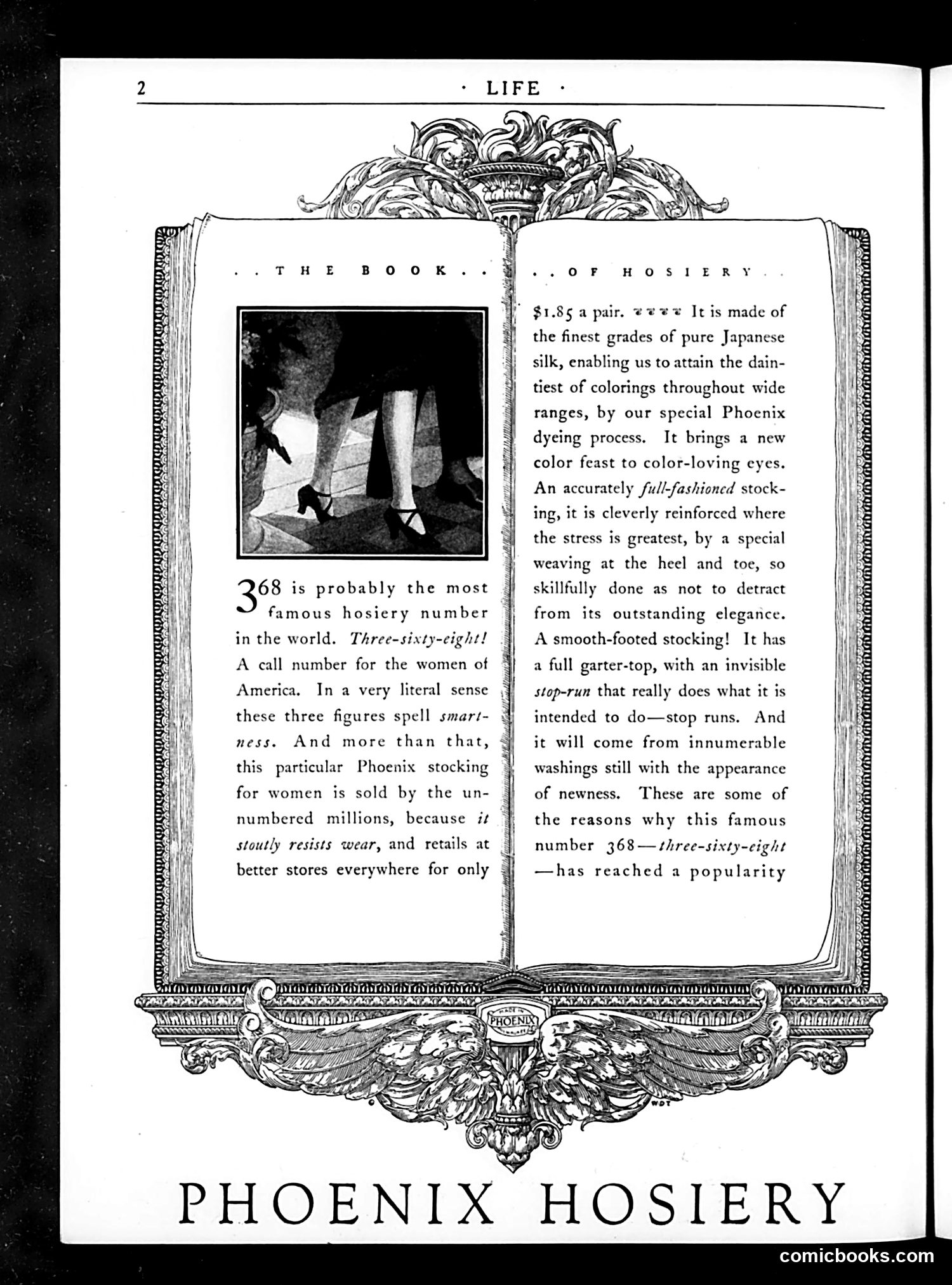
This page is **not satirical or political**—it's a straightforward advertisement for Phoenix Hosiery, specifically their "368" stocking model for women. The content emphasizes product features: the stockings are made from fine Japanese silk, feature special dyeing for rich colors, and include reinforced heels and toes with an invisible "stop-run" feature to prevent runs (a common hosiery problem of the era). The text highlights durability and elegance as selling points. The photograph shows a woman's leg displaying the hosiery. The ornate decorative border and typography reflect typical 1920s advertising design conventions found in *Life* magazine's commercial pages. This is pure advertising—no cartoon, satire, or political commentary is present.
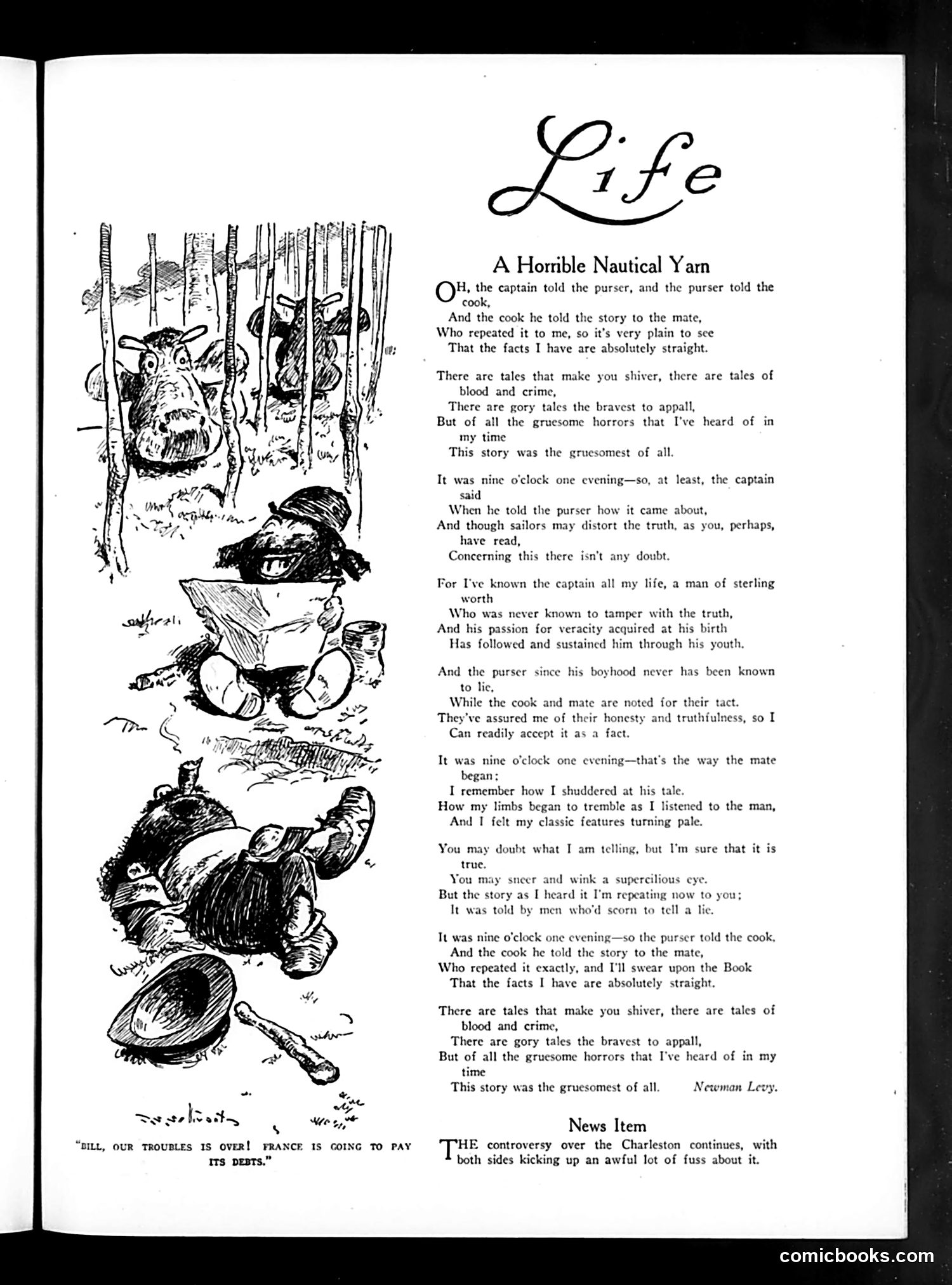
This page features "A Horrible Nautical Yarn" by Newman Levy, a humorous poem about sailors telling increasingly dramatic stories. The accompanying illustrations show sailors in exaggerated poses—one appears seasick or distressed, others in contorted positions—satirizing the tendency of sailors to embellish tales. The caption quote ("Bill, our troubles is over! France is going to pay its debts") provides political satire, likely referencing post-WWI French war debt negotiations with the United States. The joke suggests this is as unlikely as sailors telling truthful stories—implying both French debt repayment and honest sailor tales are absurdly improbable. The poem itself mocks the chain of storytelling among ship crew members, where truth becomes increasingly distorted through retelling.
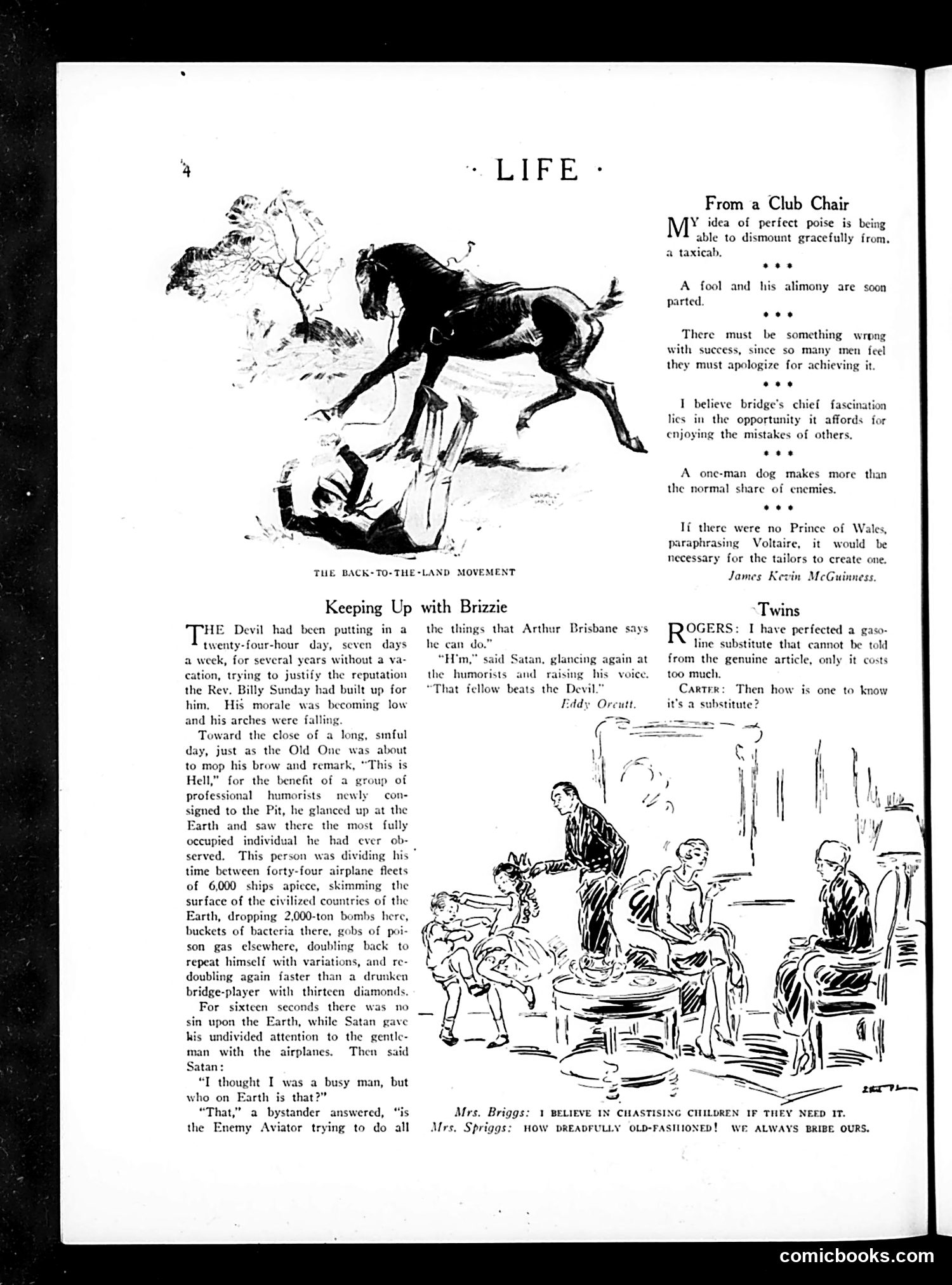
This page contains satirical commentary and humor typical of *Life* magazine's style. **"From a Club Chair"** presents cynical aphorisms about society—observations on success, failure, bridge, and dogs—attributed to various sources including James Kevin McGuinness. **"Keeping Up with Brizzie"** is a narrative story about "the Devil" (likely a personified character representing mischief or temptation) testing Rev. Billy Sunday, a famous American evangelist known for prohibitionist crusades. The humor derives from Sunday's moral righteousness being tested by increasingly absurd scenarios. **"Twins"** is a domestic comedy cartoon showing a conversation about gasoline substitutes. The joke centers on middle-class anxieties about product authenticity and cost—a woman claims her substitute is indistinguishable, but her companion questions whether one can truly know if it's genuine, satirizing consumer skepticism and wartime or economic shortages affecting product availability.
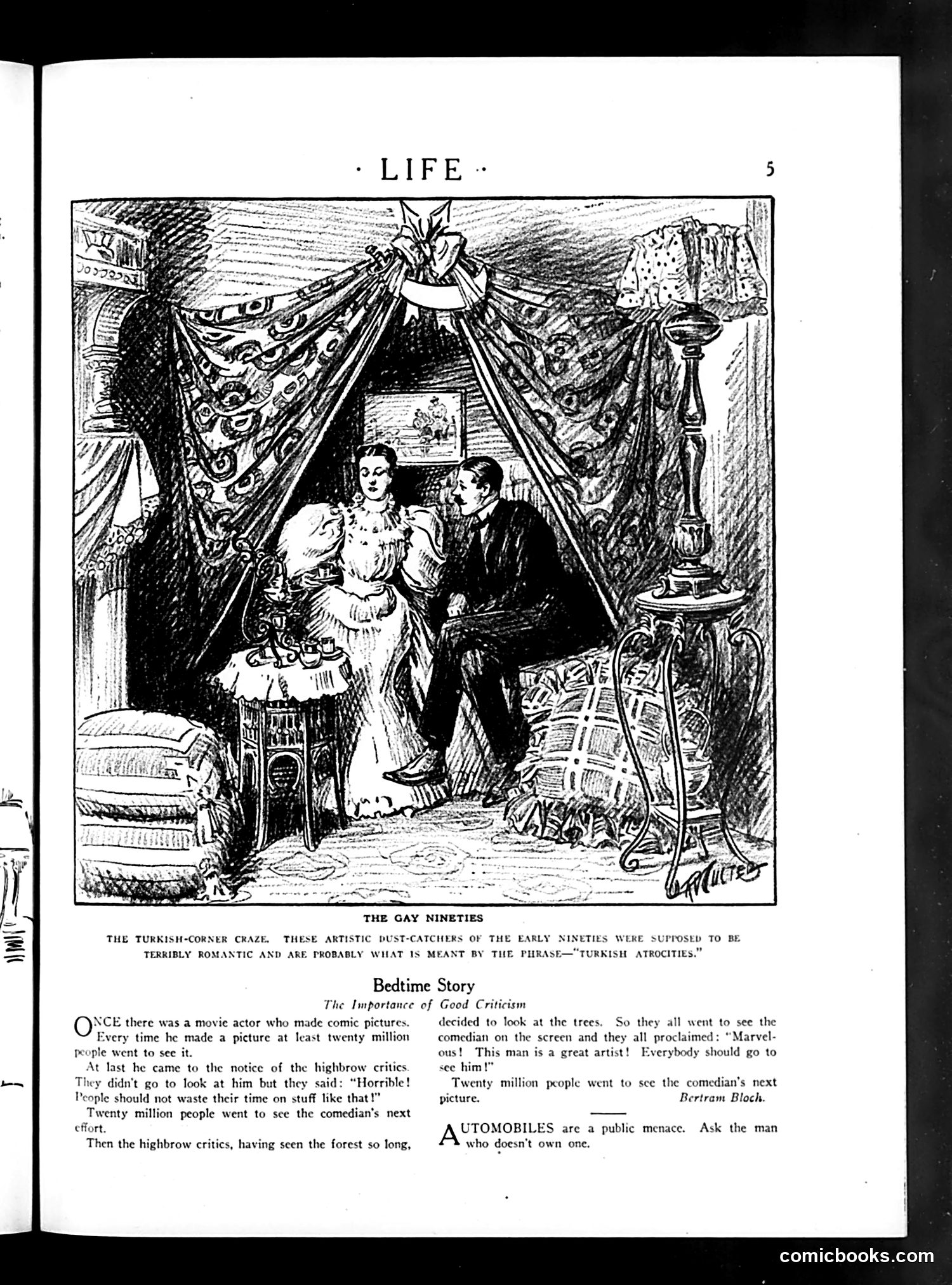
The main illustration, titled "The Gay Nineties: The Turkish-Corner Craze," depicts an ornately draped bedroom scene with a couple. The caption explains this represents "dust-catchers of the early nineties" that were "supposed to be terribly romantic" and exemplified "Turkish atrocities"—satirizing the 1890s fad for elaborate, heavily draped "Turkish corner" home décor that accumulated dust while claiming exotic romantic appeal. Below, "Bedtime Story" mocks a movie comedian whose films drew massive audiences. Critics ignored him until he achieved success, then demanded he pursue "serious" art. The joke: twenty million people will see his next picture regardless of critical approval. The final item about automobiles suggests car ownership was becoming a status symbol.
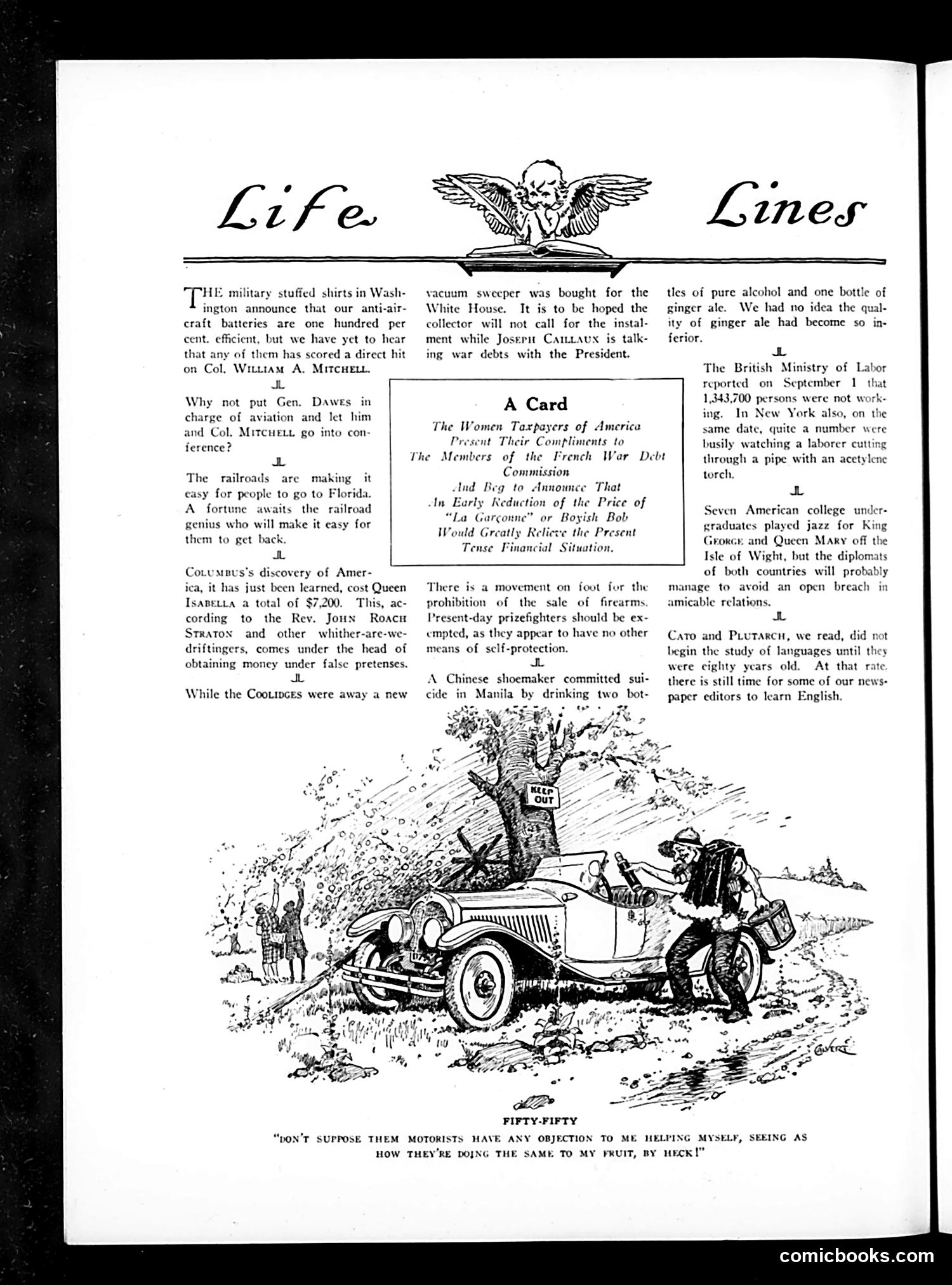
This page contains several brief satirical news items and a cartoon titled "Fifty-Fifty." The main cartoon depicts a motorist whose car has collided with a large tree or plant, causing debris to fly everywhere. The motorist addresses two pedestrians, claiming they have "no objection" to him "helping" himself to their fruit by hitting it with his vehicle—suggesting he's destroying their property while pretending to assist them. The satire targets reckless drivers who cause damage and then justify their negligence through absurd logic. The surrounding "Life Lines" section comments on contemporary issues: military aircraft efficiency, railroads, Columbus's discovery cost, and firearm prohibition. The tone is characteristic of 1920s American satirical journalism.
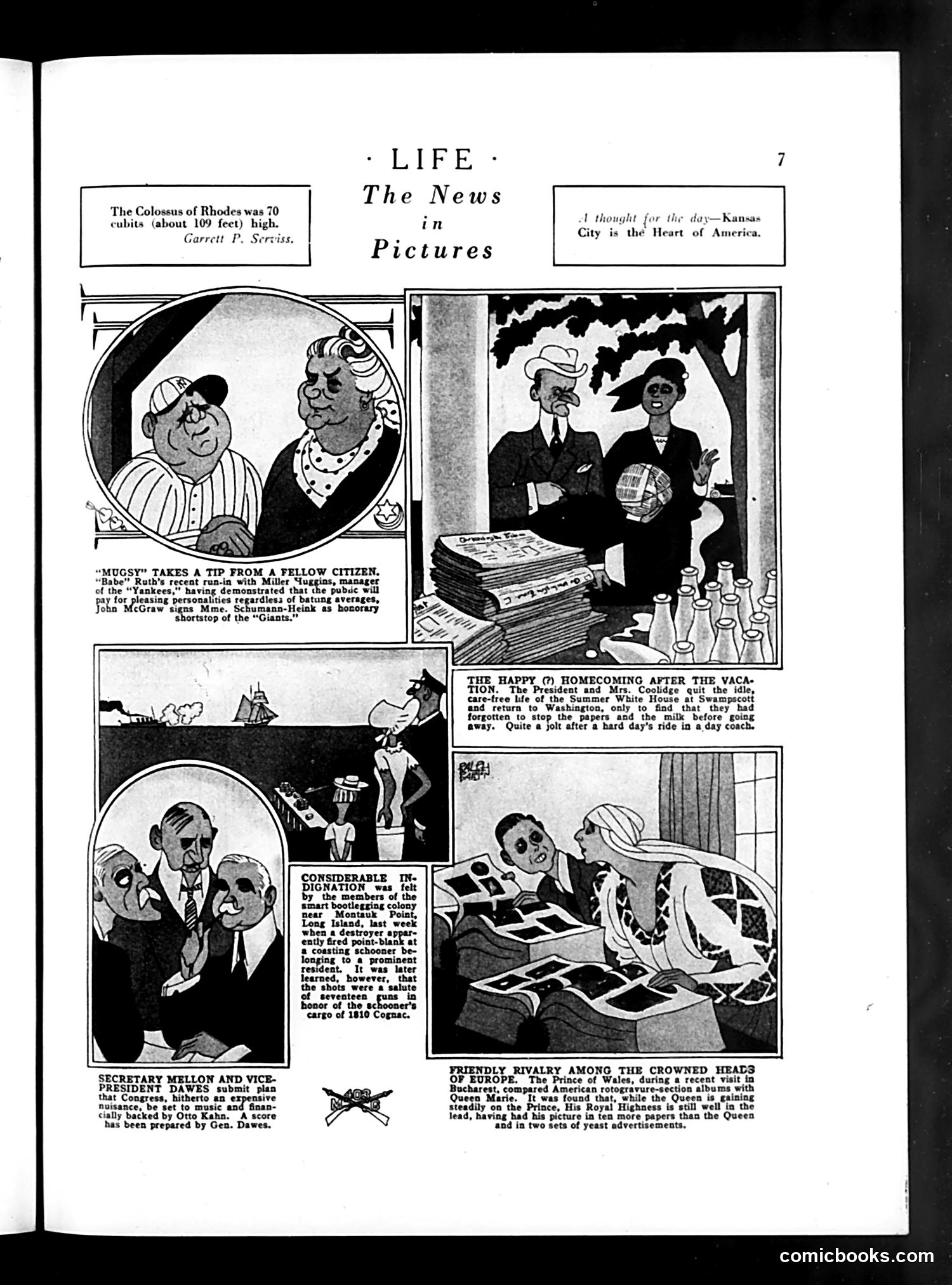
This page features four political cartoons satirizing 1920s American politics and society: 1. **"Mugsy Takes a Tip"**: A caricatured baseball figure receives advice, likely referencing baseball's popularity and gambling scandals of the era. 2. **"Secretary Mellon and Vice-President Dawes"**: Depicts two government officials submitting a financial plan to Congress, satirizing their roles in fiscal policy during the Coolidge administration. 3. **"Considerable Indignation"**: References a colonial fort incident involving a destroyer and prominent resident, appearing to mock military mishaps or diplomatic tensions. 4. **"Friendly Rivalry Among Crowned Heads"**: Shows the Prince of Wales visiting and gaining favor with Queen Marie, satirizing European royal politics and social dynamics. The page uses exaggerated facial features typical of period caricature to mock political figures and current events.
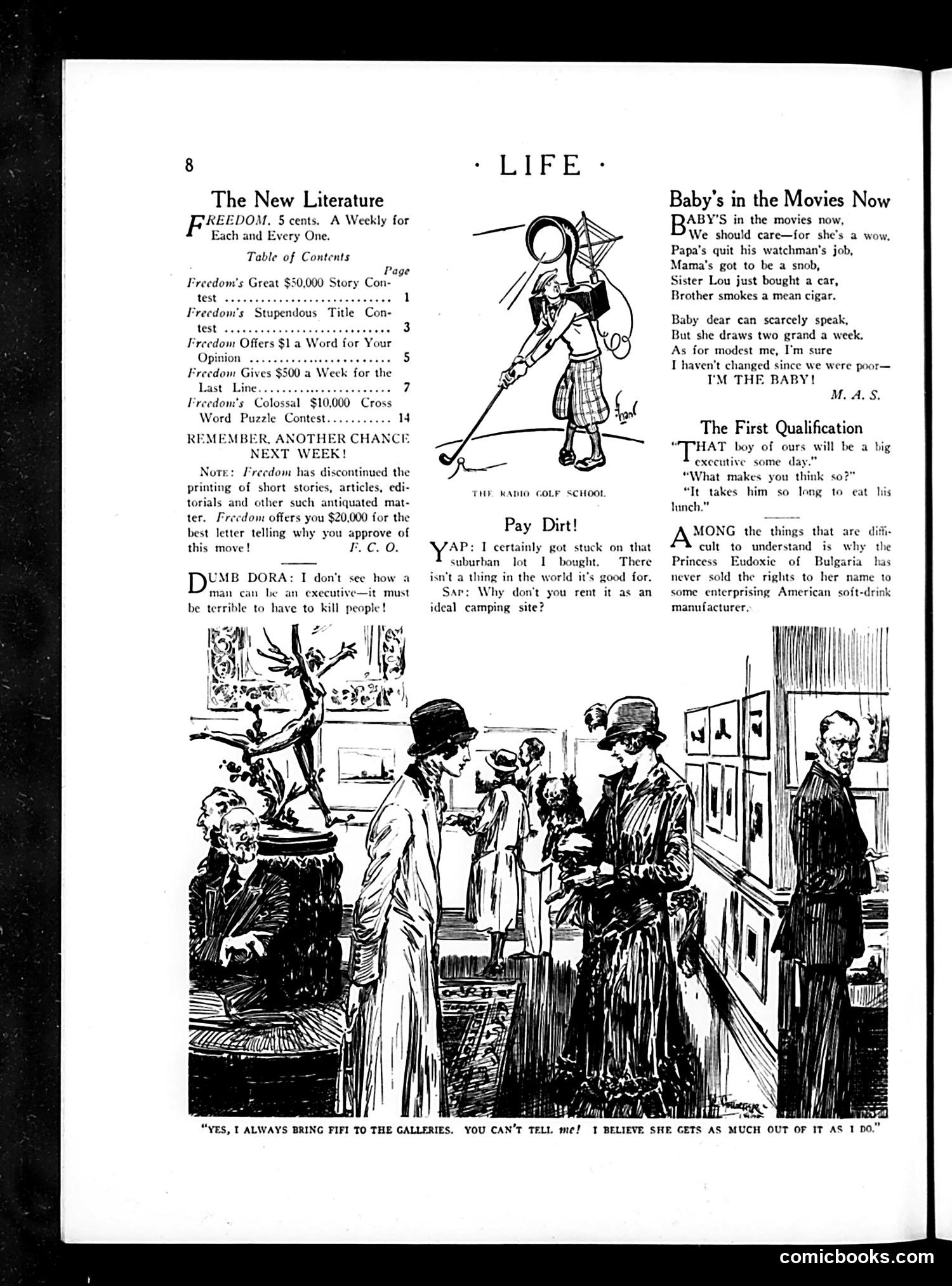
This page contains satirical content and social commentary typical of early 20th-century Life magazine. **The bottom cartoon** depicts well-dressed people at an art gallery. A woman tells her companion: "Yes, I always bring Fifi to the galleries. You can't tell me! I believe she gets as much out of it as I do." The satire mocks wealthy individuals who bring their small dogs to cultural venues, suggesting both the pretentiousness of gallery-goers and the absurdity of assuming pets appreciate fine art equally to humans. **"Baby's in the Movies Now"** is a humorous poem about an infant earning substantial income ($2 weekly) in cinema, while family members take various jobs to support this arrangement. It satirizes both child labor in early film and the economic pressures of working-class families. **Other sections** include literary competitions and advice columns typical of the magazine's format.
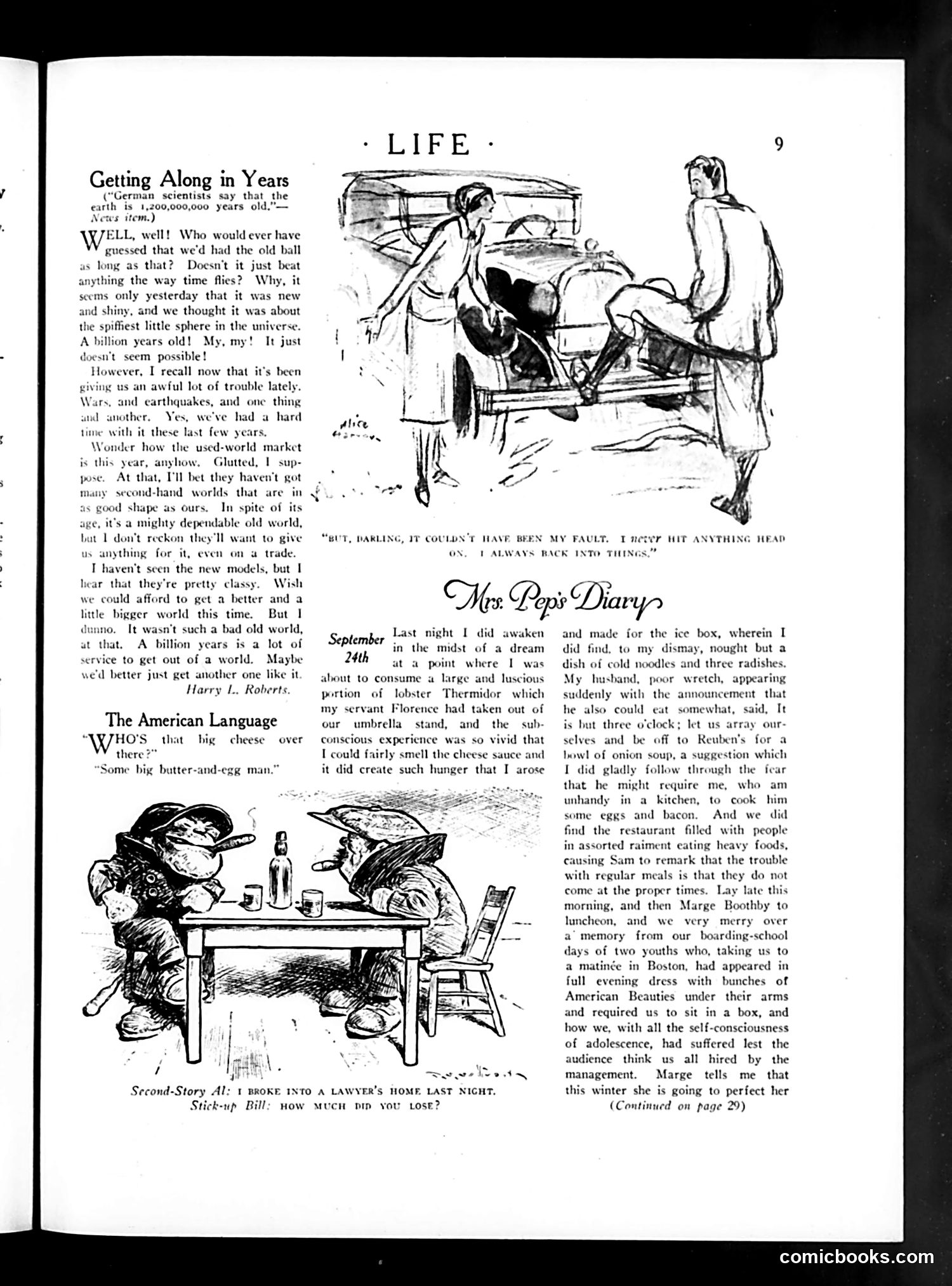
This page contains three distinct pieces of humor commentary: 1. **"Getting Along in Years"** (top left): A brief essay mocking the age of Earth (1.2 billion years old), suggesting the world is so ancient it's unreliable and worn-out—a satirical complaint about using "second-hand worlds" in poor condition. 2. **"The American Language"** (middle): A two-panel cartoon showing two large men at a table laden with food and drink. The caption identifies one as "some big butter-and-egg man," using period slang for wealthy, unsophisticated businessmen. The joke appears to mock their crude speech and manners. 3. **"Mrs. Pep's Diary"** (right): A society column entry describing a woman's domestic evening—servants, restaurant dining, and social pretensions—likely satirizing upper-class affectations and tedious leisure activities of the era.
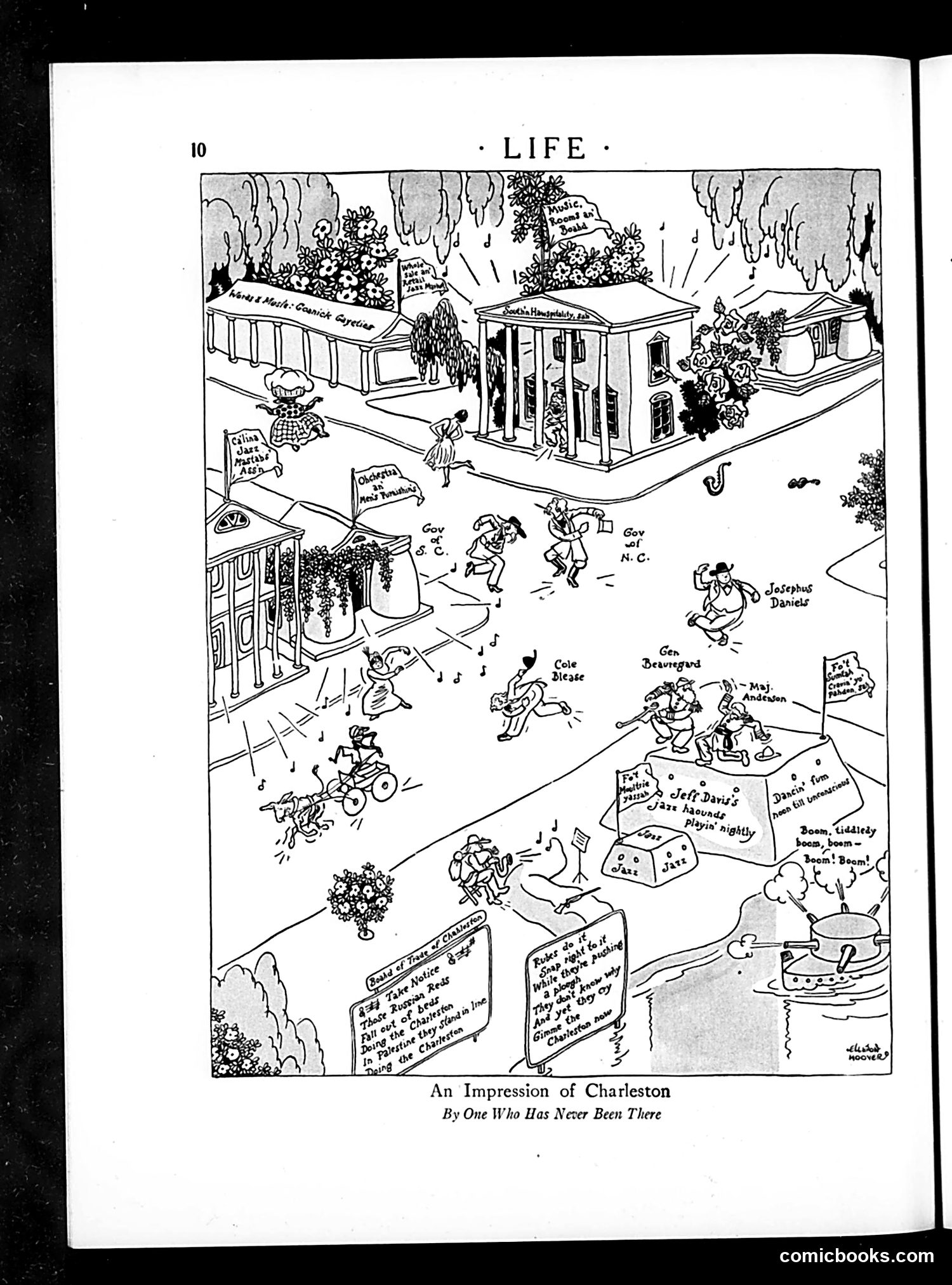
This is a humorous satirical cartoon depicting a chaotic, exaggerated vision of Charleston. The cartoon labels various figures with names like "Cole Blease" (likely South Carolina politician Cole Blease), "Gov. of N.C." (Governor of North Carolina), and other contemporary political figures. The scene shows people engaged in various activities—dancing, fighting, cooking, boating—amid signs advertising local businesses and characteristics. The satire appears to mock Charleston's reputation, possibly referencing political scandals, social disorder, or regional stereotypes about the South during this era. The subtitle "By One Who Has Never Been There" suggests the cartoonist is intentionally presenting an exaggerated, stereotypical view based on rumors rather than actual observation—the joke being how wildly inaccurate such secondhand impressions can be.
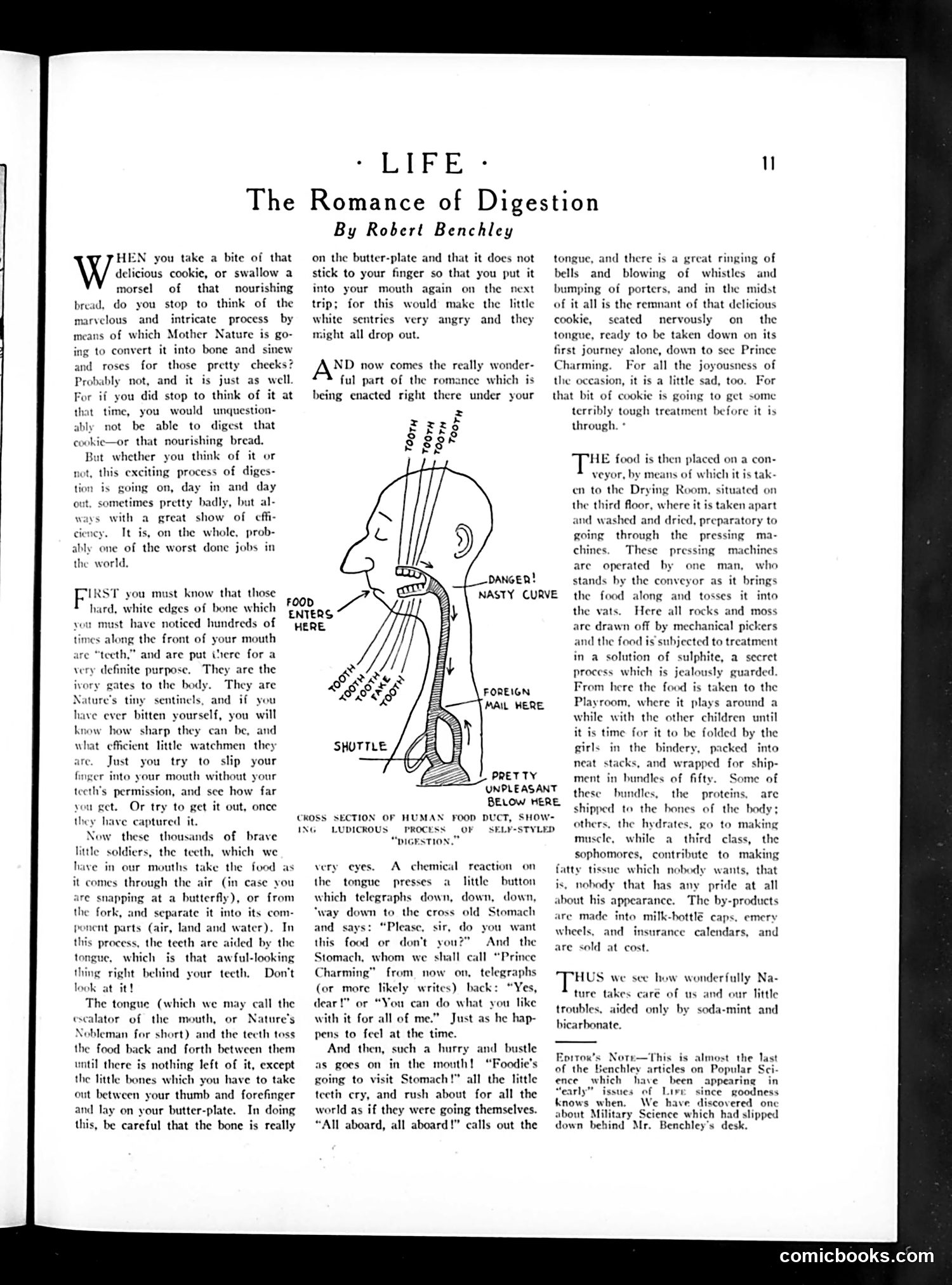
This is a humorous scientific illustration and essay explaining human digestion to a general audience. The labeled anatomical diagram shows the digestive tract with playful labels like "Danger! Nasty Curve," "Foreign Mail Here," and "Pretty Unpleasant Below Here." Benchley's text employs comedic personification, referring to the stomach as "Prince Charming" and describing digestion as a whimsical journey. He anthropomorphizes the digestive process—a cookie travels through the system like a character on an adventure, with teeth acting as "sentinels" and the stomach sending telegraphic messages. The satire gently mocks both overly technical scientific writing and readers' general discomfort discussing bodily functions. It makes digestive science accessible and entertaining for Life magazine's educated, middle-class audience by treating an undignified biological process with mock-serious, playful language.
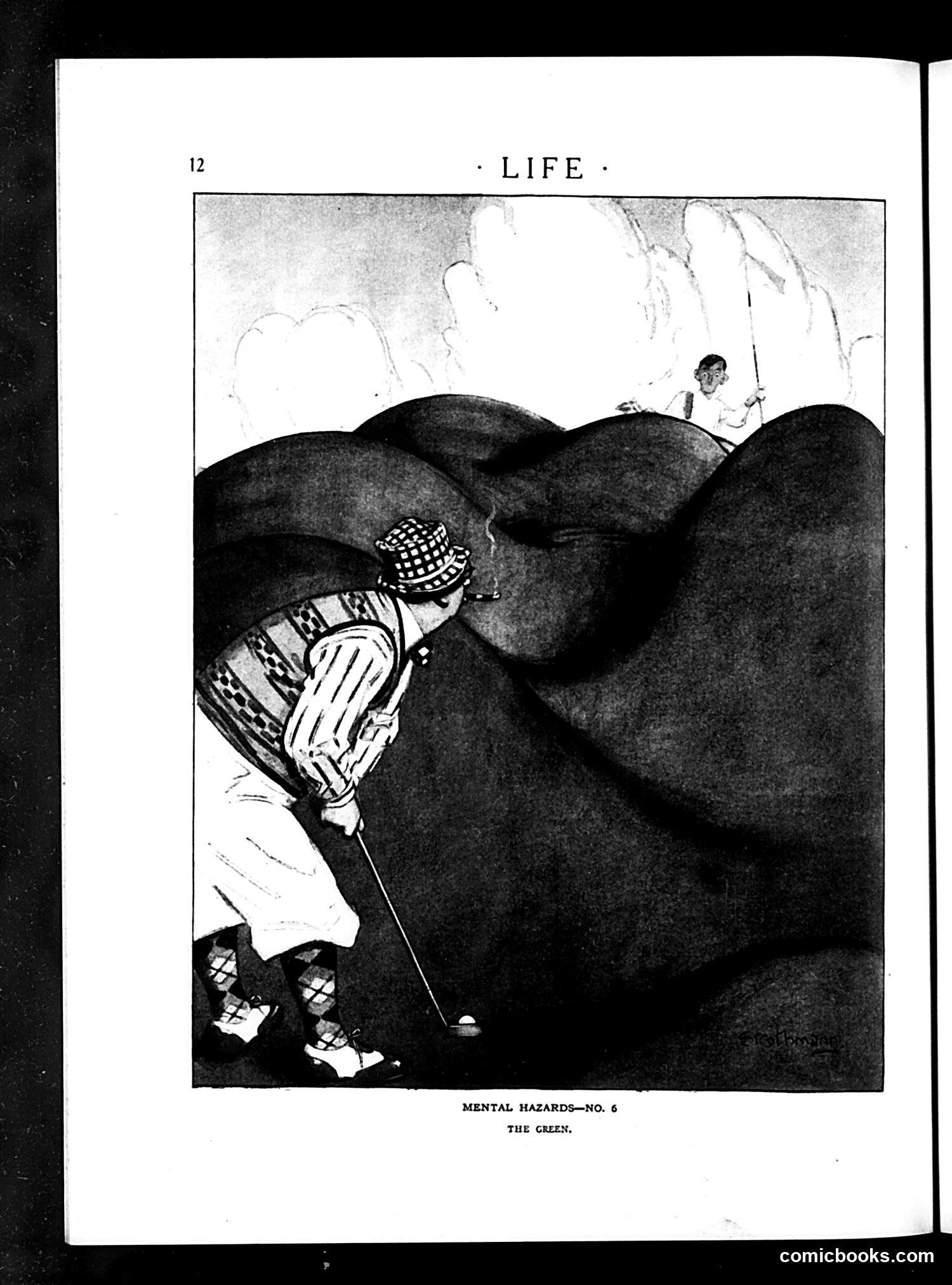
This satirical cartoon depicts a golfer struggling on the putting green, with exaggerated, menacing dark shadows looming over the landscape. The title "Mental Hazards" suggests the series examines psychological pressures in golf. The joke concerns golf's mental demands: the putting green—where precision matters most—induces anxiety in players. The ominous, oversized shadows represent the psychological burden and pressure golfers feel during crucial moments. The anxious posture and detailed clothing of the golfer contrast sharply with the dramatic, threatening landscape, emphasizing how mental factors can distort perception. This reflects early-20th-century Life magazine's satirical interest in leisure activities and their psychological effects on middle-class Americans, using visual exaggeration to mock the stress golfers experience.
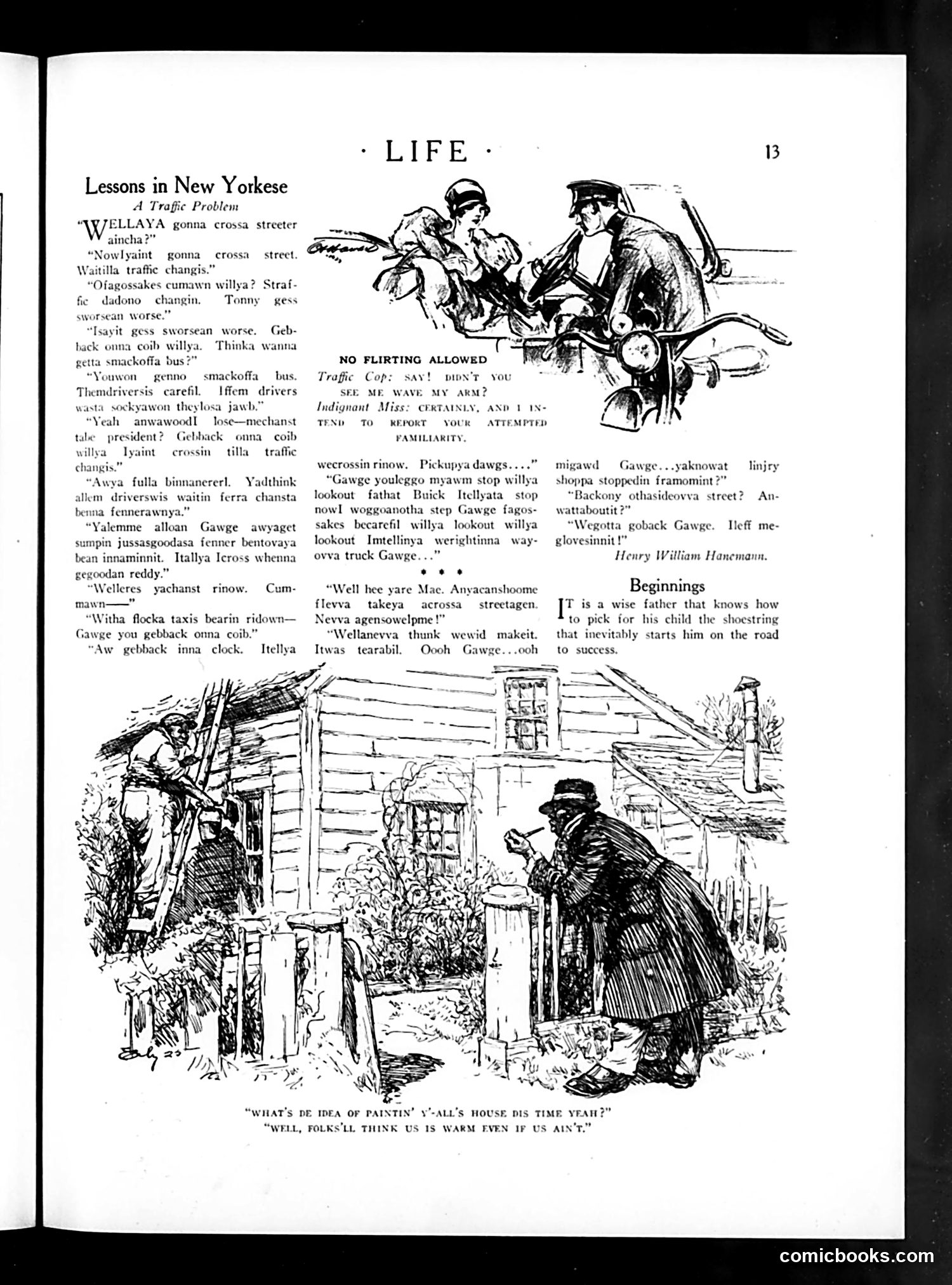
This page contains two distinct pieces: **"Lessons in New Yorkese: A Traffic Problem"** (top) depicts a humorous exchange between a traffic cop and an "indignant miss" about street crossing. The joke relies on phonetic transcriptions of working-class New York dialect—mocking how immigrants and lower-class residents pronounced English. Lines like "Wellaya gonna crossa streetcar" satirize non-standard speech patterns. **"Beginnings"** (bottom illustration) shows a father teaching his son to cross streets safely. The caption jokes that the father hopes teaching safety will keep the boy "warm even if us ain't"—suggesting poverty and cold conditions in poor neighborhoods. Both pieces satirize immigrant/working-class New Yorkers through dialect humor and depictions of urban hardship, typical of Life's early 20th-century satirical approach.
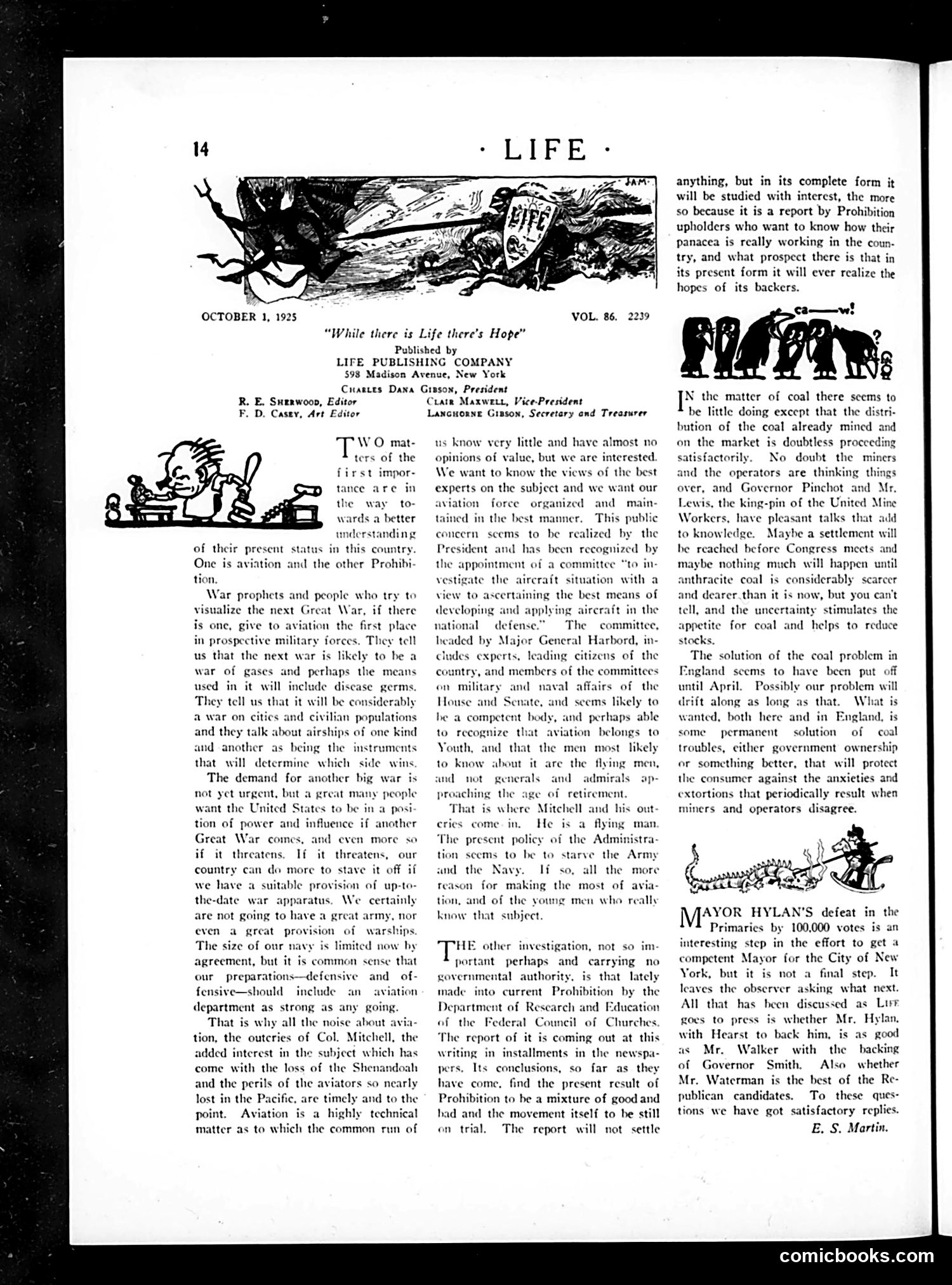
This page contains editorial commentary rather than political cartoons. The main illustrations are decorative mastheads and small spot illustrations accompanying articles. The text discusses two contemporary issues: **aviation policy** (the need for organized military aircraft development) and **Prohibition enforcement** (evaluating how well the 1920 alcohol ban is working). A brief note mentions **Mayor Hylan's defeat by 100,000 votes** in NYC primary elections, questioning whether a competent replacement will emerge. The cartoons appear to be generic editorial ornaments—a figure at a desk and a dragon-like creature—rather than specific political satire. The page functions primarily as opinion journalism addressing early 1920s policy debates rather than visual satire.
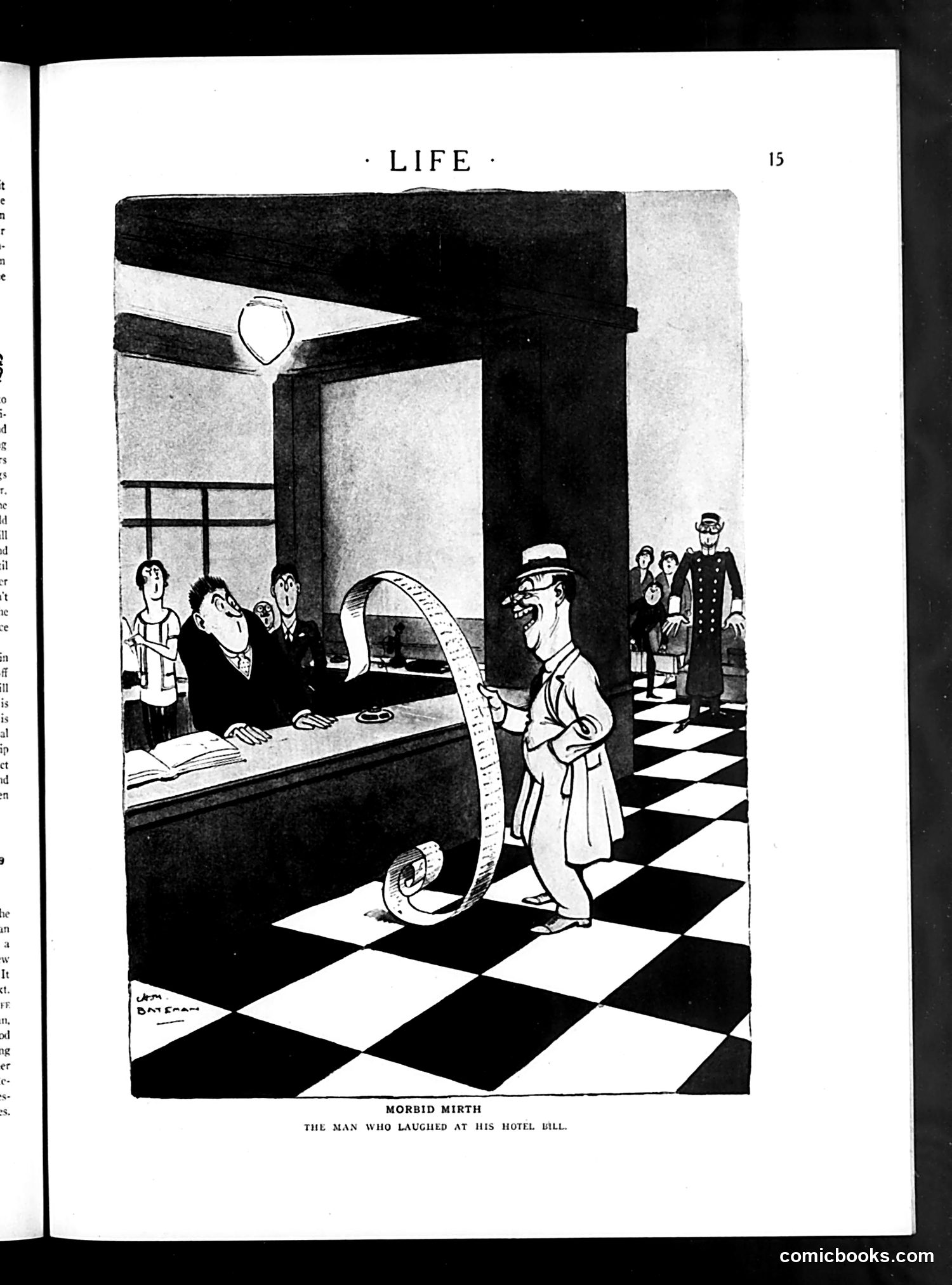
This cartoon satirizes someone's absurd reaction to an inflated hotel bill. A man at a hotel desk is shown laughing hysterically while holding an enormous unfurled bill—depicted as a long ribbon stretching across the floor. The hotel clerk and onlookers appear stunned or concerned by his reaction. The satire targets the absurdity of remaining cheerful when confronted with exorbitant lodging costs. Rather than protest or complain reasonably, the man's manic laughter suggests either delusional denial, hysteria, or sardonic acceptance of financial ruin. The caption's title "Morbid Mirth" emphasizes that this "joy" is twisted and unhealthy—a darkly comic commentary on how people cope with being financially gouged by hotels.
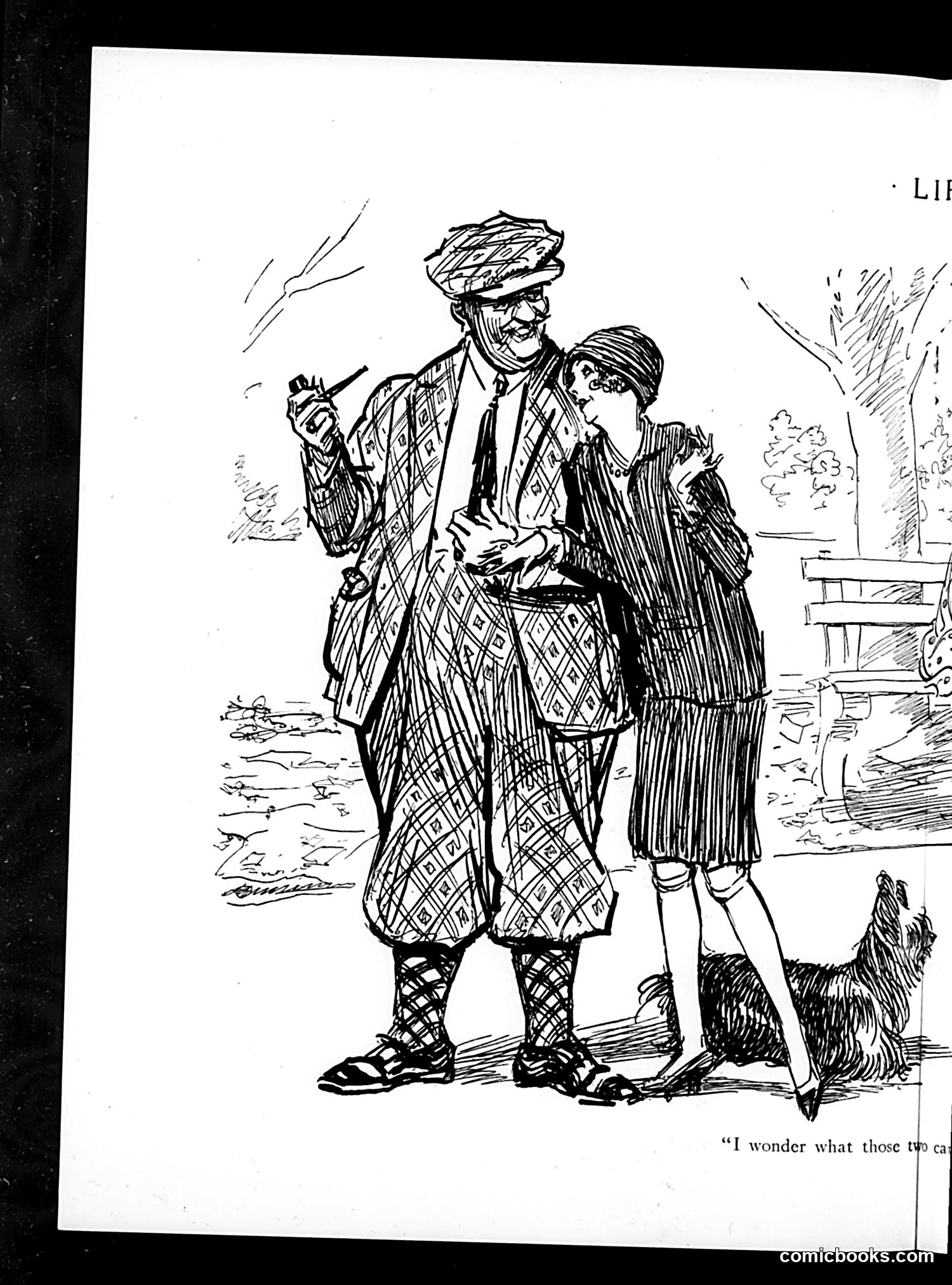
This is a satirical illustration from *Life* magazine showing an adult man in patterned clothing speaking with a young child and a dog. The man appears to be a traveling salesman or street vendor based on his outfit and apparent wares. The partially visible caption reads: "I wonder what those tw ca..." (text cuts off). The satire likely concerns a common *Life* magazine theme: the gullibility of children or the deceptive practices of traveling salesmen. The child's curious attention and the incomplete caption suggest the man is about to make some dubious claim or sales pitch. The humor lies in the contrast between innocent childhood wonder and adult manipulation or exaggeration—a frequent target of *Life*'s social satire during the early-to-mid 20th century.
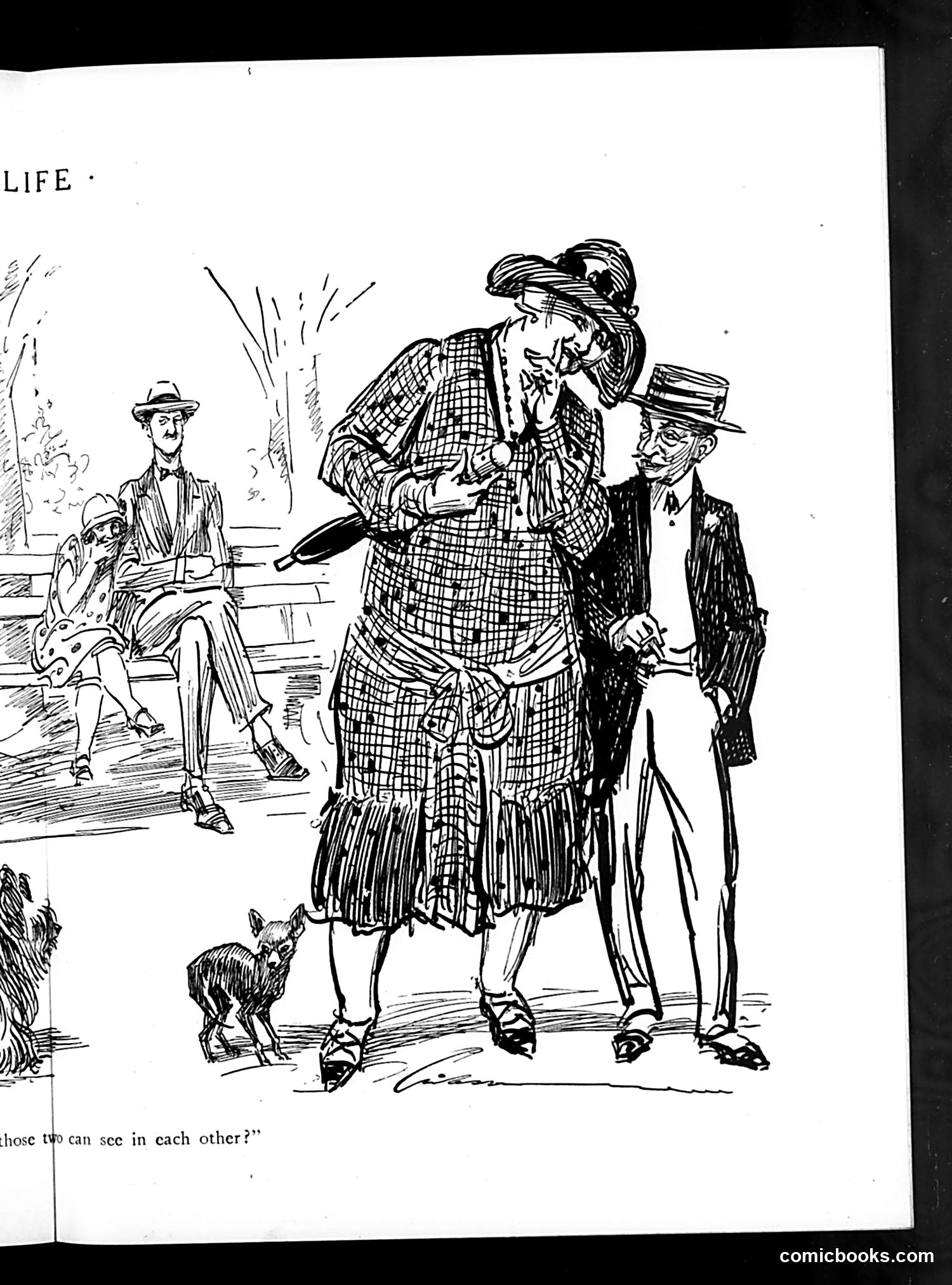
This satirical cartoon depicts a fashionably dressed woman with an elaborate checkered coat and large hat, accompanied by a well-dressed man in a suit and boater hat. A small dog stands nearby. In the background, figures sit on a bench. The partial caption reads: "those two can see in each other?" — suggesting the cartoon jokes about an unlikely or mismatched couple's attraction. The satire appears to target either: - The absurdity of romantic pairings based on superficial attraction - Social commentary on class differences or fashion pretension (the woman's ostentatious outfit) Without the complete caption or publication date, the specific reference remains unclear, though the style suggests early-to-mid 20th century American humor about courtship and social dynamics.
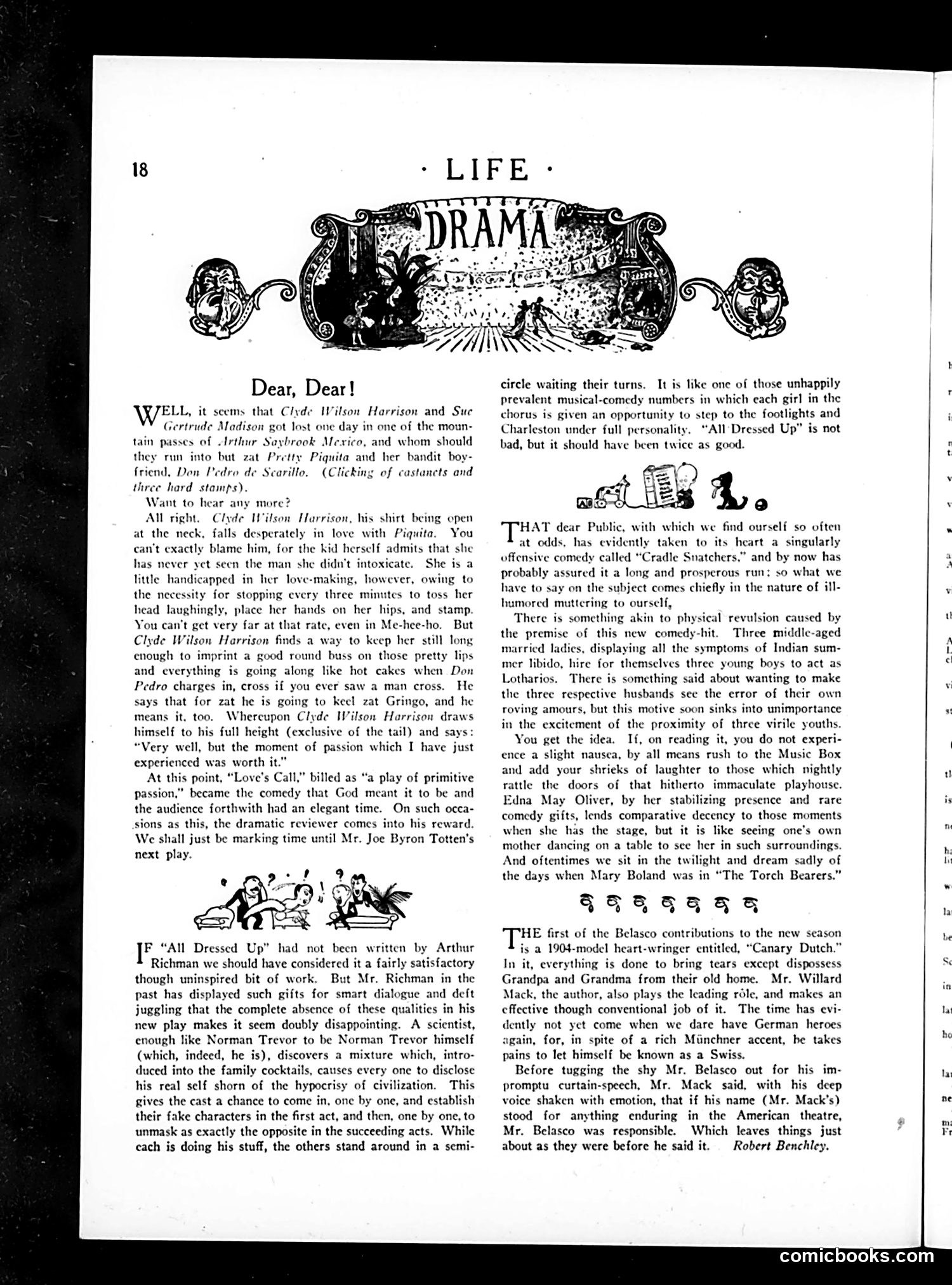
This is a theater criticism page from Life magazine's satirical "Drama" section. The reviewer discusses three Broadway plays with characteristic snark: **"Love's Call"** is mocked as a melodramatic farce with stock characters—Mexican bandits, passionate peasant girls named Piquita who constantly toss their heads and stamp their feet, and earnest American heroes. The reviewer finds it absurdly predictable yet somehow entertaining. **"All Dressed Up"** by Arthur Richman disappoints the critic. Though competently written, it lacks Richman's usual wit. The plot involves a chemical mixture revealing people's true selves, but the execution bogs down in tedious musical-comedy-style solo moments where each character unmasks in turn. **"Cradle Snatchers"** receives the harshest judgment. The reviewer finds its premise morally offensive: middle-aged married women hiring young men as lovers. Though the public embraced it, the critic expresses "physical revulsion" at the concept, complaining it's a cynical, offensive comedy. The tone is gossipy, superior, and thoroughly dismissive of public taste.
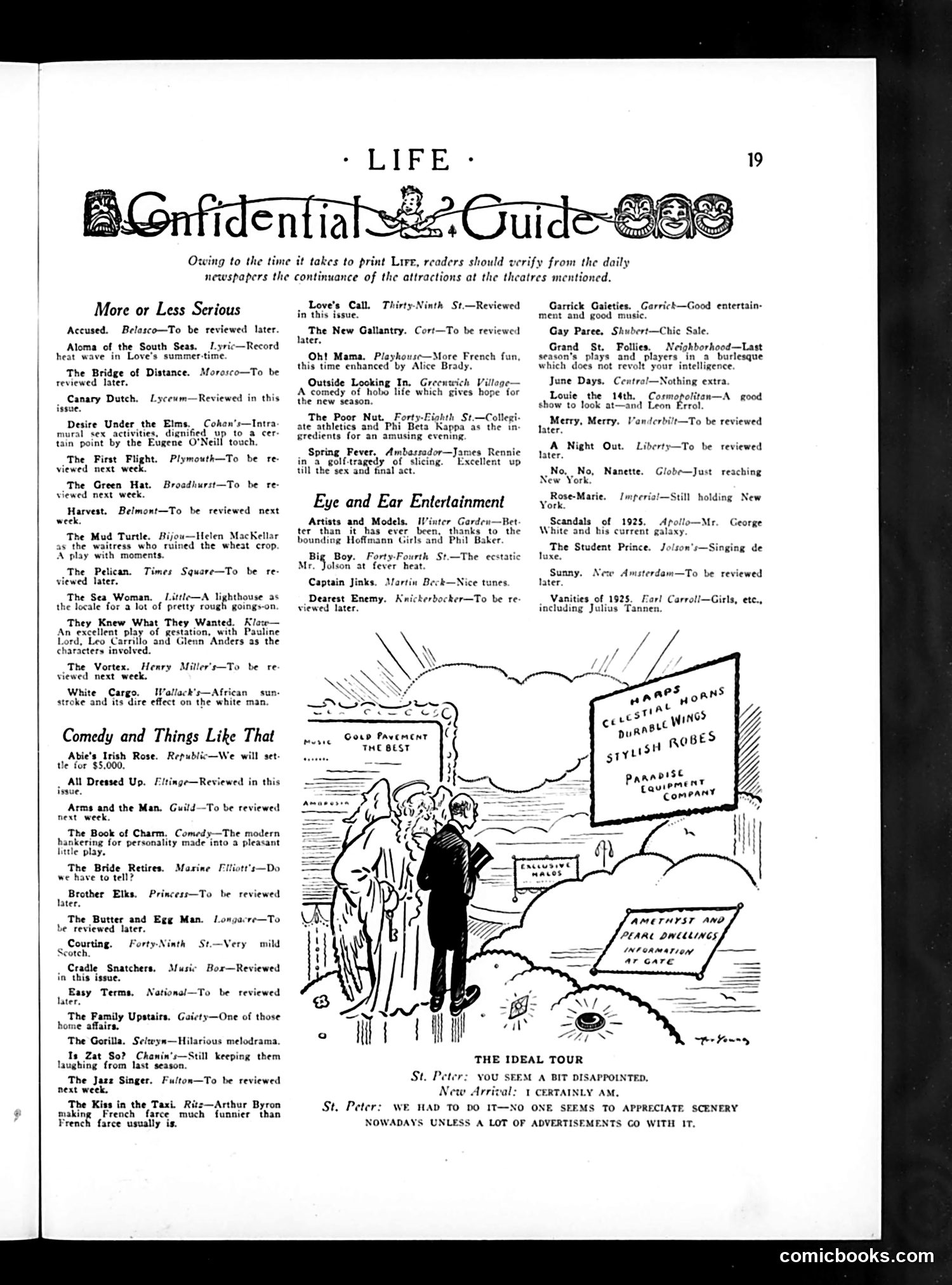
This cartoon satirizes the commercialization of scenic tourism in the 1920s. Two elegantly dressed tourists stand amid a beautiful natural landscape (mountains, water), but their view is completely obstructed by large advertising billboards for "Herps Celestial Horns," "Burnable Wings," "Stylish Robes," and "Paradise Equipment Company." The joke: modern tourists seeking natural beauty and authentic scenery now encounter only advertisements instead. The dialogue reinforces this—St. Peter (presumably representing heaven or pristine nature) laments that visitors "seem disappointed," while his companion notes that "no one seems to appreciate scenery nowadays unless a lot of advertisements go with it." This reflects 1920s anxieties about commercialism encroaching on nature and authentic experience. The cartoon mocks both the advertising industry's invasiveness and modern consumers' apparent inability to value unmediated natural beauty—a critique that remains relevant today.
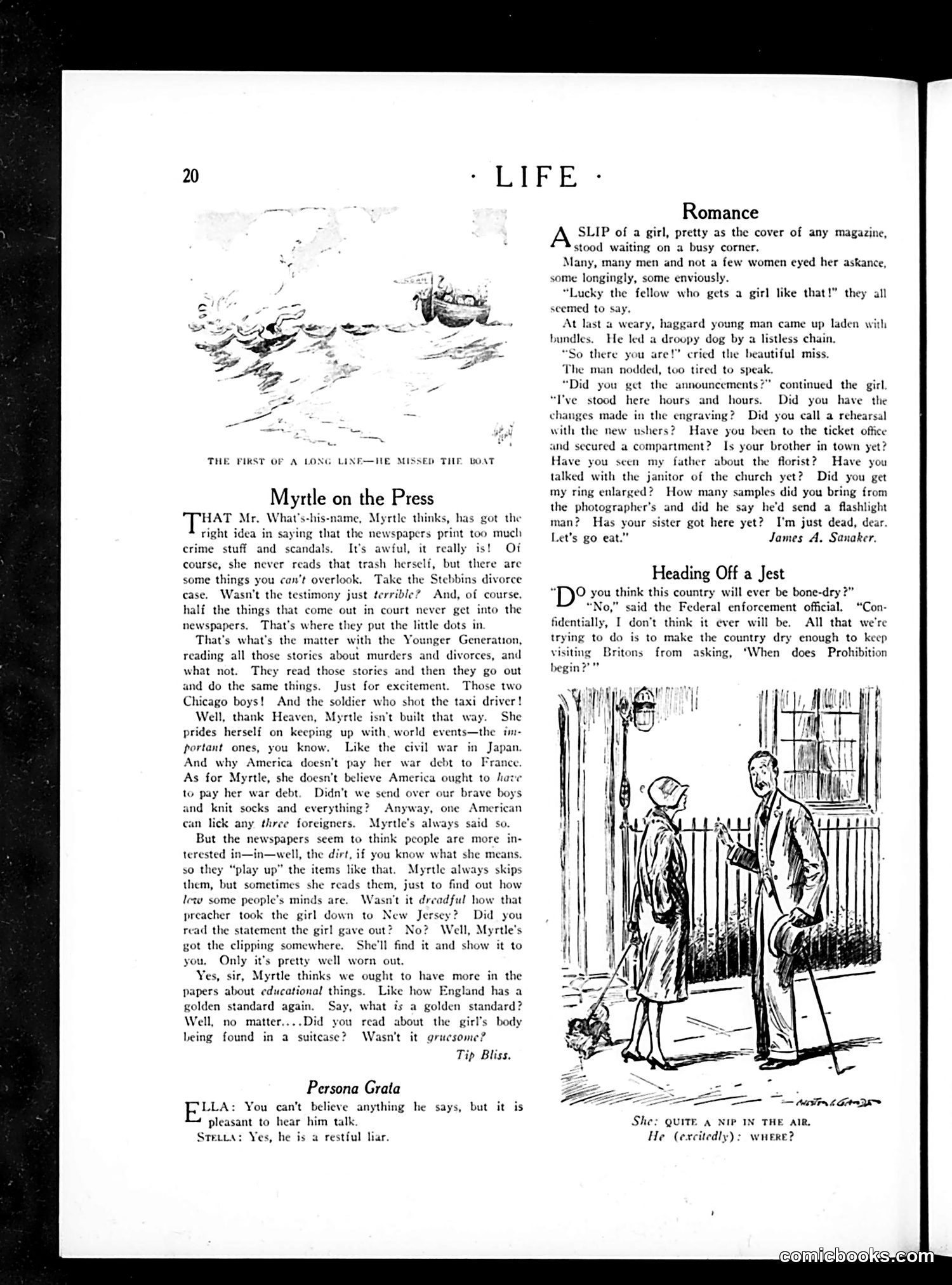
**"Myrtle on the Press"**: This satirizes a hypocritical woman who claims newspapers print too much scandal and crime, yet obsessively reads and discusses exactly such stories—divorce cases, murders, missing bodies in suitcases. The joke: she condemns sensationalism while consuming it voraciously, blaming it for corrupting "the Younger Generation" while being complicit herself. **"Heading Off a Jest"**: References Prohibition enforcement. A Federal official admits privately that enforcement aims only to keep the country *partially* dry—just dry enough to prevent British visitors from mocking American Prohibition. The satire mocks both the absurdity of Prohibition policy and American concern with international appearances. **"Persona Grata" dialogue**: A brief joke defining a "restful liar" as someone pleasant to hear despite dishonesty—likely contemporary social commentary on charming deceivers. The page reflects 1920s anxieties: media sensationalism, Prohibition's failure, generational decline, and social hypocrisy.
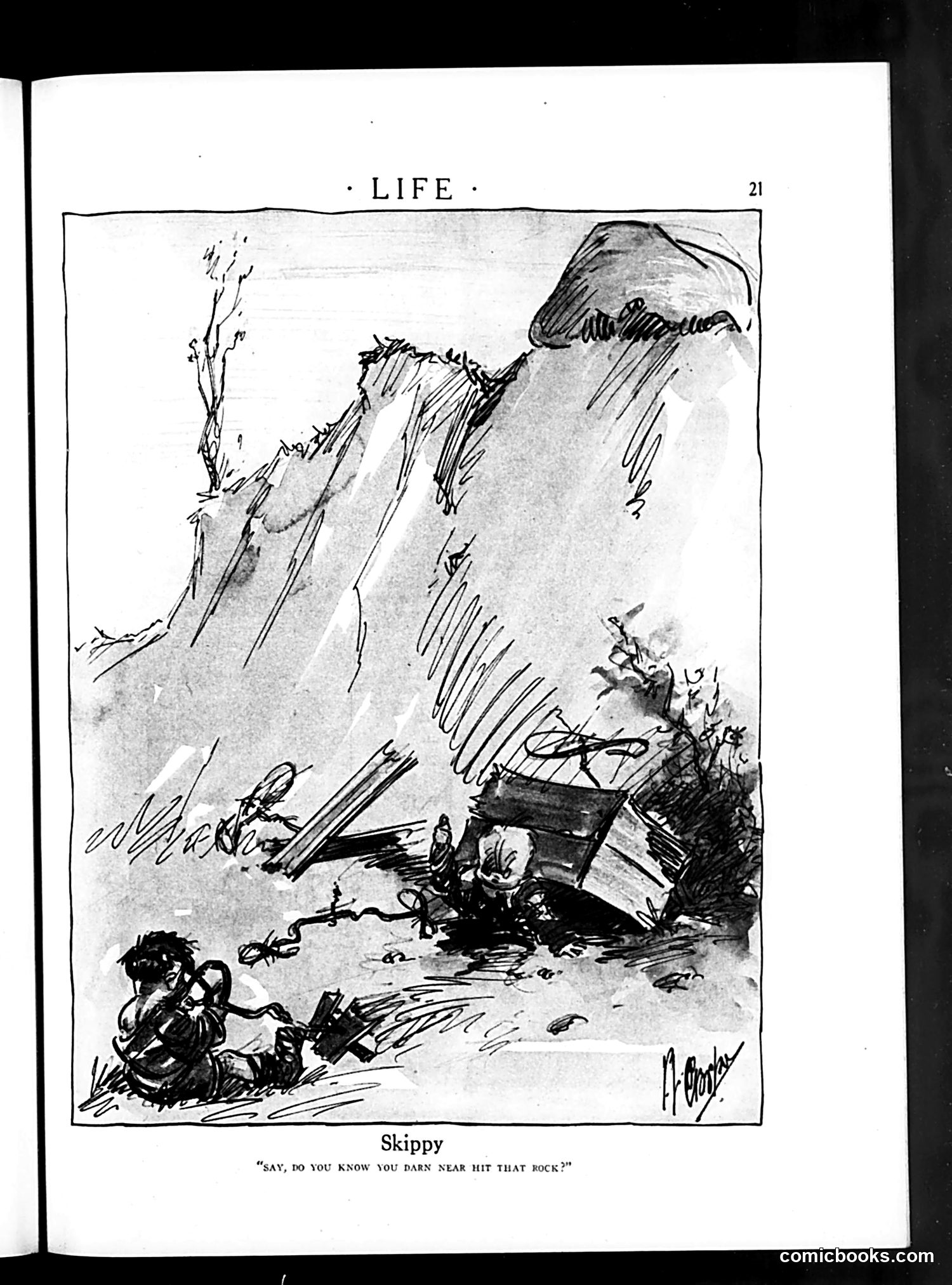
This is a comic strip titled "Skippy" showing a small child narrowly avoiding a large rock on what appears to be a hillside or slope. The child, looking back at the danger, addresses an unseen companion with the line "Say, do you know you darn near hit that rock?" The humor relies on a child's literal misinterpretation of a near-miss situation. The child seems to be suggesting the rock almost hit *them*, when the actual danger was likely that they nearly threw something (possibly a rock themselves) and it came close to hitting the larger rock. It's a simple, innocent comedic misunderstanding typical of early 20th-century children's humor—playing on the gap between adult logic and childish perspective.
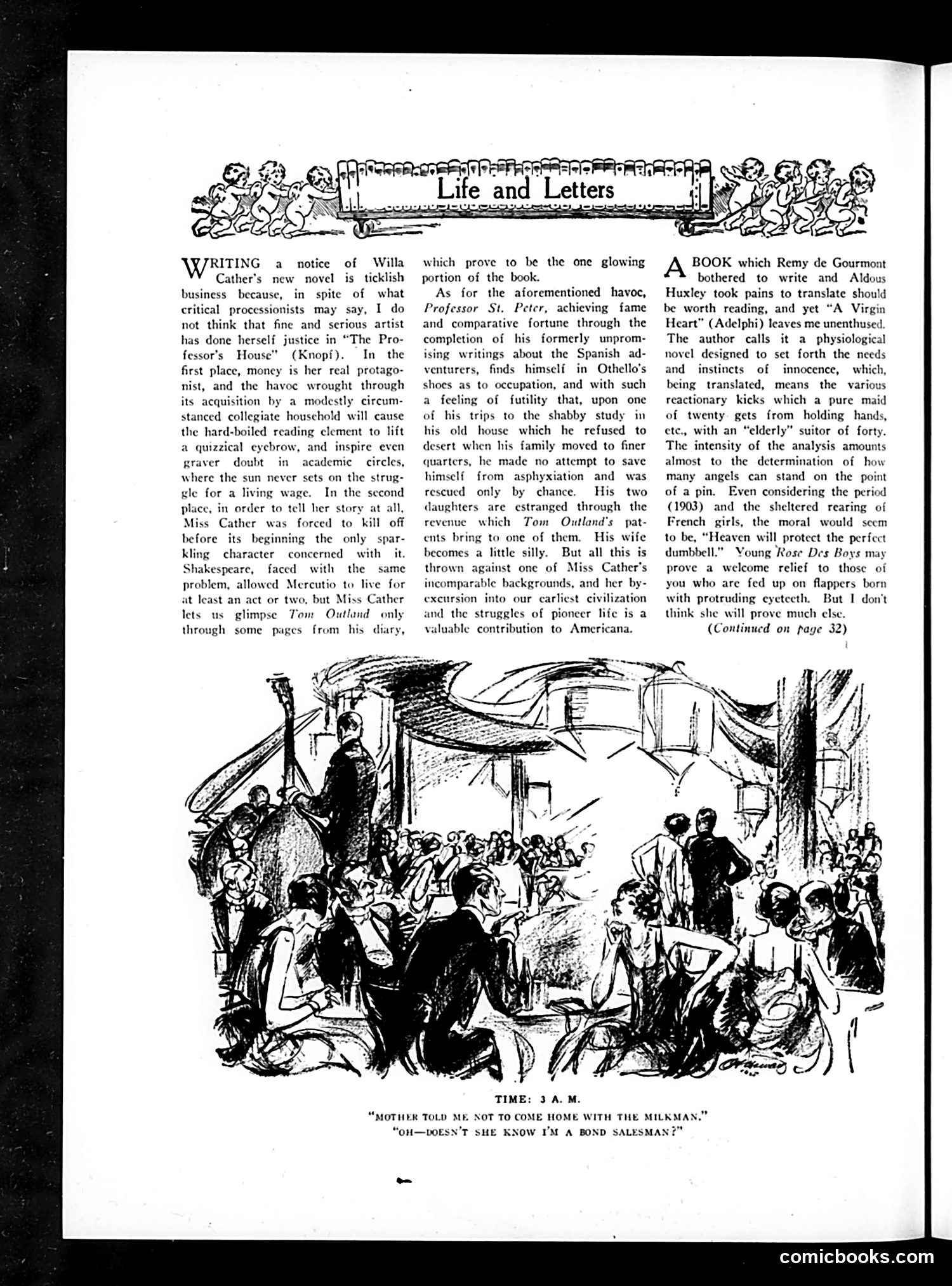
This page contains literary reviews and a cartoon joke typical of 1920s American satirical humor. **The Reviews:** Two book critiques discuss Willa Cather's *The Professor's House* and a translated French novel, *A Virgin Heart*. The Cather review praises her pioneer themes but criticizes her plot choices and focus on money's corrupting effects on an academic family. **The Cartoon:** The bottom illustration depicts a 3 A.M. scene with a woman and a man in formal dress. The caption's joke plays on social pretense: a mother warns her daughter against coming home with "the milkman" (implying scandal with working-class help), but the man claims he's actually a "bond salesman"—suggesting that his white-collar professional status supposedly makes the late-night encounter respectable. The satire mocks how 1920s society judged propriety based on class markers rather than actual behavior, and the absurdity of believing occupation could legitimize questionable conduct.
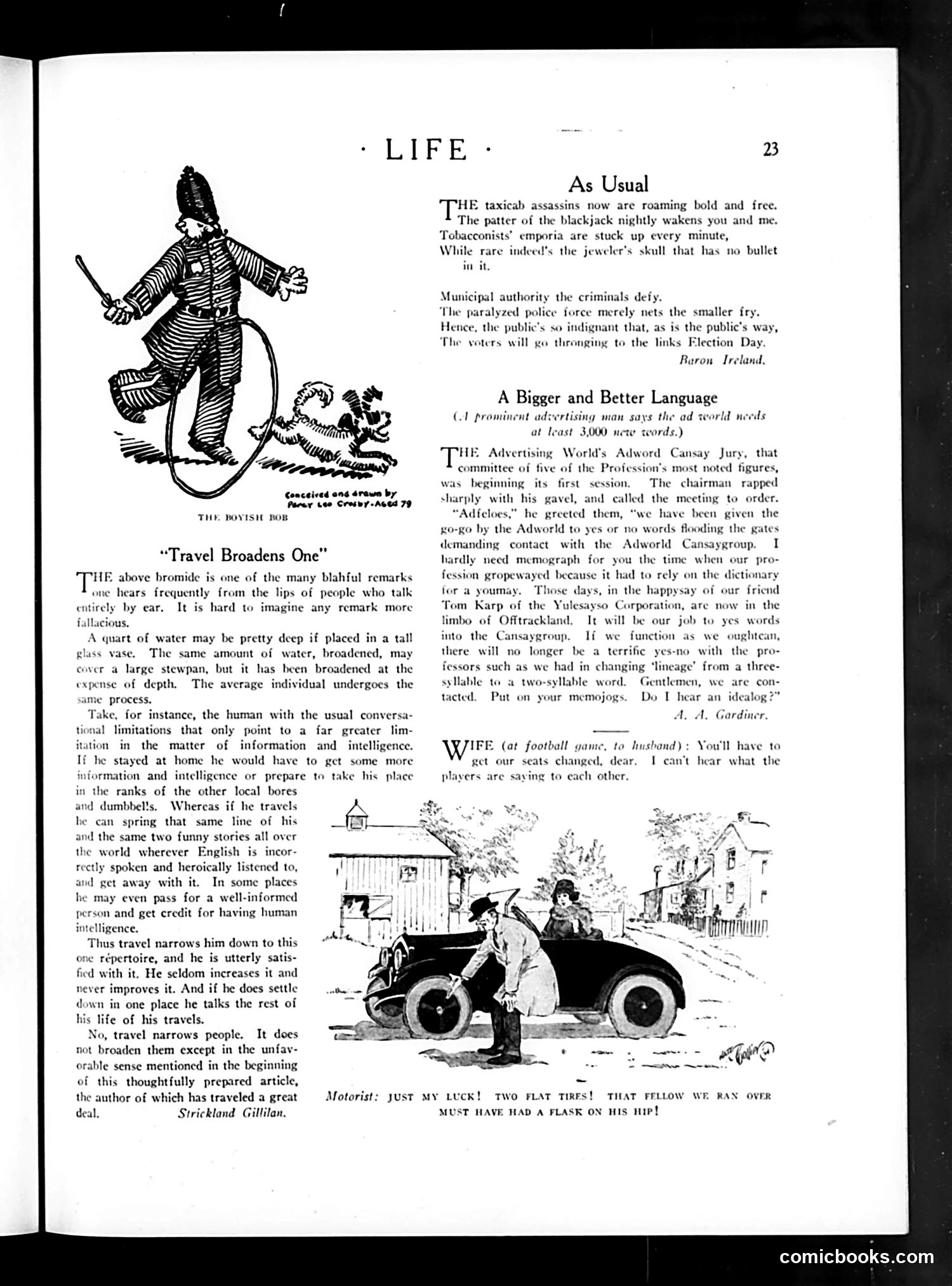
This page contains three distinct pieces of satire: **"Travel Broadens One"** (top left): A mock-serious essay arguing that travel *narrows* rather than broadens people. The author claims that travelers simply repeat the same limited anecdotes everywhere, gaining no genuine knowledge. The irony is that the author admits to having traveled extensively himself—undercutting his own argument and mocking the pretension of worldly travelers. **"As Usual"** (top right): A poem by Baron Ireland satirizing urban crime and civic dysfunction. It describes rampant taxicab robbery, holdups, and violence while police catch only minor offenders. The joke is that citizens respond by voting on Election Day—implying voting will solve nothing. **Bottom cartoon**: A motorist with two flat tires blames a fellow driver, concluding "that fellow we ran over must have had a flask on his hip!" The dark humor suggests the injured pedestrian caused the damage by being drunk, rather than the motorist being at fault. All three pieces are cynical commentaries on American society—travel, law enforcement, and personal responsibility.
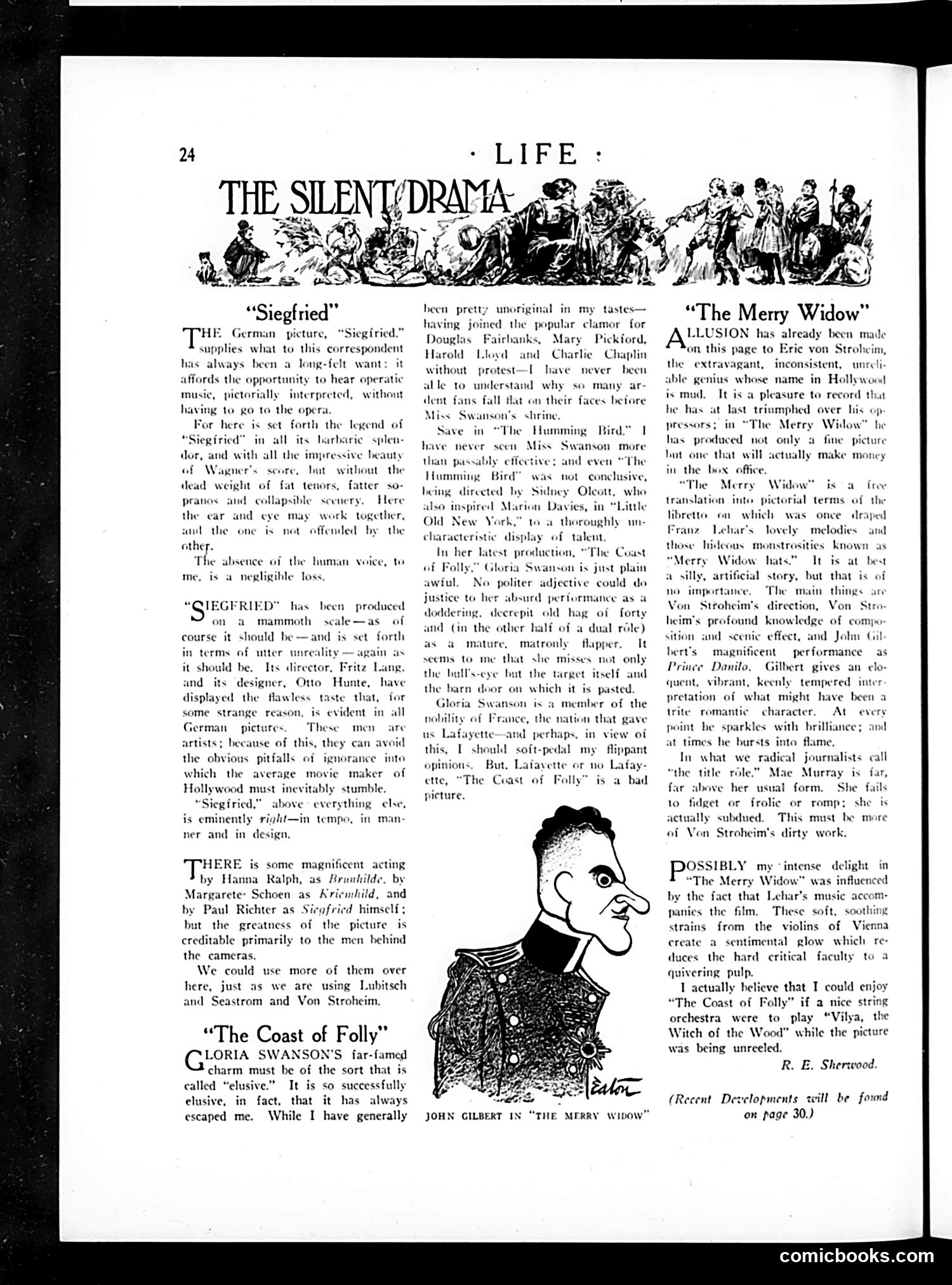
This page reviews three silent films from the 1920s. The critic praises the German film *Siegfried* for presenting Wagner's opera visually without live singers—eliminating "the dead weight of fat tenors." Director Fritz Lang and designer Otto Hunte receive high marks for tasteful execution. *The Coast of Folly* receives harsh criticism. The reviewer dismisses Gloria Swanson's famous "elusive charm" as genuinely elusive—meaning it escapes him entirely. He calls her performance "awful," mocking her portrayal of both a decrepit 40-year-old hag and a matronly flapper in a dual role. *The Merry Widow*, directed by Erich von Stroheim (shown in the caricature), is praised as a commercial success that finally vindicates the "extravagant, unreliable genius." The adaptation of Lehár's operetta music to film succeeds despite its "silly, artificial story," aided by von Stroheim's compositional knowledge. The reviews exemplify 1920s film criticism—evaluating visual composition, acting, and directorial taste.
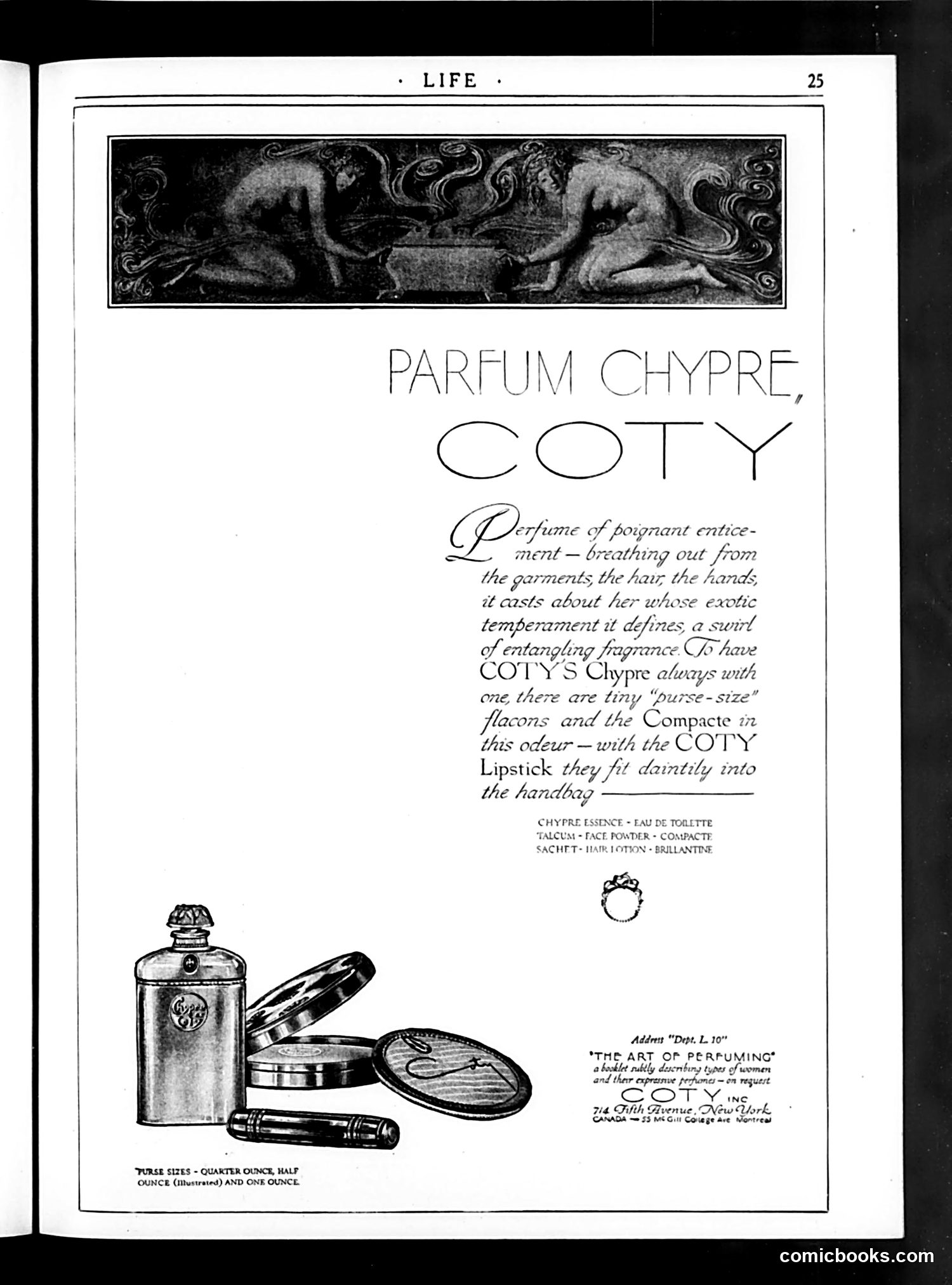
This is a **perfume advertisement**, not a political cartoon. The page promotes Coty's "Chypre" fragrance line to women readers of *Life* magazine. The ad uses romantic, exotic language ("entangling fragrance," "exotic temperament") to market the perfume as an accessory for the fashionable woman. It emphasizes **portable luxury**—tiny "purse-size" bottles and matching lipstick that "fit daintily into the handbag"—appealing to the modern woman's mobile lifestyle. The decorative header depicts classical figures (likely nymphs or muses), lending sophistication and timeless appeal. The ad includes product illustrations and mentions a free booklet titled "The Art of Perfuming," describing "types of women and their expensive perfumes," suggesting fragrance choice reflects personality. This reflects early 20th-century marketing targeting affluent female consumers through appeals to elegance, portability, and self-expression.
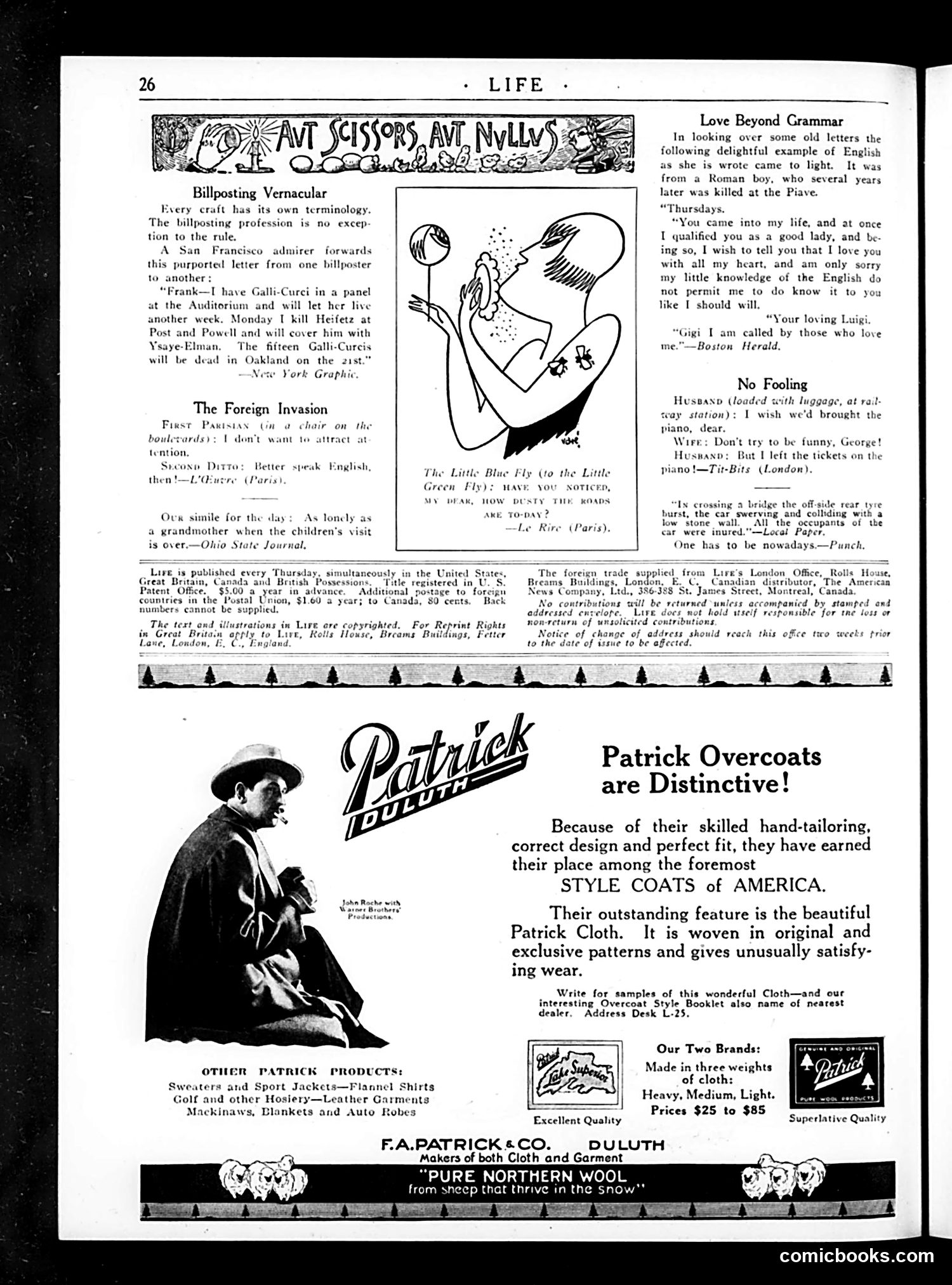
This page mixes humor columns with advertising. The cartoons satirize professional jargon and cultural anxieties of the era. **"Billposting Vernacular"** mocks the specialized slang of billboard advertisers, presenting a letter where a San Francisco billposter uses trade terminology ("kill," "dead") to describe covering up advertisements of famous singers (Galli-Curci, Heifetz, Ysaye-Elman). The joke: their language sounds violent and morbid when discussing routine billboard replacement. **"The Foreign Invasion"** satirizes immigrants' English-language struggles through two brief exchanges—a Parisian and German speaker bungling English phrases. This reflects 1920s-era anxieties about non-English speakers in America. Other humor pieces include touching letters from Italian soldiers and marital comedy. The page primarily consists of a **Patrick Overcoats advertisement** emphasizing American-made quality and "pure northern wool," likely targeting middle-class male consumers concerned with respectability and national pride during the post-WWI period.
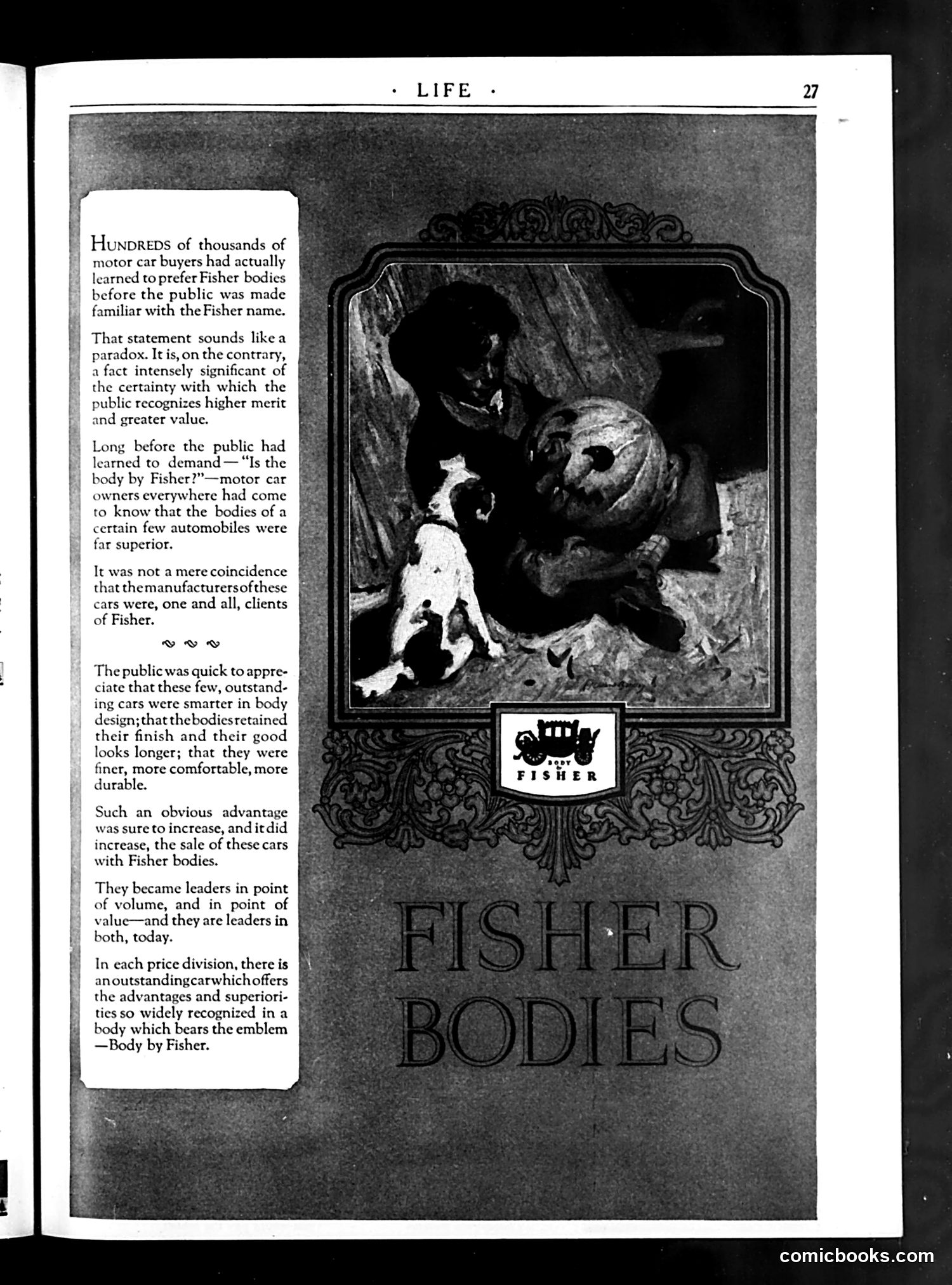
This is a **Fisher Body Company advertisement**, not a political cartoon. Fisher Bodies was an automotive supplier that manufactured car bodies for various automobile manufacturers. The ad argues that Fisher became a prestigious brand through quality reputation *before* consumers knew the Fisher name—a marketing paradox the text explores. It claims hundreds of thousands of car buyers unconsciously preferred Fisher-bodied cars for their superior design, durability, and appearance before "Body by Fisher" became a recognized brand emblem. The ornate illustration shows a well-dressed couple admiring a luxurious car, emphasizing aspirational lifestyle and quality. The Fisher crest appears centrally. This represents early 20th-century brand-building strategy: establishing reputation for craftsmanship, then leveraging that reputation through advertising and marketing. The "Body by Fisher" emblem eventually became a prestigious selling point across multiple automobile brands.
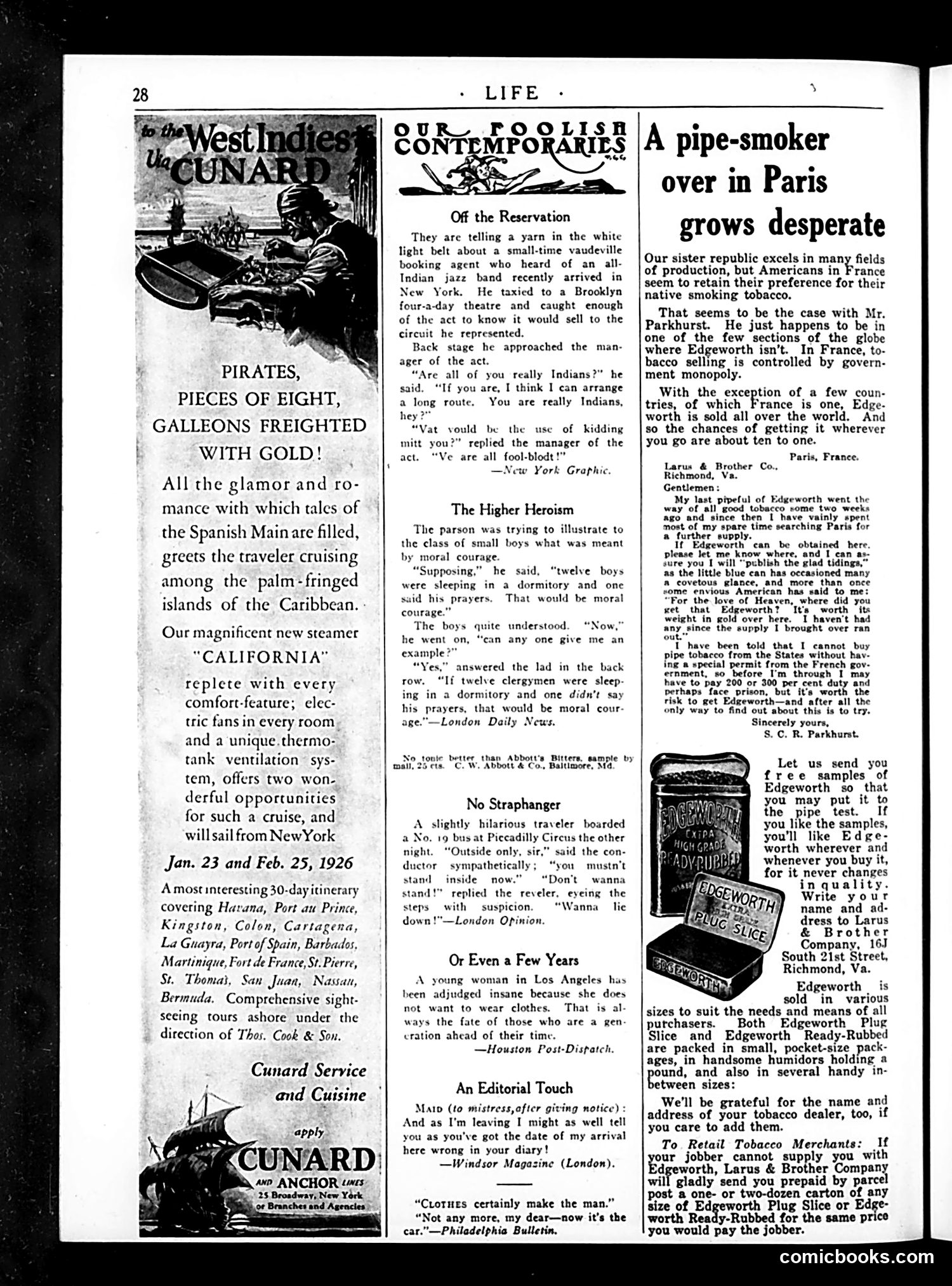
This page mixes advertisements with brief satirical items typical of Life's humor section. The main left column advertises Cunard steamship cruises to the Caribbean, emphasizing romantic adventure ("Pirates, Pieces of Eight, Galleons Freighted with Gold"). The center contains three short satirical pieces: "Off the Reservation" jokes about a vaudeville booking agent deceived by a jazz band's manager who admits they're "all fool-blodt" (fake Indians). "The Higher Heroism" contrasts moral courage between boys and clergymen saying prayers. These pieces mock pretense and social hypocrisy. The right column features the main content: a humorous letter from an American in Paris desperately seeking Edgeworth pipe tobacco, unavailable under France's government tobacco monopoly. This advertorial cleverly frames the product as so desirable that a customer risks legal trouble to obtain it—turning scarcity into marketing appeal. The satire gently mocks American consumer loyalty abroad.
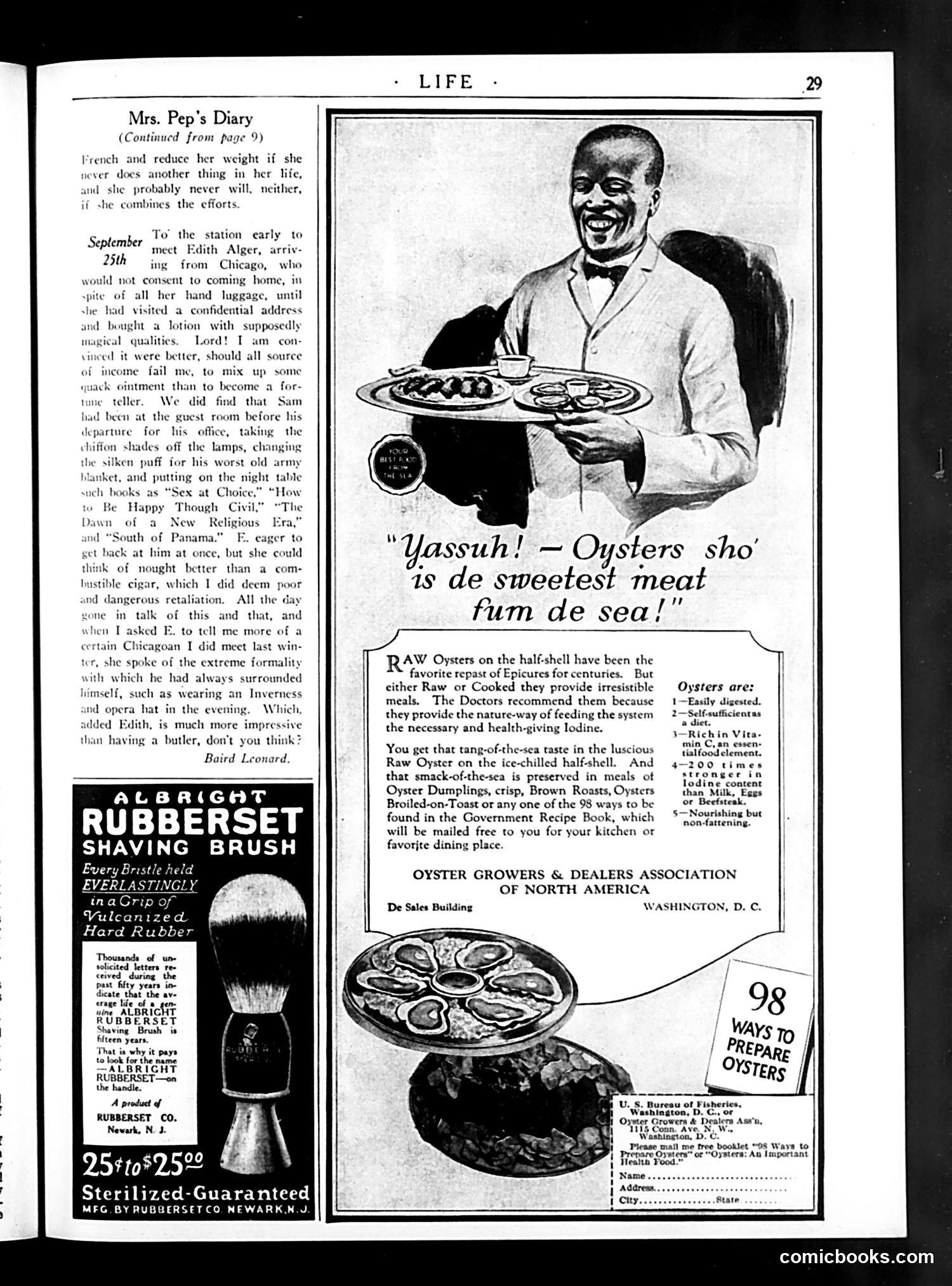
This page combines a satirical society diary with period advertising. **Mrs. Pep's Diary** (top) mocks upper-class domestic life. It describes a woman obsessed with weight-loss schemes and a husband who engages in petty bedroom pranks—removing lamp shades and replacing fine bedding—then reading risqué books like "Sex at Choice." The diarist sarcastically notes the wife's retaliation using a "combustible cigar," suggesting marital discord masked by social propriety. The final anecdote ridicules a visiting Chicagoan's pretentiousness for wearing formal opera attire casually. **The Oyster Advertisement** features a caricatured Black server presenting oysters with exaggerated dialect ("Yassuh! Oysters sho' is de sweetest meat fum de sea!"). The image reflects period advertising norms that relied on demeaning racial stereotypes for comedic effect and commercial appeal. Both sections exemplify 1920s-era satirical humor: the diary mocks bourgeois hypocrisy and marital tensions; the ad uses racist caricature as entertainment—practices now recognized as offensive.
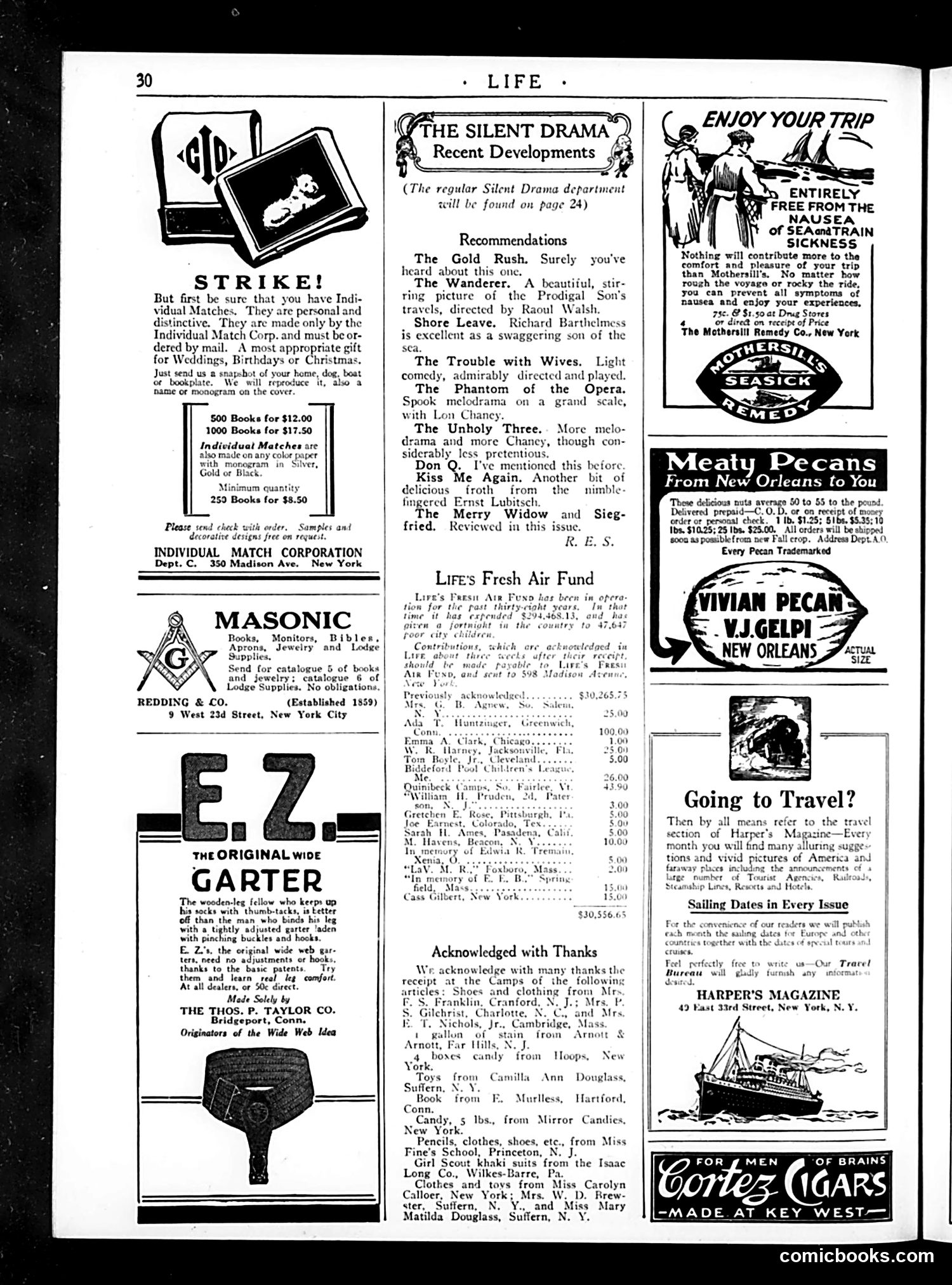
This page is primarily **advertising and editorial content** from Life magazine, with minimal satirical cartoons. The main "cartoon" is the **"STRIKE!" advertisement** at top-left, which is not political satire but a commercial pitch for personalized matchbooks. It uses the word "STRIKE" as wordplay—connecting to matches—not as social commentary. The page consists mainly of: - **Movie recommendations** (The Gold Rush, Phantom of the Opera, etc.)—reviewing silent films, reflecting 1920s entertainment - **Product advertisements** (E.Z. garters, Mothersill's seasickness remedy, Vivian Pecans) - **Life's Fresh Air Fund acknowledgments**—a charitable section thanking donors who contributed to children's camps - **Travel and Harper's Magazine promotions** There is **no identifiable political cartoon or satire** on this page. It represents typical magazine filler content: ads, reviews, and philanthropic notices common to the era. The historical interest lies in the *products and entertainment* advertised, not in satirical commentary.
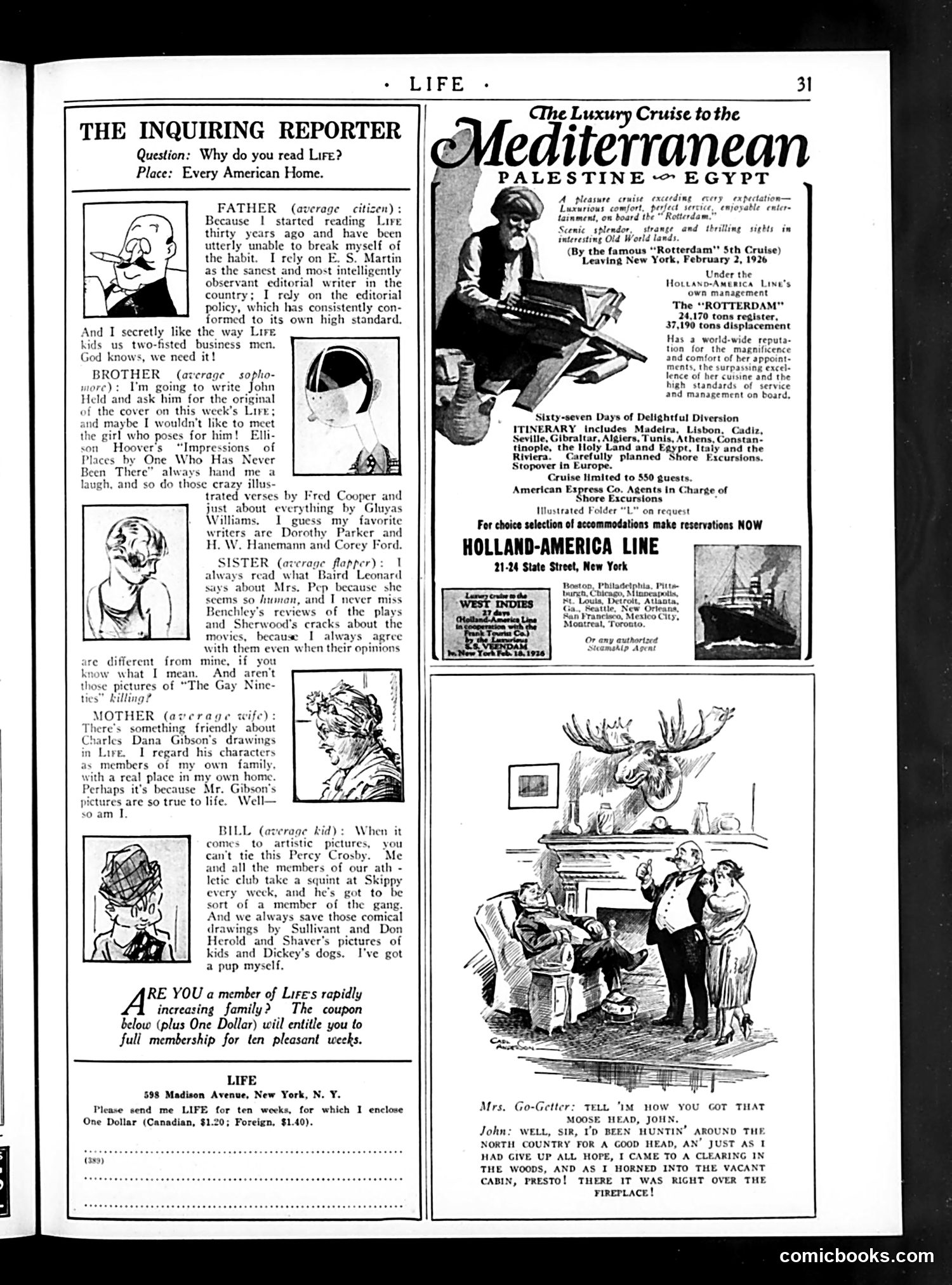
This page showcases *Life* magazine's appeal circa 1926 through reader testimonials ("The Inquiring Reporter"). Family members—father, brother, sister, mother, and boy—praise specific writers and cartoonists: E.S. Martin's editorials, Dorothy Parker, Robert Benchley, Charles Dana Gibson's illustrations, and Percy Crosby's "Skippy" comic strip. The satire is gentle: each generation finds different value in the magazine, from serious editorial policy to funny drawings. The father's thirty-year habit suggests *Life*'s cultural authority; the boy's enthusiasm for Percy Crosby indicates its reach to younger readers. The right page advertises a Mediterranean cruise—typical of *Life*'s affluent readership. The bottom cartoon shows a woman proudly displaying a moose head, with the husband's hunting story beginning—seemingly a gentle domestic humor piece common to the era. Overall, this functions as both reader testimonial and self-promotion.
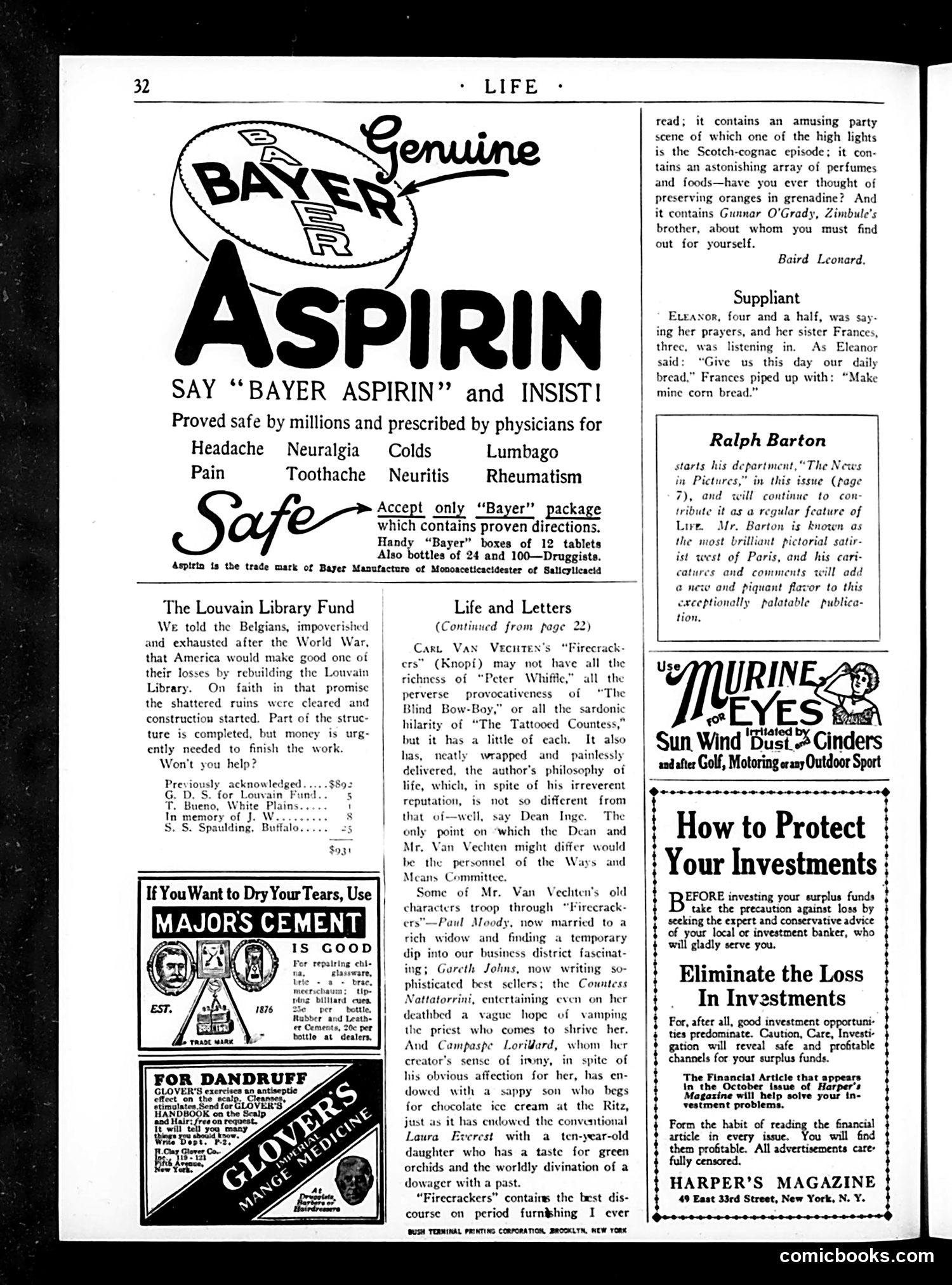
This page is primarily a compilation of advertisements and literary content, not political cartoons or satire. The main advertisement is for Bayer Aspirin, with the classic branding and health claims typical of early-20th-century pharmaceutical marketing (though the product's safety would later become controversial). There are also ads for Major's Cement, Glover's dandruff remedy, and Murine for Eyes. The only substantive editorial content is book reviews under "Life and Letters," discussing Carl Van Vechten's novel "Firecrackers"—described as containing social satire about wealthy New York characters. A separate note mentions Ralph Barton, a pictorial satirist, will contribute regular features to the magazine. There's also a charitable notice about rebuilding Belgium's Louvain Library after World War I. The page is primarily commercial rather than satirical in nature.
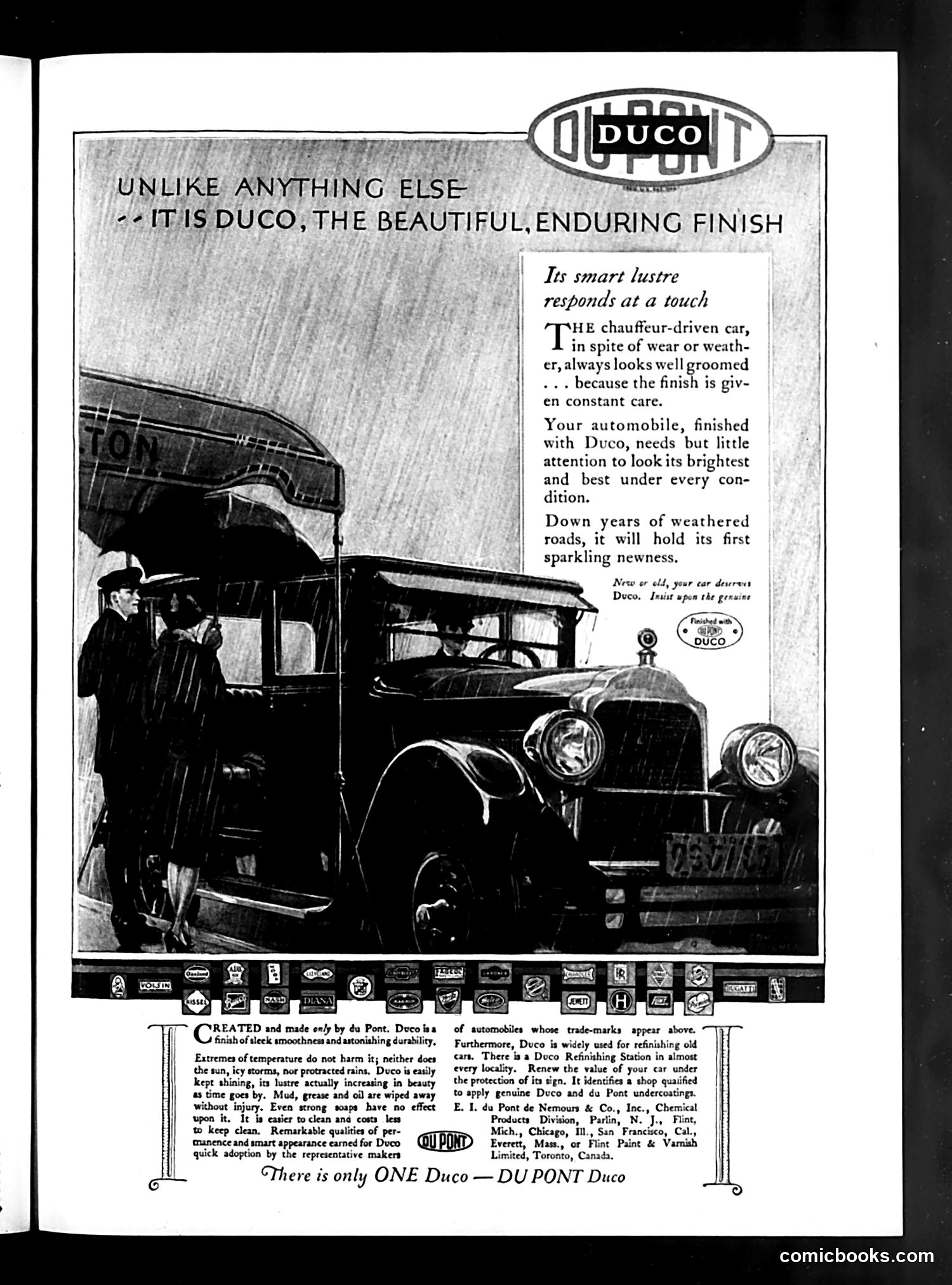
This is a **full-page advertisement, not satire or political commentary**. It promotes Duco, a Du Pont automobile lacquer finish, positioned as a revolutionary product for the 1920s car market. The image shows a chauffeur-driven luxury car in the rain, illustrating Duco's durability claim: the finish remains glossy despite weathering. The accompanying text emphasizes that Duco requires minimal maintenance while resisting mud, grease, extreme temperatures, and harsh soaps—practical concerns for car owners in an era before modern protective coatings. The small manufacturer logos at the bottom indicate which automobile brands used Duco, serving as quality endorsements. The tagline "There is only ONE Duco — DU PONT Duco" asserts market dominance. This advertisement reflects early automotive marketing, when paint finish was a significant selling point and Du Pont's chemical innovations were cutting-edge consumer technology. The chauffeur detail signals the luxury market segment being targeted.
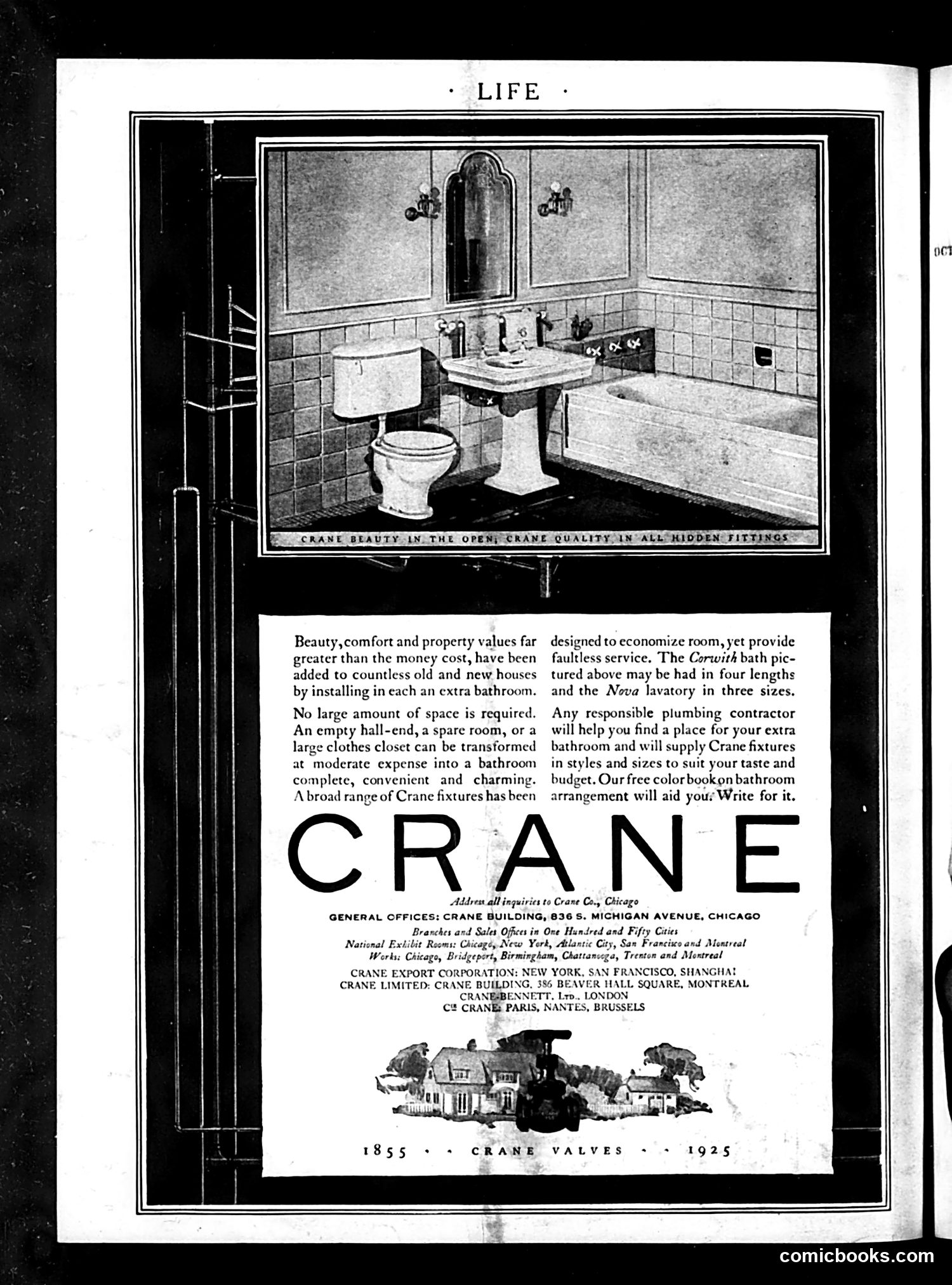
This is **not a cartoon or satire** but rather a **full-page advertisement** for Crane plumbing fixtures, appearing in Life magazine circa 1925. The ad features a photograph of a modern bathroom showing a toilet, pedestal sink, bathtub, and mirror—presented as an aspirational lifestyle image. The accompanying text promotes adding extra bathrooms to homes as an affordable way to increase property values and comfort. The marketing pitch targets middle-class homeowners, emphasizing that even small spaces (hallways, spare rooms, closets) can be converted into complete bathrooms with Crane's economical fixtures. The ad lists Crane's extensive offices across North America and Europe, suggesting their prominence as a plumbing supplier. There is no political satire or social commentary here—this is straightforward commercial advertising leveraging Life's prestigious platform to promote home modernization during the prosperous 1920s.