
Life, 1925-10-01 · page 13 of 36
Life — October 1, 1925 — page 13: what you’re looking at
What you’re looking at
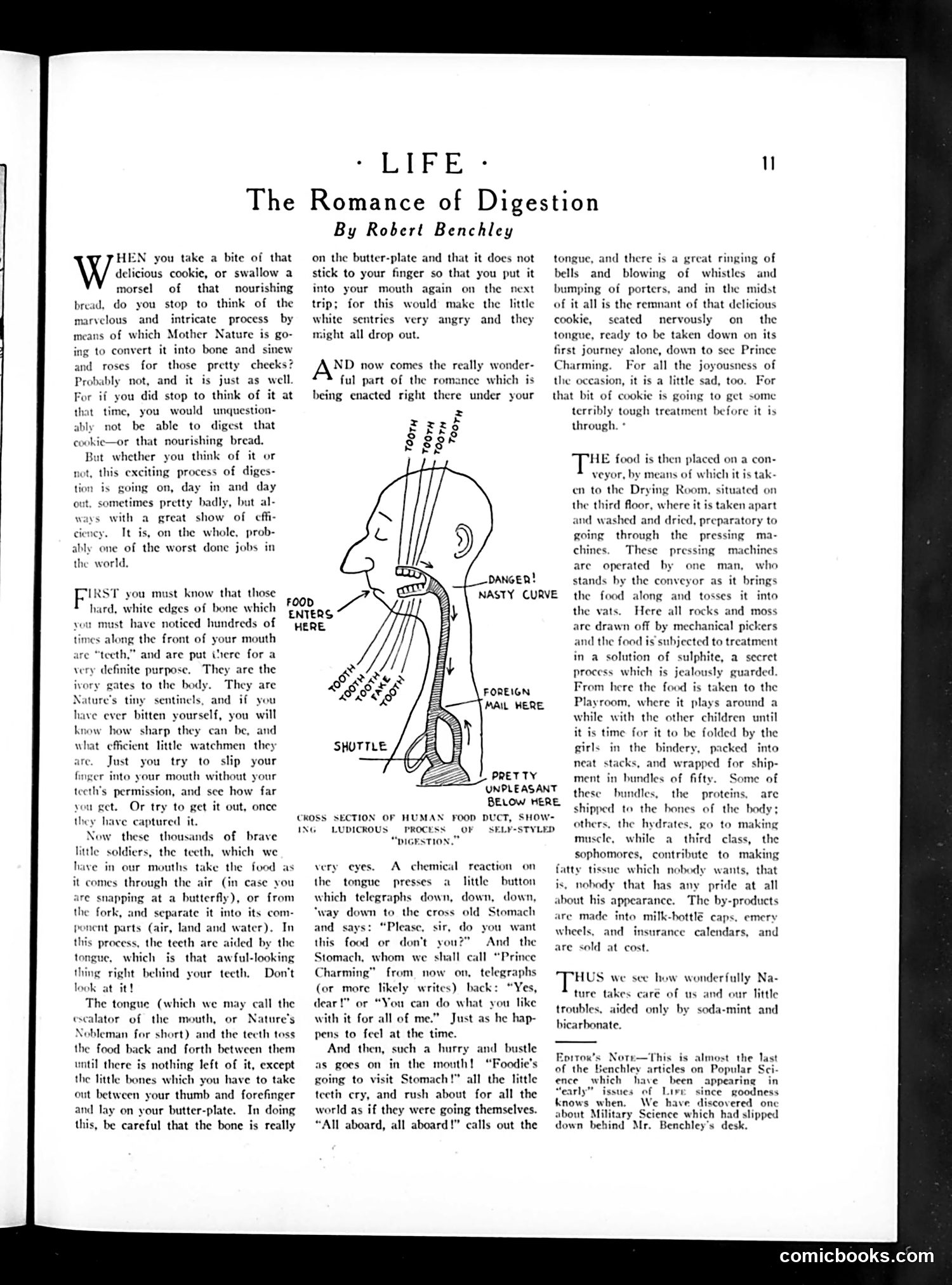
This is a humorous scientific illustration and essay explaining human digestion to a general audience. The labeled anatomical diagram shows the digestive tract with playful labels like "Danger! Nasty Curve," "Foreign Mail Here," and "Pretty Unpleasant Below Here." Benchley's text employs comedic personification, referring to the stomach as "Prince Charming" and describing digestion as a whimsical journey. He anthropomorphizes the digestive process—a cookie travels through the system like a character on an adventure, with teeth acting as "sentinels" and the stomach sending telegraphic messages. The satire gently mocks both overly technical scientific writing and readers' general discomfort discussing bodily functions. It makes digestive science accessible and entertaining for Life magazine's educated, middle-class audience by treating an undignified biological process with mock-serious, playful language.
📄 Transcribed text from this page (OCR, searchable)
Machine-transcribed from the original scan — historical spelling and the odd misread are preserved.
The HEN you take a bite of that W delicious cookie, or swallow a morsel of that nourishing bread, do you stop to think of the marvelous and intricate process by means of which Mother Nature is go- ing to convert it into bone and sinew and roses for those pretty cheeks? Probably not, and it is just as well. For if you did stop to think of it at that time, you would unquestion- be able to digest that cookie—or that nourishing bread. But whether you think of it or iting process of diges- tion is going on, day in and day out, sometimes pretty badly, but al- with a great of effi- ciency. It is, on the whole, prob- ably one of the worst done jobs in the world, ably not not, this e ways show IRST you must know that those hard, white edges of bone which you must have noticed hundreds of along the front of your mouth tecth,” and are put ihere for a very definite purpose, They are the ivory gates to the body. They are Nature's tiny sentinels, and if you have ever bitten yourself, you will know how sharp they can be, and what efficient little watchmen they Just you try to slip your finger into your mouth without your teeth’s permission, and see how far you get. Or try to get it out, once y have captured it. wv these thousands of brave little soldiers, the teeth, which we have in our mouths take the it comes through the air (in case you are snapping at a butterfly), or from the fork, and separate it into its com- ponent parts (air, land and water). In this process, the teeth are aided by the tong! which is that awful-looking thing right behind your teeth. Don't look at it! The tongue (which we may call the escalator of the mouth, or Nature's Nobleman for short) and the tecth toss the food back and forth between them il there is nothing left of it, except the little bones which you have to take out between your thumb and forefinger and lay on your butter-plate. In doing this, be careful that the bone is really time are foed as « LIFE. * Romance of Digestion By Robert Benchley on the butter-plate and that it does not stick to your finger so that you put it into your mouth again on the next trip; for this would make the little white sentries very angry and they might all drop out. ND now comes the really wonder- ful part of the romance which is being enacted right there under your = zr és ees é ze gk ® SS, & IMMMINS FOREIGN MAIL HERE PRETTY UNPLEASANT BELOw HERE CROSS SECTION OF HUMAN FOOD DUCT, SHOW- STYLED ING LUDICROUS — PROCESS “DIGESTION.” OF SEL very eyes. A chemical reaction the tongue presses a little button which telegraphs down, down, down, ‘way down to the cross old Stomach and says: “Please, sir, do you want this food or don't you?” nd the Stomach, whom we shall call “Prince Charming” from now on, telegraphs (or more likely writes) back: “Yes, dear!” or “You can do what you like with it for all of me.” Just as he hap- pens to feel at the time. And then, such a hurry and bustle as goes on in the mouth! “Foodie's going to visit Stomach!” all the little tecth cry, and rush about for all the world as if they were going themselves. “All aboard, all aboard!” calls out the tongue, and there is a great ringing of bells and blowing of whistles and bumping of porters, and in the midst of it all is the remnant of that delicious cookie, seated nervously on the tongue, ready to be taken down on its first journey alone, down to sce Prince Charming. For all the joyousness of the occasion, it is a little sad, too. For that bit of cookie is going to get some terribly tough treatment be through. * re it is 'HE food is then placed on a con- veyor, by means of which it is tak- en to the Drying Room, situated on the third floor, where it is taken apart and washed and dried, preparatory to going through the pressing ma- chines. These pressing machines are operated by man, who stands by the conveyor as it brings the food along and tosses it into the vats. Here all rocks and moss are drawn off by mechanical pickers and the food is subjected to treatment in a solution of sulphite, a sceret process which is jealously guarded. From here the food is taken to the Playroom, where it plays around a while with the other children until it is time for it to be folded by the girls in the bindery, packed into neat stacks, and wrapped for ship- ment in bundles of fifty. Some of these bundles, the proteins, are shipped to the bones of the body: one others, the hydrates, go to making muscle, while a third class, the sophomores, contribute to making fatty tissue which nobody wants, that is, nobody that has any pride at all about his appearance. The by-products are made into milk-hottlé caps. emery wheels, and insurance calendars, and are sold at cost. ‘THus we see how wonderfully Na- ture takes caré of us and our little troubles, aided only by soda-mint and bicarbonate. Eprtok’s Nore—This is almost the last of the Benchley articles on Popular S ence which have been appearing in “early” issues of Lire since goodness knows when. We have discovered onc about Military Science which had slipped down behind Mr. Benchley’s desk. comicbooks.com