
Life, 1925-10-01 · page 26 of 36
Life — October 1, 1925 — page 26: what you’re looking at
What you’re looking at
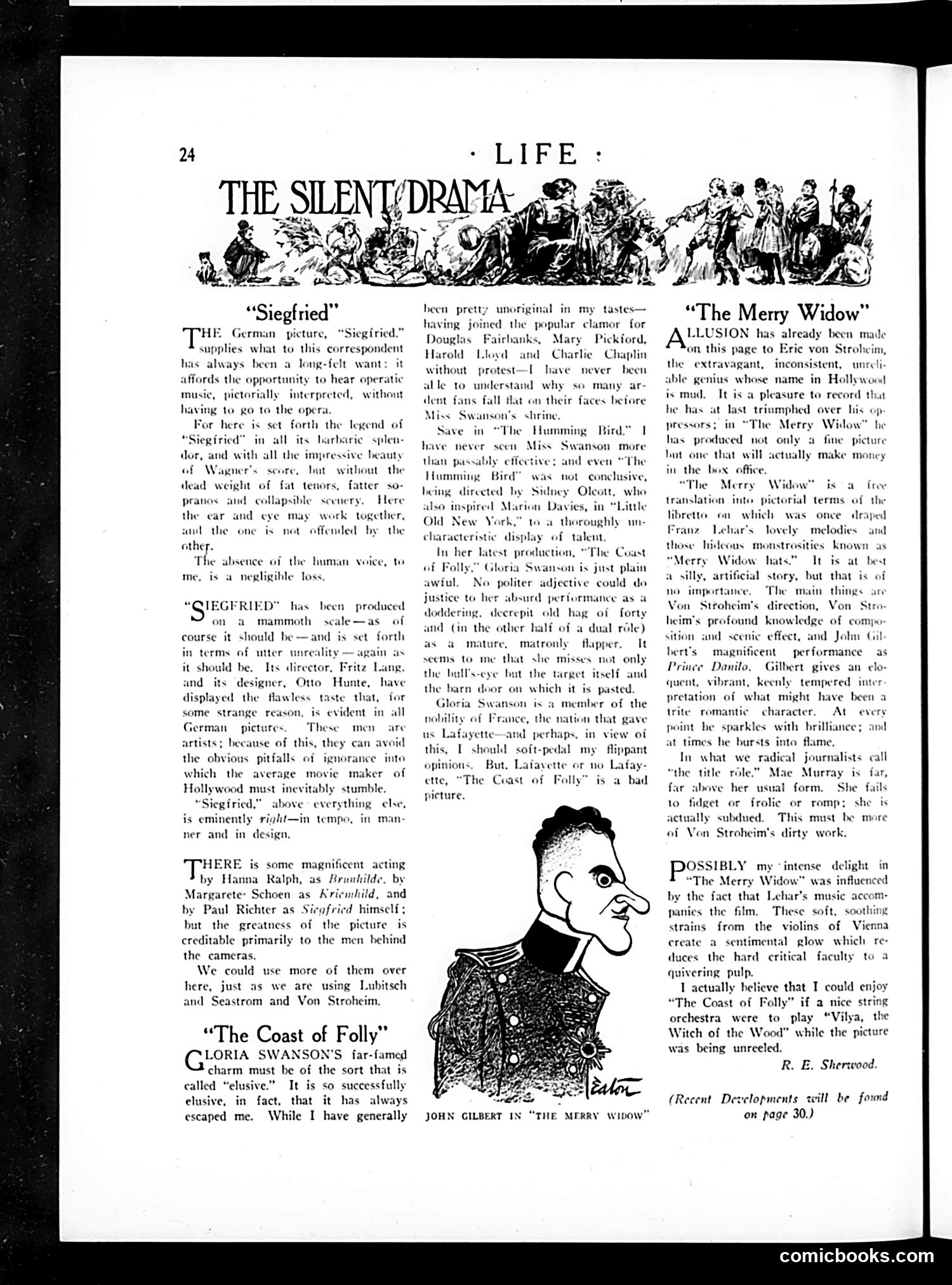
This page reviews three silent films from the 1920s. The critic praises the German film *Siegfried* for presenting Wagner's opera visually without live singers—eliminating "the dead weight of fat tenors." Director Fritz Lang and designer Otto Hunte receive high marks for tasteful execution. *The Coast of Folly* receives harsh criticism. The reviewer dismisses Gloria Swanson's famous "elusive charm" as genuinely elusive—meaning it escapes him entirely. He calls her performance "awful," mocking her portrayal of both a decrepit 40-year-old hag and a matronly flapper in a dual role. *The Merry Widow*, directed by Erich von Stroheim (shown in the caricature), is praised as a commercial success that finally vindicates the "extravagant, unreliable genius." The adaptation of Lehár's operetta music to film succeeds despite its "silly, artificial story," aided by von Stroheim's compositional knowledge. The reviews exemplify 1920s film criticism—evaluating visual composition, acting, and directorial taste.
📄 Transcribed text from this page (OCR, searchable)
Machine-transcribed from the original scan — historical spelling and the odd misread are preserved.
“Siegfried” HE German picture, supplies what to this correspondent has always been a long-felt: want: it affords the opportunity to hear operatic music, pictorially interpreted, without having to go to the opera. For here is set forth the legend of “Siegfried” in all its barbaric splen- dor, and with all the impressive beauty of Wa without the dead weight of fat tenors, fatter so- scenery, Here work together, is net offended by the “Siegfried.” ners score, but pranos and. collapsible the car and eye may and the one other. The absence of the human voice, to me, is a negligible loss. has been a mammoth produced seale—as of course it should be —and is set forth in terms of utter unreality — again as it should be. Its director, Fritz Lang. and its designer, Otto Hunte, have displayed the flawless taste that, for some strange reason, is evident in all German pictures, — These artists; because of this, they can avoid the obvious pitfalls of ignorance into which the Hol men are average movie maker of ywood must inevitably stumble. egiried,” above everything else, is eminently right—in tempc ner and in design. in man- HERE is some magnificent by Hanna Ralph, as Brinhilde, by Margarete: Schoen as Ariemhild, and by Paul Richter as Siegfried himself; but the greatness of the picture is creditable primarily to the men behind the cameras. We could use more of them over here, just as we are using Lubitsch and Seastrom and Von Stroheim. “The Coast of Folly” ORIA SWANSON'’S far-famed charm must be of the sort that is called “elusive.” It is so successfully elusive, in fact, that it has alway escaped me. While I have generally heen pretty unoriginal in my tastes— having joined the popular clamor for Douglas irhanks, Mary Pickford, Harold Lloyd Charlie Chaplin without protest—[ have never alle to understand why so many ar- dent fans fall Hat on their faces betore Miss Save in and been Swanson’s shrine. “The seen Bird.” 1 Swanson Humming Miss than passubly effective; Bird’ conclusive, heing directed by Sidney Olcott, who also inspired Marion Davies, in “Little Old New York.” to a thoroughly un- characteristic display of talent. The Coast Gloria Swanson is just plain have never more and even “The Humming was not In her latest: production, awful. No politer adjective could do justice to her absurd performance as a doddering. decrepit old hag of forty and (in the other half of a dual role) mature, matronly flapper. It seems to me that she misses not only the bull’s-cye but the target itself and the barn deor on which it is pasted. Gloria Swanson is a member of the nobility of France, the nation that gave us Lafayette—and perhaps, in view of this, [ should) soft-pedal my flippant opinions, But, Lafayette or no Lafay ette, “The Coast of picture. lly” is a bad JOHN GILBERT IN “THE MERRY WIDOW" “The Merry Widow” LLUSION has already been made ‘on this page to Eric von Stroheim, inconsistent, able genius whose name in Hollywood It is a pleasure to record that hhe has at last triumphed over his op the extravagant, unreli is mud, pressors; in “The Merry Widow" he has produced not only a_ fine picture hut one that will actually make money in the box office, “The Merry Widow" is a free translation inte pictorial terms of the libretto on whieh once draped Franz Lehar’s melodies and those hi monstrosities known as “Merry Widow hats.” It a silly, artificial story, but The things are direction, Von Stro heim's profound knowledge of compo- was lovely cous is at best that is of no importance main mn Stroheim’s sition and scenic effect, and John Gil hert’s magnificent performance as Prince Danilo, Gilbert gives an elo- quent, vibrant, keenly tempered inter pretation of what might have been a trite romantic character. At every point he sparkles with brilliance; snd at times he bursts into flame, In what we radical journalists call “the title rol Mae Murray is far, far above her usual form. She fails to fidget or frolic or romp; she is actually subdued. This must be more of Von Stroheim's dirty work. OSSIBLY my ‘intense delight in The Merry Widow” was influenced by the fact that Lehar’s music accom- panies the film. These soft, soothing strains from the violins of Vienna create a sentimental glow which re- duces the hard critical faculty to a quivering pulp. I actually believe that I could enjoy “The Coast of Folly” if a nice string orchestra were to play “Vilya, the Witch of the Wood” while the picture was being unrceled. R. E. Sherwood. (Recent Developments will be found on page 30.) comicbooks.com