
Life, 1925-10-01 · page 24 of 36
Life — October 1, 1925 — page 24: what you’re looking at
What you’re looking at
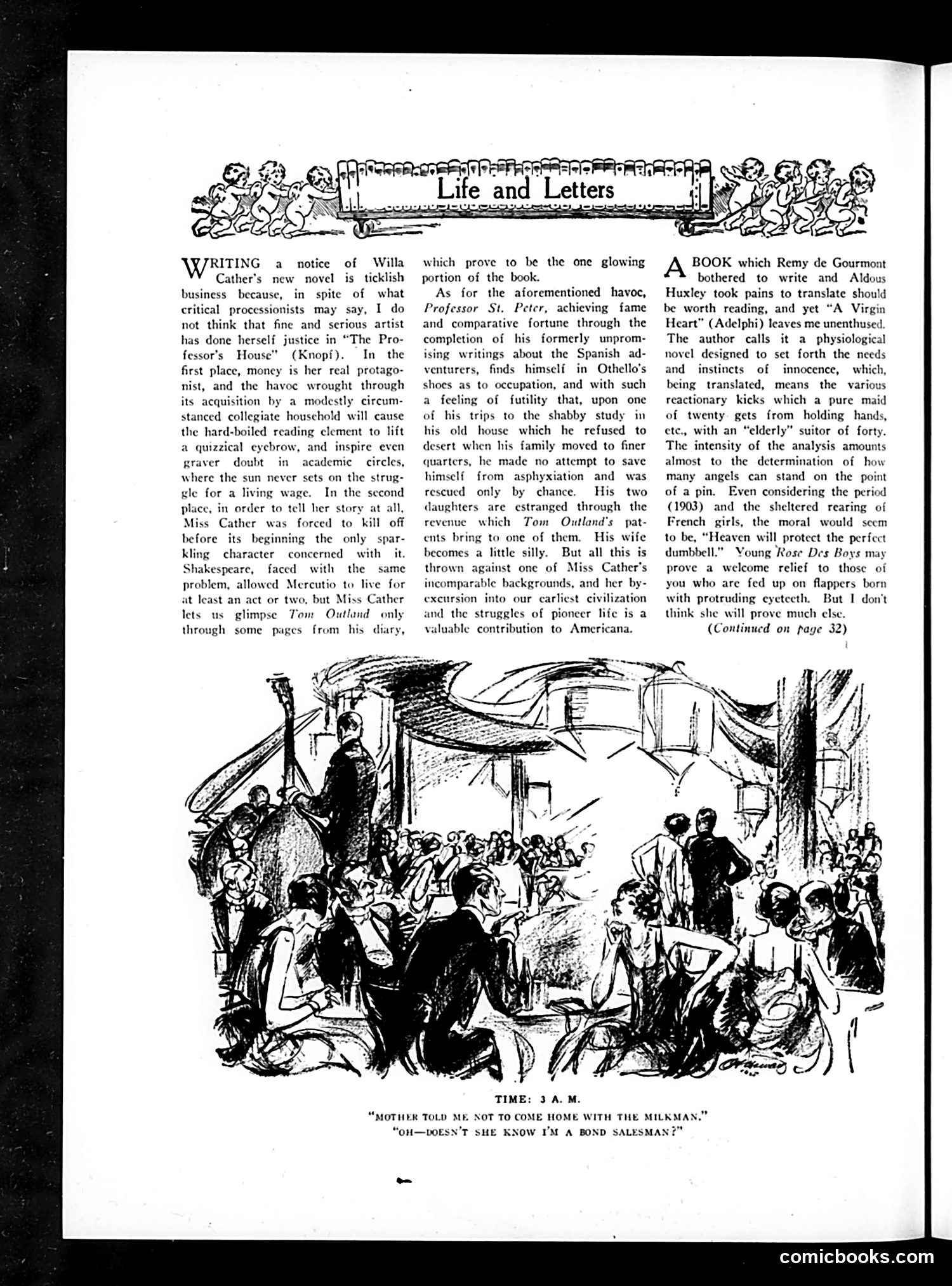
This page contains literary reviews and a cartoon joke typical of 1920s American satirical humor. **The Reviews:** Two book critiques discuss Willa Cather's *The Professor's House* and a translated French novel, *A Virgin Heart*. The Cather review praises her pioneer themes but criticizes her plot choices and focus on money's corrupting effects on an academic family. **The Cartoon:** The bottom illustration depicts a 3 A.M. scene with a woman and a man in formal dress. The caption's joke plays on social pretense: a mother warns her daughter against coming home with "the milkman" (implying scandal with working-class help), but the man claims he's actually a "bond salesman"—suggesting that his white-collar professional status supposedly makes the late-night encounter respectable. The satire mocks how 1920s society judged propriety based on class markers rather than actual behavior, and the absurdity of believing occupation could legitimize questionable conduct.
📄 Transcribed text from this page (OCR, searchable)
Machine-transcribed from the original scan — historical spelling and the odd misread are preserved.
LER “Lif ge ot RITING a Cather’s new novel is ticklish business because, in spite of what critical processionists may say, I do not think that fine and serious artist has done herself justice in “The Pro- fessor’s House” (Knopf). In_ the first place, money is her real protago- nist, and the havoc wrought through its acquisition by a modestly circum- stanced collegiate houschold will cause the hard-boiled reading element to lift a quizzical eyebrow, and inspire even graver doubt in academic circles, where the sun never sets on the strug- gle for a living wage. In the second place, in order to tell her story at all, Miss Cather was forced to kill off before its beginning the only spar- kling character concerned with — it. Shakespeare, faced with the same problem, allowed Mercutio to live for at least an act or two, but Miss Cather lets glimpse Tom Outland only through some pages from his diary, notice of Willa which prove to be the one glowing portion of the book. As for the aforementioned havoc, Professor St. Peter, achieving fame and comparative fortune through the completion of his formerly unprom- ising writings about the Spanish ad- venturers, finds himself in Othello’s shoes as to occupation, and with such a feeling of futility that, upon one of his trips to the shabby study in his old house which he refused to desert when his family moved to finer quarters, he made no attempt to save himself from asphyxiation and was rescued only by chance. His two daughters are estranged through the which Tom Outland’s pat- ents bring to one of them, His wife becomes a little silly. But all this is thrown against one of Miss Cather’s incomparable backgrounds, and her by- excursion into our carliest civilization and the struggles of pioneer life is a valuable contribution to Americana. revenue TIME: 3 A. M. A BOOK which Remy de Gourmont bothered to write and Aldous Huxley took pains to translate should be worth reading, and yet “A Virgin Heart” (Adelphi) leaves me unenthused. The author calls it a physiological novel designed to set forth the needs and instincts of innocence, which, being translated, means the various reactionary kicks which a pure maid of twenty. gets from holding hands, ete, with an “elderly” suitor of forty. The intensity of the analysis amounts almost to the determination of how many angels can stand on the point of a pin. Even considering the period (1903) and the sheltered rearing of French girls, the moral would seem to be, “Heaven will protect the perfect dumbbell.” Young Rose Des Boys may prove a welcome relief to those of you who are fed up on flappers born with protruding eyeteeth. But I don't think she will prove much else. (Continued on page 32) “MOTHER TOLD ME NOT TO COME HOME WITH THE MILKMAN,” “OH—DOESN'T SHE KNOW I'M A BOND SALESMAN?” comicbooks.com