
Life, 1925-10-01 · page 20 of 36
Life — October 1, 1925 — page 20: what you’re looking at
What you’re looking at
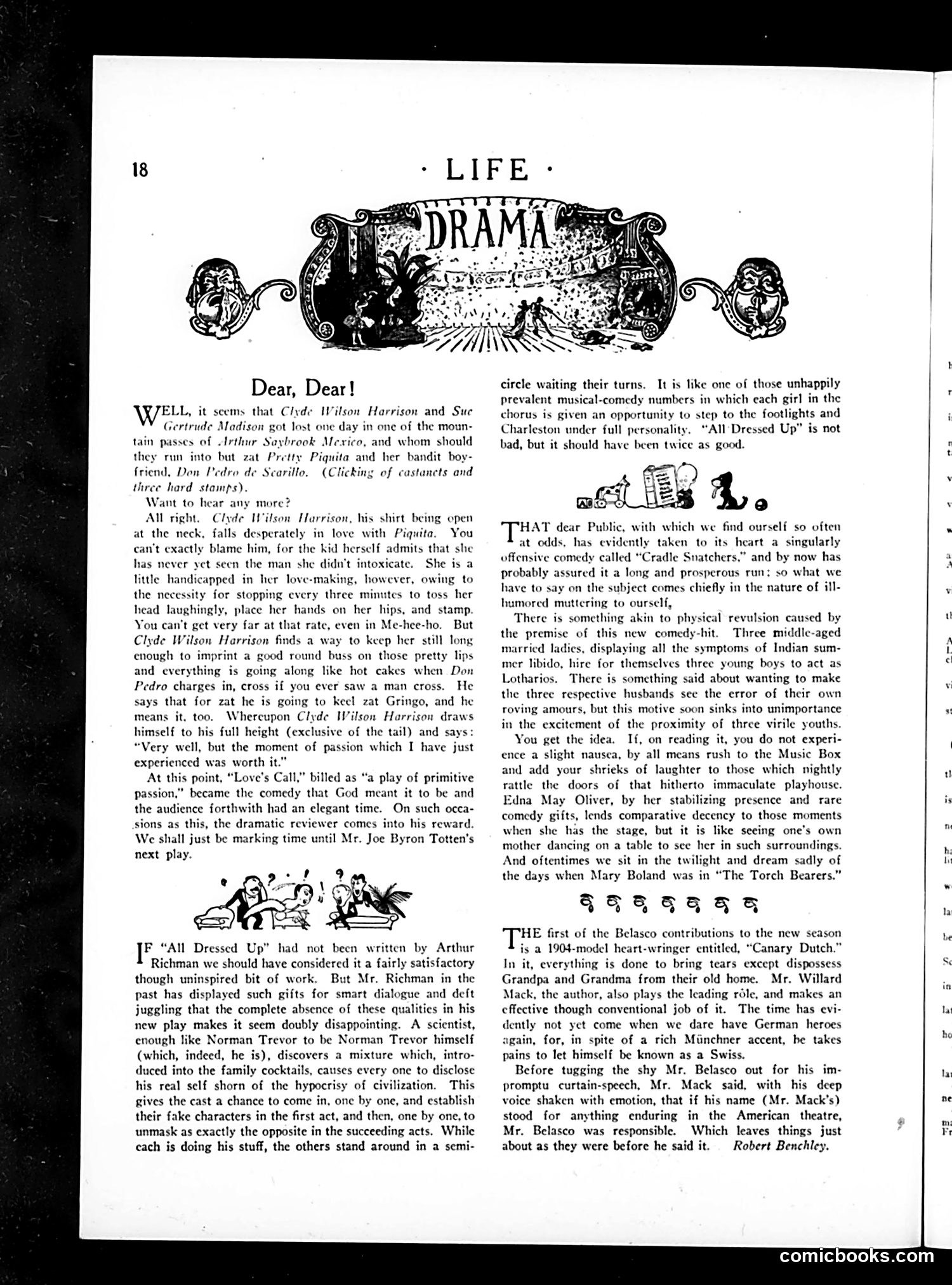
This is a theater criticism page from Life magazine's satirical "Drama" section. The reviewer discusses three Broadway plays with characteristic snark: **"Love's Call"** is mocked as a melodramatic farce with stock characters—Mexican bandits, passionate peasant girls named Piquita who constantly toss their heads and stamp their feet, and earnest American heroes. The reviewer finds it absurdly predictable yet somehow entertaining. **"All Dressed Up"** by Arthur Richman disappoints the critic. Though competently written, it lacks Richman's usual wit. The plot involves a chemical mixture revealing people's true selves, but the execution bogs down in tedious musical-comedy-style solo moments where each character unmasks in turn. **"Cradle Snatchers"** receives the harshest judgment. The reviewer finds its premise morally offensive: middle-aged married women hiring young men as lovers. Though the public embraced it, the critic expresses "physical revulsion" at the concept, complaining it's a cynical, offensive comedy. The tone is gossipy, superior, and thoroughly dismissive of public taste.
📄 Transcribed text from this page (OCR, searchable)
Machine-transcribed from the original scan — historical spelling and the odd misread are preserved.
Dear, Dear! ELL, it seems that Clyde MWilson Harrison and Sue Gertrude Madison got lost one day in one of the moun- tain passes of Arthur Saybrook Mexico, and whom should they run into but zat Pretty Piquita and her bandit boy- friend, Don Pedro de Scarillo. (Clicking of castancts and three hard stamps). Want to hear any more? All right. Clyde Wilson Harrison, his shirt being open at the neck, falls desperately in love with Piquita. You can't exactly blame him, for the kid herself admits that she has never yet seen the man she didn't intoxicate. She is a little handicapped in her love-making, however, owing to the necessity for stopping every three minutes to toss her head laughingly, place her hands on her hips, and stamp. You can't get very far at that rate, even in Me-hee-ho. But Clyde Wilson Harrison finds a way to keep her still long enough to imprint a good round buss on those pretty lips and everything is going along like hot cakes when Don Pedro charges in, cross if you ever saw a man cross. He says that for zat he is going to keel zat Gringo, and he means it, too. Whereupon Clyde Wilson Harrison draws himself to his full height (exclusive of the tail) and says: “Very well, but the moment of passion which I have just experienced was worth it.” At this point, “Love's Call,” billed as “a play of primitive passion,” became the comedy that God meant it to be and the audience forthwith had an elegant time. On such occa- sions as this, the dramatic reviewer comes into his reward. We shall just be marking time until Mr. Joe Byron Totten’s next play. F “All Dressed Up” had not been written by Arthur Richman we should have considered it a fairly satisfactory though uninspired bit of work. But Mr. Richman in the past has displayed such gifts for smart dialogue and deft juggling that the complete absence of these qualities in his new play makes it seem doubly disappointing. A scientist, enough like Norman Trevor to be Norman Trevor himself (which, indeed, he is), discovers a mixture which, intro- duced into the family cocktails, causes every one to disclose his real self shorn of the hypocrisy of civilization. This gives the cast a chance to come in, one by one, and establish their fake characters in the first act, and then, one by one, to unmask as exactly the opposite in the succeeding acts. While cach is doing his stuff, the others stand around in a semi- circle waiting their turns. It is like one of those unhappily prevalent musical-comedy numbers in which each girl in the chorus is given an opportunity to step to the footlights and Charleston under full personality. “All Dressed Up” is not bad, but it should have been twice as good. i HAT dear Public, with which we find ourself so often at odds, has evidently taken to its heart a singularly offensive comedy called “Cradle Snatchers,” and by now has probably assured it a long and prosperous run; so what we have to say on the subject comes chiefly in the nature of ill- humored muttering to ourself, There is something akin to physical revulsion caused by the premise of this new comedy-hit. Three middle-aged married ladies, displaying all the symptoms of Indian sum- mer libido, hire for themselves three young boys to act as Lotharios. There is something said about wanting to make the three respective husbands see the error of their own roving amours, but this motive soon sinks into unimportance in the excitement of the proximity of three virile youths. You get the idea. If, on reading it, you do not experi- ence a slight nausea, by all means rush to the Music Box and add your shrieks of laughter to those which nightly rattle the doors of that hitherto immaculate playhouse. Edna May Oliver, by her stabilizing presence and rare comedy gifts, lends comparative decency to those moments when she has the stage, but it is like seeing one’s own mother dancing on a table to see her in such surroundings. And oftentimes we sit in the twilight and dream sadly of the days when Mary Boland was in “The Torch Bearers.” SSRSGRS 'HE first of the Belasco contributions to the new season is a 1904-model heart-wringer entitled, “Canary Dutch.” In it, everything is done to bring tears except dispossess Grandpa and Grandma from their old home. Mr. Willard Mack, the author, also plays the leading role, and makes an effective though conventional job of it. The time has evi- dently not yet come when we dare have German heroes again, for, in spite of a rich Miinchner accent, he takes pains to let himself be known as a Swiss. Before tugging the shy Mr. Belasco out for his im- promptu curtain-speech, Mr. Mack said, with his deep voice shaken with emotion, that if his name (Mr. Mack's) stood for anything enduring in the American theatre, Mr. Belasco was responsible. Which leaves things just about as they were before he said it. Robert Benchley. comicbooks.com