
A complete issue · 41 pages · 1923
Life — November 1, 1923
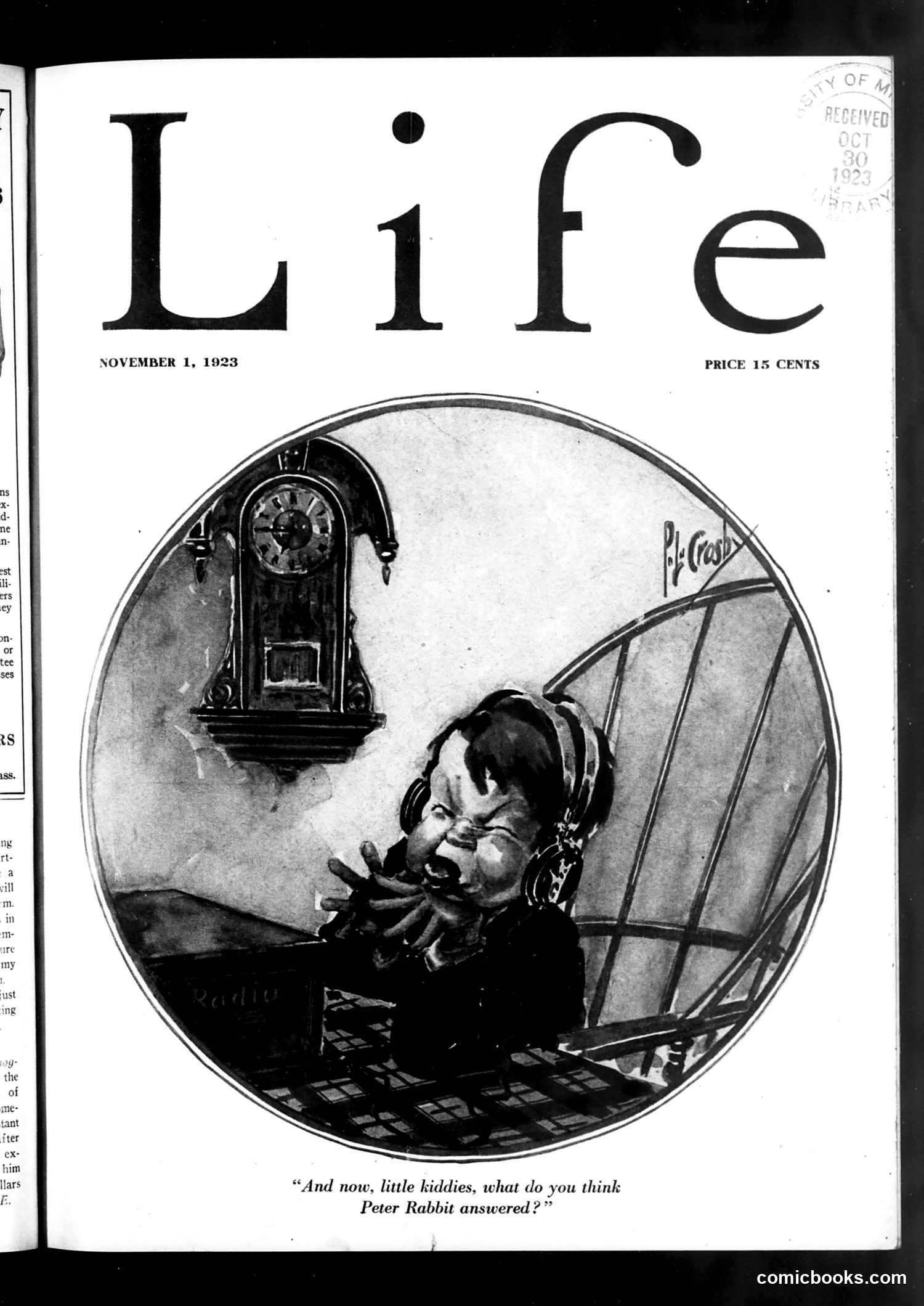
This cover depicts a child in bed looking at a clock on the wall, with the caption "And now, little kiddies, what do you think Peter Rabbit answered?" The image appears to reference **Beatrix Potter's "The Tale of Peter Rabbit,"** a popular children's story. The joke likely plays on the bedtime routine of reading children's stories—suggesting an ironic or unexpected answer to a question from the tale. The Coca-Cola advertisement visible in the corner suggests this may be satirizing commercial culture's infiltration into children's entertainment and bedtime rituals in the 1920s. Without additional context about specific events from November 1923, the precise satirical target remains unclear, though the overall point seems to mock how commercialism was affecting childhood experiences during this era.
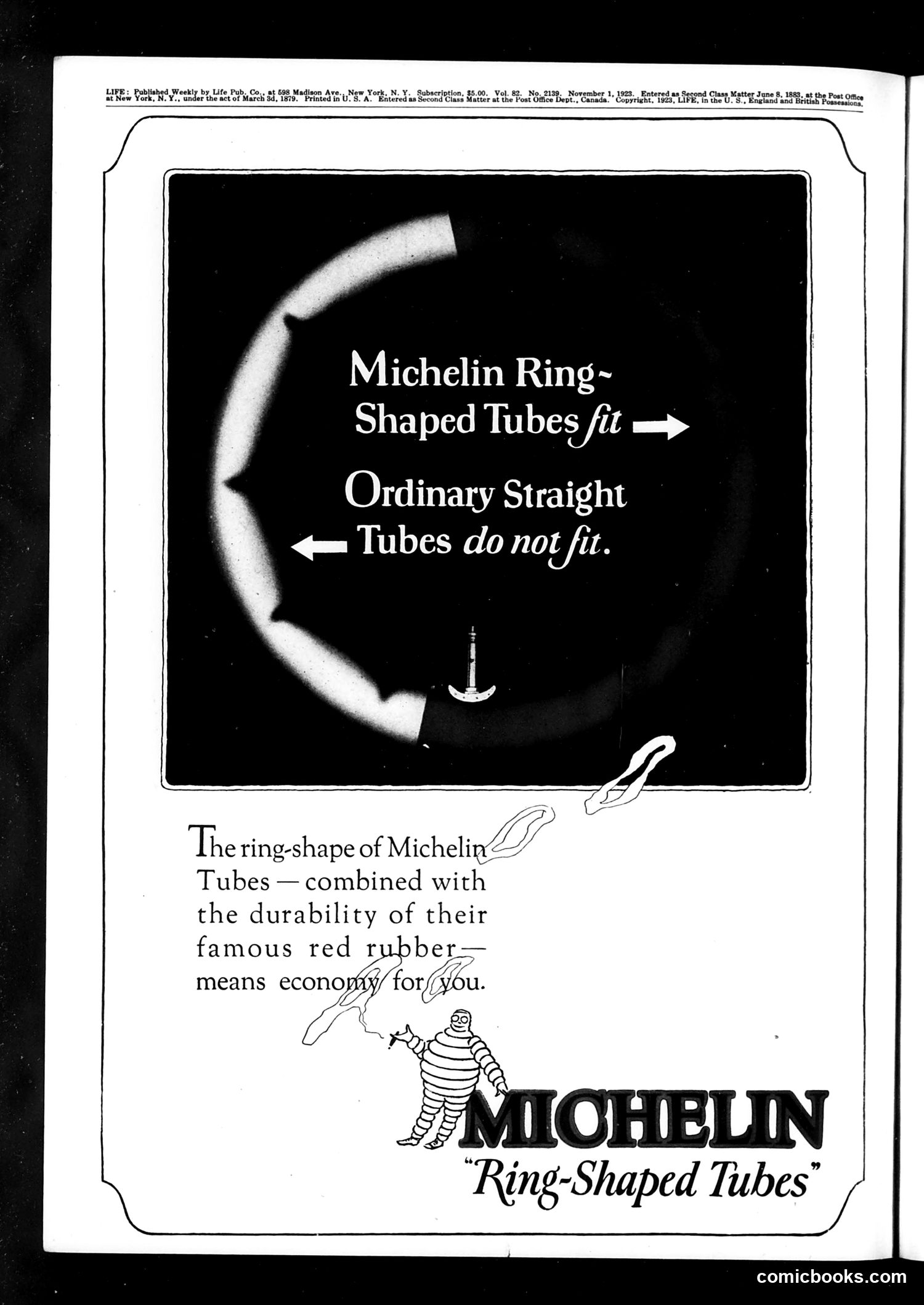
This is a **product advertisement**, not political satire or a cartoon. It promotes Michelin "Ring-Shaped Tubes" (bicycle or tire inner tubes) manufactured by the Michelin company. The ad uses a visual comparison: a photograph of the ring-shaped tube contrasted with an ordinary straight tube, with text stating the ring-shaped version "fit" while straight tubes "do not fit." The point is practical—the proprietary ring design offers superior compatibility and convenience. The Michelin Man mascot (the striped figure) appears at bottom. The sales pitch emphasizes both the product's shape-advantage and Michelin's "famous red rubber" durability, positioning ring-tubes as economical for consumers. This is straightforward commercial advertising from 1922, not editorial content with social commentary.
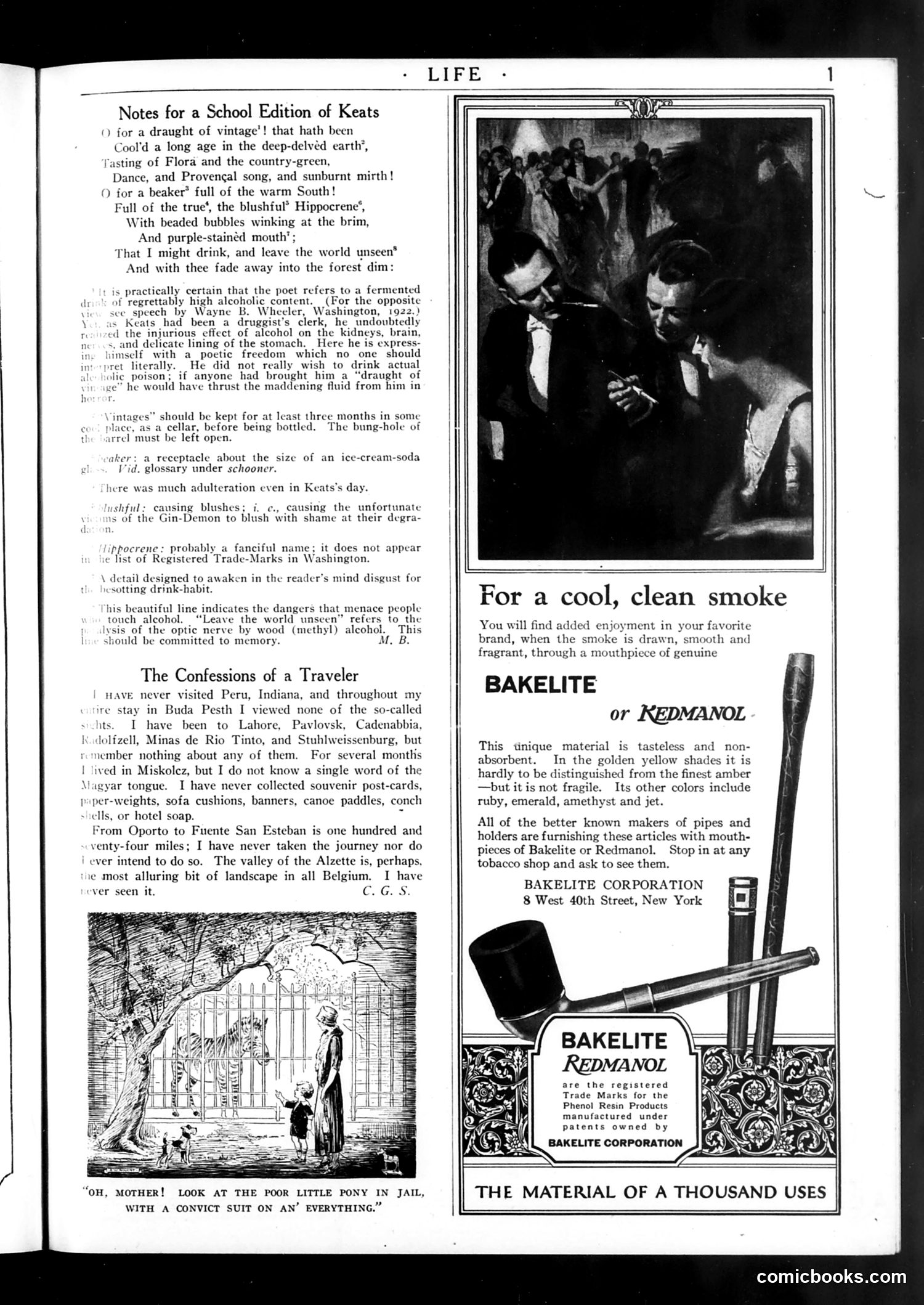
This page is primarily **advertising and editorial content rather than political satire**. The top section contains "Notes for a School Edition of Keats"—scholarly annotations on the poet's work, discussing references to fermented drinks and alcoholic content in his poetry. Below that is "The Confessions of a Traveler," a brief travel essay by C.G.S. describing visits to various European locations. The illustration shows a figure and child at a gate with the caption: "OH, MOTHER! LOOK AT THE POOR LITTLE PONY IN JAIL, WITH A CONVICT SUIT ON AN' EVERYTHING." This appears to be **humorous social commentary**—likely satirizing either animal welfare concerns or the absurdity of treating animals with excessive formality, though the specific context is unclear. The right side features advertisements for **Bakelite/Redmanol pipe tobacco and smoking accessories**.
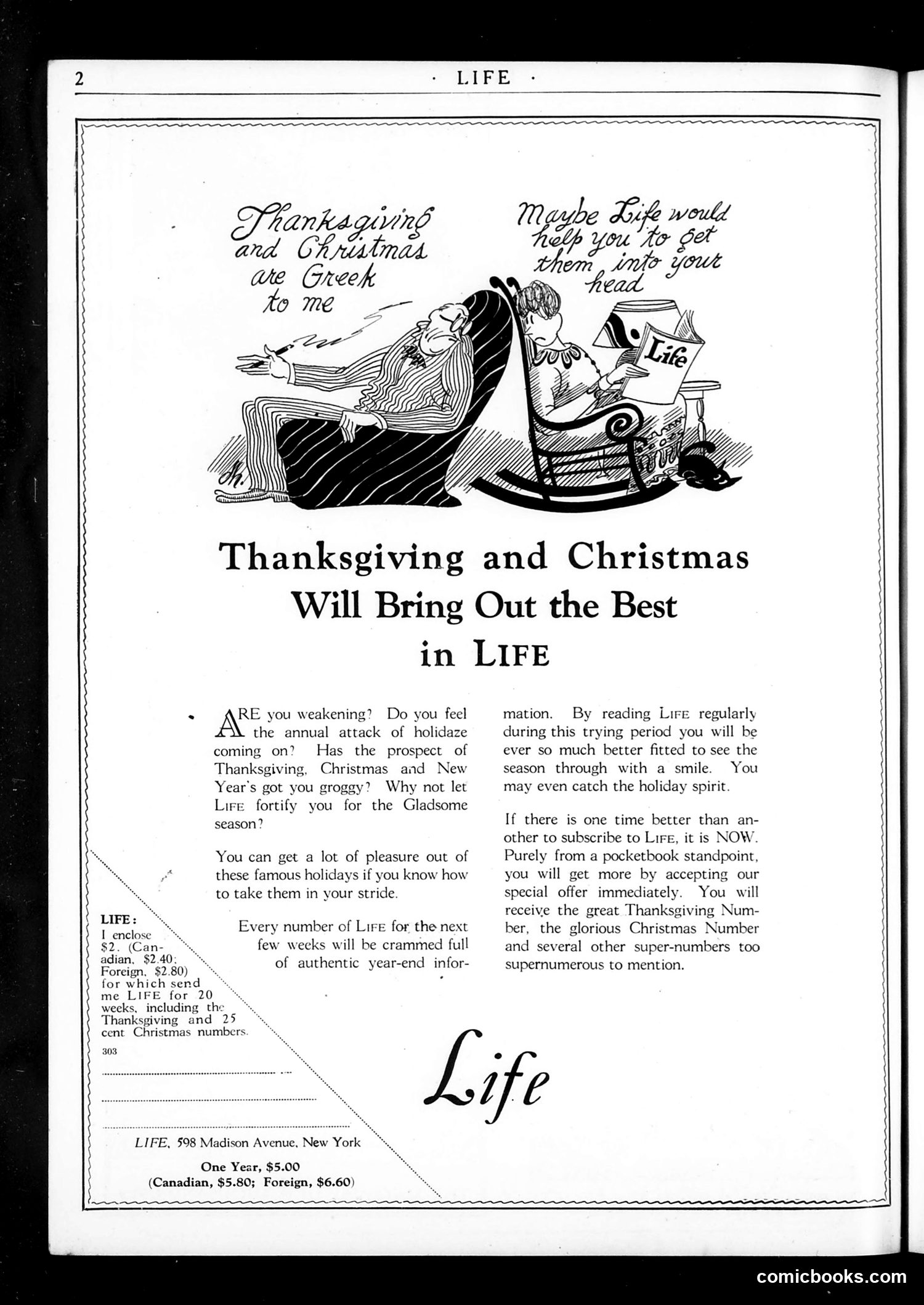
This page is primarily a **subscription advertisement for Life magazine**, not a political cartoon. The illustration shows a man relaxing in a chair while reading Life, with his wife offering him a book titled "Life" and saying "Maybe this would help you to get them into your head." The joke is domestic humor: the husband is so absorbed in Life magazine that his wife sarcastically suggests the publication itself might help educate him. The accompanying text encourages holiday subscriptions, arguing that Life's humor and content will help readers endure the stressful Thanksgiving and Christmas season "with a smile." The "Greeks" reference in the opening caption appears to be a classical allusion (likely to the phrase "it's Greek to me"), playing on the theme of comprehension/education. This is essentially a lighthearted marketing piece using gentle spousal humor to sell magazine subscriptions.
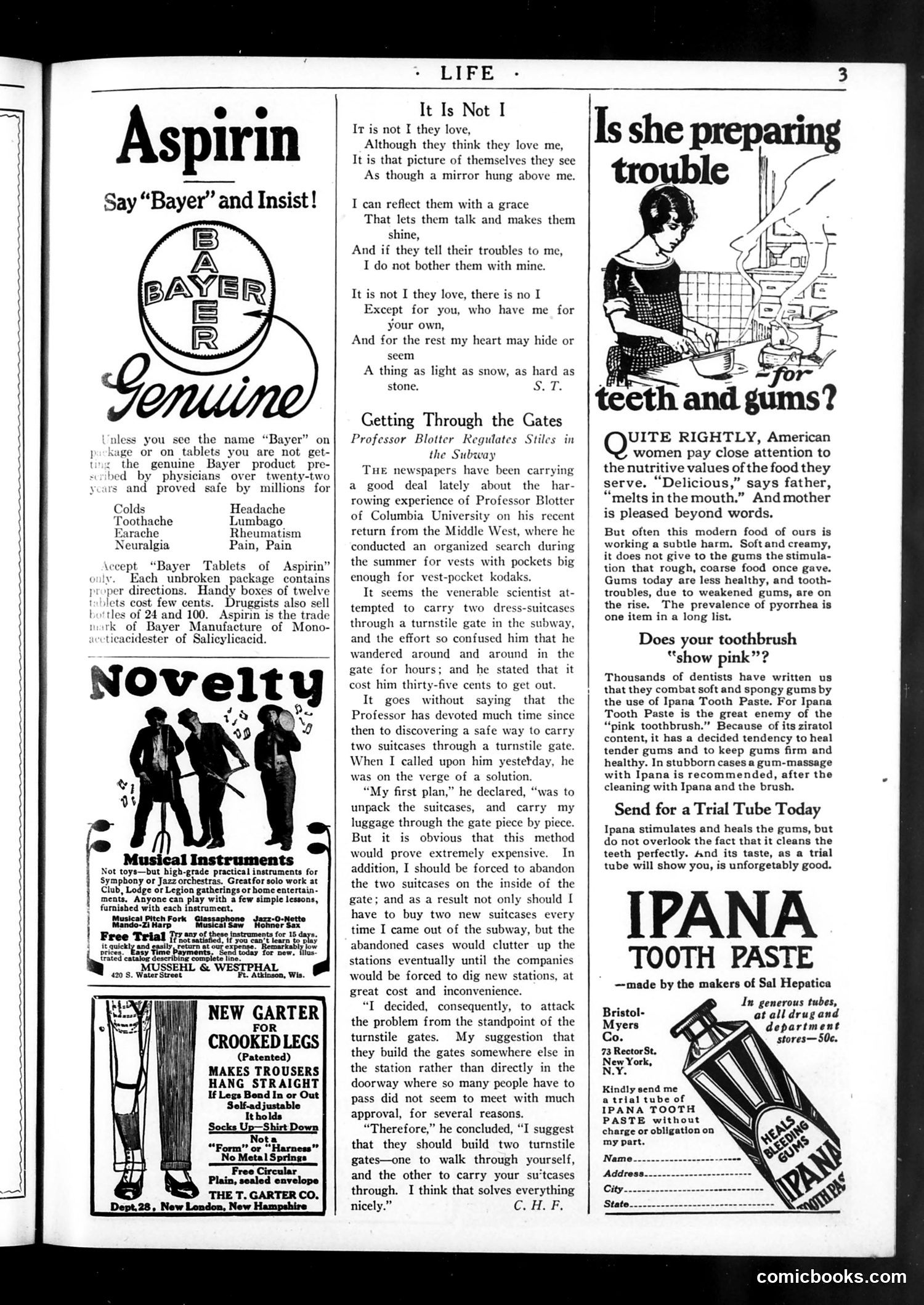
This page is primarily **advertising with minimal editorial content**. The advertisements include: - **Bayer Aspirin**: Emphasizes buying "genuine" Bayer brand specifically, suggesting counterfeit or inferior aspirin products existed in the market. - **Ipana Tooth Paste**: Addresses dental health concerns, particularly gum disease, framing it as caused by "tough, coarse food." - **Musical Instruments** and **Carter's Crooked Legs device**: The latter advertises a medical apparatus claiming to straighten bent legs. The page includes a poem titled "It Is Not I" (author S.T.) and an article "Getting Through the Gates" about Professor Blotter navigating subway turnstiles—likely satirizing bureaucratic inefficiency rather than political commentary. Overall, this represents typical 1920s-era Life magazine mix of **commercial advertisements and light social humor**, without significant political content.
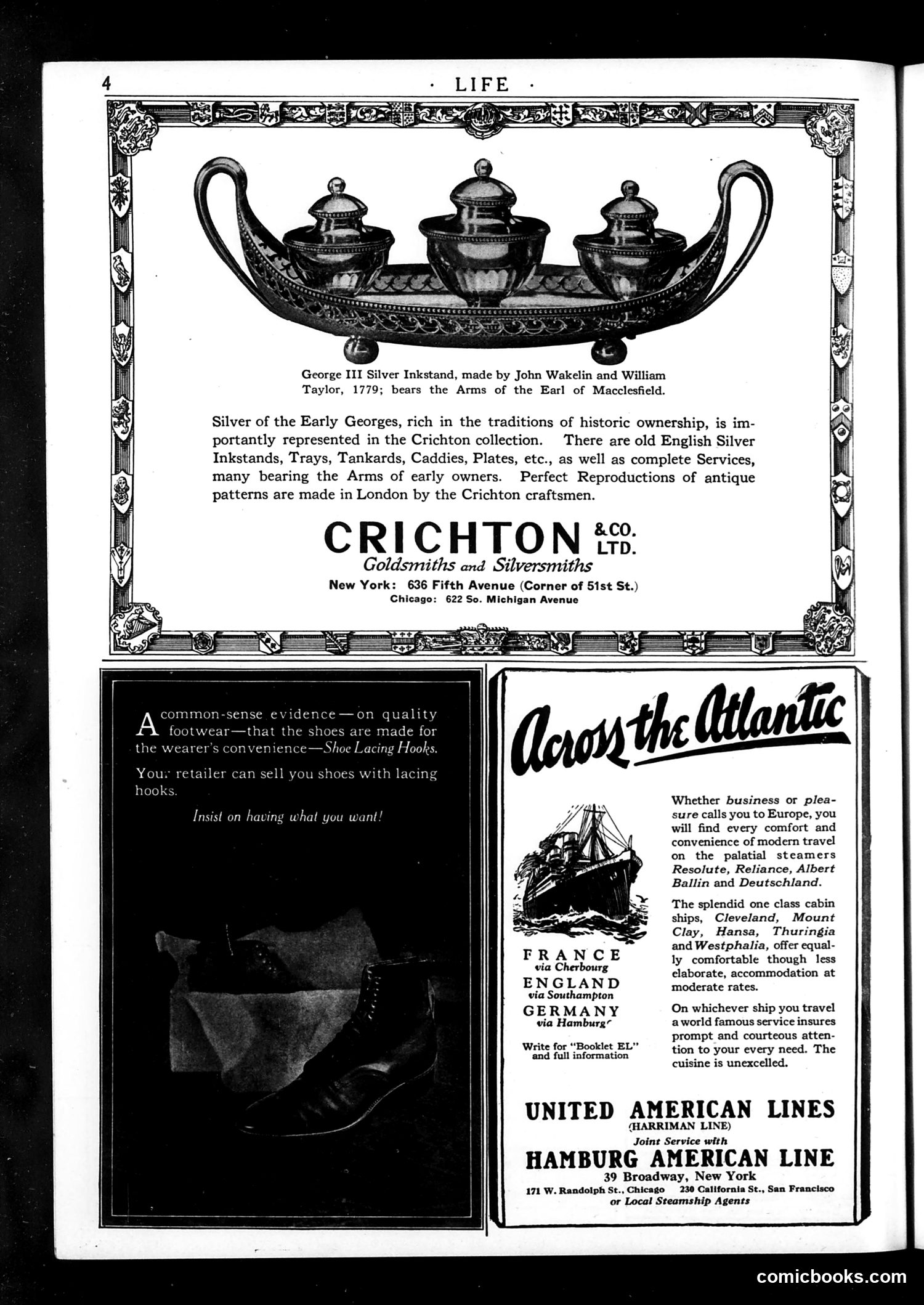
This page is primarily **advertising rather than satirical content**. It contains three advertisements: 1. **Crichton & Co.** (top): Goldsmiths and silversmiths advertising Georgian-era silver items, including a 1779 inkstand made by John Wakelin and William Taylor. They emphasize historic ownership and reproductions of antique patterns. 2. **Shoe advertisement** (bottom left): Promotes shoes with lacing hooks, emphasizing quality and consumer choice ("Insist on having what you want!"). 3. **Across the Atlantic** (bottom right): United American Lines and Hamburg American Line advertise transatlantic steamship travel to Europe, highlighting comfortable cabin ships and courteous service. There are no political cartoons or satire visible on this page—it's a standard advertising section from the magazine.
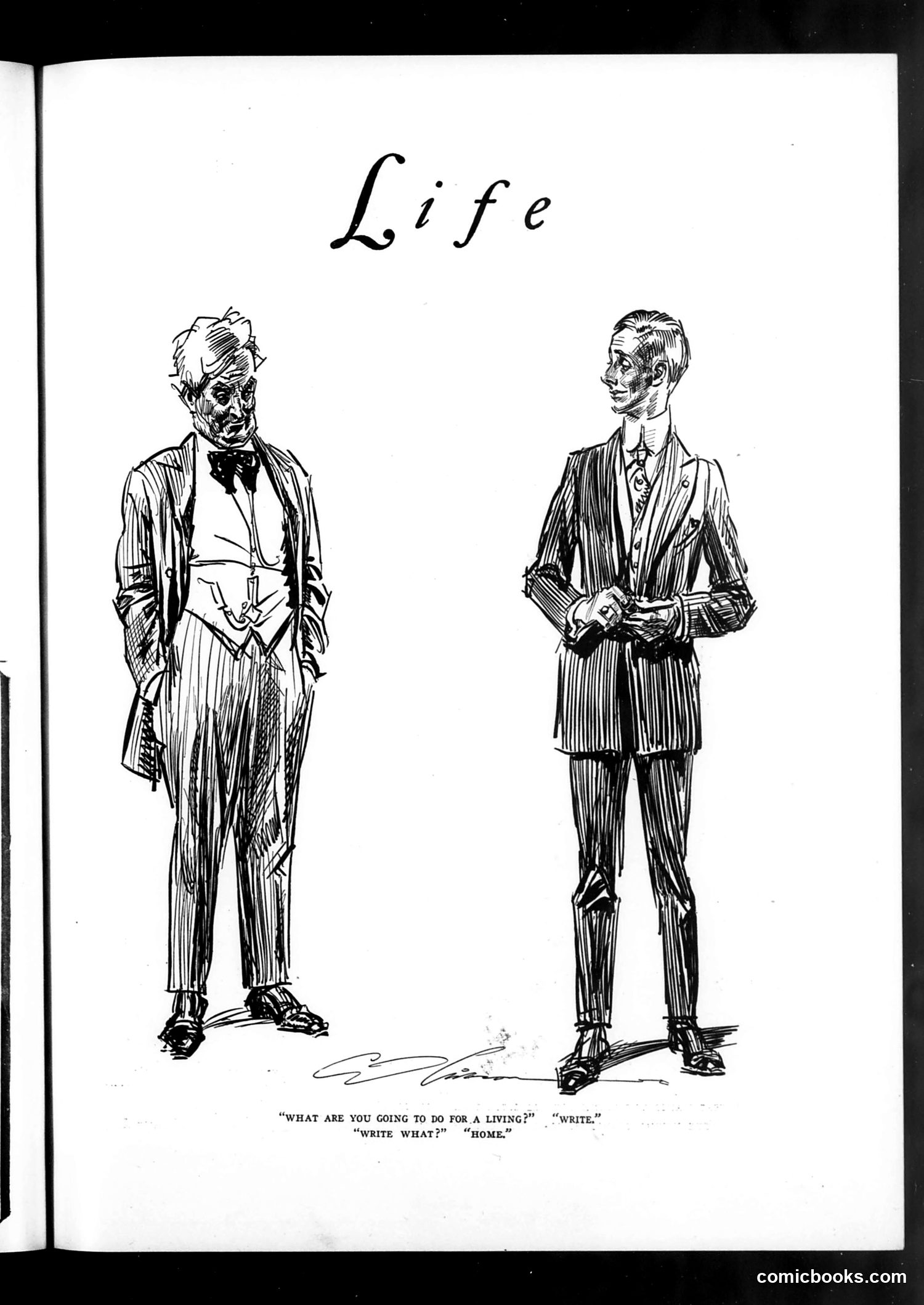
This page from *Life* magazine presents a satirical dialogue between two men about career choices. The older figure (left) asks, "What are you going to do for a living?" The younger man (right) responds simply: "Write." The older man then presses: "Write what?" to which the young man replies, "Home." The satire targets aspiring writers—likely a common concern in early 20th-century America. The joke suggests the young man's ambition is vague and impractical; he plans to write about "home" without clear commercial viability or serious literary ambition. The cartoon mocks both naive youth pursuing artistic careers and the generational tension between practical elders and idealistic youth with undefined creative aspirations.
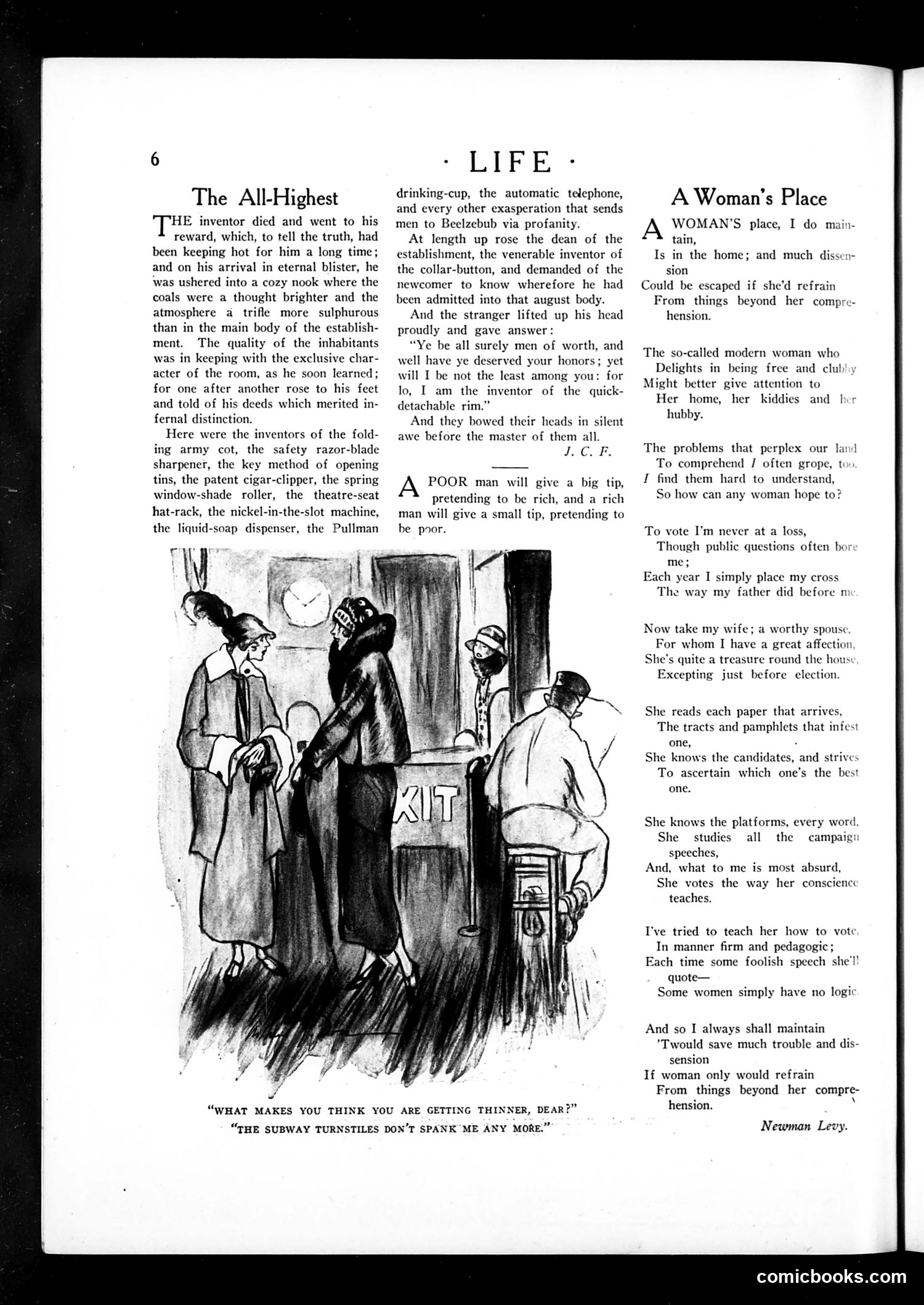
This page from *Life* magazine contains two distinct pieces of satire: **"The All-Highest"** (left column): A fictional anecdote mocking the inventor of various modern conveniences (the "quick-detachable rim," safety razor, etc.). The satire suggests these inventors are self-important and obsequious, bowing before authority figures. **The Cartoon**: Shows what appears to be a subway interaction, with the caption "What makes you think you are getting thinner, dear? The subway turnstiles don't spank me any more." This jokes about weight gain and public transportation—likely satirizing modern urban life and changing social dynamics. **"A Woman's Place"** (right): A poem by Newman Levy criticizing women's political engagement. It argues women should stay home rather than vote and engage in political discourse, reflecting early 20th-century anti-suffrage sentiment. The tone is disapproving of women's expanding public roles.
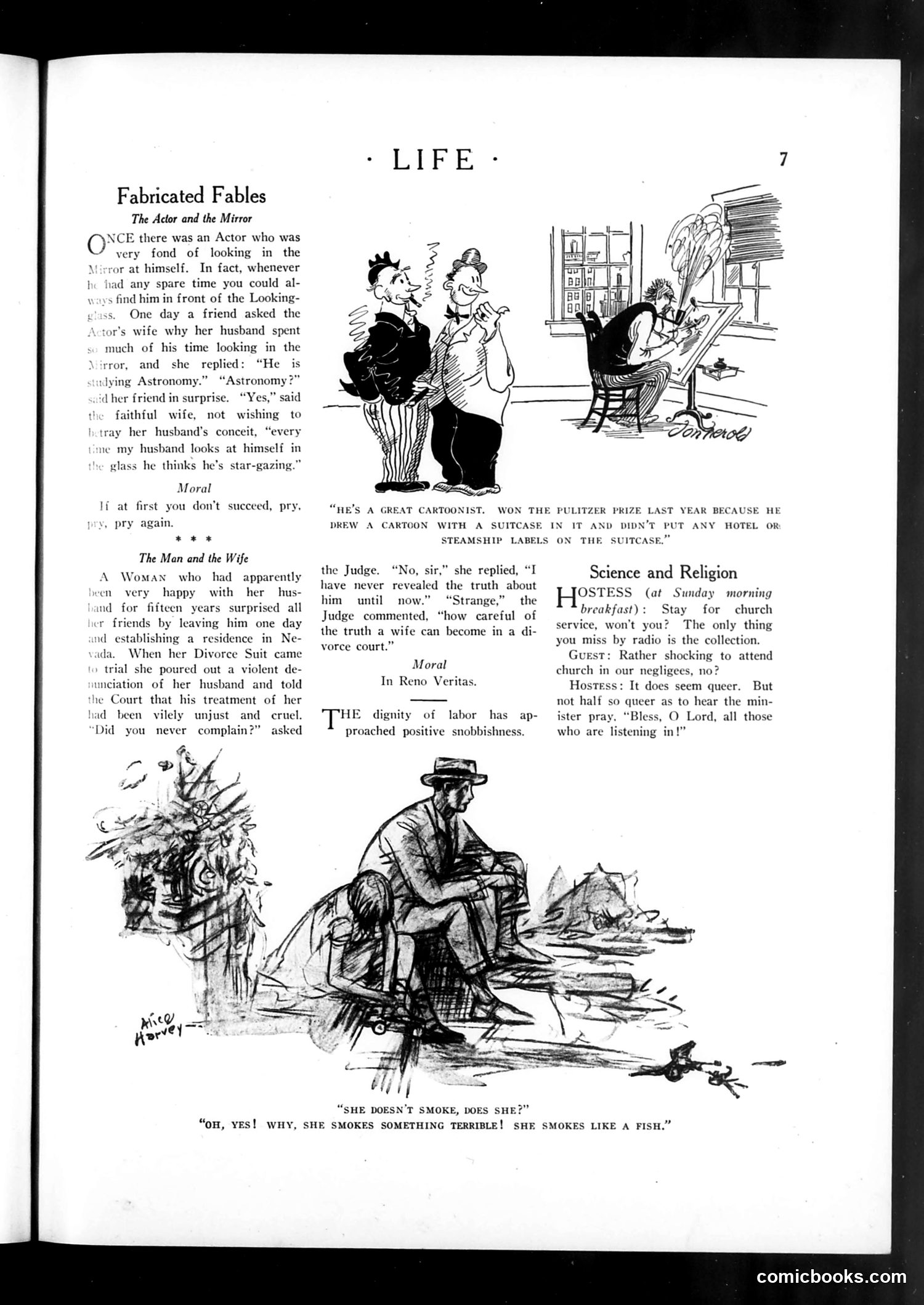
This page contains three satirical pieces on marriage and social observation: **"The Actor and the Mirror"** mocks a vain actor obsessed with self-examination. The joke: his wife claims he's "star-gazing" when actually he's just looking at himself. **"The Man and the Wife"** satirizes a woman who established a legal residence away from her husband to file for divorce. The moral critiques her complaint about his treatment being "unjust and cruel" when she abandoned him first. **"Science and Religion"** presents a church conversation where the hostess notes it's "queer" that a negligent minister's prayer for "all who are listening" excludes most of the congregation—a dig at inattentive clergy. The bottom cartoon, captioned about smoke, appears to depict labor or working-class commentary, though the context is unclear from the visible text.
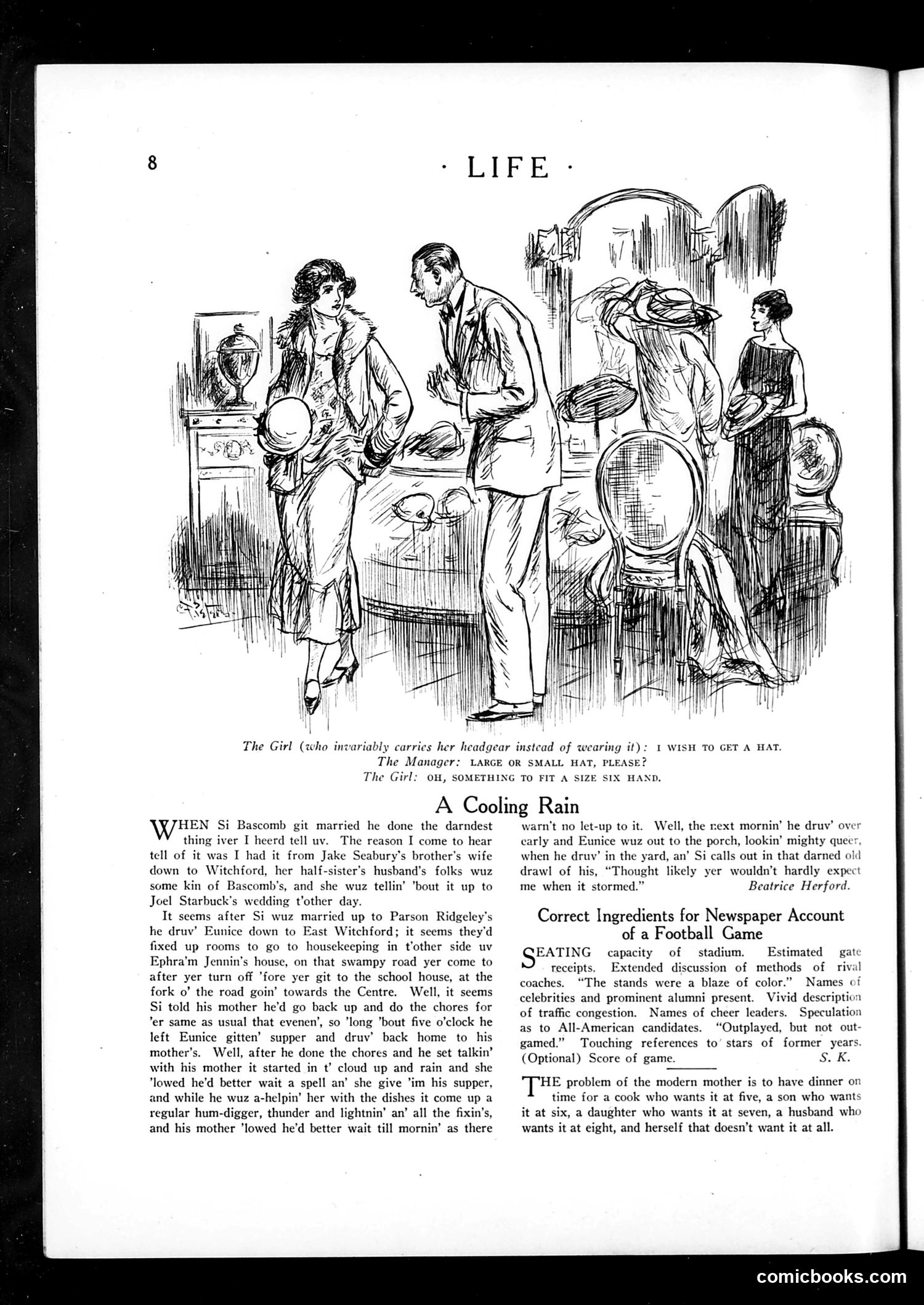
This page contains two separate pieces of satire: **Top cartoon**: A humorous exchange at what appears to be a haberdashery or hat shop. A young woman arrives carrying her headgear rather than wearing it—a fashion faux pas. The manager asks if she needs a large or small hat; she responds she needs "something to fit a size six hand," implying her head is unusually small. The joke satirizes both women's fashion choices and possibly their intelligence. **"A Cooling Rain"**: A short story satirizing marital domesticity and gender roles. It depicts a newlywed husband (Si Bascomb) whose domestic life has become mundane—involving chores, housekeeping duties on "swampy roads," and his wife's practical concerns about dinner timing. The satire targets the contrast between romantic courtship and the tedious reality of early married life, with particular emphasis on wives' management of household logistics. Both pieces mock early-20th-century social conventions and relationships.
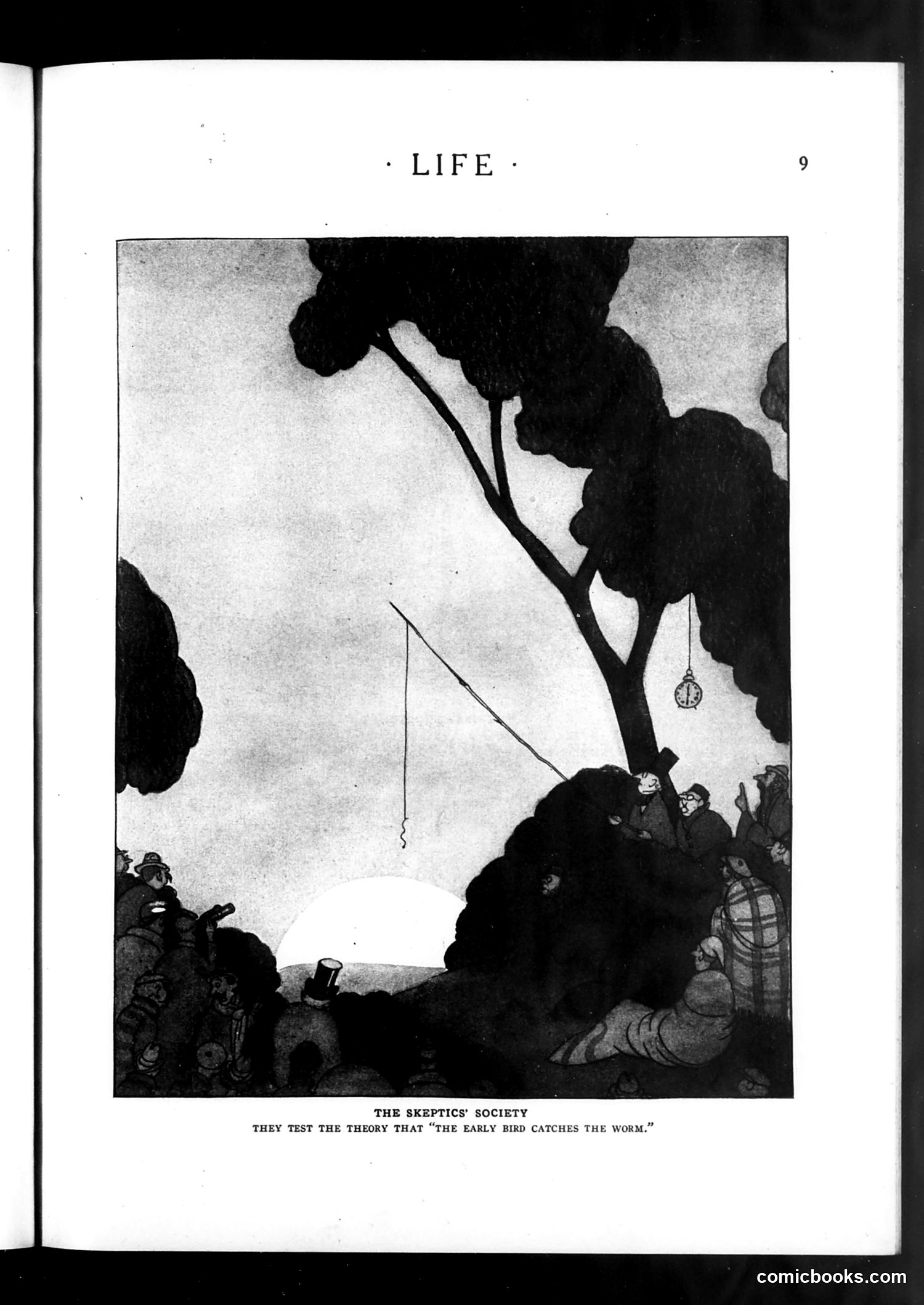
This satirical cartoon illustrates the proverb "the early bird catches the worm" through a darkly humorous scene. A group of skeptical figures (appearing to represent doubters or cynics) gather around a large worm dangling from a tree branch at sunrise. The composition suggests they're testing whether the saying holds true. The joke appears to target people who question conventional wisdom or folk sayings—the "skeptics" are so determined to verify this common adage that they've assembled to conduct an actual experiment. The silhouetted style and the surreal staging create satire about over-analytical thinking and the absurdity of laboriously testing what everyone already accepts as true.
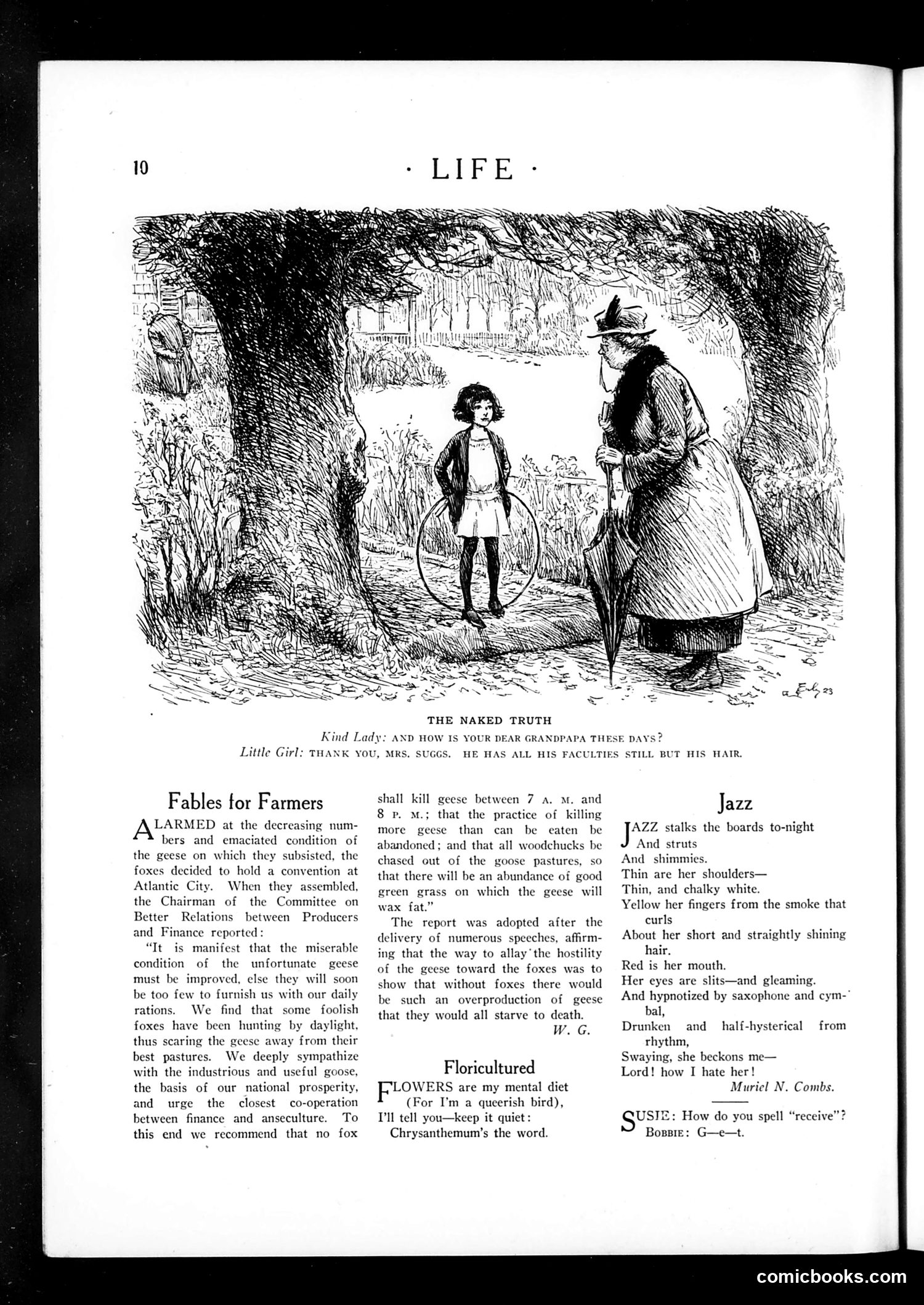
**The Top Cartoon ("The Naked Truth"):** An elderly woman asks a child about their grandfather, who "has all his faculties still but his hair." This is a gentle joke about aging—the child's blunt, innocent response reveals the uncomfortable truth that grandpa is bald despite remaining mentally sharp. The humor lies in the contrast between the kind euphemism adults use and a child's literal honesty. **"Fables for Farmers":** This section discusses a convention addressing declining geese populations. Farmers blamed foxes for losses, but the report argues foxes are actually beneficial (controlling overproduction). The satire critiques farmers' misdiagnosis of their own problems and the need for cooperation between agriculture and finance. The remaining sections contain poetry and wordplay unrelated to satire.
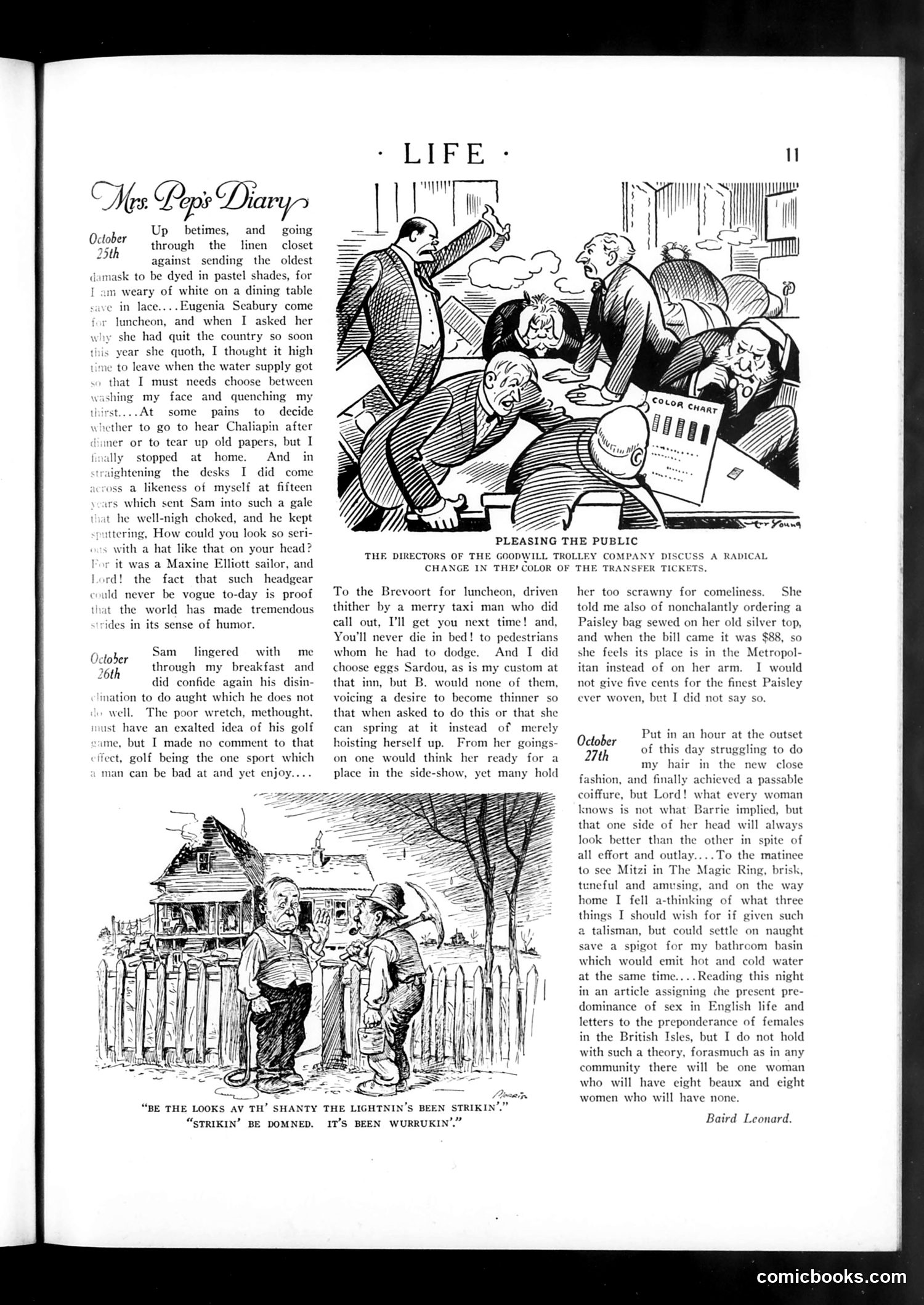
**Top Cartoon:** "Pleasing the Public" depicts directors of the Goodwill Trolley Company discussing a "radical change" to transfer ticket colors. The satire mocks corporate decision-making: bureaucrats debate trivial aesthetic changes while presenting them as significant improvements—a common critique of ineffectual management prioritizing appearance over substance. **Bottom Cartoon:** Two men at a fence discuss lightning striking nearby. One says the lightning "looks ay th' shanty" and has been "strikin'" and is "doomed" and "wurryin'." The joke appears to reference superstitious beliefs about lightning and fate, likely satirizing rural or working-class fatalism. **Text:** "Mrs. Peps' Diary" discusses social observations—dining etiquette, taxi interactions, theater attendance—capturing upper-middle-class concerns of the era. The page satirizes both corporate mediocrity and social pretension.
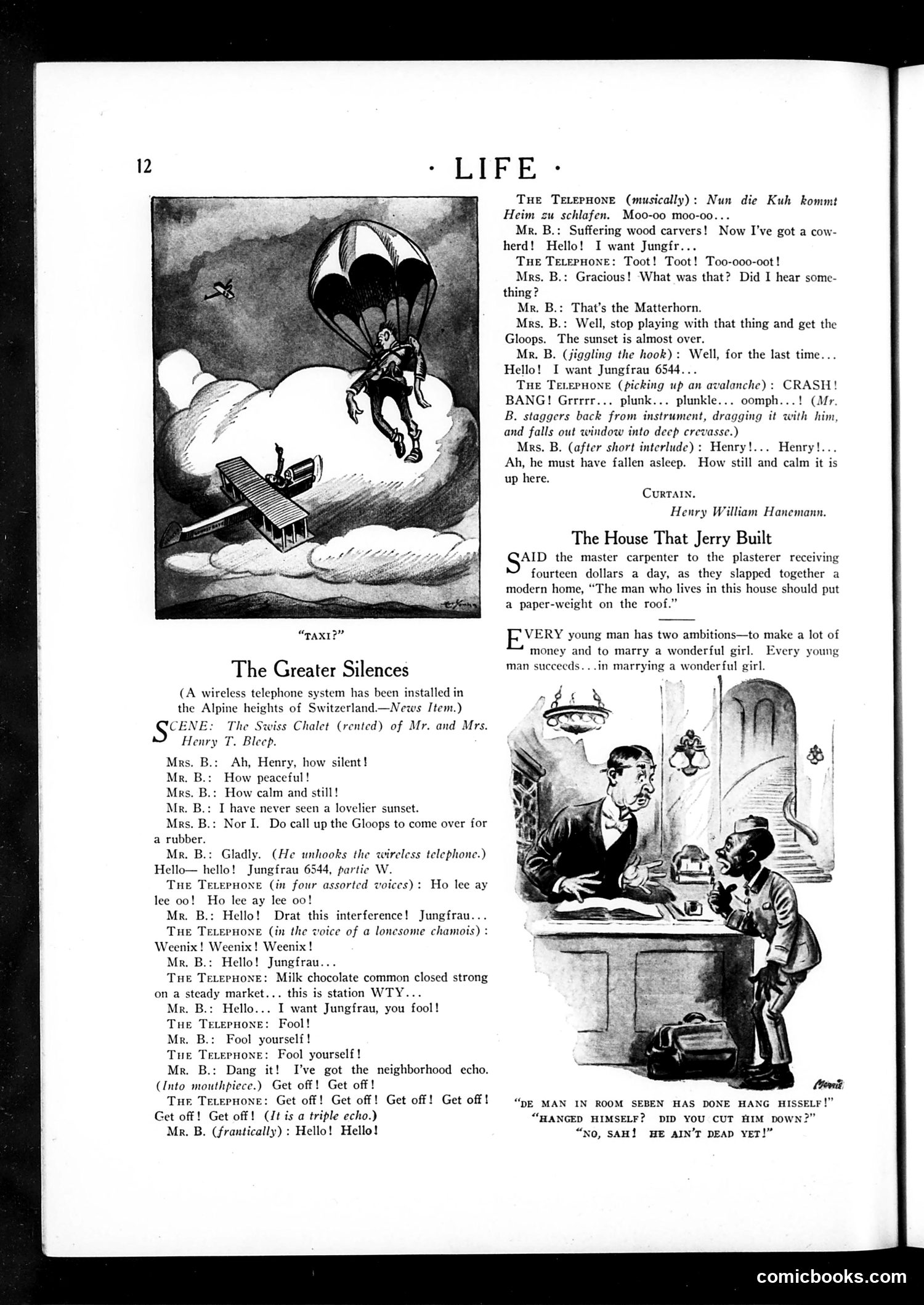
This is a humorous sketch about the newly installed wireless telephone system in Switzerland's Alpine heights. The joke centers on a man trying to use the device while his wife demands silence for the sunset's beauty. When he finally reaches the telephone operator (in increasingly absurd vocal attempts), the connection produces only cacophony and echoes—defeating the technology's purpose. The satire mocks both the unreliability of early wireless communication technology and the disruption such "modern conveniences" caused to domestic peace. The irony is that this advanced technology meant to improve communication actually creates more noise and frustration. It's a common early-20th-century anxiety about how new gadgets intrude upon traditional family life and natural beauty.
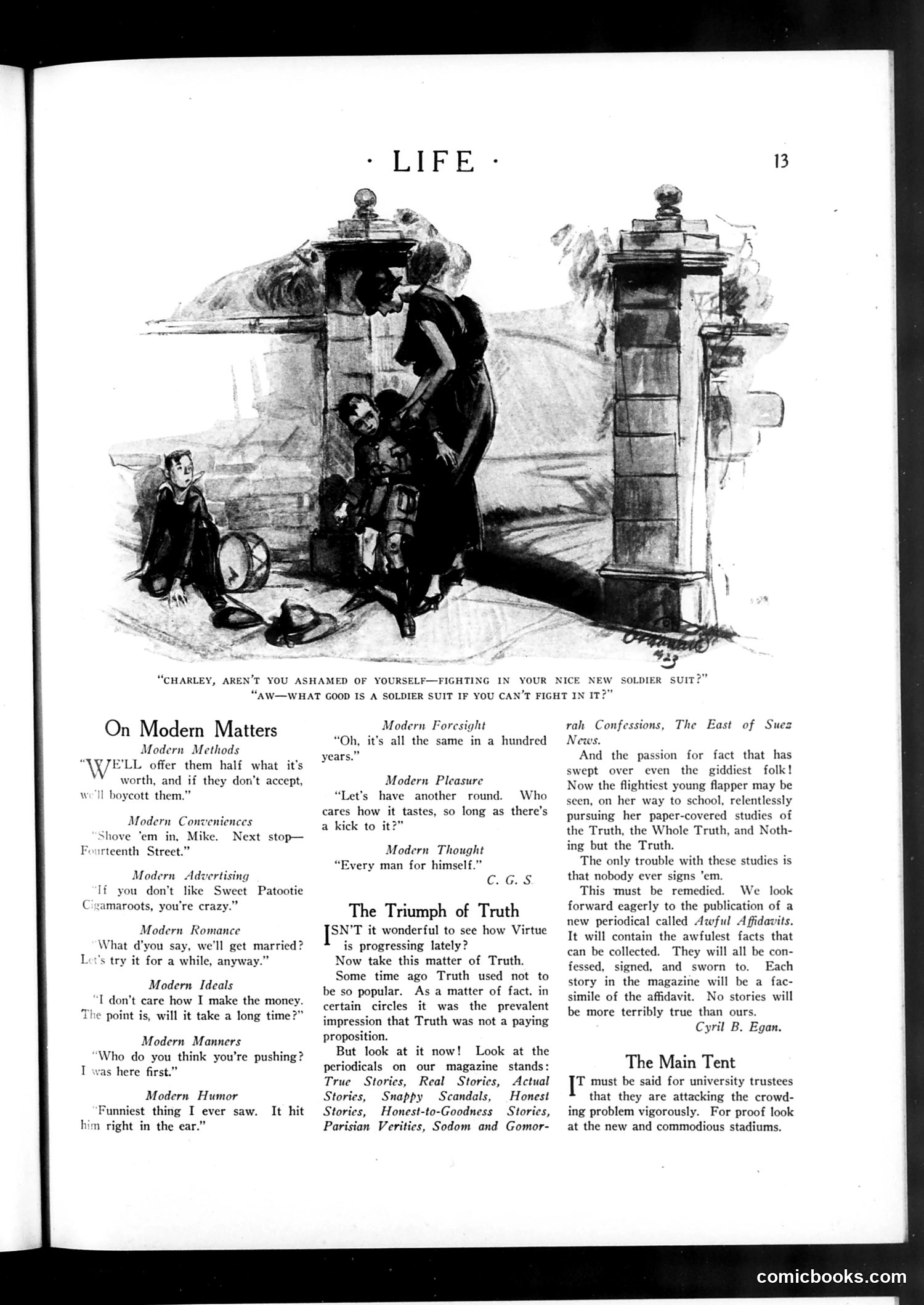
This page contains a satirical cartoon and commentary on early 20th-century social attitudes. The main cartoon depicts an adult (likely a mother) with children near military monuments, illustrating the caption's joke: a child questions why his friend "Charley" wears a new soldier suit if he's afraid to fight in it—the adult responds that a soldier suit is useless without actual fighting capability. The surrounding text consists of brief satirical observations labeled "Modern" topics (Matters, Foresight, Thought, etc.), mocking contemporary social conventions and attitudes. These include commentary on advertising, romance, ideals, manners, and humor—typical targets of Life's satirical approach to American culture and society of the era.
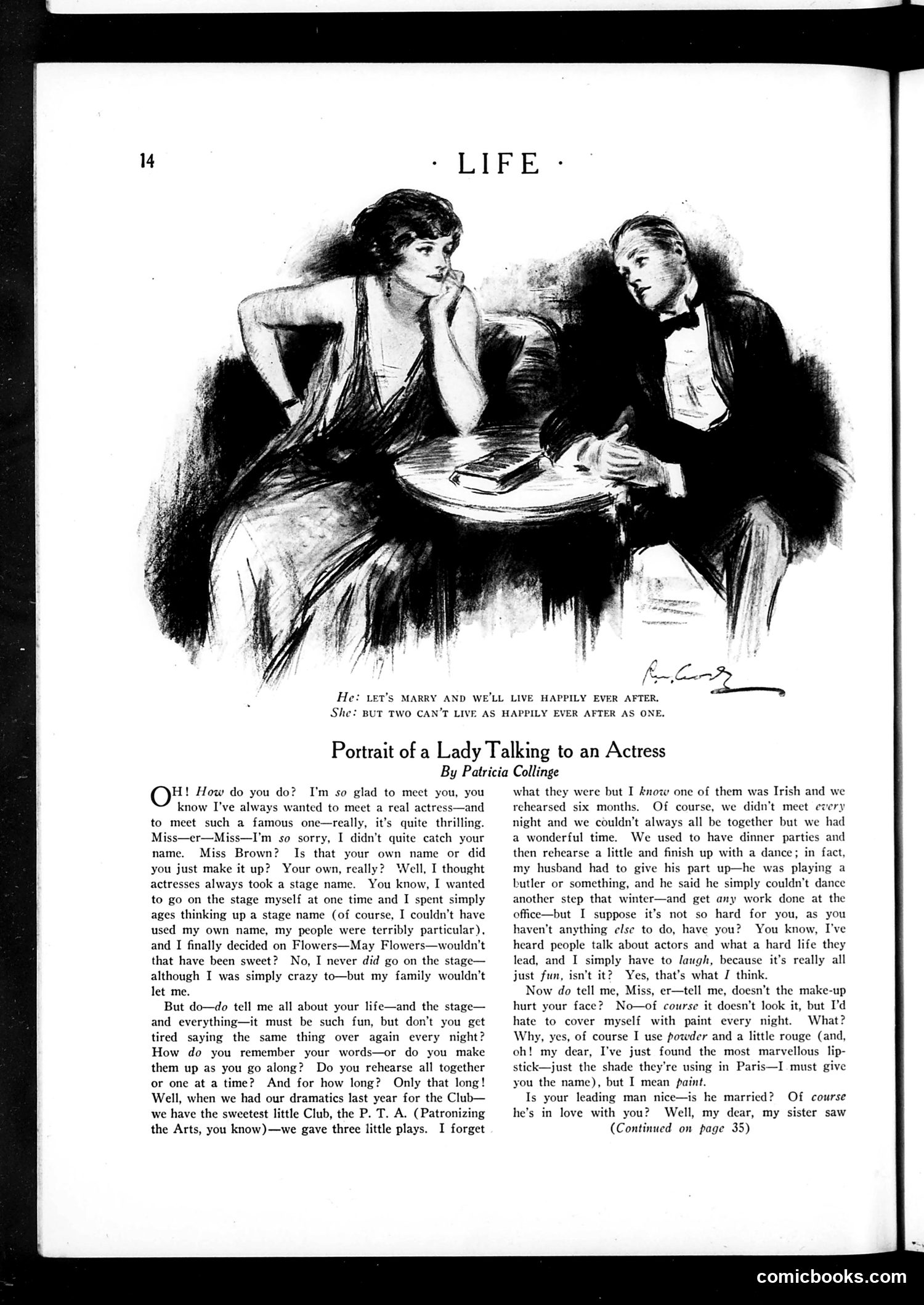
This illustration by Patricia Collinge depicts a social encounter between two women—apparently a society lady and a theatrical actress—seated at a small table. The accompanying dialogue presents their conversation with gentle satire about theatrical life and social pretension. The humor centers on contrasting perspectives: the society woman expresses fascination with stage life, asking about the actress's experiences, makeup, and romantic involvements. The actress responds with somewhat weary practicality, suggesting the glamorous theatrical world the society woman imagines differs from its reality—long rehearsals, modest pay, and exhausting work. The satire gently mocks both figures: the society woman's romanticized view of theater versus the actress's matter-of-fact professionalism. This reflects early 20th-century American attitudes toward theater as simultaneously glamorous and socially suspect.
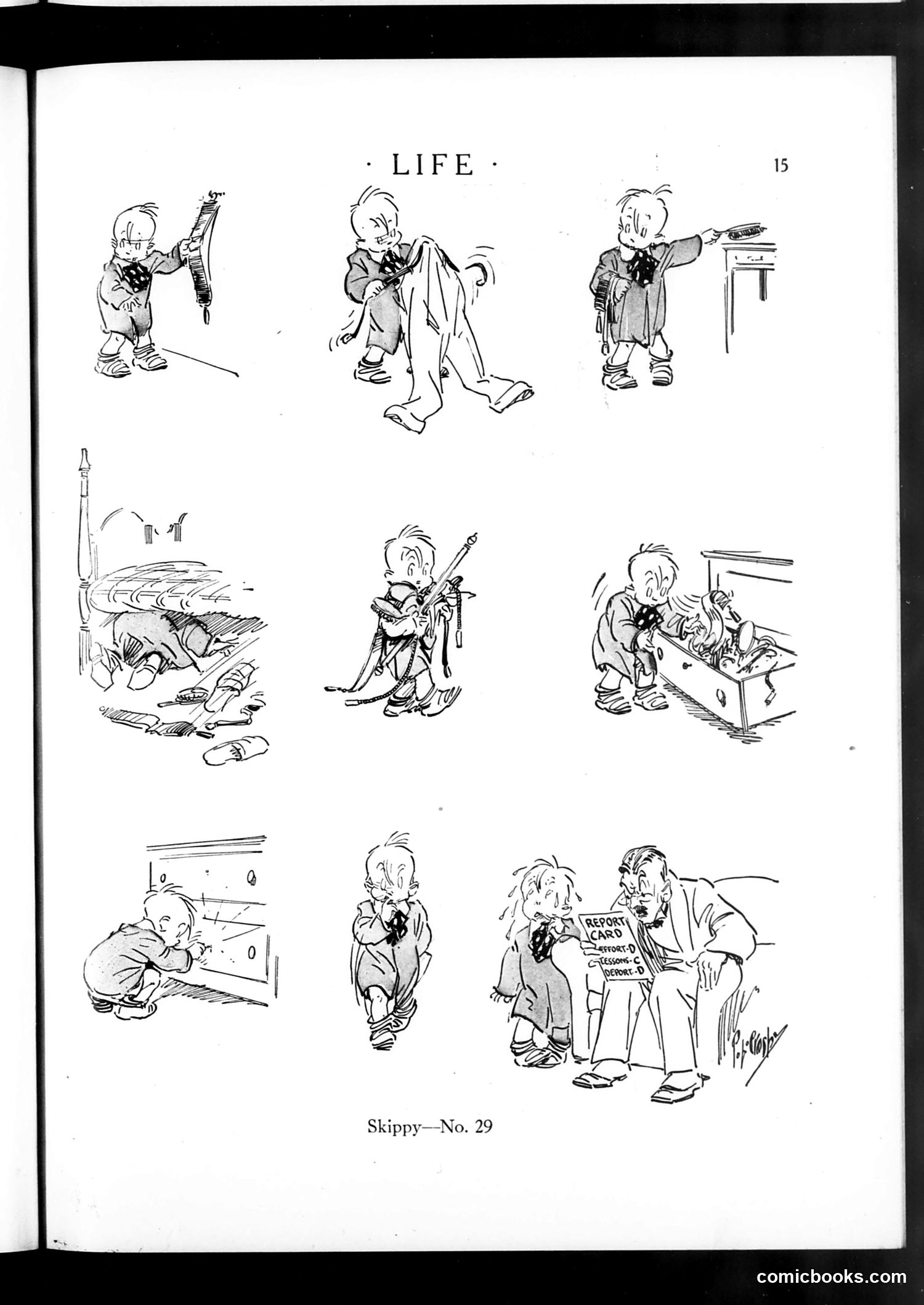
This is a comic strip titled "Skippy," featuring a mischievous young boy engaging in various pranks and misadventures. The nine panels show Skippy: - Playing with a toy gun - Trying on an oversized coat - Painting or decorating - Playing with tools and materials - Creating mess and chaos throughout his activities - Eventually getting caught or confronted (the final panel shows what appears to be an adult examining his mischief) The humor derives from depicting childhood mayhem—a relatable theme for early 20th-century American audiences. "Skippy" satirizes boyish troublemaking and the inevitable consequences children face when their pranks are discovered. The strip's appeal lay in its sympathetic portrayal of child behavior that adults recognized from their own experience, while also gently mocking youthful chaos and poor judgment.
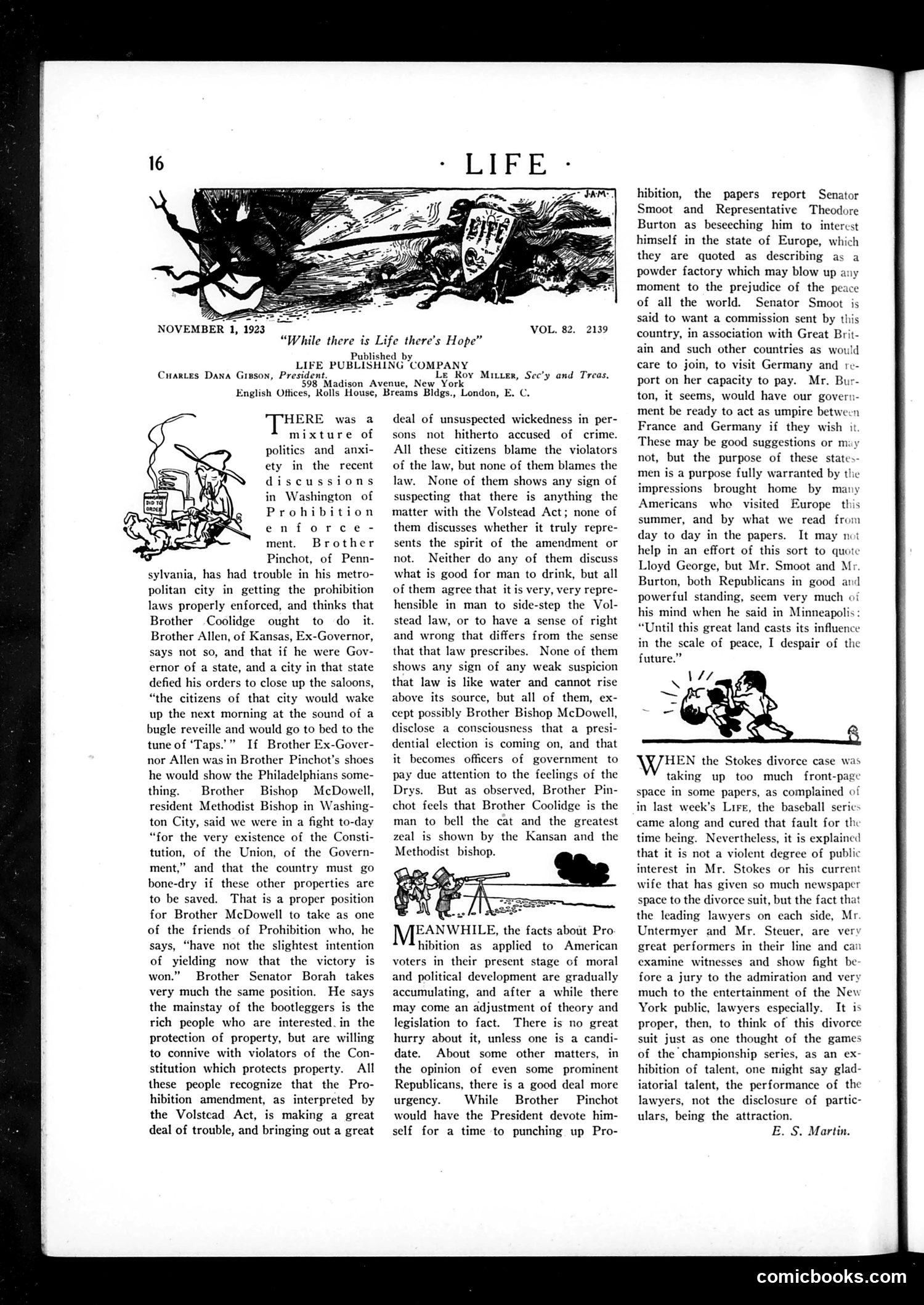
This page critiques Prohibition enforcement debates among prominent Republicans and religious figures. The article satirizes "Brother Pinchot" (Pennsylvania's Gifford Pinchot), "Brother Coolidge" (President Calvin Coolidge), "Brother Allen" (Kansas ex-governor), and Methodist Bishop McDowell for their competing positions on enforcing the Volstead Act. The author mocks their selective moral outrage: these leaders blame *violators* of Prohibition rather than questioning the law itself, while conveniently ignoring that "the mainstay of bootleggers is the rich people" seeking to protect property. The piece suggests their fervent Prohibition enforcement rhetoric masks opportunism—they're performing for voters ahead of the coming presidential election rather than genuinely addressing the "unsuspected wickedness" Prohibition has revealed. The satire implies these politicians lack intellectual honesty about Prohibition's actual failures and consequences.
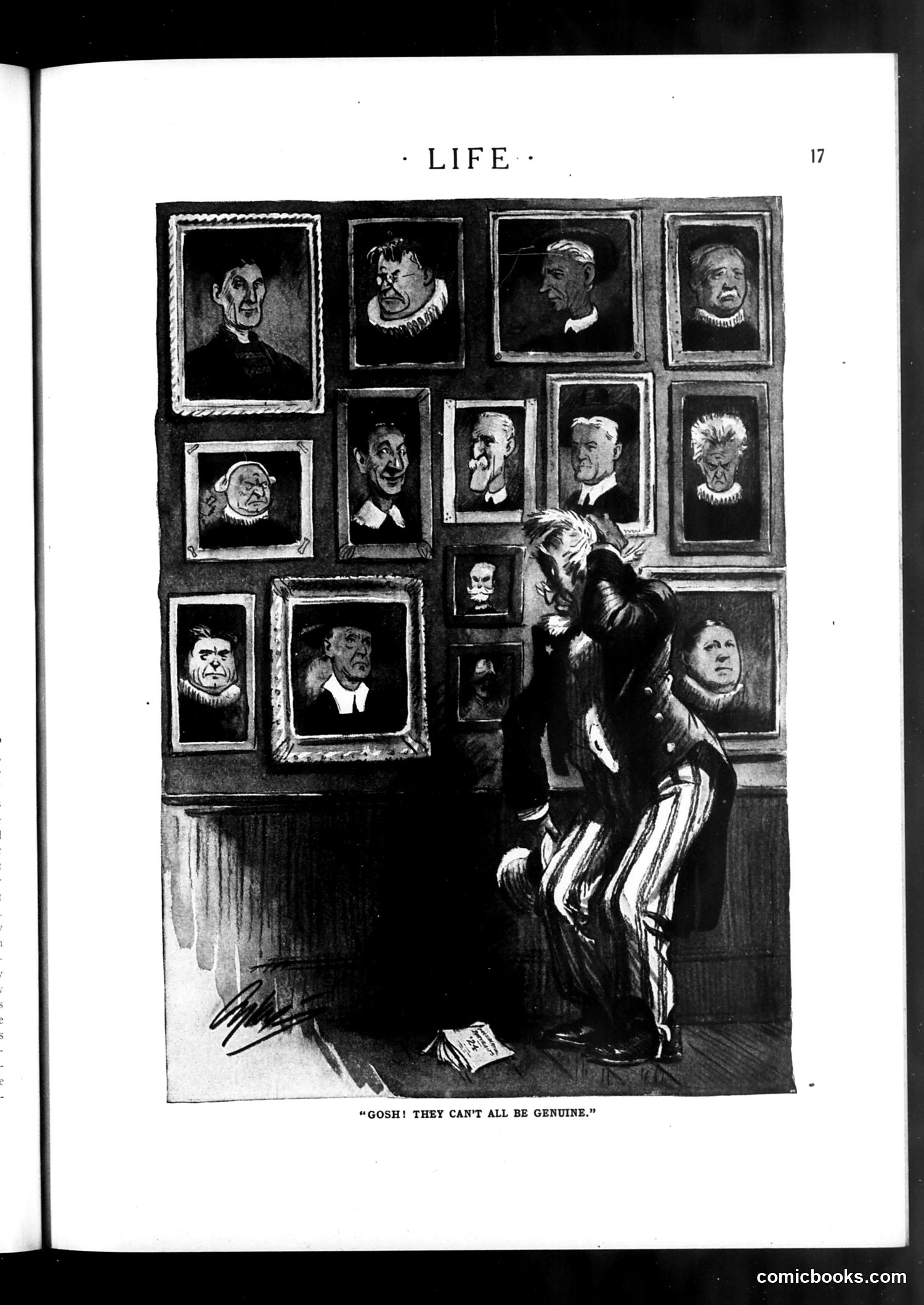
This satirical cartoon depicts two viewers examining a gallery wall of portrait paintings, with one exclaiming "Gosh! They can't all be genuine." The joke concerns **art forgery and authentication**. The wall displays numerous portraits in different styles and frames—suggesting a collection of Old Masters or historical paintings. The speaker's remark implies skepticism that every portrait is authentic, playing on the common problem of art fraud and the difficulty of verifying genuine versus fake artwork. This likely references broader concerns about art market deception, museum acquisitions, or collector gullibility that were topics of satire in early 20th-century America. The cartoon mocks both the ease with which forged paintings circulate and viewers' naive assumptions about displayed artworks' authenticity.
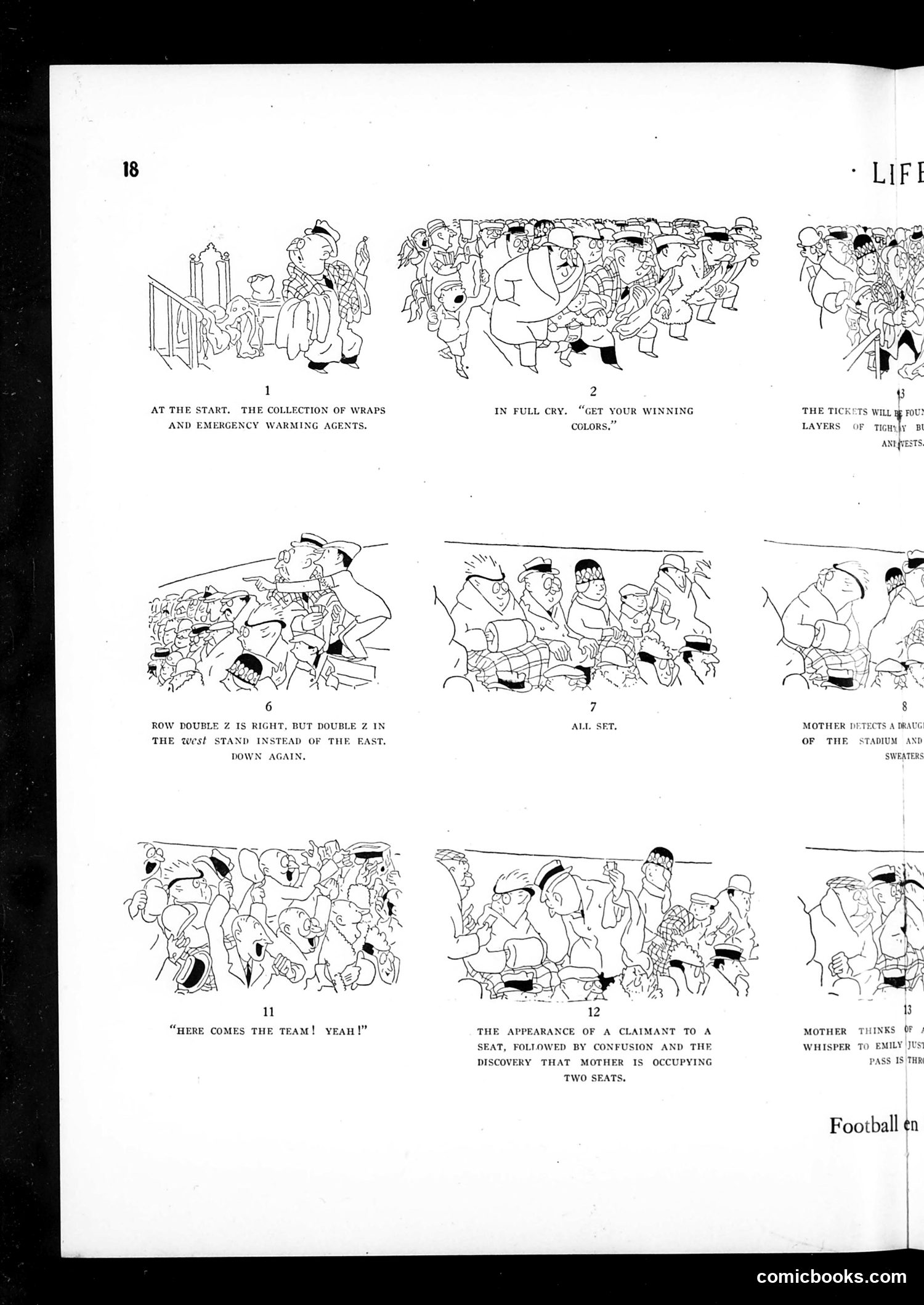
This is a humorous sequential comic strip depicting the mishaps of attending an American football game, likely from the early-to-mid 20th century. The narrative follows a family's game-day experience: gathering winter clothing and blankets (panel 1), enthusiastically selecting their team colors (panel 2), securing tickets (panel 3), and taking their seats (panels 6-7). The comedy escalates when confusion erupts over seating assignments—a claimant appears demanding a seat that the mother is already occupying (panel 12), revealing she's inadvertently taken two seats. The strip captures period-specific details: heavy wraps and sweaters for warmth, crowded stadium conditions, and social awkwardness over reserved seating disputes. The satire gently mocks the chaos of mid-century sports attendance and the frazzled family experience, poking fun at both the game-day frenzy and the mother's obliviousness to her seating transgression.
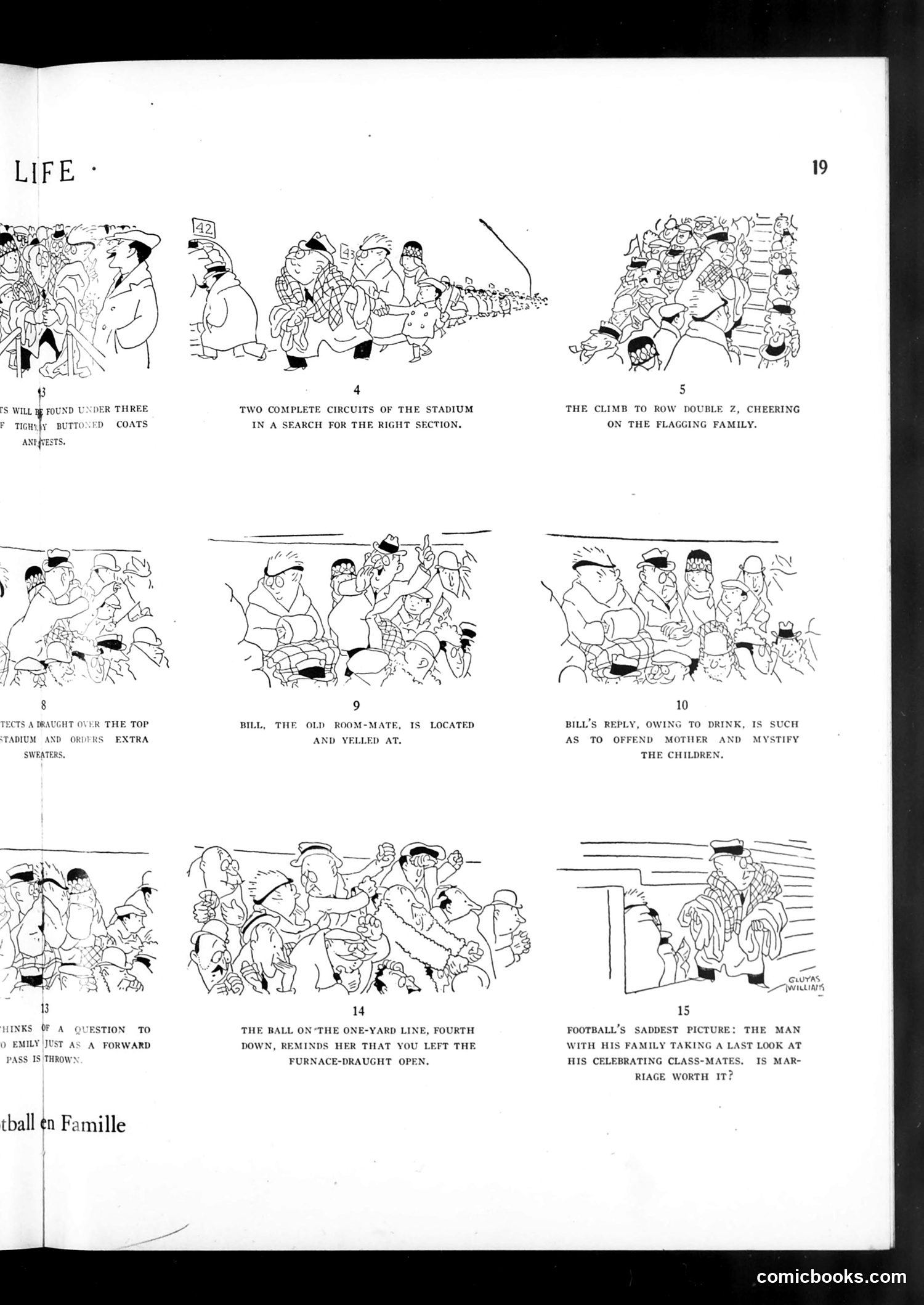
This Life magazine comic strip uses an American football game as a framework for domestic comedy. The narrative follows a family attending a stadium event, with the humor centered on marital discord and parental anxiety. The central joke: a man named Bill has brought his wife and children to the game, but his presence offends them—apparently due to his drinking ("owing to drink"). His old room-mate is located in the crowd and yelled at. The strip's final, darkest panel presents "football's saddest picture": the family taking a last look at Bill's celebrating college classmates, with the caption sardonically asking "Is marriage worth it?" The satire mocks both masculine sports enthusiasm and matrimonial regret. For modern readers, the humor relies on early-20th-century assumptions about husbands escaping domesticity through sports while wives endure awkward public situations. The title "Football en Famille" suggests pretense—presenting this decidedly unpleasant family outing as refined entertainment.
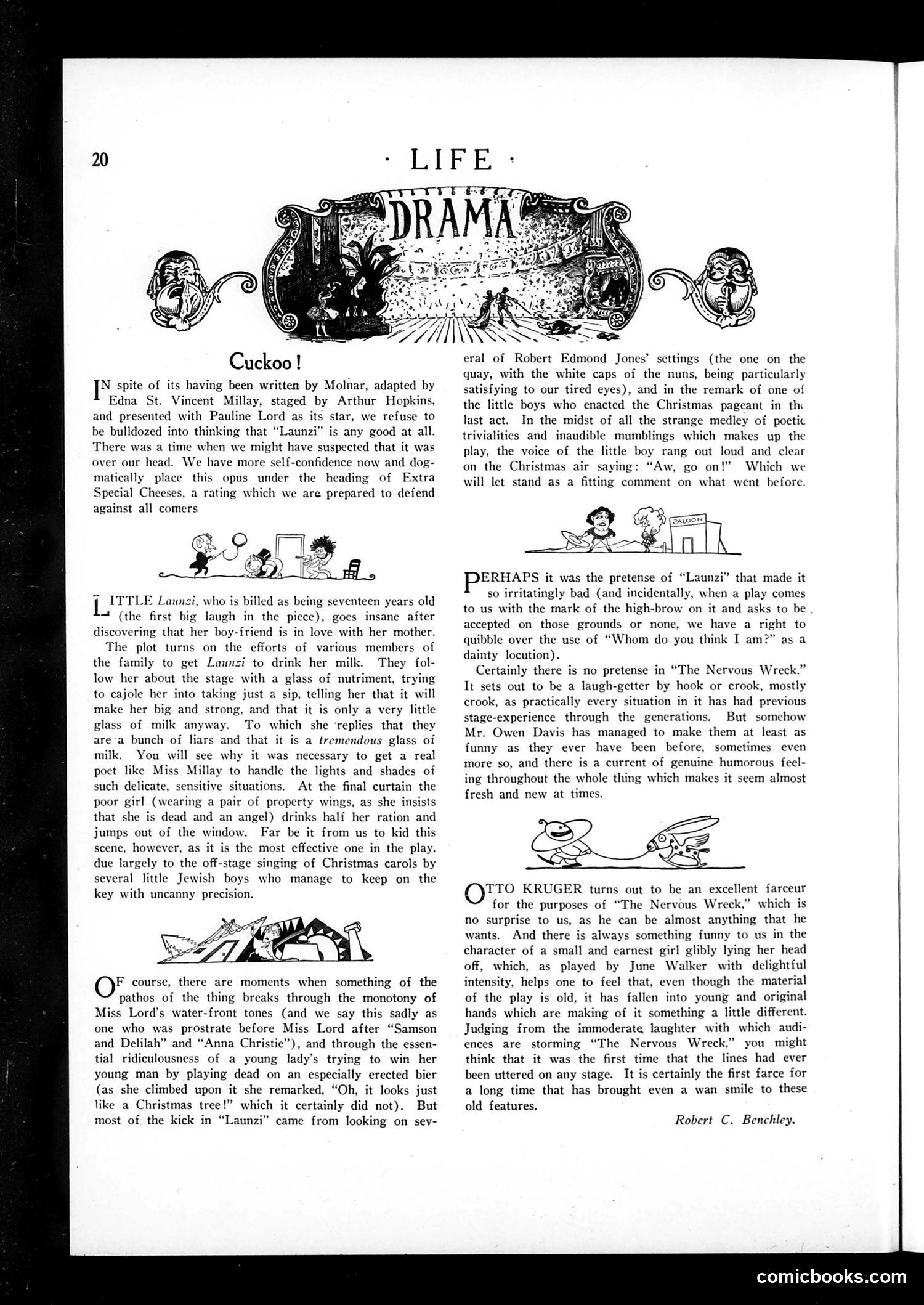
This is a theater review section mocking the play "Launzi"—a pretentious literary adaptation featuring acclaimed talent (playwright Molnar, poet Edna St. Vincent Millay, director Arthur Hopkins, and star Pauline Lord). The critic savagely dismisses it as overwrought nonsense despite its pedigree. The plot involves a seventeen-year-old girl who goes mad and ultimately commits suicide by jumping from a window—all supposedly centered around refusing to drink milk. Life's reviewer ridicules this as absurdly trivial, sarcastically praising Millay's adaption of such "delicate, sensitive situations." The only genuine laugh comes from an offhand remark by a child actor and Christmas caroling by Jewish boys. The review then pivots to favorably comparing "The Nervous Wreck" (a conventional farce with Otto Kruger), which succeeds through honest entertainment rather than pretentious artistry. The satire targets high-brow theater's self-importance and the gap between critical prestige and actual quality.
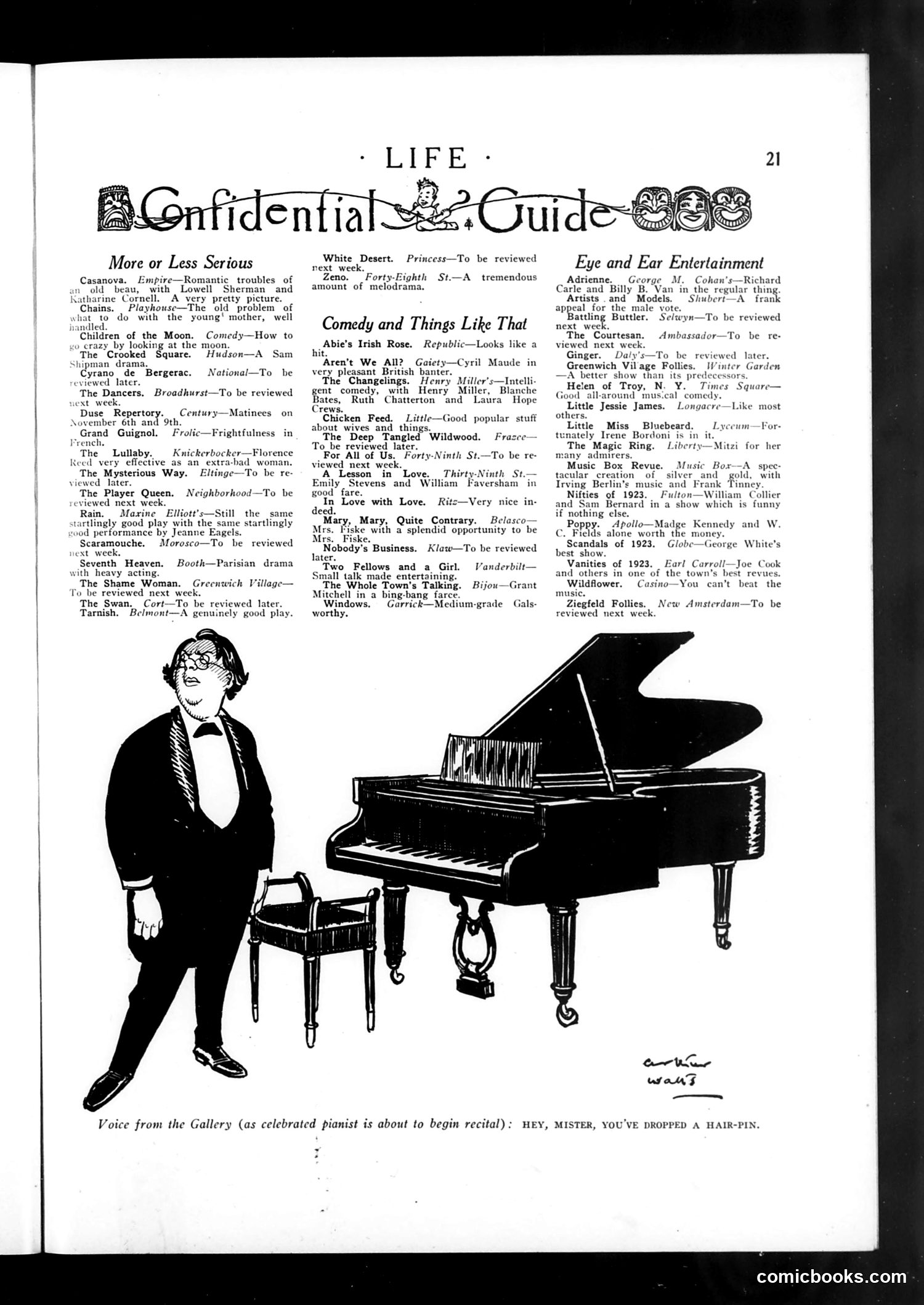
This page is primarily a **theater review and entertainment listing** from what appears to be the early 1920s. The main cartoon illustrates the caption below it: "Voice from the Gallery (as celebrated pianist is about to begin recital): HEY, MISTER, YOU'VE DROPPED A HAIR-PIN." ## The Joke The humor relies on gender stereotyping. A well-dressed male pianist, about to perform a serious classical recital, is interrupted by an audience member pointing out he's dropped a hair-pin—a feminine accessory. This is satirical commentary mocking male musicians or performers perceived as effeminate or overly refined. The "gallery" (cheapest theater seats) audience member's crude interjection contrasts with the pretension of high-art performance. ## Context The page lists Broadway productions from the early 1920s, mixing serious drama with comedies and musical revues. The satirical tone is typical of *Life* magazine's social commentary, using humor to critique cultural pretension and gender norms of the era.
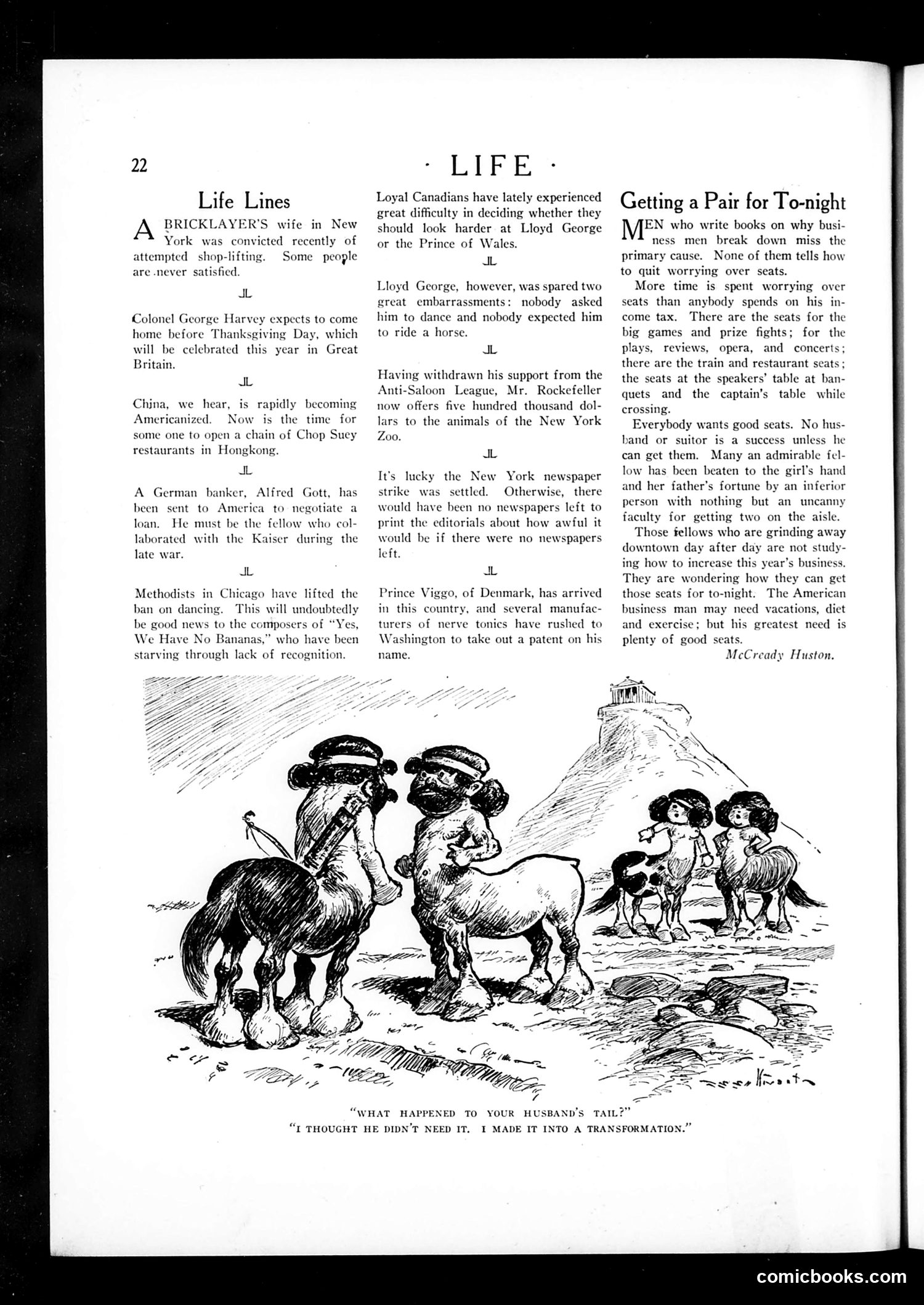
This is a satirical column page from *Life* magazine featuring brief social commentary ("Life Lines") and one cartoon with accompanying humorous essay. **The Cartoon:** Depicts anthropomorphic dogs in conversation, with one asking about another's missing tail. The response—"I thought he didn't need it. I made it into a transformation"—is a visual pun, likely satirizing fashion or cosmetic trends of the era where unnecessary items were repurposed or "transformed." **Life Lines Content:** Short, punchy jokes targeting: - Bricklayers' wives (class humor) - British politics (Lloyd George, Prince of Wales) - Americanization of China - A German banker's WWI collaboration - Methodist dancing prohibition - Rockefeller's philanthropic choices **Main Essay ("Getting a Pair for To-night"):** Satirizes American business culture's obsession with obtaining good theater/event seats as a status symbol and romantic necessity. The author argues businessmen's stress comes not from work but from seat-acquisition anxiety—a tongue-in-cheek critique of consumerism and social competition. The page's humor relies on contemporary political figures and cultural anxieties now requiring historical context.
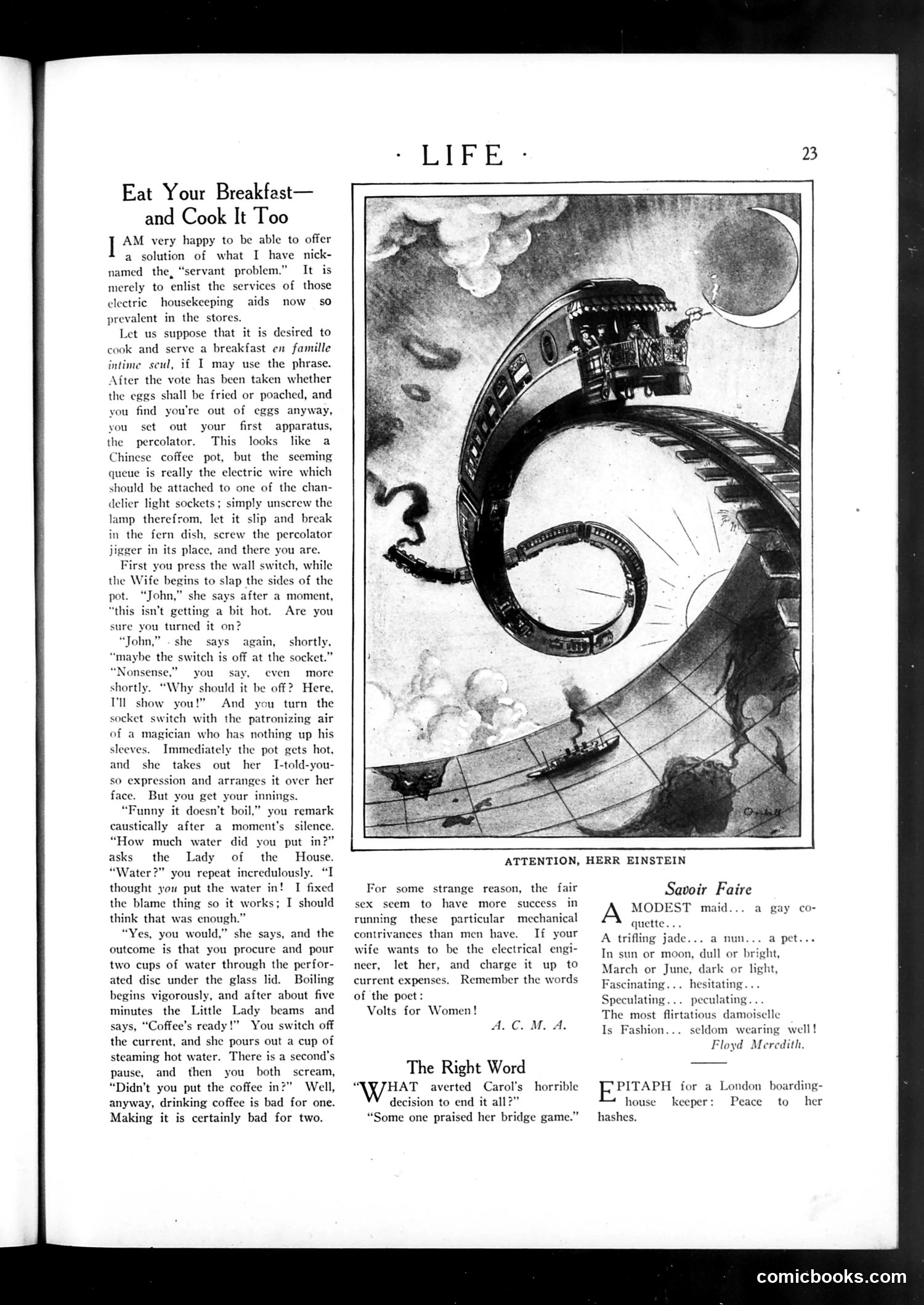
This satirical illustration depicts a fantastical mechanical contraption—appearing to be a Rube Goldberg-style device with a train, tracks, and various mechanical components suspended in space. The caption "ATTENTION, HERR EINSTEIN" references Albert Einstein, whose theory of relativity had recently revolutionized physics and captured public imagination. The joke satirizes the era's enthusiasm for complex mechanical "solutions" and modernist thinking. The accompanying article humorously describes using electric appliances (percolators, gadgets) to solve the "servant problem"—the domestic labor shortage following WWI. The cartoon mocks how contemporary writers and inventors proposed increasingly elaborate technological fixes for everyday problems, while the actual results were often comedic failures (as the breakfast-cooking narrative demonstrates). Einstein's name invokes sophisticated scientific authority being absurdly applied to mundane domestic tasks, suggesting the gap between theoretical innovation and practical reality in early 20th-century American life.
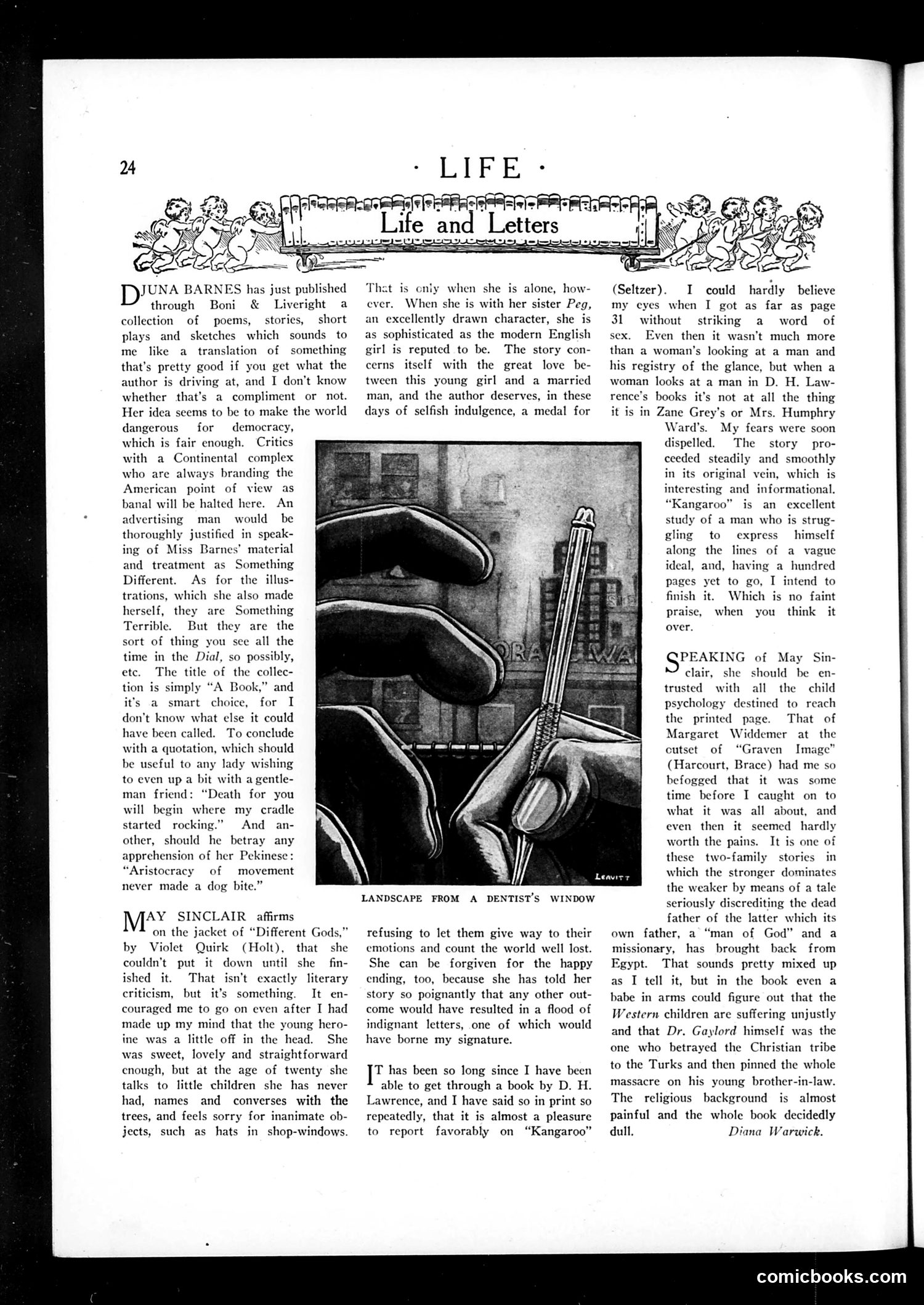
This is a literary review section titled "Life and Letters." The central image—labeled "Landscape from a Dentist's Window"—appears to be an illustration by Djuna Barnes (the author being reviewed), showing an abstract or modernist drawing of what looks like dental instruments or tools in a stylized manner. The reviews discuss several books: Barnes's own poetry/story collection "A Book," which the critic praises for being "different" and challenging American literary conventions, though the illustrations are called "Something Terrible." Other reviews cover "Different Gods" by Violet Quirk and D.H. Lawrence's "Kangaroo," which the reviewer surprisingly found readable because Lawrence restrains his typical sexual content until page 31. The tone is witty and somewhat dismissive of literary pretension while acknowledging experimental modernist work as valuable, even when difficult or unconventional.
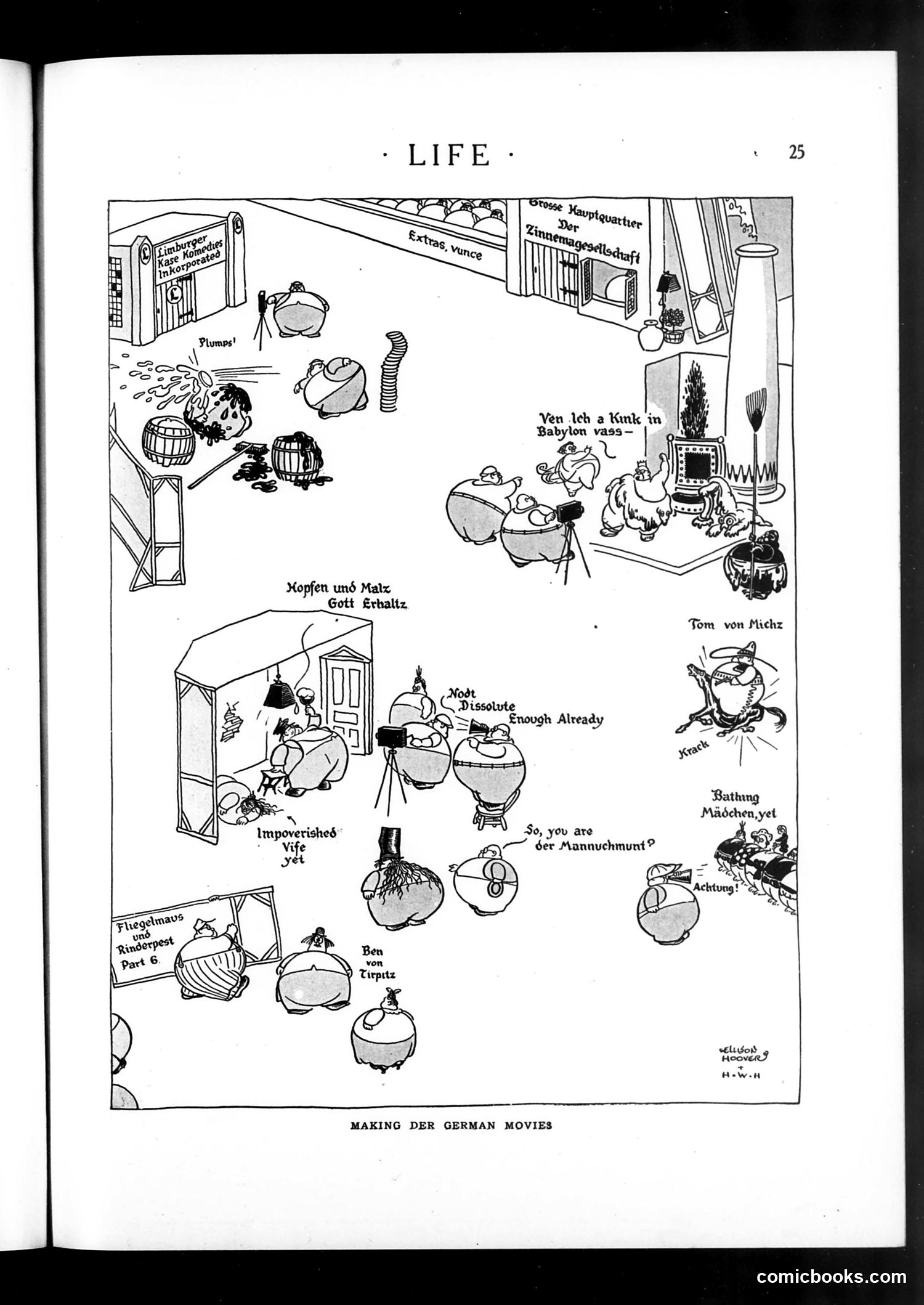
This cartoon satirizes German film production, likely from the 1920s-1930s when German cinema was internationally prominent. The page shows various film sets and production scenes labeled with German titles and phrases in broken English-German dialect ("der," "vass," "yet"). The satire mocks both German filmmaking's pretensions and American perceptions of German culture. References include "Kink in Babylon" (possibly mocking *Metropolis*-style German expressionism), "Kopf und Malz—Gott Erhaltz" (a German saying), and absurdist scene titles like "Improverished Wife Yet" and "Dissolution Enough Already." The exaggerated Germanic accents in the English captions and the chaotic, cluttered production design suggest American ridicule of German cinematic ambition and foreign film practices as overwrought or incomprehensible to English-speaking audiences.
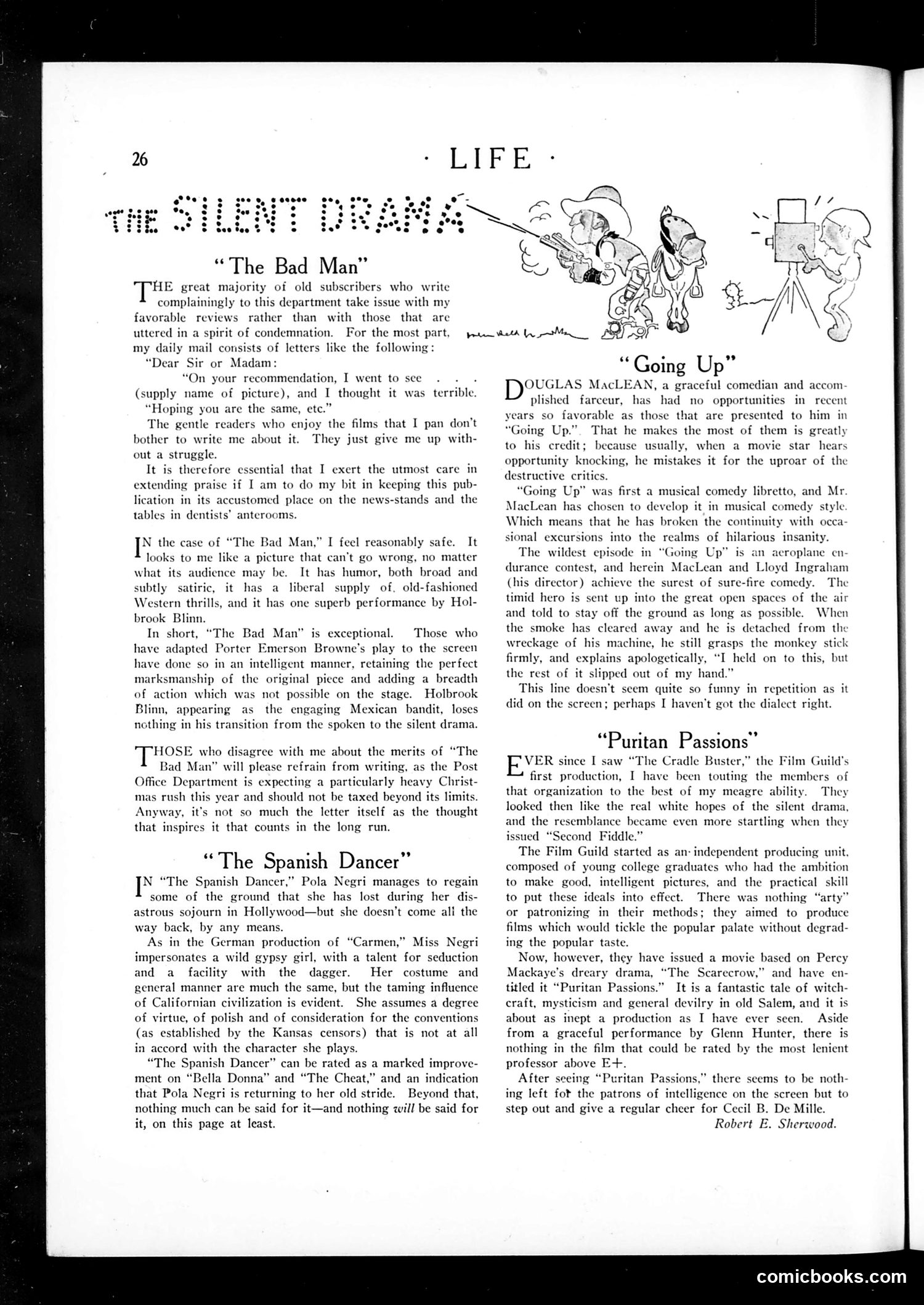
This page contains three separate film reviews from Life's drama criticism section, written in a humorous, caustic style typical of the magazine's satirical approach. **"The Bad Man"** reviews a Western adaptation of a Porter Emerson Browne play, praising actor Holbrook Blinn's performance and the film's humor. The critic humorously requests that readers who disagree *not* write complaints, claiming the Post Office is already overwhelmed during Christmas season—a joking reference to mail volume. **"The Spanish Dancer"** reviews Pola Negri's performance, noting she's recovering from previous Hollywood failures but remains somewhat tamed by "Californian civilization" and censorship ("Kansas censors") compared to her earlier roles. **"Going Up"** discusses Douglas MacLean in a musical-comedy adaptation, praising his comedic talents, particularly in an airplane-stunt sequence. The cartoon illustrations above depict typical silent-film action and slapstick scenarios. The reviews reflect 1920s cinema and industry attitudes toward European actresses and Hollywood censorship constraints.
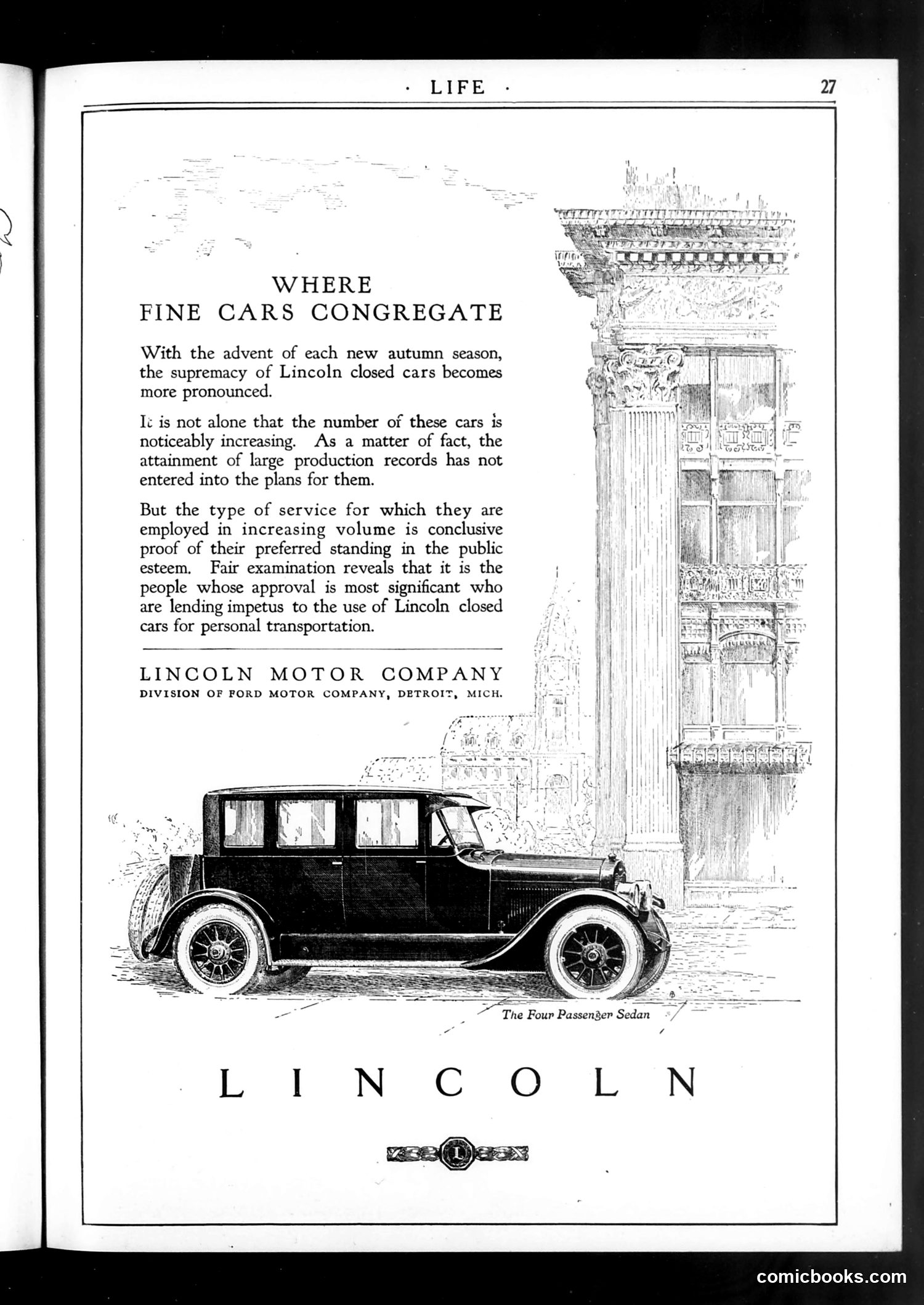
This is primarily a **luxury car advertisement**, not satire or political commentary. The page promotes Lincoln automobiles (a Ford Motor Company division) to *Life* magazine's affluent readership. The "joke" or implied messaging is subtle: the text claims Lincoln's appeal stems not from mass production or affordability, but from its adoption by society's most influential people—the wealthy and prestigious. The ornate architectural drawing behind the sedan suggests sophistication and high social standing. The humor lies in the advertisement's circular logic: Lincolns are desirable because important people buy them; important people buy them because they're desirable. There's gentle satire in how earnestly the ad argues that *not* pursuing mass production is actually a selling point—positioning exclusivity as virtue. No specific political figures or events are referenced. This is essentially early 20th-century luxury marketing dressed in the language of social aspiration.
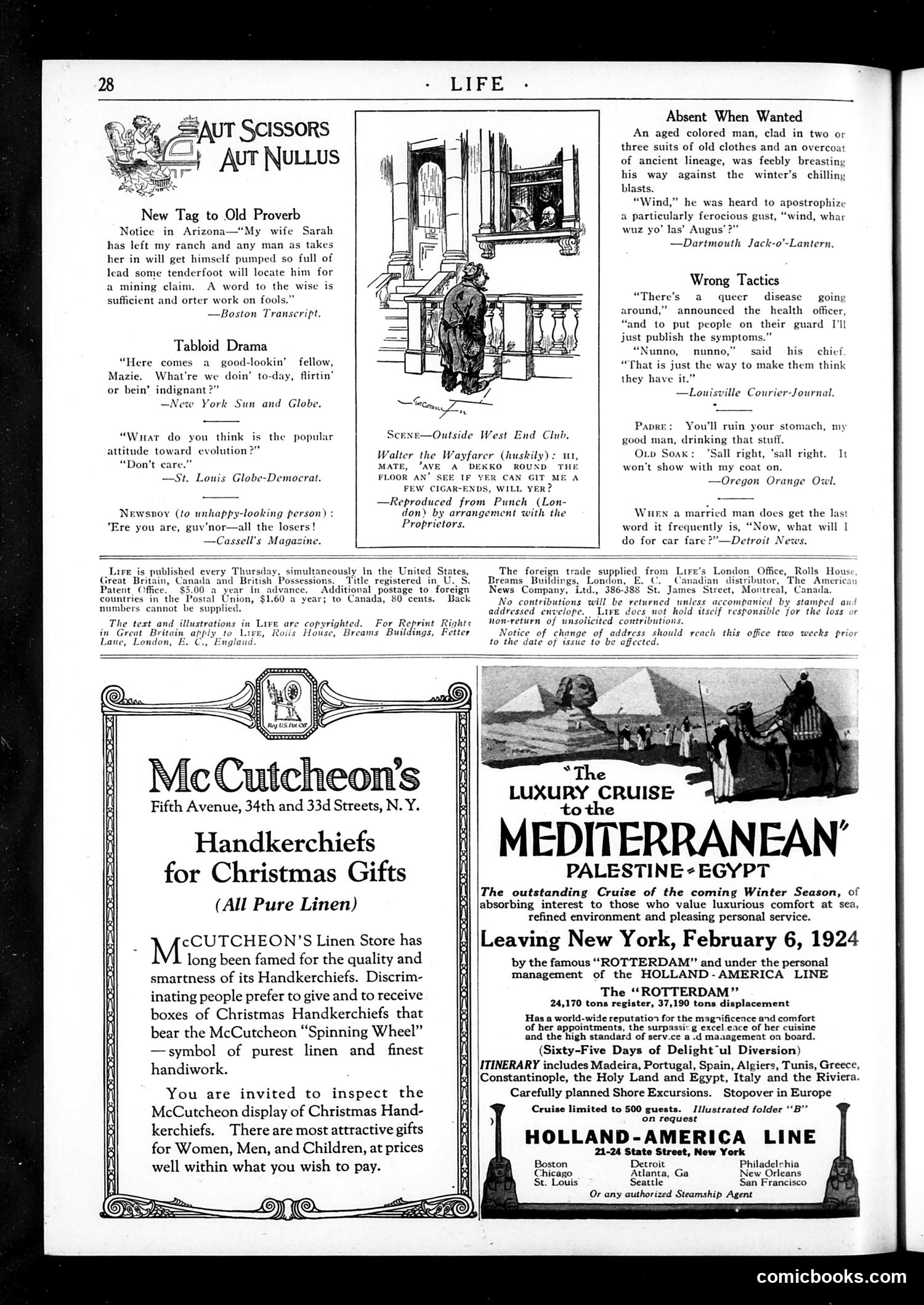
This page combines short humorous anecdotes with advertisements. The satirical content includes: **"Absent When Wanted"**: A dialectal joke about an elderly Black man scolding the wind for its severity—playing on period stereotypes through exaggerated speech patterns. **"Wrong Tactics"**: Social commentary mocking a health officer's strategy of publishing disease symptoms to warn the public, with his superior arguing this backfires by making people *think* they have the illness. **"Walter the Wayfarer"**: A sketch-style comic from *Punch* magazine about a shabby man requesting cigarette butts from a club floor. **Various one-liners**: Including a Arizona mining-claim warning about a wife-stealer and observations on marriage dynamics. The page is otherwise dominated by period advertisements (McCutcheon's handkerchiefs, Holland-America cruise line), typical of *Life* magazine's revenue model. The humor relies heavily on class-based and racial stereotypes common to 1920s American satire.
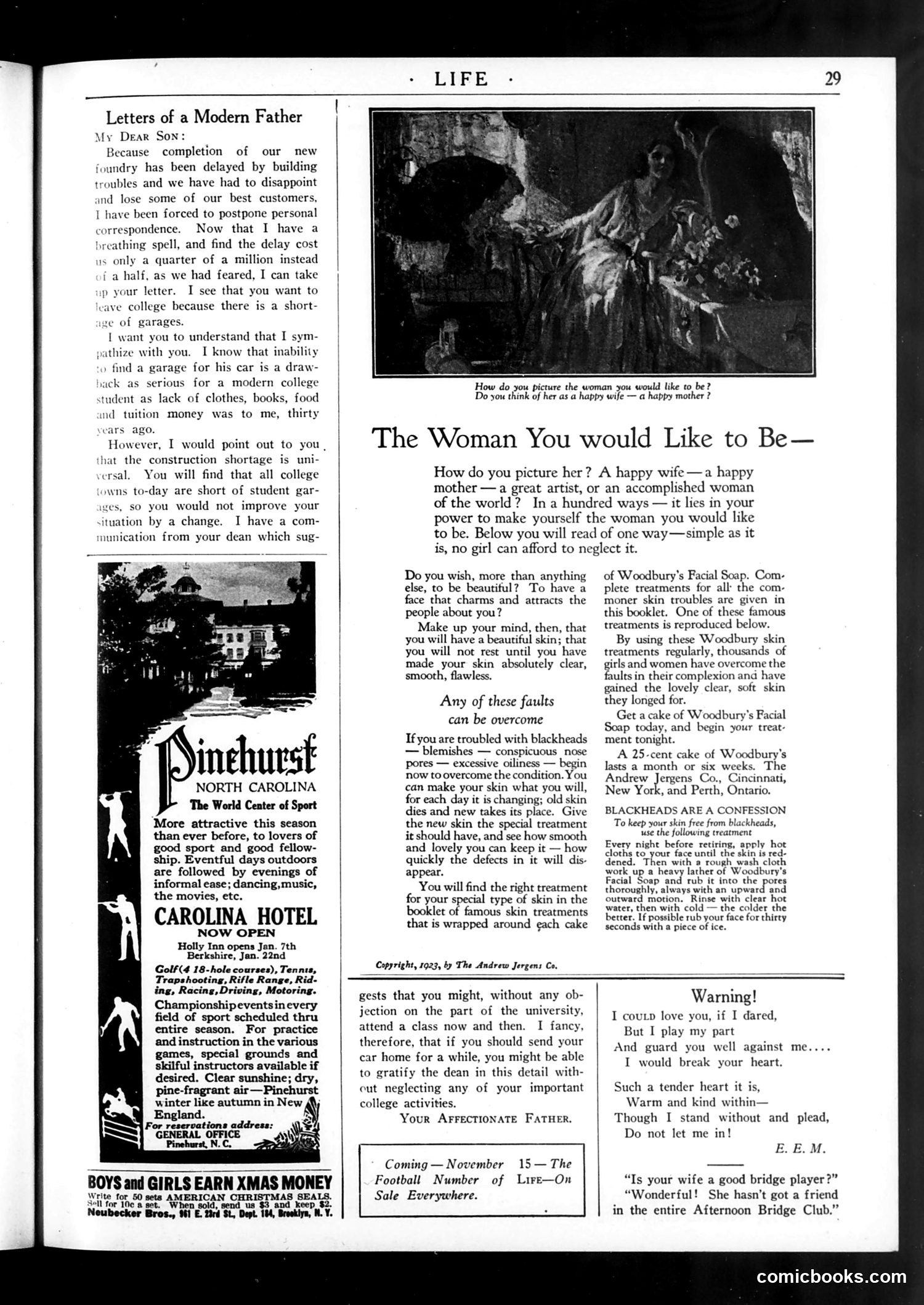
This page contains satirical and advertising content typical of 1920s Life magazine. **The Satire:** "Letters of a Modern Father" mocks post-WWI consumer culture and priorities. A father responds to his son's request to leave college, claiming a shortage of **garages for automobiles**—treating this as a serious hardship comparable to his generation's lack of food and tuition. The joke targets the era's car obsession: college students now prioritize vehicle storage over education. The father's tone is deadpan, sardonically sympathizing while noting the shortage is universal, making the son's complaint absurd. **The Advertisements:** The page also features resort advertising (Pinehurst, North Carolina; Carolina Hotel) promoting leisure and sport, and a prominent Woodbury's Facial Soap ad targeting women with promises that skincare can make them into their "ideal woman"—whether wife, mother, or accomplished woman. Together, these elements satirize 1920s materialism: men obsessed with cars, women with beauty products—both chasing consumer-defined happiness.
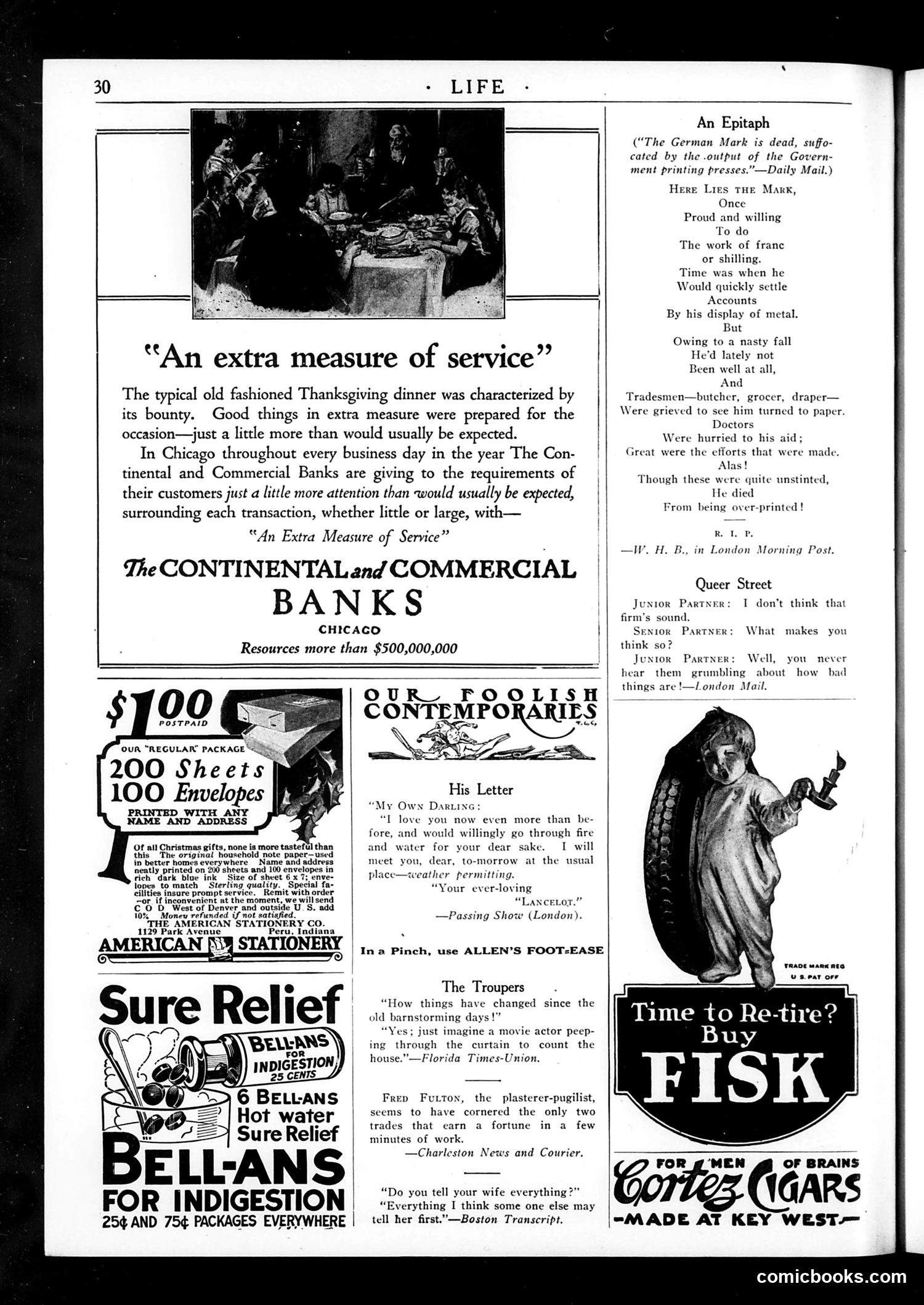
This page is primarily **advertising and miscellaneous content** from an early 20th-century American magazine, with minimal satirical cartooning. The notable editorial content is **"An Epitaph"**—a poem mocking the collapse of the German currency (the Mark) following World War I. The satire personifies the Mark as a tradesman who once reliably "settled accounts / By his display of metal" (gold standard) but died from being "over-printed"—referencing hyperinflation caused by the German government's reckless printing of currency to pay war debts. This was a real crisis of the early 1920s. The rest of the page contains lightweight humor sections ("Our Foolish Contemporaries") with brief jokes about theater and relationships, plus advertisements for banking services, stationery, indigestion relief (Bellans), foot powder, retirement investments (Fisk tires), and cigars. The page reflects post-WWI political anxiety and the magazine's mix of satire with commercial content typical of the era.
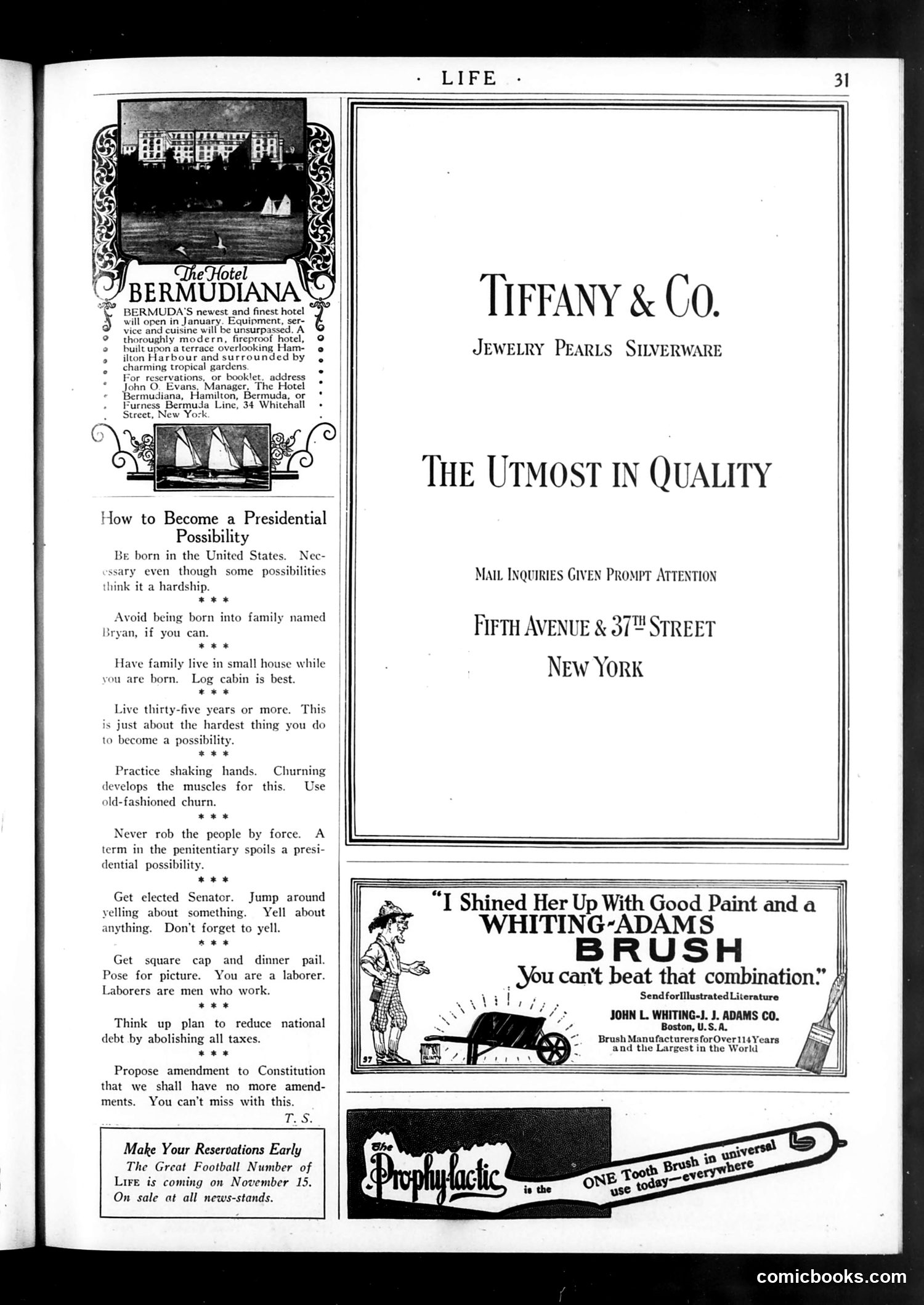
This page is primarily **advertising** (Bermudiana Hotel, Tiffany & Co., brushes) with one notable satirical piece: "How to Become a Presidential Possibility." The satire mocks the formulaic path to American presidential ambitions. Key points include: - **Log cabin origins**: References the "log cabin to White House" mythology (associated with figures like Lincoln and Garfield) - **Bryan reference**: Appears to mock William Jennings Bryan, a three-time failed presidential candidate - **Populist posturing**: The advice to "pose for picture" as a laborer and "yell about something" satirizes candidates performing working-class credentials - **Political absurdity**: Suggestions like "abolish all taxes" and "no more amendments" mock simplistic campaign promises - **Criminality warning**: The penitentiary reference suggests satire about corruption The piece ridicules the performative, manufactured nature of presidential campaigns and the perceived phoniness of candidates adopting humble origins as political theater. Without a date visible, the specific target candidate remains unclear, though the Bryan reference suggests early 1900s publication.
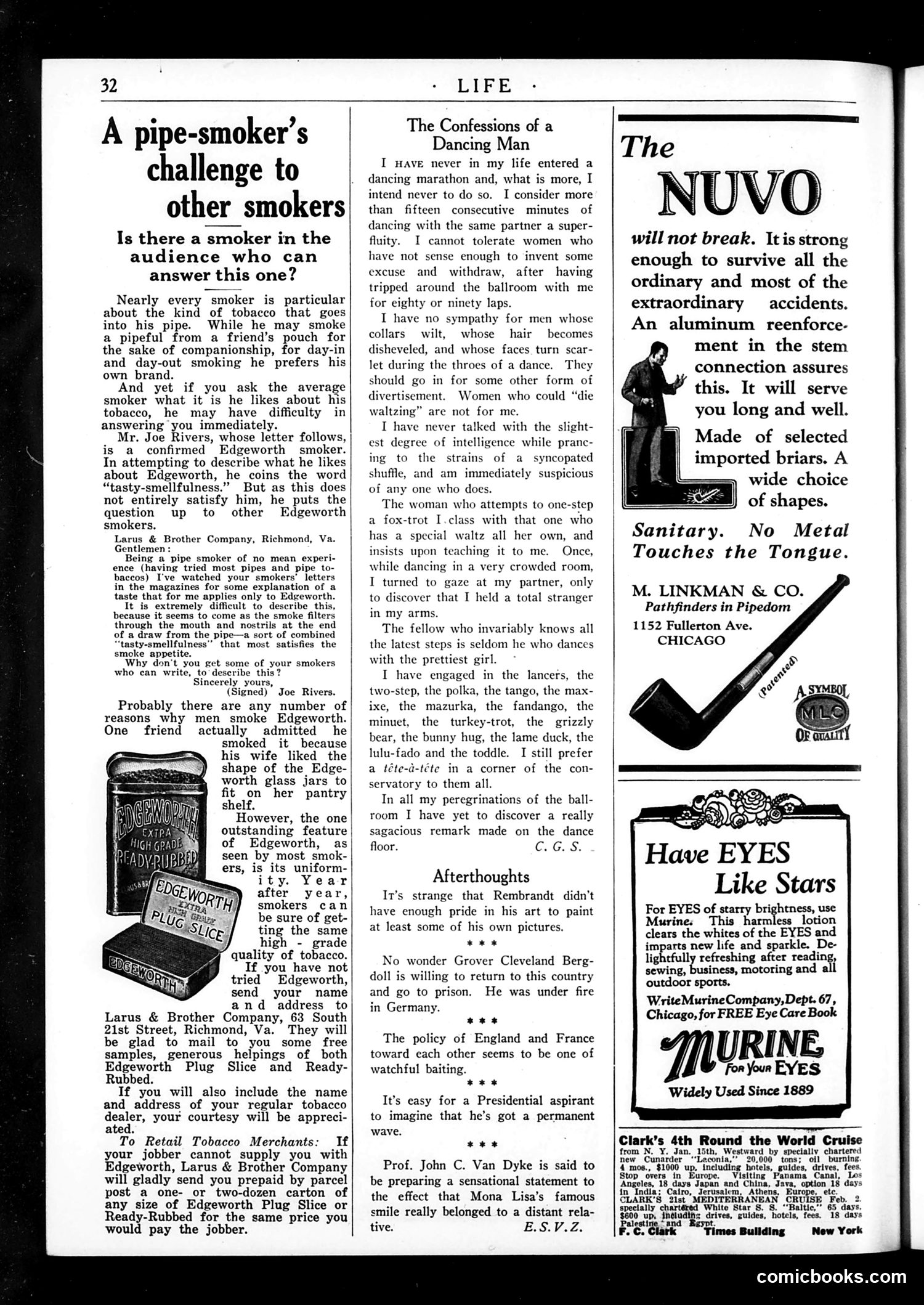
This page contains primarily **advertising and advice columns** rather than political satire. The main content includes: **"A Pipe-Smoker's Challenge"** — An Edgeworth tobacco advertisement disguised as reader correspondence. A smoker named Joe Rivers coins the term "tasty-smellfulness" to describe Edgeworth's appeal, challenging other smokers to articulate what they like about the brand. This is a marketing strategy using pseudo-authentic customer testimonials. **"The Confessions of a Dancing Man"** — A humorous personal essay mocking the era's popular "dancing marathons" (endurance dance competitions). The author expresses contempt for dancers who lose composure, can't converse while dancing, or persist in marathons. It's satirizing both the fad itself and pretentious dancers, reflecting 1920s social attitudes about proper decorum and gender behavior. The page also includes ads for NUVO pipes and Murine eye drops, typical period magazine filler content.
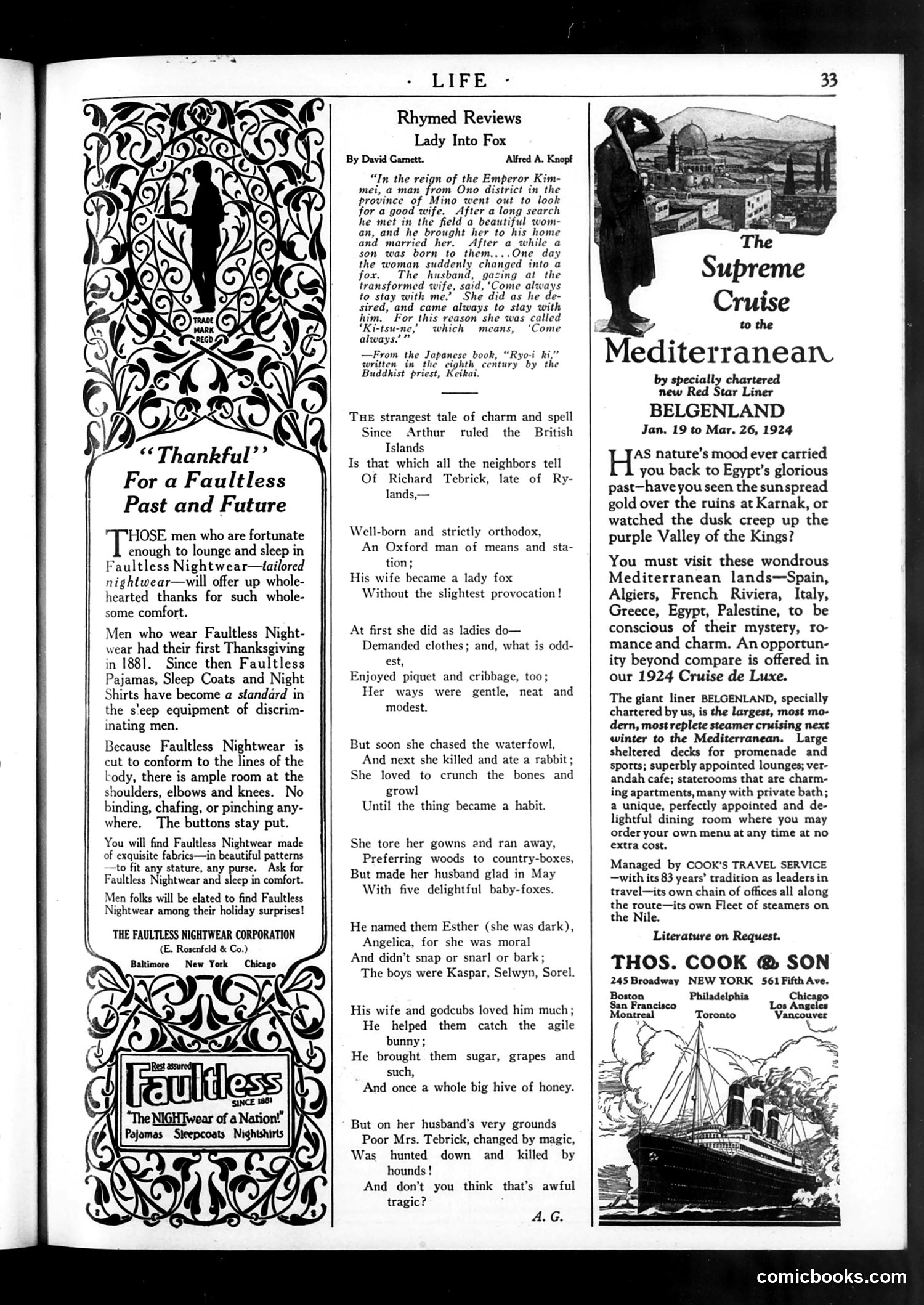
This page contains primarily **advertising and literary content**, not political cartoons. The left side features a **Faultless Nightwear advertisement** using ornamental Art Deco styling, promoting pajamas and sleep garments as gift ideas for men—typical 1920s consumer advertising emphasizing comfort and quality. The center presents a **book review** of "Lady Into Fox" by David Garnett (published by Knopf). The reviewer, writing in verse, summarizes this fantastical tale: a man marries a beautiful woman who mysteriously transforms into a fox, gradually abandoning civilized behavior for animal instincts. She bears him fox cubs but is ultimately hunted down and killed—the reviewer calling this ending "awful tragic." The review compares the story to an ancient Japanese legend of similar transformation. The right side advertises **a Mediterranean cruise** aboard the liner Belgenland, promoting exotic travel to Egypt, Greece, Italy, and the French Riviera—luxury tourism marketing typical of the 1920s. No political satire or social commentary appears on this page.
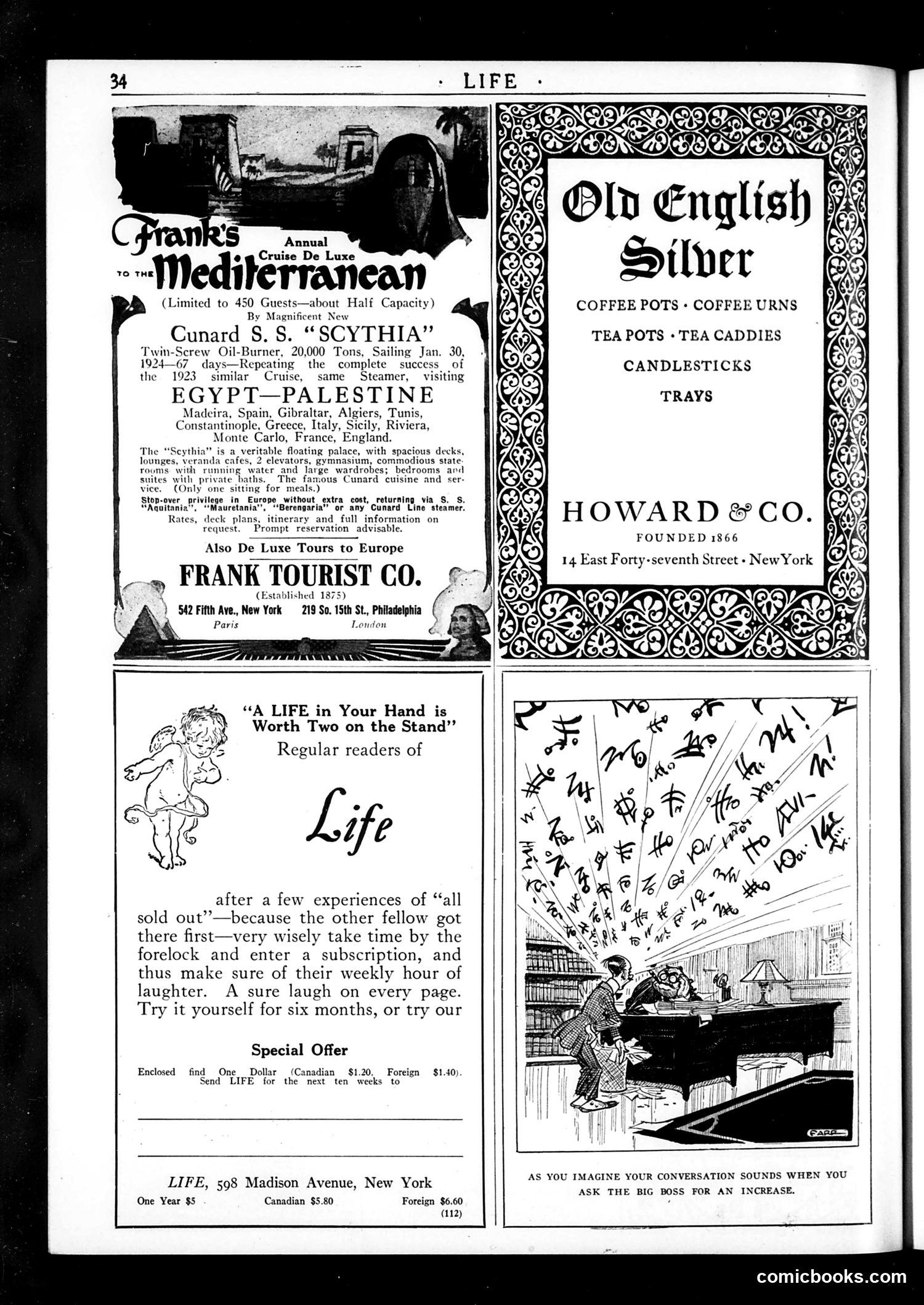
This is primarily **an advertising page** from Life magazine, circa 1924. The main content consists of four distinct ads: 1. **Frank Tourist Co.** advertises a Mediterranean cruise on the Cunard steamship "Scythia," visiting Egypt and Palestine. 2. **Howard & Co.** displays fine English silver goods (coffee pots, tea sets, candlesticks). 3. **Life magazine itself** promotes subscription with the slogan "A LIFE in Your Hand is Worth Two on the Stand"—meaning owning a subscription guarantees you get each issue rather than missing sold-out copies. 4. **A cartoon** (lower right) shows someone at a piano asking their boss for a raise. The caption jokes that asking for money sounds like discordant notes—the satire being that such conversations are awkward and jarring. The page is essentially a commercial one with minimal political or social commentary beyond the gentle humor in the self-promotional subscription ad and the piano cartoon.
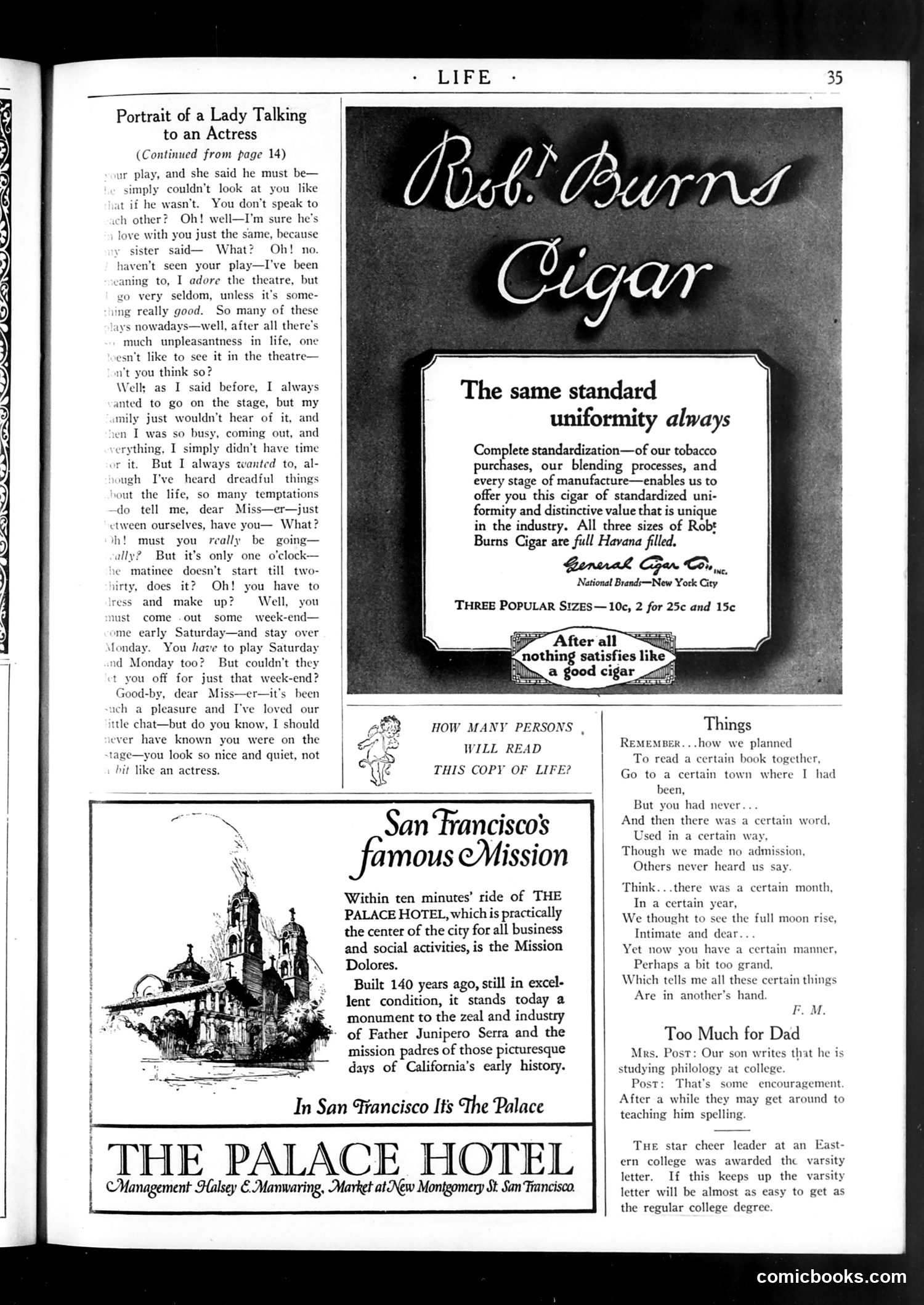
This page contains a satirical short story excerpt ("Portrait of a Lady Talking to an Actress") depicting a wealthy, gossipy society woman patronizing an actress. The humor lies in the woman's obliviousness: she claims to "adore the theatre" but rarely attends, considers stage life morally questionable, and is shocked the actress looks "nice and quiet, not a bit like an actress"—revealing her stereotyped assumptions about performers' respectability. The page also features period advertisements (Robert Burns cigars, Palace Hotel) and lighter humor pieces mocking contemporary life: a father's dismissal of his son studying "philology" (suggesting overeducation), and commentary on how easily college varsity letters are now awarded. The overall satirical target is upper-class snobbery and the cultural prejudices against theatre performers, alongside gentle jabs at modern educational and social pretension. The tone reflects 1920s-era Life magazine's focus on satirizing American social hypocrisy.
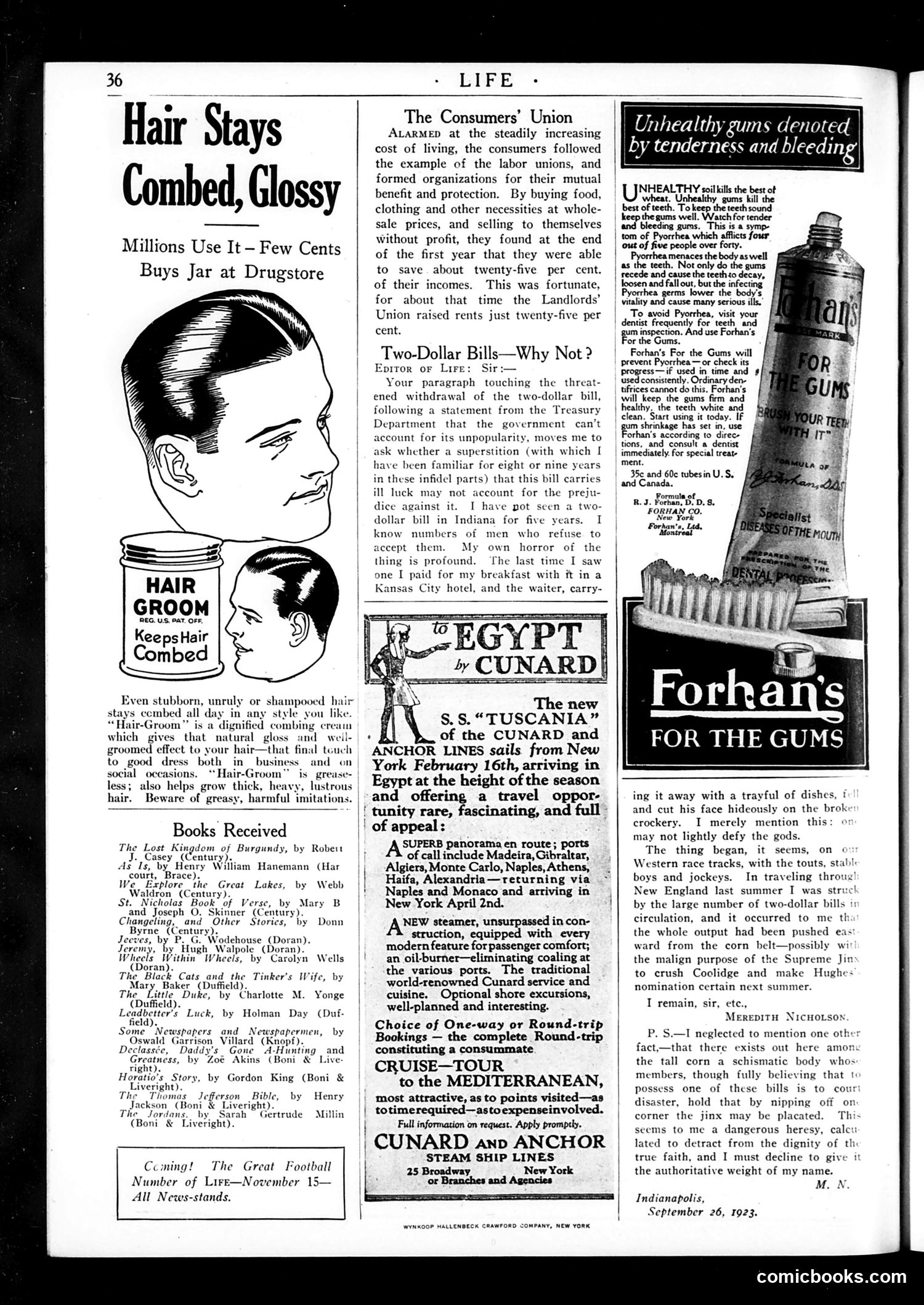
This page mixes advertising with reader letters and social commentary typical of Life's satirical format. **Main Advertisement**: "Hair-Groom" hair product promotes a five-cent jar that keeps hair "combed, glossy" for the masses ("Millions Use It"). **"The Consumers' Union" column** satirizes economic inequality: consumers formed buying cooperatives to save 25% on living costs—only to have landlords raise rents by exactly 25%, negating all savings. The joke is grim: any progress by working people is immediately neutralized by those controlling housing. **"Two-Dollar Bills—Why Not?"** is a letter debating why two-dollar bills remain unpopular. The writer suggests superstition drives rejection, noting he's never seen one circulate in Indiana for five years and knows people who refuse them. This reflects genuine 1920s currency folklore and hoarding behavior. The page reflects post-WWI American anxieties: rising costs of living, class tension, and economic uncertainty among ordinary citizens trying to gain financial footing.
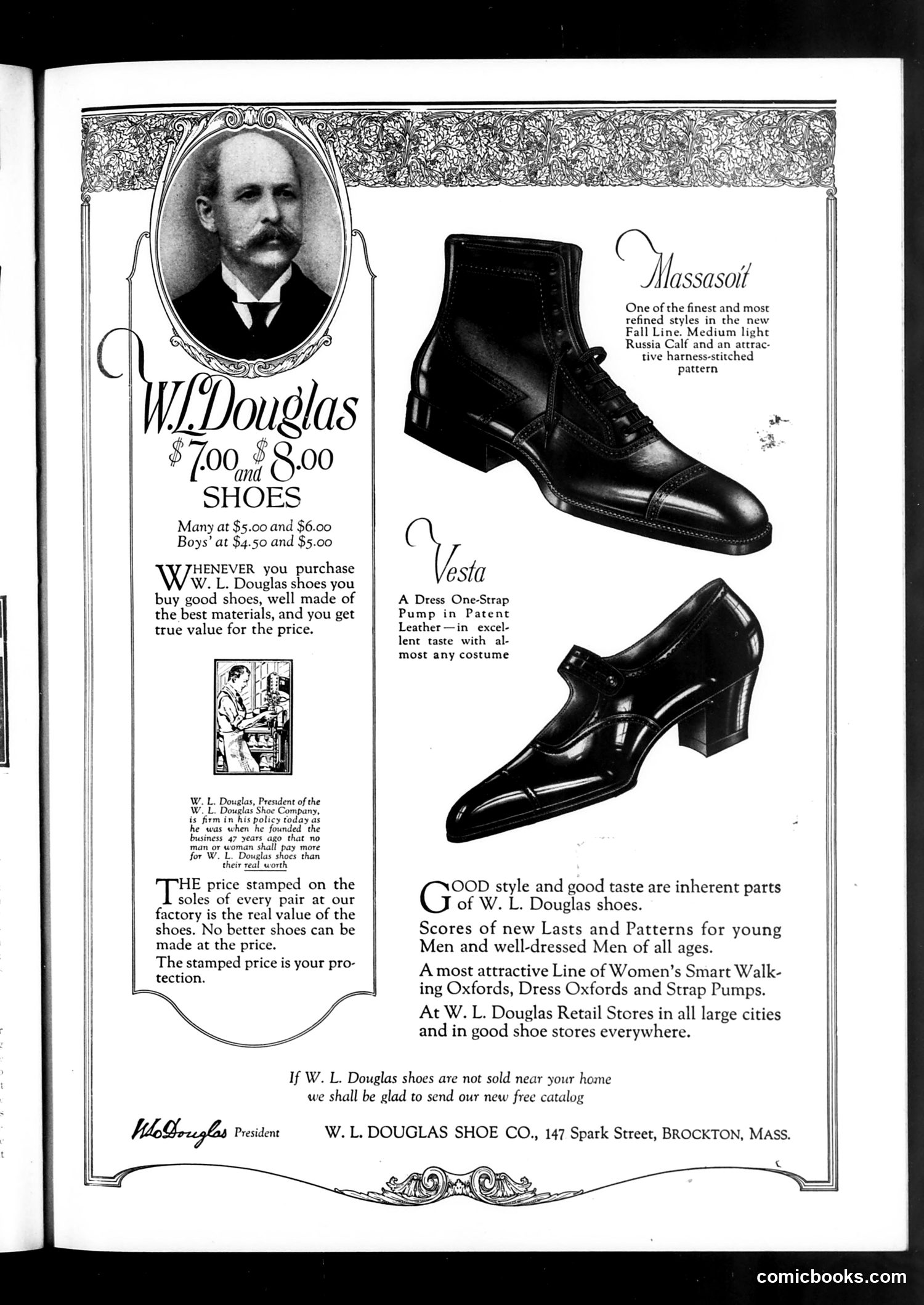
This is a **product advertisement**, not political satire. The page promotes W.L. Douglas shoes, a major American shoe brand based in Brockton, Massachusetts. The portrait shows **W.L. Douglas himself**, the company president and founder, emphasizing his 47-year commitment to fair pricing. The advertisement's central claim is that the **price stamped on shoe soles represents true value**—customers pay only what shoes are worth, nothing more. Two shoe styles are displayed: the "Massasoit" (a men's boot) and "Vesta" (a women's dress pump), exemplifying the quality and variety offered. The marketing strategy appeals to consumer confidence by personifying the brand through its founder's portrait and reputation for integrity—a common early 20th-century sales tactic. There is no satire here; this is straightforward commercial promotion.
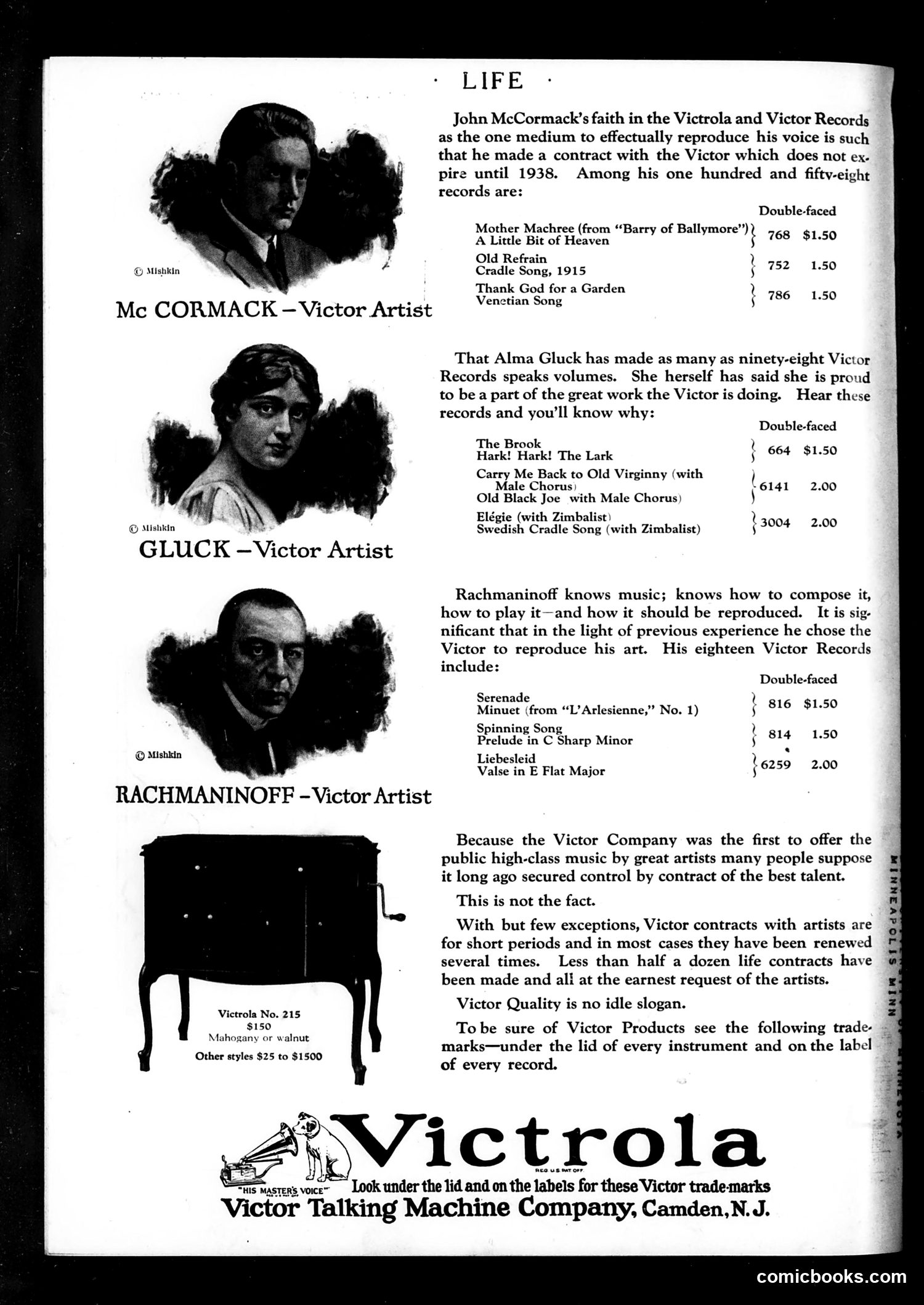
This is **not a cartoon or satire page**, but rather a **Victor Talking Machine Company advertisement** disguised as editorial content in *Life* magazine. The page features portraits of three famous recording artists—John McCormack (Irish tenor), Alma Gluck (soprano), and Sergei Rachmaninoff (composer/pianist)—with lists of their Victor Records and prices. The accompanying text promotes their exclusive or long-term contracts with Victor. The final section contains a disclaimer: Victor claims it did *not* monopolize talent through long-term contracts, stating most artist agreements are short-term and renewable. This appears defensive—likely responding to contemporary antitrust concerns about Victor's market dominance in recorded music. A Victrola phonograph model (priced $150) is pictured as a sales incentive. **For modern readers**: This represents early 20th-century celebrity endorsement advertising and corporate PR strategy, blending celebrity cachet with product promotion.

I can see this is a page from Life magazine, but the image is almost entirely black or severely degraded, making it impossible to discern any cartoon content, illustrations, or readable text beyond fragmentary partial words along the left margin and the "comicbooks.com" watermark at the bottom. The OCR text is similarly corrupted, showing only "MINNEAPOLIS MINN" and incomplete letter fragments. Without being able to see the actual cartoon(s) or read the substantive text, I cannot identify figures, explain satirical references, or convey the intended meaning to a modern reader. To provide accurate analysis as requested, I would need a legible version of this page.